
 Recruit
Average Salary in Bolivia
-
 Drew Donnelly
- Published
- September 21, 2026
Curious about salaries in Bolivia? This guide breaks down the average wages, compares professions, highlights minimum wage figures, and explores how Bolivia’s earnings measure up internationally.
- 5 ★ on G2








Let RemotePeople handle payroll, compliance, and HR admin worldwide so you can focus on building your team.
Bolivia’s low labor costs, skilled workforce, and cultural alignment with North American countries make it an ideal outsourcing destination. Employers seeking remote partnerships in the area may wonder, “What is the average salary in Bolivia?” This information will help them make wise hiring decisions.
The average monthly salary in Bolivia is 3,300 Bolivian Boliviano (BOB), about USD 480. However, salaries vary by experience, industry, position, education, and location. Comparing wages in the country against earnings in other nations provides additional insight.
This article will cover all aspects of salaries in Bolivia to prepare you for your hiring journey.
What is the Average Salary in Bolivia?
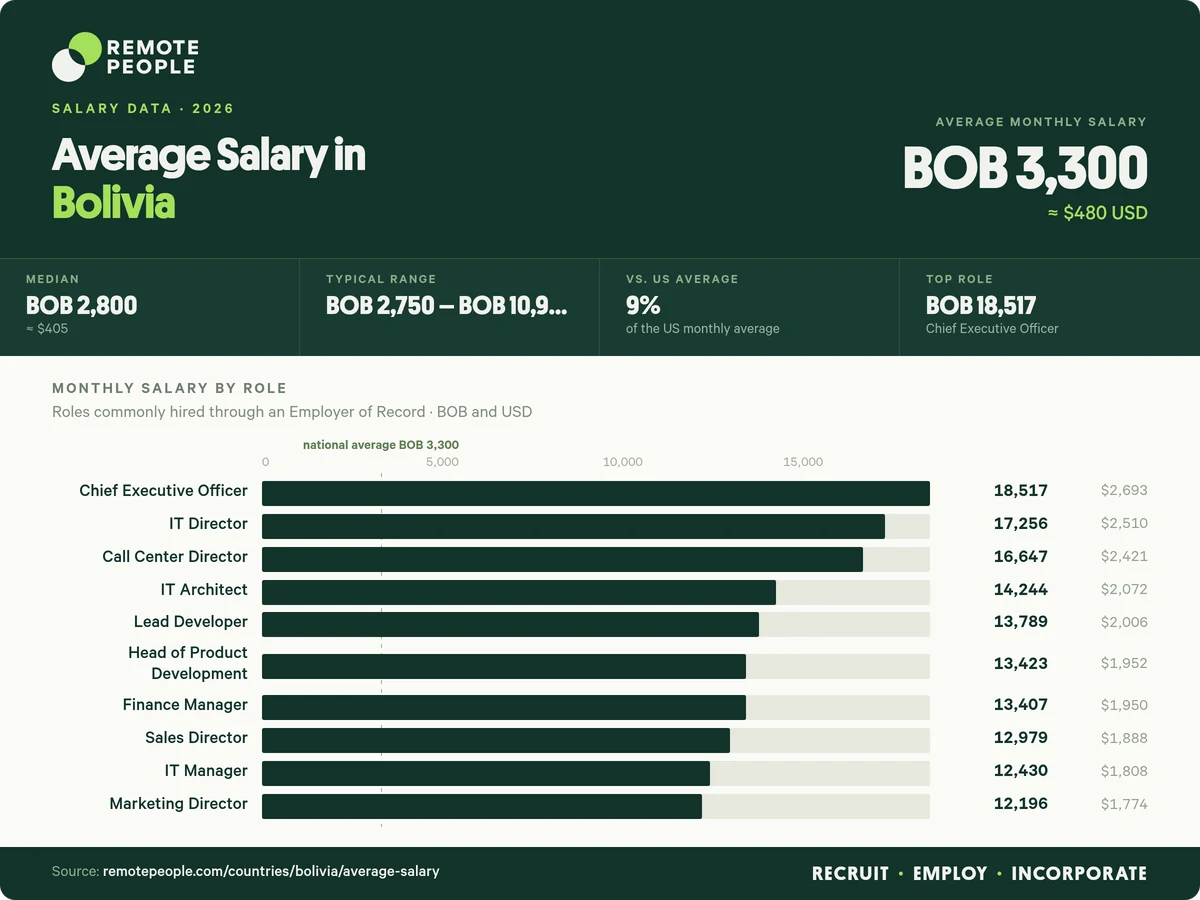
Bolivia’s average salary is 3,300 BOB, about $480. Wages are low due to economic instability, including the collapse of the tin market and currency devaluation. The country also experiences a lack of commodity diversification.
Median Income
Bolivia’s median monthly income is 2,800 BOB, about $405. Half the country’s population earns higher salaries, and the other half earns less.
Salary Range
The salary range spans from the country’s lowest to the highest wages. Low earners in Bolivia make 2,750 BOB, about $400. High earners make closer to 10,900 BOB, about $1,585.
Salary Comparisons in Bolivia
Average salary provides some insight, but you must consider how wages vary based on education, experience, location, position, and industry. The following sections will explore how these factors impact earnings.
Salary by Position
This salary comparison chart reveals how wages vary by position.
Position | Average Monthly Salary (BOB) |
|---|---|
Chief Executive Officer | 18,517 |
IT Director | 17,256 |
Call Center Director | 16,647 |
IT Architect | 14,244 |
Lead Developer | 13,789 |
Head of Product Development | 13,423 |
Finance Manager | 13,407 |
Sales Director | 12,979 |
IT Manager | 12,430 |
Marketing Director | 12,196 |
Fabric Cutter | 3,404 |
Clothing Technologist | 3,389 |
General Laborer | 3,369 |
Packer | 3,320 |
Seamstress | 3,132 |
Porter | 3,062 |
Medical Records Clerk | 3,053 |
Tailor | 3,029 |
Social Counselor | 2,964 |
Average Wage in Bolivia Based on Education
Education contributes to salaries in Bolivia with the following returns:
Education Level | Average Wage Difference |
|---|---|
Primary School | 12% |
Secondary Education | 8.5% |
Tertiary Education | 10% |
Although these are positive returns, studies indicate return rates have fallen over the years, possibly due to a lack of demand for skilled workers.
Salary Comparison by Experience
Experience also impacts wages, to an extent. Studies show that salaries increase with experience up to 27 years, after which they decline. This situation exists independently of schooling.
Salary Comparison by Location
Location is another factor to consider in wage determination. In Bolivia, workers in the Andes Plateau highland regions earn about 50% more than those in Amazonian lowland regions, as the highland region is more developed and better for mining activity. Even those with similar skills and experience can earn more based on location.
Weather plays a role in income disparities. The lowlands are hot and humid, making them less favorable to working conditions and at higher risk of natural disasters.
How Much is Minimum Wage in Bolivia?
The minimum wage in Bolivia for 2026 is 3,300 BOB, about $480, up from the previous 2,750 BOB. The wage is reviewed and updated each year.
Average Salary in Bolivia vs. the Rest of the World
The following charts compare salaries in Bolivia to those in developed, developing, and least developed countries to provide more insight.
Bolivia vs. Developed Countries
Country | Average Salary | Comparison to Average Bolivia Salary |
|---|---|---|
Japan | 340,000 JPY (approx. $2,300) | − 81% |
United Kingdom | £3,000 (approx. $4,100) | − 89% |
Norway | 50,000 NOK (approx. $4,700) | − 91% |
Germany | €4,300 (approx. $4,470) | − 90% |
Austria | €3,700 (approx. $4,050) | − 89% |
Bolivia vs. Developing Countries
Country | Average Salary | Comparison to Average Bolivia Salary |
|---|---|---|
Romania | 4,000 RON (≈ $835) | − 48% |
Russia | 73,700 RUB (approx. $700) | − 38% |
Albania | 83,330 ALL (approx. $860) | − 79% |
Kazakhstan | 342,000 KZT (approx. $645) | − 33% |
Ukraine | 18,000 UAH (approx. $500) | − 13% |
Bolivia vs. Undeveloped Countries
Country | Average Salary | Comparison to Average Bolivia Salary |
|---|---|---|
Afghanistan | 13,200 AFN (approx. $150) | 190% |
Philippines | 15,000 PHP (approx. $265) | 64% |
Cambodia | 1,150,000 Riel (approx. $280) | 55% |
Egypt | 3,900 EGP (approx. $125) | 248% |
Pakistan | 60,000 PKR (approx. $210) | 107% |
Bolivia is a developing country with a lower-middle-income economy. Although it has made some strides in economic growth, it remains one of the poorest countries in South America. It relies heavily on natural resources, like gas and mining, which fluctuate due to climate change.
Although the country faces economic issues, outsourcing can help workers overcome poverty. Bolivia offers low-cost labor, a skilled workforce, and nearshoring advantages, making it a promising outsourcing destination. Its robust education system allows businesses to access Tier 1 talent.
What are the Most Common Outsourced Industries in Bolivia?
Employers outsourcing to Bolivia will see excellent success rates when focusing on the following sectors.
IT Services
Bolivia’s IT industry is seeing significant growth with a focus on software development, cybersecurity, and e-commerce. The government invests in the digital infrastructure, including fiber optics and internet connectivity. Its skilled and affordable labor makes it an attractive resource for international businesses.
An IT manager in Bolivia earns around 12,430 BOB, about $1,810, compared to their American counterparts who earn more than $8,000. This leads to considerable savings for outsourcing companies.
BPO
Bolivia’s BPO industry is gaining traction, especially in the call center sector. Its time zone alignment with North American countries and skilled bilingual workforce make it an ideal outsourcing destination. The country’s blossoming tech ecosystem supports BPO growth.
Call center agents in Bolivia earn around $3.00 an hour while American agents earn closer to $15 an hour, giving employers plenty of bargaining power.
Mining and Resource Extraction
Mining is a primary driver of Bolivia’s economic activity. Major resources include tin, silver, and zinc. In addition to exports, companies can also outsource back-office operations and specialized services.
Conclusion
Bolivia’s low average salaries lead to cost savings for employers. The country’s skilled workforce offers top-notch products and services. Companies that outsource can reduce costs and improve their offerings to become leaders in their field while helping workers overcome poverty issues, leading to a beneficial situation for all involved parties.