
 Recruit
Employer of Record (EOR) in Mexico
-
 Drew Donnelly
- Published
- September 22, 2026
RemotePeople’s employer of record in Mexico lets you hire employees in Mexico without navigating complex IMSS requirements. We handle Mexican Social Security Institute (IMSS) contributions covering healthcare, disability, maternity, retirement and occupational risk, with combined rates of 26-30% of employee salary.
Hire in Mexico — book a free 30-minute demo
Tell us what you need. You'll get a tailored, transparent proposal within 24 hours, plus a free call to walk through it.
Tell us about your company
So we can match you with a specialist who knows your market — and unlock volume pricing tiers.
* All fields are required.
Where and when are you hiring?
Tell us the geography and timing and we'll quote each country line by line, with onboarding timelines.
* All fields are required.
Help us beat your current setup
We'll benchmark your current deal and send a line-by-line proposal in 24 hours — showing exactly where we cut cost, time, or risk. After you submit, you can book a call to walk through it together.
* All fields are required.
Thanks! Your proposal is on its way.
Expect a tailored, line-by-line proposal in your inbox within 24 hours. In the meantime…
Want to walk through it together?
Book a free 30-minute call with one of our specialists. We'll explain every line, answer your questions, and tailor the proposal further if you need.
No obligation. Pick a time that works for you.








- Hire in Mexico — book a free 30-minute demo
- Tell us about your company
- Where and when are you hiring?
- Help us beat your current setup
- Thanks! Your proposal is on its way.
- How an Employer of Record Works in Mexico
- Employment Laws and Regulations in Mexico
- Work Permits and Visas in Mexico
- Payroll, Taxes, and Social Security in Mexico
- Cost of Hiring Through an EOR in Mexico
- Benefits of Using an EOR in Mexico
- Termination and Offboarding in Mexico
- EOR vs. Other Hiring Models in Mexico
- Public Holidays in Mexico
- How to Get Started with an EOR in Mexico
- Frequently Asked Questions
- Related EOR Destinations

Start hiring in Mexico
Let RemotePeople handle payroll, compliance, and HR admin worldwide so you can focus on building your team.

An employer of record in Mexico gives companies access to the second-largest economy in Latin America and the top nearshoring destination for US firms, with EOR service fees typically running USD 300 to USD 600 per employee per month. The country offers a workforce of more than 60 million, strong English-speaking talent in Monterrey, Guadalajara, Mexico City, and Querétaro, and full time-zone alignment with North America. Salaries run well below US and Canadian levels while tech, manufacturing, finance, and customer operations talent pools keep expanding under the USMCA trade framework. For companies looking to hire employees in Mexico, the regulatory side is where nearshoring projects stall: the Ley Federal del Trabajo (LFT) governs every employment relationship, IMSS and INFONAVIT contributions add roughly 30% to 35% on top of gross salary, and the 2021 outsourcing reform (REPSE) made it illegal to lease workers through unregistered intermediaries.
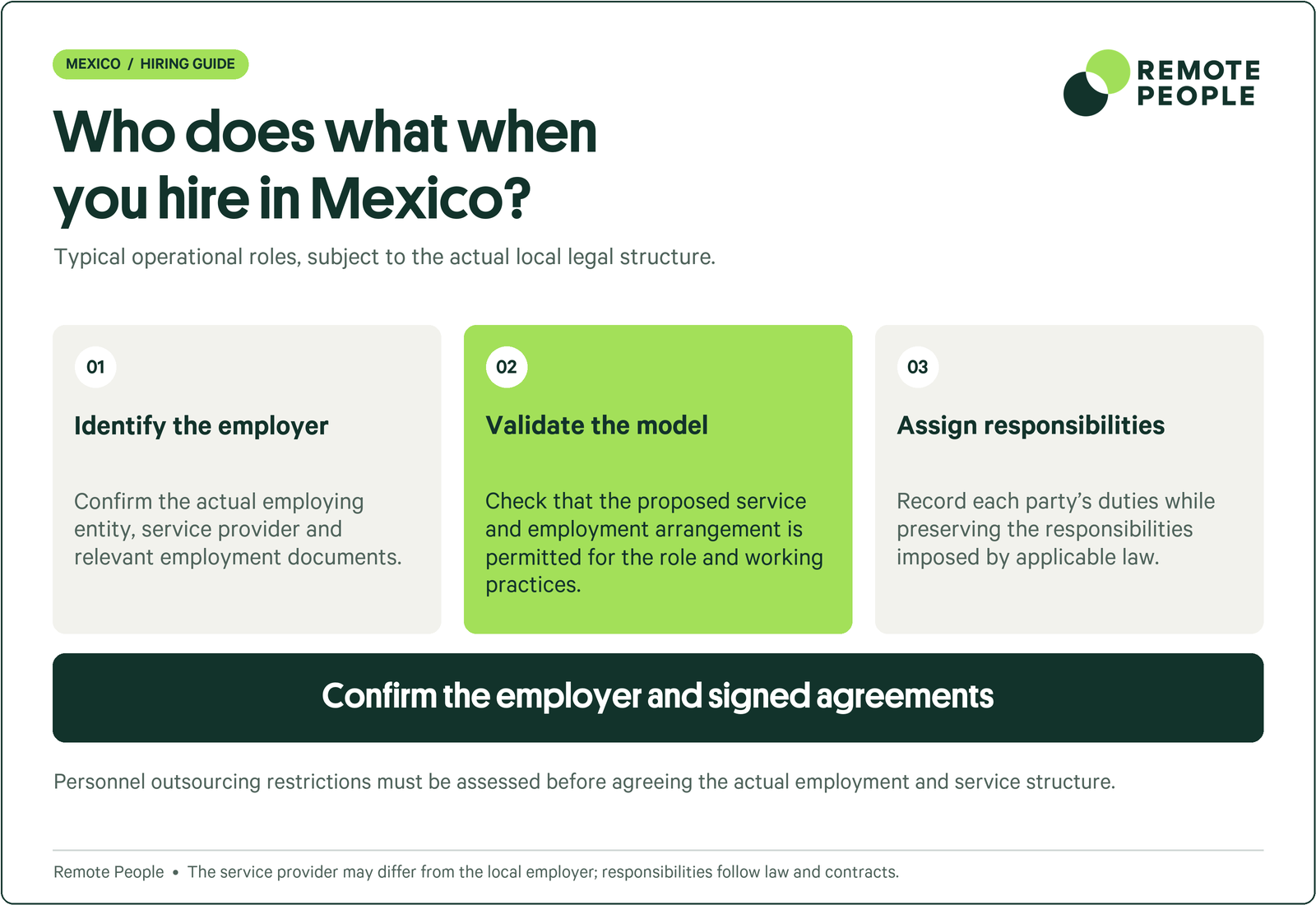
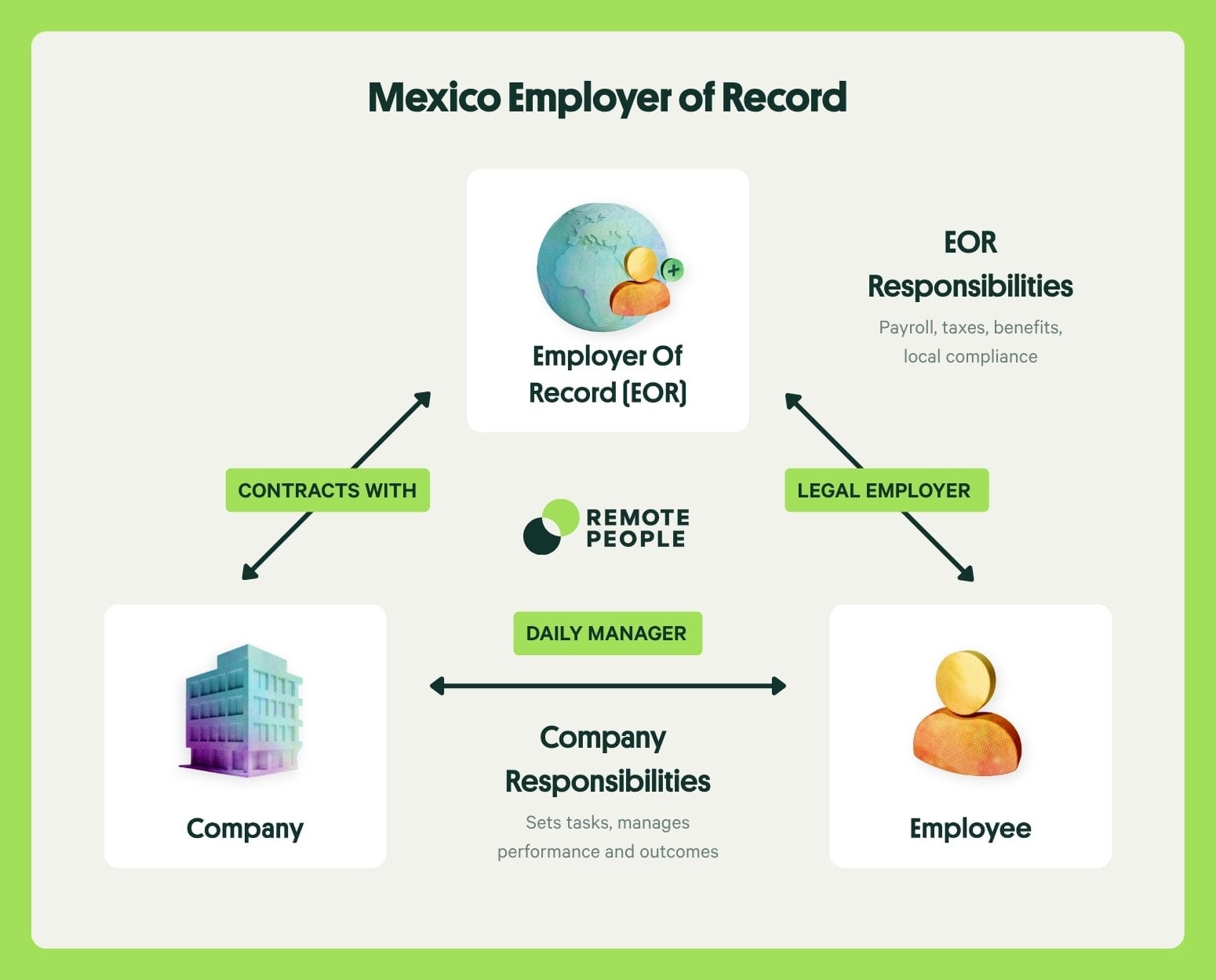
An employer of record in Mexico removes the need to register a Mexican entity while keeping you fully compliant with the LFT, IMSS, SAT, and INFONAVIT. The EOR acts as the legal employer on a bilingual contract, runs biweekly or monthly payroll through the SUA system, withholds ISR income tax, remits employer contributions, sponsors work visas through INM, and administers aguinaldo, vacation, and PTU profit sharing. You keep day-to-day direction of the employee; the EOR carries every legal and administrative obligation on the Mexican side.
How an Employer of Record Works in Mexico
If you’d like to learn more about how Employer of Record (EOR) services work, read our What Is an Employer of Record (EOR)? guide for a complete overview of the model, its benefits, and when to use it.
If you’re comparing providers, our Best Employer of Record (EOR) Providers guide reviews the leading platforms to help you choose the right solution for your business.
Who Uses an EOR in Mexico?
Companies choose an EOR in Mexico when they want Mexican talent without the cost and risk of opening an S. de R.L. or S.A. de C.V. The EOR model is especially valuable for nearshoring projects, where speed to market matters more than long-term entity strategy.
Companies most often use a Mexican EOR to test the market by hiring one or two employees before committing to an S. de R.L., or to run small distributed teams (typically under five people) where the legal and accounting cost of incorporation cannot be justified. Nearshoring software, customer-success, and operations roles is the dominant use case, particularly for US firms taking advantage of USMCA tariff treatment and full time-zone overlap with North America.
EORs are also the standard route for project-based hires that need a definite-duration LFT contract, contractor-to-employee conversions where misclassification risk has surfaced, and acquisitions where a Mexican team must be retained while the buyer establishes its own legal entity over the following 12 to 18 months.
The model works for any business expanding into Mexico, regardless of sector. It is not a substitute for a subsidiary once you employ more than fifteen or twenty people or need to bid on Mexican government contracts, but it is the fastest and lowest-risk way to hire Mexican talent in the early stages.
Typical Onboarding Timeline
The onboarding process in Mexico typically takes one to two weeks from signature to first day:
- First, sign the EOR service agreement and share employee details, including CURP and RFC if available (1–2 days).
- Second, the EOR drafts an LFT-compliant written contract in Spanish and sets the Salario Base de Cotización (2–3 days).
- Third, the employee is registered with IMSS, INFONAVIT, and AFORE, and a CFDI nómina template is configured (3–7 days).
- Fourth, payroll setup, benefits enrollment, and bank details are finalized (2–3 days).
- Fifth, the employee officially starts work and receives the first biweekly or semi-monthly paycheck on the next payroll cycle (1 day).
If the hire is a foreign national requiring a Residente Temporal visa with work authorization, add 4 to 8 weeks for INM pre-authorization, consular appointment, and in-country exchange of visa for the residency card. Background checks, medical exams, and CURP issuance for first-time registrants can each add a few business days.
Hire in Mexico
Complex and evolving labor law with PTU profit sharing, IMSS/INFONAVIT, aguinaldo, CFDI payroll invoicing, and Mexican Federal Labour Law compliance.
We handle employment contracts, payroll, social contributions, and full Mexican compliance.
No local entity needed. Your team can start in days.
Employment Laws and Regulations in Mexico
Employment Contracts
All employment relationships in Mexico are governed by the Ley Federal del Trabajo (LFT), originally enacted in 1970 and revised most recently by the 2019 labour reform, the 2021 outsourcing reform, and the 2022 “Vacaciones Dignas” reform (WIPO Lex). The law is enforced by the Secretaría del Trabajo y Previsión Social (STPS) and the federal and local labour tribunals. Every relationship where a worker performs subordinate services for remuneration is presumed to be employment under Article 20 of the LFT, regardless of what the contract calls it.
Written contracts are mandatory and must be in Spanish. They must include the employee’s personal details, job title and duties, workplace, working hours, compensation structure, payment date, probation clause (if any), duration (indefinite is the default), and the applicable collective bargaining agreement where one exists. Fixed-term contracts are permitted only when the nature of the work justifies it (seasonal, project-based, or replacement for an absent worker) under Article 37, and conversion to indefinite occurs automatically if the cause ceases.
Working Hours and Overtime
Article 61 of the LFT caps the standard daytime workweek at 48 hours, typically structured as six 8-hour days, with employees entitled to at least one paid day of rest per week (Article 69). The mixed and nighttime shifts have shorter maximums: 45 hours per week for mixed shifts and 42 hours per week for night shifts (22:00–06:00). A constitutional amendment reducing the standard workweek from 48 to 40 hours has been under discussion in Congress through 2025–2026, but as of early 2026 the 48-hour floor remains in force.
The table below summarises overtime and premium pay under Articles 66–68 and 73 of the LFT. Mexican overtime rules are unusual in that the first nine hours per week of overtime are paid at double the regular rate, and any hour beyond nine weekly overtime hours is paid at triple rate, regardless of whether the work falls on a weekday or weekend.
Mexico overtime and premium pay rates · Per Ley Federal del Trabajo | |||
Hour Type | Rate Multiplier | Weekly/Daily Cap | Notes |
|---|---|---|---|
First 9 hours of weekly overtime | 200% of regular hourly rate | Max 3 hours per day, 3 days per week | Art. 66–67 LFT |
Overtime beyond 9 hours per week | 300% of regular hourly rate | No statutory cap, but excess is technically unlawful | Art. 68 LFT |
Weekly rest day work (Sunday for most workers) | Regular pay + 25% Sunday premium | Separate from overtime rules | Art. 71 LFT |
Mandatory rest day worked | Regular day pay + 200% premium | Applies to the weekly rest day chosen by the parties | Art. 73 LFT |
Public holiday work (Art. 74 días de descanso obligatorio) | Regular day pay + 200% premium | Stacks with overtime if applicable | Art. 75 LFT |
Managerial staff, professional supervisors, and trusted employees (personal de confianza) are not exempt from overtime but rarely record it in practice. Overtime hours are computed into the Integrated Daily Salary (Salario Diario Integrado) for severance and aguinaldo purposes where they are regular and predictable, which increases the total cost of systematic overtime beyond the headline multiplier.
Minimum Wage
Mexico has two statutory minimum wage zones set annually by the Comisión Nacional de los Salarios Mínimos (CONASAMI). For 2026, the general minimum wage is MXN 313.58 per day (approximately USD 15.40) and the Zona Libre de la Frontera Norte (ZLFN, a 25-kilometre strip along the US border covering 43 municipalities) minimum is MXN 470.24 per day, effective January 1, 2026, following a 12% nominal increase announced by CONASAMI in December 2025 (CONASAMI).
The minimum wage functions as a national floor; collective bargaining agreements and individual contracts routinely set much higher rates. Several occupational categories also have specific “salarios mínimos profesionales” above the general floor, covering roles such as reporters, cashiers, and skilled tradespeople. Since 2016, the minimum wage has been fully decoupled from the Unidad de Medida y Actualización (UMA), which is now used for fines, penalties, and social security caps instead of salary floors.
Probation Period
The LFT permits a probation period (periodo a prueba) of up to 30 days for rank-and-file roles and up to 180 days for managerial, technical, or trusted positions, under Articles 39-A and 39-B of the LFT. During probation, the employer may terminate the relationship without severance if the employee fails to demonstrate the required competence, subject to a prior opinion from the Joint Commission on Productivity (Comisión Mixta de Productividad).
If the contract continues beyond the probation window, it automatically converts to an indefinite relationship with full LFT protections. Aguinaldo, vacation, IMSS, and INFONAVIT entitlements accrue from day one, so probation does not suspend any benefit; it only affects the cost of termination. Probation may not be extended, nor applied a second time to the same employee in the same role.
Leave Entitlements
Mexican leave law was significantly upgraded by the 2022 “Vacaciones Dignas” reform, which doubled the first-year annual leave entitlement and came into force on January 1, 2023. Annual leave, sick leave, maternity leave, and paternity leave are all protected by the Federal Constitution and the LFT, with IMSS covering most medical-related leave after an initial employer-paid period.
Annual Leave
After one year of continuous service, employees are entitled to 12 paid working days of vacation under Article 76 of the LFT as amended by the Vacaciones Dignas reform of December 2022 (Diario Oficial de la Federación). Entitlement rises by 2 days per year until reaching 20 days after five years, and then by 2 days every five additional years thereafter.
Article 80 of the LFT also requires a mandatory vacation premium (prima vacacional) of 25% of the base salary corresponding to the vacation days, payable at the time the leave is taken. At least 12 consecutive days of vacation must be granted as a single block in the year they accrue, with the remainder usable in shorter periods.
Sick Leave
There is no statutory employer-paid sick leave in Mexico. Instead, the IMSS covers non-occupational sickness (enfermedad general) after a three-day waiting period, paying 60% of the employee’s registered salary from day four up to a maximum of 52 weeks, renewable once for an additional 26 weeks (IMSS). A valid IMSS medical certificate (incapacidad) is required for every day of absence.
Occupational accidents and illnesses are covered from day one at 100% of salary, also paid by IMSS through the Seguro de Riesgos de Trabajo branch. Employers typically advance the payment to the employee and recover the cost via credits against their monthly IMSS contributions.
Maternity Leave
Female employees are entitled to 12 weeks of paid maternity leave under Article 170 of the LFT and Article 123 of the Federal Constitution: 6 weeks before the expected delivery date and 6 weeks after. Leave is paid at 100% of salary by the IMSS, up to the social security wage ceiling, provided the employee has at least 30 weekly contributions in the 12 months before leave starts. Employees may transfer up to 4 of the prenatal weeks to the postnatal period with medical authorization, and leave is extended by up to 6 additional weeks in the event of complications certified by IMSS.
Paternity Leave
Fathers are entitled to 5 paid working days of paternity leave under Article 132 Section XXVII-Bis of the LFT, triggered by the birth of a child or adoption. Paternity leave is fully paid by the employer, not IMSS, and must be taken in the days immediately following the event. A bill to extend paternity leave to 20 working days has been discussed in the Mexican Congress through 2025 and 2026 but has not yet been enacted.
Other Statutory Leave
- Adoption leave: 6 weeks of paid leave for the adoptive mother under Article 170-II LFT.
- Nursing breaks: Two 30-minute breaks per day during the first 6 months after returning from maternity leave (Art. 170-IV).
- Religious and civic duty leave: Paid leave for jury duty, electoral service, and union functions, as established in collective bargaining agreements and Article 132.
- Bereavement, marriage, and moving leave: Not mandated federally; governed by the employment contract or collective bargaining agreement.
The summary table below consolidates every statutory leave entitlement under the Ley Federal del Trabajo and the IMSS Law, with the pay source and the governing article noted for each. The single most important thing to notice is that annual leave now starts at 12 days rather than the pre-2023 floor of 6 days.
Mexico statutory leave entitlements · Per Ley Federal del Trabajo | ||
Leave Type | Duration | Eligibility & Notes |
|---|---|---|
Annual leave (year 1) | 12 working days | Plus 25% vacation premium. Accrues after 1 year of service. Art. 76, 80 LFT. |
Annual leave (years 2–5) | 14 / 16 / 18 / 20 days | +2 days per year until year 5. Art. 76 LFT. |
Annual leave (6+ years) | +2 days every 5 years | Cap applies only through 5-year increments. Art. 76 LFT. |
Sick leave (non-occupational) | Up to 52 weeks (renewable 26) | 60% IMSS pay from day 4. Requires incapacidad IMSS. |
Sick leave (occupational) | Until medical discharge | 100% IMSS pay from day 1. Seguro de Riesgos de Trabajo. |
Maternity leave | 12 weeks (6 + 6) | 100% paid by IMSS (up to ceiling). Art. 170 LFT. |
Paternity leave | 5 working days | Fully employer-paid. Art. 132-XXVII-Bis LFT. |
Adoption leave | 6 weeks | Applies to adoptive mother. Art. 170-II LFT. |
Nursing breaks | 2 × 30 min/day for 6 months | Post-maternity return. Art. 170-IV LFT. |
Statutory Employee Benefits
Beyond leave and social security, Mexican law mandates additional employee benefits and requires several mandatory cash and in-kind benefits that sit on top of the base salary:
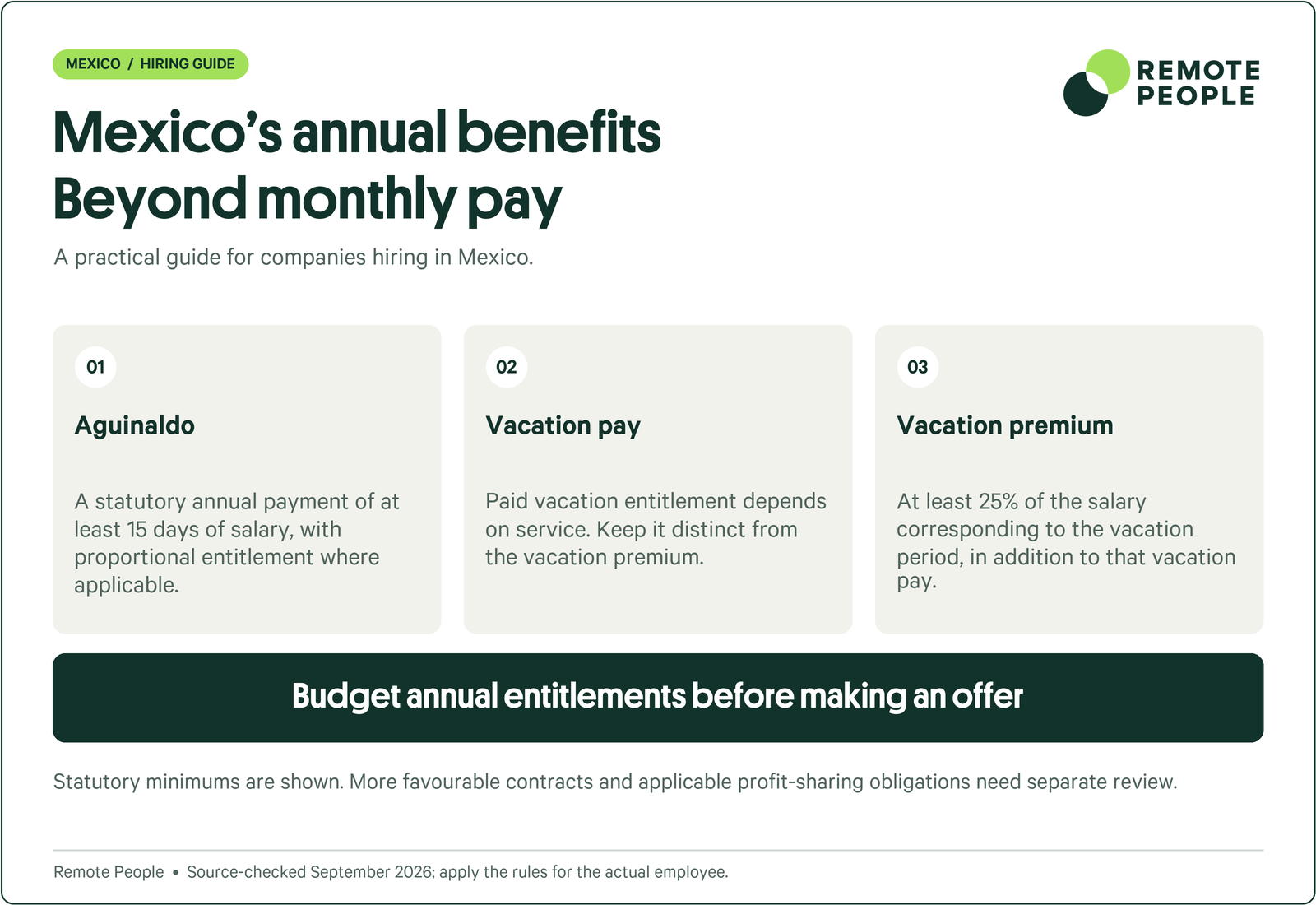
- Aguinaldo (13th month): A minimum of 15 days of base salary, payable by December 20 each year (Art. 87 LFT). Pro-rated for partial-year employees.
- PTU profit sharing: 10% of the company’s taxable profit must be distributed to eligible employees, capped by the 2021 reform at three months of salary or the average PTU paid in the last three years, whichever is higher (Art. 127-VIII LFT).
- Vacation premium: 25% of the base salary for the vacation days taken (Art. 80 LFT).
- Mandatory health coverage: Provided through IMSS; no separate employer-paid private plan required by law.
- Housing fund (INFONAVIT): Employer contributes 5% of the Integrated Salary to the employee’s INFONAVIT sub-account.
- Retirement savings (SAR / AFORE): Employer contributes 2% of the Integrated Salary to the AFORE retirement savings account, on top of IMSS pension contributions.
- Meal and transportation vouchers: Not federally mandatory, but widely used as tax-efficient compensation (vales de despensa, vales de gasolina) under ISR Article 93.
The combined statutory on-cost of IMSS, INFONAVIT, SAR, aguinaldo, and vacation premium typically adds 30% to 35% to the gross base salary. Exact contribution rates are covered in the payroll section below.
Recent Regulatory Updates (2026)
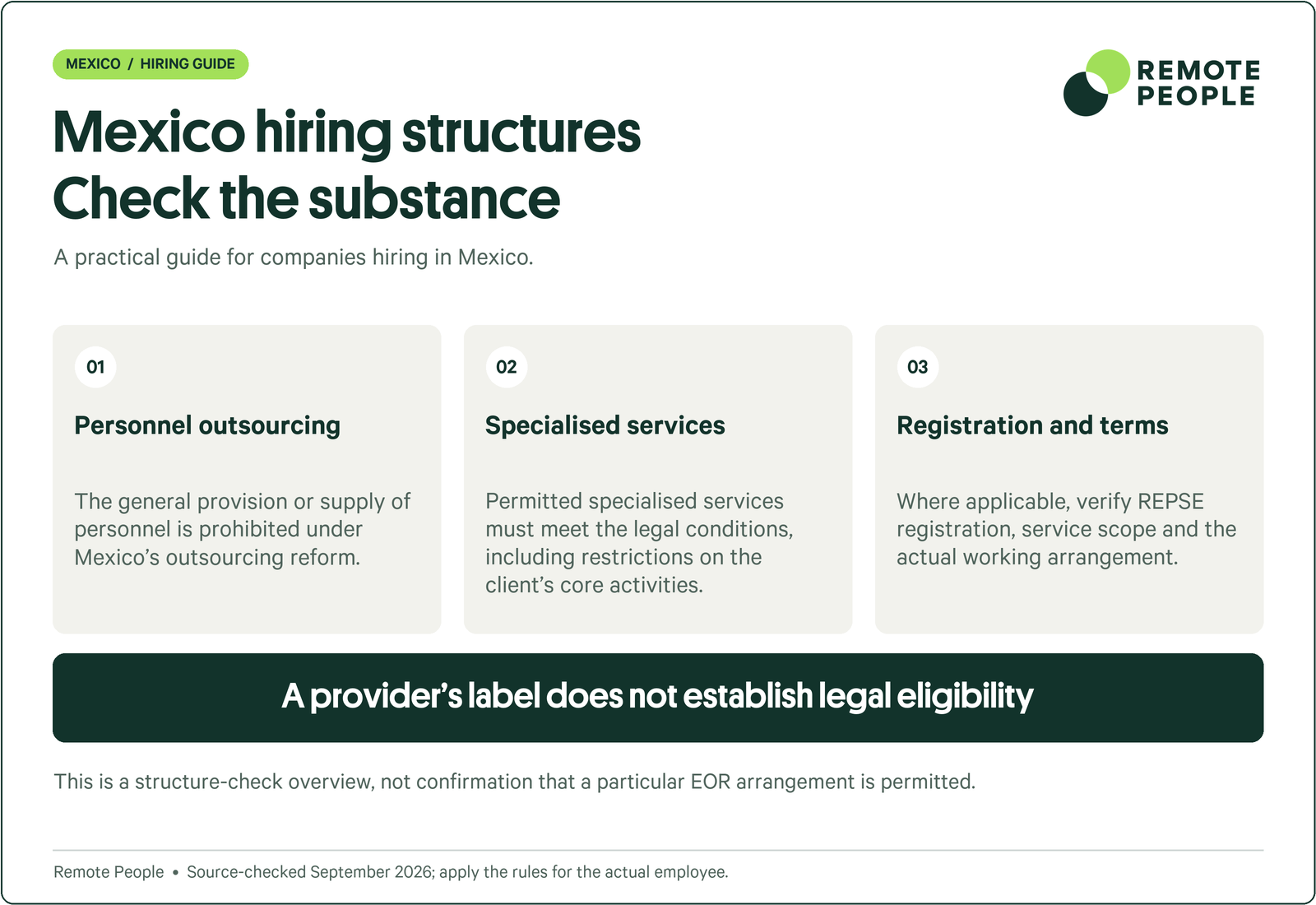
The biggest change affecting hiring in Mexico in recent years is the 2021 outsourcing reform, which prohibits the subcontracting of personnel and requires any company providing specialised services to register with the STPS in the REPSE registry. EOR arrangements that qualify as specialised services must maintain active REPSE registration and issue specialised-service invoices; failure to do so makes the service non-deductible for income tax purposes and triggers joint and several liability for IMSS and SAT obligations.
The second major reform came in December 2022 with the “Vacaciones Dignas” law, which doubled the first-year annual leave from 6 to 12 working days and adjusted the accrual schedule thereafter. It entered into force on January 1, 2023 and applies to all employment relationships, including those signed before that date.
For 2026, the CONASAMI announced a 12% nominal increase in the general and ZLFN minimum wages effective January 1, 2026. A constitutional reform to reduce the standard workweek from 48 to 40 hours remains under discussion in the Mexican Congress and was not enacted as of early 2026; employers should monitor STPS communications during 2026 for implementation details if the reform passes.
Work Permits and Visas in Mexico
Work Permit Requirements
Who Needs a Work Permit
Mexican citizens and permanent residents (Residente Permanente holders) do not need a separate work permit. All other foreign nationals require an immigration status that authorises work, issued by the Instituto Nacional de Migración (INM) under the Ley de Migración (INM). The two most common statuses are the Residente Temporal visa with work authorisation (up to 4 years) and the Residente Permanente visa (indefinite). USMCA professionals from the United States and Canada can use a streamlined procedure under the USMCA Chapter 16 framework.
Eligibility and Required Documents
To qualify for a Residente Temporal visa with work authorisation, the employee needs a valid job offer from a Mexican employer registered with INM as a “Constancia de Inscripción de Empleador”. Required documents typically include a valid passport, certified educational credentials, a clean criminal record from the country of origin, and the INM pre-authorisation letter (NUT number) issued to the sponsoring employer. The employer must demonstrate economic solvency, tax compliance with SAT, and genuine need for the foreign hire.
Processing Time and Validity
INM pre-authorisation typically takes 15 to 30 business days. The employee then presents the NUT at a Mexican consulate abroad to obtain a visa sticker, which takes 5 to 15 business days. Within 30 days of arrival in Mexico, the employee must exchange the visa for a residency card at a local INM office, adding 2 to 4 weeks. Total processing typically ranges from 6 to 12 weeks. Initial validity is 1 year, renewable for up to 3 additional years for a maximum cumulative stay of 4 years on temporary status.
Renewal Process
Renewal must be requested within 30 days before the current card expires, and the employee may continue to work while the renewal is in process provided the request was filed on time. Renewal requires proof of continued employment, updated tax returns, and biometric re-enrolment. After 4 cumulative years on Residente Temporal, the employee must either transition to Residente Permanente or leave Mexico; no further temporary renewal is possible.
Common Visa Types for Foreign Workers
The Ley de Migración and its regulations define several visa categories for foreign workers in Mexico. The immigration authority, INM, issues all of them, and an EOR registered with INM as an employer can sponsor the standard work categories. Investor, intra-company transfer, and Residente Permanente visas are also available for specific profiles.
Mexico work visa types for foreign workers · 2026 | ||||
Visa Type | Duration | Best For | Leads to APT? | Processing |
|---|---|---|---|---|
Residente Temporal (with work) | 1 year, renewable to 4 | Standard work permit for foreign hires | Yes – after 4 years can apply for Permanente | 6–12 weeks |
Residente Permanente | Indefinite | Long-term residency, family reunification, retirees | Yes – already permanent | 8–14 weeks |
Visitante con Permiso para Trabajar | Up to 180 days | Short-term projects, specialised services | No | 4–8 weeks |
Intra-company Transfer (within Residente Temporal) | 1 year, renewable to 4 | Employees moving from a foreign parent to a Mexican affiliate | Yes | 4–8 weeks |
USMCA Professional (TN-style) | 1 year, renewable | US / Canadian nationals in 63 listed professions | No (separate residency path required) | 2–4 weeks |
Investor (Residente Temporal Inversionista) | 1 year, renewable to 4 | Foreign nationals investing in a Mexican company | Yes | 6–10 weeks |
- Visitante Sin Permiso para Trabajar (tourist/business visitor): No work activity, up to 180 days.
- Estudiante (student visa): Limited part-time work only with INM authorisation.
- Visitante por Razones Humanitarias: Work permitted but case-specific, not a standard hiring path.
How an EOR Handles Work Permits
An EOR registered with INM as a “Constancia de Inscripción de Empleador” can sponsor Residente Temporal and Visitante con Permiso para Trabajar visas on your behalf. The EOR prepares and files the INM pre-authorisation, coordinates with the consulate for the visa stamp, and handles the in-country card exchange. The employee provides personal documents and attends biometric appointments; the EOR handles every filing, government fee, and renewal trigger.
Using an EOR for a work visa hire adds approximately 6 to 12 weeks to the onboarding timeline referenced in the How an EOR Works section, compared with 1 to 2 weeks for a Mexican national. Because the EOR is the sponsoring employer in INM’s system, you do not need your own Mexican entity or INM employer registration, removing one of the biggest bottlenecks for foreign companies hiring in Mexico for the first time.
Payroll, Taxes, and Social Security in Mexico
Employer Contributions
Mexican employer payroll contributions are calculated on the Salario Base de Cotización (SBC), which includes the fixed salary plus regular bonuses, commissions, and in-kind benefits. IMSS contributions are split across six branches and capped at 25 UMAs (approximately MXN 2,900 per day in 2026); INFONAVIT is capped at the same ceiling. State payroll tax (Impuesto Sobre Nómina, ISN) is levied on top and ranges from 1% to 4% depending on the state. Taken together, employer contributions typically add 30% to 35% to gross salary, before variable costs like PTU and aguinaldo.
Mexico employer social security contributions · 2026 rates | ||
Contribution | Rate | Notes |
|---|---|---|
IMSS – Sickness & maternity (in-kind) | 20.40% on (SBC − 3 UMA), up to 25 UMA | Plus 1.10% fixed on minimum wage |
IMSS – Sickness & maternity (cash) | 0.70% of SBC | Ley del Seguro Social, Art. 106 |
IMSS – Disability & life insurance | 1.75% of SBC | Invalidez y Vida |
IMSS – Work-risk insurance | 0.5% to 7.58% of SBC | Variable by company risk class |
IMSS – Retirement (RCV) | 2.00% of SBC (retirement) + variable (cesantía, rising to 11.875% by 2030) | 2020 pension reform phase-in; ~5.15% in 2026 |
IMSS – Nurseries & social services | 1.00% of SBC | Guarderías y Prestaciones Sociales |
INFONAVIT (housing fund) | 5.00% of SBC | Capped at 25 UMA |
SAR (retirement sub-account) | 2.00% of SBC | Paid into AFORE |
State payroll tax (ISN) | 1% to 4% of payroll | Varies by state (3% CDMX) |
Approximate total | ~30% to 35% of gross salary | Before PTU and aguinaldo |
Employee Contributions
Employees also contribute to IMSS, INFONAVIT (as a credit, not a direct deduction), and the RCV retirement system. Total employee social security deductions typically run between 2% and 3% of SBC, on top of ISR income tax withholding.
Mexico employee payroll deductions · 2026 monthly withholdings | ||
Deduction | Rate | Notes |
|---|---|---|
IMSS – Sickness & maternity (in-kind) | 0.40% on (SBC − 3 UMA) | Only on portion above 3 UMA |
IMSS – Sickness & maternity (cash) | 0.25% of SBC | Ley del Seguro Social, Art. 107 |
IMSS – Disability & life | 0.625% of SBC | Invalidez y Vida |
IMSS – Retirement (RCV) | 1.125% of SBC | Paid into AFORE |
ISR (income tax) | 1.92% to 35% (progressive) | See income tax table |
Social security subtotal | ~2.4% of SBC | Before ISR withholding |
Income Tax
Personal income tax (Impuesto Sobre la Renta, ISR) in Mexico is progressive, with 11 monthly brackets ranging from 1.92% to 35%. The Servicio de Administración Tributaria (SAT) updates the tables annually based on inflation under Article 96 of the Ley del ISR. The table below shows the monthly ISR brackets effective January 1, 2026, as published by SAT in the December 2025 annual adjustment.
Mexico income tax brackets · 2026 | |
Monthly Income Bracket (MXN) | Tax Calculation |
|---|---|
MXN 0.01 – 8,952.49 | 1.92% on excess over MXN 0.01 |
MXN 8,952.50 – 75,984.55 | MXN 171.88 + 6.40% on excess |
MXN 75,984.56 – 133,536.07 | MXN 4,461.94 + 10.88% on excess |
MXN 133,536.08 – 155,229.80 | MXN 10,723.55 + 16.00% on excess |
MXN 155,229.81 – 185,852.57 | MXN 14,194.54 + 17.92% on excess |
MXN 185,852.58 – 374,837.88 | MXN 19,682.13 + 21.36% on excess |
MXN 374,837.89 – 590,795.99 | MXN 60,049.40 + 23.52% on excess |
MXN 590,796.00 – 1,127,926.84 | MXN 110,842.74 + 30.00% on excess |
MXN 1,127,926.85 – 1,503,902.46 | MXN 271,981.99 + 32.00% on excess |
MXN 1,503,902.47 – 4,511,707.37 | MXN 392,294.17 + 34.00% on excess |
MXN 4,511,707.38 and above | MXN 1,414,947.85 + 35.00% on excess |
Payroll Cycle
Mexican payroll is typically run biweekly (cada 15 días) or semi-monthly, with payment by bank transfer in MXN to the employee’s nominated Mexican bank account. A CFDI 4.0 nómina receipt must be issued and uploaded to SAT for every payment, and employees can consult their payroll history directly on the SAT portal. Monthly IMSS and INFONAVIT contributions are due on the 17th of the following month, filed through the SUA system, while monthly ISR and state payroll tax filings are due on the 17th of the following month via SAT’s e-filing portal.
13th Month Salary and Bonus Pay
Aguinaldo (the Mexican 13th salary) is mandatory under Article 87 of the LFT and must be paid by December 20 each year. The statutory minimum is 15 days of base salary; many collective agreements and individual contracts provide more, commonly 20 or 30 days. Employees who have worked less than a full year are entitled to a proportional aguinaldo based on days worked.
Mexico also requires PTU profit sharing under Article 127 of the LFT: 10% of the company’s taxable profit must be distributed to eligible employees by May 30 (for legal entities) or June 29 (for individuals with business activity). The 2021 outsourcing reform capped PTU at the higher of three months of salary or the average PTU paid in the preceding three years, removing the previously unlimited exposure. There is no mandatory 14th salary; vacation premium at 25% of the base salary for vacation days taken is the other main statutory bonus.
Cost of Hiring Through an EOR in Mexico
EOR Service Fees
EOR pricing in Mexico typically ranges from USD 300 to USD 600 per employee per month, either as a flat fee or as a percentage of gross salary (commonly 8% to 15%). A flat-fee model is more predictable and scales better as salaries rise. The EOR fee normally includes contract drafting, biweekly payroll processing, CFDI issuance, IMSS and INFONAVIT remittances, ISR withholding, benefits administration, and basic HR support. Visa sponsorship, background checks, and equity plan administration are often billed separately.
Total Employment Cost Breakdown
The table below illustrates the total employer cost for a Mexican employee earning USD 40,000 per year in gross salary, the typical level for a mid-career software engineer or operations manager in Mexico City or Monterrey. All figures are in USD, converted at approximately 1 USD = 17.0 MXN (mid-April 2026). The EOR service fee is shown as a flat USD 400 per month; actual fees vary by provider.
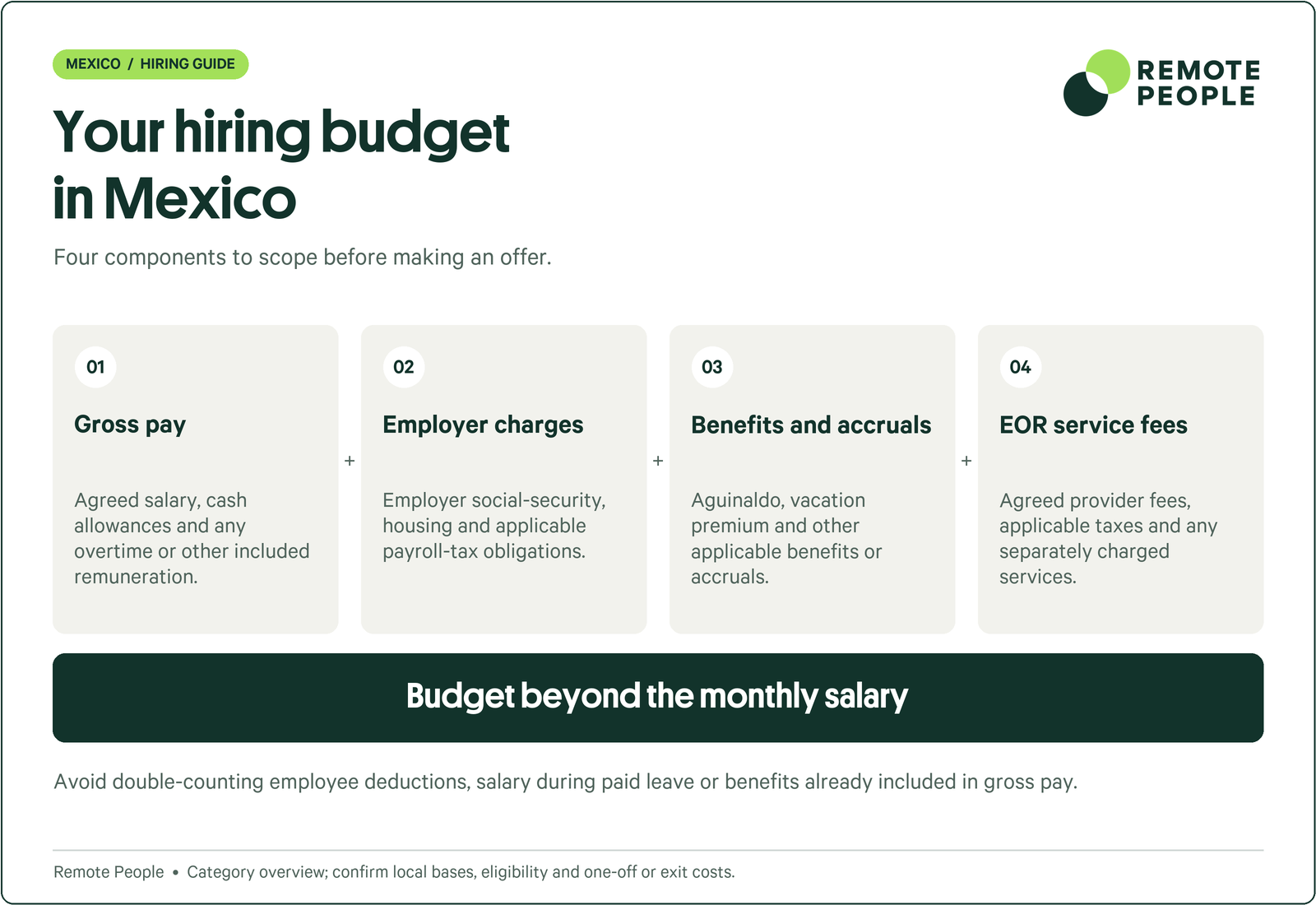
Mexico employer cost example · USD 40,000 gross · 2026 | ||
Employer Cost | Amount (USD) | % of Gross |
|---|---|---|
Gross annual salary | $40,000 | 100.0% |
IMSS employer contributions (est. 22%) | $8,800 | 22.0% |
INFONAVIT housing fund (5%) | $2,000 | 5.0% |
SAR retirement contribution (2%) | $800 | 2.0% |
State payroll tax (ISN, ~3%) | $1,200 | 3.0% |
Aguinaldo (15 days, ~4.1%) | $1,644 | 4.1% |
Vacation premium (25% × 12 days) | $329 | 0.8% |
EOR service fee ($400/month × 12) | $4,800 | 12.0% |
Total annual employer cost | $59,573 | 148.9% |
Ready to hire in Mexico? Get started with RemotePeople – we handle employment contracts, CFDI payroll, IMSS and INFONAVIT remittances, ISR withholding, and full LFT compliance. No local entity needed.
Benefits of Using an EOR in Mexico
Employer of record services in Mexico solve the hardest parts of hiring in Latin America’s second-largest economy: LFT compliance, REPSE-compliant structuring, IMSS registration, and CFDI payroll. The value compounds when you factor in the time and capital otherwise tied up in incorporating an S. de R.L., opening a Mexican bank account, and setting up accounting and payroll systems.
The biggest payoff is speed: a Mexican EOR can onboard a hire in 1–2 weeks instead of the 2–4 months needed to register an S. de R.L., open a corporate bank account, and enrol with IMSS, INFONAVIT, and SAT. Compliance risk shifts to the EOR, which carries the LFT, REPSE, IMSS, and SAT obligations as the legal employer of record and absorbs the exposure if a labour tribunal reclassifies a hire or an audit surfaces a missed contribution.
Cost predictability is the second advantage. The EOR fee replaces the variable costs of a Mexican legal entity (notary, accountant, REPSE registration, payroll software, employment lawyer) with a flat monthly amount. Termination handling is also simpler because the EOR processes the IMSS baja, calculates Salario Integrado severance, and absorbs the operational burden of conciliation hearings.
Finally, the EOR provides bilingual employment contracts, locally competitive benefits packages, and a HR contact point in Mexico City. These are material advantages when competing for nearshoring talent in Monterrey, Guadalajara, and Querétaro against domestic employers and other foreign EOR clients.
For companies entering Mexico for the first time, an EOR is the fastest path to a compliant, well-paid Mexican hire – and the lowest-risk way to test the market before committing to a full subsidiary.
Termination and Offboarding in Mexico
Notice Periods
Mexico is unusual among OECD countries in that the LFT does not require advance notice for termination by either party, except during probation. Instead, the employer must either have “justified cause” (Article 47 of the LFT) or pay the full statutory severance package (Article 50). Employees who resign are asked to give reasonable notice as a matter of custom and any collective bargaining agreement, but there is no statutory minimum. The table below summarises the practical notice expectations and related termination rules.
Mexico statutory notice periods by position level · Per Ley Federal del Trabajo | |||
Position Level | Notice Period | During Probation | Notes |
|---|---|---|---|
All employees (justified dismissal) | None – written aviso de rescisión required | None | Art. 47 LFT; must be delivered within 30 days |
All employees (unjustified dismissal) | None – full severance replaces notice | None | Art. 48, 50 LFT |
Rank-and-file (probation failure) | None – CMP opinion required | Up to 30 days | Art. 39-A LFT |
Managerial / confianza (probation failure) | None – CMP opinion required | Up to 180 days | Art. 39-A LFT |
Employee resignation | No statutory minimum | N/A | Customary 15–30 days; follow contract or CBA |
Collective dismissal (economic reasons) | Prior authorisation from labour tribunal | N/A | Art. 434, 435 LFT |
Exceptions exist for mutual agreement (rescisión por mutuo consentimiento), which is common for senior roles, and for fixed-term contracts that simply expire on their end date without further action required. Collective dismissals on economic grounds require prior authorisation from the local labour tribunal under Articles 434 and 435 of the LFT.
Severance Pay
Severance (indemnización) is mandatory for any dismissal that is not a resignation or a valid “justified cause” termination under Article 47 of the LFT. The statutory formula consists of three components: 3 months of integrated salary, 20 days of integrated salary per year of service, and 12 days per year of service (prima de antigüedad, capped at twice the minimum wage per day). The governing articles are 50 and 162 of the LFT; severance is calculated on the Salario Integrado, which includes aguinaldo, vacation premium, and regular bonuses – not the bare base salary.
Mexico severance pay schedule by years of service · Per Ley Federal del Trabajo | |||
Years of Service | Severance Amount | Base Salary | Notes |
|---|---|---|---|
1 year | 3 months + 20 days + 12 days (prima) = ~4.0 months | Salario Integrado (gross + aguinaldo + vacation premium) | Prima capped at 2× minimum wage/day |
3 years | 3 months + 60 days + 36 days = ~6.2 months | Salario Integrado | Plus pro-rata aguinaldo and vacation |
5 years | 3 months + 100 days + 60 days = ~8.3 months | Salario Integrado | Back wages from date of dismissal if litigated |
10 years | 3 months + 200 days + 120 days = ~13.7 months | Salario Integrado | Capped at 12 months back wages under 2019 reform |
Justified dismissal (Art. 47) | Prima de antigüedad only (12 days/year) | Capped at 2× minimum wage/day | If employee has 15+ years of service |
Calculation Method
Severance is always calculated on the Salario Integrado (integrated salary), not on the base salary alone. Salario Integrado includes aguinaldo (15 days minimum), vacation premium, food vouchers, and any regular bonus or commission, which typically lifts the calculation base by 4% to 10% over the base salary. Two separate components apply: the Article 50 indemnification (3 months + 20 days per year) and the Article 162 prima de antigüedad (12 days per year, capped at twice the daily minimum wage). See Table 13 for worked examples at 1, 3, 5, and 10 years of service.
Caps and Exceptions
The 2019 labour reform capped back-wages litigation at 12 months from the date of dismissal, preventing the previously open-ended exposure when dismissal lawsuits ran for years. No statutory cap applies to the indemnification or prima de antigüedad themselves. Just-cause dismissals under Article 47 (serious misconduct, repeated absence, violence) avoid the 3-months-plus-20-days severance entirely, but still require payment of prima de antigüedad for employees with 15 or more years of service. Fixed-term contracts that expire naturally do not trigger severance.
Grounds for Termination
Article 47 of the LFT lists the exhaustive grounds for justified dismissal without severance, including gross misconduct, repeated unjustified absences, violence, falsification of documents, and breach of confidentiality. The employer must deliver a written notice of rescission (aviso de rescisión) to the employee within 30 days of learning of the cause, specifying the facts and legal basis. Without-cause dismissals are legal but require the full Article 50 severance. Protected categories include pregnant employees (protected until 1 year after delivery), union representatives, and employees on sick leave, who cannot be dismissed while protected status is active.
EOR vs. Other Hiring Models in Mexico
EOR vs. Setting Up a Local Entity
A Mexican subsidiary (typically an S. de R.L. de C.V. or an S.A. de C.V.) gives full operational control and lets you bid on government contracts, but it takes 2 to 4 months to incorporate, register with SAT, IMSS, INFONAVIT, and the state tax authority, and requires ongoing accounting, labour lawyer, and payroll provider fees. An EOR is faster and cheaper for small teams.
Mexico EOR vs local entity comparison · Setup time, cost, risk and best-fit | ||
Factor | Employer of Record | Own Entity (S. de R.L. / S.A. de C.V.) |
|---|---|---|
Setup time | 1–2 weeks | 2–4 months |
Upfront cost | $0 | $5,000–$15,000 |
Ongoing cost | $300–$600/employee/month | $15,000–$30,000/year maintenance |
Local partner required | No (EOR is the local entity) | No (foreign shareholder permitted) |
Social insurance registration (IMSS, INFONAVIT) | Handled by EOR | You manage it |
Payroll & tax filing (CFDI, SAT) | Handled by EOR | You manage it (or outsource) |
Best for team size | 1–15 employees | 15+ employees |
Scale down / exit | Easy – no entity to unwind | Costly – legal dissolution required |
Government contracts | Not eligible | Eligible (requires local entity) |
Source: Secretaría de Economía and PwC Mexico Corporate Residence | ||
For teams under fifteen people, an EOR is almost always cheaper over the first two years once you factor in annual accounting fees, labour counsel, and the opportunity cost of management attention spent on Mexican compliance. If you plan to exceed twenty-five or thirty employees, bid on Mexican government work, or hold significant local assets, a local entity eventually becomes necessary.
EOR vs. Hiring Independent Contractors
Independent contractors in Mexico are a legitimate option for project-based work, but the risk of misclassification under the LFT is particularly high, and the 2021 outsourcing reform (REPSE) restricted the use of personnel-leasing arrangements that had previously disguised employment relationships. Mexican courts apply the “economic dependency” and “subordination” tests; a long-term full-time contractor is almost always reclassified as an employee. Companies searching for a contractor of record in Mexico should note that most full-time arrangements require an EOR, not a contractor structure.
Mexico EOR vs independent contractors · Compliance, cost, and risk | ||
Factor | EOR (Full-Time Employee) | Independent Contractor |
|---|---|---|
Legal relationship | Employee of the EOR | Self-employed, no employment relationship |
Compliance risk | Low – EOR ensures LFT compliance | High – misclassification risk under Art. 20 LFT |
Payroll & tax | EOR handles CFDI, ISR, IMSS, INFONAVIT | Contractor invoices you with their own RFC |
Benefits & leave | Aguinaldo, vacation, IMSS, PTU | No entitlement to employee benefits |
IP protection | Stronger – LFT-compliant contract assigns IP | Weaker – requires explicit IP clause |
Termination | Subject to Article 50 severance | Contract can be ended per agreement |
Best for | Long-term, core team roles | Short-term projects, specialised tasks |
Cost structure | Salary + ~32% employer cost + EOR fee | Contractor fee (higher gross, lower total) |
Misclassification in Mexico carries retroactive IMSS, INFONAVIT, ISR, aguinaldo, vacation, and severance exposure for up to five years, plus fines under the LFT and the Social Security Law. The 2021 outsourcing reform added the further sanction that non-REPSE payments are not deductible for corporate income tax, amplifying the cost for the client company. For any role that looks like employment – regular hours, fixed salary, integrated into company operations – an EOR is the safer structure.
EOR vs. PEO (Professional Employer Organization)
The PEO model, common in the United States, does not exist as a regulated category under Mexican law. The closest equivalent is a payroll service (maquila de nómina), where a third party runs payroll on behalf of your Mexican entity but you remain the legal employer. After the 2021 outsourcing reform, this service must be provided under a REPSE-registered specialised services contract.
Mexico EOR vs PEO comparison · Legal employer, liability, and setup | ||
Factor | Employer of Record (EOR) | PEO / Payroll Service |
|---|---|---|
Legal employer | EOR is the legal employer | Client entity remains the legal employer |
Local entity required | No – the EOR is the local entity | Yes – you must have a Mexican entity |
Best for | Companies without a Mexican entity | Companies that already have an S. de R.L. |
Compliance liability | EOR assumes compliance responsibility | Shared – client remains primarily liable |
Setup time | 1–2 weeks | Depends on your entity (2–4 months upfront) |
Control over HR policies | EOR manages within LFT framework | More direct client control |
Typical use case | Market entry, small remote teams | Established Mexican operations needing HR outsourcing |
Because a Mexican PEO cannot take on the legal employer role, the EOR model is the only route that removes the need for a local entity. For companies that already have an S. de R.L. de C.V. and simply want to outsource payroll, a REPSE-registered payroll provider is the right choice; for companies without a Mexican entity, the EOR is the only compliant option.
Public Holidays in Mexico
Mexico has eight federal mandatory holidays (días de descanso obligatorio) under Article 74 of the LFT, plus election days when applicable. Work performed on a mandatory holiday must be paid at triple the regular rate (regular day pay plus 200% premium). Several other dates are widely observed as non-mandatory (civic) holidays but do not require paid leave by federal law.
Mexico public holidays · 2026 calendar year | ||
Date | Holiday | Type |
|---|---|---|
January 1, 2026 | Año Nuevo (New Year’s Day) | Mandatory |
February 2, 2026 | Día de la Constitución (observed first Monday of February) | Mandatory |
March 16, 2026 | Natalicio de Benito Juárez (observed third Monday of March) | Mandatory |
April 2, 2026 | Jueves Santo (Holy Thursday) | Non-mandatory (widely observed) |
April 3, 2026 | Viernes Santo (Good Friday) | Non-mandatory (widely observed) |
May 1, 2026 | Día del Trabajo (Labour Day) | Mandatory |
September 16, 2026 | Día de la Independencia | Mandatory |
November 2, 2026 | Día de los Muertos | Non-mandatory (widely observed) |
November 16, 2026 | Día de la Revolución (observed third Monday of November) | Mandatory |
December 12, 2026 | Día de la Virgen de Guadalupe | Non-mandatory (widely observed) |
December 25, 2026 | Navidad (Christmas Day) | Mandatory |
Work performed on a mandatory holiday triggers triple pay under Article 75 of the LFT. Presidential inauguration day (December 1 every six years, next on December 1, 2030) and federal election days are also mandatory holidays in the year they occur. Collective bargaining agreements and individual contracts often add additional paid holidays above the statutory floor.
How to Get Started with an EOR in Mexico
- First, define the role and compensation.. Decide the job title, Spanish job description, base salary in MXN, start date, and any variable components. The EOR uses this to draft an LFT-compliant contract and calculate the Salario Base de Cotización for IMSS.
- Second, sign the eor service agreement.. Review and sign the master services agreement with RemotePeople. This sets the EOR fee, scope of services, and the client-employee relationship framework.
- Third, collect employee documents.. Passport or Mexican ID (INE), CURP, RFC, proof of address, and bank details. For foreign hires, add educational credentials, criminal record, and the INM pre-authorisation file.
- Fourth, sign the mexican employment contract and register with authorities.. The EOR issues a Spanish employment contract, registers the employee with IMSS, INFONAVIT, and AFORE, and sets up CFDI payroll in SAT.
- Fifth, start work and run payroll.. The employee begins work on day one; the EOR issues biweekly or semi-monthly CFDI nómina receipts, withholds ISR, and remits employer contributions monthly through SUA.
Ready to hire in Mexico? Contact RemotePeople to onboard your first Mexican employee in 1–2 weeks, fully compliant with the LFT, IMSS, INFONAVIT, and SAT. No Mexican entity needed.
Frequently Asked Questions
Total employer cost in Mexico is typically 130% to 150% of gross salary once IMSS (around 22%), INFONAVIT (5%), SAR (2%), state payroll tax (1% to 4%), aguinaldo (4.1%), and the EOR service fee ($300–$600/month) are added. For a USD 40,000 gross salary, expect roughly USD 59,000 to USD 62,000 all-in per year, per the PwC Mexico Corporate Tax Summary.
Onboarding a Mexican national through an EOR typically takes 1 to 2 weeks, including bilingual LFT contract drafting, IMSS and INFONAVIT registration, AFORE enrolment, and CFDI 4.0 payroll setup with SAT. Add 6 to 12 weeks if the hire is a foreign national requiring a Residente Temporal visa with work authorisation issued by the Instituto Nacional de Migración (INM).
Yes. Any provider of specialised services in Mexico must register with STPS under REPSE following the 2021 outsourcing reform. Ask your EOR for the current REPSE certificate before signing; non-REPSE service fees are not deductible for Mexican corporate income tax and trigger joint-and-several liability for unpaid IMSS contributions.
Yes. The EOR calculates and pays the 15-day aguinaldo by December 20 each year under Article 87 of the Ley Federal del Trabajo, and allocates PTU profit sharing (10% of taxable profit, capped at three months of salary or the three-year PTU average) within the May to June window following the corporate tax filing.
Under a properly drafted Mexican employment contract, intellectual property created during the scope of employment is assigned to the employer by default under Articles 83 and 84 of the Federal Copyright Law. The EOR contract template includes an explicit IP assignment clause back to the client company (you), not the EOR, so all work product remains your property.
Yes, but statutory severance under Articles 48 and 50 of the Ley Federal del Trabajo (3 months of integrated salary plus 20 days per year of service plus prima de antigüedad of 12 days/year) applies to any without-cause termination. The EOR manages the conciliation process, files the IMSS baja, and calculates the final settlement.
An EOR employee is a formal LFT employee with full benefits, CFDI 4.0 payroll, IMSS coverage, and statutory severance. A contractor (honorarios) invoices via RFC and has no employment benefits, but the LFT subordination test means long-term, full-time contractors are routinely reclassified as employees, triggering back-pay and fines. RemotePeople's contractor management solution handles compliant Mexican contractor agreements when an EOR employee is not the right fit.
Mexico does not have a dedicated digital nomad visa. Remote workers typically use the Residente Temporal visa without work authorisation (if paid by a foreign employer) or Residente Temporal with work authorisation (if paid by a Mexican employer or EOR), both issued by the Instituto Nacional de Migración (INM) for stays of one to four years.
Employer of Record in
Employer of Record in
Employer of Record in
Employer of Record in
Employer of Record in
Employer of Record in
Employer of Record in
Employer of Record in