
 Recruit
Employer of Record in the Philippines
-
 Drew Donnelly
- Published
- October 14, 2026
RemotePeople’s employer of record service in the Philippines lets you hire local employees without setting up a legal entity. It handles employment contracts, payroll, employee benefits, and local compliance, so you can focus on growing your team without having to manage the administrative side of hiring.
Hire in Philippines — book a free 30-minute demo
Tell us what you need. You'll get a tailored, transparent proposal within 24 hours, plus a free call to walk through it.
Tell us about your company
So we can match you with a specialist who knows your market — and unlock volume pricing tiers.
* All fields are required.
Where and when are you hiring?
Tell us the geography and timing and we'll quote each country line by line, with onboarding timelines.
* All fields are required.
Help us beat your current setup
We'll benchmark your current deal and send a line-by-line proposal in 24 hours — showing exactly where we cut cost, time, or risk. After you submit, you can book a call to walk through it together.
* All fields are required.
Thanks! Your proposal is on its way.
Expect a tailored, line-by-line proposal in your inbox within 24 hours. In the meantime…
Want to walk through it together?
Book a free 30-minute call with one of our specialists. We'll explain every line, answer your questions, and tailor the proposal further if you need.
No obligation. Pick a time that works for you.








- Hire in Philippines — book a free 30-minute demo
- Tell us about your company
- Where and when are you hiring?
- Help us beat your current setup
- Thanks! Your proposal is on its way.
- How an Employer of Record Works in the Philippines
- Employment Laws and Regulations in the Philippines
- Work Permits and Visas in the Philippines
- Payroll, Taxes, and Social Security in the Philippines
- Cost of Hiring Through an EOR in the Philippines
- Benefits of Using an EOR in the Philippines
- Termination and Offboarding in the Philippines
- EOR vs. Other Hiring Models in the Philippines
- Public Holidays in the Philippines
- How to Get Started with an EOR in the Philippines
- Where companies hiring in the Philippines expand next
- Frequently Asked Questions
- Related EOR Destinations

Start hiring in Philippines
Let RemotePeople handle payroll, compliance, and HR admin worldwide so you can focus on building your team.

The Philippines is Southeast Asia’s second-largest economy by GDP and a major hub for technology, business process outsourcing, and customer service operations, with significant talent concentrations in Metro Manila, Cebu, and Davao. Provincial minimum wages range from PHP 455 to PHP 695 per day across the Regional Tripartite Wages and Productivity Boards, while the national statutory framework is anchored in Presidential Decree No. 442, the Labor Code of the Philippines, which governs employment status, working conditions, benefits, and termination across all private-sector industries. For companies looking to hire employees in the Philippines, compliance requires navigating Social Security System (SSS) enrolment, PhilHealth premium contributions, Pag-IBIG housing fund deductions, and income tax withholding through the Bureau of Internal Revenue, as well as statutory benefits including 13th-month pay, maternity leave, and service incentive leave. An employer of record in the Philippines becomes the legal employer of your staff, registering them with the SSS, PhilHealth, and Pag-IBIG, managing monthly payroll in Philippine pesos, and ensuring complete compliance with the Labor Code, so you can hire and manage a Philippine team without establishing a local entity.
This guide walks through how an employer of record in the Philippines works, what the Labor Code requires in 2026, the cost of hiring through an EOR, and how the model compares with incorporating your own Philippine company, engaging independent contractors, or partnering with a PEO. The worked employer-cost illustration and its contribution assumptions were checked against the linked official sources on 22 September 2026. Other employment, tax, immigration and termination details should be confirmed for the individual hire with a qualified Philippine adviser.
How an Employer of Record Works in the Philippines
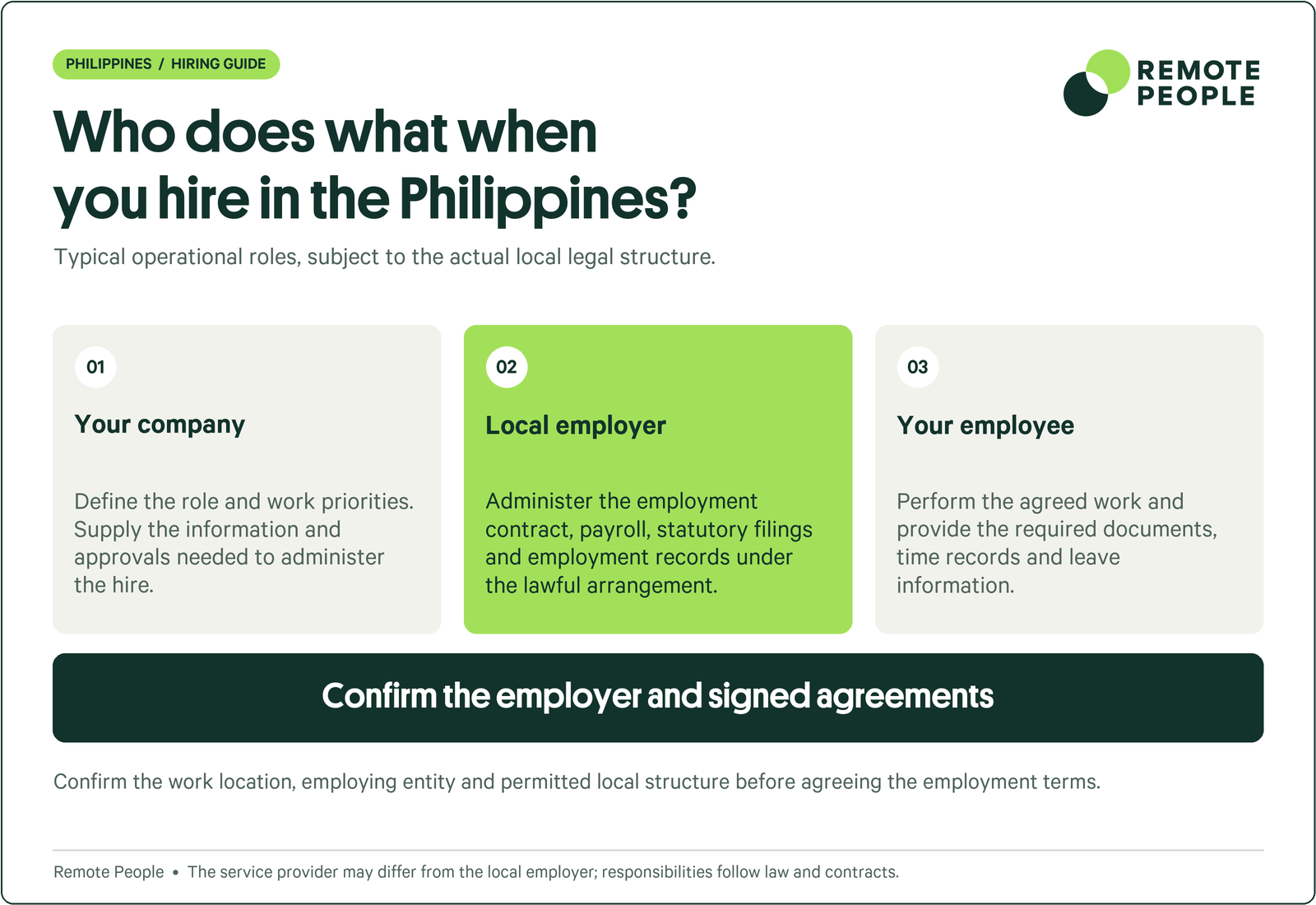
If you’d like to learn more about how Employer of Record (EOR) services work, read our What Is an Employer of Record (EOR)? guide for a complete overview of the model, its benefits, and when to use it.
If you’re comparing providers, our Best Employer of Record (EOR) Providers guide reviews the leading platforms to help you choose the right solution for your business.
Who Uses an EOR in the Philippines?
An employer of record in the Philippines is typically used by companies that want a compliant hire without committing to the setup and ongoing cost of a Philippine entity. Common scenarios include:
- Market entry testing: a company hiring its first one to three employees in the Philippines to validate demand or test a remote engineering or BPO team before committing to local incorporation. The EOR lets you pilot for twelve to twenty-four months and scale down without a Department of Trade and Industry deregistration process.
- Remote technology and BPO teams: global firms tapping the Philippines’ large pool of software developers, QA engineers, and customer service professionals based in Luzon, Visayas, and Mindanao without the cost and timeline of setting up a Philippine entity.
- Speed-sensitive hires: situations where a priority candidate needs to start within weeks rather than the two-to-four months it typically takes to incorporate a Philippine company, open a local bank account, register with SSS, PhilHealth, and Pag-IBIG.
- Foreign-national hires: where the employee is a non-Philippine national who needs a work visa (9(g) or other category). The EOR, as a Philippines legal employer, can sponsor the Alien Employment Permit and work visa application without the client setting up a local subsidiary.
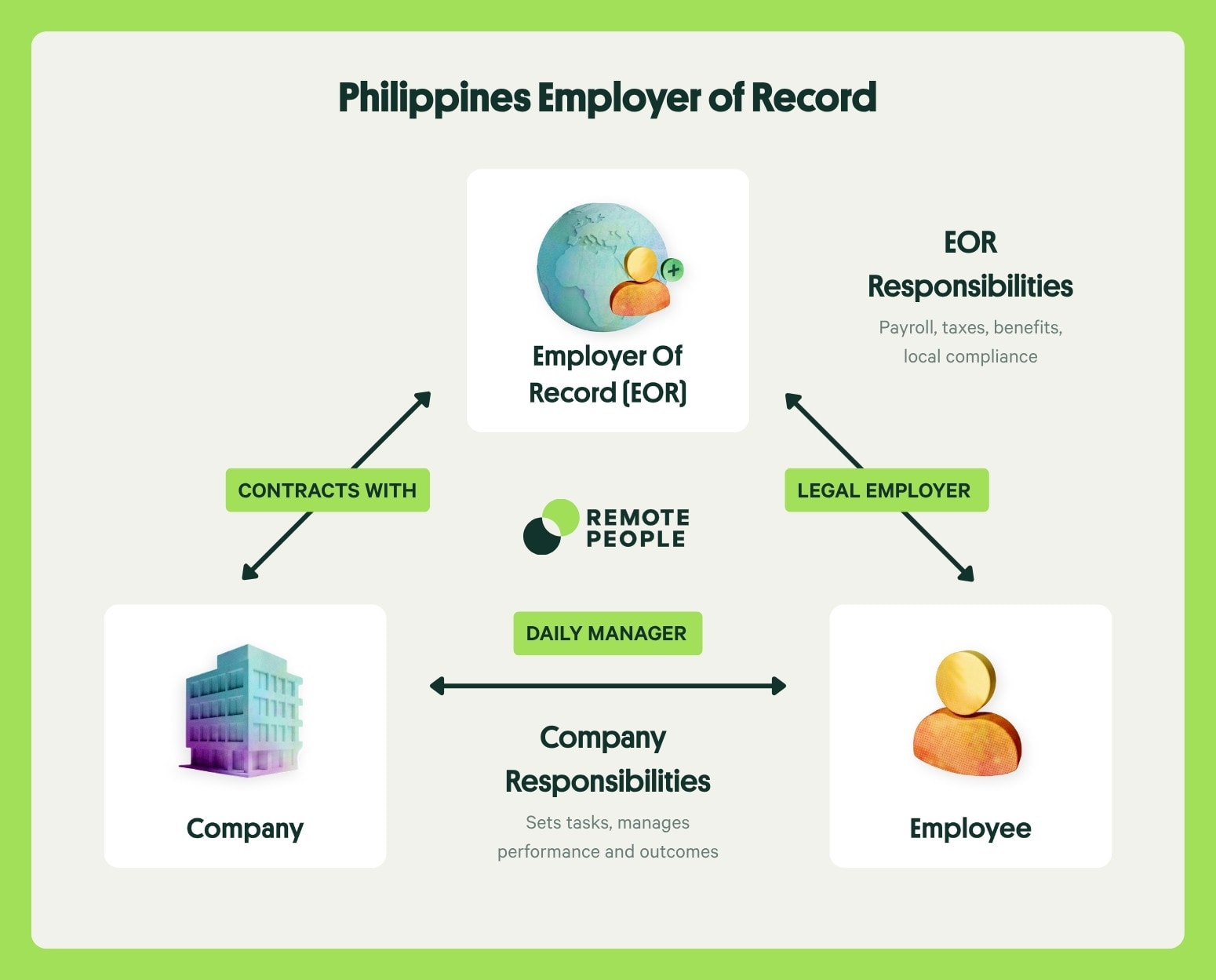
Typical Onboarding Timeline
Most EOR providers can onboard a Philippine national employee in one to two weeks when no work visa is required. The stages are sequential but short:
- First step is to sign the EOR service agreement and share the employee’s details, proposed salary, role, and start date (one to two days).
- Second, the EOR drafts a compliant appointment letter under the Labor Code and sends it for employer and employee signature (two to three days).
- Third, SSS registration, PhilHealth enrolment, and Pag-IBIG registration run in parallel, along with bank account collection and BIR tax number verification (three to seven days).
- Fourth, payroll is configured, PhilHealth coverage is activated, and the employee is onboarded into your systems (two to three days).
- Fifth, the employee begins work on the agreed start date.
Timelines extend when a work visa is required (add six to twelve weeks for Alien Employment Permit approval and Bureau of Immigration processing), when documents must be authenticated through the Department of Foreign Affairs, or when the role is regulated (medical, legal, engineering, and nursing professions require registration with the Professional Regulation Commission).
Hire in Philippines
RemotePeople can help you quickly and effectively expand globally. With our EOR and Global PEO solutions, you can effortlessly hire remote talent in over 150 countries, all without the need to establish a local entity. Get started today.
Employment Laws and Regulations in the Philippines
Employment Contracts
Employment in the Philippines is mainly governed by the Labor Code of the Philippines, which was introduced back in 1974. Although, the code has been updated several time since, it covers private-sector workers, alongside other laws covering benefits such as maternity leave, paternity leave, and mandatory 13th-month pay.
Employees can be hired on different contracts; regular, probationary, temporary, seasonal, casual, and apprenticeship. Each employment contract should clearly set out the employee’s role, salary, working hours, workplace, and any probationary period.
Probationary periods are generally limited to six months, after which employees who meet the requirements become regular employees. Employees who wish to resign are normally required to give at least 30 days’ written notice.
Working Hours and Overtime
The standard working week in the Philippines is 48 hours, typically spread across five to six days of 8 hours per day, set by Article 83 of the Labor Code. Daily working time cannot exceed 8 hours, exclusive of a one-hour meal break, and employees are entitled to at least 15 minutes of rest after every four hours of continuous work (Article 84). Workers are entitled to at least one day of rest per week, normally a Sunday (Article 85). Overtime is work performed beyond 8 hours in a day or 48 hours per week; employees performing overtime must be compensated at a premium rate. Managerial employees, as defined in Article 82, are exempt from overtime compensation and maximum hour regulations.
Philippines overtime and premium pay rates · Per Labor Code of the Philippines | |||
Hour Type | Rate Multiplier | Weekly/Daily Cap | Notes |
|---|---|---|---|
Overtime beyond 8 hours per day or 48 hours per week | 125% (1.25× regular rate) | No daily cap; weekly overtime subject to employee availability | Article 87 Labor Code; at least 25% premium on regular rate |
Work on weekly rest day (Sunday or substituted) | 130% (1.30× regular rate) for first 8 hours | Additional 130% for overtime beyond 8 hours on rest day | Article 89 Labor Code |
Work on a gazetted public holiday | 200% (2.0× regular rate) for first 8 hours | Additional 200% for overtime beyond 8 hours on holiday | Article 94 Labor Code |
Night shift differential (10 PM to 6 AM) | 110% (1.10× regular rate) | Per hour worked during night hours | Article 86 Labor Code; at least 10% premium per hour |
Overtime pay is not optional once ordered by the employer, and employees must be compensated on the next payroll cycle. Overtime compensation is calculated on the regular rate of wages, which includes basic pay and fixed allowances but excludes bonuses, leave pay, and special allowances. An employee cannot be forced to work more than 12 hours in a single day under normal circumstances, and compulsory overtime is limited to situations involving national emergency or calamity.
Minimum Wage
The minimum wage in the Philippines is set regionally by the Regional Tripartite Wages and Productivity Boards (RTWPBs) under the Department of Labor and Employment. As of January 2026, the National Capital Region (NCR) daily minimum wage for non-agricultural workers is PHP 695 per day (National Wages and Productivity Commission), effective July 18, 2025. Other regions range from PHP 455 (MIMAROPA) to PHP 580 (Calabarzon), reflecting regional economic differences. Wage orders are updated periodically; employers must monitor the NWPC website and DOLE regional offices for the current rates in their employee’s work location. Our minimum wage in the Philippines guide covers the full regional matrix.
Probation Period
Under Article 296 of the Labor Code, the probation period for a newly hired employee may not exceed six months (180 days) from the date of engagement. The standards and criteria for regular employment must be communicated to the employee on or before the date of hire. Probation can be extended once, up to a maximum combined duration of six months, only if the extension is documented in writing before the original probation expires. During probation, either party may terminate the contract without notice or severance provided the termination is not for an unlawful reason. Once the probation period ends and the employee is continued in service, they automatically attain regular employment status and cannot be terminated without just or authorized cause.
Leave Entitlements
The Philippines’ statutory leave framework is spread across the Labor Code (Articles 92–97, covering work-year leave and holiday provisions), Presidential Decree 851 (13th-month pay), Republic Act 11210 (expanded maternity leave), and Republic Act 8187 (paternity leave). Leave entitlements are mandatory for all employees, except as noted below.
Annual Leave (Service Incentive Leave)
Employees who have rendered at least one year of continuous service are entitled to five days of paid service incentive leave per year, which may be used for any purpose (vacation, personal, or sick leave). Service incentive leave is not earned during probation. Unused service incentive leave cannot be carried over to the next year and lapses at year-end unless company policy or collective agreement allows encashment; if encashed, it is paid at the employee’s daily rate. Upon termination or resignation, any earned but unused service incentive leave must be paid in cash.
Sick Leave
The Labor Code does not mandate paid sick leave; however, employees covered by the Social Security System may claim sickness benefits (90% of regular wage for the first four days and full wage thereafter) if they have contributed for at least three months during the preceding 12 months and are confined in hospital or prescribed medical rest. Some employers provide contractual sick leave; this is determined on an individual or company basis and is not a statutory minimum.
Maternity Leave
Female employees are entitled to 105 days of fully paid maternity leave under Republic Act 11210 (Expanded Maternity Leave Law), effective March 2019, regardless of whether the birth is vaginal or cesarean. The law also permits an additional 30 days of unpaid leave at the employee’s option. Solo parents (as defined under RA 8972) are entitled to an additional 15 days of paid maternity leave, bringing the total paid entitlement to 120 days. In cases of miscarriage or emergency termination of pregnancy, the employee receives 60 days of paid leave. Maternity leave accrues from the date of notice to the employer and may be taken before, during, or after delivery; the employee must return to her former position or an equivalent role with the same pay upon return from leave.
Paternity Leave
Male employees are entitled to seven days of fully paid paternity leave under Republic Act 8187 (Paternity Leave Act) for the first four deliveries of the legitimate spouse with whom he is cohabiting. The leave must be taken within 60 days after the date of delivery. Employees may take the leave in advance (before the delivery), during recovery, or during the period of nursing the newborn. Paternity leave is paid at 100% of regular wages, including basic salary and all allowances.
Other Statutory Leave
The Labor Code recognises several additional statutory leave entitlements:
- Parental leave for solo parents: 7 working days per year to perform parental duties (RA 11861, Expanded Solo Parents Welfare Act 2022), in addition to maternity/paternity leave.
- Special leave for women: up to 2 months paid leave for female employees undergoing gynecological or obstetrician surgery or hospitalization (RA 9710, Magna Carta of Women).
- Leave for violence against women and children: up to 10 days of paid leave for employees who are victims of violence under RA 9262, with an option to extend for additional unpaid leave.
- Bereavement leave: not statutorily mandated in the Labor Code; commonly granted as 3–5 days on full pay through company policy or collective agreement.
- Public holidays and special non-working days: guaranteed days off with pay as declared by proclamation each year (see Table 4 for 2026 calendar).
The single most important takeaway for employers is that service incentive leave is earned after one year of continuous service, maternity leave is a 105-day entitlement (plus 15 days for solo parents), and paternity leave is available for the first four children. All leave entitlements must be clearly documented, and employees cannot be required to waive statutory leave.
Philippines statutory leave entitlements · Per Labor Code and Republic Acts | ||
Leave Type | Duration | Eligibility & Notes |
|---|---|---|
Service incentive leave | 5 days | After 1 year of continuous service; non-cumulative; lapses at year-end unless encashed (Article 95 Labor Code) |
Maternity leave | 105 days | Full pay for normal or cesarean birth, plus 15 days for solo parents (RA 11210; 60 days for miscarriage) |
Paternity leave | 7 days | Full pay; first four deliveries of legitimate spouse; within 60 days of delivery (RA 8187) |
Parental leave (solo parents) | 7 days | Full pay per year for parental duties (RA 11861); in addition to maternity/paternity leave |
Special leave for women (medical) | 2 months | Paid leave for gynecological or obstetrician surgery (RA 9710) |
Leave for violence against women | 10 days | Paid leave if employee is victim of violence; option to extend unpaid (RA 9262) |
Public holidays and special non-working days | 14–18 per year | Paid days as declared by proclamation (see Table 4 for 2026 calendar) |
Statutory Employee Benefits
Beyond paid leave, Philippine employers must provide several mandatory benefits funded through the Social Security System, PhilHealth, and Pag-IBIG:
- Social Security System (SSS) pension insurance: the SSS provides old-age pension, disability pension, and death/survivor benefits. The contribution rate is 15% of the monthly salary credit (10% employer, 5% employee), with contributions capped at a monthly salary credit range of PHP 5,000 to PHP 35,000 effective 2025 (SSS contribution schedule).
- PhilHealth medical coverage: PhilHealth provides hospitalization benefits, emergency benefits, and outpatient benefits. The premium rate is 5.0% of monthly basic salary (2.5% employer, 2.5% employee), with an income floor of PHP 10,000 and ceiling of PHP 100,000 effective 2025 (PhilHealth 2025 contribution advisory).
- Pag-IBIG (Home Development Mutual Fund): Pag-IBIG is a mandatory savings and home-financing program. The employer contributes 2% of monthly fund salary. The employee contributes 1% where fund salary is PHP1,500 or less, and 2% above that level. The maximum fund salary is PHP10,000, effective February 2024, so the maximum monthly share at the 2% rate is PHP200.
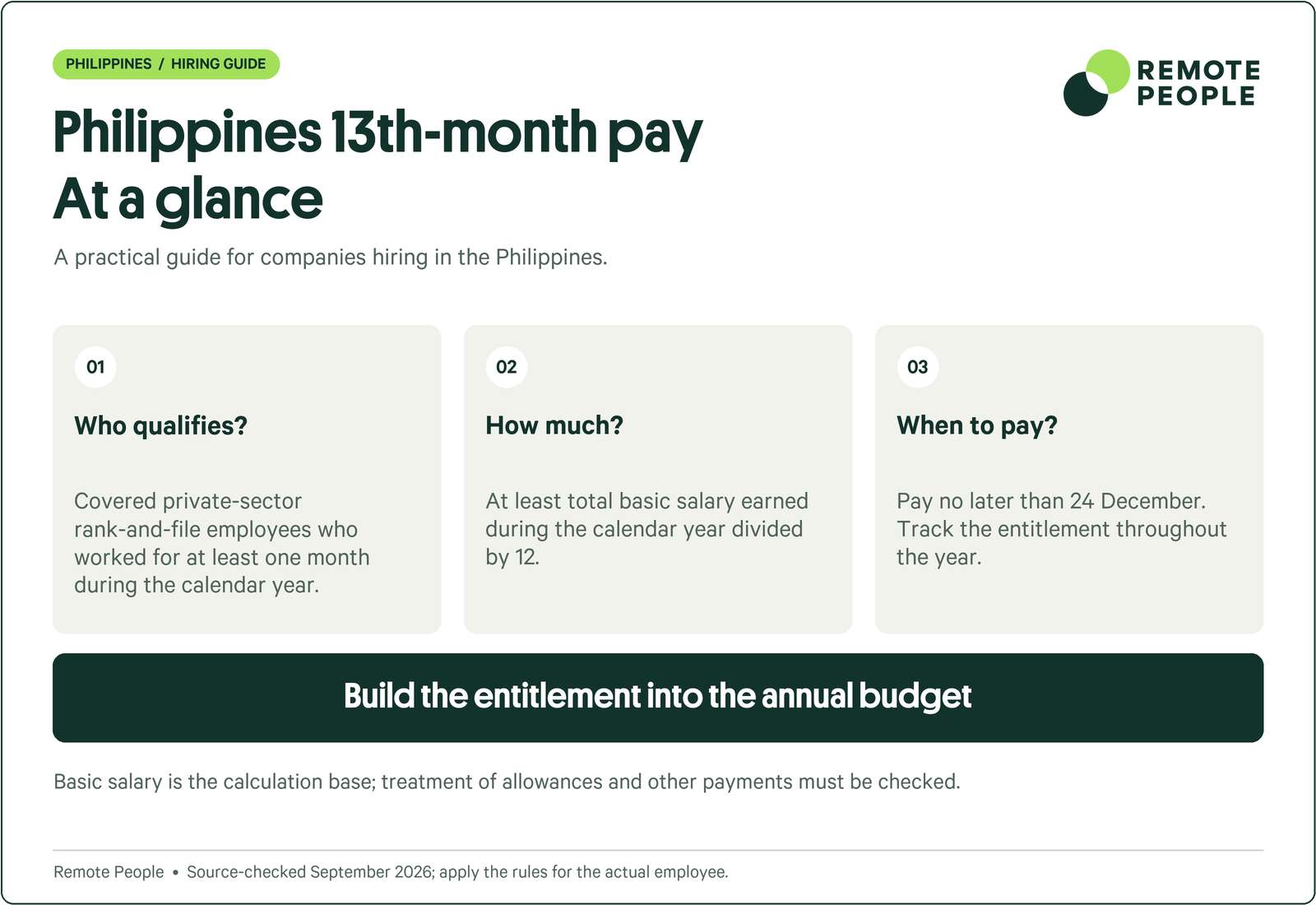
- 13th-month pay: mandatory for covered rank-and-file employees with at least one month of service during the calendar year, calculated as one-twelfth of total basic salary earned during the calendar year, paid on or before December 24 each year. Employees must receive at least the statutory minimum even if they join mid-year (pro-rated).
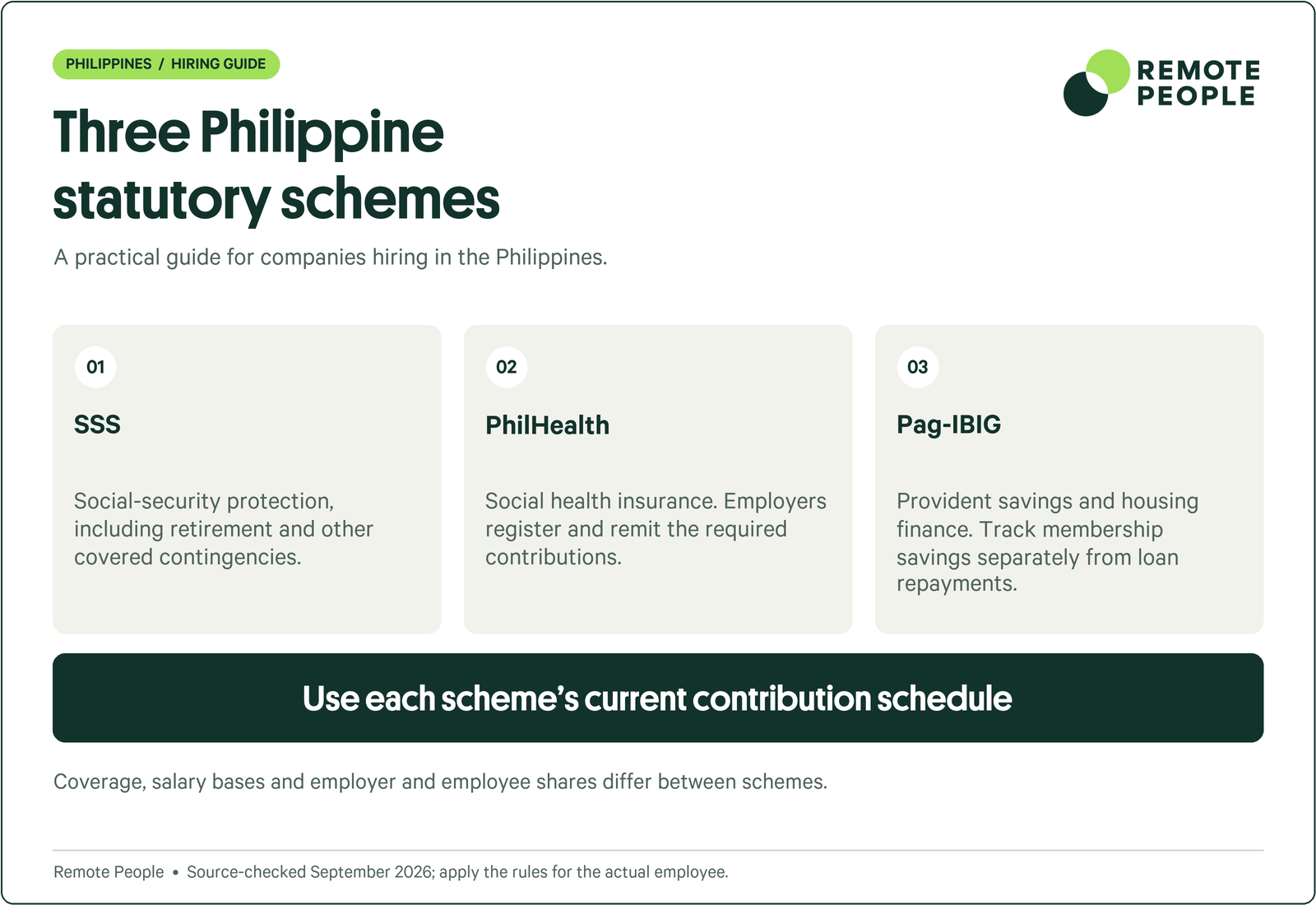
The employer deducts only the employee’s share of SSS, PhilHealth and Pag-IBIG contributions from pay and remits it together with the employer’s own share to the relevant agencies. Employees’ Compensation is funded by the employer. Employer contributions are additional employer costs and must not be deducted from the employee’s salary. Each agency has its own remittance rules and deadlines.
Recent Regulatory Updates (2025–2026)
The Philippines’ employment framework has moved in several meaningful ways during 2025. Effective January 1, 2025, the Social Security System increased the overall contribution rate from 14% to 15% (10% employer, 5% employee) under Republic Act 11199, the Social Security Act of 2018, with the maximum monthly salary credit ceiling raised to PHP 35,000 (from PHP 30,000). SSS contribution rates now apply to a wider range of wage earners.
The Bureau of Internal Revenue maintained the TRAIN Law income tax brackets for 2025–2026, with the zero-tax threshold remaining at PHP 250,000 annually and six progressive brackets extending to 35% on income above PHP 2,000,000. Effective July 18, 2025, the National Capital Region’s minimum wage for non-agricultural workers increased from PHP 645 to PHP 695 per day, the largest hike in NCR’s history. Regional wage orders continue to vary; employers must monitor the National Wages and Productivity Commission website for updates in the specific regions where their employees work.
The Labor Code of the Philippines remains the governing statute for employment relationships; no major amendments were enacted in 2025. The government continues to study digital nomad visa frameworks and special economic zone employment incentives, but these remain under review and have not been legislated as of April 2026.
Work Permits and Visas in the Philippines
Work Permit Requirements
Who Needs a Work Permit
Every non-Philippine national working in the Philippines requires a work permit. Philippine nationals, Overseas Filipino Workers (OFWs) holding valid passports, and visa-exempt nationals under bilateral agreements with the Philippines are exempt. All other foreign nationals, regardless of skill level or salary, must obtain a work visa and an Alien Employment Permit from the Department of Labor and Employment.
Eligibility and Required Documents
To hire a foreign national in the Philippines, the employer files an Alien Employment Permit (AEP) application with the Department of Labor and Employment. The applicant must prove that no qualified Filipino is available for the position through a Labor Market Test, showing that the role is specialized and requires skills or experience not readily available domestically. The employer submits the AEP application with the employee’s curriculum vitae, educational qualifications, employment contract, company registration documents, and proof of financial capacity. The employee must provide a passport valid for at least 12 months, a police clearance certificate from the home country, a medical certificate from an approved clinic, and any professional licenses or certifications required by Philippine regulatory bodies (engineering, medicine, law, nursing).
Processing Time and Validity
The Alien Employment Permit typically takes 2–3 weeks to issue once a complete application is filed. Following AEP approval, the employee applies for the 9(g) Pre-Arranged Employment Visa at the Bureau of Immigration, which processes the application in 3–7 weeks depending on the applicant’s nationality and whether a background clearance is required. Citizens of countries with high security risk profiles may face delays of 8–12 weeks or longer. The initial 9(g) work visa is issued for one year and may be renewed for additional one-year periods, with a maximum cumulative duration of seven years. The visa is tied to the sponsoring employer and the specified position; a change of employer or job title requires a new AEP and visa application.
Renewal Process
Renewals must be filed with the DOLE at least 30 days before the existing AEP expires. The employer submits an updated AEP application, proof of tax and social security payments for the prior year, recent salary slips, and proof of SSS and PhilHealth remittances. The employee may continue working while a renewal is pending provided the application was filed before expiry.
Common Visa Types for Foreign Workers
The Philippines offers several employment-linked visa categories for foreign workers, administered jointly by the Bureau of Immigration (visa issuance), the Department of Labor and Employment (AEP issuance and labor market test), and the Bureau of Internal Revenue (tax residency and withholding tax registration).
An EOR can sponsor each of the categories below because it is a registered Philippine employer. Tourist, student, and family-visit visas do not permit employment and are outside the scope of EOR sponsorship.
Philippines work visa types for foreign workers · 2026 | ||||
Visa Type | Duration | Best For | Leads to Long-Term Residency? | Processing Timeline |
|---|---|---|---|---|
9(g) Pre-Arranged Employment Visa | 1 year renewable up to 7 years total | Standard full-time employment with AEP sponsorship for executive, managerial, technical, or specialized roles | Yes; possible permanent residency after extended tenure | 2–3 weeks AEP + 3–7 weeks Bureau of Immigration |
Special Non-Immigrant Visa (47(a)(2)) | 1 year renewable | Foreign executives, investors, and missionaries; alternative to 9(g) for certain roles | Possible with long-term renewals | 3–5 weeks |
Special Investor’s Resident Visa (SIRV) | Long-term (renewable every 2 years) | Foreign investors in PEZA Special Economic Zones or large-scale projects | Yes; leads to long-term residency | 4–8 weeks |
Provisional Work Permit (PWP) | Valid while AEP/visa application is pending | Allows employee to begin work before 9(g) visa is finalized; issued on AEP filing | No; temporary only | 2 weeks from AEP filing |
Treaty Specialist or Intra-Company Transfer Visa | Up to 1 year | Employees of multinational companies transferring to Philippine operations; subject to bilateral agreement | Not automatically; depends on arrangement | 3–6 weeks |
Other visa categories do not authorise paid employment and therefore fall outside EOR sponsorship:
- Tourist visa: up to 30 days (extendable), no employment rights.
- Student visa: tied to a Philippine educational institution; limited part-time work only with additional authorization from the Bureau of Internal Revenue.
- Family visit visa: accompanying spouse or dependents; a separate work visa is required if the family member wishes to work.
- Retirement visa: SRRV (Special Resident Retiree’s Visa) for foreign retirees aged 50+ or older investing in Philippine bonds or deposits; no employment rights.
How an EOR Handles Work Permits
As the Philippine legal employer, the EOR owns every employer-side step of the work permit process. It files the Alien Employment Permit application with the Department of Labor and Employment, conducts the Labor Market Test to satisfy the requirement that no qualified Filipino is available, submits the employment contract and company registration documents, and represents the employer in DOLE interviews. Once the AEP is issued, the EOR coordinates with the Bureau of Immigration for the 9(g) Pre-Arranged Employment Visa filing, submitting the visa application, passport, job offer letter, and police/medical clearances.
The employee is responsible for obtaining the police clearance certificate from the home country, the medical examination from an approved clinic, and attending any biometric or interview appointments at the Bureau of Immigration. Work visa sponsorship extends the onboarding window referenced in H3 1.4 by 6–12 weeks (or 12–16 weeks for high-risk nationalities or regulated professions). RemotePeople’s Philippines EOR covers every employment-linked visa category in the table above, including the faster Provisional Work Permit route for urgent starts.
Payroll, Taxes, and Social Security in the Philippines
Employer Contributions
Employer statutory contributions are calculated separately for SSS, Employees’ Compensation, PhilHealth and Pag-IBIG. SSS uses a monthly salary credit schedule, PhilHealth uses monthly basic salary within an income floor and ceiling, and Pag-IBIG uses its fund-salary rules. Income tax withheld from employee pay is a separate payroll deduction, not an additional employer contribution.
Philippines employer social security contributions · 2025–2026 rates | ||
Contribution | Rate | Notes |
|---|---|---|
Employer SSS (including mandatory provident fund) | 10% of MSC | MSC range PHP5,000 to PHP35,000 effective January 2025; maximum PHP3,500/month employer share, excluding Employees’ Compensation |
Employees’ Compensation | PHP10 or PHP30/month | Employer-only; PHP10 at MSC PHP14,500 or below, PHP30 at MSC PHP15,000 or above |
PhilHealth medical | 2.5% of monthly basic salary | Monthly basic salary floor PHP10,000 and ceiling PHP100,000; maximum PHP2,500/month employer contribution |
Pag-IBIG housing fund | 2% of monthly fund salary | Maximum fund salary PHP 10,000; maximum PHP 200/month employer contribution |
Total employer contributions | Calculate each scheme separately | Different contribution bases and caps apply; the worked example below is 6.94% of PHP84,000 basic salary, including EC |
Employee Contributions
Employees contribute 5% of the applicable monthly salary credit to SSS, with a maximum PHP1,750 monthly employee share. Their PhilHealth share is 2.5% of monthly basic salary, subject to the income floor and ceiling. The Pag-IBIG employee rate is 1% where monthly fund salary is PHP1,500 or less and 2% above that level, with a PHP10,000 maximum fund salary. The employer withholds these employee shares from pay and remits them under each agency’s rules and deadlines. Income tax withholding is calculated separately.
Philippines employee payroll deductions · 2025–2026 monthly withholdings | ||
Deduction | Rate | Notes |
|---|---|---|
SSS pension contribution | 5% of MSC | MSC range PHP 5,000 to PHP 35,000; capped at PHP 1,750/month employee share effective Jan 2025 |
PhilHealth medical | 2.5% of monthly basic salary | Monthly basic salary floor PHP10,000 and ceiling PHP100,000; shared 50/50 with employer |
Pag-IBIG housing fund | 1% where monthly fund salary is PHP1,500 or less; 2% above PHP1,500 | Maximum fund salary PHP 10,000; maximum PHP 200/month employee contribution |
Income tax (PAYE) | 0% to 35% | Progressive brackets under TRAIN Law (RA 10963); effective Jan 2025 |
Total statutory withholdings (excl. tax) | Varies by contribution base and salary | Apply each scheme’s floor, ceiling and contribution schedule separately; income tax is calculated separately |
Income Tax
The Philippines levies progressive personal income tax on salary income under the TRAIN Law (Republic Act 10963), effective January 1, 2023 and maintained through 2025–2026. The first PHP 250,000 of annual taxable income is exempt from tax; income above that threshold is taxed at progressive rates reaching 35% on annual income exceeding PHP 2,000,000 (PwC Philippines individual income tax). Employers must withhold tax monthly under the BIR Withholding Tax Table (WTT) and remit to the Bureau of Internal Revenue by the 10th of the following month.
Philippines salaried income tax brackets · Effective January 2025 (TRAIN Law) | |
Annual Taxable Income (PHP) | Tax Calculation |
|---|---|
Up to PHP 250,000 | Exempt (0%) |
PHP 250,001 to PHP 400,000 | 15% of the amount exceeding PHP 250,000 |
PHP 400,001 to PHP 800,000 | PHP 22,500 + 20% of the amount exceeding PHP 400,000 |
PHP 800,001 to PHP 2,000,000 | PHP 102,500 + 25% of the amount exceeding PHP 800,000 |
PHP 2,000,001 to PHP 8,000,000 | PHP 402,500 + 30% of the amount exceeding PHP 2,000,000 |
Over PHP 8,000,000 | PHP 2,202,500 + 35% of the amount exceeding PHP 8,000,000 |
Payroll Cycle
Philippine payroll is typically processed monthly, with salaries paid by the 10th of the following month (or by a set date agreed in the employment contract). Payment must be by bank transfer for all employees; cash payment is permitted but uncommon in the formal sector. Employers must issue a salary slip to each employee showing gross wages, each statutory deduction (SSS, PhilHealth, Pag-IBIG, income tax), net pay, and year-to-date cumulative totals. SSS, PhilHealth, and Pag-IBIG contributions are due to the respective agencies by the 10th of the following month. Income tax withholding must be remitted to the BIR by the 10th of the following month, supported by a BIR Form 2307 or an electronic return. The annual employer statement (BIR Form 1604-C) must be filed by April 15 for the prior calendar year.
13th Month Salary and Bonus Pay
Under DOLE’s guidance on 13th-month pay, covered rank-and-file employees in the private sector who have worked for at least one month during the calendar year are entitled to this benefit, regardless of their employment status. The statutory amount is one-twelfth of total basic salary earned in that year, payable no later than December 24. The PHP84,000 basic-salary illustration below assumes a covered rank-and-file employee.
Employees who separate before year-end receive a pro-rated 13th-month pay based on months actually worked; those hired mid-year receive 13th-month pay proportional to tenure (e.g., an employee hired July 1 receives 6/12 of the standard amount). The 13th-month pay is taxable income and must be included in the annual gross income for income tax calculation. Some employers voluntarily pay a 14th-month bonus during the first quarter, but this is not mandatory; if paid consistently for two years or more, it may become an established contractual benefit that cannot be unilaterally withdrawn.
Cost of Hiring Through an EOR in the Philippines
EOR Service Fees
Ask for a Philippines proposal that separates the EOR administration fee from employee compensation and other charges. The administration fee covers the services agreed in the contract, such as employment documentation, payroll processing, statutory reporting and benefits administration. Gross salary, employer statutory contributions and the actual 13th-month pay benefit are employment costs funded in addition to that administration fee. Supplementary benefits, recruitment, immigration services, deposits and any taxes or currency-conversion charges should be itemized where applicable. Confirm the current fee and inclusions in your written proposal before onboarding.
Total Employment Cost Breakdown
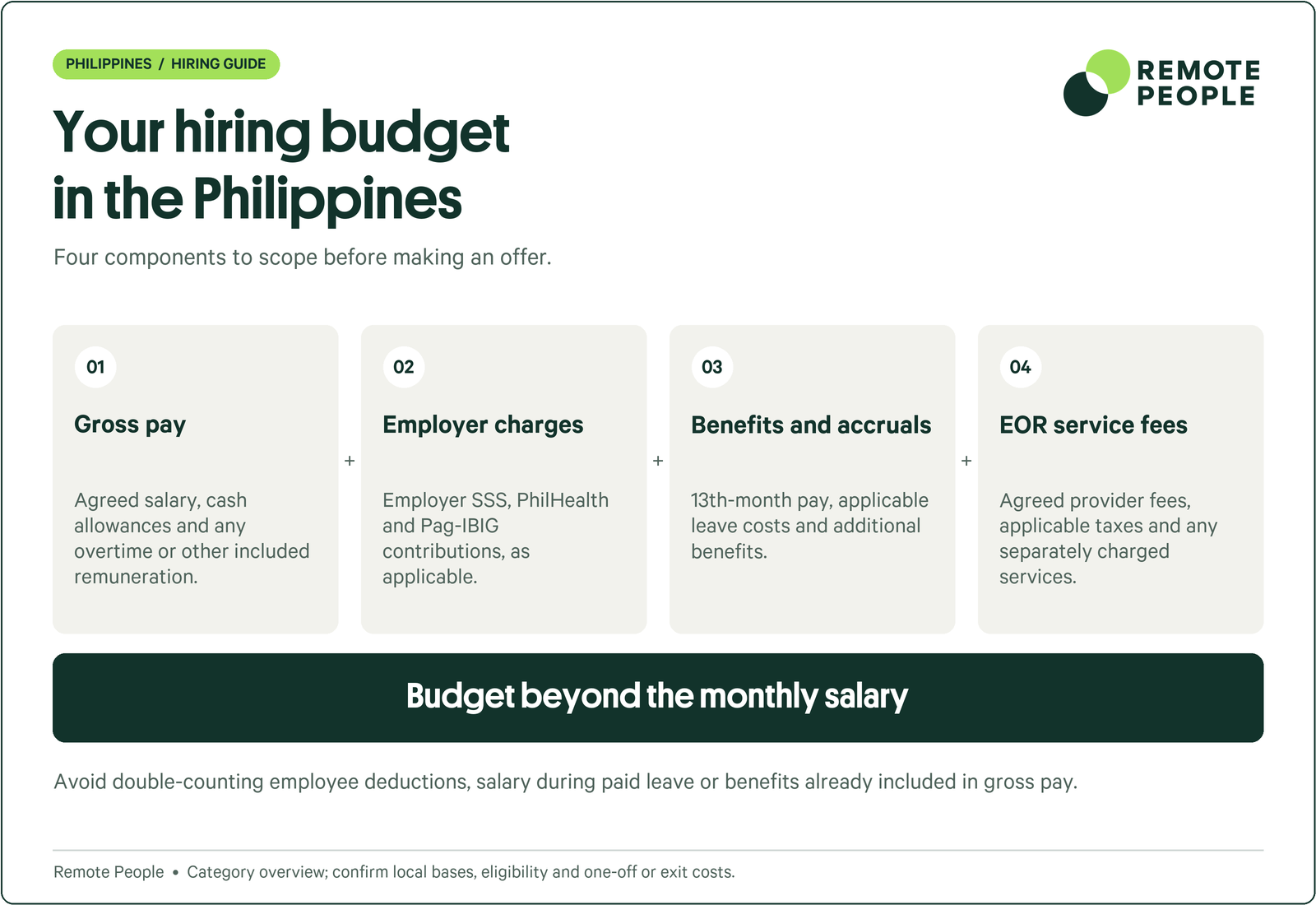
The following illustration assumes a covered rank-and-file employee earning PHP84,000 per month, entirely as basic salary, and an illustrative exchange rate of PHP56 per US$1. That is US$1,500 before employee deductions. It includes employer SSS and Employees’ Compensation contributions, the employer shares of PhilHealth and Pag-IBIG, a monthly provision for 13th-month pay, and a hypothetical US$450 EOR administration fee. The SSS and Pag-IBIG contribution bases reach their ceilings in this example; PhilHealth does not, because PHP84,000 is below its PHP100,000 monthly basic salary ceiling. This is a budgeting illustration, not a payroll quotation or a current exchange-rate quote.
Philippines employer cost illustration · PHP84,000 monthly basic salary · PHP56/US$1 | ||
Employer Cost | Amount (USD) | % of basic salary |
|---|---|---|
Monthly basic salary (PHP84,000) | $1,500.00 | 100.00% |
Employer SSS, including mandatory provident fund (10% × PHP35,000 MSC = PHP3,500) | $62.50 | 4.17% |
Employer Employees’ Compensation (PHP30) | $0.54 | 0.04% |
Employer PhilHealth (2.5% × PHP84,000 = PHP2,100) | $37.50 | 2.50% |
Employer Pag-IBIG (2% × PHP10,000 maximum fund salary = PHP200) | $3.57 | 0.24% |
Monthly provision for 13th-month pay (PHP84,000 ÷ 12 = PHP7,000) | $125.00 | 8.33% |
Hypothetical EOR administration fee (PHP25,200 equivalent) | $450.00 | 30.00% |
Total illustrated monthly budget (PHP122,030) | $2,179.11 | 145.27% |
Sources: SSS contribution schedule; PhilHealth premium advisory and 2026 confirmation; Pag-IBIG contribution rules in the UP Diliman administrators’ manual; DOLE 13th-month pay guidance. Contributions checked 22 September 2026. | ||
Assumptions: PHP56 per US$1 is used solely to illustrate the conversions. All PHP84,000 is basic salary, and the employee is covered by the statutory 13th-month pay requirement. USD amounts and percentages are rounded to two decimals; totals are calculated from PHP amounts before rounding. The US$450 EOR fee is hypothetical and is not a RemotePeople quotation. Additional benefits, overtime, holiday premiums, recruitment or visa services, termination costs, taxes on service fees and currency-conversion charges are outside this illustration and should be identified separately in the proposal.
In this example, employer contributions and the monthly 13th-month pay provision total PHP12,830, or US$229.11, above basic salary. The resulting employment-cost subtotal is PHP96,830 (US$1,729.11), 15.27% above salary before the EOR fee. Adding the hypothetical US$450 administration fee gives PHP122,030 (US$2,179.11), 45.27% above salary. Employee contributions and employee income tax are deductions from the gross salary already budgeted; they should not be added again as employer costs. Actual charges depend on the employee’s pay components, applicable benefits and the agreed provider fee.
Ready to hire in the Philippines? Get started with RemotePeople – we handle employment contracts, payroll, SSS, PhilHealth, Pag-IBIG, income tax withholding, and full Labor Code compliance. No local entity needed.
Benefits of Using an EOR in the Philippines
The EOR model in the Philippines solves the practical obstacles to hiring in a market with a common-law legal system, statutory minimum wage boards, and active SSS, PhilHealth, and Pag-IBIG oversight. Companies choose an EOR because it compresses the timeline, removes the fixed cost of incorporation and audits, and pushes the compliance risk onto a specialised provider:
- Speed to market: an EOR in the Philippines can onboard a compliant employee in 1–2 weeks, compared to 2–4 months to incorporate a Philippine company, obtain a Bureau of Internal Revenue certificate of registration, open a local bank account, and register with SSS, PhilHealth, and Pag-IBIG.
- Compliance assurance: the EOR tracks the Labor Code Articles 83–97 (working hours, overtime, leave), Article 95 (service incentive leave), Presidential Decree 851 (13th-month pay), wage orders from the National Wages and Productivity Commission, and the latest SSS, PhilHealth, and Pag-IBIG contribution rates on your behalf, with the legal employer carrying primary liability for non-compliance.
- Cost efficiency vs entity: entity setup in the Philippines involves approximately USD 2,000–5,000 in legal, incorporation, and bank account fees, plus ongoing annual compliance, statutory audit, and BIR return filing costs; an EOR avoids all of that with a flat per-employee monthly fee.
- Local expertise: RemotePeople’s in-country payroll team handles salary slips in Philippine pesos, SSS PR-03 submissions, PhilHealth and Pag-IBIG remittances, BIR withholding tax calculations, and wage order monitoring that would otherwise need a local HR function or an outsourced payroll firm.
- Flexibility to scale: adding a second or third Philippine employee is a standard onboarding; removing one is a termination with 30-day notice, separation pay calculation, and final pay within five days. No Department of Trade and Industry deregistration, bank account closure, or SSS deregistration is required.
- Risk mitigation: misclassification as contractor, under-remitted SSS, or missed BIR filings can trigger BIR assessments, back contributions, and penalties. The EOR absorbs that exposure and maintains the audit trail.
- Employee experience: employees get a compliant Philippine appointment letter, SSS and PhilHealth registration, accurate peso payroll, guaranteed 13th-month pay, and access to a dedicated HR support team for questions about leave, payroll, or benefits.
Ready to evaluate the EOR model for your Philippines hire? Talk to our team to map the specific timeline, cost, and compliance setup for your first employee.
Termination and Offboarding in the Philippines
Notice Periods
Under Article 300 of the Labor Code, either party must give 30 days written notice to terminate the employment of a regular employee. During the 30-day notice period, the employee must continue working and receiving regular wages. Alternatively, the employer may pay the employee 30 days’ wages in lieu of the notice period, allowing immediate separation. For probationary employees, no notice or severance is required; the employer may terminate at any point during the six-month probation period without cause, provided the termination is not unlawful (e.g., discriminatory or in retaliation for union organizing). For employees terminated for just cause (serious misconduct, willful disobedience, gross negligence), notice is waived, but the employer must follow the Labor Code Article 279 procedure: serving a written notice of charges, conducting a hearing, and issuing a reasoned decision, or the dismissal is presumed unfair.
Philippines statutory notice periods by employment category · Per Labor Code Articles 296–300 | |||
Employee Category | Notice Period | During Probation | Notes |
|---|---|---|---|
Regular employee (permanent status) | 30 days | Not applicable | Article 300; pay in lieu of notice permitted; applies to authorized and unauthorized causes |
Probationary employee (within 6-month probation) | None | Termination without notice or severance | Article 296; cannot be for an unlawful reason (discrimination, union activity, etc.) |
Dismissal for just cause | None (notice waived) | Applies to probationary and regular employees | Article 279; requires written charge, hearing, and reasoned decision; failure to follow procedure renders dismissal void |
Resignation by employee | 30 days (recommended best practice) | Not required; employer may waive | Article 300; employee may resign immediately in case of serious insult or inhumane treatment by employer |
Notice can be waived entirely only in cases of just cause proven through the Article 279 procedure, or by mutual written agreement. Termination of a regular employee without notice or without just cause is deemed “illegal dismissal” and entitles the employee to reinstatement with back wages, or to separation pay in lieu of reinstatement if reinstatement is not possible. Casual employees hired on a day-to-day or job-to-job basis for a specified project may be terminated at the end of the project without notice or severance provided the employment was truly temporary; the burden is on the employer to prove the casual or temporary nature of the role.
Separation Pay
Separation pay in the Philippines is a statutory benefit owed when an employee is terminated due to “authorized causes” under Article 298–299 of the Labor Code (closure of business due to serious losses, installation of labor-saving devices, redundancy, health reasons), but not for “just cause” (misconduct). Separation pay is also due when an employee is laid off due to retrenchment (reduction in workforce). The formula depends on the reason for termination: one month’s pay per year of service (or one-half month per year, whichever is higher) for redundancy or business closure, or one-half month per year of service for retrenchment or installation of labor-saving machinery. “Wages” for separation pay purposes includes basic salary and regular allowances but excludes bonuses, commission, and performance pay.
Philippines separation pay schedule by years of service · Per Labor Code Articles 298–299 | |||
Years of Service | Separation Pay Amount | Base Salary | Notes |
|---|---|---|---|
Less than 1 year | Nil (no separation pay) | Not applicable | Only applies to terminations for authorized or just cause after 6-month probation; no severance during probation |
1 year | 1 month’s pay (or 0.5 month for retrenchment) | Last month’s basic salary + regular allowances | Applies to authorized cause (closure, redundancy, illness); lower rate for retrenchment |
3 years | 3 months’ pay (or 1.5 months for retrenchment) | Calculated per completed year of service | Example: 1 month × 3 years or 0.5 month × 3 years |
5 years | 5 months’ pay (or 2.5 months for retrenchment) | Calculated per completed year of service | Fractions of a year count as full year if 6 months or more |
10 years | 10 months’ pay (or 5 months for retrenchment) | Last month’s basic salary | Example: 1 month × 10 years or 0.5 month × 10 years |
Calculation Method
The separation pay formula is straightforward: (last-drawn basic salary + regular monthly allowances) × number of completed years of service × the applicable rate (1 month per year for closure/redundancy, or 0.5 month per year for retrenchment). If an employee has worked more than six months in any given year, that period counts as a full year. For example, a five-year employee earning PHP 30,000 per month who is retrenched would receive 0.5 month × PHP 30,000 × 5 = PHP 75,000. Separation pay must be paid within five days of the effective date of separation, along with the employee’s final pay, accrued leave encashment, and 13th-month pay (if due).
Caps and Exceptions
There is no statutory cap on separation pay itself under the Labor Code. However, employees dismissed for just cause forfeit all separation pay entitlements. Probationary employees (within the first six months) are not entitled to separation pay regardless of the reason for termination. Fixed-term employees who complete a full term contract and are not renewed receive no separation pay unless the non-renewal is due to an authorized cause (business closure, retrenchment); if the contract was cut short, separation pay is calculated for the actual period worked. Employees who resign voluntarily receive no separation pay, even if they provide 30 days’ notice. Only terminations initiated by the employer for authorized business or health reasons trigger separation pay.
Grounds for Termination
The Labor Code recognises two main categories of lawful termination: just cause and authorized cause. Just cause dismissal (Article 279) includes serious misconduct (theft, fraud, habitual absenteeism), willful disobedience of lawful orders, gross negligence, commission of a crime against the employer or family members, and other serious infractions. The employer must serve a written charge, conduct a hearing with the employee’s right to be heard and represented, and issue a reasoned decision. Failure to follow this procedure renders the dismissal void and exposes the employer to reinstatement with back wages. Authorized cause termination (Article 298–299) includes business closure due to serious financial losses, retrenchment, installation of labor-saving devices, redundancy, and termination due to employee illness incompatible with continued service. Authorized cause terminations require 30 days’ written notice and separation pay. Mutual separation agreements are enforceable if documented in writing and not signed under duress. Protected categories (pregnant employees, union officers, employees on sick/medical leave) cannot be dismissed without court approval, and dismissal during these periods is presumed unfair.
EOR vs. Other Hiring Models in the Philippines
EOR vs. Setting Up a Local Entity
Setting up your own Philippine subsidiary requires incorporation with the Securities and Exchange Commission (SEC), registration with the Bureau of Internal Revenue (BIR), local Mayor’s Permit, SSS/PhilHealth/Pag-IBIG employer registration, and opening a Philippine peso bank account, a two-to-four month process with initial legal, notarial, and registration costs of roughly USD 2,000-5,000. The table below compares the EOR route against a self-operated entity across setup time, upfront and ongoing cost, compliance burden, and practical team-size thresholds. Use it to decide which vehicle fits your hiring plan and exit flexibility.
Philippines EOR vs local entity comparison · Setup time, cost, risk and best-fit | ||
Factor | Employer of Record | Own Philippine Entity |
|---|---|---|
Setup time | 1–2 weeks | 2–4 months |
Upfront cost | $0 | $2,000–$5,000 |
Ongoing cost | Agreed EOR administration fee, plus employment costs | $3,000–$8,000/year compliance + payroll |
Local partner required | No (EOR is the local entity) | No |
Social insurance registration | Handled by EOR | You manage it |
Payroll & tax filing | Handled by EOR | You manage it (or outsource) |
Best for team size | 1–15 employees | 15+ employees |
Scale down / exit | Easy – no entity to unwind | Costly – requires legal dissolution & tax clearance |
Government contracts | Not eligible | Eligible (requires local entity) |
For companies testing the Philippines market or hiring fewer than 15 employees, the EOR model is significantly faster and lower-cost. You skip the legal and bank setup, avoid annual audit and statutory compliance, and exit easily if the market doesn’t pan out. For companies planning to grow beyond 20 employees, hiring multiple teams long-term, or bidding on government contracts (which require a local entity), incorporation becomes the better choice economically. The EOR breaks even against a self-managed entity around the 15–20 employee mark, depending on local payroll outsourcing costs and whether you need government contract eligibility.
EOR vs. Hiring Independent Contractors
The Philippines applies strict worker-classification rules under Article 295 of the Labor Code and Department of Labor and Employment Order 174-17, using the four-fold and economic reality tests to distinguish employees from independent contractors. Treating a de facto employee as a contractor to avoid SSS, PhilHealth, Pag-IBIG, withholding tax, and 13th-month pay exposes you to back contributions, penalties, and possible criminal liability for the principal. The table below compares the two models across compliance risk, tax treatment, benefits, IP, and typical use cases so you can choose the right vehicle for each role.
Philippines EOR vs independent contractors · Compliance, cost, and risk | ||
Factor | EOR (Full-Time Employee) | Independent Contractor |
|---|---|---|
Legal relationship | Employee of the EOR; you control work and deliverables | Self-employed; contractor controls how work is performed |
Compliance risk | Low – EOR ensures Labor Code compliance | High – misclassification risk if relationship resembles employment |
Payroll & tax | EOR handles withholding, SSS, PhilHealth, Pag-IBIG, and BIR filings | Contractor invoices you; they handle their own taxes and contributions |
Benefits & leave | Statutory benefits: SSS, PhilHealth, Pag-IBIG, 13th-month pay, service incentive leave, maternity | No entitlement to employee benefits |
IP protection | Stronger – employment contract assigns IP by default under Labor Code | Weaker – requires explicit IP assignment clause in contract |
Termination | Subject to 30-day notice and separation pay obligations | Contract can be ended per agreement terms; no notice/severance required |
Best for | Long-term, core team roles; ongoing control over daily work | Short-term projects, specialized tasks, discrete deliverables |
Cost structure | Gross salary + employer contributions and benefits calculated under local rules + the agreed EOR administration fee. | Contractor fee (typically 20–50% higher gross rate, no overhead) |
The Philippines applies a strict “economic reality test” for employee vs contractor status, examining whether the worker is under your control, whether the work is part of your usual business, and whether the relationship resembles employment. Misclassification as a contractor when the relationship is truly employment exposes you to back SSS contributions, back PhilHealth premiums, back Pag-IBIG, income tax assessments, and penalties from the Department of Labor. The EOR eliminates this risk by establishing a clear employment relationship, handling all mandatory benefits, and maintaining audit documentation. Contractors make sense only for discrete, short-term projects where the contractor sets their own schedule and deliverables, and has no day-to-day management from you.
EOR vs. PEO (Professional Employer Organization)
In global hiring conversations, the terms EOR and PEO are often used interchangeably, but they describe distinct legal arrangements. An EOR is the sole legal employer of record abroad (which is why no local subsidiary is needed), while a PEO operates under a co-employment model that assumes you already own a Philippine entity and simply want to outsource HR administration and payroll processing. The table below sets out the key differences across legal employer, local-entity requirement, liability, and best-fit scenarios to help you pick the right model.
Philippines EOR vs PEO comparison · Legal employer, liability, and setup | ||
Factor | Employer of Record (EOR) | PEO (Professional Employer Organization) |
|---|---|---|
Legal employer | EOR is the legal employer; you are the operating/functional employer | Co-employment: both you and the PEO are legal employers |
Local entity required | No – the EOR is the local entity | Yes – you must have your own entity in the Philippines |
Best for | Companies without a local entity; market testing; small remote teams | Companies that already have a local entity; outsourcing HR on existing payroll |
Compliance liability | EOR assumes compliance responsibility; primary liability for Labor Code violations | Shared liability: you and PEO split responsibility depending on negligence |
Setup time | 1–2 weeks | Depends on your entity setup (weeks to months) |
Control over HR policies | EOR manages HR within Labor Code framework; limited customization | More direct control; PEO advises and implements your policies |
Typical use case | Market entry, small remote teams, testing new markets, rapid hiring | Established local operations needing HR outsourcing; reducing in-house HR burden |
The Philippines does not have a formal PEO regulatory framework like some countries. What exists locally are professional employment service providers that function as co-employers, requiring you to have an existing entity. If you already operate a Philippine company and want to offload payroll processing and HR administration, a local payroll service or professional services firm can help. But for hiring without a local entity (the core EOR use case), the Philippines PEO market is not established. The EOR is the appropriate vehicle for that scenario.
Public Holidays in the Philippines
Philippine public holidays are governed by the Administrative Code of 1987 (Executive Order 292) as amended by Republic Act 9492, and are finalised each year through a Presidential Proclamation issued by Malacañang Palace. Holidays fall into two statutory categories: regular holidays, which entitle employees to 100% pay even if they do not work and 200% pay if they do, and special non-working days, which follow the “no work, no pay” rule unless the employer’s policy or CBA provides otherwise. The 2026 calendar below reflects Proclamation 727 (s. 2025) and should be used as the baseline when configuring Philippine payroll and leave accruals.
Philippines public holidays · 2026 calendar year | ||
Date | Holiday Name | Type |
|---|---|---|
January 1 | New Year’s Day | Regular holiday (paid day off) |
February 10 | Feast of the Black Nazarene | Special non-working day (no pay, no work) |
February 25 | EDSA People Power Revolution Anniversary | Special working day (work continues, regular pay applies) |
March 28 | Maundy Thursday (Holy Thursday) | Special non-working day |
March 29 | Good Friday | Regular holiday |
March 30 | Black Saturday | Special non-working day |
April 9 | Day of Valor / Araw ng Kagitingan | Regular holiday |
April 10 | Eid’l Fitr (Tentative; Islamic calendar date) | Special non-working day (movable; subject to official declaration) |
June 12 | Independence Day | Regular holiday |
June 17 | Eid’l Adha (Tentative; Islamic calendar date) | Special non-working day (movable) |
August 21 | Ninoy Aquino Day | Regular holiday |
August 25 | National Heroes Day | Regular holiday (last Monday of August) |
November 1 | All Saints’ Day | Regular holiday |
November 30 | Bonifacio Day | Regular holiday |
December 8 | Feast of the Immaculate Conception | Regular holiday |
December 25 | Christmas Day | Regular holiday |
December 26 | Additional Special Day (Araw ng Pasasalamat / Family Day) | Regular holiday |
December 30 | Rizal Day | Regular holiday |
December 31 | New Year’s Eve | Special non-working day (no pay, no work) |
Regular holidays are days off with pay; employees working on regular holidays are entitled to double pay plus overtime compensation if hours exceed 8. Special non-working days are days off without pay (unless the employee chooses to work, in which case regular pay applies), and are typically used for religious observances. The EDSA People Power Revolution Anniversary (February 25) in 2026 is declared a special working day, meaning work and classes continue as usual with regular pay. Islamic holidays (Eid’l Fitr and Eid’l Adha) are observed as special non-working days each year; exact dates follow the lunar Islamic calendar and are proclaimed by Malacañang Palace typically in late December for the following year. Employers must monitor official proclamations from the Office of the President for any last-minute additions or changes to the holiday calendar.
How to Get Started with an EOR in the Philippines
- Confirm your hiring needs and timeline. Identify the role, salary, and start date for your first Philippine employee. Determine whether a work visa is required (non-Philippine nationals) and which region the employee will be based in (relevant for minimum wage and RTWPB coverage).
- Contact RemotePeople and provide employee details. Share the candidate’s full name, email, mobile number, job title, proposed salary in USD or PHP, start date, and work location. We will provide an estimate of total cost including employer contributions, EOR service fee, and 13th-month pay accrual.
- Review and sign the EOR service agreement. Our terms cover employment contracting, payroll processing, statutory reporting, leave tracking, termination procedures, and compliance responsibilities. The agreement outlines the scope of services and any add-on fees for supplementary benefits or work visa sponsorship.
- Prepare the employment contract and onboarding documents. We draft a Labor Code-compliant appointment letter specifying job title, wages, probation period (up to 6 months), notice period (30 days), place of work, and benefits. You and the employee review, sign, and return to us within 2–3 days.
- Initiate SSS, PhilHealth, and Pag-IBIG registration and payroll setup. Once the signed contract is received, we file applications with the SSS, PhilHealth, and Pag-IBIG, collect the employee’s bank details for peso salary transfer, and verify BIR tax number details. This phase takes 3–7 days. For work visa cases, we simultaneously file the Alien Employment Permit (AEP) application with the Department of Labor and Employment; once the AEP is issued, the employee applies for the 9(g) Pre-Arranged Employment Visa at the Bureau of Immigration.
- Employee starts work and first payroll processes. On the agreed start date, the employee begins work, and you activate them in your internal systems. We process the first month’s payroll in Philippine pesos, withhold income tax and SSS/PhilHealth/Pag-IBIG contributions, and transfer the net salary to the employee’s bank account by the 10th of the following month. The employee receives a detailed salary slip showing all deductions and year-to-date totals.
Ready to hire in the Philippines? Get started with RemotePeople today – we handle the entire employment setup, payroll, statutory reporting, and Labor Code compliance so you can focus on building your team.
Where companies hiring in the Philippines expand next
Teams hiring in the Philippines typically expand across ASEAN, where cross-border mobility and diverse multilingual talent make regional coverage natural. Teams frequently add hiring in Vietnam for ASEAN-wide talent flows and shared hiring norms; an EOR partner in Thailand often follows for ASEAN integration and cross-border mobility; Singapore is a common next step, offering the ASEAN single-market trade framework; and a team in Indonesia rounds out the regional footprint with overlapping ASEAN labor and mobility rules.
Frequently Asked Questions
Your total budget includes gross salary, employer statutory contributions, applicable benefits and accruals, plus the EOR administration fee agreed in your proposal. The administration fee is separate from the money used to pay salary, contributions and 13th-month pay. The worked example on this page uses PHP84,000 monthly basic salary, PHP56 per US$1 and a hypothetical US$450 administration fee, producing an illustrated total of US$2,179.11 per month. Request a Philippines proposal for current pricing, inclusions and any additional charges.
For Philippine nationals without a work visa, onboarding typically takes 1–2 weeks from agreement signature to first day of work. For foreign nationals requiring a 9(g) work visa, add 6–12 weeks for Alien Employment Permit and Bureau of Immigration processing, or 12–16 weeks for nationalities subject to enhanced security clearance.
Yes. Thirteenth-month pay is mandatory under Presidential Decree 851 and must be paid on or before December 24 each year. Maternity leave is 105 days paid under Republic Act 11210, with an additional 15 days for solo parents. Both benefits are non-waivable.
A foreign national can work in the Philippines only with a valid 9(g) Pre-Arranged Employment Visa and Alien Employment Permit (AEP) issued by the Department of Labor and Employment. An EOR handles the sponsorship and filing process on your behalf. If you have your own Philippine entity, you can sponsor the visa yourself, but the AEP application and visa processing are still required.
The Philippines has "service incentive leave" (5 days per year after 1 year of continuous service), not vacation leave per se. Service incentive leave does not carry over to the next year unless the company chooses to allow encashment. There is no statutory vacation leave separate from service incentive leave in the Labor Code.
Termination for authorized business causes (redundancy, closure, retrenchment) requires 30 days written notice and separation pay of one month per year of service. Termination for just cause (misconduct) requires a written charge, employee hearing, and reasoned decision per Article 279 of the Labor Code; no notice or severance is owed. Terminating a regular employee without notice or severance is "illegal dismissal" and exposes you to reinstatement with back wages.
Yes. Effective January 1, 2025, the SSS contribution rate increased from 14% to 15% (10% employer, 5% employee), and the maximum monthly salary credit ceiling rose to PHP 35,000. Effective July 18, 2025, the National Capital Region (NCR) daily minimum wage increased to PHP 695 for non-agricultural workers. Regional rates vary and are updated periodically by the National Wages and Productivity Commission (NWPC).
No. An EOR is a registered Philippines company licensed to operate as a legal employer under the Labor Code. RemotePeople maintains its own Philippines-registered entity that serves as the legal employer for your staff, so you do not need to incorporate a separate company. The EOR entity is our responsibility to maintain and operate.