
 Recruit
Employer of Record in Portugal
-
 Drew Donnelly
- Published
- July 22, 2026
RemotePeople’s employer of record in Portugal lets you hire employees in Portugal with full social security compliance. We handle monthly social security contributions of 23.75% from employers, mandatory workman compensation insurance for work accidents, and 11% employee contributions for retirement and unemployment.
Hire in Portugal — book a free 30-minute demo
Tell us what you need. You'll get a tailored, transparent proposal within 24 hours, plus a free call to walk through it.
Tell us about your company
So we can match you with a specialist who knows your market — and unlock volume pricing tiers.
* All fields are required.
Where and when are you hiring?
Tell us the geography and timing and we'll quote each country line by line, with onboarding timelines.
* All fields are required.
Help us beat your current setup
We'll benchmark your current deal and send a line-by-line proposal in 24 hours — showing exactly where we cut cost, time, or risk. After you submit, you can book a call to walk through it together.
* All fields are required.
Thanks! Your proposal is on its way.
Expect a tailored, line-by-line proposal in your inbox within 24 hours. In the meantime…
Want to walk through it together?
Book a free 30-minute call with one of our specialists. We'll explain every line, answer your questions, and tailor the proposal further if you need.
No obligation. Pick a time that works for you.








- Hire in Portugal — book a free 30-minute demo
- Tell us about your company
- Where and when are you hiring?
- Help us beat your current setup
- Thanks! Your proposal is on its way.
- How an Employer of Record Works in Portugal
- Employment Laws and Regulations in Portugal
- Work Permits and Visas in Portugal
- Payroll, Taxes, and Social Security in Portugal
- Cost of Hiring Through an EOR in Portugal
- Benefits of Using an EOR in Portugal
- Termination and Offboarding in Portugal
- EOR vs. Other Hiring Models in Portugal
- Public Holidays in Portugal
- How to Get Started with an EOR in Portugal
- Where companies hiring in Portugal expand next
- Frequently Asked Questions
- Related EOR Destinations

Start hiring in Portugal
Let RemotePeople handle payroll, compliance, and HR admin worldwide so you can focus on building your team.

Portugal offers access to one of Europe’s most dynamic and English-fluent talent markets, with vibrant professional clusters in Lisbon and Porto, a regulatory environment consistently ranked high by international business indices, and an economy increasingly competitive in tech, green energy, and financial services. For companies looking to hire employees in Portugal, the challenge is that setting up a Portuguese legal entity typically takes eight to twelve weeks, requires registration with the Conservatória do Registo Comercial (Commercial Registry), triggers mandatory social security and tax registration with Segurança Social and the Autoridade Tributária, and exposes the business to employer social security contributions of 23.75% on top of gross salary plus additional statutory benefits including mandatory 13th and 14th month salary payments. An employer of record in Portugal solves this by hiring workers on your behalf through an existing Portuguese entity, handling the employment contract in Portuguese or English under the Código do Trabalho (Labour Code), all employee insurance registration with Segurança Social, and full compliance with Portuguese labour law and tax requirements. Your team can start within one to two weeks, and you never need to register a company in Portugal.
This guide explains how an EOR works in Portugal, what Portuguese labour law requires, the real cost of hiring, and how EOR compares to setting up a local entity or hiring contractors. All figures reflect rates and legal requirements in force as of 1 January 2026.
How an Employer of Record Works in Portugal
What Is an EOR?
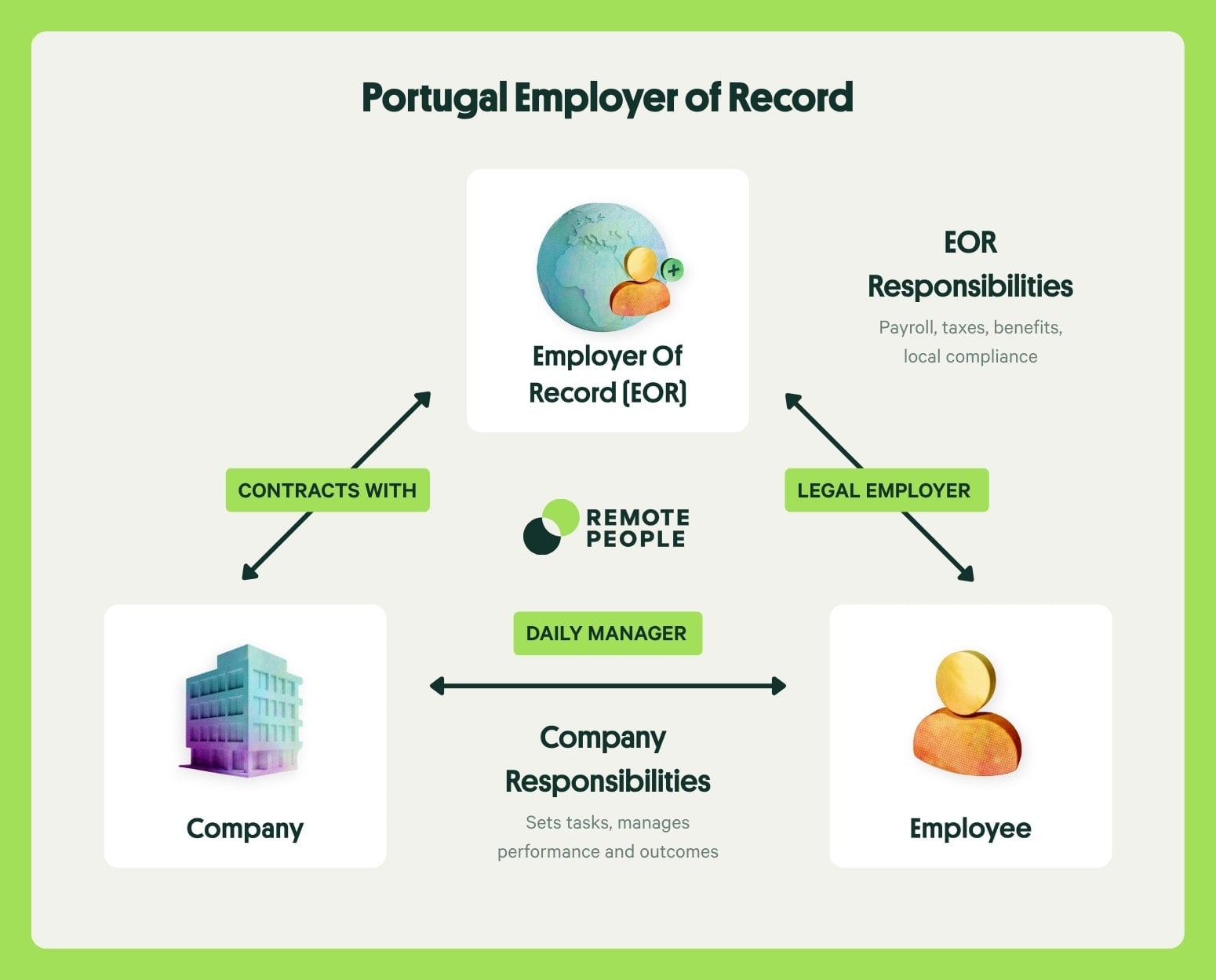
Who Uses an EOR in Portugal?
Portugal is a growing hub for remote work, tech innovation, and international talent, with English-fluency rates above 85% in professional sectors and time-zone advantages for serving both European and international markets. Typical use cases for EOR include:
Companies typically engage a Portugal EOR in four scenarios. The most common is testing the Portuguese market before committing to a legal entity — firms hiring one or two initial employees use an EOR to validate demand, local talent availability, and operational cost before setting up a Sociedade por Quotas. A second frequent use case is hiring remote specialists (software engineers, designers, data scientists) based in Lisbon, Porto, or the Algarve when the employer has no EU presence.
Third, a Portugal EOR is routinely used by companies that have acquired or merged with a Portuguese team and need an interim employer while corporate structuring is resolved — this can take 6–12 months and an EOR keeps payroll compliant during the transition. Fourth, project-based employers running time-bound engagements (6–36 months) choose an EOR to avoid the overhead of standing up and winding down a Portuguese entity for a finite project.
Businesses expanding into Portugal usually work with an EOR while they decide whether long-term headcount justifies the fixed cost of a local entity. Once a team exceeds fifteen to twenty employees, a Portuguese entity typically becomes more cost-efficient than ongoing EOR fees.
Typical Onboarding Timeline
A compliant hire through an EOR in Portugal typically takes seven to ten business days from signed service agreement to first day of work.
- EOR agreement and employee details: 1–2 days to share the candidate’s passport, taxpayer identification number (NIF), national identity card copy, qualifications, employment contract terms, and start date.
- Employment contract drafting and review: 2–3 days for the EOR to prepare the Portuguese or English contract under Article 106 of the Código do Trabalho, align it to any applicable collective bargaining agreement, and obtain signatures.
- Segurança Social and Autoridade Tributária registration: 2–3 days to register the worker for social security contributions, income tax withholding, and to obtain a unique social security identification number (número de segurado).
- Payroll setup and benefits enrolment: 2–3 days to load the employee into payroll, set up the correct IRS tax withholding bracket, activate health insurance deductions, and configure the mandatory 13th and 14th month salary accrual.
- Employee onboarding and first day: 1 day for IT access, company policies, and orientation.
Most EOR providers can onboard an employee in Portugal within one to two weeks. Non-EU nationals who need a work permit (D-visa such as the Highly Skilled Worker permit or EU Blue Card) add two to four weeks to the timeline because AIMA must approve the residence permit before the employee can start work.
Hire in Portugal
Ready to hire top talent in Portugal without opening a local entity? RemotePeople’s Portugal EOR handles contracts under the Código do Trabalho, Segurança Social registration, IRS withholding, the mandatory 13th and 14th month salaries, and full Portuguese labour-law compliance. Onboard your first employee in Portugal in 7–10 business days.
Employment Laws and Regulations in Portugal
Employment Contracts
The Portuguese employment relationship is governed by the Código do Trabalho (Labour Code, Law 7/2009), enforced by the Autoridade para as Condições do Trabalho (Labour Authority) and interpreted by Portuguese courts. Article 106 of the Código do Trabalho requires the employer to provide the employee with a written statement of the essential terms within one month of commencement, including job description, salary, working hours, holidays, notice period, and any applicable collective agreement (WIPO Lex – Código do Trabalho (Labour Code)). Failure to provide the written statement in a timely manner creates a presumption of an indefinite contract on the terms most favourable to the employee.
Contracts may be indefinite (contrato por tempo indeterminado) or fixed-term (contrato por tempo determinado). Under Article 142 of the Código do Trabalho, fixed-term contracts can be renewed up to a maximum of two renewals, with the total term not exceeding three years; the third renewal or the renewal that exceeds three years automatically converts the contract to indefinite. Portuguese or English is acceptable for the written contract, so long as the employee can reasonably understand the language chosen.
Working Hours and Overtime
The Portuguese working week is limited to 40 hours on average, with a maximum of 8 hours per day under Articles 226–231 of the Código do Trabalho. Employees are entitled to a minimum daily rest of 11 consecutive hours, a weekly rest day of 24 consecutive hours (usually Sunday), and a 30-minute break after 5.5 hours of work (WIPO Lex – Código do Trabalho, Articles 226–231). Managerial staff earning more than three times the statutory minimum wage may be exempt from some working-hours restrictions by written agreement.
Overtime is limited to a maximum of two hours per day and 150 hours per year (or up to 175 hours per year in companies with fewer than 50 employees). The compensation for overtime varies by the tier and circumstance of the overtime hours, with statutory minimums defined in the labour code. The table below summarises the overtime premium-pay framework in force under the Código do Trabalho.
Portugal overtime and premium pay rates · Per Código do Trabalho Articles 226–231 | |||
Hour Type | Rate Multiplier | Weekly/Daily Cap | Notes |
|---|---|---|---|
Weekday overtime (first hour, years 1–3) | 125% | 2 hrs/day, 150 hrs/year | Applies to the first overtime hour on regular working days. After 100 hours of overtime in the calendar year, first hour moves to 150%. |
Weekday overtime (additional hours, after 100 hrs/year) | 150%–175% | Tiered 2 hrs/day | After 100 hours of overtime annually, additional overtime jumps to 150%. Further tiers may apply beyond 150 hours (175% for second tier). |
Saturday work (non-scheduled) | 150% | By agreement | When Saturday is not a scheduled workday, compensation is 150% of normal rate. |
Sunday work and public holidays | 200% | By agreement, with compensation or time off | Work on Sunday or a public holiday is compensated at 200% of normal rate, or compensated with an equivalent day off. |
Night work (00:00–06:00) | 130%–150% | 7 hours/shift on average | Night shift work is paid at a premium set by collective agreement, typically 130–150% of base hourly rate. Employer must ensure medical check annually. |
Overtime does not qualify for the subsidised social security rate (if applicable) and is taxed at the employee’s marginal income tax rate. Overtime compensation is also included in the base for calculating 13th and 14th month salary bonuses.
Minimum Wage
From 1 January 2026, Portugal’s statutory minimum wage is €920 per month gross, an increase of €50 from the 2025 rate of €870, set by Decree-Law No. 139/2025 published 29 December 2025 (PwC Portugal – Minimum Wage 2026). This hourly rate translates to approximately €5.75 per hour for a standard 40-hour workweek. The minimum wage applies across all sectors unless a collective bargaining agreement sets a higher sector-specific floor.
The government has announced a roadmap targeting a €1,020 monthly minimum wage by 2028, with annual increases planned. Minimum wage is legally binding and supersedes any lower wage in an employment contract or collective agreement.
Probation Period
Under Article 112 of the Código do Trabalho, probation periods for open-ended contracts typically last 90 days for standard roles, and can be extended to 180 days for roles requiring technical expertise and responsibility, and up to 240 days for senior managerial positions. During probation, either party can terminate the contract without cause and without notice, provided that for probation periods exceeding 60 days the employer must provide 7 days’ notice, and for probation periods exceeding 120 days the employer must provide 30 days’ notice. No severance is owed during the probation period unless a collective agreement provides otherwise.
Leave Entitlements
Portugal provides a comprehensive statutory leave framework combining annual paid leave, sick leave, and extensive parental leave provisions funded by Segurança Social. Leave entitlements accrue based on tenure and are governed by Articles 258–299 of the Código do Trabalho.
Annual Leave
Employees are entitled to a minimum of 22 working days of paid leave per calendar year, subject to completion of the probation period (WIPO Lex – Código do Trabalho, Article 258). In the first year of employment, during or after the probation period, the entitlement accrues on a pro-rata basis of two working days for each month of service. Annual leave must be taken within the calendar year plus a carryover period of six months into the following year; any unused balance after that deadline is forfeited unless the employee was prevented from taking leave by employer-imposed circumstances. Unused leave days at termination must be paid out at the rate of the employee’s last earned salary.
Sick Leave
Sick leave is employer-paid for the first three days of any continuous illness, and thereafter is covered by Segurança Social (social security) at 55% of the employee’s reference salary for days 4–30, and 60% for days 31 onwards (Segurança Social – Leave and Parental Support). A medical certificate is required from the fourth consecutive day of illness. The employer continues to pay the employee’s social security contributions during the entire sick leave period.
Maternity Leave
Maternity leave comprises a minimum of 42 days, comprising at least 6 weeks of post-birth leave (pós-parto), with up to 4 weeks available pre-birth (pré-parto) by choice of the mother. The mother may extend leave to a maximum of 120 days (or 150 days if shared with the father) at an 80% salary replacement from Segurança Social for the additional days beyond the mandatory 42 (Segurança Social – Leave and Parental Support). The employer pays the full 42 mandatory days at 100% salary; Segurança Social funds any extension. Job protection under Article 263 of the Código do Trabalho prohibits dismissal during pregnancy and for the first 30 days after maternity leave begins.
Paternity Leave
Paternity leave (licença parental) provides up to 28 days of leave following a child’s birth, with the first 7 consecutive days paid at 100% by the employer and the remaining 21 days paid at 80% by Segurança Social. The 7 employer-paid days must be taken within 30 days of the child’s birth.
Other Statutory Leave
Portuguese law recognises several further statutory leave categories:
Several additional statutory leave categories apply in Portugal under the Código do Trabalho. Shared parental leave allows both parents to split the 150-day extended parental period, with Segurança Social paying 80% of reference earnings; exclusive father’s leave is 28 working days (20 mandatory + 8 optional) within six weeks of birth. Sickness leave is unpaid by the employer from day one but covered by Segurança Social at 55% of reference earnings after a 3-day waiting period (higher rates after 365 days of illness under Article 250).
Bereavement leave (luto) provides 5 consecutive days for a spouse, child, or parent, and 2 days for a sibling, grandparent, or in-law under Article 251. Marriage leave (casamento) entitles the employee to 15 consecutive days, and caregiving leave allows up to 15 days per year to care for a seriously ill immediate family member. Jury duty and court appearances are treated as justified absences with pay maintained by the employer for the duration required.
Together, these entitlements give Portuguese employees a combined statutory leave envelope that can exceed 10 weeks per year once parental leaves are fully utilised. The table below summarises the statutory minimums under the Código do Trabalho and Segurança Social legislation.
Portugal statutory leave entitlements · Per Código do Trabalho Articles 258–299 | ||
Leave Type | Duration | Eligibility & Notes |
|---|---|---|
Annual leave | 22 working days minimum per year | Paid by employer at 100%. Accrues pro-rata (2 days/month) during first year. Must be taken within calendar year plus 6-month carryover; unused days forfeited or cashed out at termination. |
Sick leave (first 3 days) | 3 days per illness, employer-paid | Paid at 100% of salary by employer. Days 4+ covered by Segurança Social at 55–60% of reference salary. |
Maternity leave | 42 days minimum (120–150 possible if extended) | 42 days mandatory at 100% salary (employer-paid). 6+ weeks post-birth. Extensions to 120–150 days at 80% (Segurança Social-paid). Shared with father possible. |
Paternity leave | 28 days total (7 + 21) | First 7 days at 100% (employer). Remaining 21 days at 80% (Segurança Social). Must start within 30 days of birth. |
Shared parental leave | Up to 30 days per parent (60 days total shareable) | Taken after mandatory maternity/paternity. Up to 60 days available on part-time (half-day) basis. Paid at 80% by Segurança Social. |
Childcare leave | 5 working days per child per year | Employer-paid. For medical appointments, school activities, or child health emergencies. |
Bereavement leave | 3–5 days typical | Paid by employer. Death of spouse, child, parent, or close relative. Amount set by collective agreement or employer policy. |
Marriage leave | 2–3 days typical | Paid by employer. Amount varies by collective agreement. |
Statutory Employee Benefits
Beyond wages and leave, Portuguese law obliges the employer to provide and fund a comprehensive package of mandatory benefits administered through Segurança Social and supplemented by collective bargaining agreements where applicable.
Portuguese employees are entitled to a comprehensive statutory benefits package codified in the Código do Trabalho and the Código Contributivo. Social security pension contributions fund a retirement pension based on lifetime earnings — employers contribute 23.75% of gross salary, employees contribute 11%. Universal healthcare is provided free at the point of use through the Serviço Nacional de Saúde (SNS), financed through employer social security contributions and general taxation; private health insurance is optional but common as an employer top-up.
The two mandatory extra salaries are defining features of Portuguese employment: the 13th month (Subsídio de Férias) is paid in June as one additional month’s gross salary, and the 14th month (Subsídio de Natal) is paid in December. Both may be pro-rated for partial years and may be spread across the 12 regular salaries by agreement. Employees also receive state-funded unemployment insurance, parental leave (120 or 150 days at 100% or 80% of salary respectively, funded by Segurança Social), 22 working days of paid annual leave, and work accident insurance covering medical costs and lost-earnings compensation under Law 98/2009.
An EOR enrols the employee in the correct social security contributions, manages the Work Compensation Fund registration, and ensures the 13th and 14th month salaries are accrued and paid correctly so the foreign employer never has to interact directly with Segurança Social or the Autoridade Tributária.
Recent Regulatory Updates (2026)
The most significant recent employment law reform in Portugal is the Agenda do Trabalho Digno (Decent Work Agenda), Law 13/2023, which came into force in 2024 and establishes several new protections and obligations. The reform strengthens remote work regulation, employee classification rules, and termination protections.
From a payroll perspective, the 2026 minimum wage increase of €50 per month (to €920) continues the government’s multi-year roadmap targeting €1,020 by 2028. No major changes to social security contribution rates or income tax brackets are scheduled for 2026 beyond the annual inflation adjustments to wage ceilings and benefit maximums. The Autoridade Tributária has confirmed that the 2026 IRS brackets and surcharges remain unchanged from 2025. Employers should monitor the official Diário da República (Official Gazette) for any late decree-laws affecting social security rates, which are occasionally adjusted mid-year to reflect macro-economic conditions.
Work Permits and Visas in Portugal
Work Permit Requirements
Who Needs a Work Permit
EU, EEA, and Swiss nationals do not need a work permit to work in Portugal. They can register with the municipal authority (junta de freguesia) and start work immediately upon arrival. Non-EU nationals require a residence permit that includes work authorization. The type of permit depends on the role, salary, qualifications, and the employer’s status as an approved employer (entidade empregadora aprovada) with AIMA (Autoridade para as Migrações).
Eligibility and Required Documents
Common documents required for a Portuguese work-related residence permit include a valid passport, a signed employment contract, proof of qualifications (university diplomas, with official verification for non-Portuguese degrees), proof of sufficient salary (payslips, employment contract), a criminal record declaration, and a tuberculosis or health screening (for specific nationalities and visa types). For EU Blue Card and Highly Skilled Worker permits, the sponsoring employer must hold recognised-employer status with AIMA.
Processing Time and Validity
A Highly Skilled Worker or EU Blue Card application filed by an approved employer typically takes two to four weeks to process. A standard work permit (AIMA-administered Category D visa) can take up to six to eight weeks because of administrative processing. The initial residence permit is valid for up to two years (renewable for up to three years). Delays are most often driven by incomplete documentation, unclear salary proof, a mismatch between the salary and the visa threshold, or backlogs in AIMA processing.
Renewal Process
Renewal applications should be filed at least 30 days before the permit expires. For Highly Skilled Worker visas, renewal is granted when the salary remains above the threshold and the employer is still an approved employer. The employee can continue working during the renewal if the application is filed before expiry.
Common Visa Types for Foreign Workers
The Autoridade para as Migrações (AIMA) issues several residence-and-work permits aimed at professional and remote workers. An approved-employer EOR can file the application, track progress with AIMA, and handle residence registration at the municipal level upon permit approval. Tourist and Schengen visas do not permit paid employment.
Portugal work visa types for foreign workers · 2026 | ||||
Visa Type | Duration | Best For | Leads to APT? | Processing |
|---|---|---|---|---|
Highly Skilled Worker (Category D) | Up to 2 years, renewable up to 3 years | Knowledge workers, tech, finance, and specialized roles earning ≥€1,258/month (or sector-specific thresholds) | Yes, pathway to permanent residency after 5 years | 2–4 weeks (with approved employer) |
EU Blue Card | Up to 4 years | Highly qualified workers with university degree and salary ≥€2,566/month | Yes; transferable within the EU | 2–4 weeks (with approved employer) |
Digital Nomad (D8) | 1 year (temporary) or 2–4 years (residency) | Remote workers, freelancers, independent contractors with ≥€3,680/month income from abroad | Yes, pathway to permanent residency (no employer sponsorship needed) | 4–8 weeks |
Intra-Corporate Transfer (ICT) | Up to 3 years (managers/specialists); 1 year (trainees) | Internal transfers from a non-EU group company to Portugal subsidiary | No (temporary, work-permit only) | 2–4 weeks (with approved employer) |
Startup Visa (D2) | 2 years, renewable for 3 years | Entrepreneurs and founders working with a Portuguese incubator or acceleration partner on an innovative tech project | Yes, pathway to permanent residency and citizenship after 5 years | Up to 10 months (through incubator vetting) |
Non-employment visas do not permit paid work in Portugal:
Three visa and residence categories are most common for non-EU hires. The Schengen short-stay visa allows up to 90 days within any 180-day period for business visits, meetings, and initial scoping — it does not permit paid work in Portugal. The D3 “Highly Qualified Activity” residence visa is the primary route for skilled non-EU hires, requiring a Portuguese employment contract, proof of qualifications (typically a university degree), and a salary of at least 1.5× the average gross Portuguese salary. The EU Blue Card, issued under Directive 2009/50/EC as transposed by Law 23/2007 (Article 61-A), is the pan-European alternative with a higher salary threshold (1.5× the national average) and enables intra-EU mobility after 18 months.
How an EOR Handles Work Permits
An EOR that holds approved-employer (entidade empregadora aprovada) status with AIMA can sponsor Highly Skilled Worker and EU Blue Card visas on your behalf, file the application directly with AIMA, and manage the residence registration at the local junta de freguesia. The EOR absorbs the compliance obligations that come with approved-employer status (annual audits, salary verification, record-keeping). For Digital Nomad (D8) and Startup Visa (D2) visas, the EOR can assist with documentation but the employee or founder applies directly with AIMA or through an incubator partner. The EOR’s role is to provide the employment contract, salary proof, and any supporting letters needed for the visa application.
Payroll, Taxes, and Social Security in Portugal
Employer Contributions
Portugal’s employer social security contributions are defined by Decreto-Lei 110/2009 (regulating Law 110/2009, the Social Security Code) and administered by Segurança Social. Employers withhold and remit a fixed base contribution of 23.75% on gross salary, plus variable rates for work accident insurance and the Fundo de Compensação do Trabalho. The table below summarises the 2026 contribution rates employers pay on top of gross salary.
Portugal employer social security contributions · 2026 rates | ||
Contribution | Rate | Notes |
|---|---|---|
Social security pension (old-age, disability, survivors) | 23.75% | Capped at annual wage ceiling (approx. €50,000 in 2026). Mandatory for all employees. |
Work accident and occupational disease insurance | 1.5–1.75% | Varies by industry risk classification (office work ~1.5%, construction ~2.5% or higher). Calculated on gross salary. |
Fundo de Compensação do Trabalho (Work Compensation Fund) | 0.925% | Employer contribution to fund severance payments in case of employer insolvency. Calculated on gross salary. |
Total Employer Contribution | 26.175–26.425% | Typical range (using 1.5% work accident rate). Sum of all lines above. |
Employee Contributions
Portuguese employees contribute a flat 11% of gross salary to Segurança Social, withheld at source by the employer. This single rate funds pensions, unemployment benefits, sickness, maternity, and other statutory benefits under the Portuguese Social Security Code. The table below lists 2026 employee payroll deductions.
Portugal employee payroll deductions · 2026 monthly withholdings | ||
Deduction | Rate | Notes |
|---|---|---|
Social security pension (employee share) | 11% | Deducted from gross salary. Capped at annual wage ceiling (approx. €50,000 in 2026). Mandatory for all employees. |
Income tax (IRS) withholding | 13.25%–48% (progressive) | Depends on gross salary and filing status. 9 brackets in 2026, with municipal and solidarity surcharges (0–5%) applied above certain thresholds. Calculated from gross minus social security deduction. |
Total Employee Deductions | 24.25%–59% | Approximate range. Low salary (€920, lowest bracket): ~24%. High salary (€100,000, top bracket + solidarity): ~59%. |
Income Tax
Portugal applies progressive personal income tax (IRS) under the Código do IRS, with nine brackets ranging from 13.25% to 48% for 2026 (PwC Portugal Tax Guide). Employers withhold IRS monthly under the retenção na fonte system and remit to the Autoridade Tributária e Aduaneira. The table below shows the 2026 IRS bracket schedule.
Portugal income tax brackets · 2026 | |
Taxable Income Bracket (EUR) | Tax Rate |
|---|---|
Up to €7,703 | 13.25% |
€7,704 – €11,623 | 16.5% |
€11,624 – €16,472 | 22% |
€16,473 – €21,321 | 25% |
€21,322 – €27,146 | 32% |
€27,147 – €39,791 | 35.5% |
€39,792 – €51,997 | 43.5% |
€51,998 – €81,199 | 45% |
Above €81,199 | 48% |
In addition to the base IRS brackets, employees in Portugal may be subject to municipal surcharges (autarquia, typically 0–1.5%) and solidarity surcharges (derrama solidária) of 2.5% on income above €80,000 and up to 5% on income above €250,000. These surcharges are applied on top of the base rate. The EOR calculates the correct withholding using the Autoridade Tributária’s monthly tax tables and ensures the correct amount is remitted to the tax authority.
Payroll Cycle
Payroll is typically processed monthly, with salaries paid by bank transfer to the employee’s Portuguese IBAN by the last working day of the month. Payslips (recibos verdes) must be provided in Portuguese or in English with a Portuguese translation. The EOR files monthly payroll tax returns (declarações de impostos retidos) with the Autoridade Tributária within 10 days of the end of the month. Social security contributions are remitted monthly to Segurança Social, also by the 10th of the following month. No cash payments are permitted for salary in modern Portugal; all compensation must be paid via bank transfer.
13th Month Salary and Bonus Pay
The 13th month salary (Subsídio de Férias) and 14th month salary (Subsídio de Natal) are mandatory payments under Article 263 of the Código do Trabalho. Both are calculated as one month of the employee’s base gross salary (excluding overtime and other irregular payments) and are paid twice per calendar year: the 13th month in June and the 14th month in December (REDUNIQ – 13th & 14th Month Salary Obligations). These are mandatory statutory benefits, not discretionary bonuses.
For employees who have not completed a full calendar year of service, both the 13th and 14th month salaries are pro-rated based on the number of months worked. For example, an employee hired on 1 July is entitled to receive six-twelfths (50%) of both the 13th and 14th month payments. The calculation includes only the months during which the employee was employed; probation periods are included. Upon termination, any accrued 13th and 14th month salary that has not yet been paid must be paid as part of the final settlement.
Cost of Hiring Through an EOR in Portugal
EOR Service Fees
EOR service fees in Portugal typically range from $300 to $600 per employee per month, depending on the provider, service level, and contract volume. This all-inclusive fee covers employment contract management, payroll processing, tax withholding, social security registration and contributions, benefits administration, leave tracking, and termination compliance. Some providers charge at the lower end ($300–$400) for straightforward hires; others charge more ($500–$600) if they include advanced features such as performance management, subsidized professional development, or multilingual support.
Total Employment Cost Breakdown
A total employment cost example illustrates how gross salary translates into the full employer expense after all statutory contributions, mandatory 13th and 14th month salaries, and a typical EOR service fee. The example below uses a gross salary of USD $5,000/month (converted for US-based buyers). All rates follow the Código Contributivo and Código do Trabalho published by Segurança Social and PwC Portugal.
Portugal employer cost example · USD $5,000 gross · 2026 | ||
Employer Cost | Amount (USD) | % of Gross |
|---|---|---|
Gross salary (monthly, USD) | $5,000 | 100% |
Social security pension (employer 23.75%) | $1,187.50 | 23.75% |
Work accident insurance (typical 1.5%) | $75 | 1.5% |
Fundo de Compensação do Trabalho (0.925%) | $46.25 | 0.925% |
EOR service fee (flat monthly) | $450 | 9% |
Total monthly cost (employer) | $6,758.75 | 135.175% |
Figures converted at 1 USD ≈ 0.92 EUR, April 2026. Note that the cost example above does not include the value of mandatory 13th and 14th month salary payments, which effectively increase the annual cost by two additional months of salary (€4,600 in this example) but are legal obligations separate from the monthly gross salary. Additionally, the example uses an average work accident insurance rate of 1.5%; employers in higher-risk industries (construction, manufacturing) may pay 2.5% or more, while office-based employers may pay 1.2% or less.
Ready to hire in Portugal? Get started with RemotePeople – we handle employment contracts, payroll, tax withholding, and full Portuguese compliance. No local entity needed. Contact us today.
Benefits of Using an EOR in Portugal
An EOR in Portugal eliminates the complexity and cost of establishing a local entity while ensuring full compliance with Portuguese labour law, tax requirements, and statutory benefits. Here are the key advantages:
Using an employer of record in Portugal delivers speed to market first and foremost: RemotePeople onboards your Portuguese hire in 7–10 business days, versus 4–8 weeks to incorporate a Sociedade por Quotas and register with Segurança Social and the Autoridade Tributária. You avoid €3,000–€10,000 in first-year entity setup, legal, and accounting fees, and retain the flexibility to hire a single employee without a permanent corporate footprint. Compliance is built-in — payroll is processed under the Código do Trabalho, the Código Contributivo, and the Código do IRS, with automatic updates when rates change (such as the 2026 minimum wage increase to €920 and the IRS bracket revisions in the 2026 State Budget).
An EOR also absorbs employer liability. RemotePeople is the legal employer of record under Portuguese law, which means labour disputes, Autoridade para as Condições do Trabalho (ACT) audits, and termination claims sit with the EOR entity — not with your foreign parent company. For non-EU hires, the EOR coordinates the full AIMA work permit process, including the D3 Highly Qualified Activity residence permit or EU Blue Card. Finally, global consistency matters for scaling: a single provider covers Portugal plus 150+ other countries, so you get unified contracts, HR policies, and consolidated monthly invoicing across every market where you hire.
Termination and Offboarding in Portugal
Notice Periods
Under Article 363 of the Código do Trabalho, notice periods in Portugal vary by tenure and type of termination. Either party (employer or employee) can initiate termination with notice, except during probation when immediate termination is allowed (with limited notice requirements after 60 or 120 days of probation, as described above). The statutory floor for notice is defined by the law and cannot be shortened except in collective agreements that provide longer periods.
Portugal statutory notice periods by position level · Per Código do Trabalho Article 363 | |||
Position Level / Tenure | Notice Period (Employer) | During Probation | Notes |
|---|---|---|---|
Probation period (up to 90–240 days) | None (immediate); after 60 days = 7 days; after 120 days = 30 days | Immediate or limited notice | Either party can terminate without cause. Probation periods set at hiring (90 days standard, up to 240 days for managerial roles). No severance owed. |
Less than 6 months service | 7 calendar days | N/A | After probation. Written notice required. Paid notice period (employee continues to work or is placed on garden leave). |
6 months – 2 years service | 30 calendar days | N/A | Written notice required. Paid notice period. |
2+ years service | 60 calendar days | N/A | Written notice required. Paid notice period. Longest notice period for indefinite contracts. |
Managerial / senior staff (if applicable) | 30–60 days (per contract or collective agreement) | Standard probation rules apply | Notice periods may be set higher in employment contract or collective agreement. Not separately defined in law beyond the tenure tiers above. |
During the notice period, the employee is required to continue working (or may be placed on “garden leave” / suspended work at the employer’s option). Wages and benefits continue to accrue. The notice period begins on the day following receipt of written notice and ends on the last calendar day of the notice window. Collective bargaining agreements frequently set longer notice periods than the statutory minimums; the EOR will apply the applicable agreement’s terms.
Severance Pay
Under Article 366 of the Código do Trabalho, severance compensation is owed when an employee is dismissed without just cause (objective dismissal – despedida sem justa causa). Severance is calculated based on the employee’s length of service and is mandatory for employment contracts entered into on or after 1 October 2013.
Portugal severance pay schedule by years of service · Per Código do Trabalho Article 366 | |||
Years of Service | Severance Amount (Days) | Example (EUR 2,000/mo salary) | Notes |
|---|---|---|---|
1 year | 14 working days × base salary | €1,400 (approx.) | 14 days of the employee’s base monthly salary (excluding overtime, bonuses). Base salary definition = regular gross monthly salary excluding 13th/14th month. |
3 years | 14 days × 3 = 42 working days | €4,200 (approx.) | Formula: 14 working days per full year of service. Minimum base salary definition applies to the calculation. |
5 years | 14 days × 5 = 70 working days | €7,000 (approx.) | Severance accumulates at 14 days per full year. Partial years are pro-rated. |
10 years | 14 days × 10 = 140 working days | €14,000 (approx.) | No cap on total severance in Portuguese law. Long-service employees can receive substantial severance for objective dismissals. |
Calculation Method
The severance compensation formula under Article 366 is straightforward: 14 working days of base salary per full year of service. The base salary is defined as the employee’s ordinary gross monthly salary, excluding overtime, bonuses, and the 13th and 14th month salary payments (which are accrued separately). Partial years are pro-rated: an employee with 1 year and 6 months of service receives 14 days + 7 days (half of 14 days) = 21 days of base salary. There is no statutory cap on severance in Portuguese law, so long-service employees can accrue substantial severance obligations. Severance is paid as a lump sum within a few days of the termination date, along with accrued but unpaid leave, holiday bonuses, and any final salary payment.
Caps and Exceptions
Severance is NOT owed in the following circumstances:
Portuguese law recognises five main grounds for lawful termination. Just-cause (fair) dismissal applies when an employee commits a serious disciplinary breach — fraud, insubordination, unjustified absences — and requires the employer to follow a formal disciplinary procedure under Articles 351–358. Collective redundancy (Articles 359–366) covers workforce reductions of 2+ employees in small firms or 5+ in larger firms and triggers consultation with employee representatives and the ACT. Individual redundancy (Articles 367–372) applies when a specific role is abolished for economic, structural, or technological reasons and requires prior written notice and severance.
Mutual termination (acordo de revogação) is a negotiated exit where the employer and employee agree on terms in writing — this is the most common EOR exit route. Finally, termination during the probation period (período experimental, Articles 111–114) allows either side to end the contract without cause during the first 90–240 days, subject to notice (nil to 30 days depending on tenure). Termination without a recognised ground exposes the employer to reinstatement orders plus full back-pay, so the EOR follows statutory procedures strictly.
Grounds for Termination
Portuguese law distinguishes between two categories of dismissal: just-cause (com justa causa) and without-cause (sem justa causa). Just-cause dismissal requires documented reason and fair procedure; without-cause dismissal requires notice and severance but no specific justification. Employers cannot dismiss employees on discriminatory grounds (gender, race, religion, union activity, etc.), during protected periods (pregnancy, maternity leave, disability), or in violation of employee rights under the Código do Trabalho. Protected dismissals are automatically null and void, and the employee is entitled to reinstatement or compensation.
EOR vs. Other Hiring Models in Portugal
EOR vs. Setting Up a Local Entity
Setting up a Sociedade por Quotas (Lda.) in Portugal takes 4–8 weeks through the Empresa Online portal and requires minimum capital of €1, plus ongoing legal, accounting, and tax-compliance overhead. An EOR eliminates this entirely: you contract with RemotePeople’s Portugal entity, which hires the worker as its own employee. The table below compares setup time, cost, liability, and best-fit scenarios for each model.
Portugal EOR vs local entity comparison · Setup time, cost, risk and best-fit | ||
Comparison | Employer of Record | Own Portuguese Entity (Unipessoal or Lda) |
|---|---|---|
Setup time | 1–2 weeks | 8–12 weeks (Commercial Registry, tax registration, NIF) |
Upfront cost | $0 | €500–€2,000 (registry fees, legal fees, notary) |
Ongoing cost | $300–$600/employee/month | €1,500–€3,500/year (accounting, audit, compliance, payroll software) |
Local partner required | No (EOR is the local entity) | Yes (must establish your own entity in Portugal, requires presence/proxy) |
Social insurance registration | Handled by EOR | You manage it (or hire accountant) |
Payroll & tax filing | Handled by EOR | You manage it (or hire accountant); monthly tax return, annual corporate tax return |
Best for team size | 1–15 employees | 15+ employees (cost break-even) |
Scale down / exit | Easy – no entity to unwind, simply end EOR contract | Costly – legal dissolution (encerramento) required, involving tax clearance and court filings |
Government contracts | Not eligible (government may require your entity or direct employment) | Eligible if your entity is registered and compliant |
Setting up a local entity in Portugal is a significant undertaking. The employer must register with the Conservatória do Registo Comercial (Commercial Registry), obtain a tax identification number (NIF) from the Autoridade Tributária, register with Segurança Social, and set up payroll and tax compliance infrastructure. This process takes eight to twelve weeks and exposes the business to ongoing annual accounting, tax audit, and statutory filing obligations. For small teams or market-testing scenarios, an EOR is the faster and more cost-efficient option. Once a team reaches fifteen to twenty employees, establishing a local entity may become more cost-effective, especially if the business plans long-term operations in Portugal.
EOR vs. Hiring Independent Contractors
Hiring contractors in Portugal is only appropriate in some cases, such as short-term project work or when the worker genuinely operates multiple clients. If the engagement looks like full-time employment (fixed hours, single client, supervision, integration), Portuguese authorities may reclassify the contractor as an employee — triggering back-pay of social security, 13th and 14th month salaries, and severance. The table below compares EOR employment with independent contracting on compliance, cost, and control.
Portugal EOR vs independent contractors · Compliance, cost, and risk | ||
Comparison | EOR (Full-Time Employee) | Independent Contractor |
|---|---|---|
Legal relationship | Employee of the EOR; you are a quasi-employer (ordering party) | Self-employed; no employment relationship |
Compliance risk | Low – EOR ensures full labor law and tax compliance | High – misclassification risk if relationship resembles employment (control, exclusivity, integration, salary-like compensation). Penalties include back taxes, fines, forced reclassification to employee. |
Payroll & tax | EOR withholds income tax, social security; files payroll returns | Contractor invoices you; contractor handles own taxes and social security registration (self-employed contributions ~20%) |
Benefits & leave | Statutory benefits, paid leave (22+ days), parental leave, sick leave, 13th/14th month salary | No entitlement to employee benefits; contractor responsible for own holiday, sickness, retirement planning |
IP protection | Stronger – employment contract can assign IP created during employment by default under Portuguese law | Weaker – requires explicit IP assignment clause in contractor agreement; disputes more common |
Termination | Subject to notice periods (7–60 days by tenure) and severance (14 days per year for objective dismissal) | Can be ended per service agreement terms; typically shorter notice, no severance |
Best for | Long-term, core team roles, specialized functions requiring commitment | Short-term projects, specialized tasks, episodic work, fractional roles (marketing fractional, finance advisor, etc.) |
Cost structure | Salary + 26.175% employer contributions + EOR fee ($300–$600/mo); total ~$6,500–$7,500 per $5,000 salary | Monthly fee/project rate (typically higher gross than comparable salary, contractor has lower net due to ~20% self-employed contributions); often negotiated as fixed monthly retainer |
A common misconception is that hiring a contractor is cheaper and faster than an EOR. While contractor agreements are simpler to execute, Portuguese labour law applies strict tests for contractor classification. Courts look at whether the contractor exercises genuine independence (sets own working hours, method, location), has multiple clients, supplies own equipment, or is merely a disguised employee performing core work functions under the ordering party’s control. Misclassification can result in forced reclassification, back taxes, penalties, and compulsory severance. An EOR provides a compliant, lower-risk path for ongoing headcount, while contractors work well for true project-based or fractional advisory roles.
EOR vs. PEO (Professional Employer Organization)
A PEO co-employs workers alongside your existing legal entity — meaning you still need a Portuguese entity to use a PEO. An EOR, by contrast, is the sole legal employer, so you can hire in Portugal without any local entity. The table below compares the two models on legal employer status, entity requirement, liability, and setup time.
Portugal EOR vs PEO comparison · Legal employer, liability, and setup | ||
Comparison | Employer of Record (EOR) | PEO |
|---|---|---|
Legal employer | EOR is the legal employer; you manage day-to-day work | You remain the legal employer; PEO is a co-employer (handles HR/payroll on your behalf) |
Local entity required | No – the EOR is the local entity | Yes – you must have your own established entity in Portugal; PEO services are an add-on |
Best for | Companies without a local entity; market entry, small remote teams, testing new markets | Companies that already have a local entity in Portugal needing HR outsourcing |
Compliance liability | EOR assumes compliance responsibility; you are protected from payroll, tax, and employment law liability | Shared liability between you and the PEO; you retain some responsibility as legal employer, PEO handles day-to-day compliance |
Setup time | 1–2 weeks | Depends on your entity setup (weeks to months); PEO onboarding is relatively quick once entity is ready |
Control over HR policies | EOR manages employment terms within Portuguese law framework; you focus on performance | More direct control; you set policies, PEO advises on compliance and executes payroll |
Typical use case | Fast market entry, small remote teams, pilot hiring, no desire to establish local entity | Established local operations needing to outsource HR, payroll, benefits; preferred when you already have entity and employees |
PEOs are less common in Portugal than EORs. A PEO is relevant only if you have already established a Portuguese legal entity and are seeking to outsource payroll and HR administration. If you have not yet set up a local entity, an EOR is the appropriate choice. An EOR gets you to market quickly without any entity setup, while a PEO is an HR efficiency tool for businesses that already have local presence and headcount.
Public Holidays in Portugal
Portugal observes 13 national public holidays in 2026, defined by Article 234 of the Código do Trabalho (Law 7/2009). Employees are entitled to paid time off on these dates, and work performed on a holiday is compensated at 200% of the regular rate (or paid + time off in lieu). The table below lists all 2026 statutory holidays with their legal basis.
Portugal public holidays · 2026 calendar year | ||
Date | Holiday | Type |
|---|---|---|
1 January | New Year’s Day | National |
13 February | Carnival Friday | Regional / Industry-dependent (not universally observed) |
17 April | Good Friday | National |
25 April | Freedom Day (Carnation Revolution, 1974) | National |
1 May | Labour Day | National |
5 June | Corpus Christi | National |
10 June | Portugal Day (Dia de Camões) | National |
13 June | Saint Anthony’s Day (Lisbon patron) | Regional (Lisbon and other municipalities) |
15 August | Assumption of Mary | National |
5 October | Republic Day (Proclamation of the Republic, 1910) | National |
1 November | All Saints’ Day | National |
1 December | Restoration of Independence (1640) | National |
8 December | Immaculate Conception | National |
25 December | Christmas Day | National |
Portugal observes 13 national public holidays per calendar year. Regional and municipal holidays are also recognised in specific locations (e.g. Saint Anthony’s Day in Lisbon on 13 June, Saint John’s Day in Porto on 24 June). Employees who work on a public holiday are entitled to compensation (either 200% pay for the day worked or an equivalent day off in lieu). Portugal does not shift holidays to Monday if they fall on a weekend; each feriado is observed on its official calendar date. Collective bargaining agreements may provide additional holidays or more favourable compensation terms.
How to Get Started with an EOR in Portugal
- First — Define your hiring needs: Identify the role(s), salary range, start date, and required qualifications. Determine whether the hire is EU-based (no visa needed) or a non-EU national requiring work permit sponsorship. Check the visa timeline if a permit is required (add 2–4 weeks for non-EU workers).
- Second — Connect with an EOR provider: Submit your hiring details through the EOR’s intake form or portal. Provide candidate information: name, nationality, passport copy, email, desired role, and start date. Confirm whether the candidate has existing tax identification (NIF) or if the EOR will assist with application.
- Third — Review and sign the employment contract: The EOR will draft a Portuguese or English employment contract compliant with Articles 106–107 of the Código do Trabalho, covering job description, salary, working hours, leave, notice period, and any applicable collective agreement. Review the contract with the candidate and return signed copies to the EOR within 2–3 days.
- Fourth — Register with Segurança Social and the Autoridade Tributária: The EOR submits the necessary registrations (employee social security, tax withholding, etc.) to the relevant authorities. This typically takes 2–3 business days. The EOR will confirm the employee’s social security number and tax filing status once approved.
- Fifth — Finalize payroll and benefits setup: Confirm the final salary, payment date (typically last day of the month), and any special deductions or allowances. The EOR loads the employee into payroll and activates all statutory benefits (health insurance, pension contributions, work accident insurance). The first payroll is processed and paid within the agreed cycle.
Your team is now onboarded and productive. The EOR continues to manage monthly payroll, tax filing, leave tracking, and compliance on an ongoing basis. Contact RemotePeople to discuss your Portugal hiring plans and get a free estimate – get in touch.
Where companies hiring in Portugal expand next
Employers with operations in Portugal often extend across Southern Europe, leveraging EU portability and overlapping business culture. Common expansion paths include a team in Spain (shared Iberian hiring dynamics) and operations in Brazil (Lusophone business ties and talent mobility). Teams scaling further usually add France for EU-level labor law alignment, with hiring in Ireland extending coverage through adjacent EU market with harmonized labor directives.
Frequently Asked Questions
EOR service fees in Portugal range from $300 to $600 per employee per month. This covers all payroll processing, tax withholding, social security management, statutory benefits, leave administration, and employment law compliance. The exact fee depends on the provider, service level, and contract volume. For example, a $5,000 monthly salary plus a $450 EOR fee results in a total employer cost of approximately $6,758 per month (including 23.75% social security, work accident insurance, and the Work Compensation Fund contribution) – roughly 135% of gross salary (PwC Portugal – Social Security 2026).
A standard hire through an EOR takes 7–10 business days from signed service agreement to the employee's first day of work. This includes contract drafting (2–3 days), social security and tax registration (2–3 days), and payroll setup (1–2 days). Non-EU nationals requiring a work visa add 2–4 weeks because the visa application must be approved by AIMA before employment can begin.
EU, EEA, and Swiss nationals do not need a work permit and can start work immediately upon registration with the local municipality. Non-EU nationals require a residence permit that includes work authorisation. Common visas include the Highly Skilled Worker visa (for roles earning €1,258+/month), EU Blue Card (for university graduates earning €2,566+/month), and Digital Nomad visa (for remote workers earning €3,680+/month from abroad). The EOR can assist with visa sponsorship if it holds approved-employer status with AIMA.
Yes. The 13th month salary (Subsídio de Férias, paid in June) and 14th month salary (Subsídio de Natal, paid in December) are mandatory statutory payments under Article 263 of the Código do Trabalho. Both equal one month of base gross salary and are paid twice per calendar year. For employees hired mid-year, both payments are pro-rated based on months of service. These are not optional bonuses – they are legal requirements (REDUNIQ – 13th & 14th Month Obligations).
Portuguese labour law applies strict tests for contractor classification. Courts examine whether the contractor exercises genuine independence (controls hours, method, location), has multiple clients, supplies own equipment, or is merely a disguised employee. Misclassification can result in forced reclassification, back taxes, penalties, and compulsory severance. Contractors work well for true project-based or fractional advisory roles; for ongoing headcount, an EOR provides a compliant, lower-risk path.
Notice periods under Article 363 of the Código do Trabalho vary by tenure: 7 days for less than 6 months of service, 30 days for 6 months to 2 years, and 60 days for 2+ years of service. During probation (typically 90–240 days), either party can terminate immediately (with limited notice if probation exceeds 60 or 120 days). Written notice is required in all cases. Severance (compensação por cessação) is owed for objective dismissals (without just cause) at 14 working days of base salary per full year of service (WIPO Lex – Código do Trabalho Article 363).
Employees are entitled to a minimum of 22 working days of paid leave per calendar year after completing the probation period. In the first year, leave accrues pro-rata at 2 days per month of service. Unused statutory leave expires 6 months after the end of the calendar year; unused balance must be cashed out upon termination. Portugal also offers extensive parental leave (120–150 days shared between parents), sick leave (employer-paid for the first 3 days, then social security covers days 4+), and maternity leave (42 days minimum, up to 120–150 days if extended) (WIPO Lex – Código do Trabalho Articles 258–299).
Portugal's statutory minimum wage is €920 per month gross from 1 January 2026, set by Decree-Law No. 139/2025. This represents an increase of €50 from the 2025 minimum wage of €870. The government has announced a roadmap targeting €1,020 by 2028. Minimum wage is updated annually and applies to all sectors unless a collective bargaining agreement specifies a higher floor (PwC Portugal – Minimum Wage 2026).
Employer of Record in
Employer of Record in
Employer of Record in
Employer of Record in
Employer of Record in
Employer of Record in
Employer of Record in
Employer of Record in




