
 Recruit
Employer of Record (EOR) in Argentina
-
 Drew Donnelly
- Published
- September 27, 2026
An Employer of Record (EOR) in Argentina is a locally registered company that legally hires employees on your behalf, managing AFIP payroll taxes, ANSES social security and SIPA pension contributions, ART workplace insurance, and Ley de Contrato de Trabajo (LCT) compliance. An Argentina EOR lets you hire local talent in 2–3 weeks—no S.A. or S.R.L. required.
Hire in Argentina — book a free 30-minute demo
Tell us what you need. You'll get a tailored, transparent proposal within 24 hours, plus a free call to walk through it.
Tell us about your company
So we can match you with a specialist who knows your market — and unlock volume pricing tiers.
* All fields are required.
Where and when are you hiring?
Tell us the geography and timing and we'll quote each country line by line, with onboarding timelines.
* All fields are required.
Help us beat your current setup
We'll benchmark your current deal and send a line-by-line proposal in 24 hours — showing exactly where we cut cost, time, or risk. After you submit, you can book a call to walk through it together.
* All fields are required.
Thanks! Your proposal is on its way.
Expect a tailored, line-by-line proposal in your inbox within 24 hours. In the meantime…
Want to walk through it together?
Book a free 30-minute call with one of our specialists. We'll explain every line, answer your questions, and tailor the proposal further if you need.
No obligation. Pick a time that works for you.








- Hire in Argentina — book a free 30-minute demo
- Tell us about your company
- Where and when are you hiring?
- Help us beat your current setup
- Thanks! Your proposal is on its way.
- How an Employer of Record Works in Argentina
- Employment Laws and Regulations in Argentina
- Work Permits and Visas in Argentina
- Payroll, Taxes, and Social Security in Argentina
- Cost of Hiring Through an EOR in Argentina
- Benefits of Using an EOR in Argentina
- Termination and Offboarding in Argentina
- EOR vs. Other Hiring Models in Argentina
- Public Holidays in Argentina
- How to Get Started with an EOR in Argentina
- Frequently Asked Questions
- Related EOR Destinations
Start hiring in Argentina
Let RemotePeople handle payroll, compliance, and HR admin worldwide so you can focus on building your team.

Argentina offers a deep talent pool in technology, business services, and creative fields, combined with labor costs well below North America and Western Europe. The country’s time zone aligns closely with US business hours, making real-time collaboration practical for distributed teams.
For companies looking to hire employees in Argentina, however, the regulatory environment presents real challenges. Ley de Contrato de Trabajo No. 20.744 governs every employment relationship, mandatory aguinaldo bonuses add to payroll complexity, and employer social security contributions run approximately 26% of gross salary.
An employer of record in Argentina eliminates the need to set up a local entity while ensuring full compliance with Argentine labor law. The EOR becomes the legal employer on paper, handling employment contracts, payroll processing, tax withholding, social security registration, and statutory benefits. You retain full operational control over your team’s day-to-day work, hiring decisions, and performance management.
How an Employer of Record Works in Argentina
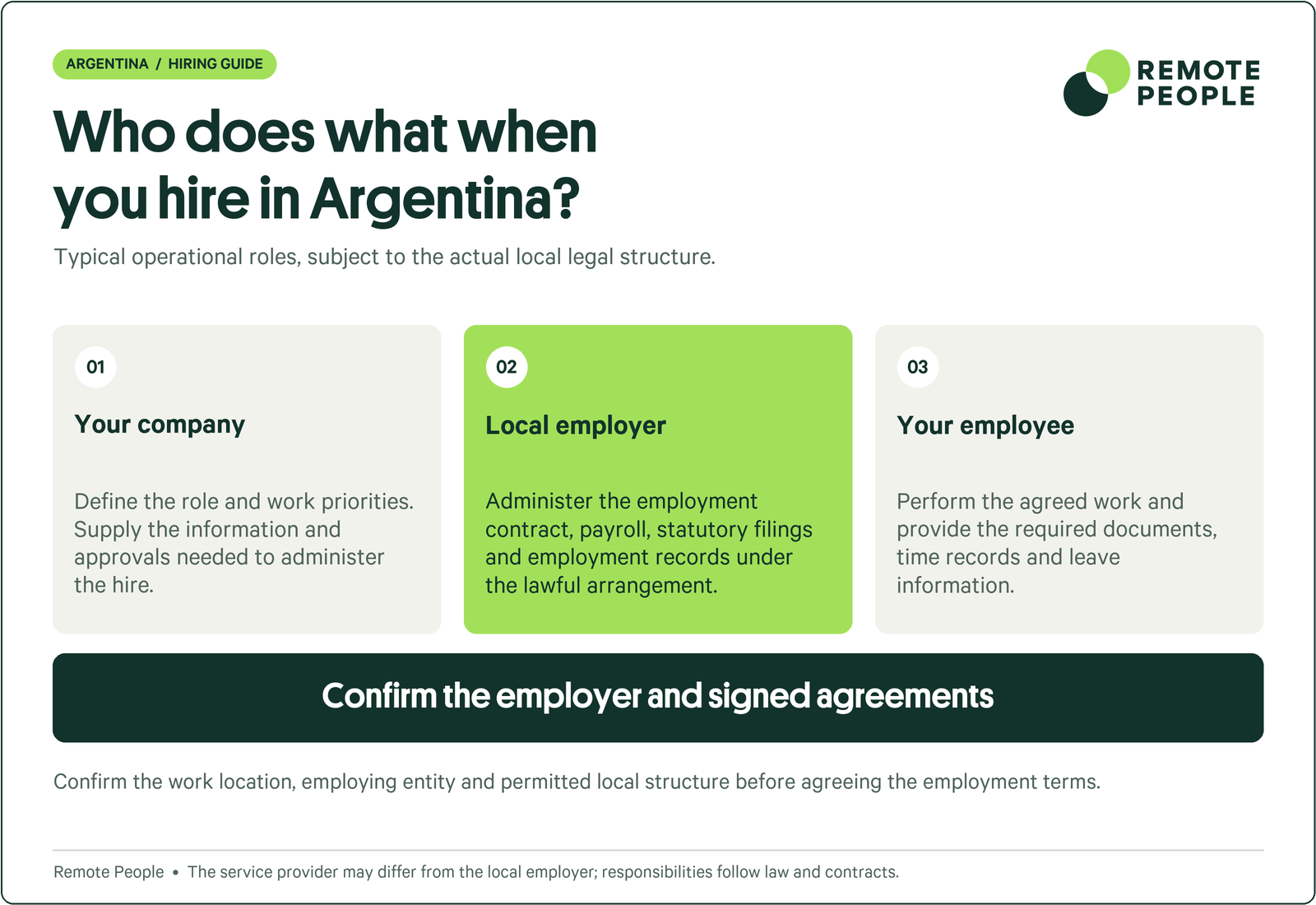
If you’d like to learn more about how Employer of Record (EOR) services work, read our What Is an Employer of Record (EOR)? guide for a complete overview of the model, its benefits, and when to use it.
If you’re comparing providers, our Best Employer of Record (EOR) Providers guide reviews the leading platforms to help you choose the right solution for your business.
Who Uses an EOR in Argentina?
Companies typically choose an EOR in Argentina to test a new market without setting up a local company, hire a small team of 1 to 15 people without the expense of incorporation, or bring people on board in weeks instead of months. Foreign companies with remote workers in Argentina find it especially valuable because the EOR handles obra social enrollment, AFIP filings, and aguinaldo calculations that would otherwise need a payroll specialist on staff. The model works for any business expanding into Argentina, regardless of size or sector.

Typical Onboarding Timeline
The onboarding process typically takes 1 to 2 weeks:
- First, sign the EOR service agreement and provide employee details (1–2 days).
- Second, the EOR drafts a compliant employment contract in Spanish with role-specific terms (2–3 days).
- Third, AFIP and ANSES registration is completed, establishing the employee’s tax ID and social security account (3–7 days).
- Fourth, payroll configuration, bank transfer setup, and benefits enrollment are finalized (2–3 days).
- Fifth, the employee officially starts work and receives their first paycheck on the next payroll cycle (1 day).
If the hire is a foreign national requiring a work visa or temporary residence permit, add 4 to 8 additional weeks depending on the permit type and consulate processing times.
Hire in Argentina
A deep talent pool in tech and business services, competitive labor costs, US-aligned time zones, and a highly educated workforce make Argentina one of the best hiring destinations in Latin America.
We handle employment contracts, payroll, tax withholding, and full Argentina compliance.
No local entity needed. Your team can start in days.
Employment Laws and Regulations in Argentina
Employment Contracts
All employment relationships in Argentina are governed by Ley de Contrato de Trabajo No. 20.744 (WIPO Lex), enforced by the Ministry of Labor. Argentine law assumes all contracts are indefinite unless there’s a specific reason to limit the term.
Fixed-term contracts must be in writing with documented justification and are limited to a maximum of 5 years.
All contracts must be executed in Spanish and include mandatory terms such as job title, responsibilities, compensation, working conditions, and applicable collective bargaining agreement (CBA) provisions. Part-time contracts need explicit documentation of hours and can’t exceed two-thirds of a full-time schedule.
Working Hours and Overtime
The Argentine labor code caps the workweek at 48 hours, usually 8 hours a day Monday through Saturday. Overtime beyond 8 hours daily carries a 50% wage premium on regular weekdays and a 100% premium on Sundays and public holidays (Ley 20.744, Art. 201). Employers cannot require more than 3 hours of overtime per day or 200 hours per year.
Night work (between 21:00 and 6:00) is limited to 7 hours per shift. Each hour of night work counts as 1 hour 8 minutes for pay purposes. Employees must receive a minimum 12-hour rest period between shifts and 35 continuous hours of weekly rest.
The table below summarizes the overtime rates, daily limits, and exemptions that apply to Argentine employees under Ley 11.544 and LCT Art. 201.
Argentina overtime and premium pay rates · Per Ley 11.544 and LCT Ley 20.744 | |||
Hour Type | Rate Multiplier | Daily Limit | Notes |
|---|---|---|---|
Weekday overtime (Mon to Sat before 1 pm) | 150% (50% premium) | 3 hours | Triggered after 8 daily or 48 weekly regular hours; counts toward the aggregate 30 hours per month and 200 hours per year cap |
Saturday after 1 pm, Sunday, or public holiday work | 200% (100% premium) | 3 hours | Double pay applies to all rest-day and holiday hours under LCT Art. 201 |
Night work (9 pm to 6 am) | Time credit in lieu | 7 hour shift | Each night hour counts as 1 hour 8 minutes of regular pay under Ley 11.544 Art. 2 |
Managerial and executive staff | Exempt | Not applicable | Corporate directors and registered managers fall outside the daily, monthly, and annual caps |
Minimum Wage
Argentina’s Salario Minimo Vital y Movil (SMVM) stands at approximately $258 per month as of April 2026. This rate was established under Resolution 9/2025 issued by the National Council of Employment, Productivity, and Minimum Wage. The same resolution schedules gradual increases through August 2026, when the SMVM will reach approximately $272 per month.
For current rates and historical adjustments, see the Argentina minimum wage page.
Probation Period
Indefinite employment contracts in Argentina include a standard 6-month probation period under Ley 27.742 (enacted July 2024). During the first 30 days, employers may terminate without notice or severance. From day 31 through the end of probation, 15 days’ written notice is required before termination.
Collective bargaining agreements may extend probation to 8 or 12 months for companies with fewer than 50 employees. No severance payment is owed for termination during probation, provided proper notice is given after the first 30 days. Leave entitlements accrue from day one, including during probation.
Leave Entitlements
Argentine law provides comprehensive leave entitlements that accrue from the first day of employment. These cover annual vacation, sick leave, family-related leave, and several other statutory absences defined under Ley 20.744.
Annual Leave
Annual leave entitlements increase with tenure: 14 days for employees with less than 5 years of service, 21 days for 5 to 10 years, 28 days for 10 to 20 years, and 35 days for 20 or more years (Ley 20.744, Art. 150). Leave must be taken between October 1 and April 30, unless employer and employee agree otherwise. Vacation accrues during probation and cannot be unilaterally canceled by the employer.
Sick Leave
Employees with less than 5 years of tenure are entitled to 3 months of paid sick leave per year; those with 5 or more years receive 6 months. If the employee has dependents, the duration doubles to 6 or 12 months respectively. The employer pays 100% of wages throughout the sick leave period.
A medical certificate is required from the first day of absence. After the employer’s paid obligation ends, continued medical coverage transitions to the employee’s obra social (health plan) and ART (workers’ compensation insurer).
Maternity Leave
Maternity leave totals 90 days, structured as 45 days before birth and 45 days after, or alternatively 30 days before and 60 days after at the employee’s choice. The 100% wage replacement is funded by ANSES (Argentina’s social security agency), not the employer (PwC Argentina). Employees cannot be terminated during pregnancy or for 7.5 months after the birth, except for serious cause under strict legal standards.
Paternity Leave
Fathers are entitled to 2 days of paid leave at 100% of regular wages following the birth of a child. This leave must be taken within the days immediately following the birth date.
Other Statutory Leave
- Marriage leave: 10 consecutive days, fully paid
- Bereavement leave: 3 days for spouse, child, or parent; 1 day for a sibling
- Study and exam leave: 2 days per exam, maximum 10 days per calendar year
- Moving leave: 1 day for residential relocation
Argentina statutory leave entitlements · Per Ley 20.744 | ||
Leave Type | Duration | Eligibility & Notes |
|---|---|---|
Annual Leave | 14–35 days/year | By tenure: 14 days (<5 yrs), 21 days (5–10), 28 days (10–20), 35 days (20+). Taken Oct 1 to Apr 30. Accrues during probation. |
Sick Leave | 3–12 months/year | 100% pay by employer. 3 months (<5 yrs tenure) or 6 months (5+ yrs); doubled with dependents. Medical certificate from day 1. |
Maternity Leave | 90 days | 45 pre + 45 post (or 30 + 60). 100% pay funded by ANSES. Job protection during pregnancy and 7.5 months post-birth. |
Paternity Leave | 2 days | 100% paid by employer. Taken immediately following birth. |
Marriage Leave | 10 days | Consecutive calendar days, fully paid. |
Bereavement Leave | 1–3 days | 3 days for spouse, child, or parent; 1 day for sibling. |
Study & Exam Leave | Up to 10 days/year | 2 days per exam for preparation and sitting. Maximum 10 days annually. |
Source: WIPO Lex (Ley 20.744) and Argentina Ministry of Labor | ||
Statutory Employee Benefits
Argentine employers must enroll all employees in obra social, a mandatory health plan funded by a 6% employer contribution and 3% deducted from employee wages. Employers also register workers with an ART provider, which covers workplace injuries, occupational diseases, and rehabilitation. All employees participate in the SIPA integrated pension system, with contributions managed through ANSES and AFIP (PwC Argentina).
Argentina doesn’t require employers to pay for meals, transportation, or housing beyond what union agreements might specify. That said, many employers offer extra perks like upgraded health plans (prepaga), performance bonuses, or training budgets to attract good talent. For a full breakdown of mandatory and optional benefits, see the Argentina employee benefits page.
Recent Regulatory Updates (2026)
Ley 27.742, which took effect in July 2024, was the biggest change to Argentine employment law in years. It extended probation from 3 months to 6 months on indefinite contracts and lets union agreements stretch it to 8 or 12 months for small companies with fewer than 50 employees. It also capped damages for discriminatory dismissal at 50 to 100% of standard severance and introduced the option for employers to contribute to alternative severance funds established through CBAs.
Resolution 9/2025 established a schedule of minimum wage increases running from December 2025 through August 2026. The SMVM rose from approximately $246 in January 2026 to $258 in April, with further increases scheduled monthly through August. A March 2026 reform capped mandatory union dues at 2% of gross wages for a two-year transition period, after which the cap drops to 0.5%.
Work Permits and Visas in Argentina
Work Permit Requirements
Who Needs a Work Permit
Citizens of Mercosur member states (Brazil, Paraguay, Uruguay, Bolivia, and others) benefit from a simplified residency process that grants work authorization with minimal documentation. Non-Mercosur nationals must obtain a formal work visa sponsored by their Argentine employer before beginning employment. All work permits are administered by the Direccion Nacional de Migraciones.
Eligibility and Required Documents
Applicants must submit a valid passport with at least 6 months remaining validity, a police clearance certificate from their country of residence, proof of professional qualifications (diplomas or certifications), and a signed employment contract compliant with Ley 20.744. All documents must be apostilled and translated into Spanish by a certified translator. A medical examination confirming fitness to work is also required for most visa categories.
Processing Time and Validity
Temporary residence work visas typically take 30 to 90 days for approval, depending on the consulate and country of origin. Initial validity ranges from 1 to 3 years based on the visa category and employment contract duration. Factors that extend processing include incomplete documentation, high application volumes at specific consulates, and additional security clearances for certain nationalities.
Renewal Process
Employees must file renewal applications with the immigration authority before their current visa expires, ideally 60 days in advance. The employee may continue working during the renewal processing period, provided the application was submitted on time. Renewal typically takes 30 to 60 days and requires updated documentation including a current employment contract and tax compliance certificates.
Common Visa Types for Foreign Workers
Argentina offers several work visa categories depending on the employee’s nationality, profession, and employment relationship. The table below summarizes the most common options used by EOR-employed workers.
Common Argentine work visa categories · 2026 | ||
Visa Type | Eligibility | Duration |
|---|---|---|
Temporary Residence for Work (Residencia Temporaria) | Skilled professionals employed by an Argentine company under a registered employment contract | 1 to 3 years, renewable |
Mercosur Residence | Citizens of Mercosur and associated states (Brazil, Uruguay, Paraguay, Bolivia, Chile, Colombia, Ecuador, Peru, Venezuela) | 2 years, convertible to permanent |
Intra-Company Transfer | Employees of multinational companies relocating to an Argentine branch, subsidiary, or affiliate | Up to 3 years, renewable |
Highly Skilled Worker | Specialists in technology, engineering, research, and other priority sectors with expedited processing | 1 to 3 years, renewable |
Source: Direccion Nacional de Migraciones. Processing times and requirements vary by consulate and category. | ||
For detailed guidance on each category, consult the Argentina work visa guide.
How an EOR Handles Work Permits
An EOR sponsors the work permit application as the official employer, preparing the employment contract, compiling the application dossier, and communicating with the consulate and Direccion Nacional de Migraciones on your behalf. The employee provides personal documents (passport, police clearance, qualifications), while the EOR manages the rest. This process typically extends the standard 1 to 2 week onboarding timeline by 4 to 8 weeks, depending on the visa category and consular processing schedule.
Payroll, Taxes, and Social Security in Argentina
Employers hiring in Argentina owe mandatory contributions on top of gross salary, funding social security, health, pensions, and other statutory schemes (PwC Argentina Tax Summary). The table below lists the employer-side contribution rates so you can calculate the true all-in cost of each hire.
Argentina employer social security contributions · 2026 rates | ||
Contribution | Rate | Notes |
|---|---|---|
Jubilacion (Pension) | 10.77% | Mandatory pension fund contribution to SIPA system |
Obra Social (Health Insurance) | 6.00% | Funds employee health coverage through the obra social system |
INSSJP/PAMI | 1.50% | National social services fund for retirees and pensioners |
Asignaciones Familiares | 4.44% | Government family allowance fund (child benefits, school bonuses) |
Fondo Nacional de Empleo | 0.89% | Unemployment insurance fund |
ART (Workers’ Compensation) | ~2.50% | Variable by industry risk category; covers workplace injuries and occupational diseases |
Total | ~26.10% | Combined employer obligation per employee (statutory rate for standard commercial employers) |
Source: PwC Argentina Tax Summary and AFIP/ARCA | ||
Argentine employers contribute approximately 26% on top of gross salaries across pension, health insurance, family allowances, and workers’ compensation. The statutory rate ranges from 24% to 26.4% depending on company classification, with an additional variable ART premium based on industry risk category (PwC Argentina). These contributions are remitted to AFIP by the 15th of the following month.
For complete payroll and tax compliance guidance, see the Argentina payroll and tax page.
Argentina employee payroll deductions · 2026 monthly withholdings | ||
Deduction | Rate | Notes |
|---|---|---|
Jubilacion (Pension) | 11.00% | Employee contribution to the mandatory pension system (SIPA) |
Obra Social (Health Insurance) | 3.00% | Employee share of mandatory health plan coverage |
INSSJP/PAMI | 3.00% | Social services fund for retiree healthcare |
Total | 17.00% | Combined monthly deduction from gross salary |
Source: PwC Argentina Tax Summary and AFIP/ARCA | ||
Employees in Argentina have 17% deducted from their gross salary each month for pension, health insurance, and social services. These deductions are withheld by the employer and remitted directly to the corresponding social security funds through AFIP.
Argentina income tax brackets · 2026 | |
Annual Taxable Income (USD) | Tax Calculation |
|---|---|
Up to $1,442 | 5% |
$1,442 – $2,884 | 9% |
$2,884 – $4,326 | 12% |
$4,326 – $6,057 | 15% |
$6,057 – $8,651 | 19% |
$8,651 – $12,978 | 23% |
$12,978 – $21,630 | 27% |
$21,630 – $43,800 | 31% |
Over $43,800 | 35% |
Source: AFIP/ARCA and PwC Argentina Income Tax | |
Argentina applies a progressive income tax (Impuesto a las Ganancias) with nine brackets ranging from 5% to 35%. Employees receive personal deductions that are adjusted every six months to account for inflation. For the first half of 2026, the annual employee deduction is approximately $12,700, meaning many lower-income employees pay little or no income tax.
AFIP adjusts bracket thresholds and deduction amounts semi-annually based on accumulated inflation from the prior period. Employers are responsible for withholding income tax from each monthly payroll and remitting it to AFIP.
Payroll Cycle
Payroll in Argentina runs on a monthly cycle, with salaries typically paid between the 1st and 5th of the following month. Bank transfer is mandatory for companies with more than 25 employees; all payments are made in local currency. Employers must issue detailed pay slips showing gross salary, each deduction, employer contributions, and net pay.
Social security filings are submitted to AFIP by the 15th of the month following the pay period. Late submissions trigger penalties and interest charges. The EOR handles all filing deadlines, ensuring contributions are declared and paid on time.
13th Month Salary and Bonus Pay
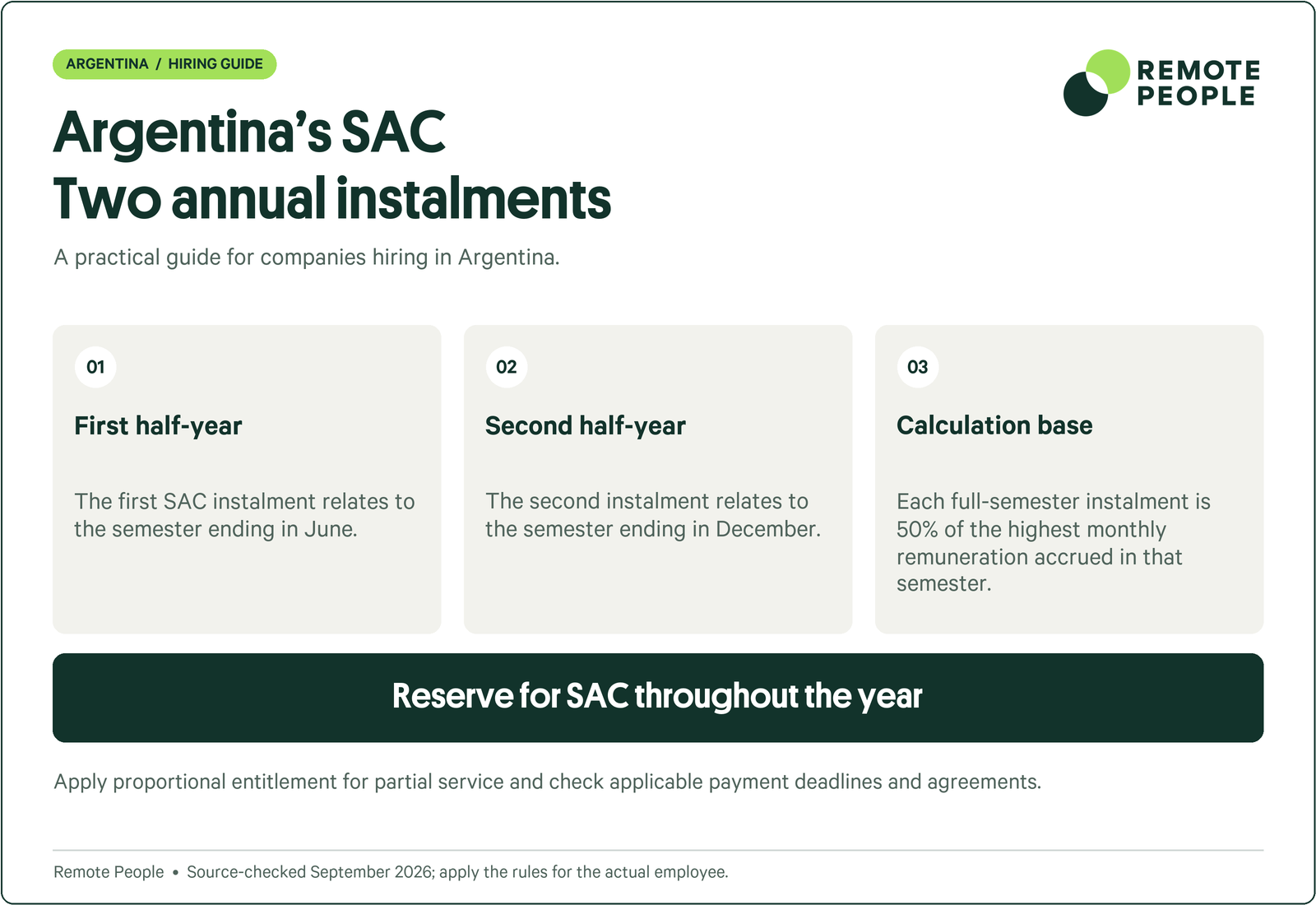
The aguinaldo (13th month bonus) is mandatory under Ley 20.744, Art. 121-123, and is paid in two installments each year. Each installment equals 50% of the highest monthly gross salary earned in the preceding six-month period. The first installment is due by June 30 and the second by December 18.
Employees who join or leave mid-year receive a pro-rata aguinaldo based on months worked in the relevant semester. The aguinaldo is subject to full social security contributions (both employer and employee) and income tax withholding, which reduces the net payout. Argentina does not mandate a 14th month salary or profit-sharing bonus, though some CBAs or individual contracts may include additional performance incentives.
Cost of Hiring Through an EOR in Argentina
EOR Service Fees
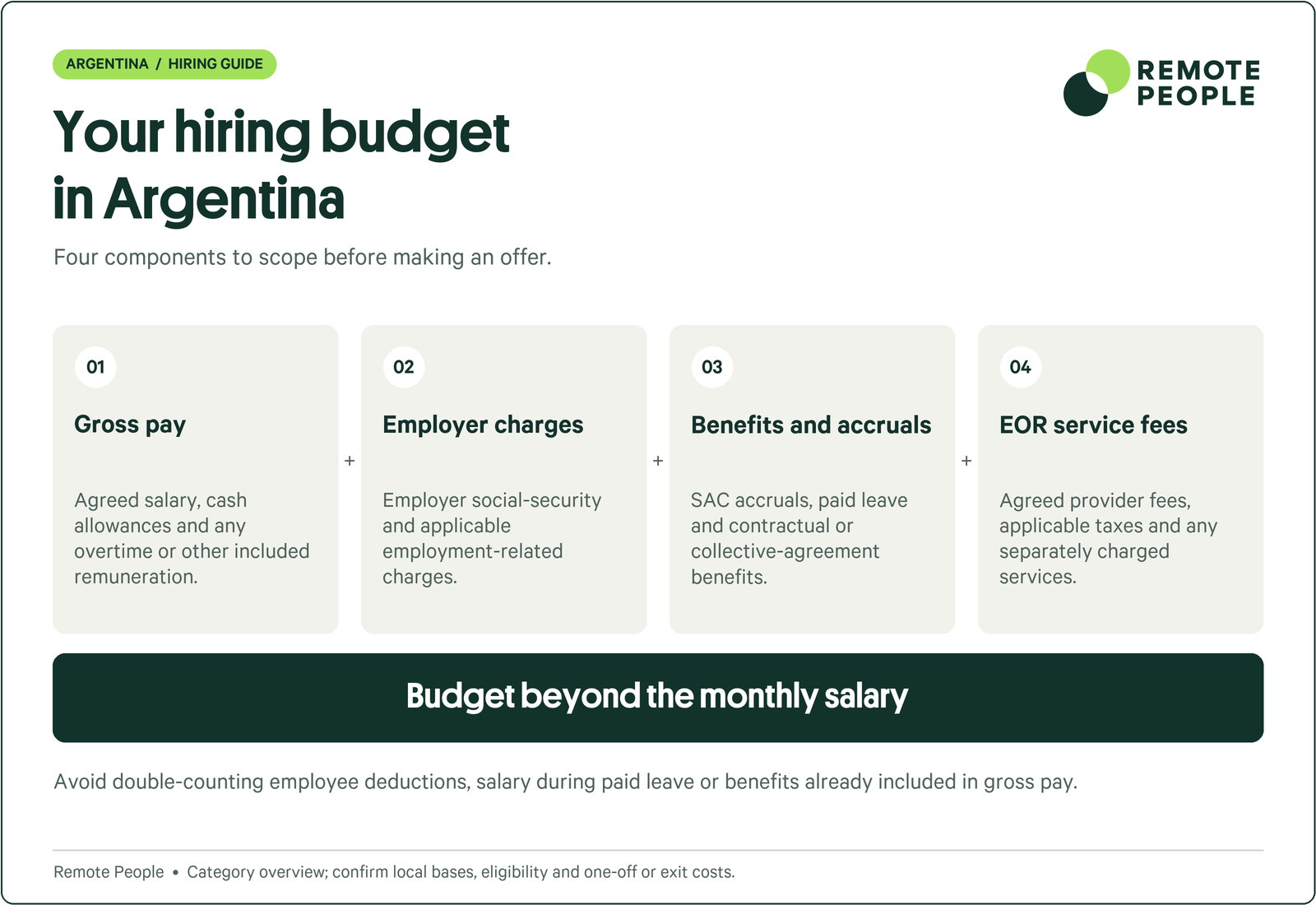
EOR service fees in Argentina typically range from $300 to $600 per employee per month. This flat monthly fee covers payroll processing and tax withholding, statutory compliance filings with AFIP and ANSES, benefits administration including obra social and ART enrollment, ongoing HR support, and employment contract management throughout the relationship.
Argentina employer cost example · $1,200/month gross · 2026 | ||
Employer Cost | Amount (USD) | % of Gross |
|---|---|---|
Gross Salary | $1,200.00 | 100.00% |
Jubilacion (10.77%) | $129.24 | 10.77% |
Obra Social (6.00%) | $72.00 | 6.00% |
INSSJP/PAMI (1.50%) | $18.00 | 1.50% |
Asignaciones Familiares (4.44%) | $53.28 | 4.44% |
Fondo Nacional de Empleo (0.89%) | $10.68 | 0.89% |
ART/Workers’ Comp (~2.50%) | $30.00 | 2.50% |
Aguinaldo Provision (8.33%) | $99.96 | 8.33% |
EOR Service Fee | $400.00 | 33.33% |
Total Employer Cost | $2,013.16 | 167.76% |
Source: PwC Argentina Tax Summary and RemotePeople | ||
The total monthly cost to employ one person through an EOR in Argentina is approximately $2,013 for a $1,200 gross salary, roughly 68% above gross compensation. This includes all mandatory employer contributions (26.10%), the monthly aguinaldo accrual (8.33%), and the EOR service fee ($400). All USD amounts are approximate conversions at April 2026 exchange rates.
By comparison, setting up a local entity in Argentina costs $15,000 to $30,000 upfront and $8,000 to $15,000 per year in ongoing maintenance, making the EOR model significantly more cost-effective for teams of 1 to 15 employees.
Ready to hire in Argentina? Get started with RemotePeople; we handle employment contracts, payroll, tax withholding, and full Argentina compliance. No local entity needed.
Benefits of Using an EOR in Argentina
An EOR accelerates your time to market by enabling employee onboarding within 1 to 2 weeks, compared to the 3 to 6 months required for entity registration, AFIP enrollment, bank account setup, and local HR hiring. Traditional entity setup costs $15,000 to $30,000 or more before your first employee starts work; an EOR eliminates those upfront costs entirely and replaces them with a predictable monthly fee.
Compliance with Ley 20.744 requires precise handling of monthly social security filings, aguinaldo calculations, progressive income tax withholding, and leave tracking across multiple entitlement categories. An EOR manages all of these obligations, reducing your exposure to penalties from incorrect payroll processing, missed filing deadlines, or noncompliant termination procedures. This is particularly valuable in Argentina, where labor law enforcement is active and employee-friendly courts tend to rule in favor of workers in disputes.
The EOR model provides local expertise without long-term structural commitment. Your EOR partner navigates Argentina’s inflation-adjusted tax brackets, manages obra social health plan selections, and handles AFIP correspondence in Spanish. You gain the flexibility to scale your Argentina team up or down as business needs change, without the fixed overhead of a local entity.
For companies testing the Argentine market or managing seasonal hiring fluctuations, this combination of speed, compliance assurance, and cost efficiency makes the EOR the standard entry path.
Termination and Offboarding in Argentina
Notice Periods
Argentine employment law requires written notice before termination, with the duration increasing by tenure. During the first 30 days of probation, no notice is required. From day 31 through the end of the 6-month probation period, 15 days’ notice is mandatory.
After probation, employees with less than 5 years of service require 1 month’s notice, while those with 5 or more years require 2 months’ notice (Ley 20.744, Art. 231).
Employers may elect to pay in lieu of notice, providing the employee with their full gross salary (including base pay, commissions, and regular bonuses) for the applicable notice period instead of requiring them to work through it.
The table below consolidates Argentina’s statutory notice periods for employer-initiated dismissal under LCT Art. 231, as updated by the 2026 Labor Modernization Law.
Argentina statutory notice periods by years of service · Per LCT Ley 20.744 | |||
Tenure | Notice Period | Pay in Lieu Allowed | Notes |
|---|---|---|---|
During probation (up to 6 months) | None required | Not applicable | Probation runs up to 6 months under Ley 27.802; no preaviso is required during the probation window |
Less than 5 years of service | 1 month | Yes | Applies to employer-initiated dismissal after probation, per LCT Art. 231 |
5 or more years of service | 2 months | Yes | Employers may pay the full gross salary in lieu of working through the notice under LCT Art. 232 |
Severance Pay
The worked examples below assume a dismissal without just cause under LCT Art. 245 and use a hypothetical best normal monthly salary of USD 2,500 to show how the formula scales with tenure.
Argentina severance pay schedule by years of service · Per LCT Ley 20.744 | |||
Years of Service | Severance Formula | Example Payout (base USD 2,500) | Notes |
|---|---|---|---|
During probation (up to 6 months) | None | USD 0 | No seniority indemnity is payable when dismissal occurs within the probation period |
1 year | 1 month of best normal pay | USD 2,500 | Minimum indemnity under LCT Art. 245 is 1 month of salary |
3 years | 3 months of best normal pay | USD 7,500 | One month per completed year of service, excluding SAC and non-monthly bonuses from the base |
5 years | 5 months of best normal pay | USD 12,500 | Fractions greater than 3 months count as a full year |
10 years | 10 months of best normal pay | USD 25,000 | Base capped at 3x the average CBA wage under the Vizzoti Supreme Court doctrine |
Calculation Method
Severance for termination without cause is calculated as one month of the employee’s highest normal monthly salary per year of service, or for any fraction exceeding three months. The salary base includes regular compensation, commissions, and recurring bonuses earned in the 12 months preceding termination. Employees also receive a proportional aguinaldo payment for the partial period worked in their final semester.
Caps and Exceptions
The Argentine Supreme Court has established a per-year severance cap at approximately 67% of three times the average monthly salary defined by the applicable collective bargaining agreement. No severance is owed during the probation period (with proper notice after day 30) or for termination with just cause. Fixed-term contracts terminated early may trigger damages equal to the remaining contract value rather than standard severance.
Under Ley 27.742, damages for discriminatory dismissal claims are now capped at 50% to 100% of the standard severance amount, replacing the previously uncapped punitive framework. This reform provides greater cost predictability for employers while maintaining employee protections against unlawful termination (WIPO Lex).
Grounds for Termination
Argentine law recognizes two primary termination categories. Termination with cause (justa causa) requires documented serious misconduct, must follow a prior disciplinary procedure, and does not trigger severance obligations. Termination without cause (sin justa causa) requires full notice and severance payments as described above.
Certain employees receive enhanced protection. Pregnant employees and those on maternity leave cannot be terminated except in extraordinary circumstances; termination during pregnancy or within 7.5 months after birth triggers an additional year of severance compensation. Union representatives can only be dismissed with prior judicial authorization.
Employees who marry are protected from termination for 3 months before and 6 months after the marriage.
EOR vs. Other Hiring Models in Argentina
Choosing between an Employer of Record and setting up your own legal entity in Argentina comes down to timeline, upfront cost, ongoing administrative burden, and how quickly you can scale up or wind down. The table below lays out both paths side by side across setup time, cost, compliance risk, and flexibility so you can match the right model to the size and duration of your Argentina hiring plan.
Argentina EOR vs local entity comparison · Setup time, cost, risk and best-fit | ||
Comparison | Employer of Record | Own Entity |
|---|---|---|
Setup time | 1–2 weeks | 3–6 months |
Upfront cost | $0 | $15,000–$30,000 |
Ongoing cost | $300–$600/employee/month | $8,000–$15,000/year maintenance |
Local partner required | No (EOR is the local entity) | No (but requires legal, accounting, HR setup) |
Social insurance registration | Handled by EOR | You manage it |
Payroll & tax filing | Handled by EOR | You manage it (or outsource) |
Best for team size | 1–15 employees | 15+ employees |
Scale down / exit | Easy, no entity to unwind | Costly, legal dissolution required |
Government contracts | Not eligible | Eligible (requires local entity) |
Source: RemotePeople and PwC Argentina | ||
The EOR model offers the fastest and lowest-cost entry point for companies testing the Argentine market or building small remote teams. You avoid the legal, accounting, and administrative overhead of entity formation while the EOR handles all payroll, tax filings, and statutory compliance from day one. For teams of 1 to 15 employees, the EOR fee is almost always more cost-effective than entity maintenance.
Establishing your own local entity becomes financially justified once you have 15 or more employees in Argentina, as the fixed annual maintenance cost ($8,000 to $15,000) is spread across a larger workforce. A local entity also provides eligibility for Argentine government contracts and grants direct control over HR policies, office infrastructure, and employee relations.
The choice ultimately depends on team size, market-entry timeline, and long-term commitment to the Argentine market. For rapid, low-risk hiring with full compliance, an EOR is the standard approach. For established or growing operations requiring local infrastructure, entity setup provides greater control and cost efficiency at scale.
Argentina EOR vs independent contractors · Compliance, cost, and risk | ||
Comparison | EOR (Full-Time Employee) | Independent Contractor |
|---|---|---|
Legal relationship | Employee of the EOR | Self-employed, no employment relationship |
Compliance risk | Low, EOR ensures local labor law compliance | High, misclassification risk if relationship resembles employment |
Payroll & tax | EOR handles withholding, contributions, filings | Contractor invoices you; they handle their own taxes |
Benefits & leave | Statutory benefits, paid leave, social security | No entitlement to employee benefits |
IP protection | Stronger, employment contract assigns IP by default | Weaker, requires explicit IP assignment clause |
Termination | Subject to local notice periods and severance | Contract can be ended per agreement terms |
Best for | Long-term, core team roles | Short-term projects, specialized tasks |
Cost structure | Salary + employer contributions + EOR fee | Contractor fee (typically higher gross, lower total cost) |
Source: RemotePeople and Argentina Ministry of Labor | ||
Hiring through an EOR provides legal certainty and full compliance with Ley 20.744, while engaging independent contractors is only appropriate in some cases such as short-term project work, specialized consulting, and roles with genuine autonomy over work methods and schedule. The distinction matters because Argentine labor law presumes an employment relationship exists unless the contractor arrangement is genuinely independent and clearly documented.
Misclassification (treating a de facto employee as an independent contractor) can result in back taxes, unpaid employer social security contributions, penalties, and forced reclassification to employment status by Argentine labor authorities. The consequences are financial and reputational: AFIP may assess several years of unpaid contributions plus interest, and the employee gains retroactive rights to severance, leave, and benefits.
For ongoing team members, core business functions, and roles requiring supervision, an EOR employee is the compliant choice. For genuinely independent, project-based engagements, RemotePeople also offers a contractor management solution that handles compliant contractor payments, contracts, and classification risk.
Argentina EOR vs PEO comparison · Legal employer, liability, and setup | ||
Comparison | Employer of Record (EOR) | PEO |
|---|---|---|
Legal employer | EOR is the legal employer | You remain the legal employer (co-employment) |
Local entity required | No, the EOR is the local entity | Yes, you must have your own entity in Argentina |
Best for | Companies without a local entity | Companies that already have a local entity |
Compliance liability | EOR assumes compliance responsibility | Shared liability between you and the PEO |
Setup time | 1–2 weeks | Depends on your entity setup (weeks to months) |
Control over HR policies | EOR manages within local law framework | More direct control, PEO advises |
Typical use case | Market entry, small remote teams, testing new markets | Established local operations needing HR outsourcing |
Source: RemotePeople and L&E Global Argentina | ||
The fundamental difference is entity ownership: an EOR serves as the legal employer and provides the local entity, while a PEO operates as a co-employer and requires you to already have an Argentine company. Argentina has no formal statutory framework regulating PEO arrangements, so most international providers in the country operate as EORs rather than PEOs.
An EOR is the correct choice for companies entering Argentina without local infrastructure that need to hire employees immediately. If you already have an established Argentine entity and want to outsource HR administration, payroll processing, or benefits management, a PEO-style arrangement may be relevant. In practice, the EOR model dominates international hiring into Argentina because most foreign companies lack an existing local presence.
For companies weighing these options, the deciding factor is simple: if you do not have an Argentine entity today and want to hire within weeks rather than months, an EOR is the path. If you already operate locally, consult with Argentine employment counsel about co-employment and outsourcing alternatives.
Public Holidays in Argentina
Argentina observes a defined set of official public holidays on which most private-sector employers must give staff a paid day off (Argentina.gob.ar Official Calendar). The table below lists the statutory holidays employers need to build into payroll calendars and leave planning for the year, along with the date rule for each.
Argentina public holidays · 2026 calendar year | ||
Date | Holiday | Type |
|---|---|---|
January 1 | New Year’s Day | Fixed |
February 16 | Carnival | Fixed |
February 17 | Carnival | Fixed |
March 23 | Bridge Day | Bridge |
March 24 | Day of Remembrance for Truth and Justice | Fixed |
April 2 | Malvinas Veterans Day | Fixed |
April 3 | Good Friday | Fixed |
May 1 | Labor Day | Fixed |
May 25 | May Revolution Day | Fixed |
June 15 | Guemes Memorial Day | Movable |
June 20 | Flag Day | Fixed |
July 9 | Independence Day | Fixed |
July 10 | Bridge Day | Bridge |
August 17 | San Martin Memorial Day | Fixed |
October 12 | Day of Respect for Cultural Diversity | Movable |
November 23 | National Sovereignty Day | Movable |
December 7 | Bridge Day | Bridge |
December 8 | Immaculate Conception | Fixed |
December 25 | Christmas Day | Fixed |
Source: Argentina.gob.ar Official Calendar and timeanddate.com | ||
Argentina observes 19 paid public holidays in 2026, including 3 government-decreed bridge days (feriados puente) that extend holiday periods into long weekends. Employees required to work on a public holiday are entitled to double their regular daily wage in addition to standard compensation. Movable holidays (feriados trasladables) are shifted to the nearest Monday to create long weekends, affecting payroll scheduling and project planning.
How to Get Started with an EOR in Argentina
Launching your Argentine team through an EOR follows a straightforward sequence:
- First, define the role description, responsibilities, and compensation package in USD or Argentine pesos.
- Second, select an EOR provider with established operations in Argentina, such as RemotePeople, and confirm their service scope and fee structure.
- Third, the EOR drafts a compliant employment contract under Ley 20.744 and shares it for your review and the employee’s signature.
- Fourth, AFIP and ANSES registration, payroll configuration, bank transfer setup, and obra social enrollment are completed by the EOR.
- Fifth, your new employee begins work within 1 to 2 weeks of contract signature, with the EOR managing all ongoing payroll, tax filings, and compliance.
Ready to build your team in Argentina? Contact RemotePeople for a free consultation on hiring costs, timelines, and compliance.
Frequently Asked Questions
EOR service fees in Argentina typically range from $300 to $600 per employee per month as a flat USD amount. Beyond this fee, you pay the employee's gross salary plus mandatory employer contributions of approximately 26% of gross (covering pension, health insurance, family allowances, and workers' compensation). The mandatory aguinaldo (13th month bonus) adds another 8.33% to your annual cost. For a $1,200/month gross salary, total monthly employer cost including the EOR fee is approximately $2,013.
An EOR is an employment model, so it does not directly support contractor engagements. However, RemotePeople offers a dedicated contractor management solution that handles compliant contractor payments, contracts, invoicing, and classification risk in Argentina. This keeps your contractor relationships separate from full-time employment and reduces the risk of misclassification under Argentine labor law.
The employment contract assigns intellectual property created during the course of employment to the client company (you), not the EOR. The EOR ensures the contract includes proper IP assignment language so all work products, inventions, and creative output flow directly to your business. You should confirm with the EOR that the IP clause covers all deliverables and is enforceable under Argentine law.
Standard onboarding takes 1 to 2 weeks from contract signature to the employee's first day. If the hire requires a work visa or temporary residence permit, the process extends to 6 to 10 weeks to allow for immigration processing. Mercosur nationals benefit from a faster visa process. For current timelines, check with your EOR provider.
Argentine employers must provide obra social (mandatory health insurance), pension contributions through the SIPA system, ART (workers' compensation insurance), the aguinaldo (13th month bonus paid in two installments), and statutory annual leave (14 to 35 days depending on tenure). For a detailed breakdown of each benefit, visit the Argentina employee benefits page.
As of April 2026, the Salario Minimo Vital y Movil (SMVM) is ARS 357,800 per month, approximately $258 USD at the current exchange rate of $1 = 1,387 ARS. The minimum wage is adjusted periodically by government resolution; scheduled increases through August 2026 will bring it to ARS 376,600 (~$272 USD). For the latest rates, see the Argentina minimum wage page.
No. An employer of record serves as the legal employer and local entity on your behalf, eliminating the need to incorporate an Argentine company. The EOR handles all statutory registrations with AFIP and ANSES, tax compliance, payroll processing, and regulatory filings. This allows you to hire and manage employees in Argentina without the administrative, legal, and financial burden of forming a local entity. Contact RemotePeople to get started.