
 Recruit
Employer of Record in Spain
-
 Drew Donnelly
- Published
- September 22, 2026
RemotePeople’s employer of record in Spain lets you hire employees in Spain with complete social security compliance. We handle general contingencies contributions at 23.60 percent, unemployment insurance at 5.5 percent, and Wage Guarantee Fund payments.
Hire in Spain — book a free 30-minute demo
Tell us what you need. You'll get a tailored, transparent proposal within 24 hours, plus a free call to walk through it.
Tell us about your company
So we can match you with a specialist who knows your market — and unlock volume pricing tiers.
* All fields are required.
Where and when are you hiring?
Tell us the geography and timing and we'll quote each country line by line, with onboarding timelines.
* All fields are required.
Help us beat your current setup
We'll benchmark your current deal and send a line-by-line proposal in 24 hours — showing exactly where we cut cost, time, or risk. After you submit, you can book a call to walk through it together.
* All fields are required.
Thanks! Your proposal is on its way.
Expect a tailored, line-by-line proposal in your inbox within 24 hours. In the meantime…
Want to walk through it together?
Book a free 30-minute call with one of our specialists. We'll explain every line, answer your questions, and tailor the proposal further if you need.
No obligation. Pick a time that works for you.








- Hire in Spain — book a free 30-minute demo
- Tell us about your company
- Where and when are you hiring?
- Help us beat your current setup
- Thanks! Your proposal is on its way.
- How an Employer of Record Works in Spain
- Employment Laws and Regulations in Spain
- Work Permits and Visas in Spain
- Payroll, Taxes, and Social Security in Spain
- Cost of Hiring Through an EOR in Spain
- Benefits of Using an EOR in Spain
- Termination and Offboarding in Spain
- EOR vs. Other Hiring Models in Spain
- Public Holidays in Spain
- How to Get Started with an EOR in Spain
- Where companies hiring in Spain expand next
- Frequently Asked Questions
- Related EOR Destinations

Start hiring in Spain
Let RemotePeople handle payroll, compliance, and HR admin worldwide so you can focus on building your team.

An employer of record (EOR) in Spain is a locally registered entity that legally employs staff on behalf of a foreign company, handling the employment contract, payroll, IRPF withholding, and social security registration with the Tesorería General de la Seguridad Social under the Workers’ Statute (Estatuto de los Trabajadores). EOR services in Spain typically cost between $300 and $600 per employee per month on top of the roughly 30.65% employer social security contribution and the mandatory 14-payment salary cycle, letting foreign companies hire Spanish talent in one to two weeks instead of the three to six months a greenfield entity requires.
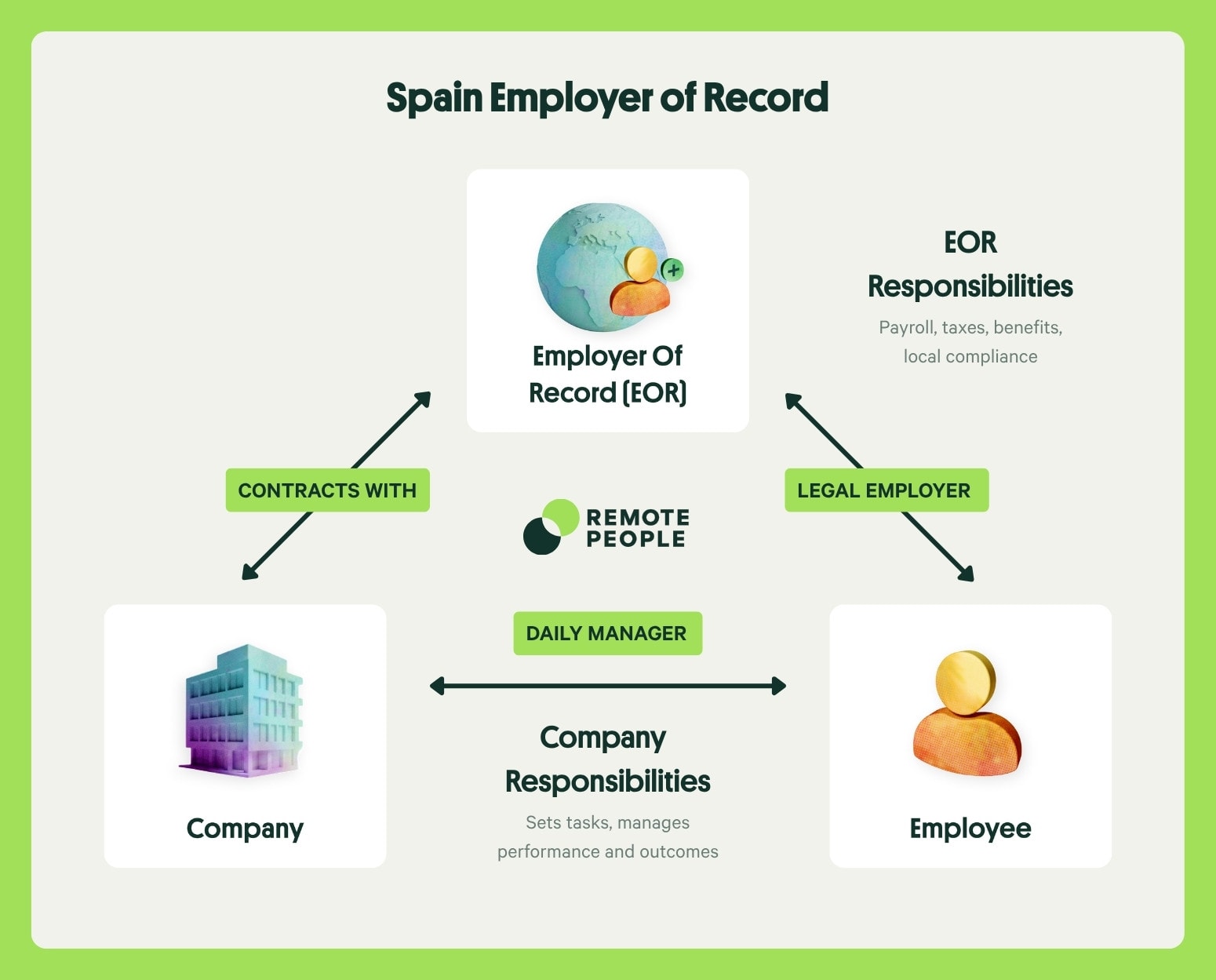
Spain ranks among the largest talent markets in the European Union, with a well-educated workforce, strong digital and engineering clusters in Madrid and Barcelona, and salaries well below Northern European levels, but those advantages come paired with progressive IRPF rates from 19% to 47% and a combined employer-plus-employee social burden of roughly 37% that catches many foreign employers off guard. RemotePeople acts as the legal employer on paper, runs local payroll, withholds IRPF at source, and keeps the contract compliant with Spanish labour law, while the client directs day-to-day work.
How an Employer of Record Works in Spain

If you’d like to learn more about how Employer of Record (EOR) services work, read our What Is an Employer of Record (EOR)? guide for a complete overview of the model, its benefits, and when to use it.
If you’re comparing providers, our Best Employer of Record (EOR) Providers guide reviews the leading platforms to help you choose the right solution for your business.
Who Uses an EOR in Spain?
An EOR fits companies that need a compliant Spanish hire without the overhead of incorporating a Sociedad Limitada. Common situations include testing the Spanish talent market before committing to an entity, bringing on one to fifteen employees where local incorporation is not cost-effective, hiring remote workers already living in Spain, converting a long-running contractor to a compliant employee, and sponsoring third-country nationals who need work authorisation backing. The model is also popular with scale-ups that want to open a Madrid or Barcelona office in days rather than the three to six months a Sociedad Limitada (SL) setup typically takes.
Typical Onboarding Timeline
Most employer of record providers can onboard a new hire in Spain within one to two weeks. The steps below cover a standard onboarding for an EU national; work authorisation for non-EU hires adds two to four months to the timeline.
- First, the client signs the EOR service agreement and shares the employee’s details, start date, and gross annual salary in euros (1–2 days).
- Second, the EOR drafts a Spanish-language employment contract that meets Workers’ Statute requirements and sends it for electronic signature (2–3 days).
- Third, the EOR registers the employee with the TGSS (the alta), assigns a Número de Afiliación a la Seguridad Social if needed, and files the contract through the SEPE’s Contrat@ system (1–3 days).
- Fourth, payroll is configured, the bank account is linked, occupational health screening is scheduled, and any supplementary benefits are activated (2–3 days).
- Fifth, the employee starts on the agreed date and first payroll runs at month-end.
Hire in Spain
A deep, multilingual talent pool, rising English proficiency, and Spain’s EU-aligned labor framework make Spain an attractive market for global teams.
We handle employment contracts, payroll, IRPF withholding, and full Spain compliance.
No local entity needed. Your team can start in days.
Employment Laws and Regulations in Spain
Employment Contracts
Spanish employment is governed by the Estatuto de los Trabajadores (Royal Legislative Decree 2/2015), with the Ministry of Labour and Social Economy (Ministerio de Trabajo y Economía Social) as the principal regulator. Every contract must be in writing where the position, duration, or regime falls under specific categories, and must be filed with SEPE through the Contrat@ electronic platform within ten days of the start date. The contract must specify the job title and professional category, place of work, start date, working hours, probation period, annual gross salary, and the applicable collective bargaining agreement (convenio colectivo).
Indefinite contracts (contrato indefinido) are the default since the 2021 labour reform (Royal Decree-Law 32/2021), which sharply restricted temporary contracts. Fixed-term contracts are now allowed only for specific production surges or substitution of absent workers, with a maximum duration of six months (extendable once by collective agreement). Spanish-language contracts are standard, and bilingual English-Spanish versions are common in the tech sector and enforceable provided the Spanish version controls in case of dispute.
Working Hours and Overtime
The standard working week in Spain is 40 hours, normally arranged as eight hours per day across five days (Workers’ Statute Article 34). The daily ceiling is nine ordinary hours unless collective bargaining provides otherwise, and employees are entitled to at least 12 consecutive hours of rest between shifts and a minimum of 36 hours of weekly rest. A mandatory time-tracking rule introduced by Royal Decree-Law 8/2019 requires every employer to keep a daily record of each employee’s start, break, and end times, retained for four years.
Overtime is capped at 80 hours per calendar year under Workers’ Statute Article 35. Hours may be compensated with paid premium (at a rate no lower than the ordinary hour) or with equivalent rest time within four months; collective bargaining usually specifies which route applies. Night work performed between 22:00 and 06:00 carries a statutory premium of at least 25% unless the work is by its nature nocturnal or compensated with rest. Overtime on rest days or public holidays typically attracts higher premiums set at the collective-agreement level.
Minimum Wage
The Spanish Salario Mínimo Interprofesional (SMI) is set at EUR 1,184 per month across 14 payments, equivalent to EUR 16,576 per year or approximately USD 17,920. The hourly minimum for occasional and domestic workers is EUR 9.26.
The SMI is reviewed annually by royal decree following consultation with trade unions and employer associations, with updates typically published in the Boletín Oficial del Estado at the start of each calendar year. The minimum applies to every employee regardless of sector or nationality, though most convenios colectivos set sector minimums well above the statutory floor.
Probation Period
Spain permits a probationary period (periodo de prueba) under Workers’ Statute Article 14. For qualified technicians with a university or vocational qualification the maximum is six months; for all other employees the cap is two months, extending to three months in companies with fewer than 25 employees.
The probation must be stated in the written contract; if no probation is mentioned, the employee is on a full contract from day one. During probation either side may terminate without notice and without cause, though Constitutional Court jurisprudence has narrowed termination of pregnant employees or workers on protected leave even within the probation window. Detailed rules on probation are on our Spain probation period page.
Leave Entitlements
Spain’s statutory leave framework is set out in Articles 37 and 38 of the Workers’ Statute and is among the more generous in the European Union, combining 30 calendar days of paid annual leave, fully funded parental leave of 16 weeks for each parent, and a rich set of short paid absences (permisos retribuidos) for family and civic events.
Annual Leave
Spanish employees are entitled to a minimum of 36 calendar days of paid annual leave per year under Workers’ Statute Article 38, equivalent to 22 working days in a five-day week. Leave cannot be replaced by cash payment during employment and must be taken within the calendar year unless collective agreement allows carry-over.
The leave calendar must be set in writing at least two months before the first day off, and employees on maternity, paternity, or long-term sick leave preserve the right to take their annual leave even if the calendar year has ended. Many convenios colectivos improve the statutory 30 days by adding extra days for seniority or specific sectors.
Sick Leave
Sick leave in Spain (incapacidad temporal) is covered jointly by the employer and the Instituto Nacional de la Seguridad Social (INSS). For the first three days of any sick spell, neither party pays unless the collective agreement provides otherwise. On days four through fifteen, the employer pays 60% of the regulatory base.
From day sixteen through twenty, the INSS takes over at 60%, rising to 75% of the regulatory base from day twenty-one onward. For work-related accidents or occupational illnesses the rate is 75% from the day after the incident. Paid temporary incapacity can last up to 365 days, extendable by a further 180 days with INSS authorisation, after which the case is assessed for permanent disability.
Maternity Leave
Maternity leave in Spain runs for 16 weeks, fully paid at 100% of the regulatory base by the INSS provided the employee has at least 180 days of contributions in the prior seven years (or 360 days across her working life for employees under 26). The first six weeks must be taken immediately after birth as a block and are non-transferable; the remaining ten weeks can be taken flexibly within the child’s first year, full-time or part-time, by mutual agreement with the employer.
Employers cannot dismiss a pregnant employee or a mother on maternity leave except in cases of company liquidation or confirmed just cause unrelated to the pregnancy, and the employee has the right to return to the same position at the end of the leave. Rights to breastfeeding leave (one hour per day reducing, or accumulated leave, until the child is nine months old) apply on top of maternity leave.
Paternity Leave
Paternity leave in Spain is equalised with maternity leave at 16 weeks, fully paid at 100% of the regulatory base by the INSS. The first six weeks must be taken immediately after birth as a full-time block and are non-transferable between parents; the remaining ten weeks are flexible and can be taken until the child is twelve months old.
Spain achieved parity between maternity and paternity leave in January 2021 under Royal Decree-Law 6/2019, making it one of the most progressive regimes in Europe. Adoption, fostering, and guardianship confer the same 16-week entitlement on each parent, counted from the court decision or administrative resolution.
Other Statutory Leave
Spanish law provides several additional paid permisos retribuidos under Workers’ Statute Article 37 that an EOR will track alongside annual and parental leave.
- Marriage leave: 15 calendar days on the employee’s own marriage or registered partnership.
- Bereavement leave: 2 calendar days for the death of a second-degree relative, extending to 4 days if the employee needs to travel.
- Serious illness or surgery of a relative: 5 days for accident, hospitalisation, or serious illness of a spouse, partner, or second-degree relative (expanded by the 2023 family conciliation reform).
- Moving house: 1 day for a change of residence.
- Civic duty: paid time off for voting, jury service, or any public duty that cannot be performed outside work hours.
- Medical appointments: paid time for prenatal check-ups and birth preparation classes during working hours.
- Force majeure leave: up to 4 days per year for urgent family matters (introduced by Royal Decree-Law 5/2023).
Spain statutory leave entitlements · Per Workers’ Statute (RDL 2/2015) | ||
Leave Type | Duration | Eligibility & Notes |
|---|---|---|
Annual leave | 36 calendar days | Article 38. Minimum 22 working days. Cannot be paid in lieu during employment. Calendar set 2 months in advance. |
Sick leave | Up to 365 days (+180) | Days 1–3 unpaid (unless CBA); days 4–15 at 60% by employer; days 16–20 at 60% by INSS; day 21+ at 75%. |
Maternity leave | 16 weeks | 100% of regulatory base via INSS. First 6 weeks non-transferable. 180 days of contributions required. |
Paternity leave | 16 weeks | 100% of regulatory base via INSS. First 6 weeks non-transferable. Equalised with maternity since 2021. |
Marriage leave | 15 calendar days | Paid by employer. On the employee’s own marriage or registered partnership. |
Bereavement leave | 2–4 days | Paid by employer. 2 days for second-degree relative; 4 days if travel required. |
Serious illness of relative | 5 days | Accident, hospitalisation, or serious illness of spouse, partner, or second-degree relative. |
Force majeure leave | Up to 4 days/year | Urgent family matters (RDL 5/2023). Paid by employer. |
Breastfeeding leave | 1 hour/day to age 9 months | May be reduced in one block or accumulated as 15–20 days of paid leave. |
Statutory Employee Benefits
Spain’s mandatory benefits sit on top of the Seguridad Social system and are mostly funded through payroll contributions rather than direct employer payments. The Sistema Nacional de Salud provides universal public healthcare financed through social security contributions, giving employees and their registered family members full access to primary care, hospital treatment, and prescription drugs at subsidised prices. The public pension system delivers a contributory old-age benefit from age 65 (rising to 67 by 2027 for employees with fewer than 38.5 years of contributions), with the amount calculated on the average regulatory base of the final 25 working years.
Beyond contribution-funded benefits, every Spanish employer must provide a free annual occupational health check under Law 31/1995 on Prevention of Occupational Risks, cover accident insurance for work-related injuries through the mutua colaboradora, and pay into the Fondo de Garantía Salarial (FOGASA), which backstops wages and severance when an insolvent employer cannot. Spanish law does not require employers to provide private medical insurance, meal vouchers, or transport allowances by statute, though meal vouchers (tickets restaurante) up to EUR 11 per day and public transport cards are popular tax-exempt benefits. Rate details for every contribution line are in the payroll tables in the next section and on our Spain payroll and tax page.

Recent Regulatory Updates (2026)
The single biggest payroll change in 2026 is the continued roll-out of the Mecanismo de Equidad Intergeneracional (MEI), the supplementary contribution that funds future pension reserves. The MEI stands at 0.90% of the contribution base in 2026, split between 0.75% employer and 0.15% employee, up from 0.80% in 2025, and is scheduled to rise 0.10 percentage points annually through 2029.
The government also raised the maximum monthly contribution base for 2026 to EUR 5,101.20 (from EUR 4,909.50 in 2025) and the minimum base to EUR 1,381.20. A new Cuota de Solidaridad applies to the portion of salary that exceeds the maximum base, at 1.15% for the first tier above the cap, 1.25% for the middle tier, and 1.46% for the highest tier (employer plus employee combined) under Royal Decree-Law 2/2023. Alongside the contribution changes, employers continue to implement the Ley Rider framework that reclassifies platform riders as employees, the Family Conciliation reform of 2023 that added paid leave categories, and updated equality plan thresholds that apply to every employer with 50 or more staff.
Work Permits and Visas in Spain
Work Permit Requirements
Who Needs a Work Permit
EU, EEA, and Swiss citizens enjoy full free movement and can work in Spain without any permit; they register with the Oficina de Extranjería for an EU residence certificate after three months of stay. All other nationals, including UK citizens post-Brexit, need a work authorisation before starting employment. Certain categories are exempt, including diplomatic personnel, accredited journalists working for foreign media, and holders of long-term EU resident permits.
Eligibility and Required Documents
For non-EU hires, the employer applies for an initial work and residence authorisation (Autorización inicial de residencia temporal y trabajo por cuenta ajena) through the Oficina de Extranjería in the province where the employee will work. The standard documentation set includes a signed employment contract that meets sector salary floors, proof that the position could not be filled from the national labour market via the Catálogo de Ocupaciones de Difícil Cobertura, the employee’s passport, a notarised and apostilled qualification certificate, a police clearance certificate from the country of origin (legalised or apostilled), and a medical certificate. All foreign-language documents must be translated into Spanish by a sworn translator (traductor jurado).
Processing Time and Validity
The initial work authorisation typically takes three to four months from application to issuance, including the labour market test. Highly Qualified Professional (HQP) permits under Law 14/2013 on Entrepreneurs are faster at 20 working days and skip the labour market test for managerial and specialist roles earning above the sector threshold.
Initial permits are valid for one year and tied to the specific employer and occupation. First renewal extends to two years; a second renewal covers a further two years, after which the employee becomes eligible for a long-term residence permit. Delays usually come from incomplete apostilles, discrepancies between the contract salary and the sector collective agreement, or missing sworn translations.
Renewal Process
Renewal applications must be filed within the 60 days before the current permit expires or up to 90 days after expiry (with a possible penalty). The employee may continue working while the renewal is under review, provided the application was filed in time.
Documentation at renewal mirrors the initial application with proof of active contributions to the social security system, up-to-date tax compliance (clearance certificate from the Agencia Tributaria), and evidence that the contractual relationship continues. After five years of continuous lawful residence, employees qualify for long-term EU residence, which removes future work-permit restrictions.
Common Visa Types for Foreign Workers
Spain offers several pathways for foreign workers depending on skill level, sector, and nationality.
- Initial work and residence authorisation: the standard route for non-EU employees with a sponsoring Spanish employer, subject to the Catálogo labour market test.
- Highly Qualified Professional (HQP) permit under Law 14/2013: for managers, specialists, and graduate-level roles meeting sector salary thresholds; 20-working-day processing and no labour market test.
- EU Blue Card: for highly qualified non-EU nationals with a higher-education qualification earning at least 1.5 times the average Spanish gross salary; grants four-year validity and EU mobility after 12 months.
- Intra-Company Transfer (ICT) permit: for managers, specialists, and graduate trainees moved from a non-EU group company to a Spanish subsidiary.
- Digital Nomad Visa under Law 28/2022: for non-EU remote workers employed by a foreign company or self-employed, valid up to five years and eligible for the Beckham flat-tax regime.
- Entrepreneur Visa: for applicants launching a business of general interest to Spain under Law 14/2013.
- Seasonal worker permit: up to nine months per calendar year for agriculture, tourism, and hospitality sectors.
How an EOR Handles Work Permits
Because Spanish work authorisation must be filed by a registered local employer with a valid CIF (Código de Identificación Fiscal) and Código Cuenta de Cotización, the EOR is well placed to handle HQP, ICT, and initial work permit applications on behalf of client companies. The provider prepares the labour market test where applicable, compiles the dossier of apostilled and translated documents, liaises with the Oficina de Extranjería and consular posts, and tracks renewal deadlines.
Work permit sponsorship typically extends the one to two week EOR onboarding window by two to four months, so clients should plan accordingly when hiring third-country nationals. RemotePeople supports full sponsorship for HQP, EU Blue Card, and standard work authorisation routes in Spain.
Payroll, Taxes, and Social Security in Spain
Employer Contributions
Spanish employers contribute approximately 30.65% of gross salary to social security, not counting the accident and occupational disease premium (AT/EP) which varies by sector risk classification. The common contingencies contribution (pension, sickness, maternity) is the largest single line at 23.60%, supplemented by unemployment, FOGASA, vocational training, and the MEI.
The AT/EP premium ranges from roughly 0.5% for office and administrative roles to over 6% for the highest-risk construction and mining categories, adding a variable layer on top of the 30.65% base. Contributions are calculated on a monthly regulatory base that is capped at EUR 5,101.20 in 2026; earnings above that cap are subject instead to the new Cuota de Solidaridad.
Spain employer social security contributions · 2026 rates | ||
Contribution | Rate | Notes |
|---|---|---|
Common contingencies | 23.60% | Funds state pension, sickness, and maternity/paternity benefits. |
Unemployment (indefinite contracts) | 5.50% | 6.70% on fixed-term contracts. Funded via SEPE. |
FOGASA (wage guarantee fund) | 0.20% | Backstops wages and severance in employer insolvency cases. |
Vocational training | 0.60% | Funds Fundae training credits and retraining programmes. |
MEI (Intergenerational Equity Mechanism) | 0.75% | 2026 rate. Rises 0.10 pp annually through 2029. Supports pension reserves. |
Accident & occupational disease (AT/EP) | 0.50%–6.00% | Sector-based. Office/administrative roles typically 0.5%–1.5%. |
Total base employer contributions | 30.65% + AT/EP | Capped at EUR 5,101.20 monthly base. Cuota de Solidaridad above cap. |
Employee Contributions
Spanish employees contribute 6.48% of gross salary to social security, deducted at source by the employer every month. The same EUR 5,101.20 monthly cap applies, with the Cuota de Solidaridad kicking in on excess earnings. Together with progressive IRPF withholding, a mid-level Spanish employee typically sees combined payroll deductions of 20% to 30% before net pay.
Spain employee payroll deductions · 2026 monthly withholdings | ||
Deduction | Rate | Notes |
|---|---|---|
Common contingencies | 4.70% | Employee share of pension, sickness, and maternity funding. |
Unemployment (indefinite contracts) | 1.55% | 1.60% on fixed-term contracts. |
Vocational training | 0.10% | Employee share of Fundae training fund. |
MEI (Intergenerational Equity Mechanism) | 0.15% | 2026 rate. Rises alongside the employer share. |
Total employee deductions | 6.50% | Plus progressive IRPF withholding from 19% to 47%. |
Source: PwC Worldwide Tax Summaries: Spain and Agencia Tributaria | ||
Income Tax
Spain applies a progressive personal income tax (Impuesto sobre la Renta de las Personas Físicas, IRPF) with national rates from 19% to 47%. The rates shown below are the combined state plus autonomous community scale used as a reference for payroll withholding; each of Spain’s 17 autonomous communities can adjust its half of the rate, so the effective top rate in Madrid differs from Catalonia or Valencia.
Personal allowances reduce taxable income before the rates apply: the standard minimum personal allowance is EUR 5,550 per year, with additional amounts for spouses (EUR 3,400) and dependent children (EUR 2,400 for the first, rising to EUR 4,500 for the fourth and beyond). Non-residents who move to Spain for work may elect the Beckham regime under Article 93 of the IRPF Law, applying a flat 24% rate on Spanish-source employment income up to EUR 600,000 and 47% above that, for up to six tax years.
Spain IRPF brackets · 2026 combined state + autonomous reference scale | |
Annual Taxable Income (EUR) | Tax Rate |
|---|---|
Up to €12,450 | 19% |
€12,450 – €20,200 | 24% |
€20,200 – €35,200 | 30% |
€35,200 – €60,000 | 37% |
€60,000 – €300,000 | 45% |
Over €300,000 | 47% |
Source: PwC Worldwide Tax Summaries: Spain and Agencia Tributaria | |
Payroll Cycle
Spanish payroll is paid monthly, normally on the last working day of the month or within the first five days of the following month, by bank transfer to a local IBAN account. Payment in cash is legal but uncommon and requires a signed receipt (recibo de salarios) from the employee.
Every employer must issue an itemised payslip (nómina) each month showing gross salary, each social security and IRPF line, and net pay. The monthly TGSS filings consist of the RLC (Relación de Liquidación de Cotizaciones) and RNT (Relación Nominal de Trabajadores), due by the last day of the month following the pay period. IRPF withholding is remitted to the Agencia Tributaria through Form 111 monthly or quarterly and reconciled with the annual Form 190.
13th Month Salary and Bonus Pay
A 14-payment structure is mandatory in Spain under Workers’ Statute Article 31. Employees receive 12 monthly salaries plus two pagas extraordinarias, usually paid in July and December, each equal to one ordinary month of pay.
Many collective agreements and individual contracts opt to prorate the two extra payments across the 12 monthly payslips (pago prorrateado), giving a higher monthly nómina but no lump-sum bonuses. Either structure is legal, provided the annual gross salary matches the collective-agreement floor. Discretionary performance bonuses are common in private-sector roles and are fully subject to IRPF and social security contributions.
Cost of Hiring Through an EOR in Spain
EOR Service Fees
Employer of record fees in Spain typically range from $500 to $900 per employee per month, billed as a flat USD amount regardless of salary. The fee covers contract drafting and management, monthly payroll processing, IRPF withholding, TGSS social security administration, FOGASA contributions, statutory leave tracking, annual occupational health screening coordination, and ongoing Workers’ Statute compliance. Full details on Spanish payroll mechanics are available on our Spain payroll and tax page.
Total Employment Cost Breakdown
The real cost of hiring in Spain is the gross salary plus the employer social security contributions plus the EOR service fee. On a $3,000/month gross salary in the administration and services sector, the total monthly employer cost is approximately $4,464, or roughly 48.8% above the gross figure. All USD amounts are approximate conversions at $1 = EUR 0.925 (April 2026 reference rate).

|
Spain employer cost example · $3,000/month gross · 2026 |
||
|
Employer Cost |
Amount (USD) |
% of Gross |
|---|---|---|
|
Gross monthly salary |
$3,000.00 |
100.00% |
|
Common contingencies |
$708.00 |
23.60% |
|
Unemployment (indefinite contract) |
$165.00 |
5.50% |
|
FOGASA |
$6.00 |
0.20% |
|
Vocational training |
$18.00 |
0.60% |
|
MEI |
$22.50 |
0.75% |
|
AT/EP (office sector, 1.5%) |
$45.00 |
1.50% |
|
EOR service fee |
$500.00 |
16.67% |
|
Total monthly employer cost |
$4,464.50 |
148.82% |
Benefits of Using an EOR in Spain
Using an employer of record in Spain cuts the time between signing a candidate and having them on the books from months to days. A greenfield Sociedad Limitada typically takes three to six months to incorporate with the Registro Mercantil, secure a CIF from the Agencia Tributaria, obtain a Código Cuenta de Cotización from the TGSS, and set up local banking and payroll, while an EOR can onboard the same hire in one to two weeks because the legal infrastructure is already in place. The compliance dividend is just as important. The Workers’ Statute runs to more than 90 articles, more than 5,000 collective bargaining agreements are in force across Spain, TGSS filings are due every month, the MEI rate changes each January, and 2026 added the Cuota de Solidaridad on top of the existing structure. An EOR that specialises in Spain keeps on top of each change, indemnifies the client against employer-side liability, and carries employers’ liability insurance as a backstop. For companies hiring one to fifteen people, that is almost always cheaper than retaining an in-country laboralista, gestoría, and payroll provider separately. The model also scales in both directions. Need a second hire in Valencia next month? Add them to the same EOR contract. Need to close the Spain operation after a pivot? Give statutory notice and exit; there is no entity to wind down, no tax clearance queue at the Agencia Tributaria, and no Commercial Register dissolution process. That flexibility is why EORs are the default route for cross-border hiring in Spain’s one-to-fifteen-employee band, especially for companies expanding into Madrid, Barcelona, Málaga, or Valencia for the first time.Termination and Offboarding in Spain
Notice Periods
Statutory notice for objective dismissals (economic, technical, organisational, or production grounds) is 15 calendar days under Workers’ Statute Article 53. For disciplinary dismissals (Article 54) no notice is required, though the dismissal letter must specify the facts and effective date. Employees who resign owe 15 days of notice unless the individual contract or applicable collective agreement stipulates longer (one month is common for technicians and managers). Notice can be replaced by payment in lieu at the employer’s discretion. Senior executives covered by Royal Decree 1382/1985 on Special Employment Relationships can have notice periods of up to three months by contract.Severance Pay
Calculation Method
Severance in Spain is set by the Workers’ Statute and depends on whether the dismissal is classified as objective, unfair (improcedente), or disciplinary (with cause). The objective-dismissal baseline is 20 days of salary per year of service up to a ceiling of 12 months of pay under Workers’ Statute Article 53. Unfair dismissals pay 33 days of salary per year of service with a ceiling of 24 months under Article 56. Contracts signed before 12 February 2012 retain a grandfathered higher rate of 45 days per year for service before that date, capped at 42 months. Severance is calculated on the employee’s last gross monthly salary including prorated pagas extraordinarias. Unused annual leave is always paid out separately on exit as part of the finiquito (settlement).Caps and Exceptions
The statutory caps of 12 months (objective) and 24 months (unfair) apply unless a specific contractual or collective-agreement clause provides higher. Employees dismissed for disciplinary cause under Article 54 (repeated absence, insubordination, breach of contractual good faith, etc.) are entitled to zero severance if the cause is upheld. Fixed-term contracts that reach their agreed end date pay end-of-contract compensation of 12 days per year of service, paid automatically. Protected categories such as pregnant employees, parents on birth-leave periods, and trade union representatives can only be dismissed with strict procedural safeguards, and dismissals that breach those protections are classified as null (nulo) and trigger reinstatement plus back pay.Grounds for Termination
Spanish law recognises objective dismissal on economic, technical, organisational, or production grounds (ERE or individual despido objetivo), disciplinary dismissal for serious breach by the employee, and mutual-agreement termination (baja voluntaria mutua). Objective dismissals must be supported by written evidence of the economic or organisational reasons, filed with the employee and (for collective redundancies above the legal thresholds) with the labour authority and workers’ representatives. Disciplinary dismissal requires a dated letter specifying the facts and grounds, and the employee can challenge it in the Social Court (Juzgado de lo Social) within 20 working days. A dismissal classified as unfair means the employer must reinstate the employee or pay the 33-days-per-year severance within five days; a null dismissal (procedural breach or protected category) always requires reinstatement with full back wages. Mutual-agreement terminations are common in practice because both sides avoid procedure and the package is negotiable, typically landing between the objective and unfair baselines.EOR vs. Other Hiring Models in Spain
EOR vs. Setting Up a Local Entity
Setting up a Spanish subsidiary requires notarised incorporation, CIF tax ID registration, and bank account opening before a single hire. That process takes three to six months that locks in ongoing accountancy, corporate tax, and TGSS administration costs. An EOR removes every one of those steps by hiring through an existing local entity, so you can onboard your first employee in under two weeks. The side-by-side below shows how each route compares on speed, cost, compliance, and risk.|
Spain EOR vs local entity comparison · Setup time, cost, risk and best-fit |
||
|
Comparison |
Employer of Record |
Own Entity (SL / SA) |
|---|---|---|
|
Setup time |
1–2 weeks |
3–6 months |
|
Upfront cost |
$0 |
$8,000–$20,000 (including EUR 3,000 SL minimum capital) |
|
Ongoing cost |
$500–$900/employee/month |
$15,000–$30,000/year maintenance |
|
Local director required |
No (EOR is the local entity) |
No, but local administrator recommended |
|
Social Security registration |
Handled by EOR |
You manage TGSS/INSS registration |
|
Payroll & tax filing |
Handled by EOR |
You manage it (or outsource to gestoría) |
|
Best for team size |
1–15 employees |
15+ employees |
|
Scale down / exit |
Easy. No entity to unwind |
Costly. Legal dissolution required |
|
Government contracts |
Not eligible |
Eligible (requires local entity) |
EOR vs. Hiring Independent Contractors
Spanish law distinguishes sharply between an employee on a contrato de trabajo and a genuine autónomo working under a commercial services agreement. Labour inspectors use the TRADE criteria (economic dependence, exclusivity, integration into the client organisation) and will reclassify a contractor as an employee if control and dependence patterns resemble employment. A reclassification triggers up to four years of back social security contributions plus penalties. The comparison below covers when each model is appropriate.|
Spain EOR vs independent contractors · Compliance, cost, and risk |
||
|
Comparison |
EOR (Full-Time Employee) |
Independent Contractor (Autónomo) |
|---|---|---|
|
Legal relationship |
Employee of the EOR |
Self-employed autónomo, no employment relationship |
|
Compliance risk |
Low. EOR ensures Workers’ Statute compliance |
Higher. Falso autónomo misclassification risk |
|
Payroll & tax |
EOR handles IRPF withholding, contributions, filings |
Contractor invoices you; they handle their own taxes and RETA contributions |
|
Benefits & leave |
Full statutory benefits, 30-day leave, social security |
No entitlement to employee benefits |
|
IP protection |
Stronger. Employment contract assigns IP by default under Law 20/2003 |
Weaker. Requires explicit IP assignment clause in the services contract |
|
Termination |
Subject to Workers’ Statute notice and severance |
Contract can be ended per agreement terms |
|
Best for |
Long-term, core team roles |
Short-term projects, specialised tasks |
|
Cost structure |
Salary + 30.65% + AT/EP + EOR fee |
Invoice fee (typically higher day rate, contractor bears RETA) |
|
Source: BOE: Workers’ Statute and Agencia Tributaria |
||
EOR vs. PEO (Professional Employer Organization)
A PEO is a co-employment model used almost exclusively in the United States, where the PEO and the client share employer responsibilities under a Client Service Agreement. Spain has no equivalent legal structure: every Spanish hire requires a single registered employer with the TGSS, which means a PEO cannot legally operate here. The table below clarifies why an EOR is the correct vehicle for Spain and where a US PEO still has a role.|
Spain EOR vs PEO comparison · Legal employer, liability, and setup |
||
|
Comparison |
Employer of Record (EOR) |
PEO |
|---|---|---|
|
Legal employer |
EOR is the legal employer |
You remain the legal employer (co-employment) |
|
Local entity required |
No. The EOR is the local entity |
Yes. You must have your own SL or SA in Spain |
|
Best for |
Companies without a Spanish entity |
Companies that already have a Spanish entity |
|
Compliance liability |
EOR assumes compliance responsibility |
Shared liability between you and the PEO |
|
Setup time |
1–2 weeks |
Depends on your entity setup (weeks to months) |
|
Control over HR policies |
EOR manages within Spanish labour framework |
More direct control, PEO advises |
|
Typical use case |
Market entry, small remote teams, testing new markets |
Established Spanish operations needing HR outsourcing |
Public Holidays in Spain
Spain recognises 14 public holidays per year: nine national holidays set by the central government, up to four additional regional (comunidad autónoma) holidays, and one local municipal holiday. When a national or regional holiday falls on a Sunday, the government publishes a replacement date in the official calendar. The 2026 national calendar below lists the dates every employer pays at the standard rate, or at overtime premium if work is required.|
Spain public holidays · 2026 calendar year |
||
|
Date |
Holiday |
Type |
|---|---|---|
|
January 1 |
New Year’s Day (Año Nuevo) |
National holiday |
|
January 6 |
Epiphany (Reyes Magos) |
National holiday |
|
April 3 |
Good Friday (Viernes Santo) |
National holiday (movable) |
|
May 1 |
Labour Day (Día del Trabajo) |
National holiday |
|
August 15 |
Assumption of Mary (Asunción) |
National holiday |
|
October 12 |
Hispanic Day (Fiesta Nacional de España) |
National holiday |
|
November 2 |
All Saints’ Day (Todos los Santos, moved from Nov 1) |
National holiday (substitute) |
|
December 7 |
Constitution Day (Día de la Constitución, moved from Dec 6) |
National holiday (substitute) |
|
December 8 |
Immaculate Conception (Inmaculada Concepción) |
National holiday |
|
December 25 |
Christmas Day (Navidad) |
National holiday |
How to Get Started with an EOR in Spain
Starting the EOR process with RemotePeople takes a single conversation and a few signed documents. The five steps below cover a standard onboarding for an EU-national employee based in Spain.- First, share the role details with RemotePeople, including the job title, gross annual salary in euros, start date, province of work, and whether the candidate needs work authorisation sponsorship.
- Second, RemotePeople prepares a cost estimate in USD, including gross salary, employer contributions, the EOR fee, and any visa costs if applicable.
- Third, sign the EOR service agreement and share the employee’s details, NIE or passport, bank IBAN, and any required qualification documents.
- Fourth, RemotePeople drafts the Spanish employment contract, registers the alta with the TGSS, files the contract with SEPE, and enrols the employee in the public health and pension systems.
- Fifth, the employee starts work on the agreed date, and RemotePeople runs monthly payroll, IRPF withholding, TGSS filings, and ongoing compliance for the life of the engagement.
Where companies hiring in Spain expand next
Employers with operations in Spain often extend across Southern Europe, leveraging EU portability and overlapping business culture. Most teams start with a team in Italy — shared EU compliance frameworks. Operations in Colombia typically follows, with a shared Spanish-speaking workforce. Portugal is a natural addition for aligned Iberian workforce norms, and hiring in France completes the regional picture with EU-level labor law alignment.Frequently Asked Questions
EOR services in Spain typically cost between $300 and $600 per employee per month, depending on the provider and the complexity of the role. That flat fee sits on top of the employer social security contributions of roughly 30.65% of gross salary plus the sector-specific AT/EP premium (PwC Worldwide Tax Summaries: Spain). On a $3,000/month gross salary, a typical all-in monthly cost through RemotePeople lands around $4,465, which is about 148.82% of gross. RemotePeople quotes on a flat per-employee fee so costs remain predictable as your Spanish headcount grows.
Standard onboarding for an EU national takes one to two weeks from signed agreement to first payroll, including contract drafting, TGSS registration, and SEPE filing. Non-EU hires who need a work authorisation or Highly Qualified Professional permit add two to four months to that timeline.
The employment contract assigns IP to the client company (you), not the EOR. RemotePeople ensures the Spanish contract contains proper IP assignment language so all intellectual property, code, designs, and written work product flow directly to your business from the day the employee starts, in line with Spanish copyright law (Royal Legislative Decree 1/1996) and Law 20/2003 on Industrial Property. The EOR is the legal employer for Spanish payroll and compliance purposes but holds no rights over the work product created by the hire.
An EOR is built around the employment model, but RemotePeople also offers a Spain contractor management solution that handles compliant autónomo payments, written services agreements, and falso autónomo classification risk reviews. That route is a better fit for short-term project work than the EOR, while still protecting you from misclassification exposure.
The Spanish Salario Mínimo Interprofesional is EUR 1,184 per month across 14 payments, equivalent to EUR 16,576 per year (Ministry of Labour and Social Economy). Most collective bargaining agreements set sector minimums well above the SMI, and roles in sectors such as finance, technology, and engineering typically pay several multiples of the floor. You can read more on our Spain minimum wage page.
Yes. Workers’ Statute Article 31 requires 14 annual payments: 12 ordinary monthly salaries plus two pagas extraordinarias, usually paid in July and December (BOE: Workers’ Statute). Many contracts opt to prorate the two extras across the 12 monthly nóminas (pago prorrateado), giving a higher monthly figure but no lump-sum bonus. The total annual compensation is the same either way, and the prorated model is generally easier to budget for EOR clients.
The Beckham regime under Article 93 of the IRPF Law applies a flat 24% rate on Spanish-source employment income up to EUR 600,000 (47% above) for up to six tax years (PwC Worldwide Tax Summaries: Spain). Eligibility requires moving to Spain for work and not having been a Spanish tax resident during the prior five years. Law 28/2022 extended access to remote workers, digital nomads, and founders of innovative start-ups, making the regime a significant draw for relocating senior talent.
Objective dismissal (economic, technical, organisational, production grounds) requires 15 calendar days of notice under Workers’ Statute Article 53, and severance is 20 days of salary per year of service capped at 12 monthly salaries (BOE: Workers’ Statute (RDL 2/2015)). Disciplinary dismissal under Article 54 requires no notice but must be supported by a written letter of grounds, and wrongful dismissal raises severance to 33 days per year capped at 24 months.
No. An employer of record in Spain acts as the legal employer on paper, so a foreign company can hire Spanish staff without incorporating a Sociedad Limitada, obtaining a CIF tax ID, or registering with the Tesorería General de la Seguridad Social. Setting up a local subsidiary typically takes three to six months and costs EUR 3,000–5,000 in legal and notary fees, while an EOR onboards a hire in one to two weeks.
A PEO (Professional Employer Organization) operates on a co-employment model where both the PEO and the client share employer responsibilities — a structure that is legal in the United States but not recognised under Spanish labour law, which requires a single employer of record on the contrato de trabajo. In Spain, providers marketed as "PEOs" are almost always operating as full employers of record, legally employing the worker on behalf of the foreign client and taking on all statutory obligations under the Workers' Statute.
Spanish payroll runs on a 14-payment cycle — 12 ordinary monthly salaries plus two pagas extraordinarias in July and December — with IRPF income tax withheld at source on progressive rates from 19% to 47% and employer social security contributions of roughly 30.65% remitted monthly to the Tesorería General de la Seguridad Social. Foreign companies without a Spanish entity can run compliant payroll through an employer of record, which handles IRPF filings, Modelo 111 withholding declarations, and monthly TGSS social security settlements on the client's behalf.
Employer of Record in
Employer of Record in
Employer of Record in
Employer of Record in
Employer of Record in
Employer of Record in
Employer of Record in
Employer of Record in