
 Recruit
Employer of Record in the Netherlands
-
 Drew Donnelly
- Published
- September 22, 2026
RemotePeople’s employer of record in Netherlands lets you hire employees in Netherlands without complex payroll tax requirements. We handle employee insurance contributions for unemployment (WW), invalidity (WAO), and work and income capacity (WIA) schemes, plus approximately 30% total personnel cost burden.
Hire in Netherlands — book a free 30-minute demo
Tell us what you need. You'll get a tailored, transparent proposal within 24 hours, plus a free call to walk through it.
Tell us about your company
So we can match you with a specialist who knows your market — and unlock volume pricing tiers.
* All fields are required.
Where and when are you hiring?
Tell us the geography and timing and we'll quote each country line by line, with onboarding timelines.
* All fields are required.
Help us beat your current setup
We'll benchmark your current deal and send a line-by-line proposal in 24 hours — showing exactly where we cut cost, time, or risk. After you submit, you can book a call to walk through it together.
* All fields are required.
Thanks! Your proposal is on its way.
Expect a tailored, line-by-line proposal in your inbox within 24 hours. In the meantime…
Want to walk through it together?
Book a free 30-minute call with one of our specialists. We'll explain every line, answer your questions, and tailor the proposal further if you need.
No obligation. Pick a time that works for you.








- Hire in Netherlands — book a free 30-minute demo
- Tell us about your company
- Where and when are you hiring?
- Help us beat your current setup
- Thanks! Your proposal is on its way.
- How an Employer of Record Works in the Netherlands
- How to Hire Employees in the Netherlands
- Employment Laws and Regulations in the Netherlands
- Work Permits and Visas in the Netherlands
- Payroll, Taxes, and Social Security in the Netherlands
- Cost of Hiring Through an EOR in the Netherlands
- Benefits of Using an EOR in the Netherlands
- Termination and Offboarding in the Netherlands
- EOR vs. Other Hiring Models in the Netherlands
- Public Holidays in the Netherlands
- How to Get Started with an EOR in the Netherlands
- Where companies hiring in the Netherlands expand next
- Frequently Asked Questions
- Related EOR Destinations

Start hiring in Netherlands
Let RemotePeople handle payroll, compliance, and HR admin worldwide so you can focus on building your team.

The Netherlands offers access to one of Europe’s most productive and English-fluent talent markets, with a highly educated workforce concentrated in Amsterdam, Rotterdam, Eindhoven, and Utrecht and a regulatory environment that consistently ranks at the top of World Bank and OECD business indicators. For companies looking to hire employees in the Netherlands, the challenge is that setting up a Dutch entity typically takes six to ten weeks, triggers mandatory registration with the Kamer van Koophandel (Chamber of Commerce) and the Belastingdienst (Tax Administration), and exposes the business to a layered social insurance system with employer contributions of roughly 22–25% on top of gross salary. An employer of record in the Netherlands solves this by hiring workers on your behalf through an existing Dutch entity, handling the employment contract, Dutch-language payslips, all employee insurance premiums (WW, WIA, Zvw), and full compliance with the Dutch Civil Code (Burgerlijk Wetboek, Book 7). Your team can start within one to two weeks, and you never need to register a company in the Netherlands.
This guide explains how an EOR works in the Netherlands, what Dutch labour law requires, the real cost of hiring, and how EOR compares to setting up a local entity or hiring contractors. All figures reflect rates in force as of 1 January 2026.
How an Employer of Record Works in the Netherlands
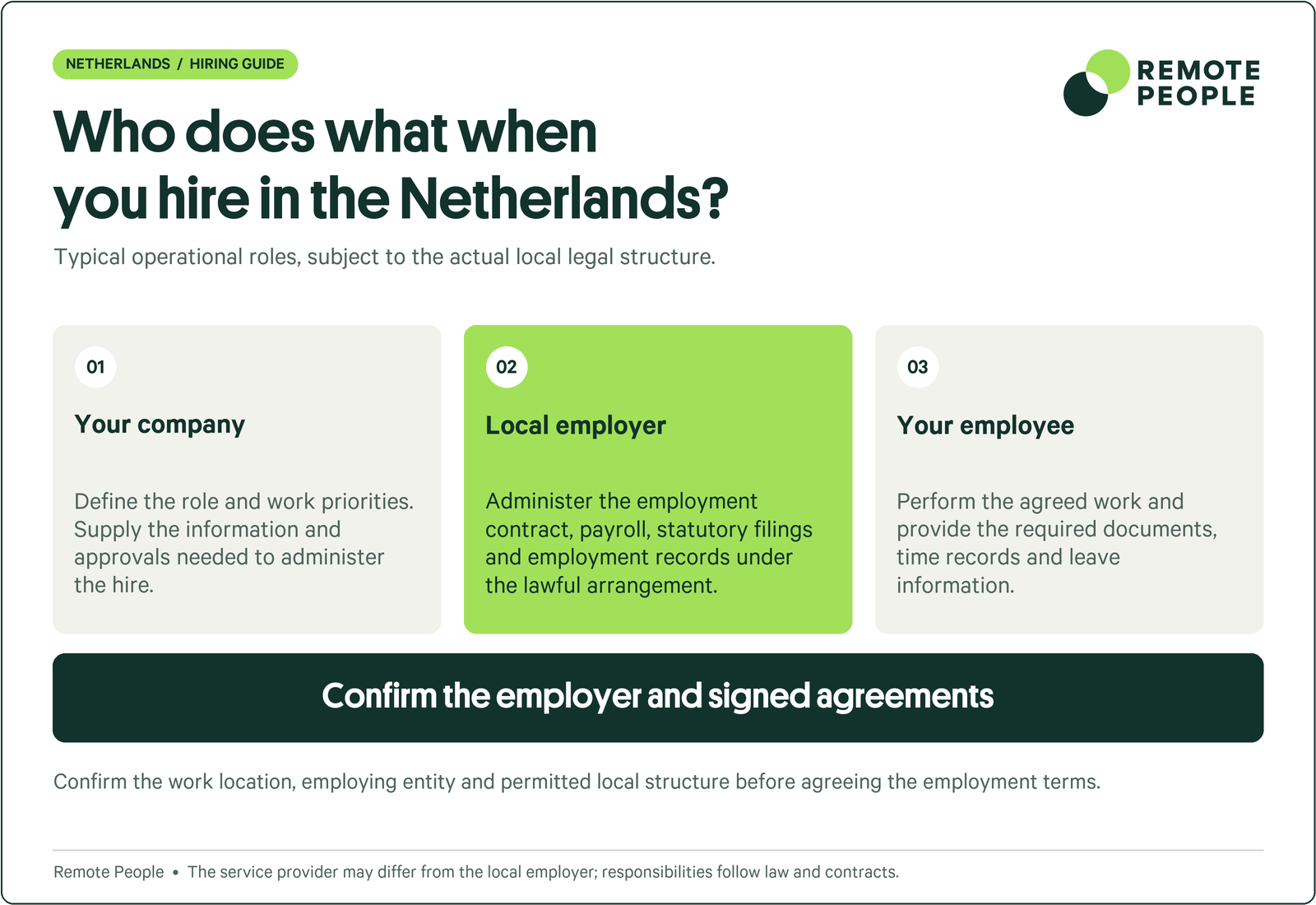
If you’d like to learn more about how Employer of Record (EOR) services work, read our What Is an Employer of Record (EOR)? guide for a complete overview of the model, its benefits, and when to use it.
If you’re comparing providers, our Best Employer of Record (EOR) Providers guide reviews the leading platforms to help you choose the right solution for your business.
Who Uses an EOR in the Netherlands?
The Netherlands is the fifth-largest EU economy, with high labour productivity, English fluency above 90%, and dense talent clusters in tech, finance, life sciences, and logistics around Schiphol. Typical use cases for EOR include:
- Testing the Dutch market before committing to an entity: Companies evaluating demand, hiring a country manager, or testing a remote-first go-to-market can hire one or two employees through an EOR before investing in BV incorporation that takes six to ten weeks and triggers ongoing bookkeeping and substance requirements.
- Hiring a small team without entity overhead: Organisations that need fewer than fifteen employees in the Netherlands often find EOR fees of $300–$600 per employee per month cheaper than the combined cost of BV setup, annual filings with the Kamer van Koophandel, and 25.8% corporate income tax exposure.
- Onboarding quickly: An EOR can issue a signed contract, register the worker with the UWV and Belastingdienst, and run the first payroll within seven to ten business days, compared to the two- to three-month lag of a fresh entity setup.
- Hiring non-EU nationals who need a work permit: An EOR that holds recognised sponsor status with the IND can sponsor the Highly Skilled Migrant permit in two to four weeks, absorbing the €380 application fee and the annual audit obligations that come with the sponsor role.
Businesses expanding into the Netherlands usually work with an EOR while they decide whether long-term headcount justifies the fixed cost of a local entity. Once a team exceeds fifteen to twenty employees, a Dutch BV typically becomes more cost-efficient than ongoing EOR fees.
Typical Onboarding Timeline
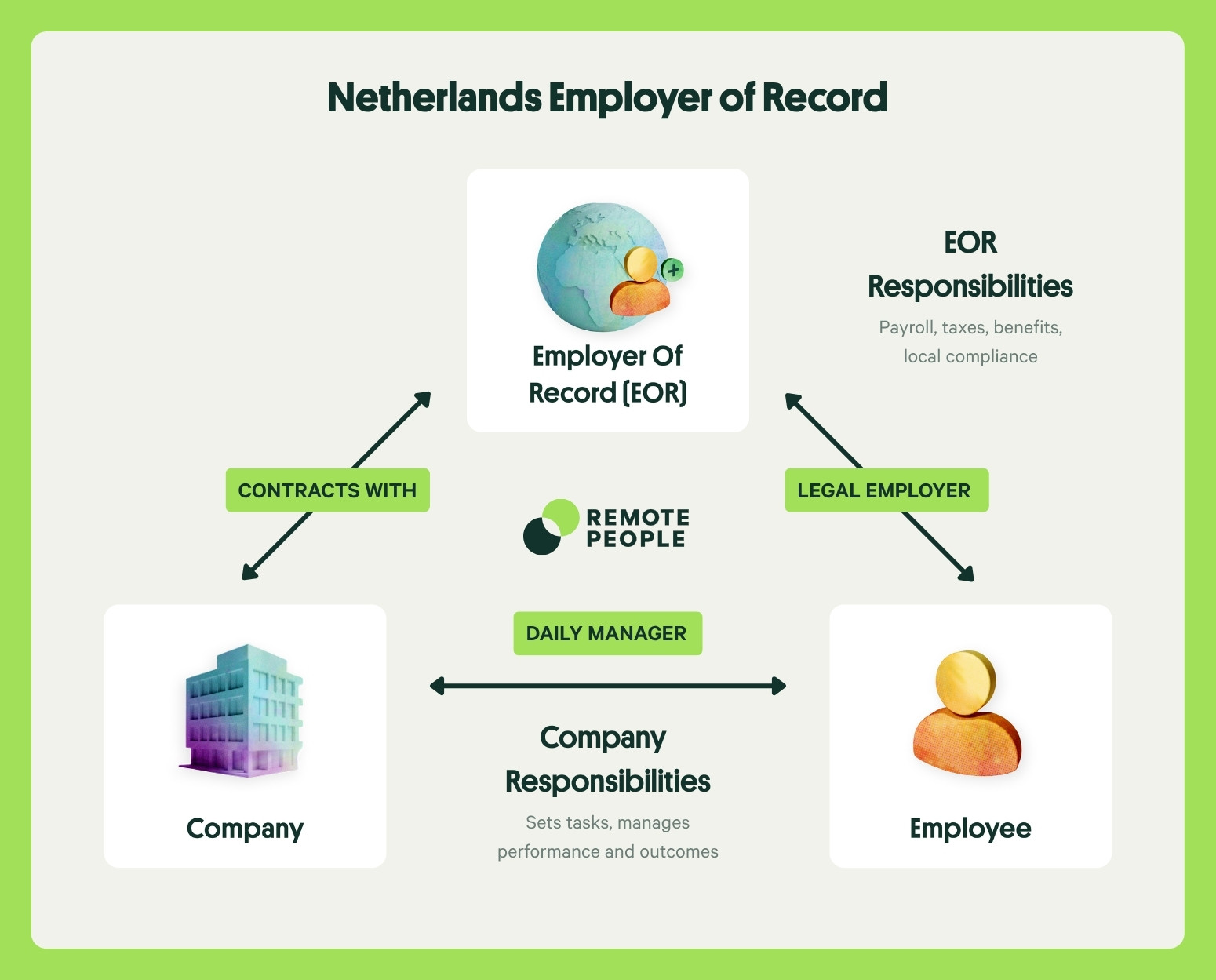
A compliant hire through an EOR in the Netherlands typically takes seven to ten business days from signed service agreement to first day of work.
- EOR agreement and employee details: 1–2 days to share the candidate’s passport, BSN (citizen service number) or BSN application status, qualifications, salary, start date, and benefits.
- Employment contract drafting and review: 2–3 days for the EOR to prepare the Dutch or English contract under Article 7:655 of the Civil Code, align it to the applicable CAO, and capture signatures.
- UWV and Belastingdienst registration: 2–3 days to register the worker for wage tax and employee insurance, and to activate the tax credit (loonheffingskorting) election.
- Payroll setup and benefits enrolment: 2–3 days to load the employee into payroll, enrol them in the industry pension fund (if applicable under the CAO), and finalise the Zvw healthcare contribution.
- Employee onboarding and first day: 1 day for IT access, policies, and orientation.
Most EOR providers can onboard an employee in the Netherlands within one to two weeks. Non-EU nationals who need a Highly Skilled Migrant or EU Blue Card permit add two to four weeks to the timeline because the IND must approve the residence permit before the employee can start work.
How to Hire Employees in the Netherlands
Before hiring in the Netherlands, it’s important to choose the right employment setup for your business goals. The method you select will impact your legal obligations, time to hire, and long-term operational flexibility. Companies can hire in the Netherlands through one of the following models:
Establish a Local Entity
Setting up a Dutch legal entity, such as a BV (Besloten Vennootschap), enables you to hire employees directly. This route offers full operational control but requires significant time, administrative effort, and ongoing compliance with Dutch corporate, tax, and labor laws.
For companies with long-term plans in the Netherlands, this is often the right path. However, establishing an entity includes registering with the Dutch Chamber of Commerce (KvK), setting up a local bank account, hiring local representatives, and enrolling in social security and tax systems. You’ll also need to manage local accounting, tax filing, and employment law updates.
If you’re not ready to commit to a permanent presence, you may want to consider alternatives. Depending on your business type, setting up a branch may also be an option, though this structure typically offers fewer tax and legal advantages than a private limited company (BV).
In either case, you will be subject to Dutch employment law from day one, so working with local legal or HR consultants is highly recommended.
Working with an Employer of Record (EOR)
An Employer of Record (EOR) is a third-party service that legally employs workers on your behalf. In this model, the EOR becomes the legal employer in the Netherlands, while you retain full control over the employee’s daily tasks, performance, and team integration.
This setup allows you to:
- Hire in the Netherlands without opening a legal entity
- Start onboarding within days, not months
- Remain fully compliant with Dutch tax and labor laws
- Avoid payroll setup and local registrations
This option is ideal for companies testing the Dutch market, scaling a distributed team, or hiring quickly without legal and administrative overhead. It also provides greater agility if you need to pivot hiring plans based on market response.
EORs are particularly helpful for businesses entering multiple European markets at once, enabling centralized coordination while adhering to local compliance in each jurisdiction. This makes them an effective tool for companies that need to scale rapidly across borders. Read about possible restrictions coming into place this year.
Hiring Independent Contractors
Hiring contractors offers flexibility and reduced overhead, particularly for short-term or project-based work. However, the Dutch Tax Authority (Belastingdienst) has significantly increased enforcement since the lifting of the enforcement moratorium in 2025, and misclassification is now an active compliance risk.
Under the Wet DBA (Deregulation Assessment of Employment Relationships Act), if a contractor operates under conditions resembling employment, such as fixed hours, direct supervision, or long-term exclusive engagement, they may be reclassified as an employee. This can result in backdated payroll taxes, social security contributions, penalties, interest, and liability for statutory benefits including holiday pay, sick leave, and pension.
Well-defined agreements that clearly establish the contractor’s independence, scope of work, deliverables, and billing terms remain essential. RemotePeople can help assess existing contractor relationships and support transitions to employee status where needed.
Hire in the Netherlands
Known for the 30% tax ruling, works councils, strict dismissal via UWV or court, transition payments, and comprehensive Dutch employment law.
We handle employment contracts, payroll, social contributions, and full Dutch compliance.
No local entity needed. Your team can start in days.
Employment Laws and Regulations in the Netherlands
Employment Contracts
The Dutch employment relationship is governed by Book 7, Title 10 of the Civil Code (Burgerlijk Wetboek), enforced by the Nederlandse Arbeidsinspectie (Netherlands Labour Authority) and interpreted by the Kantonrechter (subdistrict court). Article 7:655 of the Civil Code requires the employer to provide the employee with a written statement of the essential terms within one month of commencement, including job description, salary, working hours, holiday entitlement, notice period, and any applicable collective labour agreement (Dutch Civil Code Book 7). Failure to provide the written statement exposes the employer to damages under Article 7:655(3).
Contracts may be indefinite (arbeidsovereenkomst voor onbepaalde tijd) or fixed-term (voor bepaalde tijd). Under the chain rule (ketenregeling) in Article 7:668a, an employer may conclude up to three successive fixed-term contracts across a maximum of three years, after which the fourth contract or the fourth year automatically converts to indefinite. About 80% of Dutch employees are covered by a sector CAO that may modify these rules. Dutch, English, or German is acceptable for the written contract so long as the employee can reasonably understand it.
Working Hours and Overtime
The Working Hours Act (Arbeidstijdenwet, ATW) caps working time at 12 hours per shift and 60 hours per week, tapered to 55 hours averaged over four weeks and 48 hours averaged over sixteen weeks (Business.gov.nl Working hours and rest times). The typical full-time workweek is 36 to 40 hours, with 40 hours treated as the default in most CAOs. Employees are entitled to an 11-hour daily rest, a 36-hour weekly rest, and a 30-minute break after 5.5 hours of work. Managerial staff who earn more than three times the minimum wage may be exempt from parts of the Act by written agreement.
Dutch law does not prescribe an overtime premium. Overtime pay is set by the employment contract or the applicable CAO, and rates vary widely by sector. In sectors without a CAO, overtime is often compensated at 100% of base pay (paid time off) or by written agreement at a 25–50% premium. The table below summarises the premium-pay framework used in CAOs that do regulate overtime.
Netherlands overtime and premium pay rates · Per the Working Hours Act and typical CAO provisions | |||
Hour Type | Rate Multiplier | Weekly/Daily Cap | Notes |
|---|---|---|---|
Weekday overtime (first tier, typical CAO) | 125% (or time off in lieu) | 12 hrs/day, 60 hrs/week | Not statutory. Sector CAOs commonly pay 125% or grant an equivalent rest block. |
Weekday overtime (after 2 extra hours) | 150% | 55 hrs/week over 4 weeks | Many CAOs step up to 150% after the second overtime hour on a normal workday. |
Saturday work | 150% | 48 hrs/week over 16 weeks | Applies when Saturday is not a scheduled workday. |
Sunday work | 200% | Written consent required | Sunday work needs the employee’s written agreement unless the nature of the work requires it. |
Public holiday work | 200% | Limited by CAO | Most CAOs pay double time plus a day off in lieu. |
Night work (00:00–06:00) | 130–150% | 10 hrs/shift, avg 40 hrs/week | Special ATW limits apply. Night workers are entitled to a medical check every year. |
Because overtime premiums are CAO-driven rather than statutory, two hires on the same salary can end up with different total compensation depending on the sector that covers their role. The EOR matches each contract to the correct CAO so overtime, shift allowances, and travel reimbursements track the bargained sector standard. Overtime pay does not qualify for the 30% expat ruling allowance and is taxed at the employee’s marginal income tax rate.
Minimum Wage
From 1 January 2026, the statutory gross minimum wage is €14.71 per hour for employees aged 21 and over, an increase of 2.15% from the €14.40 rate that applied in the second half of 2025 (Business.gov.nl – Minimum wage up January 2026). Since 1 January 2024, Dutch law has defined the minimum wage exclusively on an hourly basis; there is no statutory monthly or weekly floor. At a standard 36-hour workweek, the hourly rate equates to roughly €2,303.59 per month, and at 40 hours per week to €2,559.54 per month.
Minimum wage is revised twice a year, on 1 January and 1 July, in line with the average collective wage development. Reduced rates apply to employees aged 15 to 20:
- Age 20: 80% of the adult rate.
- Age 19: 60% of the adult rate.
- Age 18: 50% of the adult rate.
- Age 17: 39.5% of the adult rate.
- Ages 15–16: 30%–34.5% of the adult rate.
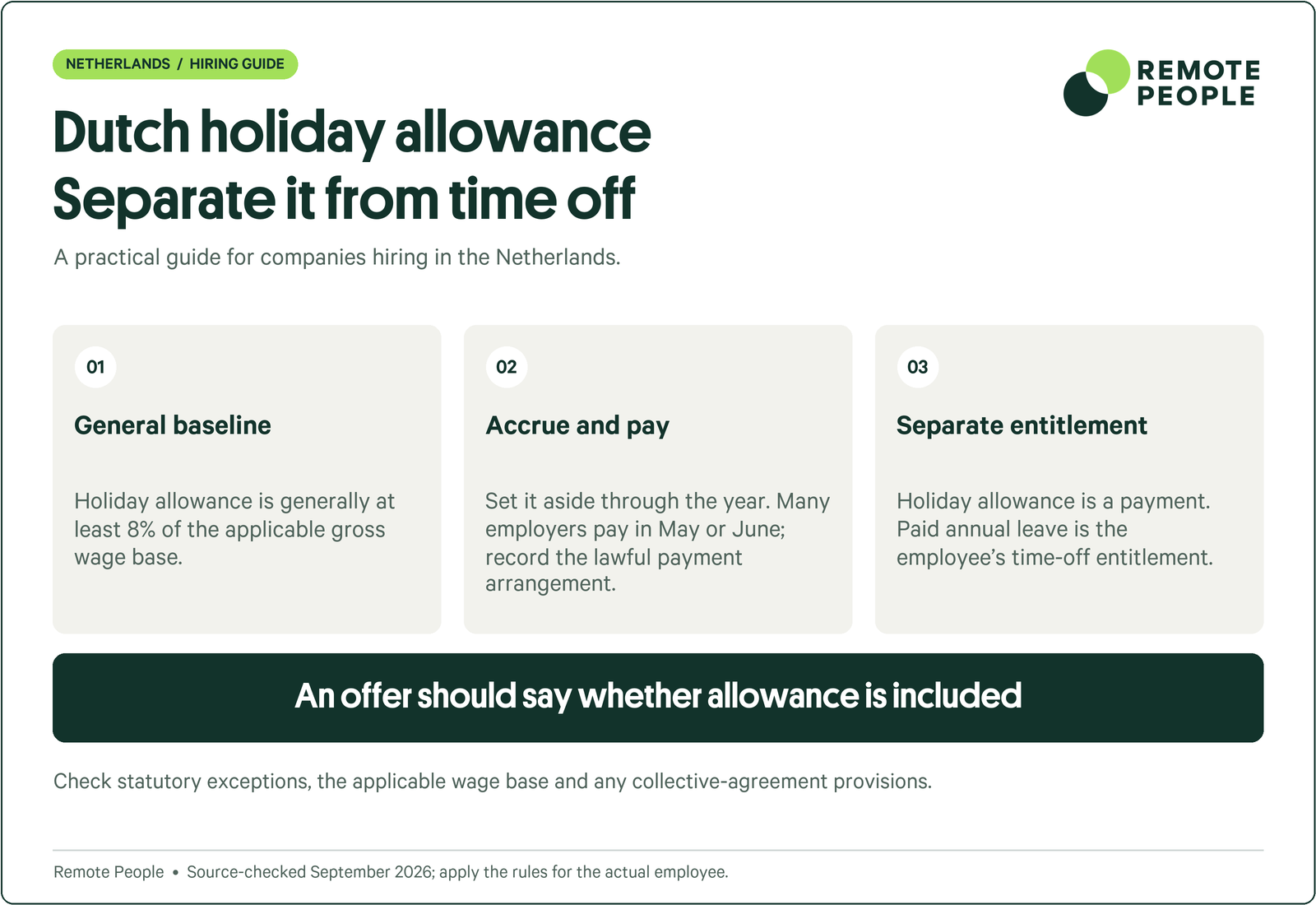
On top of the minimum wage, every employee is entitled by Article 15 of the Minimum Wage Act to a holiday allowance (vakantiegeld) of at least 8% of gross annual wages, paid out once a year, usually in May or June.
Probation Period
Under Article 7:652 of the Civil Code, a probation period (proeftijd) must be recorded in writing to be valid. Contracts for six months or less may not include a probation period at all. Fixed-term contracts longer than six months and shorter than two years allow a maximum one-month probation, and permanent contracts or fixed-term contracts of two years or more allow a maximum of two months. A probation clause is also void in a renewal contract for the same work with the same employer. During the probation period either party can terminate the contract immediately, in writing, without notice and without paying severance, but the employer must still respect anti-discrimination rules and the prohibition on dismissing a pregnant or sick employee for a discriminatory reason.
Leave Entitlements
The Netherlands has one of the most generous statutory leave frameworks in the European Union, combining a baseline annual leave entitlement, a two-year employer-paid sick leave obligation, and a full suite of parental leave benefits paid by the UWV. The types below are all statutory minimums; most CAOs enhance them.
Annual Leave
Under Article 7:634 of the Civil Code, every employee accrues at least four times the weekly working hours as paid annual leave per year, so a full-time employee working 40 hours per week accrues a minimum of 160 hours (20 days) of paid leave each calendar year (Business.gov.nl – Holiday entitlement). Most CAOs add four to five “above-statutory” days (bovenwettelijke vakantiedagen), bringing the typical entitlement to 24–28 days. Statutory days expire six months after the end of the calendar year in which they were accrued (Article 7:640a) unless the employee was unable to take them for valid reasons; above-statutory days follow a five-year prescription period. Leave accrues during probation from day one.
Sick Leave
Sick leave in the Netherlands is among the most employer-heavy in Europe. Articles 7:629 and 7:658a of the Civil Code oblige the employer to continue paying at least 70% of the employee’s last-earned wage for up to 104 weeks of illness (two years), with a floor of the applicable minimum wage during the first year (Business.gov.nl – Sick pay). Most CAOs top the employer obligation up to 100% of salary in year one and 70% in year two. The employer also runs the reintegration process under the Gatekeeper Improvement Act (Wet verbetering poortwachter), working with a company doctor (bedrijfsarts) to return the employee to work. A medical certificate is not required to call in sick, but the occupational health service must be involved after seven days.
Maternity Leave
Maternity leave (zwangerschaps- en bevallingsverlof) totals 16 weeks, split into four to six weeks of pregnancy leave before the due date and at least ten weeks of post-birth leave (UWV – Paid parental leave). The UWV pays 100% of the daily wage during the leave, capped at the maximum daily wage of €304.25 per day in 2026. Multiple births attract at least four additional weeks. Job protection under Article 7:670 of the Civil Code prohibits dismissal during pregnancy and for the first six weeks after the employee returns from leave.
Paternity Leave
Partners are entitled to one week (five working days) of paid birth leave (geboorteverlof) at 100% of salary, paid by the employer, within the first four weeks of the child’s birth. An additional five weeks of supplementary birth leave (aanvullend geboorteverlof) can be taken in the first six months, with the UWV paying 70% of the daily wage up to a cap of €212.97 per day in 2026.
Other Statutory Leave
Dutch law recognises several further statutory leave categories funded either by the employer, the UWV, or unpaid:
- Parental leave (ouderschapsverlof): 26 times the weekly working hours for each child under the age of eight. The first nine weeks, if taken in the child’s first year, are paid at 70% by the UWV; the remaining 17 weeks are unpaid.
- Short-term care leave: Up to two working weeks per year at 70% of salary, paid by the employer, to care for a sick family member or household member.
- Long-term care leave: Up to six times the weekly working hours per year, unpaid, for prolonged care of a seriously ill relative.
- Emergency leave (calamiteitenverlof): Paid leave of a reasonable duration for unforeseen personal events such as a family funeral or a burst water pipe.
- Adoption and foster leave: Six weeks paid by the UWV at 100% of daily wage, capped at the maximum daily wage.
Together, these entitlements give Dutch employees a combined statutory leave envelope that can exceed eight weeks per year once pregnancy, parental, and care leave are factored in. The table below summarises the statutory minimums under the Civil Code and the Work and Care Act (Wet arbeid en zorg).
Netherlands statutory leave entitlements · Per Book 7 of the Civil Code and the Work and Care Act | ||
Leave Type | Duration | Eligibility & Notes |
|---|---|---|
Annual leave | 4× weekly hours (20 days at 40 hrs/week) | Paid by employer at 100%. Accrues from day one. Statutory days expire 1 July of the following year. |
Holiday allowance (vakantiegeld) | 8% of annual gross salary | Paid once a year, usually May or June. Applies to all employees regardless of contract type. |
Sick leave | Up to 104 weeks | Minimum 70% of wage, floor of minimum wage in year 1. Employer-funded. Reintegration under the Gatekeeper Improvement Act. |
Maternity leave | 16 weeks | 100% of daily wage paid by UWV, capped at €304.25/day in 2026. +4 weeks for multiple births. |
Partner / paternity leave | 1 week + 5 supplementary weeks | Week 1 at 100% (employer). Weeks 2–6 at 70% (UWV, cap €212.97/day). |
Parental leave | 26× weekly hours per child under 8 | First 9 weeks (if taken in year 1) paid at 70% by UWV. Remaining 17 weeks unpaid. |
Adoption / foster leave | 6 weeks | 100% of daily wage paid by UWV, capped at €304.25/day. |
Short-term care leave | 2× weekly hours per 12 months | Employer pays 70%. For sick family / household member. |
Long-term care leave | 6× weekly hours per 12 months | Unpaid. For seriously ill close relative. |
Emergency leave | Brief, as needed | Paid by employer. Funerals, acute family events, etc. |
Statutory Employee Benefits
Beyond wages and leave, Dutch law obliges the employer to provide and fund a detailed package of mandatory benefits. These are administered through the UWV, the Belastingdienst, and, where a CAO applies, an industry pension fund.
- Health insurance (Zorgverzekeringswet): Basic health insurance is mandatory for every Dutch resident; the employee picks a private insurer and pays the nominal premium. The employer pays the income-dependent Zvw contribution at 6.10% of wages, capped at a €79,409 annual wage in 2026 (Belastingdienst – Zvw calculation).
- State pension (AOW): Funded through the employee’s income tax in bracket 1. The full AOW pension for 2026 is €1,637.57 per month (single) or €1,122.12 per month (cohabiting).
- Occupational pension: Roughly 90% of Dutch workers are enrolled in a second-pillar pension through an industry fund such as PFZW (healthcare), ABP (public sector), or BPL (agriculture). Contribution rates vary by fund but typically range from 18% to 28% of pensionable salary, with the employer paying two-thirds and the employee one-third.
- Disability and unemployment insurance: Financed entirely by the employer via the WIA (Aof), WW (AWf), Whk, and Wko contributions described in the payroll section below.
- Holiday allowance: Statutory 8% of gross annual wage, paid out in May or June.
- Commuting allowance: Up to €0.23 per kilometre can be reimbursed tax-free in 2026; many CAOs treat this as a mandatory benefit.
- Work-from-home allowance: Up to €2.35 per home-office day can be reimbursed tax-free in 2026.
An EOR enrols the employee in the correct industry pension fund, administers the holiday allowance, and files the monthly payroll tax return that covers Zvw, WW, and WIA contributions, so the foreign employer never has to interact directly with the UWV or the Belastingdienst.
Recent Regulatory Updates (2026)
The most significant 2026 change is the annual uplift of the 30% ruling thresholds and Highly Skilled Migrant salary floors. From 1 January 2026, the 30% ruling requires a minimum taxable salary of €48,013 (general) or €36,497 for employees under 30 holding a Dutch master’s degree or equivalent, and the 30% allowance is capped at a €262,000 salary, giving a maximum tax-free allowance of €78,600 (Government.nl – 30% facility). From 1 January 2027 the allowance rate drops from 30% to 27% for new and existing rulings.
Dutch income tax Box 1 brackets have also been restructured for 2026: the first bracket is taxed at 35.75% on income up to €38,883, the second at 37.56% between €38,883 and €78,426, and the top bracket at 49.50% above €78,426. The first-bracket rate bundles wage tax and national insurance (AOW, ANW, Wlz) premiums. Employer insurance premiums rose modestly. The average Whk premium increased to 1.91% and the low AWf unemployment premium to 2.74%, reflecting higher benefit outlays (Belastingdienst payroll taxes).
On the immigration side, the IND’s recognised-sponsor compliance regime tightened on 1 January 2026: sponsors must keep bank statements and batch payment evidence proving the Highly Skilled Migrant salary is actually paid each month, not just stated on a payslip. Failing this audit costs the sponsor its recognised status.
Work Permits and Visas in the Netherlands
Work Permit Requirements
Who Needs a Work Permit
EU, EEA, and Swiss nationals do not need a work permit to work in the Netherlands. They can register with the municipality and start work immediately. UK nationals became third-country nationals after Brexit and generally require a residence-and-work permit unless they qualify under the EU–UK Withdrawal Agreement as pre-2021 residents. Non-EU / non-EEA nationals need either a combined residence and work permit (Gecombineerde Vergunning voor Verblijf en Arbeid, GVVA) or a Highly Skilled Migrant / EU Blue Card permit, depending on the role and salary.
Eligibility and Required Documents
Common documents required for a Dutch work-related residence permit include a valid passport, a signed employment contract, proof of qualifications (diplomas, with Nuffic evaluation for non-Dutch degrees), proof of sufficient salary, criminal record declaration, and tuberculosis test (for specific nationalities). For the Highly Skilled Migrant permit, the sponsoring employer must already hold erkend referent (recognised sponsor) status with the IND. Entity setup, an annual audit, a €4,605 IND recognition fee (€2,303 for smaller employers), and sector-specific due diligence accompany the sponsor role.
Processing Time and Validity
A Highly Skilled Migrant application lodged by a recognised sponsor is typically decided within two to four weeks. A GVVA (regular work permit) can take up to seven weeks because the UWV conducts a labour-market test. The initial permit is valid for the duration of the employment contract up to a maximum of five years. Delays are most often driven by missing apostilled documents, unclear salary documentation, or a mismatch between the salary and the IND threshold.
Renewal Process
Renewal applications should be filed at least three months before the permit expires. For Highly Skilled Migrants, the renewal is granted when the salary remains above the threshold and the employer is still a recognised sponsor. The employee can continue working during the renewal if the application is filed before expiry.
Common Visa Types for Foreign Workers
The Dutch Immigration and Naturalisation Service (IND) issues several residence-and-work permits aimed at professional migration. A recognised-sponsor EOR can file the application, track progress, and handle the BSN (citizen service number) registration at the municipality on day one. Tourist and Schengen visas do not permit paid employment.
Netherlands work visa types for foreign workers · 2026 | ||||
Visa Type | Duration | Best For | Leads to APT? | Processing |
|---|---|---|---|---|
Highly Skilled Migrant (Kennismigrant) | Up to 5 years | Knowledge workers paid ≥€5,942/month (30+) or ≥€4,357/month (<30), excluding holiday allowance | Yes, after 5 years | 2–4 weeks |
EU Blue Card | Up to 4 years | Highly qualified workers with a recognised higher-education diploma and salary ≥€5,688/month (2026) | Yes; transferable within the EU | 2–4 weeks |
Intra-Corporate Transfer (ICT) | Up to 3 years (managers/specialists); 1 year (trainees) | Internal transfers from a non-EU group company | No (temporary) | 2–4 weeks |
GVVA (combined residence & work permit) | Up to 3 years | Standard employment not covered by a fast-track scheme | Yes | Up to 7 weeks (UWV labour-market test) |
Orientation Year (zoekjaar) | 1 year | Recent graduates of Dutch or top-ranked foreign universities looking for employment | Bridges to Highly Skilled Migrant | 2–4 weeks |
Start-up visa | 1 year, extendable | Founders working with a recognised Dutch facilitator | Bridges to self-employment permit | Up to 3 months |
Self-employed permit (DAFT for US citizens) | 2 years, renewable | US nationals investing at least €4,500 under the Dutch-American Friendship Treaty | Yes | 2–3 months |
Non-employment visas do not permit paid work in the Netherlands:
- Schengen short-stay visa: Up to 90 days for tourism or business meetings; no employment permitted.
- Student residence permit: Allows up to 16 hours per week of part-time work during term or full-time during the summer break, subject to an employer-obtained work permit.
- Working holiday scheme: Available to nationals of Argentina, Australia, Canada, Hong Kong, Japan, New Zealand, South Korea, Taiwan, and Uruguay, aged 18–30. No long-term employment.
How an EOR Handles Work Permits
A recognised-sponsor EOR can file the Highly Skilled Migrant, EU Blue Card, ICT, and orientation year permits directly with the IND. The EOR assembles the salary evidence and sponsor declarations, drafts the Dutch contract that meets the salary threshold, and tracks the TWV labour-market test where a GVVA applies. The employee supplies personal documents (passport, diplomas, criminal-record declaration) and appears at the IND desk for biometrics once the MVV (provisional entry visa) is approved. As noted in the onboarding section, add two to four weeks to the timeline for a Highly Skilled Migrant application and up to seven weeks for a full GVVA.
Payroll, Taxes, and Social Security in the Netherlands
Employer Contributions
Dutch employers fund the employee insurance system (WW, WIA, Zvw, Whk, Wko) entirely. The rates below apply to employees in the mainstream sectors in 2026; some sectors get differentiated Whk premiums based on their WGA and Ziektewet claim history.
Netherlands employer social security contributions · 2026 rates | ||
Contribution | Rate | Notes |
|---|---|---|
Unemployment fund – AWf low (permanent contracts) | 2.74% | Applies to permanent, written, non-zero-hour contracts. Capped at €79,409 wage base. |
Unemployment fund – AWf high (flexible contracts) | 7.74% | Applies to fixed-term, on-call, or verbal contracts. Same wage base cap. |
Disability fund – Aof low (small employers) | 6.27% | Employers with wage sum ≤ 25× average wage. |
Disability fund – Aof high (medium / large employers) | 7.63% | Employers with wage sum > 25× average wage. |
Childcare surcharge – Wko | 0.50% | Flat surcharge on top of Aof. Funds the Childcare Act. |
Return-to-work fund – Whk (average) | 1.91% | WGA 0.96% + ZW 0.56% + surcharges, average across sectors. Actual rate is sector- and employer-specific. |
Healthcare levy – Zvw (employer) | 6.10% | Capped at €79,409 wage base (2026). Paid on top of employee’s nominal health insurance premium. |
Typical total employer cost | ~22–25% of gross | Actual loading depends on contract type (AWf low vs high), sector Whk, and company size Aof tier. |
Employee Contributions
Employees do not pay WW, WIA, or Wko premiums directly, those are fully employer-funded. Their payroll deductions are national insurance (AOW, ANW, Wlz), which is bundled inside the 35.75% first-bracket wage tax, and an income-related Zvw contribution only where the employee is self-employed or has specific income streams. For regular employees, the effective employee-side payroll deduction is simply wage tax withholding against the Box 1 brackets.
Netherlands employee payroll deductions · 2026 monthly withholdings | ||
Deduction | Rate | Notes |
|---|---|---|
Wage tax + national insurance – Box 1 bracket 1 | 35.75% | On income up to €38,883. Bundles AOW (17.90%), ANW, Wlz, and wage tax. |
Wage tax – Box 1 bracket 2 | 37.56% | On income €38,883–€78,426. Pure income tax (national insurance capped). |
Wage tax – Box 1 bracket 3 | 49.50% | On income above €78,426. |
General tax credit (heffingskorting) | up to €3,115 | Fully deducted via payroll for employees earning below ~€28,406; phases out at higher incomes. |
Employment tax credit (arbeidskorting) | up to €5,685 | Applied via payroll. Peaks around a salary of €43,000 and then phases out. |
Whk return-to-work fund (optional deduction) | Up to 0.24% (half of WGA 0.48%) | Employer may deduct up to 50% of the WGA component from net wages. Most employers do not. |
Typical all-in effective deduction | ~28–42% of gross | Effective rate varies with salary band and tax credits; 30% ruling materially lowers this. |
Income Tax
The Netherlands uses a three-box tax system; employment income falls into Box 1 and is taxed at progressive rates. The 2026 brackets reflect the changes introduced in the Belastingplan 2026 and apply to taxpayers born on or after 1 January 1946.
Netherlands income tax brackets · 2026 | |
Bracket | Tax Calculation |
|---|---|
Up to €38,883 | 35.75% (combined wage tax + national insurance premiums) |
€38,883 – €78,426 | 37.56% (pure wage tax) |
Above €78,426 | 49.50% (pure wage tax) |
Payroll Cycle
Dutch payroll is run monthly and must be paid into the employee’s Dutch bank account (IBAN) by the last working day of the month. The employer issues a Dutch-language payslip (loonstrook) showing gross salary, tax withholdings, employer contributions, net pay, and cumulative year-to-date values. The monthly aangifte loonheffingen (wage tax return) is filed electronically with the Belastingdienst and settled within one month of the period close; late filings attract a default penalty plus interest on unpaid tax. An annual reconciliation (jaaropgaaf) is issued to the employee by 31 January of the following year so they can complete their personal income tax return by 1 May.
Holiday Allowance and 13th Month
The Netherlands does not have a statutory 13th month salary, but the law requires a separate holiday allowance (vakantiegeld) of at least 8% of gross annual wage under the Minimum Wage and Minimum Holiday Allowance Act (Wet minimumloon en minimumvakantiebijslag). The allowance accrues monthly and is paid out in a lump sum in May or June. A 13th month bonus is common in finance, professional services, and larger industrial CAOs, typically equalling one month’s salary and paid in December, but it is contractual rather than statutory. Year-end bonuses are taxed at the special rate (bijzonder tarief) using the employee’s marginal Box 1 rate. For expats under the 30% ruling, the holiday allowance also benefits from the 30% tax-free portion if it forms part of the eligible wage.
Cost of Hiring Through an EOR in the Netherlands
EOR Service Fees
RemotePeople’s EOR service fee in the Netherlands is a flat $300–$600 per employee per month, covering the Dutch employment contract, recognised-sponsor status for work permits, payroll processing, monthly wage tax filing, Zvw and employee insurance administration, benefits enrolment, and ongoing compliance with the Civil Code. There are no setup fees, no long-term commitments, and no hidden add-ons for holiday allowance administration or 30% ruling applications.
Total Employment Cost Breakdown
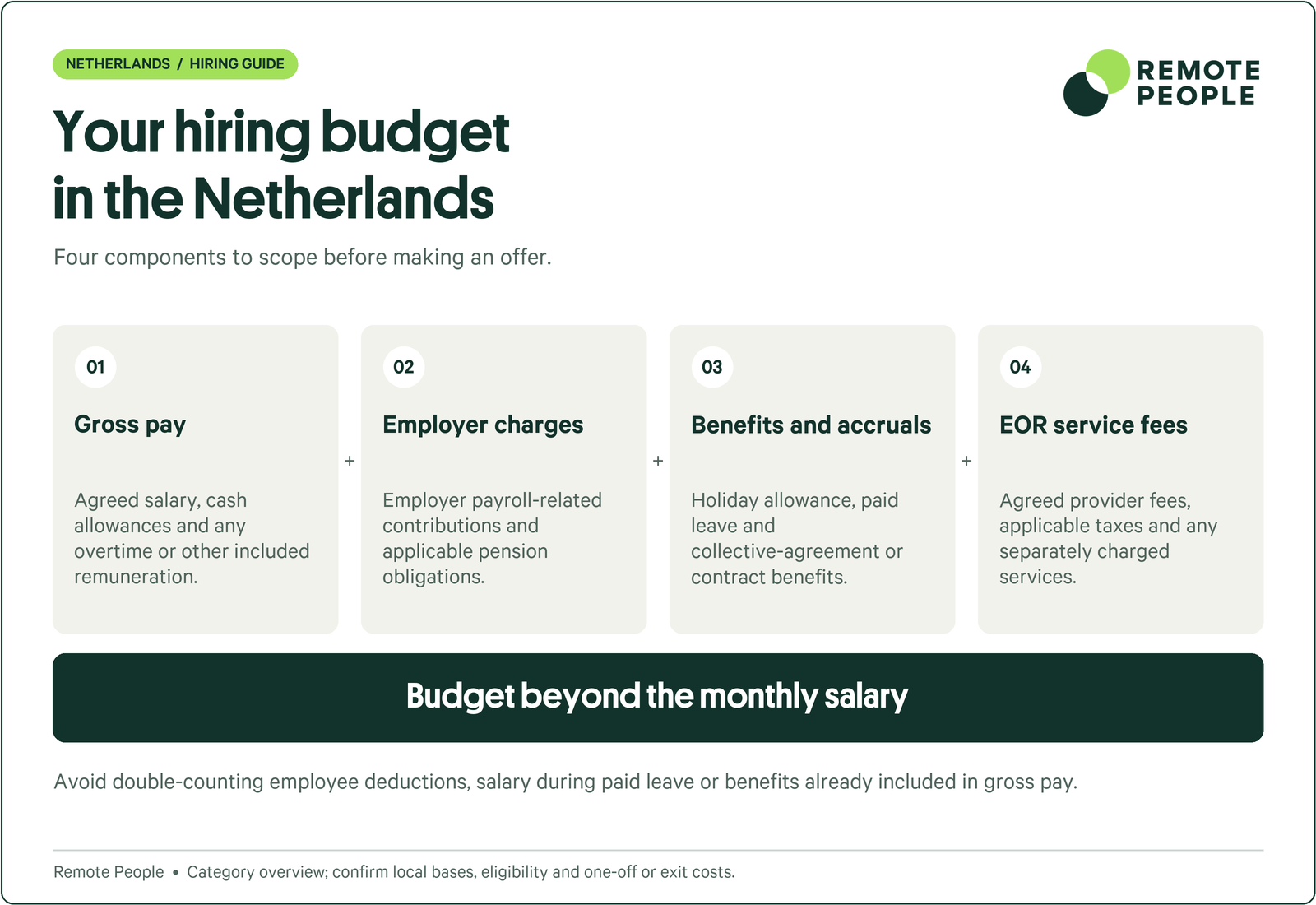
The table below shows the true total cost of hiring a mid-level employee in the Netherlands at an annual gross salary of $75,000 (roughly €69,150 at current rates). Employer insurance contributions, pension match, and the EOR fee are layered on top of the gross salary. The 8% holiday allowance is already included in the “gross salary” figure because Dutch employers fund it from the same budget line as base pay.
Netherlands employer cost example · USD 75,000 gross · 2026 | ||
Employer Cost | Amount (USD) | % of Gross |
|---|---|---|
Gross salary (includes 8% holiday allowance) | $75,000 | 100.00% |
AWf unemployment fund (low rate, permanent contract) | $2,055 | 2.74% |
Aof disability fund (high rate) | $5,723 | 7.63% |
Wko childcare surcharge | $375 | 0.50% |
Whk return-to-work fund (sector average) | $1,433 | 1.91% |
Zvw healthcare levy (capped at ~$86,400 wage base) | $4,575 | 6.10% |
Pension (employer share, typical 12% of salary) | $9,000 | 12.00% |
EOR fee ($450/month) | $5,400 | 7.20% |
Total employer cost | $103,561 | 138.08% |
Figures converted at USD 1 ≈ EUR 0.922, April 2026. Pension contribution assumes a typical industry-fund rate; actual CAO-based pension rates range from roughly 8% to 18% of pensionable salary on the employer side.
The all-in loading on top of gross salary typically runs from 30% for small-employer, CAO-light roles to 40% for senior roles in CAO-covered sectors with a large pension obligation. That load replaces the cost of setting up a Dutch BV, running local bookkeeping, and paying external payroll, HR, and legal advisers.
Ready to hire in the Netherlands? Get started with RemotePeople. We handle the Dutch employment contract, monthly payroll, all UWV and Belastingdienst filings, and full compliance, so you can onboard a Dutch employee in seven to ten business days without opening a BV. Talk to our EOR team.
Benefits of Using an EOR in the Netherlands
The Netherlands has a well-run, English-friendly regulatory system, but the sheer density of obligations, monthly wage tax returns, two-year employer-funded sick pay, 80% CAO coverage, mandatory industry pensions, Highly Skilled Migrant sponsorship, makes it expensive and slow for a foreign employer to handle alone. An EOR absorbs that complexity and lets you concentrate on managing people, not paperwork.
- Speed to market: An EOR can issue a compliant Dutch contract, register the worker with the UWV and Belastingdienst, and run the first payroll within seven to ten business days. A BV setup with Kamer van Koophandel registration typically takes six to ten weeks, and that is before you start on payroll infrastructure.
- Compliance assurance: The EOR tracks Dutch Civil Code amendments, Belastingplan changes, UWV premium updates, and the 200+ live CAOs that can apply to a single hire. In 2026 alone that includes new AWf, Aof, Whk, and Zvw rates, 30% ruling threshold adjustments, and tighter IND sponsor audits.
- Cost efficiency vs a local entity: A Dutch BV carries €0.01 minimum share capital in theory, but notary, legal, accounting, and tax advisory fees plus the €4,605 IND recognised-sponsor fee can easily exceed €15,000 in year one. For teams under fifteen employees, EOR fees are usually materially cheaper than running a dedicated entity.
- Local expertise: Dutch-language payslips, correct CAO mapping, reintegration of sick employees under the Gatekeeper Act, and proper handling of the 30% ruling require on-the-ground specialists that few foreign employers can justify hiring full-time for a single Dutch hire.
- Flexibility to scale up or down: Adding or removing headcount through an EOR takes a contract amendment, not a BV recapitalisation. This matters in the Netherlands because dismissal requires UWV or Kantonrechter approval, and missteps expose the employer to transition payment plus damages.
- Risk mitigation: The EOR carries the legal employer liability for wrongful dismissal, misclassification, and tax errors. In a country where the Wet DBA contractor reclassification regime became fully enforceable on 1 January 2026, that liability shift is meaningful.
- Employee experience: Dutch workers expect a correct loonstrook, a clear holiday allowance accrual, and timely pension enrolment. A specialist EOR delivers all three without the employee needing to educate their foreign HR team about Dutch payroll conventions.
The combined effect is that a company can hire its first Dutch employee in under two weeks, stay compliant without any in-country headcount, and convert to a local BV later, only if and when the team grows large enough to justify it.
Termination and Offboarding in the Netherlands
Notice Periods
Dutch dismissal law is strict. An employer cannot simply terminate an indefinite contract by giving notice, it also needs advance permission from either the UWV (for economic or long-term-illness grounds) or the Kantonrechter (for personal grounds). Once that permission is granted, statutory notice periods apply on top of the permission lead time. The notice periods are set by Article 7:672 of the Civil Code and scale with tenure, while the employee’s notice is a flat one month.
Netherlands statutory notice periods by position level · Per Article 7:672 of the Civil Code | |||
Tenure / Position | Notice Period | During Probation | Notes |
|---|---|---|---|
Less than 5 years | 1 month | None (immediate) | Calendar month. Notice takes effect on the 1st of the following month. |
5 – 10 years | 2 months | None (immediate) | Standard tenure tier for mid-career hires. |
10 – 15 years | 3 months | None (immediate) | Applies to employers; employees still give 1 month. |
15+ years | 4 months | None (immediate) | Maximum statutory employer notice. Cannot be extended beyond 6 months by contract. |
Employee notice (any tenure) | 1 month | None (immediate) | Contract may extend to max 6 months, but employer notice must then be double the employee’s. |
After UWV permission granted | Notice reduced by 1 month (floor 1 month) | N/A | Applies only where the UWV takes more than one month to decide. |
Common exceptions include summary dismissal for urgent cause (ontslag op staande voet), where no notice is owed but the employer bears a high evidentiary burden, and mutual termination by settlement agreement (vaststellingsovereenkomst), which is the dominant exit route in practice. Fixed-term contracts usually run to their end date without notice unless the contract contains an “interim termination” clause (tussentijds opzegbeding).
Severance Pay
Article 7:673 of the Civil Code entitles every employee whose contract is terminated on the employer’s initiative, or not renewed after a fixed term, to a transition payment (transitievergoeding). The payment is mandatory from day one of employment; there is no minimum service period, and there is no cap on entitlement beyond the statutory maximum payment amount.
Netherlands severance pay schedule by years of service · Per Article 7:673 of the Civil Code | |||
Years of Service | Severance Amount | Base Salary | Notes |
|---|---|---|---|
1 year | 1/3 of monthly salary ≈ €1,200 on €43,200 salary | Gross monthly salary + 8% holiday allowance + average bonus (last 3 years) | Partial years paid pro rata; calculated per day of service. |
3 years | 1 month salary ≈ €3,600 | Same definition as above | €3,600 at a €43,200 base salary example. |
5 years | 5/3 months salary ≈ €6,000 | Same definition | Independent of tenure-based notice period increase. |
10 years | 10/3 months salary ≈ €12,000 | Same definition | At this tenure the notice period also rises to 3 months. |
20 years | 20/3 months salary ≈ €24,000 | Same definition | Subject to the maximum transition payment of €98,000 in 2026 or one year’s salary if higher. |
Statutory maximum | €98,000 or 1 year’s salary (whichever higher) | Gross annual salary incl. holiday allowance | Cap is indexed annually. Adjusted from €94,000 in 2024. |
Calculation Method
The formula is one-third of a month’s gross salary per full year of service, with a proportional part for additional months and days. The “monthly salary” for this calculation includes the base wage, the 8% holiday allowance, structural allowances (such as a 13th month or end-of-year bonus where contractually owed), and the three-year average of variable bonuses. Pension contributions and one-off profit shares are excluded. Partial years are calculated per day: a four-month tenure gives (4/12) × (1/3) × monthly salary. See Table 13 above for worked examples at 1, 3, 5, 10, and 20 years of service.
Caps and Exceptions
The statutory cap for 2026 is €98,000 or one year’s gross salary if the employee earns more than €98,000 annually. Small employers in insolvency can apply for a compensation scheme through the UWV. No transition payment is owed where the employee is dismissed for urgent cause (ontslag op staande voet), where the employee reaches state-pension age during the contract, or where the parties agree to end the contract by mutual consent using a settlement agreement that provides its own negotiated severance. Courts may additionally award a “fair compensation” (billijke vergoeding) on top of the transition payment where the employer has acted seriously culpably, with no upper limit.
Grounds for Termination
Dutch law recognises eight closed grounds for dismissal in Article 7:669, which fall into two buckets: economic / long-term-illness grounds handled by the UWV, and personal grounds handled by the Kantonrechter. Personal grounds include unsuitability (disfunctioneren), disturbed working relationship, culpable behaviour, refusal to perform work on conscientious grounds, frequent absence, and a combination of grounds (i-grond) introduced in 2020. Collective dismissals above 20 employees within three months trigger the Wet melding collectief ontslag with mandatory consultation of the works council and the FNV or CNV trade unions. Protected categories include pregnant employees, employees on long-term sick leave, works council members, and data protection officers.
EOR vs. Other Hiring Models in the Netherlands
EOR vs. Setting Up a Local Entity
A Dutch BV (besloten vennootschap) is the default vehicle for a local entity and can be incorporated online with €0.01 minimum share capital, but the real cost is operational: notary deed, Chamber of Commerce registration, tax registrations, ongoing bookkeeping, and the annual financial statements filed with the Kamer van Koophandel. The table below compares the two paths on the factors that actually influence the decision.
Netherlands EOR vs local entity comparison · Setup time, cost, risk and best-fit | ||
Comparison | Employer of Record | Own Entity (BV) |
|---|---|---|
Setup time | 1–2 weeks | 6–10 weeks (BV + KvK + tax IDs + IND sponsor if needed) |
Upfront cost | $0 | €10,000–€15,000 (notary, legal, tax, IND sponsor fee) |
Ongoing cost | $300–$600/employee/month | €15,000–€25,000/year (accounting, payroll, tax, legal, substance) |
Local partner required | No (EOR is the local entity) | No, but a Dutch director or registered office is recommended |
Social insurance registration | Handled by EOR | You manage it with UWV and Belastingdienst |
Payroll & tax filing | Handled by EOR | You manage it (usually outsourced) |
Best for team size | 1–15 employees | 15+ employees |
Scale down / exit | Easy, no entity to unwind | Costly, formal dissolution via notary, KvK deregistration, 2-month creditor window |
Government contracts | Not eligible | Eligible (Dutch government procurement requires a local entity) |
Most foreign employers testing the Netherlands market use an EOR for the first 12 to 18 months. Once headcount clears 15 to 20 employees, the monthly EOR fee exceeds the cost of a dedicated Dutch BV with an outsourced payroll provider and a Dutch corporate-secretarial firm. At that point, many clients migrate their EOR employees to their own entity with RemotePeople handling the transfer of employment.
Entities also open up specific use cases that EOR cannot cover: tendering for central-government or EU contracts, holding Dutch real estate or intellectual property for tax-planning reasons, and qualifying for Dutch innovation incentives like the WBSO payroll credit and the Innovation Box corporate tax regime.
EOR vs. Hiring Independent Contractors
Hiring a Dutch zzp’er (zelfstandige zonder personeel) looks attractive on paper, no employer contributions, no CAO, simple hourly invoicing, but the Wet DBA (Law Deregulation of Employment Relationships) was fully reactivated on 1 January 2026. The Belastingdienst now has the resources and mandate to reclassify contractors as employees and recover up to five years of back taxes, employee insurance premiums, and fines.
Netherlands EOR vs independent contractors · Compliance, cost, and risk | ||
Comparison | EOR (Full-Time Employee) | Independent Contractor (zzp’er) |
|---|---|---|
Legal relationship | Employee of the EOR, service relationship with the client company | Self-employed, no employment relationship |
Compliance risk | Low, EOR ensures CAO and Civil Code compliance | Elevated under the Wet DBA, reclassification can trigger 5 years of back taxes and premiums |
Payroll & tax | EOR handles wage tax, Zvw, employee insurance, and filing | Contractor invoices with VAT; they file income tax and social contributions themselves |
Benefits & leave | Statutory benefits, 8% holiday allowance, paid leave, pension | No entitlement to statutory employee benefits |
IP protection | Stronger, Article 7 of the Dutch Copyright Act assigns IP to the employer by default | Weaker, requires an explicit IP-assignment clause in the contract |
Termination | Subject to Civil Code notice and transition payment | Contract can end per agreement terms |
Best for | Long-term, integrated, full-time work | Short-term projects, narrowly scoped specialist deliverables |
Cost structure | Salary + ~25% employer contributions + EOR fee | Hourly / daily rate (typically 1.5–2× employee cost, but no benefits) |
The Belastingdienst looks at three factors to determine whether a contractor is really an employee: the obligation to perform the work personally (gezagsverhouding), payment of a fixed remuneration (loonbetaling), and a relationship of authority. A zzp’er working full-time for one client, following that client’s schedule, and paid a fixed monthly fee looks indistinguishable from an employee, and the risk of reclassification in 2026 is high.
For roles that are in-scope, time-bound, and output-based (a single software module, a design project, a legal opinion), the contractor route still works. For long-term strategic roles, country manager, sales lead, senior engineer, RemotePeople’s Netherlands EOR service is the safer structure. Where you need a mix, the RemotePeople contractor-of-record solution can run the Dutch contractor payments under a compliant framework.
EOR vs. PEO (Professional Employer Organization)
The traditional US “PEO” model, where the client already has a local entity and uses a co-employment arrangement for HR outsourcing, is uncommon in the Netherlands because the local BV framework and third-party payroll providers already deliver most of what a PEO does.
Netherlands EOR vs PEO comparison · Legal employer, liability, and setup | ||
Comparison | Employer of Record (EOR) | PEO |
|---|---|---|
Legal employer | EOR is the legal employer | Your Dutch BV remains the legal employer (co-employment) |
Local entity required | No, the EOR is the local entity | Yes, you must have a Dutch BV or branch |
Best for | Companies without a Dutch entity | Companies that already operate a Dutch BV |
Compliance liability | EOR assumes compliance responsibility | Shared liability between your BV and the PEO |
Setup time | 1–2 weeks | Depends on your BV setup (weeks to months) |
Control over HR policies | EOR applies local-law framework; you set commercial strategy | You retain direct control; PEO advises |
Typical use case | Market entry, small remote teams, testing the market | Established Dutch operations with HR outsourcing needs |
The Netherlands regulates labour intermediaries through the WAADI (Wet allocatie arbeidskrachten door intermediairs). Third-party payroll providers operating as uitzendbureaus or payrollbedrijven must register with the Kamer van Koophandel and comply with the CAO for temporary agency workers. In practice, the vast majority of foreign employers either hire through an EOR (no local entity) or outsource payroll to a Dutch provider under their own BV (not a PEO). If you see the term “Netherlands PEO” in a service pitch, ask whether the provider is actually offering an EOR arrangement, the distinction determines who carries the tax and labour-law liability.
Public Holidays in the Netherlands
The Netherlands recognises eleven national public holidays; however, Dutch law does not make them compulsory paid days off. Whether an employee receives paid leave on a given holiday depends on the individual contract and the applicable CAO. Most employers follow the national calendar with the following list for 2026.
Netherlands public holidays · 2026 calendar year | ||
Date | Holiday | Type |
|---|---|---|
Thursday, 1 January | New Year’s Day (Nieuwjaarsdag) | National |
Friday, 3 April | Good Friday (Goede Vrijdag) | National (CAO-dependent) |
Sunday, 5 April | Easter Sunday (Eerste Paasdag) | National |
Monday, 6 April | Easter Monday (Tweede Paasdag) | National |
Monday, 27 April | King’s Day (Koningsdag) | National |
Tuesday, 5 May | Liberation Day (Bevrijdingsdag) | National (every 5 years guaranteed; CAO-dependent other years) |
Thursday, 14 May | Ascension Day (Hemelvaartsdag) | National |
Sunday, 24 May | Whit Sunday (Eerste Pinksterdag) | National |
Monday, 25 May | Whit Monday (Tweede Pinksterdag) | National |
Friday, 25 December | Christmas Day (Eerste Kerstdag) | National |
Saturday, 26 December | Boxing Day (Tweede Kerstdag) | National |
Because paid holiday pay on these dates is CAO-driven rather than statutory, the EOR ensures each contract maps to the correct sector CAO and that holiday premiums for holiday work (typically 200% of regular pay) match the bargained rate. In sectors without a CAO, the employment contract itself must state whether public holidays are paid off, a clause the EOR always includes.
How to Get Started with an EOR in the Netherlands
Hiring your first Dutch employee through RemotePeople is a structured five-step process that typically completes in seven to ten business days.
- First, share the role and candidate details: Send us the job title, salary, start date, location (remote or Amsterdam-based), and the candidate’s nationality and passport. We confirm within 24 hours whether the role is a straightforward EU hire or needs a Highly Skilled Migrant permit.
- Second, review the Dutch-compliant employment contract: RemotePeople drafts a Civil Code–compliant contract that aligns with the correct sector CAO, sets the 30% ruling election (where applicable), and schedules the probation, notice, and non-compete clauses. We work with both you and the candidate until all three parties are ready to sign.
- Third, complete UWV, Belastingdienst, and pension registration: Once the contract is signed, we register the employee for wage tax, employee insurance, and the industry pension fund within 48 hours. If a Highly Skilled Migrant permit is needed, we file it in parallel, typically receiving approval in two to four weeks.
- Fourth, configure payroll and benefits: RemotePeople loads the employee into the monthly Dutch payroll run, sets up the 8% holiday allowance accrual, and enrols them in Zvw healthcare and any CAO-mandated benefits such as commuting allowance or training budget.
- Fifth, onboard and manage day-to-day work: RemotePeople stays the legal employer and handles compliance. You manage the employee’s daily work, deliverables, and performance reviews through the service agreement. You can add more hires, scale down, or migrate to your own BV whenever the business case shifts.
Ready to hire in the Netherlands? RemotePeople handles the Dutch contract, payroll, tax withholding, IND sponsorship, and full Civil Code compliance, no BV required. Talk to our EOR team to onboard your first Dutch hire within two weeks.
Where companies hiring in the Netherlands expand next
Teams hiring in the Netherlands typically expand across Western Europe, where EU labor directives and adjacent markets enable rapid regional scale. Teams frequently add Ireland for aligned English-language hiring dynamics; hiring in France often follows for EU-level labor law alignment; an EOR partner in Belgium is a common next step, offering aligned Benelux employment norms; and Luxembourg rounds out the regional footprint with the Benelux-region multilingual talent pool.
Frequently Asked Questions
EOR services in the Netherlands typically cost between $300 and $600 per employee per month, covering the Dutch employment contract, monthly wage tax filings with the Belastingdienst, Zvw and employee insurance administration, and full compliance with Book 7 of the Civil Code. On top of the EOR fee, the employer pays ~22–25% of gross salary in employer social insurance (AWf, Aof, Whk, Wko, Zvw) and an industry-fund pension contribution that averages around 12% of salary. A $75,000 hire costs roughly $103,000 fully loaded (Belastingdienst).
Most EOR providers can onboard an employee in the Netherlands within seven to ten business days once the candidate is identified. The timeline covers contract drafting under Article 7:655 of the Civil Code, UWV and Belastingdienst registration, and payroll enrolment. Non-EU nationals who need a Highly Skilled Migrant permit through a recognised-sponsor EOR add another two to four weeks for the IND to decide the application (IND).
Yes. Dutch employment law is among the most protective in the EU. The employer pays at least 70% of wages during sickness for up to two years, dismissals require UWV or Kantonrechter approval on one of eight closed grounds under Article 7:669, and every employee is entitled to a transition payment from day one under Article 7:673. Statutory annual leave is four times weekly working hours (20 days for a 40-hour worker), plus an 8% holiday allowance, and Highly Skilled Migrants under age 30 qualify for the 30% ruling at a €36,497 salary threshold in 2026 (Business.gov.nl).
For long-term, integrated, full-time roles the EOR route is safer. On 1 January 2026 the Belastingdienst fully reactivated enforcement of the Wet DBA (Law on Deregulation of Employment Relationships), and the Tax Administration can now reclassify a zzp'er contractor as an employee and recover up to five years of back taxes, employee insurance premiums, and fines. For short, output-based projects with specialist scope, contractors remain an option. RemotePeople's contractor management solution can run compliant Dutch zzp'er engagements where the role genuinely fits that profile (Business.gov.nl DBA).
From 1 January 2026, the statutory gross minimum wage is €14.71 per hour for employees aged 21 and over, an increase of 2.15% from €14.40 in the second half of 2025. At a standard 36-hour workweek this equates to roughly €2,303.59 per month; at 40 hours it equates to roughly €2,559.54 per month. Reduced rates apply for ages 15 to 20 on a sliding scale from 30% to 80% of the adult rate, and the minimum wage is revised every six months on 1 January and 1 July (Business.gov.nl).
Dutch Box 1 income tax uses three brackets in 2026: 35.75% on income up to €38,883 (this bracket bundles wage tax and national insurance premiums for AOW, ANW, and Wlz), 37.56% on income between €38,883 and €78,426, and 49.50% on income above €78,426. General and employment tax credits can reduce the effective rate materially for employees under €50,000 of annual salary (PwC).
Under Article 7 of the Dutch Copyright Act (Auteurswet), copyright in works created by an employee in the course of their duties vests automatically in the employer. Through an EOR arrangement, the service agreement between RemotePeople and the client company (you) assigns the IP directly to the client company (you), not the EOR. Patent rights follow a similar default under the Dutch Patents Act, and the EOR contract reinforces the assignment with an explicit clause covering pre-existing IP and moral rights (Dutch Civil Code Book 7).
Not easily. An employer cannot terminate an indefinite contract at will; it needs UWV permission for economic grounds or a Kantonrechter ruling for personal grounds under one of the eight grounds of Article 7:669 of the Civil Code. Statutory notice then runs from one month (under five years' tenure) to four months (fifteen+ years). The employee is entitled to a transition payment of one-third of a month's salary per year of service, capped at €98,000 in 2026 or one year's salary if higher. The fastest dismissal path in practice is a mutual-termination settlement agreement (vaststellingsovereenkomst), where RemotePeople's legal team can usually negotiate an exit in two to four weeks (Business.gov.nl).
Employer of Record in
Employer of Record in
Employer of Record in
Employer of Record in
Employer of Record in
Employer of Record in
Employer of Record in
Employer of Record in