
 Recruit
Employer of Record (EOR) in Brazil
-
 Drew Donnelly
- Published
- September 21, 2026
An Employer of Record (EOR) in Brazil is a third-party company that legally hires and pays workers on your behalf, handling CLT contracts, INSS social security, FGTS contributions, and federal payroll tax compliance with Receita Federal. A Brazil EOR lets you employ Brazilian talent in 1–2 weeks without opening a local entity (filial).
Hire in Brazil — book a free 30-minute demo
Tell us what you need. You'll get a tailored, transparent proposal within 24 hours, plus a free call to walk through it.
Tell us about your company
So we can match you with a specialist who knows your market — and unlock volume pricing tiers.
* All fields are required.
Where and when are you hiring?
Tell us the geography and timing and we'll quote each country line by line, with onboarding timelines.
* All fields are required.
Help us beat your current setup
We'll benchmark your current deal and send a line-by-line proposal in 24 hours — showing exactly where we cut cost, time, or risk. After you submit, you can book a call to walk through it together.
* All fields are required.
Thanks! Your proposal is on its way.
Expect a tailored, line-by-line proposal in your inbox within 24 hours. In the meantime…
Want to walk through it together?
Book a free 30-minute call with one of our specialists. We'll explain every line, answer your questions, and tailor the proposal further if you need.
No obligation. Pick a time that works for you.








- Hire in Brazil — book a free 30-minute demo
- Tell us about your company
- Where and when are you hiring?
- Help us beat your current setup
- Thanks! Your proposal is on its way.
- How an Employer of Record Works in Brazil
- Employment Laws and Regulations in Brazil
- Work Permits and Visas in Brazil
- Payroll, Taxes, and Social Security in Brazil
- Cost of Hiring Through an EOR in Brazil
- Benefits of Using an EOR in Brazil
- Termination and Offboarding in Brazil
- EOR vs. Other Hiring Models in Brazil
- Public Holidays in Brazil
- How to Get Started with an EOR in Brazil
- Where companies hiring in Brazil expand next
- Frequently Asked Questions
- Related EOR Destinations

Start hiring in Brazil
Let RemotePeople handle payroll, compliance, and HR admin worldwide so you can focus on building your team.

Brazil has the largest economy in Latin America and a workforce of more than 100 million, with deep talent pools in software engineering, finance, agribusiness, design, and customer operations. Salaries run well below North American and Western European levels while time zones overlap with US business hours, which makes real-time collaboration practical. For companies looking to hire employees in Brazil, the regulatory side is the hard part: the Consolidação das Leis do Trabalho (CLT) governs every formal employment relationship, mandatory 13th salary and FGTS add meaningful payroll cost, and employer contributions run roughly 35.8% of gross salary before benefits.
An employer of record in Brazil removes the need to register a Brazilian entity while keeping you fully compliant with CLT rules. The EOR acts as the legal employer, handling CLT-compliant contracts, monthly payroll, INSS and FGTS remittances, income tax withholding, work visas, and statutory benefits. You keep day-to-day direction of the employee; the EOR carries the legal and administrative load.
How an Employer of Record Works in Brazil
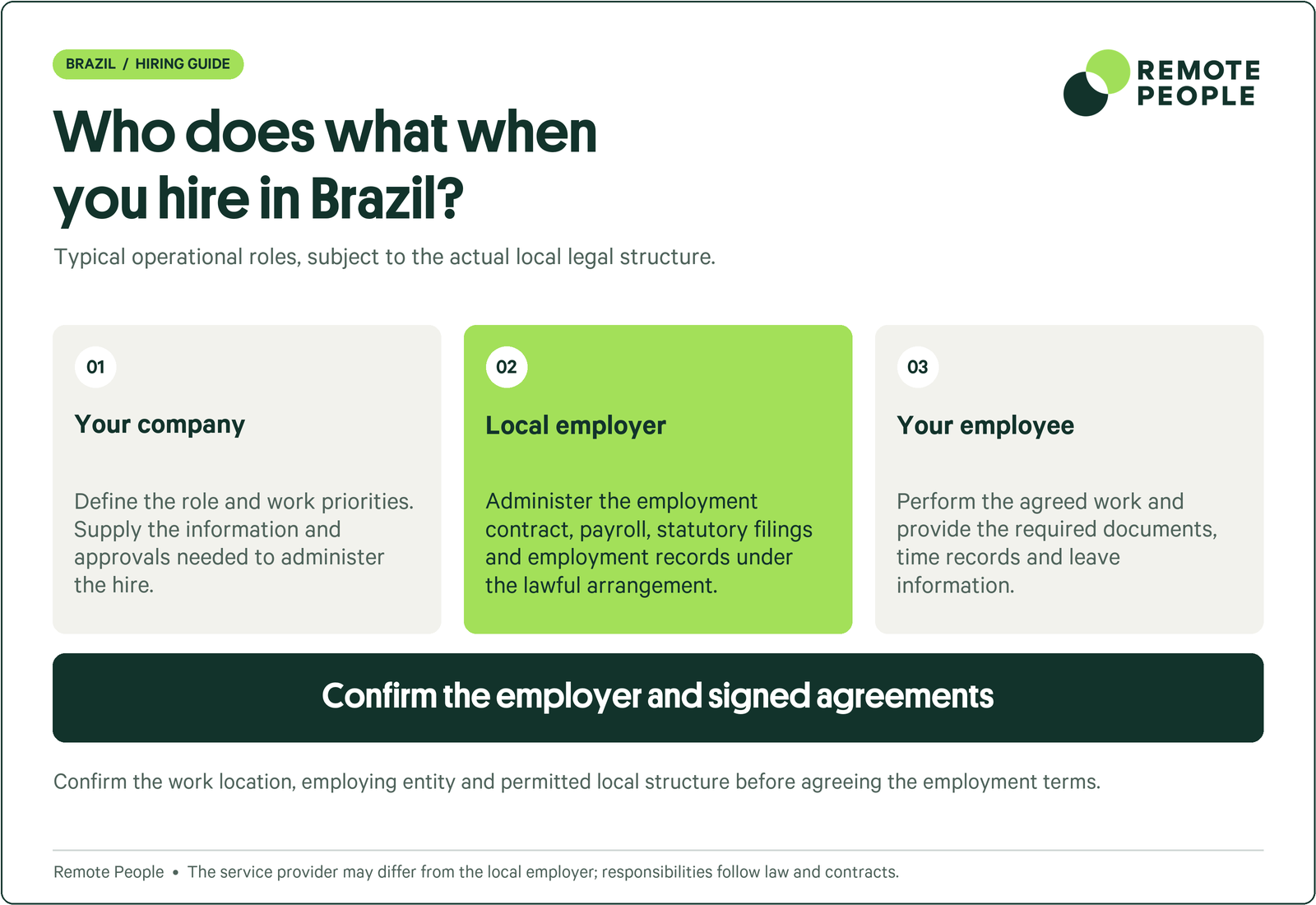
If you’d like to learn more about how Employer of Record (EOR) services work, read our What Is an Employer of Record (EOR)? guide for a complete overview of the model, its benefits, and when to use it.
If you’re comparing providers, our Best Employer of Record (EOR) Providers guide reviews the leading platforms to help you choose the right solution for your business.
Who Uses an EOR in Brazil?
Companies choose an EOR in Brazil to enter the market without incorporating a local subsidiary, to hire a small team of one to fifteen people where the cost of a Limitada or S.A. is hard to justify, or to onboard a candidate in weeks instead of the months required for entity setup. Foreign companies with remote workers in Brazil find it especially valuable because CLT compliance, eSocial filings, FGTS deposits, and INSS submissions would otherwise need a Brazilian payroll specialist on staff. The model works for any business expanding into Brazil, regardless of size or sector.
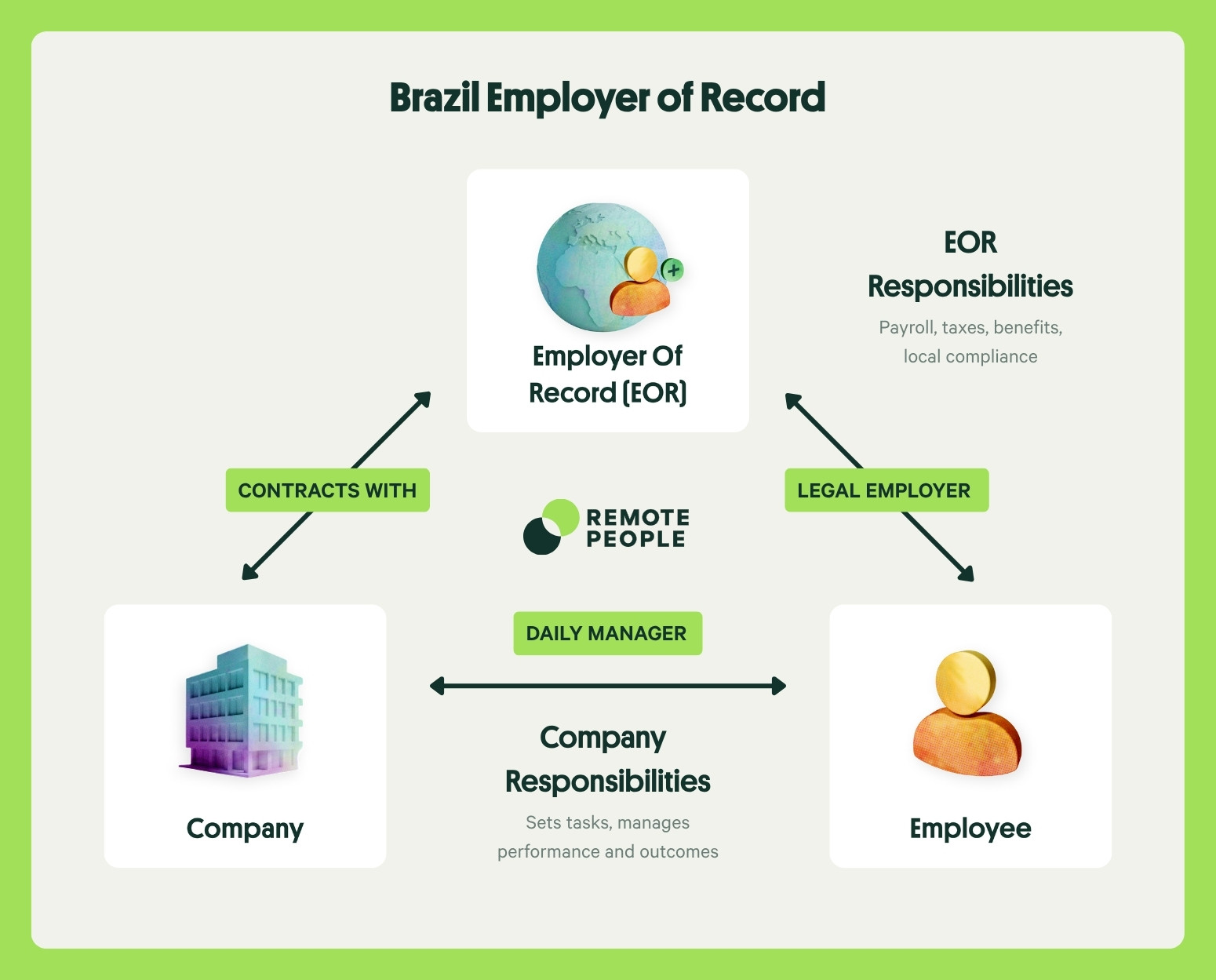
Typical Onboarding Timeline
The onboarding process typically takes 1 to 2 weeks:
- First, sign the EOR service agreement and share employee details (1-2 days).
- Second, the EOR drafts a CLT-compliant contract in Portuguese with role-specific terms (2-3 days).
- Third, the employee is registered in eSocial, INSS, and FGTS, and assigned a Carteira de Trabalho Digital (3-7 days).
- Fourth, payroll configuration, benefits enrollment, and bank details are finalized (2-3 days).
- Fifth, the employee officially starts work and receives the first paycheck on the next payroll cycle (1 day).
If the hire is a foreign national requiring a VITEM V work visa, add 2 to 4 months for the Ministry of Justice residence authorization, consular processing, and Federal Police registration.
Hire in Brazil Without Setting Up an Entity
Access to 215 million people, a deep talent pool in tech and services, strong labor protections under the CLT, and competitive costs make Brazil Latin America’s top hiring destination.
We handle employment contracts, payroll, INSS contributions, FGTS, and full Brazilian compliance.
No local entity needed. Your team can start in days.
Statutory Employee Benefit
Employment Laws and Regulations in Brazil
Employment Contracts
All formal employment relationships in Brazil are governed by the Consolidação das Leis do Trabalho, established by Decree-Law 5,452/1943 (WIPO Lex) and enforced by the Ministério do Trabalho e Emprego. Brazilian law presumes every contract is indefinite unless a specific exception applies. Fixed-term contracts are allowed only in limited scenarios such as temporary replacements or project-based roles, capped at two years.
All written contracts must be in Portuguese and include job title, duties, compensation, working hours, place of work, probation length, and the applicable collective bargaining agreement (CBA). Most industries in Brazil are covered by a CBA that can add sector-specific rules on minimum pay, bonuses, meal tickets, and overtime. Every new hire is registered in eSocial, the government’s unified payroll and labour reporting system.
Working Hours and Overtime
The CLT caps the standard workweek at 44 hours, typically arranged as 8 hours per day Monday to Friday plus 4 hours on Saturday, or as five 8.8-hour days. Daily hours may not exceed 10 including overtime, and employees are entitled to a 1-hour meal break on shifts longer than 6 hours plus at least 11 consecutive hours of rest between workdays (CLT Art. 58-71).
Overtime on regular weekdays is paid at a minimum 50% premium over the regular hourly rate; overtime on Sundays and public holidays carries a 100% premium (ICLG Brazil 2025-2026). Night work, defined as hours between 22:00 and 05:00, attracts an additional 20% premium and counts each “night hour” as 52 minutes and 30 seconds for pay purposes.
The table below summarises every statutory overtime and premium-pay rate that applies to CLT-regulated employment in Brazil, including the 50% weekday floor set by Article 7 XVI of the Constitution, the 100% premium for Sunday and public-holiday work under Law 605/1949, and the 20% night-shift premium established by CLT Art. 73.
Brazil overtime and premium pay rates · Per the Consolidação das Leis do Trabalho (CLT) | |||
Hour Type | Rate Multiplier | Weekly or Daily Cap | Notes |
|---|---|---|---|
Standard workweek | 1.0× (base rate) | 44 hours per week, 8 hours per day | CLT Art. 58; 5-day or 6-day schedules allowed by written agreement |
Weekday overtime (hours 1 and 2) | 1.5× (50% premium) | Maximum 2 overtime hours per day | Constitution Art. 7 XVI sets the 50% floor; CLT Art. 59 caps daily overtime |
Sunday or public holiday work without compensatory rest | 2.0× (100% premium) | Weekly paid rest (DSR) must still be respected | Law 605/1949; a compensatory day off within the week removes the premium |
Night work (22:00–05:00, urban employees) | 1.2× (20% night premium) | Each “night hour” is counted as 52 minutes 30 seconds for pay | CLT Art. 73; paid in addition to any applicable overtime premium |
Banco de horas (hour bank) | 1.0× as compensatory time off | Compensation within 6 months (individual written agreement) or 12 months (CBA) | CLT Art. 59 §§ 2–5, as amended by Law 13,467/2017 |
Exempt positions | Not applicable | External workers without time control and managerial / cargo de confiança roles | CLT Art. 62 I and II; applies only when trust-position premium is at least 40% of base |
Minimum Wage
Brazil’s federal minimum wage is $295 per month in 2026 (set by federal decree), approximately $295/month at the current exchange rate. The rate was set by Decree 12,797/2025 signed in December 2025 and took effect on January 1, 2026 (Agência Brasil). This is a 6.79% increase over the 2025 floor of $276.
Several states publish a higher regional “piso estadual” that applies to specific occupational categories. São Paulo, Rio de Janeiro, Paraná, Rio Grande do Sul, and Santa Catarina all maintain state floors above the federal minimum. Industry CBAs also frequently set higher sector minimums that supersede the federal rate for covered workers.
Probation Period
The CLT permits a probation period (contrato de experiência) of up to 90 days, either as a single 90-day period or split into two shorter terms that together do not exceed 90 days (CLT Art. 445). Termination during probation requires reduced notice, and severance is limited to accrued wages, proportional 13th salary, proportional vacation, and FGTS balance.
If the contract continues past the 90-day probation, it automatically converts to an indefinite-term employment relationship with full CLT protections. All statutory benefits including FGTS, INSS enrollment, and leave accrual apply from day one of the probation period.
Leave Entitlements
Brazilian law provides generous statutory leave protected by both the Federal Constitution and the CLT. Annual vacation, sick leave, and family leave accrue from the first day of employment, and most categories must be fully paid by either the employer or the INSS.
Annual Leave
Every CLT employee is entitled to 30 calendar days of paid vacation after 12 months of continuous service (CLT Art. 129-130). Vacation must be taken within the 12 months following the date of entitlement and can be split into up to three periods, provided one period lasts at least 14 days and none is shorter than 5 days. On top of the regular salary, employers must pay a mandatory vacation bonus equal to one-third of the monthly salary under Article 7, XVII of the Federal Constitution.
Employees who miss more than 5 but fewer than 15 workdays during the accrual period see their vacation reduced on a sliding scale. More than 32 unjustified absences forfeit vacation entirely for that year, although this is rare in practice.
Sick Leave
When a CLT employee is unable to work due to illness or injury, the employer pays 100% of salary for the first 15 days of absence. From day 16 onward, the INSS takes over and pays a sickness benefit (auxílio-doença) calculated on the employee’s average contribution salary (PwC Brazil). A medical certificate is required from the first day of absence, and continued absence beyond 15 days triggers a mandatory INSS medical examination.
There is no annual cap on sick leave days as long as each period is supported by a medical certificate and, if required, an INSS assessment. The employment relationship is suspended while the employee receives INSS benefits, but job protection applies upon return to work.
Maternity Leave
Maternity leave in Brazil is 120 days at 100% of regular salary, paid by the INSS rather than the employer and reimbursed through payroll tax offsets. Companies enrolled in the Empresa Cidadã tax incentive program may voluntarily extend leave to 180 days in exchange for a federal tax deduction, which is a common benefit at larger employers (L&E Global Brazil). Pregnant employees are protected from dismissal from confirmation of pregnancy until 5 months after giving birth.
Paternity Leave
Fathers are entitled to 5 days of paid paternity leave under the CLT, extended to 20 days for companies enrolled in Empresa Cidadã. Law 15,371/2026, signed in March 2026, establishes a phased increase of statutory paternity leave up to 20 days, beginning January 1, 2027, subject to fiscal conditions (Trench Rossi Watanabe). Leave must be taken within the days immediately following the birth.
Other Statutory Leave
- Marriage leave: 3 consecutive days, fully paid by the employer.
- Bereavement leave: 2 consecutive days for the death of a spouse, parent, child, or sibling.
- Blood donation leave: 1 day per 12-month period with proof of donation.
- Voter registration leave: up to 2 days to obtain the título de eleitor.
- Jury duty and military service: paid time off for the required period.
Brazil statutory leave entitlements · Per Consolidação das Leis do Trabalho | ||
Leave Type | Duration | Eligibility & Notes |
|---|---|---|
Annual Leave | 30 calendar days | After 12 months of service. 100% pay plus 1/3 vacation bonus. Can split into up to 3 periods. |
Sick Leave | 15 days + INSS | First 15 days paid by employer at 100%. From day 16, INSS auxílio-doença based on contribution average. |
Maternity Leave | 120 days | 100% pay funded by INSS. Up to 180 days under Empresa Cidadã program. Dismissal protection to 5 months post-birth. |
Paternity Leave | 5 days | 100% paid by employer. Up to 20 days under Empresa Cidadã. Phased extension to 20 days from January 2027. |
Marriage Leave | 3 days | Consecutive calendar days. Fully paid by employer. |
Bereavement Leave | 2 days | For spouse, parent, child, or sibling. Fully paid by employer. |
Blood Donation Leave | 1 day/year | Per 12-month period with proof of donation. Fully paid by employer. |
Source: WIPO Lex (CLT) and Ministério do Trabalho e Emprego | ||
Statutory Employee Benefits
Brazilian employers must enroll every CLT worker in the federal social security system, which funds pensions, sickness benefits, maternity pay, work accident coverage, and family allowances through INSS contributions. Employers also deposit 8% of gross monthly salary into each employee’s FGTS account managed by Caixa Econômica Federal, and pay work-accident insurance (RAT) at 1% to 3% depending on the company’s risk classification. A full breakdown of mandatory and common voluntary perks is available on our Brazil employee benefits page.
Transportation vouchers (vale-transporte) are mandatory when public transport is used for the commute, with the employer funding the portion exceeding 6% of base salary. Meal or food vouchers (vale-refeição or vale-alimentação) are not legally mandatory but are standard in most CBAs and are effectively required to attract qualified candidates. Private health insurance, life insurance, and dental plans are not statutory but appear in the vast majority of CLT offers at professional salary levels.

Recent Regulatory Updates (2026)
Law 15,270/2025, published in the Official Gazette on November 27, 2025, took effect January 1, 2026. It expands the monthly income tax exemption to $909 with a gradual discount up to $1,336, introduces a new minimum individual income tax (IRPFM) of up to 10% on annual income above $218,000, and imposes a 10% withholding on dividends exceeding $9,091 per month paid to resident individuals (KPMG Flash Alert).
Decree 12,797/2025 set the 2026 federal minimum wage at $295 per month, a 6.79% increase over 2025. The 2026 INSS employee contribution table was published in Ordinance 13/2026, with the contribution ceiling rising from $1,483 to $1,541 and the maximum employee contribution increasing to $173 per month.
Law 15,371/2026, signed March 31, 2026, establishes a phased extension of statutory paternity leave from the current 5 days up to 20 days, beginning January 1, 2027, contingent on fiscal conditions. Employers planning 2026 hires should budget for the existing 5-day entitlement and prepare to update payroll systems ahead of the 2027 phase-in.
Work Permits and Visas in Brazil
Work Permit Requirements
Who Needs a Work Permit
Citizens of Mercosur member states (Argentina, Paraguay, Uruguay, Bolivia, Chile, Colombia, Ecuador, and Peru) qualify for a simplified residency process that grants work authorization with minimal documentation under the Mercosur Residence Agreement. Nationals of all other countries must obtain a Brazilian work visa sponsored by their employer before beginning formal employment. Work permits are administered by the Ministry of Justice and Public Security through the Coordenação-Geral de Imigração Laboral (CGIL) and consular posts.
Eligibility and Required Documents
Applicants for a VITEM V temporary work visa must submit a valid passport with at least 6 months of remaining validity, a police clearance certificate from their country of residence, proof of professional qualifications or a diploma, a signed Brazilian employment contract compliant with the CLT, and evidence the Brazilian employer has obtained prior residence authorization from CGIL. All foreign documents must be apostilled and translated into Portuguese by a sworn (juramentado) translator. A medical examination may be required depending on the country of origin and the visa subcategory.
Processing Time and Validity
The full VITEM V process typically takes 2 to 4 months, covering the CGIL residence authorization at the Ministry of Justice, consular visa issuance, travel to Brazil, and Federal Police registration. Initial validity is up to 2 years, tied to the duration of the employment contract. Delays commonly come from missing apostilles, consular backlogs, and incomplete diploma translations (Brazilian Ministry of Foreign Affairs).
Renewal Process
VITEM V holders may apply for a single 2-year extension before their initial permit expires, bringing the total temporary stay to 4 years. After that point the employee typically qualifies for a permanent residence transformation. Employees must register with the Polícia Federal within 90 days of arrival to obtain the Carteira de Registro Nacional Migratório (CRNM) and RNM number; missing this deadline can invalidate the visa.
Common Visa Types for Foreign Workers
Foreign nationals typically need a work permit or employment-authorised visa to take up a job in Brazil (Brazilian Ministry of Justice and Public Security). The table below summarises the most common visa categories employers use when relocating international hires, along with typical eligibility requirements and permit durations.
Brazil work visa types for foreign workers · 2026 CGIL and Ministry of Justice rules | ||||
Visa Type | Duration | Best For | Leads to Permanent Residence? | Processing Time |
|---|---|---|---|---|
VITEM V Temporary Work Visa | Up to 2 years, renewable once (4 years total) | Foreign professionals hired under a Brazilian CLT contract | Yes – transforms to permanent residence after 4 years | 2 to 4 months end to end |
Mercosur Residence | 2 years, convertible to permanent | Citizens of Mercosur and associated states (Argentina, Paraguay, Uruguay, Bolivia, Chile, Colombia, Ecuador, Peru) | Yes – convertible before the 2-year expiry | 1 to 3 months (simplified documentation) |
Intra-Company Transfer (VITEM V subcategory) | Up to 2 years, renewable once | Employees transferred from a multinational parent or affiliate to a Brazilian office | Yes – same pathway as VITEM V | 6 to 10 weeks (streamlined CGIL process) |
VIPER Investor Visa | Up to 4 years, renewable | Foreign nationals investing from $90,900 in a Brazilian company | Yes – eligible for permanent residence once investment is maintained | 3 to 5 months |
Digital Nomad Visa | 1 year, renewable once | Remote workers employed by a foreign company outside Brazil | No – not valid for employment by a Brazilian entity | 4 to 8 weeks |
How an EOR Handles Work Permits
An employer of record in Brazil can sponsor VITEM V work visas because the EOR already holds a registered Brazilian legal entity that meets the CGIL sponsorship requirements. The EOR files the residence authorization, provides the employment contract, and supports the employee through the consular visa appointment, Federal Police registration, and CRNM issuance. You can see the full visa workflow on our Brazil work visa and permit page.
The visa process adds 2 to 4 months to the onboarding timeline covered in the “typical onboarding” section, so foreign hires should plan accordingly. Brazilian nationals and Mercosur citizens can be onboarded within the standard 1 to 2 week window because no visa sponsorship is required.
Payroll, Taxes, and Social Security in Brazil

Employer Contributions
Employers hiring in Brazil owe mandatory contributions on top of gross salary, funding social security, health, pensions, and other statutory schemes (PwC Brazil Tax Summaries). The table below lists the employer-side contribution rates so you can calculate the true all-in cost of each hire.
Brazil employer social security contributions · 2026 rates | ||
Contribution | Rate | Notes |
|---|---|---|
INSS (Social Security) | 20% | Flat rate on gross payroll, no cap. Funds pensions, sickness, maternity, and family benefits. |
FGTS (Severance Fund) | 8% | Monthly deposit into employee’s Caixa FGTS account, no cap. Funds severance and housing. |
RAT (Work Accident Insurance) | 1-3% | Rate depends on risk classification. 2% is typical for office and tech roles. |
Sistema S / Third-Party | 5.8% | Salário Educação 2.5%, INCRA 0.2%, SENAI 1.0%, SESI 1.5%, SEBRAE 0.6%. |
Total Employer Burden | 35.8% | Approximate total on gross salary (using 2% RAT). Excludes 13th salary, vacation bonus, and EOR fee. |
Source: PwC Brazil Tax Summaries and Receita Federal | ||
Employee Contributions
Alongside income tax, employees in Brazil pay statutory payroll deductions that fund social security, health cover, and other state schemes (PwC Brazil Tax Summaries). The table below summarises the employee-side contribution rates payroll must withhold from gross pay each month.
Brazil employee payroll deductions · 2026 monthly withholdings | ||
Deduction | Rate | Notes |
|---|---|---|
INSS (up to $295) | 7.5% | Progressive on monthly contribution salary. First bracket per Ordinance 13/2026. |
INSS ($295-$528) | 9% | Second INSS bracket. Marginal rate applied only to the portion within the bracket. |
INSS ($528-$792) | 12% | Third INSS bracket. |
INSS ($792-$1,541) | 14% | Fourth INSS bracket. Capped at $173 per month (contribution ceiling). |
Income Tax (IRPF) | 0-27.5% | Progressive monthly. Effective 0% up to $909/month under Law 15,270/2025. |
Maximum Combined Deduction | ~41.5% | INSS 14% + IRPF 27.5% top marginal; most employees pay far less due to progressive bands and new exemption. |
Source: PwC Brazil Tax Summaries and Receita Federal | ||
Income Tax
Personal income tax in Brazil is levied on a progressive basis, with the rate rising as taxable income crosses statutory thresholds (PwC Brazil Individual Taxes). The table below sets out the current income-tax brackets that apply to resident employees so you can model net-of-tax compensation before making an offer.
Brazil income tax brackets · 2026 | |
Annual Taxable Income (USD) | Tax Calculation |
|---|---|
Up to $10,900 | 0% (effective exemption under Law 15,270/2025 ($909/month threshold)) |
$10,901 – $16,040 | Gradual reduction between $10,900 and $16,040 per Law 15,270/2025 ($909-$1,336/month) |
$16,041 – $18,500 | 15% on income in this band |
$18,501 – $22,900 | 22.5% on income in this band |
Over $22,900 | 27.5% marginal rate on income above this level |
Over $130,900 (annual) | IRPFM minimum tax up to 10% per Law 15,270/2025 ($109,091+) |
Source: PwC Brazil Individual Taxes and KPMG Flash Alert | |
Payroll Cycle
Brazilian payroll runs on a monthly cycle, with salaries paid by the 5th business day of the following month per CLT Article 459. Payment must be made by bank transfer to the employee’s registered account in Brazilian reais; cash payments are technically allowed but almost never used in formal employment. Every employer must issue a monthly pay slip (holerite) detailing gross pay, deductions, and net pay.
INSS contributions are due by the 20th of the following month, and FGTS deposits must be made by the 7th. All payroll events are reported through eSocial in real time, and annual income reports (informe de rendimentos) must be provided to employees by the end of February for the prior tax year.
13th Month Salary and Bonus Pay
The 13th month salary (gratificação natalina or décimo terceiro) is mandatory under Law 4,090/1962 and Article 7, VIII of the Federal Constitution. It equals one additional month of salary per year, prorated for employees hired mid-year, and must be paid in two installments: the first (50%) between February 1 and November 30, and the second by December 20 (Europortage Brazil).
INSS and income tax are withheld only from the second installment, not the first. The 13th salary must be paid to all CLT employees, including those on maternity leave, sick leave, or during the notice period of a termination. There is no 14th month salary in Brazil, but the one-third vacation bonus under the Federal Constitution functions as an additional mandatory payment tied to annual leave.
Cost of Hiring Through an EOR in Brazil
EOR Service Fees
EOR service fees in Brazil typically fall between $300 and $600 per employee per month, depending on the provider, the number of employees, and the complexity of the role. The fee covers payroll processing, CLT contract drafting, eSocial filings, INSS and FGTS remittance, statutory benefits administration, and a local point of contact for labour compliance. It does not include the employer contributions themselves or the employee’s gross salary.
Total Employment Cost Breakdown
The all-in cost of employing someone in Brazil goes well beyond gross salary. The table below walks through a realistic cost build-up for a typical hire, layering mandatory employer social contributions, statutory benefits, and payroll taxes on top of base pay so finance teams can budget accurately before an offer goes out.

|
Brazil employer cost example · $1,200/month gross · 2026 |
||
|
Employer Cost |
Amount (USD) |
% of Gross |
|---|---|---|
|
Gross Salary |
$1,200.00 |
100% |
|
INSS (Social Security) |
$240.00 |
20% |
|
FGTS (Severance Fund) |
$96.00 |
8% |
|
RAT (Work Accident Insurance) |
$24.00 |
2% |
|
Sistema S / Third-Party |
$69.60 |
5.8% |
|
EOR Service Fee |
$400.00 |
33.3% |
|
Total Monthly Cost |
$2,029.60 |
169.1% |
Benefits of Using an EOR in Brazil
Speed to market is the headline advantage of using an EOR in Brazil. Setting up a Limitada or S.A. in Brazil takes 2 to 6 months and involves CNPJ registration, state and municipal licensing, bank account opening, and accountant engagement. An EOR can have your first employee onboarded in 1 to 2 weeks, which is the difference between hiring a top candidate and losing them to a faster competitor. Compliance certainty is the second major benefit: CLT rules, eSocial reporting, and INSS/FGTS obligations change frequently, and the EOR carries the legal and administrative risk of keeping up. Cost efficiency matters for small teams. Running a Brazilian entity typically requires a local accountant, a payroll provider, legal counsel, and an annual maintenance budget that easily exceeds $25,000 before a single employee is hired. An EOR bundles all of that into a per-employee fee, which makes small deployments financially rational and keeps overhead predictable as you scale. It also gives you the flexibility to scale down or exit without dissolving a legal entity, a process in Brazil that can take more than a year. Local expertise closes the loop. A reputable EOR in Brazil knows how the relevant CBAs treat meal vouchers, what health insurance plans candidates expect at different salary bands, and how to structure compensation to stay tax-efficient. That operational knowledge shows up in better candidate experience, faster onboarding, and fewer compliance surprises during the first year.Termination and Offboarding in Brazil
Notice Periods
The statutory notice period (aviso prévio) under Law 12,506/2011 is 30 days for employees with up to one year of service, plus 3 additional days for every full year of service thereafter, capped at 90 days total. During a worked notice period the employee is entitled to either a 2-hour daily reduction in hours or 7 consecutive days off without loss of pay. Employers may instead pay the notice period in lieu, releasing the employee immediately and compensating for the full notice amount. The schedule below shows the proportional notice (aviso prévio) an employer must give for dismissal without just cause at different tenure points. Notice may be worked or paid in lieu, and the proportional add-on only applies to dismissals without just cause per TST Súmula 276.|
Brazil statutory notice periods by length of service · Per Law 12,506/2011 and CLT Art. 487 |
|||
|
Length of Service |
Notice Period |
During Probation |
Notes |
|---|---|---|---|
|
Probation contract (up to 90 days) |
Early termination allowed |
No notice required; CLT Arts. 479–480 indemnify the remaining days |
Governed by CLT Art. 445 (contrato de experiência) |
|
Up to 1 year of service |
30 days |
Not applicable (probation already complete) |
Base period per Law 12,506/2011 Art. 1 and CLT Art. 487 |
|
3 years of service |
39 days (30 + 9) |
Not applicable |
3 days added per completed year after the first |
|
5 years of service |
45 days (30 + 15) |
Not applicable |
Law 12,506/2011 sole paragraph |
|
10 years of service |
60 days (30 + 30) |
Not applicable |
Proportional calculation for dismissal without just cause |
|
20 years or more |
90 days (statutory cap) |
Not applicable |
Maximum reached at 20 years of service; pay in lieu permitted |
|
Source: Law 12,506/2011 and CLT Art. 487 (Decree-Law 5,452/1943) |
|||
Severance Pay
The schedule below models the core severance components for a $1,200 gross-monthly employee dismissed without just cause at different tenure points. The 40% FGTS penalty is the largest single item and is calculated on the employer’s full FGTS deposit history, which is why severance grows linearly with tenure.|
Brazil severance pay schedule by years of service · Per CLT and FGTS Law 8,036/1990 |
|||
|
Years of Service |
Severance Amount |
Base Salary |
Notes |
|---|---|---|---|
|
Just-cause dismissal (any tenure) |
None |
$1,200 gross monthly |
CLT Art. 482; no 40% FGTS penalty, no pro-rata 13th, no pro-rata vacation premium |
|
1 year (without just cause) |
$460.80 (40% of FGTS balance) |
$1,200 gross monthly |
FGTS balance $1,152; plus 30-day indemnified notice, pro-rata 13th, and pro-rata vacation + 1/3 |
|
3 years |
$1,382.40 (40% of FGTS balance) |
$1,200 gross monthly |
FGTS balance $3,456; plus 39-day notice and accrued premiums |
|
5 years |
$2,304.00 (40% of FGTS balance) |
$1,200 gross monthly |
FGTS balance $5,760; plus 45-day notice and accrued premiums |
|
10 years |
$4,608.00 (40% of FGTS balance) |
$1,200 gross monthly |
FGTS balance $11,520; plus 60-day notice and accrued premiums |
|
Mutual agreement (distrato) |
20% of FGTS balance (half the normal penalty) |
Varies with tenure |
CLT Art. 484-A (Law 13,467/2017); allows withdrawal of up to 80% of FGTS |
Calculation Method
Severance on dismissal without cause in Brazil has several components: the final salary balance for the days worked in the termination month, the proportional 13th salary, accrued and proportional vacation plus the one-third vacation bonus, the FGTS account balance, and a 40% penalty on total FGTS deposits paid directly to the employee (CMS Law Brazil). The 40% FGTS penalty is the largest single severance cost and is funded entirely by the employer.Caps and Exceptions
There is no monetary cap on severance for dismissal without cause; the cost grows proportionally with tenure and FGTS deposits. Dismissal for just cause (justa causa) under CLT Article 482 eliminates the 40% FGTS penalty, the aviso prévio, the proportional 13th salary, and access to unemployment insurance, but just cause is interpreted narrowly by Brazilian labour courts and must be documented meticulously. Mutual agreement terminations under Law 13,467/2017 reduce the FGTS penalty to 20% and allow the employee to withdraw 80% of the FGTS balance, offering a middle-ground option when both sides want to part ways.Grounds for Termination
Brazilian employment law recognizes four main termination categories: dismissal without cause, dismissal with just cause, resignation, and mutual agreement. Dismissal without cause is the most common and triggers full severance. Just cause dismissals cover offenses listed in CLT Article 482, including repeated misconduct, abandonment of work, and serious breach of duty, and are litigated frequently in labour court. Protected categories cannot be dismissed without cause: pregnant employees, members of the internal accident prevention committee (CIPA), union representatives, and employees on sick leave all enjoy temporary job stability.EOR vs. Other Hiring Models in Brazil
EOR vs. Setting Up a Local Entity
Choosing between an Employer of Record and setting up your own legal entity in Brazil comes down to timeline, upfront cost, ongoing administrative burden, and how quickly you can scale up or wind down. The table below lays out both paths side by side across setup time, cost, compliance risk, and flexibility so you can match the right model to the size and duration of your Brazil hiring plan.|
Brazil EOR vs local entity comparison · Setup time, cost, risk and best-fit |
||
|
Comparison |
Employer of Record |
Own Entity |
|---|---|---|
|
Setup time |
1-2 weeks |
2-6 months |
|
Upfront cost |
$0 |
$15,000-$30,000 |
|
Ongoing cost |
$300-$600/employee/month |
$25,000-$50,000/year maintenance |
|
Local partner required |
No (EOR is the local entity) |
Yes (resident administrator required for some structures) |
|
Social insurance registration |
Handled by EOR |
You manage INSS, FGTS, and eSocial |
|
Payroll & tax filing |
Handled by EOR |
You manage it (or outsource) |
|
Best for team size |
1-15 employees |
15+ employees |
|
Scale down / exit |
Easy, no entity to unwind |
Costly, legal dissolution can take 12+ months |
|
Government contracts |
Not eligible |
Eligible (requires CNPJ) |
|
Source: Gov.br Empresas and PwC Brazil Corporate |
||
EOR vs. Hiring Independent Contractors
Classifying a Brazil-based worker as an independent contractor rather than an employee can expose you to back-taxes, unpaid social contributions, and reclassification penalties if the working relationship looks like employment in practice. The table below contrasts EOR employment with contractor engagement across legal relationship, tax and benefits treatment, IP ownership, and misclassification risk so you can pick the right model role by role.|
Brazil EOR vs independent contractors · Compliance, cost, and risk |
||
|
Comparison |
EOR (Full-Time Employee) |
Independent Contractor |
|---|---|---|
|
Legal relationship |
CLT employee of the EOR |
Self-employed (MEI, PJ, or autônomo) |
|
Compliance risk |
Low, EOR ensures CLT compliance |
Higher, misclassification risk if the relationship resembles employment |
|
Payroll & tax |
EOR handles INSS, FGTS, IRPF withholding, and eSocial |
Contractor invoices you; they handle their own taxes and social security |
|
Benefits & leave |
Statutory CLT benefits, 30-day vacation, 13th salary, FGTS |
No entitlement to CLT benefits |
|
IP protection |
Stronger, employment contract assigns IP by default |
Weaker, requires explicit IP assignment clause in the service agreement |
|
Termination |
Subject to aviso prévio and 40% FGTS penalty |
Contract can be ended per agreed terms |
|
Best for |
Long-term core team roles |
Short-term projects, specialized consulting |
|
Cost structure |
Salary + 35.8% employer contributions + EOR fee |
Contractor fee (higher gross, lower total cost but exposed to misclassification claims) |
|
Source: WIPO Lex (CLT) and Ministério do Trabalho e Emprego |
||
EOR vs. PEO (Professional Employer Organization)
EORs and PEOs both simplify international hiring, but only an EOR becomes the legal employer of record in Brazil — a critical distinction when you don’t have a local entity of your own. The table below maps the practical differences across legal employer status, entity requirement, liability allocation, and scope of coverage.|
Brazil EOR vs PEO comparison · Legal employer, liability, and setup |
||
|
Comparison |
Employer of Record (EOR) |
PEO |
|---|---|---|
|
Legal employer |
EOR is the legal employer |
You remain the legal employer (co-employment) |
|
Local entity required |
No, the EOR is the local entity |
Yes, you must have your own Brazilian entity (CNPJ) |
|
Best for |
Companies without a local entity |
Companies that already operate in Brazil |
|
Compliance liability |
EOR assumes compliance responsibility |
Shared liability between you and the PEO |
|
Setup time |
1-2 weeks |
Depends on your entity setup (weeks to months) |
|
Control over HR policies |
EOR manages within CLT framework |
More direct control, PEO advises |
|
Typical use case |
Market entry, small remote teams, testing Brazil |
Established local operations needing HR outsourcing |
|
Source: PwC Brazil Corporate and Ministério do Trabalho e Emprego |
||
Public Holidays in Brazil
Brazil observes a defined set of official public holidays on which most private-sector employers must give staff a paid day off (Presidência da República). The table below lists the statutory holidays employers need to build into payroll calendars and leave planning for the year, along with the date rule for each.|
Brazil public holidays · 2026 calendar year |
||
|
Date |
Holiday |
Type |
|---|---|---|
|
January 1 (Thu) |
Confraternização Universal (New Year’s Day) |
National |
|
February 16 (Mon) |
Carnaval (Monday) |
Optional (ponto facultativo) |
|
February 17 (Tue) |
Carnaval (Tuesday) |
Optional (ponto facultativo) |
|
February 18 (Wed) |
Quarta-feira de Cinzas (Ash Wednesday, half day) |
Optional (ponto facultativo) |
|
April 3 (Fri) |
Sexta-feira Santa (Good Friday) |
National |
|
April 21 (Tue) |
Tiradentes Day |
National |
|
May 1 (Fri) |
Dia do Trabalho (Labour Day) |
National |
|
June 4 (Thu) |
Corpus Christi |
Optional (ponto facultativo) |
|
September 7 (Mon) |
Independência do Brasil (Independence Day) |
National |
|
October 12 (Mon) |
Nossa Senhora Aparecida |
National |
|
November 2 (Mon) |
Finados (All Souls’ Day) |
National |
|
November 15 (Sun) |
Proclamação da República |
National |
|
November 20 (Fri) |
Dia da Consciência Negra (Black Awareness Day) |
National |
|
December 25 (Fri) |
Natal (Christmas Day) |
National |
|
Source: Presidência da República and timeanddate.com Brazil 2026 |
||
How to Get Started with an EOR in Brazil
The employer of record hiring process in Brazil is fast and structured. RemotePeople can onboard your first Brazilian employee in 1 to 2 weeks, from contract drafting through eSocial registration, INSS and FGTS setup, and benefits enrollment. Here is what each step involves:- First, share your candidate details (name, role, salary, start date, location) and we will send you a country-specific cost breakdown within 24 hours.
- Second, sign the EOR service agreement and we will prepare a CLT-compliant employment contract in Portuguese for the candidate to review and sign.
- Third, we register the employee in eSocial, INSS, and FGTS, set up bank transfers, and enroll them in statutory benefits and any optional plans you want to offer.
- Fourth, the employee officially starts work on the agreed date and is paid on the next monthly payroll cycle, fully compliant with Brazilian labour law.
- Fifth, we handle every subsequent payroll run, FGTS deposit, INSS filing, vacation tracking, 13th salary payment, and termination process for as long as the employee is on payroll.
Where companies hiring in Brazil expand next
Companies hiring in Brazil commonly expand across South America, leveraging Spanish and Portuguese talent pools and regional trade frameworks. Common expansion paths include operations in Portugal (shared Lusophone hiring dynamics) and Chile (shared Mercosur trade and workforce framework). Teams scaling further usually add hiring in Colombia for a shared Spanish-speaking workforce, with an EOR partner in Peru extending coverage through shared Andean-market workforce norms.Frequently Asked Questions
Beyond the employee's gross salary, you'll pay approximately 35.8% in employer contributions (INSS 20%, FGTS 8%, RAT 2%, and Sistema S 5.8%) plus an EOR service fee of $300 to $600 per employee per month. For a $1,200 monthly gross salary, the total all-in cost comes to around $2,030 per month. You should also budget for the mandatory 13th salary, which adds roughly one-twelfth of gross per month across the year, and the one-third vacation bonus.
Brazilian nationals can typically be onboarded in 1 to 2 weeks from contract signing to first day on the job, including CLT contract drafting, eSocial registration, INSS and FGTS setup, and benefits enrollment. Foreign hires requiring a VITEM V work visa should plan on an additional 2 to 4 months for the Ministry of Justice residence authorization and consular processing.
You can engage Brazilian contractors for legitimate short-term or specialized project work, but misclassification risk is real. Brazilian labour courts apply a substance-over-form test, and a contractor who works exclusively for one client on a fixed schedule can be reclassified as an employee, triggering back pay for FGTS, 13th salary, vacation, and INSS contributions. RemotePeople offers a dedicated contractor management solution that handles compliant payments, classification assessments, and contract templates. Start with our Brazil contractor solution if the project truly is short-term.
The employment contract assigns intellectual property to the client company (you), not the EOR. RemotePeople's standard CLT contract template includes an explicit IP assignment clause so that all inventions, code, designs, and written work produced during employment flow directly to your business. The EOR is the legal employer on paper for compliance purposes, but commercial IP ownership sits with you from day one.
Yes. The 13th salary (gratificação natalina) is mandatory under Law 4,090/1962 and the Federal Constitution. It equals one additional month of pay per year, prorated for employees hired mid-year, and must be paid in two installments: the first between February 1 and November 30, the second by December 20. INSS and income tax are withheld only from the second installment.
Dismissal without cause triggers a standard severance package: salary balance for the current month, proportional 13th salary, accrued and proportional vacation plus one-third bonus, the FGTS account balance, and a 40% penalty on total FGTS deposits paid directly to the employee. Notice period is 30 days plus 3 days per year of service, capped at 90 days. Just cause dismissal under CLT Article 482 eliminates most of these payments but is interpreted narrowly and must be documented carefully.
Yes. A Brazilian EOR holds a registered CNPJ that qualifies it to sponsor VITEM V temporary work visas through the Coordenação-Geral de Imigração Laboral at the Ministry of Justice. The EOR handles the residence authorization application, supports the employee through the consular visa appointment, and manages Federal Police registration and CRNM issuance within 90 days of arrival.
Yes. RemotePeople administers all statutory benefits including vale-transporte (mandatory when public transit is used), and where collective bargaining agreements or market norms require it, vale-refeição or vale-alimentação. Private health insurance, life insurance, and dental plans are not statutory but can be added to the compensation package at your request. A full list of standard and optional benefits is on our Brazil employee benefits page.
The EOR already holds a registered Brazilian legal entity (CNPJ) that acts as the official employer under the CLT. When you hire through an EOR, it drafts a compliant employment contract, registers the employee in eSocial, opens the FGTS account, enrolls the worker in INSS and mandatory benefits (vale-transporte, vale-refeição, health insurance), and runs monthly payroll including the 13th salary. You direct the employee’s day-to-day work while the EOR handles every legal and tax obligation. The entire setup typically takes 1 to 2 weeks for Brazilian nationals.
Onboarding starts with contract drafting (1–2 days), followed by eSocial registration, CTPS digital annotation, FGTS account creation, and INSS enrollment (2–3 days). Benefits enrollment including vale-transporte, health insurance, and meal vouchers takes another 1–2 days. The first payroll run happens at the end of the month following the start date, with INSS and FGTS contributions remitted by the 7th and 20th of the following month respectively. Total time from signed contract to first payslip is typically 2 to 4 weeks.
A contractor of record (COR) manages independent contractor relationships, not employment. In Brazil, misclassifying an employee as a contractor carries serious risk: CLT Article 9 voids any arrangement designed to circumvent labor protections, and labor courts routinely reclassify contractors who work fixed hours, use company equipment, or report to a single client. If your hire will work exclusively for your company on an ongoing basis, an EOR with a proper CLT contract is the compliant route. For genuinely independent project-based work, see our Brazil contractor hiring guide.




