
 Recruit
Employer of Record (EOR) in Germany
-
 Drew Donnelly
- Published
- October 9, 2026
RemotePeople’s employer of record in Germany lets you hire employees in Germany with comprehensive social insurance compliance. We handle health insurance contributions, pension insurance payments, unemployment and nursing care insurance, and accident insurance.
Hire in Germany — book a free 30-minute demo
Tell us what you need. You'll get a tailored, transparent proposal within 24 hours, plus a free call to walk through it.
Tell us about your company
So we can match you with a specialist who knows your market — and unlock volume pricing tiers.
* All fields are required.
Where and when are you hiring?
Tell us the geography and timing and we'll quote each country line by line, with onboarding timelines.
* All fields are required.
Help us beat your current setup
We'll benchmark your current deal and send a line-by-line proposal in 24 hours — showing exactly where we cut cost, time, or risk. After you submit, you can book a call to walk through it together.
* All fields are required.
Thanks! Your proposal is on its way.
Expect a tailored, line-by-line proposal in your inbox within 24 hours. In the meantime…
Want to walk through it together?
Book a free 30-minute call with one of our specialists. We'll explain every line, answer your questions, and tailor the proposal further if you need.
No obligation. Pick a time that works for you.








- Hire in Germany — book a free 30-minute demo
- Tell us about your company
- Where and when are you hiring?
- Help us beat your current setup
- Thanks! Your proposal is on its way.
- How an Employer of Record Works in Germany
- Employment Laws and Regulations in Germany
- Statutory Employee Insurance
- Work Permits and Visas in Germany
- Payroll, Taxes, and Social Security in Germany
- Cost of Hiring an Employee Through an EOR in Germany
- Terminating and Offboarding an Employee in Germany
- Severance Pay in Germany
- Public Holidays in Germany
- Benefits of Using an Employer of Record in Germany
- EOR vs Other Hiring Models in Germany
- How to Get Started with an EOR in Germany
- Frequently Asked Questions
- Related EOR Destinations
Start hiring in Germany
Let RemotePeople handle payroll, compliance, and HR admin worldwide so you can focus on building your team.

Germany is home to the largest economy in Europe and is one of the most significant countries in the European Union. While only the 19th-largest country by population, Germany has the third-largest GDP in the world, worth $5.45 trillion in 2026. Combined with a highly skilled and well-educated labor force of over 45.5 million workers, a strong manufacturing sector, and access to the 452 million people in the EU market, Germany is a highly attractive source of employees.
Germany’s population of over 83.5 million enjoys extensive legal protections and social programs, largely paid for through corporate and employment taxes. Setting up your own entity in Germany takes time, and then managing HR for German workers in strict compliance with these local regulations can be highly challenging for foreign employers. Instead, partnering with an Employer of Record in Germany is an efficient and cost-effective solution for employers looking to hire small teams of talented German workers. This article will examine how an EOR works, the benefits of using one compared with other hiring options, and how Remote People can work as a reliable partner to help you get top German talent on your team quickly.
How an Employer of Record Works in Germany
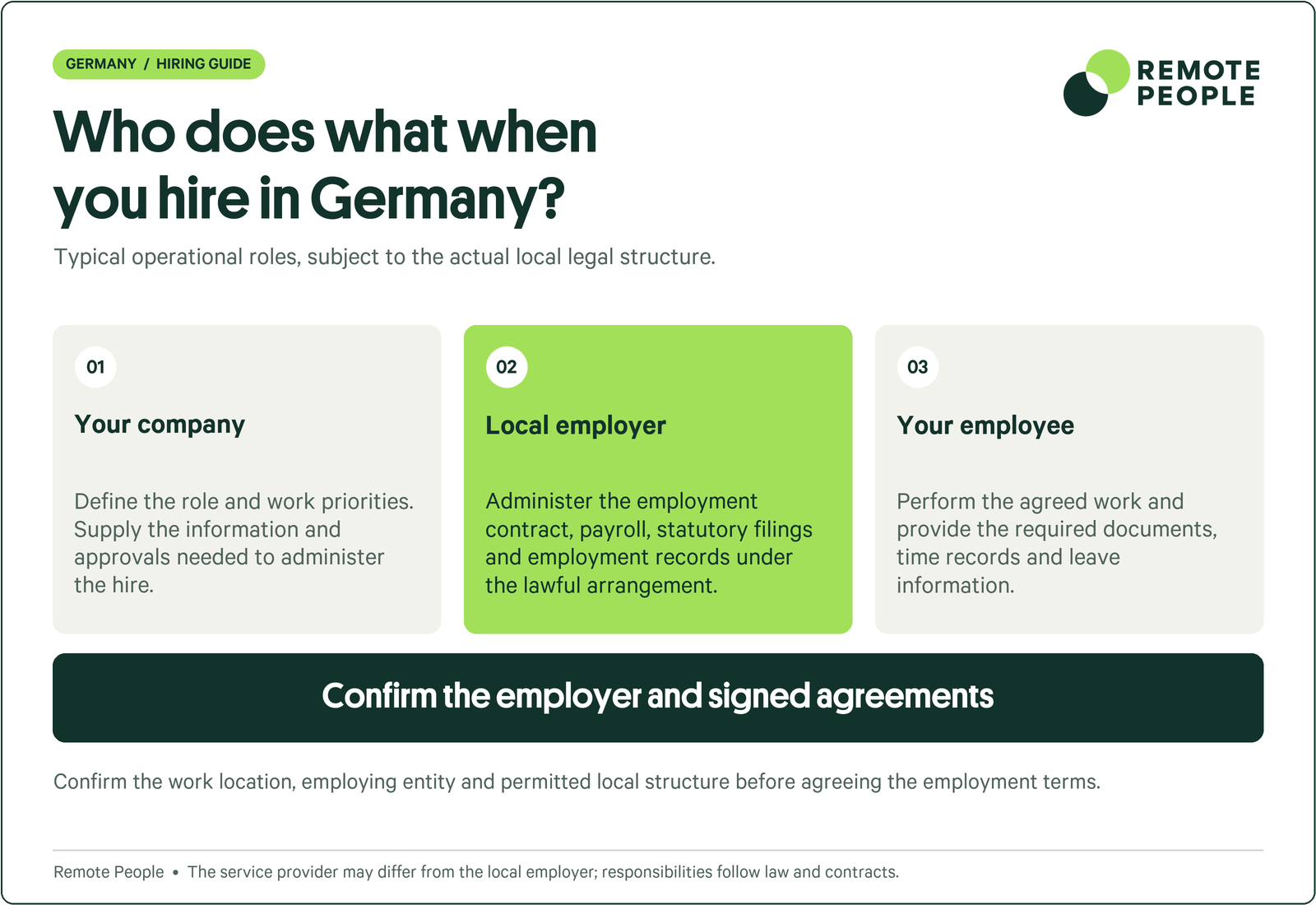
An Employer of Record (EOR) in Germany hires employees on your behalf, becoming their legal employer. It also handles HR services, pays your employees, and manages mandatory filings with the German tax and labor authorities, while you only have to manage your employees’ work tasks and schedules.
If you’d like to learn more about how Employer of Record (EOR) services work, read our What Is an Employer of Record (EOR)? guide for a complete overview of the model, its benefits, and when to use it.
If you’re comparing providers, our Best Employer of Record (EOR) Providers guide reviews the leading platforms to help you choose the right solution for your business.
Who Uses an Employer of Record in Germany?
Hiring through an EOR is a great option for companies of many different sizes and market positions. Small companies that want to access specific expertise and large companies looking to expand into new markets can benefit from the arrangement EORs offer – letting them hire from abroad without having to register local entities or master local employment laws.
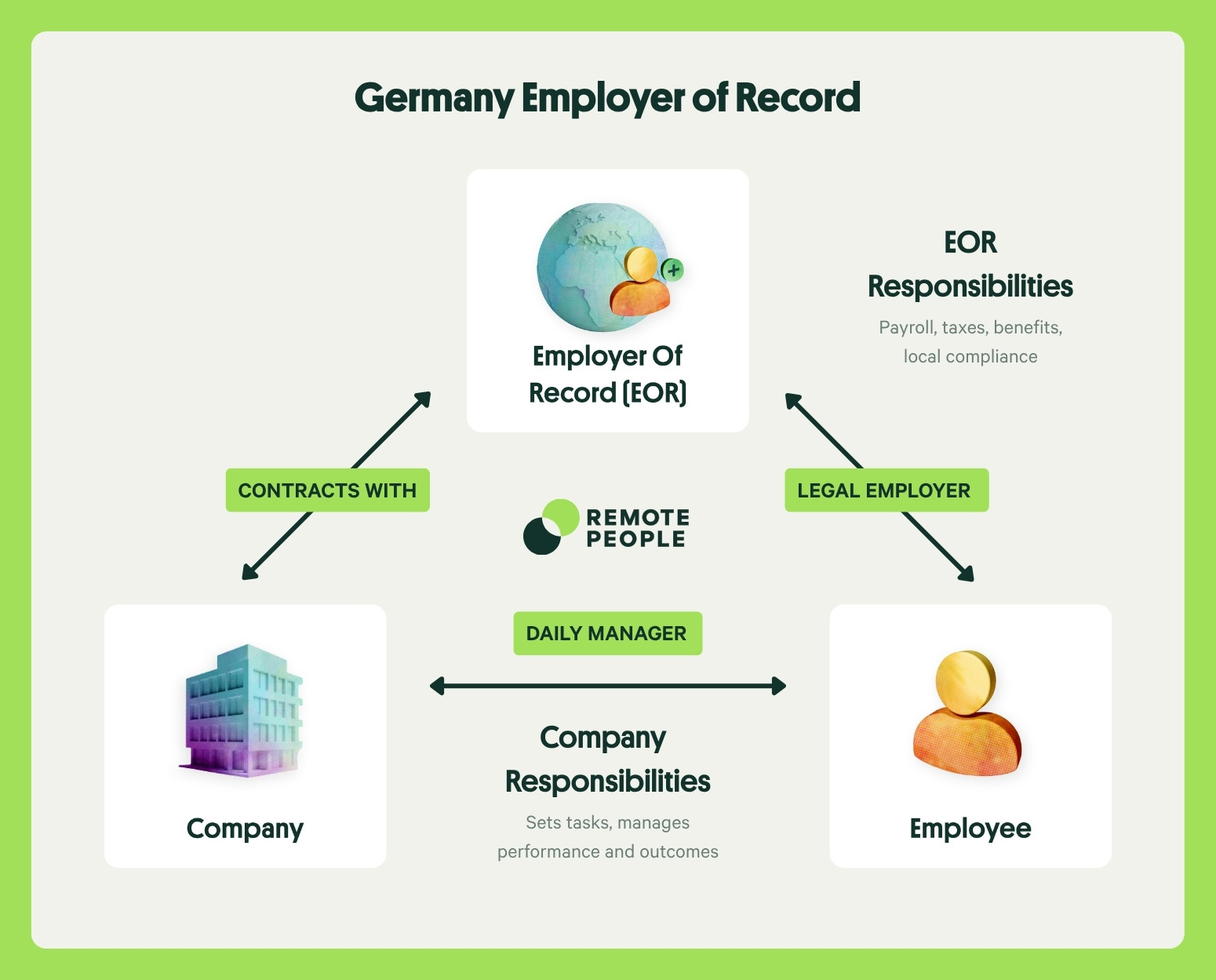
EORs are used extensively by companies that want to:
- Onboard workers quickly: It can take two to four months to set up an entity in Germany and get employees started working for you. With an EOR that already has a registered local entity, onboarding workers takes just one or two weeks, letting you bring new hires onboard much more quickly.
- Hiring a small number of German workers without entity overhead: For companies that want to stay agile, work with remote teams, and be able to pivot quickly don’t want to be burdened with the costs and complications of registering entities in multiple countries. EORs allow them to skip this entirely, while still allowing them access to top German expertise.
- Test the German market before committing to a subsidiary: Mid-sized or large companies looking to expand into Germany and, by extension, the whole EU market, need to perform research and make connections before committing their resources. Before setting up entities, these companies can tap into German talent, hiring experts who can help them test the waters and decide if expansion is the right move.
- Add Germans to their international teams: Modern companies don’t want to be limited by geography. They want to put together teams of the best people from across the globe, regardless of where they live, and EORs help them hire in multiple countries at once by paying service fees instead of setting up multiple entities.
Any business looking to hire skilled workers without needing to set up an entity, learn the ins and outs of local employment and tax laws, or risk non-compliance penalties can benefit from engaging an EOR. Employers of Record in Germany are efficient, professional, and make good economic sense when hiring individuals or small teams.
Who Uses an Employer of Record in Germany?
Instead of waiting months to set up an entity before you can hire German employees on your own, working with an EOR helps you get started immediately. Most EORs can help you onboard workers in one to three weeks through a process that follows these steps:
- EOR agreement and employee details (1-2 days): The client engages the EOR by entering into a service agreement, then shares the details of the names, positions, salaries, and benefits of their prospective employees.
- Employment contract drafting and review (1-3 days): The EOR draws up a compliant contract for each employee. It signs the contracts directly and obtains the employees’ signatures, making the EOR their legal employer in Germany.
- Social security and tax registration (3-7 days): The EOR registers each employee with the Health Insurance Fund, German Pension Insurance organization, Federal Employment Agency, and Local Tax Office applicable to them. This ensures that they can be legally employed in the country.
- Payroll setup and benefits enrollment (2-3 days): The EOR adds each employee to the client’s payroll, creating standing calculations in its systems based on the employee’s salary, benefits, and tax status. It also enrolls them with its accident insurance provider, as well as with the providers of any supplementary benefits the client wishes to offer.
- Employee onboarding and first day (1 day): The EOR ensures that each employee has a social insurance card. With this card, they can start working. The client normally provides an orientation on their first day of work or a more extensive onboarding program.
While it normally doesn’t take more than three weeks to onboard Germans and other EU nationals, non-EU nationals need to obtain permission to work in the country. This can add between four and twenty weeks to the onboarding process.
Hire in Germany
One of Europe’s most complex payroll systems, with Sozialversicherung contributions, works council requirements, church tax obligations, and strict termination protection under the Kündigungsschutzgesetz.
We handle employment contracts, payroll, social contributions, and full German compliance.
No local entity needed. Your team can start in days.
Employment Laws and Regulations in Germany
Instead of a single labor code, employment in Germany is governed by a wide array of legal instruments. Relevant laws are found in the German Civil Code (BGB – Bürgerliches Gesetzbuch), Protection Against Unfair Dismissal Act (KSchG – Kündigungsschutzgesetz), Working Time Act (ArbZG – Arbeitszeitgesetz), and other legislation. Most policy enforcement is done by the Federal Ministry of Labor and Social Affairs (BMAS – Bundesministerium für Arbeit und Soziales).
Employment Contracts
Contracts in Germany can be permanent or fixed-term. According to the Verification Act (NachwG – Nachweisgesetz 2025), fixed-term contracts must be written, while permanent contracts need not be. However, permanent employees must be given written particulars within one month of starting work. These particulars must include details on the place of work, remuneration, overtime pay, working hours, breaks, holidays, probation periods, leave entitlements, and disciplinary and termination procedures. If any collective agreement applies to the employment, it must also be included.
Fixed-term contracts can be made for any period up to two years, and they can also be renewed up to three times during this period, but not afterward. For new companies, fixed-term contracts can be made for up to four years’ duration. If the employer can prove objective or material reasons, longer contracts may be accepted. All terms must be given in writing, including a clear start and end date of the contract as well as renewal possibilities and conditions.
Working Hours and Overtime
According to the Working Time Act (ArbZG), German employees work eight standard hours a day, and up to 48 hours a week. Overtime is allowed, but workers cannot work more than ten hours a day or 60 hours a week, unless extended hours are defined in a collective agreement. However, regular working hours must not exceed an average of eight hours a day over a 24-week period. There is no mandate in Germany for employers to pay premiums for overtime work. However, individual contracts and collective agreements often include clauses for overtime pay, and 125% of normal wages is standard. Overtime limits generally do not, however, apply to managerial staff.
Workers are entitled to at least one 24-hour period of rest per week, which is normally on Sundays. Between shifts, workers must be granted at least 11 hours of rest. They also must get at least 30 minutes of breaks if they work for six hours, and 45 minutes if they work nine hours or more.
Overtime and Premium Pay Rates
There are no mandatory premium pay rates dictated by law in Germany. However, compensatory rest is mandated in some circumstances, and premium rates are often included in collective agreements and individual contracts. Typical rates are shown in the table below:
| Hour Type | Rate Multiplier | Daily-Weekly Cap | Notes |
|---|---|---|---|
| Standard overtime (weekday) | 125% (typical) | 10 hours/day maximum, including regular and overtime hours | No statutory premium; rate set by collective agreement or contract. 25% is the most common premium |
| Night work (23:00–06:00) | 125-130% | 8 hours/night (up to 10 hours, as long as the average is 8 hours/night over a 4-week period) | Adequate premium pay or compensatory time off is required |
| Public holiday work | 150–200% (typical) | Prohibited unless exempted under the ArbZG | Replacement rest day required within 8 weeks; premiums common in collective agreements; pay is non-taxable |
| Saturday work | 100–125% | Part of regular 6-day statutory week | Saturday is a regular working day; premium only if contractually agreed |
| Sunday work | 150% (typical) | Workers must have at least 15 Sundays free per year | Replacement rest day required within 2 weeks; premium set by collective agreement |
Minimum Wage and Bonuses
The minimum wage in Germany is normally reviewed and updated every calendar year. The current general statutory minimum wage is €13.90/hour, before taxes and social security deductions. This rate will be in effect until 31 December 2026.
On 1 January 2027, the minimum wage will be increased to €14.60/hour. However, different collective agreements have defined higher minimum wages for specific industries that must be followed.
The minimum wage applies to all employees, with only a few exceptions:
- trainees in programs not longer than three months
- interns on education programs
- workers under 18 who have not completed vocational training
- workers who were unemployed for at least the full year before being hired (they can be paid less than the minimum wage for their first six months)
Germany Minimum Wage Levels 2026-2027 | |
Minimum Wage Level | Period |
|---|---|
€13.90/hour | 1 January 2026 – 31 December 2026 |
€14.60/hour | 1 January 2027 – 31 December 2027 |
Probation Period
The German Civil Code (BGB) allows for probation periods (Probezeit) of up to six months, and these are standard in German contracts. Shorter periods are frequently used, and these can be extended, in writing, up to the maximum of six months, as long as this possibility is stipulated in contracts. Fixed-term contracts may also include probation periods, but these must be proportional to their overall durations, though no ratio of probation to contract duration is mandated.
Workers on probation can resign by giving their employers two weeks’ notice. Likewise, they can be dismissed with just two weeks’ notice from their employers. Employers do not need to provide justification to dismiss employees during probation. However, workers receive social security coverage from day one and paid sick leave entitlements after the fourth week of their employment. Their paid annual leave entitlements are also accrued as usual during probation.
Leave Entitlements
German workers are entitled to leave for public holidays, as well as annual paid leave for rest and personal business. They may also be eligible for a number of other leaves for health and family reasons. These various leaves and their criteria are explained below:
Annual Leave
According to the Federal Holiday Act (BUrlG – Bundesurlaubsgesetz), employees who work six days a week are entitled to paid annual leave of not less than 24 working days per year. Those who work five days a week are only entitled to 20 working days per year. Working days here are all days Monday to Saturday, and leave out Sundays and public holidays. Many collective agreements provide for 25-30 days of annual leave, however, it’s not uncommon for individual contracts to offer similar amounts.
Employees are paid the average of the wage they made over the 13 weeks preceding their annual leave. In general, workers must use their annual leave within the year it was accrued and may not roll it over. However, workers start accruing paid annual leave from their first day of work, even when on probation.
Sick Leave
Once an employee has worked for four weeks, they become entitled to sick leave. They must be granted paid leave for illnesses and accidents that make them unable to work, with 100% of their normal wages paid by the employer for their first six weeks (42 calendar days) of absence. After this period, workers are instead paid 70% of their wages through their health insurance for absences up to 78 total weeks within a three-year period. Their right to return to their same jobs is also fully protected during sick leave, unless a negative prognosis and serious damage to the employer’s business can be demonstrated.
Currently, employees only need to provide medical certificates (sick notes) to their employers from the first day of their illness if contracts or collective agreements stipulate this. However, reforms aim to require all workers on sick leave from January 2027 to provide medical certificates from day one.
Maternity Leave
The Maternity Protection Act (MuSchG – Mutterschutzgesetz) protects pregnant mothers in various ways. They cannot work for more than 8.5 hours a day or past 10 pm, and they mustn’t work for the six weeks before their due dates or eight weeks after delivery, giving them a total of 14 weeks of maternity leave. They may gain another 12 weeks of leave if they have multiple or premature births. Mothers generally also can’t be dismissed during this time.
Mothers on maternity leave in Germany are paid 100% of their regular earnings. This income comes from a combination of €13/day from health insurance (Mutterschaftsgeld), and the balance being paid by the employer.
Paternity Leave
According to the Federal Holiday Act (BUrlG – Bundesurlaubsgesetz), employees who work six days a week are entitled to paid annual leave of not less than 24 working days per year. Those who work five days a week are only entitled to 20 working days per year. Working days here are all days Monday to Saturday, and leave out Sundays and public holidays. Many collective agreements provide for 25-30 days of annual leave, however, it’s not uncommon for individual contracts to offer similar amounts.
Employees are paid the average of the wage they made over the 13 weeks preceding their annual leave. In general, workers must use their annual leave within the year it was accrued and may not roll it over. However, workers start accruing paid annual leave from their first day of work, even when on probation.
Other Statutory Leaves
In addition to annual, sick, and maternity leave, Germany also offers several types of leave for workers to help them with their personal obligations. These include:
- Parental Leave: Parents are granted up to three years of (Elternzeit) leave each per child they have. They have until the child is three years old to take the first 12 months of this leave, while the remaining 24 months can be used up until the age of eight. Parents are paid 65% of their net earnings (Elterngeld payments) for 12 months, or 14 months if they use the leave at the same time. They can also choose to receive half these payments for twice the length of time (ElterngeldPlus payments) if they want to work part-time (15-32 hours/week) during the leave.
- Child sick leave: Parents are each entitled to up to 15 days per child or a maximum of 35 days per year of leave to care for their sick children under the age of 12. Single parents get 30 days per child or 70 days per year maximum. Employees are paid by their public health insurers at the rate of 90% of their normal earnings up to €135.63/day.
- Bereavement leave: While not stipulated by its own law, the BGB allows for paid leave for short, unavoidable leave for personal reasons that aren’t their own fault. This may be included in contracts specifically as bereavement leave, generally for one to three days.
- Carer leave: The Care Leave Act (PflegeZG – Pflegezeitgesetz) entitles workers to up to ten days of leave for short-term care needs, paid at the rate of 90% of their normal earnings up to €135.63/day by the long-term care insurance fund or private insurance. They also get up to six months of unpaid leave to provide long-term care (only for companies with 15 or more employees).
- Marriage leave: While not mandated by law, many collective agreements provide workers with one day of paid leave for marriage.
|
Table of Germany Employment Leave Entitlements |
||
|
Leave Type |
Duration |
Eligibility & Notes |
|---|---|---|
Annual leave |
24 working days (6-day week); 20 working days (5-day week) |
Full entitlement after 6 months; most contracts provide 25–30 days |
Sick leave (employer-paid) |
78 weeks (6 weeks at 100% pay; 72 more weeks at 70% pay) |
4-week employment minimum; medical certificates required |
Maternity leave |
14 weeks (6 prenatal + 8 postnatal) |
100% pay, with €13/day from health insurance and the rest from the employer |
Parental leave |
Up to 3 years per child |
Both parents eligible; Elterngeld at 65% of net income for 12–14 months |
Child sick leave |
15 days per child per year up to 35 days; double for single parents |
Children under 12; 90% pay from health insurer |
Care leave |
Up to 10 days for short-term care; up to six months (unpaid) for long-term care |
Short-term care for seriously ill relatives |
Bereavement leave |
1–3 days |
For close family members; personal leave or stipulated in collective agreements |
Marriage leave |
1 day |
Not statutory, but common in collective agreements |
When you work with an EOR in Germany, it manages all of these leave types for your employees, including tracking their entitlements, paying them as required, and counting their days away from work. This frees you up to focus on their work only, while also ensuring that you’re always compliant with German labor laws.
Statutory Employee Insurance
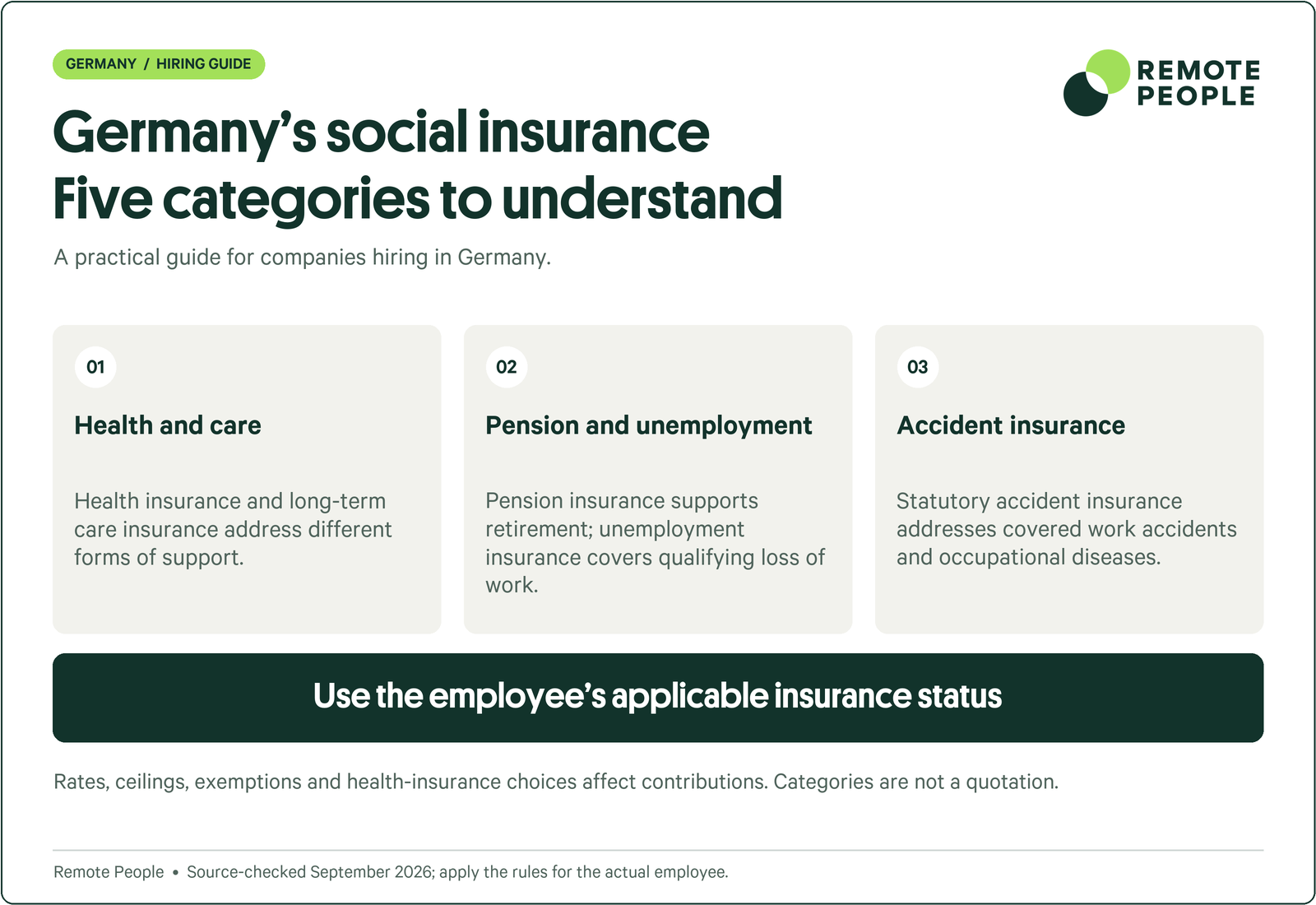
In Germany, workers are covered by a social insurance system (Sozialversicherung) that includes five different branches. Most are funded through contributions from both the employer and the employee, while accident insurance is wholly employer-funded.
These branches include:
- Health Insurance (GKV – Gesetzliche Krankenversicherung): Mandatory health insurance is an entitlement for all workers in Germany. It covers hospitalization, medication, preventative medicine, and other medical treatment. The base rate for GKV is 14.6% of the employee’s gross salary, shared equally (7.3%) by the employer and employee. Each public health insurance fund sets a different additional fee that averages around 2.9%, again equally shared. This makes the employer’s contribution 8.75% on average up to a salary ceiling of €69,750.
- Long-Term Care Insurance (SPV – Soziale Pflegeversicherung): SPV provides support for the costs of nursing care due to illness, old age, and disability. This insurance costs 3.6% of gross salary (increased to 4.2% for childless workers over the age of 23) and is shared equally between the employer and employee (1.8%) up to €69,750.
- Pension Insurance (GRV – Gesetzliche Rentenversicherung): Pension insurance provides employees with retirement benefits. It’s funded equally by the employer and employee, with each paying half (9.3%) of the total 18.6% contribution on gross salary up to €101,400.
- Unemployment Insurance (ALV – Arbeitslosenversicherung): ALV is funded equally, with each of the employer and employee paying half (1.3%) of the total 2.6% contribution up to annual salaries of €101,400.
- Accident Insurance (GUV – Gesetzliche Unfallversicherung): GUV is paid in full by the employer and ranges from 0.7-13% of each employee’s salary, depending on the risk level of their industry. This insurance provides coverage for employees when they have workplace accidents or work-related illnesses, much like workers’ compensation insurance in the US.
Work Permits and Visas in Germany
If you want to hire non-German nationals who either already live in Germany or will move to the country to work, they need the right authorization. This is often a complicated process, but many EORs provide support and assistance for their clients.
Who Needs a Work Permit (Residence Permit)?
Citizens of the EU and the EFTA can move to Germany and work there freely. Other nationals need to obtain both visas to enter the country and residence permits that explicitly allow them to work. These residence permits function like the work permits used in other countries. Citizens from Australia, Canada, Israel, Japan, New Zealand, South Korea, the United Kingdom, and the United States can enter Germany without visas, however, and then apply for residence permits once in the country.
Eligibility and Required Documents
Skilled and qualified workers from around the world can enter Germany to work, as long as they meet the individual qualifications for the permits they’re seeking. For the Germany Blue Card, for example, they need to have a job offer, an appropriate academic or vocational qualification for it, and a salary of at least €50,700. For shortage occupations (STEM professionals, ICT managers, etc.), this salary can be as low as €45,924.20. Applicants generally need to provide their passports, along with proof of accommodation, qualifications, and health insurance.
Processing Time and Validity
Permit applications can take different lengths of time to process, depending on their types, the qualifications of the applicant, and their nationalities. Blue Cards, for example, typically take between four and twelve weeks to obtain.
Blue cards are issued for the duration of the worker’s contract plus three months, to a limit of four years. Other permits have durations of between one and four years.
Renewal Process
Most types of residence permits in Germany can be renewed up to the same maximum duration as they were initially provided, as long as the applicant still meets the required conditions for the permit. Permit holders generally must apply for renewals six to eight months before their permits expire. They need to provide their original permits, new contracts, and proof of extended health insurance to the local Foreigners’ Authority (Ausländerbehörde), along with payslips proving their employment.
Common Permit Types for Foreign Workers
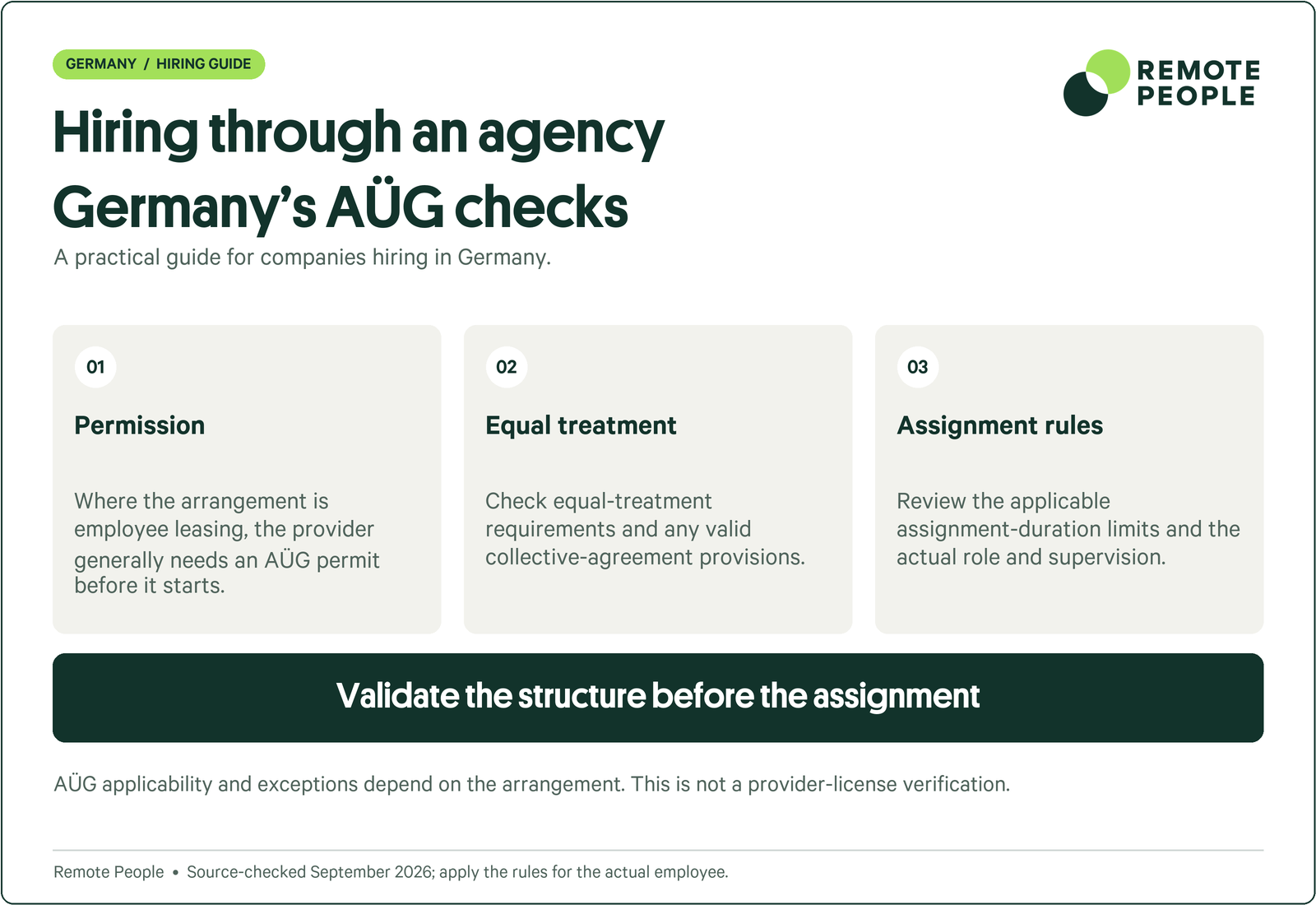
There are multiple routes available for workers to enter and work in Germany. In general, workers must obtain National Visas to enter the country, then apply to the local Foreigners’ Authority for residence permits that allow them to work. In most cases, an EOR that holds an Employee Leasing Act (AÜG – Arbeitnehmerüberlassungsgesetz) license can sponsor these permits. The different types of permits possible include:
Permit Types for Foreign Workers in Germany | ||
Visa Type | Duration | Best For |
|---|---|---|
EU Blue Card | Up to 4 years | Highly skilled professionals with university degrees and salaries above €50,700/year |
Skilled Worker Permit | 1–4 years | Qualified professionals with recognized vocational training or university degrees |
ICT Permit (intra-company transfer) | Up to 3 years | Managers, specialists, or trainees transferring within a multinational company |
Chancenkarte (Opportunity Card) | 1 year (job-seeking) | Skilled professionals seeking employment; points-based system |
Self-Employment / Freelance Permit | 1–3 years | Freelancers and business owners with viable business plans |
How an EOR Handles Residence Permits
EORs in Germany must be registered as temporary employment agencies and must, therefore, hold AÜG (Employee Leasing Act) licenses. With these licenses, they’re allowed to directly hire workers and create their contracts. For foreign nationals, they can use these contracts to sponsor residence permits directly through the local Foreigners’ Authority where they’re situated.
The workers must apply for their own entry visas and interviews, including providing proof of their qualifications and health insurance. EORS often also coordinate the checking of academic qualifications with the Central Office for Foreign Education (ZAB – Zentralstelle für ausländisches Bildungswesen). It can take anywhere from four to twenty additional weeks to onboard foreign national employees who need residence permits.
It’s critical to note that the Employee Leasing Act (AÜG) limits placements with individual employers to a hard cap of 18 months. While workers can take three months off work and then be placed for another 18 months, this is an important limit to recognize for EOR hiring in Germany.
Payroll, Taxes, and Social Security in Germany
EORs manage payroll for your employees in Germany. As part of this process, they calculate and withhold income taxes and social insurance contributions from the employees, while also calculating your employer contributions to social insurance, as follows:
Employer Contributions
In addition to salaries, employers in Germany must pay social insurance contributions and other surcharges to support their employees. These are assessed at different rates and apply to gross salaries up to set ceilings for each contribution type.
| Contribution | Rate (of gross salaries) | Notes |
|---|---|---|
| Pension insurance (Rentenversicherung) | 9.3% | Half of 18.6% total; ceiling €101,400/year |
| Health insurance (Krankenversicherung) | 7.3% | Half of 14.6% general rate; ceiling €69,750/year |
| Supplementary health contribution (Zusatzbeitrag) | 1.45% | Half of 2.9% average supplementary rate; varies by public health insurance fund |
| Unemployment insurance (Arbeitslosenversicherung) | 1.3% | Half of 2.6% total; ceiling €101,400/year |
| Long-term care insurance (Pflegeversicherung) | 1.8% | Half of 3.6%; employer share fixed regardless of employee’s parental status; ceiling €69,750/year |
| Occupational accident insurance (Berufsgenossenschaft) | ~1.3% (average) | 100% employer-paid; varies by industry and risk class (0.7%–13%) |
| Insolvency surcharge (Insolvenzgeldumlage) | 0.06% | 100% employer-paid; funds employee claims in cases of employer insolvency |
| Total employer contributions | ~22.41% | Approximate total; actual rate varies by health fund and industry risk level |
Employee Contributions
Employees also contribute to social insurance programs with amounts that are deducted from their gross salaries by their employers. In EOR hiring, the EOR automates these calculations, deducts the funds from the employees’ pay, and remits them to the appropriate authorities for you.
| Deduction | Rate | Notes |
|---|---|---|
| Pension insurance (Rentenversicherung) | 9.3% | Half of 18.6% total; ceiling €101,400/year |
| Health insurance (Krankenversicherung) | 7.3% | Half of 14.6% general rate; ceiling €69,750/year |
| Supplementary health contribution (Zusatzbeitrag) | 1.45% | Half of 2.9% average; actual rate varies by public health insurance fund |
| Unemployment insurance (Arbeitslosenversicherung) | 1.3% | Half of 2.6% total; ceiling €101,400/year |
| Long-term care insurance (Pflegeversicherung) | 1.7% | Base rate for employees with children; childless employees over 23 pay 2.3%; ceiling €69,750/year |
| Total employee contributions | ~21.05% | For employees with children; childless employees pay ~21.65% |
Income Tax Brackets
Employers are required to withhold employee income taxes on a pay-as-you-earn basis and pay them to the local tax office (Finanzamt). Germany assesses a geometrically progressive income tax for most of the average income range of middle-class workers, with higher flat rates for high-income earners.
| Tax Bracket | Taxable Income Range | Tax Rate |
|---|---|---|
| (basic tax-free allowance) | EUR 0 – EUR 12,348 | 0% |
| Progressive Zones 1&2 | EUR 12,349 – EUR 69,878 | 14% – 42% geometrically progressive rates |
| Top Tax Rate | EUR 69,879 – EUR 277,825 | 42% flat rate on income above EUR 69,878 |
| Wealth Tax Rate | EUR 277,826 and above | 45% on income above EUR 277,825 |
These rates are for Class 1 tax filers and can vary between six tax classes (Steuerklasse) depending on marital status, parental status, and employment situation.
In addition to these standard tax rates, Germany also assesses a solidarity surcharge tax (Soli) on income over €20,350 for those filing individually. The top rate of 5.5% applies to income over €116,600, with progressively lower rates down to €20,350. Registered church members also pay a church tax that varies from 8-9% depending on the state where the person lives.
Payroll Cycle in Germany
Payroll cycles in Germany are monthly, with employees normally paid on the 25th of each month. EORs handle all payroll calculations for their clients, including employer contributions, employee deductions, and tax withholding. They also provide monthly payslips detailing employees’ earnings and deductions as required by law.
Withheld income tax must be submitted to the Finanzamt by the 10th of the next month. Social insurance contributions from both the employer and the employee must be remitted by the third-last bank working day of the same month, with a contribution statement due on the fifth-last bank working day. An annual wage summary must also be given to each employee by the last day of February of the following tax year.
13th-Month Salary and Bonuses
Neither 13th- nor 14th-month bonuses are mandatory in Germany. Some employers may choose to offer bonuses as incentives, however, especially in the form of Christmas and holiday bonuses. These bonuses often represent 50-100% of an employee’s regular monthly earnings. Some of these bonuses may be mandatory if included in collective agreements. For employees, they’re treated as normal income and are subject to income tax and social insurance deductions.
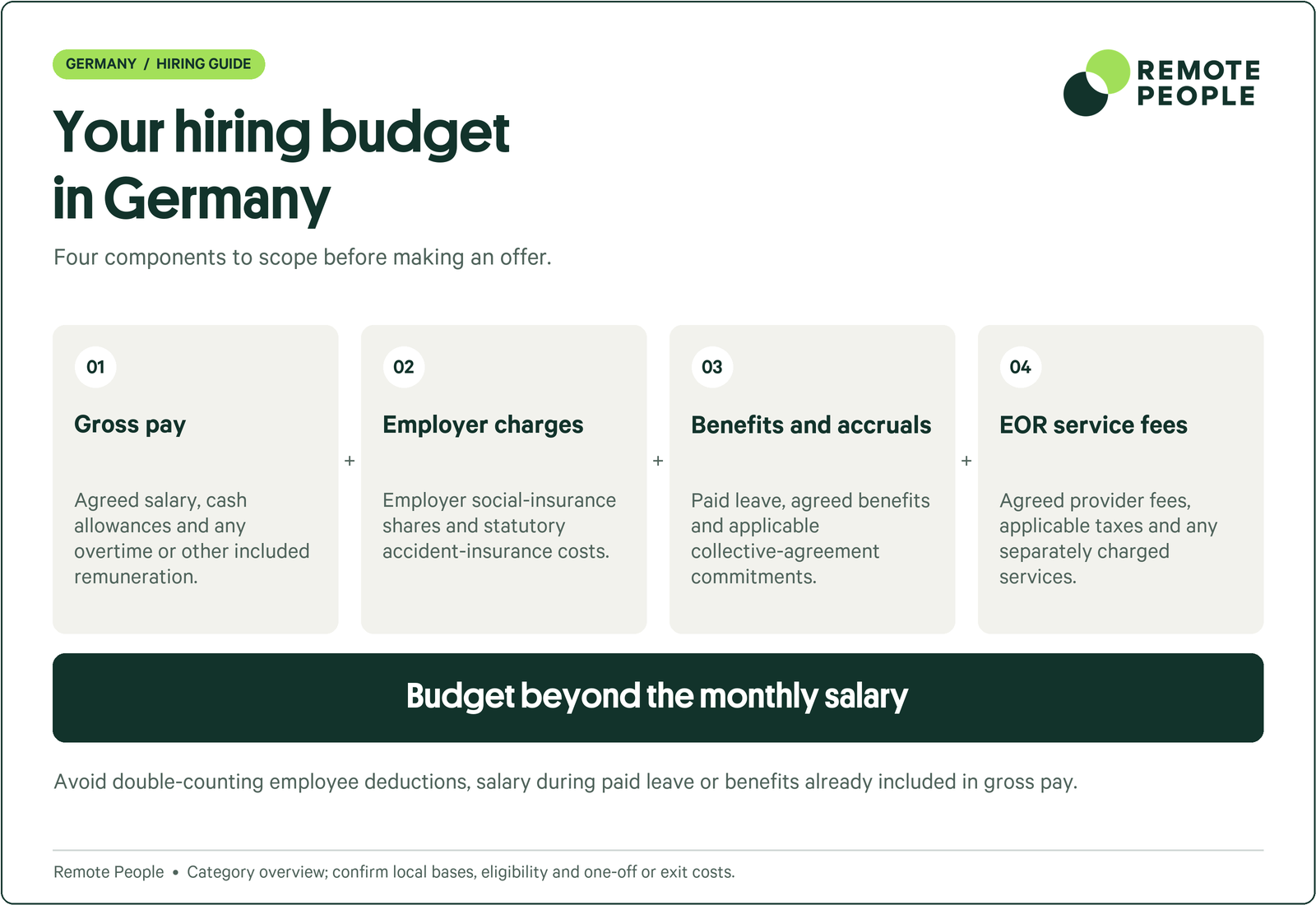
Cost of Hiring an Employee Through an EOR in Germany
The cost of hiring an employee through a Germany EOR can vary based on salaries, industry risk levels, and EOR fees. The following table shows an example calculation for the total cost of employment (TCE) for an employee paid a salary of $60,000/year.
Germany Employer Cost Calculation Example | ||
Employer Cost | Monthly (USD) | Annually (USD) |
|---|---|---|
Gross monthly salary | $5,000 | $60,000 |
Pension insurance (9.3%) | $465 | $5,580 |
Health insurance (7.3%) | $365 | $4,380 |
Supplementary health (1.45%) | $72.50 | $870 |
Unemployment insurance (1.3%) | $65 | $780 |
Long-term care insurance (1.7%) | $85 | $1020 |
Occupational accident insurance (~1.3%) | $65 | $780 |
Insolvency surcharge (0.06%) | $3 | $36 |
EOR service fee (estimate) | $500 | $6,000 |
Total employer cost | $6,620.50/month | $79,446/year |
The TCE for this standard employee is roughly 32.4% above gross salary. Mandatory employer contributions add around 22.4% to the cost, while EOR fees contribute another 10%.
Terminating and Offboarding an Employee in Germany
As the legal employer of your employees in Germany, your EOR partner is ultimately responsible for terminating contracts. However, you’ll indicate the reasons and dates for termination and will be responsible for offboarding employees from your company.
Grounds for Termination
Employees in Germany can be dismissed for operational/economic reasons (redundancy), personal reasons such as long-term illnesses or inability to perform the work required, and misconduct. Except in serious cases of gross misconduct, for which they can be immediately terminated, employees generally must be provided with justification and appropriate notice, in writing, for their dismissals.
Notice Periods
During probation, either the employee or employer can terminate their contract with no justification and only two weeks’ notice. After this, employees must give four weeks’ notice to the 15th or end of the month. Employees can agree to longer notice periods in their contracts, but they can’t be longer than the employer’s notice periods. For employers, notice periods increase with employee seniority after probation, as per the table below:
| Position Level | Notice Period |
|---|---|
| Probation (up to 6 months) | 2 weeks |
| Less than 2 years of service | 4 weeks |
| 2 years of service | 1 month |
| 5 years of service | 2 months |
| 8 years of service | 3 months |
| 10 years of service | 4 months |
| 12 years of service | 5 months |
| 15 years of service | 6 months |
| 20+ years of service | 7 months |
Severance Pay in Germany
German law does not provide a mandate for severance pay for workers who are terminated for personal reasons or misconduct, though collective agreements and individual contracts may include severance pay clauses.
When employees are dismissed due to economic or operational reasons, they’re generally entitled to severance pay at the rate of 50% of a month’s salary for every year of service to the employer. If an employee has worked for at least six months of a year, that period is rounded up to a full year. Again, individual contracts and collective agreements may provide for greater severance pay. When workers agree to receive severance pay, they waive their rights to sue their employers for unfair dismissal.
Caps and Settlement Agreements
According to the Protection Against Unfair Dismissal Act (KSchG), labor courts can award up to 12 months’ pay as severance to most employees, 15 months’ pay for employees over 50 with over 15 years of service, and 18 months’ pay for employees over 55 with over 20 years of service. While there is no official cap on severance payments, these settlement awards represent the most that employers would have to pay if found to have unfairly dismissed workers. Offering severance payment at the standard rate is, then, often in the employer’s best interest.
Public Holidays in Germany
There are nine national public holidays celebrated in Germany, but individual states also celebrate additional holidays, so employees have between nine and 13 public holidays per year. Employees are entitled to time off with pay on these holidays if they fall on their regular workdays, but holidays that fall on Saturdays and Sundays are not substituted. If employees have to work on these holidays, they must be compensated with time off on later days, but a public holiday premium is not mandatory. If it is paid to workers, however, holiday premium pay is not taxable.
Germany Public Holidays 2026-2027 | |
Holiday | Date |
|---|---|
German Unity Day (Tag der Deutschen Einheit) | Saturday, 3 October 2026 |
Christmas Day (Erster Weihnachtstag) | Friday, 25 December 2026 |
2nd Day of Christmas (Zweiter Weihnachtstag ) | Saturday, 26 December 2026 |
New Year’s Day (Neujahrstag) | Friday, 1 January 2027 |
Good Friday (Karfreitag) | Friday, 26 March 2027 |
Easter Monday (Ostermontag) | Monday, 29 March 2027 |
Labour Day (Tag der Arbeit) | Saturday, 1 May 2027 |
Ascension Day (Christi Himmelfahrt) | Thursday, 6 May 2027 |
Whit Monday (Pfingstmontag ) | Monday, 17 May 2027 |
German Unity Day (Tag der Deutschen Einheit) | Sunday, 3 October 2027 |
Christmas Day (Erster Weihnachtstag) | Saturday, 25 December 2027 |
2nd Day of Christmas (Zweiter Weihnachtstag ) | Sunday, 26 December 2027 |
Benefits of Using an Employer of Record in Germany
Germany has some of the most stringent labor and employment laws in the world, and it’s also rated as only the 125th-easiest place to set up a business by the World Bank. These are some of the top reasons why working with an Employer of Record in Germany is an attractive option for so many employers.
When they hire through EORs, they can take advantage of a multitude of benefits, including:
- Fast market entry: Instead of waiting weeks to months to register an entity before being able to hire employees, EORs can start the registration and onboarding process right away, allowing employees to start working in two weeks, on average. EORs can also immediately sponsor residence permits for foreign employees, greatly shortening the time it takes to help them gain permission to work in Germany.
- Avoiding local entity registration: Because the EOR works as the legal employer of their workers, employers can tap into the German labor market easily. They can avoid the cost and time needed to incorporate an entity, register it with the social insurance, tax, and trade permit offices, and operate it long-term.
- Compliance with German employment law: Without an EOR, employers need to manage strict employment regulations on their own, or hire HR experts to manage compliance for them. With an EOR, HR services are covered and are maintained in full compliance with German law.
- Affordable supplementary benefits: Many EORs offer their own benefits packages, while those that don’t can use the size of their combined workforces to negotiate affordable rates with benefits providers. This allows foreign employers to offer supplementary benefits packages that can attract top German talent.
- Responsive scalability: To open and maintain your own entity, you need to balance the services you can offer with the number of staff you can hire, with strict ratios to stay cost-effective. With an EOR, you can increase the size of your workforce at any time, simply by paying a set fee for each new employee, and reduce your workforce whenever necessary.
- Reduced employment liability: By engaging with an EOR in Germany, you protect yourself from liability, as the EOR is the legal employer of your workers. It deals with compliance for you and handles any disputes that might arise.
EOR vs Other Hiring Models in Germany
While the EOR hiring model is an appropriate option for many employers, it’s not always the best fit. Some employers may choose alternatives like setting up an entity, working with contractors instead of hiring employees, or hiring through a PEO instead. Below, we examine these options and show their direct advantages and disadvantages compared with EOR hiring.
EOR vs Setting Up a German Limited Company
Instead of hiring through EORs, some employers choose to set up their own entities in Germany and hire local workers directly. The table below illustrates the main differences between these two approaches in terms of cost, timing, and responsibilities:
Germany EOR vs. Local Entity | ||
Employer of Record | Own Entity (GmbH) | |
|---|---|---|
1–2 weeks | Setup time | 2–4 months |
$0 | Upfront cost | $30,000–$50,000 (paid-in share capital, legal, and notary costs) |
$300–$600/employee/month | Ongoing cost | $15,000–$30,000/year maintenance |
No (EOR is the local entity) | Local partner required | No (but requires a managing director, or Geschäftsführer) |
Handled by EOR | Social insurance registration | Managed in-house |
Handled by EOR | Payroll & tax filing | Managed in-house (or outsourced) |
1–15 employees | Best for team size | Over 15 employees |
Easy, no entity to unwind | Scale down / exit | Costly, legal dissolution required |
Not eligible | Government contracts | Eligible (requires local entity) |
This comparison is based on a GmbH (Gesellschaft mit beschränkter Haftung), which is much like a Limited Liability Company (LLC) in the US and is the most common entity choice for foreign investors.
The EOR option is more efficient and cost-effective for smaller teams, while registering an entity can be a better choice for hiring large numbers of staff for a long-term position in the German market. The high costs of starting and maintaining a local entity make this option prohibitively expensive when hiring just a small number of employees. EORs also normally can’t help you secure intellectual property (IP), take on government contracts, or buy real estate.
One route that many employers choose is to transition from EOR hiring to direct hiring as their staff needs grow. When this becomes necessary, it’s possible to transfer employee contracts over to a newly registered local entity, and your EOR should be able to support you in this transition.
EOR vs Hiring Contractors
Another alternative to the EOR model is to work only with independent contractors in Germany and not directly hire any employees. While this is a good way to access specific skills when you need them, it also carries with it the risk of misclassification and must therefore be used carefully. The differences between EOR and contractor hiring are shown below:
Germany EOR vs. Hiring Contractors | ||
EOR (Full-Time Employee) | Independent Contractor | |
|---|---|---|
Employee of the EOR | Legal relationship | Self-employed, no direct employment relationship |
Low: EOR ensures local labor law compliance | Compliance risk | High: misclassification risk if relationship resembles employment |
EOR handles withholding, contributions, filings | Payroll & tax | Contractor invoices you; they handle their own taxes |
Statutory benefits, paid leave, social security | Benefits & leave | No entitlement to employee benefits |
Stronger: employment contract assigns IP by default | IP protection | Weaker: requires explicit IP assignment clause |
Subject to local notice periods and severance | Termination | Contract can be ended per agreement terms |
Long-term, core team roles | Best for | Short-term projects and specialized tasks |
Salary + employer contributions + EOR fee | Cost structure | Contractor fee (typically higher gross, but lower total cost) |
Overall, contractors can cost less than employees hired through an EOR and can be used only if and when you need them to provide specific services. However, this lower monetary cost comes at a higher risk. EORs protect you from risk exposure as the legal employers of your workers. Contractors must not be treated like employees, and if you’re found to have done so, you can be liable for back pay, retroactive social insurance contributions, and fines.
To avoid these penalties, employers must ensure they don’t treat contractors like employees. If contractors receive 80% or more of their earnings from a single employer, have their hours and methods of work dictated by the employer, and use the employer’s tools and equipment to work, the employer may be found to be promoting false self-employment (Scheinselbstständigkeit). Many EORs offer Contractor of Record services, however, which greatly reduce this risk by assessing contractor relationships and handling contracts directly on the client’s behalf.
EOR vs PEO
A final option is to work with a Professional Employer Organization (PEO) in Germany instead of an EOR. While these service providers aren’t widespread in the country, they can be used to manage HR services and payroll provision. The differences between PEOs and EORs are outlined below:
Germany EOR vs. PEO | ||
EOR | PEO | |
|---|---|---|
EOR is the legal employer | Legal employer | You remain the legal employer (co-employment) |
No, the EOR is the local entity | Local entity required | Yes, you must have your own entity in Germany |
Companies without a local entity | Best for | Companies that already have a local entity |
EOR assumes compliance responsibility | Compliance liability | Shared liability between you and the PEO |
1–2 weeks | Setup time | Depends on your entity setup (weeks to months) |
EOR manages within local law framework | Control over HR policies | More direct control, PEO advises |
Market entry, small remote teams, testing new markets | Typical use cases | Established local operations needing HR outsourcing |
PEOs in the US have legally recognized co-employment relationships with their clients, while in Germany, these relationships aren’t recognized and only a single party can be the legal employer. For this reason, a PEO in Germany would have only the reduced role of managing HR and compliance for your workforce, so you’d still need to own a registered entity and hire your employees directly.
How to Get Started with an EOR in Germany
It’s easy to get started with an EOR to help you hire employees in Germany. All you need to do is follow these five simple steps:
- Define your hiring needs: Outline the positions you need to fill, the qualifications required, your budget for compensation, and whether you need to hire Germans or non-nationals in Germany.
- Choose your EOR partner: Shop around for EOR providers, evaluating them based on their AÜG license status, experience working in Germany, and knowledge of visa and residence permit processing if required. Ask for quotes based on your hiring needs, and select the provider that can offer the services you need within your budget.
- Finalize employment terms: Select candidates and have your EOR draw up contracts based on your negotiated salary and benefits terms, then enter into them directly to officially hire your employees.
- Onboard employees: While the EOR registers your employees with the tax and social security authorities, you can provide orientations and access to the tools and data they’ll need to perform their jobs. Once they have their social insurance cards and have been added to your payroll, they can begin to work.
- Manage and scale your team: You manage your employees’ schedules and work tasks, while the EOR handles their paid time off, salaries, and benefits. You can add more members to your team at any time, and when the time comes for you to register a local entity, your EOR can help you with the transition.
When it’s time to hire employees in Germany, RemotePeople can help you quickly and effortlessly bring them onto your team. With low fees and high-quality, fully compliant services, we’re the ideal partner to help you crack the German market. Contact RemotePeople today.
Frequently Asked Questions
EOR fees can vary widely. In Germany, advertised fees range from as low as $199 to as high as $699, and these monthly fees have to be added to your budget. These fees cover hiring and contracting, HR services, payroll, and ongoing compliance with German law. Employers also have to pay social insurance contributions and other surcharges, and these can average around 22-23% above salary. Together, EOR fees and employer contributions represent a cost of around 30-35% above each employee’s gross salary.
The short answer is that there are numerous laws, and EORs must keep in strict compliance with all of them to avoid fines and other penalties. Major regulations to be aware of include the German Civil Code (BGB - Bürgerliches Gesetzbuch), the Protection Against Unfair Dismissal Act (KSchG - Kündigungsschutzgesetz), and the Working Time Act (ArbZG - Arbeitszeitgesetz). However, when you hire through an EOR, its experts and automated systems ensure that your employees are treated correctly to the letter of the law.
According to German law, the intellectual assets created by an employee in the course of their paid work for an employer belong to that employer. With EOR hiring, the EOR is the sole legal employer of your employees, so IP rights belong to the EOR. However, these rights can be legally transferred to you through your contracts, and RemotePeople includes these clauses in employment contracts to protect client interests.
Yes, you can usually do both through an EOR service provider, as most also offer contractor management services. These services cost much less than EOR services, and generally only help you to generate contracts and pay invoices. If you want greater protection against misclassification liability, some EORs will also hire your contractors and manage their contracts directly as Contractors of Record (CORs).
Your German employees are entitled to at least 20 days of paid annual leave, sick leave, paid public holidays, and other leaves. They must also be provided with health, pension, long-term care, and unemployment insurance through national insurance programs, and as the employer, you need to hold accident insurance to cover workplace accidents and illnesses. Many employers also choose to offer additional bonuses, paid leave, and private insurance to enhance their benefits packages.
If an EOR is properly registered with an AÜG license, it can sponsor residence permits that allow foreign nationals to work in Germany. The most common type of permit, the Blue Card, can be issued for up to four years and lets workers with appropriate qualifications and minimum salaries work in Germany. However, EORs can only contract workers for you for up to 18 months at a time, according to AÜG license rules.
Workers can resign or be dismissed during probation with just two weeks’ notice and no justification. After probation, employers need to provide between four weeks’ and seven months’ notice, depending on the worker’s period of service. Severance pay isn’t standard for terminations due to personal reasons or misconduct, but may be included in contracts or collective agreements. For economic reasons, however, employers have to provide terminated workers with half a month’s pay for each year of service they’ve provided.
Employer of Record in
Employer of Record in
Employer of Record in
Employer of Record in
Employer of Record in
Employer of Record in
Employer of Record in
Employer of Record in