Recruit
Employer of Record in the UK
-
 Drew Donnelly
- Published
- August 13, 2026
RemotePeople’s UK Employer of Record hires your UK staff compliantly, with no local entity, 5-10 day onboarding, from $199/employee/month. We handle PAYE, 15% employer NIC, auto-enrolment pension, IR35 classification, right-to-work checks and Skilled Worker visa sponsorship.
Hire in United Kingdom — book a free 30-minute demo
Tell us what you need. You'll get a tailored, transparent proposal within 24 hours, plus a free call to walk through it.
Tell us about your company
So we can match you with a specialist who knows your market — and unlock volume pricing tiers.
* All fields are required.
Where and when are you hiring?
Tell us the geography and timing and we'll quote each country line by line, with onboarding timelines.
* All fields are required.
Help us beat your current setup
We'll benchmark your current deal and send a line-by-line proposal in 24 hours — showing exactly where we cut cost, time, or risk. After you submit, you can book a call to walk through it together.
* All fields are required.
Thanks! Your proposal is on its way.
Expect a tailored, line-by-line proposal in your inbox within 24 hours. In the meantime…
Want to walk through it together?
Book a free 30-minute call with one of our specialists. We'll explain every line, answer your questions, and tailor the proposal further if you need.
No obligation. Pick a time that works for you.








- Hire in United Kingdom — book a free 30-minute demo
- Tell us about your company
- Where and when are you hiring?
- Help us beat your current setup
- Thanks! Your proposal is on its way.
- How an Employer of Record Works in the United Kingdom
- Employment Laws and Regulations in the United Kingdom
- Work Permits and Visas in the United Kingdom
- Payroll and Taxes in the United Kingdom
- Cost of Hiring an Employee Through an EOR in the United Kingdom
- Benefits of Using an Employer of Record in the United Kingdom
- Terminating an Employee in the United Kingdom
- EOR vs Other Hiring Models in the United Kingdom
- Public Holidays in the United Kingdom
- How to Get Started With an EOR in the United Kingdom
- Frequently Asked Questions
- Related EOR Destinations

Start hiring in United Kingdom
Let RemotePeople handle payroll, compliance, and HR admin worldwide so you can focus on building your team.

The United Kingdom remains one of the largest talent pools in Europe, with 33.6 million people in employment, a deep concentration of software, finance, life sciences, and professional-services expertise across London, Manchester, Edinburgh, and Bristol, and a business environment that ranks in the top ten of the World Bank Doing Business indicators.
For companies looking to hire employees in the United Kingdom, the challenge is that incorporating a UK entity typically takes six to eight weeks, triggers mandatory registration with Companies House, HMRC PAYE, and the Pensions Regulator, and exposes the business to employer National Insurance contributions of 15% on earnings above the £5,000 secondary threshold plus auto-enrolment pension, apprenticeship levy for larger employers, and a rapidly expanding body of day-one statutory rights under the Employment Rights Act 2025. An employer of record in the United Kingdom solves this by hiring workers on your behalf through an existing UK entity, handling the written statement of particulars required by section 1 of the Employment Rights Act 1996, running RTI payroll through HMRC, paying employer National Insurance and pension contributions, and assuming compliance responsibility for the full suite of UK employment legislation. Your team can start within one to two weeks, and you never need to register a company in the UK.
This guide explains how an EOR works in the United Kingdom, what UK employment law requires, the real cost of hiring, and how EOR compares to setting up a limited company or hiring contractors. All figures reflect rates in force for the 2026/27 tax year (6 April 2026 to 5 April 2027) unless otherwise stated.
How an Employer of Record Works in the United Kingdom
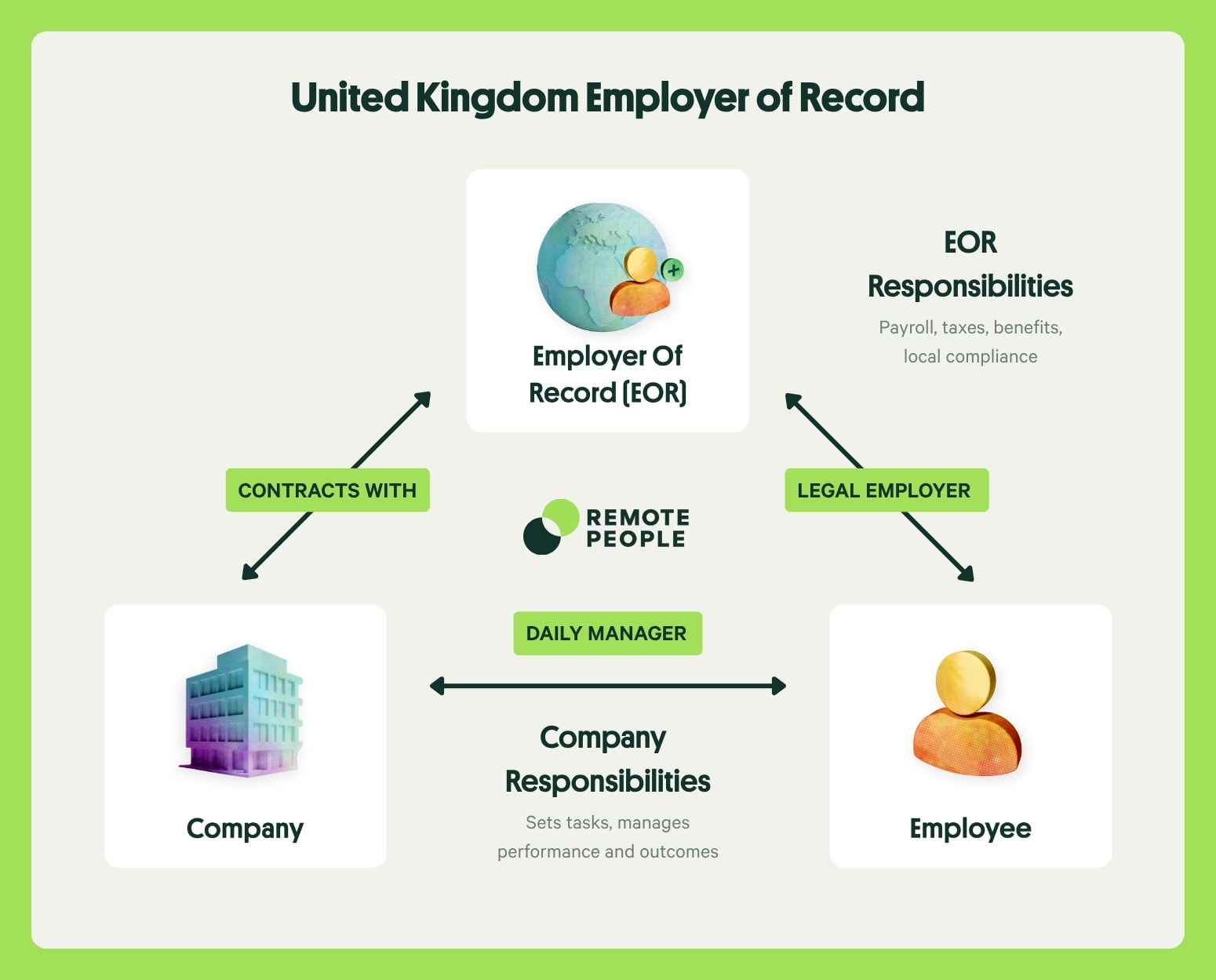
If you’d like to learn more about how Employer of Record (EOR) services work, read our What Is an Employer of Record (EOR)? guide for a complete overview of the model, its benefits, and when to use it.
If you’re comparing providers, our Best Employer of Record (EOR) Providers guide reviews the leading platforms to help you choose the right solution for your business.
Who Uses an EOR in the United Kingdom?
The UK is the sixth-largest economy in the world, with English as the working language, deep talent pools in technology, finance, life sciences, and creative industries, and a legal framework that is familiar to most foreign investors. Typical use cases for EOR include:
- Testing the UK market before committing to a subsidiary: Companies evaluating product-market fit, hiring a country manager, or testing a remote-first go-to-market can hire one or two employees through an EOR before investing in limited company setup, which takes six to eight weeks and triggers ongoing Companies House filings, corporation tax returns, and VAT registration above £90,000 of taxable turnover.
- Hiring a small UK team without entity overhead: Organisations that need fewer than fifteen UK employees often find EOR fees of $300–$600 per employee per month cheaper than the combined cost of incorporation, annual accounts, 25% main-rate corporation tax exposure, and payroll bureau fees.
- Onboarding quickly: An EOR can issue a signed contract, complete right-to-work checks, register the worker for PAYE, and run the first payroll within seven to ten business days, compared to the two- to three-month lag of a fresh entity setup and Skilled Worker sponsor licence application.
- Hiring non-UK nationals who need a visa: An EOR that already holds a Skilled Worker sponsor licence can issue a Certificate of Sponsorship in days rather than the eight to twelve weeks required for a new applicant to secure its own licence, absorbing the Immigration Skills Charge and compliance audit obligations.
Businesses expanding into the United Kingdom usually work with an EOR while they decide whether long-term headcount justifies the fixed cost of a limited company. Once a team exceeds fifteen to twenty employees, a UK subsidiary typically becomes more cost-efficient than ongoing EOR fees.
Typical Onboarding Timeline
A compliant hire through an EOR in the United Kingdom typically takes seven to ten business days from signed service agreement to first day of work.
- EOR agreement and employee details: 1–2 days to share the candidate’s passport or biometric residence permit, National Insurance number, qualifications, salary, start date, and benefits.
- Right-to-work check and contract drafting: 2–3 days for the EOR to complete a statutory right-to-work check, prepare the employment contract and written statement of particulars under section 1 of the Employment Rights Act 1996, and capture signatures.
- HMRC and pension registration: 1–2 days to register the worker under PAYE Real Time Information, issue a tax code, and set up the auto-enrolment pension.
- Payroll setup and benefits enrolment: 2–3 days to load the employee into payroll, enrol them in the pension scheme and private medical insurance (if offered), and confirm salary sacrifice or benefits-in-kind elections.
- Employee onboarding and first day: 1 day for IT access, policies, and orientation.
Most EOR providers can onboard an employee in the United Kingdom within one to two weeks. Non-UK and non-Irish nationals who need a Skilled Worker visa add four to eight weeks to the timeline because the Home Office must approve the Certificate of Sponsorship and visa application before the employee can start work.
Hire in the United Kingdom
A deep talent pool, English-speaking workforce, and one of Europe’s most familiar legal frameworks make the United Kingdom an attractive market for global teams.
We handle employment contracts, PAYE payroll, tax withholding, and full UK compliance.
No limited company needed. Your team can start in days.
Employment Laws and Regulations in the United Kingdom
Employment Contracts
The UK employment relationship is governed by a combination of statute, common law, and case law. The foundational statute is the Employment Rights Act 1996, which section 1 requires every employer to provide a written statement of particulars to all employees and workers on or before the first day of employment (Employment Rights Act 1996, section 1). The statement must cover the names of the parties, start date, pay and pay intervals, hours of work, holiday entitlement, job title or description, place of work, notice periods, probationary period (if any), and the length of any fixed term. Additional particulars on pensions, collective agreements, training entitlements, and non-compulsory training must be provided within two months of starting.
Contracts may be permanent (indefinite) or for a fixed term. Under the Fixed-term Employees (Prevention of Less Favourable Treatment) Regulations 2002, a fixed-term employee automatically becomes a permanent employee once they have been continuously employed for four years on successive fixed-term contracts, unless the continued use of a fixed-term contract is objectively justified. English is the normal contractual language, and the written statement must be given in English. Employment contracts do not need to be notarised or filed with any government agency.
Working Hours and Overtime
The Working Time Regulations 1998 cap the average working week at 48 hours averaged over 17 weeks and require a minimum 11-hour daily rest, a 24-hour weekly rest, and a 20-minute break after six hours of work (Working Time Regulations 1998). Adult workers in the UK may opt out of the 48-hour weekly limit by signing a written individual opt-out agreement, which can be revoked on seven days’ notice. The opt-out is not available for workers in certain sectors such as road transport. A typical full-time workweek is 35 to 40 hours, with 37.5 hours treated as the standard in most professional-services contracts.
UK law does not prescribe a statutory overtime premium. Overtime pay is set by the employment contract, and rates vary widely by sector and seniority. Many salaried professional roles include overtime within the base salary, while shift-based and hourly-paid roles typically attract a 125%–150% premium for weekday overtime and up to 200% for Sunday, bank holiday, or unsocial hours work. The table below summarises the framework used in most UK collective agreements and shift-based contracts.
United Kingdom overtime and premium pay framework · Per the Working Time Regulations 1998 and typical contract terms | |||
Hour Type | Rate Multiplier | Weekly/Daily Cap | Notes |
|---|---|---|---|
Weekday overtime (typical contract) | 125% (or time off in lieu) | 48 hrs/wk average over 17 wks | Not statutory. Time-and-a-quarter is the most common rate for hourly-paid roles above 37.5 hours per week. |
Weekday overtime (after extended hours) | 150% | 48 hrs/wk unless opted out | Many contracts step to time-and-a-half after 2–4 overtime hours or beyond 10 hours in a single day. |
Saturday work | 150% | 24-hr weekly rest required | Applies when Saturday is outside the contractual working week. |
Sunday work | 200% | Retail workers may opt out | Shop and betting workers have a statutory right to refuse Sunday work under the Employment Rights Act 1996. |
Bank holiday work | 200% | Agreed in contract | No statutory right to bank holidays off; contracts typically pay double time plus a day off in lieu. |
Night work (23:00–06:00) | No statutory premium | 8 hrs/24 hrs average | Night workers limited to 8 hours per 24 on average and entitled to free health assessments. |
Source: Working Time Regulations 1998 and Acas – Working hours | |||
Because overtime premiums are contractual rather than statutory, two hires on the same base salary can end up with different total compensation depending on whether their contract is salaried-professional or shift-based. The EOR drafts each contract to match the role’s working pattern so overtime, shift allowances, and on-call arrangements are priced correctly. Workers who have signed the 48-hour opt-out can still revoke it with seven days’ written notice.
Minimum Wage
From 1 April 2026, the National Living Wage for workers aged 21 and over is £12.71 per hour, an increase of 4.1% from the £12.21 rate that applied in 2025/26 (GOV.UK – National Minimum Wage rates). The National Minimum Wage applies to workers under 21 and to apprentices, with lower rates set annually by the Low Pay Commission. Enforcement is carried out by HM Revenue and Customs, which can recover unpaid wages, impose penalties of up to 200% of arrears, and publicly name non-compliant employers.
National Minimum Wage and National Living Wage rates effective from 1 April 2026:
- Age 21 and over (National Living Wage): £12.71 per hour.
- Age 18 to 20: £10.85 per hour.
- Age 16 to 17: £8.00 per hour.
- Apprentice rate (under 19, or 19+ in the first year): £8.00 per hour.
- Accommodation offset: £11.46 per day (maximum offset against wages where employer provides accommodation).
The UK has no statutory 13th-month payment and no general cost-of-living or inflation indexation of salaries. Wages are reviewed annually in line with market rates, and the National Minimum Wage is updated every April. See our UK minimum wage page for the full age-banded breakdown and historical rates.
Probation Period
UK statute does not prescribe a fixed probation period. The length is a matter of contract, with most employers setting a three- to six-month probation, extendable once by written agreement. During probation the employer can dismiss with short contractual notice (typically one week) without triggering the full capability or disciplinary procedure, but only employees with fewer than two years of continuous service have no right to claim ordinary unfair dismissal. This two-year qualifying period is a central feature of UK employment law, and the Employment Rights Act 2025 reforms do not shorten it as originally proposed in earlier drafts, although day-one rights have been extended in other areas such as paternity leave, bereavement leave, and protection from dismissal for pregnancy and family reasons. Discriminatory dismissal, automatic unfair dismissal grounds (for example dismissal for whistleblowing, trade union activity, or asserting a statutory right), and dismissal in breach of the contractual notice period are actionable from day one regardless of length of service. Our UK probation period guide explains how to draft enforceable probation clauses and extend them lawfully.
Leave Entitlements
The United Kingdom provides a structured statutory leave framework combining a 5.6-week paid annual leave floor, Statutory Sick Pay, and a full suite of family-related leave and pay. The 2026 reforms extended many of these rights to day one of employment. The types below are all statutory minimums; most UK contracts enhance them.
Annual Leave
Under regulation 13 of the Working Time Regulations 1998, every worker is entitled to 5.6 weeks of paid annual leave per leave year, which equates to 28 days for a full-time employee working five days a week (GOV.UK – Holiday entitlement). The 28-day entitlement is inclusive of bank holidays, meaning employers may count bank holidays towards the 5.6-week minimum. Part-time workers accrue leave pro rata. Leave is paid at the worker’s normal rate of pay, including a 52-week reference average of commission, regular overtime, and shift premiums under the Supreme Court ruling in Chief Constable of the Police Service of Northern Ireland v Agnew.
Untaken statutory leave generally cannot be carried over to the next leave year unless the worker was unable to take it due to sickness, family leave, or the employer preventing them from doing so. On termination, the employer must pay in lieu of any unused statutory leave accrued up to the termination date.
Sick Leave
Statutory Sick Pay (SSP) is payable from the first day of sickness for all employees from April 2026, following the removal of the three-day waiting period and the lower earnings limit under the Employment Rights Act 2025 (GOV.UK – Statutory Sick Pay). The weekly SSP rate for 2026/27 is £123.25, payable for up to 28 weeks of continuous sickness absence. From April 2026, SSP is paid at the lower of the standard weekly rate or 80% of the employee’s normal weekly earnings, removing the earnings threshold that previously excluded low-paid workers from SSP. The employer pays SSP directly through payroll; there is no longer a reclaim mechanism from HMRC. Most UK employers supplement SSP with contractual “company sick pay” schemes that pay full salary for a defined number of weeks, typically four to thirteen weeks depending on tenure.
Maternity Leave
Statutory maternity leave totals 52 weeks, structured as 26 weeks of Ordinary Maternity Leave and 26 weeks of Additional Maternity Leave, available to all employees from day one under sections 71 to 75 of the Employment Rights Act 1996 (GOV.UK – Maternity pay and leave). Statutory Maternity Pay (SMP) is paid for up to 39 weeks: the first 6 weeks at 90% of the employee’s average weekly earnings and the next 33 weeks at the lower of 90% of average weekly earnings or £194.32 per week for 2026/27. A compulsory maternity leave period of two weeks after the birth (four weeks for factory workers) prohibits return to work. Employees are protected from dismissal for any pregnancy- or maternity-related reason from day one, with extended protection from redundancy selection continuing for six months after returning to work under the Protection from Redundancy (Pregnancy and Family Leave) Act 2023.
Paternity Leave
From 6 April 2026, paternity leave is a day-one right, removing the previous 26-week service requirement. Eligible fathers, partners of the mother or adopter, and intended parents in surrogacy arrangements are entitled to two weeks of paternity leave, which may be taken as a single block or as two separate one-week blocks within 52 weeks of the child’s birth or placement. Statutory Paternity Pay (SPP) for 2026/27 is payable at the lower of 90% of average weekly earnings or £194.32 per week.
Other Statutory Leave
UK law provides several further statutory leave categories, most of which are paid by the employer and recovered in part through the Small Employers’ Compensation scheme for employers with annual Class 1 NIC liability under £45,000:
- Shared Parental Leave: Up to 50 weeks of leave and 37 weeks of Shared Parental Pay (ShPP) at £194.32 per week for 2026/27, shared between eligible parents after converting unused maternity or adoption leave.
- Adoption leave: 52 weeks of leave and up to 39 weeks of Statutory Adoption Pay at the same rates as SMP, available from day one for the primary adopter.
- Neonatal care leave: Up to 12 weeks of paid leave and pay for parents whose baby requires neonatal care for seven or more continuous days in the first 28 days of life, a day-one right introduced by the Neonatal Care (Leave and Pay) Act 2023, effective April 2025.
- Bereavement leave: Two weeks of paid Parental Bereavement Leave for parents of a child under 18 who dies, and from April 2026, a new statutory right to one week of bereavement leave following the death of a close relative.
- Carer’s leave: One week of unpaid leave per rolling 12-month period for employees with caring responsibilities for a dependant with a long-term care need, a day-one right under the Carer’s Leave Act 2023.
- Time off for dependants: Reasonable unpaid time off to deal with an unexpected emergency involving a dependant, under section 57A of the Employment Rights Act 1996.
Together, these entitlements give UK employees a structured statutory leave envelope that compares favourably with most advanced economies, especially after the 2026 day-one-rights expansion. The table below summarises the statutory minimums under the Employment Rights Act 1996 and successive family-friendly statutes.
United Kingdom statutory leave entitlements · Per the Employment Rights Act 1996 and Working Time Regulations 1998 | ||
Leave Type | Duration | Pay Rate (2026/27) |
|---|---|---|
Annual leave | 5.6 weeks (28 days for 5-day week) | 100% of normal pay; bank holidays may count toward the 28 days |
Statutory Sick Pay | Up to 28 weeks from day one | Lower of £123.25/week or 80% of normal weekly earnings |
Maternity leave | 52 weeks (26 OML + 26 AML) | 6 weeks at 90% of AWE, 33 weeks at lower of 90% of AWE or £194.32/week, 13 weeks unpaid |
Paternity leave (day-one right from April 2026) | 2 weeks (one or two blocks) | Lower of 90% of AWE or £194.32/week |
Adoption leave | 52 weeks (26 OAL + 26 AAL) | Same as Statutory Maternity Pay |
Shared Parental Leave | Up to 50 weeks leave, 37 weeks pay | £194.32/week (converted from mother’s or adopter’s entitlement) |
Neonatal care leave | Up to 12 weeks | £194.32/week, paid from day one |
Parental Bereavement Leave | 2 weeks (child under 18) | £194.32/week, paid from day one |
Bereavement leave (close relative, from April 2026) | 1 week | Paid at employer discretion; statutory rate £194.32/week where applicable |
Carer’s leave | 1 week per rolling 12 months | Unpaid; day-one right |
Unpaid parental leave | 18 weeks per child up to age 18 | Unpaid; maximum 4 weeks per year per child |
Source: GOV.UK – Time off work and Employment Rights Act 1996 | ||
An EOR manages every leave type on this list through its payroll, records absences correctly on the Full Payment Submission to HMRC, and ensures that statutory pay is calculated on the right reference period. UK employers typically enhance statutory maternity, paternity, and adoption pay through contractual “enhanced” schemes, and an EOR can administer these too as part of the benefits package you design.
Work Permits and Visas in the United Kingdom
Since the end of free movement on 1 January 2021, the UK operates a single points-based immigration system that treats EU, EEA, and non-EEA nationals identically (GOV.UK – Work visas). Employers who want to sponsor workers must hold a Home Office sponsor licence and pay an Immigration Skills Charge of £1,000 per sponsored worker per year (£364 for small or charitable sponsors). From 22 July 2025, the Skilled Worker general salary threshold increased to £41,700 per year, up from £38,700, with separate rates for new entrants and shortage occupations. An EOR that already holds a valid sponsor licence can onboard a visa-requiring hire much faster than a new employer, who must secure a licence before applying for the first Certificate of Sponsorship.
United Kingdom work permit routes · Per the Immigration Rules and Home Office sponsor guidance | |||
Visa Route | Who Qualifies | Maximum Validity | Processing Time |
|---|---|---|---|
Skilled Worker visa | Workers with a graduate-level job offer from a licensed sponsor paying at least £41,700 per year (or the going rate, whichever is higher) | 5 years per grant, extendable; leads to settlement after 5 years | 3 weeks (outside UK), 8 weeks (inside UK) |
Global Business Mobility – Senior or Specialist Worker | Senior managers or specialist employees transferring from an overseas branch of the same corporate group | 5 years (9 years for high earners); does not lead to settlement | 3 weeks |
Global Business Mobility – Graduate Trainee | Graduate trainees on a structured programme transferring from an overseas office of the same corporate group | 12 months; does not lead to settlement | 3 weeks |
Scale-up visa | Workers joining a fast-growing UK business with an authorised sponsor, on a salary of at least £36,300 per year | 2 years initially; switchable to Skilled Worker or Global Talent | 3 weeks |
Global Talent visa | Exceptional talent or promise in academia, research, arts, culture, or digital technology, endorsed by an approved body | 5 years, extendable; leads to settlement after 3–5 years | 3 weeks (outside UK), 8 weeks (inside UK) |
High Potential Individual visa | Recent graduates from an eligible top-50 global university, no sponsor required | 2 years (3 for PhD); non-extendable; switchable | 3 weeks |
Graduate visa | Students who completed an eligible UK degree; no sponsor required | 18 months post-study (18 months for PhD before reform); switchable to Skilled Worker | 8 weeks |
Fees depend on the route and the length of the visa. A five-year Skilled Worker visa typically costs the employer around £6,500 in application fees, Immigration Skills Charge, Certificate of Sponsorship fee, and Immigration Health Surcharge (which the employee may pay but most sponsors reimburse). The EOR can sponsor most routes on your behalf and bill the costs through as a pass-through, which is especially useful for roles where candidate competition is international. Our UK work visa and permit page covers the sponsor duties and compliance audit obligations in more depth.
Payroll and Taxes in the United Kingdom
Employer Contributions
UK employer payroll costs consist of employer Class 1 Secondary National Insurance, the Apprenticeship Levy (for large employers), and auto-enrolment pension contributions. Employer Class 1 Secondary NIC is charged at 15% of earnings above the £5,000 per year Secondary Threshold for 2026/27, following the rate increase announced in the Autumn 2024 Budget and confirmed for 2026/27. There is no upper limit on employer NIC (it applies to all earnings above the threshold), so the effective cost of a high-paid employee is typically 18–22% above gross salary once NIC, pension, and the Apprenticeship Levy are included.
The Apprenticeship Levy applies at 0.5% on the annual pay bill above a £3 million allowance, and is paid through PAYE. It funds apprenticeship training in England and flows to the devolved administrations in Scotland, Wales, and Northern Ireland.
United Kingdom employer payroll contributions · 2026/27 tax year (6 April 2026 – 5 April 2027) | ||
Contribution Type | Rate (% of Salary) | Notes |
|---|---|---|
Class 1 Secondary National Insurance | 15.00% | On earnings above £5,000 per year Secondary Threshold; no upper limit |
Apprenticeship Levy | 0.50% | On annual pay bill above £3 million allowance |
Auto-enrolment workplace pension (minimum) | 3.00% | On qualifying earnings between £6,240 and £50,270 per year |
Immigration Skills Charge (sponsored workers only) | £1,000/yr | Per sponsored worker (£364 for small or charitable sponsors) |
Employer’s liability insurance | ~0.15%–0.50% | Compulsory under the Employers’ Liability (Compulsory Insurance) Act 1969; minimum £5 million cover |
Total typical employer burden | ~18–22% | Above gross salary for mid-career professional earning £45,000–£80,000 |
Employee Deductions
UK employees are subject to PAYE income tax, employee Class 1 Primary National Insurance, the auto-enrolment pension contribution, and, where applicable, student loan repayments. Employee Class 1 Primary NIC is charged at 8% on earnings between the £12,570 Primary Threshold and the £50,270 Upper Earnings Limit, then 2% on earnings above the UEL for 2026/27. The Personal Allowance of £12,570 means income up to that level is tax free; the allowance tapers away by £1 for every £2 of adjusted net income above £100,000 and is fully withdrawn at £125,140.
United Kingdom employee payroll deductions · 2026/27 tax year | ||
Deduction Type | Rate (% of Salary) | Notes |
|---|---|---|
Income tax (Personal Allowance) | 0% | First £12,570 tax free; tapers above £100,000 of adjusted net income |
Income tax (Basic rate) | 20% | Taxable income between £12,571 and £50,270 (England, Wales, NI) |
Income tax (Higher rate) | 40% | Taxable income between £50,271 and £125,140 |
Income tax (Additional rate) | 45% | Taxable income above £125,140 |
Class 1 Primary National Insurance (main rate) | 8% | On earnings between £12,570 and £50,270 per year |
Class 1 Primary National Insurance (upper rate) | 2% | On earnings above £50,270 per year (no upper limit) |
Auto-enrolment workplace pension (minimum) | 5% | On qualifying earnings £6,240–£50,270; often salary-sacrificed |
Student loan (Plan 2, most common) | 9% | On earnings above £28,470 per year (Plan 2 threshold for 2026/27) |
Income Tax Brackets
The UK operates a progressive income tax system administered through PAYE. Tax is deducted at source each pay period using the employee’s tax code issued by HMRC. The rates and thresholds below apply to employment income in England, Wales, and Northern Ireland for the 2026/27 tax year (6 April 2026 to 5 April 2027). Scotland has its own income tax bands set by the Scottish Parliament; Scottish residents pay a 19% starter rate, 20% basic rate, 21% intermediate rate, 42% higher rate, 45% advanced rate, and 48% top rate across a separate set of band thresholds, while National Insurance and most reliefs continue to be set by Westminster.
United Kingdom income tax brackets (England, Wales, Northern Ireland) · 2026/27 tax year | |
Taxable Income per Year | Tax Rate |
|---|---|
£0 – £12,570 (Personal Allowance) | 0% |
£12,571 – £50,270 (Basic rate band) | 20% |
£50,271 – £125,140 (Higher rate band) | 40% |
Above £125,140 (Additional rate) | 45% |
The Personal Allowance is frozen at £12,570 and the higher-rate threshold at £50,270 through the 2027/28 tax year, a freeze that drags more earners into higher bands as wages grow. Dividend income, savings income, and capital gains are taxed under separate rate tables. UK employees are also subject to National Insurance as detailed above; NIC is independent of income tax and is not affected by the Personal Allowance. For a deeper walkthrough of PAYE RTI, student loan deductions, and the Apprenticeship Levy, see our UK payroll tax page.
Cost of Hiring an Employee Through an EOR in the United Kingdom
The total cost of hiring an employee through an EOR in the UK is the employee’s gross salary plus the employer’s statutory contributions (National Insurance, Apprenticeship Levy where applicable, and auto-enrolment pension), plus the EOR’s monthly service fee. UK employer burden typically runs at 18–22% above gross salary for mid-career hires, before any private medical insurance, life assurance, or enhanced benefits. The example below uses USD figures at current exchange rates for a mid-career professional earning the equivalent of £60,000 per year gross.
United Kingdom employer cost example · USD 6,500 monthly gross · 2026/27 | ||
Employer Cost | Amount (USD) | % of Gross |
|---|---|---|
Gross salary (~£60,000/yr) | $6,500 | 100.0% |
Employer National Insurance (15% above £5,000) | $920 | 14.2% |
Auto-enrolment pension (employer 3%) | $140 | 2.2% |
Apprenticeship Levy (large-employer estimate) | $35 | 0.5% |
Employers’ liability insurance + payroll admin | $50 | 0.8% |
EOR service fee (flat) | $599 | 9.2% |
Total monthly cost | $8,244 | 126.8% |
Figures converted at approximately £1 = $1.30 (April 2026). Actual cost varies by exchange rate, benefits package, and seniority.
The effective all-in cost of a £60,000 UK hire through an EOR works out at about 27% above the employee’s gross salary, of which roughly 18% is statutory employer burden and the rest is the EOR’s service fee and admin cost. That number rises for higher earners because employer NIC has no upper cap, and falls for lower earners because a larger share of gross salary falls below the £5,000 secondary threshold.
Benefits of Using an Employer of Record in the United Kingdom
An EOR lets you employ UK-based talent without registering a UK limited company, opening a UK bank account, or building an in-house UK payroll function. The value is highest for companies that are testing the market, hiring fewer than fifteen UK employees, or that need to onboard a visa-dependent hire quickly. Specific benefits include:
- Fast market entry: Start hiring in one to two weeks instead of the six to eight weeks required to incorporate a UK subsidiary, register for PAYE, apply for a sponsor licence, and set up banking.
- No legal entity required: The EOR is the employer of record for HMRC, Companies House, and the Pensions Regulator, so you avoid the recurring cost of UK statutory accounts, corporation tax returns, VAT registration above the £90,000 threshold, and sponsor-licence compliance audits.
- Built-in compliance with UK employment law: The EOR keeps contracts, policies, and payroll aligned with the Employment Rights Act 1996, the Employment Rights Act 2025 reforms, the Working Time Regulations, the Equality Act 2010, and GDPR as incorporated by the Data Protection Act 2018.
- Sponsor licence access on day one: A UK EOR with an existing Home Office Skilled Worker sponsor licence can issue Certificates of Sponsorship for eligible hires, saving eight to twelve weeks compared to a first-time sponsor application.
- Benefits parity with local employers: The EOR sources competitive private medical insurance, life assurance, income protection, and workplace pension schemes at group rates that a small or foreign employer would struggle to match on its own.
- Reduced employment liability: Statutory claims for unfair dismissal, discrimination, and wage disputes are managed by the EOR, subject to the contractual indemnities in the service agreement. The EOR handles Acas early conciliation and any Employment Tribunal proceedings that arise.
- Scalable hiring: Add or offboard UK employees per hire rather than committing to a fixed-cost entity. This is particularly valuable for seasonal expansion, contract-based delivery teams, or pilot projects.
Terminating an Employee in the United Kingdom
Grounds for Termination
Under the Employment Rights Act 1996, an employer can fairly dismiss an employee for one of five statutory reasons: capability or qualifications, conduct, redundancy, breach of a statutory restriction (for example the loss of a driving licence for a driver), or “some other substantial reason.” The employer must both have a fair reason and follow a fair procedure, which usually means complying with the Acas Code of Practice on Disciplinary and Grievance Procedures. Failure to follow the Code can lead to an uplift of up to 25% on the compensation awarded by an Employment Tribunal.
Employees with less than two years of continuous service generally cannot bring an ordinary unfair dismissal claim, but they can still claim for automatic unfair dismissal (for example pregnancy, whistleblowing, or asserting a statutory right), discrimination under the Equality Act 2010, wrongful dismissal for breach of contractual notice, or unlawful deductions from wages. The two-year qualifying period remains in place for 2026/27.
Notice Periods
Under section 86 of the Employment Rights Act 1996, the statutory minimum notice an employer must give an employee depends on length of continuous service. Contractual notice can be longer, and in practice most professional-services contracts provide for one, three, or six months of notice for senior roles. The employee must give at least one week’s notice once they have been employed for one month or more, regardless of tenure, unless the contract requires longer.
United Kingdom statutory minimum notice periods · Section 86, Employment Rights Act 1996 | |
Length of Continuous Service | Employer Minimum Notice |
|---|---|
Less than 1 month | None (contractual terms apply) |
1 month to less than 2 years | 1 week |
2 years to less than 3 years | 2 weeks |
3 years to less than 4 years | 3 weeks |
Each additional complete year up to 12 | +1 week per year |
12 years or more | 12 weeks (statutory maximum) |
An employer may pay the employee in lieu of notice (a “PILON”) where the contract allows it, which ends employment immediately and converts the notice period into a taxable cash payment. PILON is subject to income tax and National Insurance in full under the post-employment notice pay (PENP) rules introduced by the Finance (No. 2) Act 2017.
Severance Pay
Statutory Redundancy Pay
Employees with at least two years of continuous service who are dismissed by reason of redundancy are entitled to statutory redundancy pay under sections 135 and 162 of the Employment Rights Act 1996 (GOV.UK – Redundancy pay). The calculation depends on age and length of service, using a weekly pay cap that is revised every April. For 2026/27, the weekly pay cap is £751, and the maximum statutory redundancy payment is £22,530 (20 years × 1.5 weeks × £751).
The per-year-of-service multipliers are:
- Each full year of service under age 22: 0.5 week’s pay.
- Each full year of service between ages 22 and 40 inclusive: 1 week’s pay.
- Each full year of service from age 41 onwards: 1.5 weeks’ pay.
- Service cap: 20 years.
- Weekly pay cap for 2026/27: £751.
Contractual Severance and Settlement Agreements
Statutory redundancy pay is the legal minimum. Employers may pay an enhanced contractual redundancy package or negotiate a settlement agreement (formerly “compromise agreement”) under section 203 of the Employment Rights Act 1996 to close out potential Employment Tribunal claims. Settlement agreements are legally binding only when the employee has received independent legal advice from a qualified adviser, and the first £30,000 of a compensatory payment is generally tax-free under section 401 of the Income Tax (Earnings and Pensions) Act 2003, subject to the PENP rules. Anything above £30,000 is taxable income and subject to income tax (and in the case of PILON amounts, NIC). The EOR administers the tax treatment and paperwork on the employer’s behalf, including filing the P45 and any post-termination payroll corrections.
United Kingdom statutory redundancy pay · 2026/27 (weekly cap £751) | |
Age Bracket at Termination | Per Full Year of Service |
|---|---|
Under 22 | 0.5 week’s pay (capped at £375.50) |
22 to 40 inclusive | 1 week’s pay (capped at £751) |
41 and over | 1.5 weeks’ pay (capped at £1,126.50) |
Maximum service counted | 20 years |
Maximum statutory payment 2026/27 | £22,530 |
EOR vs Other Hiring Models in the United Kingdom
When you need to put people on the ground in the UK, you have four main options: set up a UK limited company of your own, engage contractors under an IR35-compliant arrangement, appoint a Professional Employer Organisation (PEO), or use an EOR. The right choice depends on how many people you plan to hire, how long you need them, and how much UK compliance risk you want to carry in-house.
EOR vs Setting Up a UK Limited Company
Setting up a UK limited company involves Companies House registration, appointment of a director who is typically resident for practical reasons, opening a UK business bank account, and registering for PAYE and the Pensions Regulator before running a first payroll. An EOR removes all of these steps because the EOR is already a UK-incorporated legal employer with live HMRC, PAYE, and sponsor-licence infrastructure. The table below compares the two routes across setup time, upfront cost, ongoing cost, and scalability.
United Kingdom EOR vs local entity comparison · Setup time, cost, risk and best-fit | ||
Dimension | Employer of Record | UK Limited Company (Ltd) |
|---|---|---|
Time to first hire | 7–10 business days | 6–8 weeks (incorporation, PAYE, bank) |
Setup cost | None (per-employee fee only) | $2,000–$5,000 legal + incorporation |
Ongoing compliance | EOR handles PAYE, NIC, pension, HR | Self-managed: Companies House accounts, CT600, VAT, PAYE |
Best for team size | 1–15 UK employees | 15+ UK employees or long-term base |
Break-even point | Typically cheaper below 15–20 hires | Typically cheaper above 15–20 hires |
Sponsor licence for visas | Included on day one via EOR’s licence | Separate application; 8–12 weeks |
Employer liability for claims | EOR manages, with indemnity in contract | Self-managed, full Tribunal exposure |
For a small team of five to ten UK employees, running EOR services typically costs less than the combined expense of UK accounting, company secretarial work, sponsor licence compliance, and HR administration. Once you cross roughly fifteen employees the fixed costs of a limited company are spread across more headcount and entity ownership becomes the more efficient option.
EOR vs Hiring Contractors
Hiring UK contractors can be faster than employment for short-term, specialised projects, but the off-payroll working rules (commonly called IR35) force medium and large end-client businesses to determine the deemed employment status of off-payroll workers and operate PAYE if the engagement is inside IR35. Misclassification carries back-tax, National Insurance, interest, and penalties running to 30% of unpaid tax for careless behaviour and up to 100% for deliberate behaviour. The comparison below summarises the legal and commercial differences between an EOR employee and a UK contractor.
United Kingdom EOR vs independent contractors · Compliance, cost, and risk | ||
Dimension | Employer of Record | UK Contractor / Self-Employed |
|---|---|---|
Legal employment status | Employee under the Employment Rights Act 1996 | Self-employed under contract for services |
IR35 / off-payroll risk | None: PAYE from day one | HMRC may reclassify under IR35 with back-tax, interest, penalties |
Statutory leave and benefits | Full entitlement (5.6 weeks holiday, SSP, SMP) | None unless reclassified |
Pension | Auto-enrolled if eligible | Self-funded |
Payroll taxes | Employer withholds PAYE + NIC | Contractor invoices + self-assesses |
Typical use case | Permanent, full-time role | Short-term project, genuine business-to-business |
Client tax liability | Managed by EOR | Medium or large clients must assess IR35 status under Chapter 10, ITEPA 2003 |
UK contractors are a legitimate way to engage specialists for defined projects, but for permanent, full-time roles they carry IR35 reclassification risk. Under the off-payroll working rules, medium and large end-client businesses must determine the deemed employment status of off-payroll workers and operate PAYE if the engagement is inside IR35, with HMRC penalties running to 30–100% of unpaid tax for careless or deliberate non-compliance. Using an EOR removes this risk entirely because the worker is a PAYE employee from day one.
EOR vs PEO
A Professional Employer Organisation (PEO) is a co-employment model in which the PEO handles HR, payroll, and benefits but the client company remains the legal employer of record. In the UK the PEO concept is rarely used because co-employment has no formal statutory basis under the Employment Rights Act 1996. An EOR in the UK is the full legal employer: the client has no local entity and no co-employment. The table below outlines the structural differences most relevant to UK hiring decisions.
United Kingdom EOR vs PEO comparison · Legal employer, liability, and setup | ||
Dimension | Employer of Record | Professional Employer Organisation |
|---|---|---|
Employer of record on contract | EOR (the client has no UK entity) | Client’s UK entity (co-employment) |
Need for UK entity | Not required | Required: client must have a UK Ltd |
UK market prevalence | Widely available from global EOR providers | Rare: US model does not map cleanly to UK law |
Compliance liability | EOR bears primary employer liability | Shared between PEO and client entity |
Fit for market entry | Ideal for companies without a UK entity | Only after incorporating a UK Ltd |
The PEO model is common in the United States, where state-level labour law allows for formal co-employment. In the UK, the PEO concept has limited market adoption because UK employment law does not recognise co-employment in the US sense, and a client must already hold its own UK entity to make the arrangement work. EOR is therefore the default route for international employers who want UK talent without opening a UK Ltd.
Public Holidays in the United Kingdom
The UK has no statutory right to paid bank holidays off. Whether an employee is paid for a bank holiday, or has to take annual leave to cover it, depends on the contract of employment. Most employers give eight bank holidays in England and Wales (nine in Scotland and ten in Northern Ireland) on top of or within the 5.6-week statutory annual leave entitlement. Bank holidays are set by Royal Proclamation under the Banking and Financial Dealings Act 1971 (GOV.UK – UK bank holidays).
United Kingdom bank holidays 2026 (England and Wales) | ||
Holiday Name | Date 2026 | Notes |
|---|---|---|
New Year’s Day | Thursday, 1 January 2026 | National bank holiday |
Good Friday | Friday, 3 April 2026 | Common-law bank holiday |
Easter Monday | Monday, 6 April 2026 | Statutory bank holiday (not Scotland) |
Early May bank holiday | Monday, 4 May 2026 | First Monday of May |
Spring bank holiday | Monday, 25 May 2026 | Last Monday of May |
Summer bank holiday | Monday, 31 August 2026 | Last Monday of August (England, Wales, NI) |
Christmas Day | Friday, 25 December 2026 | Statutory bank holiday |
Boxing Day | Monday, 28 December 2026 | Substitute for Saturday 26 December |
Scotland observes 2 January and St Andrew’s Day (30 November) in addition to most English bank holidays, while Northern Ireland adds St Patrick’s Day (17 March) and the Battle of the Boyne (12 July). A UK EOR configures the holiday calendar for each employee based on their work location to ensure they receive the correct statutory entitlement.
How to Get Started With an EOR in the United Kingdom
Engaging an EOR in the UK is a straightforward three-step process that puts a UK employee on payroll within one to two weeks of agreeing on the hire.
- Step 1: Scope the hire and confirm EOR pricing. Share the candidate’s role, salary, start date, benefits package, and work location. The EOR returns a quote showing the gross salary, employer National Insurance and pension, Apprenticeship Levy (if applicable), benefits cost, and the monthly service fee. Most providers offer a flat per-employee fee between $300 and $600 per month.
- Step 2: Sign the service agreement and onboard the employee. The EOR prepares the written statement of particulars under section 1 of the Employment Rights Act 1996, completes the right-to-work check, registers the worker under PAYE Real Time Information with HMRC, sets up the auto-enrolment pension, and enrols any benefits. For sponsored workers the EOR issues a Certificate of Sponsorship through its Skilled Worker licence.
- Step 3: Pay the monthly invoice and manage the employee day-to-day. You direct the employee’s work, priorities, and performance. The EOR runs payroll, remits PAYE income tax and NIC to HMRC, pays the pension contribution to the provider, issues P60s at tax year end, and administers all statutory leave. You receive a single consolidated invoice each month covering salary, employer burden, benefits, and the EOR fee.
Selecting the right EOR comes down to three practical tests: whether the provider is UK-incorporated with its own payroll function and Skilled Worker sponsor licence, whether it publishes transparent flat-fee pricing (rather than a percentage of salary that penalises senior hires), and whether its service agreement explicitly indemnifies you against employment claims within scope. RemotePeople operates its own UK entity, holds an active sponsor licence, and charges a flat monthly fee regardless of employee salary.
Frequently Asked Questions
A UK EOR typically charges a flat monthly service fee of $300 to $600 per employee, plus pass-through costs for employer National Insurance (15% above the £5,000 secondary threshold), auto-enrolment pension (3% employer minimum), Apprenticeship Levy (0.5% for pay bills above £3 million), and any elected benefits. For a £60,000 per year hire, the all-in cost lands at roughly 127% of gross salary once the employer burden and EOR fee are factored in.
No. The EOR is the UK-registered employer of record for HMRC, Companies House, and the Pensions Regulator. You do not need to incorporate a UK limited company, open a UK bank account, register for PAYE, or apply for a sponsor licence. The EOR carries all those obligations while you manage the employee's day-to-day work.
A standard UK hire takes seven to ten business days from signed service agreement to the employee's first day. This covers the written statement of particulars, right-to-work check, PAYE registration with HMRC through RTI, and auto-enrolment pension setup. Non-UK and non-Irish nationals who need a Skilled Worker visa add four to eight weeks for Home Office processing.
Employer statutory cost in the UK is roughly 18–22% above gross salary for a mid-career professional. This comprises 15% employer Class 1 Secondary National Insurance on earnings above £5,000, 3% minimum auto-enrolment pension on qualifying earnings, 0.5% Apprenticeship Levy for employers with a pay bill above £3 million, and around 0.15–0.5% employers' liability insurance. Higher earners pay a higher effective rate because employer NIC has no upper cap.
Yes: most UK EORs offer a separate contractor-management service that handles IR35 status determinations, contractor agreements, and compliant invoicing. For roles that behave like full-time employment, however, an EOR employee arrangement is safer because the worker is PAYE from day one, which eliminates the risk of HMRC reclassifying the engagement as disguised employment and imposing back-tax, interest, and penalties under the off-payroll working rules.
Employer Class 1 Secondary National Insurance is 15% of earnings above the £5,000 per year Secondary Threshold for the 2026/27 tax year, with no upper limit. Employers can also claim the £10,500 Employment Allowance against their NIC bill if they qualify. Large employers additionally pay the Apprenticeship Levy at 0.5% of the pay bill above a £3 million annual allowance.
Yes: any UK employer that wants to sponsor a Skilled Worker, Senior or Specialist Worker, Scale-up, or most other work routes must hold a Home Office sponsor licence. A new sponsor licence application typically takes eight to twelve weeks and costs £574 for small and charitable sponsors or £1,579 for medium and large sponsors, plus ongoing compliance audits. A UK EOR with an existing licence can issue a Certificate of Sponsorship immediately, so you avoid the licence wait entirely.
The EOR manages the termination process in line with the Employment Rights Act 1996 and the Acas Code of Practice. You must have a fair reason (capability, conduct, redundancy, illegality, or some other substantial reason), follow a fair procedure, and respect the statutory minimum notice in section 86, which is one week for one month to two years of service, stepping up by one week per year of service to a twelve-week statutory maximum. Redundancy-dismissed employees with at least two years of service are entitled to statutory redundancy pay, capped at £22,530 for 2026/27.
No. The UK has no statutory 13th-month or 14th-month salary. Bonuses, performance pay, and annual awards are entirely contractual. Many UK employers do pay a discretionary annual bonus, but it is not legally required and does not accrue as deferred compensation.
The National Living Wage for workers aged 21 and over is £12.71 per hour from 1 April 2026, a 4.1% increase on the 2025/26 rate. The National Minimum Wage for 18- to 20-year-olds is £10.85 per hour, and the rate for 16- and 17-year-olds and apprentices in their first year is £8.00 per hour. Rates are reviewed annually by the Low Pay Commission and updated every April.
Employer of Record in
Employer of Record in
Employer of Record in
Employer of Record in
Employer of Record in
Employer of Record in
Employer of Record in
Employer of Record in