
 Recruit
Employer of Record (EOR) in India
-
 Drew Donnelly
- Published
- September 22, 2026
RemotePeople’s employer of record in India lets you hire employees in India with ESI and statutory compliance. We handle 3.25% ESI contributions, Employees’ State Insurance enrollment, and mandatory benefit coverage.
Hire in India — book a free 30-minute demo
Tell us what you need. You'll get a tailored, transparent proposal within 24 hours, plus a free call to walk through it.
Tell us about your company
So we can match you with a specialist who knows your market — and unlock volume pricing tiers.
* All fields are required.
Where and when are you hiring?
Tell us the geography and timing and we'll quote each country line by line, with onboarding timelines.
* All fields are required.
Help us beat your current setup
We'll benchmark your current deal and send a line-by-line proposal in 24 hours — showing exactly where we cut cost, time, or risk. After you submit, you can book a call to walk through it together.
* All fields are required.
Thanks! Your proposal is on its way.
Expect a tailored, line-by-line proposal in your inbox within 24 hours. In the meantime…
Want to walk through it together?
Book a free 30-minute call with one of our specialists. We'll explain every line, answer your questions, and tailor the proposal further if you need.
No obligation. Pick a time that works for you.








- Hire in India — book a free 30-minute demo
- Tell us about your company
- Where and when are you hiring?
- Help us beat your current setup
- Thanks! Your proposal is on its way.
- How an Employer of Record Works in India
- Employment Laws and Regulations in India
- Work Permits and Visas in India
- Payroll, Taxes, and Social Security in India
- Cost of Hiring Through an EOR in India
- Benefits of Using an EOR in India
- Termination and Offboarding in India
- EOR vs. Other Hiring Models in India
- Public Holidays in India
- How to Get Started with an EOR in India
- Where companies hiring in India expand next
- Frequently Asked Questions
- Related EOR Destinations

Start hiring in India
Let RemotePeople handle payroll, compliance, and HR admin worldwide so you can focus on building your team.

An employer of record in India enables companies to hire employees compliantly without establishing a local entity, with EOR services in India typically costing $199–$599 per employee per month. India’s workforce of over 500 million people, a large technology sector, and competitive salary costs make it one of the top destinations for international hiring – but the regulatory environment is complex, spanning EPFO and ESIC social security structures, state-level variations in labour law, and strict work permit requirements for foreign nationals. RemotePeople’s employer of record service handles employment contracts, payroll, tax deductions, provident fund contributions, and statutory benefits, so organizations can build their India team quickly while staying fully compliant with the Factories Act 1948, state-level Shops and Establishments Acts, and all applicable tax regulations.
How an Employer of Record Works in India
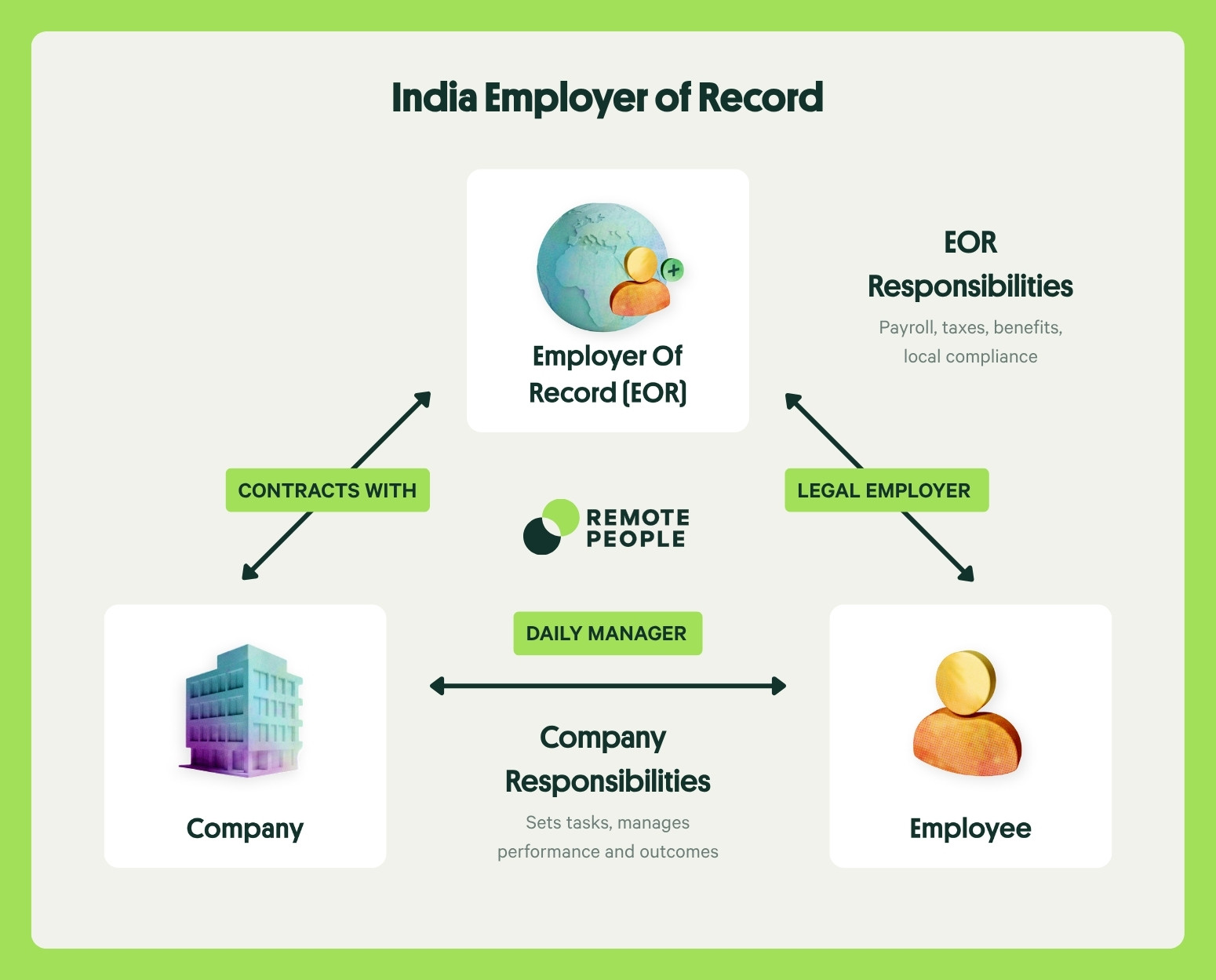
An Employer of Record (EOR) in India is the legal employer for your international hires, managing all compliance, payroll, and statutory obligations on your behalf. This arrangement lets you hire talent in India without incorporating a private limited company or registering with state-level authorities, reducing both time and administrative overhead. The EOR handles everything from employment contracts to Provident Fund and ESI filings, while you retain full control over day-to-day work assignments, team management, and strategic decisions.

If you’d like to learn more about how Employer of Record (EOR) services work, read our What Is an Employer of Record (EOR)? guide for a complete overview of the model, its benefits, and when to use it.
If you’re comparing providers, our Best Employer of Record (EOR) Providers guide reviews the leading platforms to help you choose the right solution for your business.
Who Uses an EOR in India?
Organizations across a wide range of sizes and stages use EOR services to hire in India without the cost and complexity of entity incorporation. The most common use cases include the following.
- Market testing before committing: Companies exploring the Indian market can hire a small initial team through an EOR, evaluate performance, and decide whether to incorporate a local entity later, avoiding premature investment in registration and compliance infrastructure.
- Small teams without entity overhead: For organizations that need 1–15 employees in India, the cost of incorporating a private limited company (registration, annual compliance, audits, director requirements) often exceeds the total EOR fees, making an EOR the more cost-effective option.
- Fast onboarding for time-sensitive projects: When a company needs to hire quickly in India, an EOR can onboard employees within 1–2 weeks, compared to 2–4 months for entity incorporation, EPFO registration, and state-level Shops and Establishments registration.
- Hiring foreign nationals who need work permits: Companies relocating international staff to India can use the EOR’s existing entity to sponsor Employment Visas and manage FRRO compliance without establishing their own registered office.
As teams grow beyond 15–20 employees, some organizations transition to their own Indian subsidiary. Until that point, an EOR provides full compliance coverage at a fraction of the entity setup and maintenance cost.
Typical Onboarding Timeline
- Step 1: You submit employee details, job description, and proposed compensation to the EOR. This takes 1–2 business days.
- Step 2: The EOR drafts the employment contract in compliance with the applicable state’s Shops and Establishments Act, then obtains the employee’s signature. This takes 2–3 business days.
- Step 3: The EOR registers the employee with EPFO for provident fund coverage and ESIC for state insurance (if the employee’s gross wages fall within the ESIC threshold of INR 21,000 per month). Registration takes 3–5 business days.
- Step 4: The EOR sets up the first payroll cycle. Salaries in India are typically paid on the last working day of the month or the first of the following month, with all statutory deductions (EPF, ESI, TDS, professional tax) applied automatically.
- Step 5: The EOR provides you with a monthly payroll summary showing gross pay, all deductions, employer contributions, and net pay. Ongoing compliance reporting (TDS returns, EPFO/ESIC filings) is handled automatically.
Most EOR India providers can onboard an employee within 1–2 weeks. The timeline extends to 6–10 weeks if the employee is a foreign national requiring an Employment Visa and FRRO registration.
Hire in India
Competitive salary costs, a 500+ million person workforce, deep technology talent, and established legal frameworks make India one of the top destinations for international hiring.
We handle employment contracts, payroll, tax withholding, and full India compliance.
No local entity needed. Your team can start in days.
Employment Laws and Regulations in India
Employment in India is regulated by over 40 central and state-level labour laws, making compliance one of the most complex challenges for employer of record services in India. Key central laws include the Factories Act 1948, the Industrial Disputes Act 1947, the Shops and Establishments Acts (enacted individually by each state), the Employees’ Provident Funds and Miscellaneous Provisions Act 1952, and the Employees’ State Insurance Act 1948. Four new Labour Codes were enacted in 2019–2020 (Code on Wages, Industrial Relations Code, Social Security Code, and Occupational Safety Code) but have not yet been notified for implementation as of early 2026, so the existing legislation remains in effect. Any company using an employer of record in India needs to be aware of these regulations, as non-compliance penalties include fines, prosecution, and debarment from government contracts.

Employment Contracts
Indian law does not mandate a single central statute requiring written employment contracts for all workers, but the applicable state’s Shops and Establishments Act typically requires a written appointment letter or contract for employees in commercial establishments. In practice, all EOR-managed employees in India receive a written employment contract specifying job title, compensation, working hours, probation terms, notice period, leave entitlements, and confidentiality obligations. Fixed-term contracts are recognized under the Industrial Relations Code 2020 and by several state amendments, allowing employers to hire for a specific duration with defined start and end dates. Indefinite-term contracts remain the default for permanent roles. Contracts must comply with both central laws (Factories Act, Payment of Wages Act, Minimum Wages Act) and the relevant state’s Shops and Establishments Act, which varies across India’s 28 states and 8 union territories.
Working Hours and Overtime
The standard workweek in India is 48 hours spread across six days under the Factories Act 1948, with a maximum of 9 hours per day (India Code, Factories Act 1948). Many modern employers and state Shops and Establishments Acts have adopted a five-day, 40-hour workweek for office-based roles. Overtime compensation is set at twice the ordinary rate of wages under Section 59 of the Factories Act, and overtime hours are capped at 50 hours per quarter to prevent excessive working. Employees are entitled to at least one rest day per week, typically Sunday.
India’s overtime framework under the Factories Act 1948 applies a flat 2× multiplier for all hours exceeding the standard daily or weekly limits. Unlike many countries, India does not have separate statutory tiers for night work, rest day work, or public holiday work at the central level, though some state Shops and Establishments Acts provide additional premiums. The table below summarizes the applicable rates under central legislation.
India overtime and premium pay rates · Per Factories Act, 1948 | |||
Hour Type | Rate Multiplier | Weekly/Daily Cap | Notes |
|---|---|---|---|
Weekday overtime (beyond 9 hrs/day or 48 hrs/week) | 2× ordinary rate | 50 hours per quarter | Section 59, Factories Act 1948 |
Night shift (after 7:00 p.m.) | No additional central premium | 9 hours per shift | Some state S&E Acts provide a night premium |
Weekly rest day (typically Sunday) | 2× ordinary rate | Compensatory rest day required | Section 52, Factories Act 1948 |
Public holiday work | 2× ordinary rate (varies by state) | Per state S&E Act | National holidays (3) are mandatory; others per state |
Spread-over beyond 10.5 hours | 2× ordinary rate for excess | 10.5-hour spread-over limit | Section 56, Factories Act 1948 |
Source: India Code, Factories Act 1948 and PwC India Tax Summary | |||
The 50-hour quarterly overtime cap means employers cannot systematically schedule more than approximately 4 hours of overtime per week across a 13-week quarter. Employees in managerial or supervisory roles may be exempt from overtime provisions under Section 64 of the Factories Act. Overtime does not affect 13th-month bonus calculations, as India’s bonus under the Payment of Bonus Act is computed separately on basic wages plus dearness allowance.
Minimum Wage
India does not have a single national minimum wage. Instead, minimum wages are set by both the central government and individual state governments under the Minimum Wages Act 1948, varying by state, industry, and skill level. The central government’s recommended floor wage stands at INR 178 per day (approximately $2.09), though most states set significantly higher rates for their scheduled employments. Delhi’s minimum wage for unskilled workers, for example, is approximately INR 17,494 per month (around $206), while states like Maharashtra and Karnataka set their own rates for different categories of workers (Ministry of Labour and Employment). Employers must comply with whichever rate is higher between the central and the applicable state minimum wage for the relevant employment category.
Probation Period
Indian law does not prescribe a single statutory probation period at the central level. Probation terms are typically set by the employment contract, with most companies using a 3-month or 6-month probation period. During probation, employees are generally entitled to all statutory benefits (EPF, ESI, minimum wage) but may have shorter notice periods and can be terminated more easily than confirmed employees. The Industrial Employment (Standing Orders) Central Rules require establishments with 100 or more workers to define probation terms in their standing orders, and probation periods cannot exceed the limits specified in those orders. Extensions of probation are common and legally permissible if stated in the contract, but indefinite extensions are not enforceable.
Leave Entitlements
India’s statutory leave framework varies significantly between central legislation and state-level Shops and Establishments Acts. The Factories Act 1948 governs leave for factory workers, while commercial establishments follow the applicable state’s Shops and Establishments Act. All employees are entitled to a combination of earned leave (annual leave), sick leave, and casual leave, though the specific entitlements differ by state.
Annual Leave
Under the Factories Act 1948, employees earn one day of paid leave for every 20 days worked, resulting in approximately 15 earned leave days per year for a full-time worker. State Shops and Establishments Acts typically provide 12–21 days of earned leave per year depending on the state. In most states, annual leave begins accruing from the date of joining but can only be taken after completing a qualifying period (usually 240 days of work in the preceding calendar year under the Factories Act). Unused earned leave can generally be carried forward, with accumulation caps varying by state, typically 30–45 days.
Sick Leave
Sick leave entitlements in India are governed primarily by state Shops and Establishments Acts, as the Factories Act 1948 does not provide a specific sick leave provision separate from earned leave. Most states provide 7–12 days of paid sick leave per year at full salary. Employees must typically present a medical certificate for absences exceeding 2–3 consecutive days. Sick leave generally does not accumulate or carry forward to the next year in most states. Employers are responsible for paying sick leave wages directly; there is no state-funded sickness benefit except through ESI for insured employees, which provides 70% of wages for up to 91 days for ESI-covered workers (ESIC).
Maternity Leave
The Maternity Benefit Act 1961, as amended in 2017, entitles female employees to 26 weeks of paid maternity leave for the first two children and 12 weeks for the third child onward (India Code, Maternity Benefit Act 1961). Of the 26 weeks, up to 8 weeks can be taken before the expected delivery date. Maternity leave pay is 100% of average daily wages, funded entirely by the employer (or through ESI for insured employees). The Act applies to all establishments employing 10 or more persons. Adoptive and commissioning mothers are entitled to 12 weeks of leave from the date of handover. Women returning from maternity leave at establishments with 50 or more employees also have the right to a crèche facility.
Paternity Leave
India has no central statute mandating paternity leave for private-sector employees. Central government employees receive 15 days of paternity leave, but this does not extend to the private sector. In practice, many private-sector employers offer 5–15 days of voluntary paternity leave as part of their benefits policy, though this is not a legal requirement. The Social Security Code 2020, once notified, may introduce formal paternity leave provisions, but as of early 2026 it has not been implemented.
Other Statutory Leave
Beyond earned leave, sick leave, and maternity leave, Indian employees are entitled to several other forms of statutory leave depending on the applicable legislation.
- Casual leave: Most state Shops and Establishments Acts provide 7–12 days of casual leave per year for personal matters, emergencies, or short-notice absences. Casual leave typically cannot be carried forward.
- Festival and religious holidays: Employees are entitled to paid time off on gazetted public holidays (typically 10–15 per year depending on the state), plus restricted holidays that employees can choose based on their religion.
- Bereavement leave: Not mandated by central law, but commonly provided by employers as 3–5 days of paid leave for the death of an immediate family member.
- Study leave: Available to central government employees under specific rules; not mandatory in the private sector but occasionally provided by policy.
Under the Factories Act 1948 and applicable state Shops and Establishments Acts, the table below summarizes every statutory leave entitlement available to employees in India. The most important takeaway is that earned leave accrual rates and sick leave entitlements vary substantially across states, so the EOR must apply the correct state-specific rules based on the employee’s location.
India statutory leave entitlements · Per Factories Act 1948 and state Shops and Establishments Acts | ||
Leave Type | Duration | Eligibility and Notes |
|---|---|---|
Earned Leave (Annual Leave) | 15–21 days per year | 1 day per 20 days worked (Factories Act); 12–21 days (state S&E Acts); accrual after qualifying period |
Sick Leave | 7–12 days per year | Per state S&E Act; medical certificate required for 2+ consecutive days; non-cumulative in most states |
Casual Leave | 7–12 days per year | Per state S&E Act; for personal matters and emergencies; cannot be carried forward |
Maternity Leave | 26 weeks (first two children) | 100% pay; 12 weeks for third child onward; 12 weeks for adoptive mothers; employer-funded (or ESI) |
Maternity Leave (third child onward) | 12 weeks | 100% pay; same eligibility as above |
Paternity Leave | No statutory entitlement (private sector) | 15 days for central government employees; 5–15 days commonly offered voluntarily by private employers |
Public Holidays | 10–15 days per year | 3 national holidays mandatory; remaining per state gazette; paid at regular rate |
Bereavement Leave | 3–5 days (per employer policy) | Not mandated by central law; commonly provided for death of immediate family member |
Statutory Employee Benefits
Beyond leave entitlements, Indian employers must provide several mandatory benefits that are funded through employer and employee contributions. India’s statutory benefits framework includes retirement savings, health insurance, life insurance, and performance bonuses.
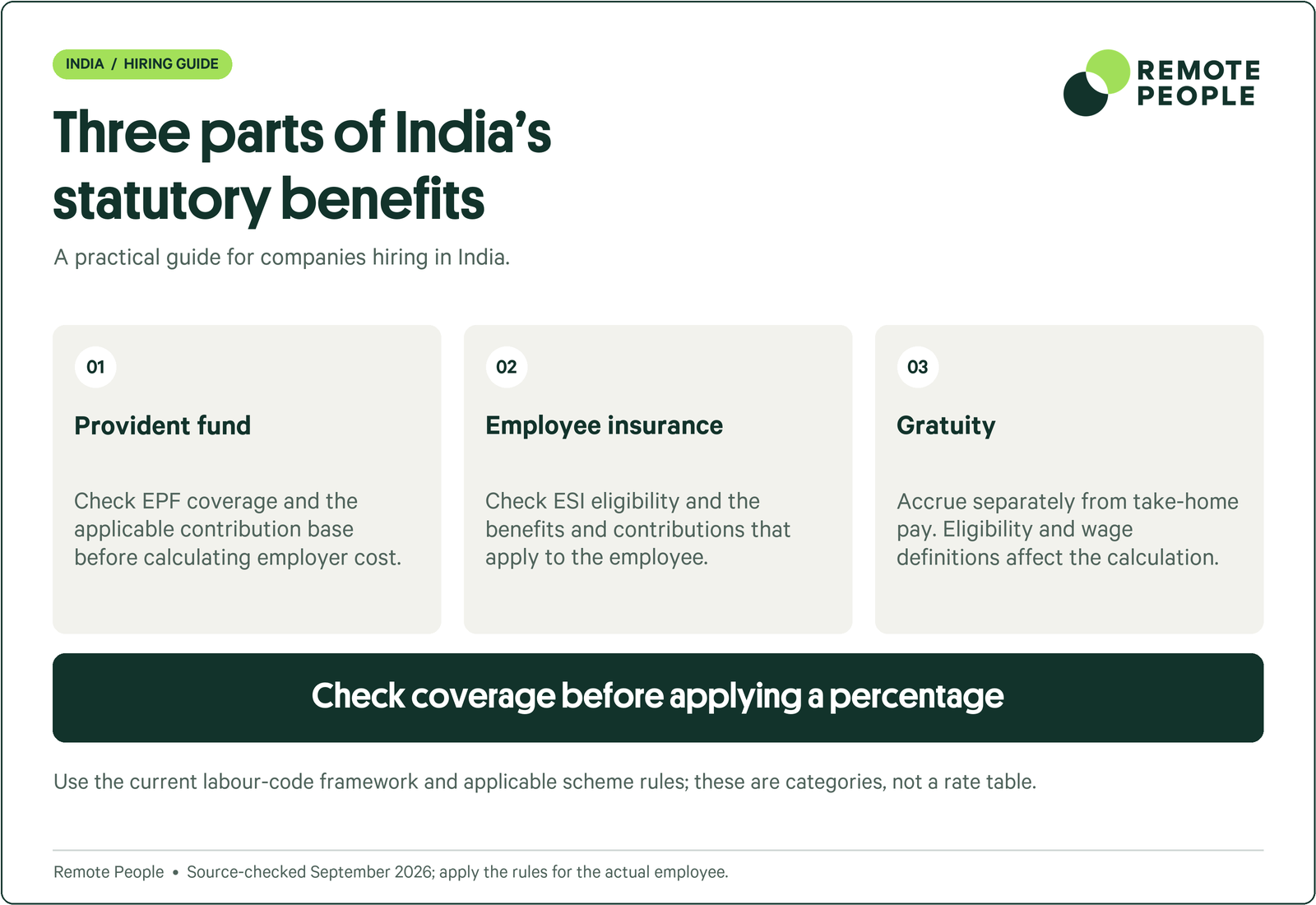
- Employees’ Provident Fund (EPF): A mandatory retirement savings scheme requiring both employer and employee to contribute 12% of basic wages plus dearness allowance. Applies to establishments with 20 or more employees. The employer’s 12% is split between EPF (3.67%) and the Employees’ Pension Scheme (8.33%, capped at INR 15,000 basic). Managed by EPFO.
- Employees’ State Insurance (ESI): A social security and health insurance scheme funded by employer contributions of 3.25% and employee contributions of 0.75% of gross wages. Applies to employees earning up to INR 21,000 per month in establishments with 10 or more employees. Provides medical care, sickness benefits, maternity benefits, and disability coverage through ESIC.
- Employees’ Deposit-Linked Insurance (EDLI): A life insurance scheme for EPF members, funded entirely by the employer at 0.5% of basic wages plus dearness allowance. Provides a lump-sum payment to the employee’s nominee in case of death during service, with a maximum benefit of INR 7,00,000.
- Gratuity: Under the Payment of Gratuity Act 1972, employees who complete five or more years of continuous service are entitled to a gratuity payment upon separation. The formula is (last drawn salary × 15 × years of service) ÷ 26, capped at INR 20,00,000 for private-sector employees.
- Bonus: The Payment of Bonus Act 1965 mandates a minimum annual bonus of 8.33% of basic wages (or INR 100, whichever is higher) for employees earning up to INR 21,000 per month, with a maximum of 20%. Applicable to establishments with 20 or more employees.
- Professional tax: A state-level tax deducted from the employee’s salary, capped at INR 2,500 per year. Rates vary by state; not all states levy professional tax.
Exact contribution rates for EPF, ESI, and other statutory deductions are detailed in the payroll section under H2 4. The EOR handles all registration, calculation, deduction, and remittance of these benefits on your behalf.
Recent Regulatory Updates (2026)
As of 2026, India’s core employment framework remains governed by the existing central and state legislation, as the four new Labour Codes (Code on Wages 2019, Industrial Relations Code 2020, Social Security Code 2020, Occupational Safety Code 2020) have not yet been notified for implementation. The central government has indicated that notification depends on state-level rule-making, and as of early 2026, fewer than half the states have published draft rules.
The Union Budget 2025–2026, presented in February 2025, introduced significant changes to the individual income tax regime, raising the basic exemption limit under the new tax regime to INR 4,00,000 and restructuring slab rates to reduce the tax burden on middle-income earners (Income Tax Department). The rebate under Section 87A was raised so that employees earning up to INR 12,00,000 annually under the new regime pay zero income tax. The ESIC wage ceiling for coverage remains at INR 21,000 per month, unchanged since 2017. The EPF wage ceiling for mandatory membership remains at INR 15,000 per month for the pension scheme component, though total EPF contributions apply on the full basic salary without a ceiling.
Several states updated their minimum wage schedules in late 2025 and early 2026, with notable increases in Delhi (raising unskilled worker minimum wage to approximately INR 17,494 per month), Karnataka, and Tamil Nadu. The central government’s Code on Wages 2019, which would establish a national floor wage, remains pending notification.
Work Permits and Visas in India
Foreign nationals hired through an employer of record in India require an Employment Visa to work legally in the country. India’s visa and work permit system is administered by the Ministry of Home Affairs through the Bureau of Immigration and the Foreigners Regional Registration Office (FRRO). Processing times vary based on nationality and visa category, though typical Employment Visa applications take 4–8 weeks to process.
Work Permit Requirements
Who Needs a Work Permit
All non-Indian citizens require an Employment Visa before starting paid work in India. Indian Overseas Citizens (OCI cardholders) are exempt from the Employment Visa requirement and can work freely in India. Citizens of Nepal and Bhutan do not require visas to enter or work in India under bilateral agreements. For all other nationalities, the Employment Visa is the primary route for legal employment, and it must be obtained before arrival (it cannot be converted from a Tourist or Business Visa while in India).
Eligibility and Required Documents
To qualify for an Employment Visa, the applicant must earn a minimum annual salary of $25,000 (or its equivalent in INR), though this threshold may be waived for certain categories including ethnic cooks, language teachers, and staff of country-specific airlines. The employer must provide a formal offer letter specifying the role, salary, and contract duration. Required documents include a valid passport with at least six months’ remaining validity, completed visa application form, passport-size photographs, proof of educational qualifications, employment contract or offer letter, and a letter from the sponsoring employer confirming the nature of work and salary. Background verification and police clearance may be required depending on the applicant’s nationality.
Processing Time and Validity
Standard Employment Visa processing takes 4–8 weeks from application submission at the Indian mission in the applicant’s home country. The initial validity is typically one year or the contract duration (whichever is shorter), with a maximum initial grant of five years. Within 14 days of arriving in India, the visa holder must register with the FRRO in their city of residence. Factors that extend the timeline include incomplete documentation, security clearance requirements for certain nationalities, and the need for apostilled or notarized educational certificates.
Renewal Process
Employment Visa renewals are processed through the FRRO in India, typically 60 days before the visa expires. Required documents include an updated employment contract, current salary slips, income tax returns filed in India, and a renewal application form. The employer must confirm the ongoing employment relationship. Processing takes 2–4 weeks for renewals, and the employee can continue working during the renewal period as long as the application was filed before the expiry date. If the employee changes employers, a new Employment Visa application is required.
Common Visa Types for Foreign Workers
India offers several visa categories relevant to foreign workers, each administered by the Ministry of Home Affairs through Indian diplomatic missions abroad. The EOR can sponsor Employment Visas directly, as the EOR’s Indian entity is the legal employer. The table below compares the main visa categories used by international hires.
India work visa types for foreign workers · 2026 | ||||
Visa Type | Duration | Best For | Leads to Long-Term Residency? | Processing Time |
|---|---|---|---|---|
Employment Visa (E Visa) | 1–5 years | Foreign nationals employed by an Indian company; minimum $25,000/year salary | No direct path to permanent residency | 4–8 weeks |
Business Visa (B Visa) | 1–5 years (multiple entry) | Business meetings, conferences, trade negotiations; does not permit employment | No | 1–3 weeks |
Project Visa (P Visa) | Project duration (up to 1 year, extendable) | Foreign workers executing specific projects in power, steel, or infrastructure sectors | No | 4–8 weeks |
Intra-Company Transfer (ICT) | Up to 5 years | Employees transferring from a foreign parent or subsidiary company to an Indian branch | No | 4–8 weeks |
Research Visa (R Visa) | Up to 5 years | Scientists and researchers conducting research at Indian institutions | No | 6–12 weeks (security clearance required) |
Source: Bureau of Immigration, India and Indian Visa Online | ||||
- Tourist Visa (T Visa): Available for leisure travel only; does not permit any form of employment or paid activity in India.
- Student Visa (S Visa): For enrolled students at recognized Indian institutions; limited part-time work may be permitted under specific conditions.
- Transit Visa: Short-stay visa for passengers transiting through India; does not permit employment.
How an EOR Handles Work Permits
The EOR manages the Employment Visa application process end-to-end, including preparing the employer sponsorship letter, compiling all required documentation, and coordinating with the Indian mission in the employee’s country. Once the employee arrives in India, the EOR handles FRRO registration within the mandatory 14-day window and maintains the registration records. The EOR tracks visa expiry dates and initiates renewal applications proactively, typically 60–90 days before expiration. If the work permit process is required, it extends the standard 1–2 week onboarding timeline (referenced in H3 1.4) to approximately 6–10 weeks. The EOR cannot guarantee visa approval, as this remains the discretion of the Indian government, but it ensures all documentation is complete and compliant to maximize the likelihood of approval.
Payroll, Taxes, and Social Security in India
India’s payroll system involves employer and employee contributions to the Employees’ Provident Fund (EPF), Employees’ State Insurance (ESI), income tax deducted at source (TDS), professional tax, and various state-specific levies. Salaries are paid monthly in Indian Rupees (INR) by bank transfer. The fiscal year runs from April 1 to March 31, and all tax filings, TDS returns, and compliance deadlines follow this cycle.
Employer Contributions
Indian employers bear mandatory contributions to EPF, EDLI, and ESI (where applicable). The EPF contribution is the most significant at 12% of the employee’s basic wages plus dearness allowance. ESI applies only to employees earning gross wages of INR 21,000 or less per month, adding 3.25% for the employer. The table below breaks down each employer contribution type and rate (EPFO).
India employer social security contributions · 2026 rates | ||
Contribution Type | Rate | Notes |
|---|---|---|
EPF (Employees’ Provident Fund) | 12% of basic + DA | Split: 3.67% to EPF account, 8.33% to EPS (pension, capped at INR 15,000 basic) |
EDLI (Deposit-Linked Insurance) | 0.5% of basic + DA | Life insurance for EPF members; max benefit INR 7,00,000 |
ESI (Employees’ State Insurance) | 3.25% of gross wages | Applicable only when employee gross wages ≤ INR 21,000/month |
Total Employer Contributions | 15.75% (with ESI) or 12.5% (without ESI) | ESI drops off above INR 21,000/month gross; EPF applies on basic + DA only |
Employee Contributions
Indian employees have several mandatory deductions from their gross salary each month. EPF and ESI are the primary social security deductions, while income tax (TDS) and professional tax are also withheld by the employer. The employee’s EPF contribution of 12% is matched by the employer and deposited into the employee’s individual EPF account (PwC India Individual Tax Summary).
India employee payroll deductions · 2026 monthly withholdings | ||
Deduction Type | Rate | Notes |
|---|---|---|
EPF (Employees’ Provident Fund) | 12% of basic + DA | Mandatory for establishments with 20+ employees; entire amount goes to EPF account |
ESI (Employees’ State Insurance) | 0.75% of gross wages | Applicable only when gross wages ≤ INR 21,000/month |
Professional Tax | Up to INR 2,500/year | Varies by state; monthly deduction typically INR 150–200; not levied in all states |
Income Tax (TDS) | 0%–30% (per tax brackets) | Deducted monthly at source; rate depends on declared tax regime (old or new) |
Total Employee Deductions | 12.75% + TDS (with ESI) or 12% + TDS (without ESI) | Net pay = gross minus all deductions above |
Income Tax
India’s income tax system gives employees a choice between two regimes: the new tax regime (default since FY 2023–24) with lower rates and fewer deductions, and the old regime with higher rates but more deduction options. Most EOR-managed employees opt for the new regime due to its simplicity. The new regime for FY 2025–26 (April 2025 to March 2026) has seven slab rates ranging from 0% to 30%, with a standard deduction of INR 75,000 and a tax rebate under Section 87A that effectively eliminates tax for income up to INR 12,00,000 (Income Tax Department).
India income tax brackets · FY 2025–2026 (new regime) | |
Annual Taxable Income (INR) | Tax Rate |
|---|---|
Up to ₹4,00,000 | 0% (exempt) |
₹4,00,001 – ₹8,00,000 | 5% |
₹8,00,001 – ₹12,00,000 | 10% |
₹12,00,001 – ₹16,00,000 | 15% |
₹16,00,001 – ₹20,00,000 | 20% |
₹20,00,001 – ₹24,00,000 | 25% |
Above ₹24,00,000 | 30% |
Under the new regime, employees with annual income up to INR 12,00,000 (approximately $14,118) pay zero income tax after applying the Section 87A rebate and INR 75,000 standard deduction, making the effective tax-free threshold INR 12,75,000 for salaried individuals. The old tax regime remains available for employees who benefit from deductions under Sections 80C, 80D, and HRA exemptions, but requires a specific declaration to the employer before the start of the fiscal year.
Payroll Cycle
Payroll in India is processed on a monthly basis, with salaries typically paid on the last working day of the month or the first of the following month. The Payment of Wages Act 1936 requires wages to be paid before the 7th of the following month for establishments with fewer than 1,000 employees, and before the 10th for larger establishments. All payments must be made in Indian Rupees (INR) via bank transfer, as cash payments above INR 10,000 are restricted under tax regulations.
The employer must file TDS returns quarterly (Form 24Q) with the Income Tax Department and remit the deducted tax by the 7th of the following month. EPF contributions must be deposited with EPFO by the 15th of the following month, and ESI contributions by the 15th as well. At the end of the fiscal year (March 31), the employer issues Form 16 to each employee summarizing total earnings, deductions, and tax paid. The EOR handles all these filings and deadlines automatically.
13th Month Salary and Bonus Pay
India does not have a mandatory 13th-month salary. However, the Payment of Bonus Act 1965 requires employers to pay an annual bonus to eligible employees. The minimum statutory bonus is 8.33% of the employee’s basic wages plus dearness allowance (or INR 100, whichever is higher), with a maximum of 20%. The Act applies to employees earning up to INR 21,000 per month in establishments with 20 or more employees.
Bonus is calculated on a salary ceiling of INR 7,000 per month (or the minimum wage, whichever is higher), regardless of the employee’s actual salary. This means that for employees earning well above the ceiling, the effective bonus percentage of total pay is relatively small. Bonus must be paid within eight months of the close of the accounting year. For an employee who joins mid-year, the bonus is pro-rated based on the number of days worked. The statutory bonus is fully taxable as salary income and subject to TDS.
Cost of Hiring Through an EOR in India
EOR Service Fees
Employer of record service fees in India typically range from $199 to $599 per employee per month, depending on the EOR company in India, its service tier, and the complexity of the engagement. These fees cover employment contract management, monthly payroll processing, statutory compliance (EPFO, ESIC, TDS filings), benefits administration, and ongoing HR support. The fee is charged as a flat monthly rate per employee rather than a percentage of salary, making costs predictable regardless of compensation levels.
Total Employment Cost Breakdown
The total cost of hiring through an EOR in India includes the employee’s gross salary, mandatory employer contributions (primarily EPF and EDLI), and the EOR service fee. For employees earning above the ESI ceiling of INR 21,000 per month (which includes most professional roles), the employer’s statutory contribution is approximately 12.5% of basic wages plus dearness allowance, typically representing 5–7% of total gross salary depending on the salary structure.

|
India employer cost example · USD $1,200 gross · 2026 |
||
|
Employer Cost |
Amount (USD) |
% of Gross |
|---|---|---|
|
Gross Monthly Salary |
$1,200 |
100% |
|
EPF – Employer (12% of basic + DA) |
$72 |
6.0% |
|
EDLI – Employer (0.5% of basic + DA) |
$3 |
0.25% |
|
ESI – Employer (3.25% of gross) |
Not applicable |
N/A (gross exceeds INR 21,000 ceiling) |
|
EOR Service Fee |
$399 |
33.3% |
|
Total Monthly Employer Cost |
$1,674 |
139.5% |
Benefits of Using an EOR in India
Hiring through an employer of record in India removes the need to incorporate a private limited company, register with the Registrar of Companies, or maintain ongoing compliance with India’s Companies Act. The EOR model provides immediate access to India’s talent market while the EOR service provider handles the regulatory complexity across central and state-level jurisdictions.- Speed to market: An EOR can onboard your first Indian employee within 1–2 weeks, compared to the 2–4 months required to incorporate a private limited company, register with EPFO and ESIC, and complete state-level Shops and Establishments registration.
- Multi-state compliance: India’s employment laws vary across 28 states and 8 union territories, with different minimum wages, leave entitlements, and registration requirements. The EOR manages this complexity, ensuring the correct state-level rules apply to each employee based on their work location.
- Cost efficiency: For teams of 1–15 employees, EOR fees ($199–$599 per employee per month) are significantly lower than the combined cost of entity incorporation ($5,000–$15,000), annual statutory audits, director liability, and local HR staff.
- Local expertise: An EOR’s India team understands the nuances of salary structuring (basic vs HRA vs special allowance), tax-saving declarations, and the practical differences between the old and new income tax regimes, ensuring employees receive optimized compensation packages.
- Flexibility to scale: You can hire one employee or twenty through an EOR without changing your corporate structure. If business needs change, you can reduce headcount without the legal and financial burden of winding down a local subsidiary.
- Risk mitigation: The EOR assumes legal employer liability for labour law compliance, EPFO/ESIC filings, and TDS remittance. This shields your organization from penalties that can include fines, director prosecution, and debarment under Indian law.
- Employee experience: Employees hired through an EOR receive the same statutory protections (EPF, ESI, gratuity, leave) as any locally employed worker, plus the EOR provides a dedicated point of contact for payroll queries, tax declarations, and benefits administration.
Termination and Offboarding in India
Notice Periods
Notice periods in India depend on whether the employee is classified as a “workman” under the Industrial Disputes Act 1947 or as a non-workman (managerial, supervisory, or administrative staff) governed primarily by the employment contract. For workmen who have completed one year of continuous service, the employer must provide 30 days’ written notice or one month’s wages in lieu before retrenchment, as specified in Section 25F of the Industrial Disputes Act (India Code, Industrial Disputes Act 1947). For non-workmen, notice periods are contractual and typically range from 30 to 90 days.|
India statutory notice periods by position level · Per Industrial Disputes Act, 1947 |
|||
|
Position Level |
Notice Period |
During Probation |
Notes |
|---|---|---|---|
|
Workmen (under 1 year of service) |
No statutory notice required |
Per employment contract |
Termination must still follow just-cause requirements |
|
Workmen (1+ years, retrenchment) |
30 calendar days or 1 month’s wages in lieu |
N/A (confirmed employees) |
Section 25F, Industrial Disputes Act 1947 |
|
Non-workmen / managerial staff |
30–90 calendar days (contractual) |
7–30 days (contractual) |
Per employment contract; no statutory floor |
|
Employees under state S&E Acts |
30 calendar days (varies by state) |
7–15 days (varies by state) |
State Shops and Establishments Acts set minimums |
|
Mass retrenchment (100+ employees, Chapter VB) |
90 calendar days + government approval |
N/A |
Prior government permission mandatory under Section 25N |
Severance Pay
India has two primary statutory severance-related payments: retrenchment compensation under the Industrial Disputes Act 1947 (applicable to “workmen” with at least one year of continuous service) and gratuity under the Payment of Gratuity Act 1972 (applicable to all employees completing five or more years of continuous service). These are separate entitlements, and an employee who qualifies for both receives both payments upon termination (India Code, Payment of Gratuity Act 1972).|
India severance pay schedule by years of service · Per Industrial Disputes Act 1947 and Payment of Gratuity Act 1972 |
|||
|
Years of Service |
Severance Amount (INR) |
Base Salary |
Notes |
|---|---|---|---|
|
1 year |
₹29,423 retrenchment |
₹51,000/month basic + DA |
Retrenchment only; gratuity requires 5 years |
|
3 years |
₹88,269 retrenchment |
₹51,000/month basic + DA |
Retrenchment only; gratuity not yet vested |
|
5 years |
₹1,47,115 retrenchment + ₹1,47,115 gratuity = ₹2,94,231 total |
₹51,000/month basic + DA |
Both entitlements apply from 5 years onward |
|
10 years |
₹2,94,231 retrenchment + ₹2,94,231 gratuity = ₹5,88,462 total |
₹51,000/month basic + DA |
Gratuity capped at ₹20,00,000 (cap not reached here) |
Calculation Method
Retrenchment compensation is calculated as 15 days’ average pay for every completed year of continuous service (or any part thereof exceeding six months), using the formula: (average monthly pay × 15) ÷ 26. “Average pay” means the average of wages drawn during the last three months of employment, including basic wages and dearness allowance but excluding overtime and bonuses. Gratuity is calculated separately using the formula: (last drawn basic salary + DA) × 15 × years of service ÷ 26. Both formulas use 26 as the divisor because it represents the number of working days in a month. The worked examples in Table 13 above illustrate both calculations for an employee with INR 51,000 monthly basic plus dearness allowance.Caps and Exceptions
Gratuity is capped at INR 20,00,000 (approximately $23,529) for private-sector employees and INR 25,00,000 for government employees. There is no statutory cap on retrenchment compensation. Employees terminated for just cause (misconduct proven through domestic inquiry) are not entitled to retrenchment compensation. Gratuity can be forfeited wholly or partially if the termination is for willful destruction of employer property or for an offence involving moral turpitude. Employees on fixed-term contracts receive gratuity on a pro-rata basis if the contract was for a period exceeding five years. Voluntary resignation entitles the employee to gratuity (if five years are completed) but not to retrenchment compensation.Grounds for Termination
Indian employers may terminate employees for just cause, including proven misconduct (theft, fraud, habitual absenteeism, willful insubordination), or without cause (retrenchment) subject to notice and severance requirements. For workmen, retrenchment must follow the “last in, first out” principle under Section 25G of the Industrial Disputes Act, and employers with 100 or more employees must obtain prior government permission before retrenching any workman under Chapter VB. Non-workmen can be terminated per the terms of their employment contract, subject to any applicable state Shops and Establishments Act provisions. Termination on grounds of discrimination (religion, caste, sex, disability) is prohibited under the Constitution and various labour statutes. Non-compete clauses restricting post-employment competition are generally unenforceable in India under Section 27 of the Indian Contract Act 1872, though non-solicitation and confidentiality clauses during employment are valid.EOR vs. Other Hiring Models in India
EOR vs. Setting Up a Local Entity
An EOR in India lets you hire within 1–2 weeks with zero entity setup, compared to 2–4 months and six separate registrations (ROC, PAN, TAN, GST, EPFO, ESIC) required to incorporate a private limited company or register a branch office through the Ministry of Corporate Affairs. EOR companies in India bypass all of this, providing immediate hiring capability through their existing local entity. The table below compares the two approaches across key operational dimensions.|
India EOR vs local entity comparison · Setup time, cost, risk and best-fit |
||
|
Comparison Area |
Employer of Record |
Own Entity |
|---|---|---|
|
Setup Time |
1–2 weeks |
2–4 months |
|
Upfront Cost |
$0 |
$5,000–$15,000 |
|
Ongoing Cost |
$199–$599/employee/month |
$3,000–$8,000/year maintenance |
|
Local Partner Required |
No (EOR is the local entity) |
No (100% FDI allowed in most sectors) |
|
Social Insurance Registration |
Handled by EOR |
You manage it |
|
Payroll & Tax Filing |
Handled by EOR |
You manage it (or outsource) |
|
Best for Team Size |
1–15 employees |
15+ employees |
|
Scale Down / Exit |
Easy – no entity to unwind |
Costly – legal dissolution required |
|
Government Contracts |
Not eligible |
Eligible (requires local entity) |
EOR vs. Hiring Independent Contractors
Contractor arrangements in India are common but carry substantial misclassification risk. Indian labour authorities examine the substance of the working relationship, not just the contract label, when determining whether a worker is an employee or a genuine independent contractor. The table below contrasts the two models across compliance, cost, and operational dimensions.|
India EOR vs independent contractors · Compliance, cost, and risk |
||
|
Comparison Area |
EOR (Full-Time Employee) |
Independent Contractor |
|---|---|---|
|
Legal Relationship |
Employee of the EOR |
Self-employed, no employment relationship |
|
Compliance Risk |
Low – EOR ensures local labour law compliance |
High – misclassification risk if relationship resembles employment |
|
Payroll & Tax |
EOR handles withholding, contributions, filings |
Contractor invoices you; they handle their own taxes |
|
Benefits & Leave |
Statutory benefits, paid leave, social security |
No entitlement to employee benefits |
|
IP Protection |
Stronger – employment contract assigns IP by default |
Weaker – requires explicit IP assignment clause |
|
Termination |
Subject to local notice periods and severance |
Contract can be ended per agreement terms |
|
Best For |
Long-term, core team roles |
Short-term projects, specialized tasks |
|
Cost Structure |
Salary + employer contributions + EOR fee |
Contractor fee (typically higher gross, lower total cost) |
EOR vs. PEO (Professional Employer Organization)
India does not have a formal regulatory framework for Professional Employer Organizations (PEOs) or co-employment arrangements. What some providers call “PEO services” in India typically refers to HR outsourcing or staffing arrangements where the client company remains the legal employer. The table below compares the theoretical EOR and PEO models as they apply in the Indian context.|
India EOR vs PEO comparison · Legal employer, liability, and setup |
||
|
Comparison Area |
Employer of Record (EOR) |
PEO |
|---|---|---|
|
Legal Employer |
EOR is the legal employer |
You remain the legal employer (co-employment) |
|
Local Entity Required |
No – the EOR is the local entity |
Yes – you must have your own entity in India |
|
Best For |
Companies without a local entity |
Companies that already have a local entity |
|
Compliance Liability |
EOR assumes compliance responsibility |
Shared liability between you and the PEO |
|
Setup Time |
1–2 weeks |
Depends on your entity setup (weeks to months) |
|
Control over HR Policies |
EOR manages within local law framework |
More direct control, PEO advises |
|
Typical Use Case |
Market entry, small remote teams, testing new markets |
Established local operations needing HR outsourcing |
Public Holidays in India
India observes three mandatory national holidays (Republic Day, Independence Day, and Gandhi Jayanti) plus a varying number of gazetted holidays declared annually by the central and state governments. The central government typically declares 14–17 gazetted holidays per year, while individual states may add or substitute holidays based on regional festivals and observances. The table below lists the major gazetted holidays for 2026 as declared by the central government; note that Islamic holidays are approximate as exact dates depend on moon sighting (timeanddate.com).|
India public holidays · 2026 calendar year |
||
|
Date |
Holiday |
Type |
|---|---|---|
|
January 26 |
Republic Day |
National |
|
February 19 |
Maha Shivaratri |
Gazetted |
|
March 4 |
Holi |
Gazetted |
|
March 21 |
Eid-ul-Fitr |
Gazetted (approximate) |
|
April 3 |
Good Friday |
Gazetted |
|
April 6 |
Ram Navami |
Gazetted |
|
April 10 |
Mahavir Jayanti |
Gazetted |
|
May 12 |
Buddha Purnima |
Gazetted |
|
May 28 |
Eid-ul-Adha (Bakrid) |
Gazetted (approximate) |
|
June 17 |
Muharram |
Gazetted (approximate) |
|
August 15 |
Independence Day |
National |
|
August 25 |
Janmashtami |
Gazetted |
|
October 2 |
Gandhi Jayanti |
National |
|
October 12 |
Dussehra (Vijayadashami) |
Gazetted |
|
October 31 |
Diwali |
Gazetted |
|
November 6 |
Guru Nanak Jayanti |
Gazetted |
|
December 25 |
Christmas |
Gazetted |
How to Get Started with an EOR in India
- Step 1: Define your hiring requirements. Identify the role, required skills, employee location within India, and target compensation range. Clarify whether the hire is an Indian citizen (standard onboarding) or a foreign national (Employment Visa required, which extends the timeline). Determine your expected team size and growth trajectory to help the EOR provider recommend the right service tier.
- Step 2: Select a remote EOR provider with India expertise. Evaluate providers based on their India-specific capabilities, including multi-state compliance coverage, EPFO/ESIC registration in the employee’s state, familiarity with the applicable Shops and Establishments Act, and the ability to handle salary structuring across basic, HRA, and special allowances. Confirm pricing and service scope before signing.
- Step 3: Complete client onboarding with the EOR. This involves KYC verification, signing the service agreement, and providing job descriptions and compensation details. The EOR prepares a compliant employment contract and handles all statutory registrations. This step typically completes within 3–5 business days.
- Step 4: The EOR onboards your employee. The EOR issues the employment contract, collects the employee’s PAN card, Aadhaar, and bank details, registers them with EPFO and ESIC (if applicable), and sets up payroll. The employee receives their offer letter, appointment letter, and benefits enrollment confirmation. First-day administrative setup is handled by the EOR.
- Step 5: Ongoing management and compliance. The EOR processes monthly payroll, files TDS returns quarterly, remits EPF/ESI contributions, and manages all leave and attendance records. You receive monthly payroll summaries and can request changes to compensation, benefits, or team size at any time. At fiscal year-end, the EOR issues Form 16 and handles annual compliance filings.
Where companies hiring in India expand next
Companies hiring in India commonly expand across South Asia, drawing on shared English proficiency and deep tech talent pools. Most teams start with operations in Sri Lanka — the Asia-Pacific gateway with multilingual workforce. Nepal typically follows, with access to pan-Asian talent and supply-chain clusters. Hiring in Pakistan is a natural addition for deep Asian tech and services talent, and an EOR partner in Bangladesh completes the regional picture with Asia-Pacific connectivity and English-proficient hires.Frequently Asked Questions
Employer of Record in
Employer of Record in
Employer of Record in
Employer of Record in
Employer of Record in
Employer of Record in
Employer of Record in
Employer of Record in