
 Recruit
Employer of Record (EOR) in Canada
-
 Drew Donnelly
- Published
- September 27, 2026
Hire employees in Canada without setting up a local entity. RemotePeople handles payroll, contracts, tax compliance, and benefits, so you can build your Canadian team in days, not months.
Hire in Canada — book a free 30-minute demo
Tell us what you need. You'll get a tailored, transparent proposal within 24 hours, plus a free call to walk through it.
Tell us about your company
So we can match you with a specialist who knows your market — and unlock volume pricing tiers.
* All fields are required.
Where and when are you hiring?
Tell us the geography and timing and we'll quote each country line by line, with onboarding timelines.
* All fields are required.
Help us beat your current setup
We'll benchmark your current deal and send a line-by-line proposal in 24 hours — showing exactly where we cut cost, time, or risk. After you submit, you can book a call to walk through it together.
* All fields are required.
Thanks! Your proposal is on its way.
Expect a tailored, line-by-line proposal in your inbox within 24 hours. In the meantime…
Want to walk through it together?
Book a free 30-minute call with one of our specialists. We'll explain every line, answer your questions, and tailor the proposal further if you need.
No obligation. Pick a time that works for you.








- Hire in Canada — book a free 30-minute demo
- Tell us about your company
- Where and when are you hiring?
- Help us beat your current setup
- Thanks! Your proposal is on its way.
- How an Employer of Record Works in Canada
- Employment Laws and Regulations in Canada
- Work Permits and Visas in Canada
- Payroll, Taxes, and Social Security in Canada
- Cost of Hiring Through an EOR in Canada
- Benefits of Using an EOR in Canada
- Termination and Offboarding in Canada
- Public Holidays in Canada
- EOR vs. Other Hiring Models in Canada
- How to Get Started with an EOR in Canada
- Where companies hiring in Canada expand next
- Frequently Asked Questions
- Related EOR Destinations
Start hiring in Canada
Let RemotePeople handle payroll, compliance, and HR admin worldwide so you can focus on building your team.

An employer of record in Canada lets you hire Canadian employees without setting up a local subsidiary, with EOR service fees typically running $400 to $600 per employee per month on top of salary and statutory contributions. RemotePeople acts as the legal employer on your behalf, handling payroll, tax compliance, benefits, and all federal and provincial employment obligations so you can build a Canadian team in days rather than months.
An employer of record in Canada solves these challenges by acting as the legal employer of your staff, handling all payroll processing, tax compliance, benefits administration, and statutory obligations on your behalf. This guide covers everything you need to know about hiring through an EOR in Canada in 2026, including employment laws, payroll taxes, work permits, costs, and how EOR services compare to other hiring models.
How an Employer of Record Works in Canada
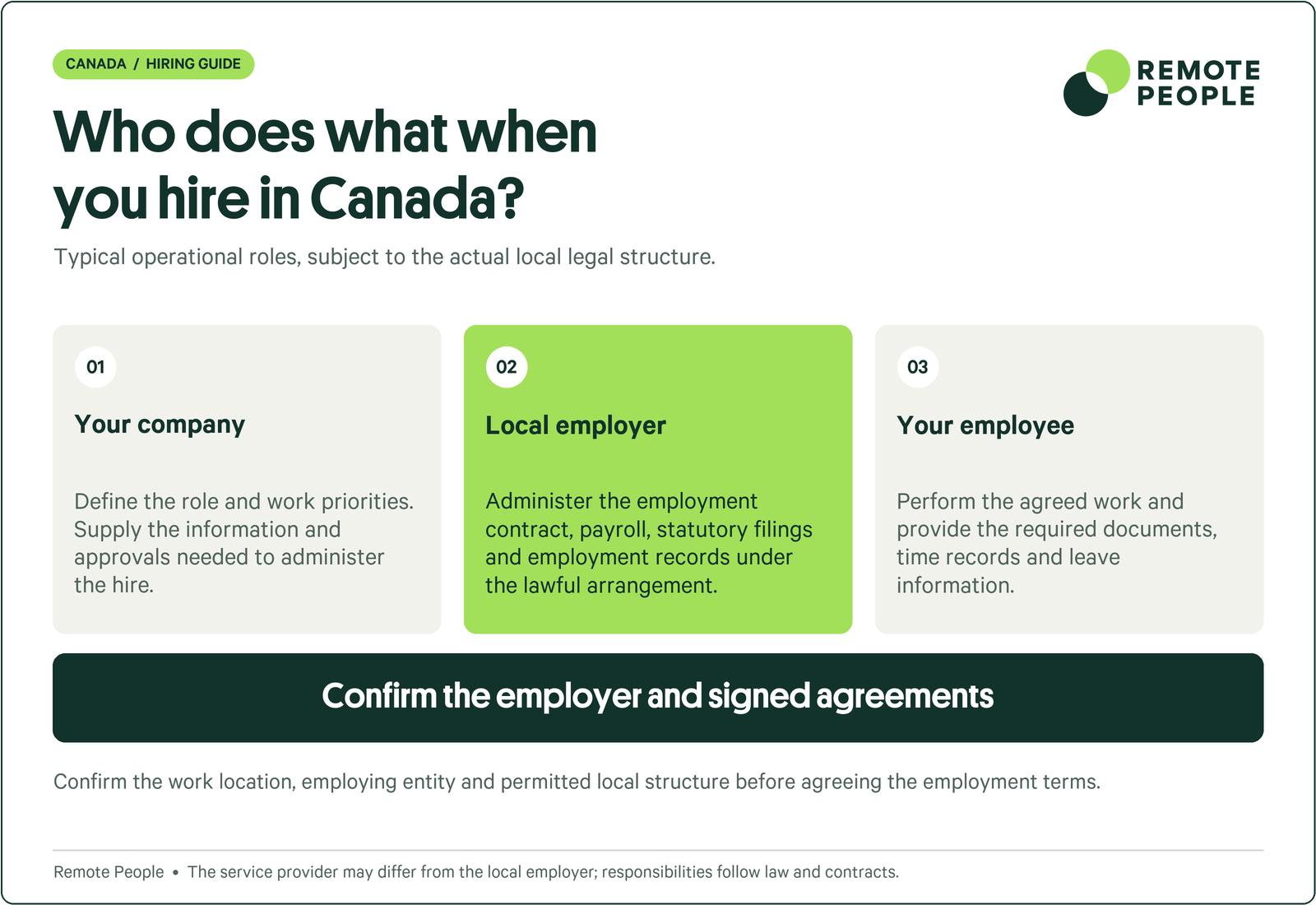
If you’d like to learn more about how Employer of Record (EOR) services work, read our What Is an Employer of Record (EOR)? guide for a complete overview of the model, its benefits, and when to use it.
If you’re comparing providers, our Best Employer of Record (EOR) Providers guide reviews the leading platforms to help you choose the right solution for your business.
Who Uses an EOR in Canada?
An EOR in Canada is used by several types of organizations:
Startups and scale-ups use an EOR when entering the Canadian market without the resources to establish a local entity. US and multinational companies use an EOR to hire employees in Canada without setting up a subsidiary. Organizations piloting operations in Canada before committing to a full legal presence also benefit from EOR services, as do remote-first companies that hire Canadian employees while maintaining headquarters elsewhere.

Typical Onboarding Timeline
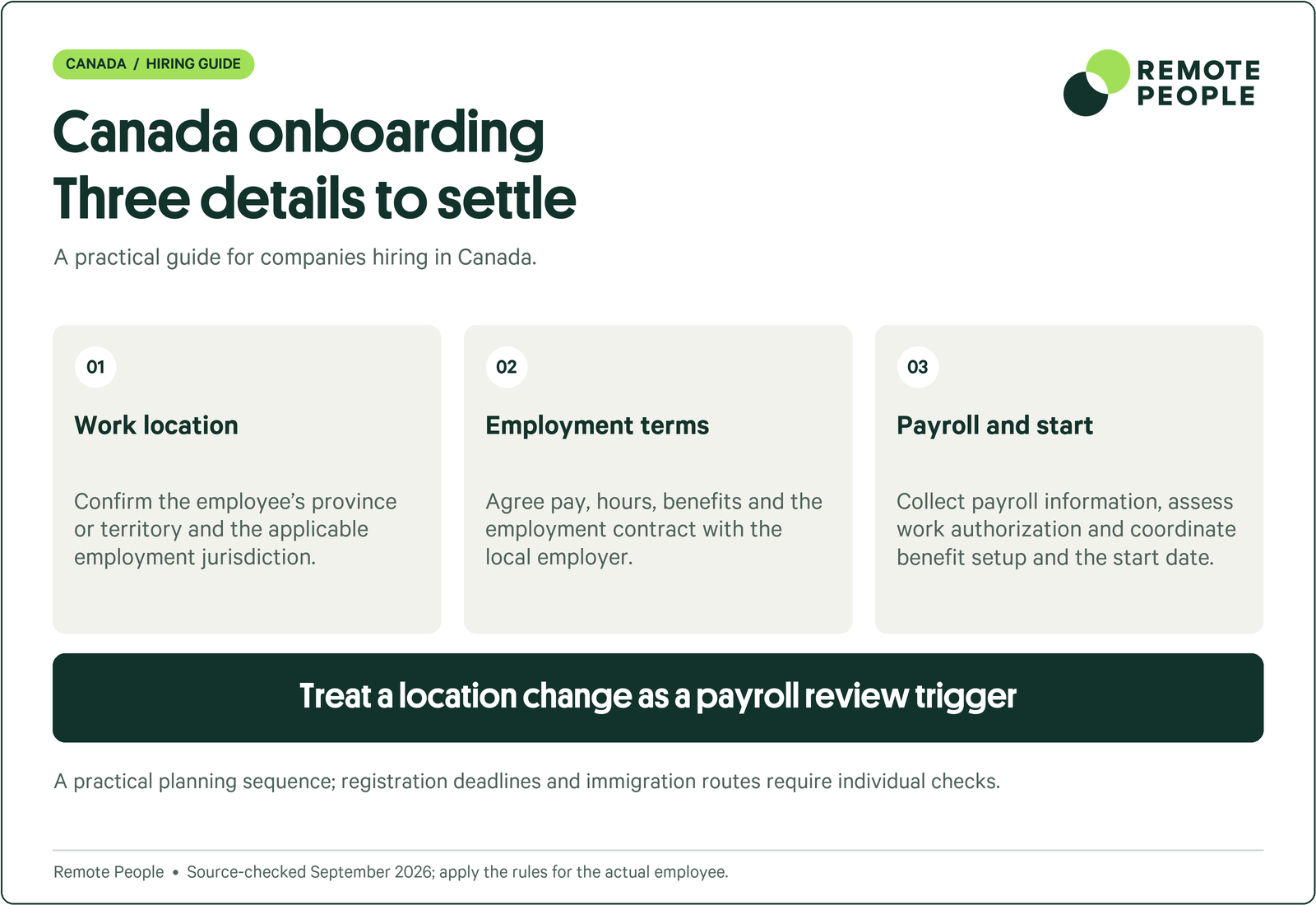
The onboarding process with a Canadian EOR typically takes 1–2 weeks from contract signature to first payroll run. Initial steps include collecting employee personal information (SIN, address, direct deposit details), completing pre-employment verifications, and setting up payroll parameters.
The EOR registers the employee for CPP, EI, and provincial tax deductions, and handles work permit applications if required. Once all documentation is submitted and approved, payroll processing begins on your specified schedule.
Employment Laws and Regulations in Canada
Employment Contracts
Canadian employment law recognizes both written and verbal employment contracts, but best practice always involves a written agreement. Employment contracts should clearly define the job title, compensation, job responsibilities, reporting structure, and conditions of employment.
In Canada, employment contracts cannot waive statutory rights granted under provincial employment standards legislation or the Canada Labour Code. For example, a contract cannot reduce vacation entitlements below the statutory minimum or eliminate notice period requirements upon termination.
The contract should specify whether the role is permanent, temporary, or fixed-term, as this affects notice period and severance obligations. If you hire through an EOR, the EOR typically provides a compliant employment agreement template tailored to your employee’s province of work.
Working Hours and Overtime
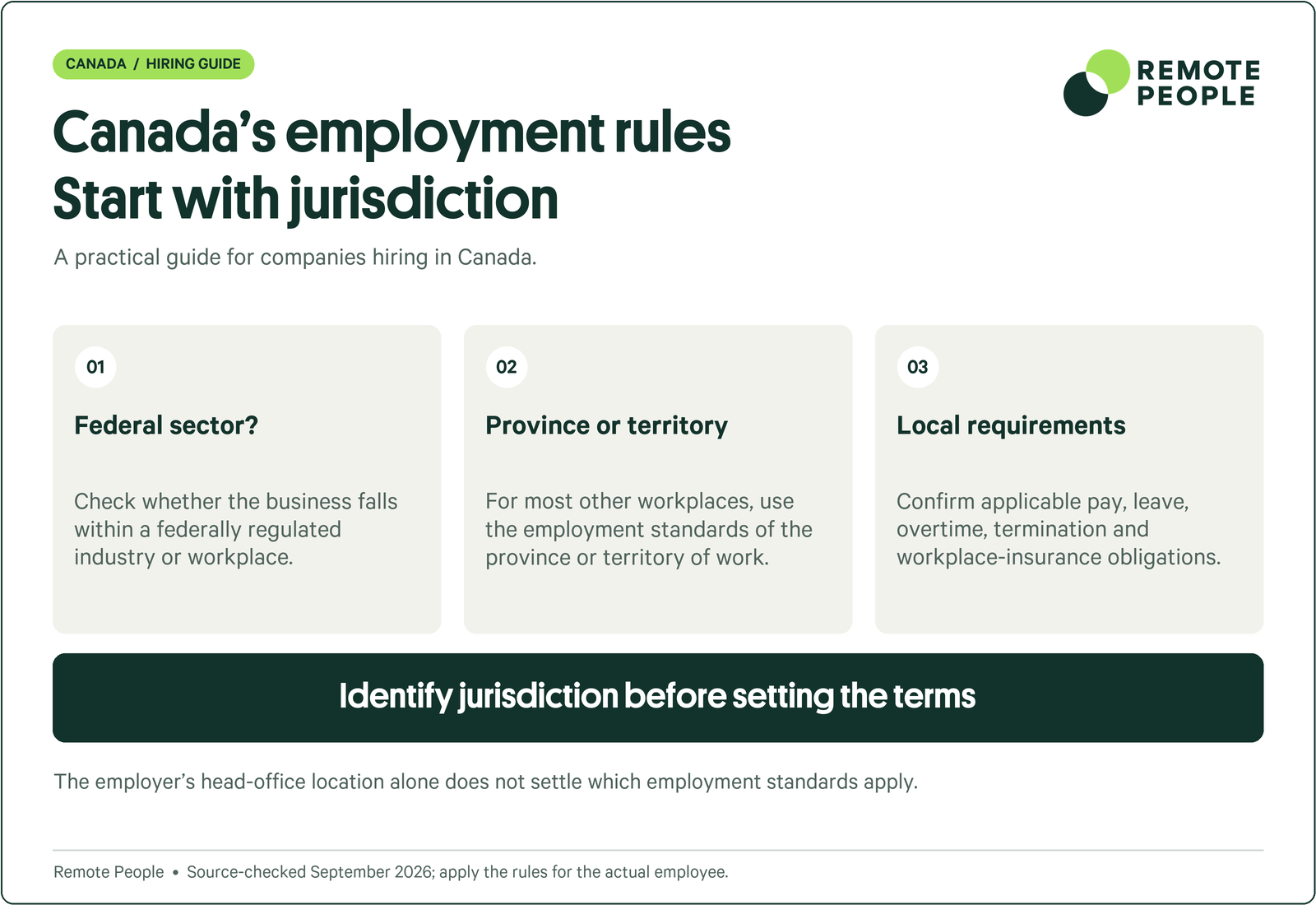
Canada’s employment standards vary between federally regulated industries and provincial jurisdiction. In Ontario, the standard workweek is 44 hours, and overtime compensation at 1.5 times the regular rate applies to hours worked beyond this threshold.
Federal employees are covered under the Canada Labour Code, which establishes a 40-hour standard workweek with overtime at 1.5 times after 8 hours in a day or 40 hours in a week. Employees can be asked to work up to 48 hours per week in Ontario without overtime if no agreement is in place, but written agreements can extend this to 60 hours in exceptional circumstances.
Canada overtime and premium pay rates · Per Employment Standards Act | |||
Jurisdiction | Standard Hours | Overtime Rate | Maximum Weekly Hours |
|---|---|---|---|
Ontario | 44 hrs/week | 1.5x after 44 hrs | 48 hrs (up to 60 with agreement) |
Federal (Canada Labour Code) | 40 hrs/week or 8 hrs/day | 1.5x after 8 hrs/day or 40 hrs/week | No statutory max (reasonable hours) |
Quebec | 40 hrs/week | 1.5x after 40 hrs | No statutory max |
British Columbia | 40 hrs/week | 1.5x after 8 hrs/day or 40 hrs/week | No statutory max |
Source: Ontario Employment Standards Act and Canada Labour Code | |||
Minimum Wage
Minimum wage in Canada is set by province and by the federal government for federally regulated industries. For a complete breakdown, see our guide to minimum wage in Canada. Ontario’s minimum wage stands at CAD 17.60 per hour in 2026, with a scheduled increase to CAD 17.95 per hour on October 1, 2026 (Ontario ESA).
The federal minimum wage is CAD 17.75 per hour (Canada Labour Code). Employers must pay the higher of the applicable minimum wage or the employee’s agreed wage. Some provinces and the federal jurisdiction offer lower minimum wages for certain groups (such as homeworkers or liquor servers in specific roles), but these exceptions are narrowly defined.
Probation Period
Canadian employment law does not establish an automatic probation period. While many employers use probationary arrangements to evaluate new hires, there is no statutory “probation period” that eliminates notice requirements or limits protections. If you have established a formal probation period in the employment contract, statutory notice requirements under provincial law still apply once the employee has been employed for 3 months or more.
Some employers use a 90-day informal evaluation window, but this does not override the legal requirement to provide notice of termination after 3 months of employment. For a more detailed explanation, see our guide to probation periods in Canada.
Leave Entitlements
Annual Leave
In Ontario, employees are entitled to a minimum of 2 weeks of vacation leave per year during the first 5 years of employment, and 3 weeks per year thereafter. Vacation pay is calculated at 4% of gross earnings for years 1–5, and 6% for years 5 and beyond. Federally regulated employees receive 2 weeks of annual leave in the first year of employment, 3 weeks after 5 years, and 4 weeks after 10 years of service, with similar vacation pay calculations.
Sick Leave
Ontario’s Employment Standards Act provides 3 unpaid sick leave days per year, which must be paid by the employer if the employee qualifies under the Health Care Accessibility Act. Federally regulated employees are entitled to 10 paid sick leave days per year as of 2022, a major improvement over provincial minimums (Federal labour standards).
Maternity Leave
Ontario provides 17 weeks of unpaid pregnancy leave, during which an employee may receive maternity benefits through Employment Insurance (EI), which covers approximately 55% of insurable earnings up to a maximum of CAD 695 per week. The employee must have accumulated sufficient insurable hours to qualify for EI maternity benefits.
Paternity Leave
While Ontario does not have a dedicated paternity leave, employees may use parental leave following maternity leave or following the birth of a child without using maternity leave. Parental leave in Ontario provides 61 weeks of unpaid leave if taken after maternity leave, or 63 weeks if taken without using maternity leave. Federally regulated employees receive similar entitlements under the Canada Labour Code.
Other Statutory Leave
Both Ontario and federal jurisdictions provide unpaid leave for bereavement, jury duty, and voting. Some employees may also be entitled to unpaid leave for family violence purposes, or for the adoption of a child. Employers must accommodate these absences without penalty or loss of seniority.
The following table summarizes the main statutory leave entitlements across Canadian jurisdictions. Leave pay and requirements vary by province and by whether the employee is federally or provincially regulated. An EOR tracks leave usage against the correct provincial or federal standard, preventing over-allocation and missed entitlements.
Canada statutory leave entitlements · Per Employment Standards Act and Canada Labour Code | ||
Leave Type | Ontario | Federal |
|---|---|---|
Annual vacation | 2 weeks (years 1–5), 3 weeks (5+ years) | 2 weeks (year 1), 3 weeks (5+ years), 4 weeks (10+ years) |
Sick leave | 3 unpaid days/year | 10 paid days/year |
Maternity leave | 17 weeks unpaid (EI covers 55% earnings) | 17 weeks maternity + 61 weeks parental |
Parental leave (after maternity) | 61 weeks unpaid | Available concurrently with maternity |
Parental leave (no maternity) | 63 weeks unpaid | 63 weeks unpaid |
Bereavement leave | 3–5 days unpaid | 3 days unpaid |
Statutory Employee Benefits
Canada’s statutory employee benefits are primarily delivered through mandatory social insurance programs rather than employer-provided benefits. All employees contribute to the Canada Pension Plan (CPP) or Quebec Pension Plan (QPP), Employment Insurance (EI), and in Ontario, the Workplace Safety and Insurance Board (WSIB).
CPP, EI, and provincial workers’ compensation programs provide retirement income, unemployment insurance, disability coverage, and workplace injury protection. Some provinces, such as Ontario, also operate employer health tax programs.
Beyond statutory social insurance, Canada does not mandate employer-provided health insurance, dental, or life insurance. However, many employers offer these benefits as part of competitive compensation packages. An EOR can administer voluntary benefits on your behalf if you choose to offer them to your Canadian employees.
Recent Regulatory Updates (2026)
For 2026, several regulatory updates affect Canadian payroll. The Canada Pension Plan contribution rate remains at 5.95% for both employer and employee on earnings between the basic exemption (CAD 3,500) and the Year’s Maximum Pensionable Earnings (YMPE) of CAD 74,600.
An additional CPP2 rate of 4.00% applies to earnings between CAD 74,600 and CAD 85,000 (YAMPE) for both employer and employee (CRA CPP rates). The EI premium rate for 2026 is 1.63% for employees and 2.282% for employers on insurable earnings up to CAD 68,900 (ESDC EI announcement).
Ontario’s Employer Health Tax (EHT) remains graduated between 0.98% and 1.95% of payroll depending on annual payroll levels, with a CAD 1 million exemption for eligible employers. Quebec employers must remit QPP contributions at 6.30% each (employer and employee) and QPIP (parental insurance) contributions of 0.692% for employers and 0.494% for employees (Quebec pension plan).
Work Permits and Visas in Canada
Work Permit Requirements
For a detailed overview of all visa categories and eligibility requirements, see our guide to work visas in Canada.
Who Needs a Work Permit
Foreign nationals must obtain a valid work permit before beginning employment in Canada, with limited exceptions. Canadian citizens and permanent residents do not require work permits. Temporary Foreign Worker Program (TFWP) participants, International Mobility Program (IMP) applicants, and individuals entering under specific trade agreements all have different requirements.
Eligibility and Required Documents
Work permit eligibility depends on the program category. For the Temporary Foreign Worker Program, the employer must demonstrate a genuine recruitment effort to hire Canadian workers and receive a positive Labour Market Impact Assessment (LMIA) from Employment and Social Development Canada (ESDC).
The LMIA process requires documentation of recruitment activities, job description, salary details, and proof that no suitable Canadian candidate is available. Processing takes 2–3 months, and the LMIA application fee is approximately CAD 1,000 per position.
The International Mobility Program (IMP) offers an LMIA-exempt pathway for intra-company transfers (such as relocating an existing employee from your US office to a new Canadian office), or for positions covered under trade agreements like USMCA, CETA, or CPTPP. IMP applications require a work permit application fee of approximately CAD 155 and a compliance fee of roughly CAD 100. Processing time is typically 2–4 weeks.
Processing Time and Validity
Work permit processing times vary by application stream. TFWP applications take 2–3 months from LMIA submission through work permit issuance (IRCC work permits).
IMP applications process faster, typically within 2–4 weeks. Work permits are generally valid for the same duration as the employment contract, typically 1–3 years, and can be renewed if the employment relationship continues and conditions are met.
Renewal Process
Work permit renewals follow the same application pathway as initial permits. If the employee is renewing under an LMIA-exempt stream, a new LMIA may not be required if conditions have not substantially changed. If renewing under the TFWP, a new LMIA is typically required, though some employers qualify for streamlined processing under the Global Talent Stream (GTS), which targets fast-track LMIA approvals within 10 business days for specific occupations.
Common Visa Types for Foreign Workers
Canada offers several work permit programs for foreign nationals, each with different eligibility criteria, processing times, and requirements. The table below compares the main pathways, including the Temporary Foreign Worker Program, International Mobility Program, Global Talent Stream, and trade agreement categories (IRCC).
Canada work visa types for foreign workers · 2026 | ||||
Program | LMIA Required | Processing Time | Typical Validity | Best For |
|---|---|---|---|---|
Temporary Foreign Worker Program (TFWP) | Yes | 2–3 months (LMIA) | 1–3 years | Skilled and low-skill workers when no Canadian recruitment available |
International Mobility Program (IMP) | No | 2–4 weeks | 1–3 years | Intra-company transfers, treaty professionals |
Global Talent Stream (GTS) | Yes, but expedited | 10 business days (LMIA) | 1–3 years | High-wage occupations, specialized skills |
USMCA/CETA/CPTPP Professional | No | 2–4 weeks | 1–3 years | Professionals from treaty countries |
Spouse/Common-law open work permit | No | 2–4 weeks | Tied to sponsoring spouse’s permit | Spouses of skilled worker permit holders |
Source: IRCC work permits and Global Talent Stream | ||||
How an EOR Handles Work Permits
Most Canadian EOR providers offer work permit application support as part of their service. The EOR typically coordinates LMIA documentation, collects required evidence from you (job description, recruitment records, salary justification), and submits the LMIA and work permit applications to ESDC and IRCC on behalf of the employer.
Some EORs cover filing fees as part of their service, while others pass them through. Processing timelines remain dependent on ESDC and IRCC capacity, but a qualified EOR can ensure all documentation is complete and accurate, reducing the risk of application rejections or delays.
Payroll, Taxes, and Social Security in Canada
Employer Contributions
Canadian employers must remit social insurance contributions on behalf of their employees. These contributions are not deducted from the employee’s paycheck; they are an employer obligation in addition to the employee’s gross salary. For a deeper breakdown, see our guide to payroll and taxes in Canada.
Canada employer social security contributions · 2026 rates | ||
Contribution Type | Rate | Maximum Insurable Earnings / Notes |
|---|---|---|
CPP (Canada Pension Plan) | 5.95% | Up to CAD 74,600 YMPE (less CAD 3,500 basic exemption) |
CPP2 (Additional CPP) | 4.00% | Earnings CAD 74,600–85,000 (YAMPE) |
EI (Employment Insurance) | 2.282% | Up to CAD 68,900 maximum insurable earnings |
Ontario EHT (Employer Health Tax) | 0.98%–1.95% | Graduated by payroll; CAD 1M exemption for eligible employers |
WSIB (Workplace Safety Insurance Board) | ~1.23% average | Industry-dependent; calculated on insurable earnings |
QPP (Quebec Pension Plan) | 6.30% | Same YMPE as CPP; Quebec employees only |
QPIP (Quebec Parental Insurance) | 0.692% | Quebec employees only |
Source: CRA CPP rates and CRA EI rates | ||
Employee Contributions
Employees in Canada pay mandatory contributions to CPP (or QPP in Quebec) and EI. These amounts are withheld from the employee’s paycheck and remitted by the employer to the Canada Revenue Agency (CRA) or to Revenu Quebec in the case of QPP and QPIP.
Canada employee payroll deductions · 2026 monthly withholdings | ||
Deduction Type | Rate | Maximum Insurable Earnings / Notes |
|---|---|---|
CPP (Canada Pension Plan) | 5.95% | Up to CAD 74,600 YMPE (less CAD 3,500 basic exemption) |
CPP2 (Additional CPP) | 4.00% | Earnings CAD 74,600–85,000 (YAMPE) |
EI (Employment Insurance) | 1.63% | Up to CAD 68,900 maximum insurable earnings |
Federal income tax | 14%–33% | Progressive, based on federal brackets (see Tax Brackets table) |
Provincial income tax | 5.05%–13.16% | Progressive, varies by province (Ontario 5.05%–13.16%) |
QPP (Quebec Pension Plan) | 6.30% | Quebec employees only, same YMPE as CPP |
Quebec EI | 1.30% | Quebec employees only |
QPIP (Quebec Parental Insurance) | 0.494% | Quebec employees only |
Source: CRA tax rates and PwC Canada tax guide | ||
Income Tax
Canada levies progressive income tax at both federal and provincial levels. Federal and provincial tax brackets are indexed annually for inflation. The federal tax system applies the same brackets to all residents, while provincial rates vary by province.
The following table shows 2026 federal and Ontario provincial tax brackets.
Canada income tax brackets · 2026 | ||
Taxable Income (CAD) | Federal Rate | Ontario Provincial Rate |
|---|---|---|
CAD 0–58,523 | 14% | 5.05% |
CAD 58,523–117,045 | 20.5% | 9.15% |
CAD 117,045–181,440 | 26% | 11.16% |
CAD 181,440–258,482 | 29% | 12.16% |
CAD 258,482+ | 33% | 13.16% |
Source: CRA current tax rates and PwC tax summaries | ||
All employees receive a basic personal amount (BPA) that is not subject to tax, reducing overall tax liability. The 2026 federal basic personal amount is CAD 16,452 (CRA tax rates). Each province also provides its own basic personal amount.
Payroll Cycle
Canadian employers typically process payroll bi-weekly (every two weeks) or semi-monthly (twice per month on fixed dates such as the 15th and last day of the month). Some employers use monthly or weekly cycles, but bi-weekly is the most common standard.
Regardless of pay frequency, employers must remit payroll deductions (CPP, EI, income tax) to the CRA within specified timeframes. Most employers remit monthly or on a prescribed schedule based on the size of their payroll.
An EOR manages all payroll cycles and remittance schedules automatically, ensuring compliance with CRA deadlines.
13th Month Salary and Bonus Pay
Canada does not require employers to pay a 13th month salary or annual bonus. Unlike some countries, there is no statutory entitlement to a year-end bonus or 13th-month payment.
If an employer chooses to offer bonuses, this is entirely discretionary and must comply with any promises made in employment contracts or employee handbooks. If a bonus is promised but not paid, it may be treated as a breach of contract claim, depending on the language of the contract.
Hire in Canada
A stable regulatory environment, skilled multilingual workforce, and proximity to the US market make Canada one of the top destinations for global hiring.
We handle employment contracts, payroll, CPP/EI contributions, tax withholding, and full Canadian compliance across all provinces.
No local entity needed. Your team can start in days.
Cost of Hiring Through an EOR in Canada
EOR Service Fees
The employer of record cost in Canada typically ranges from $400 to $600 per employee per month, depending on the provider, service level, and size of your team. Larger teams often negotiate volume discounts.
Some EOR providers charge a one-time setup fee (typically CAD 500–1,000), while others include onboarding at no extra charge. Fees may vary based on whether you require work permit support, benefits administration, or additional compliance services.
When comparing EOR providers, clarify what is included in the base fee and what services incur additional charges.
Total Employment Cost Breakdown
The following table shows a realistic cost example for hiring a single employee in Canada with a gross monthly salary of CAD 6,500 (approximately USD 4,700 at 1 CAD = 0.72 USD). The example includes statutory employer contributions, EOR service fees, and total employment cost.

Canada employer cost example · USD 4,700 gross · 2026 | ||
Cost Component | Amount (USD) | % of Gross |
|---|---|---|
Gross salary (monthly) | $4,700.00 | – |
CPP employer (5.95%) | $279.65 | 5.95% |
EI employer (2.282%) | $107.25 | 2.28% |
Ontario EHT (1.95%) | $91.65 | 1.95% |
WSIB (~1.23%) | $57.81 | 1.23% |
Subtotal: Statutory contributions | $536.36 | 11.41% |
EOR service fee | $499.00 | 10.62% |
Total monthly employer cost | $5,735.36 | 22.0% |
Source: CRA contribution rates and WSIB 2026 rates | ||
The example above demonstrates that total employer cost is typically 22–24% above the employee’s gross salary when accounting for statutory contributions and EOR fees. This calculation assumes Ontario location and an EOR fee of approximately USD 499 per month. Quebec-based employees would have different contribution rates due to QPP and QPIP, while other provinces have different EHT or provincial insurance requirements.
To estimate your total cost of hiring in Canada, take the desired employee gross salary, add statutory contributions (11–12% of gross depending on province), and add the EOR service fee (typically 10–15% of gross salary).
For a CAD 60,000 annual salary (CAD 5,000/month), you should budget approximately CAD 72,000–78,000 in total annual employer cost including the EOR fee.
Ready to hire in Canada? Contact RemotePeople with an EOR solution tailored to your team size and industry.
Benefits of Using an EOR in Canada
Hiring through an EOR in Canada gives companies a practical way to enter the Canadian market without setting up a local subsidiary. The main advantages include:
- No local entity required: You avoid the cost and complexity of incorporating a subsidiary or branch office in Canada. The EOR is the legal employer, eliminating the need for directors, corporate registration, and annual filings.
- Rapid market entry: You can hire your first Canadian employee in 1–2 weeks rather than waiting 3–6 months for entity setup. This accelerates business expansion and allows faster testing of new markets.
- Complete compliance: The EOR handles all employment law compliance, from drafting contracts to managing leave entitlements, termination notices, and severance pay. You reduce legal risk and avoid costly employment disputes.
- Simplified payroll: The EOR processes payroll, calculates deductions, files tax returns, and remits contributions to the CRA, WSIB, and provincial authorities. You receive one consolidated invoice monthly.
- Managed work permits: The EOR guides you through LMIA applications, work permit processing, and renewals, coordinating with ESDC and IRCC on your behalf.
- Flexible scaling: You can hire and terminate employees without legal impediments. If you decide to exit the Canadian market, you can do so without dissolving a corporation or managing complex liquidation.
- Cost-effective for small teams: An EOR is typically most cost-effective for teams of 1–15 employees. Above that size, establishing a local entity may become more economical.
Discover how an EOR can simplify your Canadian hiring. get in touch today.
Termination and Offboarding in Canada
Notice Periods
Canadian employment law requires employers to provide notice of termination to employees, except in cases of just cause. The notice period is calculated based on length of service and varies by province and by whether the employee is federally or provincially regulated.
Canada statutory notice periods by tenure · Per Ontario Employment Standards Act | |||
Length of Service | Ontario ESA | Federal (Canada Labour Code) | Special Rules |
|---|---|---|---|
Less than 3 months | No notice required | No notice required | Probationary period; immediate termination permitted |
3 months to 2 years | 1 week written notice | 2 weeks written notice | Notice or pay in lieu of notice may be given |
2 years or more | 2 weeks written notice | 2 weeks written notice | Accumulates: 1 week per year of service up to 8 weeks maximum |
3+ years (under ESA) | 1 week per year of service (max 8 weeks) | 2 weeks + 2 weeks per year (max 12 weeks federal) | Notice period stacks on severance pay if applicable |
In Ontario, employees hired after January 1, 2022, are entitled to notice of 1 week per year of service, calculated on a prorated basis (for example, 6 months of service = 0.5 weeks notice). Notice requirement increases to a maximum of 8 weeks for employees with 8 or more years of service. If the employer fails to provide written notice, the employer must pay the employee “pay in lieu of notice” equal to the wages the employee would have earned during the notice period.
Severance Pay
Severance pay in Canada is distinct from notice pay and is not mandatory in all circumstances. In Ontario, severance pay is triggered only when an employee has completed 5 or more years of service AND the employer’s payroll is CAD 2.5 million or greater in a calendar year.
Severance is calculated as 1 week of pay per year of service, with a maximum of 26 weeks. Severance is paid in addition to notice pay (not instead of it).
Canada severance pay schedule by years of service · Per Ontario Employment Standards Act | |||
Years of Service | Ontario Statutory Severance | Eligibility Requirements | Stacking with Notice |
|---|---|---|---|
Less than 5 years | No severance entitlement | Statutory severance not triggered | Only notice pay applies |
5–7 years | 1 week per year = 5–7 weeks maximum | 5+ years service AND employer payroll CAD 2.5M+ | Severance + notice (both paid) |
8–15 years | 1 week per year = 8–15 weeks | 5+ years service AND employer payroll CAD 2.5M+ | Severance + notice (both paid) |
16+ years | 1 week per year, max 26 weeks | 5+ years service AND employer payroll CAD 2.5M+ | Severance + notice (both paid) |
Calculation Method
Severance pay is calculated as regular wages for the period, including overtime if applicable. “Regular wages” means the employee’s normal hourly rate or salary, excluding bonuses, discretionary payments, or benefits. For example, an employee earning CAD 60,000 per year (CAD 2,884.62 bi-weekly on a 26-pay cycle) with 8 years of service at a company with CAD 3 million payroll would receive 8 weeks of severance pay = CAD 23,077.
Caps and Exceptions
Ontario’s severance pay is capped at 26 weeks. Employers with fewer than 5 employees, or employers with payroll below CAD 2.5 million, do not have a statutory obligation to pay severance under the Employment Standards Act.
However, courts may award “common-law notice” (damages in lieu of notice) based on age, tenure, position, and re-employability, which can range from 1 to 24 months of pay. This is distinct from statutory notice and severance and is determined by courts in litigation.
Grounds for Termination
Canadian employment law recognizes two primary grounds for termination: termination for cause and termination without cause. Termination for cause means the employee has committed serious misconduct (theft, violence, willful disobedience, gross negligence) that breaches the employment contract. If termination is for cause, the employer may be entitled to terminate immediately without notice or pay in lieu.
Termination without cause is a termination not attributable to employee misconduct. In this case, the employer must provide statutory notice or pay in lieu of notice, and severance pay if applicable.
Employers cannot require employees to waive statutory notice or severance entitlements, and any severance offer below the statutory minimum may be unenforceable. An EOR manages all termination documentation and calculations to ensure compliance and reduce the risk of wrongful dismissal claims.
Public Holidays in Canada
Canada observes 10 federal statutory holidays that apply to federally regulated employees. Employees in other provinces follow their provincial holiday schedules, though most provinces observe similar holidays.
In Ontario, there are additional statutory holidays such as Family Day in February. The following table lists federal holidays in 2026 and indicates which provinces follow the same calendar.
Canadian statutory holidays are established under the Canada Labour Code for federally regulated employees and under provincial employment standards legislation for provincially regulated employees. Most statutory holidays require employers to pay regular wages or provide premium pay if the employee works on the holiday. When a statutory holiday falls on a day an employee normally works, the employee is entitled to either the day off with pay or premium pay (typically 1.5x to 2x regular wages) if required to work.
Canada public holidays · 2026 calendar year | ||
Holiday | Date (2026) | Observed Across Jurisdictions |
|---|---|---|
New Year’s Day | Thursday, January 1 | Federal, all provinces |
Family Day (Ontario) | Monday, February 16 | Ontario (other provinces have similar holidays) |
Good Friday | Friday, April 3 | Federal, most provinces (not Quebec) |
Victoria Day | Monday, May 18 | Federal, all provinces except Quebec |
Canada Day | Wednesday, July 1 | Federal, all provinces |
Labour Day | Monday, September 7 | Federal, all provinces |
National Day for Truth and Reconciliation | Wednesday, September 30 | Federal, most provinces |
Thanksgiving | Monday, October 12 | Federal, all provinces except BC and Quebec |
Remembrance Day | Wednesday, November 11 | Federal, observed (not universal paid holiday) |
Christmas Day | Friday, December 25 | Federal, all provinces |
Boxing Day | Saturday, December 26 | Federal, most provinces |
An EOR automatically tracks all applicable holidays based on the employee’s province and work schedule, ensuring correct holiday pay calculations and compliance with applicable legislation.
EOR vs. Other Hiring Models in Canada
EOR vs. Setting Up a Local Entity
Deciding between an EOR and establishing a local Canadian entity depends on your business timeline, team size, and long-term commitment to the Canadian market. The following comparison outlines key differences in setup time, cost, compliance responsibility, and best-fit scenarios.
Canada EOR vs local entity comparison · Setup time, cost, risk and best-fit | ||
Comparison | EOR | Local Entity (Subsidiary/Branch) |
|---|---|---|
Setup time | 1–2 weeks | 3–6 months |
Upfront cost | CAD 0 (EOR covers incorporation) | CAD 10,000–20,000 (legal, accounting, registration) |
Ongoing cost | CAD 300–600 per employee per month | CAD 15,000–30,000 per year (tax, legal, accounting) |
Local partner required | No (EOR is the local entity) | Yes (directors, accountant, legal counsel) |
Social insurance registration | Handled by EOR | You manage (or outsource to accountant) |
Payroll and tax filing | Handled by EOR | You manage (or outsource to accountant) |
Best for team size | 1–15 employees | 15+ employees or long-term operations |
Scale down or exit | Easy, no entity to unwind | Costly (legal dissolution, tax clearance) |
Government contracts | Not eligible (federal/provincial procurement restrictions) | Eligible if local entity is established |
A Canadian employer of record is the stronger choice for companies that need compliant, full-time employees in Canada without setting up a local subsidiary. The EOR handles every statutory obligation from CPP remittances to provincial employment standards, removing the legal exposure that comes with direct entity ownership.
Establishing a Canadian subsidiary only makes financial sense once you have a substantial local headcount, typically 15 or more employees, and a long-term commitment to the market. Below that threshold, the administrative overhead of maintaining a federal or provincial corporation, filing corporate taxes, and managing an in-house payroll function generally exceeds the EOR service fee.
EOR vs. Hiring Independent Contractors
Many companies consider hiring independent contractors to avoid the complexity of employment relationships. However, contractor misclassification carries serious legal and financial risk in Canada. The following table outlines the legal, tax, and operational differences between hiring employees through an EOR and engaging independent contractors.
Canada EOR vs independent contractors · Compliance, cost, and risk | ||
Comparison | EOR (Employee) | Independent Contractor |
|---|---|---|
Legal relationship | Employee of EOR (subordinate relationship) | Self-employed, independent business person |
Compliance risk | Low, EOR ensures compliance | High, misclassification risk if relationship resembles employment |
Payroll and tax | EOR withholds CPP, EI, income tax; files T4 | Contractor invoices you; contractor files own taxes (T1 General) |
Benefits and leave | Statutory benefits, paid vacation, sick leave, statutory holidays | No entitlements (contractor bears own risk) |
IP protection | Stronger, employment contract assigns IP by default | Weaker, requires explicit IP assignment clause in contract |
Termination | Subject to notice periods and severance laws | Contract can be ended per agreement terms (fewer restrictions) |
Best for | Long-term, core team roles, compliance priority | Short-term projects, specialized tasks, lower compliance requirements |
Cost structure | Salary + employer contributions + EOR fee (total ~22%) | Contractor fee (typically higher gross, potentially lower total cost) |
The key risk with contractor misclassification is that Canada Revenue Agency and provincial labor boards may reclassify a “contractor” as an employee if the working relationship demonstrates control, integration, or economic dependence (the “control test” under common law). If reclassification occurs, the employer becomes liable for back-tax withholdings, CPP/EI contributions, penalties, and interest, potentially years of liabilities.
For more information on hiring contractors in Canada, see our guide to contractors in Canada.
EOR vs. PEO
PEOs (Professional Employer Organizations) are often confused with EORs, but they operate under a different legal model in Canada. The following table compares the legal structure, liability, and best-fit use cases for EORs and PEOs.
Canada EOR vs PEO comparison · Legal employer, liability, and setup | ||
Comparison | EOR | PEO |
|---|---|---|
Legal employer | EOR is the sole legal employer | You remain the legal employer (PEO is co-employer) |
Local entity required | No, the EOR is the local entity | Yes, you must have your own Canadian entity |
Best for | Companies without a local entity or entering new markets | Companies with established local operations seeking HR outsourcing |
Compliance liability | EOR assumes compliance responsibility and legal liability | Shared liability between you and the PEO |
Setup time | 1–2 weeks (no entity setup needed) | Depends on your entity setup (weeks to months) |
Control over HR policies | EOR manages within local law framework | More direct control; PEO advises and supports |
Typical use case | Market entry, remote teams, testing new markets | Established operations, HR outsourcing, payroll simplification |
A PEO requires your company to already have a registered entity in Canada, because the PEO operates as a co-employer rather than the sole legal employer. For foreign companies without a Canadian subsidiary, this makes the PEO model impractical as a market-entry solution.
An EOR eliminates the entity requirement entirely. RemotePeople employs the worker through its own Canadian entity, bears the statutory employer obligations, and invoices you a single monthly fee. Companies that want full employment compliance from day one, without registering a corporation in Canada, should choose the EOR route.
How to Get Started with an EOR in Canada
Hiring your first Canadian employee through employer of record services in Canada is straightforward. Follow these steps to launch:
- First, evaluate your hiring needs. Determine how many employees you plan to hire, in which provinces they will work, and whether you need work permit support. This assessment helps you identify the right EOR provider and service level.
- Second, select an EOR provider and review their service agreement. Ensure their fees, service model, and compliance support align with your needs. Verify they offer support in the provinces where you plan to hire. Compare EOR pricing across providers to find the best fit for your team size.
- Third, prepare employee documentation. Collect personal information from your hire (full name, Social Insurance Number, address, birth date, direct deposit details). The EOR will use this to register the employee with CRA, CPP, EI, and provincial authorities.
- Fourth, finalize employment contracts and compensation details. The EOR typically provides a compliant employment agreement template. Confirm job title, salary, start date, work schedule, and any benefits you plan to offer.
- Fifth, complete payroll setup and first payment. Once all documentation is submitted and verified, the EOR processes your first payroll run. Most EORs can process first payroll within 1–2 weeks of receiving complete documentation.
Ready to expand your team in Canada? Contact RemotePeople today to discuss your hiring goals and explore EOR solutions tailored to your business.
Where companies hiring in Canada expand next
Teams hiring in Canada frequently expand across North America and into aligned English-speaking markets. Common expansion paths include a team in the Philippines (an established BPO and support-services hub) and operations in the United States (USMCA labor provisions and trade framework). Teams scaling further usually add the United Kingdom for shared Commonwealth business frameworks, with hiring in Ireland extending coverage through aligned English-language hiring dynamics.
Frequently Asked Questions
EOR services in Canada typically cost between $400 and $600 per employee per month for the service fee, plus the employee’s gross salary and statutory employer contributions of roughly 11.41% (CPP, EI, Ontario EHT, and WSIB) (CRA Payroll Deductions). On a $4,700 USD gross monthly salary in Ontario with a $499 EOR fee, the total fully-loaded employer cost is approximately $5,735 USD per month, or about 22% above gross. Costs vary slightly by province because of different payroll tax rates (Quebec is higher due to QPP and QPIP) and workers’ compensation classifications.
You can, but only if the relationship genuinely meets the Canada Revenue Agency's four-factor test for independent contracting (control, ownership of tools, chance of profit and risk of loss, and integration into your business). Long-term full-time roles working exclusively for one client almost always fail this test and create backdated CPP, EI, and income tax liabilities when reclassified. For short-term project work where a contractor arrangement is genuinely appropriate, RemotePeople offers a compliant Canada contractor management solution that handles onboarding, service agreements, and cross-border payments.
RemotePeople can onboard a Canadian employee in five to ten business days from signed service agreement to first payroll run. This includes contract drafting, employee review and signature, payroll onboarding (TD1 forms, direct deposit), and provincial registrations. For candidates requiring a work permit, add two weeks (Global Talent Stream) to two or three months (standard LMIA) (IRCC Work Permits).
No. The entire point of an EOR is that RemotePeople acts as the legal employer on your behalf, so you do not need to incorporate a Canadian subsidiary, register as an extra-provincial corporation, or open a CRA payroll account. This saves $5,000 to $15,000 in setup costs and three to six months of lead time (Canada Business Registration), and avoids ongoing corporate tax and compliance obligations for the parent company.
Under Canadian employment law, intellectual property created by an employee in the course of employment automatically belongs to the employer. RemotePeople's employment contracts include an express assignment clause that transfers all IP, inventions, and work product created by the employee to the client company (you), not the EOR. You retain full ownership of all work product from day one, identical to the position you would be in with an employee of your own subsidiary.
No. Canada has no statutory 13th-month salary or annual bonus (Ontario ESA) requirement. Employees are entitled to their regular salary, vacation pay at 4% or 6% of earnings, statutory holiday pay, and whatever performance or signing bonuses are set out in the employment contract. Unlike many Latin American and European countries, Canada has no aguinaldo, Christmas bonus, or thirteenth-month obligation.
RemotePeople handles all termination compliance including notice calculations under the applicable provincial Employment Standards Act, severance pay where required (Ontario adds severance on top of notice for employees with 5+ years of service (Ontario ESA Severance) at employers with an Ontario payroll of approximately CAD 2.5 million or more), record of employment (ROE) filing with Service Canada, and final pay. The client company instructs the termination decision and reason; the EOR executes it in compliance with local law. A properly drafted employment contract with an enforceable termination clause limits exposure to the statutory minimum rather than the much higher common-law reasonable notice standard.
CPP (Canada Pension Plan) applies in every province except Quebec. QPP (Quebec Pension Plan) applies to employees working in Quebec. The two plans are closely coordinated but have different rates: CPP is 5.95% each for employer and employee in 2026, while QPP is 6.40% each (CRA Contribution Rates). Both use the same YMPE ceiling of approximately $53,700 USD for 2026 and both added a second-tier contribution (CPP2 and QPP2) at 4% on earnings between YMPE and YAMPE (~$61,150 USD). Periods of contribution transfer seamlessly between the two plans when an employee moves provinces.
Canada uses a progressive federal income tax system with five brackets for 2026: 15% on the first CAD 58,523, 20.5% on CAD 58,523–117,045, 26% on CAD 117,045–181,440, 29% on CAD 181,440–258,482, and 33% on income above CAD 258,482 (CRA Tax Rates). Provincial tax rates apply on top of federal rates, varying by province. In Ontario, provincial rates range from 5.05% to 13.16%. An EOR in Canada handles all income tax withholding and remittance to the CRA on behalf of your employees, ensuring compliance with both federal and provincial tax obligations.
The federal minimum wage in Canada is CAD 17.75 per hour as of 2026, applying to federally regulated industries (Federal Minimum Wage). Provincial minimum wages vary: Ontario is CAD 17.20, British Columbia is CAD 17.85, Alberta is CAD 15.00, and Quebec is CAD 16.10. For a complete breakdown of minimum wage by province, see our guide to minimum wage in Canada. An employer of record ensures your Canadian employees are always paid at or above the applicable minimum wage for their province.
Canadian employers pay several mandatory payroll contributions: CPP at 5.95% of pensionable earnings up to CAD 74,600, EI at 2.282% of insurable earnings up to CAD 68,900, plus provincial levies such as Ontario’s Employer Health Tax (0.98–1.95%) and WSIB workers’ compensation (averaging 1.23%) (CRA Payroll Deductions). Total statutory employer contributions in Ontario are approximately 11.41% of gross salary. Quebec employers face slightly higher rates due to QPP and QPIP. For a detailed breakdown, see our Canada payroll tax guide.
Severance pay in Canada varies by province and is separate from termination notice. In Ontario, employees with five or more years of continuous service are entitled to statutory severance of one week per year of service, capped at 26 weeks, if the employer’s Ontario payroll is CAD 2.5 million or more (Ontario ESA Severance). Federal employees under the Canada Labour Code receive two days’ pay per year of service after 12 months. Courts may also award common-law severance above statutory minimums, typically one month per year of service. An EOR calculates and administers all severance obligations on your behalf.
Employer of Record in
Employer of Record in
Employer of Record in
Employer of Record in
Employer of Record in
Employer of Record in
Employer of Record in
Employer of Record in