
 Recruit
Employer of Record (EOR) in Australia
-
 Drew Donnelly
- Published
- October 25, 2026
RemotePeople’s employer of record in Australia lets you hire employees in Australia with mandatory superannuation coverage. Our team helps with your HR admin and tasks.
Hire in Australia — book a free 30-minute demo
Tell us what you need. You'll get a tailored, transparent proposal within 24 hours, plus a free call to walk through it.
Tell us about your company
So we can match you with a specialist who knows your market — and unlock volume pricing tiers.
* All fields are required.
Where and when are you hiring?
Tell us the geography and timing and we'll quote each country line by line, with onboarding timelines.
* All fields are required.
Help us beat your current setup
We'll benchmark your current deal and send a line-by-line proposal in 24 hours — showing exactly where we cut cost, time, or risk. After you submit, you can book a call to walk through it together.
* All fields are required.
Thanks! Your proposal is on its way.
Expect a tailored, line-by-line proposal in your inbox within 24 hours. In the meantime…
Want to walk through it together?
Book a free 30-minute call with one of our specialists. We'll explain every line, answer your questions, and tailor the proposal further if you need.
No obligation. Pick a time that works for you.








- Hire in Australia — book a free 30-minute demo
- Tell us about your company
- Where and when are you hiring?
- Help us beat your current setup
- Thanks! Your proposal is on its way.
- How an Employer of Record Works in Australia
- Employment Laws and Regulations in Australia
- Work Permits and Visas in Australia
- Payroll, Taxes, and Social Security in Australia
- Cost of Hiring Through an EOR in Australia
- Benefits of Using an EOR in Australia
- Termination and Offboarding in Australia
- EOR vs. Other Hiring Models in Australia
- Public Holidays in Australia
- How to Get Started with an EOR in Australia
- Where companies hiring in Australia expand next
- Frequently Asked Questions
- Related EOR Destinations
Start hiring in Australia
Let RemotePeople handle payroll, compliance, and HR admin worldwide so you can focus on building your team.

Australia offers a stable economy and skilled workforce that attracts global companies seeking talent. Hiring employees there, however, means navigating superannuation, fair work laws, work visas, and state-based payroll taxes. Each comes with its own complexity. An employer of record (EOR) steps in as your legal employer, managing all compliance so you can focus on building your team.
Our employer of record guide explains how EORs work in Australia, what statutory employment rules apply, typical hiring costs, and how to compare an employer of record in Australia against other hiring models like setting up a local entity or hiring contractors.
How an Employer of Record Works in Australia
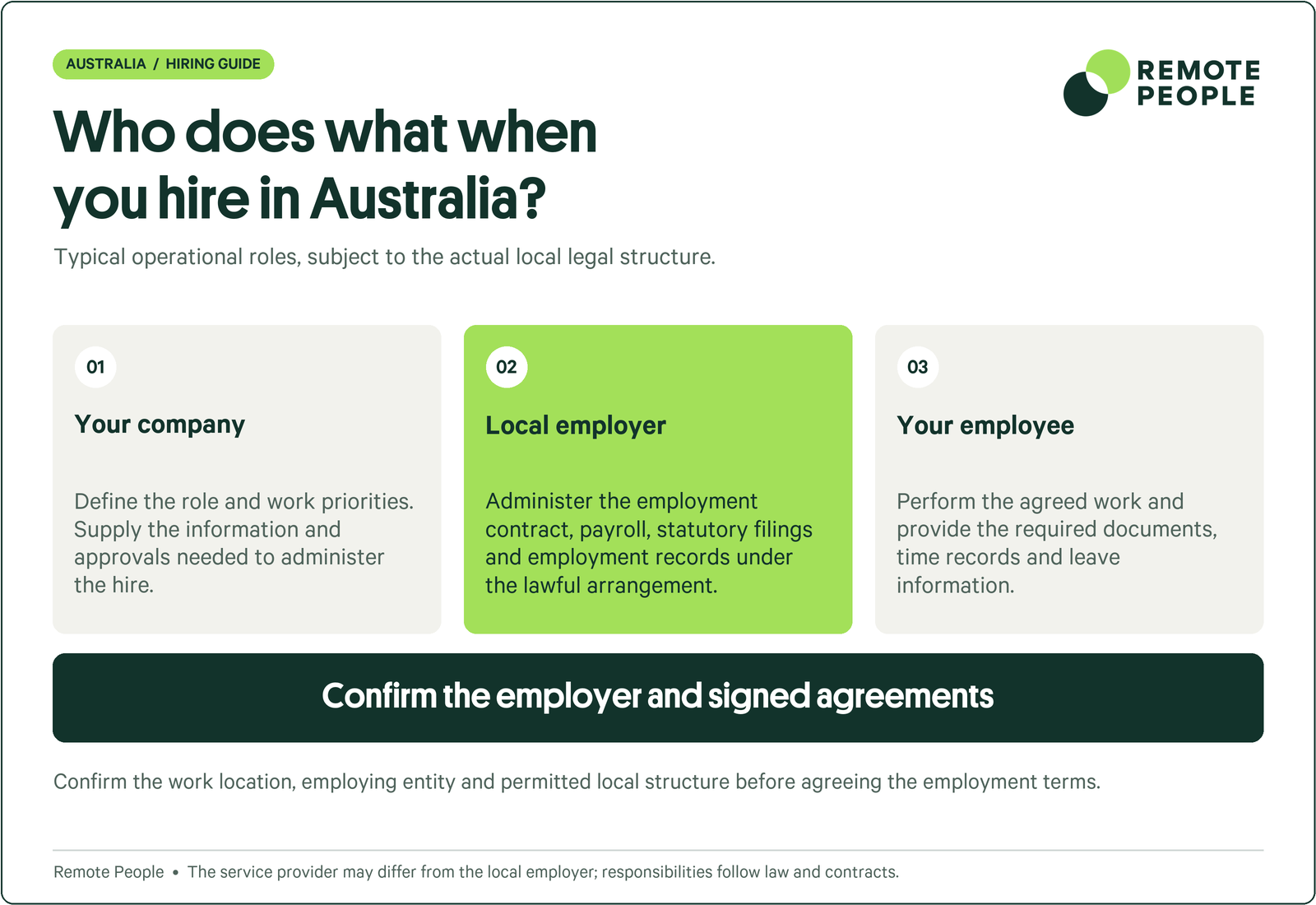
If you’d like to learn more about how Employer of Record (EOR) services work, read our What Is an Employer of Record (EOR)? guide for a complete overview of the model, its benefits, and when to use it.
If you’re comparing providers, our Best Employer of Record (EOR) Providers guide reviews the leading platforms to help you choose the right solution for your business.
Who Uses an EOR in Australia?
An EOR works best for companies with 1 to 15 employees. Startups testing new markets, established firms expanding into Australia, and organizations lacking local HR infrastructure typically find this model cost-effective. If you plan to hire 15+ employees long-term or need to bid for government contracts that require a registered local entity, a traditional company setup may become more efficient.
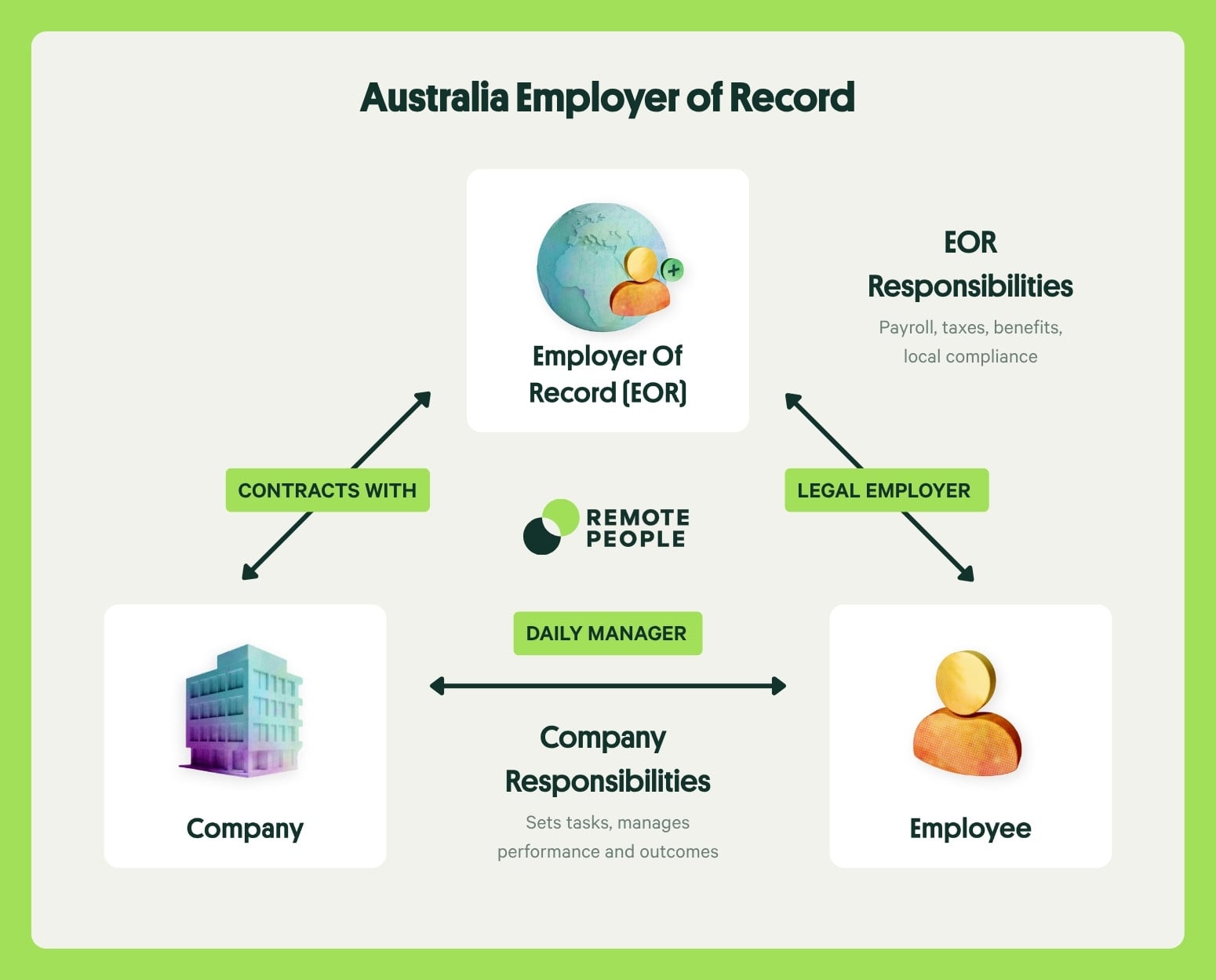
Typical Onboarding Timeline
- First, you submit candidate information and employment details (role, salary, location) to the EOR.
- Second, the EOR prepares the employment contract, compliant with Fair Work Act standards and relevant Modern Award.
- Third, the candidate signs and you confirm start date.
- Fourth, the EOR registers the employee with the ATO for tax purposes and initiates superannuation setup.
- Fifth, payroll begins the following pay period, and the employee receives their first payment including all statutory deductions and employer contributions.
Total time from submission to first payment: 5-10 business days in most cases. This contrasts sharply with forming a local company (3-6 months) or handling visa sponsorship independently (8-12 weeks for skilled visas).
Hire in Australia
A 12% flat superannuation rate, no 13th month salary requirement, and access to a highly skilled, English-speaking talent pool make Australia one of the most straightforward hiring markets in the Asia-Pacific region.
We handle employment contracts, payroll, PAYG withholding, superannuation, and full Australian compliance.
No local entity needed. Your team can start in days.
Employment Laws and Regulations in Australia
Employment Contracts
An employer of record (EOR) in Australia lets you hire full-time employees without setting up a local entity. EOR services in Australia typically cost $300 to $600 USD per employee per month, covering payroll, superannuation, tax withholding, and full compliance with the Fair Work Act 2009 and National Employment Standards (NES). Every employment contract must reference the applicable Modern Award and meet all statutory minimums — the EOR handles this for you, so you can onboard employees in as few as 5 business days.
Your EOR drafts contracts that comply with the NES and the relevant Modern Award for each employee’s industry. The Fair Work Commission publishes and regularly updates these awards across occupations like retail, hospitality, construction, and professional services. Your EOR applies the correct award to each contract.
Working Hours and Overtime
The standard full-time week in Australia is 38 hours under the Fair Work Act. There’s no legislated maximum, but hours must be “reasonable” based on the role, the employee’s circumstances, and industry norms. Overtime isn’t automatically paid; compensation is negotiated or defined in Modern Awards, usually at 150% of base rate for extra hours and 200% for public holidays or specific weekends. An employer of record ensures overtime calculations comply with award requirements.
Australia’s working time rules come from the Fair Work Act 2009 and industry-specific Modern Awards administered by the Fair Work Commission. The statutory standard is 38 hours per week, and any additional hours must be “reasonable” under section 62 of the Fair Work Act. Overtime, penalty rates and public holiday loadings are set in the applicable Modern Award or enterprise agreement; most awards follow the standard pattern shown below.
Overtime and Premium Pay Rates in Australia
Australia’s labour code caps the standard working week and sets the premium rates employers must pay for hours worked beyond it (Fair Work Ombudsman – Hours of work). The table below lays out the statutory overtime multipliers for each shift type so you know what to budget for weekday, weekend, night, and public-holiday work.
Australia overtime and premium pay rates · Per Fair Work Act 2009 | |||
Hour Type | Rate Multiplier | Weekly or Daily Cap | Notes |
|---|---|---|---|
Standard hours | 100% (base rate) | 38 hours / week | Full-time standard under Fair Work Act s.62; “reasonable additional hours” permitted beyond this. |
Overtime, first 2 hours (weekday) | 150% | No fixed cap | Typical Modern Award rate for weekday overtime beyond ordinary hours. |
Overtime, beyond 2 hours (weekday) | 200% | No fixed cap | Applies to each additional overtime hour worked on a weekday. |
Saturday work | 150% | No fixed cap | Typical Saturday penalty rate; some awards apply 125% for the first 2 hours. |
Sunday work | 200% | No fixed cap | Typical Sunday penalty; exact rate is set by the relevant Modern Award. |
Public holiday work | 250% | No fixed cap | Standard public holiday loading under most Modern Awards. |
Minimum Wage
Australia’s minimum wage is set annually by the Fair Work Commission. As of approximately A$24.95 per hour (effective 1 July 2025). This is the statutory floor for all full-time, part-time, and casual employees.
Many Modern Awards set higher rates depending on the role. Skilled trades and professional positions, for example, often exceed the minimum. When using an employer of record in Australia, payroll automatically reflects the correct wage and applicable award rate for each employee.
Probation Period
Australia’s Fair Work Act doesn’t mandate probation periods, though including a 3 to 6 month term is standard practice.
Dismissal during probation is easier if the fit isn’t right, but you still must follow procedural fairness and provide warnings. Once probation ends (or if you didn’t specify one), dismissal requires genuine reason and proper notice, except within the first 6 months (12 months for small businesses under 15 employees).
In practice, probation is a trial period, but employment protections still apply. Your EOR documents the terms clearly and advises on dismissal procedures if things don’t work out. For details, see our probation rules guide.
Leave Entitlements
Annual Leave
Permanent employees accrue four weeks (20 days) of annual leave per year at roughly 1.54 hours per week. Continuous shift workers get an extra week: five weeks total.
Unused leave can roll over, though you can cap carryover at a reasonable level and require employees to take leave with reasonable notice. Leave is paid at the ordinary rate of pay. An employer of record tracks accruals and ensures leave balances comply with Fair Work regulations.
Sick Leave
Employees get 10 days per year of paid personal or carer’s leave from a single pool. This covers their own illness or injury, or caring for family or household members.
Unlike annual leave, sick leave is a fixed yearly entitlement with no accrual. Employees can use it for medical appointments and must notify you as soon as possible.
Maternity Leave
Primary caregiver leave extends 12 months after 12 months of employment. From from 1 July 2026, paid parental leave expands to 26 weeks at the national minimum wage (A$948.10 per week). This government-funded payment supplements employer-provided superannuation and other benefits during the leave period.
Paternity Leave
The second parent gets at least four weeks of unpaid parental leave as part of a shared 12-month entitlement (from 1 July 2026). The government pays up to four weeks at the minimum wage if both parents draw from the same employment. You can offer more generous terms in enterprise agreements.
Other Statutory Leave
Long service leave builds at roughly 8.67 weeks per 10 years under state legislation (eligibility varies by state). Compassionate leave (2 days per occasion for serious illness or death) is paid for permanent employees.
Community service leave covers jury duty (paid for permanent employees) and emergency activities like firefighting. Employees also have protections for family and domestic violence leave, now standard in workplace policies and awards. Your employer of record stays updated on these evolving entitlements.
Australia statutory leave entitlements · Per Fair Work Act 2009 | ||
Leave Type | Duration | Eligibility & Notes |
|---|---|---|
Annual Leave | 4 weeks (20 days) per year | Accrues progressively; 5 weeks for continuous shift workers |
Personal/Carer’s Leave | 10 days per year | Covers sick leave and carer’s leave from same pool |
Compassionate Leave | 2 days per occasion | Paid for permanent employees; unpaid for casuals |
Parental Leave (Unpaid) | Up to 12 months | After 12 months of service; can request additional 12 months |
Paid Parental Leave (Government) | 26 weeks (from 1 July 2026) | Government-funded at national minimum wage (A$948.10/week) |
Long Service Leave | ~8.67 weeks after 10 years | State-based legislation; varies by jurisdiction |
Community Service Leave | As needed | For jury duty (paid for permanent employees) and emergency activities |
Source: Fair Work Ombudsman and Fair Work Act 2009 | ||
Statutory Employee Benefits
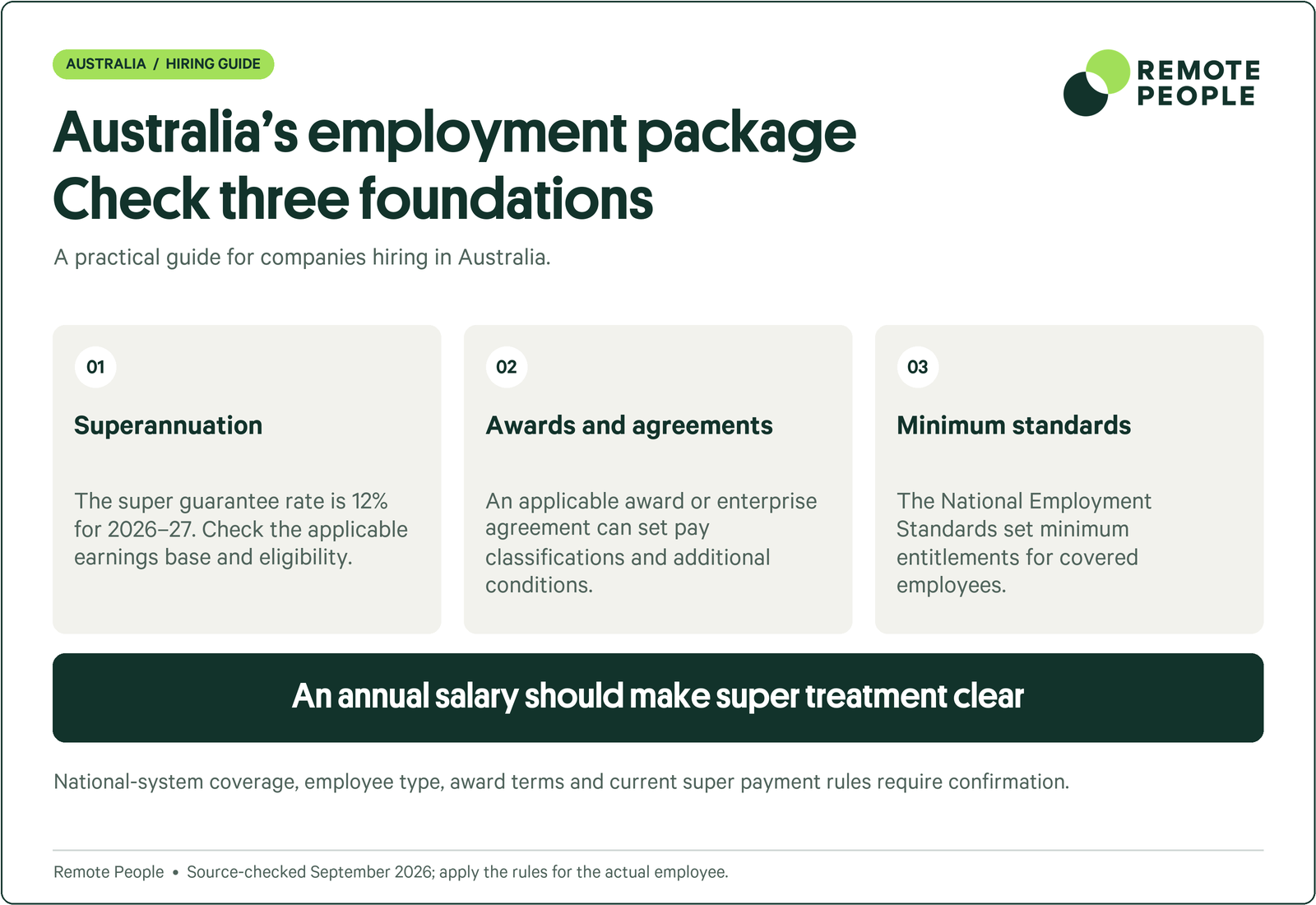
Superannuation is Australia’s mandatory retirement system and the most significant employee benefit in Australia. You must contribute 12% of ordinary time earnings (capped at A$62,500 per quarter) to each employee’s registered fund.
It’s separate from salary and non-negotiable. Employees can’t opt out; the contribution comes from your budget, not their pay. Your EOR handles registration and contributions automatically.
Workers’ compensation is a state-based scheme covering work-related injuries and illnesses. You must carry a policy; premiums typically range from 1% to 3% of payroll depending on industry risk and state.
It protects employees injured at work and gives you limited liability protection. Your EOR handles registration and premium payments.
The Medicare Levy (2% of taxable income) funds Australia’s public healthcare system and is withheld from employee pay. A surcharge (up to 1.5%) may apply to high-income earners without private health insurance, incentivizing private coverage.
Recent Regulatory Updates (2026)
Starting 1 July 2026, employers must pay superannuation on each payday or within 5 business days. No more quarterly or end-of-year payments. Your EOR handles this automatically, ensuring compliance.
Paid parental leave expanded from 18 to 26 weeks effective 1 July 2026 at the national minimum wage. It applies to all employees and is government-funded, though you can supplement it or offer additional benefits.
Wage theft became a criminal offense in January 2025 (not just a civil matter). This tightens Australia’s enforcement of wage and payment obligations and emphasizes why accurate payroll is critical.
Non-compete reforms arrive in 2027, restricting post-employment non-competes to narrow circumstances (senior management, legal professional privilege). This limits your ability to prevent employees from working for competitors afterward.
Work Permits and Visas in Australia
Work Permit Requirements
Who Needs a Work Permit
Non-Australian and non-New Zealand citizens need a work visa to legally work in Australia. If you hire someone from elsewhere, verify they have a valid visa before they start. Working without one exposes you both to penalties.
Eligibility and Required Documents
Common work visas include the Skilled Independent Visa (subclass 482, Temporary Skill Shortage), Employer Nomination Scheme (subclass 186, permanent sponsorship), and Regional Sponsored Migration Scheme (subclass 494). Eligibility hinges on occupation, qualifications, work experience, and English proficiency.
Applicants need a formal job offer, relevant qualifications or work experience, plus health and character clearance. Typical documents include a passport, professional skills assessment, employment offer letter, and proof of qualifications.
Processing Time and Validity
Processing times vary: Temporary Skill Shortage visas (482) usually take 8-12 weeks, while permanent visas like the Employer Nomination Scheme (186) can take 6-12 months or longer depending on complexity. Temporary visas last 2-4 years; permanent ones grant indefinite work rights.
Renewal Process
Temporary visas must be renewed before expiry, similar to the initial application and often requiring a fresh skills assessment and sponsorship letter. Permanent visa holders don’t need renewal, but must maintain residency if they spend extended time overseas.
Foreign workers can be employed in Australia through employer-sponsored pathways administered by the Department of Home Affairs. The main sponsorship channels are the Skills in Demand visa (subclass 482), the Employer Nomination Scheme (subclass 186) and the Skilled Employer Sponsored Regional visa (subclass 494), with the Short Stay Specialist visa (subclass 400) covering brief specialised assignments. Each pathway has distinct duration, eligibility and permanent-residency implications.
Work Visa Types for Foreign Workers in Australia
Foreign nationals typically need a work permit or employment-authorised visa to take up a job in Australia (Home Affairs – Skills in Demand visa (subclass 482)). The table below summarises the most common visa categories employers use when relocating international hires, along with typical eligibility requirements and permit durations.
Australia work visa types for foreign workers · 2026 | ||||
Visa Type | Duration | Best For | Leads to PR? | Processing |
|---|---|---|---|---|
Skills in Demand subclass 482 (Core Skills) | Up to 4 years | Mid-skill roles on the Core Skills Occupation List, above the Core Skills Income Threshold (A$76,515/year from 1 July 2025). | Yes, via subclass 186 after 2 years. | 4 to 7 months |
Skills in Demand subclass 482 (Specialist Skills) | Up to 4 years | Senior specialists earning above the Specialist Skills Income Threshold (A$141,210/year from 1 July 2025). | Yes, via subclass 186. | 11 to 53 days |
Employer Nomination Scheme subclass 186 | Permanent | Direct permanent-residence sponsorship for nominated workers. | Yes (grants PR on arrival). | 6 to 12 months |
Skilled Employer Sponsored Regional subclass 494 | Up to 5 years | Skilled workers employed in designated regional areas. | Yes, via subclass 191 after 3 years. | 6 to 12 months |
Temporary Work (Short Stay Specialist) subclass 400 | Up to 3 months (6 months in exceptional cases) | Short, highly specialised, non-ongoing work. | No | 2 to 6 weeks |
How an EOR Handles Work Permits
Your EOR doesn’t directly sponsor visas. That’s the legal employer’s responsibility. Since the EOR is your legal employer in Australia, it can serve as the sponsoring employer on visa applications. As the legal employer of record in Australia, the EOR can act as the sponsoring employer on visa applications.
Your EOR provides the job offer letter, employment contract, and supporting documents the Department of Home Affairs needs. This streamlines sponsorship through the EOR rather than forcing you to set up a local company. See our work visa requirements guide for details.
Payroll, Taxes, and Social Security in Australia
Australia’s employer of record handles all payroll and tax obligations on your behalf. Understanding the cost structure is essential for budgeting, so here is how employer contributions, employee deductions, and income tax work in practice. When you partner with an employer of record in Australia, these calculations are handled automatically, freeing you to focus on building your team.
Employer Contributions
Employers hiring in Australia owe mandatory contributions on top of gross salary, funding social security, health, pensions, and other statutory schemes (ATO Super Guarantee). The table below lists the employer-side contribution rates so you can calculate the true all-in cost of each hire.
Australia employer social security contributions · 2026 rates | ||
Contribution | Rate | Notes |
|---|---|---|
Superannuation Guarantee | 12% | Mandatory on ordinary time earnings up to $62,500/quarter cap (MCB) |
Payroll Tax (NSW reference) | 5.45% | State-based; applies above $1,200,000 annual threshold (NSW) |
Workers’ Compensation Insurance | ~1.5% | Varies by state and industry risk category |
Total (estimated, NSW) | ~18.95% | Varies significantly by state; excludes Fringe Benefits Tax |
Source: ATO Super Guarantee and PwC Australia Tax Summaries | ||
Superannuation Guarantee (12%) is your largest employer contribution. The ATO sets a maximum contribution base of A$62,500 per quarter for 2025-2026. Once earnings exceed this cap, no further super is required that quarter.
Payroll tax is state-based. New South Wales charges 5.45% on annual payroll above A$1.2 million. Workers’ comp varies by state and industry, from 0.5% for low-risk office work to 5%+ for high-risk construction or mining.
Employee Contributions
Alongside income tax, employees in Australia pay statutory payroll deductions that fund social security, health cover, and other state schemes (ATO Tax Rates). The table below summarises the employee-side contribution rates payroll must withhold from gross pay each month.
Australia employee payroll deductions · 2026 monthly withholdings | ||
Deduction | Rate | Notes |
|---|---|---|
Income Tax (PAYG) | 0%–45% | Progressive rates per ATO brackets; withheld by employer via PAYG |
Medicare Levy | 2% | Applied on taxable income; reduced for low-income earners below A$27,222 |
Medicare Levy Surcharge | 0%–1.5% | Only if no private health insurance and income exceeds A$101,000 (single) |
Total (effective, varies) | 2%–47% | Depends on income level and private health insurance status |
Source: ATO Tax Rates and PwC Australia Individual Taxes | ||
Employees pay progressive income tax withheld at source (PAYG, or Pay As You Go), calculated by the ATO based on their income and tax file number. Most also pay the Medicare Levy (2%), Australia’s universal health contribution.
High-income earners without private health insurance pay an extra Medicare Levy Surcharge (0–1.5% depending on income), incentivizing private coverage. Employer superannuation contributions aren’t deducted from employee pay; they’re funded separately by you.
Income Tax Brackets
Personal income tax in Australia is levied on a progressive basis, with the rate rising as taxable income crosses statutory thresholds (ATO). The table below sets out the current income-tax brackets that apply to resident employees so you can model net-of-tax compensation before making an offer.
Australia income tax brackets · 2025–2026 | |
Annual Taxable Income (AUD) | Tax Calculation |
|---|---|
A$0 – A$18,200 | Nil |
A$18,201 – A$45,000 | 16c for each A$1 over A$18,200 |
A$45,001 – A$135,000 | A$4,288 + 30c for each A$1 over A$45,000 |
A$135,001 – A$190,000 | A$31,288 + 37c for each A$1 over A$135,000 |
Over A$190,000 | A$51,638 + 45c for each A$1 over A$190,000 |
Source: ATO and PwC Australia | |
Australia’s income tax system is progressive, with rates ranging from 16% at the lowest bracket to 45% at the top. The tax-free threshold is A$18,200, meaning individuals earning below this amount pay no income tax. Note that Medicare Levy (2%) is applied on top of income tax and is effective on all taxable income; this means even low-income earners pay the levy once they exceed the tax-free threshold.
Payroll Cycle
Australia’s standard payroll cycle is monthly, though weekly and fortnightly cycles are also common in hospitality and retail. Payments are made via bank transfer (BPAY or direct deposit) to the employee’s nominated bank account.
The employer must comply with Single Touch Payroll (STP), a digital reporting system where payroll data is reported to the ATO automatically with each pay run. STP has been mandatory since July 2019 and streamlines tax compliance by providing real-time payroll data to tax authorities.
13th Month Salary and Bonus Pay
Australia does not have a statutory 13th month salary or mandatory annual bonus. Australian employment is based on 12 monthly payments, with no additional mandated payments beyond superannuation.
Bonuses, performance payments, and discretionary annual payments are entirely optional and must be documented in the employment contract or enterprise agreement. An EOR will process any bonuses as directed but does not automatically include a 13th month in your cost calculations.
Cost of Hiring Through an EOR in Australia
EOR Service Fees
EOR service fees in Australia typically range from $300 to $600 USD per employee per month. This fee covers payroll processing, tax withholding, superannuation administration, employment contract drafting, and Fair Work Act compliance.
Using an employer of record means you avoid setup costs and administrative overhead, paying only the service fee plus statutory contributions.
Some EOR providers charge a flat rate; others scale fees based on the complexity of the role or industry classification. The fee does not include statutory employer contributions (superannuation, payroll tax, workers’ compensation), which are additional costs on top of the service fee.
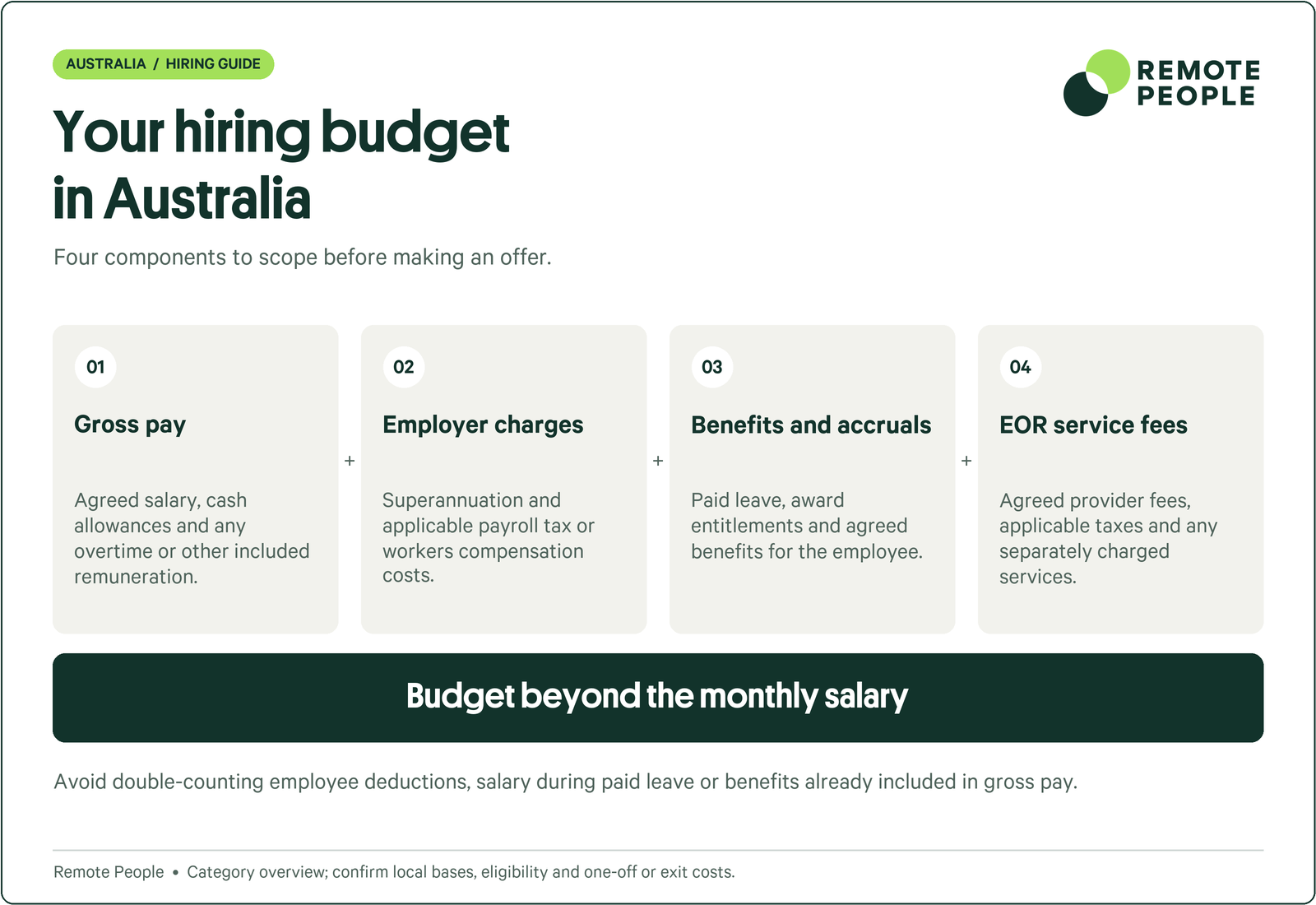
Total Employment Cost Breakdown
Monthly Cost Example
The all-in cost of employing someone in Australia goes well beyond gross salary. The table below walks through a realistic cost build-up for a typical hire, layering mandatory employer social contributions, statutory benefits, and payroll taxes on top of base pay so finance teams can budget accurately before an offer goes out.
Australia employer cost example · $3,200/month gross · 2026 | ||
Employer Cost | Amount (USD) | % of Gross |
|---|---|---|
Gross Monthly Salary | $3,200 | 100% |
Superannuation Guarantee (12%) | $384 | 12% |
Payroll Tax (est. 5.45%, NSW) | $174 | 5.45% |
Workers’ Compensation (est. 1.5%) | $48 | 1.5% |
EOR Service Fee | $400 | 12.5% |
Total Estimated Monthly Cost | $4,206 | 131.4% |
Source: ATO Super Guarantee and PwC Employment Taxes | ||
For a single employee earning $3,200 USD per month in New South Wales, the total cost is roughly $4,206 USD per month (131.4% of gross salary). The biggest recurring costs beyond salary are superannuation (12%), EOR service fee (12.5%), and state payroll tax in NSW (5.45% if payroll exceeds A$1.2 million).
Exchange rates fluctuate; the figure above uses the April 2026 exchange rate. Actual costs vary by state (payroll tax rates differ) and by role (different Modern Awards set higher minimums). For benchmarking, review the average salary in Australia guide.
Using an EOR eliminates the upfront cost of forming a local company (typically $1,920–$9,600 USD) and its ongoing maintenance. For teams of 1 to 10 employees, the EOR service fee is substantially cheaper than hiring a local payroll manager or outsourcing firm.
Ready to hire in Australia? Contact RemotePeople to discuss your hiring needs. We handle employment contracts, payroll, tax withholding, and full Australia compliance. No local entity needed.
Benefits of Using an EOR in Australia
The primary benefit of using an employer of record in Australia is speed — one of the reasons companies choose EOR solutions in Australia over entity setup. Hiring through an EOR takes 5 to 10 business days from job offer to first payment. In contrast, setting up a local company in Australia requires 3 to 6 months of registration with ASIC (Australian Securities and Investments Commission), ACN (Australian Company Number) issuance, ABN application, and payroll system setup. For companies seeking to quickly test the Australian market or grow a small team, an employer of record compresses hiring timelines dramatically.
Your EOR handles compliance. The Fair Work Act, modern awards, superannuation, and state payroll taxes are intricate. By transferring responsibility to the EOR, you reduce exposure to penalties and litigation.
If an employee is misclassified, underpaid, or denied statutory leave, the EOR bears initial liability. By using an established employer of record in Australia, you leverage their expertise and compliance infrastructure.
Cost efficiency improves for small teams. Instead of hiring a local HR manager ($60,000–$100,000 USD annually) or outsourcing payroll to a firm, an employer of record charges a per-employee fee, typically $300–$600 per month.
For 1 to 10 employees, an EOR is far cheaper than local alternatives. It also handles all administrative tasks (leave accrual, tax updates, payroll certification), freeing your team to focus on business strategy.
An EOR also manages currency and FX risk. If you operate in the US but hire in Australia, the EOR handles conversion and protects you from currency swings. Many EORs offer payment in your base currency and handle conversion internally.
Termination and Offboarding in Australia
Notice Periods
Notice periods in Australia are prescribed by the National Employment Standards, depending on the employee’s tenure. For employees with less than 1 year of service, the employer must provide one week notice. Employees with 1 to 3 years of service receive 2 weeks, and those with 3 to 5 years receive 3 weeks. Using an employer of record ensures termination notices meet legal requirements. Your employer of record also manages the full termination process, from redundancy calculations to final pay and statutory reconciliation.
Employees with over 5 years of service get four weeks’ notice. If they’re over 45 and have served at least 2 years, add another week for a maximum of five weeks.
Employees must also provide notice when resigning; the notice period mirrors the employer’s obligation. Employees can be terminated immediately for serious misconduct (willful disobedience, theft, violence, repeated performance failures after warnings).
Minimum notice of termination in Australia is set by section 117 of the Fair Work Act 2009 as part of the National Employment Standards. The statutory schedule rises with continuous service, and employees aged 45 or over with at least two years of service receive an extra week on top of the base entitlement. Employers may pay in lieu of notice; casual staff, fixed-term employees whose contracts expire naturally and workers dismissed for serious misconduct are outside the minimum notice regime.
Statutory Notice Periods in Australia by Position Level
Under Australia labour law, employers must give written notice before terminating an indefinite employment contract, and the minimum period scales by either tenure or position level (Fair Work Ombudsman – Dismissal and notice). The table below sets out the statutory notice periods employers owe in each termination scenario, including how probation affects the minimum notice required.
Australia statutory notice periods by position level · Per Fair Work Act 2009 | |||
Period of Continuous Service | Notice Period | Age 45+ (2+ yrs) | Notes |
|---|---|---|---|
Less than 1 year | 1 week | Not applicable (under 2 years service) | Statutory floor for employees in their first year, including those still on probation. |
1 to 3 years | 2 weeks | 3 weeks (adds 1 week if 45+ with at least 2 years service) | Applies to continuous service of at least 1 year and less than 3 years. |
3 to 5 years | 3 weeks | 4 weeks (adds 1 week if 45+ with at least 2 years service) | Applies to continuous service of at least 3 years and less than 5 years. |
5 years or more | 4 weeks | 5 weeks (adds 1 week if 45+ with at least 2 years service) | Add 1 extra week if the employee is 45 or older with at least 2 years of service. |
Severance Pay
Redundancy pay in Australia is set by section 119 of the Fair Work Act 2009 under the National Employment Standards. The schedule rises with continuous service and peaks at 16 weeks’ pay for employees with 9 to 10 years of service, then drops to 12 weeks for those with 10 or more years of service in recognition of long service leave entitlements. Redundancy pay is calculated on the employee’s base rate of pay for their ordinary hours and is triggered only by a genuine redundancy; small business employers with fewer than 15 employees are generally exempt.
Severance Pay Schedule in Australia by Years of Service
Australia’s labour code entitles eligible employees to severance pay when an indefinite contract ends without cause, typically rising with years of service (Fair Work Ombudsman – Redundancy pay). The table below lays out the statutory severance schedule so finance teams can budget end-of-service liabilities before a termination date is set.
Australia severance pay schedule by years of service · Per Fair Work Act 2009 | |||
Years of Service | Severance Amount | Approx Months’ Pay | Notes |
|---|---|---|---|
At least 1 year but less than 2 years | 4 weeks’ pay | 0.9 months | Employees with under 1 year of continuous service are not entitled to redundancy pay. |
At least 2 but less than 3 years | 6 weeks’ pay | 1.4 months | Excludes overtime, penalty rates, bonuses, commissions and allowances. |
At least 3 but less than 4 years | 7 weeks’ pay | 1.6 months | Small business employers (fewer than 15 employees) are exempt from NES redundancy pay. |
At least 4 but less than 5 years | 8 weeks’ pay | 1.8 months | Genuine redundancy required; dismissal for misconduct does not qualify. |
At least 5 but less than 6 years | 10 weeks’ pay | 2.3 months | Applies to most national-system employees covered by the NES. |
At least 6 but less than 7 years | 11 weeks’ pay | 2.5 months | – |
At least 7 but less than 8 years | 13 weeks’ pay | 3.0 months | – |
At least 8 but less than 9 years | 14 weeks’ pay | 3.2 months | – |
At least 9 but less than 10 years | 16 weeks’ pay | 3.7 months | Maximum NES redundancy entitlement. |
10 years or more | 12 weeks’ pay | 2.8 months | Reduced from 16 weeks in recognition of long service leave entitlements. |
Grounds for Termination
Valid grounds for termination include genuine redundancy (position no longer exists), serious misconduct (theft, violence, willful breach of a material obligation), poor performance (after documented warnings and fair opportunity to improve), and other valid reasons (repeated absence, repeated breaches of conduct standards).
Termination must follow procedural fairness: the employee must be informed of the alleged misconduct or performance issue, given an opportunity to respond, and provided with a clear warning and opportunity to remedy. Termination without this process is often deemed “unfair dismissal” and can result in re-employment orders or financial compensation.
Your EOR manages the entire termination: notice periods, severance calculations, final pay processing, and document retention. It handles all final payments (accrued leave, superannuation, tax reconciliation).
EOR vs. Other Hiring Models in Australia
EOR vs. Setting Up a Local Entity
Local Entity Comparison Table
Choosing between an Employer of Record and setting up your own legal entity in Australia comes down to timeline, upfront cost, ongoing administrative burden, and how quickly you can scale up or wind down. The table below lays out both paths side by side across setup time, cost, compliance risk, and flexibility so you can match the right model to the size and duration of your Australia hiring plan.
Australia EOR vs local entity comparison · Setup time, cost, risk and best-fit | ||
Dimension | EOR | Local Entity |
|---|---|---|
Setup Time | 1–2 weeks | 3–6 months |
Upfront Cost | $0 | $15,000–$50,000 USD |
Ongoing Cost | $300–$600/employee/month | $30,000–$80,000/year maintenance |
Local Partner Required | No (EOR is the local entity) | Yes (ASIC registration, ABN, registered office) |
Social Insurance Registration | Handled by EOR | You manage it |
Payroll & Tax Filing | Handled by EOR | You manage it (or outsource) |
Best for Team Size | 1–15 employees | 15+ employees |
Scale Down / Exit | Easy, no entity to unwind | Costly, ASIC deregistration required |
Government Contracts | Not eligible | Eligible (requires local entity) |
Source: ASIC Company Registration and RemotePeople EOR | ||
An EOR is ideal for companies testing a market or building a small team (1 to 15 employees) without long-term local presence. You sidestep the upfront legal and accounting costs of forming an Australian company, the complexity of ASIC registration and ABN applications, and the burden of managing local compliance.
The decision between an employer of record, a subsidiary, and contractors depends on your hiring volume, timeline, and growth plans.
If you scale to 15+ employees or plan a multi-year commitment, the annual cost of maintaining a local entity ($30,000–$80,000) may eventually become cheaper than an EOR in Australia, which scales with employee count.
You need a local entity if you plan to bid for government contracts (federal, state, or local) requiring an Australian company with an ACN and registered office. Government procurement often excludes foreign entities and EORs. A local company also offers equity ownership and asset protection if you plan to sell the Australian business later; an EOR is service-based with no ownership stake.
The choice hinges on timeline and team size. For rapid market entry with a lean team, an EOR is superior. For long-term large teams or government revenue, a local entity is necessary.
Some companies use a hybrid approach: start with an EOR for 1 to 3 employees, then transition to a local company once the team exceeds 10 people and the business case justifies the investment.
EOR vs. Hiring Independent Contractors
Contractor Comparison Table
Classifying a Australia-based worker as an independent contractor rather than an employee can expose you to back-taxes, unpaid social contributions, and reclassification penalties if the working relationship looks like employment in practice. The table below contrasts EOR employment with contractor engagement across legal relationship, tax and benefits treatment, IP ownership, and misclassification risk so you can pick the right model role by role.
Australia EOR vs independent contractors · Compliance, cost, and risk | ||
Aspect | EOR (Permanent Employee) | Independent Contractor |
|---|---|---|
Employment Status | Permanent employee (entitled to all statutory protections) | Self-employed; not covered by Fair Work Act (generally) |
Minimum Wage Guarantee | Yes; must meet or exceed modern award rates | No; rates negotiated freely (minimum wage does not apply) |
Leave Entitlements | 4 weeks annual leave, 10 days sick leave, parental leave, etc. | No statutory leave; all leave negotiated in contract |
Superannuation Contributions | Mandatory 12% employer contribution | None (contractor manages own retirement via tax deductions) |
Workers’ Compensation | Covered (employer holds policy) | Not covered (contractor obtains own insurance or assumes risk) |
Tax Withholding | Employer withholds PAYG tax each pay cycle | Contractor pays own tax; may pay quarterly or annually |
Misclassification Risk | Low (clear employment relationship) | High (Fair Work Commission may reclassify if worker appears dependent) |
Source: Fair Work Ombudsman and ATO Employee or Contractor | ||
Independent contractors offer flexibility and lower per-hour costs, as you do not pay superannuation, workers’ compensation, or statutory leave. However, Australia’s Fair Work Act contains a sham contracting provision; if the relationship appears to be an employment arrangement (the worker is dependent on your business, works on your premises, follows your direction), the Fair Work Commission can reclassify the contractor as an employee retroactively. This exposes you to back-payment of superannuation, leave accrual, and statutory entitlements.
Contractors are appropriate for genuinely independent work: consultants advising on strategy, external specialists on short-term projects, freelancers providing specialized services to multiple clients. Contractors are inappropriate for ongoing operational roles where the worker is integrated into your team, works exclusively for you, or has minimal control over how they deliver their work.
If you intend to use independent contractors, consult the hire contractors in Australia guide and ensure the arrangement genuinely reflects the contractor’s independent status.
For ongoing, full-time roles integrated into your team, an EOR is the safer, more compliant choice. It clarifies employment status, ensures all obligations are met, and protects you from reclassification risk. RemotePeople also offers a contractor management solution for properly structured contractor relationships.
EOR vs. PEO
EORs and PEOs both simplify international hiring, but only an EOR becomes the legal employer of record in Australia — a critical distinction when you don’t have a local entity of your own. The table below maps the practical differences across legal employer status, entity requirement, liability allocation, and scope of coverage.
Australia EOR vs PEO comparison · Legal employer, liability, and setup | ||
Dimension | EOR | PEO |
|---|---|---|
Legal Employer Status | EOR is the sole legal employer; you are the work direction company | Co-employer model; both you and the PEO share employment duties |
Employer Liability | EOR assumes most employment liability (tax, compliance, benefits) | Liability split; you retain some HR and misconduct liability |
Requires Local Entity | No; EOR is the local entity | Yes; PEO services in Australia require client to have registered company |
Client Control Over HR | You direct work; EOR manages employment/payroll | You manage day-to-day HR alongside the PEO |
Typical Fee | $300–$600/employee/month | $150–$400/employee/month + percentage of payroll (typically 2%–4%) |
Regulatory Framework | Clear; EOR is the statutory employer | Unclear in Australia; no formal PEO regulation, risk of reclassification |
Best Use Case | Companies with no Australian presence seeking rapid, compliant hiring | Companies with existing local entity seeking to outsource HR and benefits |
Source: Fair Work Ombudsman and RemotePeople EOR | ||
A PEO (Professional Employer Organization) is a co-employer model where both your company and the PEO share employment responsibilities. Unlike an EOR, a PEO does not replace your employment relationship; instead, both entities are technically employers.
In Australia, PEO services do exist but are less common than in the United States. Importantly, Australian PEOs typically require you to already have a registered local company (ABN); they do not eliminate the need for a local entity as an EOR does.
EOR and PEO models differ significantly in liability and compliance. An EOR assumes primary liability for employment law, payroll accuracy, tax withholding, and benefits. A PEO shares liability; you typically keep responsibility for hiring, performance management, and termination (though the PEO co-signs).
Shared liability can muddy things if wage theft, discrimination, or unfair dismissal claims come up. An EOR, as the sole legal employer, has clear liability for all statutory obligations.
PEOs are better suited to companies that already have a local Australian presence, a registered company, and an HR team that wants to outsource specific functions (payroll, benefits administration) while retaining control over HR strategy. For companies with no Australian footprint seeking rapid market entry, an EOR is the clearer, simpler choice.
Australia’s regulatory environment doesn’t formalize PEO arrangements as clearly as employment law, creating compliance risk if challenged as sham employment. An EOR, as the sole statutory employer, sidesteps that ambiguity.
Public Holidays in Australia
Australia observes a defined set of official public holidays on which most private-sector employers must give staff a paid day off (Fair Work Ombudsman). The table below lists the statutory holidays employers need to build into payroll calendars and leave planning for the year, along with the date rule for each.
Australia public holidays · 2026 calendar year | ||
Date | Holiday | Type |
|---|---|---|
1 January | New Year’s Day | National |
26 January | Australia Day | National |
3 April | Good Friday | National |
4 April | Easter Saturday | National (most states) |
6 April | Easter Monday | National (most states) |
25 April | ANZAC Day | National |
9 June | Queen’s Birthday | National (most states; varies WA, QLD) |
25 December | Christmas Day | National |
26 December | Boxing Day | National |
Source: Fair Work Ombudsman and timeanddate.com | ||
Australia observes nine national public holidays in 2026. Most states honor the same dates; however, some variations exist. Western Australia and Queensland observe Queen’s Birthday in different months (WA: September, QLD: October).
Some states also have additional local or state-specific holidays (e.g., Melbourne Cup Day in Victoria). When an employee works on a public holiday, they are typically entitled to penalty rates (150%–250% of ordinary pay) or paid time off in lieu, depending on the Modern Award and enterprise agreement.
Your EOR ensures public holiday pay is calculated right per the applicable award, tracks state-specific variations, and applies the correct schedule for each employee’s location. It’s critical for payroll accuracy and compliance.
How to Get Started with an EOR in Australia
Getting started with employer of record services in Australia is straightforward and takes only a few steps. Below is the typical onboarding process for hiring through an EOR:
Partnering with an employer of record in Australia streamlines the entire process, from candidate sign-up to first paycheck.
- First, gather candidate information and employment details. Provide the candidate’s full name, date of birth, Tax File Number (if they have one), location, role title, start date, and salary. If the candidate is a foreign national, confirm their work visa status and visa subclass.
- Second, define the employment terms. Confirm whether the role is permanent full-time, part-time, or fixed-term, and identify the relevant Modern Award that applies to the role (the EOR will assist here if needed).
- Third, the EOR drafts and issues the employment contract. The contract will be compliant with the Fair Work Act, include all relevant National Employment Standards, and reference the applicable modern award rates and conditions.
- Fourth, the candidate signs the contract and confirms acceptance. You and the EOR receive a signed copy for your records.
- Fifth, the EOR registers the employee with the ATO, sets up superannuation, and initiates payroll. The first pay run begins the following pay period, and the employee receives all statutory deductions and employer contributions correctly processed.
Throughout this process, the EOR handles compliance, documentation, and regulatory filings. You focus on onboarding the candidate to your team, setting expectations, and managing their work.
Ready to hire your first employee in Australia? Contact RemotePeople to discuss your hiring needs and timeline. Our EOR experts will guide you through the process and answer any questions about Australian employment law, costs, or benefits. We can have your first employee on payroll in as little as one week.
Where companies hiring in Australia expand next
Teams hiring in Australia typically expand across Asia-Pacific, leveraging existing regional trade ties and overlapping business hours. Companies often start with operations in New Zealand, drawing on closely aligned employment frameworks. Singapore typically follows as the Asia-Pacific regional hub, while hiring in Hong Kong adds access to financial services talent. An EOR partner in Japan often rounds out the regional footprint with deep engineering and manufacturing expertise.
Frequently Asked Questions
An EOR (Employer of Record) is your legal employer. It handles payroll, taxes, compliance, benefits, and employee management. You control the work and direction.
Staffing agencies recruit and place candidates as temporary workers; they may handle payroll but aren't always the legal employer. An EOR is a long-term employment model; staffing agencies focus on temporary placements.
EOR service fees in Australia range from $300 to $600 USD per employee per month, plus the statutory employer contributions (superannuation ~12%, payroll tax if applicable ~5.45%, workers' compensation ~1.5%). For a $3,200 USD/month salary, total employer cost is approximately $4,200 USD/month. Costs vary based on the role, industry, state of employment, and the EOR provider.
You can hire contractors, but there is significant misclassification risk in Australia. If the Fair Work Commission determines that a contractor should be classified as an employee (because they are dependent on your business, work on your premises, or follow your direction), you will owe back-payment of superannuation, leave accrual, and statutory entitlements.
Contractors are appropriate for independent, project-based work; employees are appropriate for ongoing, integrated roles. RemotePeople provides a contractor management solution to help you structure contractor relationships compliantly.
The employment contract assigns all IP to the client company (you), not the EOR. We draft it with proper assignment language so everything created during employment goes directly to your business.
Without an explicit IP assignment clause, the employee may retain ownership. Consult with the EOR to ensure the contract includes IP protections specific to your industry and business needs.
Your EOR manages the entire termination process. For redundancy, the employee gets severance (4 weeks per year of service, capped at 16 weeks). For performance or conduct issues, you must follow procedural fairness: document problems, give warnings, and allow a chance to improve.
Your EOR ensures notice periods are met (1 to 5 weeks depending on tenure) and final pay is processed correctly, with accrued leave, superannuation, and tax reconciliation. Skipping proper procedures can trigger unfair dismissal claims.
Superannuation and statutory leave are mandatory. Other benefits (health insurance, gym memberships, professional development allowances) are optional and are typically negotiated with the employee or included in modern award entitlements.
Some awards include annual bonuses, shift allowances, or other benefits. The EOR will advise you on what the modern award requires and what benefits you may choose to offer competitively.
You can adjust an employee's salary, but only by mutual agreement and with compliance to minimum wage and modern award requirements. You cannot reduce an employee's salary below the legal minimum or the award rate.
Salary reviews and increases are typically handled annually or as part of performance discussions. Any change must be documented in writing and agreed to by both parties.
The employee is responsible for renewing and maintaining their visa. But as the employer, you can't knowingly hire someone without a valid visa. That exposes you to penalties. Your EOR requires a valid visa or passport during onboarding.
If a visa is expiring soon, tell the employee to apply early. Your EOR can guide them but can't sponsor renewals directly; that requires a formal nomination through the Department of Home Affairs.
Employer of Record in
Employer of Record in
Employer of Record in
Employer of Record in
Employer of Record in
Employer of Record in
Employer of Record in
Employer of Record in