Recruit
Employer of Record in Poland
-
 Drew Donnelly
- Published
- September 11, 2026
RemotePeople’s employer of record in Poland lets you hire employees in Poland without complex ZUS navigation. We handle social security contributions of 19.52-22.14% from employers (varying by industry risk), pension insurance, disability insurance, accident insurance, and labor fund requirements.
Hire in Poland — book a free 30-minute demo
Tell us what you need. You'll get a tailored, transparent proposal within 24 hours, plus a free call to walk through it.
Tell us about your company
So we can match you with a specialist who knows your market — and unlock volume pricing tiers.
* All fields are required.
Where and when are you hiring?
Tell us the geography and timing and we'll quote each country line by line, with onboarding timelines.
* All fields are required.
Help us beat your current setup
We'll benchmark your current deal and send a line-by-line proposal in 24 hours — showing exactly where we cut cost, time, or risk. After you submit, you can book a call to walk through it together.
* All fields are required.
Thanks! Your proposal is on its way.
Expect a tailored, line-by-line proposal in your inbox within 24 hours. In the meantime…
Want to walk through it together?
Book a free 30-minute call with one of our specialists. We'll explain every line, answer your questions, and tailor the proposal further if you need.
No obligation. Pick a time that works for you.








- Hire in Poland — book a free 30-minute demo
- Tell us about your company
- Where and when are you hiring?
- Help us beat your current setup
- Thanks! Your proposal is on its way.
- How an Employer of Record Works in Poland
- Employment Laws and Regulations in Poland
- Work Permits and Visas in Poland
- Payroll, Taxes, and Social Security in Poland
- Cost of Hiring Through an EOR in Poland
- Benefits of Using an EOR in Poland
- Termination and Offboarding in Poland
- EOR vs. Other Hiring Models in Poland
- Public Holidays in Poland
- How to Get Started with an EOR in Poland
- Where companies hiring in Poland expand next
- Frequently Asked Questions
- Related EOR Destinations

Start hiring in Poland
Let RemotePeople handle payroll, compliance, and HR admin worldwide so you can focus on building your team.

Poland combines the largest economy in Central and Eastern Europe with a highly skilled workforce of 17 million, competitive labour costs, and full access to the European Union’s single market of over 440 million consumers. For companies looking to hire employees in Poland, the regulatory environment is detailed: written employment contracts governed by the Kodeks pracy (Labour Code), mandatory social security contributions to ZUS exceeding 20% of gross salary, and progressive personal income tax (PIT) rates up to 32% plus a 4% solidarity levy. An employer of record in Poland allows companies to onboard talent compliantly without establishing a sp. z o.o. or other local entity, handling payroll, tax withholding, social insurance registration, and employment contracts under Polish law.
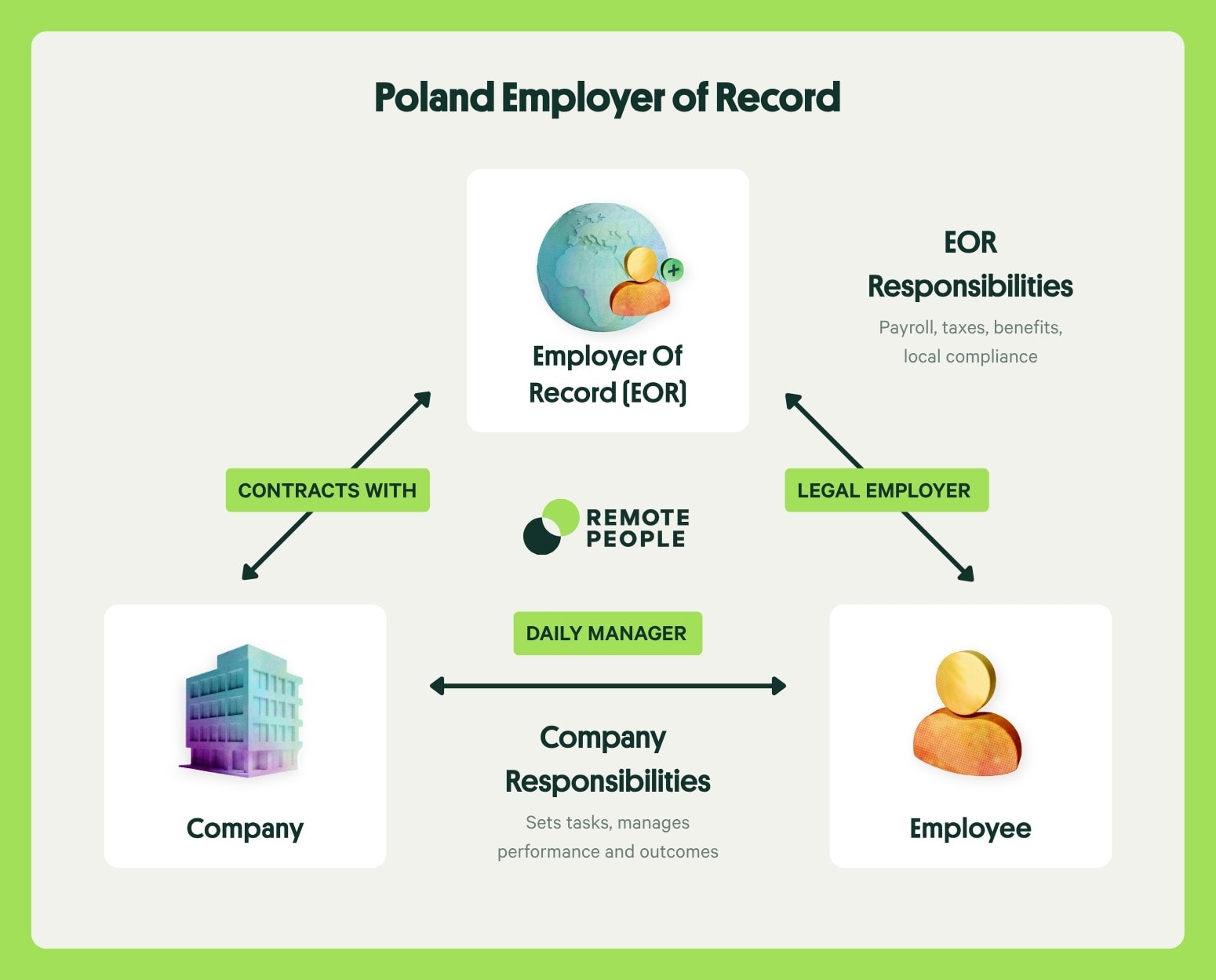
RemotePeople operates as the legal employer in Poland, managing every obligation from Zakład Ubezpieczeń Społecznych (ZUS) registration to income tax withholding under the Ustawa o podatku dochodowym od osób fizycznych. Companies retain full day-to-day control over their employees while RemotePeople ensures compliance with the Kodeks pracy, the Act of 13 March 2003 on collective redundancies, the Act of 1 December 2022 on remote work, and the Whistleblower Protection Act of 14 June 2024.
How an Employer of Record Works in Poland

If you’d like to learn more about how Employer of Record (EOR) services work, read our What Is an Employer of Record (EOR)? guide for a complete overview of the model, its benefits, and when to use it.
If you’re comparing providers, our Best Employer of Record (EOR) Providers guide reviews the leading platforms to help you choose the right solution for your business.
Who Uses an EOR in Poland?
Companies at different growth stages use an employer of record in Poland to access the Polish talent market without the cost and complexity of setting up a local entity.
- Market testing before entity setup: Companies evaluating the Polish market often hire a small initial team through an EOR to validate demand, build client relationships, and assess whether permanent establishment justifies the cost of incorporating a sp. z o.o. (which requires PLN 5,000 minimum share capital plus notary, court, and registration fees of roughly PLN 3,000-8,000).
- Small distributed teams: Organizations that need one to fifteen employees in Poland find that maintaining a sp. z o.o. for a small headcount creates disproportionate administrative overhead, including annual financial statements (sprawozdanie finansowe), corporate income tax filings, and mandatory management board duties.
- Fast onboarding requirements: Companies with urgent hiring needs use an EOR to onboard employees within one to two weeks, compared to the four to eight weeks typically required to register a Polish company, open a business bank account, and obtain a REGON and NIP number.
- Foreign national hiring: Employers sponsoring non-EU workers for work permits or EU Blue Cards benefit from an EOR’s established relationships with voivodeship offices (urzędy wojewódzkie) and experience navigating Poland’s labour market tests and salary threshold requirements.
Any business that wants to hire compliantly in Poland without the fixed costs of a local entity can benefit from the EOR model, regardless of whether the engagement is short-term project-based or a long-term strategic hire.
Typical Onboarding Timeline
Onboarding through an EOR in Poland follows a set sequence, where each step depends on the one before it. Timelines vary depending on the employee’s nationality and how complex their tax and immigration situation is.
- First, EOR agreement and employee details: The client company signs the EOR service agreement and provides employee information, compensation details, and start date. This typically takes one to two business days.
- Second, employment contract drafting and review: The EOR prepares a compliant Polish employment contract meeting Article 29 Labour Code requirements. The employee reviews and signs, either with a wet-ink signature or using a qualified electronic signature. This takes two to three business days.
- Third, ZUS and tax registration: The EOR registers the employee with ZUS (form ZUS ZUA) within seven days of the start date, files the PIT-2 tax declaration if applicable, and assigns the employee to the NFZ regional fund. Processing takes two to three business days.
- Fourth, payroll setup and benefits enrollment: The EOR configures the employee in the payroll system, enrols them in the PPK auto-enrolment scheme (with a three-month opt-out window), and sets up any supplementary benefits. This takes two to three business days.
- Fifth, employee onboarding and first day: The employee begins work. The EOR confirms all registrations are complete and the employee has been added to the ZUS and NFZ systems. This takes one business day.
Most EOR providers can onboard an employee in Poland within one to two weeks for EU, EEA, and Swiss nationals. For non-EU nationals requiring a work permit or visa, the timeline extends by four to twelve weeks depending on the permit type, voivodeship processing capacity, and whether the employee’s country is subject to simplified procedures.
Hire in Poland with Confidence
RemotePeople acts as your employer of record in Poland, handling ZUS registration, PIT withholding, Kodeks pracy-compliant contracts, and monthly payroll in złoty — without the need for a Polish subsidiary or representative office.
Onboard your first Polish hire in as little as five business days. We take on the legal employment risk while you retain day-to-day direction of the employee, combining speed with full compliance under Polish labour law.
Employment Laws and Regulations in Poland
Employment Contracts
Polish employment law is governed primarily by the Kodeks pracy (Act of 26 June 1974, Dz.U. 1974 Nr 24 poz 141, as amended), supplemented by the Constitution, sector-specific statutes, and European Union employment directives. The Ministerstwo Rodziny, Pracy i Polityki Społecznej (Ministry of Family, Labour and Social Policy) oversees labour policy, while the Państwowa Inspekcja Pracy enforces compliance (Ministry of Family, Labour and Social Policy).
Employment contracts in Poland must be concluded in writing under Article 29 §2 of the Labour Code. If the contract is not in writing, the employer must confirm the terms in writing before the employee is allowed to begin work. Required termstract, date of conclusion, workplace, job description, remuneration and its components, working time, and start date. Contracts must be drafted in Polish or in a bilingual format where the employee does not speak Polish (CMS Poland Employment Law Guide).
Polish law recognizes four main contract types: indefinite-term (umowa na czas nieokreślony), fixed-term (umowa na czas określony, capped at 33 months across a maximum of three successive contracts with the same employer under Article 25¹), probationary (umowa na okres próbny, up to three months), and replacement contracts. Indefinite contracts are the default and offer the strongest protection under Polish law. Civil law contracts such as umowa zlecenia (mandate contract) and umowa o dzieło (specific-work contract) exist but fall outside the Labour Code and carry reclassification risk when used for ongoing employment relationships.
Working Hours and Overtime
Working time in Poland is regulated by Articles 128-151⁹ of the Kodeks pracy. Standard working time may not exceed 8 hours per day and 40 hours per week on average in a five-day working week, calculated over a reference period that typically lasts up to four months but can be extended to twelve months in certain circumstances. Employees are entitled to a minimum daily rest of 11 consecutive hours and a weekly rest of at least 35 consecutive hours, including Sunday as the default day of rest (Państwowa Inspekcja Pracy).
Overtime is permitted under Article 151 for special needs of the employer, rescue operations, or protection of property, subject to an annual cap of 150 hours per employee (which may be increased by collective agreement or the employment contract, up to the limit imposed by maximum average weekly working time of 48 hours including overtime). Employees working more than six hours are entitled to at least a 15-minute paid break. Break time for work in front of a computer screen is additional, with a 5-minute rest after each hour of screen work.
Overtime and Premium Pay Rates
Poland overtime and premium pay rates · Per Article 151 Kodeks pracy | |||
Hour Type | Rate Multiplier | Annual/Daily Cap | Notes |
|---|---|---|---|
Standard overtime (weekday, daytime) | 150% | 150 hrs/year per employee | Art. 151¹ §1 pkt 2; 50% premium on regular wage |
Sunday or public holiday work | 200% | Requires replacement rest day | Art. 151¹ §1 pkt 1; 100% premium plus normal pay |
Night work (between 21:00 and 07:00) | 120% (+20% supplement) | Night worker limited to 8 hrs/shift if in hazardous work | Art. 151⁸; supplement calculated on minimum wage |
Overtime on a rest day (non-working Saturday) | 200% | Replacement day preferred | Employer must grant a day off in the same settlement period where possible |
Extended overtime (beyond weekly average cap) | 200% | Weekly average ≤ 48 hrs including overtime | Art. 151¹ §2; triggered when overtime exceeds average 40-hour week |
Managerial employees (pracownicy zarządzający w imieniu pracodawcy) and certain task-based roles under Article 151⁴ are not entitled to overtime premiums, though they remain subject to the rest period rules. The Labour Code permits the employer to grant time off in lieu instead of overtime pay: one hour off for one hour of overtime at the employee’s written request, or 1.5 hours off for one hour of overtime at the employer’s initiative (PwC Poland Worldwide Tax Summary).
Minimum Wage
Poland’s statutory minimum wage increased to PLN 4,806 gross per month on January 1, 2026, up from PLN 4,666 in the second half of 2025. The corresponding minimum hourly rate for civil-law contracts rose to PLN 31.40 gross. The rate was set by the Regulation of the Council of Ministers of 11 September 2025 (Ministry of Family, Labour and Social Policy – Minimum Wage 2026).
The minimum wage applies to all full-time employees aged 18 and over, regardless of seniority. Part-time workers are entitled to a proportional minimum. Reforms taking effect in 2026 unbundle certain supplements (such as the seniority allowance) from the base wage calculation, meaning the PLN 4,806 figure represents the actual base pay rather than total remuneration for most employees. An additional increase is expected for January 2027 in line with the Act of 10 October 2002 on the minimum wage.
Probation Period
The probationary contract (umowa na okres próbny) is defined in Article 25 of the Kodeks pracy and may not exceed three months. Since the April 2023 reforms transposing EU Directive 2019/1152, probation length is tied to the planned duration of the subsequent fixed-term contract: one month for a planned fixed-term of less than six months, two months for a planned fixed-term of six to twelve months, and three months for longer engagements or indefinite contracts. The parties may extend the probation period by up to one month to accommodate agreed leave (DLA Piper Poland Labour Code Amendments 2023).
During probation, statutory notice periods are shorter: three working days for probation of up to two weeks, one week for probation longer than two weeks, and two weeks for probation of three months. Probationary employees retain their entitlement to statutory annual leave (accrued at 1/12 of annual entitlement per month), sick pay, and all ZUS protections.
Leave Entitlements
Polish employees are protected by a layered system of leave statutes. The Kodeks pracy governs annual, sick, maternity, paternity, and parental leave. ZUS sickness and maternity benefits are administered under the Act of 25 June 1999 on cash benefits from social insurance.
Annual Leave
Under Article 154 of the Kodeks pracy, employees are entitled to 20 working days of paid annual leave per year if they have less than ten years of total employment history, or 26 working days per year if they have ten or more years of employment (including recognized periods of education, such as a completed university degree which counts as eight years). Leave accrues in proportion to time worked during the employee’s first calendar year of employment (ISAP – Kodeks pracy Art. 154).
Annual leave must generally be taken in the calendar year in which it is earned; unused leave is carried over and must be taken by 30 September of the following year. Four days per year may be taken as “on-demand” leave (urlop na żądanie) with notice given to the employer on the day itself. Payment for leave is calculated on the employee’s regular remuneration for the leave period.
Sick Leave
Under Article 92 of the Kodeks pracy, employees receive 80% of their regular salary from the employer for the first 33 days of sickness in a calendar year (or the first 14 days if the employee is over 50 years old). From the 34th day (or 15th day for employees over 50) onward, the ZUS sickness benefit (zasiłek chorobowy) takes over at 80% of the employee’s average remuneration, paid for up to 182 days (270 days for tuberculosis or pregnancy-related illness) (ZUS – Social Insurance Institution).
Sickness at 100% of salary applies in cases of workplace accidents, occupational diseases, pregnancy, or medical examinations for tissue/organ donors. Employees must provide an electronic medical certificate (e-ZLA), which is transmitted directly by the physician to the employer and ZUS ).
Maternity Leave
Article 180 of the Kodeks pracy provides 20 weeks of maternity leave for a single birth, extending to 31, 33, 35, or 37 weeks for multiple births. At least 14 weeks must be taken after the birth; the remaining six weeks can be taken before or after, and the employee may transfer the unused post-birth portion to the child’s father or another insured parent after eight weeks post-birth. Maternity benefit (zasiłek macierzyński) is paid by ZUS at 100% of the employee’s average remuneration when taken as 20 weeks of maternity leave plus 9 weeks parental leave; where the full 20 + 41/43 weeks are split differently, the rate drops to 81.5% and 70% for the remaining parental weeks (ZUS – Maternity Benefit).
Employers may not terminate the employment of a pregnant employee or an employee on maternity leave, except in cases of employer insolvency or gross misconduct. The protection extends from the confirmation of pregnancy through the end of maternity leave.
Paternity Leave
Article 182³ of the Kodeks pracy entitles fathers to two weeks of paternity leave (urlop ojcowski), to be taken in one or two blocks before the child’s first birthday (or the first year after adoption). Paternity benefit is paid by ZUS at 100% of the father’s average remuneration. The right to paternity leave is separate from parental leave and cannot be transferred between parents.
Other Statutory Leave
Polish law provides several additional paid or unpaid leave entitlements:
- Parental leave (urlop rodzicielski): Up to 41 weeks (43 weeks for multiple births) shared between parents under Article 182¹ᵃ, with a non-transferable nine-week block reserved for each parent. Parental benefit is paid by ZUS at 70% for the general portion and 81.5% if the full 20 + 41 weeks are taken together (ISAP – Kodeks pracy Art. 182¹ᵃ).
- Childcare leave (urlop wychowawczy): Up to 36 months of unpaid leave under Article 186 for each parent until the child turns 6 years old, with at least one month reserved for each parent.
- Caregiver leave (urlop opiekuńczy): Five days per year of unpaid leave under Article 173¹ to care for a child, parent, spouse, or other close relative in need of significant care (introduced April 2023).
- Force majeure leave: Two days or 16 hours per calendar year of paid leave at 50% of remuneration under Article 148¹ for urgent family emergencies (introduced April 2023).
- Marriage and bereavement leave (urlop okolicznościowy): Two days for the employee’s own wedding or the death of a spouse/child/parent; one day for the wedding of a child or the death of a sibling, grandparent, or in-law.
Leave Entitlements Summary
Poland statutory leave entitlements · Per Kodeks pracy and ZUS benefits rules | ||
Leave Type | Duration | Eligibility & Notes |
|---|---|---|
Annual leave (under 10 yrs service) | 20 working days | Paid at 100%; carries over to 30 September of following year |
Annual leave (10+ yrs service) | 26 working days | Higher education degrees count toward service total (up to 8 yrs) |
Sick leave (employer-paid) | 33 days at 80% (14 days if 50+) | Per calendar year; then ZUS sickness benefit at 80% up to 182 days |
Maternity leave | 20 weeks (more for multiples) | 100% of average pay via ZUS; non-transferable to father (after mandatory 14 wks) |
Paternity leave | 2 weeks | 100% of avg pay via ZUS; must be taken before child’s 1st birthday |
Parental leave | 41 weeks (43 for multiples) | 9 weeks non-transferable per parent; 70% or 81.5% benefit rate |
Childcare leave (unpaid) | Up to 36 months | Until child turns 6; at least 1 month reserved per parent |
Caregiver leave (unpaid) | 5 days per year | Introduced April 2023; for close family member needing significant care |
Force majeure leave | 2 days / 16 hours per year | Paid at 50%; urgent family emergencies |
Marriage / bereavement leave | 1-2 days per event | Paid at 100%; defined by Reg. of Minister of Labour 1996 |
Statutory Employee Benefits
Beyond leave entitlements and social security contributions, employers in Poland must provide several mandatory benefits that form part of the overall compensation package.
- Public health insurance (NFZ): Employers withhold 9% of the employee’s gross salary (reduced by ZUS social contributions) and remit it to the Narodowy Fundusz Zdrowia. This grants access to the public healthcare system covering GP visits, specialist care, hospitalization, and emergency services.
- Employee Capital Plans (PPK): Auto-enrolment pension scheme under the Act of 4 October 2018. The employer contributes a minimum of 1.5% of gross salary (up to 4%) and the employee a minimum of 2% (up to 4%). Employees can opt out within three months of enrolment but are automatically re-enrolled every four years (Mojeppk – Official PPK Portal).
- Company Social Benefits Fund (ZFŚS): Mandatory for employers with 50+ full-time equivalent employees (opt-in for smaller employers). Funded by the employer at approximately 37.5% of the average national wage (around PLN 2,417 per employee in 2026); used for holiday allowances (wczasy pod gruszą), social loans, and welfare support.
- Occupational safety (BHP) training: Employers must provide mandatory initial and periodic health and safety training under Article 237³ of the Labour Code, along with pre-employment and periodic medical examinations through a registered occupational physician.
- Severance for collective redundancies: Under the Act of 13 March 2003, employers with 20+ employees pay statutory severance (one to three months’ salary depending on tenure) when conducting collective dismissals; capped at 15 times the minimum wage (PLN 72,090 in 2026).
- Sick pay and accident pay: Employers fund the first 33 (or 14) days of sick pay per calendar year at 80% or 100% of salary, depending on the cause of absence.
Recent Regulatory Updates (2026)
Poland has enacted several significant employment law changes effective in 2025 and 2026 that affect employers and EOR providers operating in the country.
The statutory minimum wage increased to PLN 4,806 gross per month on January 1, 2026 (hourly rate PLN 31.40), with a single annual adjustment replacing the previous twice-yearly revaluation. The maximum ZUS contribution base for pension and disability insurance rose to PLN 282,600 per year in line with the projected average salary of PLN 9,420 per month (ZUS Contribution Limits 2026).
The Pay Transparency Directive (Directive 2023/970/EU) must be transposed into Polish law by 7 June 2026, requiring employers to disclose salary ranges in job advertisements and give candidates the right to request pay comparison data. Draft implementing legislation was published in December 2025 and is moving through the Sejm (Dentons – Poland Pay Transparency Implementation).
The Whistleblower Protection Act (Act of 14 June 2024) has been in force since 25 September 2024 and requires employers with 50+ employees to maintain internal reporting channels and protect whistleblowers from retaliation. Separately, since 25 December 2024, Christmas Eve (24 December) is a statutory public holiday, bringing Poland’s total to 14 public holidays (Baker McKenzie – Poland Whistleblower Act).
Work Permits and Visas in Poland
Work Permit Requirements
Who Needs a Work Permit
EU, EEA, and Swiss nationals have full freedom of movement and do not require a work permit or residence permit to work in Poland. Ukrainian nationals benefit from a simplified procedure under the Act of 12 March 2022 on assistance to Ukrainian citizens, permitting employment based solely on a notification submitted to the labour office (powiatowy urząd pracy). All other non-EU foreign nationals must hold a residence title that authorizes employment before they can legally work in Poland (Office for Foreigners (Urząd do Spraw Cudzoziemców)).
Eligibility and Required Documents
The specific requirements depend on the permit category, but common documentation includes a valid passport, a signed employment contract or job offer specifying salary no lower than that of comparable Polish workers, proof of qualifications, a completed application form, proof of the employer’s legal status (KRS/CEIDG extract), and health insurance coverage. For the EU Blue Card, applicants must demonstrate a minimum annual gross salary of approximately PLN 147,270 in 2026 (roughly 1.5 times the average salary). Labour market test requirements (information from the starosta on the local labour market) were largely removed under the June 2025 reform, though stricter employer verification applies (Ministry of Family, Labour and Social Policy – Work Permits).
Processing Time and Validity
Work permits are issued by the voivoda (wojewoda) with a statutory processing time of one month (two months for complex cases). In practice, processing takes four to twelve weeks depending on the voivodeship, the employee’s nationality, and application completeness. Work permits are typically valid for up to three years (five years for intra-corporate transferees) and can be renewed. The visa or residence card must be obtained separately through the Polish consulate or voivodeship office once the permit is granted.
Renewal Process
Work permit and residence card renewals are handled by the voivodeship office and should be initiated at least 30 days (preferably 60 days) before expiry. Required documentation includes the current permit and residence card, updated employment contract, recent payslips, proof of paid taxes and ZUS contributions, and a valid passport. Under the Act on Foreigners, employees who apply for a renewal before the current permit expires may continue working legally while the renewal is processed.
Common Visa Types for Foreign Workers
Poland has modernized its immigration framework through successive amendments to the Act of 20 April 2004 on employment promotion and the Act of 12 December 2013 on foreigners. The voivoda issues work permits, while Polish consulates abroad issue national (Type D) visas for employment. An EOR with established employer registration can sponsor most work permit categories.
Poland work visa types for foreign workers · 2026 | ||||
Visa / Permit Type | Duration | Best For | Leads to PR? | Processing |
|---|---|---|---|---|
Work Permit Type A (standard employment) | Up to 3 years | Foreign nationals employed by a Polish-based employer | Yes (after 5 yrs) | 4-12 weeks |
Work Permit Type B (board member) | Up to 3 years | Directors/board members of Polish entities staying 6+ months/year | Yes | 4-12 weeks |
Work Permit Type C / D / E (posted workers, ICT) | Up to 3 years | Intra-company transferees and foreign-employer secondments | No | 4-12 weeks |
EU Blue Card | Up to 3 years | Highly qualified workers earning ≥ 1.5× avg Polish salary | Yes (after 21 months with conditions) | 4-10 weeks |
Single Permit (residence + work) | Up to 3 years | Unified permit replacing separate work and residence cards | Yes (after 5 yrs) | 2-6 months |
Statement on Entrusting Work (Ukraine, Belarus, etc.) | Up to 24 months | Nationals of 7 eligible countries; simplified procedure | No | 7-30 days |
Visa types not covered above that do not permit employment in Poland include:
- Schengen visa (Type C): Permits stays of up to 90 days within a 180-day period for business meetings, conferences, and tourism but does not authorize employment.
- Student visa: Allows full-time students to work without a separate work permit during their studies but is not itself a work visa for graduates.
- Pole’s Card (Karta Polaka): Grants persons of Polish origin certain privileges, including work authorization, but is a heritage-based document rather than a labour migration route.
How an EOR Handles Work Permits
An employer of record in Poland can sponsor work permit applications because it acts as the legal employer registered with ZUS and the tax authorities. The EOR files the work permit application with the relevant voivodeship office, pays the statutory administrative fee (PLN 50 for permits up to three months, PLN 100 for longer permits, PLN 200 for Type B), and coordinates documentation such as the employment contract, salary evidence, and proof of the employer’s legal status.
The employee is responsible for submitting the visa application at their local Polish consulate, attending the biometrics appointment, providing personal documentation (passport, qualifications, health insurance), and once in Poland applying for a residence card at the voivodeship office within the validity of their entry visa. Work permit processing adds four to twelve weeks to the standard onboarding timeline described in the EOR onboarding section above; the Single Permit route can extend this to two to six months.
One important limitation: the employer listed on the work permit is bound to the employment conditions (salary, position, working hours) stated in the application. Any material change requires a new application or amendment. EOR providers structure engagement letters to match the permit terms exactly and flag any changes in scope before they are implemented.
Payroll, Taxes, and Social Security in Poland
Employer Contributions
Poland employer ZUS contributions · 2026 rates on gross salary | ||
Contribution | Rate | Notes |
|---|---|---|
Pension insurance (emerytalne) | 9.76% | Half of 19.52%; capped at PLN 282,600/year (30× avg salary) |
Disability insurance (rentowe) | 6.50% | Employer share of 8% total; capped at PLN 282,600/year |
Accident insurance (wypadkowe) | 1.67% | Default rate; actual rate 0.67%-3.33% by industry risk class |
Labour Fund + Solidarity Fund (FP / FS) | 2.45% | 100% employer-paid; not owed for employees 55+ (women) / 60+ (men) |
Guaranteed Employee Benefits Fund (FGŚP) | 0.10% | 100% employer-paid; funds employee claims in employer insolvency |
Employee Capital Plans (PPK) – employer share | 1.50% | Minimum employer contribution; up to 4% optional |
Total employer contributions | ~21.98% | Including PPK min; ~20.48% without PPK |
Employee Contributions
Poland employee payroll deductions · 2026 monthly withholdings | ||
Deduction | Rate | Notes |
|---|---|---|
Pension insurance (emerytalne) | 9.76% | Half of 19.52%; capped at PLN 282,600/year |
Disability insurance (rentowe) | 1.50% | Employee share of 8% total; capped at PLN 282,600/year |
Sickness insurance (chorobowe) | 2.45% | Full employee cost; funds first 33/14 days of sick pay |
Health insurance (zdrowotne) | 9.00% | Calculated on gross salary reduced by social contributions |
Employee Capital Plans (PPK) – employee share | 2.00% | Opt-out within 3 months; auto-re-enrolment every 4 years |
Total employee contributions | ~24.71% | Including PPK min; ~22.71% without PPK |
Income Tax
Poland personal income tax (PIT) brackets · 2026 | |
Annual Taxable Income | Tax Rate |
|---|---|
PLN 0 – PLN 30,000 | 0% (kwota wolna od podatku, tax-free allowance) |
PLN 30,001 – PLN 120,000 | 12% of income above PLN 30,000 (less PLN 3,600 tax-free reducing amount) |
PLN 120,001 – PLN 1,000,000 | PLN 10,800 + 32% on income above PLN 120,000 |
PLN 1,000,001 and above | 32% PIT + 4% solidarity levy (danina solidarnościowa) on income above PLN 1,000,000 |
Poland applies a two-rate progressive PIT scale under Article 27 of the PIT Act (Ustawa z dnia 26 lipca 1991 r. o podatku dochodowym od osób fizycznych). The 12% rate applies up to PLN 120,000 of annual taxable income, and 32% applies above. The annual tax-free allowance of PLN 30,000 (translating to PLN 3,600 tax reducing amount) has been in place since 2022. Employees earning more than PLN 1 million per year pay an additional 4% solidarity levy on income above that threshold (PwC Poland Tax Summary).
Employees can apply tax reliefs such as joint spousal filing, tax relief for families (ulga na dzieci), the “return relief” (ulga na powrót) for Polish tax residents returning from abroad, and the “4+ relief” for parents with four or more children. The employer processes most reliefs monthly through the PIT-2 declaration; the employee reconciles the final tax liability in their annual PIT-37 return by 30 April.
Payroll Cycle
Payroll in Poland is processed monthly, with employees entitled to payment at least once per month under Article 85 of the Labour Code. The default pay date is no later than the 10th of the following month; most employers pay between the 25th and the last working day of the month worked, or on the first working day of the following month. Bank transfers are the standard payment method; cash payments are permitted only with the employee’s written request.
PIT advances (zaliczki) must be remitted to the Urząd Skarbowy by the 20th of the following month. ZUS contributions are due by the 15th of the following month for companies and by the 20th for self-employed individuals. Annual PIT-11 statements must be provided to employees and the tax authorities by the end of February, and employees file their own PIT-37 return by 30 April. Electronic filing through e-Deklaracje and ZUS PUE is mandatory for almost all employers.
13th Month Salary and Bonus Pay
Poland does not have a universal statutory 13th month salary for private-sector employees. A 13th-month bonus (trzynastka) is mandatory only in the public sector under the Act of 12 December 1997 on the additional annual salary for public-sector employees. In the private sector, bonuses such as the Christmas bonus (premia świąteczna), performance bonuses, or annual bonuses are entirely voluntary and governed by the employment contract, collective labour agreement (układ zbiorowy pracy), or remuneration regulacje (regulamin wynagradzania).
Where a bonus is paid, it is fully subject to PIT and ZUS contributions. If a discretionary bonus is paid consistently according to clearly defined rules, Polish labour courts may treat it as a contractual entitlement. Employers should include wording such as “uznaniowa” (discretionary) in bonus scheme documents to preserve flexibility.
Cost of Hiring Through an EOR in Poland
EOR Service Fees
EOR service fees in Poland typically range from $299 to $599 per employee per month. This fee covers the full scope of employer responsibilities: employment contract management, monthly payroll processing, PIT withholding and filing, ZUS registration and contributions, NFZ coordination, employee benefits administration, leave tracking, PPK enrolment, and ongoing compliance with the Labour Code. Some providers offer volume discounts for companies hiring multiple employees.
Total Employment Cost Breakdown

Poland employer cost example · USD 5,000 gross · 2026 | ||
Employer Cost | Amount (USD) | % of Gross |
|---|---|---|
Gross monthly salary | $5,000.00 | 100.0% |
Pension insurance (9.76%) | $488.00 | 9.8% |
Disability insurance (6.50%) | $325.00 | 6.5% |
Accident insurance (1.67% default) | $83.50 | 1.7% |
Labour Fund + Solidarity Fund (2.45%) | $122.50 | 2.5% |
Guaranteed Employee Benefits Fund (0.10%) | $5.00 | 0.1% |
PPK employer contribution (1.50%) | $75.00 | 1.5% |
EOR service fee (est.) | $499.00 | 10.0% |
Total monthly employer cost | $6,598.00 | 132.0% |
Source: ZUS Contribution Rates 2026 and PwC Poland Tax Summary | ||
The total cost of employing a worker through an EOR in Poland at a gross monthly salary of USD 5,000 is approximately USD 6,598, or about 32% above gross salary. Employer ZUS contributions account for roughly 22% of this premium, with the EOR service fee adding approximately 10%. Companies hiring employees with salaries above the pension and disability ceiling (PLN 282,600 per year, about USD 70,000) will see a lower effective contribution rate as pension and disability contributions are capped, while accident, labour fund, and FGŚP contributions remain uncapped.
Ready to hire in Poland? Get started with RemotePeople: we handle employment contracts, payroll, PIT withholding, ZUS registration, and full Poland compliance. No local entity needed.
Benefits of Using an EOR in Poland
Polish employment regulation is detailed and actively enforced by the Państwowa Inspekcja Pracy. Strong employee protections, procedural requirements for dismissals, and frequent legislative updates mean that compliance mistakes are both easy to make and expensive to fix. An employer of record addresses these challenges directly.
- Speed to market: An EOR can onboard employees in Poland within one to two weeks, compared to the four to eight weeks required to register a sp. z o.o., obtain REGON/NIP/VAT numbers, open a business bank account, and register with ZUS as an employer. This allows companies to secure talent and begin operations immediately.
- Full compliance assurance: Polish labour law includes the Kodeks pracy, the Act on Trade Unions, the Act on Collective Redundancies, the Whistleblower Protection Act, sector-specific safety regulations, and numerous executive regulations. An EOR maintains legal expertise across all of these, reducing the risk of Państwowa Inspekcja Pracy fines (up to PLN 30,000) and employment tribunal claims.
- Cost efficiency versus a local entity: Setting up a sp. z o.o. requires PLN 5,000 share capital, notary and court fees of PLN 3,000-8,000, ongoing bookkeeping and audit obligations, and appointment of a management board. For companies hiring fewer than fifteen employees, the EOR model eliminates these fixed costs while providing the same level of legal compliance.
- Local payroll and tax expertise: Poland’s payroll and tax system involves six ZUS contribution types, progressive PIT with numerous reliefs, mandatory PPK enrolment, NFZ health contributions, and monthly reporting to ZUS PUE and the Urząd Skarbowy. An EOR handles all of this accurately each pay cycle.
- Flexibility to scale: Companies can increase or decrease their Polish headcount through an EOR without the structural commitments of maintaining a local entity. If a market test succeeds, the company can transition employees to its own sp. z o.o.; if it does not, the EOR handles compliant offboarding.
- Risk mitigation: The EOR assumes the legal employer role, meaning compliance liability for ZUS registration, PIT withholding, and employment contract adherence sits with the EOR. This protects the client company from direct exposure to Polish labour court claims and regulatory penalties.
- Employee experience: Employees hired through an EOR receive fully compliant Polish employment contracts, statutory benefits (ZUS insurance, paid leave, PPK pension), and a Polish-language payslip. This provides the same employment experience as working for a Polish company directly.
For companies that want to build a team in Poland without the complexity and fixed costs of a local entity, an EOR provides the fastest and most compliant path. Contact RemotePeople to discuss your Poland hiring needs.
Termination and Offboarding in Poland
Notice Periods
Statutory notice periods in Poland are defined in Article 36 of the Kodeks pracy and increase with the employee’s length of service with the same employer. During a probationary contract, shorter notice applies under Article 34. The notice period runs from the first day of the week or month following delivery of the notice, and must be given in writing with a justification for indefinite-term contracts (ISAP – Kodeks pracy Art. 36).
Poland statutory notice periods by length of service · Per Articles 34 and 36 Kodeks pracy | |||
Contract / Service Length | Notice Period | Who Can Give Notice | Notes |
|---|---|---|---|
Probationary contract < 2 weeks | 3 working days | Either party | Art. 34 pkt 1; runs from delivery date |
Probationary contract 2 weeks – 3 months | 1 week | Either party | Art. 34 pkt 2 |
Probationary contract = 3 months | 2 weeks | Either party | Art. 34 pkt 3 |
Fixed-term or indefinite: < 6 months service | 2 weeks | Either party | Art. 36 §1 pkt 1 |
Fixed-term or indefinite: 6 months – 3 years service | 1 month | Either party | Art. 36 §1 pkt 2; runs to end of calendar month |
Fixed-term or indefinite: 3+ years service | 3 months | Either party | Art. 36 §1 pkt 3; runs to end of calendar month |
Summary dismissal without notice (rozwiązanie bez wypowiedzenia) is permitted under Article 52 of the Kodeks pracy only for serious cause (ciężkie naruszenie obowiązków pracowniczych), such as gross misconduct, commission of a crime, or loss of qualifications essential to the role. In cases of mutual agreement (porozumienie stron), the parties may agree to any notice period or immediate separation. Fixed-term contracts that expire on their agreed end date do not require notice. Longer notice periods can be agreed by contract but may not be shorter than the statutory minimum.
Severance Pay
Statutory severance (odprawa) in Poland is governed by the Act of 13 March 2003 on specific rules for terminating employment relationships for reasons not attributable to employees (the Collective Redundancies Act). It applies to employers with 20 or more employees when the termination is for reasons outside the employee’s control, including individual redundancies and collective dismissals (ISAP – Act of 13 March 2003 on Collective Redundancies).
Poland severance pay schedule by years of service · Per Act of 13 March 2003 | |||
Years of Service | Severance Amount | Base Salary | Notes |
|---|---|---|---|
Less than 2 years | 1 month’s salary | Average gross of last 3 months | Applies only to employers with 20+ employees |
2 – less than 8 years | 2 months’ salary | Average gross of last 3 months | Continuous service with same employer |
8+ years | 3 months’ salary | Average gross of last 3 months | Maximum statutory multiplier |
Statutory cap | 15× minimum wage | PLN 72,090 in 2026 | Cap applies regardless of service length |
Calculation Method
The severance base is the average gross monthly remuneration of the three months preceding termination, calculated according to the Regulation of the Minister of Labour and Social Policy of 8 January 1997 on the calculation of holiday and severance pay. Variable components (bonuses, commissions) are included where they were regularly paid. The severance multiplier is one, two, or three months depending on total service with the dismissing employer, including prior employment continued under a transfer of undertaking (Article 23¹ Kodeks pracy).
In practice, higher severance amounts are often agreed in mutual-termination agreements (porozumienie rozwiązujące umowę) to incentivise voluntary departure and reduce litigation risk. Amounts of three to six months’ salary are common in settlements of senior roles or contested dismissals.
Caps and Exceptions
The statutory cap on severance under the Act of 13 March 2003 is 15 times the minimum wage, equal to PLN 72,090 in 2026. Severance is not payable in cases of dismissal for just cause under Article 52 Kodeks pracy (disciplinary dismissal), during the probationary period, or when the employee resigns voluntarily without employer-caused reasons. Fixed-term contracts that expire on their agreed end date do not trigger severance obligations. Severance payments are subject to PIT (reduced rate under PIT Act) and exempt from ZUS social contributions, but health insurance contributions apply.
Grounds for Termination
Indefinite-term employment contracts in Poland may be terminated by the employer only for justifiable reasons. Under the 2023 reforms implementing EU Directive 2019/1152, the employer must provide a written justification (przyczyna wypowiedzenia) for both indefinite-term and fixed-term contracts. The reason must be specific, verifiable, and proportionate. Common grounds include poor performance, redundancy, loss of employer trust, and reorganization. Summary dismissal under Article 52 applies only for gross misconduct and must be delivered within one month of the employer learning of the circumstances.
Before terminating, the employer must consult with the relevant trade union organization where the employee is a member (Article 38 Kodeks pracy). Termination is prohibited during protected periods: pregnancy, maternity/paternity/parental leave, pre-retirement protection (four years before retirement age), and periods of authorized absence such as sick leave lasting less than the Article 53 thresholds. Non-compliance with the written form, notice, or procedural requirements entitles the employee to claim reinstatement or compensation before the labour court (sąd pracy).
EOR vs. Other Hiring Models in Poland
EOR vs. Setting Up a Local Entity
Poland EOR vs local entity (sp. z o.o.) comparison · Setup time, cost, risk and best-fit | ||
Comparison | Employer of Record | Own Entity (sp. z o.o.) |
|---|---|---|
Setup time | 1-2 weeks | 4-8 weeks |
Upfront cost | $0 | $3,000-$8,000 (share capital + notary + court fees) |
Ongoing cost | $299-$599/employee/month | $6,000-$15,000/year maintenance |
Local partner required | No (EOR is the local entity) | No (but requires management board member) |
ZUS and NFZ registration | Handled by EOR | You manage it |
Payroll & tax filing | Handled by EOR | You manage it (or outsource) |
Best for team size | 1-15 employees | 15+ employees |
Scale down / exit | Easy, no entity to unwind | Costly, legal dissolution required |
Government contracts | Not eligible | Eligible (requires local entity) |
For companies hiring one to fifteen employees in Poland, the EOR model eliminates the upfront investment and ongoing overhead of a sp. z o.o. The PLN 5,000 minimum share capital, notary fees for the articles of association, court registration with the Krajowy Rejestr Sądowy (KRS), and appointment of a management board create fixed costs that are disproportionate for a small team.
An EOR is best suited for market entry, distributed teams, and situations where the company needs operational flexibility. A sp. z o.o. becomes more cost-effective as headcount grows beyond fifteen employees, when the company needs to bid on Polish public procurement, or when the business requires a permanent legal presence for banking, real estate, or intellectual property holding purposes.
The transition from EOR to own entity is straightforward: the EOR transfers employees to the new sp. z o.o. through mutual agreement or a transfer of undertaking under Article 23¹ Kodeks pracy, and the new entity assumes all employment obligations. RemotePeople supports this transition process for clients that outgrow the EOR model.
EOR vs. Hiring Independent Contractors

Poland EOR vs independent contractors · Compliance, cost, and risk | ||
Comparison | EOR (Full-Time Employee) | Independent Contractor (B2B / umowa zlecenia) |
|---|---|---|
Legal relationship | Employee of the EOR | Self-employed (JDG) or mandate; no employment relationship |
Compliance risk | Low; EOR ensures Labour Code compliance | High; PIP reclassification risk if relationship resembles employment |
Payroll & tax | EOR handles withholding, ZUS, PIT filings | Contractor invoices you; they handle their own PIT and ZUS |
Benefits & leave | Statutory leave, sick pay, PPK, ZUS insurance | No Labour Code benefits; limited mandatory ZUS for umowa zlecenia |
IP protection | Stronger; Art. 12 Copyright Act assigns employment-created IP to employer | Weaker; requires explicit IP assignment clause (Art. 41 Copyright Act) |
Termination | Subject to Labour Code notice and severance | Contract can be ended per agreed terms |
Best for | Long-term, core team roles | Short-term projects, specialized tasks |
Cost structure | Salary + ZUS + EOR fee | Contractor fee (typically higher gross, lower total cost) |
Source: Państwowa Inspekcja Pracy and ISAP – Copyright Act 1994 | ||
Poland enforces strict rules against disguised employment (ukryte zatrudnienie). The Państwowa Inspekcja Pracy and ZUS investigate contractor relationships, and Article 22 §1¹ of the Kodeks pracy explicitly states that work performed under the conditions of an employment relationship (subordination, personal performance, set workplace and hours, paid remuneration) constitutes employment regardless of the contract label used. A contractor who works exclusively for one client, follows the client’s instructions on how and when to work, uses the client’s equipment, and is integrated into the client’s organizational structure is likely to be reclassified as an employee.
The consequences of misclassification are severe: the client company must pay retroactive ZUS contributions (employer and employee shares) for up to five years, plus PIT adjustments, and may face PIP fines up to PLN 45,000 per violation. The worker gains full employee status with all associated protections, including dismissal protection, paid leave, and severance entitlement.
Hiring contractors is appropriate in some cases, such as genuine project-based work with defined deliverables where the worker controls their own schedule and methods. For ongoing, integrated roles, the EOR model provides compliance certainty. RemotePeople also offers contractor management solutions for companies that need both employment types in Poland.
EOR vs. PEO (Professional Employer Organization)
Poland EOR vs PEO comparison · Legal employer, liability, and setup | ||
Comparison | Employer of Record (EOR) | PEO |
|---|---|---|
Legal employer | EOR is the legal employer | You remain the legal employer (co-employment) |
Local entity required | No, the EOR is the local entity | Yes, you must have your own sp. z o.o. or branch |
Best for | Companies without a local entity | Companies that already have a Polish entity |
Compliance liability | EOR assumes compliance responsibility | Shared liability between you and the PEO |
Setup time | 1-2 weeks | Depends on your entity setup (weeks to months) |
Control over HR policies | EOR manages within Labour Code framework | More direct control; PEO advises |
Typical use case | Market entry, small remote teams, testing new markets | Established Polish operations needing HR outsourcing |
Poland does not recognize PEO co-employment as a distinct legal model. Under Polish law, any arrangement where a third party places workers with a client company typically falls under temporary agency work (praca tymczasowa), regulated by the Act of 9 July 2003 on the employment of temporary workers. Temporary agency work is subject to duration limits (18 months with the same user employer over 36 months) and equal-treatment rules, making it unsuitable for permanent roles.
A traditional PEO co-employment model, as used in the United States, does not exist in Polish law. For companies without a Polish entity, the EOR is the only viable third-party employment model. For companies that already have a sp. z o.o. and want to outsource HR administration, a payroll service provider (biuro rachunkowe) or HR outsourcing firm is the appropriate alternative, as true co-employment is not recognized under Polish law.
Public Holidays in Poland
Poland public holidays · 2026 calendar year | ||
Date | Holiday | Type |
|---|---|---|
January 1 (Thursday) | Nowy Rok (New Year’s Day) | Nationwide |
January 6 (Tuesday) | Trzech Króli (Epiphany) | Nationwide |
April 5 (Sunday) | Wielkanoc (Easter Sunday) | Nationwide |
April 6 (Monday) | Poniedziałek Wielkanocny (Easter Monday) | Nationwide |
May 1 (Friday) | Święto Pracy (Labour Day) | Nationwide |
May 3 (Sunday) | Święto Konstytucji 3 Maja (Constitution Day) | Nationwide |
May 24 (Sunday) | Zielone Świątki (Pentecost Sunday) | Nationwide |
June 4 (Thursday) | Boże Ciało (Corpus Christi) | Nationwide |
August 15 (Saturday) | Wniebowzięcie NMP / Święto Wojska Polskiego (Assumption & Armed Forces Day) | Nationwide |
November 1 (Sunday) | Wszystkich Świętych (All Saints’ Day) | Nationwide |
November 11 (Wednesday) | Święto Niepodległości (Independence Day) | Nationwide |
December 24 (Thursday) | Wigilia (Christmas Eve) | Nationwide (since 2025) |
December 25 (Friday) | Boże Narodzenie (Christmas Day) | Nationwide |
December 26 (Saturday) | Drugi Dzień Bożego Narodzenia (Second Day of Christmas) | Nationwide |
Poland has 14 public holidays in 2026 following the addition of Christmas Eve (Wigilia) as a statutory public holiday effective 25 December 2024. Under Article 130 §2 of the Kodeks pracy, a public holiday falling on a Saturday reduces the working time standard by eight hours in that settlement period, entitling employees to an additional paid day off. Public holidays falling on a Sunday are not rescheduled. Employees required to work on a public holiday are entitled to 100% additional pay plus a replacement rest day (Timeanddate.com Poland 2026 Holidays).
Sunday and public holiday trading restrictions under the Act of 10 January 2018 significantly limit retail operations, with only eight Sundays per year permitted for regular retail trading. This affects retail employers but not office-based roles.
How to Get Started with an EOR in Poland
- First, define your hiring needs: Identify the roles you need to fill in Poland, the required qualifications, expected compensation range (benchmarked against the PLN 9,420 projected average monthly salary), and whether candidates are EU nationals or will require work permit sponsorship. This information determines the onboarding timeline and any additional immigration steps.
- Second, select your EOR provider: Evaluate providers based on their Polish employer registration, experience with the Kodeks pracy and ZUS, payroll processing capabilities, and ability to support work permit sponsorship. Confirm that the provider handles all six ZUS contribution types, PPK enrolment, and PIT filing, and can manage compliance in Polish and English.
- Third, finalize employment terms: Work with the EOR to draft a compliant employment contract that meets Article 29 Kodeks pracy requirements, reflects the agreed compensation package, and includes any supplementary benefits such as private medical insurance (Medicover, LuxMed, Enel-Med), Multisport cards, meal allowances, or additional annual leave beyond the statutory minimum.
- Fourth, onboard your employee: The EOR registers the employee with ZUS (form ZUS ZUA), NFZ, and the Urząd Skarbowy; prepares and signs the employment contract; enrols the employee in PPK; and coordinates mandatory BHP (health and safety) training and pre-employment medical examination. For non-EU employees, the EOR coordinates the work permit application process in parallel.
- Fifth, manage and scale your team: Once onboarded, the EOR processes monthly payroll, manages leave requests through a self-service portal, handles PIT and ZUS filing, and ensures ongoing compliance. You retain full operational control over your team’s work while the EOR manages the employer obligations. As your team grows, you can add employees through the EOR or transition to your own sp. z o.o. when the headcount justifies it.
Ready to hire your first employee in Poland? Contact RemotePeople to get started. We handle the entire employment process from contract to payroll to compliance, so you can focus on building your team.”
Where companies hiring in Poland expand next
Teams hiring in Poland commonly expand across Central and Eastern Europe, where competitive labor costs and EU market access anchor regional growth. After building a team in Poland, employers often look to Hungary for parallel labor-cost tier and talent supply, then hiring in Slovakia for aligned compensation ranges and delivery speed. An EOR partner in the Czech Republic follows with matching cost-to-quality tier, and Romania typically closes the regional footprint via similar cost profile and comparable hiring speed.
Frequently Asked Questions
EOR services in Poland typically cost between $299 and $599 per employee per month. This flat fee covers employment contract management, monthly payroll processing, PIT withholding and filing, ZUS registration and contributions, PPK enrolment, benefits administration, and ongoing compliance with the Kodeks pracy. On top of the EOR fee, total employer costs include ZUS contributions of approximately 20-22% of gross salary (pension, disability, accident, Labour Fund, FGŚP, and PPK), bringing the total cost to roughly 32% above the employee's gross salary. See the current rate schedule at the (ZUS Contribution Rates) and (PwC Poland – Social Security Contributions).
An EOR can typically onboard an EU, EEA, or Swiss national employee in Poland within one to two weeks, covering contract preparation, ZUS and NFZ registration, and payroll setup. For non-EU nationals who require a work permit (Type A, B, or EU Blue Card), the timeline extends by four to twelve weeks depending on the permit category, voivodeship processing times, and consular visa appointments. Ukrainian nationals benefit from a simplified notification procedure, typically taking 7-30 days. Official timelines are published by the (Office for Foreigners (UdSC)) and the relevant (Ministry of Family, Labour and Social Policy – Foreign Employment).
An EOR in Poland must comply with the Kodeks pracy (Labour Code, Act of 26 June 1974) for contract terms, working time, and dismissal protection; the Act of 13 October 1998 on ZUS for social insurance contributions; the PIT Act of 26 July 1991 for income tax withholding; the Act of 4 October 2018 on PPK for pension plan auto-enrolment; the Act of 13 March 2003 on collective redundancies for severance; the Whistleblower Protection Act of 14 June 2024; and the Act of 1 December 2022 on remote work. Enforcement is led by the Państwowa Inspekcja Pracy and ZUS. Consolidated texts of these acts are available through the (ISAP – Internet System of Legal Acts) and the (PIP – National Labour Inspectorate).
Under Article 12 of the Polish Copyright Act (Ustawa o prawie autorskim z 1994 r.), economic copyright in works created by an employee within the scope of their employment duties automatically vests in the employer upon acceptance of the work. Since the EOR is the legal employer, the EOR-client agreement and the employment contract must explicitly assign or license the resulting rights to the client company. RemotePeople's standard employment contracts and client master services agreements include IP assignment clauses that transfer all rights to the client.
Hiring contractors in Poland carries significant misclassification risk. Article 22 §1¹ of the Kodeks pracy states that work performed under conditions of subordination, personal performance, and fixed hours constitutes employment regardless of the contract label. The Państwowa Inspekcja Pracy and ZUS investigate contractor relationships actively, and misclassification leads to retroactive ZUS contributions for up to five years plus PIT adjustments and fines up to PLN 45,000 per violation. RemotePeople offers contractor management solutions for genuine contractor relationships, and the EOR model for ongoing, integrated roles.
Polish law mandates employee benefits including ZUS social insurance (pension, disability, sickness, accident), NFZ health insurance, a minimum of 20 or 26 days paid annual leave (based on total service), 33 days of employer-paid sick leave at 80% per year (14 days for employees over 50), 20 weeks of maternity leave, two weeks of paternity leave, up to 41 weeks of parental leave, PPK auto-enrolment pension, and occupational health and safety (BHP) measures. Employers with 50+ employees must also operate the ZFŚS social benefits fund.
Yes, an EOR registered as an employer in Poland can act as the legal employer and sponsor work permit applications. This includes Work Permit Type A (standard employment) for most foreign nationals, EU Blue Cards for highly qualified workers earning at least 1.5 times the average Polish salary, Work Permit Type B for board members, and intra-company transfer permits. The EOR files the application with the voivodeship office, pays the administrative fee (PLN 50-200), and coordinates with the employee on documentation and consular appointments.
Termination of indefinite-term and fixed-term contracts in Poland requires written justification under Article 30 §4 Kodeks pracy. Statutory notice periods under Article 36 depend on length of service: two weeks (under 6 months), one month (6 months to 3 years), or three months (3+ years). Summary dismissal under Article 52 is permitted only for gross misconduct and must occur within one month of the employer learning of the cause. Severance under the Act of 13 March 2003 is payable by employers with 20+ employees for non-employee-caused dismissals, at one, two, or three months' salary based on service, capped at 15 times the minimum wage (PLN 72,090 in 2026).
Employer of Record in
Employer of Record in
Employer of Record in
Employer of Record in
Employer of Record in
Employer of Record in
Employer of Record in
Employer of Record in