
 Recruit
Employer of Record (EOR) in Colombia
-
 Drew Donnelly
- Published
- September 27, 2026
RemotePeople’s employer of record in Colombia lets you hire employees in Colombia with comprehensive social security coverage. We handle employer contributions averaging 30% including pension system at 12%, health and pension insurance at 20.5%, and professional risk contributions ranging from 0.522% to 6.96%.
Hire in Colombia — book a free 30-minute demo
Tell us what you need. You'll get a tailored, transparent proposal within 24 hours, plus a free call to walk through it.
Tell us about your company
So we can match you with a specialist who knows your market — and unlock volume pricing tiers.
* All fields are required.
Where and when are you hiring?
Tell us the geography and timing and we'll quote each country line by line, with onboarding timelines.
* All fields are required.
Help us beat your current setup
We'll benchmark your current deal and send a line-by-line proposal in 24 hours — showing exactly where we cut cost, time, or risk. After you submit, you can book a call to walk through it together.
* All fields are required.
Thanks! Your proposal is on its way.
Expect a tailored, line-by-line proposal in your inbox within 24 hours. In the meantime…
Want to walk through it together?
Book a free 30-minute call with one of our specialists. We'll explain every line, answer your questions, and tailor the proposal further if you need.
No obligation. Pick a time that works for you.








- Hire in Colombia — book a free 30-minute demo
- Tell us about your company
- Where and when are you hiring?
- Help us beat your current setup
- Thanks! Your proposal is on its way.
- How an Employer of Record Works in Colombia
- Employment Laws and Regulations in Colombia
- Work Permits and Visas in Colombia
- Payroll, Taxes, and Social Security in Colombia
- Cost of Hiring Through an EOR in Colombia
- Benefits of Using an EOR in Colombia
- Termination and Offboarding in Colombia
- EOR vs. Other Hiring Models in Colombia
- Public Holidays in Colombia
- How to Get Started with an EOR in Colombia
- Where companies hiring in Colombia expand next
- Frequently Asked Questions
- Related EOR Destinations
Start hiring in Colombia
Let RemotePeople handle payroll, compliance, and HR admin worldwide so you can focus on building your team.

Colombia offers the second-largest bilingual talent pool in Latin America, with more than 25 million economically active workers concentrated in Bogotá, Medellín, Cali, and Barranquilla and deep strength in software engineering, customer support, finance, and Spanish-language content operations. Following the January 2026 minimum wage increase to COP 1,750,905 under Decretos 1469 and 1470 of 2025, and the continued phase-in of the 42-hour workweek under Ley 2101 of 2021, Colombia remains one of the most attractive nearshore hiring markets for North American and European companies. For any business looking to hire employees in Colombia, compliance means registering workers with the health (EPS), pension (AFP), occupational risk (ARL), and family compensation (CCF) systems, running monthly payroll through the DIAN, and applying the Código Sustantivo del Trabajo (CST) at every stage of the employment relationship.
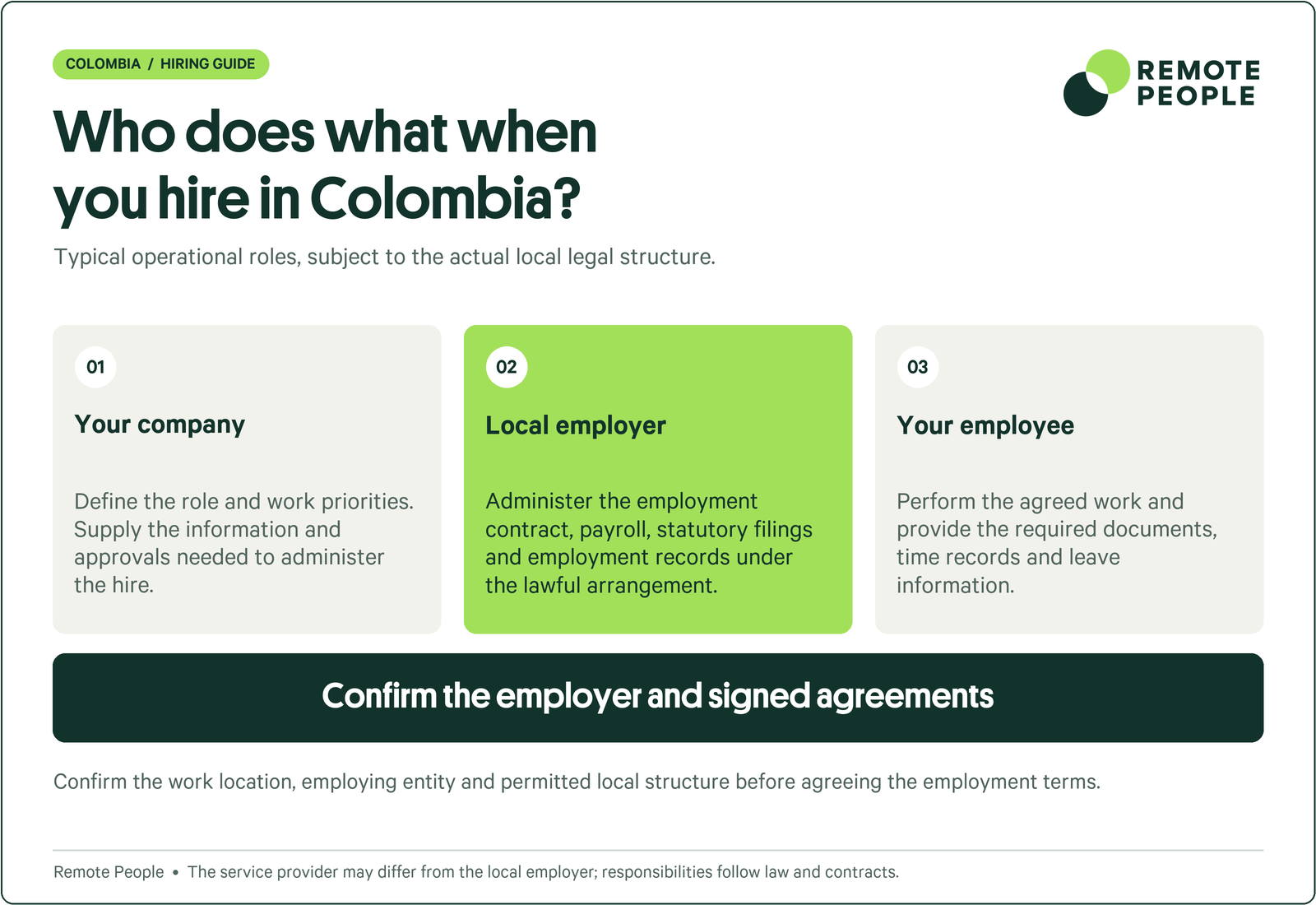
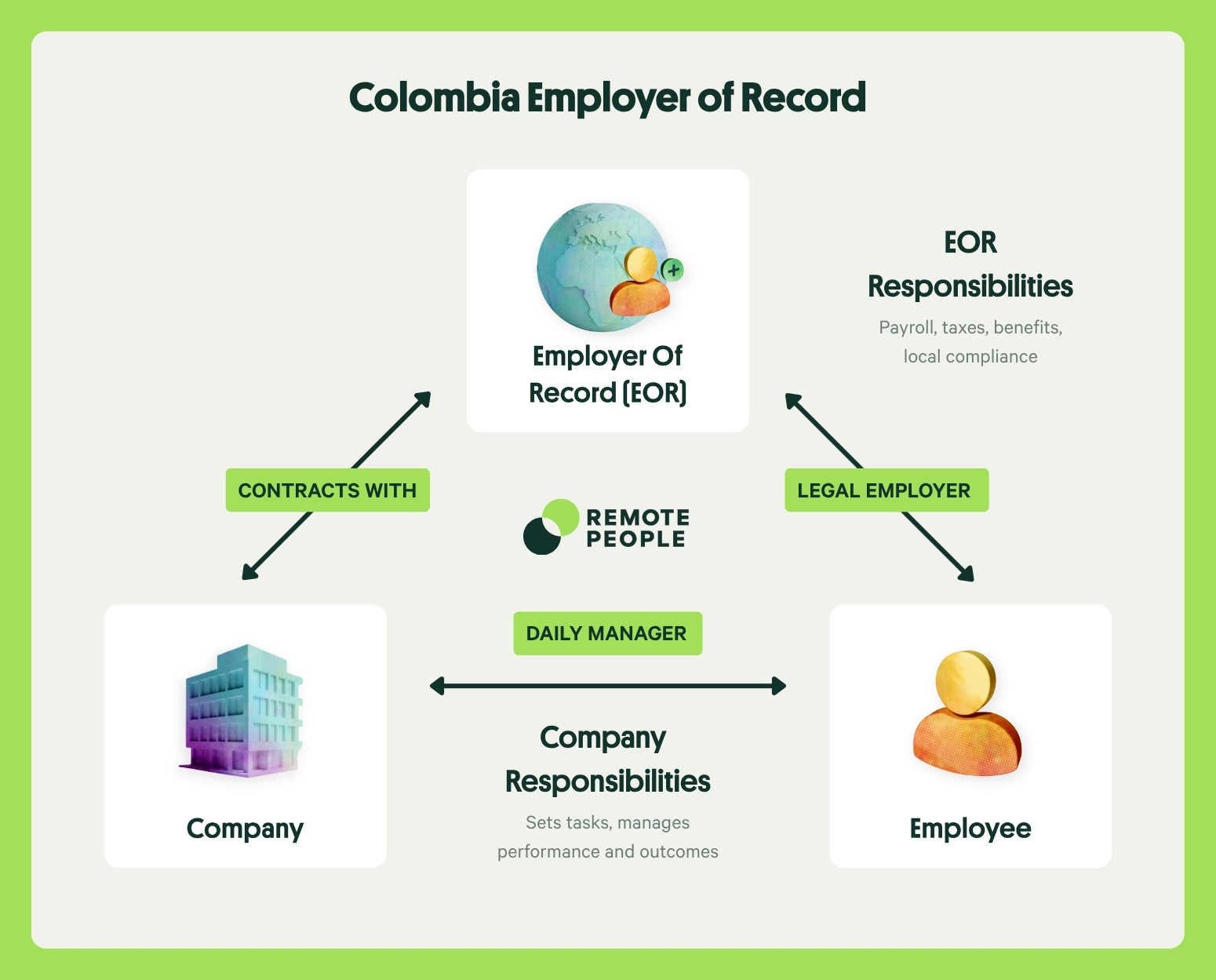
An employer of record in Colombia removes the need to incorporate a local company while keeping every hire fully compliant with Colombian labour law. The EOR acts as the legal employer on paper, managing Spanish-language employment contracts, social security enrolment, prestaciones sociales, income tax withholding, and work visa sponsorship. You retain full operational control over the employee’s day-to-day work, performance, and deliverables.
How an Employer of Record Works in Colombia
If you’d like to learn more about how Employer of Record (EOR) services work, read our What Is an Employer of Record (EOR)? guide for a complete overview of the model, its benefits, and when to use it.
If you’re comparing providers, our Best Employer of Record (EOR) Providers guide reviews the leading platforms to help you choose the right solution for your business.
Who Uses an EOR in Colombia?
Companies typically use an employer of record in Colombia to test the Andean market before committing to a full entity, to hire a small team of one to fifteen people without the overhead of incorporation, or to onboard a single high-value hire in one to two weeks rather than the two to four months a local entity setup would take. The model is particularly useful for firms hiring bilingual software engineers in Medellín, customer support agents in Bogotá, or finance and operations talent in Cali and Barranquilla, where nearshore cost advantages are meaningful for North American employers on the same time zone.
An EOR is the right fit for foreign companies that need local compliance without a permanent establishment, for employers converting existing Colombian contractors into full employees to reduce misclassification exposure under DIAN rules, and for organisations that need to offer statutory benefits quickly to attract senior talent in a competitive market.
Typical Onboarding Timeline
The onboarding process typically takes one to two weeks for Colombian nationals, broken into five clear stages.
- First, sign the EOR service agreement and share the employee’s details including full name, cédula de ciudadanía, salary, and start date (1–2 days).
- Second, the EOR drafts a compliant Spanish-language employment contract and sends it for signature (2–3 days).
- Third, EPS, AFP, ARL, and Caja de Compensación registration happen in parallel through the PILA platform, together with DIAN tax enrolment if needed (3–5 business days).
- Fourth, payroll configuration, benefits enrolment, and bank account verification are finalised (1–2 days).
- Fifth, the employee officially starts work and receives their first paycheck on the next monthly payroll cycle.
If the hire is a foreign national requiring an M-5 work visa, add 4 to 8 weeks for processing through the Ministerio de Relaciones Exteriores and Migración Colombia. An expedited pathway may be available for senior technical roles and intra-company transferees already approved by the Ministry of Labour.
Hire in Colombia
RemotePeople handles payroll, compliance, and benefits in Colombia so you can focus on building your team. No entity setup required.
Employment Laws and Regulations in Colombia
Employment Contracts
The Código Sustantivo del Trabajo of 1950, together with its subsequent amendments, governs every employment relationship in Colombia and is administered by the Ministerio del Trabajo. Written contracts are mandatory for fixed-term, part-time, and foreign worker arrangements, and strongly advised for all indefinite-term hires. Indefinite-term contracts (contrato a término indefinido) are the default for ongoing roles, while fixed-term contracts (contrato a término fijo) may only be used for defined-duration work and are capped at three consecutive renewals of less than one year before they must be extended to at least one year.
Employment contracts must be written in Spanish and must specify job title, workplace, salary, working hours, leave entitlement, probation clause if any, and notice terms. Verbal agreements are permitted only for indefinite contracts but are strongly discouraged because they create evidentiary risk in the event of a labour dispute before the Ministerio del Trabajo or the labour courts.
Working Hours and Overtime
The maximum legal workweek in Colombia is 44 hours as of April 2026, reducing to 42 hours from 15 July 2026 under Ley 2101 of 2021. The law has phased in the reduction from the historical 48 hours: 47 hours from July 2023, 46 hours from July 2024, 44 hours from July 2025, and 42 hours from July 2026. Employers may distribute the weekly hours over five or six days, with a minimum of four and a maximum of nine hours per day without incurring overtime, provided the weekly total does not exceed the legal cap.
Overtime is paid at 125% of the ordinary rate for daytime hours and at 175% for night work performed between 9:00 p.m. and 6:00 a.m. Work performed on Sundays and public holidays is paid at 200% of the regular rate when it is not compensated with substitute rest. Overtime is capped at 2 hours per day and 12 hours per week and requires prior authorisation from the Ministerio del Trabajo except in emergency situations.
Minimum Wage
The statutory national minimum wage (Salario Mínimo Mensual Legal Vigente, SMMLV) in Colombia is COP 1,750,905 per month, equivalent to approximately $480 at the April 2026 exchange rate of $1 = 3,650 COP. The rate took effect on 1 January 2026 under Decree 0159 of 2026, which ratified Decrees 1469 and 1470 of December 2025 and represented a 23% increase from the previous rate of COP 1,423,500 set in December 2024. Colombia also pays a mandatory transport allowance (auxilio de transporte) of COP 249,095 per month, equivalent to about $68, to all employees earning up to two SMMLV. The combined minimum compensation floor for most entry-level employees is therefore approximately $548 per month.
For more detail on the 2026 minimum wage, including the historical sequence of increases and the sector variations, see the Colombia minimum wage guide.
Probation Period
Probation periods in Colombia may last up to two months (60 calendar days) for indefinite-term contracts under Article 78 of the Código Sustantivo del Trabajo. For fixed-term contracts shorter than one year, the probation period is capped at one-fifth of the contract term, up to a maximum of two months. Probation must be expressly included in the written employment contract to be enforceable; if the contract does not mention probation, the employee is considered permanent from day one. During probation, either party may terminate the employment relationship in good faith without notice and without severance, provided the termination is not discriminatory.
Leave Entitlements
Colombian law provides a comprehensive set of statutory leave entitlements under the Código Sustantivo del Trabajo and Ley 100 of 1993, covering paid annual leave, sick leave jointly funded by the employer and the EPS, maternity and paternity leave funded by the EPS, and specific family event leave. The EPS funds most medical and parental leave after the initial employer-covered period.
Annual Leave
Paid annual leave in Colombia is 15 working days per year of service under Article 186 of the Código Sustantivo del Trabajo. Leave accrues monthly from the start of employment at the rate of 1.25 working days per month and becomes available after the first full year. Employees must take at least six consecutive days of leave; the remaining days may be split by agreement. Any accrued and unused leave must be paid out in cash upon termination, calculated on the basis of the most recent monthly salary plus any habitual bonuses and the transport allowance.
Sick Leave
Sick leave in Colombia is funded jointly by the employer and the EPS. The employer pays the first two days of incapacity at two-thirds (66.67%) of the employee’s salary, and the EPS pays from day three onward at the same rate for common illness (enfermedad general) for up to 180 days. After day 181 and up to day 540, the pension fund takes over the subsidy. A medical certificate from an EPS-affiliated physician is required for any absence beyond two days.
Maternity Leave
Maternity leave in Colombia is 18 weeks of fully paid leave under Ley 1822 of 2017, with at least one week mandatory before the expected delivery date and the remaining weeks taken after. The leave is fully funded by the EPS, not the employer, provided the mother has contributed during her pregnancy. Multiple births extend the leave by two additional weeks. Job protection during pregnancy and for three months after delivery means the employee cannot be dismissed without prior authorisation from a labour inspector under the fuero de maternidad.
Paternity Leave
Paternity leave in Colombia is two weeks of fully paid leave under Ley 2114 of 2021, applicable to biological and adoptive fathers. The leave is funded by the EPS on the same basis as maternity leave. The father must have contributed to the EPS during the pregnancy to qualify, and the leave must be taken within the first 30 days after birth.
Other Statutory Leave
Colombian law provides additional paid leave for specific life events under Article 57 of the Código Sustantivo del Trabajo.
- Bereavement leave of 5 working days for the death of a spouse, parent, child, or sibling.
- Marriage leave of 5 working days under collective agreements, though not a universal statutory entitlement.
- Voting leave of half a working day for employees who vote in national, regional, or local elections.
- Medical appointment leave for pregnancy-related prenatal check-ups and for children under two years of age.
- Union leave for elected union representatives attending meetings or training.
Colombia statutory leave entitlements · Per Código Sustantivo del Trabajo | ||
Leave Type | Duration | Eligibility & Notes |
|---|---|---|
Annual leave | 15 working days | Accrues at 1.25 days per month; available after first full year. Employer-funded |
Sick leave | Up to 180 days | Employer pays first 2 days at 66.67%; EPS pays from day 3 onward |
Maternity leave | 18 weeks | Fully paid by EPS; 1 week mandatory prenatal; fuero de maternidad protects job |
Paternity leave | 2 weeks | Fully paid by EPS under Ley 2114 of 2021; must be taken within 30 days of birth |
Bereavement leave | 5 working days | Death of spouse, parent, child, or sibling. Employer-funded |
Voting leave | Half working day | For national, regional, or local elections. Employer-funded |
Medical check-up leave | As needed | Prenatal visits and care for children under 2 years old |
Source: Código Sustantivo del Trabajo and Ministerio del Trabajo | ||
Statutory Employee Benefits
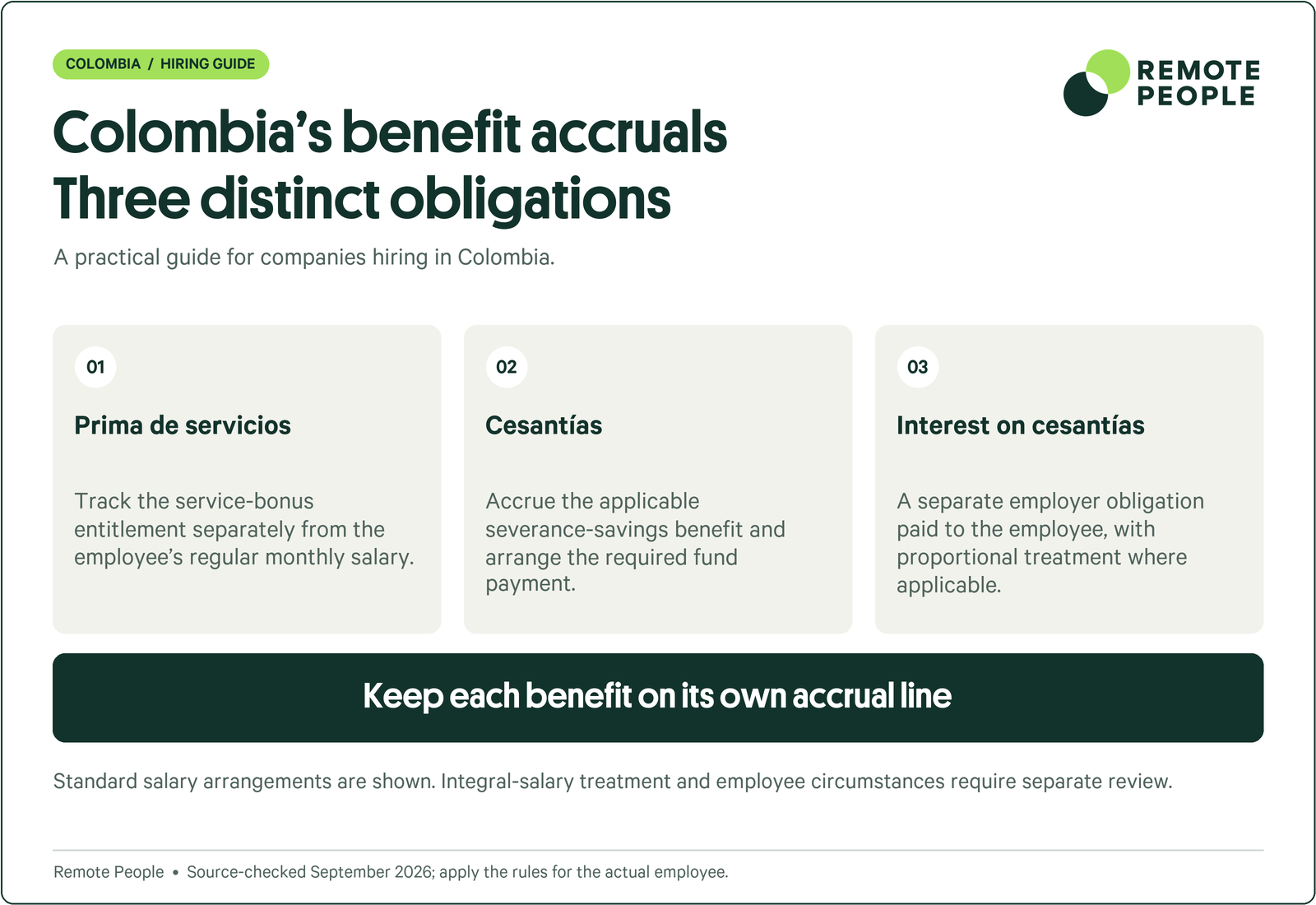
Colombian employers must fund several mandatory benefits beyond base salary and social security contributions. The most significant are the prestaciones sociales, which include the prima de servicios (an additional month of salary per year, paid in two instalments on 30 June and 20 December), the cesantías (a severance savings equivalent to one month of salary per year of service, deposited annually into a cesantías fund by 14 February of the following year), and the intereses sobre cesantías (12% annual interest on the cesantías balance, paid directly to the employee). Combined, these prestaciones add approximately 21.83% to the employer’s monthly payroll cost on top of the social security contributions.
Employers must also register employees with an Entidad Promotora de Salud (EPS) for universal health coverage, an Administradora de Fondos de Pensiones (AFP) for retirement savings, an Administradora de Riesgos Laborales (ARL) for occupational risk insurance, and a Caja de Compensación Familiar (CCF) for family welfare benefits. The CCF provides subsidised recreation, housing loans, and family subsidies, and is mandatory for all employees regardless of salary level. For a full breakdown, see the Colombia employee benefits guide.
Recent Regulatory Updates (2026)
Three significant labour law updates take effect in 2026. First, the minimum wage rose by 23% to COP 1,750,905 effective 1 January 2026 under Decree 0159 of 2026, the largest single-year increase in over two decades. Second, the workweek drops from 44 hours to 42 hours on 15 July 2026, completing the phased reduction under Ley 2101 of 2021 without any corresponding salary reduction. Third, Ley 2466 of 2025 allows employers and employees to agree in writing to pay interest on cesantías monthly (at 1% of the liquidation base) instead of the traditional annual lump-sum payment by 31 January.
The long-discussed Reforma Laboral continues to progress through Congress but has not been fully enacted as of April 2026. Employers should monitor the Ministerio del Trabajo website for any additional implementation decrees.
Work Permits and Visas in Colombia
Work Permit Requirements
Who Needs a Work Permit
Foreign nationals employed in Colombia require an M-type (Migrante) visa, specifically the M-5 Worker Visa for those hired under a local employment contract. Citizens of Mercosur member states benefit from simplified residence and work arrangements, and nationals of countries that have bilateral labour agreements with Colombia may be eligible for expedited processing. Short business trips of up to 180 days do not require a work visa but do not permit paid employment.
Colombia work visa options · 2026 overview | |||
Visa type | Who it is for | Validity and processing | Work rights |
|---|---|---|---|
M-5 Worker Visa (Migrante Trabajador) | Foreign nationals hired under a local Colombian employment contract sponsored by an employer or EOR | Up to 3 years, tied to employment contract; processing 2 to 5 weeks | Full right to work for the sponsoring employer only |
M-Type Migrante (other subtypes) | Investors, independent professionals, Colombian nationals’ spouses and dependents, mental health professionals | 1 to 3 years depending on subtype; renewable | Conditional on category; investor and professional classes allow self-employment |
Mercosur Residence Visa | Citizens of Argentina, Bolivia, Brazil, Chile, Ecuador, Paraguay, Peru and Uruguay under bilateral agreement | 2 years temporary, convertible to permanent after registration with Migración Colombia | Full work rights once cedula de extranjeria is issued |
V-Type PIP-5 Business Visitor | Short business trips: meetings, contract negotiations, client visits, conferences, training sessions | Up to 180 days per calendar year; visa waiver available for 90 plus nationalities | No paid employment permitted; no local salary or payroll allowed |
R-Type Resident Visa | Foreign nationals after 5 years on an M-type visa, or via qualifying investment thresholds under Resolucion 5477 of 2022 | Indefinite, renewed every 5 years with proof of continued residency | Unrestricted work rights with any Colombian employer or as self-employed |
Eligibility and Required Documents
To qualify for an M-5 Worker Visa, the foreign employee must have a signed employment contract with a Colombian employer, and the sponsoring employer must demonstrate monthly income of at least 100 SMMLV (approximately $48,025 per month at 2026 rates) to support the hire. Required documents include a valid passport with at least six months of validity, the signed employment contract in the official Ministerio de Relaciones Exteriores format, proof of professional qualifications, a criminal background check apostilled and translated into Spanish, and a passport-style photo. Foreign nationals must not fill more than 10% of a Colombian company’s total workforce for ordinary roles, though specialised technical positions may be exempt from this cap.
Processing Time and Validity
M-5 Worker Visa processing typically takes two to five weeks at Colombian consulates abroad or through the Ministerio de Relaciones Exteriores online portal. The visa is valid for up to three years and is tied to the sponsoring employment contract. If the contract ends, the visa must be cancelled or the employee must secure new sponsorship within 30 days.
Renewal Process
Renewal must be initiated at least 30 days before the current visa expires. The renewal process requires proof of ongoing employment, continued social security enrolment, and a valid Cédula de Extranjería issued by Migración Colombia within 15 days of the employee’s initial arrival. Renewal typically takes two to four weeks, and employees may continue working under the expiring visa during the processing window.
How an EOR Handles Work Permits
An employer of record in Colombia manages the full visa sponsorship process on your behalf, acting as the local sponsoring entity for the M-5 Worker Visa without requiring you to set up a Colombian subsidiary. The EOR prepares the Ministerio de Relaciones Exteriores contract format, coordinates document apostille and translation, submits the application on the SITAC online portal, and registers the employee with Migración Colombia upon arrival. As noted in the onboarding timeline above, a foreign hire adds approximately 4 to 8 weeks to the standard one-to-two-week EOR onboarding process. Colombia is one of the few Latin American jurisdictions where an EOR can directly sponsor foreign workers without a local entity, making it a practical entry route for companies hiring non-Colombian talent.
Payroll, Taxes, and Social Security in Colombia
Employer Contributions
Employers hiring in Colombia owe mandatory contributions on top of gross salary, funding social security, health, pensions, and other statutory schemes (PwC Worldwide Tax Summaries: Colombia). The table below lists the employer-side contribution rates so you can calculate the true all-in cost of each hire.
Colombia employer social security contributions · 2026 rates | ||
Contribution | Rate | Notes |
|---|---|---|
Pension (AFP) | 12.00% | Employer share under Ley 100 of 1993. Remitted to Colpensiones or a private pension fund |
Health (EPS) | 0.00% / 8.50% | Exempt for employees earning under 10 SMMLV under Article 114-1 of the Tax Code (Ley 1607 of 2012). 8.50% applies above 10 SMMLV |
Occupational Risk (ARL) | 0.522% | Class I risk (office-based roles). Higher classes II to V range from 1.044% to 6.960% depending on risk profile |
SENA (training) | 0.00% / 2.00% | Exempt for employees under 10 SMMLV. 2.00% applies above 10 SMMLV |
ICBF (child welfare) | 0.00% / 3.00% | Exempt for employees under 10 SMMLV. 3.00% applies above 10 SMMLV |
Family Compensation Fund (CCF) | 4.00% | Cajas de Compensación Familiar, mandatory for every employee regardless of salary level |
Total (salary under 10 SMMLV) | 16.52% | Standard white-collar burden with Article 114-1 exemption |
The employer’s total statutory burden in Colombia is 16.52% of gross salary for employees earning under 10 SMMLV (approximately $4,800 per month in 2026), which covers the vast majority of hires. For higher earners, the total rises to 30.02% because health, SENA, and ICBF contributions become payable. These figures exclude prestaciones sociales, which add approximately 21.83% on top of the social security base.
Employee Contributions
Alongside income tax, employees in Colombia pay statutory payroll deductions that fund social security, health cover, and other state schemes (PwC Worldwide Tax Summaries: Colombia). The table below summarises the employee-side contribution rates payroll must withhold from gross pay each month.
Colombia employee payroll deductions · 2026 monthly withholdings | ||
Deduction | Rate | Notes |
|---|---|---|
Health (EPS) | 4.00% | Employee share under Ley 100 of 1993, withheld and remitted by the employer |
Pension (AFP) | 4.00% | Employee share; paid to Colpensiones or a private AFP of the employee’s choice |
Solidarity Fund (FSP) | 1.00% – 2.00% | Applies only to salaries above 4 SMMLV. 1.00% from 4 to 16 SMMLV, rising to 2.00% above 20 SMMLV |
Income tax withholding | 0.00% – 39.00% | Retención en la fuente on monthly taxable base above 95 UVT, per Article 383 of the Tax Code |
Total (standard employee) | 8.00% | Plus progressive income tax for earners above 95 UVT monthly base |
Employees earning below 4 SMMLV (roughly $1,920 per month) pay a flat 8% in combined health and pension deductions. Higher earners contribute an additional 1% to 2% to the Solidarity Fund (FSP), and income tax withholding kicks in once the monthly taxable base exceeds 95 UVT (approximately COP 4,975,530 or $1,363 in 2026). For more detail on payroll mechanics and filing obligations, see the Colombia payroll and tax guide.
Income Tax
Personal income tax in Colombia is levied on a progressive basis, with the rate rising as taxable income crosses statutory thresholds (PwC Worldwide Tax Summaries: Colombia). The table below sets out the current income-tax brackets that apply to resident employees so you can model net-of-tax compensation before making an offer.
Colombia income tax brackets · 2026 | |
Annual Taxable Income (USD) | Tax Calculation |
|---|---|
Up to $15,640 | 0% (tax-free threshold) |
$15,640 to $24,390 | 19% on the amount above $15,640 |
$24,390 to $58,830 | 28% plus $1,663 fixed amount |
$58,830 to $124,410 | 33% plus $11,306 fixed amount |
$124,410 to $272,200 | 35% plus $32,947 fixed amount |
$272,200 to $444,820 | 37% plus $84,674 fixed amount |
Above $444,820 | 39% plus $148,543 fixed amount |
Colombia applies a seven-bracket progressive income tax with a top marginal rate of 39%. The tax-free threshold of 1,090 UVT means employees earning under approximately $15,640 per year pay no income tax. All brackets are denominated in UVT, and the UVT value for 2026 was set at COP 52,374 by DIAN Resolution 000238. Employees are entitled to a 25% exempt deduction on employment income up to 790 UVT per year, together with deductions for dependents, mortgage interest, and voluntary pension contributions.
Payroll Cycle
Payroll in Colombia is paid monthly or biweekly, with monthly being the most common cadence for salaried employees. Payments must be made in Colombian pesos through bank transfer to an account in the employee’s name, with cash payments permitted only in exceptional circumstances. Employers must issue a monthly payslip (desprendible de nómina) detailing gross salary, deductions, and net pay. Social security contributions are remitted through the PILA (Planilla Integrada de Liquidación de Aportes) platform by the deadline assigned to the employer’s NIT, typically between the 6th and 14th of the following month. Income tax withholdings are reported and paid monthly to DIAN.
13th Month Salary and Bonus Pay
Colombia does not use the 13th month terminology, but the prima de servicios functions as a mandatory equivalent. Every employer must pay 30 days of salary per year as prima, split into two equal instalments: 15 days by 30 June and 15 days by 20 December. The prima is calculated on the base salary plus any habitual bonuses and the transport allowance where applicable. Employees who leave mid-year receive a pro-rata prima based on days worked. In addition to the prima, employers must pay annual cesantías equivalent to one month of salary per year of service, deposited into a cesantías fund by 14 February of the following year, plus 12% annual interest on the cesantías balance paid directly to the employee by 31 January. Ley 2466 of 2025 now allows these interest payments to be made monthly by mutual agreement.
Cost of Hiring Through an EOR in Colombia
EOR Service Fees
EOR services in Colombia typically cost between $300 and $600 per employee per month. The fee covers contract drafting in Spanish, PILA filings, EPS, AFP, ARL, and CCF registration, monthly payroll processing, income tax withholding, prestaciones sociales administration, termination support, and compliance updates as Colombian labour law evolves.
Total Employment Cost Breakdown
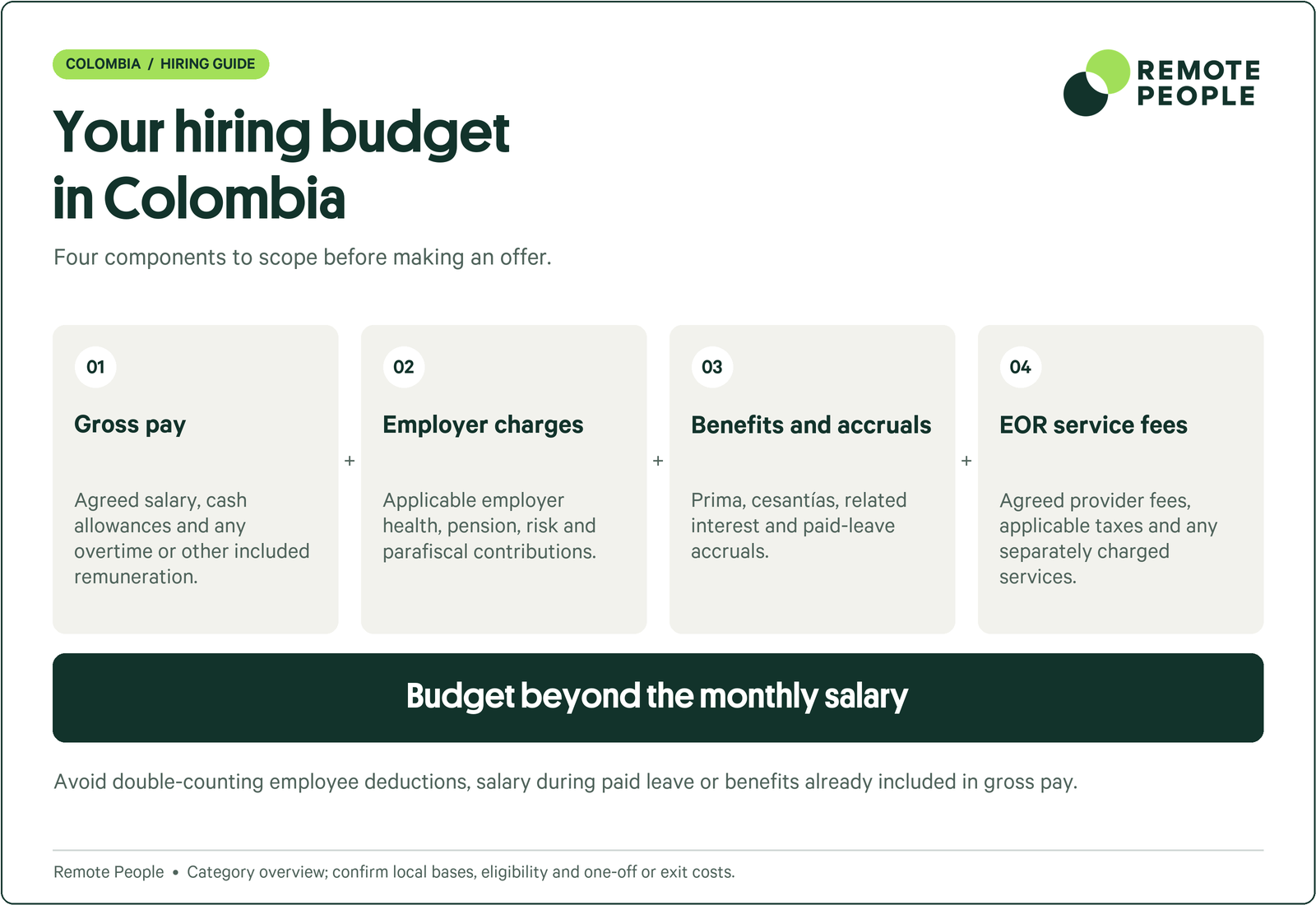
The all-in cost of employing someone in Colombia goes well beyond gross salary. The table below walks through a realistic cost build-up for a typical hire, layering mandatory employer social contributions, statutory benefits, and payroll taxes on top of base pay so finance teams can budget accurately before an offer goes out.
Colombia employer cost example · $1,500/month gross · 2026 | ||
Employer Cost | Amount (USD) | % of Gross |
|---|---|---|
Gross salary | $1,500.00 | 100.00% |
Pension (AFP) 12.00% | $180.00 | 12.00% |
Occupational Risk (ARL) 0.522% | $7.83 | 0.52% |
Family Compensation Fund (CCF) 4.00% | $60.00 | 4.00% |
Prima de servicios 8.33% | $125.00 | 8.33% |
Cesantías 8.33% | $125.00 | 8.33% |
Intereses sobre cesantías 1.00% | $15.00 | 1.00% |
Vacaciones accrual 4.17% | $62.50 | 4.17% |
EOR service fee | $400.00 | 26.67% |
Total monthly cost | $2,475.33 | 165.02% |
The total monthly cost of a $1,500 gross hire in Colombia through an EOR is approximately $2,475, or about 65% above the gross salary. The social security contributions add 16.52% and the prestaciones sociales add another 21.83%, for a combined statutory burden of approximately 38.35% before the EOR service fee. All USD amounts are approximate conversions at $1 = 3,650 COP (April 2026 rate) and assume the Article 114-1 exemption applies because the employee earns under 10 SMMLV. Higher earners or companies without the Article 114-1 exemption will see the statutory burden rise to approximately 51.85% due to the 8.5% health, 2% SENA, and 3% ICBF contributions becoming payable.
Ready to hire in Colombia? Get started with RemotePeople. We handle employment contracts, payroll, tax withholding, and full Colombia compliance. No local entity needed.
Benefits of Using an EOR in Colombia
Hiring through an employer of record in Colombia delivers speed, compliance certainty, and cost efficiency in one package. Instead of the two-to-four-month local entity setup, an EOR onboards a Colombian employee in one to two weeks, giving you a productive team member on payroll before the incorporation paperwork for a SAS would even be complete. The EOR also assumes full responsibility for the Código Sustantivo del Trabajo, DIAN, PILA, and Migración Colombia obligations, transferring compliance risk away from your business. For companies with only one or two hires in Colombia, this eliminates the recurring cost of local accountants, labour lawyers, and payroll software that a self-managed entity would require.
The EOR model also provides flexibility to scale up or down without penalty. A local SAS costs roughly $3,000 to $6,000 to incorporate and another $3,000 to $8,000 per year to maintain, even for a single hire, and closing it if your Colombia plans change requires a formal dissolution process. An EOR contract can be terminated on short notice with no wind-down cost, and the employee can be offboarded compliantly under Article 64 indemnización rules. Add to this the EOR’s access to strong local benefits packages, which are often hard for foreign employers to negotiate directly with Colombian EPS providers and AFPs, and the result is a materially lower total cost of entry than any entity-based alternative.
Finally, an EOR gives you local expertise without hiring it. Colombian labour law is highly protective of workers, and subtle compliance missteps around fuero de maternidad, just-cause termination, or the 10% cap on foreign workers can create significant liability. A competent EOR has dealt with these nuances hundreds of times and provides operational protection that a foreign HR team cannot replicate from abroad.
Termination and Offboarding in Colombia
Notice Periods
Colombia does not impose a statutory minimum notice period for terminating an indefinite-term employment contract, but the employer must either provide just cause under Article 62 of the Código Sustantivo del Trabajo or pay the statutory indemnización described below. During the two-month probation period, either party may terminate the contract in good faith without notice or severance. For fixed-term contracts, the employer must notify the employee in writing at least 30 days before expiration if the contract will not be renewed; failure to give this notice automatically renews the contract for the same original term.
Severance Pay
Calculation Method
Indemnización por despido sin justa causa is regulated by Article 64 of the Código Sustantivo del Trabajo and depends on whether the employee earned above or below 10 SMMLV. Employees earning under 10 SMMLV are entitled to 30 days of salary for the first year of service plus 20 days of salary for each additional year or pro-rata fraction. Employees earning at or above 10 SMMLV (approximately $4,800 per month in 2026) are entitled to 20 days of salary for the first year plus 15 days of salary for each additional year or pro-rata fraction. The calculation base is the average salary earned in the last year of service, including habitual bonuses, commissions, overtime, and the transport allowance where applicable.
Caps and Exceptions
No statutory cap applies to indemnización in Colombia, though the formula itself acts as a natural ceiling because long-tenured employees accumulate fewer days per year above the first. For fixed-term contracts terminated early without just cause, the indemnización equals the salaries remaining until the contractual end date, with a minimum floor of 15 days of pay. Employees on fuero sindical (union protection), fuero de maternidad (maternity protection), or fuero de salud (health protection due to a work-related condition) cannot be dismissed without prior authorisation from a labour inspector, and unauthorised terminations trigger reinstatement plus back pay. Cesantías and prima de servicios accrued up to the termination date must also be paid out at offboarding.
Grounds for Termination
Article 62 of the Código Sustantivo del Trabajo lists 15 grounds for just-cause termination by the employer, including serious misconduct, repeated breach of contractual obligations, revealing trade secrets, willful damage to company property, and failing to attend work for justified reasons. Termination for just cause avoids the indemnización but requires written notice to the employee specifying the factual grounds, and the employee may contest the dismissal before a labour court. Termination without cause is legally permitted but triggers the full indemnización under Article 64. Collective dismissals affecting 30% or more of the workforce (or lower thresholds at smaller companies) require prior authorisation from the Ministerio del Trabajo.
EOR vs. Other Hiring Models in Colombia
EOR vs. Setting Up a Local Entity
Choosing between an Employer of Record and setting up your own legal entity in Colombia comes down to timeline, upfront cost, ongoing administrative burden, and how quickly you can scale up or wind down. The table below lays out both paths side by side across setup time, cost, compliance risk, and flexibility so you can match the right model to the size and duration of your Colombia hiring plan.
Colombia EOR vs local entity comparison · Setup time, cost, risk and best-fit | ||
Comparison | Employer of Record | Own Entity (SAS) |
|---|---|---|
Setup time | 1–2 weeks | 2–4 months |
Upfront cost | $0 | $3,000–$6,000 |
Ongoing cost | $300–$600/employee/month | $3,000–$8,000/year maintenance |
Local partner required | No (EOR is the local entity) | No (foreign 100% ownership allowed) |
Social insurance registration | Handled by EOR | You manage it |
Payroll & tax filing | Handled by EOR | You manage it (or outsource) |
Best for team size | 1–15 employees | 15+ employees |
Scale down / exit | Easy, no entity to unwind | Costly, legal dissolution required |
Government contracts | Not eligible | Eligible (requires local entity) |
The most meaningful difference between an EOR and a Colombian SAS is time to first paycheck. An EOR can have your employee on compliant payroll within two weeks, while incorporating a SAS, obtaining an NIT from DIAN, opening a local bank account, and registering with the social security PILA system typically consumes two to four months. The second difference is the cost curve: below about 15 employees, an EOR’s per-employee fees are lower than the fixed overhead of running your own SAS because the entity maintenance costs (accountant, labour lawyer, payroll software, annual DIAN filings) do not scale down.
The SAS model becomes advantageous once you cross roughly 15 to 20 employees, the payroll volume justifies a dedicated Colombian finance function, or you need to pursue public-sector contracts that require a Colombian taxpayer. Many companies use an EOR for the first three to twelve months to validate the market, then convert to a SAS once growth is established. RemotePeople supports this transition with employee continuity, transferring existing cesantías balances and seniority calculations to the new entity.
EOR vs. Hiring Independent Contractors
Classifying a Colombia-based worker as an independent contractor rather than an employee can expose you to back-taxes, unpaid social contributions, and reclassification penalties if the working relationship looks like employment in practice. The table below contrasts EOR employment with contractor engagement across legal relationship, tax and benefits treatment, IP ownership, and misclassification risk so you can pick the right model role by role.
Colombia EOR vs independent contractors · Compliance, cost, and risk | ||
Comparison | EOR (Full-Time Employee) | Independent Contractor |
|---|---|---|
Legal relationship | Employee of the EOR | Self-employed, no employment relationship |
Compliance risk | Low. EOR ensures CST compliance | Higher if relationship resembles employment (misclassification risk) |
Payroll & tax | EOR handles withholding, PILA, filings | Contractor invoices you; they handle their own taxes and PILA |
Benefits & leave | Prestaciones sociales, paid leave, social security | No entitlement to employee benefits |
IP protection | Stronger; employment contract assigns IP by default | Weaker; requires explicit IP assignment clause |
Termination | Subject to Article 64 notice and indemnización | Contract can be ended per agreement terms |
Best for | Long-term, core team roles | Short-term projects, specialised tasks |
Cost structure | Salary + contributions + prestaciones + EOR fee | Contractor fee (typically higher gross, lower total cost) |
Source: Código Sustantivo del Trabajo and DIAN | ||
Hiring independent contractors through a contrato de prestación de servicios is only appropriate in some cases, such as short-term project work, specialised consulting engagements, or roles with genuine autonomy over schedule and deliverables. Colombia’s labour courts apply the principle of primacía de la realidad, meaning the actual working relationship trumps the label on the contract. If a contractor works fixed hours, uses company equipment, reports to a manager, and receives regular monthly payments, the courts will frequently reclassify the relationship as employment, exposing the employer to retroactive prestaciones, unpaid social security, DIAN penalties, and indemnización.
For ongoing roles that resemble employment, an EOR is the compliant alternative. It provides the same flexibility as a contractor engagement from your operational perspective while ensuring full legal classification as an employee. For genuine project-based contractor work, RemotePeople also offers a dedicated contractor management solution that handles compliant payments, classification assessments, and IP protection for Colombian contractors.
EOR vs. PEO (Professional Employer Organization)
EORs and PEOs both simplify international hiring, but only an EOR becomes the legal employer of record in Colombia — a critical distinction when you don’t have a local entity of your own. The table below maps the practical differences across legal employer status, entity requirement, liability allocation, and scope of coverage.
Colombia EOR vs PEO comparison · Legal employer, liability, and setup | ||
Comparison | Employer of Record (EOR) | PEO |
|---|---|---|
Legal employer | EOR is the legal employer | You remain the legal employer (co-employment) |
Local entity required | No; the EOR is the local entity | Yes; you must have your own SAS in Colombia |
Best for | Companies without a local entity | Companies that already have a local entity |
Compliance liability | EOR assumes compliance responsibility | Shared liability between you and the PEO |
Setup time | 1–2 weeks | Depends on your entity setup (weeks to months) |
Control over HR policies | EOR manages within CST framework | More direct control, PEO advises |
Typical use case | Market entry, small remote teams, testing Colombia | Established Colombian operations needing HR outsourcing |
Colombia does not have a formal PEO framework in the way the United States does. The closest local equivalent is an Empresa de Servicios Temporales (EST) regulated by Decree 4369 of 2006, which provides temporary workers to a user company but is not a true co-employment arrangement. In practice, companies looking at “PEO” services for Colombia almost always end up with either an EOR arrangement (where the EOR is the full legal employer) or a payroll outsourcing contract that requires an existing SAS.
The practical choice for most foreign companies is therefore between an EOR (if you have no Colombian entity) and payroll outsourcing (if you already do). EOR is the clear winner for market entry and small teams; payroll outsourcing makes sense once your Colombian SAS is fully operational and you want to reduce administrative overhead without transferring legal employer status.
Public Holidays in Colombia
Colombia observes a defined set of official public holidays on which most private-sector employers must give staff a paid day off (timeanddate.com Colombia 2026). The table below lists the statutory holidays employers need to build into payroll calendars and leave planning for the year, along with the date rule for each.
Colombia public holidays · 2026 calendar year | ||
Date | Holiday | Type |
|---|---|---|
1 January (Thursday) | Año Nuevo (New Year’s Day) | Civic |
12 January (Monday) | Día de los Reyes Magos (Epiphany) | Religious (moved to Monday) |
23 March (Monday) | Día de San José (Saint Joseph’s Day) | Religious (moved to Monday) |
2 April (Thursday) | Jueves Santo (Maundy Thursday) | Religious |
3 April (Friday) | Viernes Santo (Good Friday) | Religious |
1 May (Friday) | Día del Trabajo (Labour Day) | Civic |
18 May (Monday) | Ascensión del Señor (Ascension Day) | Religious (moved to Monday) |
8 June (Monday) | Corpus Christi | Religious (moved to Monday) |
15 June (Monday) | Sagrado Corazón (Sacred Heart) | Religious (moved to Monday) |
29 June (Monday) | San Pedro y San Pablo (Saints Peter and Paul) | Religious (moved to Monday) |
20 July (Monday) | Día de la Independencia (Independence Day) | Civic |
7 August (Friday) | Batalla de Boyacá | Civic |
17 August (Monday) | Asunción de la Virgen (Assumption of Mary) | Religious (moved to Monday) |
12 October (Monday) | Día de la Raza (Columbus Day) | Civic (moved to Monday) |
2 November (Monday) | Día de Todos los Santos (All Saints’ Day) | Religious (moved to Monday) |
16 November (Monday) | Independencia de Cartagena | Civic (moved to Monday) |
8 December (Tuesday) | Inmaculada Concepción (Immaculate Conception) | Religious |
25 December (Friday) | Navidad (Christmas Day) | Religious |
Source: timeanddate.com Colombia 2026 and Ministerio del Trabajo | ||
Colombia observes 18 public holidays in 2026, making it one of the most holiday-rich calendars in Latin America. Under Ley 51 of 1983 (Ley Emiliani), most holidays that fall on a Tuesday through Friday are moved to the following Monday to create long weekends; the Easter triduum, Immaculate Conception, and Christmas are fixed on their original dates. Employees who work on a public holiday are entitled to 200% of their regular rate, plus substitute rest where agreed. Payroll scheduling should account for these holidays, particularly around Semana Santa in April and the December cluster.
How to Get Started with an EOR in Colombia
Engaging an employer of record in Colombia is a straightforward five-step process.
- First, define the role you want to fill, including salary range in USD or COP, start date, and any specific requirements such as language skills or bilingual proficiency.
- Second, request a quote from RemotePeople including the monthly EOR fee and the all-in employer cost for your proposed salary. We will confirm the applicability of the Article 114-1 exemption based on the salary band.
- Third, sign the EOR service agreement and share employee details including full name, cédula de ciudadanía, bank account, and emergency contact.
- Fourth, RemotePeople drafts the Spanish-language employment contract and handles EPS, AFP, ARL, and Caja de Compensación registration through the PILA platform.
- Fifth, your employee starts work within one to two weeks of the signed agreement and receives their first paycheck on the following monthly payroll cycle.
For a compliant, fast, and cost-effective path to hiring in Colombia, contact our team to start the process today.
Where companies hiring in Colombia expand next
Companies hiring in Colombia commonly expand across South America, leveraging Spanish and Portuguese talent pools and regional trade frameworks. Teams frequently add hiring in Ecuador for the Andean corridor’s Spanish-speaking talent; an EOR partner in Panama often follows for aligned Spanish-speaking candidate pipelines; Peru is a common next step, offering aligned Andean-region cost and talent profile; and a team in Chile rounds out the regional footprint with shared Andean-market workforce norms.
Frequently Asked Questions
Employer of Record in
Employer of Record in
Employer of Record in
Employer of Record in
Employer of Record in
Employer of Record in
Employer of Record in
Employer of Record in