Recruit
Average Salary in Ethiopia
-
 Drew Donnelly
- Published
- September 21, 2026
Wondering what people earn in Ethiopia? Below you will find average wages by profession, current minimum wage figures, and how Ethiopia’s pay compares with other markets. Employers hiring locally often work with an Employer of Record (EOR) in Ethiopia to handle payroll and stay compliant without registering a business.
- 5 ★ on G2








Let RemotePeople handle payroll, compliance, and HR admin worldwide so you can focus on building your team.
Ethiopia’s expanding workforce and competitive labor costs have made it an increasingly attractive market for global hiring. Companies hiring through an employee of record (EOR) in Ethiopia should understand local salary benchmarks to make competitive offers and attract qualified talent. For employers hiring in Ethiopia, understanding the local requirements for employee background checks in Ethiopia can help ensure candidates are screened properly and compliantly.
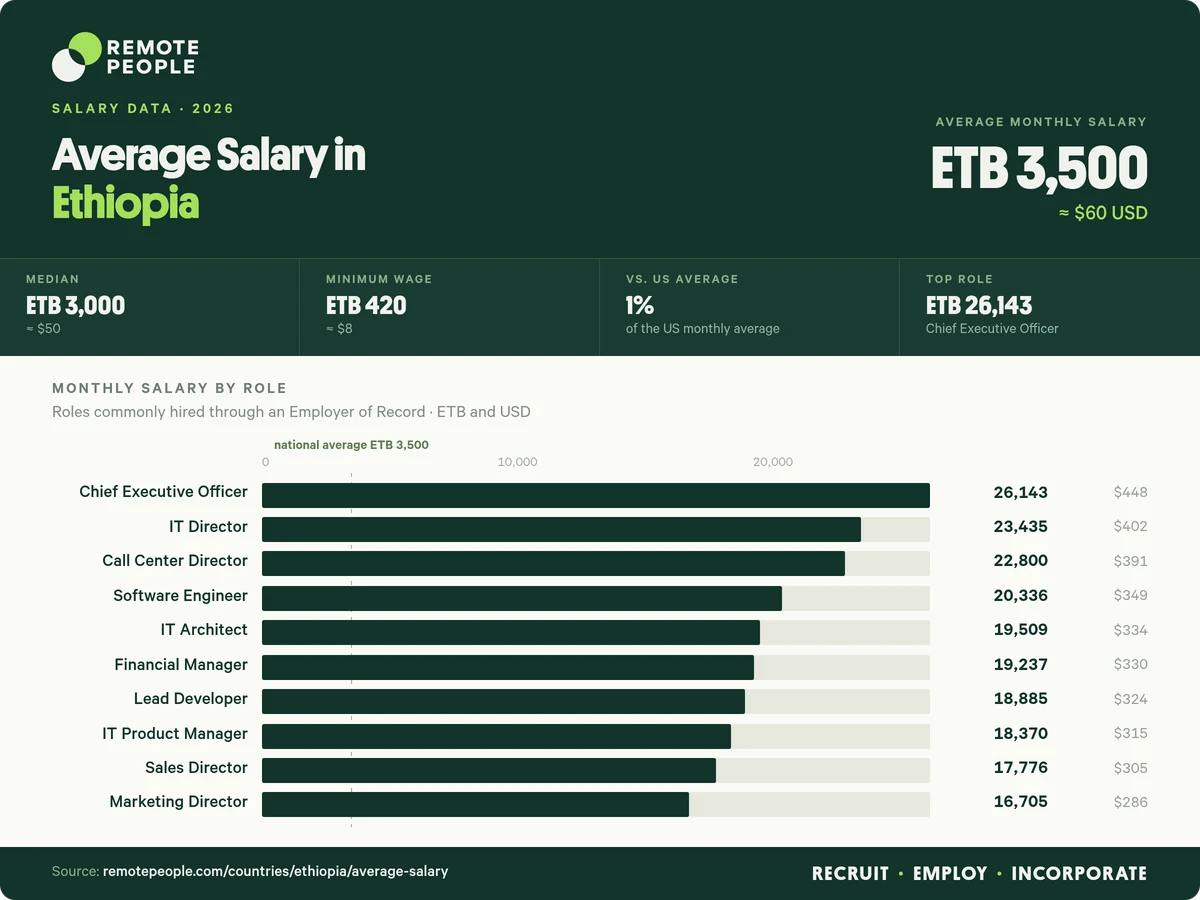
The average monthly salary in Ethiopia is 3,500 Ethiopian Birr (ETB), which translates to about USD 60. However, you must also consider how salary is affected by education, experience, position, industry, and location. Median wage and salary range are other factors to consider.
This guide will review the various aspects of Ethiopian wages, providing the information you need to start hiring.
What is the Average Salary in Ethiopia?
The average salary Ethiopia is 3,500 ETB (approximately $60) per month. The government intentionally sets salaries low to attract foreign investors. However, many argue that these methods are exploitative.
Median Income
The median salary can also be considered the middle salary. Ethiopia’s median monthly income is 3,000 ETB (approximately $50). Half the country’s workers earn more than this amount, and the other half earn less.
Salary Range
The salary range spans from the lowest to the highest. Low-earners in Ethiopia make around 2,000 ETB (approximately $35) per month, while high-earners make closer to 15,000 ETB (roughly $255).
Salary Comparison by Profession
|
Profession |
Monthly Salary (ETB) |
|---|---|
|
Chief Executive Officer |
26,143 |
|
IT Director |
23,435 |
|
Call Center Director |
22,800 |
|
Software Engineer |
20,336 |
|
IT Architect |
19,509 |
|
Financial Manager |
19,237 |
|
Lead Developer |
18,885 |
|
IT Product Manager |
18,370 |
|
Sales Director |
17,776 |
|
Marketing Director |
16,705 |
|
Fabric Cutter |
4,662 |
|
Clothing Technologist |
4,643 |
|
General Laborer |
4,615 |
|
Packer |
4,547 |
|
Seamstress |
4,341 |
|
Porter |
4,194 |
|
Medical Records Clerk |
4,182 |
|
Tailor |
4,150 |
|
Nursery School Teacher Assistant |
3,659 |
Average Wage in Ethiopia by Education
Education is an issue in Ethiopia, primarily because teachers leave their positions due to low pay. However, Ethiopians who can access quality education find it pays off in higher salaries.
2023 data shows employees with higher education earned higher salaries as follows:
- Workers in the teaching and education industry earned an average of 3,800 ETB per month, seeing a 23% return on education
- Workers in the agricultural sector earned an average of 3,200 ETB per month, seeing a 15% return on education
- Workers in the health industry earned an average of 4,000 ETB per month, seeing a 16% return on education.
Comparatively, secondary school leavers earned an average of 1,800 ETB per month, with a 3% return on education, and primary school leavers earned an average of 1,400 ETB per month, with a 7% return on education.
Salary Comparison by Experience
Experience plays a role in Ethiopian wages. Experienced workers get hired at higher salaries and are eligible for raises as they move forward in their company. A likely salary trajectory is as follows:
- Entry-level administrative and junior management workers may earn around 3,000 ETB per month.
- After 1-2 years, salaries may increase to around 4,500 ETB.
- After 3-5 years, workers may move onto mid-level positions such as assistant managers and project supervisors. Salaries rise to 7,000 ETB.
- After 6-10 years, workers may be promoted to senior-level positions such as managers, project leaders, and expert consultants. They may earn closer to 10,000 ETB.
- Workers who have been at their company for 10 years or more may move to an executive level as senior consultants and industry leaders. Salaries will be 13,000 ETB or more.
Salary Comparison by Location
Location impacts salaries, with workers in urban areas earning more due to proximity to prominent companies offering more job opportunities and higher living costs. This situation rings true in Ethiopia, a country with a rapidly developing economy. Workers find higher wages in the capital city of Addis Ababa and other major cities like Dire Dawa, Gondor, Hawassa, and Mek’ele.
Urban workers also benefit from higher employment rates. 37% of urban workers are employed in a waged position, compared to only 2% of rural workers.
How Much is Minimum Wage in Ethiopia?
The minimum wage in Ethiopia is 420 ETB per month, approximately $7.50 Ethiopia minimum wage USD. The wage has not changed since at least 2012. However, as of 2024, the private sector has no minimum wage. Additionally, workers in industrial parks earn a minimum salary of 750 ETB (approx. $13.50) per month.
Average Salary in Ethiopia vs. the Rest of the World
Comparing Ethiopian salaries against salaries throughout the world provides a deeper perspective. The following charts compare Ethiopian wages to those in developed, developing, and undeveloped countries.
Ethiopia vs. Developed Countries
Country | Average Salary | Comparison to Average Ethiopia Salary |
|---|---|---|
United Kingdom | £3,000 (approx. $4,100) | − 6,733% |
United States | $5,220 | − 8,600% |
Norway | 50,000 NOK (approx. $4,700) | − 7,733% |
Germany | €4,300 (approx. $4,470) | − 7,350% |
Austria | €3,700 (approx. $4,050) | − 6,650% |
Ethiopia vs. Developing Countries
Country | Average Salary | Comparison to Average Ethiopia Salary |
|---|---|---|
Romania | 4,000 RON (approx. $835) | − 1,292% |
Russia | 73,700 RUB (approx. $700) | − 1,067% |
Albania | 83,330 ALL (approx. $860) | − 1,333% |
Kazakhstan | 342,000 KZT (approx. $645) | − 975% |
Ukraine | 18,000 UAH (approx. $500) | − 733% |
Ethiopia vs. Undeveloped Countries
Country | Average Salary | Comparison to Average Ethiopia Salary |
|---|---|---|
Thailand | 15,000 Baht (approx. $420) | − 600% |
Philippines | 15,000 PHP (approx. $265) | − 342% |
Vietnam | 7.5 million Dong (approx. $300) | − 400% |
Egypt | 3,900 EGP (approx. $125) | − 108% |
Pakistan | 60,000 PKR (approx. $210) | − 250% |
The United Nations classifies Ethiopia as a Least Developed Country. Despite recent rapid economic growth, it has a low per capita income and faces developmental challenges. Common issues include war, drought, land degradation, and government corruption.
It is a promising outsourcing destination due to its young population of tech-savvy individuals and low labor costs. However, some issues must be overcome, including infrastructure limitations, language barriers, and complexity in the business environment.
What are the Most Common Outsourced Industries in Ethiopia?
Employers who wish to partner with Ethiopian talent for outsourcing may consider the following services.
IT Services
Ethiopia’s tech industry is growing significantly and is expected to reach a projected $2.44 billion in 2026. This acceleration is due mainly to the Digital Ethiopia 2026 initiative, which aims to digitize the economy and promote tech adoption across sectors. Ethiopia is becoming a favorable destination for startups and notable companies like ArifPay and BeBlocky.
Ethiopian workers earn significantly less than their American counterparts, with monthly salaries ranging from $100 to $200. Employers who hire in this sector can see considerable savings.
Apparel Manufacturing
Ethiopia has one of the lowest minimum wages for garment workers globally, which equates to low-cost garment production. The government has developed industrial parks designed explicitly for garment manufacturing to attract large-scale production. The focus is on essential apparel items like jeans, T-shirts, and simple dresses.
Although companies can save substantially by partnering with Ethiopia’s apparel manufacturers, working with organizations that offer fair wages is best.
Agricultural Processing
Agriculture is the backbone of Ethiopia’s economy, contributing to a large percentage of the country’s GDP. Its staple crops include wheat, barley, teff, maize, sorghum, lentils, chickpeas, and coffee. Most agriculture is grown in small-scale environments.
Outsourcing agriculture can benefit companies by reducing costs. It has also been shown to increase the income of Ethiopian farmers.
Conclusion
Ethiopia is a country plagued by a low-income economy. Yet, it has a lot to offer in terms of young, skilled workers. Employers outsourcing to the government will help stimulate the work environment while benefiting from money savings. The situation benefits everyone involved.