
 Recruit


Let RemotePeople handle payroll, compliance, and HR admin worldwide so you can focus on building your team.
Ask any HR professional these days, and they’ll tell you that managing people is becoming more complex. Since the pandemic, more and more people have realized that they can work from home and are demanding remote or hybrid positions. Organizations are also looking beyond their geographical borders to hire employees based on their skills and not just where they live. Teams can be scattered across multiple states and even multiple countries all over the world.
So what can companies do? The answer is to look at technological solutions and service providers that can support their HR needs or even fulfill them completely.
What You’ll Discover:
- In-Depth Feature Analysis: A thorough breakdown of the features and usability of both platforms.
- Pricing Comparison: A detailed look at the costs associated with each service to assist with effective budgeting.
- Pros and Cons: Unbiased assessments of the strengths and limitations of Rippling and Workday.
This article features two of these providers, Rippling vs Workday. We’ll examine each one’s offerings and individual strengths and weaknesses. Then, we’ll compare them directly to show you the areas in which each one might be a good partner for your organization.
Rippling vs Workday Overview
| Feature | Rippling | Workday | Explanation |
|---|---|---|---|
| User reviews | G2: 4.8/5 TrustRadius: 8.7/10 |
G2: 4.0/5 TrustRadius: 8.2/10 |
Rippling’s reviews are very good, while Workday’s ratings are slightly lower. |
| Pricing | $500–600 per international employee/month; contractor price unknown | Not publicly listed — we’ve seen anything from $40–100 per person/month for in-country employees | Neither Rippling nor Workday posts their prices online, so we’ve only uncovered some of them. |
| User-friendliness | Very good | Good | Rippling’s reviews for ease of use, ease of setup, and quality of support are all higher. |
| Customer support | 24/7 live chat and phone support | 24/7 live chat and phone support | Rippling offers live support at all times, while Workday’s support is 24/5 or 24/7, depending on the client’s subscription level. |
| Integrations | Excellent | Excellent | Both Rippling and Workday can integrate with 600 HR, accounting, and financial apps. |
| Data security | Excellent | Excellent | Rippling is GDPR and SOC2 compliant and both CSA STAR Level 2 and ISO 27001 certified. Workday is compliant with SOC 1, SOC 2, Asia-Pacific Economic Cross-Border Privacy Rules, and GDPR and ISO 27001, 27017, 27018, and 27701 certified. |
| International hiring (EOR) | Very good | Very good | Rippling enables employee hiring in 29 countries and contractor hiring in 185. Through its partners, Workday supports hiring in up to 100 countries. |
| Recruitment | Good | Good | Neither provider performs recruiting directly. Rippling includes an ATS, while Workday has an ATS, candidate experience management, and referral management system. |
| Benefits administration | Excellent | Excellent | Both platforms help clients offer plenty of benefits to their employees, such as health insurance and pensions. |
| Payroll | Very good | Good | Both providers offer comprehensive payroll services in the US, though Workday doesn’t offer automatic tax filings. Rippling also manages payments for contractors and international employees. |
Rippling Overview
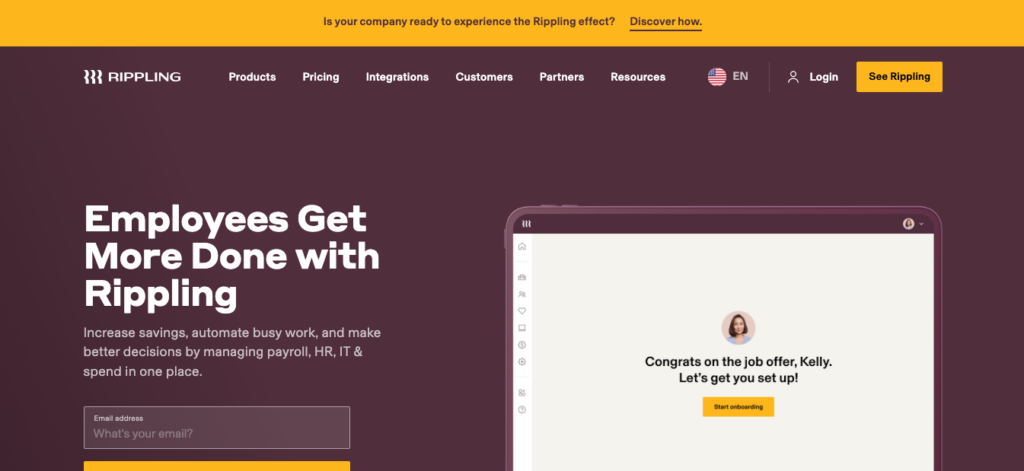
Rippling was started in 2016 in San Francisco. It was originally designed as a software-as-a-solution (SaaS) product, presenting itself as a human resources information system (HRIS). With extensive features, including time-tracking, payroll, performance management, and benefits administration, its goal was to help companies manage their employee data and HR services within a single platform. Rippling can be used as a standalone HRIS for small and medium businesses (SMBs) and even large enterprises because of its ability to scale easily to accommodate thousands of employees.
Because of its comprehensive platform, Rippling chose to expand its service provision into several other areas. It now offers payroll, contractor management, PEO (Professional Employment Organization), and EOR (Employer of Record) services primarily aimed at companies in the US. Its EOR service gives companies the ability to hire employees in other countries where they don’t own entities. Rippling’s entities and partners, instead, become the legal employers of its clients’ local staff in these countries. Rippling takes on the responsibility of maintaining compliance with all the labor and tax laws of these countries on behalf of its clients. It also manages HR for them by managing contract creation, onboarding, payroll, benefits, taxes, social security deductions, offboarding, and more. Rippling currently offers EOR services in just 29 countries; however, which is far fewer than many competitors in this space.
Rippling’s network is larger for contractor management. It can help clients hire independent contractors or freelancers in over 180 countries and pay them in their local or preferred currencies. This is as good as any international contractor management solution.
In the US, Ripping acts as a payroll and PEO provider. Organizations can easily sign up their workers and run multi-state payrolls with automated calculations and tax filings across the country. As a PEO, Rippling does more than just payroll. It also takes care of hiring, onboarding, training, multi-state payroll, mandatory and optional benefits administration, and many more HR needs for US employees. This complete HR outsourcing service is also available for workers in all 50 states.
Rippling doesn’t reveal its prices online; instead, it requires customers to request personalized quotes. We’ve discovered a starting price of $599/employee per month for EOR services, but we don’t know what it charges for contractor management or PEO services.
Rippling Pros and Cons
Rippling is an HRIS provider that has expanded into EOR and PEO services. Working with this service provider brings the following advantages and disadvantages:
- Pros
Benefits packages
Rippling lets employers offer benefits packages that include health, vision, dental, and life insurance as well as pensions to their employees. These packages can be made compliant in all 50 states and the 29 countries where it offers EOR services.
Extensive administration tools
Rippling is a standalone HR management tool with extensive features, including payroll, tax calculations, paid time off (PTO), time tracking, applicant management, and many other useful HR functions.
Mobile app
Rippling’s mobile app for iOS and Android devices is called Rippling HR, IT, and Finance. This app lets workers access their benefits, request time off, submit expenses, and view their payslips conveniently.
Extensive integrations
Rippling offers an incredible 600 + out-of-the-box integrations with financial, HR, and communication apps. These integrations help smooth workflows between companies’ existing software and Rippling’s HRIS.
- Cons
No pricing online
Rippling’s prices are not shown online. Instead, potential clients need to work through a lengthy process of explaining their needs to receive tailored quotes which can make it difficult to quickly compare it with other providers.
Platform complexity
Rippling’s HRIS is extensive and is a complex system to learn. While it’s still rated highly for ease of setup, mastering the platform can be challenging and time-consuming.
Limited support for international hiring
While it helps clients hire contractors in 188 countries worldwide, Rippling’s EOR service is limited to just 29 countries. Other competitors offer over 150-180 countries for truly global coverage.
Workday Overview
Workday is a very different service provider. This California-based company launched its human capital management (HCM) platform in 2016. Workday is also a complete, standalone HRIS that includes extensive features such as onboarding, training, time-tracking, benefits administration, talent management, performance management, analytics and reporting, payroll, workforce planning, and much more. This company handles SMB clients but also huge enterprises with millions of employees.
The Workday platform offers a huge number of ready-to-use integrations – over 600, in fact. These include links with finance, payroll, recruiting, and numerous other useful software solutions. This platform is also comprehensive and with so many functions, it can be difficult to learn how to use.
Workday offers a complete payroll solution that lets companies automate their payroll runs and tax and benefits calculations. However, it should be noted that Workday does not automatically file taxes; instead, it leaves this up to its clients to perform. It also offers extensive benefits packages and lets clients manage them easily through the platform. Workday partners with multiple well-known providers to offer benefits that are compliant with state and federal regulations and even employment laws around the world.
Workday is neither a PEO nor an EOR, however, it partners with other organizations that are. These partnerships enable it to arrange employee hiring in 100 countries worldwide and PEO services in the US, Canada, the UK, and France. However, because it works with established providers like Insperity and ADP, you can expect its prices to be higher than average for international hiring.
Workday Pros and Cons
Workday is a comprehensive HCM service provider specializing in medium and large enterprises. Its particular pros and cons include:
- Pros
Extensive administration tools
Workday offers so many features there’s no space to name them all. It essentially covers all aspects of HR so that it can act as a single management system for all employees’ needs.
Mobile app
Workday includes a mobile app for both iOS and Android devices. The app lets employees check in and out of work, view their payslips, make time off requests, and even submit expense reports.
Extensive integrations
Workday can integrate with over 600 software applications. These integrations represent a multitude of extra tools that help clients smooth their workflows and communicate data.
- Cons
Limited support for international hiring
Workday doesn’t manage international hiring for employees or contractors on its own. Instead, it works with third-party partners that can enable hiring in 100 countries. Workday doesn’t mention contractor hiring.
Challenging setup
Workday’s platform is very extensive, and while this isn’t a fault, it can be hard to learn how to use it. User reviews suggest that setting up this platform can be moderately difficult.
No pricing online
Workday doesn’t give any prices online so we can only guess what its services cost. User reviews suggest that they’re expensive.
Head-to-Head Comparison: Rippling vs Workday Features
Now that we’ve examined these two service providers on their own, it’s time to put them up against each other. Rather than looking for one clear winner, our goal here is to indicate the uses that each one would be best for.
User-friendly platform: Rippling Wins
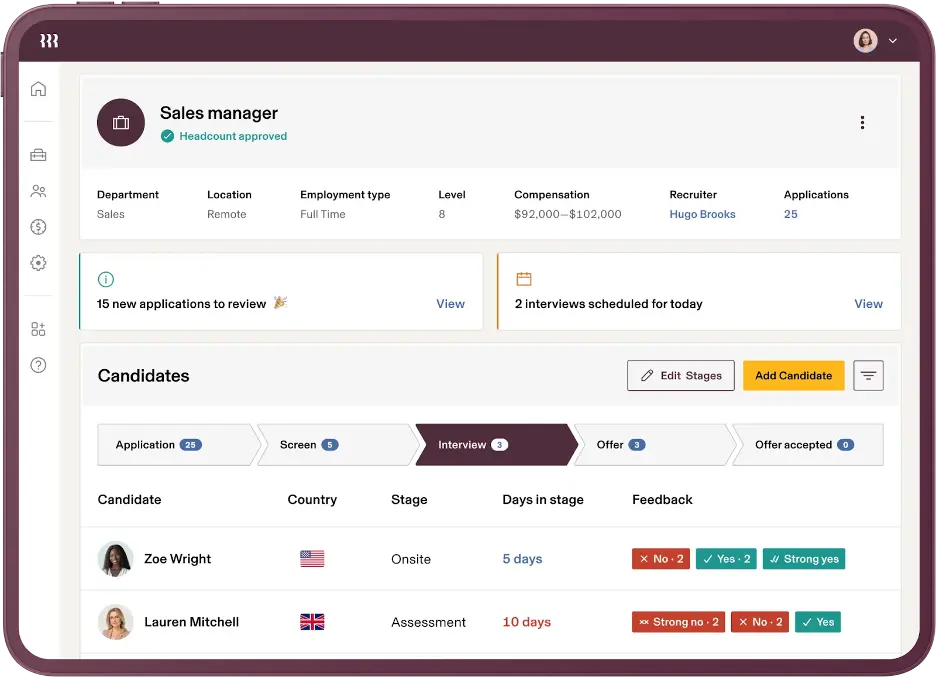
Rippling’s user ratings for ease of use, administration, and setup are all significantly higher than Workday’s. Both platforms are enormous and can take time to learn, but Rippling’s seems to be easier to get a handle on. Its support is also seen as delivering better quality service than Workday’s.
Resources: It’s a tie
Rippling has tools for analytics, global spend, and headcount, and also educational resources like Rippling University, webinars, and a blog. Workday features a blog, events, demos, webinars, and even direct training sessions to help HR admins learn to use its platform. We think these resources are quite equal and call this category a tie.
Integration with other software: Rippling Wins
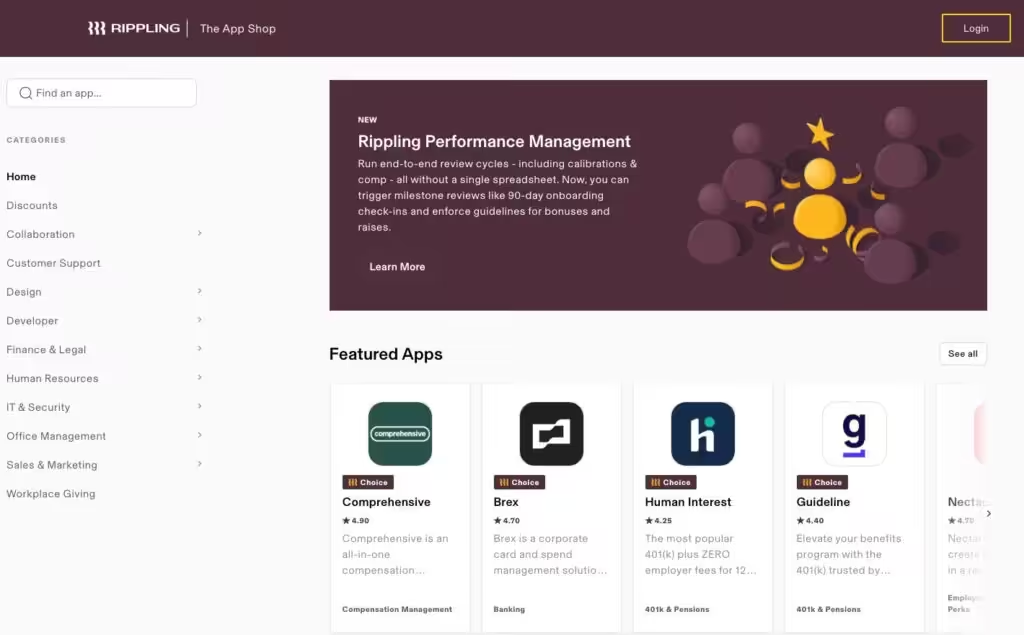
Both of these platforms can integrate with upwards of 600 apps of all kinds. These integrations can make it easy for any organization to maintain its current tech stack while implementing either platform easily. It’s another tie.
International hiring: Rippling Wins
Despite what the numbers suggest, Rippling has the upper hand in this category. It can only facilitate employee hiring in 29 countries, but it can also help clients hire contractors in 188 countries worldwide. It also takes on direct EOR responsibilities. Workday, on the other hand, simply offers to connect clients with other EOR providers. While it can help them hire in 100 countries, this third-party model is likely to lead to higher prices and communication problems.
PEO Solution: Ripping Wins
Rippling offers comprehensive services for its PEO clients and maintains strict compliance with state and federal laws. It’s also an IRS-certified and ESAC-compliant PEO in the US. Workday again works with third-party providers to offer PEO services, so we expect to see more complications and likely higher prices as well.
Employee Benefits: It’s a tie
Both of these service providers offer broad lists of both mandatory and optional benefits. They also maintain strict compliance with state laws and federal regulations. Without pricing, we’ll assume both can command below-market prices so we’ll rate them equally.
Payroll Management: Rippling Wins
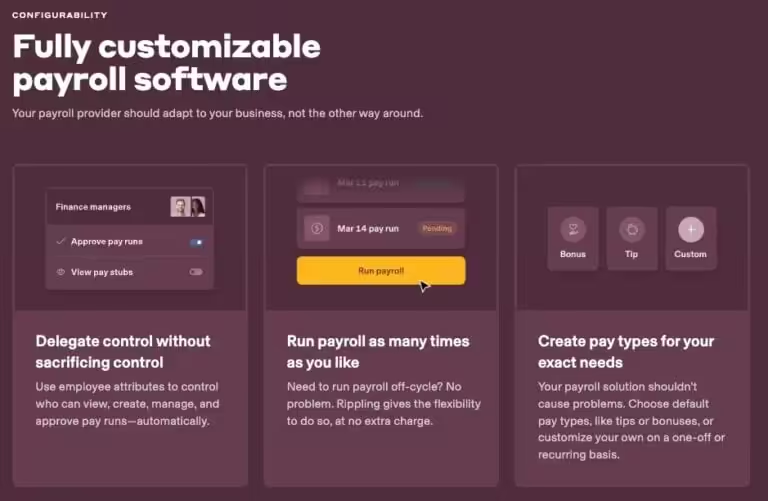
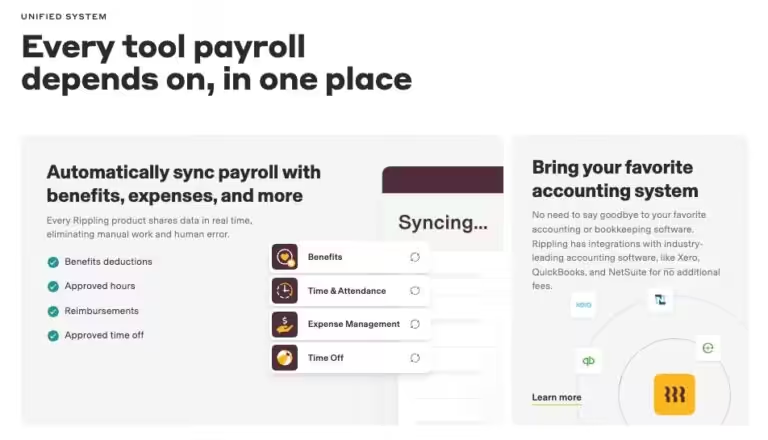
Both platforms automate payroll administration, tax calculations, and benefits deductions very effectively. However, Rippling files taxes for its clients while Workday doesn’t and this makes a major difference.
Our Verdict: Rippling vs Workday
We don’t have an overall winner. Instead, we think it’s much more useful to point out the use cases where each of these service providers would be a better choice.
When to choose Rippling
SMBs looking to scale by hiring distributed teams can choose to work with Rippling. It can help them outsource all of their HR functions in the US or in a limited number of other countries and hire and manage contractors almost anywhere in the world.
When to choose Workday
Workday is a good choice for medium and large businesses largely working in the US, Canada, the UK, and France. While we suspect this platform is too expensive for small businesses, larger ones can use it to manage thousands or even millions of employees effectively.




