
 Recruit
Average Salary in Chile
-
 Drew Donnelly
- Published
- September 21, 2026
Curious about salaries in Chile? This guide covers average wages, salary by profession, minimum wage figures, and how Chile’s earnings measure up internationally. Companies hiring in the country commonly use an Employer of Record (EOR) in Chile to manage contracts, payroll, and local employment law.
- 5 ★ on G2








Let RemotePeople handle payroll, compliance, and HR admin worldwide so you can focus on building your team.
Chile’s stable economy, skilled workforce, and well-established technology sector make it a popular choice for international hiring. Businesses using an employee of record (EOR) in Chile should understand local salary benchmarks to attract qualified professionals and stay competitive in the market.
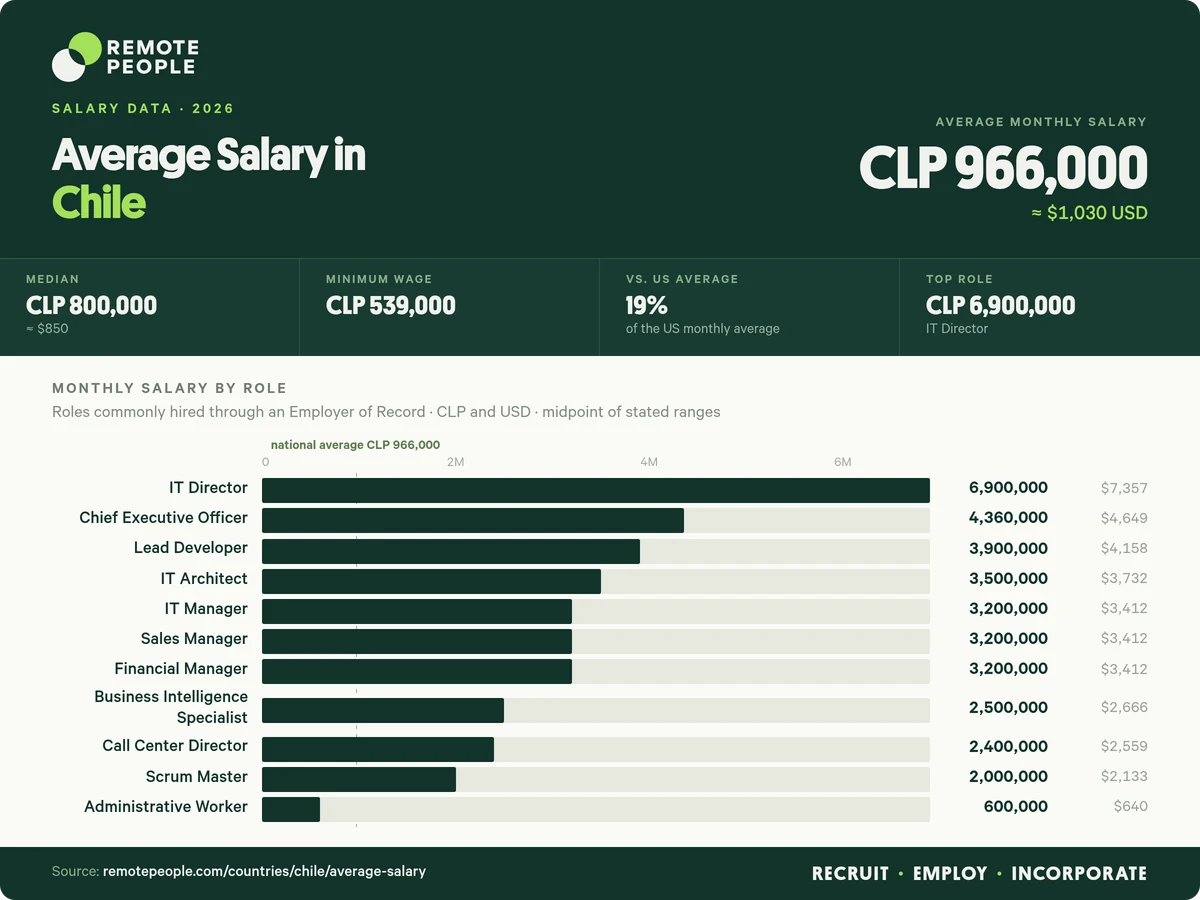
The average monthly salary in Chile is 966,000 Chilean pesos, approx. USD 1,030. However, salaries vary depending on education, experience, location, and profession. To gain comprehensive insights, you must also consider average vs median salary, salary range, and earnings in other countries.
This guide will explore all aspects of salaries in Chile to provide in-depth insight.
What is the Average Salary in Chile?
The average salary in Chile is approximately 966,000 CLP per month, which is around $1,030. Salaries in Chile reflect a relatively stable economy with strong sectors such as mining, agriculture, and services.
Median Income
The median salary is slightly lower, at approximately 800,000 CLP per month (~$850 USD). That’s because the top 20% of earners take home about half of all income in the country, while the bottom 80% share the remaining half, creating significant income inequality.
Salary Range
Overall, monthly salaries in Chile range from around CLP 400,000 ($430) to over CLP 6,000,000 ($6,400), with most workers earning between CLP 500,000 and CLP 2,000,000 per month. The upper end is reserved for specialized, high-experience, or management roles.
Salary Comparison by Profession
This professional salary overview highlights earning differences between industries.
Position | Average Monthly Wage (CLP) |
|---|---|
Chief Executive Officer | 4,360,000 |
IT Architect | 3,000,000 – 4,000,000 |
IT Manager | 3,200,000 |
IT Director | 3,900,000 – 9,900,000 |
Call Center Director | 2,400,000 |
Lead Developer | 3,900,000 |
Business Intelligence Specialist | 2,500,000 |
Sales Manager | 3,200,000 |
Scrum Master | 2,000,000 |
Financial Manager | 3,200,000 |
General Laborer | 529,000 |
Administrative Worker | 600,000 |
Seamstress | 580,000 |
Packer | 529,000 |
Data Entry Operator | 580,000 |
Porter | 529,000 |
Medical Records Clerk | 540,000 |
Tailor | 580,000 |
Receptionist | 660,000 |
Average Wage in Chile by Education
In Chile, higher levels of education are strongly associated with significantly higher salaries. According to the Rio Times, workers with a university degree earn about 161% more than those with only a high school diploma, the largest education-related income gap among OECD countries. This steep wage premium shows that a university education in Chile can more than double earnings compared to those of high school graduates.
Employees with diplomas or certificates above high school earn about 17% more than those with only completed high school, while those holding bachelor’s degrees earn approximately 24% more than diploma holders. Advanced degrees such as master’s and PhDs yield further salary increases of around 23-29%.
Salary Comparison by Experience
In Chile, salary progression by experience is an important factor in wage determination, similar to other countries. Workers typically earn more as they gain tenure in their field.
Years of Experience | Average Salary Increase |
|---|---|
2–5 years | 32% |
5–10 years | 34% |
10–15 years | 19% |
15–20 years | 8% |
20+ years | 7% |
For instance, an entry-level IT worker earning 1,200,000 CLP monthly can expect a steady salary increase of roughly one-third every 2–5 years, potentially reaching over 3,000,000 CLP after 15+ years.
Salary Comparison by Location
Workers are drawn to Santiago, Chile’s capital and economic hub, which offers higher salaries averaging 1,200,000 CLP monthly. Nearby metropolitan areas like Puente Alto and La Florida provide competitive rates at 1,150,000 CLP and 1,100,000 CLP, respectively. Moving further from the capital to coastal regions like Valparaíso or southern areas like San Bernardo, salaries drop to 1,000,000 CLP and 950,000 CLP monthly.
While minimum wage stays constant across the country, ambitious professionals gravitate toward regions with superior earning potential.
How Much is Minimum Wage in Chile?
Chile’s minimum wage is 539,000 Chilean Pesos (CLP) per month, which is approximately 575 US Dollars (USD). This applies to full-time workers aged 18 to 65. Workers under 18 or over 65 have a lower minimum wage of about 402,082 CLP per month (around 430 USD).
Average Salary in Chile vs. the Rest of the World
Comparing Chile’s salaries against salaries worldwide provides a better perspective on worker earnings. The following chart will compare Chile’s wages to those in developed, developing, and undeveloped countries.
Chile vs. Developed Countries
Country | Average Salary | Comparison to Average Chilean Salary |
|---|---|---|
United Kingdom | £3,000 (approx. $4,100) | – 75% |
United States | $5,220 | – 80% |
Norway | 50,000 NOK (approx. $4,700) | – 78% |
Germany | €4,300 (approx. $4,470) | – 77% |
Austria | €3,700 (approx. $4,050) | – 75% |
Chile vs. Developing Countries
Country | Average Monthly Salary | Comparison to Average Chilean Salary |
|---|---|---|
Argentina | 592,571 ARS (approx. $650) | 58% |
Brazil | 3,200 BRL (approx. $640) | 61% |
Mexico | 17,000 MXN (approx. $1,000) | 3% |
Colombia | 1,400,000 COP (approx. $360) | 186% |
Peru | 1,500 PEN (approx. $400) | 158% |
Chile vs. Undeveloped Countries
Country | Average Monthly Salary | Comparison to Average Chilean Salary |
|---|---|---|
Afghanistan | 13,200 AFN (approx. $150) | 587% |
Philippines | 15,000 PHP (approx. $265) | 289% |
Egypt | 3,900 EGP (approx. $125) | 724% |
Pakistan | 60,000 PKR (approx. $210) | 390% |
Vietnam | 7.5 million Dong (approx. $300) | 243% |
A developed country with a high-income economy, Chile ranks among the most prosperous nations in Latin America and was the first South American country to join the OECD in 2010. Yet, despite achieving remarkable economic stability and growth, the country still faces challenges with income inequality and regional development disparities.
Still, salaries remain competitive compared to developed markets, and they offer substantial cost advantages for companies seeking high-quality remote partnerships. Chile provides a highly educated, bilingual workforce with strong English proficiency, particularly in urban centers like Santiago.
Dominant sectors include IT and software development, mining and engineering, financial services, telecommunications, and business process outsourcing, with the government’s “Chile Digital 2035” initiative further strengthening its appeal as a premier nearshoring destination.
What are the Most Common Outsourced Industries in Chile?
IT and Software Development
The country excels in custom software development, mobile app development, and emerging technologies like AI and blockchain. Major tech giants, including Google, Amazon, and Microsoft, have established significant operations there. Software developers in Chile earn between $18,000–$35,000 annually, while their American counterparts earn $80,000–$120,000, resulting in notable cost savings.
Customer Service and Call Centers
Chile’s customer service industry is highly developed, supported by government initiatives in the BPO sector. The country offers a skilled, bilingual workforce with excellent English proficiency and cultural alignment with North American markets. Customer service representatives earn around $10,000–$14,000 per year, compared to approximately $35,000 for similar roles in the United States.
Mining and Engineering Services
As one of the world’s largest copper producers, Chile offers specialized expertise in mining engineering, geological consulting, and resource management. Companies can access highly skilled mining professionals and engineers at competitive rates while benefiting from Chile’s deep industry knowledge and regulatory expertise.
Conclusion
Chile doesn’t compete on rock-bottom prices like other developing countries, but it delivers top-tier talent with excellent education, political stability, and world-class infrastructure.
Companies get highly skilled professionals who speak fluent English and understand Western business culture. Add in perfect time zone alignment with North America and strong government backing for tech innovation, and Chile becomes the wise choice for businesses opening a branch office or outsourcing talent in South America.