
 Recruit
Employer of Record (EOR) in Chile
-
 Drew Donnelly
- Published
- September 27, 2026
Hire employees in Chile without setting up a local entity. RemotePeople handles payroll, Spanish-language contracts, Impuesto Único withholding, AFP and Fonasa enrolment, gratificación legal payments, and full Código del Trabajo compliance, so you can build your Chile team in days, not months.
Hire in Chile — book a free 30-minute demo
Tell us what you need. You'll get a tailored, transparent proposal within 24 hours, plus a free call to walk through it.
Tell us about your company
So we can match you with a specialist who knows your market — and unlock volume pricing tiers.
* All fields are required.
Where and when are you hiring?
Tell us the geography and timing and we'll quote each country line by line, with onboarding timelines.
* All fields are required.
Help us beat your current setup
We'll benchmark your current deal and send a line-by-line proposal in 24 hours — showing exactly where we cut cost, time, or risk. After you submit, you can book a call to walk through it together.
* All fields are required.
Thanks! Your proposal is on its way.
Expect a tailored, line-by-line proposal in your inbox within 24 hours. In the meantime…
Want to walk through it together?
Book a free 30-minute call with one of our specialists. We'll explain every line, answer your questions, and tailor the proposal further if you need.
No obligation. Pick a time that works for you.








- Hire in Chile — book a free 30-minute demo
- Tell us about your company
- Where and when are you hiring?
- Help us beat your current setup
- Thanks! Your proposal is on its way.
- How an Employer of Record Works in Chile
- Hire in Chile Without a Local Entity
- Employment Laws and Regulations in Chile
- Work Permits and Visas in Chile
- Payroll, Taxes, and Social Security in Chile
- Cost of Hiring Through an EOR in Chile
- Benefits of Using an EOR in Chile
- Termination and Offboarding in Chile
- EOR vs. Other Hiring Models in Chile
- Public Holidays in Chile
- How to Get Started with an EOR in Chile
- Where companies hiring in Chile expand next
- Frequently Asked Questions
- Related EOR Destinations
Start hiring in Chile
Let RemotePeople handle payroll, compliance, and HR admin worldwide so you can focus on building your team.

Chile offers one of the most educated and productive workforces in Latin America, with roughly 9.4 million economically active workers concentrated in Santiago, Valparaíso, and Concepción, and deep talent pools in mining, finance, software engineering, renewable energy, and Spanish-language customer operations. Following the January 2026 minimum wage increase to approximately $604 per month under Law 21.751 and the phased rollout of the 40-hour working week under Law 21.561, Chile remains the benchmark for labour stability in the Southern Cone. For companies looking to hire employees in Chile, the compliance requirements include contracting under the Código del Trabajo (DFL No. 1 of 2003), registering staff with an AFP, a health fund (Fonasa or Isapre), and the Mutual de Seguridad, and running monthly payroll through the Servicio de Impuestos Internos (SII).
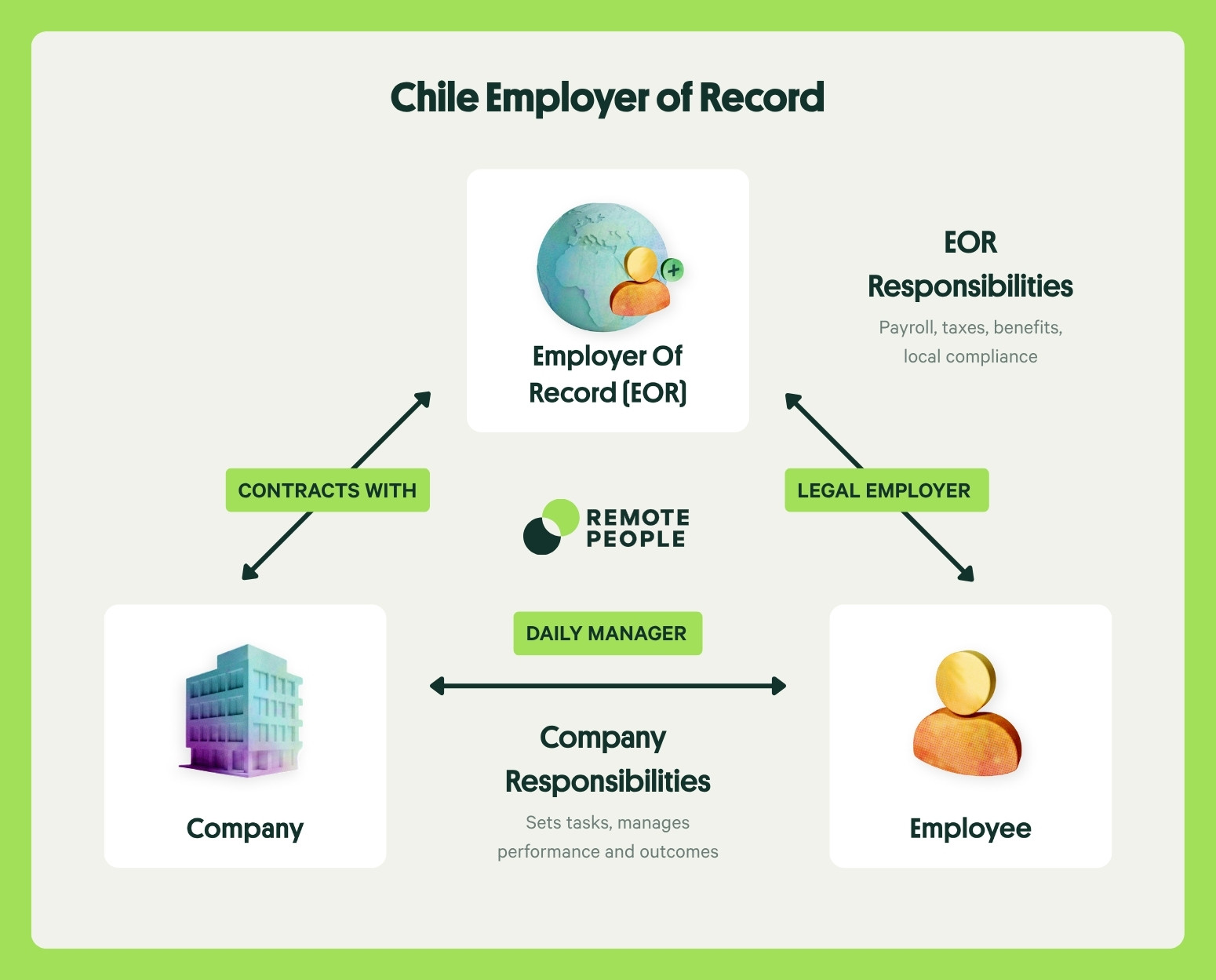
An employer of record in Chile removes the need to incorporate a local company while keeping every hire fully compliant with Chilean labour law. The EOR acts as the legal employer on paper, managing Spanish-language employment contracts, AFP and Fonasa enrolment, Impuesto Único de Segunda Categoría withholding, statutory benefits, and work permit sponsorship through the Servicio Nacional de Migraciones. You retain full operational control over the employee’s work, performance, and daily management.
How an Employer of Record Works in Chile

If you’d like to learn more about how Employer of Record (EOR) services work, read our What Is an Employer of Record (EOR)? guide for a complete overview of the model, its benefits, and when to use it.
If you’re comparing providers, our Best Employer of Record (EOR) Providers guide reviews the leading platforms to help you choose the right solution for your business.
Who Uses an EOR in Chile?
Companies typically use an employer of record in Chile to test the Southern Cone market before committing to a full entity, to hire a small team of one to fifteen people without the overhead of incorporation, or to onboard a single high-value hire in days rather than the six to ten weeks a full entity setup would take. The model is particularly useful for firms in fintech, mining services, SaaS, clean energy, and Spanish-language content operations that are hiring remote workers in Santiago, Viña del Mar, or Concepción. For any business expanding into Chile, an EOR removes the legal, banking, and HR barriers to a quick start.
An EOR is the right fit for foreign companies that need local compliance without a permanent establishment, for employers who want to convert existing Chilean contractors into full employees to reduce misclassification risk, and for organisations that need to provide statutory benefits quickly to attract senior talent in one of Latin America’s most competitive labour markets.
Typical Onboarding Timeline
The onboarding process typically takes one to two weeks for Chilean nationals, broken into five clear stages.
- First, sign the EOR service agreement and share the employee’s details including full name, RUT (Rol Único Tributario), salary, and start date (1–2 days).
- Second, the EOR drafts a compliant Spanish-language employment contract aligned with Articles 9 and 10 of the Código del Trabajo (1–2 days).
- Third, AFP, Fonasa or Isapre, and Mutual de Seguridad registration, plus Previred enrolment, happen in parallel (2–5 business days).
- Fourth, payroll configuration, Dirección del Trabajo contract filing, and benefits enrolment are finalised (1–2 days).
- Fifth, the employee officially starts work and receives their first paycheck on the next monthly payroll cycle.
If the hire is a non-Chilean national requiring a temporary residence visa under Law 21.325, add 6 to 8 months for processing through the Servicio Nacional de Migraciones. An expedited pathway may be available for senior technical roles covered by an intra-company transfer agreement or for applicants from countries with visa-waiver arrangements.
Hire in Chile Without a Local Entity
RemotePeople acts as your employer of record in Chile, handling Spanish-language contracts, payroll, AFP and Fonasa enrolment, Impuesto Único withholding, gratificación payments, and full Código del Trabajo compliance. Build your Chile team in one to two weeks with no local entity required.
Employment Laws and Regulations in Chile
Employment Contracts
The Código del Trabajo, consolidated as DFL No. 1 of 2003, governs every employment relationship in Chile and is administered by the Dirección del Trabajo (WIPO Lex text). Written contracts are mandatory for every employee under Article 9 and must be signed within 15 calendar days of the start date (5 days for short project roles), or the employer faces a fine and the presumption that any verbal terms alleged by the worker are true. Indefinite-term contracts (contrato indefinido) are the default for ongoing roles, while fixed-term contracts (contrato a plazo fijo) are capped at 12 months, or 24 months for technicians and professionals, before converting automatically to indefinite under Article 159.
Employment contracts must be written in Spanish and must specify the parties’ identification, workplace, job description, salary, payment frequency, working hours, leave terms, and the start date. All contract amendments must be recorded in annexes signed by both parties. Contracts covering minors, foreign workers, and apprentices have additional content and notification requirements, and any contract involving a non-Chilean worker must be registered with the Dirección del Trabajo within 15 days of signature.
Working Hours and Overtime
The statutory working week in Chile is 44 hours until 25 April 2026, after which it drops to 42 hours per week under Law 21.561, with a further reduction to 40 hours scheduled for 26 April 2028. The schedule sits inside Article 22 of the Código del Trabajo and may be distributed over five or six days, capped at 10 hours per day. The law also created a new daily rest guarantee of 12 consecutive hours between shifts and introduced flexible arrangements such as a four-day week, compressed scheduling, and time-banking of up to five weekly hours against rest days for workers with children under 14.
Overtime is paid at 150% of the regular hourly rate (time and a half) and is capped at 2 hours per day, and it may only be worked under a written agreement limited to three months at a time under Article 32. Work performed on Sundays and public holidays is paid at the overtime rate when the worker is not exempt from Sunday rest. All overtime must be recorded in a company time-keeping system that complies with the Dirección del Trabajo’s electronic attendance rules, and employers that breach the hour limits face fines of up to 60 UTM per worker.
Minimum Wage
The statutory monthly minimum wage (Ingreso Mínimo Mensual or IMM) in Chile is approximately $604 per month at the April 2026 exchange rate of roughly 892 pesos per US dollar. The rate took effect on 1 January 2026 under Law 21.751, replacing the approximately $593 monthly rate that had applied since July 2025. Workers aged under 18 or over 65 have a separate statutory floor of approximately $451 per month, and a non-wage component for lunch and transport benefits is set at approximately $390.
Law 21.751 locks in a second adjustment of approximately $617 per month effective 1 May 2026, which will be the reference figure for any collective bargaining negotiations concluded in the second half of the year. Employers that pay below the minimum wage face a fine of up to 10 UTM per affected worker and a Dirección del Trabajo inspection order to regularise back pay. For a full breakdown of the current scale, see the Chile minimum wage guide.
Probation Period
Chile does not recognise a formal probation period for employees hired on an indefinite contract, so every worker enjoys full protection under the Código del Trabajo from day one. Employers that want a structured evaluation window typically use a short fixed-term contract of 30 to 60 days before moving the employee onto an indefinite contract, or they apply the first-month dismissal route under Article 161 with the reduced notice and indemnisation rules that follow from short tenure. Either approach must be documented in writing and filed with the Dirección del Trabajo.
For a full comparison of probation, fixed-term, and indefinite arrangements, see the Chile probation period guide. The EOR can advise which structure best fits your hiring scenario and draft the contract in a way that stays compliant with Dirección del Trabajo inspection standards.
Leave Entitlements
Chilean law provides a comprehensive set of statutory leave entitlements under the Código del Trabajo and Law 20.545, covering paid annual leave that scales with tenure, sick leave covered by the health fund, one of the longest paid maternity regimes in Latin America, and specific family event leave. Leave is funded primarily by the health fund and the state, with only a small portion paid directly by the employer.
Annual Leave
Annual paid leave in Chile is 15 working days per year after one full year of continuous service under Article 67 of the Código del Trabajo. Workers in the extreme southern regions of Magallanes, Aysén, and Palena receive 20 working days, and employees who complete 10 years of service, not necessarily with the same employer, earn one additional day of leave for every three years of service beyond that threshold. Leave accrues monthly and must be taken in a single block of at least 10 working days, with any remainder agreed between the parties.
Sick Leave
Paid sick leave requires a medical certificate (licencia médica) issued by a registered physician and submitted to the employer within two business days. The first three days of leave are unpaid unless the absence extends beyond 10 days, in which case the full period is covered from day one by the employee’s health fund.
Subsidies are paid by Fonasa or the Isapre at 100% of taxable salary up to a monthly ceiling (SUSESO). Dismissal of a worker during a certified licencia médica is prohibited under Article 161 bis.
Maternity Leave
Female employees are entitled to 30 weeks of paid maternity leave, structured as 6 weeks before the expected delivery date, 12 weeks after birth, and a further 12 weeks of parental leave that may be taken full-time or part-time under Law 20.545. The benefit is paid at 100% of taxable salary by the state, with a monthly cap set each year by the Superintendencia de Seguridad Social. Pregnant employees are protected from dismissal from the moment of pregnancy confirmation until one year after the end of maternity leave (fuero maternal), and they retain the right to return to the same position at the end of the leave period.
Paternity Leave
Fathers are entitled to 5 working days of paid paternity leave at the time of the birth of a child, paid at 100% of salary by the employer under Article 195 of the Código del Trabajo. Fathers may also take up to 6 weeks of the 12-week parental leave if the mother transfers it to them, in which case the benefit is paid by the state. Adoptive parents enjoy the same entitlement from the date of the adoption order.
Other Statutory Leave
Employees are entitled to additional statutory leave for specific events, typically paid by the employer at full salary.
- Marriage or civil union leave: 5 working days under Law 20.764.
- Bereavement leave: 7 calendar days for the death of a spouse, child, or unborn child; 3 days for the death of a parent or sibling.
- Ley SANNA leave: Paid time off to care for a child under 18 with a serious illness, funded by the SANNA social insurance.
- Breastfeeding leave: 1 paid hour per day until the child turns 2 years old.
- Civic duty leave: Paid time off for jury duty, elections, and civil defence obligations.
Leave Entitlements Summary
Chile’s labour code codifies every statutory leave type employers must grant, from annual leave to maternity, sick, and other protected absences (Código del Trabajo (WIPO Lex)). The table below summarises each statutory leave category with duration and eligibility so payroll and HR can plan accruals and cover without missing a mandatory entitlement.
Chile statutory leave entitlements · Per Código del Trabajo and Law 20.545 | ||
Leave Type | Duration | Eligibility & Notes |
|---|---|---|
Annual Leave | 15 working days | After 1 full year of service. 20 days in Magallanes, Aysén, and Palena. +1 day every 3 years after 10 years of total service. Paid by employer. |
Sick Leave | Doctor-certified | First 3 days unpaid unless leave extends beyond 10 days. From day 4 (or day 1 if over 10 days): Fonasa or Isapre pays 100% of taxable salary up to the SUSESO cap. |
Maternity Leave | 30 weeks | 6 weeks pre-natal + 12 weeks post-natal + 12 weeks parental. Paid at 100% of taxable salary by the state. Fuero maternal until 1 year after the leave ends. |
Paternity Leave | 5 working days | Paid at 100% by employer. Transferable up to 6 of the 12 parental weeks to the father, funded by the state. |
Marriage or Civil Union | 5 working days | Paid by employer under Law 20.764, taken on the date of the ceremony or within 30 days. |
Bereavement Leave | 3–7 days | 7 calendar days for spouse, child, or unborn child; 3 days for a parent or sibling. Paid at 100% by employer. |
Ley SANNA Leave | Up to 90 days | To care for a child under 18 with a serious illness. Funded by the SANNA social insurance, administered by the Superintendencia de Seguridad Social. |
Public Holidays | 18 days/year | Paid time off on 18 national public holidays in 2026. Work on a holiday is paid at overtime rates under Article 32. |
Source: Código del Trabajo (WIPO Lex) and Dirección del Trabajo | ||
Statutory Employee Benefits
The core mandatory benefit in Chile is enrolment in the pension system through one of the Administradoras de Fondos de Pensiones (AFP), which run individual capitalisation accounts, and the health system through either the public Fondo Nacional de Salud (Fonasa) or a private Isapre of the worker’s choice. Every formal worker must also be covered by a Mutual de Seguridad for workplace accident insurance under Law 16.744.
Together these three pillars provide healthcare, pensions, disability, maternity subsidies, and work accident benefits for the entire formal workforce. For a detailed Chile employee benefits breakdown, see the country guide.
Beyond AFP, Fonasa, and the Mutual, employers must contribute to the unemployment insurance scheme (Seguro de Cesantía) administered by AFC Chile, the SIS disability and survivor insurance, the Ley SANNA social insurance for parents of seriously ill children, and the new pension reform surcharge introduced by Law 21.735. Private employers commonly supplement these statutory benefits with private Isapre top-ups, complementary health insurance, meal vouchers (colación), and transport allowances, especially in Santiago’s high-cost labour market. Many companies also offer a profit-sharing arrangement (gratificación legal) under Article 50, which is discussed in the payroll section below.
Recent Regulatory Updates (2026)
The most significant 2026 change is the second phase of Law 21.561, which cuts the working week from 44 to 42 hours on 26 April 2026 and builds in complementary flexibilities such as four-day schedules, time-banking, and the right to disconnect outside working hours. The full 40-hour working week is scheduled to take effect on 26 April 2028, completing a five-year phased reduction that employers must integrate into shift plans, collective agreements, and electronic attendance systems.
Law 21.735, the structural pension reform signed in March 2025, introduces a new 1.0% employer contribution on gross salary that is routed to a mixed public-private pension fund, plus phased increases of up to 6.0% over the next nine years. The reform also created the Fondo Autónomo de Protección Previsional (FAPP) to top up low pensions, changed the rules on AFP fund selection, and raised the oldest benefit (PGU) by up to approximately $280 per month. Employers apply the new contribution from the first payroll cycle of 2026, with the Superintendencia de Pensiones publishing monthly guidance on rate schedules.
Law 21.645 (the “Work-Family Balance Law”) and Law 21.643 (the “Karin Law” on workplace harassment) remain in force for 2026, requiring employers to run an internal harassment protocol, update the internal rules of procedure (reglamento interno), and allow parents of children under 14 to request flexible schedules. Employers that ignore the Karin Law protocol face Dirección del Trabajo fines and civil claims under the amended Article 2 of the Código del Trabajo.
Work Permits and Visas in Chile
Work Permit Requirements
Who Needs a Work Permit
Every non-Chilean national who takes up paid employment in Chile must hold a valid temporary residence permit that allows work from the Servicio Nacional de Migraciones under Law 21.325 of 2021. Citizens of Mercosur Associated State members (Argentina, Bolivia, Brazil, Colombia, Ecuador, Paraguay, Peru, Uruguay, and Venezuela) benefit from a specific Mercosur temporary residence category, but they still need to complete the application and obtain the Cédula de Identidad para Extranjeros before starting work. Full details are on the Chile work visa and permit page.
Eligibility and Required Documents
Applications under Law 21.325 must be filed from outside Chile at a Chilean consulate, and the employer or EOR provides the sponsoring contract of employment. Required documents include a valid passport with at least 18 months remaining validity, a signed and notarised employment contract containing the specific Article 24 “repatriation clause”, apostille-legalised academic credentials, a police clearance certificate from the country of origin and every country where the applicant lived in the last 5 years, a medical certificate, proof of marital status for accompanying dependants, and payment of the consular and visa fees. The Servicio Nacional de Migraciones reviews the file and issues a preliminary approval that the applicant presents at a Chilean consulate to stamp the visa.
Processing Time and Validity
Temporary residence visa processing currently takes 6 to 8 months from file submission, reflecting the backlog that accumulated after Law 21.325 centralised every application in the Santiago-based Servicio Nacional de Migraciones. The initial temporary residence permit is issued for up to 1 year and is tied to the sponsoring employer. After 12 months of residence, the worker may apply for a 2-year extension or move directly to definitive residence, and after 24 months on temporary status the worker is eligible for permanent residency.
Renewal Process
Temporary residence holders must file their renewal or change-of-category application at least 30 days before the current permit expires, with processing typically taking 3 to 5 months. Renewal requires an updated employment contract, proof of continued AFP and health fund enrolment, updated police clearance, a tax residency certificate from the SII, and payment of the renewal fee. Employment may continue during the renewal window provided the application was filed on time and the applicant holds a valid receipt (certificado de trámite).
Common Visa Types for Foreign Workers
Chile issues several categories of work-related authorisation depending on the hire profile. The standard Temporary Residence with Work Authorisation is the primary category for full-time employees sponsored by a Chilean employer or EOR.
The Mercosur Temporary Residence is a simplified track for citizens of Mercosur member and associated states. Workers hired under an intra-company transfer scheme benefit from a streamlined subcategory, and investors, highly qualified professionals, and digital nomads qualify for specialised permits under the Law 21.325 regulations.
Chile work visa categories for foreign workers · 2026 Servicio Nacional de Migraciones rules | ||||
Visa Type | Best For | Initial Validity | Renewal | EOR Sponsorship |
|---|---|---|---|---|
Temporary Residence with Work Authorisation | Foreign professionals hired full-time under a Chilean employment contract | Up to 1 year, tied to employer | Renewable for 2 years; convertible to permanent residence after 24 months | Yes. EOR acts as sponsor with the Servicio Nacional de Migraciones |
Mercosur Temporary Residence | Citizens of Argentina, Bolivia, Brazil, Colombia, Ecuador, Paraguay, Peru, Uruguay, and Venezuela | Up to 2 years | Convertible to permanent residence after the initial 2-year period | Yes, with streamlined documentation and shorter processing |
Intra-Company Transfer Visa | Senior staff transferred from a foreign parent to a Chilean subsidiary or EOR | Up to 2 years | Renewable for the duration of the assignment | Yes, when the EOR holds the local sponsoring contract |
Highly Qualified Professional Visa | Specialists in science, technology, or digital services earning above the statutory threshold | Up to 2 years | Renewable and convertible to definitive residence | Yes, subject to qualification review |
Investor Visa | Foreign nationals investing in a Chilean business that meets the ministerial capital threshold | Up to 2 years | Renewable on proof of continued investment | No. Individual applicant, not employer-sponsored |
How an EOR Handles Work Permits
An EOR acts as the official employer sponsor on the temporary residence application, handling the Servicio Nacional de Migraciones paperwork, the Article 24 repatriation clause, apostille coordination, and fee payments on your behalf. The employee provides their personal documents (passport, academic credentials, police clearance, medical certificate), while the EOR manages the process in Spanish and supports the consular appointment abroad.
For a non-Chilean hire, work permit sponsorship typically extends the standard 1 to 2 week onboarding timeline by 6 to 8 months. EOR sponsorship is available for most foreign hires, though roles classified as exclusive to Chilean nationals (certain maritime and public sector positions) cannot be sponsored through an EOR.
Payroll, Taxes, and Social Security in Chile

Employer Contributions
Employers hiring in Chile owe mandatory contributions on top of gross salary, funding social security, health, pensions, and other statutory schemes (PwC Chile Tax Summary). The table below lists the employer-side contribution rates so you can calculate the true all-in cost of each hire.
Chile employer social security contributions · 2026 rates | ||
Contribution | Rate | Notes |
|---|---|---|
SIS (Disability & Survivor Insurance) | 1.88% | Seguro de Invalidez y Sobrevivencia. Premium set by tender and paid by the employer for every worker enrolled in the AFP system. |
Unemployment Insurance (Cesantía) | 2.40% | Employer share for indefinite contracts (0.6% financial fund + 1.6% individual account + 0.2% to AFC). Fixed-term contracts carry a 3.0% employer-only rate. |
Mutual de Seguridad (ATEP) | 0.95% | Base premium for workplace accident and occupational disease insurance under Law 16.744. Risk-rated with surcharges up to 3.4% for hazardous sectors. |
Pension Reform (Law 21.735) | 1.00% | New employer contribution introduced by the 2025 pension reform. Phases up to 6.0% over the next nine years, routed via the Fondo Autónomo de Protección Previsional. |
Ley SANNA | 0.03% | Social insurance for parents of children under 18 with a serious illness. Administered by the Superintendencia de Seguridad Social. |
Total employer burden | 6.26% | Standard combined employer contribution for indefinite-contract office roles. Excludes risk loadings, the Mutual sector surcharge, and any supplementary benefits. |
Source: PwC Chile Tax Summary and Superintendencia de Pensiones | ||
Employers in Chile pay five mandatory payroll contributions on gross wages up to the AFP cap of 84.3 UF per month (approximately $3,720 USD): 1.88% for the SIS disability and survivor insurance, 2.40% for unemployment insurance on an indefinite contract, 0.95% for the Mutual de Seguridad base premium, 1.00% for the new pension reform surcharge under Law 21.735, and 0.03% for the Ley SANNA fund. The combined standard employer burden is 6.26% of gross salary, which is the lowest headline employer rate in South America outside of Paraguay.
Hazardous sectors such as mining, construction, and transport pay a higher Mutual de Seguridad surcharge of up to 3.4% (so the total employer rate can reach roughly 8.7%), and fixed-term contracts carry a 3.0% unemployment insurance rate paid entirely by the employer instead of the 2.4% split. The pension reform surcharge will rise in annual steps from 1.0% in 2026 to 6.0% by 2035, which employers must build into multi-year workforce cost forecasts. For a full breakdown of the 2026 Chile payroll and tax rules, see the country guide.
Employee Contributions
Alongside income tax, employees in Chile pay statutory payroll deductions that fund social security, health cover, and other state schemes (Superintendencia de Pensiones). The table below summarises the employee-side contribution rates payroll must withhold from gross pay each month.
Chile employee payroll deductions · 2026 monthly withholdings | ||
Deduction | Rate | Notes |
|---|---|---|
AFP Pension Contribution | 10.00% | Individual capitalisation account. Applied up to the AFP taxable cap of 84.3 UF per month (around $3,720 USD). |
AFP Commission | 0.58%–1.44% | Administrative fee set by each AFP. Modelo AFP is the lowest at roughly 0.58% and Provida one of the highest at 1.44% in 2026. |
Health Fund (Fonasa or Isapre) | 7.00% | Mandatory health contribution. Employees who select an Isapre may pay a higher top-up under their private plan. |
Unemployment Insurance (Cesantía) | 0.60% | Employee share for indefinite contracts only. Fixed-term contracts have no employee contribution to Cesantía. |
Total employee deduction | ~18.60% | Typical deduction before income tax, assuming a mid-range AFP commission. Deductions cap out at 84.3 UF per month. |
Source: Superintendencia de Pensiones and PwC Chile Tax Summary | ||
Employees in Chile have a base deduction of around 18.6% of gross monthly salary withheld by the employer and remitted to the respective institutions via the Previred portal on or before the 10th of the following month. The 10% AFP pension contribution goes to the worker’s individual capitalisation account, the 7% health contribution flows to Fonasa or the chosen Isapre, the 0.6% unemployment insurance contribution funds the Seguro de Cesantía individual account, and the AFP commission (0.58% to 1.44%) covers the fund manager’s administrative fee. All four items are applied to the same gross base up to a ceiling of 84.3 UF per month.
Workers who select a private Isapre typically pay an additional top-up to cover the full cost of their health plan, and higher earners see their contributions capped at the 84.3 UF ceiling so the effective deduction rate falls as salary rises. Contributions are paid in Unidades de Fomento (UF), an inflation-linked unit of account published daily by the Banco Central de Chile, which means the peso-denominated cap adjusts automatically with inflation.
Income Tax
Personal income tax in Chile is levied on a progressive basis, with the rate rising as taxable income crosses statutory thresholds (PwC Chile Individual Taxes). The table below sets out the current income-tax brackets that apply to resident employees so you can model net-of-tax compensation before making an offer.
Chile income tax · 2026 Impuesto Único de Segunda Categoría (monthly) | ||
Monthly Taxable Income (USD) | Rate | Notes |
|---|---|---|
Up to $1,058 | 0% | Exempt bracket. Corresponds to 13.5 UTM per month. |
$1,058 – $2,351 | 4% | 13.5 – 30 UTM range. |
$2,351 – $3,917 | 8% | 30 – 50 UTM range. |
$3,917 – $5,485 | 13.5% | 50 – 70 UTM range. |
$5,485 – $7,052 | 23% | 70 – 90 UTM range. |
$7,052 – $9,402 | 30.4% | 90 – 120 UTM range. |
$9,402 – $24,289 | 35% | 120 – 310 UTM range. |
Above $24,289 | 40% | Top marginal rate for employment income above 310 UTM per month. |
Chile taxes employment income through the Impuesto Único de Segunda Categoría, a progressive monthly withholding tax with eight brackets that run from 0% to 40%. Brackets are set in Unidades Tributarias Mensuales (UTM), an inflation-linked tax unit that stood at roughly $78 in April 2026.
Employers convert each month’s gross wages into UTM, apply the bracket rate, and withhold the tax from the employee’s payslip. The tax is final for workers whose only income is their salary, so no annual reconciliation is required for the majority of employees.
Workers with additional sources of income, such as investment returns or second employment, file an annual return (Operación Renta) by the end of April each year through the Servicio de Impuestos Internos. The annual Global Complementary Tax uses the same eight-bracket structure expressed in Unidades Tributarias Anuales (UTA), which is 12 UTM, and credits the monthly Impuesto Único already paid against the final liability.
Payroll Cycle
Payroll in Chile is run on a monthly cycle, with salary payment due by the first day of the following month under Article 55 of the Código del Trabajo. Payment must be made in Chilean pesos through a local bank transfer to an account held by the employee, and employers must deliver an itemised payslip (liquidación de sueldo) showing gross salary, every social security contribution, the Impuesto Único withholding, and the net amount paid. Electronic payslips delivered through approved platforms are accepted by the Dirección del Trabajo.
Employers file contributions through the Previred portal by the 10th of the following month (or 13th if filing electronically), remit the Impuesto Único to the Servicio de Impuestos Internos by the 12th, and submit the monthly electronic remuneration book (Libro de Remuneraciones Electrónico) to the Dirección del Trabajo. Late filing triggers fines of 0.75 UF per affected worker and interest on the unpaid contributions.
13th Month Salary and Bonus Pay
Chile does not have a traditional 13th month salary, but most employees receive a profit-sharing payment known as the gratificación legal under Articles 47 to 50 of the Código del Trabajo. Employers that had net taxable profits in the fiscal year must share 30% of those profits across their workforce under Article 47, or, more commonly, pay 25% of each worker’s annual wages capped at 4.75 times the monthly minimum wage (approximately $2,870 USD per year in 2026) under Article 50. The Article 50 route is predictable and is the default in most EOR cost quotes.
The gratificación legal is paid either monthly alongside the salary or in a single annual installment, depending on the wording of the employment contract. Employers may also offer discretionary year-end bonuses, sales commissions, and the traditional 18 de Septiembre and Christmas aguinaldo (token bonus) payments, but these are voluntary unless set out in a collective bargaining agreement. The Dirección del Trabajo publishes an annual guidance note that sets out the gratificación rules in plain language.
Cost of Hiring Through an EOR in Chile
EOR Service Fees
EOR service fees in Chile typically range from $300 to $600 per employee per month, billed in USD and covering employment contract drafting, AFP and health fund registration, monthly payroll processing, Impuesto Único withholding and filing, statutory benefits administration, gratificación calculation, and work permit sponsorship when needed. Pricing at the higher end of the range usually reflects work permit support for foreign nationals, complex equity compensation, or bespoke benefit packages such as full Isapre coverage and enhanced life insurance.
Total Employment Cost Breakdown
The all-in cost of employing someone in Chile goes well beyond gross salary. The table below walks through a realistic cost build-up for a typical hire, layering mandatory employer social contributions, statutory benefits, and payroll taxes on top of base pay so finance teams can budget accurately before an offer goes out.

Chile employer cost example · $1,200/month gross · 2026 | ||
Employer Cost | Amount (USD) | % of Gross |
|---|---|---|
Gross salary | $1,200.00 | 100.00% |
SIS (Disability & Survivor) | $22.56 | 1.88% |
Unemployment Insurance (Cesantía) | $28.80 | 2.40% |
Mutual de Seguridad (ATEP) | $11.40 | 0.95% |
Pension Reform (Law 21.735) | $12.00 | 1.00% |
Ley SANNA | $0.36 | 0.03% |
Gratificación legal (Article 50 cap) | $239.19 | 19.93% |
EOR service fee (est.) | $400.00 | 33.33% |
Total monthly employer cost | $1,914.31 | 159.53% |
Source: PwC Chile Tax Summary and Superintendencia de Pensiones | ||
Hiring a Chilean employee on a $1,200 gross monthly salary through an EOR costs approximately $1,914 per month, roughly 60% above the gross wage once statutory contributions, the gratificación legal accrual, and the EOR service fee are included. The statutory employer contributions alone add 6.26% of gross salary, and the Article 50 gratificación accrual of $239.19 (the 4.75 IMM annual cap spread monthly) brings the mandatory labour cost premium to about 26.19% before the EOR fee. All USD amounts are approximate conversions at the April 2026 rate of roughly 892 Chilean pesos per US dollar.
The cost profile is unusually employer-friendly for Latin America because the headline employer rate is only 6.26%, most health and pension costs sit with the employee, and the gratificación is capped in cash terms rather than being a full 13th month. Companies hiring a team of five to ten workers at this salary band should budget between $9,500 and $19,200 per month on average, with the EOR fee the single largest variable.
Ready to hire in Chile? Contact our team to get started.
RemotePeople handles employment contracts, payroll, tax withholding, gratificación payments, and full Chile compliance. No local entity needed.
Benefits of Using an EOR in Chile
Hiring through an employer of record lets you onboard Chilean talent in one to two weeks rather than the six to ten weeks needed to incorporate a sociedad por acciones, register with the Servicio de Impuestos Internos, open a local bank account, and enrol with the Dirección del Trabajo. That speed advantage is often the decisive factor for companies that have already identified a candidate and cannot afford to wait a full quarter to make the hire.
Beyond speed, an EOR absorbs the full weight of Chilean compliance. The Código del Trabajo is one of the most detailed labour frameworks in Latin America, with strict rules on termination, severance, fuero maternal, and the new Karin Law harassment protocol that can expose foreign employers to significant liabilities if handled incorrectly.
An EOR stays on top of every minimum wage update, AFP rate change, tax filing deadline, and Dirección del Trabajo inspection cycle, so you get local expertise without needing to hire a Chilean payroll specialist or employment lawyer. It also provides the flexibility to scale a team up or down without the cost of closing a local entity, which in Chile can take 6 to 12 months and require formal dissolution through the Conservador de Bienes Raíces.
On the employee experience side, workers hired through an EOR receive a fully compliant Spanish-language contract, a valid AFP and Fonasa or Isapre enrolment, a Mutual de Seguridad card, a proper payslip, and all statutory benefits including gratificación, paid leave, and the full 30-week maternity entitlement. This matches or exceeds what they would receive from a direct local employer and makes an EOR arrangement effectively indistinguishable from a standard Chilean job offer from the worker’s perspective.
Termination and Offboarding in Chile
Notice Periods
Notice periods in Chile are set by Article 161 of the Código del Trabajo. Employers that dismiss a worker for “business needs” (necesidades de la empresa) must give 30 days of written notice or pay one additional month of salary in lieu of notice.
The same rule applies to dismissals based on the employer’s discretion for senior household staff and workers of exclusive trust. Dismissals for serious misconduct under Article 160 do not require prior notice, but the employer must serve the dismissal letter within three business days and notify the Dirección del Trabajo.
In practice, most Chilean employers and EORs pay the 30-day amount in lieu of notice (aviso previo) because keeping an employee in the workplace after the decision to dismiss has been made is often impractical. The aviso previo is added on top of any indemnización owed and must be recorded in the written termination letter (carta de despido).
Severance Pay
Calculation Method
Severance in Chile has two components: the indemnización por años de servicio (one month’s wages per year of service, capped at 11 months) and the indemnización sustitutiva del aviso previo (one month’s wages in lieu of notice). Both are due when the employer dismisses for business needs under Article 161, and both are calculated on the last monthly remuneration including fixed allowances but excluding one-off bonuses and overtime. Dismissal for serious misconduct under Article 160 eliminates the indemnización por años de servicio, but the burden of proof sits squarely with the employer and must be supported with documentary evidence.
The monthly base for severance is capped at 90 UF (approximately $3,985 USD at the April 2026 UF value), so senior employees earning above that threshold receive severance calculated on the cap rather than their full salary. Unpaid gratificación, unused annual leave, and any unpaid salary components are settled alongside the severance in the final settlement (finiquito), which must be signed before a notary or a Dirección del Trabajo official to be enforceable.
Caps and Exceptions
The 11-month cap on the indemnización por años de servicio applies to most employees, but workers hired before 14 August 1981 benefit from the old “unlimited” severance regime under Article 163 of the Código del Trabajo. Fixed-term and specific-project contracts that run to their natural end give rise to no severance, though the Cesantía unemployment insurance account can be drawn down by the worker after separation. Termination by mutual agreement also extinguishes the severance liability provided the finiquito is properly notarised and filed.
Grounds for Termination
Chilean employment contracts may be terminated for just cause under Article 160, for business needs under Article 161, by mutual agreement under Article 159, upon the natural expiration of a fixed-term contract, or by employee resignation. Just cause grounds under Article 160 include serious misconduct, theft, unjustified absence for two consecutive days or three days in a month, and breach of contractual obligations. The business-needs ground under Article 161 is the most common route for non-disciplinary dismissals and triggers the full severance and notice liability described above.
Certain categories of employee enjoy fuero (job stability) that prevents dismissal except with prior judicial authorisation from a labour court. Protected categories include pregnant workers from the moment of pregnancy until one year after the end of maternity leave, union representatives during their mandate and for 6 months thereafter, and employee delegates negotiating collective agreements. Dismissal of a protected worker without prior judicial authorisation is void and results in reinstatement with back pay.
EOR vs. Other Hiring Models in Chile
EOR vs. Setting Up a Local Entity
Choosing between an Employer of Record and setting up your own legal entity in Chile comes down to timeline, upfront cost, ongoing administrative burden, and how quickly you can scale up or wind down. The table below lays out both paths side by side across setup time, cost, compliance risk, and flexibility so you can match the right model to the size and duration of your Chile hiring plan.
Chile EOR vs local entity comparison · Setup time, cost, risk and best-fit | ||
Comparison | Employer of Record | Own Entity (SpA) |
|---|---|---|
Setup time | 1–2 weeks | 6–10 weeks |
Upfront cost | $0 | $2,500–$6,000 (notary, SII tax ID, municipal patent, legal fees) |
Ongoing cost | $300–$600/employee/month | $6,000–$15,000/year maintenance (accounting, legal, tax filings) |
Local partner required | No (EOR is the local entity) | Not required, but a resident legal representative is needed |
Social insurance registration | Handled by EOR | You manage AFP, Fonasa or Isapre, Mutual, and Previred registration |
Payroll and tax filing | Handled by EOR | You manage it or outsource to a local accountant |
Best for team size | 1–15 employees | 15+ employees |
Scale down or exit | Easy, no entity to unwind | Costly. Formal dissolution takes 6–12 months |
Government contracts | Not eligible | Eligible (requires local entity and ChileProveedores registration) |
Source: World Bank Chile and PwC Chile Corporate Tax Summary | ||
For companies hiring their first one to fifteen employees in Chile, the EOR model is almost always the right choice. Setting up a sociedad por acciones requires a notarised public deed, registration with the Conservador de Bienes Raíces, a tax ID (RUT) from the Servicio de Impuestos Internos, a municipal patent, and enrolment with the Dirección del Trabajo, AFP, Fonasa, and the Mutual. The full process typically takes six to ten weeks under the accelerated “Empresa en un Día” regime and involves ongoing accounting, tax, and legal maintenance costs of $6,000 to $15,000 per year even for a dormant entity.
A local entity begins to make financial sense once headcount reaches roughly 15 to 20 employees, at which point the fixed cost of the entity is spread across enough salaries to offset the per-employee EOR fee. Below that threshold, and especially during the market-entry phase when future headcount is uncertain, an EOR gives you the same legal compliance with none of the fixed overhead and none of the exit friction. Companies that want to bid on Chilean government tenders through ChileCompra, obtain sector-specific operating licences, or claim Corfo research and development tax credits will eventually need their own entity regardless of headcount.
EOR vs. Hiring Independent Contractors
Classifying a Chile-based worker as an independent contractor rather than an employee can expose you to back-taxes, unpaid social contributions, and reclassification penalties if the working relationship looks like employment in practice. The table below contrasts EOR employment with contractor engagement across legal relationship, tax and benefits treatment, IP ownership, and misclassification risk so you can pick the right model role by role.
Chile EOR vs independent contractors · Compliance, cost, and risk | ||
Comparison | EOR (Full-Time Employee) | Independent Contractor |
|---|---|---|
Legal relationship | Employee of the EOR under the Código del Trabajo | Self-employed professional under civil law, no employment relationship |
Compliance risk | Low. EOR ensures full Código del Trabajo compliance | Higher. Courts apply the subordination test under Article 7 to flag misclassification |
Payroll and tax | EOR handles Impuesto Único withholding, AFP, Fonasa, and Previred filings | Contractor issues a boleta de honorarios and manages their own 13.75% retention |
Benefits and leave | Statutory benefits, paid leave, gratificación, and 30-week maternity | No entitlement to employee benefits or gratificación |
IP protection | Stronger. Employment contract assigns IP to the client company (you), not the EOR | Weaker. Requires an explicit IP assignment clause in the service agreement |
Termination | Subject to Article 161 notice and indemnización | Contract can be ended per the agreement terms |
Best for | Long-term, core team roles with a fixed schedule | Short-term projects, specialised advisory, roles with genuine autonomy |
Cost structure | Salary + employer contributions + gratificación + EOR fee | Contractor fee (typically higher gross, lower total cost) |
Source: Dirección del Trabajo and Código del Trabajo (WIPO Lex) | ||
Hiring independent contractors in Chile is only appropriate in certain cases, such as short-term project work, specialised consulting engagements, or roles where the worker has genuine autonomy over how and when the work is performed. Chilean courts apply a subordination test under Article 7 of the Código del Trabajo to look at whether the worker is subject to direction, integrated into the client’s organisation, and dependent on a single client for their income, and a contractor relationship can be reclassified as employment when those indicators are present. Reclassification exposes the employer to retroactive social security contributions, unpaid gratificación, indemnización, and administrative fines imposed by the Dirección del Trabajo.
The Tribunal Laboral de Cobranza has consistently ruled in favour of workers in misclassification cases, applying the principio de primacía de la realidad to look beyond the wording of a contract to the actual conduct of the parties. For ongoing roles with fixed hours and embedded team responsibilities, an EOR is the safer and more compliant option. RemotePeople can also help you manage compliant engagements through our Chile hire and pay contractors service, which handles contracts, international payments, and classification diagnostics.
EOR vs. PEO (Professional Employer Organization)
EORs and PEOs both simplify international hiring, but only an EOR becomes the legal employer of record in Chile — a critical distinction when you don’t have a local entity of your own. The table below maps the practical differences across legal employer status, entity requirement, liability allocation, and scope of coverage.
Chile EOR vs PEO comparison · Legal employer, liability, and setup | ||
Comparison | Employer of Record (EOR) | PEO |
|---|---|---|
Legal employer | EOR is the legal employer under the Código del Trabajo | Your Chilean entity remains the legal employer (co-employment) |
Local entity required | No. The EOR is the local entity | Yes. You must have your own SpA or Limitada in Chile |
Best for | Companies without a Chilean entity | Companies that already have a Chilean entity |
Compliance liability | EOR assumes compliance responsibility | Shared liability between you and the PEO |
Setup time | 1–2 weeks | Depends on your entity setup (6–10 weeks) |
Control over HR policies | EOR manages within Chilean labour law framework | More direct control, PEO advises |
Typical use case | Market entry, small remote teams, testing Chilean talent | Established local operations needing HR outsourcing |
Source: Dirección del Trabajo and PwC Chile Corporate Tax Summary | ||
Chile does not have a formal PEO regulatory framework. Labour outsourcing and co-employment arrangements exist in practice through registered service providers under Law 20.123 on subcontracting, but the legal structure is informal compared to the statutory PEO regimes found in the United States and parts of Europe. In practice, most Chilean “PEO” engagements operate as payroll outsourcing for companies that already have a local entity and need help with monthly filings.
For companies without a Chilean entity, the EOR is the correct vehicle because the EOR itself carries the legal employer status and assumes full compliance liability under the Código del Trabajo. A PEO model, by contrast, requires you to have already incorporated a Chilean subsidiary, which reintroduces all the setup time, cost, and exit friction of a local entity. The practical distinction is simple: use an EOR when you do not have (and may never need) a Chilean entity, and use a PEO only when you already have an SpA or Limitada up and running locally.
Public Holidays in Chile
Chile observes a defined set of official public holidays on which most private-sector employers must give staff a paid day off (Chile public holidays 2026). The table below lists the statutory holidays employers need to build into payroll calendars and leave planning for the year, along with the date rule for each.
Chile public holidays · 2026 calendar year | ||
Date | Holiday | Type |
|---|---|---|
January 1 | Año Nuevo (New Year’s Day) | National |
April 3 | Viernes Santo (Good Friday) | National (movable) |
April 4 | Sábado Santo (Holy Saturday) | National (movable) |
May 1 | Día del Trabajo (Labour Day) | National |
May 21 | Día de las Glorias Navales (Navy Day) | National |
June 21 | Día Nacional de los Pueblos Indígenas | National |
June 29 | San Pedro y San Pablo | National (observed) |
July 16 | Virgen del Carmen | National |
August 15 | Asunción de la Virgen | National |
September 18 | Independencia Nacional | National |
September 19 | Día de las Glorias del Ejército | National |
October 12 | Encuentro de Dos Mundos | National (observed) |
October 31 | Día de las Iglesias Evangélicas | National |
November 1 | Día de Todos los Santos | National |
December 8 | Inmaculada Concepción | National |
December 14 | Elecciones Presidenciales (second round) | National (if required) |
December 25 | Navidad (Christmas Day) | National |
December 31 | Feriado Bancario (bank holiday) | Sectoral |
Source: Chile public holidays 2026 and Dirección del Trabajo | ||
Chile observes 18 national public holidays in 2026, all of which are paid days off for employees. Work performed on a holiday must be paid at overtime rates under Article 32 when the employee is not entitled to Sunday and holiday rest. Several holidays are classified as “irrenunciables” for retail workers, meaning employers in the commerce sector cannot open their stores on those days without a Dirección del Trabajo authorisation.
How to Get Started with an EOR in Chile
Hiring your first Chilean employee through an EOR follows a straightforward process.
- First, share your hiring requirements including role, target salary in USD, work location (Santiago, Valparaíso, Concepción, or remote), and expected start date.
- Second, receive a cost quote covering gross salary, employer contributions, gratificación accrual, and the EOR service fee in a single monthly USD figure.
- Third, sign the EOR service agreement and provide the employee’s personal details, RUT, and signed offer terms.
- Fourth, the EOR drafts a compliant Spanish-language contract, registers the employee with AFP, Fonasa or Isapre, and the Mutual de Seguridad, and enrols them in payroll.
- Fifth, the employee starts work on the agreed date and is paid through the first monthly payroll cycle with a compliant liquidación de sueldo and all statutory withholdings.
Ready to hire your first Chilean employee? Contact RemotePeople to get a tailored quote and start onboarding within two weeks. We handle employment contracts, payroll, tax withholding, gratificación payments, and full Chilean compliance so you can focus on managing your team.
Where companies hiring in Chile expand next
Companies hiring in Chile commonly expand across South America, leveraging Spanish and Portuguese talent pools and regional trade frameworks. Teams frequently add an EOR partner in Colombia for overlapping Andean hiring and cost tier; Brazil often follows for aligned Mercosur employment standards; a team in Ecuador is a common next step, offering the Andean corridor’s Spanish-speaking talent; and operations in Peru rounds out the regional footprint with aligned Andean-region cost and talent profile.
Frequently Asked Questions
EOR services in Chile typically cost between $300 and $600 per employee per month, billed in USD, on top of the gross salary and the mandatory employer contributions of around 6.26% (SIS, unemployment insurance, Mutual de Seguridad, pension reform, and Ley SANNA). For a $1,200 gross monthly salary, total employer cost through an EOR works out to approximately $1,900 per month including the gratificación legal accrual under Article 50. The exact fee depends on your provider and the complexity of the role.
Chilean nationals can typically be onboarded in 1 to 2 weeks, including contract drafting, AFP and Fonasa or Isapre registration, Mutual de Seguridad enrolment, and payroll setup through Previred. Foreign nationals requiring a temporary residence visa under Law 21.325 add another 6 to 8 months for processing through the Servicio Nacional de Migraciones.
Yes, employers with net taxable profits must pay a gratificación legal under Articles 47 to 50 of the Código del Trabajo. Most companies apply Article 50, which sets the payment at 25% of each worker's annual wages capped at 4.75 times the monthly minimum wage (about $2,870 USD per year in 2026). The payment is usually spread monthly alongside the salary. Chile does not have a traditional 13th month salary like other Latin American countries.
The employment contract assigns IP to the client company (you), not the EOR. The EOR makes sure the Spanish-language contract includes proper IP assignment language so all intellectual property created in the course of employment flows directly to your business. Review the assignment clause as part of the onboarding sign-off to confirm it matches your requirements.
Contractor engagements in Chile carry significant misclassification risk under the subordination test of Article 7 of the Código del Trabajo, which allows labour courts to reclassify contractors as employees based on the actual conduct of the relationship. RemotePeople offers a dedicated contractor management solution through our hire contractors service, which handles compliant service agreements, international payments, and classification diagnostics so you can engage Chilean specialists without misclassification exposure.
Dismissal for business needs under Article 161 requires 30 days of written notice or one month of salary in lieu, plus the indemnización por años de servicio of one month's wages per year of service capped at 11 months. The monthly base is capped at 90 UF (around $3,985 USD), so senior employees earning above the cap receive severance calculated on the capped amount. Just cause dismissal under Article 160 eliminates the indemnización, but requires formal documented proof.
Yes, Chile recognises remote work arrangements under Law 21.220 on teletrabajo, which added dedicated articles to the Código del Trabajo. An EOR can hire a fully remote Chilean employee and register their home address as the workplace for Dirección del Trabajo purposes, provided the contract specifies the remote arrangement, establishes the right to disconnect outside working hours, and the employer covers any reasonable equipment or connectivity costs.
From 26 April 2026 the statutory workweek drops from 44 to 42 hours, with a further cut to 40 hours scheduled for 26 April 2028. Employers must reconfigure shift plans, update the internal rules of procedure, and adjust electronic attendance systems to reflect the new maximum. An EOR automatically applies the change and recalculates any payroll components that depend on the standard hour base, so no action is required on your side.