Recruit
Average Salary in Indonesia
-
 Drew Donnelly
- Published
- September 21, 2026
- 5 ★ on G2








Let RemotePeople handle payroll, compliance, and HR admin worldwide so you can focus on building your team.
Indonesia’s large talent pool, low labor costs, and strategic location make it an ideal outsourcing destination. Employers considering hiring remote workers in the country may wonder, “What is the average salary in Indonesia?” This information will help them create a competitive work offer.
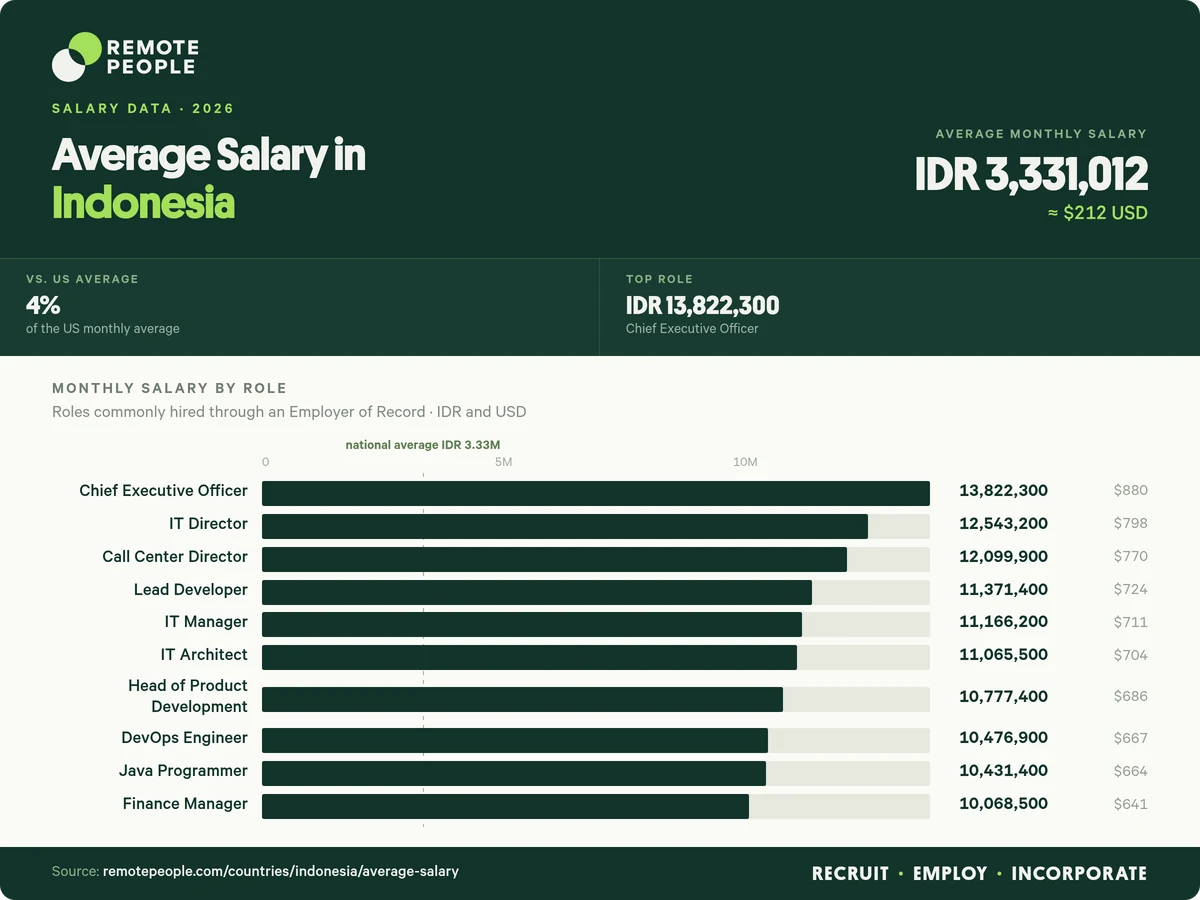
The average monthly salary in Indonesia is 3,331,012 IDR (Indonesian rupiahs), which translates to about USD 212. However, experience, education, location, position, and industry affect salaries. The median wage and salary range are other factors to consider.
This article will explore all aspects of the average salary Indonesia to provide comprehensive insight.
What is the Average Salary in Indonesia?
The average salary in Indonesia is 3,331,012 IDR or $212 monthly. The country’s wages are low due to a large workforce that exceeds job demand, an informal work sector, and a low minimum wage. Many workers seek remote positions to improve their financial situation.
Median Income
The median salary in Indonesia can also be considered the ‘middle salary.’ When comparing average vs. median salary, median salaries are typically lower in economies with income inequality.
Salary Range
The salary range in Indonesia spans from the lowest to the highest. Low-earners in Indonesia earn significantly below the national average, while high earners can make substantially more depending on industry, experience, and location.
Salary Comparison by Profession
Salaries in Indonesia vary by industry and position, with skilled workers earning more than unskilled workers. The following salary comparison chart offers a comprehensive view of various professional salaries.
Position | Monthly Salary (IDR) |
|---|---|
Chief Executive Officer | 13,822,300 |
IT Director | 12,543,200 |
Call Center Director | 12,099,900 |
Lead Developer | 11,371,400 |
IT Manager | 11,166,200 |
IT Architect | 11,065,500 |
Head of Product Development | 10,777,400 |
DevOps Engineer | 10,476,900 |
Java Programmer | 10,431,400 |
Finance Manager | 10,068,500 |
Banking Cashier | 2,479,180 |
Fabric Cutter | 2,474,630 |
Clothing Technologist | 2,463,840 |
Packer | 2,413,200 |
General Laborer | 2,406,740 |
Tailor | 2,313,050 |
Seamstress | 2,304,020 |
Porter | 2,225,960 |
Medical Records Clerk | 2,219,460 |
Average Wage in Indonesia by Education
Education is a significant factor in wage determination in Indonesia. An Institute of Social Studies review reveals that workers with a primary education earn less than workers with a secondary education. Individuals with a tertiary education are the highest earners.
Additionally, workers with tertiary educations tend to be employed in high-paying industries like finance and community and social services. Few highly educated workers work in the agriculture, mining, or construction sectors.
Salary Comparison by Experience
Experience plays a significant role in Indonesian salary determinations, with experienced workers earning more than entry-level workers. Employees who gain tenure in their companies also become eligible for raises.
Statistics show that Indonesian workers earn an 8% salary increase every 18 months they work for a company, higher than the global average of 3% every 16 months. Salary increases tend to be greater in urban areas and among skilled workers.
Salary Comparison by Location
Workers in urban areas tend to earn more than rural workers due to the higher cost of living, proximity to more prominent companies, and more job opportunities. A Science Direct study reveals that urban workers earn around 6% more than their rural peers. Salaries in the Java-Bali region can be as much as 9% more than rural salaries.
How Much is Minimum Wage in Indonesia?
The minimum wage in Indonesia increased by 5–7% in many regions as of January 2026. However, minimum wages vary by province. Workers in Jakarta receive the highest minimum wage at IDR 5,729,876 per month (approximately $365 USD), while West Java has the lowest at IDR 2,317,601 per month (roughly $148 USD).
Average Salary in Indonesia vs. the Rest of the World
A world salary comparison will help you gain perspective on salaries in Indonesia. The following charts provide wages in developed, developing, and undeveloped regions.
Indonesia vs. Developed Countries
Country | Average Salary | Comparison to Average Indonesia Salary |
|---|---|---|
United Kingdom | £3,000 (approx. $4,100) | − 1834% |
United States | $5,220 | − 2362% |
Norway | 50,000 NOK (approx. $4,700) | − 2116% |
Germany | €4,300 (approx. $4,470) | − 2009% |
Austria | €3,700 (approx. $4,050) | − 1810% |
Indonesia vs. Developing Countries
Country | Average Salary | Comparison to Average Indonesia Salary |
|---|---|---|
Romania | 4,000 RON (approx. $835) | − 294% |
Russia | 73,700 RUB (approx. $700) | − 230% |
Albania | 83,330 ALL (approx. $860) | − 306% |
Kazakhstan | 342,000 KZT (approx. $645) | − 204% |
Ukraine | 18,000 UAH (approx. $500) | − 136% |
Indonesia vs. Undeveloped Countries
Country | Average Salary | Comparison to Average Indonesia Salary |
|---|---|---|
Thailand | 15,000 Baht (approx. $420) | − 98% |
Philippines | 15,000 PHP (approx. $265) | − 25% |
Vietnam | 7.5 million Dong (approx. $300) | − 42% |
Egypt | 14,317 EGP (approx. $284) | − 34% |
Pakistan | 60,000 PKR (approx. $210) | 1% |
Indonesia is a developing country with an upper-middle-income economy. It has an emerging market and aims to achieve a Golden Indonesia 2045 Vision Plan to fulfill its economic goals. Agriculture is the country’s dominant industry, followed by tourism, trade, finance, and manufacturing services.
The country is considered one of the best for outsourcing. It offers a skilled, cost-effective workforce, a strategic location, and increased English proficiency. The developing infrastructure means circumstances will be even more favorable in the future.
What are the Most Common Outsourced Industries in Indonesia?
Businesses seeking remote partnerships in Indonesia should focus on the following sectors:
IT Services
Indonesia’s IT industry is experiencing rapid growth. It is currently considered one of the fastest-developing digital economies in the region, and it has a thriving startup scene. The sector focuses on e-commerce, fintech, edtech, and logistics technology.
IT workers in the region earn around 7,000,000 IDR (approximately $446), compared to American workers who earn more than $5,800. This results in significant cost savings for employers who wish to outsource.
Customer Support
Indonesia has a robust customer service industry focused on digital interactions and personalized experiences. Cultural norms like politeness and respect lead to a high quality of service. The country quickly adopts technologies like chatbots and data analytics to improve efficiency.
A customer service rep in Indonesia earns about 3,500,000 IDR (approx. $223) per month, while American workers earn closer to $2,916 giving employers plenty of bargaining power.
Manufacturing
Textiles, electronics, automotive products, food processing, and chemicals dominate Indonesia’s vibrant manufacturing industry. Initiatives like Making Indonesia 4.0 aim to enhance growth and position Indonesia as a manufacturing hub. Companies that outsource for manufacturing needs can benefit from cost savings and quality products.
Conclusion
Indonesia is an ideal outsourcing destination due to its cost-effective labor and skilled workforce. Companies that partner with the country for remote services can benefit from reduced expenses and quality output while helping Indonesia reach its economic goals, resulting in an advantageous outcome for everyone involved.