Recruit
Employer of Record (EOR) in Indonesia
-
 Drew Donnelly
- Published
- September 22, 2026
RemotePeople’s employer of record in Indonesia lets you hire employees in Indonesia with BPJS registration. We handle 4% BPJS Kesehatan healthcare contributions, BPJS Ketenagakerjaan social security, and monthly payment requirements.
Hire in Indonesia — book a free 30-minute demo
Tell us what you need. You'll get a tailored, transparent proposal within 24 hours, plus a free call to walk through it.
Tell us about your company
So we can match you with a specialist who knows your market — and unlock volume pricing tiers.
* All fields are required.
Where and when are you hiring?
Tell us the geography and timing and we'll quote each country line by line, with onboarding timelines.
* All fields are required.
Help us beat your current setup
We'll benchmark your current deal and send a line-by-line proposal in 24 hours — showing exactly where we cut cost, time, or risk. After you submit, you can book a call to walk through it together.
* All fields are required.
Thanks! Your proposal is on its way.
Expect a tailored, line-by-line proposal in your inbox within 24 hours. In the meantime…
Want to walk through it together?
Book a free 30-minute call with one of our specialists. We'll explain every line, answer your questions, and tailor the proposal further if you need.
No obligation. Pick a time that works for you.








- Hire in Indonesia — book a free 30-minute demo
- Tell us about your company
- Where and when are you hiring?
- Help us beat your current setup
- Thanks! Your proposal is on its way.
- How To Hire Employees in Indonesia
- Indonesia Employer of Record vs Legal Entity in Indonesia
- Using an Employer of Record in Indonesia
- How Much Does an Indonesia Employer of Record Cost?
- Employment and Labor Laws in Indonesia
- How an Employer of Record Helps You Hire in Indonesia
- Payroll and Employment Taxes in Indonesia
- Work Permits and Visas in Indonesia
- Time Off and Leave in Indonesia
- Terminations and Severance in Indonesia
- Expand into Indonesia Easily with RemotePeople’s Employer of Record in Indonesia
- Where companies hiring in Indonesia expand next
- Frequently Asked Questions
- Related EOR Destinations

Start hiring in Indonesia
Let RemotePeople handle payroll, compliance, and HR admin worldwide so you can focus on building your team.

How To Hire Employees in Indonesia
Are you a multinational looking to expand their business operations into Indonesia? Hiring newly in Indonesia can be quite stressful, from the labor laws to the cultural system that can affect your business operations if not managed properly.
There are several options available for international companies looking to build a team in Indonesia:
Set up a PT PMA (Foreign Investment Company)
This option is most suitable for larger companies planning long-term operations in Indonesia because the minimum investment required is about USD 640,000. To do this, you’ll need substantial investment, time, and ongoing administrative commitments.
Working with an Employer of Record (EOR)
An EOR can assist you with hiring employees in Indonesia without establishing a local entity. They’ll become your legal employer on paper while you maintain the day-to-day management of your team. This option is very flexible and reduces compliance risk.
Hiring Independent Contractors
This approach is equally flexible but has significant compliance risks. Indonesian law has strict criteria for distinguishing between contractors and employees. Posing to be an independent contractor when you are in fact an employee can lead to Misclassification, and you can be fined heavily for this.
If you’d like to learn more about how Employer of Record (EOR) services work, read our What Is an Employer of Record (EOR)? guide for a complete overview of the model, its benefits, and when to use it.
If you’re comparing providers, our Best Employer of Record (EOR) Providers guide reviews the leading platforms to help you choose the right solution for your business.
This is where an Employer of Record (EOR) service comes in to transform your hiring process. Whether you’re looking to recruit from the local talent pool or planning to bring your team to Indonesia, an EOR solution like RemotePeople can help you establish a legal presence without the need for a local entity setup.
We’ll walk you through everything you need to know about hiring in Indonesia through an EOR service, employment laws, compliance requirements, benefits, payroll, and cultural considerations. Ours is a comprehensive guide that will set your business up for success in Indonesia!
Hire in Indonesia
Southeast Asia’s largest economy with BPJS social security, THR mandatory bonus, Omnibus Law reforms, and Indonesian manpower regulations.
We handle employment contracts, payroll, social contributions, and full Indonesian compliance.
No local entity needed. Your team can start in days.
Indonesia Employer of Record vs Legal Entity in Indonesia
When deciding between engaging an Employer of Record provider or setting up a legal entity in Indonesia, businesses should evaluate their organizational goals and budget considerations.
An EOR handles employment-related administrative tasks, giving companies the flexibility to focus on core business priorities. This includes payroll management, local talent recruitment, and full compliance with Indonesian labor and employment laws. By leveraging legal expertise, EOR services help mitigate the risk of costly non-compliance penalties and reputational damage.
Contracting an EOR can also be a cost-effective solution, eliminating the need for long-term financial commitments associated with establishing a legal entity. Additionally, using an EOR provides immediate access to the Indonesian and broader Asian markets without the complexities of local incorporation.
Conversely, incorporating a business in Indonesia requires navigating a lengthy and complex registration process. Companies must select a legal structure, reserve their business name, and submit essential documents such as identification.
Additionally, they need to draft and notarize a deed of establishment, obtain a business license (SIUP), register with the Ministry of Trade, and open a foreign bank account.
Establishing a legal entity in Indonesia involves significant expenses, including staff salaries, licensing fees, operating costs, and facility investments. For businesses aiming to test the market or expand quickly, these upfront costs may create unnecessary financial burdens.
Using an Employer of Record in Indonesia
An Employer of Record (EOR) acts as a third-party legal employer on behalf of your business. They’ll hire workers in Indonesia, handle the payroll, tax, compliance, and other administrative responsibilities that come with being an employer. The only thing you’ll be concerned with is the day-to-day running of your business.
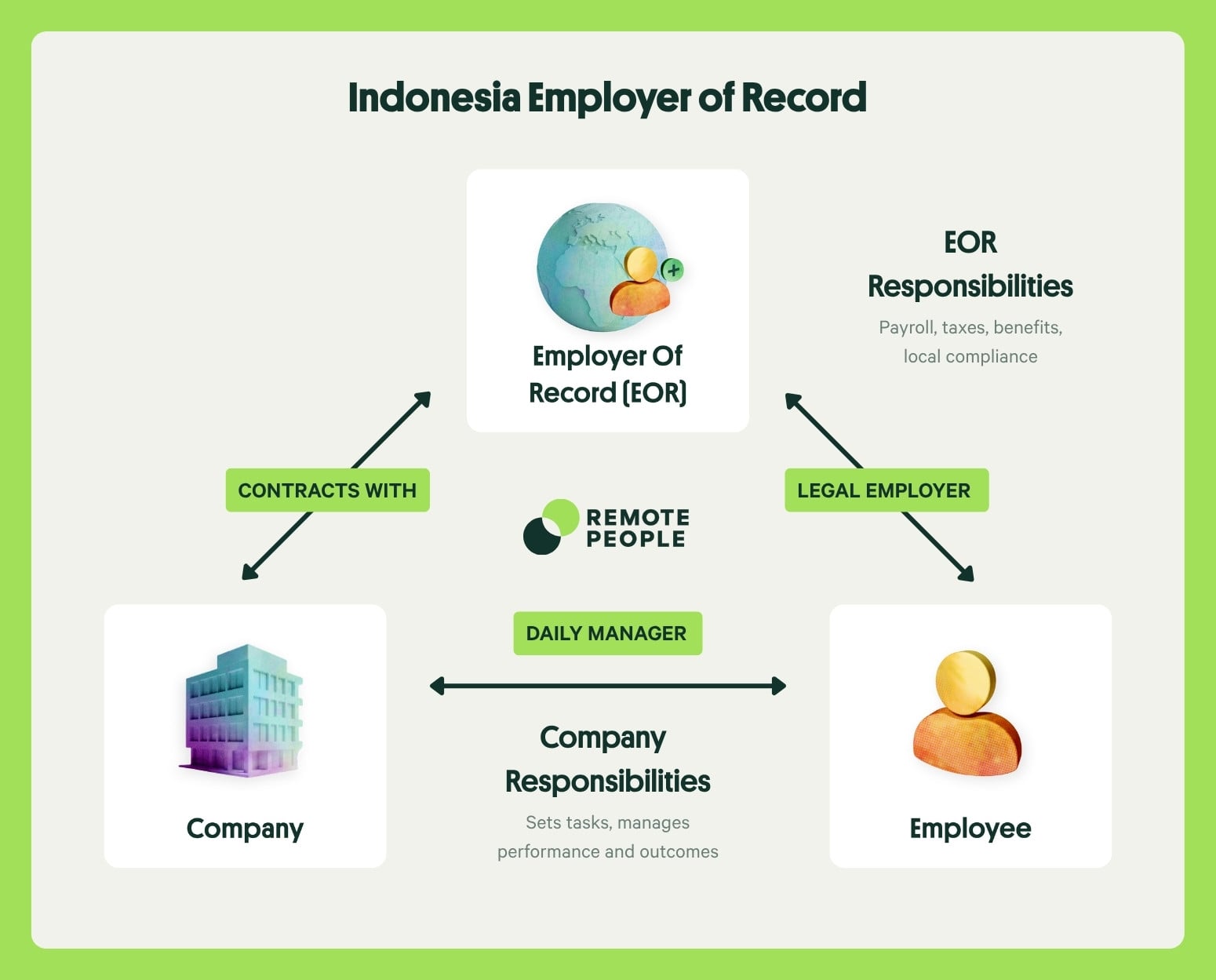
At RemotePeople, we’ll help you use our EOR service in Indonesia so you can benefit from the following:
- Quick market entry: Start hiring within days instead of the months required to establish a legal entity in Indonesia.
- Compliance expertise: No more complex Indonesian labor laws, as we’ll help you navigate every process with confidence
- Reduced administrative burden: Focus on your major business activity while the EOR handles employment paperwork, tax filings, and payroll processing
- Risk mitigation: Avoid costly mistakes in employee classification and compliance.
- Flexibility: Scale your team up or down without long-term commitments to physical infrastructure
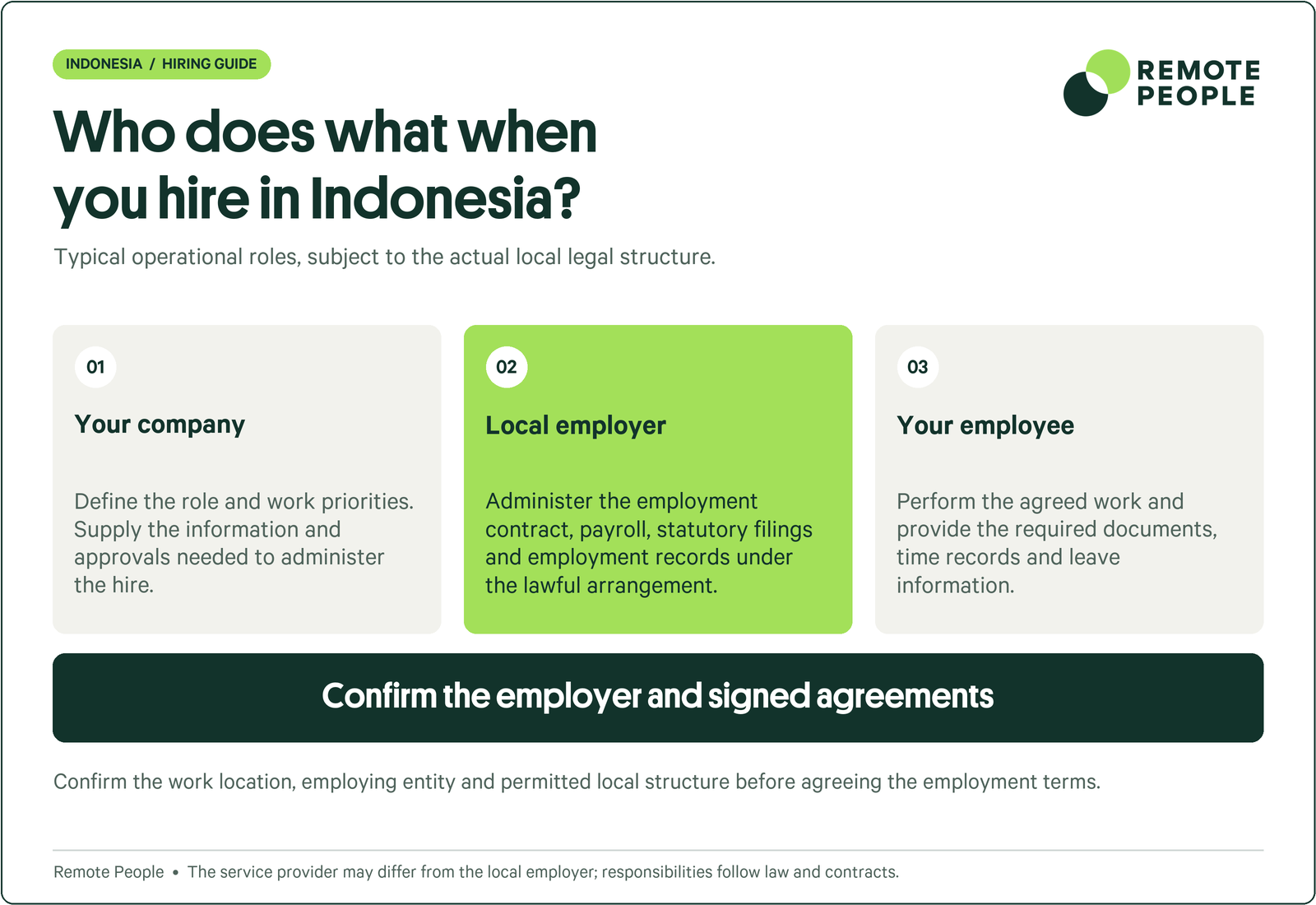
For businesses that need to hire contractors instead of full-time employees, a Contractor of Record service can also ensure proper compliance while remaining flexible.
How Much Does an Indonesia Employer of Record Cost?
The cost of using an Employer of Record (EOR) service in Indonesia depends on several factors, including the number of employees you plan to hire, the size of your business, the seniority of your workforce, and the complexity of the services you need.
Typically, Indonesia EOR providers charge a monthly fee ranging from $399 to $1,000 per employee, depending on the service package. Some providers also charge a one-time setup fee, which covers administrative costs for onboarding employees, registering them with Indonesian authorities, and setting up payroll and benefits systems.
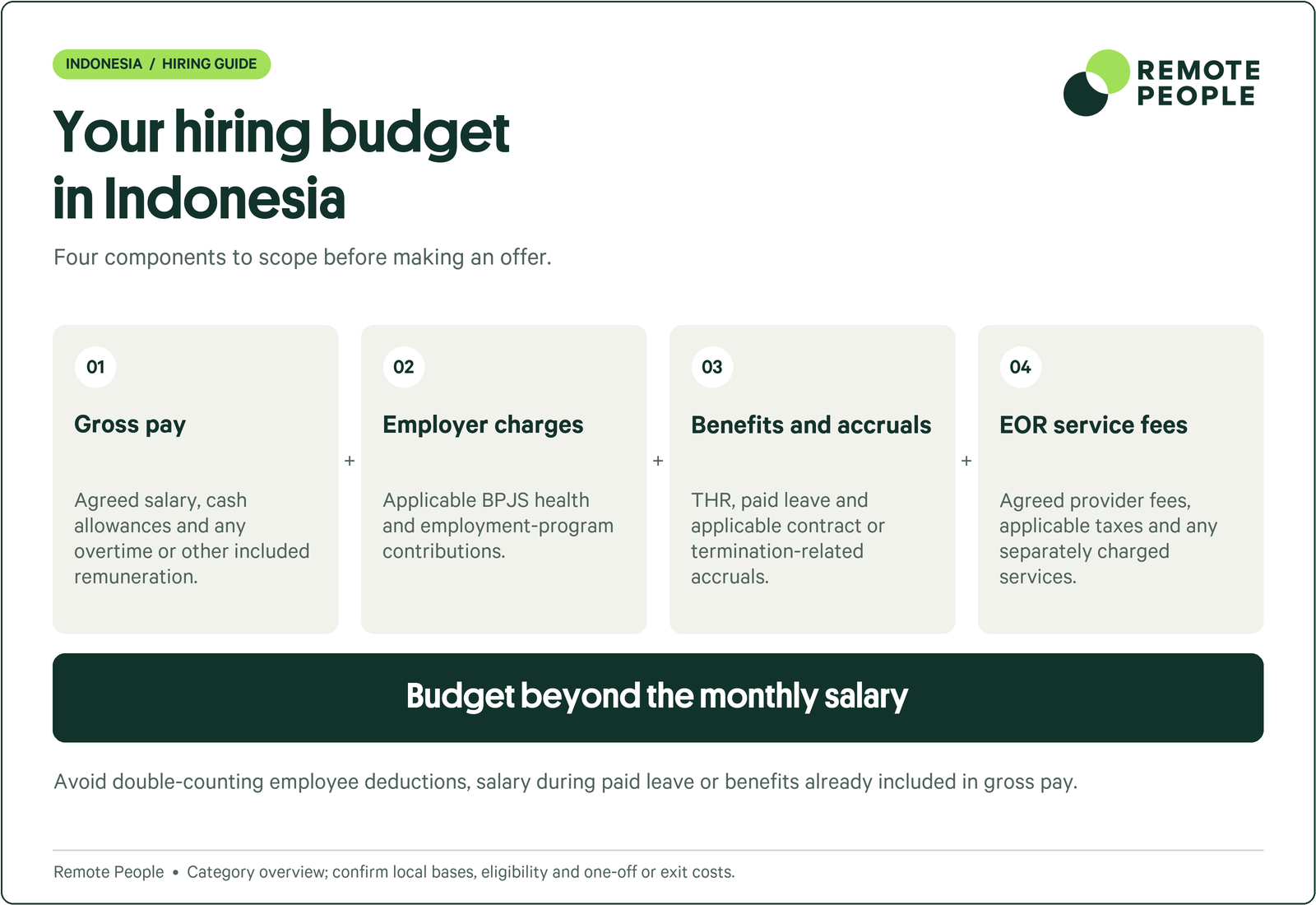
Additional costs may apply if you require extra services, such as:
- Payroll processing and HR management software access
- Visa and work permit sponsorships (e.g., KITAS for expatriates)
- Enhanced employee benefits packages (private health insurance, extra paid leave)
- Customized reporting or HR consulting support
Even with these extra charges, partnering with an EOR is usually far more affordable and less risky than establishing your own PT PMA (foreign-owned company) in Indonesia, which involves licensing fees, minimum capital requirements, ongoing compliance costs, and longer setup times.
Employment and Labor Laws in Indonesia
Indonesia has comprehensive labor regulations that are designed to protect worker rights. Your business can only operate successfully if it complies with these laws to provide a framework for business operations.
For compliance and to build positive employer-employee relationships, you’ll need a proper understanding of the labor laws below:
- Law No. 13 of 2003 on Manpower: This covers employment relationships in Indonesia. It controls everything from employment contracts and working hours to termination and industrial relations.
- Government Regulation No. 35 of 2021: This law is used to update every aspect of fixed-term employment contracts, outsourcing, working and rest hours, and termination of employment.
- Law No. 24 of 2011 on the Social Security Agency: This law was used to establish BPJS (Badan Penyelenggara Jaminan Sosial), a mandatory social security program in Indonesia.
- Law No. 40 of 2004 on the National Social Security System: This is the framework law for all social security programs in Indonesia.
- Law No. 6 of 2023 (Job Creation Law): The Job Creation Law is a reform that regulates the business climate affecting various aspects of labor regulations.
Employers in Indonesia are subject to Law No. 27 of 2022 on Personal Data Protection (PDP Law), which took effect in October 2024. Under this law, employers must obtain employee consent before processing personal data, implement appropriate security safeguards, and notify the relevant authority of any data breaches within 72 hours.
Organizations involved in large-scale data processing are required to appoint a Data Protection Officer. Cross-border transfers of personal data are permitted only where adequate protection standards are met. Non-compliance carries penalties of up to 2% of annual revenue or IDR 60 billion, in addition to potential criminal sanctions.
Employment Contracts
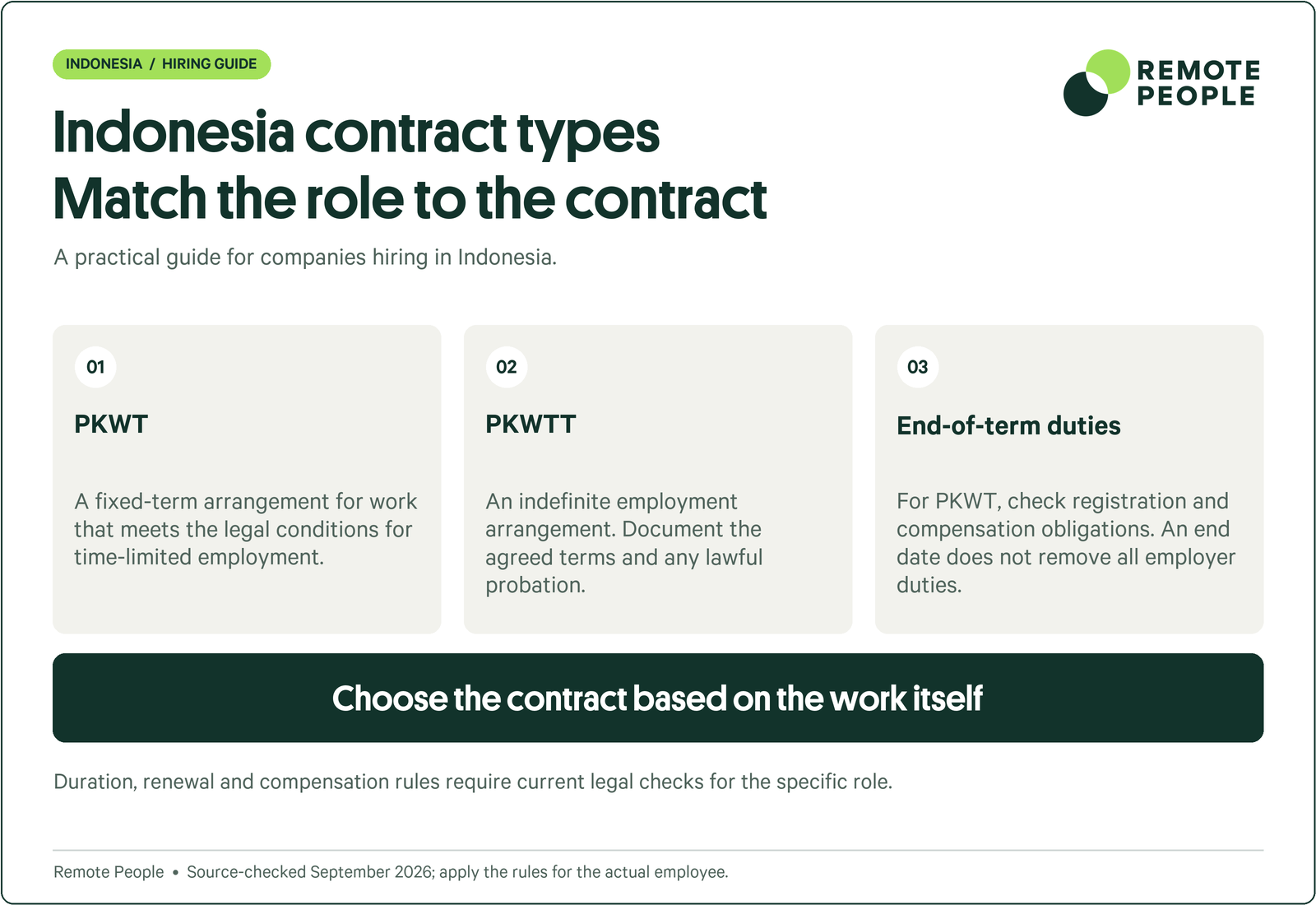
Indonesian labor law recognizes two types of employment contracts.
- A Permanent Employment Contract (PKWTT) has no specified end date and may include a probation period of up to 3 months. It provides greater job security and benefits, and termination requirements are more involved compared to fixed-term arrangements.
- A Fixed-Term Employment Contract (PKWT) is used for work that is temporary in nature, such as seasonal work, project-based assignments, new product development, or non-routine tasks. The maximum duration is 5 years, and probation periods are not permitted. Upon expiry or early termination by the employer, employees are entitled to compensation equivalent to 1 month’s salary for every 12 months of service, with shorter periods pro-rated accordingly under GR 35/2021. Fixed-term contracts must also be registered with the relevant Manpower Office within 3 working days of signing.
All employment contracts must be written in the Indonesian language because the Indonesian version is legally relevant if disputes ever happen in the future.
Working Hours
The standard working hourly rate in Indonesia is 40 hours per week, broken down into 8 hours per day, 5 times a week, or 7 hours per day, 6 times a week.
Public Holidays
Indonesia observes 17 national public holidays (libur nasional) per year, reflecting the country’s religious and cultural diversity across Islam, Christianity, Hinduism, Buddhism, and Confucianism.
In addition, the government declares collective leave days (cuti bersama) each year, typically ranging from 7 to 10 days. These are strategically placed around national holidays to create extended long weekends and encourage domestic tourism. Unlike public holidays, cuti bersama days are deducted from an employee’s annual leave entitlement rather than granted as additional days off.
Combined, employees can expect approximately 24 to 27 non-working days per year depending on how many collective leave days are declared in a given year.
Overtime
An employee is only allowed a maximum overtime of 4 hours per day or 18 hours per week. The first hour of overtime must be compensated at 1.5x the regular hourly wage, while subsequent hours can be 2x the regular hourly wage.
For weekend/holiday overtime, 2x to 3x the regular hourly wage must be paid, depending on the circumstances of the overtime.
Rest Periods
Employees in Indonesia are entitled to a mandatory rest of at least 30 minutes after 4 hours of continuous work.
Social Security Contributions
All employees in Indonesia, including foreign nationals, must be enrolled in the national social security programs administered by BPJS. There are two agencies: BPJS Kesehatan, which covers healthcare, and BPJS Ketenagakerjaan, which covers employment-related protections. Both employers and employees share contribution responsibilities across these programs.
Probation Period
Maximum 3 months, applicable only to permanent employment contracts (PKWTT). Probation clauses are prohibited in fixed-term contracts (PKWT) and are void if included. During probation, employees must be paid at least applicable minimum wage. Termination during probation requires no severance payment but must provide 30 days’ written notice or payment in lieu.
How an Employer of Record Helps You Hire in Indonesia
Starting a business in Indonesia comes with exciting prospects, but you would have to approach the recruitment process effectively.
From including the cultural elements that can attract the local talent to sourcing for the right candidates, reviewing applications, interviews, and final onboarding, an Employer of Record takes the stress off you so you can be fully committed to the smooth running of your business.
It will help compile the required documentation for compliance and payroll, process work permits for foreign employees, and act as your legal representative, any day, any time!
Using an Employer of Record service like RemotePeople helps you avoid common pitfalls while ensuring a smooth experience for your new employees.
Payroll and Employment Taxes in Indonesia
Currency and Payment Methods
In Indonesia, salaries must legally be paid in Indonesian Rupiah (IDR), even for foreign employees working in Bali. This requirement is mandated by Law No. 7 of 2011 on Currency, which states that all transactions conducted within Indonesia must use the Rupiah.
Common payment methods include bank transfers, digital payment platforms, and cash payments, although the latter is less common in formal employment, but is still used in some sectors.
Most professional employees in Bali prefer monthly salary payments, which is also the standard practice under Indonesian employment regulations.
Minimum Wage
Indonesia operates a regional minimum wage system where each province sets its own rate, known as the Provincial Minimum Wage (UMP), based on local living costs, inflation, and economic growth. Rates are revised annually and take effect on January 1 each year. Some cities and regencies also set their own local minimum wage (UMK), which may exceed the provincial rate.
The table below shows a selection of 2026 provincial minimum wage rates for reference.
| Province | Monthly Minimum Wage (IDR) | Approximate (USD) |
|---|---|---|
| Jakarta | IDR 5,729,876 | ~$350 |
| Banten | IDR 3,100,811 | ~$189 |
| Bali | IDR 3,207,459 | ~$195 |
| West Java | IDR 2,317,601 | ~$141 |
City and regency rates can go higher than the provincial figure. For example, Bekasi’s UMK reaches IDR 5,990,000 per month, exceeding West Java’s provincial rate by a significant margin.
It is also worth noting that the minimum wage applies only to employees with less than one year of service. For longer-tenured employees, employers are required to follow a structured company wage scale (SUSU) in accordance with Government Regulation PP No. 49/2025. For professional and specialized roles, market rates will generally exceed the minimum wage regardless of tenure.
Income Tax
Employees in Indonesia are subject to progressive income tax (PPh 21) on their annual earnings. Before applying the tax rates, a non-taxable income threshold (PTKP) is first deducted from gross income to determine the actual taxable amount.
The personal PTKP allowance is IDR 54,000,000 per year. Married taxpayers receive an additional IDR 4,500,000, and each registered dependent adds another IDR 4,500,000, up to a maximum of three dependents. Only the income remaining after these deductions is subject to the rates below.
| Annual Income Earned By An Employee (IDR) | Tax Rates |
|---|---|
| Up to 60 million | 5% |
| 60 million – 250 million | 15% |
| 250 million – 500 million | 25% |
| 500 million – 5 billion | 30% |
| Above 5 billion | 35% |
Since January 2024, employers are required to use the Average Effective Rate (TER) method for monthly PPh 21 withholding from January through November, with a year-end reconciliation carried out in December using the full progressive rates. Employees who do not hold a Tax Identification Number (NPWP) are subject to a 20% surcharge on their withholding, making NPWP registration an important step for all employees.
Foreign employees working in Indonesia for
more than 183 days within a 12-month period are considered tax residents and are subject to the same progressive rates on their worldwide income. Those staying for fewer than 183 days are taxed only on Indonesian-sourced income at a flat rate of 20%. Indonesia has tax treaties with a number of countries that may affect how expatriate income is taxed, and employees in this situation should verify whether a treaty applies to their home country.
Employer Social Security Contributions
Employers are responsible for the larger share of social security contributions. This covers healthcare, work accident protection, death benefits, old-age savings, and pension.
| Program | Rate | Notes |
|---|---|---|
| BPJS Kesehatan (Healthcare) | 4% of monthly salary | |
| Work Accident Protection (JKK) | 0.12% – 0.87% of wages | Rate depends on industry risk level |
| Death Benefits (JKM) | 0.3% of wages | |
| Old-Age Benefits (JHT) | 3.7% of wages | |
| Pension Benefits (JP) | 2% of wages |
The JKK rate varies based on the risk classification of the employer’s industry, following Government Regulation PP No. 28/2025, which halved the previous rates to reduce the burden on labor-intensive industries.
| Risk Category | JKK Rate |
|---|---|
| Very Low Risk | 0.12% |
| Low Risk | 0.27% |
| Medium Risk | 0.44% |
| High Risk | 0.58% |
| Very High Risk | 0.87% |
Contribution amounts for BPJS Kesehatan are capped at a maximum wage base of IDR 12,000,000 per month, meaning the maximum employer contribution is IDR 480,000 per month regardless of actual salary. For the Pension Program (JP), the wage base is capped at IDR 10,547,400 per month as of 2025, adjusted annually based on GDP growth. There is no wage cap for Old-Age Savings (JHT). Starting December 2025, BPJS Kesehatan is transitioning to a new standardized inpatient care system called KRIS (Kelas Rawat Inap Standar), which replaces the previous three-tiered class system.
Employee Social Security Contributions
Employees contribute to three programs: healthcare, old-age savings, and pension. These are deducted directly from the employee’s monthly salary.
| Program | Rate |
|---|---|
| BPJS Kesehatan (Healthcare) | 1% of monthly salary |
| Old-Age Benefits (JHT) | 2% of wages |
| Pension Benefits (JP) | 1% of wages |
The same wage caps apply to employee contributions. BPJS Kesehatan contributions are capped at a maximum wage base of IDR 12,000,000 per month, with a maximum employee contribution of IDR 120,000 per month. The Pension Program (JP) wage base is capped at IDR 10,547,400 per month, while Old-Age Savings (JHT) contributions have no cap.
THR (Religious Holiday Allowance)
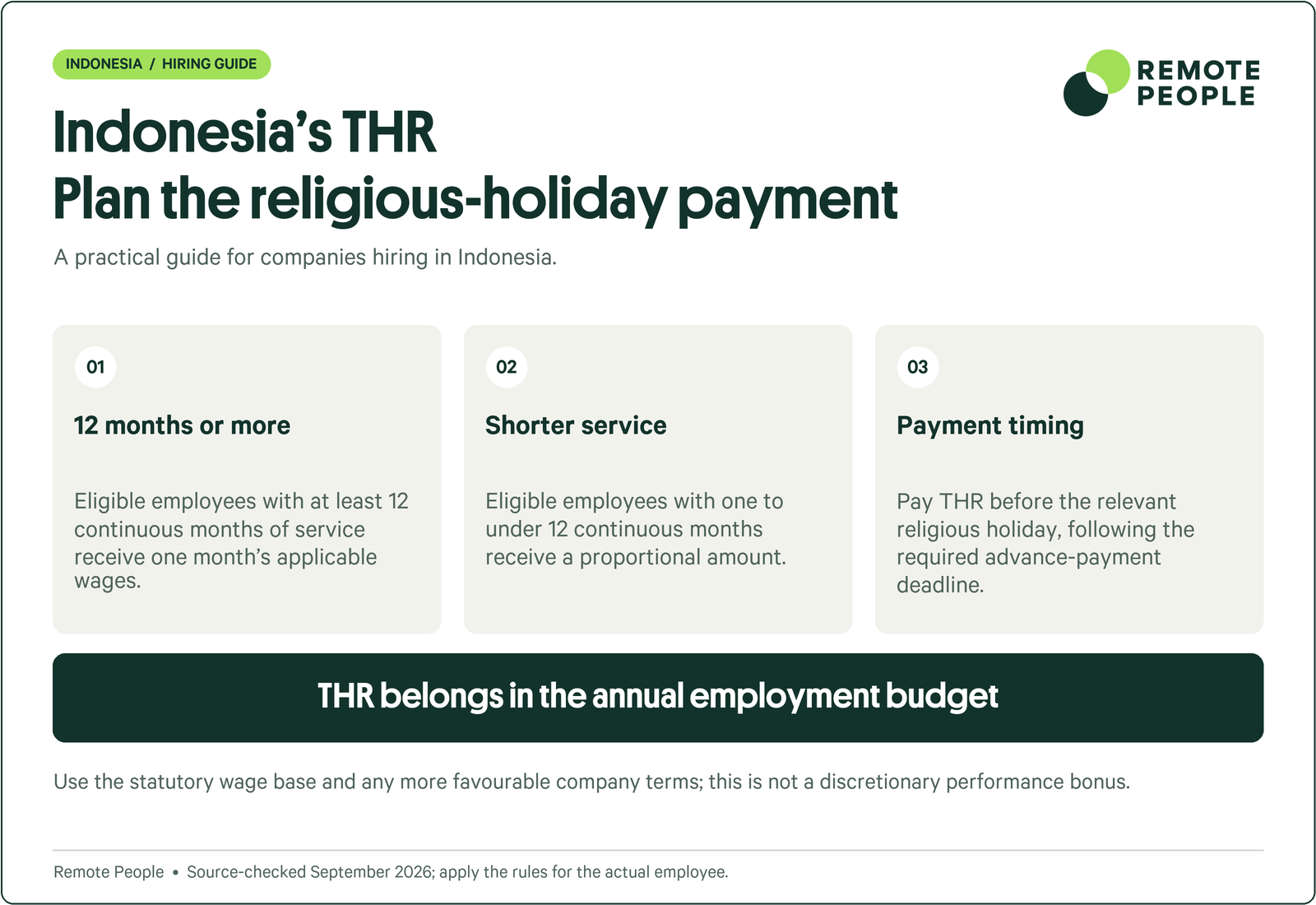
All employees in Indonesia are entitled to a religious holiday bonus known as THR (Tunjangan Hari Raya), regardless of employment type, whether permanent, fixed-term, or daily. Employees with 12 or more months of service receive one full month’s salary, while those with less than 12 months receive a pro-rated amount based on their length of service.
THR must be paid at least 7 days before the employee’s religious holiday, which is determined by the employee’s declared religion. Late payment carries a 5% penalty on the outstanding amount. If an employee is terminated within 30 days of their religious holiday, THR remains payable.
Payroll Process and Requirements
The Indonesian payroll process involves a lot of components that are mandatory and must be properly adhered to by employers in Indonesia. Failure to comply with any of the following requirements can attract heavy penalties and fines.
- Tax Withholding: Employers in Indonesia are required to calculate, withhold, and remit income tax (PPh 21) to the Indonesian tax authorities.
- Social Security Contributions: Both the employer and the employee are responsible for making contributions to BPJS programs that must be calculated and remitted every month.
- Religious Holiday Allowance (THR): THR is a mandatory annual bonus equivalent to one month’s salary for the job. This must be paid before the employee’s religious holiday.
- Overtime Calculation: Employers must accurately track and calculate all overtime hours spent by an employee, according to legal requirements in Indonesia.
- Payslips: A detailed payslip must be provided to employees during the onboarding process. If you have an EOR service provider, they can help handle the paperwork. The payslip is expected to show the gross salary, deductions, and net payment.
Work Permits and Visas in Indonesia
Hiring foreign workers in Indonesia requires employers to obtain approval for a Foreign Worker Utilization Plan (RPTKA) before the hiring process can begin. Once approved, the foreign worker is issued a Limited Stay Permit (KITAS), which is valid for up to 2 years and renewable.
Employers are also required to pay a monthly compensation fund (DPKK) of USD 100 per foreign worker, appoint an Indonesian counterpart for skills transfer purposes, and ensure the role is not among those reserved exclusively for Indonesian nationals. The full work permit process typically takes between 4 to 8 weeks from start to finish.
Time Off and Leave in Indonesia
Annual Leave
Employees are entitled to 12 working days of paid annual leave per year after completing 12 months of continuous service under Article 79 of the Manpower Law. Unused leave expires if not taken within 6 months of the entitlement period. Collective leave days (cuti bersama) are deducted from this entitlement.
Employees in specific industries who have completed 6 or more years of continuous service are entitled to long service leave of at least 2 months, granted on the 6th and 7th year of each service cycle.
Maternity Leave
Under the KIA Law (Law No. 4/2024), working mothers are entitled to a minimum of 3 months of paid maternity leave after childbirth, with up to 3 additional months available if supported by a medical certificate.
| Period | Pay |
|---|---|
| Months 1 to 3 | 100% of salary |
| Month 4 | 100% of salary |
| Months 5 to 6 | 75% of salary |
| Miscarriage or pregnancy termination | 6 weeks paid leave at full salary |
Employers with sufficient workforce are also required to provide breastfeeding rooms and access to daycare facilities.
Paternity Leave
Fathers are entitled to 2 days of paid paternity leave, which may be extended by up to 3 additional days with employer agreement under the KIA Law, for a potential total of 5 days.
Sick Leave
Employees are entitled to paid sick leave provided they present a valid doctor’s certificate. Pay is not fixed and decreases the longer the absence continues.
| Period | Pay |
|---|---|
| Months 1 to 3 | 100% of salary |
| Month 4 | 100% of salary |
| Months 5 to 6 | 75% of salary |
| Miscarriage or pregnancy termination | 6 weeks paid leave at full salary |
An illness extending beyond 12 months is considered a valid ground for termination with severance pay.
Menstruation Leave
Female employees who experience pain during menstruation are entitled to leave on the first and second day of their menstrual cycle under Article 81 of the Manpower Law. A medical certificate is not required, though employers may set specific procedures for requesting this leave in their company regulations.
Terminations and Severance in Indonesia
The Indonesian labor law provides strong protections regarding the termination of workers. Employers who wish to terminate an employee must attempt negotiation before proceeding with termination, provide notice periods, pay severance packages calculated based on years of service, and obtain approval from the Industrial Relations Court for contested terminations.
Termination Process
- Negotiation Phase: Employers must attempt to negotiate with the employee before proceeding with termination. For companies with labor unions, negotiations must involve union representatives
- Termination Grounds: Indonesian law requires valid reasons for termination. Before you can be permitted to terminate employees, it means your company is either restructuring or having financial difficulties, employee misconduct after appropriate warnings, extended illness of an employee for more than 12 months, employee’s criminal conviction, employee reaching retirement, or voluntarily resigning.
- Documentation Requirements: Employers must provide a formal termination letter stating the grounds for termination, records of any prior warnings or performance improvement plans, evidence supporting the termination reason, and negotiation attempts made until then.
- Dispute Resolution: If the employee contests the termination, the case may then proceed to Bipartite negotiations, mediation through the Manpower Department or the Industrial Relations Court.
Notice Period
Notice periods in Indonesia take an average of 30 days but may vary based on employment contract terms. There is also an option for payment in lieu of notice.
Severance Pay
Indonesia mandates severance pay (pesangon) for terminated employees under Government Regulation GR 35/2021. The amount is based on the employee’s length of service, and the final payout is further adjusted by a multiplier factor ranging from 0.5x to 2x depending on the reason for termination. Resignation, for instance, carries a lower multiplier than employer-initiated termination.
| Length of Service | Severance Pay |
|---|---|
| Less than 1 year | 1 month salary |
| 1 to 2 years | 2 months salary |
| 2 to 3 years | 3 months salary |
| 3 to 4 years | 4 months salary |
| 4 to 5 years | 5 months salary |
| 5 to 6 years | 6 months salary |
| 6 to 7 years | 7 months salary |
| 7 to 8 years | 8 months salary |
| 8 years or more | 9 months salary |
In addition to severance, employees with three or more years of service are entitled to a service appreciation payment (UPMK), which recognizes long-term contribution and is calculated separately.
| Length of Service | Service Appreciation Pay |
|---|---|
| 3 to 6 years | 2 months salary |
| 6 to 9 years | 3 months salary |
| 9 to 12 years | 4 months salary |
| 12 to 15 years | 5 months salary |
| 15 to 18 years | 6 months salary |
| 18 to 21 years | 7 months salary |
| 21 to 24 years | 8 months salary |
| 24 years or more | 10 months salary |
Beyond severance and service appreciation pay, employees are also entitled to other compensation rights upon termination, including payment for unused annual leave, housing and medical allowances at 15% of total severance and service pay, and reimbursement of relocation expenses where applicable.
Expand into Indonesia Easily with RemotePeople’s Employer of Record in Indonesia
Indonesia offers a lot of prospects to international businesses that are looking to expand into the growing economy. You get to access the country’s diverse talent locally and establish a presence in one of Southeast Asia’s most vibrant business environments.
With the right EOR service, you will be able to successfully launch your business in Indonesia, comply with legal laws, cultural considerations, and other administrative details.
Where companies hiring in Indonesia expand next
Teams hiring in Indonesia typically expand across ASEAN, where cross-border mobility and diverse multilingual talent make regional coverage natural. Many companies add Thailand first, drawing on ASEAN integration and cross-border mobility. A team in Malaysia follows as the ASEAN single-market trade framework, while operations in Singapore offers overlapping ASEAN labor and mobility rules. Vietnam is often the fourth step, valued for ASEAN-wide talent flows and shared hiring norms.
Frequently Asked Questions
Yes. Employers must first obtain RPTKA approval before hiring a foreign national, after which the employee is issued a KITAS (Limited Stay Permit) valid for up to 2 years. Employers are also required to pay a monthly compensation fund of USD 100 per foreign worker and appoint a local counterpart for skills transfer. The process typically takes 4 to 8 weeks.
A PKWTT is a permanent contract with no fixed end date and allows for a probation period of up to 3 months. A PKWT is a fixed-term contract used for temporary or project-based work, capped at a maximum duration of 5 years, with no probation period allowed. Fixed-term employees are entitled to compensation upon contract expiry under GR 35/2021.
Yes. THR, or religious holiday bonus, is mandatory for all employees regardless of employment type. Employees with 12 or more months of service receive one full month's salary, while shorter-tenured employees receive a pro-rated amount. It must be paid at least 7 days before the employee's religious holiday.
Generally, no. Indonesian labor law provides strong termination protections. Most terminations require a valid legal ground, a negotiation process, proper documentation, and severance pay calculated based on length of service. The only exceptions are resignation and termination due to misconduct following due process.
Failure to register employees with BPJS Kesehatan or BPJS Ketenagakerjaan is a violation of Indonesian law and can result in administrative sanctions, fines, and reputational damage. All employees, including foreign nationals, must be enrolled from the start of employment.
No. Probation periods are only permitted under permanent contracts (PKWTT), with a maximum duration of 3 months. Fixed-term contracts (PKWT) do not allow for probation periods under any circumstances.
Employer of Record in
Employer of Record in
Employer of Record in
Employer of Record in
Employer of Record in
Employer of Record in
Employer of Record in
Employer of Record in