
 Recruit
Average Salary in Israel
-
 Drew Donnelly
- Published
- September 21, 2026
- 5 ★ on G2








Let RemotePeople handle payroll, compliance, and HR admin worldwide so you can focus on building your team.
Israel is a good outsourcing destination due to its highly skilled workforce, strong startup ecosystem, and sense of innovation. Employers hiring remote workers in the country may wonder, what is the average salary in Israel? If you want to hire in Israel without setting up your own legal entity, an employer of record (EOR) in Israel is a practical solution. An EOR becomes your official local employer, handling employment compliance, payroll, taxes, and all regulatory requirements.
This information will help them prepare a fair job offer.
The average monthly salary in Israel is 13,588 shekels, or about USD 3,723—however, experience, education, industry, profession, and location all impact salaries. The median income and salary range must also be considered.
This article will explore all aspects of Israeli salaries to provide more comprehensive insight.
What is the Average Salary in Israel?
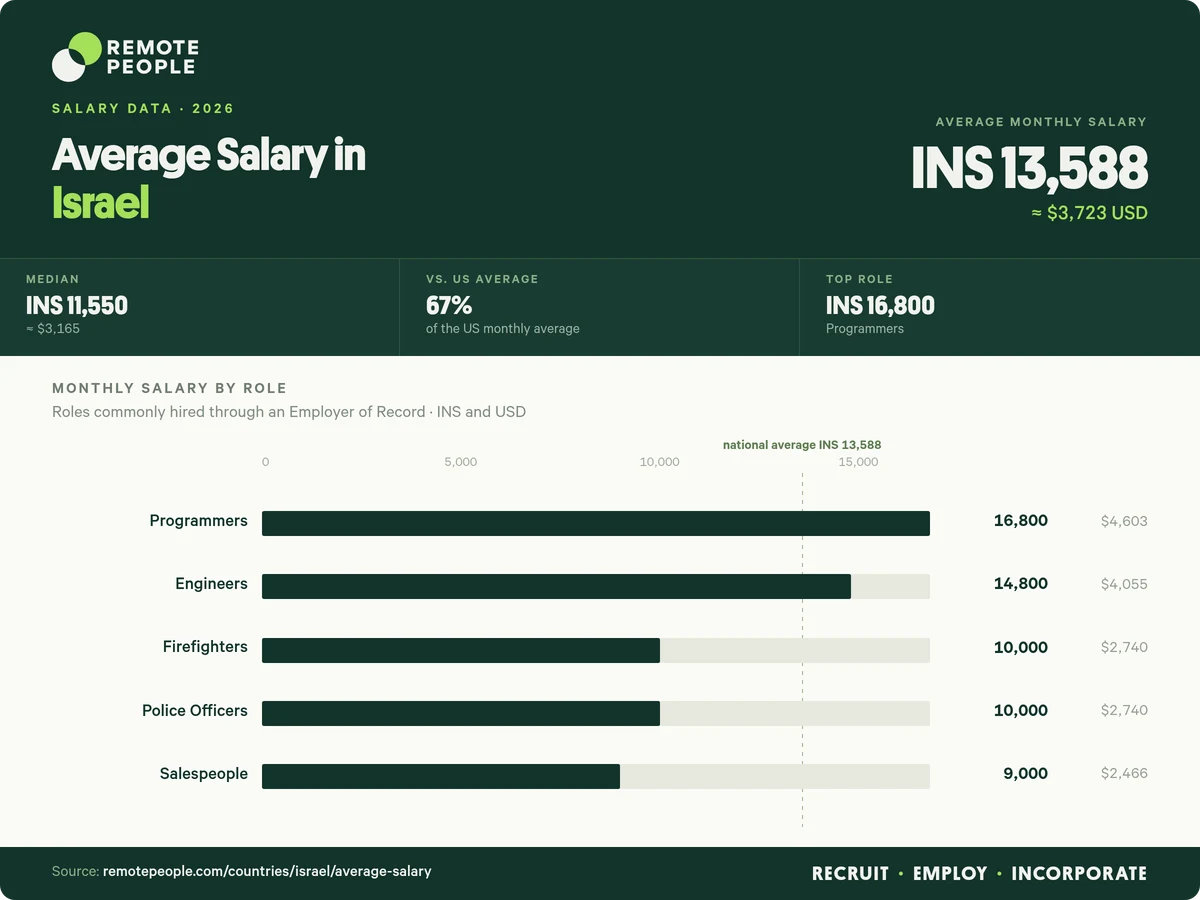
The average salary in Israel is 13,588 ILS, or $3,723. The country’s high wages are due to a highly skilled workforce and a thriving tech sector. The government also invests in research and development, keeping it on top of innovation.
Median Income
The median salary can also be considered the ‘middle salary.’ Based on typical OECD wage distributions, Israel’s estimated median monthly income is approximately 11,550 NIS (around $3,165). Half the population earns more than this amount, while the other half earns less. This figure is an estimate derived from the relationship between median and average wages in comparable developed economie
Salary Range
The salary range spans the lowest to highest salaries in the country. Low earners make around 6,247.67 shekels (about $1,712) per month based on the national minimum wage, while high earners can make significantly more depending on industry, seniority, and specialization.
Salary Comparison by Profession
The following salary comparison chart reveals how salaries fluctuate by position and industry.
Profession | Monthly Salary (INS) |
|---|---|
Programmers | 16,800 |
Drivers | 8,400 |
Welders and Electricians | 10,800 |
Construction Specialists | 8,800 |
Highly Qualified Medical Professionals | 15,800 |
Less Qualified Medical Professionals | 6,800 |
Cooks | 6,900 |
Engineers | 14,800 |
Firefighters | 10,000 |
Police Officers | 10,000 |
Salespeople | 9,000 |
Average Wage in Israel by Education
Education is a vital consideration in Israeli salaries. Educated workers tend to find employment more easily and qualify for higher-paying jobs.
Statistics show that 56% of workers 25-34 years old without an upper secondary education are employed compared to 69% of workers with an upper secondary, post-secondary, or non-tertiary education in the same age group.
Similarly, 27% of workers 25-64 years old without an upper secondary education earn wages below the median income level compared to 21% of workers with an upper secondary, post-secondary, or non-tertiary education and 13% with a tertiary qualification.
Salary Comparison by Experience
A recent press release reveals that experience and education are among the most significant factors in salary determination. Experienced workers earn more than entry-level workers. Additionally, workers tend to become eligible for raises with tenure at their jobs, contributing to higher salaries.
The article revealed that most Israelis hit their peak salaries after 32 years of experience in their field. Top earners are typically 40-60 years old.
Salary Comparison by Location
Location also impacts salaries, with workers in urban centers earning more than rural workers due to higher living costs and proximity to major companies offering more job opportunities.
Israeli workers living in tech hubs like Tel Aviv and Herzliya tend to earn more than workers in Jerusalem. Haifa and Ra-anana also offer competitive salaries and lower living costs.
How Much is Minimum Wage in Israel?
Israel’s last minimum wage increase was enacted on April 1, 2025. It is currently 6,247.67 NIS (approximately $1,712 USD). The update is designed to align salaries with higher living costs.
Average Salary in Israel vs. the Rest of the World
Comparing Israeli salaries to salaries worldwide can give you more perspective. The following charts reveal how Israel’s wages compare to salaries in developed, developing, and undeveloped countries.
Israel vs. Developed Countries
Country | Average Salary | Comparison to Average Israel Salary |
|---|---|---|
United Kingdom | £3,000 (approx. $4,100) | − 10% |
United States | $5,220 | − 40% |
Norway | 50,000 NOK (approx. $4,700) | − 26% |
Germany | €4,300 (approx. $4,470) | − 20% |
Austria | €3,700 (approx. $4,050) | − 9% |
Israel vs. Developing Countries
Country | Average Salary | Comparison to Average Israel Salary |
|---|---|---|
Romania | 4,000 RON (approx. $835) | 78% |
Russia | 73,700 RUB (approx. $700) | 81% |
Albania | 83,330 ALL (approx. $860) | 77% |
Kazakhstan | 342,000 KZT (approx. $645) | 83% |
Ukraine | 18,000 UAH (approx. $500) | 87% |
Israel vs. Undeveloped Countries
Country | Average Salary | Comparison to Average Israel Salary |
|---|---|---|
Thailand | 15,000 Baht (approx. $420) | 89% |
Philippines | 15,000 PHP (approx. $265) | 93% |
Vietnam | 7.5 million Dong (approx. $300) | 92% |
Egypt | 14,317 EGP (approx. $284) | 92% |
Pakistan | 60,000 PKR (approx. $210) | 94% |
Israel is a highly developed country with a high Human Development Index and per capita income. Its work economy is focused on high-tech industries like software, electronics, and life sciences. The government supports research and development, making it a prime destination for startups and product innovation.
The country is a good outsourcing destination due to its highly skilled workforce, reputation for innovation, and research and development culture. Its focus on technology makes it a prime resource for AI, software development, and cybersecurity services. However, its high wages mean it is not the most cost-effective solution.
What are the Most Common Outsourced Industries in Israel?
Employers considering partnering with Israel on remote work projects should focus on the following sectors:
IT Services
Israel is a global leader in modern technology. Its software development sector has grown by 400% in a decade. The country offers everything from PC motherboards to cell phone chips. It is home to the R&D headquarters of various multinational tech companies, including Microsoft, PayPal, and Apple.
Health Technology
Israel has become a top resource for healthcare solutions. Advanced electronics and communications technologies have led to medical lasers, diagnostics, surgical equipment, telemedicine, and digital imaging innovations. Multinational medical companies that operate in Israel include Pfizer, Johnson & Johnson, and Noris Medical.
Automotive Technology
Several large companies have expressed interest in opening R&D operations in Israel after the country demonstrated increased innovation in Smart transportation technology.
The government has made progress in HDL technologies like computer vision, control of sound systems, and location-based services, leading to more innovative, faster, and more energy-efficient vehicles. Several companies, including Volvo, Ford, and General Motors, have chosen to open operations in Israel to further their development.
Conclusion
Israel’s highly skilled and innovative workforce makes it a prime outsourcing destination. The average salary in Israel is high, so it may not be the most cost-effective option; however, wages are still lower than in some other countries. Employers that hire remote workers in the state can save money while benefiting from high-quality products and services.