
 Recruit
Employer of Record (EOR) in Israel
-
 Drew Donnelly
- Published
- September 22, 2026
RemotePeople’s employer of record in Israel lets you hire employees in Israel with Bituach Leumi enrollment. We handle 4.51% to 7.6% National Insurance contributions, health insurance deductions, and monthly reporting.
Hire in Israel — book a free 30-minute demo
Tell us what you need. You'll get a tailored, transparent proposal within 24 hours, plus a free call to walk through it.
Tell us about your company
So we can match you with a specialist who knows your market — and unlock volume pricing tiers.
* All fields are required.
Where and when are you hiring?
Tell us the geography and timing and we'll quote each country line by line, with onboarding timelines.
* All fields are required.
Help us beat your current setup
We'll benchmark your current deal and send a line-by-line proposal in 24 hours — showing exactly where we cut cost, time, or risk. After you submit, you can book a call to walk through it together.
* All fields are required.
Thanks! Your proposal is on its way.
Expect a tailored, line-by-line proposal in your inbox within 24 hours. In the meantime…
Want to walk through it together?
Book a free 30-minute call with one of our specialists. We'll explain every line, answer your questions, and tailor the proposal further if you need.
No obligation. Pick a time that works for you.








- Hire in Israel — book a free 30-minute demo
- Tell us about your company
- Where and when are you hiring?
- Help us beat your current setup
- Thanks! Your proposal is on its way.
- How an Employer of Record Works in Israel
- Employment Laws and Regulations in Israel
- Work Permits and Visas in Israel
- Payroll, Taxes, and Social Security in Israel
- Cost of Hiring Through an EOR in Israel
- Benefits of Using an EOR in Israel
- Termination and Offboarding in Israel
- EOR vs. Other Hiring Models in Israel
- Public Holidays in Israel
- How to Get Started with an EOR in Israel
- Where companies hiring in Israel expand next
- Frequently Asked Questions
- Related EOR Destinations

Start hiring in Israel
Let RemotePeople handle payroll, compliance, and HR admin worldwide so you can focus on building your team.

An employer of record in Israel lets companies hire employees without setting up a local entity, at a typical cost of $300 to $600 per employee per month. Israel’s employment rules are spread across dozens of standalone statutes rather than a single labour code, from mandatory pension contributions under extension orders to strict severance obligations under the Severance Pay Law 5723-1963. An employer of record in Israel takes on the legal employer role, managing payroll, tax withholding, social security registration with Bituach Leumi, and full compliance with Israeli employment legislation, so businesses can onboard talent in days rather than months.
How an Employer of Record Works in Israel
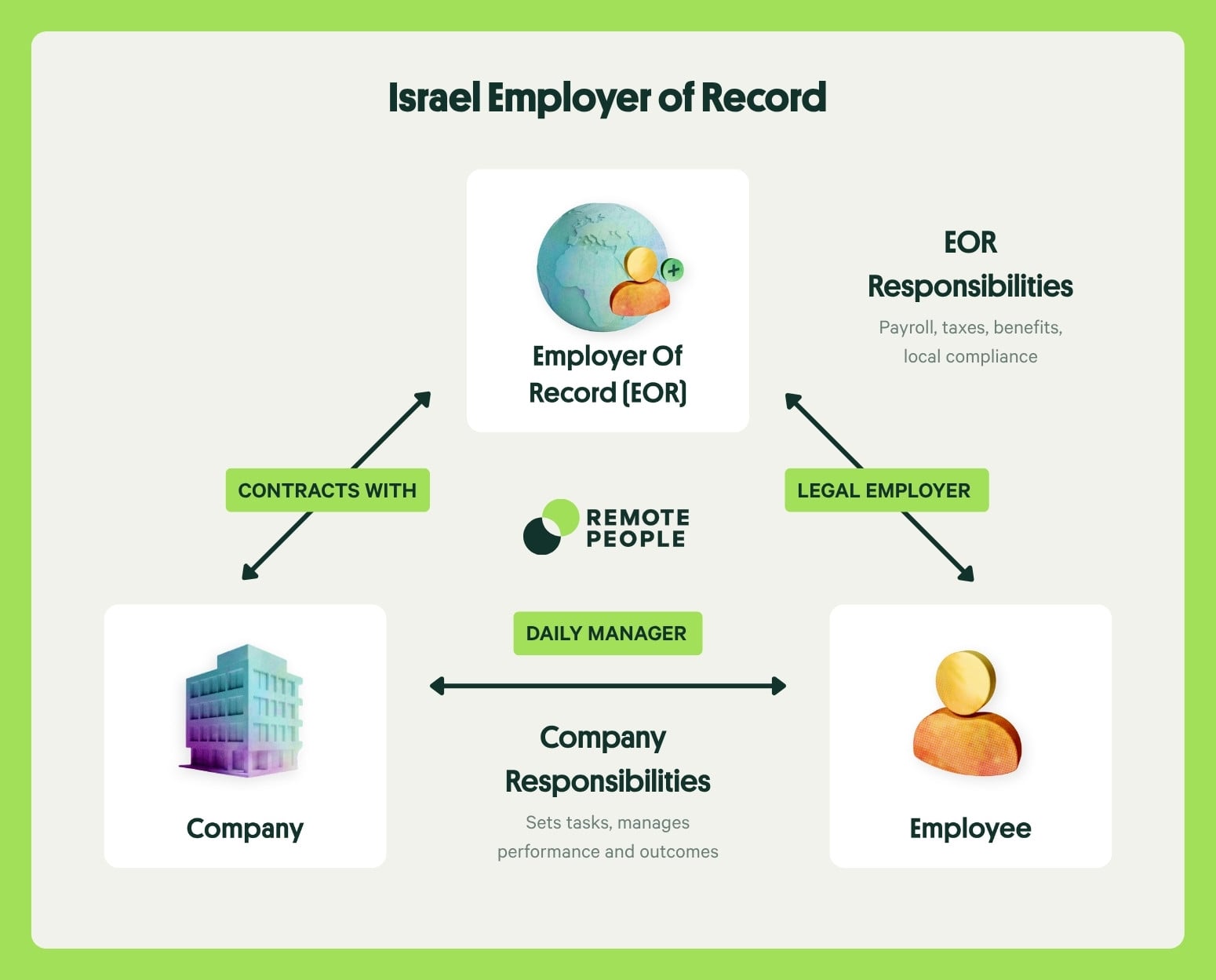
If you’d like to learn more about how Employer of Record (EOR) services work, read our What Is an Employer of Record (EOR)? guide for a complete overview of the model, its benefits, and when to use it.
If you’re comparing providers, our Best Employer of Record (EOR) Providers guide reviews the leading platforms to help you choose the right solution for your business.
Who Uses an EOR in Israel?
Companies turn to an EOR in Israel for several reasons tied to Israel’s specific regulatory environment and talent market.
- Testing the market before committing: Companies exploring Israel’s technology sector or other industries can hire a small team through an EOR without the cost and time of incorporating a local entity through the Israeli Companies Registrar.
- Hiring a small remote team: Organizations that need 1 to 15 employees in Israel benefit from an EOR structure rather than maintaining a local subsidiary, which requires annual filings, a local director, and ongoing legal fees.
- Onboarding quickly: An EOR can onboard an employee in Israel within 1 to 2 weeks, compared to 2 to 4 months for entity setup through the Companies Registrar, tax registration, and Bituach Leumi enrollment.
- Hiring foreign nationals: When hiring non-Israeli workers who need B-1 work visas, an EOR with a registered Israeli entity can sponsor work permits through the Population and Immigration Authority (PIBA).
Any business that wants to hire in Israel without the overhead of a local entity, while remaining fully compliant with Israeli employment law, is a fit for the EOR model.
Typical Onboarding Timeline
Onboarding through an EOR in Israel typically takes 1 to 2 weeks for citizens, though timelines stretch considerably if the employee is a foreign national who needs a work permit.
- EOR agreement and employee details: 1 to 2 days to finalize the service agreement and collect employee information.
- Employment contract drafting and review: 2 to 3 days to prepare a compliant Hebrew-language employment contract that includes all mandatory terms under the Notice to Employee Law.
- Social security and tax registration: 3 to 5 days to register the employee with Bituach Leumi and the Israel Tax Authority, and to set up pension fund enrollment.
- Payroll setup and benefits enrollment: 2 to 3 days to configure payroll, enroll the employee in a pension fund and Keren Hishtalmut, and set up convalescence pay tracking.
- Employee onboarding and first day: 1 day for orientation and work commencement.
Most EOR providers can onboard an Israeli citizen employee within 1 to 2 weeks. For foreign nationals requiring a B-1 work visa, the timeline extends by 8 to 14 weeks due to PIBA processing.
Hire in Israel
A highly educated workforce, robust IP protections, and a mature technology ecosystem make Israel one of the strongest talent markets globally.
We handle employment contracts, payroll, tax withholding, and full Israel compliance.
No local entity needed. Your team can start in days.
Employment Laws and Regulations in Israel
Employment Contracts
Understanding Israel’s employment framework is essential for any employer of record in Israel, because the country does not have a single unified labour code. Employment relationships are governed by a collection of standalone statutes, including the Hours of Work and Rest Law 5711-1951, the Annual Leave Law 5711-1951, and the Severance Pay Law 5723-1963, among others (PwC Israel). The Ministry of Labor, Social Affairs and Social Services oversees enforcement.
All employers must provide a written notice of employment terms within 30 days of the start date under the Notice to Employee Law 5762-2002. The notice must specify salary, payment date, working hours, leave entitlements, pension arrangements, and any applicable extension orders or collective agreements. Contracts can be for an indefinite term or a fixed term, though fixed-term contracts that are renewed repeatedly may be reclassified as indefinite by Israeli labour courts.
Working Hours and Overtime
The standard workweek in Israel is 42 hours, reduced from 43 hours effective April 2018 under an amendment to the Hours of Work and Rest Law 5711-1951 (Gov.il). For a 5-day workweek, this translates to 8 hours and 24 minutes per day. The weekly rest day is Saturday (Shabbat), with at least 36 consecutive hours of rest required. Certain categories of employees, including managerial staff and those in positions requiring a special degree of personal trust, are exempt from overtime provisions.
Overtime is calculated on a daily basis. The Hours of Work and Rest Law caps daily overtime at 4 additional hours beyond the standard workday, and total weekly hours at 58. The annual overtime cap is 182 hours per calendar year, though employers can apply to the Ministry of Labor for a permit to extend this limit.
Source:&nsp;Gov.il Working Hours and PwC Israel Tax Summary
Israel overtime and premium pay rates · Per Hours of Work and Rest Law 5711-1951 | |||
Hour Type | Rate Multiplier | Weekly/Daily Cap | Notes |
|---|---|---|---|
Weekday overtime (first 2 hours) | 125% | 2 hours/day | Calculated on regular hourly wage |
Weekday overtime (hours 3-4) | 150% | 2 hours/day | Total daily overtime capped at 4 hours |
Weekly rest day (Shabbat) work | 150% | Per permit only | Requires Ministry of Labor permit; first 2 OT hours at 175%, additional at 200% |
Public holiday work | 150% | Per permit only | Same overtime escalation as rest day work |
Night work (after 22:00) | 100% (standard) | 7 hours = full shift | No statutory premium; 7-hour night shift equals a full workday |
Employees exempt from overtime provisions include senior managers, employees whose working conditions do not allow employer supervision of hours, and certain other categories defined by ministerial order. The annual 182-hour overtime cap does not include rest-day or holiday work performed under a special permit.
Minimum Wage
The national minimum wage in Israel increased to ILS 6,443.85 per month effective April 1, 2026, equivalent to ILS 34.64 per hour based on a 42-hour workweek (CWS Israel). This represents a 3.3% increase from the previous rate of ILS 6,247.67 per month. The minimum wage applies uniformly across all sectors and is updated periodically by government order. Employers must ensure that total compensation, including base salary and fixed allowances, meets or exceeds the statutory minimum.
Probation Period
Israeli law does not prescribe a statutory probation period. Probation terms are set by the employment contract, with 3 to 6 months being the most common duration. During probation, the employee is entitled to all statutory protections, including minimum wage, social security contributions, and pension enrollment. The employer must still follow the pre-dismissal hearing (shimu’a) process before terminating a probationary employee. Notice periods during probation follow the standard rules under the Prior Notice Law 5761-2001 (Gov.il). More information on probation rules is available on RemotePeople’s Israel probation period page.
Leave Entitlements
Leave in Israel is spread across multiple standalone laws, each covering a different leave type. Employees start accruing leave from day one, and entitlements grow with tenure.
Annual Leave
Under the Annual Leave Law 5711-1951, employees working a 5-day week are entitled to a minimum of 12 working days of paid annual leave during each of the first 4 years of employment. Entitlements increase with tenure: 16 days in the fifth year, 18 days in the sixth year, and one additional day per year thereafter up to a maximum of 28 days (Gov.il). Leave accrues from the first day of employment and can be carried over, though employers may require employees to use a minimum number of days each year. Unused leave must be paid out upon termination.
Sick Leave
The Sick Pay Law 5736-1976 entitles employees to accumulate 1.5 sick days per month of employment, up to a maximum of 90 days. Payment during sick leave follows a tiered structure: the first day is unpaid, days 2 and 3 are compensated at 50% of the regular wage, and from day 4 onward the employee receives 100% pay (Gov.il). A medical certificate is required from the first day of absence. The employer bears the full cost of sick pay.
Maternity Leave
Under the Employment of Women Law 5714-1954, female employees are entitled to 26 weeks of maternity leave. Of these, 15 weeks are paid through a maternity allowance (dmei leda) funded by Bituach Leumi, provided the employee has paid National Insurance contributions for at least 10 of the 14 months preceding the birth, or 15 of the 22 months preceding the birth (Bituach Leumi). The remaining 11 weeks are unpaid. The employee may begin maternity leave up to 7 weeks before the expected due date. Job protection extends throughout the leave period and for 60 days after return.
Paternity Leave
Fathers are entitled to 5 days of leave following the birth, consisting of 3 paid days (using the employee’s sick leave balance or annual leave) and 2 unpaid days. Additionally, fathers may share a portion of the maternity leave with the mother: if the mother has taken at least 6 weeks of maternity leave, the father may take up to 9 weeks of the remaining entitlement, subject to Bituach Leumi eligibility requirements (Bituach Leumi).
Other Statutory Leave
Israeli law also grants these additional leave types:
- Bereavement leave: 7 days for first-degree relatives (parents, siblings, spouse, children), paid by the employer.
- Marriage leave: 3 days of paid leave for the employee’s own wedding.
- Reserve duty leave: Employees called for military reserve duty (miluim) receive full pay through Bituach Leumi reimbursement to the employer.
- Voting day: Election day is a paid day off by law.
- Adoption leave: Adoptive parents are entitled to the same leave duration as maternity leave, starting from the date the child is received.
Under the Annual Leave Law 5711-1951 and the various extension orders governing Israeli employment, the table below consolidates every statutory leave entitlement. The most significant provision for employers to note is that annual leave accrues from day one, not after any probation period, and unused leave creates a financial liability that must be settled upon termination.
Israel statutory leave entitlements · Per Israeli employment legislation | ||
Leave Type | Duration | Eligibility and Notes |
|---|---|---|
Annual leave | 12â28 days/year | 12 days for years 1â4 (5-day week); increases with tenure up to 28 days |
Sick leave | Up to 90 days | Accrues at 1.5 days/month; day 1 unpaid, days 2â3 at 50%, day 4+ at 100% |
Maternity leave | 26 weeks | 15 weeks paid by Bituach Leumi; 11 weeks unpaid; requires NI contribution history |
Paternity leave | 5 days | 3 paid + 2 unpaid; fathers may share up to 9 weeks of maternity leave |
Bereavement leave | 7 days | For first-degree relatives; fully paid by employer |
Marriage leave | 3 days | Paid leave for the employee’s own wedding |
Military reserve duty | As called | Full pay; employer reimbursed by Bituach Leumi |
Source: Gov.il Annual Leave and Gov.il Sick Leave | ||
Statutory Employee Benefits
Beyond leave and social security contributions, Israeli employers must provide several mandatory benefits established through legislation and extension orders:
- Mandatory pension: Since the 2008 Mandatory Pension Extension Order, all employees must be enrolled in a pension fund. The employer contributes 6.5% and the employee contributes 6% of the insured salary. Most employers also apply Section 14 of the Severance Pay Law, depositing an additional 8.33% monthly to cover future severance obligations.
- Convalescence pay (Dmei Havra’a): Employees who have completed at least one year of employment are entitled to annual convalescence pay. The number of days ranges from 5 to 10 based on tenure, at a rate of ILS 418 per day for 2026 (CWS Israel). This is typically paid as a lump sum in June or July.
- Travel allowance: Extension orders require employers to reimburse commuting costs up to a monthly cap based on the distance between the employee’s home and workplace, using public transportation rates.
- Keren Hishtalmut (education fund): While not mandatory by statute, the General Extension Order makes Keren Hishtalmut contributions standard practice. The employer typically contributes 7.5% and the employee 2.5% of salary up to a tax-beneficial ceiling of ILS 15,712 per month.
- Health insurance: Universal health coverage in Israel is provided through the National Health Insurance Law 5754-1994. All residents are covered through one of four health funds (kupot cholim), funded by the health tax deducted from employee wages. Employers do not pay a separate health insurance premium.
Detailed information on Israel’s benefits requirements is available on RemotePeople’s Israel employee benefits page.
Recent Regulatory Updates (2026)
A few notable changes to Israeli employment rules took effect in 2025 and 2026. The minimum wage increased to ILS 6,443.85 per month on April 1, 2026, continuing the government’s gradual increase trajectory (CWS Israel).
Income tax brackets were restructured for 2026, with the 20% bracket expanded to ILS 228,000 annually (up from ILS 193,800) and the 31% bracket starting at ILS 228,001 (up from ILS 193,801). The brackets have been frozen through 2027 with no inflation indexing (PwC Israel).
Keren Hishtalmut withdrawals saw a tax policy change: profits accumulated after January 2025 on deposits in education funds are now subject to capital gains tax upon withdrawal, whereas profits accumulated through December 2024 remain tax-exempt. Employers should factor this into benefits communication with employees.
Work Permits and Visas in Israel
Work Permit Requirements
Who Needs a Work Permit
All foreign nationals who are not Israeli citizens or permanent residents require a valid work visa to be employed in Israel. An employer of record in Israel can sponsor work permits on behalf of your employees, simplifying a process that would otherwise require a locally registered entity. There is no visa-free work authorization for any nationality. The Population and Immigration Authority (PIBA), operating under the Ministry of Interior, administers all work permit applications (Gov.il PIBA). The employer, not the employee, must initiate and sponsor the work permit application.
Eligibility and Required Documents
Eligibility for a B-1 work visa depends on the category. For expert workers, the employee must hold a relevant academic degree or professional qualification and the salary must meet minimum thresholds (approximately double the average wage for specialists). Required documents include a valid passport with at least 18 months remaining validity, a signed employment contract, academic credentials (apostilled), a criminal background check, a medical examination, passport photographs, and the employer’s company registration documents.
Processing Time and Validity
Standard B-1 work visa processing takes approximately 8 to 14 weeks from application submission to approval. The initial visa is typically valid for 1 year. Delays can occur due to security clearance requirements, incomplete documentation, or high application volumes during peak periods. The application fee is ILS 1,420 per year, which is non-refundable if the application is rejected.
Renewal Process
Work visa renewals must be submitted at least 30 days before the current visa expires. The renewal process requires updated employment documentation, proof of continued salary payment, and a valid employer sponsorship. Employees may continue working during the renewal period provided the application was submitted on time. B-1 visas can be renewed for up to 5 years total, after which additional extensions require special authorization.
Common Visa Types for Foreign Workers
The Population and Immigration Authority (PIBA) administers all work visas in Israel. The primary work authorization is the B-1 visa, which comes in multiple sub-categories based on the worker’s qualifications and the type of work. An EOR with a registered Israeli entity can sponsor most B-1 visa categories.
Israel work visa types for foreign workers · 2026 | ||||
Visa Type | Duration | Best For | Leads to Residency? | Processing |
|---|---|---|---|---|
B-1 Expert (academic) | 1 year, renewable up to 5 years | Engineers, auditors, senior executives with academic credentials | No | |
B-1 Expert (non-academic) | 1 year, renewable up to 5 years | Skilled tradespeople, technical specialists | No | |
B-1 STEP (short-term expert) | Up to 3 months | Short-term projects requiring specialized expertise | No | 2â4 weeks |
B-1 SEA (short-stay expert) | Up to 45 days/year | Brief assignments, installations, training | No | 1â2 weeks |
HIT (high-tech visa) | 1 year, renewable | Technology and cybersecurity specialists | No | 4â8 weeks |
Visa types not listed above, such as tourist visas (B-2), student visas (A-2), and volunteer visas (A-1), do not authorize employment in Israel.
How an EOR Handles Work Permits
An EOR with a registered entity in Israel can act as the sponsoring employer for B-1 work visa applications. The EOR prepares and submits the work permit application to PIBA, provides the required employer documentation (company registration, financial statements, job justification), and manages the ongoing visa renewal process.
The employee’s responsibilities are limited to providing personal documents (passport, credentials, background check, medical exam) and attending any required interviews or biometric appointments. When a work permit is required, the onboarding timeline from the typical 1 to 2 weeks (referenced in the onboarding section above) extends by 8 to 14 weeks for standard processing. The EOR monitors visa expiration dates and initiates renewals proactively to prevent gaps in work authorization.
Payroll, Taxes, and Social Security in Israel
Employer Contributions
When you hire through an employer of record in Israel, the EOR handles all mandatory employer contributions. Israeli employers are responsible for National Insurance (Bituach Leumi) contributions, mandatory pension contributions, and severance fund deposits. The employer does not pay health insurance tax, as that is an employee-only deduction. Contribution rates are split between a reduced rate (on income up to 60% of the average wage) and a normal rate (on income above that threshold up to the contribution ceiling) (PwC Israel).
Israel employer social security contributions · 2026 rates | ||
Contribution | Rate | Notes |
|---|---|---|
National Insurance (reduced) | 3.55% | On income up to ILS 7,122/month (60% of average wage) |
National Insurance (normal) | 7.60% | On income from ILS 7,122 to ILS 50,695/month |
Pension contribution | 6.50% | Mandatory since 2008 Extension Order; on insured salary |
Severance fund (Section 14) | 8.33% | Monthly deposit replacing lump-sum severance obligation |
Total employer cost (normal rate) | ~22.43% | Blended rate depends on salary level relative to thresholds |
Source: Bituach Leumi Rates and PwC Israel | ||
For more detail on Israel’s payroll and tax obligations, visit RemotePeople’s Israel payroll and tax page.
Employee Contributions
Israeli employees have National Insurance, health tax, and pension contributions deducted from their gross salary each month. The health tax funds Israel’s universal health coverage through the four kupot cholim (health funds). Like employer contributions, employee rates are split between a reduced bracket and a normal bracket based on the same income thresholds (Bituach Leumi).
Israel employee payroll deductions · 2026 monthly withholdings | ||
Deduction | Rate | Notes |
|---|---|---|
National Insurance (reduced) | 0.40% | On income up to ILS 7,122/month |
National Insurance (normal) | 7.00% | On income from ILS 7,122 to ILS 50,695/month |
Health tax (reduced) | 3.10% | On income up to ILS 7,122/month |
Health tax (normal) | 5.00% | On income from ILS 7,122 to ILS 50,695/month |
Pension contribution | 6.00% | Mandatory since 2008 Extension Order |
Total employee deduction (normal rate) | ~18.00% | Blended rate depends on salary level relative to thresholds |
Source: Bituach Leumi Employee Rates and PwC Israel | ||
Income Tax
Israel applies a progressive income tax system with seven brackets. Tax brackets were restructured for 2026, with the 20% bracket expanded significantly. The brackets have been frozen through 2027, meaning no inflation adjustment will be applied (PwC Israel). All residents are entitled to a basic tax credit of 2.75 credit points (men) or 2.75 credit points (women receive an additional 0.5 points). Each credit point is worth ILS 2,904 annually for 2026.
Israel income tax brackets · 2026 | |
Annual Taxable Income (ILS) | Tax Rate |
|---|---|
Up to ILS 84,120 | 10% |
ILS 84,121 âã ILS 120,720 | 14% |
ILS 120,721 âã ILS 228,000 | 20% |
ILS 228,001 âã ILS 301,200 | 31% |
ILS 301,201 âã ILS 560,280 | 35% |
ILS 560,281 âã ILS 721,560 | 47% |
Over ILS 721,560 | 50% |
Payroll Cycle
The standard payroll cycle in Israel is monthly. Salaries must be paid by the 9th of the following month under the Wage Protection Law 5718-1958. Payment is made by bank transfer; cash payments above ILS 6,000 are restricted under Israeli anti-money-laundering legislation. Employers must issue a detailed payslip (tlush sachar) each month showing gross salary, all deductions (income tax, National Insurance, health tax, pension), net pay, and cumulative year-to-date figures.
Employer tax and social security filings are due by the 15th of the month following the payroll period. Annual tax reconciliation (Form 126) must be submitted to the Israel Tax Authority by April 30 of the following year.
13th Month Salary and Bonus Pay
Israel does not have a statutory 13th month salary requirement. There is no legal obligation for employers to pay a year-end bonus
Israel does not have a statutory 13th month salary requirement. There is no legal obligation for employers to pay a year-end bonus. Some collective agreements and extension orders in specific sectors include provisions for annual bonuses, holiday gifts, or profit-sharing arrangements, but these are sector-specific rather than universal. Many Israeli employers voluntarily pay annual bonuses as part of their compensation packages, particularly in competitive sectors, but the structure and amount are entirely at the employer’s discretion unless a collective agreement applies.
Cost of Hiring Through an EOR in Israel
EOR Service Fees
Employer of record services in Israel typically cost between $300 and $600 per employee per month. This flat fee covers payroll processing, tax withholding and remittance, social security administration, pension and severance fund management, employment contract drafting, ongoing compliance monitoring, and HR support. The fee does not include the employee’s salary, employer contributions, or benefits costs, which are billed separately as pass-through costs.
Total Employment Cost Breakdown
The total cost of employing someone in Israel through an EOR includes the gross salary, mandatory employer contributions, and the EOR service fee. The table below illustrates a typical cost breakdown for an employee earning $5,000 per month gross. At this salary level, employer contributions add approximately 21.4% above gross, and the EOR fee brings the total to approximately 31.4% above gross salary (Bituach Leumi).
Israel employer cost example · USD 5,000 gross · 2026 | ||
Line Item | Amount (USD) | % of Gross |
|---|---|---|
Gross monthly salary | $5,000 | 100.0% |
National Insurance (employer) | $330 | 6.6% |
Pension contribution (employer) | $325 | 6.5% |
Severance fund, Section 14 (employer) | $417 | 8.3% |
EOR service fee (est.) | $499 | 10.0% |
Total monthly cost | $6,571 | 131.4% |
Source: Bituach Leumi Rates and PwC Israel | ||
Figures converted at 1 USD = 3.60 ILS, April 2026. Additional costs such as convalescence pay, travel allowance, and Keren Hishtalmut contributions may apply depending on applicable extension orders and the employment agreement.
Ready to hire in Israel? Get started with RemotePeople. We handle employment contracts, payroll, tax withholding, and full Israel compliance. No local entity needed.
Benefits of Using an EOR in Israel
Hiring in Israel through an employer of record has clear advantages over setting up your own subsidiary. Israel’s patchwork of extension orders and standalone employment statutes, makes the EOR model especially practical.
- Speed to market: An EOR can onboard employees in Israel within 1 to 2 weeks, compared to the 2 to 4 months typically required to register a company through the Israeli Companies Registrar, open a local bank account, register with Bituach Leumi, and establish pension and severance fund accounts.
- Compliance assurance: Israel’s employment obligations span dozens of statutes, extension orders, and collective agreements that change frequently. An EOR maintains current knowledge of regulations including the latest minimum wage updates, pension contribution requirements, and leave entitlement changes, reducing the risk of non-compliance penalties from the Ministry of Labor.
- Cost efficiency: Establishing and maintaining a local entity in Israel involves annual filing fees, a local accountant, legal counsel, and administrative overhead. For teams of 1 to 15 employees, the EOR fee of $300 to $600 per employee per month is typically lower than the fixed costs of entity maintenance.
- Local expertise: An EOR in Israel handles the complexities of Section 14 severance fund management, Keren Hishtalmut enrollment, convalescence pay calculations, and the pre-dismissal hearing process, which require familiarity with both statute law and established labour court precedent.
- Flexibility to scale: Companies can add or reduce headcount in Israel without the legal and financial burden of winding down a subsidiary, which requires a formal dissolution process through the Companies Registrar.
- Risk mitigation: The EOR assumes the legal employer role and the associated compliance liability, including responsibility for correct tax withholding, timely social security remittance, and proper termination procedures under the Severance Pay Law 5723-1963.
- Employee experience: Employees hired through an EOR receive compliant employment contracts, timely salary payments, full social security coverage, and statutory benefits administration, providing the same legal protections as direct employment.
Termination and Offboarding in Israel
Notice Periods
When offboarding an employee hired through an employer of record in Israel, the Prior Notice Law 5761-2001 establishes minimum notice periods for both employer-initiated termination and employee resignation. Notice requirements depend on the employee’s pay structure (monthly vs. hourly/daily) and length of service. Notice can be given as working notice or as pay in lieu of notice. Both employer and employee are subject to the same notice requirements (Gov.il).
Israel statutory notice periods by position level · Per Prior Notice Law 5761-2001 | |||
Employee Category / Tenure | Notice Period | During Probation | Notes |
|---|---|---|---|
Monthly employee, under 6 months | 1 day per month worked | Same | Applies to both termination and resignation |
Monthly employee, 6–12 months | 6 days + 2.5 days per additional month | Same | Calculated from month 7 onward |
Monthly employee, 1+ year | 1 month | Same | Maximum statutory notice for monthly employees |
Hourly/daily employee, under 1 year | 1 day per month worked | Same | Same formula as monthly employees in first year |
Hourly/daily employee, 1–2 years | 14 days + 1 day per 2 months of second year | N/A | Incremental increase during second year |
Hourly/daily employee, 3+ years | 1 month | N/A | Maximum statutory notice for hourly/daily employees |
Just-cause termination (e.g., theft, violence, breach of trust) may allow immediate dismissal without notice, though the employer must still conduct a pre-dismissal hearing. Fixed-term contracts expire automatically at the end of the term, but if renewed or extended, the same notice obligations apply. Contracts can also include a mutual agreement to a notice period longer than the statutory minimum.
Severance Pay
Under the Severance Pay Law 5723-1963, employees who have completed at least one year of continuous employment with the same employer are entitled to severance pay upon dismissal. The standard calculation is one month’s salary for each year of service, based on the employee’s last monthly salary (Gov.il).
Israel severance pay schedule by years of service · Per Severance Pay Law 5723-1963 | |||
Years of Service | Severance Amount | Base Salary | Notes |
|---|---|---|---|
1 year | 1 month’s salary | Last monthly salary | Section 14: accumulated fund = 8.33% x 12 months |
3 years | 3 months’ salary | Last monthly salary | Section 14 fund balance covers full obligation |
5 years | 5 months’ salary | Last monthly salary | Pro-rata for partial years worked |
10 years | 10 months’ salary | Last monthly salary | No statutory cap on total severance |
Source: Gov.il Severance Pay and PwC Israel | |||
Calculation Method
The statutory formula is straightforward: one month’s last salary multiplied by the number of years of service. The “last salary” includes the base salary and any fixed, regular components (such as seniority increments) but excludes variable bonuses, overtime, and one-time payments. For employees who received salary increases during their tenure, the severance is calculated on the final salary, not the average. Partial years are calculated pro-rata. Under Section 14, the monthly severance fund deposits (8.33% of salary) accumulate in a dedicated pension/insurance fund and are released to the employee upon any termination, regardless of whether the termination would otherwise trigger a statutory severance obligation.
Caps and Exceptions
Israeli law does not impose a statutory cap on total severance pay. Employees dismissed for just cause (theft, fraud, gross misconduct) may lose their severance entitlement, but only following a labour court determination. Employees who resign generally are not entitled to statutory severance unless resignation is for a qualifying reason (relocation to a remote area, health reasons, or post-childbirth resignation within 9 months of birth). Under Section 14 arrangements, the accumulated fund belongs to the employee upon any separation, effectively removing the distinction between dismissal and resignation for severance purposes.
Grounds for Termination
Israeli law does not require “just cause” for termination, but employers must follow a fair process. Before any dismissal, the employer must conduct a pre-dismissal hearing (shimu’a) where the employee is informed of the grounds for potential termination and given an opportunity to respond. Failure to conduct a proper hearing can result in the termination being deemed unlawful by the labour court, potentially requiring reinstatement or enhanced compensation.
Protected categories include employees on maternity leave (protected for the full leave plus 60 days after return), employees on military reserve duty, and employees who filed complaints regarding workplace safety or employment rights violations. Collective dismissals (reducing workforce by more than 10% within 30 days) require notification to the Employment Service.
EOR vs. Other Hiring Models in Israel
EOR vs. Setting Up a Local Entity
Setting up a local entity in Israel requires registration with the Companies Registrar, opening a local bank account, registering with the Israel Tax Authority and Bituach Leumi, appointing a local director, and establishing pension fund relationships. The process typically takes 2 to 4 months and costs $15,000 to $30,000 in legal, accounting, and registration fees. The table below compares the two approaches across key operational factors.
Israel EOR vs local entity comparison · Setup time, cost, risk and best-fit | ||
Factor | Employer of Record | Own Entity |
|---|---|---|
Setup time | 1–2 weeks | 2–4 months |
Upfront cost | $0 | $15,000–$30,000 |
Ongoing cost | $300–$600/employee/month | $15,000–$25,000/year maintenance |
Local partner required | No (EOR is the local entity) | Yes (local director required) |
Social insurance registration | Handled by EOR | You manage it |
Payroll and tax filing | Handled by EOR | You manage it (or outsource) |
Best for team size | 1–15 employees | 15+ employees |
Scale down / exit | Easy, no entity to unwind | Costly, legal dissolution required |
Government contracts | Not eligible | Eligible (requires local entity) |
Source: RemotePeople EOR Solutions and Israel Companies Registrar | ||
For companies with fewer than 15 employees in Israel, the EOR model is typically more cost-effective and faster to implement. The break-even point where entity setup becomes worthwhile depends on the company’s long-term hiring plans, the need for government contract eligibility, and the desired level of direct control over HR operations.
The entity approach makes sense for companies committed to a permanent, large-scale presence in Israel. It provides full control over hiring practices, direct relationships with Israeli banks and government agencies, and eligibility for government tenders and grants administered by the Israel Innovation Authority.
EOR vs. Hiring Independent Contractors
Misclassification of employees as independent contractors carries significant risks in Israel. Israeli labour courts apply a multi-factor test to determine the true nature of the working relationship, examining factors such as degree of control, integration into the business, exclusivity, and economic dependence. If a contractor is reclassified as an employee, the employer faces retroactive liability for all unpaid benefits, including pension contributions, severance pay, annual leave, and social security, potentially spanning the entire engagement period.
Israel EOR vs independent contractors · Compliance, cost, and risk | ||
Factor | EOR (Full-Time Employee) | Independent Contractor |
|---|---|---|
Legal relationship | Employee of the EOR | Self-employed, no employment relationship |
Compliance risk | Low, EOR ensures local labor law compliance | High, misclassification risk if relationship resembles employment |
Payroll and tax | EOR handles withholding, contributions, filings | Contractor invoices you; they handle their own taxes |
Benefits and leave | Statutory benefits, paid leave, social security | No entitlement to employee benefits |
IP protection | Stronger, employment contract assigns IP by default | Weaker, requires explicit IP assignment clause |
Termination | Subject to local notice periods and severance | Contract can be ended per agreement terms |
Best for | Long-term, core team roles | Short-term projects, specialized tasks |
Cost structure | Salary + employer contributions + EOR fee | Contractor fee (typically higher gross, lower total cost) |
Contractor arrangements are appropriate only in limited circumstances, such as genuinely independent professionals providing defined-scope project work to multiple clients simultaneously. For ongoing, core team roles in Israel, the EOR model provides full legal protection against misclassification liability.
Companies already working with contractors in Israel who are concerned about classification risk can explore RemotePeople’s Israel contractor management and contractor of record solutions for a compliant transition.
EOR vs. PEO (Professional Employer Organization)
Israel does not have a formal PEO regulatory structure like the United States does. Companies seeking co-employment arrangements must already have their own registered entity in Israel, which eliminates the primary advantage of outsourced employment. The EOR model is the standard solution for companies without a local presence.
Israel EOR vs PEO comparison · Legal employer, liability, and setup | ||
Factor | Employer of Record (EOR) | PEO |
|---|---|---|
Legal employer | EOR is the legal employer | You remain the legal employer (co-employment) |
Local entity required | No, the EOR is the local entity | Yes, you must have your own entity in Israel |
Best for | Companies without a local entity | Companies that already have a local entity |
Compliance liability | EOR assumes compliance responsibility | Shared liability between you and the PEO |
Setup time | 1–2 weeks | Depends on your entity setup (weeks to months) |
Control over HR policies | EOR manages within local law framework | More direct control, PEO advises |
Typical use case | Market entry, small remote teams, testing new markets | Established local operations needing HR outsourcing |
Source: RemotePeople EOR Solutions and RemotePeople Israel PEO | ||
The bottom line: if your company does not have a registered entity in Israel, the EOR is the only compliant way to hire employees. The PEO model requires an existing entity and provides HR outsourcing rather than full legal employer services.
Companies that already have an Israeli entity and want to outsource HR administration can explore PEO arrangements, but for market entry and remote team building, the EOR model eliminates the entity requirement entirely.
Public Holidays in Israel
An employer of record in Israel must account for 9 statutory paid rest days per year, all based on the Hebrew calendar. Because the Hebrew calendar is lunisolar, holiday dates shift each Gregorian year. Employers must account for this when planning payroll schedules and project timelines. Employees required to work on a public holiday are entitled to 150% of their regular wage plus a compensatory rest day (TimeandDate).
Israel public holidays · 2026 calendar year | ||
Date | Holiday | Type |
|---|---|---|
April 12 | Passover (first day) | National |
April 18 | Passover (seventh day) | National |
April 23 | Independence Day (Yom Ha’atzmaut) | National |
May 22 | Shavuot | National |
September 12 | Rosh Hashana (first day) | National |
September 13 | Rosh Hashana (second day) | National |
September 21 | Yom Kippur | National |
September 26 | Sukkot (first day) | National |
October 3 | Simchat Torah | National |
Source: TimeandDate Israel 2026 and Gov.il Public Holidays | ||
Holiday eves (erev chag) are shortened workdays; employees typically work until midday. Non-Jewish employees may substitute national holidays for their own religious observances under the Hours of Work and Rest Law. Payroll scheduling in September and October requires particular attention, as four holidays cluster within a three-week period.
How to Get Started with an EOR in Israel
Hiring employees in Israel through an employer of record is a step-by-step process. Here is what the setup looks like in practice.
- First, define your hiring needs: Identify the roles you need to fill in Israel, including job descriptions, compensation ranges, and whether the candidates are Israeli citizens or foreign nationals requiring work permits. This determines the onboarding timeline and any visa sponsorship requirements.
- Second, select an EOR provider: Evaluate providers based on their experience with Israeli employment law, their ability to handle Section 14 severance fund management, pension enrollment, Keren Hishtalmut setup, and their track record with Bituach Leumi compliance. RemotePeople provides full-service employer of record coverage in Israel.
- Third, sign the service agreement: The EOR agreement defines the scope of services, fee structure, liability allocation, and termination procedures. Review the agreement to confirm it covers all Israeli-specific requirements, including pre-dismissal hearing obligations and extension order compliance.
- Fourth, onboard your employees: The EOR drafts compliant employment contracts, registers employees with Bituach Leumi and the Tax Authority, enrolls them in a pension fund and Keren Hishtalmut, and sets up payroll. For Israeli citizens, onboarding completes within 1 to 2 weeks. For foreign nationals, add 8 to 14 weeks for work permit processing.
- Fifth, manage ongoing operations: The EOR runs monthly payroll, handles all tax filings and social security remittances, tracks leave balances, manages annual convalescence pay, and ensures ongoing compliance with regulatory changes. Your company manages the employee’s day-to-day work while the EOR handles the legal and administrative obligations.
Ready to build your team in Israel? Contact RemotePeople to start hiring in Israel within days, with full compliance and zero entity setup.
Where companies hiring in Israel expand next
Employers with teams in Israel often extend across the Levant and into nearby Gulf markets, where Arabic fluency and business ties create natural overlap. Teams frequently add operations in Greece for EU-level labor law alignment; the United Kingdom often follows for mature tech talent at favorable cost; hiring in the United States is a common next step, offering a scaled engineering workforce; and an EOR partner in Cyprus rounds out the regional footprint with overlapping Levant labor markets and mobility.
Frequently Asked Questions
EOR services in Israel typically cost between $300 and $600 per employee per month as a flat service fee. This covers payroll processing, tax withholding, social security administration, pension and severance fund management, and compliance monitoring. On top of the service fee, you pay the employee's gross salary and mandatory employer contributions, which include National Insurance at 3.55% to 7.60%, pension at 6.5%, and severance fund deposits at 8.33% (Bituach Leumi). For an employee earning $5,000 per month gross, total employer cost including the EOR fee is approximately $6,571 per month.
An EOR can onboard an Israeli citizen employee within 1 to 2 weeks. This includes drafting the employment contract, registering with Bituach Leumi and the Israel Tax Authority, enrolling in a pension fund, and setting up payroll. For foreign nationals who require a B-1 work visa, the timeline extends to 10 to 16 weeks due to processing by the Population and Immigration Authority (PIBA) (Gov.il PIBA).
Israeli employers must pay National Insurance contributions to Bituach Leumi (3.55% reduced rate on income up to ILS 7,122 per month, 7.60% normal rate on income up to ILS 50,695 per month), mandatory pension contributions of 6.5% of salary, and severance fund deposits of 8.33% under Section 14 of the Severance Pay Law 5723-1963 (PwC Israel). The total employer cost ranges from approximately 18% to 22% of gross salary depending on the salary level relative to the National Insurance thresholds.
Contractor arrangements are appropriate only for genuinely independent professionals providing defined-scope project work to multiple clients. Israeli labour courts apply a strict multi-factor test to determine true employment status, and misclassification carries significant retroactive liability for unpaid benefits, severance, pension contributions, and social security. For ongoing, core team roles, an EOR provides full legal protection. RemotePeople also offers contractor management in Israel for companies working with independent professionals.
Under Israeli law, IP rights in work created during the course of employment belong to the employer. Since the EOR is the legal employer, the employment contract includes an IP assignment clause that transfers all work-product IP rights to the client company (you), not the EOR. This provides stronger IP protection than contractor arrangements, which require a separate, explicit IP assignment agreement.
Termination in Israel requires a pre-dismissal hearing (shimu'a) where the employee is notified of the potential grounds and given an opportunity to respond. Notice periods under the Prior Notice Law 5761-2001 range from 1 day per month worked (in the first 6 months) to 1 month (after 1 year of employment). Employees with over 1 year of service are entitled to severance pay of 1 month's salary per year of service under the Severance Pay Law 5723-1963 (Gov.il). Under Section 14 arrangements, severance funds are released from the accumulated pension/severance fund.
Mandatory benefits include pension fund enrollment (6.5% employer, 6% employee contribution), severance fund deposits (8.33% under Section 14), convalescence pay of ILS 418 per day for 5 to 10 days annually based on tenure, travel allowance reimbursement, annual leave starting at 12 days per year, sick leave accruing at 1.5 days per month, and full social security and health insurance coverage through Bituach Leumi (RemotePeople Israel Benefits). Keren Hishtalmut (education fund) contributions are standard practice under extension orders, with the employer contributing 7.5% and the employee 2.5%.
The minimum wage in Israel is ILS 6,443.85 per month (approximately $1,790 USD) effective April 1, 2026. This equals ILS 34.64 per hour based on a 42-hour workweek. The minimum wage applies uniformly across all sectors and employment types (RemotePeople Israel Minimum Wage). Employers must ensure total compensation meets or exceeds this threshold.
Startups use an employer of record (EOR) to hire remote employees in Israel without opening a local entity. The EOR registers with Bituach Leumi, handles monthly payroll in ILS, withholds income tax, manages pension and severance fund contributions (Section 14), and ensures compliance with all Israeli employment statutes. Setup typically takes 1 to 2 weeks at a cost of $300 to $600 per employee per month.
No. An employer of record (EOR) in Israel acts as the legal employer on your behalf, eliminating the need to register a company through the Israeli Companies Registrar. The EOR handles all employer obligations including payroll, tax filings, social security, pension enrollment, and employment contracts. A local entity is only required if you need government contract eligibility or plan to hire more than 15 employees long-term.
Israeli employers must pay National Insurance contributions to Bituach Leumi at 3.55% (reduced rate on income up to ILS 7,122 per month) or 7.60% (normal rate on income up to ILS 50,695 per month). In addition, employers contribute 6.5% to mandatory pension and 8.33% to the severance fund under Section 14 of the Severance Pay Law. Total employer contributions range from approximately 18% to 22% of gross salary depending on the employee's pay level.
Employer of Record in
Employer of Record in
Employer of Record in
Employer of Record in
Employer of Record in
Employer of Record in
Employer of Record in
Employer of Record in