
 Recruit
Average Salary in Jamaica
-
 Drew Donnelly
- Published
- September 6, 2026
Wondering what people earn in Jamaica? Below you will find average wages by profession, current minimum wage figures, and how Jamaica’s pay compares with other markets. Employers hiring locally often work with an Employer of Record (EOR) in Jamaica to handle payroll and stay compliant without registering a business.
- 5 ★ on G2








Let RemotePeople handle payroll, compliance, and HR admin worldwide so you can focus on building your team.
Jamaica is an ideal outsourcing destination thanks to its skilled workforce, cost-efficient labor, and strategic location in the Caribbean. Employers seeking outsourcing opportunities may wonder, What is the average salary in Jamaica? If you want to hire in Jamaica without setting up your own legal entity, an employer of record (EOR) in Jamaica is a practical solution. An EOR becomes your official local employer, handling employment compliance, payroll, taxes, and all regulatory requirements.
What is the average salary in Jamaica? This information will help them prepare a competitive job offer.
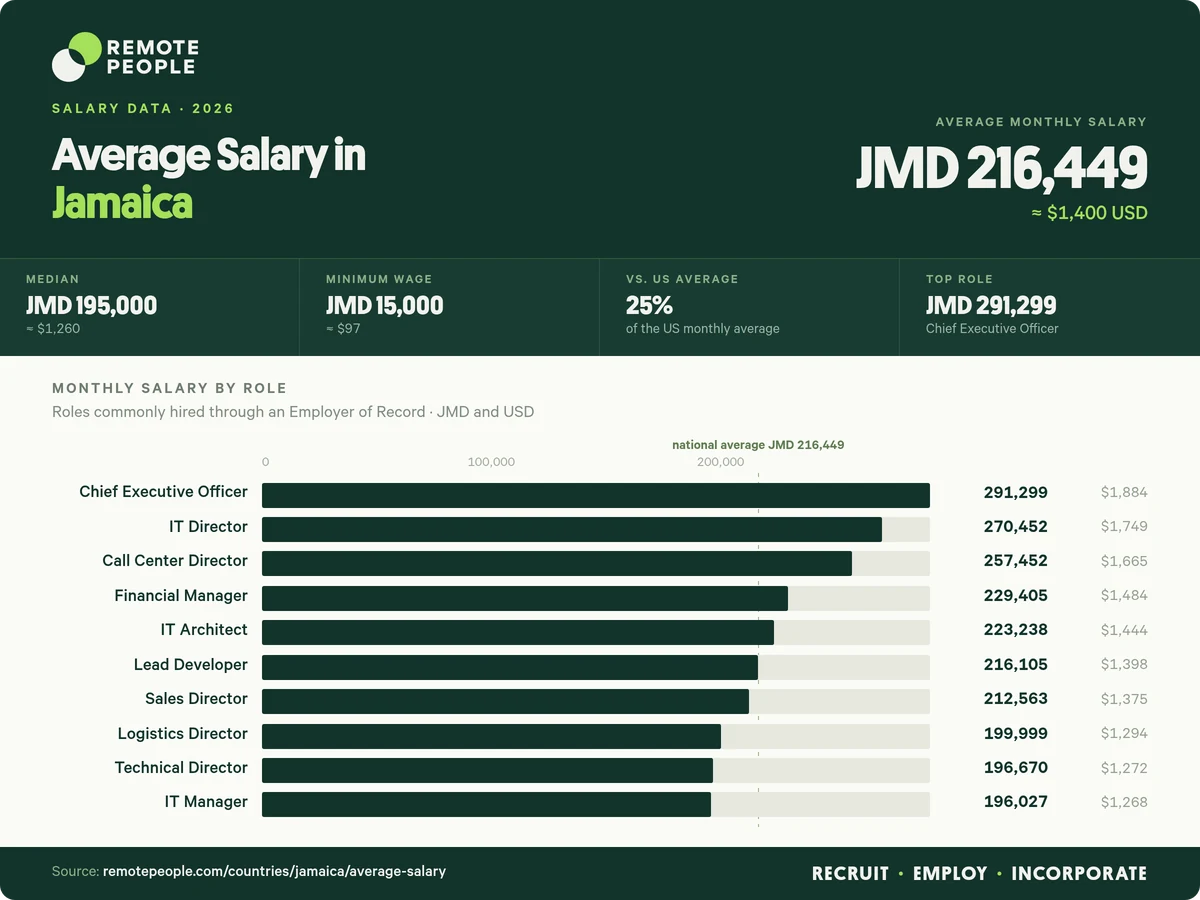
The average monthly salary in Jamaica is 216,449 Jamaican dollars (JMD) or USD 1,400. However, you must also consider how wages are impacted by education, experience, location, position, and industry. Comparing Jamaican salaries with wages worldwide also provides more insight.
This guide will review all aspects of salaries in Jamaica, providing the information you need to start hiring.
What is the Average Salary in Jamaica?
The average salary in Jamaica is 216,449 JMD, or $1,400. The country’s wages are relatively low due to an informal work sector, a dominant tourism industry that leads to low-paying work, and a history of economic challenges.
Median Income
The median salary can also be considered the ‘middle salary’. It differs from the average salary, which is calculated by adding salaries throughout the country and dividing the sum by the total number of workers. Jamaica’s median monthly income is approximately 195,000 JMD, or $1,260.
Salary Range
The salary range spans from the country’s lowest to the highest wages. Low earners in Jamaica make around 100,000 JMD (about $645), while top earners make closer to 650,000 JMD (approximately $4,200) depending on industry and specialization.
Salary Comparison by Profession
This salary comparison chart explains how wages fluctuate according to industry and profession.
Position | Average Monthly Salary (JMD) |
|---|---|
Chief Executive Officer | 291,299 |
IT Director | 270,452 |
Call Center Director | 257,452 |
Financial Manager | 229,405 |
IT Architect | 223,238 |
Lead Developer | 216,105 |
Sales Director | 212,563 |
Logistics Director | 199,999 |
Technical Director | 196,670 |
IT Manager | 196,027 |
Banking Cashier | 53,470 |
Fabric Cutter | 53,357 |
Clothing Technologist | 52,125 |
Packer | 52,033 |
General Laborer | 51,650 |
Seamstress | 49,676 |
Medical Records Clerk | 49,296 |
Porter | 47,996 |
Tailor | 47,485 |
Average Wage in Jamaica by Education
Jamaica is plagued by social disparities based on ethnicity, gender, sexuality, class and age. Classes that are discriminated against often don’t have access to higher education. Uneducated workers in the country are frequently unemployed or employed in low-paying positions.
Salary Comparison by Experience
Experience is another factor that impacts salaries. Experienced Jamaican workers tend to earn more than entry-level workers. Employees also become eligible for raises with tenure in their positions.
Salary Comparison by Location
Urban workers typically earn more than rural workers due to the higher cost of living and proximity to more businesses and job opportunities. Jamaican workers in major cities like Kingston and St. Andrews usually earn more than those in rural parts of the island. The National Library of Jamaica’s Pay Guidelines states that a business’s location is one of the significant considerations when employees and employers bargain for wages.
How Much is Minimum Wage in Jamaica?
Jamaica’s minimum wage updated to 15,000 JMD per week (about $97 Jamaica minimum wage USD) on June 1, 2024, marking an increase from 2023’s 13,000 JMD rate. The wages are based on a 40-hour work week.
Average Salary in Jamaica vs. the Rest of the World
Comparing Jamaica’s average salaries to wages worldwide provides more in-depth insight. The following charts compare Jamaican salaries to wages in developed, developing, and undeveloped countries.
Jamaica vs. Developed Countries
Country | Average Salary | Comparison to Average Jamaica Salary |
|---|---|---|
United Kingdom | £3,000 (approx. $4,100) | − 193% |
United States | $5,220 | − 273% |
Norway | 50,000 NOK (approx. $4,700) | − 236% |
Germany | €4,300 (approx. $4,470) | − 219% |
Austria | €3,700 (approx. $4,050) | − 189% |
Jamaica vs. Developing Countries
Country | Average Salary | Comparison to Average Jamaica Salary |
|---|---|---|
Romania | 4,000 RON (approx. $835) | 40% |
Russia | 73,700 RUB (approx. $700) | 50% |
Albania | 83,330 ALL (approx. $860) | 39% |
Kazakhstan | 342,000 KZT (approx. $645) | 54% |
Ukraine | 18,000 UAH (approx. $500) | 64% |
Jamaica vs. Undeveloped Countries
Country | Average Salary | Comparison to Average Jamaica Salary |
|---|---|---|
Thailand | 15,000 Baht (approx. $420) | 70% |
Philippines | 15,000 PHP (approx. $265) | 81% |
Vietnam | 7.5 million Dong (approx. $300) | 79% |
Egypt | 14,317 EGP (approx. $284) | 80% |
Pakistan | 60,000 PKR (approx. $210) | 85% |
Jamaica is one of the slowest-developing countries in the world, with its real per capita GDP growing at just one percent per year over the last thirty years. Its most profitable economic sectors are mining and tourism, but agriculture and manufacturing also contribute to the nation’s growth.
The country is a good outsourcing destination due to its skilled workforce, cost-effective labor, and strategic location. The government supports its BPO sector and has established initiatives to develop its talent pool. However, Jamaica’s slow development is an impeding factor.
What are the Most Common Outsourced Industries in Jamaica?
Companies considering outsourcing to Jamaica will benefit most when concentrating on the following sectors.
Customer Service
Jamaica is ideal for customer service outsourcing due to its high English proficiency and low labor costs. It is a prime destination for technical support, data processing, and other service-related needs. Reps in the country earn about 126,771 JMD monthly (approx. $820) compared to American reps who earn closer to $3,000, giving employers plenty of bargaining power.
Manufacturing
In 2014, the Jamaican government embarked on a tax reform process that offers a simplified system for granting fiscal incentives. The updated program is especially beneficial to the manufacturing industry. It provides duty-free importation of raw materials, machinery, and equipment, and an environmental levy that can be claimed as a tax credit.
Mining
Mining companies can also benefit from the government’s fiscal incentives. These include the Employment Tax Credit (ETC), which ensures low tax rates, capital allowances for industrial buildings, duty-free importation of equipment and machinery, and Productive Import Relief, which means companies don’t have to pay customs duties on healthcare-related equipment.
Conclusion
Jamaica’s skilled workforce, cost effective labor, strategic location, and fiscal incentives make it an ideal outsourcing destination. Businesses can benefit from reduced expenses while helping the country overcome its financial inequalities, creating an advantageous situation for all parties.




