Employ
 Recruit
Employer of Record (EOR) in Jamaica
-
 Drew Donnelly
- Published
- June 4, 2026
An employer of record in Jamaica lets you hire employees without setting up a local entity, with EOR services typically costing $500–$1,200 per employee per month. RemotePeople handles NIS contributions, National Housing Trust fees, payroll taxes, and full statutory compliance so you can onboard Jamaican talent in days.

Hiring in Jamaica at a glance
Jamaican Dollar (JMD)
English
~$600/mo
Biweekly/ Monthly
3.00%
10 days
3 months
2-4 weeks
Not mandatory
40 hrs/wk








- Jamaica Services
- Start hiring in Jamaica
- How an Employer of Record Works in Jamaica
- Start hiring with a Jamaica EOR
- Employment Laws and Regulations in Jamaica
- Work Permits and Visas in Jamaica
- Payroll, Taxes, and Social Security in Jamaica
- Cost of Hiring Through an EOR in Jamaica
- Benefits of Using an EOR in Jamaica
- Termination and Offboarding in Jamaica
- EOR vs. Other Hiring Models in Jamaica
- Public Holidays in Jamaica
- How to Get Started with an EOR in Jamaica
- Where companies hiring in Jamaica expand next
- Frequently Asked Questions
- Related EOR Destinations

Start hiring in Jamaica
Let Remote People handle payroll, compliance, and HR admin worldwide so you can focus on building your team.

How an Employer of Record Works in Jamaica
An EOR allows you to hire employees in Jamaica without setting up your own legal entity. Below is a breakdown of what an EOR is, what it handles, who benefits most from the model, and how the onboarding process works from start to finish.What Is an EOR?
An employer of record is a local legal entity that becomes the official employer of your team members in Jamaica. The EOR takes on all legal and financial responsibility for employment while you manage day-to-day work and team leadership. Under Jamaica’s Employment Termination and Redundancy Payments Act (ETRPA) and Labour Relations and Industrial Disputes Act (LRIDA), the EOR ensures full compliance with local labor standards, minimum wage requirements, and statutory benefits.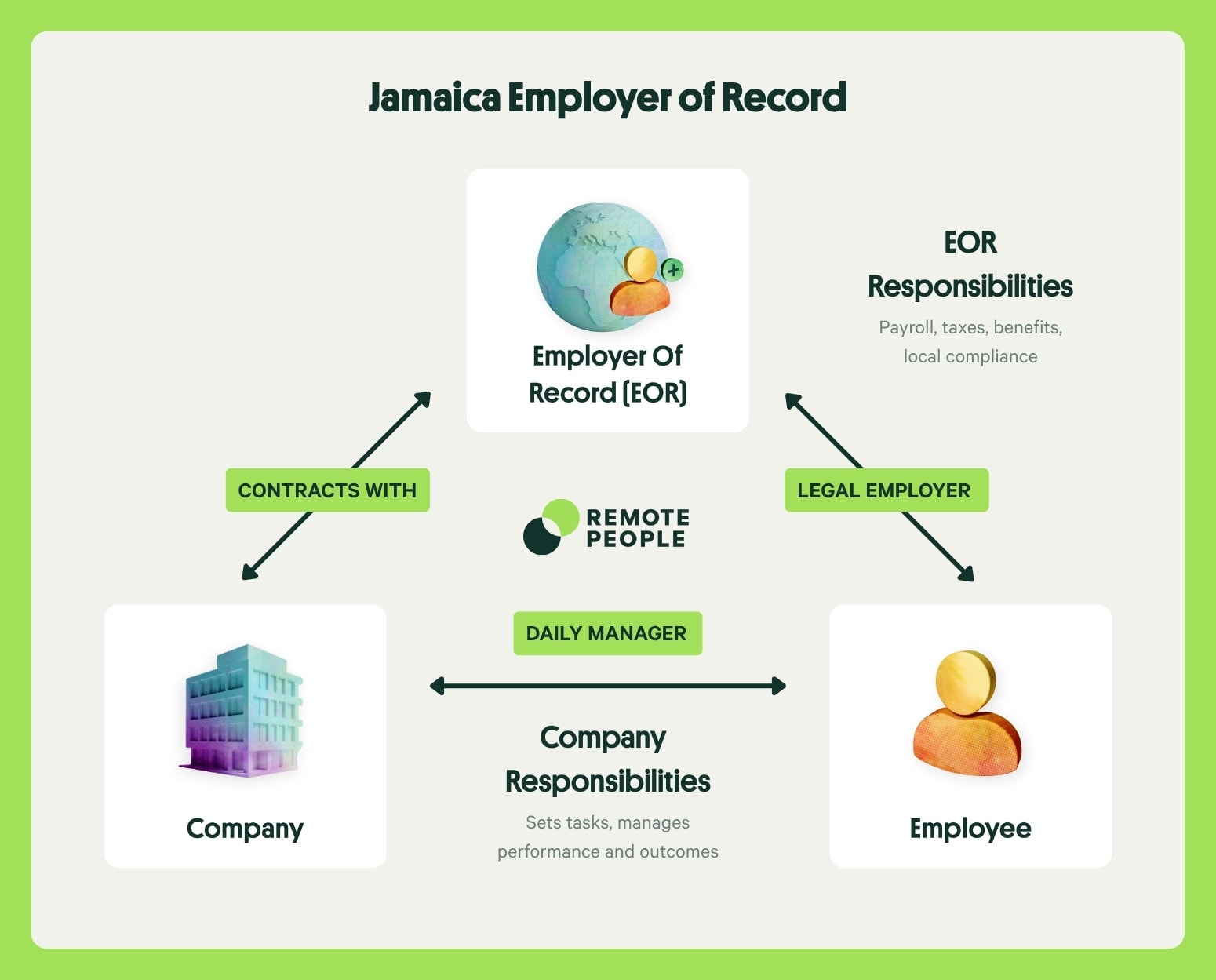
What Does an EOR Handle?
In Jamaica, the EOR manages every piece of the employment puzzle on your behalf. This starts with payroll processing, where the EOR runs monthly or biweekly salary payments, calculates statutory withholdings, and remits them to tax authorities within legal deadlines.
Tax compliance is handled end-to-end, covering income tax withholding, National Insurance Scheme (NIS) contributions, National Housing Trust (NHT), Education Tax, and HEART/NSTA levy calculations and filing. The EOR also handles social security registration, including NIS enrollment, pension contributions, and unemployment insurance setup for all employees.
On the legal side, the EOR drafts Jamaica-compliant employment contracts covering compensation, termination terms, and statutory rights per the ETRPA and LRIDA. Leave and benefits management includes tracking annual leave, maternity leave, sick leave, and other statutory entitlements under Jamaica’s Holidays with Pay Act. The EOR also manages statutory compliance tasks such as work permit applications, visa sponsorship, employment reporting, and updates to labour ministry filings.
Who Uses an EOR in Jamaica?
Companies use EOR services in Jamaica for several practical reasons. Market-entry companies testing demand in Jamaica choose an EOR to avoid committing to a full local entity setup before they know the market works. Businesses that need to scale rapidly use an EOR to hire employees within weeks rather than months of planning.
Remote-first teams hiring individual contributors in Jamaica to support global operations rely on an EOR for local compliance. Employers who need staffing flexibility and may scale up or down prefer an EOR to avoid the cost and legal complexity of maintaining a local company.
Typical Onboarding Timeline
Hiring through an EOR in Jamaica follows a structured process. First, you provide employee information including name, address, role, and salary. The EOR typically confirms Jamaica-specific legal compliance requirements within one business day.
Second, the EOR prepares the employment contract in Jamaica-compliant format and sends it for signing, which takes two to three days. Third, if the employee is a non-Jamaican national, the EOR submits a work permit application, which takes six to ten weeks for processing. CARICOM nationals are exempt from this requirement.
Fourth, once the work permit is approved (or immediately for Jamaican citizens), the EOR completes NIS, NHT, and other statutory registrations within three to five business days. Fifth, the employee’s first paycheck is processed and transferred to their bank account on the agreed pay date.
The entire process takes one to two weeks for employees who do not require a work permit and eight to twelve weeks for foreign nationals with work permit processing time included.
Start hiring with a Jamaica EOR
English-speaking Caribbean talent in US time zones with NIS/NHT contributions, Jamaican Employment Act, and local statutory requirements.
We handle employment contracts, payroll, social contributions, and full Jamaican compliance.
No local entity needed. Your team can start in days.
Employment Laws and Regulations in Jamaica
Jamaica’s employment framework is governed by the Employment (Termination and Redundancy Payments) Act (ETRPA), the Labour Relations and Industrial Disputes Act (LRIDA), and the Minimum Wage Act. These laws establish the statutory rights and obligations that apply to every employment relationship in the country, and an EOR ensures full compliance with all of them.
Employment Contracts
Jamaica requires employment relationships to be governed by either written or verbal agreements, though written contracts are strongly recommended to avoid disputes. Under the ETRPA and LRIDA, all contracts must outline compensation, duties, hours of work, and grounds for termination. Fixed-term contracts (e.g., 2-year roles) are enforceable and commonly used for project-based or temporary positions. Indefinite contracts (permanent employment) are equally valid and provide employees greater statutory protections including severance pay upon termination without just cause.
Working Hours and Overtime
Jamaica’s standard workweek is 40 hours (8 hours per day) as the baseline. Overtime compensation is calculated at 150% of the regular hourly rate for hours worked beyond 40 per week or 8 per day. Work performed on a weekly rest day (typically Sunday) is compensated at 200% of the regular rate, and work on public holidays is also paid at 200%. Night work (typically 10 PM to 6 AM) is compensated at a 125% premium to the regular rate. These rates are statutory minimums and cannot be reduced by contract.
Jamaica overtime and premium pay rates · Per ETRPA and LRIDA | |||
Hour Type | Rate Multiplier | Weekly/Daily Cap | Notes |
|---|---|---|---|
Weekday overtime (beyond 8 hrs/day or 40 hrs/week) | 150% | No statutory cap | Applies Monday–Friday; calculated as time-and-a-half |
Night work (10 PM–6 AM) | 125% | Ongoing | Premium applies to all hours worked during night shift |
Weekly rest day work (Sunday or designated rest day) | 200% | Entire day | Statutory minimum; employers may pay more but not less |
Public holiday work | 200% | Entire day | Applies to all 11 public holidays; employees may be given equivalent holiday in lieu |
Minimum Wage
Jamaica’s statutory minimum wage is JMD 16,000 per week (approximately USD 102 at current exchange rates), effective June 1, 2025. This rate applies to all workers in the private sector and is enforced by the Ministry of Labour, Social Security and Sport. Employers must ensure all employees, regardless of contract type, earn at least this amount. The minimum wage is reviewed annually and indexed to inflation.
Probation Period
Probation periods are optional and defined by the employment contract. If a probation period is 90 days or shorter, either party may terminate without notice or statutory severance. Probation periods longer than 90 days trigger notice requirements and severance pay entitlements upon termination without just cause. Best practice is to specify the probation length clearly in the employment contract to avoid disputes.
Leave Entitlements
Jamaican employees are entitled to several categories of statutory leave under the Holidays with Pay Act and related labour regulations. The specific entitlements depend on length of service, employment type, and the leave category.
Annual Leave
Employees are entitled to a minimum of 2 weeks (10 working days) of annual leave per year after 220 days of continuous service under the Holidays with Pay Act. After 10 years of continuous service, entitlement increases to 3 weeks (15 working days). Leave must be taken within 12 months of accrual and is calculated on a pro-rata basis for periods of less than a full year. Employers may restrict leave timing for operational reasons but must grant leave at mutually agreed times.
Sick Leave
Jamaica’s private sector has no statutory entitlement to paid sick leave. Sick leave terms are determined by the employment contract, collective agreement, or employer policy. Public sector employees receive sick leave benefits under separate legislation. Best practice is to outline sick leave provisions clearly in the employment contract to manage expectations.
Maternity Leave
Female employees are entitled to 12 weeks of maternity leave: 8 weeks paid and 4 weeks unpaid. The paid portion is funded by the government (via NIS) for up to JMD 4,500 per week for the first 3 children (maximum employer contribution). After 3 children, maternity leave becomes unpaid. Employees must complete 12 months of continuous service before becoming eligible. Leave typically begins 2 weeks before the expected delivery date.
Paternity Leave
Jamaica’s private sector has no statutory paternity leave entitlement. Public sector employees have been entitled to 20 days of paternity leave since January 2023. Private sector entitlements depend on employer policy or collective agreement. Advocacy for private sector paternity leave is ongoing but not yet legally mandated.
Other Statutory Leave
Bereavement leave and jury duty leave are governed by employment contracts and collective agreements rather than statutory minimums in Jamaica. Employers typically grant 3-5 days for immediate family bereavement and cooperate with court-mandated jury duty. Terms should be clarified in the employment contract.
Jamaica statutory leave entitlements · Per Holidays with Pay Act | ||
Leave Type | Duration | Eligibility & Notes |
|---|---|---|
Annual leave (first year) | 2 weeks (10 working days) | After 220 days continuous service; accrued over 12 months |
Annual leave (10+ years service) | 3 weeks (15 working days) | Increases after 10 years continuous service with same employer |
Maternity leave – paid | 8 weeks | Requires 12 months continuous service; first 3 children funded by NIS |
Maternity leave – unpaid | 4 weeks | Follows paid maternity leave; unpaid portion after 3 children |
Paternity leave (public sector only) | 20 days | Available to public sector employees only since Jan 2023; private sector has no statutory entitlement |
Sick leave (private sector) | Not statutory | Determined by contract or employer policy; no legal minimum in private sector |
Bereavement leave | Typically 3–5 days | Governed by contract or collective agreement; not statutory |
Statutory Employee Benefits
Jamaica mandates four key social security and employee benefits contributions. The National Insurance Scheme (NIS) funds retirement pensions, disability benefits, and survivor benefits through shared contributions — employers pay 3% and employees pay 3% of gross salary.
The National Housing Trust (NHT) requires employers to contribute 3% and employees 2% toward a housing fund; employees can later withdraw their NHT balance to purchase or construct a home. The Education Tax is an employer-only contribution of 3.5% of payroll that funds Jamaica’s education system, with no corresponding employee deduction. Finally, the HEART/NSTA Levy requires employers to contribute 3% of payroll toward national workforce development and training programmes.
Recent Regulatory Updates (2026)
Jamaica has implemented several significant changes affecting employment and payroll in 2025–2026. The minimum wage increased to JMD 16,000 per week effective June 1, 2025. The income tax-free threshold increased to JMD 1.8 million annually (effective April 2025), reducing tax liability for lower-income earners. The withholding tax on dividends paid to non-residents increased to 15%. The goods and services tax (GCT) registration threshold rose to JMD 15 million in annual revenue. Additionally, Bob Marley Day (February 6) was added as a public holiday in 2024, bringing the total statutory public holidays to 11.
Work Permits and Visas in Jamaica
Foreign nationals working in Jamaica must obtain a valid work permit from the Ministry of Labour and Social Security before they can legally begin employment. The EOR handles the entire application and renewal process on behalf of the employer and the employee.
Work Permit Requirements
Jamaica’s work permit system distinguishes between exempt and non-exempt categories based on nationality and the type of work being performed. The requirements and processing timelines vary accordingly.
Who Needs a Work Permit
Non-Jamaican nationals require a work permit to be employed legally in Jamaica. Citizens of CARICOM member states who are classified as Skilled Nationals are exempt from work permit requirements and may work in Jamaica under a CARICOM Skilled Nationals Certificate. Jamaican citizens do not require any work authorization to work in Jamaica.
Eligibility and Required Documents
Applicants must be at least 18 years old and have no criminal convictions that would disqualify them. Required documents include a completed work permit application form, passport copy, job offer letter from the employer, medical clearance, police clearance from the applicant’s home country, and proof of qualifications if the role is specialized. The employer or EOR submits the application to the Ministry of Labour, Social Security and Sport.
Processing Time and Validity
Work permits typically take 6–10 weeks to process from submission date. Once approved, the permit is valid for 1–3 years depending on the employment contract length and renewal decisions. Permits must be renewed before expiration, and the renewal application should be submitted 60 days prior to the expiration date to avoid gaps in legal work authorization.
Renewal Process
Work permit renewals follow the same process as initial applications. The employer or EOR submits a renewal application along with updated documentation (current passport, updated job offer, medical clearance if required). Processing time is typically 4–8 weeks for renewals. Employers should initiate the renewal at least 60 days before the current permit expires to ensure continuity.
Common Visa Types for Foreign Workers
Jamaica’s Ministry of Labour, Social Security and Sport issues several categories of work authorization for foreign nationals. The standard work permit is the most common route, but CARICOM Skilled Nationals benefit from a faster, separate certificate process. The table below summarizes the main visa and permit categories available to foreign workers in Jamaica.
Jamaica work visa types for foreign workers · 2026 | ||||
Visa/Permit Type | Eligibility | Processing Time | Validity Period | Key Notes |
|---|---|---|---|---|
Standard Work Permit | Non-Jamaican nationals, 18+, no criminal convictions, job offer from registered employer | 6–10 weeks | 1–3 years (renewable) | Most common; employer sponsorship required; can be extended for same or different roles |
CARICOM Skilled Nationals Certificate | Citizens of CARICOM member states (exclude Jamaica) with recognized professional qualifications in designated occupations (IT, healthcare, engineering, etc.) | 2–4 weeks | 2–5 years (renewable) | Faster processing; self-sponsored; no employer pre-approval required; broader mobility across CARICOM region |
Intra-Company Transfer | Employees of multinational corporations transferring to Jamaica subsidiary or branch; 12+ months tenure with employer | 6–8 weeks | 1–3 years (may be longer for senior roles) | Faster processing than standard work permit; demonstrates internal mobility; requires employer sponsorship |
Marriage Exemption Certificate | Foreign spouses of Jamaican citizens; married at least 2 years; employed or self-employed in Jamaica | 4–6 weeks | 5 years (renewable) | Issued by Ministry of Labour; exempts from standard work permit requirements; requires marriage certificate and proof of marriage duration |
How an EOR Handles Work Permits
An EOR prepares all work permit applications, collects the required documentation, and submits everything to the Ministry of Labour on the employee’s behalf. The EOR also tracks permit expiration dates and starts renewals before they lapse, so you do not end up with a compliance gap. For CARICOM Skilled Nationals, the EOR can point you to faster pathways than the standard work permit route.
Payroll, Taxes, and Social Security in Jamaica
Jamaica operates a multi-layered payroll tax system administered by Tax Administration Jamaica (TAJ). Employers must register with TAJ and remit statutory contributions on behalf of every employee. The system covers social insurance, housing, education, and workforce training — each with its own rate and ceiling. Understanding these obligations is essential because the EOR handles all calculations and filings on your behalf.
Employer Contributions
Jamaican employers are responsible for several mandatory payroll contributions on behalf of employees:
Jamaica employer social security contributions · 2026 rates | ||
Contribution | Rate | Notes |
|---|---|---|
National Insurance Scheme (NIS) | 3% | Funds retirement pension, disability, and survivor benefits; employer pays 3% on gross earnings |
National Housing Trust (NHT) | 3% | Funds housing program; employer contributes 3% on gross earnings |
Education Tax | 3.5% | Employer-only contribution to education fund; applies to all payroll |
HEART/NSTA Levy | 3% | Employer-only contribution to workforce development training; applies to all payroll |
Total employer rate | 12.5% | Cumulative burden on salary; employer expense above gross salary paid to employee |
Source: PwC Jamaica Tax Summaries and Jamaica Tax Administration | ||
Employee Contributions
Employees have mandatory deductions withheld from their gross salary:
Jamaica employee payroll deductions · 2026 monthly withholdings | ||
Deduction | Rate | Notes |
|---|---|---|
National Insurance Scheme (NIS) | 3% | Employee contribution to pension and benefits fund; withheld from gross salary |
National Housing Trust (NHT) | 2% | Employee contribution to housing fund; can be withdrawn for home purchase/construction |
Education Tax | 2.25% | Employee contribution to education fund; withheld from gross salary |
Total employee deductions (before income tax) | 7.25% | These are deducted before income tax calculation; not tax-deductible |
Income Tax
Jamaica uses a progressive income tax system with tax brackets that adjust annually for inflation:
Jamaica income tax brackets · 2026 | |
Bracket | Tax Calculation |
|---|---|
Up to JMD 1,800,000 | 0% (tax-free threshold effective April 2025) |
JMD 1,800,001 to JMD 6,000,000 | 25% on income above JMD 1,800,000 |
Above JMD 6,000,000 | 30% on income above JMD 6,000,000 |
Non-residents | 25% flat rate on Jamaican-source income (no progressive brackets) |
Source: PwC Jamaica Income Tax and KPMG Jamaica 2025 Tax Updates | |
Payroll Cycle
Jamaica allows monthly or biweekly payroll cycles, with monthly being the most common. Employers must pay employees by direct bank transfer unless the employee requests cash (cash is legal but less common for formal employment). Each pay slip must itemize gross salary, all deductions, and net pay. Employers are required to remit all withholdings and contributions to the relevant authorities by the 14th of the following month. Late payments incur penalties and interest.
13th Month Salary and Bonus Pay
Jamaica does not mandate a 13th month salary (Christmas bonus) as a statutory entitlement. Bonuses are optional and are determined by employer policy, employment contracts, or collective agreements. Many employers provide a year-end bonus as an incentive or profit-sharing mechanism, but this is discretionary and not legally required.
Cost of Hiring Through an EOR in Jamaica
The total cost of hiring through an EOR in Jamaica comprises two components: the EOR service fee and the statutory employer contributions layered on top of the employee’s gross salary. Below is a transparent breakdown so you can budget accurately before making your first hire.
EOR Service Fees
EOR service fees in Jamaica typically range from USD 300 to USD 600 per employee per month. Fees vary based on company size, payroll complexity, and additional services such as work permit handling or benefits administration. Smaller teams or single-employee setups may pay rates at the higher end of the range, while larger teams (10+ employees) may negotiate volume discounts.
Total Employment Cost Breakdown
Understanding the total cost of employment in Jamaica requires accounting for both direct salary and employer-side contributions:
Jamaica employer cost example · USD 3,000 gross · 2026 | ||
Employer Cost | Amount (USD) | % of Gross |
|---|---|---|
Gross salary to employee | $3,000 | 100% |
National Insurance Scheme (3%) | $90 | 3% |
National Housing Trust (3%) | $90 | 3% |
Education Tax (3.5%) | $105 | 3.5% |
HEART/NSTA Levy (3%) | $90 | 3% |
EOR service fee (estimated) | $450 | 15% |
Total employer cost | $3,825 | 127.5% |
Source: PwC Jamaica and Jamaica Tax Administration | ||
For a USD 3,000 gross monthly salary, the total employer cost is approximately USD 3,825 including all statutory contributions and EOR fees. This is 27.5% higher than the base salary and reflects Jamaica’s mandatory social security and employer-funded training contributions. Contact Remote People for a customized cost estimate based on your team’s specific needs.
Benefits of Using an EOR in Jamaica
The most immediate advantage is instant legal compliance. The EOR keeps you in line with Jamaica’s ETRPA, Labour Relations Act, and all tax regulations from day one, removing the risk of penalties for non-compliance. You also skip the 2–4 month timeline and USD 8,000–USD 20,000 cost of incorporating a local entity in Jamaica, which means you can test the market before making a long-term commitment.
On the operational side, the EOR handles monthly payroll processing, tax withholding, statutory contributions, and remittance to authorities end-to-end, so your finance team has no manual work. Work permit applications, documentation, renewals, and immigration compliance are also managed by the EOR, keeping you out of Jamaica’s Ministry of Labour processes entirely.
The EOR manages NIS enrollment, NHT contributions, leave tracking, and statutory benefits compliance so every employee receives their legally mandated entitlements. If you decide to scale down or close Jamaica operations, there is no entity to dissolve and no lengthy legal wind-down — you simply terminate employees per local law. And because the EOR fee is a fixed monthly cost, you can budget employment expenses accurately without hidden surprises or unexpected government fines.
Termination and Offboarding in Jamaica
Ending an employment relationship in Jamaica is governed by the Employment (Termination and Redundancy Payments) Act (ETRPA). The law prescribes minimum notice periods based on length of service, defines when severance is payable, and sets out procedural requirements employers must follow to avoid unfair-dismissal claims. Your EOR manages the entire offboarding process to ensure full compliance.
Notice Periods
Jamaica’s notice period requirements depend on length of service and whether termination is with or without just cause. These are statutory minimums and apply to all employment relationships unless a specific collective agreement specifies otherwise:
Jamaica statutory notice periods by length of service · Per ETRPA | |||
Length of Service | Notice Period (Without Cause) | During Probation | Notes |
|---|---|---|---|
Up to 5 years | 2 weeks | No notice required (if probation ≤90 days) | Either party may terminate with 2 weeks written notice |
5 to 10 years | 4 weeks | N/A (N/A – post-probation only) | Additional notice protection reflects tenure stability expectations |
10 to 15 years | 6 weeks | N/A | Further notice increase protects long-tenure employees |
15 to 20 years | 8 weeks | N/A | Extended notice period for senior tenure employees |
20+ years | 12 weeks | N/A | Maximum notice period; recognizes long-term employment relationship |
Source: Jamaica ETRPA and Baker McKenzie Caribbean Employment Law | |||
Severance Pay
Employees terminated without just cause are entitled to severance pay under Jamaica’s ETRPA. The amount depends on length of continuous service and is calculated as 2 weeks of average weekly earnings for each year of service in the first 10 years, and 3 weeks for each year after 10 years of service. The cap is 104 weeks of pay (equivalent to 2 years). Average weekly earnings are calculated over the 52 weeks immediately preceding termination.
Jamaica severance pay schedule by years of service · Per ETRPA | |||
Years of Service | Severance Amount | Calculation Basis | Notes |
|---|---|---|---|
2 years | 4 weeks of pay | 2 years × 2 weeks/year | Based on average weekly earnings over prior 52 weeks |
5 years | 10 weeks of pay | 5 years × 2 weeks/year | Example: JMD 30,000/week = JMD 300,000 severance |
10 years | 20 weeks of pay | 10 years × 2 weeks/year | Reaches 20-week threshold; no 3-week multiplier yet |
15 years | 35 weeks of pay | (10 × 2 weeks) + (5 × 3 weeks) | Years 11–15 are calculated at 3 weeks/year; total = 20 + 15 weeks |
Source: Jamaica ETRPA and PwC Jamaica Employment | |||
Calculation Method
Severance is calculated as: (Years of service in first 10 years × 2 weeks) + (Years of service beyond 10 years × 3 weeks) × Average weekly earnings. Average weekly earnings are determined by dividing total earnings in the 52 weeks immediately preceding termination by 52. Bonuses and overtime are included in the calculation but only if they were regular and recurring during that 52-week period.
Caps and Exceptions
The maximum severance pay is capped at 104 weeks of average earnings (equivalent to 2 years of salary). No severance is due if the employee is terminated for just cause (e.g., theft, gross misconduct, repeated policy violations after warnings). Employees on probation periods of 90 days or less receive no severance if terminated during the probation phase.
Grounds for Termination
Jamaica’s LRIDA recognizes two categories of termination: for just cause and without just cause. Just cause includes theft, gross insubordination, repeated violation of safety rules after warnings, chronic absenteeism, and documented performance failures despite corrective feedback. Terminations for just cause require no notice and no severance. Terminations without just cause (redundancy, role elimination, business restructuring) require notice as per service length and severance payment. Protected categories including pregnancy, union membership, race, and gender cannot be grounds for termination.
EOR vs. Other Hiring Models in Jamaica
Companies expanding into Jamaica can choose from several hiring structures, each with different cost profiles, compliance burdens, and speed-to-hire timelines. The comparison below helps you evaluate which model fits your operational needs and risk tolerance.
EOR vs. Setting Up a Local Entity
Setting up your own company in Jamaica takes months and costs thousands of dollars. An EOR gets you hiring within weeks at a fraction of the price:
Jamaica EOR vs local entity comparison · Setup time, cost, risk and best-fit | ||
Comparison Factor | Employer of Record | Your Own Entity (Company) |
|---|---|---|
Setup time | 1–2 weeks | 2–4 months |
Upfront cost | $0 | $8,000–$20,000 |
Ongoing cost | $300–$600/employee/month + salary | $5,000–$10,000/year maintenance + salary |
Local partner required | No (EOR is the local entity) | Yes |
Social insurance registration | Handled by EOR | You manage it |
Payroll and tax filing | Handled by EOR | You manage it (or outsource) |
Best for team size | 1–15 employees | 15+ employees |
Scale down / exit | Easy, no entity to unwind | Costly, legal dissolution required |
Government contracts | Not eligible | Eligible (requires local entity) |
Source: KPMG Jamaica and Jamaica Tax Administration | ||
EOR vs. Hiring Independent Contractors
Contractors give you flexibility, but they come with real compliance and IP risks in Jamaica:
Jamaica EOR vs independent contractors · Compliance, cost, and risk | ||
Comparison Factor | Employer of Record | Independent Contractor |
|---|---|---|
Legal relationship | Employee of the EOR | Self-employed, no employment relationship |
Compliance risk | Low, EOR ensures local labor law compliance | High, misclassification risk if relationship resembles employment |
Payroll and tax | EOR handles withholding, contributions, filings | Contractor invoices you; they handle their own taxes |
Benefits and leave | Statutory benefits, paid leave, social security | No entitlement to employee benefits |
IP protection | Stronger, employment contract assigns IP by default | Weaker, requires explicit IP assignment clause |
Termination | Subject to local notice periods and severance | Contract can be ended per agreement terms |
Best for | Long-term, core team roles | Short-term projects, specialized tasks |
Cost structure | Salary + employer contributions + EOR fee | Contractor fee (typically higher gross, lower total cost) |
Source: Jamaica LRIDA and DunnCox Employment Classification | ||
Jamaica’s labor authorities closely scrutinize contractor relationships, especially when the work is core to business operations or the contractor works exclusively for one client. If a contractor relationship appears to resemble employment (scheduled hours, management control, integration into the company), authorities may reclassify the relationship as employment and impose back taxes, penalties, and social security contributions on both parties. For core team roles with ongoing work, an EOR employee relationship is legally safer and provides statutory protections that contractors lack.
For short-term project work or specialized expertise, Remote People offers a contractor solution for Jamaica that manages tax compliance and contracting documentation to minimize misclassification risk.
EOR vs. PEO
A PEO (Professional Employer Organization) works differently from an EOR in one critical way: you need your own local entity to use a PEO, but not for an EOR:
Jamaica EOR vs PEO comparison · Legal employer, liability, and setup | ||
Comparison Factor | Employer of Record (EOR) | Professional Employer Organization (PEO) |
|---|---|---|
Legal employer | EOR is the legal employer | You remain the legal employer (co-employment) |
Local entity required | No, the EOR is the local entity | Yes, you must have your own entity in Jamaica |
Best for | Companies without a local entity | Companies that already have a local entity |
Compliance liability | EOR assumes compliance responsibility | Shared liability between you and the PEO |
Setup time | 1–2 weeks | Depends on your entity setup (weeks to months) |
Control over HR policies | EOR manages within local law framework | More direct control, PEO advises |
Typical use case | Market entry, small remote teams, testing new markets | Established local operations needing HR outsourcing |
Jamaica does not have a formal regulatory framework for PEOs as a distinct employment model. Most HR outsourcing in Jamaica falls under payroll and benefits administration contracts rather than true co-employment arrangements. An EOR is the standard solution for foreign companies hiring in Jamaica without a local entity.
Public Holidays in Jamaica
Jamaica observes 11 statutory public holidays. Employees are entitled to receive holiday pay (200% of regular rate) if required to work on these days, or to receive paid time off on an equivalent date. The 2026 holiday calendar is as follows:
Jamaica public holidays · 2026 calendar year | ||
Date | Holiday | Type |
|---|---|---|
January 1 | New Year’s Day | Public |
February 6 | Bob Marley Day | Public |
February 18 | Ash Wednesday | Public |
April 3 | Good Friday | Public |
April 6 | Easter Monday | Public |
May 23 | Labour Day | Public |
August 1 | Emancipation Day | Public |
August 6 | Independence Day | Public |
October 19 | National Heroes Day | Public |
December 25 | Christmas Day | Public |
December 26 | Boxing Day | Public |
How to Get Started with an EOR in Jamaica
Getting started with an EOR in Jamaica follows a straightforward five-step process. First, contact Remote People or another EOR provider and schedule a consultation to discuss your hiring needs, team size, and budget. Second, provide candidate information including name, address, passport details (for work permit applications), role, salary, and start date.
Third, review and approve the Jamaica-compliant employment contract, which outlines salary, benefits, notice periods, and statutory rights. Fourth, the EOR submits the work permit application if the employee is a non-Jamaican national; processing takes 6–10 weeks, while Jamaican citizens and CARICOM nationals can start immediately.
Fifth, the EOR completes NIS, NHT, and tax registration once the work permit is approved (or immediately for local candidates), and your employee’s first paycheck processes on the agreed date.
The entire process takes 1–2 weeks for employees who do not require a work permit and 8–12 weeks for foreign nationals with work permit processing time included. Contact Remote People today to discuss your Jamaica hiring strategy and receive a custom cost estimate.
Where companies hiring in Jamaica expand next
Employers with operations in Jamaica often extend across the Caribbean and nearby US-adjacent markets. After building a team in Jamaica, employers often look to an EOR partner in the Dominican Republic for CARICOM mobility and shared Caribbean business practices, then the Bahamas for aligned CARICOM employment frameworks. A team in Trinidad and Tobago follows with CARICOM-wide workforce portability, and operations in Barbados typically closes the regional footprint via shared Caribbean labor and trade norms.
Frequently Asked Questions
EOR service fees range from USD 300 to USD 600 per employee per month, depending on company size and service level. This fee covers payroll, tax compliance, and benefits administration but does not include the employee’s salary or statutory contributions (NIS, NHT, Education Tax, HEART/NSTA). For a USD 3,000 monthly salary, total employer cost is approximately USD 3,825 including all contributions and the EOR fee.
Jamaican citizens and CARICOM nationals can be onboarded and start work within 1–2 weeks. Non-Jamaican nationals require a work permit, which adds 6–10 weeks to the timeline. Plan for 8–12 weeks total for foreign hires. An EOR expedites this significantly compared to setting up your own entity, which takes 2–4 months.
Yes, the EOR handles 100% of payroll processing, income tax withholding, NIS contributions, NHT, Education Tax, and HEART/NSTA levy calculations. The EOR remits all withholdings to Jamaica Tax Administration and the relevant authorities by statutory deadlines, typically the 14th of the following month.
Your client company (you) owns all intellectual property created by the employee in the course of employment. Jamaica’s standard employment contracts include IP assignment clauses that vest ownership of work product with the employer, which is you in this relationship. The EOR is merely the legal employer on administrative and compliance matters.
The employee experience is identical to hiring directly. They receive a Jamaica-compliant employment contract, monthly salary payments, access to statutory benefits (NIS pension, NHT housing fund), paid leave, and all protections under Jamaica’s labour laws. The employee reports to your management; the EOR handles backend compliance. The employee is aware they are employed by the EOR but take direction from your team.
Yes, fixed-term contracts are fully enforceable in Jamaica. You can hire for a defined project duration (e.g., 6 months, 1 year) and the contract terminates automatically on the end date without triggering severance if structured correctly. However, if the fixed term is longer than 90 days and you terminate early, you may owe severance. The EOR handles contract drafting to ensure Jamaica compliance.
An EOR ensures all statutory benefits are provided (NIS, NHT, annual leave, maternity leave). Additional benefits such as health insurance, life insurance, or retirement matching are optional and can be negotiated separately. Remote People can facilitate additional benefits if desired, though these are not mandatory.
Employees hired through an EOR receive statutory benefits, paid leave, social security contributions, and notice/severance protections. Contractors are self-employed and receive none of these benefits but offer more flexibility to terminate. Jamaica’s labor authorities scrutinize contractor relationships that resemble employment, creating misclassification risk. For ongoing, core work, an EOR employee is legally safer. For short-term projects, consider Remote People’s contractor solution for Jamaica.
If you are hiring a Jamaican citizen or a CARICOM Skilled National, no work permit is required. If you are hiring a non-CARICOM foreign national, they must have a work permit before they can legally work. The EOR handles work permit applications and the 6–10 week processing timeline. Hiring without a work permit exposes you to penalties and employment law violations.
Employer of Record in
Employer of Record in
Employer of Record in
Employer of Record in
Employer of Record in
Employer of Record in
Employer of Record in
Employer of Record in