
 Recruit
Average Salary in Kenya
-
 Drew Donnelly
- Published
- September 21, 2026
Curious about salaries in Kenya? This guide breaks down the average wages, compares professions, highlights minimum wage figures, and explores how Kenya’s earnings measure up internationally. If you plan to hire there without opening a local entity, an Employer of Record (EOR) in Kenya can run payroll, contracts, and compliance on your behalf.
- 5 ★ on G2








Let RemotePeople handle payroll, compliance, and HR admin worldwide so you can focus on building your team.
Kenya has become a leading destination for global hiring, supported by its expanding talent pool, competitive labor costs, and growing digital economy. Companies hiring through an employee of record (EOR) in Kenya can benefit from understanding local salary expectations to attract skilled professionals and offer competitive compensation. When hiring in Kenya, employers may also consider employee background checks in Kenya to help verify candidates’ identities, employment history, and qualifications.
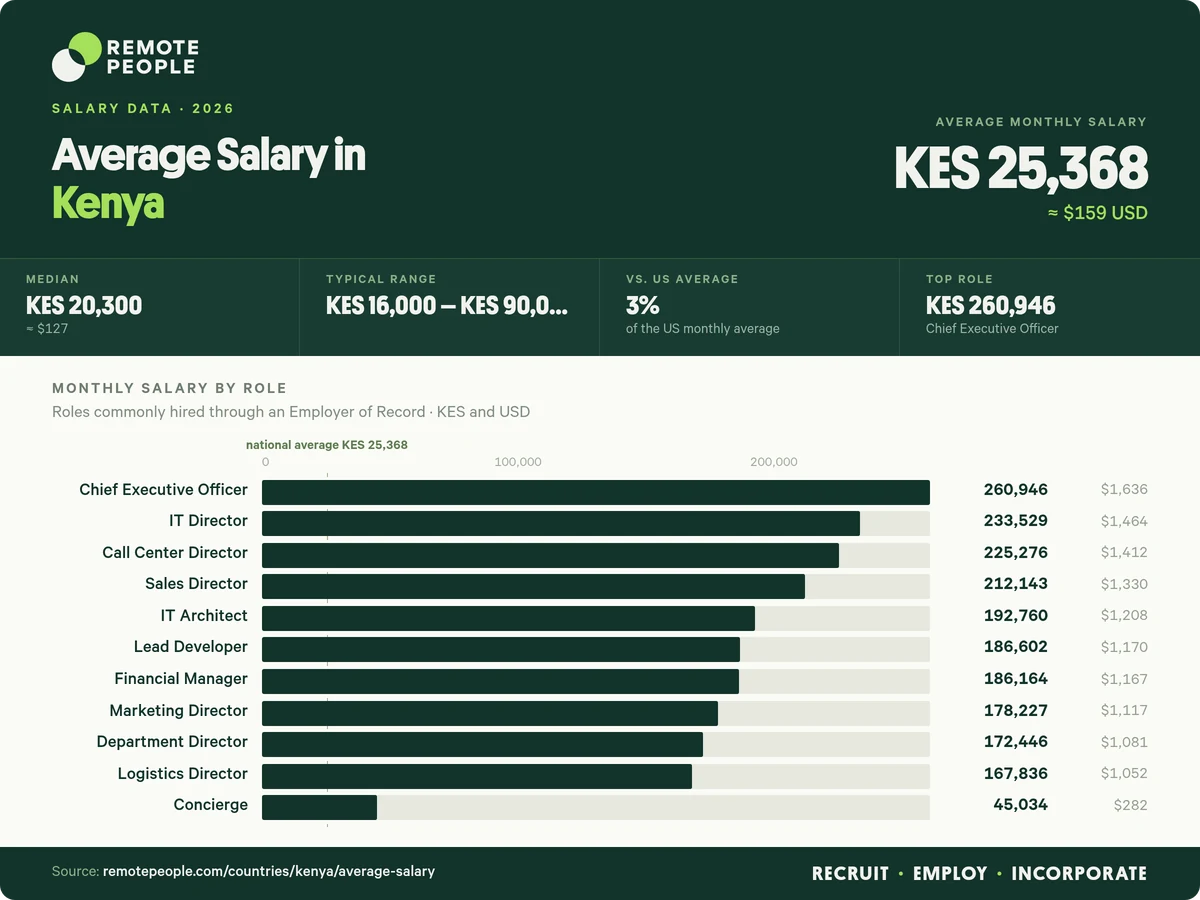
The average monthly salary in Kenya is 25,368 Kenyan shillings (KES), or about USD 159. However, salary levels are affected by experience, education, location, position, and industry. Comparing Kenyan salaries to wages worldwide can also provide perspective.
This guide will review all aspects of salaries in Kenya for a deeper understanding.
What is the Average Salary in Kenya?
You can calculate average wages by adding up salaries across the country and dividing the sum by the total number of workers. The average salary in Kenya is 25,368 shillings, or $159. Wages in the country are low due to low living costs, a low minimum wage, and an informal work economy.
Median Income
The median salary can also be considered the ‘middle salary’. Kenya’s median monthly income is about 20,300 KES, or approximately $127. Half the country’s workers earn higher salaries, and the other half earn less.
Salary Range
The salary range spans from the lowest to highest salaries in the country. In Kenya, low earners make around 16,000 KES monthly (about $100), while high earners make close to 90,000 KES (approximately $563).
Salary Comparison by Profession
Average salaries provide some insight, but you must also consider how wages are impacted by education, experience, location, position, and industry. The following sections will explore how these factors affect earnings.
Position | Average Monthly Earnings (KES) |
|---|---|
Chief Executive Officer | 260,946 |
IT Director | 233,529 |
Call Center Director | 225,276 |
Sales Director | 212,143 |
IT Architect | 192,760 |
Lead Developer | 186,602 |
Financial Manager | 186,164 |
Marketing Director | 178,227 |
Department Director | 172,446 |
Logistics Director | 167,836 |
Fabric Cutter | 46,073 |
General Laborer | 45,789 |
Concierge | 45,034 |
Clothing Technologist | 44,469 |
Packer | 44,425 |
Seamstress | 42,896 |
Medical Records Clerk | 41,322 |
Tailor | 41,002 |
Porter | 40,847 |
Average Wage in Kenya by Education
Education is a factor in wage determination. Educated workers find jobs more quickly, and are more likely to qualify for high-paying work. The more educated workers are, the better their job opportunities will be.
A 2017 report reveals workers with 6 years of education see a 4% return in the workforce, while workers with 14 years of schooling see a 22% return.
Salary Comparison by Experience
Experience also affects wage earnings. Entry-level workers earn less than experienced workers, and employees who have worked for a company for some time become eligible for raises.
In Kenya, experience is a more significant factor in skilled industries. For example, a telecommunications worker with experience in their sector may see a salary increase from 50,000 KES to 190,000 KES. Meanwhile, a manufacturing worker will only see a maximum salary of 77,500 KES.
Salary Comparison by Location
Location also affects salaries. Workers in urban areas, such as Nairobi, Mombasa, Kisumu, Eldoret, and Lamu, tend to earn more than those in rural areas due to a higher cost of living and proximity to large companies with more and better-paying job opportunities. In Kenya, salaries may also vary due to differences in labor laws across various markets.
How Much is Minimum Wage in Kenya?
Kenya’s last minimum wage increase took effect on Nov. 1, 2024. Under the Regulation of Wages (General) (Amendment) Order, minimum wages vary by occupation and location. In major cities such as Nairobi, Mombasa, Kisumu, Nakuru, and Eldoret, general laborers earn KES 16,113.75 per month. Minimum wages are lower in smaller towns and rural areas, and rates differ depending on skill level and job classification.
Average Salary in Kenya vs. the Rest of the World
The following charts offer more perspective on salaries in Kenya by comparing them to wages in developed, developing, and underdeveloped countries worldwide.
Kenya vs. Developed Countries
Country | Average Salary | Comparison to Average Kenya Salary |
|---|---|---|
United Kingdom | £3,000 (approx. $4,100) | − 2,478% |
United States | $5,220 | − 3,183% |
Norway | 50,000 NOK (approx. $4,700) | − 2,857% |
Germany | €4,300 (approx. $4,470) | − 2,711% |
Austria | €3,700 (approx. $4,050) | − 2,448% |
Kenya vs. Developing Countries
Country | Average Salary | Comparison to Average Kenya Salary |
|---|---|---|
Romania | 4,000 RON (approx. $835) | − 425% |
Russia | 73,700 RUB (approx. $700) | − 340% |
Albania | 83,330 ALL (approx. $860) | − 441% |
Kazakhstan | 342,000 KZT (approx. $645) | − 306% |
Ukraine | 18,000 UAH (approx. $500) | − 214% |
Kenya vs. Undeveloped Countries
Country | Average Salary | Comparison to Average Kenya Salary |
|---|---|---|
Thailand | 15,000 Baht (approx. $420) | – 164% |
Philippines | 15,000 PHP (approx. $265) | – 67% |
Vietnam | 7.5 million Dong (approx. $300) | – 89% |
Egypt | 14,317 EGP (approx. $284) | – 79% |
Pakistan | 60,000 PKR (approx. $210) | – 32% |
Kenya is a developing country with a lower-middle-income economy. Despite poverty and weak governance, it shows strong economic growth and leads industrial development in East Africa. The agricultural sector dominates the work economy, although ICT, healthcare, and building and construction are other strong industries.
The country is a good outsourcing destination due to its low labor costs, growing talent pool, and high English proficiency. The government supports the outsourcing industry through various policies and initiatives. Kenya also offers positive time zone alignment with European and Asian countries.
What are the Most Common Outsourced Industries in Kenya?
IT Services
Kenya boasts a thriving IT industry and a rapidly growing tech hub. It is often called a “Silicon Savannah” focusing on AI, cloud computing, data analytics, and cybersecurity. Nairobi is a center for tech growth with various startups and significant tech companies opening operations in the area.
Tech workers in Kenya earn around 125,000 KES (about $781) monthly compared to American workers who make closer to $5,000 per month. Employers who outsource to the country may significantly reduce human resource expenses.
Customer Service
Kenya is emerging as a hub for customer service, focusing on call center operations. Its tech-savvy population and high English proficiency make it a desirable source for labor. The government actively supports the development of the BPO industry through training initiatives.
Customer service reps in the country earn around 96,215 KES or $601 monthly, while American workers earn closer to $3,500. Companies seeking outsourcing partnerships can save considerably.
Data Entry
Kenya’s growing tech sector makes it a prime source for data entry workers. Employers seeking data entry specialists can benefit from cost-effective labor and high English proficiency. Typical tasks include transcribing data from paper to digital, entering customer information into databases, and updating spreadsheets with new information.
Data entry workers in Kenya typically earn about 32,600 KES monthly, about $204.
Conclusion
Kenya’s skilled workforce, low-cost labor, and stable business environment make it an ideal outsourcing destination. Employers who hire in the area can benefit from reduced expenses and high-quality products and services while helping workers overcome poverty, providing a favorable environment for all parties.