Recruit
Employer of Record (EOR) in Kenya
-
 Drew Donnelly
- Published
- September 11, 2026
RemotePeople’s employer of record in Kenya lets you hire employees in Kenya with NSSF registration. We handle 6% employer NSSF contributions, two-tier fund system, and monthly contribution payments.
Hire in Kenya — book a free 30-minute demo
Tell us what you need. You'll get a tailored, transparent proposal within 24 hours, plus a free call to walk through it.
Tell us about your company
So we can match you with a specialist who knows your market — and unlock volume pricing tiers.
* All fields are required.
Where and when are you hiring?
Tell us the geography and timing and we'll quote each country line by line, with onboarding timelines.
* All fields are required.
Help us beat your current setup
We'll benchmark your current deal and send a line-by-line proposal in 24 hours — showing exactly where we cut cost, time, or risk. After you submit, you can book a call to walk through it together.
* All fields are required.
Thanks! Your proposal is on its way.
Expect a tailored, line-by-line proposal in your inbox within 24 hours. In the meantime…
Want to walk through it together?
Book a free 30-minute call with one of our specialists. We'll explain every line, answer your questions, and tailor the proposal further if you need.
No obligation. Pick a time that works for you.








- Hire in Kenya — book a free 30-minute demo
- Tell us about your company
- Where and when are you hiring?
- Help us beat your current setup
- Thanks! Your proposal is on its way.
- How an Employer of Record Works in Kenya
- Employment Laws and Regulations in Kenya
- Work Permits and Visas in Kenya
- Payroll, Taxes, and Social Security in Kenya
- Cost of Hiring Through an EOR in Kenya
- Benefits of Using an EOR in Kenya
- Termination and Offboarding in Kenya
- EOR vs. Other Hiring Models in Kenya
- Public Holidays in Kenya
- How to Get Started with an EOR in Kenya
- Where companies hiring in Kenya expand next
- Frequently Asked Questions
- Related EOR Destinations

Start hiring in Kenya
Let RemotePeople handle payroll, compliance, and HR admin worldwide so you can focus on building your team.

An employer of record in Kenya lets foreign companies hire employees without setting up a local entity. EOR services in Kenya typically cost between $300 and $600 per employee per month for full-service employment management, covering contracts, payroll, tax filings, and social security registration.
Kenya’s fast-growing economy, English-speaking workforce, and position as East Africa’s commercial hub make it one of the most attractive markets to hire employees in Kenya. The compliance challenge is real: the Employment Act 2007, a reformed social security system (NSSF and the new SHIF under the Social Health Authority), and a progressive income tax with rates from 10% to 35% all require careful management. This guide covers Kenya’s employment laws, payroll taxes, leave entitlements, work permits, termination rules, and the full cost of hiring through an EOR in 2026.
How an Employer of Record Works in Kenya
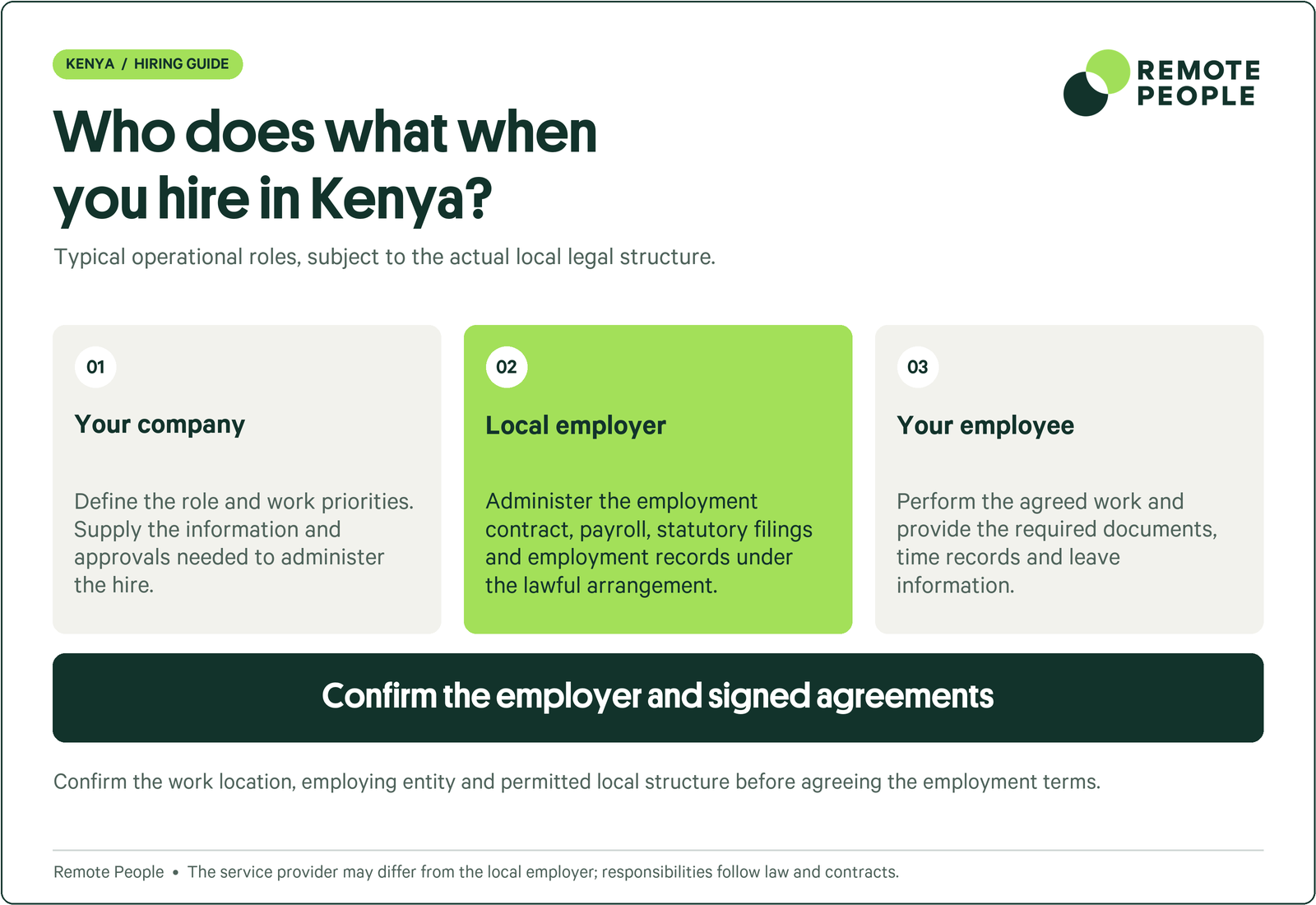
Who Uses an EOR in Kenya?
An EOR lets you hire employees in Kenya without setting up a local company. Common use cases include:
Companies exploring the Kenyan market often hire a small team through an EOR to validate demand before committing to entity setup, which typically takes 2 to 4 months and costs $5,000 to $15,000. Businesses that need 1 to 15 employees in Kenya find the EOR’s monthly per-employee fee significantly cheaper than maintaining a local entity with its fixed annual compliance costs.
Speed matters too: an EOR can execute a compliant employment contract and begin payroll processing within 1 to 2 weeks, compared to the months required for entity registration. Companies hiring non-Kenyan workers who require Class D work permits also benefit from the EOR’s ability to act as the local sponsor and manage the immigration process end to end.
The flexibility to scale up or down without unwinding a legal entity makes an EOR particularly useful for project-based engagements, seasonal expansions, and companies in early-stage growth across East Africa.
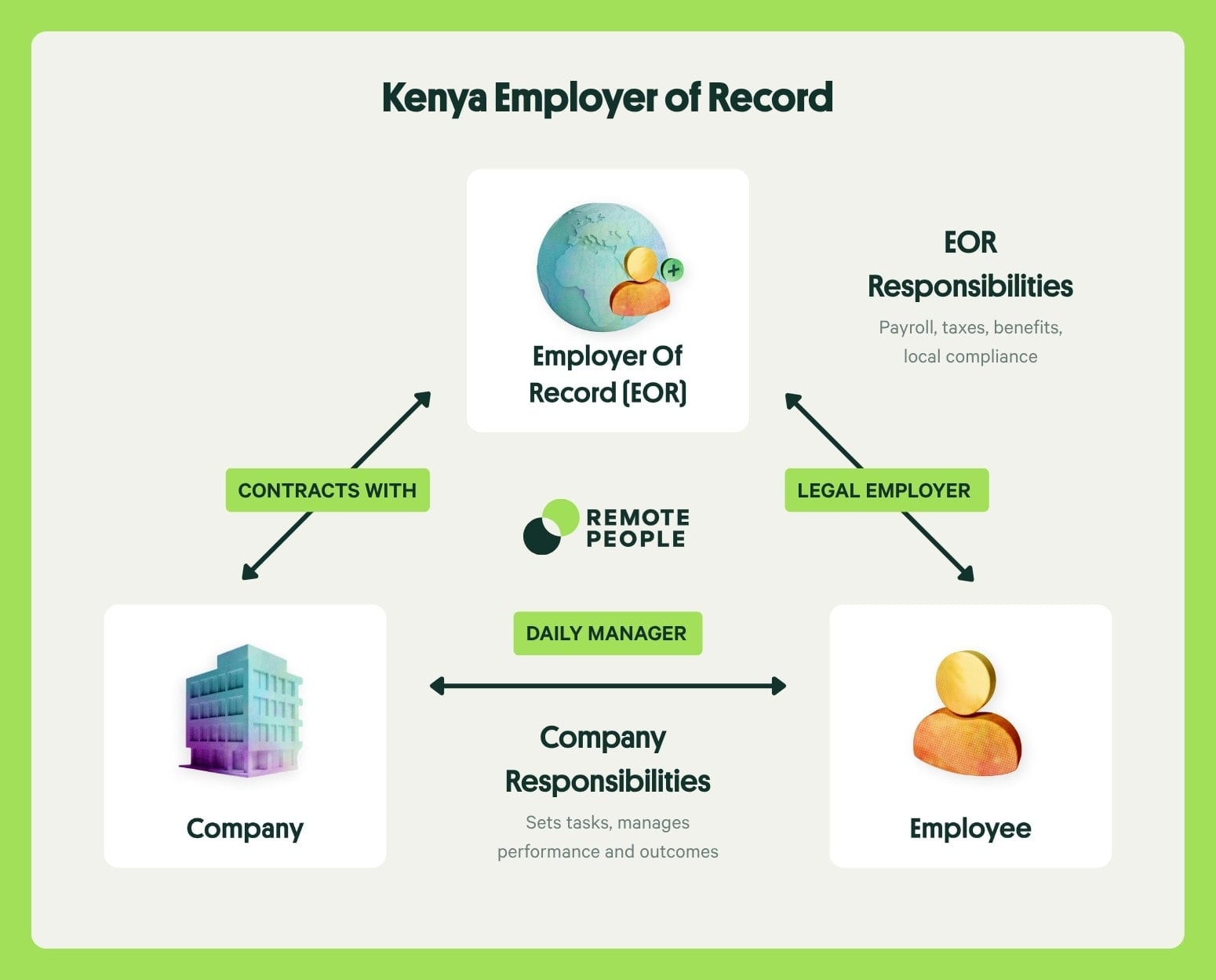
Typical Onboarding Timeline
Most EOR providers can onboard an employee in Kenya within 1 to 2 weeks. The process typically follows this sequence:
- First: EOR agreement and employee details submission (1 to 2 days).
- Second: Employment contract drafting and review under the Employment Act 2007 (2 to 3 days).
- Third: NSSF, SHA (SHIF), and KRA registration, plus AHL enrollment (3 to 7 days).
- Fourth: Payroll setup, benefits enrollment, and bank account verification (2 to 3 days).
- Fifth: Employee onboarding and first day of work (1 day).
If the employee is a foreign national requiring a work permit, the timeline extends by 4 to 8 weeks for Class D permit processing. A Special Pass can be obtained in 1 to 4 weeks as interim authorization while the full permit is processed.
Hire in Kenya
Africa’s Silicon Savannah with SHIF, NSSF, PAYE obligations, Kenyan Employment Act, and Nairobi’s thriving tech ecosystem.
We handle employment contracts, payroll, social contributions, and full Kenyan compliance.
No local entity needed. Your team can start in days.
Employment Laws and Regulations in Kenya
Employment Contracts
Employment in Kenya follows the Employment Act 2007 (Chapter 226, Laws of Kenya). The Act requires a written contract for any employment lasting longer than three months (Section 38). Oral contracts are valid for engagements of three months or less. The written contract must be provided within two months of the start of employment and include the employee’s name, job description, wages and payment frequency, working hours, leave entitlements, notice period, and the duration of the contract (indefinite or fixed-term). Contracts are typically drafted in English, though the Act doesn’t mandate a specific language as long as the employee understands the terms. Indefinite contracts are the default and continue unless terminated by proper notice or payment in lieu. Fixed-term contracts end on their specified date and don’t require termination notice at expiry, though repeated renewals may create an expectation of permanence.
Working Hours and Overtime
Standard working hours in Kenya are set by the Regulation of Wages (General) Order, 1982. Day workers may work up to 52 hours per week, while night workers (those working between 10:00 PM and 6:00 AM) may work up to 60 hours per week. The standard daily limit is 8 hours. Every employee is entitled to at least one rest day per seven-day period. Overtime is regulated and paid at premium rates, with strict weekly caps to prevent overwork.
Kenya overtime and premium pay rates · Per Regulation of Wages (General) Order | |||
Hour Type | Rate Multiplier | Weekly/Daily Cap | Notes |
|---|---|---|---|
Weekday overtime | 1.5x normal rate | 6 hours/week (day workers) | Applies to hours exceeding 52/week |
Night work overtime | 1.5x normal rate | 12 hours/week (night workers) | Applies to hours exceeding 60/week |
Sunday/rest day work | 2x normal rate | No statutory cap | Applies to any work on the designated rest day |
Public holiday work | 2x normal rate | No statutory cap | In addition to the normal daily wage |
Night shift (regular, non-overtime) | No statutory premium | 60 hours/week | CBAs may provide 1.1x to 1.5x allowance |
Day workers may not exceed 116 hours over any two consecutive weeks (including normal hours and overtime). Night workers may not exceed 144 hours over the same period. Managerial employees and those in positions of trust may be exempt from overtime provisions, though this must be specified in the employment contract. Overtime pay is calculated on the employee’s basic hourly rate and doesn’t factor into 13th month salary calculations, as Kenya doesn’t mandate a 13th month payment.
Minimum Wage
Kenya’s minimum wage varies by location and sector. The most recent adjustment took effect on 1 November 2024 under Legal Notice No. 164 of 2024, which increased general minimum wages by 6%. The current monthly minimum wage for general workers in Nairobi, Mombasa, and Kisumu (major cities) is KES 16,113.75. General workers in other areas earn a minimum of KES 7,997.33 per month. Agricultural workers have a separate, lower wage schedule. Employers must pay at least the gazetted minimum for the applicable location and category. The minimum wage in Kenya is reviewed periodically by the government through Legal Notices published in the Kenya Gazette.
Probation Period
Section 42 of the Employment Act 2007 allows a probation period of up to six months. This may be extended by an additional six months with the written agreement of both parties, bringing the maximum to 12 months. During probation, either party may terminate the contract with at least 7 days’ written notice or 7 days’ wages in lieu of notice. A 2024 Court of Appeal ruling declared that the procedural fairness requirements of Section 41 (which mandate a fair hearing before dismissal) now apply to probationary employees as well, overturning previous practice that allowed at-will termination during probation. For more details on how probation periods in Kenya work, see our dedicated guide.
Leave Entitlements
Kenya’s Employment Act 2007 establishes a framework of statutory leave entitlements. Employers need to provide annual leave, sick leave, maternity and paternity leave, pre-adoptive leave, and allowances for public holidays. Each type has specific accrual rules, pay rates, and eligibility conditions.
Annual Leave
Every employee is entitled to a minimum of 21 working days of paid annual leave after completing 12 consecutive months of service (Section 28, Employment Act). Leave accrues proportionally during the qualifying year. Annual leave doesn’t automatically carry over to the following year; unused days are typically forfeited unless the employment contract or company policy provides otherwise. Annual leave accrues independently of maternity or sick leave taken during the same period.
Sick Leave
Employees who have completed at least two consecutive months of service get sick leave of up to 7 days with full pay, followed by 7 days with half pay, per 12-month period (Section 30, Employment Act). A medical certificate from a registered medical practitioner is required. The employer bears the full cost of sick leave pay; there’s no social security reimbursement for short-term illness in Kenya.
Maternity Leave
Female employees get 90 calendar days (three months) of maternity leave with full pay (Section 29, Employment Act). The employer pays the full salary during this period. The employee must give at least 7 days’ notice (or as soon as reasonably practicable) before taking maternity leave. An employer may not terminate an employee’s contract or give notice of termination during maternity leave. Maternity leave doesn’t reduce the employee’s annual leave entitlement.
Paternity Leave
Male employees get 14 calendar days (two weeks) of paternity leave with full pay upon the birth of a child (Section 29(8), Employment Act). The employer pays the full salary. No minimum service period is required.
Other Statutory Leave
The Employment (Amendment) Act 2021 introduced pre-adoptive leave of 30 calendar days with full pay (Section 29A), available to both male and female employees who formally adopt a child through a recognized adoption society. The employee must give at least 14 days’ notice with supporting documentation. Bereavement leave, marriage leave, and study leave are not explicitly mandated by the Employment Act and are generally provided at the employer’s discretion or through collective bargaining agreements. Employees are also entitled to paid time off on all gazetted public holidays.
Under the Employment Act 2007, Kenya’s leave framework covers seven distinct categories of statutory leave. The table below summarizes each entitlement, including duration, pay, and eligibility conditions. The most notable provision is the 21-day annual leave floor, which is among the more generous in the East African region.
Kenya statutory leave entitlements · Per Employment Act 2007 | ||
Leave Type | Duration | Eligibility & Notes |
|---|---|---|
Annual leave | 21 working days | After 12 months of service; full pay; does not carry over automatically |
Sick leave (full pay) | 7 days | After 2 months of service; medical certificate required; per 12-month period |
Sick leave (half pay) | 7 days | Following the 7 full-pay days; same 12-month period |
Maternity leave | 90 calendar days | Full pay; employer-funded; 7 days’ notice required; no minimum service |
Paternity leave | 14 calendar days | Full pay; employer-funded; upon birth of child; no minimum service |
Pre-adoptive leave | 30 calendar days | Full pay; both parents; 14 days’ notice with adoption documentation |
Public holidays | 11 to 13 days/year | Paid at normal daily wage; 2x rate if required to work |
Source: Employment Act 2007, Kenya Law and PwC Kenya Tax Summary | ||
Statutory Employee Benefits
Beyond leave entitlements and social security contributions, employers in Kenya need to provide several mandatory benefits. These are funded through the contribution framework detailed in the Kenya payroll and tax section and administered through government agencies:
- Social health insurance (SHIF): All employees must be registered with the Social Health Authority (SHA). SHIF contributions are split between employer (1.375% of gross salary) and employee (1.375%), for a total of 2.75%. This replaced the former NHIF system in October 2024 and provides access to public and accredited private healthcare facilities.
- Pension and retirement (NSSF): Both employer and employee contribute 6% of gross salary (capped at KES 6,480 per party from February 2026) to the National Social Security Fund. NSSF operates a two-tier system: Tier I covers a provident fund up to the lower earnings limit, and Tier II covers earnings between the lower and upper limits. Benefits vest upon retirement, permanent disability, or emigration.
- Affordable Housing Levy (AHL): Both employer and employee contribute 1.5% of gross salary with no cap. This funds the government’s affordable housing program and has been mandatory since March 2024. AHL contributions are tax-deductible since December 2024.
- Work injury insurance: Employers must maintain work injury benefits coverage under the Work Injury Benefits Act 2007, either through a licensed insurer or self-insurance (for qualifying employers). This covers medical expenses and compensation for work-related injuries or occupational diseases.
- NITA levy: Employers with five or more employees pay a KES 50 per employee per month training levy to the National Industrial Training Authority.
Private medical insurance, life insurance, and supplementary pension contributions are not legally required but are commonly offered by employers competing for talent in Kenya’s urban job market, particularly in Nairobi. An EOR can administer these supplementary benefits alongside the statutory requirements.
Recent Regulatory Updates (2026)
Kenya’s employment landscape has undergone significant reform over the past 18 months. The most impactful changes for employers and EOR providers include:
The NHIF to SHIF transition took effect on 1 October 2024, replacing the fixed-tier NHIF contribution table with a percentage-based 2.75% of gross salary model under the Social Health Insurance Act 2024. The new system is administered by the Social Health Authority (SHA). Unlike the old NHIF, SHIF includes an employer contribution of 1.375% of gross, a new payroll cost that did not exist previously (EY Tax Alert).
The NSSF contribution increase took effect on 1 February 2025 under the NSSF Act 2013’s phased schedule. The Tier I lower earnings limit rose to KES 8,000 and the Tier II upper earnings limit rose to KES 72,000, resulting in a maximum contribution of KES 4,320 per party per month. From 1 February 2026, these limits increase further to KES 9,000 and KES 108,000 respectively, raising the maximum contribution to KES 6,480 per party (KPMG Tax Alert).
The Affordable Housing Levy became mandatory in March 2024 at 1.5% from both employer and employee. The Tax Laws (Amendment) Act 2024, effective 27 December 2024, made AHL contributions deductible from taxable income, providing partial relief. The levy is collected by the KRA and remitted through the monthly P10 PAYE return (KRA Public Notice).
Work Permits and Visas in Kenya
Work Permit Requirements
Who Needs a Work Permit
All foreign nationals require a valid work permit to be employed in Kenya under the Kenya Citizenship and Immigration Act, 2011. Citizens of East African Community (EAC) member states (Burundi, Rwanda, South Sudan, Tanzania, and Uganda) may obtain a Class R work permit on a gratis basis with no government fees. Diplomats and certain intergovernmental organization staff are exempt under Section 34(3) of the Act. All other nationalities must obtain a work permit before commencing employment.
Eligibility and Required Documents
To qualify for a work permit in Kenya, the applicant must have a confirmed job offer from a Kenya-registered employer, possess skills or qualifications not readily available locally, and demonstrate that the employment benefits Kenya. For a Class D permit (the most common for employed foreign workers), the employer must also nominate a Kenyan “understudy” who will receive skills transfer training. Required documents include a valid passport (minimum 6 months validity), letter of offer, curriculum vitae, certified academic and professional certificates, police clearance from the country of origin, medical examination certificate, and the employer’s tax compliance certificate (TCC), certificate of incorporation, and business licenses.
Processing Time and Validity
Applications are submitted online through the eFNS Portal of the Directorate of Immigration Services. Processing takes 4 to 8 weeks in standard cases, though the full process can extend to 3 to 6 months depending on document completeness and immigration workload. Class D permits are issued for 1 to 3 years. Government fees include a KES 20,000 processing fee, KES 250,000 to 500,000 annual issuance fee, and a KES 100,000 security bond.
Renewal Process
Renewal applications should be submitted at least 3 months before the permit expires. Processing takes 3 to 6 months, and the employee may continue working while the renewal is pending, provided the application was filed before expiration. Updated documentation is required, including a current TCC, proof of immigration compliance, and evidence of skills transfer to the Kenyan understudy.
Common Visa Types for Foreign Workers
Kenya’s work permit system is administered by the Directorate of Immigration Services under the Ministry of Interior. The system uses a class-based structure (Classes A through R), with each class covering a specific type of economic activity or employment. The EOR can sponsor employees under several of these categories, most commonly Class D for general employment.
Kenya work visa types for foreign workers · 2026 | ||||
Visa Type | Duration | Best For | Leads to PR? | Processing |
|---|---|---|---|---|
Class D (Employment) | 1 to 3 years | Foreign employees hired by a Kenyan employer | Yes (after 7 years) | 4 to 8 weeks |
Class G (Trade/Business) | 1 to 3 years | Self-employed professionals, consultants, entrepreneurs | Yes (after 7 years) | 4 to 8 weeks |
Class C (Prescribed Professions) | 1 to 3 years | Regulated professionals (doctors, engineers, lawyers) | Yes (after 7 years) | 6 to 12 weeks |
Class N (Digital Nomad) | 1 to 3 years | Remote workers employed outside Kenya | No | 4 to 8 weeks |
Class R (EAC Nationals) | Renewable | Citizens of Burundi, Rwanda, South Sudan, Tanzania, Uganda | Yes | 1 to 2 weeks |
Special Pass (interim) | Up to 6 months | Interim authorization while full permit is processed | No | 1 to 4 weeks |
Visa types not listed above, including tourist visas, student visas, and transit visas, don’t permit employment in Kenya. Holders of these visas who wish to work must first obtain a valid work permit in the appropriate class.
How an EOR Handles Work Permits
An EOR in Kenya acts as the official local employer and can sponsor work permit applications on behalf of foreign employees. The EOR prepares and submits the application through the eFNS portal, provides the required company documentation (TCC, certificate of incorporation, business licenses), nominates and trains a Kenyan understudy as required for Class D permits, and handles all communications with the Directorate of Immigration Services. The employee remains responsible for personal documents (passport, academic certificates, police clearance, medical exam). Work can’t legally commence until the permit is approved, but the EOR can apply for a Special Pass to provide interim authorization during the 4 to 8 week processing period. For EAC nationals, the Class R gratis permit process is faster and simpler, typically completing in 1 to 2 weeks.
Payroll, Taxes, and Social Security in Kenya
Employer Contributions
Employers in Kenya are required to make several statutory contributions on top of gross salary. As of 2026, these include NSSF (pension), SHIF (health), AHL (housing), and NITA (training). The total employer burden is approximately 8.9% of gross salary plus a flat KES 50 per employee, though NSSF contributions are capped. The following table breaks down each component with the current rates.
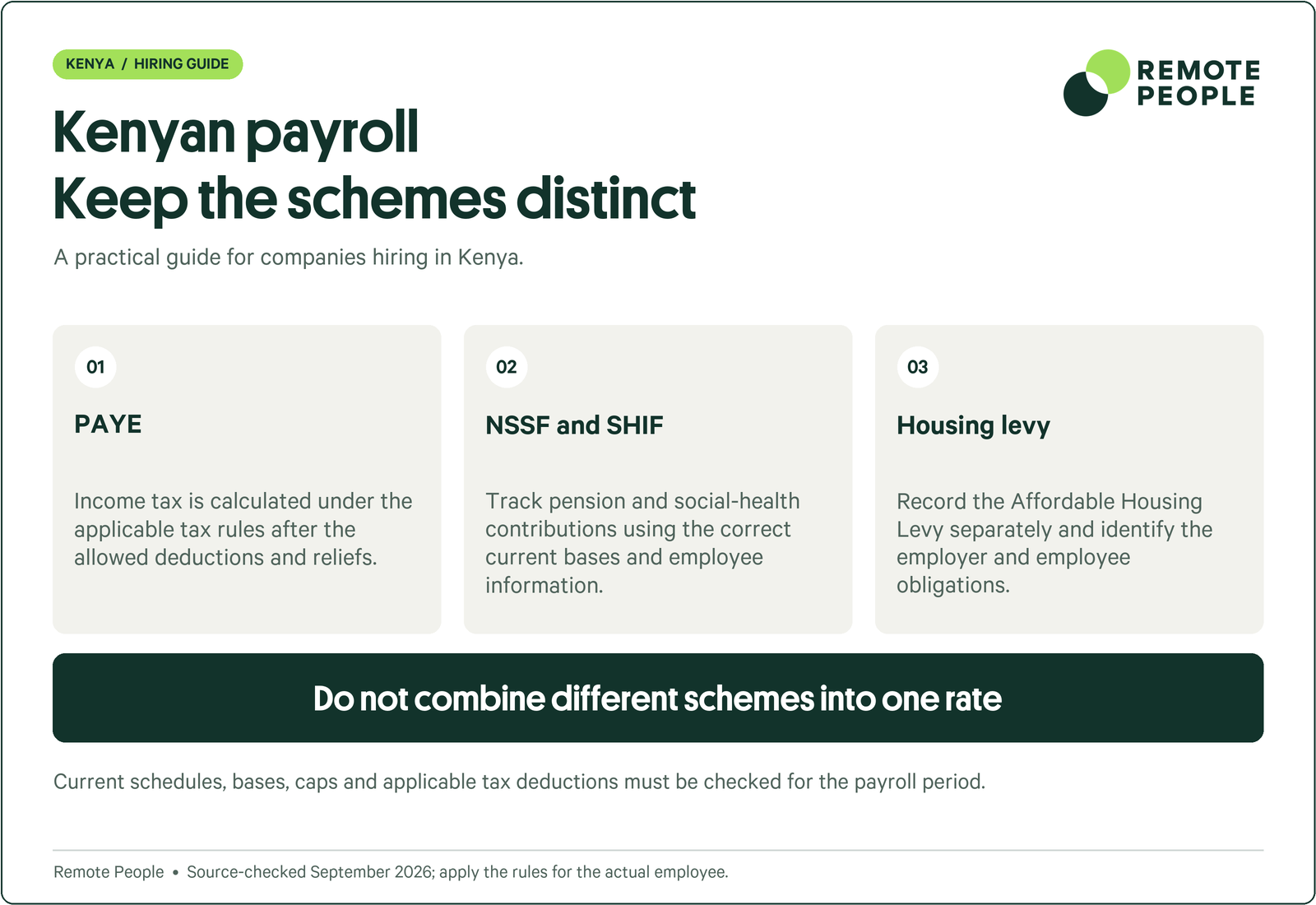
Kenya employer social security contributions · 2026 rates | ||
Contribution | Rate | Notes |
|---|---|---|
NSSF (Tier I + II) | 6% of gross salary | Capped at KES 6,480/month from Feb 2026 (upper limit KES 108,000) |
SHIF (Social Health Insurance Fund) | 1.375% of gross salary | No cap; new employer cost since Oct 2024 (replaced NHIF) |
AHL (Affordable Housing Levy) | 1.5% of gross salary | No cap; mandatory since Mar 2024; tax-deductible since Dec 2024 |
NITA (Training Levy) | KES 50/employee | Flat monthly fee; employers with 5+ employees |
Total employer contributions | ~8.875% + KES 50 | NSSF portion capped; SHIF and AHL uncapped |
Source: NSSF Kenya and PwC Kenya Tax Summary | ||
Employee Contributions
Employees in Kenya have several mandatory deductions withheld from their gross salary each month. These include NSSF pension contributions, SHIF health insurance, and the Affordable Housing Levy. All deductions are remitted by the employer (or the EOR) to the respective authorities by the 9th of the following month.
Kenya employee payroll deductions · 2026 monthly withholdings | ||
Deduction | Rate | Notes |
|---|---|---|
NSSF (Tier I + II) | 6% of gross salary | Capped at KES 6,480/month from Feb 2026 |
SHIF (Social Health Insurance Fund) | 1.375% of gross salary | Minimum KES 300/month; no cap; tax-deductible since Dec 2024 |
AHL (Affordable Housing Levy) | 1.5% of gross salary | No cap; tax-deductible since Dec 2024 |
PAYE (income tax) | 10% to 35% (progressive) | See income tax brackets below; personal relief of KES 2,400/month |
Total employee deductions | ~8.875% + PAYE | NSSF capped; SHIF and AHL uncapped; PAYE varies by income |
Source: Kenya Revenue Authority and PwC Kenya Tax Summary | ||
Income Tax
Kenya uses a progressive income tax system with five bands. Pay-As-You-Earn (PAYE) is withheld monthly by the employer and remitted to the KRA. Employees receive a personal relief of KES 2,400 per month (KES 28,800 annually), deducted from the calculated tax. Insurance relief of 15% of qualifying insurance premiums is also available, capped at KES 5,000 per month. NSSF, SHIF, and AHL contributions are allowable deductions from gross income before PAYE is calculated.
Kenya income tax brackets · 2026 | |
Monthly Taxable Income (KES) | Tax Rate |
|---|---|
Up to KES 24,000 | 10% |
KES 24,001 to KES 32,333 | 25% |
KES 32,334 to KES 500,000 | 30% |
KES 500,001 to KES 800,000 | 32.5% |
Above KES 800,000 | 35% |
Payroll Cycle
Most employers in Kenya process payroll monthly, with payment due by the last working day of the month. Salaries are paid in Kenya Shillings (KES) via bank transfer; cash payments are permitted but uncommon for formal employment. Employers must issue a detailed payslip showing gross salary, each statutory deduction (PAYE, NSSF, SHIF, AHL), any voluntary deductions, and net pay. The P10 return (PAYE, SHIF, AHL, and NITA remittances) is due to the KRA by the 9th of the following month. NSSF contributions are remitted separately to the NSSF by the same deadline. Annual P9 tax certificates must be issued to each employee after the end of the tax year for personal income tax filing.
13th Month Salary and Bonus Pay
Kenya doesn’t mandate a 13th month salary. There is no statutory requirement for end-of-year bonuses, profit sharing, or any additional monthly payment beyond the agreed salary. Some employers voluntarily pay performance bonuses or year-end gratuities, but these are contractual rather than statutory. When bonuses are paid, they are under PAYE at the employee’s marginal tax rate but are not included in the base for NSSF, SHIF, or AHL calculations unless the employment contract defines them as part of regular remuneration.
Cost of Hiring Through an EOR in Kenya
EOR Service Fees
EOR providers in Kenya typically charge between $300 and $600 per employee per month for full-service employment management. This fee covers employment contract administration, monthly payroll processing, PAYE and social security filings, employee benefits administration, leave management, and ongoing compliance monitoring. Some providers offer lower entry-level pricing starting at $125 to $275 per month for basic payroll-only services. The fee is fixed regardless of the employee’s salary level, making it more cost-effective for higher-salary roles.
Total Employment Cost Breakdown
The total cost of employing someone through an EOR in Kenya includes the gross salary, all mandatory employer contributions, and the EOR service fee. The following example assumes a monthly gross salary of $2,000 (approximately KES 260,000 at 1 USD = 130 KES, April 2026) and illustrates the full employer cost breakdown.
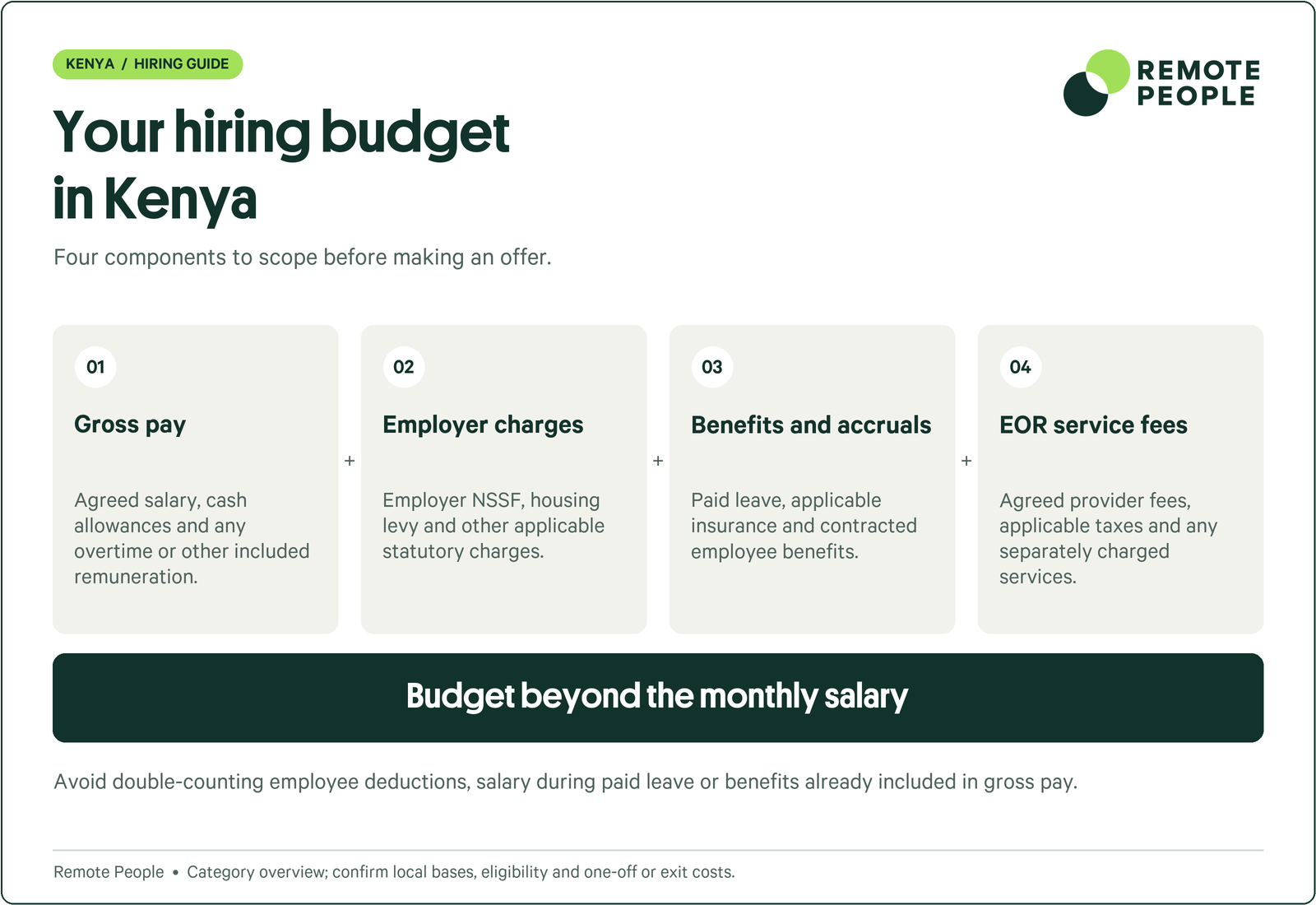
Kenya employer cost example · USD 2,000 gross · 2026 | ||
Cost Component | Amount (USD) | % of Gross |
|---|---|---|
Gross monthly salary | $2,000 | 100% |
NSSF (employer, 6% capped) | $50 | 2.5% |
SHIF (employer, 1.375%) | $28 | 1.4% |
AHL (employer, 1.5%) | $30 | 1.5% |
NITA (employer, flat) | $0.38 | <0.1% |
EOR service fee | $400 | 20% |
Total monthly employer cost | $2,508 | 125.4% |
Source: NSSF Kenya and PwC Kenya Tax Summary | ||
Figures converted at 1 USD ≈ 130 KES, April 2026. The NSSF employer contribution is capped at KES 6,480/month (approximately $50 at this exchange rate), so the percentage of gross decreases as salary increases. The EOR fee shown ($400) is a mid-range estimate; actual fees vary by provider.
Ready to hire in Kenya? Get started with RemotePeople, which handles employment contracts, payroll, tax withholding, and full Kenya compliance. No local entity needed. Contact us today.
Benefits of Using an EOR in Kenya
Hiring through an employer of record in Kenya offers several benefits over setting up a local subsidiary or engaging contractors. For companies entering the Kenyan market or building a distributed team across East Africa, an EOR eliminates the most time-consuming and risk-heavy aspects of cross-border employment.
An EOR can onboard a Kenyan employee in 1 to 2 weeks, bypassing the 2 to 4 months required for company registration, KRA and NSSF enrollment, bank account opening, and ongoing annual filing obligations. For teams of 1 to 15 employees, the EOR’s per-employee fee ($300 to $600/month) is substantially less than the fixed cost of maintaining a Kenyan entity, which includes annual audit fees, company secretary services, tax compliance, and registered office rental.
Kenya’s employment framework spans the Employment Act 2007, the NSSF Act 2013, the Social Health Insurance Act 2024, the Affordable Housing Act 2024, and sector-specific regulations. An EOR maintains local legal and HR expertise to stay current with regulatory changes, such as the 2024 NHIF-to-SHIF transition and the February 2026 NSSF rate increase. This compliance assurance extends to payroll tax withholding, where the EOR handles monthly PAYE, NSSF, SHIF, and AHL filings and remittances with zero exposure to penalties for the client company.
The EOR also provides workforce flexibility, allowing companies to scale from 1 to 50+ employees without restructuring a local entity, and to exit the market by simply ending the EOR agreement rather than dissolving a subsidiary. For companies hiring foreign nationals, the EOR sponsors Class D work permits as the local employer, managing the full immigration process through the eFNS portal. Employment contracts executed by the EOR include IP assignment clauses, confidentiality provisions, and non-compete terms tailored to Kenyan law, protecting the client company’s intellectual property from day one.
Termination and Offboarding in Kenya
Notice Periods
Notice periods in Kenya are governed by Sections 35 to 37 of the Employment Act 2007. The statutory notice period varies based on the employee’s payment frequency. Either party may terminate the contract without notice by paying the other party’s remuneration for the notice period in lieu (Section 36). During the probation period, the notice requirement is 7 days or 7 days’ wages in lieu.
Kenya statutory notice periods by payment frequency · Per Employment Act 2007 | |||
Employment Type | Notice Period | During Probation | Notes |
|---|---|---|---|
Monthly-paid employees | 28 calendar days | 7 days | Most common for salaried staff |
Weekly/biweekly-paid employees | End of next pay period | 7 days | Notice given before end of current pay period |
Daily-paid employees | End of the day | 7 days | Terminable at close of any working day |
Fixed-term contracts | Per contract terms | 7 days | No notice required at natural expiry date |
Contractually specified | Per contract (must meet statutory floor) | 7 days | Contract may provide longer notice; cannot be shorter than statutory |
Termination by mutual agreement doesn’t require statutory notice. Termination for just cause (gross misconduct, theft, fraud, or gross insubordination) may be summary (without notice), but the employer must still follow the procedural fairness requirements of Section 41, which include a hearing and an opportunity for the employee to respond to the allegations.
Severance Pay
Severance pay in Kenya follows Section 40 of the Employment Act 2007 and is payable when an employee is terminated due to redundancy (the employer no longer requires the role). Employees with at least 12 months of continuous service get severance. The entitlement doesn’t apply to dismissal for just cause or resignation.
Kenya severance pay schedule by years of service · Per Employment Act 2007 | |||
Years of Service | Severance Amount | Base Salary | Notes |
|---|---|---|---|
1 year | 15 days’ basic pay | KES 30,000 example = KES 15,000 | Minimum qualifying period |
3 years | 45 days’ basic pay | KES 30,000 example = KES 45,000 | 15 days per completed year |
5 years | 75 days’ basic pay | KES 30,000 example = KES 75,000 | 15 days per completed year |
10 years | 150 days’ basic pay | KES 30,000 example = KES 150,000 | 15 days per completed year |
Source: Employment Act 2007, Section 40 and AfricaPay Kenya | |||
Calculation Method
Severance is calculated at 15 days’ basic pay for each completed year of service. The formula is: (monthly basic wage / 30) x 15 x number of completed years. “Basic pay” means the employee’s base monthly salary excluding allowances, bonuses, and overtime, unless the employment contract explicitly includes those components in the severance calculation base. The worked examples in Table 13 above use a KES 30,000 monthly basic wage for illustration.
Caps and Exceptions
The Employment Act doesn’t impose a statutory cap on the total severance amount; entitlement accrues linearly with each year of service. Severance is not owed when termination is for just cause (gross misconduct under Section 44), when the employee resigns, or when a fixed-term contract expires naturally. During the probation period, severance doesn’t apply. Collective dismissals (redundancy affecting multiple employees) must follow the procedure in Section 40, which includes consultation with the relevant trade union or employee representatives and notification to the labour officer at least one month before the first termination takes effect.
Grounds for Termination
Kenyan law distinguishes between termination with just cause and termination without cause (redundancy). Just cause grounds include gross misconduct, habitual neglect of duty, criminal conviction relating to the employment, and willful disobedience of lawful orders (Section 44). In all cases, the employer must follow the procedural fairness requirements of Section 41: inform the employee of the grounds, allow them to respond (accompanied by a colleague or union representative), and consider the response before making a decision. Employees in protected categories, including pregnant employees, employees on maternity leave, and trade union members acting in their capacity as representatives, receive additional protections against unfair dismissal.
EOR vs. Other Hiring Models in Kenya
EOR vs. Setting Up a Local Entity
Employer of record services in Kenya offer an alternative to entity setup. The choice between an EOR and a local entity varies based on your team size, budget, and long-term commitment to Kenya. For teams of fewer than 15 employees, the EOR model is almost always more cost-effective. The table below compares the two approaches across the most important dimensions.
Kenya EOR vs local entity comparison · Setup time, cost, risk and best-fit | ||
Comparison | Employer of Record | Own Entity |
|---|---|---|
Setup time | 1 to 2 weeks | 2 to 4 months |
Upfront cost | $0 | $5,000 to $15,000 |
Ongoing cost | $300 to $600/employee/month | $8,000 to $20,000/year maintenance |
Local partner required | No (EOR is the local entity) | No (100% foreign ownership permitted) |
Social insurance registration | Handled by EOR | You manage it |
Payroll and tax filing | Handled by EOR | You manage it (or outsource) |
Best for team size | 1 to 15 employees | 15+ employees |
Scale down / exit | Easy, no entity to unwind | Costly, legal dissolution required |
Government contracts | Not eligible | Eligible (requires local entity) |
Source: Employment Act 2007 and PwC Kenya Corporate Tax Summary | ||
Kenya permits 100% foreign ownership of a private limited company, so a local partner is not legally required for entity setup. However, the registration process involves the Business Registration Service, KRA, NSSF, SHA, county government permits, and (for most businesses) single business permit fees. Annual compliance includes audited financial statements, annual returns, and tax filings. For companies testing the Kenyan market or building a small distributed team, these fixed costs make a local entity uneconomical compared to the EOR model.
The breakeven point typically occurs at around 15 employees, where the cumulative EOR fees approach the fixed cost of maintaining a local entity. At that scale, the entity also provides advantages such as eligibility for government contracts and greater control over HR policies.
EOR vs. Hiring Independent Contractors
Engaging independent contractors in Kenya can seem simpler and cheaper than hiring through an EOR, but it carries significant compliance risk. Kenya’s Employment Act and KRA enforcement increasingly scrutinize contractor relationships that resemble employment. If a contractor works exclusively for one company, follows set hours, uses company equipment, and receives regular monthly payments, the relationship may be reclassified as employment, exposing the company to back taxes, NSSF arrears, penalties, and forced employee status.
Kenya EOR vs independent contractors · Compliance, cost, and risk | ||
Comparison | EOR (Full-Time Employee) | Independent Contractor |
|---|---|---|
Legal relationship | Employee of the EOR | Self-employed, no employment relationship |
Compliance risk | Low, EOR ensures local labor law compliance | High, misclassification risk if relationship resembles employment |
Payroll and tax | EOR handles withholding, contributions, filings | Contractor invoices you; they handle their own taxes |
Benefits and leave | Statutory benefits, paid leave, social security | No entitlement to employee benefits |
IP protection | Stronger, employment contract assigns IP by default | Weaker, requires explicit IP assignment clause |
Termination | Subject to local notice periods and severance | Contract can be ended per agreement terms |
Best for | Long-term, core team roles | Short-term projects, specialized tasks |
Cost structure | Salary + employer contributions + EOR fee | Contractor fee (typically higher gross, lower total cost) |
Source: Employment Act 2007 and Kenya Revenue Authority | ||
The consequences of misclassification include retroactive PAYE and NSSF assessments (typically covering the full engagement period), penalties of 2% to 3% per month on unpaid amounts, and the forced conversion of the contractor to employee status with full statutory benefits and leave entitlements. For companies engaging workers in Kenya on an ongoing, full-time basis, the EOR model eliminates this risk entirely.
For genuine short-term, project-based engagements with specialists who serve multiple clients, contractor arrangements remain appropriate. RemotePeople also offers contractor management services for companies that need to engage independent contractors compliantly.
EOR vs. PEO (Professional Employer Organization)
A PEO (Professional Employer Organization) operates under a co-employment model where the client company remains the legal employer and the PEO provides HR outsourcing services. This requires the client to already have a registered entity in Kenya. Kenya doesn’t have a formal regulatory framework for PEOs; the concept is less established than in markets like the United States. In practice, most companies without a Kenyan entity use an EOR rather than a PEO.
Kenya EOR vs PEO comparison · Legal employer, liability, and setup | ||
Comparison | Employer of Record (EOR) | PEO |
|---|---|---|
Legal employer | EOR is the legal employer | You remain the legal employer (co-employment) |
Local entity required | No, the EOR is the local entity | Yes, you must have your own entity in Kenya |
Best for | Companies without a local entity | Companies that already have a local entity |
Compliance liability | EOR assumes compliance responsibility | Shared liability between you and the PEO |
Setup time | 1 to 2 weeks | Depends on your entity setup (weeks to months) |
Control over HR policies | EOR manages within local law framework | More direct control, PEO advises |
Typical use case | Market entry, small remote teams, testing new markets | Established local operations needing HR outsourcing |
Source: Employment Act 2007 and PwC Kenya Corporate Tax Summary | ||
The fundamental difference is the legal employer relationship: with an EOR, you don’t need a Kenyan entity. With a PEO, you do. For companies entering Kenya for the first time, or those with fewer than 15 employees, the EOR is the more practical choice. Companies that already operate a Kenyan subsidiary and want to outsource HR administration may find a PEO arrangement useful, though the service is offered by fewer providers in the Kenyan market compared to EOR services.
Public Holidays in Kenya
Kenya observes 11 gazetted public holidays per year, plus one optional Islamic holiday (Eid al-Adha) that is declared by the government based on the Islamic lunar calendar. When a public holiday falls on a Sunday, the following Monday is observed as a public holiday. Employees required to work on a gazetted public holiday get double their normal daily wage. The following table lists all public holidays for 2026.
Kenya public holidays · 2026 calendar year | ||
Date | Holiday | Type |
|---|---|---|
1 January (Thursday) | New Year’s Day | National |
20 March (Friday) | Idd ul-Fitr | National (date subject to moon sighting) |
3 April (Friday) | Good Friday | National |
6 April (Monday) | Easter Monday | National |
1 May (Friday) | Labour Day | National |
27 May (Wednesday) | Eid al-Adha | Optional (date subject to moon sighting) |
1 June (Monday) | Madaraka Day | National |
10 October (Saturday) | Mazingira Day | National |
20 October (Tuesday) | Mashujaa Day | National |
12 December (Saturday) | Jamhuri Day | National |
25 December (Friday) | Christmas Day | National |
26 December (Saturday) | Boxing Day | National |
Source: Employment Act 2007 and timeanddate.com | ||
Islamic holidays (Idd ul-Fitr and Eid al-Adha) are based on the lunar calendar and their exact dates are confirmed by the government shortly before each observance. Mazingira Day (10 October, formerly known as Utamaduni Day) was renamed in 2024 to emphasize environmental conservation. In 2026, both Mazingira Day and Boxing Day fall on Saturdays; payroll teams should confirm whether Monday substitute holidays will be gazetted.
How to Get Started with an EOR in Kenya
Hiring your first employee in Kenya through an EOR follows a straightforward process. These five steps cover everything from initial engagement to the employee’s first day of work:
Companies that want to hire employees in Kenya without the complexity of local registration start by choosing an EOR provider. Evaluate providers based on their presence in Kenya, service scope (payroll-only vs. full compliance), pricing model (per-employee flat fee vs. percentage of salary), and whether they can handle work permit sponsorship for foreign nationals. Confirm that the provider is registered with the KRA, NSSF, and SHA.
Next, define the role and compensation. Work with the EOR to structure the compensation package, including gross salary, any supplementary benefits (private medical insurance, pension top-up), and the applicable minimum wage floor for the employee’s location. The EOR will advise on market benchmarks and mandatory benefit requirements.
The EOR then drafts a compliant employment contract under the Employment Act 2007, including all required terms (job description, wages, working hours, leave, notice period). You review and approve the contract before the EOR and employee sign it. Once signed, the EOR registers the employee with the KRA (for PAYE), NSSF (pension), SHA (SHIF health insurance), and the AHL system. If the employee is a foreign national, the EOR initiates the work permit application through the eFNS portal.
Finally, the employee starts work and the EOR runs the first payroll cycle, calculating gross-to-net, withholding PAYE, NSSF, SHIF, and AHL, and remitting all statutory contributions by the 9th of the following month. The EOR issues payslips and manages ongoing compliance.
Ready to hire in Kenya without the complexity of setting up a local entity? Get in touch with RemotePeople to start onboarding your Kenyan team in as little as 1 to 2 weeks.
Where companies hiring in Kenya expand next
Hiring in Kenya frequently leads to recruitment across East Africa’s English-speaking cluster and the wider Indian Ocean corridor. Teams frequently add Tanzania for shared East African workforce norms; a team in Rwanda often follows for overlapping East African talent profile; operations in Ethiopia is a common next step, offering the regional East African talent pool; and Uganda rounds out the regional footprint with aligned East African English-first hiring profile.
Frequently Asked Questions
EOR providers in Kenya typically charge between $300 and $600 per employee per month for full-service employment management. Some providers offer basic payroll-only plans starting at $125 to $275 per month. The fee is fixed regardless of salary level, and covers employment contracts, payroll processing, tax filings, social security registration, and compliance monitoring.
Most EOR providers can onboard a Kenyan employee within 1 to 2 weeks. This includes contract drafting, KRA and NSSF registration, SHIF enrollment, and payroll setup. If the employee is a foreign national requiring a work permit, the timeline extends by 4 to 8 weeks for Class D permit processing.
Yes. An EOR operates as a fully registered Kenyan employer under the Employment Act 2007. The EOR is the legal employer of record, responsible for all statutory obligations including PAYE, NSSF, SHIF, and AHL contributions. There is no specific regulation prohibiting or restricting EOR arrangements in Kenya.
No. An EOR allows you to hire employees in Kenya without setting up a local subsidiary. The EOR serves as the legal employer and handles all registrations with the KRA, NSSF, SHA, and other authorities. A local entity is only required if you plan to bid on government contracts or prefer direct control over employment administration.
As of 2026, employers contribute approximately 8.875% of gross salary plus KES 50 per employee per month. This includes NSSF at 6% (capped at KES 6,480/month from February 2026), SHIF at 1.375%, AHL at 1.5%, and the NITA training levy at KES 50 flat per employee.
An EOR is designed for full-time employees, not independent contractors. However, many EOR providers also offer contractor management services that handle invoicing, tax compliance, and misclassification risk assessment. If the working relationship involves set hours, exclusive engagement, and company-directed work, an EOR employment arrangement is the compliant option.
The EOR manages the termination process in compliance with the Employment Act 2007. Monthly-paid employees are entitled to 28 days' notice (or payment in lieu). If the termination is due to redundancy and the employee has at least 12 months of service, severance pay of 15 days' basic salary per completed year of service is required. The employer must follow Section 41 procedural fairness requirements in all cases.
Mandatory benefits include NSSF pension contributions, SHIF health insurance, Affordable Housing Levy participation, work injury insurance, 21 days of annual leave, 90 days of maternity leave (full pay), 14 days of paternity leave (full pay), and sick leave of up to 14 days per year. Private medical insurance and supplementary pension are not mandatory but are commonly offered.
Yes. An EOR in Kenya can employ workers across all sectors, including construction, real estate, technology, and professional services. The EOR holds the employment contracts under the Employment Act 2007 regardless of industry. For construction-specific roles, the EOR ensures compliance with sector wage orders under the Regulation of Wages (General) Order and handles any additional occupational safety registration requirements. The only limitation is that government procurement contracts typically require a locally incorporated entity.
Kenya uses a progressive PAYE (Pay As You Earn) income tax system with five brackets: 10% on the first KES 24,000 per month, 25% on KES 24,001 to 32,333, 30% on KES 32,334 to 500,000, 32.5% on KES 500,001 to 800,000, and 35% above KES 800,000 (PwC Kenya Tax Summary). On top of PAYE, both employer and employee contribute 6% each to NSSF (capped at KES 6,480/month), 1.375% each to SHIF health insurance, and 1.5% each to the Affordable Housing Levy. The EOR calculates all deductions, issues payslips, and remits to the KRA by the 9th of each month.
The standard probation period in Kenya is 6 months under the Employment Act 2007 (Section 42). During probation, an employee can be terminated with 7 days' written notice (compared to 28 days for confirmed monthly-paid employees). The probation period must be stated in the employment contract, and the employer must provide a reason for any termination during this period. An EOR structures the probation clause in compliance with the Act and manages the confirmation or termination process at the end of the period.
Employer of Record in
Employer of Record in
Employer of Record in
Employer of Record in
Employer of Record in
Employer of Record in
Employer of Record in
Employer of Record in