Recruit
Average Salary in Nigeria
-
 Drew Donnelly
- Published
- September 21, 2026
- 5 ★ on G2








Let RemotePeople handle payroll, compliance, and HR admin worldwide so you can focus on building your team.
Nigeria’s large talent pool, expanding tech sector, and competitive labor costs have made it an increasingly attractive option for international hiring. For companies working with an Employer of Record (EOR) in Nigeria, knowing the local salary landscape can make it easier to set appropriate compensation and attract skilled professionals.
This guide looks at average salaries in Nigeria, how pay varies by role and experience, and the factors that shape employee compensation across the country. Employers may also run background checks in Nigeria for certain roles, so it is worth knowing what is permitted before you hire.
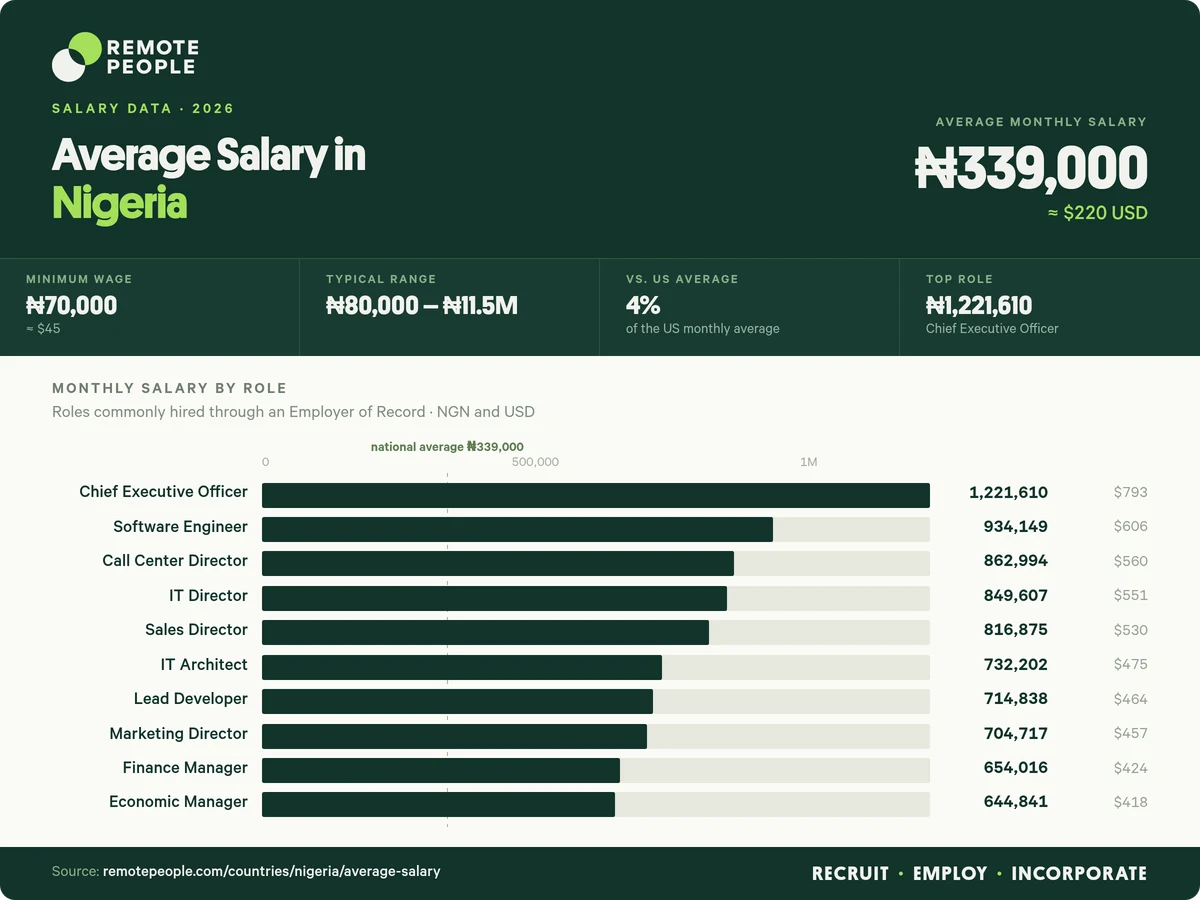
The average monthly salary in Nigeria is 339,000 Nigerian Naira (NGN), about USD 220. However, you must also consider how salaries are affected by experience, education, location, position, and industry. Comparing salaries in the country to wages worldwide will also provide more insight.
This guide will explore all aspects of salaries in Nigeria to prepare you for your hiring journey.
What is the Average Salary in Nigeria?
The average monthly salary in Nigeria is 339,000 NGN, or about $220. Wages in the country are low due to recession and economic instability, volatile oil dependence, and currency devaluation. There are also limited job opportunities and a dominant informal work sector.
Median Income
The median monthly income in Nigeria is the same as the average salary, 339,000 NGN. Half the country earns higher wages; the other half earns lower salaries.
Salary Range
The salary range in Nigeria spans from the highest to the lowest. Low earners make around 80,000 NGN monthly (about $52), while high earners make closer to 11.5 million NGN, about $7845.
Salary Comparison by Profession
Average salaries provide insight, but you must consider how wages vary based on profession, industry, location, experience, and education. The following sections will explore how these factors impact earnings:
Position | Average Monthly Salary (NGN) |
|---|---|
Chief Executive Officer | 1,221,610 |
Software Engineer | 934,149 |
Call Center Director | 862,994 |
IT Director | 849,607 |
Sales Director | 816,875 |
IT Architect | 732,202 |
Lead Developer | 714,838 |
Marketing Director | 704,717 |
Finance Manager | 654,016 |
Economic Manager | 644,841 |
Banking Cashier | 176,821 |
Fabric Cutter | 176,496 |
Clothing Technologist | 175,727 |
General Laborer | 174,667 |
Packer | 172,115 |
Seamstress | 164,328 |
Porter | 158,761 |
Social Counselor | 153,691 |
Tailor | 153,413 |
Average Wage in Nigeria by Education
Education plays a significant role in Nigeria’s wage determination. Many people in the country do not have access to free education, leading to unequal income distribution and high levels of poverty.
Statistics show that the salary of a university graduate is about 12 times that of illiterate workers with no education and 4.5 times higher than that of a secondary school graduate.
Salary Comparison by Experience
Experience is another factor that impacts salaries as follows:
Experience Level | Salary Increase Compared to Previous Tier |
|---|---|
2–5 years | +32% |
5–10 years | +36% |
10–15 years | +21% |
15–20 years | +14% |
20+ years | +9% |
Salary Comparison by Location
Location also affects salaries as urban workers earn more than rural workers due to higher living costs and proximity to large companies offering more job opportunities. Here are the best states for Nigerian workers:
State | Key Industries & Opportunities |
|---|---|
Lagos State | Commercial hub with multinational companies, tech startups, and top-tier private sector roles |
Abuja | Capital city with high-paying opportunities in government, international organizations, and finance |
Rivers State | Oil and gas powerhouse offering lucrative roles in energy and engineering |
Akwa Ibom | Emerging industrial hub attracting talent across manufacturing and development sectors |
Ogun State | Fast-growing manufacturing sector with rising demand for skilled labor and managerial talent |
How Much is Minimum Wage in Nigeria?
The minimum wage in Nigeria is 70,000 NGN (about $45 Nigeria minimum wage USD) per month. The last increase took effect in July 2024. Before that, the minimum wage was 30,000, established in 2019.
Average Salary in Nigeria vs. the Rest of the World
To provide more insight, the following charts compare salaries in Nigeria to wages in developed, developing, and undeveloped countries.
Nigeria vs. Developed Countries
Country | Average Salary | Comparison to Average Nigeria Salary |
|---|---|---|
United Kingdom | €3,000 (approx. $3,116) | – 1,300% |
United States | $5,677 | – 2,500% |
Norway | 50,790 NOK (approx. $4,700) | – 2,036% |
Germany | €4,300 (approx. $4,467) | – 1,945% |
Austria | €3,500 (approx. $3,636) | – 1,536% |
Nigeria vs. Developing Countries
Country | Average Salary | Comparison to Average Nigeria Salary |
|---|---|---|
Romania | 4,000 RON (approx. $835) | – 281% |
Russia | 73,709 RUB (approx. $700) | – 218% |
Albania | €1,500 (approx. $1,550) | – 604% |
Kazakhstan | 342,082 KZT (approx. $645) | – 195% |
Ukraine | 18,000 UAH (approx. $500) | – 127% |
Nigeria vs. Undeveloped Countries
Country | Average Salary | Comparison to Average Nigeria Salary |
|---|---|---|
Thailand | 97,500 Baht (approx. $2,772) | – 1,172% |
Philippines | 18,423 PHP (approx. $875) | – 300% |
Vietnam | 8.5 million VND (approx. $360) | – 63% |
Egypt | 13,244 EGP (approx. $263) | – 18% |
Pakistan | 45,000 PKR (approx. $150) | 46% |
Nigeria is a developing country with growth potential. Despite being Africa’s largest economy, it is limited in human development, infrastructure, and government. Although it has abundant natural resources, it faces challenges in translating them into generating income.
Although the country faces internal issues, it offers great promise as an outsourcing destination. It provides cost-effective labor and a growing tech ecosystem, and its strategic location offers access to a large and growing African market.
What are the Most Common Outsourced Industries in Nigeria?
Employers outsourcing to Nigeria will see the most significant benefits in the following industries.
IT Services
Nigeria’s IT industry has grown significantly in the past few years, especially in e-commerce and fintech. Lagos is emerging as a prominent tech hub, attracting investments and startups. The large and young population provides a pool of potential IT talent.
A starting salary for an IT worker in Nigeria is about 400,000 NGN (about $260) monthly, while American workers earn closer to $5000, leading to significant cost savings for employers who outsource.
Petroleum
Petroleum is Nigeria’s most important industry. It is one of the top ten global oil producers, and crude and petroleum products are some of the country’s biggest exports. They generate about 14% of the country’s GDP and account for approximately 83% of the government’s revenue.
Statistics show oil deposits in the country can be as high as 35 billion barrels. Beyond being a popular export destination, companies can outsource various aspects of petroleum production, including back office functions, engineering and manufacturing, and supply chain logistics, to save costs.
Agriculture
Agriculture is another significant industry in the Nigerian economy, accounting for around 18% of the country’s GDP. It produces about 8 million tons of oil palms annually for cosmetics, bioenergy, plastics, and other industries. It is also a major exporter of cocoa with the potential to produce over .3 million tons, although production is hindered by reliance on small-scale farmers.
Companies may import crops from Nigeria and outsource specific production, management tasks, and specialized services.
Conclusion
Nigeria’s vast resources, low-cost labor, and strategic location make it a promising outsourcing destination. Companies that partner with the country for remote work can take advantage of reduced expenses and exceptional products and services while helping workers overcome poverty, providing benefits for all involved parties.