
 Recruit
Employer of Record in Nigeria
-
 Drew Donnelly
- Published
- September 22, 2026
Hire employees in Nigeria without setting up a local entity. RemotePeople’s employer of record handles contracts, payroll in NGN, Personal Income Tax, pension, and NHIA — so you can build your Nigeria team in days, not months.
Hire in Nigeria — book a free 30-minute demo
Tell us what you need. You'll get a tailored, transparent proposal within 24 hours, plus a free call to walk through it.
Tell us about your company
So we can match you with a specialist who knows your market — and unlock volume pricing tiers.
* All fields are required.
Where and when are you hiring?
Tell us the geography and timing and we'll quote each country line by line, with onboarding timelines.
* All fields are required.
Help us beat your current setup
We'll benchmark your current deal and send a line-by-line proposal in 24 hours — showing exactly where we cut cost, time, or risk. After you submit, you can book a call to walk through it together.
* All fields are required.
Thanks! Your proposal is on its way.
Expect a tailored, line-by-line proposal in your inbox within 24 hours. In the meantime…
Want to walk through it together?
Book a free 30-minute call with one of our specialists. We'll explain every line, answer your questions, and tailor the proposal further if you need.
No obligation. Pick a time that works for you.








- Hire in Nigeria — book a free 30-minute demo
- Tell us about your company
- Where and when are you hiring?
- Help us beat your current setup
- Thanks! Your proposal is on its way.
- How an Employer of Record Works in Nigeria
- Employment Laws and Regulations in Nigeria
- Work Permits and Visas in Nigeria
- Payroll, Taxes, and Social Security in Nigeria
- Cost of Hiring Through an EOR in Nigeria
- Benefits of Using an EOR in Nigeria
- Termination and Offboarding in Nigeria
- EOR vs. Other Hiring Models in Nigeria
- Public Holidays in Nigeria
- How to Get Started with an EOR in Nigeria
- Where companies hiring in Nigeria expand next
- Frequently Asked Questions
- Related EOR Destinations

Start hiring in Nigeria
Let RemotePeople handle payroll, compliance, and HR admin worldwide so you can focus on building your team.

An employer of record (EOR) in Nigeria lets you hire full-time employees without registering a local entity, typically at $300–$600 per employee per month plus the employee’s salary and statutory contributions. The EOR acts as the legal employer, handling contracts under the Labour Act (Cap L1), payroll in Nigerian Naira, Personal Income Tax withholding, and mandatory contributions to the Pension Reform Act 2014 scheme and the National Health Insurance Authority. Nigeria is Africa’s largest economy with a workforce exceeding 100 million people and strong demand for skilled talent in technology, finance, and energy sectors. Using an EOR removes the need to register a subsidiary, appoint local directors, or maintain ongoing corporate compliance, allowing your team to start work within one to two weeks. This guide covers Nigeria’s employment laws, tax obligations, work permits, severance rules, and how to get started with EOR services.
How an Employer of Record Works in Nigeria
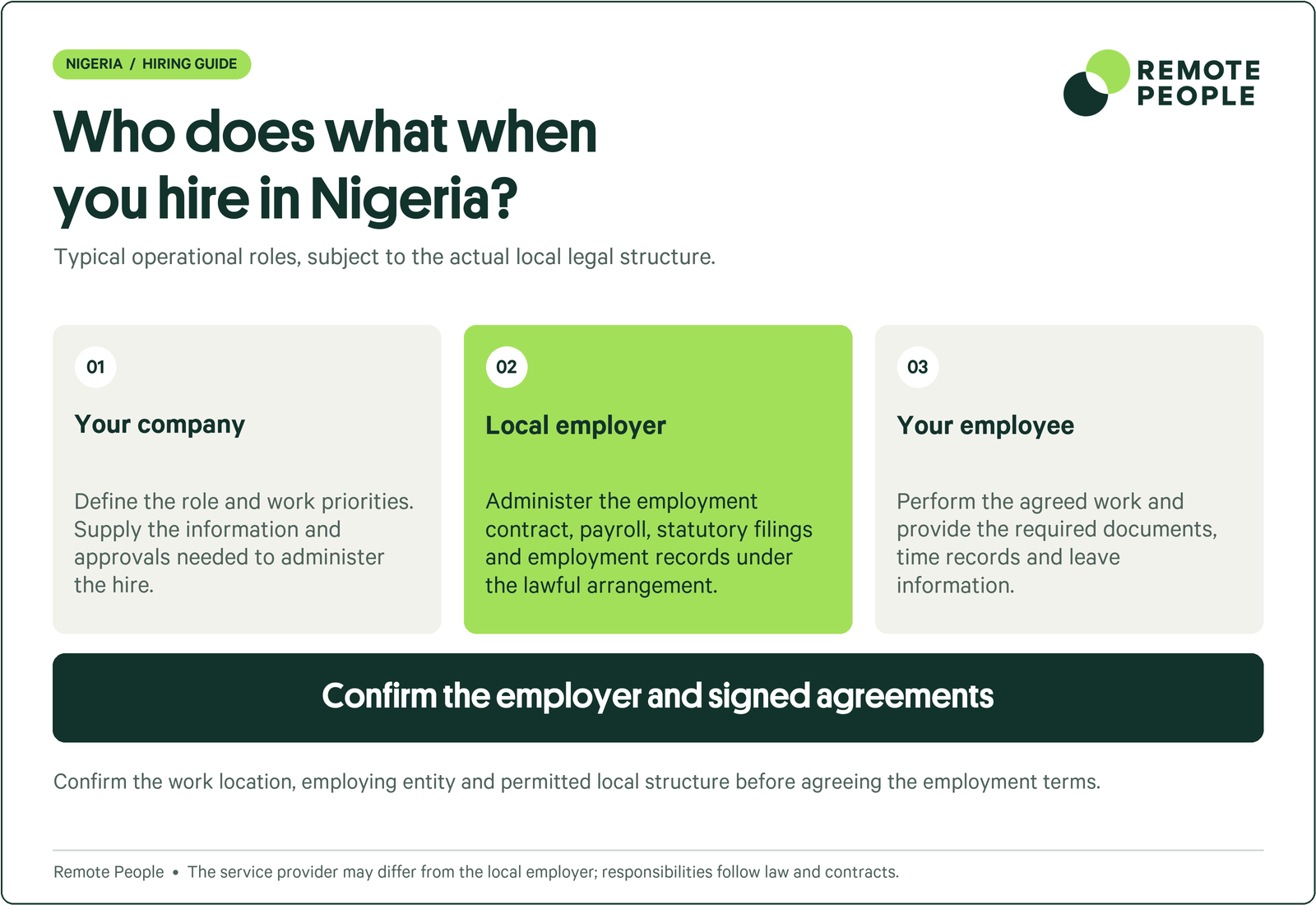
If you’d like to learn more about how Employer of Record (EOR) services work, read our What Is an Employer of Record (EOR)? guide for a complete overview of the model, its benefits, and when to use it.
If you’re comparing providers, our Best Employer of Record (EOR) Providers guide reviews the leading platforms to help you choose the right solution for your business.
Who Uses an EOR in Nigeria?
EOR arrangements work well for several business scenarios:
EORs in Nigeria serve a range of hiring scenarios. Companies new to the market often hire one or two employees to validate demand or test product-market fit without registering a local entity. Small international teams with 1–15 staff outsource payroll, compliance, and HR administration to free up internal resources. When speed matters, an EOR onboards employees within 1–2 weeks compared to 3–6 months for a subsidiary. Foreign nationals requiring CERPAC work permits also benefit, since the EOR sponsors the visa and handles all Nigeria Immigration Service submissions.
EOR arrangements work best when you want cost efficiency, legal compliance, and speed to hire while retaining direct management of daily operations and strategy.
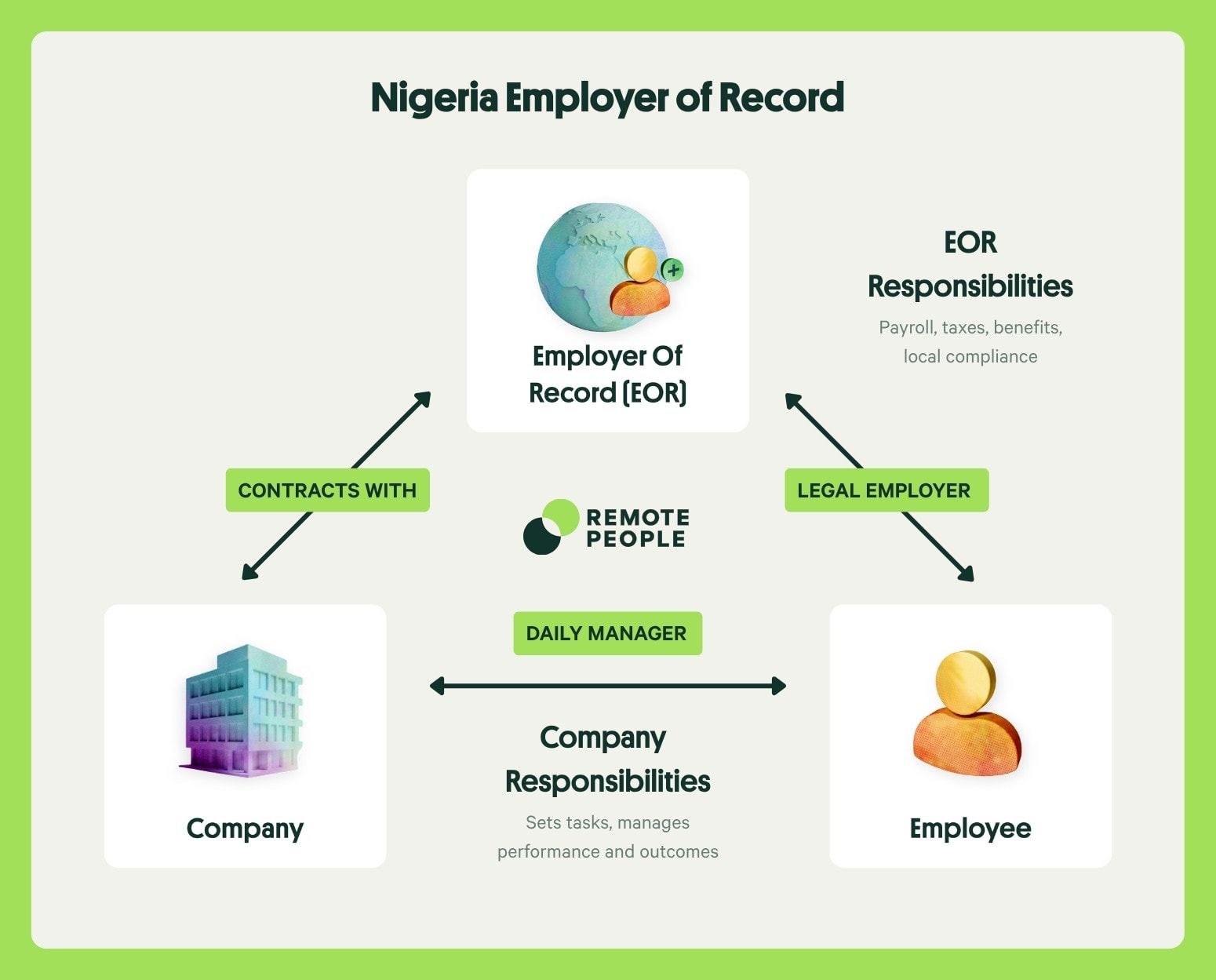
Typical Onboarding Timeline
Hiring a new employee through an EOR in Nigeria typically follows this sequence:
- First, EOR agreement and employee details (days 1–2): You provide employee information (name, address, qualifications, role, salary) and sign the service agreement with the EOR. The EOR verifies information and begins contract preparation.
- Second, employment contract drafting and review (days 3–5): The EOR prepares an employment contract compliant with the Labour Act and sends it to the candidate for signature. Both parties execute the contract.
- Third, pension and tax registration (days 6–10): The EOR registers the employee with a Pension Fund Administrator (PFA), applies for NHIA health insurance coverage, and sets up payroll with the Nigeria Revenue Service.
- Fourth, payroll setup and first payment (days 8–14): The EOR processes the first payroll run, withholds taxes and pension contributions, and generates payslips showing gross salary, deductions, and net pay in NGN.
- Fifth, employee onboarding and first day: The employee begins work. For non-Nigerian staff, add 4–8 weeks for CERPAC work permit processing through the Nigeria Immigration Service.
Most EOR providers complete onboarding for Nigerian nationals in 1–2 weeks. Work permits for foreign employees add 4–8 weeks, depending on Nigeria Immigration Service processing speed and document completeness.
Hire in Nigeria
Africa’s largest economy, a workforce of 100 million+, growing tech and finance hubs, and a fast-expanding digital talent pool make Nigeria a strategic hiring destination.
We handle employment contracts, payroll, tax withholding, and full Nigeria compliance.
No local entity needed. Your team can start in days.
Employment Laws and Regulations in Nigeria
Employment Contracts
Nigerian employment law requires a written contract for any engagement lasting more than three months under the Labour Act (Cap L1). The contract must be in English and include all mandatory terms: job title, basic salary and allowances, workplace location, working hours, leave entitlements, duration (fixed-term with end date or indefinite), probation period if applicable, and termination conditions. The employer must provide a signed copy to the employee within two weeks of hiring.
Employers can offer fixed-term contracts (defined end date, renewable by agreement) or indefinite-duration contracts (ongoing until termination with notice). Both must specify the probation period, typically 3–6 months, during which either party may terminate with shorter notice.
Working Hours and Overtime
Nigeria’s standard working week is 40 hours across five days, with an eight-hour daily cap, governed by Section 13 of the Labour Act. Employees are entitled to at least one rest day per seven-day period (typically Saturday or Sunday), provided as 24 consecutive hours with paid leave compensation if reduced. Hours worked beyond the standard constitute overtime and are compensated by contract, collective bargaining agreement, or industrial wages board order; the Labour Act does not prescribe rates. Common market practice uses 1.25x to 1.5x the hourly rate for weekday overtime and 1.5x to 2x for rest day or public holiday work.
Nigeria overtime and premium pay rates · Per Labour Act (Cap L1) | |||
Hour Type | Rate Multiplier | Weekly/Daily Cap | Notes |
|---|---|---|---|
Weekday Overtime | 1.25x–1.5x base hourly rate | No statutory cap | Hours beyond 8 per day or 40 per week; determined by contract or CBA |
Night Work (10 pm–6 am) | 1.25x–1.5x base hourly rate | No statutory cap | Work during night hours; rate negotiated in employment contract |
Weekly Rest Day Work | 1.5x–2x base hourly rate | No statutory cap | Work on the designated weekly rest day (Saturday or Sunday) |
Public Holiday Work | 1.5x–2x base hourly rate | No statutory cap | Work on a national public holiday; full day at premium or contractual rate |
Overtime rates are contractual, not statutory. Employer and employee may negotiate rates within market practice. Managers and salaried professionals are often exempt from overtime by contract, receiving fixed compensation packages instead.
Minimum Wage
Nigeria’s national minimum wage is ₦70,000 per month, effective 1 May 2024, per the National Minimum Wage (Amendment) Act 2024 signed July 2024. The minimum wage applies uniformly to all private and public sector workers earning less than this threshold. It is subject to review every two years by a tripartite committee (government, employers, and trade unions). The current rate is set to expire in 2027. Certain exemptions apply: workers employed on a part-time basis, those paid by commission or piece rate, employers with fewer than 25 employees, seasonal workers, and workers in vessels or aircraft. See our minimum wage in Nigeria guide for sector-specific guidance and compliance notes.
Probation Period
The Labour Act sets no statutory maximum probation period. Industry practice typically uses 3–6 months. The employment contract must state the probation length and conditions for completion. During probation, employees are entitled to statutory leave and benefits, but may receive shorter notice periods (often one day or one week instead of the full statutory period) at termination. Upon completion, workers move to permanent status with all leave and severance entitlements. Our Nigeria probation period guide covers drafting, notice during probation, and common market practice in more depth.
Leave Entitlements
Nigeria’s Labour Act mandates paid leave to protect employee rest and well-being. These entitlements are enforceable across all sectors. For comprehensive guidance on leave administration, see our employee benefits in Nigeria resource.
Annual Leave
Employees receive a minimum of 6 working days of paid annual leave after 12 months continuous service under Section 18 of the Labour Act. Young workers (under 16) and apprentices receive a minimum 12 working days. Leave is paid at the ordinary rate (excluding overtime). Leave may carry forward by agreement, though excessive carryover is uncommon. Employees may take leave in portions with employer agreement.
Sick Leave
The Labour Act provides 12 working days of paid sick leave per calendar year without requiring a medical certificate for the first three days. After three consecutive days absent, a registered medical practitioner’s certificate is mandatory. The first 7 days are paid at full rate; the subsequent 5 days at 50% of wages (in practice, many employers pay full sick leave). Sick leave is separate from annual leave and does not accrue unused days into the following year.
Maternity Leave
Female employees receive a minimum 12 weeks of maternity leave per Section 54 of the Labour Act, at not less than 50% of wages if the employee has been continuously employed for six months or more. In practice, many employers pay full maternity salary. Leave comprises six weeks before confinement and six weeks after. The mother is entitled to one hour of paid nursing time daily until the child reaches 12 months, counted as regular working hours. Dismissal for pregnancy or childbirth is prohibited.
Paternity Leave
Nigeria’s Labour Act does not mandate paternity leave for private sector employees. However, the Federal Government approved 14 working days of paternity leave for federal civil servants in November 2022, effective for up to four children per employee and not more than once every two years. Private sector paternity leave depends on the employment contract or company policy. Some employers voluntarily provide 3–7 days.
Other Statutory Leave
Bereavement leave, marriage leave, study leave, and other special leave are not mandated by the Labour Act and depend on individual contract or company policy. Religious holiday leave is not separately required beyond the national public holiday calendar, though employers may accommodate religious observance by contract.
Here is a summary of Nigeria’s statutory leave entitlements under the Labour Act (Cap L1). Annual leave accrues after 12 months of service, while sick and maternity leave are available from the first day of employment.
Nigeria statutory leave entitlements · Per Labour Act (Cap L1) | ||
Leave Type | Duration | Eligibility & Notes |
|---|---|---|
Annual Leave | Minimum 6 working days | After 12 months continuous service; paid at ordinary rate; 12 days for workers under 16 |
Sick Leave | 12 working days per year | 7 days at full pay; next 5 at 50% pay (many employers pay all at full rate); medical cert required after 3 days |
Maternity Leave | 12 weeks minimum (50% pay guaranteed) | 6 weeks before + 6 weeks after confinement; 1 hour daily nursing break until child age 12 months |
Paternity Leave | None (statutory private sector) | Not mandated by Labour Act; 14 days approved for federal civil servants (Nov 2022), up to 4 children |
Bereavement Leave | By contract | Not mandated; typically 3–5 days by company policy or CBA |
Marriage Leave | By contract | Not mandated; customary practice is 2–3 days |
Other Leave | By contract | Study leave, voting leave, religious observance (depends on contract or company policy) |
Statutory Employee Benefits
Beyond leave entitlements, Nigerian law mandates several non-wage benefits that employers must provide:
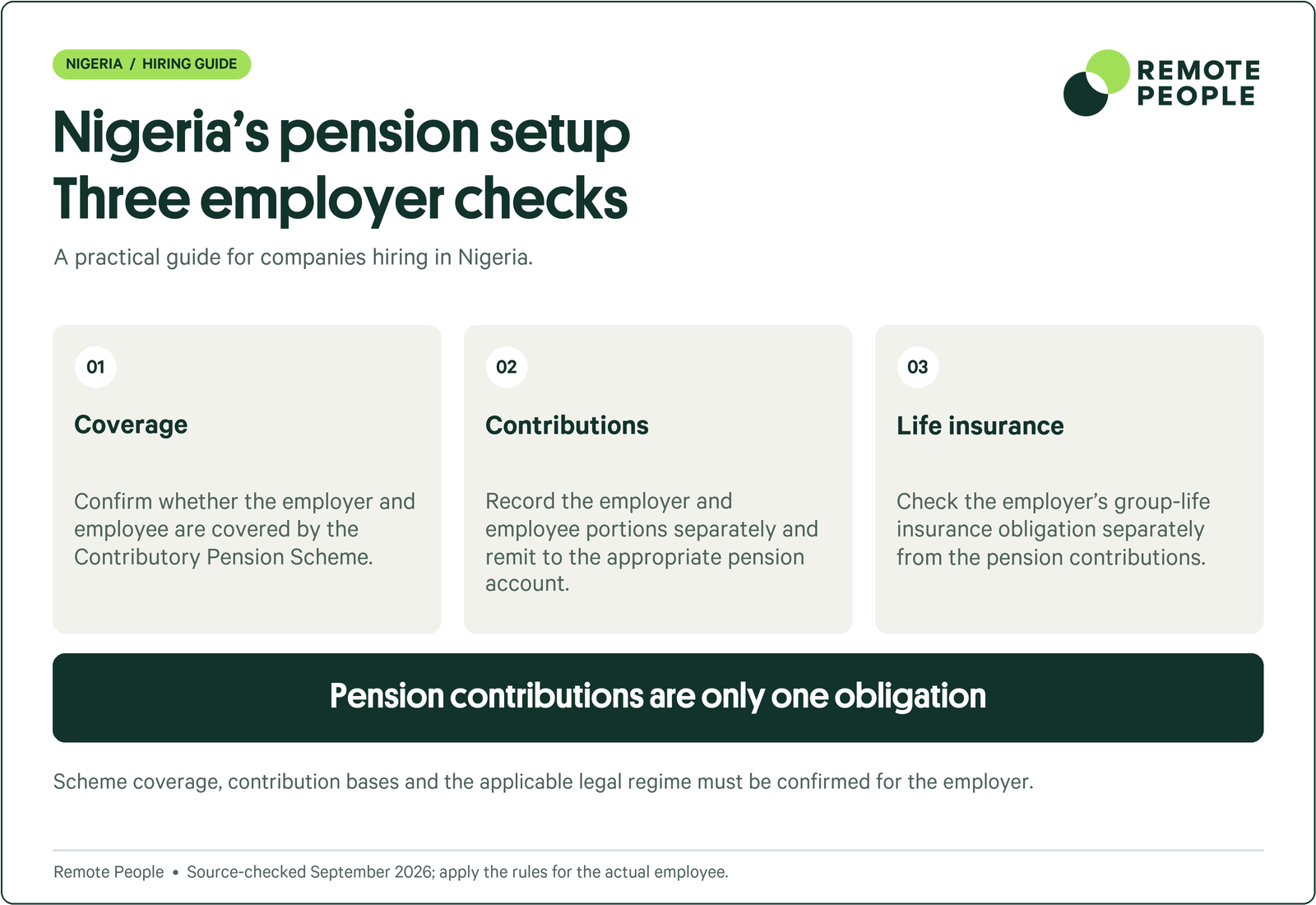
Nigeria’s statutory benefits framework layers several mandatory schemes on top of base salary. Under the Pension Reform Act 2014, all employees join a three-tier contributory pension scheme administered by the National Pension Commission (PenCom), funded by 10% employer and 8% employee contributions on monthly emoluments with a maximum insurable cap set annually by PenCom. The National Health Insurance Authority Act 2022 requires employers with five or more employees to register workers with NHIA, with a combined 15% contribution (10% employer, 5% employee) on basic salary, though many employers pay the full premium to shield staff from deductions. The Employee Compensation Act mandates a 1% employer contribution to the Nigeria Social Insurance Trust Fund (NSITF), covering workplace injury, occupational disease, and death benefits. Employers with five or more staff also pay a 1% annual Industrial Training Fund (ITF) levy on total payroll to support workforce training. Following the 2025 tax reforms, National Housing Fund contributions are no longer mandatory for private-sector employees, though public-sector workers and self-employed individuals earning the minimum wage or above must still contribute 2.5% of gross monthly salary. Nigeria does not mandate housing, transport, or meal allowances in the private sector, though these are commonly added to compensation packages by contract.
Recent Regulatory Updates (2026)
Nigeria underwent a major tax reform in June 2025 when the National Assembly passed four critical pieces of legislation: the Nigeria Tax Act 2025, the Nigeria Tax Administration Act 2025, the Nigeria Revenue Service Act 2025, and the Joint Revenue Board Act 2025. These laws became effective on 1 January 2026.
The Nigeria Tax Act 2025 introduced a completely revised Personal Income Tax structure with new brackets and the first significant increase to the tax-free threshold in over a decade. The new tax-free threshold is now ₦800,000 annually (previously ₦300,000), with progressive brackets reaching 25% at the top rate for annual income above ₦50 million. The Consolidated Relief Allowance (CRA) was abolished in favor of itemized deductions including 20% rent relief (capped at ₦500,000), pension contributions (8% of gross), National Housing Fund (2.5%), and life assurance premiums (up to ₦100,000). These changes take effect from January 2026 and represent the most comprehensive overhaul of Nigeria’s personal taxation in the last decade.
The minimum wage remained at ₦70,000 per month (effective May 2024 and set for review in 2027). The National Health Insurance Authority continues mandatory coverage for organizations with 5+ employees. No major changes to the Labour Act occurred in 2025, though employment practices continue evolving through case law and industry standards.
Work Permits and Visas in Nigeria
Work Permit Requirements
Who Needs a Work Permit
All non-Nigerian nationals intending to work in Nigeria require a work permit and the Combined Expatriate Residence Permit and Aliens Card (CERPAC) from the Nigeria Immigration Service. Regional treaties (such as ECOWAS agreements for West African nationals) may provide limited exemptions for short-term visits, but employment typically requires a permit regardless of nationality.
Eligibility and Required Documents
The employer (or the EOR on the employer’s behalf) submits the work permit application to the Nigeria Immigration Service. Required documents include: valid passport, signed employment contract, police clearance or criminal background check, medical examination results, educational or professional qualifications, proof of employment (job offer letter), and a Non-Citizen ID Card application. The applicant must also undergo biometric registration at a designated NIS office.
Processing Time and Validity
Work permits typically process in 4–8 weeks from submission to approval. Once granted, CERPAC is valid for 12 months. Employees may begin work while processing continues under the employer’s sponsorship, but international travel requires the valid permit card.
Renewal Process
Permits renew annually. Employers submit renewal applications to the Nigeria Immigration Service 4–6 weeks before expiry, with an updated employment contract and current payroll records. Work may continue during renewal. Failure to renew results in fines and deportation risk.
Common Visa Types for Foreign Workers
Nigeria offers several visa pathways for foreign workers. The most common routes for employment are the Subject-to-Regularization (STR) visa and the Temporary Work Permit (TWP), which allow entry; the worker then applies for CERPAC upon arrival. Nigeria does not currently offer a dedicated digital nomad or freelance visa. Immigration rules may change, so confirm current requirements with the Nigeria Immigration Service.
Nigeria work visa types for foreign workers · 2026 | ||||
Visa Type | Duration | Best For | Leads to Residence? | Processing |
|---|---|---|---|---|
Subject-to-Regularization (STR) Visa | Entry visa; CERPAC valid 12 months (renewable) | Employees filling approved expatriate quota positions with Nigerian employers | Yes (indefinite renewal) | 4–8 weeks |
Temporary Work Permit (TWP) | Entry permit; specific project duration | Short-term projects, contract workers, consulting assignments | No (project-based) | 2–4 weeks |
Business/Investor Visa | CERPAC valid 12 months (renewable) | Foreign business owners and shareholders of registered Nigerian companies | Yes (indefinite renewal) | 4–6 weeks |
Intra-Company Transfer (ICT) Visa | CERPAC valid 12 months (renewable) | Expatriate employees of multinationals transferred to Nigerian branch or subsidiary | Yes (indefinite renewal) | 6–8 weeks |
Resident Visa | Valid 12 months (renewable) | Long-term residents, retirees, investors with substantial holdings | Yes (indefinite renewal) | 6–12 weeks |
Other visa types not listed above do not permit employment:
Two common visa categories do not support employment in Nigeria. Tourist visas are valid for 30–90 days and prohibit paid work; violations result in cancellation and deportation risk. Student visas restrict activities to on-campus engagement, and any external employment requires a separate work permit.
How an EOR Handles Work Permits
Your EOR acts as the official sponsoring employer for work permit applications. The EOR collects all required documentation (passport copies, medical exam results, police clearance, employment contract, qualifications), prepares the complete application package, and submits it to the Nigeria Immigration Service. The EOR also tracks application status, responds to information requests, and manages the approval process until CERPAC is issued. This responsibility adds 4–8 weeks to onboarding for non-Nigerian staff but ensures immigration compliance. Your EOR handles all interaction with Nigeria Immigration Service, so your company does not need to navigate the system directly.
Payroll, Taxes, and Social Security in Nigeria
For guidance on Nigeria payroll outsourcing, local tax filing, and contribution remittance, see our Nigeria payroll outsourcing services, which covers FIRS returns, state IRS PAYE remittance, and PenCom pension filing cycles.
Employer Contributions
Employers in Nigeria are required to contribute to several mandatory social security and training funds, calculated as percentages of employee salaries. These contributions are separate from the employee’s gross salary and represent employer-borne costs. Contributions are calculated on monthly emoluments as defined in the employment contract (basic salary plus statutory allowances).
Nigeria employer social security contributions · 2026 rates | ||
Contribution | Rate | Notes |
|---|---|---|
Pension (PRA 2014 Tier 1) | 10% | Mandatory defined-benefit retirement pension; remit to PFA by 23rd of following month |
Health Insurance (NHIA) | 10% (or 15% if paying employee share) | Mandatory health coverage for orgs with 5+ employees; standard split 10% employer / 5% employee |
Employee Compensation (NSITF) | 1% | Workplace injury and occupational illness insurance; remit by 16th of following month |
Industrial Training Fund (ITF) | 1% annual payroll | Skills development levy for orgs with 5+ employees or ₦50M+ turnover; due 1 April; 50% refund if training approved |
Total Employer Contribution | 22% (standard) | 10% pension + 10% NHIA + 1% NSITF + 1% ITF annually; does not include employee tax withholding |
Source: PenCom Nigeria and PwC Nigeria Tax Summaries | ||
Employee Contributions
Employees contribute to the pension system and health insurance through payroll deductions. These are withheld before income tax is calculated, reducing the employee’s taxable income. Contributions are remitted to the respective authorities on the employee’s behalf by the employer.
Nigeria employee payroll deductions · 2026 monthly withholdings | ||
Deduction | Rate | Notes |
|---|---|---|
Pension (PRA 2014 Tier 1) | 8% | Mandatory employee pension contribution; deducted before income tax; remitted to PFA |
Health Insurance (NHIA) | 5% | Standard employee share (or 0% if employer pays full 15%); calculated on basic salary |
Life Assurance (Nigeria Tax Act 2025) | Up to ₦100,000 p.a. | Deductible premium; not a payroll deduction but allowed as tax relief |
Personal Income Tax (PIT) | Progressive brackets | Calculated on chargeable income after pension and NHIA deductions (see Table 3 for brackets) |
Total Mandatory Employee Deduction | 13% | 8% pension + 5% NHIA; reduces taxable income before PIT withholding |
Source: PenCom Nigeria and PwC Nigeria Tax Summaries | ||
Income Tax
Nigeria uses a progressive monthly Personal Income Tax (PIT) system under the Nigeria Tax Act 2025, effective 1 January 2026. Tax is calculated on chargeable income, which is gross monthly salary minus the 8% pension contribution and 5% NHIA health insurance deduction. The new brackets introduced in January 2026 feature a ₦800,000 annual tax-free threshold (roughly ₦66,667 monthly), significantly higher than the previous ₦300,000. Non-residents pay a flat 25% on Nigeria-source employment income.
Nigeria income tax brackets · 2026 (Per Nigeria Tax Act 2025, effective Jan 1) | |
Annual Bracket (NGN) | Tax Calculation |
|---|---|
0 – ₦800,000 | 0% (tax-free threshold) |
₦800,001 – ₦3,000,000 | 15% of amount above ₦800,000 |
₦3,000,001 – ₦12,000,000 | ₦330,000 + 18% of amount above ₦3,000,000 |
₦12,000,001 – ₦25,000,000 | ₦1,950,000 + 21% of amount above ₦12,000,000 |
₦25,000,001 – ₦50,000,000 | ₦4,680,000 + 23% of amount above ₦25,000,000 |
Above ₦50,000,000 | ₦10,430,000 + 25% of amount above ₦50,000,000 |
Payroll Cycle
Payroll runs monthly with bank transfers due by the last working day of the month. All payments are in Nigerian Naira (NGN). Employers must remit Personal Income Tax to the Nigeria Revenue Service by the 21st of the following month and submit pension contributions to the PFA by the 23rd. NHIA and NSITF contributions have similar timelines (by the 15th–16th). Payslips must show gross salary, pension and health insurance deductions, PIT withheld, and net pay. Using an EOR means the provider handles all payroll processing, tax remittance, and statutory reporting on your behalf.
13th Month Salary and Bonus Pay
Nigeria does not require a 13th month salary or year-end bonus by law. Some employers offer these voluntarily as part of compensation, discretionary bonuses, or through collective bargaining agreements, but it is entirely optional. If provided, the 13th month salary or bonus is subject to regular payroll withholding (PIT, pension, and NHIA contributions) like any monthly payment and receives no special tax treatment under the Nigeria Tax Act 2025.
Cost of Hiring Through an EOR in Nigeria
EOR Service Fees
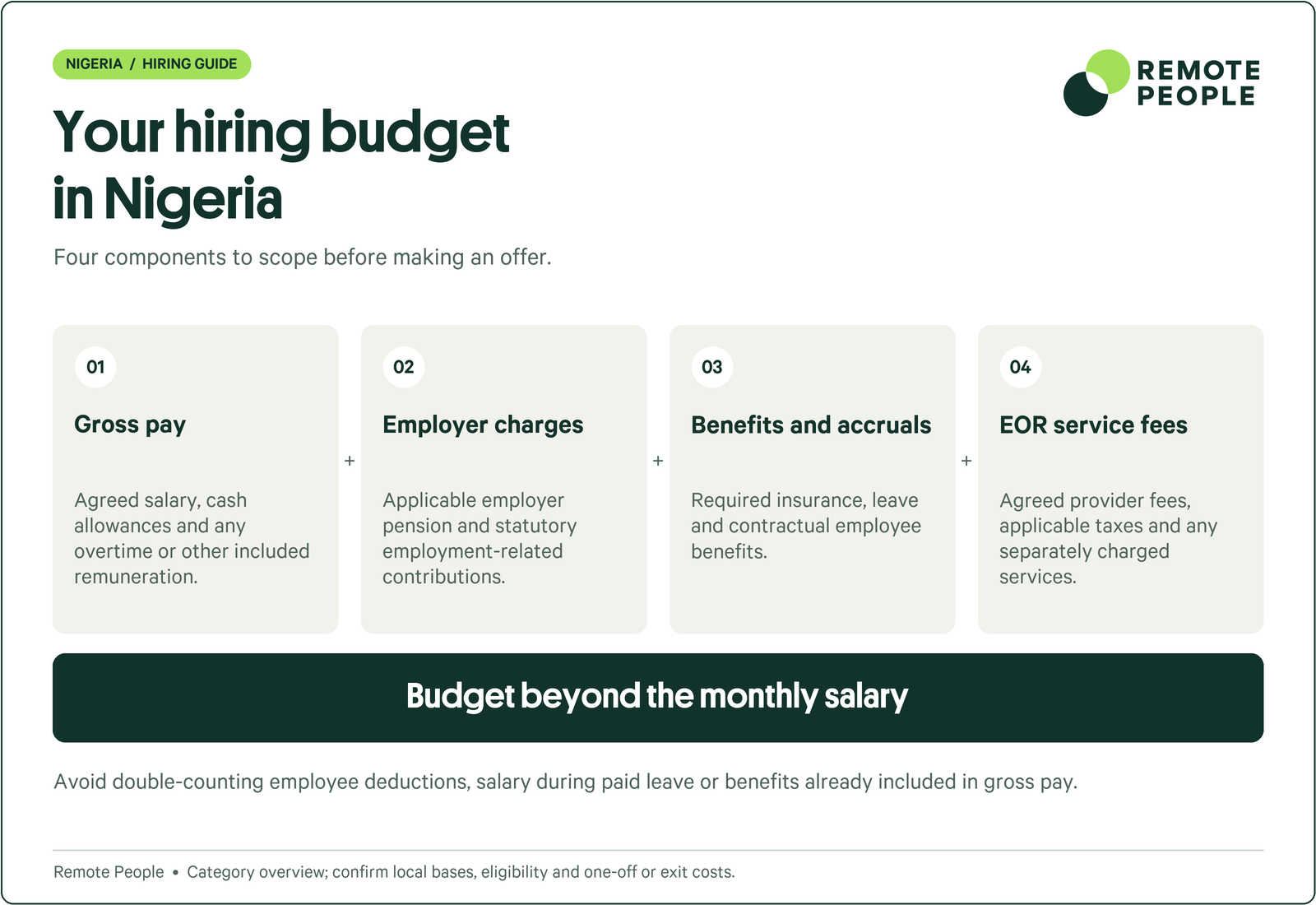
EOR service fees in Nigeria typically range from $300 to $600 per employee per month, depending on your provider and the level of support required. This flat fee includes employment contracts, payroll processing, tax withholding and remittance, pension and health insurance administration, statutory reporting, and ongoing compliance support. There are no upfront setup costs.
Total Employment Cost Breakdown
Your total hiring cost includes the employee’s gross salary, all mandatory employer contributions, and the EOR monthly fee. Here is an example for a ₦750,000 monthly gross salary (approximately $500 USD at the April 2026 exchange rate of ₦1,500 = $1).
Nigeria employer cost example · USD 500 gross monthly · 2026 | ||
Employer Cost | Amount (USD) | % of Gross |
|---|---|---|
Gross Salary | $500 | 100.00% |
Pension (PRA 2014) – 10% | $50 | 10.00% |
Health Insurance (NHIA) – 10% | $50 | 10.00% |
Employee Compensation (NSITF) – 1% | $5 | 1.00% |
Industrial Training Fund (ITF) – 1% annually | $5 | 1.00% |
EOR Service Fee | $400 | 80.00% |
Total Monthly Employer Cost | $1,010 | 202.00% |
Source: PenCom Nigeria and PwC Nigeria Tax Summaries | ||
Ready to hire in Nigeria? We handle employment contracts, payroll, tax withholding, and compliance so you can focus on business growth. Your team starts within days, not months.
Benefits of Using an EOR in Nigeria
An EOR simplifies Nigeria hiring by removing legal, administrative, and financial barriers. You hand off compliance to a specialist, allowing you to scale your Nigeria team in weeks instead of months while maintaining direct management of daily operations.
Companies that use an EOR in Nigeria gain seven practical advantages. Speed to market comes first: employees can be onboarded in 1–2 weeks without company registration, tax identification numbers, or local partnership negotiations, so operations begin immediately. Full regulatory compliance is built in, with the EOR handling the Labour Act (Cap L1), Pension Reform Act 2014, NHIA, Nigeria Revenue Service, and Nigeria Immigration Service obligations.
Cost efficiency is meaningful too. An EOR costs $300–$600 per employee per month versus ₦500,000–₦1,000,000+ per year to operate a local subsidiary, with no office lease, corporate secretary, or local directors required. EORs provide local HR expertise, including knowledge of Nigerian labour customs, public holidays, and National Industrial Court precedent, reducing the risk of costly compliance errors.
Scalability without commitment lets you add or remove employees as needs change without unwinding a legal entity. Risk mitigation covers statutory and contractual exposure, with the EOR managing any National Industrial Court claims on your behalf. Finally, a professional employee experience – proper payslips, NHIA coverage, pension statements, leave tracking, and statutory protections – builds trust, reduces turnover, and strengthens your employer brand in Nigeria.
Contact RemotePeople to accelerate your Nigeria hiring and help you build a compliant, efficient team.
Termination and Offboarding in Nigeria
Notice Periods
Nigeria’s Labour Act (Cap L1) sets statutory notice periods based on tenure under Section 11. Either party may terminate by giving written notice on the expiration date; notice may be paid in lieu by mutual agreement if the employee receives full salary compensation. The statutory minimum cannot be shortened unilaterally, though parties may agree to longer periods in the employment contract.
Nigeria statutory notice periods by tenure · Per Labour Act (Cap L1, Section 11) | |||
Contract Duration | Notice Period | During Probation | Notes |
|---|---|---|---|
3 months or less | 1 day | 1 day (or contract term) | Casual or trial arrangements with no fixed term |
More than 3 months to less than 2 years | 1 week | 1 day or 1 week (contract-specified) | Standard notice for indefinite or fixed-term contracts under 2 years tenure |
2 years to less than 5 years | 2 weeks | 1 week (or shorter if contract specifies) | Written notice required; notice runs from formal notification date |
5 years or more | 1 month | 1 week–1 month (contract-specified) | Extended notice recognizing long-tenure employees; written notice required |
Just-cause terminations (theft, violence, serious misconduct, breach of contract) do not require statutory notice if documented and the employee is given a fair opportunity to respond. Mutual agreement in writing can also shorten or waive notice if both parties consent. During notice, employees remain entitled to full wages, benefits, and leave accrual.
Severance Pay
Nigeria’s Labour Act does not prescribe a statutory severance pay formula. Section 20 requires employers to “use best endeavors to negotiate redundancy payments” for dismissed workers, but no fixed formula exists. Severance is determined by employment contract, collective bargaining agreement, company policy, or negotiation at termination. If employer and employee cannot agree, the National Industrial Court may award compensation for unfair dismissal, which can exceed negotiated amounts.
Nigeria severance pay schedule by years of service · Per Labour Act (Cap L1, Section 20) | |||
Years of Service | Severance Amount | Base Salary | Notes |
|---|---|---|---|
Less than 6 months | None (statutory) | N/A | Probationary and casual workers have no severance entitlement unless contract specifies |
6 months – 1 year | Negotiated (0.5–1 month typical) | Last monthly gross salary | No statutory minimum; determined by contract, CBA, or negotiation |
1–3 years | Negotiated (1–3 months typical) | Last monthly gross salary | Common practice: 1 month per year of service; varies by industry and negotiation |
3–5 years | Negotiated (3–5 months typical) | Last monthly gross salary | Longer tenure commands higher multiples; collective agreements may apply |
5–10 years | Negotiated (5–10 months typical) | Last monthly gross salary | Senior staff often receive 1–2 months per year of service |
10+ years | Negotiated (10–20+ months typical) | Last monthly gross salary | National Industrial Court may award unfair dismissal compensation above negotiated amount |
Source: Labour Act Section 20 and Mondaq Nigeria Redundancy Law | |||
Calculation Method
Severance is negotiated based on years of service, reason for termination (redundancy, restructuring, or performance), final gross salary, and any applicable collective bargaining agreement. A common formula is the last monthly gross salary multiplied by an agreed number of months per year of service. For example, an employee with 5 years earning ₦500,000 monthly might receive 1 month per year of service, totaling ₦2,500,000 (5 months’ salary). However, no statutory formula binds this calculation.
Caps and Exceptions
Nigeria’s labour law sets no statutory severance cap. Probationary staff, casual workers, and fixed-term contractors whose terms end without renewal have no severance entitlement unless the contract provides otherwise. If a dispute arises, the National Industrial Court can order back wages, reinstatement, or enhanced severance beyond negotiated amounts. Your EOR ensures all termination payments comply with local standards and are properly documented.
Grounds for Termination
Employers can terminate on two grounds: just cause (misconduct, incompetence, breach of contract) and without cause (redundancy, business restructuring). Just-cause terminations require documented evidence and a fair hearing per the Labour Act. Section 11 protects workers from termination based on union membership, pregnancy, political opinion, religion, gender, race, or disability. Discriminatory terminations lead to damages claims and reinstatement orders from the National Industrial Court.
EOR vs. Other Hiring Models in Nigeria
EOR vs. Setting Up a Local Entity
An EOR handles legal employment and compliance without local registration. A subsidiary requires months of administrative work, local directors, corporate accounts, and ongoing overhead. Your choice depends on team size, timeline, and budget. Here’s a detailed comparison:
Nigeria EOR vs local entity comparison · Setup time, cost, risk and best-fit | ||
Comparison | Employer of Record | Own Entity (Subsidiary) |
|---|---|---|
Setup Time | 1–2 weeks | 3–6 months |
Upfront Cost | $0 | $5,000–$15,000 |
Ongoing Cost | $300–$600/employee/month | ₦500,000–₦1,000,000/year maintenance |
Local Partner Required | No (EOR is the local entity) | Yes (directors, corporate secretary, accountant) |
Social Security Registration | Handled by EOR | You manage or outsource |
Payroll & Tax Filing | Handled by EOR | You manage or hire accounting firm |
Best for Team Size | 1–15 employees | 15+ employees |
Scale Down / Exit | Easy – no entity to unwind | Costly – legal dissolution and asset transfer required |
Government Contracts | Not eligible | Eligible (requires local registration) |
Source: RemotePeople EOR Solutions and PwC Nigeria | ||
For 1–15 person teams or market entry, an EOR is much faster and cheaper. Setup is limited to employment agreements and pension registration, completed within days. No upfront costs, no local directors needed, and no company dissolution costs if plans change. A local entity makes sense at 15+ employees or when pursuing government contracts requiring Nigerian registration. You gain more HR control and brand presence but face ongoing compliance work and high exit costs.
Many companies start with an EOR to test the Nigeria market, then move to a local subsidiary as the team grows. This phased approach reduces risk and maintains flexibility.
EOR vs. Hiring Independent Contractors
An EOR provides full-time employment with benefits and legal protections. Contractors are self-employed and handle their own taxes and insurance. Misclassification risk is significant in Nigeria, with serious penalties.
Nigeria EOR vs independent contractors · Compliance, cost, and risk | ||
Comparison | EOR (Full-Time Employee) | Independent Contractor |
|---|---|---|
Legal Relationship | Employee of the EOR | Self-employed; no employment relationship |
Compliance Risk | Low – EOR ensures Labour Act compliance | High – misclassification risk if relationship resembles employment |
Payroll & Tax | EOR handles withholding, contributions, filings | Contractor invoices you; they handle own taxes and pension |
Benefits & Leave | Statutory benefits, paid leave, social security, health insurance | No entitlement to employee benefits |
IP Protection | Stronger – employment contract assigns IP by default | Weaker – requires explicit IP assignment clause |
Termination | Subject to Labour Act notice periods and severance | Contract can be ended per agreement terms |
Best For | Long-term, core team roles | Short-term projects, specialist tasks, episodic work |
Cost Structure | Salary + employer contributions + EOR fee | Contractor fee (typically higher gross, lower total cost) |
Misclassification carries meaningful legal exposure in Nigeria. If the tax authority or National Industrial Court determines a contractor should have been an employee based on exclusivity, control, duration, or integration into the business, you face back Personal Income Tax, pension contributions, NHIA premiums, and substantial penalties. Use contractors only for defined projects with clear deliverables, fixed end dates, and genuine independence.
Our contractor solution simplifies engagement while maintaining proper legal classification and compliance. For ongoing roles needing team integration and direct management, an EOR full-time hire is the compliant path.
EOR vs. PEO (Professional Employer Organization)
A PEO shares employment responsibilities with you in a co-employment model. An EOR is the sole legal employer. This structural difference affects liability, setup, and control.
Nigeria EOR vs PEO comparison · Legal employer, liability, and setup | ||
Comparison | Employer of Record (EOR) | PEO |
|---|---|---|
Legal Employer | EOR is the sole legal employer | You remain the legal employer (co-employment model) |
Local Entity Required | No – the EOR is the local entity | Yes – you must have your own entity in Nigeria |
Best For | Companies without a local entity | Companies that already have a local entity |
Compliance Liability | EOR assumes compliance responsibility | Shared liability between you and the PEO |
Setup Time | 1–2 weeks | Depends on your entity setup (weeks to months) |
Control over HR Policies | EOR manages within local law framework | More direct control; PEO advises and enforces |
Typical Use Case | Market entry, small remote teams, testing new markets | Established local operations needing HR outsourcing |
Source: RemotePeople EOR Solutions and PwC Nigeria | ||
Nigeria does not have a formal PEO framework like the United States. Most providers operating in Nigeria function as EORs or payroll processors, not co-employers. An EOR is the preferred model for remote hiring abroad because it eliminates local entity setup, clarifies liability, and gives you operational control under Nigeria’s law. PEO arrangements only make sense if you already operate an office and have a local registered entity.
Public Holidays in Nigeria
Nigeria observes 13 federal public holidays in 2026. Employers must grant these as paid days off under the Labour Act. Employees are paid their ordinary rate even if not working. Work on a public holiday results in premium pay (typically 1.5x to 2x the hourly rate) or a compensatory rest day. Your EOR accounts for holidays automatically in payroll and absence tracking.
Nigeria public holidays · 2026 calendar year | ||
Date | Holiday | Type |
|---|---|---|
January 1 | New Year’s Day | Fixed |
March 19–20 | Eid al-Fitr | Islamic (variable) |
April 3–4 | Easter (Good Friday & Easter Monday) | Christian (variable) |
May 1 | Workers’ Day | Fixed |
May 27 | Children’s Day | Fixed |
June 12 | Democracy Day | Fixed |
June 16–17 | Eid al-Adha | Islamic (variable) |
July 7 | Eid al-Mawlid (Prophet’s Birthday) | Islamic (variable) |
August 27 | Arafat Day | Islamic (variable) |
October 1 | Independence Day | Fixed |
December 25 | Christmas Day | Fixed |
December 26 | Boxing Day | Fixed |
How to Get Started with an EOR in Nigeria
Hiring your first Nigeria employee through an EOR is straightforward and takes one to two weeks:
- First, define the role, job title, and salary for your Nigeria hire. Ensure the monthly gross meets or exceeds Nigeria’s minimum wage of ₦70,000. Prepare a clear job description and compensation package in NGN.
- Second, engage an employer of record provider and provide candidate information, including name, address, professional background, start date, and salary. The EOR prepares an employment agreement compliant with the Labour Act and collects required documentation.
- Third, review and sign the employment agreement. The contract outlines salary, allowances, benefits, notice periods, grounds for termination, leave entitlements, and compliance with Nigerian law. The candidate must also sign and retain a copy.
- Fourth, coordinate the first payroll. Provide the EOR with banking details, salary amount, and any onboarding bonus or signing incentive. The EOR registers the employee with a Pension Fund Administrator, applies for NHIA health insurance, and begins payroll processing in NGN.
- Fifth, monitor ongoing compliance through the EOR’s reporting dashboard. Communicate any salary changes, termination, or leave requests to the EOR. The provider delivers monthly payslips, statutory reports, and ongoing HR support.
Contact us today to start your Nigeria team. We handle contracts, payroll, taxes, and compliance so you can focus on business growth. Your team starts within days.
Where companies hiring in Nigeria expand next
Companies building West African operations commonly expand across the ECOWAS bloc and neighboring Francophone and Anglophone markets. Many companies add Ivory Coast first, drawing on the regional West African talent footprint. A team in Cameroon follows as overlapping West African workforce dynamics, while operations in Mali offers shared West African labor and language overlap. Ghana is often the fourth step, valued for aligned West African hiring norms.
Frequently Asked Questions
EOR services in Nigeria typically cost between $300 and $600 per employee per month as a flat fee, covering employment contracts, payroll processing, tax withholding, pension and health insurance registration, and statutory reporting. On top of the EOR fee, you pay the employee's gross salary plus mandatory employer contributions under the Labour Act (Cap L1) and Pension Reform Act 2014: 10% pension, 10% NHIA health insurance, 1% employee compensation (NSITF), and 1% Industrial Training Fund contribution. Total employer cost is roughly 220% of base salary.
Most EOR providers can onboard a Nigerian national within 1–2 weeks, including contract preparation, pension and NHIA registration, and payroll setup. For non-Nigerian employees requiring a work permit (CERPAC), add 4–8 weeks for processing by the Nigeria Immigration Service. This compares favorably to 3–6 months for establishing a local subsidiary with registered directors and corporate accounts.
The EOR assumes full compliance responsibility, including employment contract drafting per the Labour Act (Cap L1), pension registration with a licensed Pension Fund Administrator, NHIA health insurance enrollment, Personal Income Tax withholding per the Nigeria Tax Act 2025 brackets, statutory leave administration, public holiday tracking, termination and severance administration per Section 11, and representation in any National Industrial Court disputes.
Intellectual property created during employment is assigned to the client company (you), not the EOR. Under the Nigerian Copyright Act, the employment contract includes a clear IP assignment clause specifying that all work product, inventions, software, and creative output belong to the client company, not the EOR or the employee. The EOR does not claim any IP rights.
Yes. Employees hired through an EOR receive all statutory protections under the Labour Act (Cap L1), including 6 working days of paid annual leave, maternity leave (12 weeks at 50% pay minimum), sick leave (12 working days per year), NHIA health insurance coverage, mandatory pension contributions, and professional payslips showing gross, deductions, and net pay in NGN. Employees have access to the National Industrial Court if disputes arise.
EORs in Nigeria use fixed-term contracts (with a defined end date and renewal options) and indefinite contracts (ongoing until termination by either party with notice). Both must comply with the Labour Act (Cap L1) and include salary, workplace, working hours, leave entitlements, probation period (typically 3–6 months), notice periods per Section 11, and grounds for termination.
Yes. All EOR-employed workers receive mandatory benefits including 6+ days of paid annual leave, maternity leave (12 weeks at minimum 50% pay), sick leave (12 working days per year at full rate for the first 7 days), pension contributions (8% employee, 10% employer per Pension Reform Act 2014), NHIA health insurance coverage per the National Health Insurance Authority, and employee compensation protection. The EOR manages all benefit administration and statutory filings.
Contractor engagements are separate from EOR employment. Contractors are self-employed and responsible for their own taxes and insurance. However, misclassification carries significant risk in Nigeria under the Federal Inland Revenue Service and National Industrial Court, including back Personal Income Tax, pension contributions, NHIA premiums, and penalties. RemotePeople's contractor management solution provides compliant contractor engagement with proper classification, payment processing, and documentation.
Employer of Record in
Employer of Record in
Employer of Record in
Employer of Record in
Employer of Record in
Employer of Record in
Employer of Record in
Employer of Record in




