
 Recruit
Average Salary in Haiti
-
 Drew Donnelly
- Published
- September 21, 2026
Curious about salaries in Haiti? This guide covers average wages, salary by profession, minimum wage figures, and how Haiti’s earnings measure up internationally. Companies hiring in the country commonly use an Employer of Record (EOR) in Haiti to manage contracts, payroll, and local employment law.
- 5 ★ on G2








Let RemotePeople handle payroll, compliance, and HR admin worldwide so you can focus on building your team.
Haiti’s cost-effective labor and young talent pool make it an ideal destination for outsourcing. Employers seeking remote partnerships in the region may wonder, What is the average salary in Haiti? This information will help them develop competitive job offers. Employers may also run background checks in Haiti for certain roles, so it is worth knowing what is permitted before you hire.
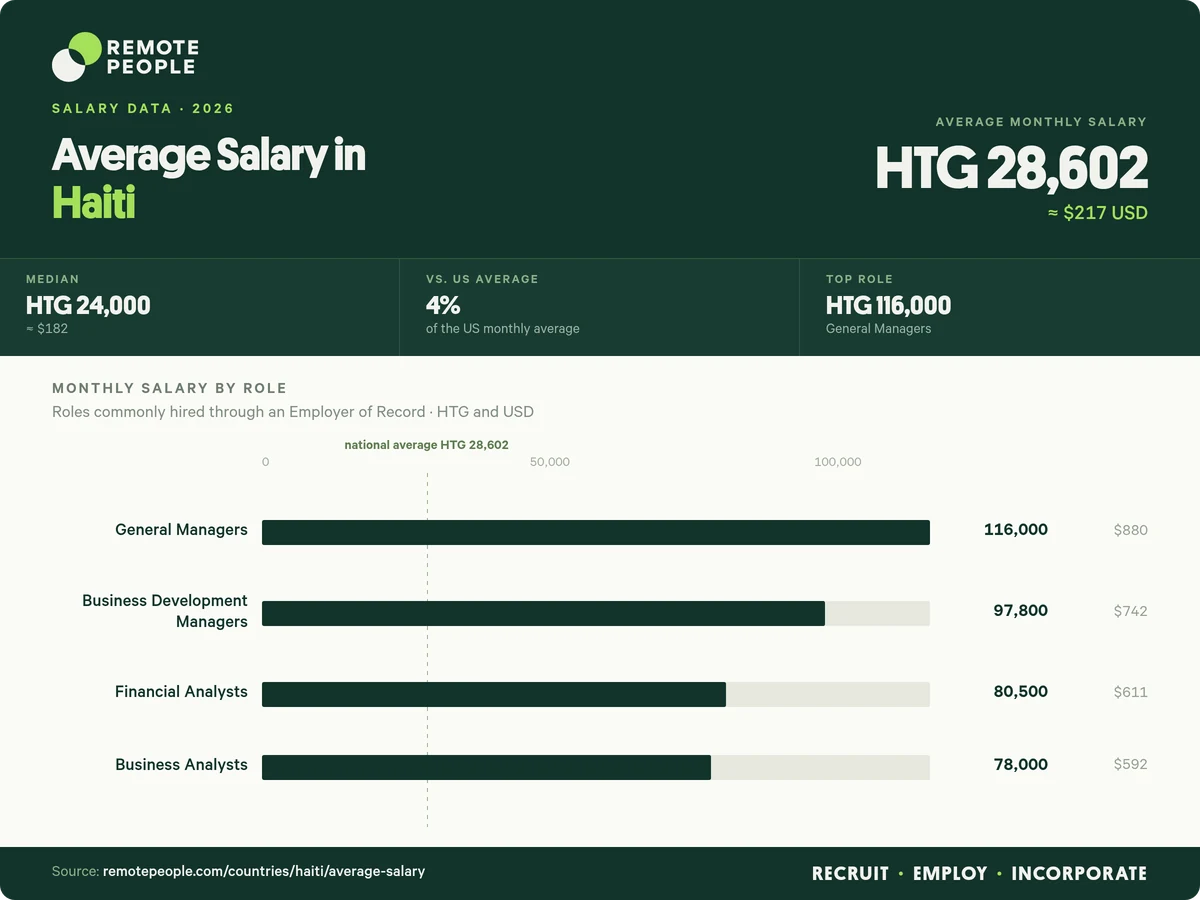
The average monthly salary in Haiti is 28,602 Haitian Gourdes (HTG), equivalent to approximately USD 217. However, you must consider how wages are influenced by factors such as education, experience, location, profession, and industry. Comparing wages in the country to earnings in other regions provides additional insight.
This article will examine all aspects of salaries in Haiti, preparing you for your hiring journey.
What is the Average Salary in Haiti?
The average salary in Haiti is 28,602 HTG, equivalent to approximately $217. Wages in the country are low due to economic instability, which is linked to a high risk of natural disasters and political and governance issues. The government also has a large informal economy and limited infrastructure.
Median Income
The median salary in Haiti is 24,000 HTG, equivalent to approximately $182. Half the people in the country earn higher wages, and the other half earn less.
Salary Range
Salary range spans from the lowest to the highest wages in the country. In Haiti, low earners can earn as little as $3 to $4 per day. High earners typically earn around $15 per hour, which translates to about $120 per day.
Salary Comparisons in Haiti
Average salary provides some insight, but you must also consider how wages vary by experience, education, location, position, and industry. The following sections will explore how these factors impact earnings.
Salary by Position
This salary comparison chart reveals how wages vary by position.
Position | Average Monthly Salary (HTG) |
|---|---|
General Managers | 116,000 |
Business Development Managers | 97,800 |
Financial Analysts | 80,500 |
Business Analysts | 78,000 |
Public School Teachers | 18,000 |
Average Wage in Haiti Based on Education
Access to education is limited in Haiti. Many of the schools are privatized, making it difficult for families to afford education. However, experts view education as one of the primary ways for people in the country to overcome poverty. It can lead to better salaries and improved outcomes.
Salary Comparison by Experience
Experience also impacts salaries as experienced workers earn more than entry-level workers, and employees become eligible for raises with tenure in their field. This situation rings true in Haiti; however, other factors come into play.
For example, workers in the informal sector often lack the bargaining power to request raises and higher salaries. Additionally, workers in skilled industries are more likely to see higher wages over time than those in unskilled sectors.
However, based on the information available, statistics show the following:
Experience Level | Monthly Salary Range (HTG) |
|---|---|
Entry-level Workers | 25,000 – 40,000 |
Skilled Technicians | 40,000 – 70,000 |
Mid-level Professionals | 60,000 – 120,000 |
Senior/Managerial Professionals | 100,000 – 300,000 |
Salary Comparison by Location
Location is one of the most significant factors impacting salaries in Haiti. Workers who live in urban regions, such as Port-au-Prince, can earn significantly higher wages than those in rural areas due to higher costs of living and proximity to large companies offering higher-paying job opportunities. Unfortunately, only 48% of the population resides in urban areas, and a mere 22% live in Port-au-Prince, which holds the majority of the country’s wealth.
How Much is Minimum Wage in Haiti?
The minimum wage in Haiti varies by segment or industry as follows, based on an eight-hour workday:
Sector | Daily Minimum Wage (HTG) | Approx. in USD |
|---|---|---|
Segment A (Telecommunications and Financial Services) | 770 | $5.90 |
Agriculture (Segment B) | 615 | $4.71 |
Small Business (Segment C) | 540 | $4.14 |
Export-oriented Assembly (Manufacturing) | 685 | $5.25 |
Private Security and Petroleum Distribution | 615 | $4.71 |
Domestic Workers | 350 | $2.69 |
Workers have been protesting for higher wages, resulting in sliding scale hikes in 2022. However, salaries remain low.
Average Salary in Haiti vs. the Rest of the World
The following charts will compare salaries in Haiti to those in developed, developing, and undeveloped countries, providing more insight.
Haiti vs. Developed Countries
Country | Average Monthly Salary | Comparison to Average Haiti Salary |
|---|---|---|
Japan | 340,000 JPY (approx. $2,300) | − 959% |
United Kingdom | £3,000 (approx. $4,100) | − 1,789% |
Norway | 50,000 NOK (approx. $4,700) | − 2,065% |
Germany | €4,300 (approx. $4,470) | − 1,960% |
Austria | €3,700 (approx. $4,050) | − 1,766% |
Haiti vs. Developing Countries
Country | Average Monthly Salary | Comparison to Average Haiti Salary |
|---|---|---|
Romania | 4,000 RON (approx. $835) | − 285% |
Russia | 73,709 Rubles (approx. $700) | – 250% |
Albania | 83,330 ALL (approx. $860) | − 296% |
Kazakhstan | 342,000 KZT (approx. $645) | − 197% |
Ukraine | 18,000 UAH (approx. $500) | − 130% |
Haiti vs. Undeveloped Countries
Country | Average Monthly Salary | Comparison to Average Haiti Salary |
|---|---|---|
Afghanistan | 30,000 Afghanis (approx. $419) | – 110% |
Philippines | 18,423 PHP (approx. $875) | – 340% |
Cambodia | 1,000,027 KHR (approx. $250) | – 13% |
Egypt | 13,244 EGP (approx. $263) | – 18% |
Pakistan | 45,000 PKR (approx. $150) | 46% |
Haiti is a least developed country with a low-income economy. It has a high unemployment rate, a large informal economy, and struggles with poverty. Agriculture is a significant sector, but it is hindered by a high risk of natural disasters and slow technological development.
Although the country faces internal struggles, it shows promise as an outsourcing destination. It offers cost-effective labor and a highly bilingual workforce. Its strategic location in the Caribbean provides proximity to North and South America.
What are the Most Common Outsourced Industries in Haiti?
Employers who outsource to Haiti will benefit most when focusing on the following industries:
BPO
Haiti’s BPO industry is experiencing rapid growth with a focus on call centers and customer service. Caracol Industrial Park is a BPO hub with a dedicated space for knowledge service industries. The Haiti Digital Smart Services Program offers comprehensive support for BPO and IT investors.
Textile and Apparel
The country was once a significant destination for textiles and apparel, with the industry accounting for a substantial portion of Haiti’s exports and gross domestic product (GDP). Trade agreements like HOPE/HELP and CBTPA provide duty-free access for Haitian garments. These agreements aimed to promote “Made in Haiti” products.
Unfortunately, the industry is currently struggling due to gang violence and political instability. However, there is hope that it will regain its status.
Agriculture
Agriculture accounts for a substantial portion of Haiti’s economy, making a significant contribution to its GDP. The country largely depends on subsistence farming crops like cassava, yams, corn, bananas, plantains, sweet potatoes, and rice. It also produces cash crops, such as coffee and sugarcane.
Conclusion
Haiti’s low average salary makes it a promising destination for outsourcing. Employers who form remote partnerships in the area can benefit from cost savings and exceptional products and services, while helping workers in the country overcome poverty, leading to positive outcomes for everyone involved.