
 Recruit
Employer of Record (EOR) in Haiti
-
 Drew Donnelly
- Published
- September 21, 2026
RemotePeople’s employer of record in Haiti lets you hire employees in Haiti with ONA enrollment. We handle 6% ONA pension contributions, OFATMA occupational insurance, and INFP professional training fees.
Hire in Haiti — book a free 30-minute demo
Tell us what you need. You'll get a tailored, transparent proposal within 24 hours, plus a free call to walk through it.
Tell us about your company
So we can match you with a specialist who knows your market — and unlock volume pricing tiers.
* All fields are required.
Where and when are you hiring?
Tell us the geography and timing and we'll quote each country line by line, with onboarding timelines.
* All fields are required.
Help us beat your current setup
We'll benchmark your current deal and send a line-by-line proposal in 24 hours — showing exactly where we cut cost, time, or risk. After you submit, you can book a call to walk through it together.
* All fields are required.
Thanks! Your proposal is on its way.
Expect a tailored, line-by-line proposal in your inbox within 24 hours. In the meantime…
Want to walk through it together?
Book a free 30-minute call with one of our specialists. We'll explain every line, answer your questions, and tailor the proposal further if you need.
No obligation. Pick a time that works for you.








- Hire in Haiti — book a free 30-minute demo
- Tell us about your company
- Where and when are you hiring?
- Help us beat your current setup
- Thanks! Your proposal is on its way.
- How an Employer of Record Works in Haiti
- Start hiring with a Haiti EOR
- Employment Laws and Regulations in Haiti
- Work Permits and Visas in Haiti
- Payroll, Taxes, and Social Security in Haiti
- Cost of Hiring Through an EOR in Haiti
- Benefits of Using an EOR in Haiti
- Termination and Offboarding in Haiti
- EOR vs. Other Hiring Models in Haiti
- Public Holidays in Haiti
- How to Get Started with an EOR in Haiti
- Where companies hiring in Haiti expand next
- Frequently Asked Questions
- Related EOR Destinations

Start hiring in Haiti
Let RemotePeople handle payroll, compliance, and HR admin worldwide so you can focus on building your team.

Hiring employees in Haiti comes with real challenges for foreign companies. Code du Travail (the labor code), payroll, social security contributions – the compliance burden is substantial. An employer of record (EOR) in Haiti sidesteps this entirely.
Rather than navigate these complexities yourself or set up a local entity, an EOR becomes your legal employer, handles all employment obligations, and lets you scale quickly.
The sections below explain hiring through an EOR in Haiti in 2026: employment laws, payroll and tax structures, work permit requirements, and a detailed cost breakdown.
How an Employer of Record Works in Haiti
An employer of record lets you hire in Haiti without establishing your own company. The EOR becomes the official employer on your behalf and handles all compliance requirements. This model works well in Haiti, where labor regulations are detailed and social security obligations are complex.
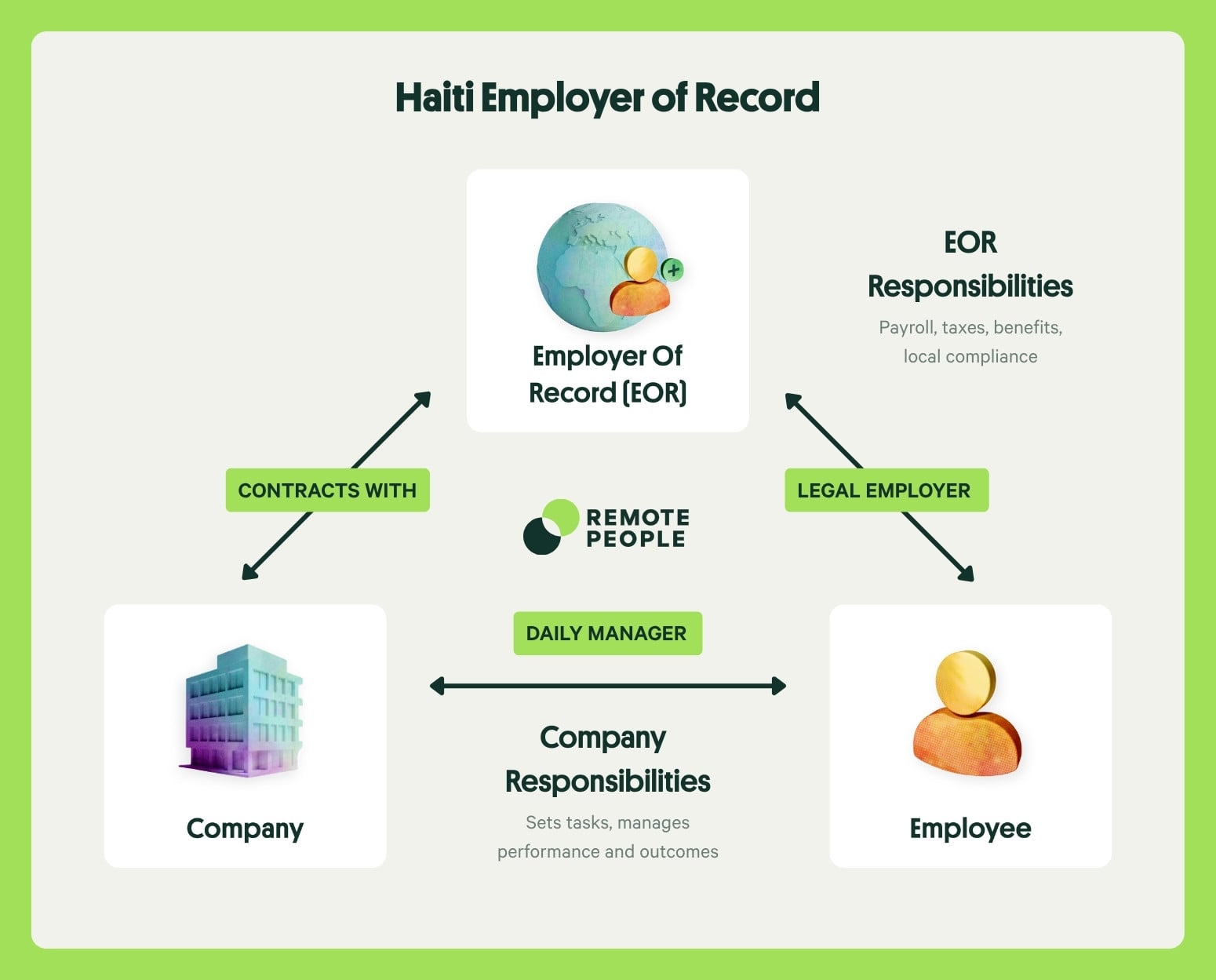
If you’d like to learn more about how Employer of Record (EOR) services work, read our What Is an Employer of Record (EOR)? guide for a complete overview of the model, its benefits, and when to use it.
If you’re comparing providers, our Best Employer of Record (EOR) Providers guide reviews the leading platforms to help you choose the right solution for your business.
Who Uses an EOR in Haiti?
New market entrants use an EOR when testing the Haitian market or launching operations without a legal entity. Remote-first companies hiring Haitian talent for distributed teams rely on an EOR to stay compliant without local infrastructure. Project-based employers running fixed-term assignments in construction, NGO work, or consulting use the EOR to handle contracts and offboarding cleanly.
Small and mid-size businesses that lack in-house legal or HR teams for Haitian labour law find the EOR especially valuable, since it eliminates the need to become experts in local compliance.
Typical Onboarding Timeline
Onboarding through an employer of record in Haiti is fast compared to setting up a local company. Once you select your employer of record and provide employee information, onboarding takes 1–2 weeks. The employer of record registers the employee with social security, prepares the employment contract (in French), and processes the first payroll.
Forming a legal entity takes 3–6 months instead, making an employer of record the faster path to scale.
Start hiring with a Haiti EOR
A challenging but navigable market with ONA/OFATMA contributions, Haitian Labour Code, and local employment requirements.
We handle employment contracts, payroll, social contributions, and full Haitian compliance.
No local entity needed. Your team can start in days.
Employment Laws and Regulations in Haiti
Haiti’s employment framework stems primarily from the Code du Travail (Labor Code). Whether using an employer of record or managing your own entity, you need to understand the key regulations.
Haitian labor law sets specific working hours, leave entitlements, minimum wage protections, and social security obligations. Many differ sharply from Western standards.
Employment Contracts
Employment contracts must be in writing and comply with the Code du Travail. Contracts should specify job title, salary, working hours, place of work, and duration. You must provide the contract to the employee within 8 days of hiring and file it with MAST.
An EOR handles contract drafting, translation, and filing. Oral agreements aren’t enforceable, and missing documentation exposes employers to substantial penalties.
Working Hours and Overtime
Haiti sets the legal working week at 48 hours over 6 days, or 8 hours per day. That’s notably different from the 40-hour week common in North America.
Hours beyond 48 per week count as overtime and must be paid at premium rates. The Code du Travail sets different rates depending on when the work happens, shown in the table below.
Haiti overtime and premium pay rates · Per Code du Travail |
||
Work Type |
Premium Rate |
Notes |
|---|---|---|
Weekday overtime (beyond 8 hrs/day) |
150% (1.5x) |
Applies to hours 9–48 per week |
Night work (7 PM – 6 AM) |
150% (1.5x) |
Applies to standard hours; additional premium if also overtime |
Sunday / rest day work |
200% (2x) |
Applies to entire shift; cannot exceed 8 hours |
Public holiday work |
200–250% |
Rate depends on whether it falls on a regular or rest day |
Quarterly overtime cap |
80 hours maximum |
Cannot work more than 80 overtime hours in any 3-month period |
Minimum Wage
Haiti sets minimum wage by sector, not as a national figure. The daily minimum is roughly 685 HTG (about $5.20 USD in 2026) for commercial and industrial workers, and about 350 HTG for domestic workers.
The Commission Salaire Minimum adjusts the minimum annually. Your EOR ensures salary meets the sectoral minimum for each employee’s role.
Probation Period
New employees in Haiti are subject to a probation period of up to 3 months. During this period, either party can terminate without notice or severance.
Once probation ends, all notice and severance rules apply. Many employers use the full 3-month window to assess performance before committing to the long-term relationship.
Leave Entitlements
Haitian labor law requires multiple forms of paid leave for all employees. Annual leave is the primary type, but employees also have rights to sick leave, maternity leave, and public holidays.
You must track and honor these entitlements from the first day of employment. The subsections below detail each type, with a summary table following.
Annual Leave
Employees earn 15 working days of paid annual leave after completing 1 year of service. It accrues only after that first year ends; first-year employees get no annual leave.
You and the employee can agree on timing, but if you disagree, you set the schedule. Unused leave doesn’t carry over and is forfeited.
Sick Leave
Employees get 15 days of paid sick leave per year at 100% salary. A doctor’s note is required for absences beyond 3 consecutive days. Unlike annual leave, sick leave accumulates year to year, though the law doesn’t set a maximum cap.
Maternity Leave
Female employees get 12 weeks of paid maternity leave at 100% salary, split between employer (50%) and OFATMA (50%). Leave must start no later than 2 weeks before the expected delivery and extends 6 weeks post-delivery. This is a non-negotiable right.
Paternity Leave
Haitian law doesn’t provide statutory paternity leave. It’s left to employer discretion. Some employers offer a few days as a gesture, but it’s not legally required or paid unless the employer chooses to compensate.
Other Statutory Leave
Employees get time off on Haiti’s 15 annual public holidays and are paid even if they don’t work. Employees can also request unpaid leave for family events like marriage or bereavement (typically 3 days each), though these aren’t legally mandated and depend on employer policy and agreement.
The following table summarizes statutory leave entitlements.
Haiti statutory leave entitlements · Per Code du Travail |
||
Leave Type |
Entitlement |
Pay & Notes |
|---|---|---|
Annual Leave |
15 working days/year |
100% salary; begins after 1 year of service |
Sick Leave |
15 days/year |
100% salary; medical cert. required for 3+ days |
Maternity Leave |
12 weeks |
100% salary (50% employer, 50% OFATMA) |
Paternity Leave |
Not statutory |
Discretionary; not paid unless employer provides |
Public Holidays |
15 per calendar year |
Paid at 100% salary; employee does not work |
Bereavement Leave |
Up to 3 days |
Unpaid; by employer discretion and mutual agreement |
Marriage Leave |
Up to 3 days |
Unpaid; by employer discretion and mutual agreement |
Statutory Employee Benefits
Haitian law requires employers to provide access to social security benefits, which are funded by employer and employee contributions to ONA (the National Health Insurance) and OFATMA (health, maternity, and work injury insurance). Employers must register all employees and deduct contributions from salary.
Beyond social security, additional benefits such as health insurance, retirement plans, or paid wellness programs are left to employer discretion and are not mandated by law. An EOR manages all mandatory social security enrollment and withholding, ensuring your employees are protected.
Recent Regulatory Updates (2026)
Haiti’s labor regulations remain relatively stable, and the core Code du Travail has not undergone major reform in recent years. However, social security contribution rates and minimum wage levels are adjusted periodically by government agencies.
In 2026, employers should monitor announcements from the Ministry of Social Affairs and Labour (MAST) regarding any minimum wage increases or changes to social security rates, particularly for OFATMA work injury insurance, which varies by sector. Your EOR stays current with these updates and automatically incorporates them into payroll calculations.
Work Permits and Visas in Haiti
Foreign nationals employed in Haiti must obtain proper work authorization. The work permit process involves the Ministry of Social Affairs and Labour (MAST) and requires advance planning, as processing times can extend beyond 2 months. You need to understand visa categories, eligibility, and how your EOR helps manage permits for legal foreign employment.
Work Permit Requirements
All non-Haitian citizens working in Haiti require a work permit, regardless of employment type or duration. The permit is distinct from a tourist visa and signals to immigration that the individual has been granted official permission to work. An employer of record in Haiti handles the full work permit application process on your behalf, ensuring documents are filed correctly and timelines are met.
Who Needs a Work Permit
Any foreign national (non-Haitian citizen) employed by a Haitian entity or working in Haiti on behalf of a foreign company must obtain a work permit. This includes employees on temporary assignment, remote workers based in Haiti, and long-term local hires.
Only Haitian citizens are exempt. Work permits are job-specific and tied to the employer; if an employee changes employers, a new permit is required.
Eligibility and Required Documents
To qualify for a Haitian work permit, the applicant must have a valid passport and an offer letter from the Haitian employer (your EOR). The EOR submits the application to MAST along with proof of Haitian registration, the employment contract, and salary information. Most foreign nationalities are eligible, but restrictions may apply to citizens of specific countries or if the applicant has a criminal record or immigration violations.
Processing Time and Validity
Work permits in Haiti are typically valid for 1 year from the date of issue. Processing time ranges from 2 to 6 months, depending on MAST’s caseload and completeness of the application.
Delays are common, so permits should be applied for well in advance of the intended start date. Once issued, the permit allows the holder to work for the named employer in the specified role during the validity period.
Renewal Process
Work permits must be renewed annually before expiration. Renewal applications are submitted 30–60 days before the permit expires and typically require an updated employment contract and proof of continued employment.
Renewal processing generally takes 1–3 months. An EOR manages the full renewal cycle, ensuring continuity of legal employment status.
Common Visa Types for Foreign Workers
Haiti offers several visa categories for foreign workers, each with distinct requirements and approval timelines. The following table outlines the primary visa types available for employment purposes in 2026.
Haiti work visa types for foreign workers · 2026 |
||||
Visa Type |
Duration |
Best For |
Leads to Permanent Residence? |
Processing Time |
|---|---|---|---|---|
Standard Work Permit (Carte de Travail) |
1 year, renewable up to 5 times |
Employees, contractors, long-term assignments |
No; different track |
2–6 months |
Intra-Company Transfer Visa |
1–3 years |
Expat managers, technical experts from parent company |
No; temporary |
2–4 months |
Investor/Business Visa |
1–2 years, renewable |
Business owners, company founders, significant investors |
Possible; path to residency |
3–6 months |
Temporary Employment Permit (Short-term) |
3–6 months |
Consultants, specialists, project-based work |
No; designed for short assignments |
1–2 months |
Source: Global People Strategist and Time and Date | ||||
How an EOR Handles Work Permits
Your EOR manages the entire work permit application and renewal process on behalf of your employee. The EOR prepares the required documentation, submits the application to MAST, and tracks processing status throughout the approval window.
By serving as the local legal employer, the EOR simplifies the process and reduces the risk of application delays or rejections due to improper filing. This is one of the key advantages of using an EOR for foreign hires in Haiti.
Payroll, Taxes, and Social Security in Haiti
Payroll in Haiti involves multiple layers of employer contributions, employee withholdings, and tax filings. You need to understand the structure, particularly the distinction between ONA (national health insurance) and OFATMA (health, maternity, and work injury), to estimate costs accurately and stay compliant. Social security contributions are mandatory and non-negotiable, and failure to remit triggers penalties and legal liability.
Employer Contributions
Employers in Haiti are responsible for several mandatory contributions calculated as a percentage of gross salary. These contributions are paid directly to social security agencies and are separate from the employee’s salary withholdings. The following table details the 2026 employer contribution rates.
Haiti employer social security contributions · 2026 rates |
||
Contribution Type |
Rate |
Agency |
|---|---|---|
Old-Age Insurance (ONA) |
6% |
ONA (Office National d’Assurance Vieillesse) |
Health & Maternity (OFATMA) |
3% |
OFATMA (Office d’Assurance Sociale d’Haiti) |
Work Injury Insurance (OFATMA) |
2–6% (by sector) |
OFATMA (rate varies by industry risk) |
Total Employer Contribution |
11–15% |
Combined, ranges by work injury rate |
Employee Contributions
Employees in Haiti have mandatory payroll deductions for social security. These amounts are withheld from gross salary and remitted to the appropriate agencies. The following table outlines the 2026 employee contribution rates.
Haiti employee payroll deductions · 2026 monthly withholdings |
||
Withholding Type |
Rate |
Notes |
|---|---|---|
Old-Age Insurance (ONA) |
6% |
Deducted from gross salary monthly |
Health & Maternity (OFATMA) |
3% |
Deducted from gross salary monthly |
Income Tax (if applicable) |
0–30% (by bracket) |
Based on annual income; see income tax table below |
Total Employee Deductions |
9% + income tax |
Combined social security; income tax is additional |
Source: SSA Haiti and Global People Strategist Haiti | ||
Income Tax
Haiti employs a progressive income tax system with five brackets. Employees earning below a certain threshold pay no income tax, while those above are taxed at rates ranging from 10% to 30%.
The tax is withheld monthly and filed annually with the Directeur Général des Impôts (DGI). The following table shows the 2026 income tax brackets.
Haiti income tax brackets · 2026 |
||
Annual Income (HTG) |
Tax Rate |
|
|---|---|---|
0 – 120,000 |
0% |
|
120,001 – 240,000 |
10% |
|
240,001 – 480,000 |
15% |
|
480,001 – 1,000,000 |
25% |
|
Over 1,000,000 |
30% |
|
Source: Haiti Income Tax Calculator and Labour Rights Index | ||
Payroll Cycle
Most employers in Haiti use a monthly payroll cycle, paying at month-end or early the following month. Weekly or bi-weekly payroll is less common and requires explicit agreement.
Salaries are typically paid by bank transfer, check, or cash. An EOR manages the full cycle, including deductions, tax withholding, contributions, and monthly remittance to authorities.
13th Month Salary and Bonus Pay
Haiti requires a 13th month salary (gratification), a mandatory year-end bonus equal to one month’s pay, paid between December 24–31. It’s calculated as a daily average of the past 12 months and prorated for employees hired mid-year. This is non-negotiable and a significant annual cost.
Cost of Hiring Through an EOR in Haiti
Total employment cost through an EOR includes gross salary, employer social security contributions, the 13th month bonus, and the EOR fee. Unlike a local entity, an EOR model has predictable per-employee costs with no fixed overhead for payroll, compliance, or administration.
EOR Service Fees
Employer of record fees in Haiti range from $300–$600 per employee per month, depending on role complexity, team size, and the scope of services included (payroll processing, benefits administration, compliance monitoring). Most providers use flat-rate or tiered pricing.
Work permit processing for foreign nationals costs extra, typically $100–$300 per application. Some EOR providers also charge a one-time onboarding fee of $200–$500 per employee.
Total Employment Cost Breakdown
Consider an employee with a $3,000 USD gross monthly salary. The table below breaks down employer costs for 2026.
Haiti employer cost example · USD 3,000 gross · 2026 |
|
Employer Cost |
Amount (USD) |
|---|---|
Gross monthly salary |
$3,000.00 |
ONA employer contribution (6%) |
$180.00 |
OFATMA health & maternity (3%) |
$90.00 |
OFATMA work injury insurance (3%) |
$90.00 |
EOR service fee (monthly avg.) |
$399.00 |
Total monthly employer cost |
$3,759.00 |
Percentage above gross salary |
25.3% |
Plus: 13th month salary (annual) |
$3,000.00 (1/12 of annual cost) |
Source: Global People Strategist and SSA Haiti | |
At $3,000 gross salary, total monthly employer cost is roughly $3,759, or 25.3% above base salary. Over 12 months plus the 13th month bonus, annual cost is about $45,100.
This covers all social security, payroll, tax compliance, and administration. An EOR provides transparent, all-inclusive pricing with no hidden costs, making budgeting straightforward.
Ready to hire in Haiti? Contact our EOR team to discuss your hiring needs and get a customized quote.
Benefits of Using an EOR in Haiti
Using an employer of record in Haiti delivers real operational and financial benefits over setting up a local company or navigating the law yourself. The key advantages include the following.
- No local entity required – skip the 3–6 month formation timeline and $5,000–$15,000 setup cost; start hiring within 1–2 weeks.
- Full regulatory compliance – the EOR manages all Code du Travail requirements, tax filings, social security registration, and labor inspections, reducing your legal and financial risk.
- Predictable per-employee costs – unlike a local subsidiary with fixed overhead, an EOR charges only for the employees you hire, making scaling flexible and cost-efficient.
- Work permit and visa management – the EOR handles all documentation, submissions to MAST, and renewal tracking, eliminating the complexity of foreign worker employment.
- Payroll and 13th month automation – the EOR calculates gross pay, deductions, employer contributions, and mandatory 13th month bonuses, ensuring accuracy and on-time payment.
- Multi-currency support – the EOR can pay salaries in USD, EUR, or HTG, accommodating global teams and reducing foreign exchange friction.
- No wind-down complexity – when you exit the market or end employment, there’s no entity to dissolve; the EOR handles offboarding and final severance calculations.
Termination and Offboarding in Haiti
Ending employment in Haiti requires strict adherence to notice and severance rules. Missteps expose you to wrongful termination claims, penalties, and financial liability. You need to understand termination grounds, notice periods by tenure, and severance calculations.
Notice Periods
Notice periods depend on employee tenure. Longer-tenured employees get more notice, protecting those with deeper organizational investment. The table below shows statutory notice periods by tenure.
Haiti statutory notice periods by position level · Per Code du Travail |
|
Years of Service |
Notice Period |
|---|---|
During probation (0–3 months) |
No notice required |
3 months – 1 year |
15 days |
1–3 years |
1 month |
3–6 years |
2 months |
6–10 years |
3 months |
10+ years |
4 months |
Severance Pay
Employees terminated after probation receive severance based on tenure. The amount increases with years of service, recognizing the hardship of job loss. The table below shows the severance schedule.
Haiti severance pay schedule by years of service · Per Code du Travail |
|
Years of Service |
Severance Calculation |
|---|---|
During probation (0–3 months) |
No severance |
3 months – 5 years |
15 days’ wages per year of service |
5–10 years |
20 days’ wages per year of service |
10+ years |
20 days’ wages per year of service |
Calculation Method
Severance is calculated from the employee’s average daily wage over the past 12 months. Divide total gross salary by 360 (standard workdays per year) to get the average daily wage.
Multiply by the days owed (15 or 20, based on tenure). Pay the full amount on the final day or within a reasonable timeframe.
Caps and Exceptions
Haitian law doesn’t set an explicit severance cap, though courts may review unusually high amounts. Severance is waived during probation. For cause terminations (serious misconduct, repeated violations, theft), severance can be reduced or eliminated, but you must document the cause thoroughly and may face a burden of proof in disputes.
Grounds for Termination
You can terminate for just cause or without cause, though each has different rules. Just cause (theft, insubordination, safety violations) may skip notice and reduce or eliminate severance if well documented. No-cause terminations require full notice and severance.
Both parties can also agree to end employment by mutual consent and negotiate terms outside statutory minimums. Your EOR guides termination decisions to ensure compliance and minimize risk.
EOR vs. Other Hiring Models in Haiti
Several hiring models exist in Haiti, each with distinct legal, financial, and operational tradeoffs. Comparing an EOR to alternatives helps you choose the best fit for your size, timeline, and risk tolerance.
EOR vs. Setting Up a Local Entity
Setting up your own Haitian company (SARL or SA) gives direct control but requires time and money. The table below compares the two models.
Haiti EOR vs local entity comparison · Setup time, cost, risk and best-fit |
||
Dimension |
EOR |
Local Entity (SARL/SA) |
|---|---|---|
Setup time |
1–2 weeks |
3–6 months |
Upfront cost |
$0 |
$5,000–$15,000 |
Ongoing cost (per employee/month) |
$300–$600 + benefits |
$8,000–$15,000/year overhead + payroll |
Local partner required |
No (EOR is the local entity) |
Yes |
Social insurance registration |
Handled by EOR |
You manage it |
Payroll & tax filing |
Handled by EOR |
You manage it (or outsource) |
Best for team size |
1–15 employees |
15+ employees |
Scale down or exit |
Easy, no entity to unwind |
Costly, legal dissolution required |
Government contracts eligible |
Not eligible |
Eligible (requires local entity) |
Source: Global People Strategist Haiti and Better Work | ||
For most companies with fewer than 15 employees, an employer of record wins on cost and speed. Entity formation takes 3–6 months and costs $5,000–$15,000 upfront, plus $8,000–$15,000 annually for accounting and filings.
An employer of record skips all that and starts in 1–2 weeks. Companies expanding across the Caribbean often pair their Haiti employer of record with an EOR in the Dominican Republic or Jamaica for regional coverage.
The exception: government contracts. Haiti requires a locally registered entity for public tenders, so organizations targeting government work need their own entity regardless of size.
EOR vs. Hiring Independent Contractors
Some hire contractors instead of employees to reduce compliance burden. But this carries real legal and tax risks in Haiti. The table below contrasts the two models.
Haiti EOR vs independent contractors · Compliance, cost, and risk |
||
Dimension |
EOR Employees |
Independent Contractors |
|---|---|---|
Legal relationship |
Employee of the EOR |
Self-employed, no employment relationship |
Compliance risk |
Low, EOR ensures local labor law compliance |
High, misclassification risk if relationship resembles employment |
Payroll & tax |
EOR handles withholding, contributions, filings |
Contractor invoices you; they handle their own taxes |
Benefits & leave |
Statutory benefits, paid leave, social security |
No entitlement to employee benefits |
IP protection |
Stronger, employment contract assigns IP by default |
Weaker, requires explicit IP assignment clause |
Termination |
Subject to local notice periods and severance |
Contract can be ended per agreement terms |
Best for |
Long-term, core team roles |
Short-term projects, specialized tasks |
Cost structure |
Salary + employer contributions + EOR fee |
Contractor fee (typically higher gross, lower total cost) |
Misclassification is the main risk with contractors in Haiti. Labor inspectors use a substance-over-form test: if the worker has set hours, uses your equipment, reports to a manager, and has no other clients, they’re reclassified as an employee.
Consequences include back social security payments (ONA and OFATMA), back taxes, penalties, and potential criminal liability. An EOR eliminates this risk by establishing a compliant employment relationship from day one.
Contractors work well for genuinely independent, project-based engagements: consultants, freelance translators, or short-term specialists who control their own schedule and tools.
EOR vs. PEO (Professional Employer Organization)
A PEO (Professional Employer Organization) is often confused with an EOR, but they’re different. A PEO works with an existing entity you own, while an EOR is the legal employer itself. The table below clarifies the distinction.
Haiti EOR vs PEO comparison · Legal employer, liability, and setup |
||
Dimension |
EOR |
PEO |
|---|---|---|
Legal employer |
EOR is the legal employer |
You remain the legal employer (co-employment) |
Local entity required |
No, the EOR is the local entity |
Yes, you must have your own entity in Haiti |
Best for |
Companies without a local entity |
Companies that already have a local entity |
Compliance liability |
EOR assumes compliance responsibility |
Shared liability between you and the PEO |
Setup time |
1–2 weeks |
Depends on your entity setup (weeks to months) |
Control over HR policies |
EOR manages within local law framework |
More direct control, PEO advises |
Typical use case |
Market entry, small remote teams, testing new markets |
Established local operations needing HR outsourcing |
Haiti lacks a formal PEO framework, so PEO arrangements operate in a grey area. For companies without a Haitian entity, an EOR is the only compliant option.
If you already have a local entity and want to outsource HR, a PEO can handle payroll and benefits while you stay the legal employer. For most foreign companies entering Haiti, the EOR model is faster, lower-risk, and avoids the regulatory uncertainty of an unregulated PEO arrangement.
Public Holidays in Haiti
Haiti observes 15 official public holidays per year. On these days, employees don’t work and are paid their regular rate.
You can’t compel work without premium pay (typically 200–250% depending on the holiday and day of week). The table below lists all 15 holidays for 2026.
Haiti public holidays · 2026 calendar year |
||
Date |
Holiday |
Day of Week |
|---|---|---|
January 1 |
Independence Day |
Thursday |
January 2 |
Ancestors’ Day |
Friday |
February 17 |
Carnival |
Tuesday |
February 18 |
Ash Wednesday |
Wednesday |
April 3 |
Good Friday |
Friday |
May 1 |
Labour Day |
Thursday |
May 14 |
Ascension Day |
Thursday |
May 18 |
Flag & Universities Day |
Monday |
June 4 |
Corpus Christi |
Thursday |
August 15 |
Assumption Day |
Saturday |
October 17 |
Dessalines Day |
Friday |
November 1 |
All Saints’ Day |
Sunday |
November 2 |
All Souls’ Day |
Monday |
November 18 |
Battle of Vertières Day |
Thursday |
December 25 |
Christmas Day |
Friday |
Source: Time and Date Haiti 2026 and Calendar Labs | ||
How to Get Started with an EOR in Haiti
Launching a team in Haiti through an employer of record is straightforward. Working with an employer of record, you’ll move through five key steps from initial inquiry to first payroll. Here’s how to start.
- First, select and contact your employer of record provider. Research EOR companies that operate in Haiti and request a consultation. Share your hiring timeline, team size, and job functions to get a customized proposal and fee estimate.
- Second, gather and prepare employee information. Collect personal details (full name, date of birth, address, phone, email, passport/ID), job title, start date, salary, and employment terms for each candidate. Provide any existing employment contracts or job descriptions.
- Third, complete the EOR onboarding paperwork. Sign the EOR service agreement and provide your organization’s information, tax ID, and banking details for invoice and payment processing.
- Fourth, register your employees with the EOR. Submit employee data to the EOR. The EOR will draft employment contracts (in French), register employees with social security (ONA and OFATMA), and apply for work permits if employees are foreign nationals.
- Fifth, set up payroll and begin operations. The EOR processes the first payroll, deposits salary, and provides payroll reports and tax filings. From this point forward, monthly payroll runs automatically with your input on hours, bonuses, or other adjustments.
The entire process takes 1–2 weeks from contact to first payday. Contact RemotePeople today to begin your Haiti hiring.
Where companies hiring in Haiti expand next
Employers with operations in Haiti often extend across the Caribbean and nearby US-adjacent markets. Most teams start with operations in the Bahamas — shared Caribbean labor and trade norms. Trinidad and Tobago typically follows, with CARICOM mobility and shared Caribbean business practices. Hiring in the Dominican Republic is a natural addition for aligned CARICOM employment frameworks, and an EOR partner in Jamaica completes the regional picture with CARICOM-wide workforce portability.
Frequently Asked Questions
EOR fees range from $300–$600 per employee per month, depending on team size and services. This covers payroll, tax compliance, benefits, and reporting. Work permit processing adds $100–$300 per application. At $3,000 gross salary, the total monthly cost is roughly $3,759, including all employer contributions and fees (SSA Haiti).
Haiti sets minimum wage by sector, not as one national rate. The daily minimum is about 685 HTG (roughly $5.20 USD) for commercial and industrial workers, and about 350 HTG for domestic workers. The Commission Salaire Minimum adjusts it annually (Labour Rights Index). Your EOR ensures salaries meet the rate for each employee’s sector.
Contractors carry higher compliance risk. Haiti’s labor authorities scrutinize these relationships closely. If the arrangement looks like employment (regular hours, your direction, work on your premises), inspectors will reclassify it as employment, exposing you to back taxes, penalties, and severance. EOR employees are safer and compliant. For genuinely short-term, independent project work, contractors can work – learn more here.
An EOR takes 1–2 weeks from agreement to first payroll, covering social security registration, contract drafting, and payroll setup. Setting up a local company takes 3–6 months and costs $5,000–$15,000 in registration and legal fees. Foreign nationals needing work permits add 2–6 months, but this runs in parallel with onboarding (Better Work Haiti).
Haiti requires a 13th month salary (gratification) for all employees, paid between December 24–31. It equals one month’s pay and is prorated for mid-year hires. It’s mandatory under the Code du Travail and a major annual cost (Better Work Haiti). Your EOR calculates and includes it automatically.
Under Haitian law, IP created by an employee within their job scope belongs to the client company (you), not the EOR (WIPO Lex Haiti). The EOR includes IP assignment clauses in employment contracts that transfer ownership to the client company. This is a key advantage over contractors, who retain IP unless explicitly assigned.
Termination requires notice and severance based on tenure under the Code du Travail. Probation terminations (first 3 months) get no notice or severance. After probation, notice ranges from 15 days to 4 months depending on tenure, and severance is 15–20 days’ wages per year of service (Better Work Haiti). Your EOR calculates severance and ensures legal compliance.
Employer of Record in
Employer of Record in
Employer of Record in
Employer of Record in
Employer of Record in
Employer of Record in
Employer of Record in
Employer of Record in