
 Recruit
Average Salary in Saudi Arabia
-
 Drew Donnelly
- Published
- September 21, 2026
Curious about salaries in Saudi Arabia? This guide breaks down the average wages, compares professions, highlights minimum wage figures, and explores how Saudi Arabia’s earnings measure up internationally. If you plan to hire there without opening a local entity, an Employer of Record (EOR) in Saudi Arabia can run payroll, contracts, and compliance on your behalf.
- 5 ★ on G2








- Saudi Arabia Services
- What is the Average Salary in Saudi Arabia?
- Wage Growth Trends in Saudi Arabia
- Salary Comparisons in Saudi Arabia
- How Much is Minimum Wage in Saudi Arabia?
- Gender Pay Gap in Saudi Arabia
- Cost of Living and Purchasing Power in Saudi Arabia
- Average Salary in Saudi Arabia vs. the Rest of the World
- What are the Most Common Outsourced Industries in Saudi Arabia?
- Conclusion

Let RemotePeople handle payroll, compliance, and HR admin worldwide so you can focus on building your team.
Saudi Arabia’s fast-growing economy and push toward creating more high-skilled jobs are opening new opportunities for international employers. Businesses planning to hire through an employee of record (EOR) in Saudi Arabia can benefit from understanding local salary expectations before making an offer.
This guide looks at average salaries in Saudi Arabia, how compensation varies across roles, and the factors employers should consider when setting pay.
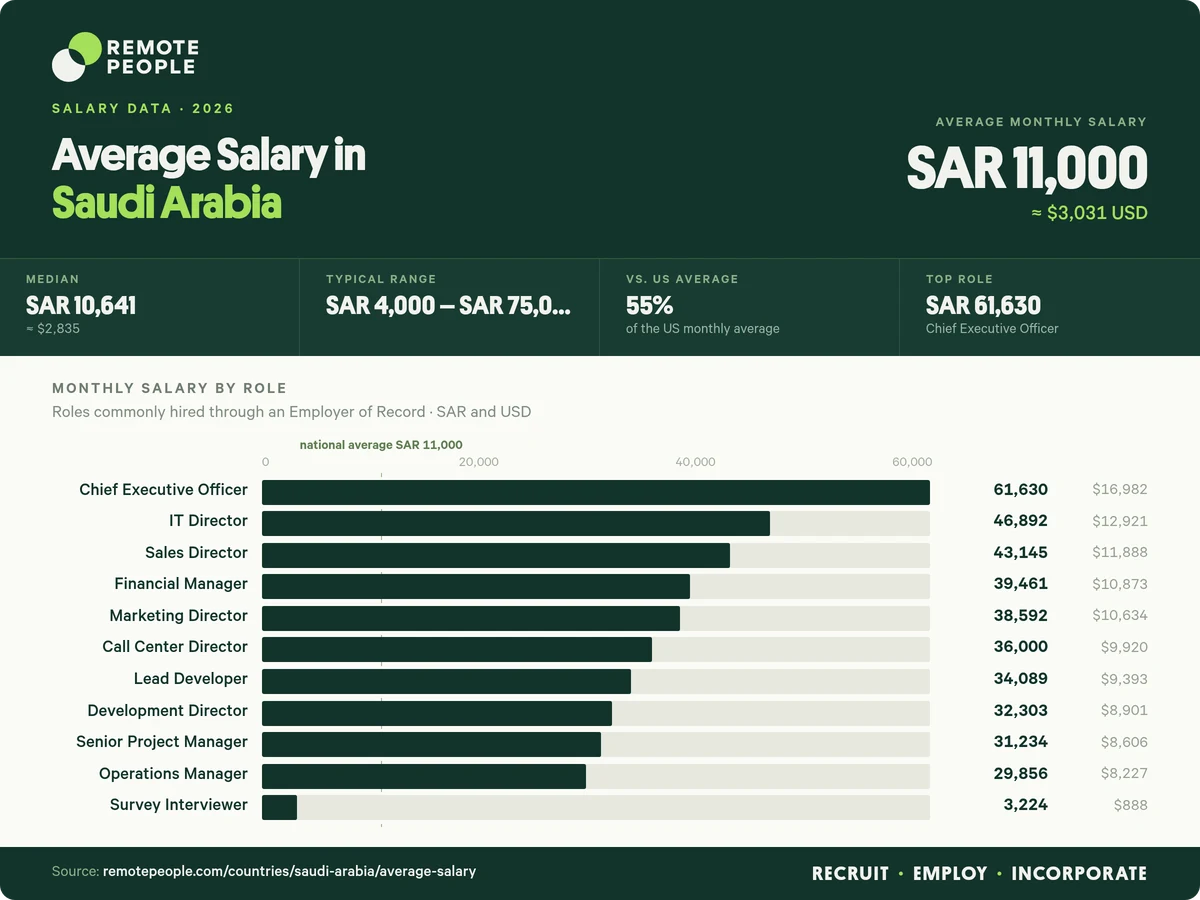
The average monthly salary in Saudi Arabia is SAR 11,000, approximately USD 3,031. However, wages vary depending on factors such as experience, education, location, industry, and position. You must also consider how earnings in the country compare to wages worldwide.
This guide will explore all aspects of Saudi Arabian salaries to provide deeper insight.
What is the Average Salary in Saudi Arabia?
The average salary in Saudi Arabia is 11,000 SAR, approximately $ 2,931. Salaries are relatively high for a Middle Eastern country due to thriving oil, gas, technology, and healthcare sectors, which offer high-paying positions. It is home to several large, international companies that pay high wages.
Median Income
Saudi Arabia’s median monthly income is 10,641 SAR, equivalent to approximately $ 2,835. Half the country earns higher salaries; the other half earns lower wages.
Salary Range
The salary range spans the entire spectrum, from the lowest to the highest in the country. Low earners typically earn around 4,000 SAR, equivalent to about $ 1,066, while high earners can earn 75,000 SAR (approximately $19,981) or more.
Wage Growth Trends in Saudi Arabia
Saudi Arabia is contending with significant upheaval resulting from its Vision 2030 program, where the country is pushing to reduce its reliance on expatriate workers and encourage more Saudi natives into the workforce.
According to the latest stats published by Mastercard, GDP is expected to rise 3.7%, consumer spending by 4.5%, and inflation by 2% year-on-year. Interestingly, non-oil real GDP growth is projected to grow in 2025 but will fall 0.8% lower than the numbers posted in 2024. In terms of salaries, this also means increases.
Unlike in other countries, the minimum wage only applies to Saudi nationals, and the same goes for annual salary increases. Generally, employees see increases based on performance, with the annual salary increase this year expected to be between 2% and 5%. Rather than relying on wage increases alone, the private sector prefers to reward its employees in terms of bonuses, which are anywhere from one to three months of salary, with larger increases in the financial sector.
According to reports, here’s what each sector could expect in terms of wage growth in 2025:
Sector | Estimated Growth Rate |
|---|---|
Energy | 4.3% |
Marketing / Advertising / PR | 10%+ |
Logistics | 10%+ |
Renewables | 10%+ |
Hospitality | 0–5% |
Tourism | 0–5% |
Technology | 4.2% |
Life Sciences | 4.2% |
Government | 5% |
Defense | 5% |
The battle for talent in an increasingly competitive market, as skilled expats continue to flock to the country, is also driving these wage increases. Rather than allowing skilled workers to move on, where they could previously expect enormous salary increases via lucrative welcome packages, companies are focusing more on retention. And that means ballooning wage costs for Saudi businesses, as they look to drive down the costs of hiring and high employee churn rates.
Overall, the Saudi average wage is projected to continue its consistent rise, but with more modest figures largely in line with averages posted in Europe. This is despite the fact that Saudi Arabia is seeing its fastest job growth rate in 14 years, which is also pushing up wage costs for companies.
Salary Comparisons in Saudi Arabia
While the average salary provides some insight, it is also essential to consider how wages vary based on factors such as education, experience, location, position, and industry. These sections will examine these factors and their impact on earnings.
Salary by Profession
The following salary comparison chart illustrates the variation in wages by profession in Saudi Arabia.
Position | Salary (SAR) |
|---|---|
Chief Executive Officer | 61,630 |
IT Director | 46,892 |
Sales Director | 43,145 |
Financial Manager | 39,461 |
Marketing Director | 38,592 |
Call Center Director | 36,000 |
Lead Developer | 34,089 |
Development Director | 32,303 |
Senior Project Manager | 31,234 |
Operations Manager | 29,856 |
Receptionist | 4,109 |
Cobbler | 4,050 |
Tailor | 4,038 |
Forklift Truck Operator | 4,007 |
Fabric Cutter | 3,956 |
Seamstress | 3,543 |
General Laborer | 3,271 |
Survey Interviewer | 3,224 |
Porter | 2,728 |
Average Salary Based on Education
Education plays a significant role in wage determination. Here are some statistics to consider regarding Saudi Arabian workers:
Education Level | Average Lifetime Earnings (USD) |
|---|---|
Bachelor’s Degree | $2.27 million |
Master’s Degree | $2.67 million |
Doctoral Degree | $3.25 million |
Professional Degree | $3.65 million |
Salary vs. Experience
Experience also impacts Saudi Arabian salaries, but education may be a more significant factor. Studies show a worker may see a slight increase in earnings after a year of experience, but that increase will be more substantial for educated workers.
Overall, a male with a doctoral degree in science and 10 to 14 years of experience working in the private sector will see the highest salaries in Saudi Arabia.
Salary by Location
Location is a significant factor in wage determination, as workers in urban areas typically earn more than those in rural areas due to a higher cost of living and proximity to large companies offering higher-paying job opportunities. In Saudi Arabia, workers in major cities, such as Riyadh and the Eastern Province, earn more than those in surrounding areas, including Rumah, Tawala, Hanak, Araar, and Aljof. Experts have suggested addressing this wage inequality by developing rural areas.
How Much is Minimum Wage in Saudi Arabia?
Saudi Arabia has a two-tiered minimum wage system as follows:
Category | Minimum Monthly Wage (SAR) |
|---|---|
Saudi Nationals in the Private Sector | 4,000 |
Expatriates in the Private Sector | No official minimum (negotiated) |
Public Sector (All Nationalities) | 3,000 |
Gender Pay Gap in Saudi Arabia
The Kingdom has seen enormous cultural and social changes over the past decade. Under the guidance of Crown Prince Mohammed Bin Salman, the traditional role of women has changed massively, with more women being welcomed into different parts of the public and private sectors. Currently, female labor participation is reported as nearly 35% in 2024, which has already surpassed the Vision 2030 goal.
Under Saudi law, gender-based wage discrimination in the private and public sectors is illegal. Equal pay is required for comparable work. The government has made significant attempts at enforcing these laws, but the gender pay gap remains high.
According to an analysis of the private sector, women in Saudi Arabia continue to earn significantly less than men. The unadjusted gender pay gap is estimated to be 49%. If the calculations are adjusted for differences in education, industry, company size, and occupation, the gap does narrow but remains at 43%.
Reports have found major wage disparities across regions, with some regions seeing pay gaps as high as 48%. Granted, much of this gap can be attributed to differences in occupations. Men are more likely to be found in professional and technical roles, whereas women in the Kingdom are more likely to work in the education sector or as clerical staff.
On the other hand, there’s a very different picture when it comes to the realities for non-Saudi workers in the country. Within the private sector, non-Saudi women earned an average total salary of SR 3587 in 2023, whereas non-Saudi men earned just SR 2523 per month.
It’s a mixed picture, but the government has made it clear that it expects emerging sectors forming part of the Vision 2030 program to help narrow the gender pay gap, including the green energy sector. Additionally, it’s important to mention that the pace of change has been rapid, and it will take time to integrate women into different sectors of the economy fully.
Despite Saudi Arabia still falling well short of gender parity, it’s one of the fastest-improving countries in the world on this front. Currently, the major battle is improving female labor force participation, which in a highly conservative country, remains the most significant challenge, as does gender diversification within male-dominated sectors.
Cost of Living and Purchasing Power in Saudi Arabia
Inflation remains moderate in the country, but it is on the rise. According to the latest inflation report, the Kingdom’s inflation rate reached 2.3% in June 2025, which is a significant increase from the 1.5% a year previously. Primarily, the inflation rate has been driven by spikes in rents and property prices, as well as rising utility bills.
Housing costs represent the greatest challenge to a reasonable cost of living in the country. The center of the housing boom has been in the capital Riyadh, where property prices have exploded by 81% since 2020, with apartment prices climbing by 56%. It’s reached a point where even native Saudis are struggling to achieve their dreams of homeownership.
According to the latest cost of living stats from Expatica, here’s what locals and expats can expect to spend on average in 2025 every month, expressed in SR:
Category | Monthly Cost (SAR) |
|---|---|
Accommodation | 1,125 |
Utilities | 300–600 |
Food | 747 |
Transportation | 638 |
Purchasing power remains strong and growing, but many regions have not kept up with rising housing costs, leading to a loss in purchasing power for many. According to the latest per capita GDP stats, adjusted for purchasing power parity, the average Saudi should have $65,560 in 2025, but due to the lack of data transparency, this figure is primarily based on macroeconomic models and analyst input. The World Economics project estimates this same figure at $80,488.
In short, this puts the purchasing power of the average Saudi citizen in the same league as many European countries, and surpassing many of them.
Average Salary in Saudi Arabia vs. the Rest of the World
The following charts will compare salaries in Saudi Arabia to those in developed, developing, and least developed nations.
Saudi Arabia vs. Developed Countries
Country | Average Salary | Comparison to Average Saudi Arabia Salary |
|---|---|---|
United Kingdom | €3,000 (approx. $3,116) | – 6% |
United States | $5,677 | – 96% |
Norway | 50,790 NOK (approx. $4,700) | – 62% |
Germany | €4,300 (approx. $4,467) | – 55% |
Austria | €3,500 (approx. $3,636) | – 24% |
Saudi Arabia vs. Developing Countries
Country | Average Salary | Comparison to Average Saudi Arabia Salary |
|---|---|---|
Romania | 4,000 RON (approx. $835) | 245% |
Russia | 73,709 Rubles (approx. $700) | 314% |
Albania | €1,500 (approx. $1,550) | 87% |
Kazakhstan | 342,082 Tenge (approx. $645) | 346% |
Ukraine | 18,000 Hryvnia (approx. $500) | 480% |
Saudi Arabia vs. Undeveloped Countries
Country | Average Salary | Comparison to Average Saudi Arabia Salary |
|---|---|---|
Thailand | 97,500 Baht (approx. $2,772) | 3% |
Philippines | 18,423 PHP (approx. $875) | 229% |
Vietnam | 8.5 million VND (approx. $360) | 705% |
Egypt | 13,244 EGP (approx. $263) | 1,015% |
Pakistan | 45,000 PKR (approx. $150) | 1,833% |
Saudi Arabia is a developed country with a high-income economy and a high Human Development Index. Its economy is highly reliant on the petroleum sector. However, the government has launched initiatives to diversify, branching into construction, tourism, hospitality, technology, and green energy.
The country is establishing itself as a promising outsourcing destination by focusing on increasing skilled employment. Its Vision 2030 project aims to attract foreign investment. The government also offers a diverse workforce and cost-effective labor for most companies.
What are the Most Common Outsourced Industries in Saudi Arabia?
IT Services
Saudi Arabia’s IT industry has experienced significant growth over the past few years. It aims to become a hub for Middle Eastern technology, attracting both local and international investments. ICT is its fastest-growing sector.
Advanced Manufacturing
The country is also expanding its manufacturing technologies with significant growth in renewable energy, semiconductors, and aerospace. The government recognizes a demand for specialized skills, such as digital construction and sustainable engineering, and offers programs to meet that demand. Saudi Arabia’s numerous manufacturing and industrial zones ensure a productive work environment.
Oil and Gas
The gas and oil industries largely support Saudi Arabia’s economy. It has the second-largest oil reserves and is the world’s second-largest producer. Companies worldwide partner with the country on exports and related services, including land management, logistics, and back office functions.
Conclusion
Saudi Arabia’s skilled workforce, cost-effective labor, and vast natural resources make it a promising destination for outsourcing. Companies that partner with the country for remote opportunities can benefit from high-quality products and services while helping workers overcome income inequality, ultimately creating a favorable situation for all parties involved.