
 Recruit
Employer of Record in Saudi Arabia
-
 Drew Donnelly
- Published
- September 25, 2026
RemotePeople’s employer of record in Saudi Arabia lets you hire employees in Saudi Arabia with GOSI expertise. We handle General Organization for Social Insurance contributions for Saudi employees, mandatory health insurance, and end-of-service benefits.
Hire in Saudi Arabia — book a free 30-minute demo
Tell us what you need. You'll get a tailored, transparent proposal within 24 hours, plus a free call to walk through it.
Tell us about your company
So we can match you with a specialist who knows your market — and unlock volume pricing tiers.
* All fields are required.
Where and when are you hiring?
Tell us the geography and timing and we'll quote each country line by line, with onboarding timelines.
* All fields are required.
Help us beat your current setup
We'll benchmark your current deal and send a line-by-line proposal in 24 hours — showing exactly where we cut cost, time, or risk. After you submit, you can book a call to walk through it together.
* All fields are required.
Thanks! Your proposal is on its way.
Expect a tailored, line-by-line proposal in your inbox within 24 hours. In the meantime…
Want to walk through it together?
Book a free 30-minute call with one of our specialists. We'll explain every line, answer your questions, and tailor the proposal further if you need.
No obligation. Pick a time that works for you.








- Hire in Saudi Arabia — book a free 30-minute demo
- Tell us about your company
- Where and when are you hiring?
- Help us beat your current setup
- Thanks! Your proposal is on its way.
- How an Employer of Record Works in Saudi Arabia
- Employment Laws and Regulations in Saudi Arabia
- Work Permits and Visas in Saudi Arabia
- Payroll, Taxes, and Social Security in Saudi Arabia
- Cost of Hiring Through an Employer of Record in Saudi Arabia
- Termination and Offboarding in Saudi Arabia
- EOR vs. Other Hiring Models in Saudi Arabia
- Public Holidays in Saudi Arabia
- How to Get Started with an EOR in Saudi Arabia
- Frequently Asked Questions
- Related EOR Destinations

Start hiring in Saudi Arabia
Let RemotePeople handle payroll, compliance, and HR admin worldwide so you can focus on building your team.

Since 19 February 2025, a Saudi employment contract that promises ten weeks of maternity leave, a 90-day probation period or 30 days’ notice from the employer is wrong on all three counts. The amendments to the Labor Law under Royal Decree M/44 moved maternity leave to twelve weeks, allowed probation of up to 180 days and set employer notice at 60 days, and the Ministry of Human Resources and Social Development (HRSD) now checks contract wording through the Qiwa platform. Many international guides still quote the old numbers.
Saudi Arabia is the largest labour market in the Gulf: roughly 19 million people in employment, real GDP growth of 4.5% in 2025, no personal income tax on wages and a private-sector hiring wave driven by Vision 2030 giga-projects, regional headquarters relocations to Riyadh and expansion in fintech, tourism, healthcare and technology. For companies looking to hire employees in Saudi Arabia, the operational load is the barrier: Qiwa-authenticated Arabic contracts, monthly GOSI contributions at rates that step up every July, the Mudad Wage Protection System, Saudization (Nitaqat) quotas, work visas and Iqama sponsorship for expatriates and an end-of-service award that accrues from day one.
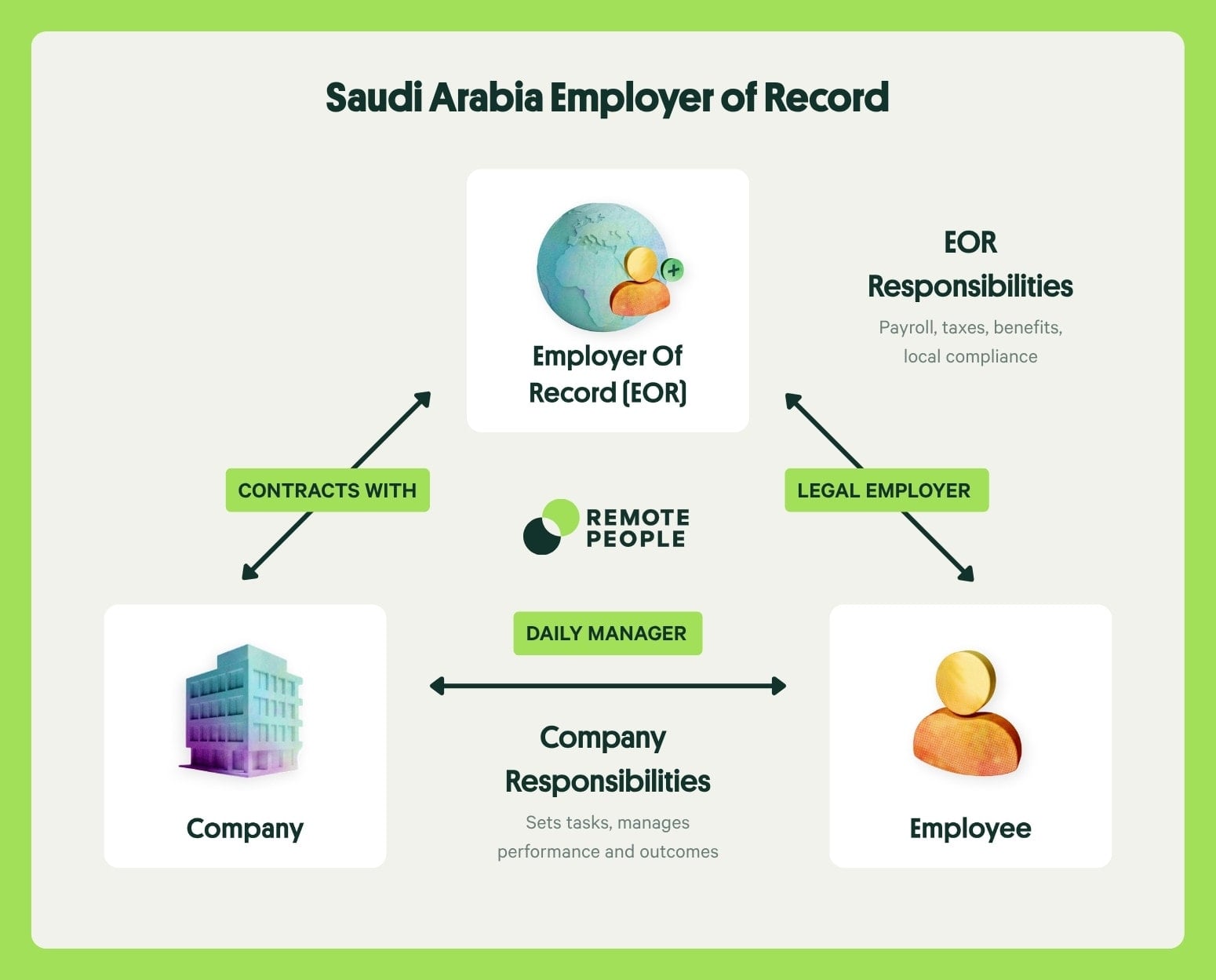
An employer of record in Saudi Arabia takes that load on. RemotePeople acts as the legal employer through a licensed Saudi establishment. We draft and authenticate the bilingual contract on Qiwa, register the employee with GOSI, run riyal payroll through Mudad, sponsor the work visa and Iqama, provide the mandatory health insurance, accrue the end-of-service award and manage offboarding, while your employees report to you. A Saudi national can be on payroll in one to two weeks; an expatriate hired from abroad in six to ten.
How an Employer of Record Works in Saudi Arabia
An employer of record (EOR) in Saudi Arabia is a Saudi-registered establishment, licensed by HRSD to supply labour, that becomes the legal employer of your staff in the Kingdom. The EOR holds the commercial registration, the HRSD establishment file, the GOSI subscription, the Qiwa account and the Mudad payroll account that Saudi law requires of every employer. It signs the employment contract, sponsors the Iqama for non-Saudis and answers to the Labor Office and the Labor Courts. Your company directs the work, sets targets and manages performance under a service agreement with the EOR.
This means you can hire in Riyadh, Jeddah or the Eastern Province without a MISA investment registration, a commercial registration from the Ministry of Commerce, a Chamber of Commerce membership, a Saudization file or a bank account under foreign-owner due diligence. That entity process takes three to six months even when the licence itself is issued in weeks. Because the Labor Law only recognises a Saudi establishment as an employer, direct employment by a foreign company is not an option; the EOR is the compliant alternative to incorporation.
If you’d like to learn more about how Employer of Record (EOR) services work, read our What Is an Employer of Record (EOR)? guide for a complete overview of the model, its benefits, and when to use it.
If you’re comparing providers, our Best Employer of Record (EOR) Providers guide reviews the leading platforms to help you choose the right solution for your business.
Who Uses an EOR in Saudi Arabia?
EOR services in Saudi Arabia are typically used by companies that want a compliant hiring solution without committing to a MISA commercial registration, a Regional Headquarters (RHQ) licence, or a full establishment file with HRSD. Common scenarios include:
- Testing the Saudi market: A company looking to validate demand in Riyadh or Jeddah before committing to an entity can hire one or two people through an EOR while retaining the option to register a MISA subsidiary or RHQ once revenue is proven.
- Hiring a regional lead based in Riyadh: For organisations expanding into the GCC, placing a regional manager in Saudi Arabia through an EOR is faster than the 10-to-16-week MISA licensing process.
- Retaining relocating employees: An existing employee moving to Riyadh on a spouse’s Iqama, or transferring from another Saudi employer under the post-kafala mobility rules, can be kept on payroll through an EOR rather than lost to resignation.
- Onboarding foreign hires quickly: Any business hiring employees in Saudi Arabia who need sponsored Iqamas can use the EOR’s existing HRSD establishment and Jawazat sponsor code instead of building a new file from scratch and waiting for Nitaqat colour certification.
The EOR model is also a practical fit for teams hiring between one and twenty people in Saudi Arabia, where the cost and lead time of MISA entity setup plus Nitaqat green-zone achievement would outweigh the benefit. Companies hiring regionally often pair Saudi Arabia with an EOR in Qatar or an EOR in Bahrain to cover the wider Gulf market under a single provider.
Typical Onboarding Timeline
Most EOR providers can onboard an employee in Saudi Arabia within one to two weeks when the candidate is already a Saudi national or a valid Iqama holder with HRSD-cleared transfer rights. For expatriates hired from outside the Kingdom, the HRSD work permit plus Ministry of Foreign Affairs visa plus Jawazat Iqama chain adds roughly five to seven weeks in total. The typical sequence looks like this:
- First, the client signs the EOR agreement and provides employee details, job description, and compensation package (1–2 days).
- Second, the EOR drafts the bilingual Arabic-English employment contract under the Saudi Labor Law and authenticates it on Qiwa (2–3 days).
- Third, the EOR files the work permit with HRSD, obtains the Professional Verification Program accreditation, and submits the work visa request through Enjaz and the Ministry of Foreign Affairs (3–5 weeks for applicants outside Saudi Arabia, 3–5 days for candidates already holding a transferable Iqama).
- Fourth, on arrival, the employee completes biometric capture at Jawazat, undergoes medical fitness testing at an approved Ministry of Health centre, and receives a one-year Iqama card inside the 90-day statutory window.
- Fifth, payroll is configured on Mudad, GOSI registration is completed, benefits are enrolled, and the employee starts work fully payrolled on day one.
Background checks, attestation of academic certificates through the Saudi Cultural Attaché network, and Professional Verification Program skill-category classification can extend this timeline. A realistic planning assumption is two weeks for locally resident hires and six to seven weeks for expatriates arriving from abroad.
Hire in Saudi Arabia
Vision 2030 is driving the fastest private-sector hiring growth in the GCC, with no personal income tax on wages, a deep Saudi and expatriate talent pool, and Qiwa-authenticated contracts make Saudi Arabia a high-leverage market for regional teams.
We handle Qiwa contracts, Mudad WPS payroll, GOSI contributions, Iqama sponsorship, end of service award accruals, and full Saudi Labor Law compliance.
No MISA entity needed. Your team can start in 1–2 weeks for local hires.
Employment Laws and Regulations in Saudi Arabia
Employment Contracts
Private-sector employment in Saudi Arabia is governed by the Labor Law issued by Royal Decree No. M/51 of 2005, most recently amended by Royal Decree M/44 of 2024 with effect from 19 February 2025, together with its Implementing Regulations issued by HRSD (HRSD Labor Law). HRSD supervises employers through Qiwa, Mudad and the Labor Offices; disputes go first to amicable settlement at the Labor Office and then to the Labor Courts under the Ministry of Justice.
Article 9 makes Arabic the mandatory language for contracts, records and files. A second language may be attached, but the Arabic text prevails. Article 52 requires the contract to state the employer’s name and address, the employee’s name, nationality, ID and address, the agreed wage including allowances and benefits, the type and place of work, the start date and, for fixed-term contracts, the duration. Since 2021 every private-sector contract must be authenticated on the Qiwa platform, and Article 51 as amended in 2025 makes authentication a statutory requirement; a Qiwa contract awaiting the employee’s approval is cancelled automatically after ten working days. From 15 April 2026 only Saudi employees whose contracts are documented on Qiwa count toward an establishment’s Nitaqat ratio, with HRSD requiring 90% documentation by 30 June 2026.
Saudi nationals may be employed on indefinite or fixed-term contracts. Under Article 55, a fixed-term contract for a Saudi that continues past its term becomes indefinite, and a renewable contract becomes indefinite after three consecutive renewals or four years, whichever is shorter. Non-Saudis must be on written fixed-term contracts; Article 37 as amended in 2025 deems a contract without a stated term to run for one year from the actual start date and to renew for similar periods while work continues (Chambers and Partners). The 2025 amendments also added an express non-discrimination duty (Article 3), a duty to provide housing and transport or cash allowances in lieu (Article 61), a training policy for Saudi employees (Articles 42–43), a resignation procedure under which silence for 30 days is acceptance (Article 79) and penalties of SAR 200,000 to 500,000 for unlicensed manpower activity.
Part-time work is defined as less than half of standard daily hours, and HRSD’s flexible-work rules allow hourly contracts of up to 160 hours per month at one establishment, with 160 flexible hours counting as one Nitaqat point. The enforceable wage clause introduced in phases from October 2025 to August 2026 lets an employee enforce unpaid wages through the Najiz portal 30 days after they fall due, without a court judgment, so wage terms on Qiwa must match what payroll actually pays.
Working Hours and Overtime
Article 98 caps working time at eight actual hours per day or 48 hours per week. During Ramadan, Muslim employees work a maximum of six hours per day or 36 per week. No employee may work more than five consecutive hours without a break of at least 30 minutes, and total presence at the workplace, including breaks, may not exceed eleven hours a day (Article 101). Friday is the statutory weekly rest day of 24 hours on full pay; employers may substitute another day after notifying the Labor Office, and the Sunday-to-Thursday working week with a Friday–Saturday weekend is standard. In exceptional cases such as inventory, budget closing or seasonal peaks, hours may rise to ten per day or 60 per week for up to 30 days a year (Article 106). Outdoor work between 12:00 and 15:00 is prohibited from 15 June to 15 September under HRSD’s midday work ban.
Overtime and Premium Pay Rates
Saudi Arabia overtime and premium pay rates · Per Saudi Labor Law | |||
Hour Type | Rate Multiplier | Daily/Weekly Cap | Notes |
|---|---|---|---|
Standard overtime (beyond 8 hrs/day or 48 hrs/week) | 150% of basic hourly wage | 11 hours’ presence per day; 10 hrs/day or 60 hrs/week for up to 30 days a year in exceptional cases | Article 107: hourly wage plus 50% of basic hourly wage; since 2025 the employee may accept paid leave in lieu. |
Ramadan (Muslim employees) | Overtime above 6 hrs/day or 36 hrs/week | 6 hrs/day, 36 hrs/week standard | Article 98. |
Weekly rest day (Friday) | 150% | 24 consecutive hours’ rest must be granted | Counted as overtime under Article 107. |
Public holiday | 150% | — | Counted as overtime under Article 107; Eid and National Day work is compensated as overtime. |
Night work | No statutory premium | Within the daily cap | Any night allowance is contractual. |
Overtime is calculated on the basic wage, not the total package, so the structure of basic salary versus housing and transport allowances matters for both overtime and GOSI. RemotePeople builds the overtime rate into Mudad payroll and records consent where leave in lieu is used.
Minimum Wage
Saudi Arabia has no statutory minimum wage for the private sector, and none for expatriate employees, whose pay is contractual. For Saudi nationals, HRSD’s Nitaqat rules set an effective floor: a Saudi employee counts as one full worker toward the establishment’s Saudization ratio only if paid at least SAR 4,000 per month (about USD 1,067); employees paid SAR 3,000–3,999 count as half, and those below SAR 3,000 are not counted (Saudi Press Agency). Profession-specific Saudization decisions carry higher floors, such as SAR 5,500 for marketing and sales roles, SAR 8,000 for engineers and SAR 9,000 for dentists. GOSI contributions are calculated on a contributory wage of between SAR 1,500 and SAR 45,000 per month. Salary benchmarks by role are on our average salary in Saudi Arabia page.
Probation Period
Article 53 as amended in 2025 allows the contract to set a probation period of up to 180 days without a separate extension agreement; before February 2025 the default was 90 days extendable to 180 by written consent. Either party may terminate during probation without notice or compensation unless the contract reserves that right to one side. Eid al-Fitr, Eid al-Adha and sick leave do not count toward the probation period, and a second probation with the same employer is permitted only for a different profession or after a gap of at least six months (Article 54) (DLA Piper). Our probation period in Saudi Arabia guide covers the rules in detail.
Leave Entitlements
Saudi leave entitlements are set in Articles 109 to 117 and 151 to 160 of the Labor Law and are all employer-funded; there is no state sickness or maternity benefit.
Annual Leave
Employees are entitled to at least 21 days of paid annual leave per year, rising to at least 30 days after five consecutive years with the same employer (Article 109). Leave pay is due in advance, the employer fixes the dates according to business needs and the employee may not waive leave for cash while in service. With the employer’s agreement leave may be deferred to the following year, and accrued unused leave is paid out on termination pro rata.
Sick Leave
Employees receive up to 120 days of sick leave per year, counted from the first day of absence: the first 30 days at full pay, the next 60 days at 75% of pay and the final 30 days unpaid (Article 117). A medical certificate from an approved provider is required, and sick leave does not count toward probation.
Maternity Leave
Since 19 February 2025, female employees are entitled to twelve weeks of maternity leave at full pay, of which six weeks must be taken after delivery and the remaining six may be distributed before or after (up to four weeks before). The employee may extend by one month unpaid, and where the child is sick or disabled she receives a further month at full pay and another month unpaid. A nursing break of up to one hour a day counts as working time (Article 151) (King & Spalding).
Paternity Leave
Fathers are entitled to three days of paid paternity leave, taken within seven days of the birth (Article 113).
Other Statutory Leave
Article 113 also grants five days’ paid leave for the employee’s marriage, five days for the death of a spouse, parent or child and, since 2025, three days for the death of a sibling. Muslim employees who have completed two years’ service may take Hajj leave of ten to fifteen days including Eid al-Adha, once during their employment (Article 114). Employees sitting examinations receive paid leave for the exam days (Article 115). A Muslim widow receives Iddah leave of four months and ten days at full pay, and a non-Muslim widow fifteen days (Article 160). Unpaid leave may be agreed, and the contract is suspended if unpaid leave exceeds 20 days unless otherwise agreed (Article 116).
Leave Entitlements Summary
Saudi Arabia statutory leave entitlements · Per Labor Law as amended 19 February 2025 | ||
Leave Type | Duration | Eligibility & Notes |
|---|---|---|
Annual leave | 21 days; 30 days after 5 years’ service | Paid in advance; employer sets dates; encashed on termination. |
Sick leave | 120 days per year | 30 days at 100%, 60 days at 75%, 30 days unpaid; medical certificate required. |
Maternity leave | 12 weeks at full pay | 6 weeks mandatory post-delivery; plus 1 month unpaid; plus 1 month paid if the child is sick or disabled; nursing hour included. |
Paternity leave | 3 days | Paid; within 7 days of birth. |
Marriage leave | 5 days | Paid. |
Bereavement leave | 5 days (spouse, parent, child); 3 days (sibling) | Paid; sibling leave added in 2025. |
Hajj leave | 10 to 15 days | Paid; once during service after 2 years; includes Eid al-Adha. |
Examination leave | Actual exam days | Paid for a non-repeated year. |
Iddah leave | 4 months and 10 days (Muslim widow); 15 days (non-Muslim widow) | Paid. |
Public holidays | 10 days in 2026 | Paid; 150% if worked. |
Statutory Employee Benefits
Four employer obligations sit alongside salary in Saudi Arabia. GOSI social insurance covers pensions and unemployment (SANED) for Saudi nationals and occupational hazards for everyone, at the rates in the payroll section below. Mandatory health insurance under the Cooperative Health Insurance Law requires every employer to cover employees and their dependants with a policy approved by the Council of Health Insurance. A valid policy is a precondition for issuing or renewing an Iqama, and the unified policy carries an annual benefit cap of SAR 500,000 per insured. The end-of-service award under Article 84 accrues at half a month’s wage for each of the first five years and a full month’s wage for each year thereafter, calculated on the final wage.
And since February 2025 employers must provide suitable housing and transport or pay cash allowances in lieu (Article 61); market practice is 25% of basic salary for housing and 10% for transport. All wages must be paid in riyals through the Mudad Wage Protection System.
Saudization (Nitaqat) and the EOR
HRSD’s Nitaqat programme grades every establishment from Platinum through three Green bands to Red based on the share of Saudi nationals in its workforce, weighted by sector and size; a Red or Low Green band blocks new visas, work-permit and Iqama renewals and government bidding. In 2025 and 2026 HRSD layered profession-level quotas on top of the establishment ratio.
Accounting must be 40% Saudi from October 2025, rising to 70% by 2028; procurement 70%; dentistry 55% from January 2026; marketing and sales 60% from April 2026; engineering 30% from June 2026; and tourism 40% from June 2026, each with a minimum Saudi salary.
Under an EOR arrangement, Saudization obligations attach to the EOR’s establishment file, not to the client. This frees a foreign company from quota exposure for a small team, but it also means each expatriate hire consumes the EOR’s visa quota and Nitaqat headroom, which is why EOR providers ask about nationality and profession before quoting a timeline.
Recent Regulatory Updates (2026)
Saudi employment rules have changed repeatedly since early 2025, and most of the changes raise the cost of non-compliance rather than the cost of employment.
The Labor Law amendments in force from 19 February 2025 extended maternity leave to twelve weeks, allowed 180-day probation in the contract and set notice at 60 days for the employer and 30 for the employee on indefinite contracts. They also required written fixed-term contracts for all non-Saudis, added sibling bereavement leave, codified the housing and transport duty and introduced a resignation procedure. From 1 March 2025 the Mudad wage-file upload window was cut from 60 to 30 days, and HRSD now escalates from reminders at day ten to inspection at day twenty.
From July 2025 HRSD classified every expatriate work permit as High-Skilled, Skilled or Basic on a points system that weighs education, experience, wage and age, with automated reclassification in Qiwa. The new Social Insurance Law’s phased GOSI increase for Saudis registered from July 2024 stepped up on 1 July 2025 and again on 1 July 2026, with two further steps to come. The enforceable wage clause reached all contract types on 6 August 2026. In December 2025 the Cabinet permanently abolished the expatriate levy for licensed industrial establishments.
On 26 January 2026 Ministerial Resolution 60339 restricted the outsourcing and lending of non-Saudi labour to HRSD-licensed providers holding an Ajeer permit for up to three years, with substance-over-form review and shared liability for the beneficiary . In the first quarter of 2026 Muqeem introduced a physical resident ID valid for five years (with residency still renewed annually), a 60-day grace period after contract expiry and work permits for dependants, and from 15 April 2026 only Qiwa-documented Saudi employees count toward Nitaqat.
Work Permits and Visas in Saudi Arabia
Work Permit Requirements
Who Needs a Work Permit
Every non-Saudi employee needs an employer-sponsored work visa, a residence permit (Iqama) and an HRSD work permit before starting work. GCC nationals are exempt from the visa and Iqama but must be registered with GOSI under the GCC insurance protection extension. Saudi nationals need only a Qiwa-authenticated contract and GOSI registration. Business visit visas allow meetings and short assignments but not employment.
Eligibility and Required Documents
The sponsoring establishment must hold a commercial registration, an HRSD file in a Nitaqat band that permits new visas, GOSI and Mudad accounts and available visa quota. The employee’s profession must match the visa and the work permit’s skill tier, and for professions covered by the Professional Verification Program (engineering, health and other Skill Group 1–3 occupations across 160 countries) a verification certificate (USD 93, about 15 days) is required before the visa is issued. Standard documents are a passport with at least six months’ validity, the attested degree certificate, a medical fitness certificate from a Wafid-approved clinic, a police clearance certificate, photographs and the signed contract. Because the EOR is the sponsor, its establishment file satisfies the employer-side requirements.
Processing Time and Validity
Visa-quota approval through Qiwa takes two to four weeks depending on the Nitaqat band and skill tier, Ministry of Foreign Affairs authorisation and embassy stamping a further two to three weeks, and the Iqama is issued within 90 days of entry, usually inside two weeks. Immigration practitioners quote five to nine weeks end to end, and up to fourteen for professions needing verification. Iqamas and work permits are issued for one year (or two) and renewed through Absher and Muqeem; since 2026 the physical Muqeem card is valid for five years while the residency itself is still renewed annually. The employee must enter the Kingdom within 90 days of visa issue.
Renewal Process
The sponsor renews the work permit and Iqama before expiry by paying the annual government fees through Absher: SAR 650 for the Iqama, the expatriate levy of SAR 9,600 (SAR 8,400 where Saudis equal or outnumber expatriates at the establishment) and SAR 4,800 per dependant, each plus a valid health-insurance policy. Under the 2026 rules there is a 60-day grace period after contract expiry to renew, transfer or exit, and transfers may be processed on an expired Iqama once fines are settled.
Common Visa Types for Foreign Workers
Saudi Arabia visa and residence routes for foreign workers · 2026 | ||||
Route | Duration | Best For | Leads to Permanent Residence? | Processing |
|---|---|---|---|---|
Work visa + Iqama + HRSD work permit | 1 year (or 2), renewable; 5-year Muqeem card from 2026 | All employed expatriates; classified High-Skilled, Skilled or Basic | No (Premium Residency is the separate route) | 5 to 9 weeks end to end |
Business visit visa | Up to 90 days per visit | Meetings, negotiations, audits; no employment | No | 1 to 2 weeks |
Work visit visa | 90 days | Short technical assignments for a Saudi establishment | No | 2 to 3 weeks |
Premium Residency (Limited) | 1 year, renewable | Self-sponsored residence; SAR 100,000 per year; exempt from expat and dependant fees | Renewable indefinitely | Via the Premium Residency Center |
Premium Residency (Unlimited, Special Talent, Investor, Entrepreneur, Real Estate Owner) | Permanent or 5 years renewable | High-net-worth individuals, investors, professionals in priority fields; SAR 800,000 one-time for Unlimited | Permanent | Via the Premium Residency Center |
GCC nationals | No visa or Iqama | Citizens of the UAE, Bahrain, Kuwait, Oman and Qatar | Not applicable | GOSI registration only |
Sponsorship transfer rules changed under the 2021 Labor Reform Initiative. An expatriate may now transfer to a new employer without the current sponsor’s consent on contract expiry or after one year from entry with notice. Transfer is also possible at any time if wages are unpaid for three months, the work permit is not issued within 90 days of arrival, the contract is not registered on Qiwa or the sponsor’s file is non-compliant. The new employer pays a transfer fee of SAR 2,000 for a first transfer, SAR 4,000 for a second and SAR 6,000 thereafter. Full details are on our Saudi Arabia work visa and permit page.
How an EOR Handles Work Permits
An employer of record in Saudi Arabia sponsors the visa and Iqama through its own HRSD establishment and Jawazat sponsor file. RemotePeople requests the visa quota on Qiwa, obtains the Professional Verification certificate where required, issues the Enjaz invitation, coordinates embassy stamping, books the in-country medical and biometrics and pays the Iqama, work-permit and levy fees, which are passed through at cost. Because the EOR is the sponsor of record, its Nitaqat band and visa quota govern how quickly a permit is issued, and every expatriate placed under a client’s day-to-day supervision is covered by an Ajeer permit where the January 2026 outsourcing rules require one. Expect the visa stage to add five to nine weeks to the standard onboarding timeline for hires from abroad, and three to five business days for candidates already holding a transferable Iqama.
Payroll, Taxes, and Social Security in Saudi Arabia
Employer Contributions
Saudi Arabia has no personal income tax, so the employer’s statutory cost is GOSI. Contributions depend on the employee’s nationality and, for Saudis, on whether they entered the system before or after the new Social Insurance Law of July 2024. Contributions are calculated on the basic wage plus housing allowance, subject to a floor of SAR 1,500 and a ceiling of SAR 45,000 per month; transport allowances, commissions and bonuses are excluded.
Saudi Arabia employer GOSI contributions · Rates from 1 July 2026 | ||||
Contribution | Saudi national (registered before 3 July 2024) | Saudi national (new scheme, registered from 3 July 2024) | Non-Saudi | Notes |
|---|---|---|---|---|
Annuities (pension) | 9.00% | 10.00% | — | New-scheme rate rises 0.5% each July to 11% by July 2028. |
Unemployment insurance (SANED) | 0.75% | 0.75% | — | Reduced from 1% in 2022. |
Occupational hazards | 2.00% | 2.00% | 2.00% | Employer-only for all nationalities. |
Total employer GOSI | 11.75% | 12.75% | 2.00% | Base: basic plus housing, SAR 1,500 to 45,000/month. |
Beyond GOSI, employers budget for mandatory health insurance (typically SAR 1,500–4,000 a year for an employee-only mid-tier policy, considerably more for families), the end-of-service accrual (about 4.17% of wage in years one to five and 8.33% thereafter) and, for expatriates, the annual levy, Iqama and visa fees described above. Late GOSI payment attracts a 2% monthly surcharge on the arrears.
Employee Contributions
Saudi Arabia employee payroll deductions · Rates from 1 July 2026 | ||||
Deduction | Saudi national (pre-July 2024 scheme) | Saudi national (new scheme) | Non-Saudi | Notes |
|---|---|---|---|---|
Annuities (pension) | 9.00% | 10.00% | — | New scheme rises to 11% by July 2028. |
Unemployment insurance (SANED) | 0.75% | 0.75% | — | — |
Income tax | None | None | None | No personal income tax in Saudi Arabia. |
Total employee deductions | 9.75% | 10.75% | 0% | On basic plus housing, capped at SAR 45,000. |
Income Tax
Saudi Arabia levies no personal income tax on employment income, and no wealth, inheritance or gift tax. Taxes at entity level (Zakat at 2.5% on Saudi- and GCC-owned capital, corporate income tax at 20% on foreign-owned shares, VAT at 15% and withholding tax of 5–20% on payments to non-residents) fall on the employer, not on payroll. Employees therefore receive their full gross salary less GOSI, which makes the Kingdom one of the most attractive net-pay markets for expatriate professionals. Employers should note that VAT at 15% applies to health-insurance premiums and to services invoiced by Saudi-registered suppliers.
Payroll Cycle
Payroll in Saudi Arabia is monthly. Article 90 requires monthly-paid employees to be paid at least once a month and daily-paid workers at least weekly. Every private-sector establishment, regardless of size, must pay wages in riyals into a Saudi bank account or licensed payroll card and upload the wage file to the Mudad Wage Protection System within 30 days of the due date. HRSD sends reminders at day ten and fifteen and inspects at day twenty. After two months of non-compliance it suspends ministry services, and after three months employees may transfer without consent. A monthly itemised payslip is mandatory, bilingual in practice. GOSI contributions are remitted monthly through the GOSI portal. The riyal is pegged at SAR 3.75 to the US dollar, which removes currency risk from dollar-based budgets.
13th Month Salary and Bonus Pay
Saudi Arabia has no statutory 13th-month salary. Ramadan and Eid bonuses are customary in some sectors but discretionary, and annual bonuses are governed by the contract; Article 86 lets the parties agree to exclude commissions and variable pay from the end-of-service award base. Bonuses are not subject to income tax and, being excluded from the GOSI contributory wage, do not attract contributions. Housing (25% of basic) and transport (10%) allowances are the standard components of a Saudi package and are now backed by the statutory duty in Article 61.
Cost of Hiring Through an Employer of Record in Saudi Arabia
EOR Service Fees
EOR fees in Saudi Arabia depend on employee nationality and hiring requirements. RemotePeople’s EOR pricing for Saudi nationals starts at USD 199 per employee per month with no salary markup. Expatriate EOR fees are quoted separately; the USD 199 starting fee does not apply to expatriate hires. Contact us for an expatriate EOR quote. Our EOR services cover the Qiwa contract, Mudad payroll, GOSI filings, end-of-service accrual, leave tracking and offboarding. Government fees (visa, Iqama, levy, transfer), health-insurance premiums and Professional Verification charges are passed through at cost. See our employer of record cost guide for a provider comparison.
Total Employment Cost Breakdown
Because employer costs differ by nationality, the table below shows two employees on the same package: a hypothetical monthly wage equivalent to USD 5,000 (SAR 18,750), structured as basic salary plus housing allowance so that the full amount is the GOSI contributory base. The Saudi national is on the new GOSI scheme at the rate applying from 1 July 2026; the expatriate is on a one-year contract with visa costs spread over twelve months.
Saudi Arabia employer cost example · $5,000 gross · 2026 | ||
Employer Cost | Saudi National (USD) | Expatriate (USD) |
|---|---|---|
Gross monthly wage (basic plus housing) | $5,000 | $5,000 |
GOSI employer contribution (12.75% Saudi / 2% expatriate) | $638 | $100 |
Expatriate levy (SAR 800/month) | — | $213 |
Iqama fee (SAR 650/year, divided by 12) | — | $14 |
Work visa issuance (SAR 2,000 one-off, divided by 12) | — | $44 |
Mandatory health insurance (employee-only, estimated SAR 3,000/year) | $67 | $67 |
End-of-service award accrual (4.17%, years 1 to 5) | $208 | $208 |
EOR service fee (RemotePeople) | $199 | |
Total monthly employer cost | $6,112 | $5,646 + quoted EOR fee |
As % of gross wage | 122.2% | 112.9% before EOR fee |
Source: Mercans, GOSI contribution rates 2026, HRSD, end-of-service award and KSA Expats, Iqama and expatriate fee schedule; Saudi national example uses RemotePeople’s USD 199 starting fee; expatriate EOR fees require a separate quote | ||
Using the USD 199 EOR fee in this example, a Saudi national on USD 5,000 costs about USD 6,112 per month, 22% above wage, with GOSI at 12.75 points and the end-of-service accrual at 4.2. For an expatriate on the same package, the listed costs total about USD 5,646 per month before the separately quoted EOR service fee. That subtotal is 12.9% above gross wage; the final total depends on the expatriate EOR quote. GOSI is 2%, while the fixed government fees in this example add roughly USD 270 a month. The expatriate figures exclude dependants (SAR 400 per month each plus insurance), the annual return flight, exit and re-entry visas and any Professional Verification fee, and the end-of-service accrual doubles to 8.33% from year six for both. Transport allowance, where paid separately, is outside the GOSI base.
Ready to hire in Saudi Arabia? Get started with RemotePeople: we handle Qiwa contracts, Mudad payroll, GOSI, Iqama sponsorship and full Saudi Labor Law compliance. No MISA entity needed.
Benefits of Using an EOR in Saudi Arabia
Saudi employment compliance is platform-driven and time-sensitive. Contracts live on Qiwa, wages on Mudad, contributions on GOSI, residency on Absher and Muqeem and outsourcing on Ajeer. Each platform enforces its own deadline with automatic consequences: a wage file uploaded late triggers inspection, an unpaid wage becomes enforceable through Najiz after 30 days, an undocumented Saudi contract drops out of Nitaqat and a Red band freezes visas. Foreign employers rarely fail on intent; they fail on sequencing, which is exactly what an employer of record in Saudi Arabia manages for them.
Using an EOR in Saudi Arabia removes the MISA registration, commercial registration, Chamber of Commerce membership, municipal licence, ZATCA registration, GOSI and HRSD files, Mudad account and bank onboarding that a new entity needs, a sequence that takes three to six months and requires a resident general manager on an Iqama. A first hire is on payroll in one to two weeks. The EOR also carries Saudization exposure for small teams, holds the visa quota that a new establishment must earn and absorbs the fixed costs of an entity for headcounts of one to twenty.
The compliance calendar is where the EOR earns its fee: the July GOSI rate step, the annual Iqama and levy renewals, the profession-level Saudization decisions that took effect through 2026 and the 30-day Mudad window. The EOR also pre-funds the end-of-service liability monthly, so a termination in year eight does not create an unbudgeted cash call. When the Labor Law amendments took effect in February 2025, RemotePeople updated contracts, leave rules and notice provisions without clients having to track the Umm al-Qura gazette.
For companies that want to build a team in Saudi Arabia without the complexity and fixed costs of a local entity, an EOR provides the fastest compliant path. Contact RemotePeople to discuss your Saudi Arabia hiring needs.
Termination and Offboarding in Saudi Arabia
Notice Periods
Notice under Article 75 applies to indefinite contracts, which only Saudi nationals may hold. Fixed-term contracts, including all expatriate contracts, end on their expiry date without notice; early termination without a valid reason triggers compensation under Article 77 rather than a notice period.
Saudi Arabia statutory notice periods · Per Labor Law Articles 53, 75 and 77 as amended 2025 | |||
Situation | Notice Period | During Probation | Notes |
|---|---|---|---|
Indefinite contract, monthly-paid, employer terminates | 60 days | None | Written notice; pay in lieu permitted (Article 76). |
Indefinite contract, monthly-paid, employee resigns | 30 days | None | Resignation deemed accepted if no reply in 30 days; employer may defer up to 60 days. |
Indefinite contract, not monthly-paid | 30 days (both parties) | None | — |
Fixed-term contract (all non-Saudis) | None; ends on expiry | None | Early termination without valid reason: Article 77 compensation applies. |
Dismissal for cause under Article 80 | None | None | No notice, award or compensation; must be invoked within 30 days. |
Resignation for cause under Article 81 | None | None | Employee keeps full rights, including the end-of-service award. |
Where a contract is ended without a valid reason, Article 77 awards the employee 15 days’ wage for each year of service on an indefinite contract, or the wages for the remaining term on a fixed-term contract. The minimum is two months’ wages in either case, and the parties may agree a higher amount in the contract. Termination during probation requires neither notice nor compensation.
Severance Pay
Severance in Saudi Arabia takes the form of the end-of-service award (EOSB) under Articles 84 to 87, payable on every termination and, on a sliding scale, on resignation. It is calculated on the final wage, which HRSD interprets as basic salary plus regular allowances unless the contract validly excludes variable pay.
Saudi Arabia end-of-service award schedule · Per Labor Law Articles 84 to 85 | |||
Years of Service | Award on Termination by Employer or Contract Expiry | Award on Resignation | Notes |
|---|---|---|---|
Under 2 years | Half a month’s wage per year (pro rata) | Nil | Pro rata for part years. |
2 years | 1.0 month’s wage | One-third of the full award (0.33 month) | Resignation between 2 and 5 years: one-third. |
5 years | 2.5 months’ wage | One-third (0.83 month) | — |
8 years | 5.5 months’ wage | Two-thirds (3.67 months) | Resignation between 5 and 10 years: two-thirds. |
10 years | 7.5 months’ wage | Full award (7.5 months) | Resignation after 10 years: full award. |
15 years | 12.5 months’ wage | Full award | No statutory cap. |
Source: HRSD, end-of-service award and HRSD Labor Law | |||
Calculation Method
The award is half a month’s wage for each of the first five years of service and one month’s wage for each subsequent year, based on the last wage and pro-rated for fractions of a year. On resignation the employee receives nothing before two years, one-third of the award between two and five years, two-thirds between five and ten and the full award after ten. Under Article 87 a woman who resigns within six months of marriage or three months of childbirth, or any employee who leaves because of force majeure, receives the full award regardless of tenure. EOR providers accrue the liability monthly, at roughly 4.17% of wage in the first five years and 8.33% thereafter, so that it is funded when the employee leaves.
Caps and Exceptions
There is no statutory cap on the award. It is forfeited only where the employee is dismissed for one of the Article 80 causes, and it is paid in full in addition to any Article 77 compensation where the termination was unlawful. Accrued but unused annual leave is paid out alongside the award, and for expatriates the employer bears the cost of the final-exit ticket and the cancellation of the Iqama and work permit.
Grounds for Termination
Article 74 lists the lawful ways an employment contract ends: mutual written agreement, expiry of a fixed term, notice by either party on an indefinite contract, resignation, retirement age (60 for men and 55 for women unless the parties agree otherwise), force majeure, permanent closure of the establishment, termination of the activity in which the employee works or a final court decision. A redundancy that eliminates a position must be genuine and documented, or the Labor Court will treat it as termination without a valid reason under Article 77.
Article 80 permits dismissal without notice, award or compensation for serious misconduct. The grounds are assault, failure to perform essential duties after written warning, proven dishonesty, deliberate acts causing material loss, forgery to obtain the job, unexcused absence of more than 30 days in a year or 15 consecutive days after written warning, abuse of position and disclosure of trade secrets. Each must be invoked within 30 days of the employer learning of it. Article 81 mirrors this for employees, who may leave without notice and with full rights where the employer breaches essential obligations, misrepresented the job, assaults or mistreats them or fails to remedy a serious hazard. Since 2025 an employee may grieve a disciplinary penalty within 30 days, the employer must answer within 15 days, and the employee has a further 30 days to go to the Labor Court.
Offboarding an expatriate involves paying the final settlement (wages, leave encashment and the end-of-service award) through Mudad, terminating the contract on Qiwa, cancelling the work permit and either issuing a final-exit visa (SAR 70) or approving a sponsorship transfer within the 60-day grace period, and providing the repatriation ticket. Missed steps at this stage are the most common source of Labor Court claims in the Kingdom.
EOR vs. Other Hiring Models in Saudi Arabia
EOR vs. Setting Up a Local Entity
Companies hiring in Saudi Arabia choose between registering with the Ministry of Investment (MISA) and using an EOR. The table compares the two on time, cost and obligations.
Saudi Arabia EOR vs local entity comparison · Setup time, cost, risk and best-fit | ||
Comparison | Employer of Record | Own Entity (MISA-registered LLC or branch) |
|---|---|---|
Setup time | 1 to 2 weeks (Saudi national); 6 to 10 weeks (expatriate) | 2 to 4 weeks for MISA registration; 3 to 6 months to be payroll-ready (CR, Chamber, ZATCA, GOSI, HRSD, Mudad, bank, GM Iqama) |
Upfront cost | $0 | MISA registration and first-year subscription SAR 12,000; Ministry of Commerce, publication and CR fees; office lease; apostilled parent documents and audited accounts |
Ongoing cost | Saudi nationals: from $199/employee/month; expatriates: contact us for a quote | Corporate income tax at 20% on foreign-owned profits, Zakat, VAT filings, audited accounts, Saudization compliance, HR and payroll staff |
Local presence required | No (the EOR is the establishment) | Registered office; resident general manager on an Iqama |
Saudization (Nitaqat) | Sits with the EOR’s file | Your establishment must reach and hold a Green band to obtain visas |
Visa quota | EOR’s existing quota | Earned by your establishment after certification |
Payroll, GOSI and Mudad | Handled by the EOR | You register and file |
Best for team size | 1 to 20 employees | 20+ employees, government contracts or an RHQ |
Scale down / exit | Easy; no entity to deregister | Liquidation, final Zakat/tax clearance, visa cancellations |
Government contracts | Not eligible | Eligible; RHQ required for most government contracts since January 2024 |
For teams of one to twenty, the EOR avoids the MISA subscription, the resident general manager, the Nitaqat certification that a new establishment must earn before it can issue visas and the three-to-six-month setup sequence. An entity becomes worthwhile when headcount grows, when the business must bid for government contracts (which since 1 January 2024 generally require a Saudi Regional Headquarters, with 30-year corporate tax and withholding exemptions on RHQ income and a ten-year Saudization exemption as incentives) or when it must hold licences, property or bank facilities in its own name. RemotePeople supports the transfer of employees from the EOR to a new entity, including sponsorship transfer of Iqamas; our Saudi Arabia company registration guide covers the MISA route.
EOR vs. Hiring Independent Contractors
Saudi Arabia EOR vs independent contractors · Compliance, cost and risk | ||
Comparison | EOR (Full-Time Employee) | Independent Contractor |
|---|---|---|
Legal relationship | Employee of the EOR under the Labor Law | Self-employed; possible only for Saudis with a freelance permit or fully offshore contractors |
Compliance risk | Low; EOR ensures Labor Law, GOSI and WPS compliance | High; no contractor status for non-Saudis without an Iqama; misclassification exposure for Saudis |
Payroll and tax | EOR runs Mudad payroll and GOSI | Contractor invoices; registers for VAT above SAR 375,000 turnover |
Benefits and leave | 21 to 30 days’ leave, sick pay, health insurance, end-of-service award | None |
IP protection | Employment contract assigns IP | Requires an explicit assignment clause |
Termination | Labor Law notice, Article 77 compensation and EOSB | Per contract terms |
Best for | Ongoing, integrated roles and anyone who needs to be in the Kingdom | Genuine project work by Saudi freelancers or offshore specialists |
Cost structure | Wage plus GOSI plus insurance plus EOSB accrual plus EOR fee | Fee only, but back benefits, GOSI and fines if reclassified |
Saudi Arabia leaves little room for contractor arrangements. A non-Saudi cannot work in the Kingdom without a sponsor and an Iqama, so an “independent contractor” who is physically in Saudi Arabia and is not a Saudi national with a freelance permit from HRSD’s freelance platform is working illegally. Saudi freelancers are lawful but are assessed on the usual tests of control, exclusivity, tools and payment structure, and a freelancer who works fixed hours for one foreign client is exposed to reclassification with back benefits, GOSI and Labor Office fines. A Riyadh-based Saudi designer who invoiced one European agency monthly for a year on a set schedule is an employee in all but name. RemotePeople offers contractor management in Saudi Arabia for genuine freelance engagements and the EOR model for everything else.
EOR vs. PEO (Professional Employer Organization)
Saudi Arabia EOR vs PEO comparison · Legal employer, liability and setup | ||
Comparison | Employer of Record (EOR) | PEO |
|---|---|---|
Legal employer | EOR (HRSD-licensed establishment) | You remain the legal employer |
Local entity required | No | Yes; a MISA-registered establishment with its own HRSD, GOSI and Mudad files |
Compliance liability | EOR carries employer obligations | Stays with your entity; PEO advises and processes |
Setup time | 1 to 2 weeks | Depends on your entity |
Iqama sponsorship | EOR sponsors | Your entity sponsors |
Saudization | EOR’s Nitaqat file | Your Nitaqat file |
Typical use case | Market entry, small teams, expatriate hires without an entity | Established Saudi operations outsourcing HR and payroll |
Co-employment does not exist in Saudi law; the legal employer must be a Saudi-registered establishment. The only lawful way to place a worker employed by one establishment under the supervision of another is through Ajeer, HRSD’s outsourcing platform, and since 26 January 2026 only HRSD-licensed manpower providers may supply non-Saudi labour, under an Ajeer permit of up to three years with employee consent and shared liability for the beneficiary. Licensed EOR providers operate inside that framework. For a company that already has a Saudi entity, a PEO or payroll outsourcing service in Saudi Arabia handles HR administration while the entity remains the employer and sponsor.
Public Holidays in Saudi Arabia
Article 112 of the Labor Law and Article 24 of its Implementing Regulations set four paid public holidays for private-sector employees: Eid al-Fitr, Eid al-Adha, National Day and, since 2022, Founding Day. A Cabinet decision of July 2025 fixes each Eid holiday at four to five working days. Eid dates follow the Umm al-Qura calendar and are confirmed by HRSD each year.
Saudi Arabia public holidays · 2026 calendar year | ||
Date | Holiday | Type |
|---|---|---|
22 February (Sun) | Founding Day | Nationwide; public, private and non-profit sectors |
19 to 22 March (Thu to Sun) | Eid al-Fitr (4 days, from the day after 29 Ramadan) | Nationwide; work resumed Monday 23 March |
26 to 29 May (Tue to Fri) | Eid al-Adha (4 days, from Arafat Day) | Nationwide; work resumed Sunday 31 May |
23 September (Wed) | National Day | Nationwide; moved to the adjacent working day if it falls on a weekend |
Saudi Arabia therefore has ten statutory paid holidays in 2026. An employee required to work on a holiday is paid overtime at 150% under Article 107 or, with consent, receives paid leave in lieu. A holiday that falls during annual leave or the weekly rest day is compensated, except where Eid overlaps National Day. Ramadan working hours (six per day for Muslim employees) applied from mid-February to mid-March 2026.
How to Get Started with an EOR in Saudi Arabia
- First, define your hiring needs: Identify the roles, the nationality of likely candidates (which determines whether the timeline is two weeks or ten), the package structure of basic salary plus housing and transport allowances, and whether the profession falls under a Saudization quota or the Professional Verification Program.
- Second, select your EOR provider: Confirm the provider employs through its own HRSD-licensed Saudi establishment with a Green Nitaqat band and available visa quota, that it holds the manpower licence the January 2026 Ajeer rules require, and that pricing and government fees are published. Ask how it handled the February 2025 amendments and the July 2026 GOSI step.
- Third, finalise employment terms: Work with the EOR to draft the bilingual contract with the Article 52 particulars, a fixed term for non-Saudis, a probation period within the 180-day ceiling, the end-of-service base, and any supplementary benefits such as family health cover, a school allowance or an annual flight.
- Fourth, onboard your employee: The EOR authenticates the contract on Qiwa, registers the employee with GOSI, enrols them in health insurance, sponsors the visa and Iqama where needed and configures Mudad payroll. The employee receives the contract, payslip template and holiday calendar.
- Fifth, manage and scale your team: The EOR runs monthly riyal payroll inside the 30-day Mudad window, remits GOSI, accrues the end-of-service award, renews Iqamas and work permits before expiry and handles offboarding under Articles 74 to 87. As your team grows, add employees through the EOR or transition to a MISA entity or RHQ when the headcount and government-contract pipeline justify it.
Ready to hire your first employee in Saudi Arabia? Contact RemotePeople to get started. We handle the entire employment process from contract to payroll to compliance, so you can focus on building your team.
Frequently Asked Questions
RemotePeople's EOR pricing for Saudi nationals starts at USD 199 per employee per month with no salary markup. Expatriate EOR fees are quoted separately; the USD 199 starting fee does not apply to expatriate hires. Contact us for an expatriate EOR quote. On top of the fee, employers pay GOSI at 12.75% of basic-plus-housing for a Saudi national on the new scheme (11.75% on the pre-2024 scheme) or 2% for an expatriate, plus mandatory health insurance and an end-of-service accrual of about 4.17%. Expatriates add the annual levy of SAR 9,600, the Iqama fee of SAR 650 and a SAR 2,000 visa fee. In the illustrative USD 5,000 gross-salary example above, the Saudi national total is about USD 6,112 per month using a USD 199 EOR fee. The expatriate subtotal is about USD 5,646 per month before the separately quoted EOR fee and the exclusions listed below the table.
Yes, through an employer of record. The Labor Law only recognises a Saudi-registered establishment as an employer, and every employee must be on a Qiwa-authenticated contract with a Saudi sponsor, so a foreign company cannot employ directly. An EOR that holds a commercial registration, an HRSD manpower licence, GOSI, Qiwa and Mudad accounts employs the staff, sponsors their Iqamas and runs payroll while your company directs the work.
Yes. From 1 July 2026 the employer pays 12.75% of basic salary plus housing allowance for a Saudi national registered under the new Social Insurance Law (10% annuities, 0.75% SANED, 2% occupational hazards), rising by 0.5 points each July to 13.75% in 2028, or 11.75% for Saudis registered before July 2024. For non-Saudis the employer pays only the 2% occupational-hazards contribution. The contributory wage is capped at SAR 45,000 per month, and Saudi employees contribute 9.75% or 10.75% themselves.
Nitaqat ratios and the 2025–2026 profession-level quotas (for example 60% for marketing and sales roles and 30% for engineers) attach to the employing establishment, which under an EOR arrangement is the EOR. Your company carries no Saudization quota for a small EOR team, but each expatriate hire uses the EOR's visa quota and Nitaqat headroom, so providers confirm nationality and profession before committing to a timeline. Saudi nationals hired through the EOR must be paid at least SAR 4,000 a month and documented on Qiwa to count.
Yes. As the legal employer the EOR requests the visa quota on Qiwa, obtains Professional Verification where the profession requires it, secures the Ministry of Foreign Affairs authorisation and Enjaz invitation, supports embassy stamping and obtains the Iqama within 90 days of arrival. The EOR is the sponsor named on the Iqama; if you later set up your own entity, the employee can transfer for a fee of SAR 2,000. End-to-end processing for a hire from abroad takes five to nine weeks, or three to five business days for a candidate already holding a transferable Iqama.
Under Article 84 the award is half a month's wage for each of the first five years of service and one month's wage for each year after that, calculated on the final wage and pro-rated for part years. On resignation the employee receives nothing before two years, one-third of the award between two and five years, two-thirds between five and ten and the full award after ten years. An employee dismissed for one of the Article 80 causes forfeits the award. RemotePeople accrues the liability monthly so it is funded at exit.
On an indefinite contract, which only Saudi nationals may hold, the employer must give 60 days' written notice and the employee 30 days, or pay in lieu. Fixed-term contracts, which all expatriates hold, end on expiry without notice; ending one early without a valid reason costs the wages for the remaining term, with a minimum of two months. Probation of up to 180 days may be ended by either side without notice or compensation. Dismissal without notice or award is limited to the serious-misconduct grounds in Article 80, invoked within 30 days.
An EOR is the legal employer and sponsor; you need no Saudi entity, and the EOR carries payroll, GOSI, Saudization and Labor Law liability. A PEO works only for companies that already hold a MISA registration and HRSD file, which remain the employer and sponsor while the PEO processes payroll and HR. Co-employment does not exist in Saudi law, and since January 2026 any placement of non-Saudi workers under another company's supervision must run through an HRSD-licensed provider under an Ajeer permit, which is the framework licensed EOR providers use.