
 Recruit
Employer of Record in Switzerland
-
 Drew Donnelly
- Published
- September 22, 2026
RemotePeople’s employer of record in Switzerland lets you hire employees in Switzerland with AHV/IV compliance. We handle Old-Age and Survivors’ Insurance at 10.6 percent, Unemployment Insurance at 2.2 percent, and mandatory occupational pension contributions.
Hire in Switzerland — book a free 30-minute demo
Tell us what you need. You'll get a tailored, transparent proposal within 24 hours, plus a free call to walk through it.
Tell us about your company
So we can match you with a specialist who knows your market — and unlock volume pricing tiers.
* All fields are required.
Where and when are you hiring?
Tell us the geography and timing and we'll quote each country line by line, with onboarding timelines.
* All fields are required.
Help us beat your current setup
We'll benchmark your current deal and send a line-by-line proposal in 24 hours — showing exactly where we cut cost, time, or risk. After you submit, you can book a call to walk through it together.
* All fields are required.
Thanks! Your proposal is on its way.
Expect a tailored, line-by-line proposal in your inbox within 24 hours. In the meantime…
Want to walk through it together?
Book a free 30-minute call with one of our specialists. We'll explain every line, answer your questions, and tailor the proposal further if you need.
No obligation. Pick a time that works for you.








- Hire in Switzerland — book a free 30-minute demo
- Tell us about your company
- Where and when are you hiring?
- Help us beat your current setup
- Thanks! Your proposal is on its way.
- What Is a Switzerland Employer of Record?
- Switzerland Employer of Record vs Legal Entity in Switzerland
- Is Employer of Record Legal in Switzerland?
- How Much Does Employer of Record Cost in Switzerland?
- How Does a Switzerland Employer of Record Help with Payroll and Taxes?
- How Does a Switzerland Employer of Record Help with Benefits Administration?
- What Labor Laws Apply to Hiring in Switzerland?
- Payroll and Employment Taxes in Switzerland
- Work Permits and Visas in Switzerland
- Workers’ Compensation in Switzerland
- Time Off and Leave in Switzerland
- Terminations and Severance in Switzerland
- Grow Your Team in Switzerland with RemotePeople’s EOR Services
- Where companies hiring in Switzerland expand next
- Frequently Asked Questions
- Related EOR Destinations

Start hiring in Switzerland
Let RemotePeople handle payroll, compliance, and HR admin worldwide so you can focus on building your team.

An employer of record (EOR) in Switzerland lets you hire full-time employees in 1–2 weeks for a service fee of $300–$600 per employee per month, with no local entity required. The EOR becomes the legal employer under Swiss law, handling payroll, AHV/BVG social security contributions (roughly 36% employer-side), and Swiss Code of Obligations compliance — while you direct the work.
Navigating Switzerland’s 26 cantons, canton-specific tax rates, and the Federal Labour Act can be complex. A Switzerland EOR (also called a Swiss employer of record or EOR Suisse / Employer of Record Schweiz) removes that burden entirely. In this guide, we’ll explain how Switzerland EOR services work, the benefits of EOR, pricing, and how to choose the right provider for your Swiss hiring.
What Is a Switzerland Employer of Record?
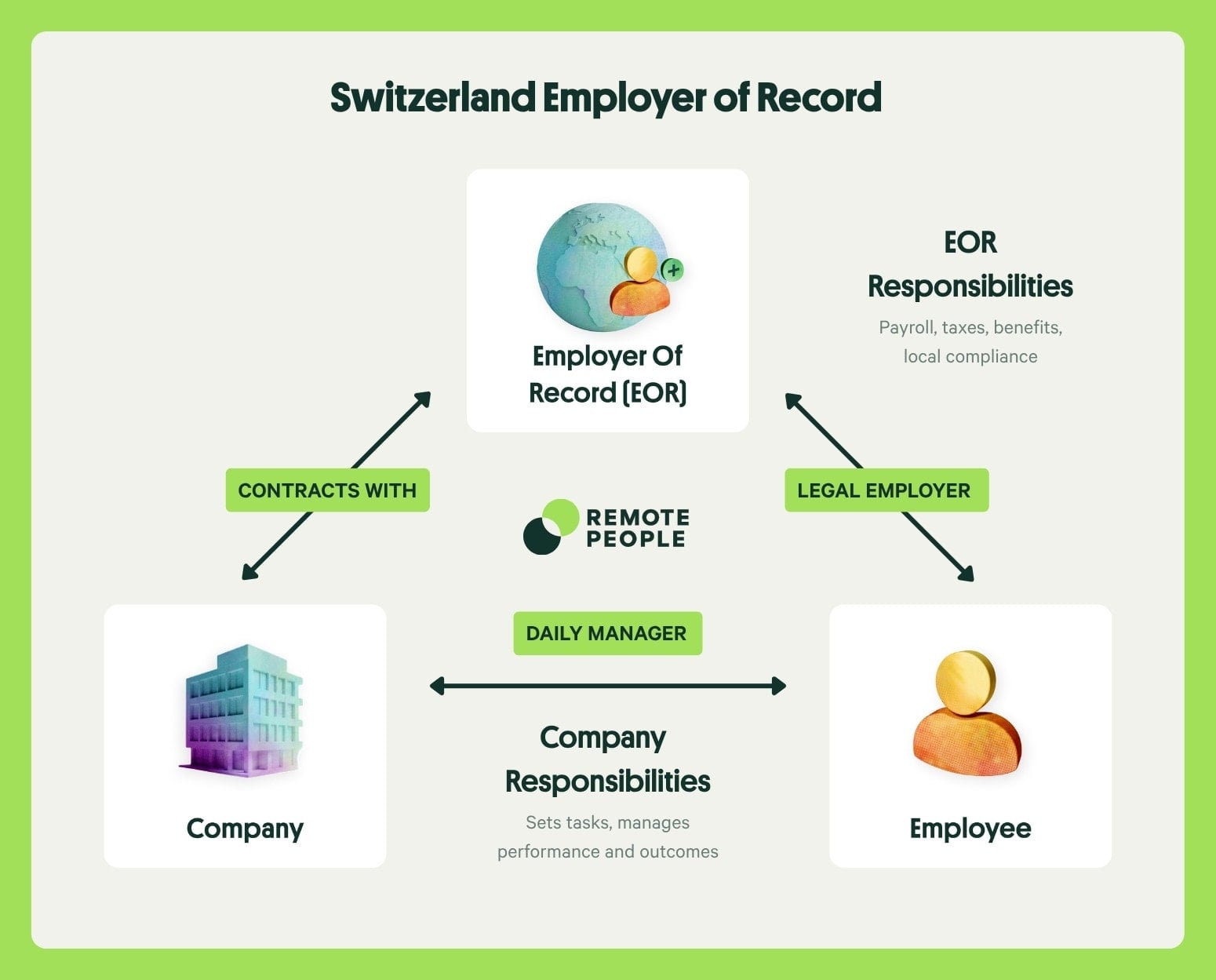
If you’d like to learn more about how Employer of Record (EOR) services work, read our What Is an Employer of Record (EOR)? guide for a complete overview of the model, its benefits, and when to use it.
If you’re comparing providers, our Best Employer of Record (EOR) Providers guide reviews the leading platforms to help you choose the right solution for your business.
A Switzerland Employer of Record (EOR) is a service provider that employs personnel on behalf of foreign companies wanting to expand or operate in the Swiss market. Rather than setting up a local entity in a country known for its complex regulations and precise compliance requirements, businesses can partner with an EOR to handle hiring, onboarding, and day-to-day employment management. This arrangement grants companies immediate operational capability in Switzerland, enabling them to focus on business growth without grappling with the intricacies of Swiss labor laws, social security obligations, and payroll processes.
One of the key advantages of working with a Switzerland EOR is ensuring full compliance with local employment legislation. Swiss labor regulations require that social security contributions, pension fund payments (the “LPP/BVG”), and mandatory accident insurance be properly administered. EORs have the specialized knowledge to manage these requirements and are well-versed in navigating canton-specific policies, ensuring employees receive the correct benefits and entitlements. By handling permits for foreign workers and residency regulations, a Switzerland EOR further mitigates risks and potential legal exposures.
Partnering with a Switzerland EOR is particularly useful for businesses needing to establish a presence in Switzerland quickly—whether to explore a new market or provide local sales and support. Because the EOR manages all the administrative, legal, and HR responsibilities, expanding companies can seamlessly onboard staff and begin operations within days. This approach saves significant time, reduces upfront expenses, and lets employers devote their energy to strategic objectives and market development.
Hire in Switzerland
Twenty-six cantons, each with different tax rates, plus AHV/IV/ALV federal contributions, BVG occupational pension, and Swiss Code of Obligations compliance.
We handle employment contracts, payroll, social contributions, and full Swiss compliance.
No local entity needed. Your team can start in days.
Switzerland Employer of Record vs Legal Entity in Switzerland
When expanding into Switzerland, businesses have some different options: Two of the most popular ones are to use a Switzerland EOR or to form a legal entity in Switzerland. Each approach has its advantages, and your decision should be based on your company’s goals, schedules, and business needs. Here is a breakdown of the two options:
Establishing a legal entity in Switzerland gives your company a full presence in the country. This allows for direct supervision and control of operations, which is useful for large-scale, continuous growth activities. However, the process of establishing a legal entity typically requires many steps. First, companies must register with the Swiss Commercial Register, which involves getting the necessary permits, preparing and notarizing articles of association, and passing capital requirements. The registration fee for sole proprietorships is CHF 80, CHF 160 for joint partnerships, and CHF 160 for limited liability companies.
With an EOR, your company can enter the Swiss market quickly and efficiently. The EOR serves as the legal employer for your employees, handling hiring, payroll, tax, and compliance issues on your behalf. Working with an EOR helps your company to set up operations in Switzerland in a matter of days or weeks. It is responsible for ensuring that Swiss labor laws are followed, including employment contracts, benefits administration, tax payments, and compliance with local employment standards.
This protects your company from potential legal or financial problems associated with non-reduced administrative burdens. The EOR manages payroll, tax withholding, and benefits, freeing your firm from administrative responsibilities and allowing it to focus on core activities. However, while an EOR is simple and flexible, it may be more expensive per employee if your company intends to establish a long-term, large-scale presence.
Is Employer of Record Legal in Switzerland?
Yes, an EOR can lawfully manage employees on your behalf as long as it adheres to Swiss labor laws. An EOR operates as a legal business in the country, allowing it to serve as the official employer of your Swiss workforce.
Note, Switzerland, like Austria and Germany, does have a Staff Leasing Law in place which may apply to the activities of EOR companies. Staff leasing in Switzerland is governed by the Federal Act on Employment Services and the Hiring of Services (AVG/LSE), along with its ordinances. Companies wishing to engage in staff leasing must obtain a license from the State Secretariat for Economic Affairs (SECO). This legal framework mandates that leased employees receive equal treatment in terms of wages, working conditions, and social benefits as permanent staff in comparable positions. Staff leasing agencies are responsible for employment contracts, social security contributions, and ensuring compliance with Swiss labor laws, while client companies must provide safe working conditions and cannot re-lease employees to third parties.
The laws aim to protect employees’ rights and ensure fair competition among businesses. Both staff leasing agencies and client companies must adhere to collective bargaining agreements and labor regulations. Regulatory authorities monitor compliance, and penalties for violations can include fines, license revocation, and criminal charges. Certain practices are prohibited, such as leasing employees to companies involved in strikes or lockouts, and there are restrictions on leasing in sensitive sectors or for specific durations. The overall goal is to balance the flexibility needs of businesses with robust protections for workers.
Note unlike Germany, Switzerland does not place a time limit on employing staff through a leasing arrangement. It’s also unclear whether all EOR activities in Switzerland are covered by this law.
Read more about staff leasing licenses in Switzerland, Austria and Germany in our Guide to the AUG license.
How Much Does Employer of Record Cost in Switzerland?
The cost of working with an EOR in Switzerland will depend on several factors, including the specific services that your company requires, the number of employees you want to hire and manage, the size of your company, and the duration that you will require the EOR’s services. EOR providers in Switzerland often charge a flat monthly fee (ranging from $600 to $2,500) or a percentage of each employee’s monthly income (generally between 10% and 15%).
Additionally, several EORs in Switzerland set onboarding fees to cover the initial setup of each employee. If you want an accurate quotation, it’s best to request a quote directly from the EOR provider’s website, as most suppliers offer a customized pricing tool that can accommodate your company’s needs and budget.
How Does a Switzerland Employer of Record Help with Payroll and Taxes?
An EOR in Switzerland is responsible for processing your employees’ payroll. They calculate employee salaries, including any overtime or other compensation, and make sure that they are paid on time. They also handle compulsory withholdings, such as income tax and social security contributions, and pay them to the Swiss Federal Tax Administration (FTA).
In addition, Swiss companies are required to contribute to a variety of social insurance programs, such as accident insurance, pension funds, and unemployment benefits, all of which the EOR will manage for you.
How Does a Switzerland Employer of Record Help with Benefits Administration?
Switzerland enforces employee benefits such as social insurance contributions, paid vacation, pension fund contributions, and health insurance coverage. An EOR in Switzerland ensures that these benefits are provided completely in line with Swiss labor rules. The EOR calculates and manages employees’ social security contributions, which include health and accident insurance, pension funds, and unemployment insurance, among other benefits.
These social security contributions are paid to the relevant Swiss authorities, such as the Swiss Social Security Office, ensuring that employees have access to health and social services. The EOR protects employees’ retirement funds by ensuring that contributions are made to occupational pension systems. By managing these contributions and benefits, the EOR helps your company to fulfill Swiss compliance.
What Labor Laws Apply to Hiring in Switzerland?
The Swiss Code of Obligations and the Federal Labor Act define both employers’ and employees’ rights and responsibilities in Switzerland to maintain fair practices and preserve both sides’ interests. These laws govern several areas of employment, such as working hours, termination procedures, minimum pay, paid leave, and health and safety regulations. Noncompliance with these regulations may result in fines, penalties, or even legal action by Swiss regulatory authorities.
Here is a breakdown of key labor laws that companies hiring in Switzerland must comply with:
Employment Contracts
Swiss law requires that employment contracts explicitly state the terms of employment, such as job function, compensation, working hours, and employment tenure. A formal contract is not required for all roles, but it is strongly recommended for transparency and compliance.
Employment contracts can be indefinite-term for ongoing assignments, fixed-term for temporary roles, or project-specific. The Swiss Code of Obligations outlines specific criteria for these contracts, including notice periods, working hours, overtime pay, and termination rights.
Working Hours
Under Switzerland’s Labour Act (ArG), maximum weekly working hours are 45 hours for office, technical, and retail employees, and 50 hours for industrial workers and certain other categories. In practice, most full-time roles operate at 40–42.5 hours per week through collective agreements or employment contracts.
Hours worked beyond the statutory maximum require approval and must be compensated at 125% of the regular rate, or replaced with equivalent time off with the employee’s written consent. Annual overtime is capped at 170 hours for employees under the 45-hour limit and 140 hours for those under the 50-hour limit.
Paid Holidays
Switzerland has only one federally mandated public holiday: Swiss National Day on 1 August. All other holidays are set at the cantonal level, with most cantons observing 8–10 public holidays per year. The total ranges from 7 in Solothurn to 13 in Ticino.
Commonly observed holidays across most cantons include New Year’s Day (1 January), Good Friday, Easter Monday, Ascension Day, Whit Monday, Christmas Day (25 December), and Boxing Day (26 December). Canton-specific holidays include Berchtoldstag (2 January, observed in Bern and Zurich), Corpus Christi (Catholic cantons), and the Jeûne fédéral (third Sunday in September).
The canton where the employee works determines which public holidays apply, not the canton where the employer is headquartered. Employers hiring across multiple cantons should verify the applicable holiday calendar for each location.
Social Security Contributions
Both employers and employees contribute to Switzerland’s social security system, covering retirement, disability, unemployment, accidents, and family expenses. Contributions are calculated as a percentage of gross salary. Health insurance is compulsory but sits outside the social security system and is arranged separately through private insurers, with premiums paid directly by the employee.
The total employer social security burden is approximately 14–18% of gross salary, depending on the pension fund plan and canton.
Switzerland employer social security contributions · 2026 rates | ||
Contribution | Employer Rate | Notes |
|---|---|---|
5.30% | Old-age, disability & income compensation (1st pillar) | |
ALV | 1.10% | Unemployment insurance on salary up to $163,020/year |
BVG | ~7–18% | Occupational pension (2nd pillar), age-graded — minimum 50% of total |
UVG-BU | ~0.1–2% | Mandatory occupational accident insurance |
FAK | ~1–3% | Family allowances fund, varies by canton |
Maternity/Admin | ~0.05–0.5% | Cantonal maternity insurance & administrative fees |
Employee Payroll Deductions
Swiss employees contribute to the same social security schemes as their employers, with deductions appearing on every monthly payslip. The typical employee withholding covers AHV/IV/EO (5.30%), ALV (1.10% up to $163,020/year), BVG occupational pension (3.5%–9% depending on age), and non-occupational accident insurance (UVG-NBU, ~1–3%). Foreign employees without a C permit also have cantonal withholding tax (Quellensteuer) deducted at source, with rates varying by canton and income.
Switzerland employee payroll deductions · 2026 monthly withholdings | ||
Deduction | Employee Rate | Notes |
|---|---|---|
AHV/IV/EO | 5.30% | Mirrors employer contribution |
ALV | 1.10% | Unemployment insurance, salary-capped |
BVG | ~7–18% | Occupational pension, age-graded (max 50% of total) |
UVG-NBU | ~1–3% | Non-occupational accident insurance |
Withholding tax | Varies | Only for foreign employees without C permit; rate depends on canton & income |
ALV applies only on salary up to CHF 148,200/year. BVG contributions vary by employee age, with a total rate ranging from 7% to 18% of the coordinated salary. Occupational accident insurance (BU) is fully employer-funded, while non-occupational accident insurance (NBU) is deducted from the employee’s salary. Family allowances (FAK) are fully employer-funded and vary by canton.
What each contribution covers:
- AHV/IV/EO funds the state pension, disability insurance, and income compensation during military service or maternity leave. The retirement age is 65 for men and 64.5 for women in 2026, with women’s reference age increasing gradually to 65 by 2028. From December 2026, pensioners will receive a 13th AHV payment for the first time.
- ALV compensates employees who lose their jobs, with benefit levels based on contribution history and length of service.
- UVG covers medical expenses and income replacement for both work-related and non-work-related accidents.
BVG (2nd Pillar Occupational Pension) — Key 2026 Parameters
The BVG mandatory scheme applies to employees earning above CHF 22,680/year. A coordination deduction of CHF 26,460 is subtracted from gross salary to determine the insured coordinated salary. The maximum salary insurable under the mandatory scheme is CHF 90,720/year, giving a maximum coordinated salary of CHF 64,260.
Minimum contribution rates by age, as a percentage of coordinated salary:
Switzerland BVG occupational pension minimum rates · Age-graded 2nd pillar | |||
Age Band | Total Contribution | Employee Share | Employer Minimum |
|---|---|---|---|
25–34 | 7% | 3.5% | 3.5% |
35–44 | 10% | 5% | 5% |
45–54 | 15% | 7.5% | 7.5% |
55–64/65 | 18% | 9% | 9% |
Employers must contribute at least 50% of total BVG contributions. Many go further, offering a 60/40 or two-thirds/one-third employer split as part of a competitive benefits package. Salaries above CHF 90,720 can be insured voluntarily through supplementary pension plans beyond the mandatory scheme.
Probation Periods
In Switzerland, probation periods are regulated by the Code of Obligations. The normal probation period lasts 1-3 months, during which either side can terminate the employment contract with 7-14 days’ notice. It should be reflected in the employee’s written contract. At the end of the probation period, the employer and employee usually meet for an evaluation interview to discuss the trial phase and decide whether to continue the job relationship.
Union Membership
Employees in Switzerland have the right to join unions and participate in collective bargaining under the Federal Act on Labour Unions (FALU). The State Secretariat for Economic Affairs (SECO) also regulates union activity and protects employees from anti-union discrimination.
Payroll and Employment Taxes in Switzerland
Minimum Wage
Switzerland has no national statutory minimum wage. In cantons without cantonal legislation, wages are determined through collective labor agreements (Gesamtarbeitsverträge / CLAs) negotiated between employer associations and trade unions, or through individual employment contracts. Many CLAs are declared generally binding, meaning even non-union employers must comply.
Five cantons have enacted their own statutory minimum wages, all updated as of 1 January 2026:
Switzerland cantonal minimum wages · 2026 statutory rates (USD equivalent) | ||
Canton | Hourly Minimum (USD) | Scope & Notes |
|---|---|---|
Geneva | $27.05/hour | Highest cantonal minimum worldwide; applies to all sectors except agriculture, horticulture, apprenticeships, and under-18 au pairs |
Basel-Stadt | $24.42/hour | Applies in selected sectors only |
Neuchâtel | $23.49/hour | First Swiss canton to introduce a cantonal minimum wage (2017) |
Jura | $23.54/hour | Canton-wide application |
Ticino | $22.00–$22.55/hour | Rate varies by economic sector |
A national minimum wage of CHF 22/hour was put to a referendum in 2014 and rejected by Swiss voters. The debate has continued at the cantonal level, with Valais having approved a minimum wage initiative, though implementation timing is still pending.
Taxes
In Switzerland, employers are required to deduct income taxes directly from employees’ salaries through a withholding mechanism. Tax rates vary depending on salary level, marital status, and place of residence, as Switzerland operates a three-tier tax system at the federal, cantonal, and municipal levels. The Federal Tax Administration (FTA) oversees national tax compliance, while cantonal tax offices handle local collection and set their own rates.
Federal income tax is uniform across Switzerland, with a progressive rate ranging from 0% to a maximum of 11.5%.
Cantonal and municipal taxes vary significantly by location and can have a far greater impact on an employee’s overall tax burden than the federal rate alone.Combined cantonal and municipal rates at higher incomes range from approximately 21% in low-tax cantons such as Zug to over 45% in Geneva. Indicative combined effective rates (federal + cantonal + municipal) for key cantons are:
Switzerland combined federal + cantonal income tax · Approximate effective rates 2026 | |
Canton | Combined Effective Rate |
|---|---|
Zug | ~21–22% |
Lucerne | ~30% |
Basel | ~mid-30s% |
Zurich | ~37% |
Bern | ~41% |
Geneva | ~44–46% |
A notable exception is Obwalden, which introduced a cantonal flat tax of 1.8% by referendum, making it one of the most tax-competitive cantons for individuals.
Given the wide variation across cantons and municipalities, effective rates cannot be reduced to a single national average. Employers and employees should calculate their specific burden based on the relevant canton and municipality.
Withholding tax (Quellensteuer) applies to non-Swiss nationals who do not hold a C permit and are not married to a Swiss citizen. It is deducted directly from salary and covers all three levels of tax. Employees earning above CHF 120,000 per year are required to file a full tax return regardless of permit status, and may no longer be taxed at source only.
Bonus Payment
Switzerland has no statutory requirement for a 13th month salary, but it is included in approximately 90% of employment contracts through collective agreements, individual contracts, or established company practice. Where it has been paid consistently, it can become an acquired right, meaning the employer cannot unilaterally withdraw it.
When negotiating salaries through an EOR, it is important to clarify upfront whether the stated annual figure is based on 12 or 13 monthly payments, as this distinction significantly affects total employment cost.
Work Permits and Visas in Switzerland
Non-EU/EEA nationals require a work permit before starting employment in Switzerland, issued by the cantonal migration authority. EU/EEA citizens benefit from the Agreement on the Free Movement of Persons and can work in Switzerland without a permit, though registration is required for stays beyond 90 days.
The employer initiates the permit application and must demonstrate that the role meets salary and employment condition requirements. Processing times vary by canton, typically ranging from a few weeks to several months. An EOR can support the process but cannot guarantee approval, as decisions rest with the cantonal authorities.
Workers’ Compensation in Switzerland
Workers’ compensation applies under Switzerland’s Accident Insurance Law (UVG/LAA), which provides insurance for workplace accidents and occupational sickness. Employers are required to contribute to their employees’ accident insurance to cover workplace injuries and illnesses. This insurance provides medical treatment, rehabilitation, and income replacement payments to injured workers during their recovery period. If an employee becomes permanently displaced due to an accident at work, they are entitled to a disability pension. In the event of death, the benefits are paid to the employee’s dependents.
Time Off and Leave in Switzerland
Mandatory Annual Leave
Employees are entitled to a minimum of 20 days of paid annual leave per year, or 25 days for workers under 20. These minimums cannot be reduced by contract. In practice, many employers offer 25 days as standard, with collective agreements often providing 25–30 days.
The employer sets vacation dates but must consider the employee’s wishes and grant at least two consecutive weeks per year. Vacation days cannot be compensated financially during employment and are only paid out upon termination. Unused leave claims expire after five years.
Sick Leave
Under Art. 324a of the Swiss Code of Obligations, employers must continue paying full salary during illness for a minimum period that increases with length of service, starting at three weeks in the first year. The Bern, Basel, and Zurich cantonal scales are the most commonly used references for calculating the duration beyond year one.
Most employers take out daily sickness benefits insurance (Krankentaggeld), which is not legally required but is standard practice. It covers 80% of salary for up to 720 days within a 900-consecutive-day period, protecting both employer and employee during extended illness.
Maternity Leave
Mothers are entitled to 14 weeks of paid maternity leave, beginning on the date of birth. Compensation is 80% of average salary, capped at CHF 220 per day, and funded through Switzerland’s Income Compensation Insurance (EO). To qualify, the employee must have been insured under AHV for at least nine months before birth and worked for a minimum of five months during the pregnancy. Geneva extends this to 16 weeks through a cantonal supplement.
Paternity Leave
Fathers are entitled to 2 weeks (10 working days) of paid paternity leave, taken within six months of the child’s birth. Leave can be taken all at once or spread across individual days. Compensation follows the same terms as maternity leave: 80% of average salary, capped at CHF 220 per day, funded through the EO scheme.
Both leave types are administered through the employer, who advances the salary and is reimbursed by the cantonal AHV compensation office. Many collective agreements and employers provide more generous arrangements beyond the federal minimums.
Switzerland currently has no federal shared parental leave scheme, though a referendum initiative proposing up to 18 weeks of shared parental leave is under way, with a signature deadline in October 2026.
Terminations and Severance in Switzerland
Employment Termination
In Switzerland, employers must have just cause to terminate an employee, such as for reasons based on performance concerns or misconduct. Your company must provide written notice (minimum of 1-3 months, depending on work tenure) before termination. Companies must also respect termination protection periods (for example, maternity and paternity leave, military service) and follow collective bargaining agreements (where applicable). Wrongful termination might result in legal action and compensation claims.
Aside from the Swiss Code of Obligations, other bodies monitor unlawful termination procedures. The Federal Act on Gender Equality (FAGE) prevents discriminatory terminations based on gender and the Disability Discrimination Act (DDA) protects employees with disabilities from unfair discontinuation of their employment contracts.
Notice Period
During the probation period, either party may terminate with 7 days’ notice. After probation, statutory notice periods are:
Switzerland statutory notice periods · Swiss Code of Obligations Art. 335c | |
Length of Service | Minimum Notice |
|---|---|
Year 1 (probationary) | 1 month |
Years 2–9 | 2 months |
Year 10+ | 3 months |
Notice must be given by the end of a calendar month unless the employment contract specifies otherwise.
Termination is prohibited during the following protection periods:
- Illness: 30 days in year one, 90 days in years two to five, 180 days from year six onwards
- Pregnancy: entire pregnancy plus 16 weeks after birth
- Military or civil service: duration of service
Any notice given during a protection period is void and must be reissued once the period ends.
Severance Pay
Swiss law does not mandate severance pay in most cases. An exception applies under Art. 339b of the Swiss Code of Obligations: employees aged 50 or older with at least 20 years of service are entitled to a severance payment of two to eight months of salary. In practice, this provision rarely applies, as any pension fund benefits financed by the employer can be offset against the amount.
Severance can also arise through collective agreements, individual employment contracts, or negotiated settlements, particularly for senior roles. Where an EOR is involved, the EOR manages the severance process on the client’s behalf.
Grow Your Team in Switzerland with RemotePeople’s EOR Services
Hiring in Switzerland gives you access to one of the most skilled and reliable workforces in the world, but navigating Swiss labor laws and social security requirements can be tricky. That’s where partnering with a trusted Employer of Record (EOR) makes all the difference.
With RemotePeople’s Switzerland EOR services, you can tap into top talent quickly, stay fully compliant with local regulations, and avoid the time and cost of setting up a legal entity. Our deep understanding of the Swiss business environment ensures a smooth, efficient expansion, so you can focus on growing your business and achieving your global goals.
Ready to expand your team in Switzerland? Contact us today to discuss how an EOR can support your business expansion in Switzerland.
Where companies hiring in Switzerland expand next
Teams hiring in Switzerland typically expand across Western Europe, where EU labor directives and adjacent markets enable rapid regional scale. Most teams start with a team in France — shared EU compliance frameworks. Operations in Italy typically follows, with EU-level labor law alignment. Liechtenstein is a natural addition for the DACH cluster’s engineering and services depth, and hiring in Austria completes the regional picture with the German-speaking DACH talent pool.
Frequently Asked Questions
Yes. An Employer of Record (EOR) allows you to legally hire employees in Switzerland without setting up a local entity. The EOR acts as the legal employer for compliance purposes, while you manage the employee’s day-to-day work.
Swiss employees are entitled to benefits like pension contributions (Pillar 1 and Pillar 2 plans), health insurance coverage, paid annual vacation (usually 4–5 weeks), sick leave, and often a 13th-month salary bonus.
Switzerland’s employment laws can vary by canton (region). A knowledgeable EOR ensures that contracts, taxes, and employment terms comply with both national and local (canton) regulations, removing a major complexity for foreign companies.
With the right paperwork ready, onboarding a new hire through an EOR in Switzerland typically takes between a few days to two weeks, depending on the role and background check requirements.
Without an EOR or a local entity, you risk non-compliance with Switzerland’s strict labor laws and social security requirements, which could lead to fines, legal trouble, and reputational damage.
An employer of record in Switzerland typically costs $300–$600 per employee per month in service fees, plus the employee salary and employer-side social security contributions (roughly 36% of gross). For a CHF 8,000/month salary (about $9,200 USD), the all-in monthly cost usually lands between $12,800 and $13,400, depending on the provider, canton, and BVG pension age bracket. See our Switzerland payroll tax guide for full contribution details.
Yes — a Switzerland EOR can convert contractors to compliant full-time employees or engage them as independent contractors where that status is legally defensible. Switzerland is strict about misclassification: regulators use the Scheinselbständigkeit test (economic dependence, instruction-taking, integration into the business) to reclassify "contractors" as employees, triggering back-payment of AHV, BVG, and ALV contributions. An EOR or contractor-of-record solution eliminates that risk by putting the worker on a compliant Swiss employment agreement.
Employers in Switzerland contribute roughly 36% of gross salary across four pillars: AHV/IV/EO (5.3% — Pillar 1 state pension, disability, income compensation), ALV unemployment insurance (1.1% up to CHF 148,200/year), BVG occupational pension (minimum 3.5%–9% depending on employee age, Pillar 2), and UVG accident insurance (≈0.2%–2% depending on industry risk). Family allowance contributions vary by canton (1.2%–3.5%). Employees contribute the mirror 5.3% AHV, 1.1% ALV, and at least 50% of the BVG total.
No — an employer of record lets you hire Swiss employees legally without opening a Swiss GmbH, AG, or branch office. The EOR is the legal employer of record in Switzerland (also called employer of record Schweiz or EOR Suisse) and handles payroll, social security registration, work permits, and tax withholding. You still direct the employee’s day-to-day work. This approach saves 3–6 months of entity setup time and avoids CHF 20,000–50,000 in incorporation and ongoing compliance costs.
Employer of Record in
Employer of Record in
Employer of Record in
Employer of Record in
Employer of Record in
Employer of Record in
Employer of Record in
Employer of Record in