
 Recruit
Employer of Record (EOR) in Ireland
-
 Drew Donnelly
- Published
- September 11, 2026
RemotePeople’s employer of record in Ireland lets you hire employees in Ireland with PRSI compliance. We handle 11.25% employer PRSI contributions, social welfare funding, and PAYE tax administration.
Hire in Ireland — book a free 30-minute demo
Tell us what you need. You'll get a tailored, transparent proposal within 24 hours, plus a free call to walk through it.
Tell us about your company
So we can match you with a specialist who knows your market — and unlock volume pricing tiers.
* All fields are required.
Where and when are you hiring?
Tell us the geography and timing and we'll quote each country line by line, with onboarding timelines.
* All fields are required.
Help us beat your current setup
We'll benchmark your current deal and send a line-by-line proposal in 24 hours — showing exactly where we cut cost, time, or risk. After you submit, you can book a call to walk through it together.
* All fields are required.
Thanks! Your proposal is on its way.
Expect a tailored, line-by-line proposal in your inbox within 24 hours. In the meantime…
Want to walk through it together?
Book a free 30-minute call with one of our specialists. We'll explain every line, answer your questions, and tailor the proposal further if you need.
No obligation. Pick a time that works for you.








- Hire in Ireland — book a free 30-minute demo
- Tell us about your company
- Where and when are you hiring?
- Help us beat your current setup
- Thanks! Your proposal is on its way.
- How to Hire Employees in Ireland
- Ireland EOR vs Legal Entity in Ireland
- Using an Employer of Record in Ireland
- How Much Does an Ireland EOR Cost?
- Employment and Labor Laws in Ireland
- Payroll and Employment Taxes in Ireland
- Work Permits and Visas in Ireland
- Time Off and Leave in Ireland
- Employee Benefits in Ireland
- Terminations and Severance in Ireland
- Expand into Ireland Easily with RemotePeople’s Employer of Record in Ireland
- Where companies hiring in Ireland expand next
- Frequently Asked Questions
- Related EOR Destinations

Start hiring in Ireland
Let RemotePeople handle payroll, compliance, and HR admin worldwide so you can focus on building your team.

Ireland has established itself as one of Europe’s most attractive destinations for international business. With a highly educated, English-speaking workforce, a competitive corporate tax environment, and a strong multinational presence across technology, finance, and pharmaceuticals, it offers a compelling base for global expansion.
The country’s labor market is well-regulated, with clear frameworks governing employment contracts, pay, working hours, leave, and termination. As an EU member state, Ireland also falls under EU-wide regulations including GDPR, which carries specific obligations for employers handling employee data.
Whether you are building a remote team, relocating talent, or expanding operations into the EU, this guide covers everything you need to hire confidently and legally in Ireland, from payroll and employment contracts to leave entitlements, termination rules, and work permit requirements.
How to Hire Employees in Ireland
There are three common ways to employ someone in Ireland:
Setting Up a Local Entity
Establishing a local company gives you full control over hiring and operations. However, it comes with considerable cost, administrative setup, and long-term commitment. This option is generally chosen by businesses planning to establish a permanent presence in Ireland.
Working with an Employer of Record (EOR)
An Employer Of Record serves as the legal employer on your behalf. They manage contracts, payroll, taxes, and ensure local compliance. This is often the fastest and most efficient way to hire in Ireland without opening a local entity.
Hiring Independent Contractors
For short-term or project-based work, hiring freelancers or contractors can be cost-effective. However, be cautious – if the working relationship resembles that of an employee, you could be at risk of misclassification, which may result in penalties.
If you’d like to learn more about how Employer of Record (EOR) services work, read our What Is an Employer of Record (EOR)? guide for a complete overview of the model, its benefits, and when to use it.
If you’re comparing providers, our Best Employer of Record (EOR) Providers guide reviews the leading platforms to help you choose the right solution for your business.
Hire in Ireland
Europe’s English-speaking tech corridor with PRSI contributions, Workplace Relations Commission oversight, and Irish employment legislation.
We handle employment contracts, payroll, social contributions, and full Irish compliance.
No local entity needed. Your team can start in days.
Ireland EOR vs Legal Entity in Ireland
It is vital that companies consider both their long-term goals and budget requirements when choosing whether to use an EOR or set up a legal entity in Ireland.
EORs help steer companies compliantly through foreign legal environments, protecting them from financially damaging non-compliance penalties. When using an EOR, companies are not required to establish a legal entity in Ireland.
EORs relieve companies of their administrative duties, allowing them the freedom to concentrate on their core business activities and strategic objectives.
When setting up a legal entity, companies will be required to complete a long and at times, costly registration process.
As of 2024, businesses looking to register a Private Limited Company (Ltd) will be required to pay between €50 to €100. Irish companies are also legally required to have a company secretary, and professional firms can charge fees ranging from €200 to more than €600.
Companies who enlist the help of a solicitor to assist them with legal matters will likely pay between €500 and €1500, depending on the nature of the service. Additional costs pertaining to office rent, utilities, and internet must also be considered when establishing a legal entity.
As a result, using an EOR can often prove more cost-effective as it eliminates expenditures relating to facilities, utilities and legal consultants.
Using an Employer of Record in Ireland
An Employer of Record acts as the official employer for your team members in Ireland, handling key responsibilities that ensure full compliance with local laws. This approach lets you hire employees in Ireland without needing to register a local business.
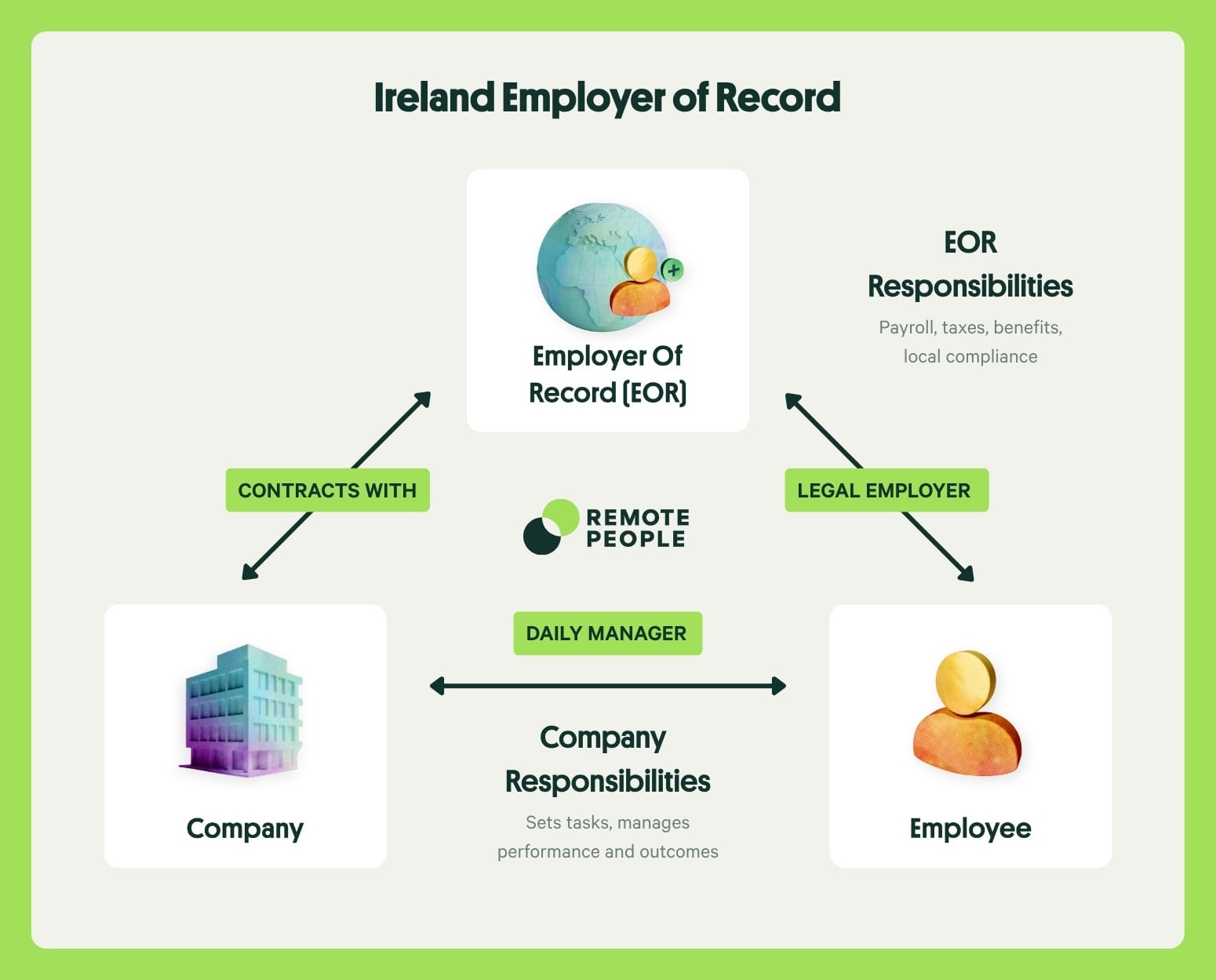
An Employer of Record in Ireland typically handles:
- Employment contracts: They draft legally compliant contracts that outline salary, employee benefits, working hours, and termination terms according to Irish law.
- Payroll processing: Salaries are calculated, processed, and paid, including all necessary deductions for taxes and social insurance.
- Tax and social contributions: The EOR registers with Irish tax authorities and ensures that all employer taxes and social security contributions are filed and paid correctly.
- Compliance with labor regulations: The EOR makes sure all legal employment standards are met, from employee classification to working conditions.
- Benefits administration: Mandatory benefits such as health insurance, pension contributions, and statutory leave are provided and managed on your behalf.

How Much Does an Ireland EOR Cost?
Most Ireland EOR providers charge a one-time onboarding fee, typically ranging from €1000 to €3000, depending on the provider and the service package. In addition, you’ll pay a monthly fee per employee, usually between €500 and €1500, based on factors like employee seniority, salary level, and any additional support services.
Some EORs also offer optional add-ons, such as enhanced health insurance packages, customized HR support, or detailed tax reporting services, which may incur extra costs beyond the standard monthly fee.
Even with these fees, using an EOR is often far more cost-effective than setting up and maintaining a local legal entity in Ireland, especially for companies looking to move quickly and stay flexible.

Employment and Labor Laws in Ireland
To hire legally in Ireland, it’s essential to follow the country’s labor regulations. These rules cover contracts, employee rights, taxes, and workplace conditions. Below is an overview of what employers need to provide and be aware of when hiring in Ireland.
Key Contract Requirements
When hiring in Ireland, employers must meet the following core legal and administrative requirements before an employee starts work:
- A written employment contract must be provided, covering job title, duties, salary, working hours, and termination terms
- The employee must be registered with Revenue before their first payday
- For non-EU nationals, a valid work permit must be obtained before employment begins
- Employees must be informed of their statutory rights, including leave entitlements and grievance procedures
GDPR Protection
Employers in Ireland are required to publish annual gender pay gap reports. The reporting threshold was 250 or more employees in 2022, reduced to 150 or more employees in 2024, and reduces further to 50 or more employees from 2025.
Reports must include the mean and median hourly pay gap, bonus pay gaps, and the proportion of employees receiving benefits-in-kind, broken down by gender. There are no direct penalties for having a pay gap, but failure to publish a report is a compliance risk and may attract regulatory scrutiny.
Employment Equality Act
The Employment Equality Acts 1998 to 2015 prohibit discrimination across nine grounds: gender, civil status, family status, sexual orientation, religion, age, disability, race, and membership of the Traveller community. These protections apply at every stage of the employment relationship, including recruitment, pay, promotion, working conditions, and dismissal. Employers are required to provide reasonable accommodation for employees with disabilities. The Equal Status Acts extend similar protections to access to services.
Gender Pay Gap Reporting
Employment complaints in Ireland are handled by the Workplace Relations Commission (WRC), which also conducts workplace inspections and adjudication. Employees can file a complaint within 6 months of the alleged contravention, extendable to 12 months where reasonable cause is shown. WRC inspectors have the authority to conduct unannounced workplace inspections, and adjudication hearings are held in private, though decisions are published. Appeals from WRC decisions are heard by the Labour Court.
Dispute Resolution
As an EU member state, Ireland is subject to the General Data Protection Regulation (GDPR), enforced locally by the Data Protection Commission (DPC). The DPC also serves as the lead supervisory authority for many US tech companies’ EU operations, making Ireland’s data protection environment particularly significant for international employers.
Employers must establish a lawful basis for processing employee personal data, issue privacy notices at the point of hiring, and conduct Data Protection Impact Assessments for any high-risk processing activities. Data breaches must be reported to the DPC within 72 hours, and employees have the right to access, correct, or request deletion of their personal data. Non-compliance can result in fines of up to EUR 20 million or 4% of global annual turnover, whichever is higher.
Working Hours
Under the Organisation of Working Time Act 1997, the maximum working week in Ireland is 48 hours, averaged over a reference period of 4 to 6 months depending on the sector. Employees are entitled to the following rest periods:
- 11 consecutive hours of daily rest between working days
- A 15-minute break after 4.5 hours of work
- A 30-minute break after 6 hours of work
- 24 consecutive hours of weekly rest
Employees required to work on Sundays are entitled to a reasonable premium or compensatory paid time off. Night workers are subject to additional restrictions, including a maximum of 8 hours worked in any 24-hour period and a requirement for regular health assessments.
Right to Request Remote Working
Under the Work Life Balance and Miscellaneous Provisions Act 2023, employees have the right to request remote working after 6 months of continuous service. Employers must respond within 4 weeks and can only refuse on specified business grounds. Employees working remotely can also claim tax relief on 30% of broadband and heating costs through the e-Working tax relief scheme.
Public Holidays
Ireland observes 10 public holidays per year. Employees are entitled to a paid day off or compensatory pay if required to work on any of these days:
- New Year’s Day (1 January)
- St. Brigid’s Day (first Monday in February, or 1 February if it falls on a Friday)
- St. Patrick’s Day (17 March)
- Easter Monday (date varies)
- May Bank Holiday (first Monday in May)
- June Bank Holiday (first Monday in June)
- August Bank Holiday (first Monday in August)
- October Bank Holiday (last Monday in October)
- Christmas Day (25 December)
- St. Stephen’s Day (26 December)
Overtime
There is no standard legal rate for overtime pay in Ireland. Whether or not overtime is paid, and at what rate, depends on the individual employment contract or any relevant collective agreements.
Probation Periods
Probation is optional but widely used. Most probation periods last between three and six months, though they can legally run for up to 12 months under specific conditions.
Payroll and Employment Taxes in Ireland
When hiring in Ireland, employers must follow the country’s payroll rules and contribute to various tax and social insurance systems. Below is a summary of key points related to payroll cycles, minimum wages, and both employer and employee contributions.
Payroll Cycle
Most companies in Ireland pay employees on a monthly basis, usually on the last working day of the month.
Minimum Wage
As of January 1, 2026, the national minimum wage in Ireland is EUR 14.15 per hour, which works out to approximately EUR 2,260 per month for a standard 40-hour workweek. This rate is part of Ireland’s National Living Wage framework, introduced by the Low Pay Commission, with the goal of setting the minimum wage at 60% of median hourly earnings.
Sub-minimum rates apply to younger workers and those in structured training:
| Category | Hourly Rate |
|---|---|
| Under 18 | EUR 9.91 |
| Age 18 | EUR 11.32 |
| Age 19 | EUR 12.73 |
| Age 20 and above (standard rate) | EUR 14.15 |
Reduced training rates may also apply during the first three years of employment where a formal training programme is in place.
Individual Income Tax Contributions
Income tax is charged at 20% up to the standard rate cut-off point and 40% on income above it. The cut-off point varies by personal circumstance as follows:
| Category | 20% Band (EUR) | Above Threshold |
|---|---|---|
| Single | Up to 44,000 | 40% |
| Married (one income) | Up to 53,000 | 40% |
| Married (two incomes) | Up to 86,000 | 40% |
| One-parent family | Up to 48,000 | 40% |
For married couples with two incomes, the combined band of EUR 86,000 is subject to a cap, where the increase for the second earner is limited to the lower of EUR 35,000 or their actual income.
Employees benefit from key tax credits that directly reduce the amount of tax owed. For 2025 and 2026, the Personal Tax Credit, Employee Tax Credit, and Earned Income Credit each stand at EUR 2,000. Ireland operates real-time payroll reporting under PAYE Modernisation, requiring employers to submit pay details to Revenue on or before each pay date. Tax credits are applied automatically through Revenue Payroll Notifications (RPNs). Where no RPN is available, emergency tax applies.
Employer Social Security Contributions
Employers in Ireland are responsible for paying additional costs on top of gross salary. The primary employer contribution is PRSI, which funds social insurance benefits.
| Contribution Type | Employer Rate | Notes |
|---|---|---|
| PRSI Class A (standard) | 11.25% | On weekly earnings above EUR 552. Effective 1 October 2025. |
| PRSI Class A (reduced) | 9% | On weekly earnings up to EUR 552. |
Employer PRSI is scheduled to increase to 11.40% from 1 October 2026 as part of the PRSI roadmap.
Employee Social Security Contributions
Employees contribute to tax and social insurance through the following deductions:
| Contribution Type | Rate |
|---|---|
| PRSI | 4.2% |
| USC (Universal Social Charge) | 0.5% – 8% |
| Income Tax | 20% / 40% |
Employee deductions are made up of three components: PRSI, USC, and income tax.
PRSI is charged at 4.2% effective October 2025. No PRSI applies on weekly earnings up to EUR 352, and a sliding credit of up to EUR 12 per week applies for earnings between EUR 352 and EUR 424. This rate is scheduled to increase to 4.35% from 1 October 2026.
USC is a tax on gross income charged in addition to PRSI and income tax. It applies to all employees earning above EUR 13,000 per year, calculated on gross income before pension contributions. Employees with total annual income of EUR 13,000 or less are exempt entirely. The rates for 2025 and 2026 are as follows:
| Income Band | USC Rate |
|---|---|
| Up to EUR 12,012 | 0.5% |
| EUR 12,013 to EUR 27,382 | 2% |
| EUR 27,383 to EUR 70,044 | 3% |
| Above EUR 70,044 | 8% |
The 3% rate on the third band was reduced from 4% as part of Budget 2025, providing modest relief for middle-income earners. Reduced USC rates apply to medical card holders and individuals aged 70 and over, provided their income does not exceed EUR 60,000. USC is calculated on a cumulative basis throughout the tax year and is withheld by the employer through the PAYE system alongside income tax and PRSI.
Income tax is charged at 20% up to the standard rate threshold and 40% on income above it.
Pension System
Ireland is introducing a mandatory Auto-Enrolment pension scheme, expected to be phased in from late 2025 into 2026. Employees aged 23 to 60 who earn above EUR 20,000 per year and are not already enrolled in a qualifying pension scheme will be automatically enrolled.
Contributions are designed to increase gradually over a 10-year period, giving both employers and employees time to adjust.

| Contributor | Initial Rate | Rate After 10 Years |
|---|---|---|
| Employee | 1.5% | 6% |
| Employer | 1.5% | 6% |
| State Top-Up | EUR 1 for every EUR 3 contributed by the employee | |
Employer contributions are matched to the employee’s contribution at each stage of the phase-in. The state top-up effectively adds an additional 33% on employee contributions, making this one of the more generous auto-enrolment structures in Europe. Employers should factor the rising contribution rates into long-term employment cost planning, as the full 6% employer contribution will represent a meaningful addition to total payroll costs over time.
Bonus Payments
Irish law does not require employers to pay bonuses or a 13th-month salary. Any such payments are typically outlined in employment contracts or agreed upon at the company level.
Tax Compliance and Payroll Reporting
Accurate and timely payroll reporting is essential in Ireland, particularly under the PAYE Modernisation system. Employers must report pay, income tax, and social insurance contributions to Revenue in real time, on or before each pay date. These submissions include gross pay, PAYE (income tax), USC (Universal Social Charge), and PRSI (Pay-Related Social Insurance).
Non-compliance, such as late filings or underpayments, can result in financial penalties or trigger audits. Employers must also issue payslips showing deductions and ensure that payroll data is securely stored for inspection. Working with a payroll provider or Employer of Record can reduce the risk of errors and help meet reporting deadlines consistently.
Work Permits and Visas in Ireland
Non-EEA, non-Swiss nationals will generally require a valid employment permit before starting work in Ireland. The type of permit depends on the role, salary level, and the candidate’s qualifications. Key permit types include:
- Critical Skills Employment Permit — For roles on the government’s Critical Skills Occupations List, typically in IT, engineering, and healthcare. Requires a minimum salary of EUR 38,000 for listed occupations, or EUR 64,000 or above for other eligible roles. Offers a faster pathway to residency.
- General Employment Permit — For a broader range of roles not covered by the critical skills list. Requires a minimum salary of EUR 34,000, though some occupations may qualify at EUR 30,000. Employers must complete a Labour Market Needs Test, advertising the role for at least 28 days to demonstrate it could not be filled locally.
- Intra-Company Transfer Permit — Allows multinational companies to transfer employees from an overseas branch to their Irish operations for a fixed period.
All employment permits are issued for up to 2 years and are renewable. Employers must also comply with the 50/50 rule, which requires at least 50% of their workforce to be EEA or Swiss nationals.
Time Off and Leave in Ireland
Mandatory Leave Entitlement
Employees in Ireland are entitled to four weeks of paid annual leave per if they work full time. For part-time employees, the allowance is based on 8% of the hours worked, up to a maximum of four weeks.
Maternity Leave
All female employees are entitled to 26 weeks of maternity leave, regardless of how long they’ve been employed. An additional 16 weeks of unpaid leave can be added after the statutory leave ends.
Parental Leave
Ireland provides several forms of parental and family leave beyond standard maternity and paternity entitlements.
- Parental Leave allows each parent to take up to 26 weeks of unpaid leave per child, to be taken before the child reaches 12 years of age. Both parents are entitled to this independently, and it can be taken in one block or in separate periods subject to employer agreement.
- Parent’s Leave entitles each parent to 9 weeks of paid leave within the first 2 years of a child’s birth or adoption. This was increased from 7 weeks in August 2024. Leave is paid at EUR 274 per week through Parent’s Benefit, administered by the Department of Social Protection (DEASP). As with parental leave, both parents hold this entitlement individually.
- Adoptive Leave provides 24 weeks of paid leave for the adopting parent, in addition to any parental or parent’s leave entitlements that may apply.
Force Majeure Leave covers urgent and unavoidable family emergencies where the immediate presence of the employee is required. Employees are entitled to a maximum of 3 days paid leave in any 12-month period, or 5 days over any 36-month period. A medical certificate or supporting documentation may be required depending on the circumstances.
Sick Leave
Under the Sick Leave Act 2022, employees are entitled to 5 days of paid sick leave per calendar year. To qualify, employees must have completed at least 13 weeks of continuous service and provide a medical certificate from the first day of absence. Sick pay is set at 70% of normal wages, capped at EUR 110 per day.
The previously planned increases to 7 days in 2025 and 10 days in 2026 have been paused following a ministerial review of the impact on small and medium-sized businesses. The entitlement remains at 5 days for 2025 and beyond, with future increases expected but no confirmed timeline announced.
Bereavement and Jury Duty
Bereavement leave is not mandatory under Irish law but is typically granted by employers for 3 to 5 days in the event of a death in the immediate family. Employees called for jury service must be allowed time off and continue to receive full pay.
Employee Benefits in Ireland
Beyond statutory entitlements, many employers in Ireland offer supplementary benefits to attract and retain talent in a competitive labor market. Common additions include private health insurance, life and disability cover, wellness programs, performance-based bonuses, Employee Assistance Programs (EAPs), and pension contributions beyond the state minimum. Flexible working arrangements, including remote work, hybrid models, and compressed hours, have also become standard expectations particularly in tech, finance, and professional services. Some companies extend this further with learning stipends or tuition reimbursement.
Employers should be aware that certain benefits are treated as benefits-in-kind and must be reported to Revenue and taxed accordingly. Structuring a benefits package correctly from the outset helps avoid unexpected tax liabilities for both the employer and employee.
Terminations and Severance in Ireland
Termination
Terminations must comply with the Unfair Dismissals Acts 1977 to 2015. Employees with 12 or more months of continuous service can bring an unfair dismissal claim, though this threshold does not apply where dismissal relates to pregnancy, trade union membership, or whistleblowing.
All dismissals must follow fair procedures under SI 146/2000, including informing the employee of the grounds, allowing them to respond, and providing an appeals process. Compensation for a successful claim can reach up to two years’ remuneration. Constructive dismissal claims are also actionable under the same legislation.
Transfer of Undertakings
Under the European Communities (Protection of Employees on Transfer of Undertakings) Regulations 2003 (SI 131/2003), employees’ terms and conditions are automatically protected when a business transfers to a new employer. Continuity of service and existing contractual rights must be preserved through the transfer. This is particularly relevant when switching EOR providers, as the change in legal employer may constitute a transfer of undertaking, requiring careful handling to ensure full compliance and no disruption to employee entitlements.
Restrictive Covenants
Non-compete and non-solicitation clauses are enforceable in Ireland provided they are reasonable in scope, duration, and geographic area. Courts assess enforceability strictly, and overly broad restrictions will be struck down.
A duration of 6 to 12 months is generally considered reasonable depending on the seniority of the role and the legitimate business interest being protected. Garden leave provisions are common in senior contracts and can serve a similar protective function.
Employers should ensure any restrictive covenants are clearly drafted and proportionate, as there is no automatic right to enforcement.
Notice Periods
Notice requirements in Ireland are governed by the Minimum Notice and Terms of Employment Acts 1973 to 2005. The statutory minimum notice period is based on the employee’s length of service as follows:
| Length of Service | Minimum Notice Period |
|---|---|
| 13 weeks to 2 years | 1 week |
| 2 to 5 years | 2 weeks |
| 5 to 10 years | 4 weeks |
| 10 to 15 years | 6 weeks |
| 15 years or more | 8 weeks |
Where an employment contract specifies a longer notice period, the contractual terms take precedence over the statutory minimums. Employees are required to give a minimum of 1 week’s notice regardless of their length of service. Payment in lieu of notice is permitted in all cases.
Severance and Redundancy Pay
Employees who are made redundant after two or more years of continuous service are entitled to statutory redundancy pay, provided they are aged 16 or over. The payment is calculated as two weeks’ pay for each year of service, plus one additional week’s pay, with weekly earnings capped at EUR 600 gross. This cap has been unchanged since 2005. Redundancy payment must be made on or before the date of termination, and employers bear the full cost as the previous 60% employer rebate has been discontinued.
Redundancy payments benefit from a tax-free exemption made up of a basic exemption of EUR 10,160 plus EUR 765 for each completed year of service. Any amount exceeding this threshold may be subject to income tax, though additional reliefs may apply depending on the employee’s circumstances.
Expand into Ireland Easily with RemotePeople’s Employer of Record in Ireland
Hiring in Ireland offers many advantages, from access to a skilled workforce to strong employee protections and clear legal frameworks. Whether you’re building a local team or adding remote staff to support your European operations, it’s important to understand the country’s employment standards, tax requirements, and cultural expectations.
Working with an Employer of Record in Ireland can make the process smoother by handling local compliance and administrative tasks, allowing your team to focus on growth and productivity. For companies looking to hire efficiently and responsibly in Ireland, preparation and the right local support are key to long-term success.
Ireland offers one of Europe’s most stable and skilled hiring environments, backed by clear employment legislation, strong worker protections, and full EU compliance. For companies looking to hire here efficiently and compliantly, partnering with an Employer of Record removes the complexity and lets you focus on building your team.
Where companies hiring in Ireland expand next
Employers hiring in Ireland frequently expand into adjacent English-speaking European hubs as a natural next step. Most teams start with the Netherlands — the Benelux-region multilingual talent pool. A team in Spain typically follows, with adjacent EU market with harmonized labor directives. Operations in Portugal is a natural addition for EU-wide worker mobility and portable social security, and the United Kingdom completes the regional picture with aligned English-language hiring dynamics.
Frequently Asked Questions
The Critical Skills Employment Permit is for roles on the government's designated shortage list, typically in IT, engineering, and healthcare, and offers a faster route to residency. The General Employment Permit covers a broader range of roles but requires employers to first complete a Labour Market Needs Test, demonstrating the role could not be filled locally. Salary thresholds also differ between the two.
No. Irish law does not mandate a 13th month salary or annual bonus. Any such payments are discretionary and should be outlined in the employment contract if offered.
Ireland's mandatory Auto-Enrolment pension scheme is being phased in from late 2025 into 2026. Employees aged 23 to 60 earning above EUR 20,000 per year who are not already in a qualifying pension scheme will be automatically enrolled. Both employer and employee start at a 1.5% contribution rate, rising to 6% over 10 years, with a state top-up of EUR 1 for every EUR 3 contributed by the employee.
Not in most cases. Employees generally need 12 months of continuous service before they can bring an unfair dismissal claim. However, this threshold does not apply where the dismissal is connected to pregnancy, trade union membership, or whistleblowing, in which case protection applies immediately.
No. You can hire in Ireland without a local entity by using an Employer of Record. The EOR acts as the legal employer on your behalf, handling payroll, taxes, social insurance, and compliance while you manage the employee's day-to-day work.
Yes, but only if they are reasonable in scope, duration, and geographic area. Courts assess enforceability strictly, and overly broad restrictions will be struck down. A duration of 6 to 12 months is generally considered reasonable depending on the role and the legitimate business interest being protected.
Employer of Record in
Employer of Record in
Employer of Record in
Employer of Record in
Employer of Record in
Employer of Record in
Employer of Record in
Employer of Record in




