
 Recruit
Employer of Record (EOR) in Albania
-
 Drew Donnelly
- Published
- September 27, 2026
RemotePeople’s employer of record in Albania lets you hire employees in Albania without setting up a local entity. We handle social insurance contributions at 9.5% of employee salaries, health insurance contributions at 1.7%, and statutory annual leave of 22 working days per year.
Hire in Albania — book a free 30-minute demo
Tell us what you need. You'll get a tailored, transparent proposal within 24 hours, plus a free call to walk through it.
Tell us about your company
So we can match you with a specialist who knows your market — and unlock volume pricing tiers.
* All fields are required.
Where and when are you hiring?
Tell us the geography and timing and we'll quote each country line by line, with onboarding timelines.
* All fields are required.
Help us beat your current setup
We'll benchmark your current deal and send a line-by-line proposal in 24 hours — showing exactly where we cut cost, time, or risk. After you submit, you can book a call to walk through it together.
* All fields are required.
Thanks! Your proposal is on its way.
Expect a tailored, line-by-line proposal in your inbox within 24 hours. In the meantime…
Want to walk through it together?
Book a free 30-minute call with one of our specialists. We'll explain every line, answer your questions, and tailor the proposal further if you need.
No obligation. Pick a time that works for you.








- Hire in Albania — book a free 30-minute demo
- Tell us about your company
- Where and when are you hiring?
- Help us beat your current setup
- Thanks! Your proposal is on its way.
- How an Employer of Record Works in Albania
- Employment Laws and Regulations in Albania
- Work Permits and Visas in Albania
- Payroll, Taxes, and Social Security in Albania
- Cost of Hiring Through an EOR in Albania
- Benefits of Using an EOR in Albania
- Termination and Offboarding in Albania
- EOR vs. Other Hiring Models in Albania
- Public Holidays in Albania
- How to Get Started with an EOR in Albania
- Where companies hiring in Albania expand next
- Frequently Asked Questions
- Related EOR Destinations
Start hiring in Albania
Let RemotePeople handle payroll, compliance, and HR admin worldwide so you can focus on building your team.

An employer of record (EOR) in Albania lets you hire local talent without setting up a legal entity or wading through complex employment regulations yourself. You get simpler hiring, streamlined payroll, and full compliance with Albanian labour laws. Albania’s location in Southeast Europe, combined with a cost-effective workforce and English-speaking talent pool, makes it attractive for remote hiring. An EOR handles all the compliance work: contracts, tax withholding, social security, benefits. This frees you to focus on building your team. Want to expand quickly? An EOR cuts the typical 3-6 month setup timeline down to weeks and protects you against employment law violations.
How an Employer of Record Works in Albania
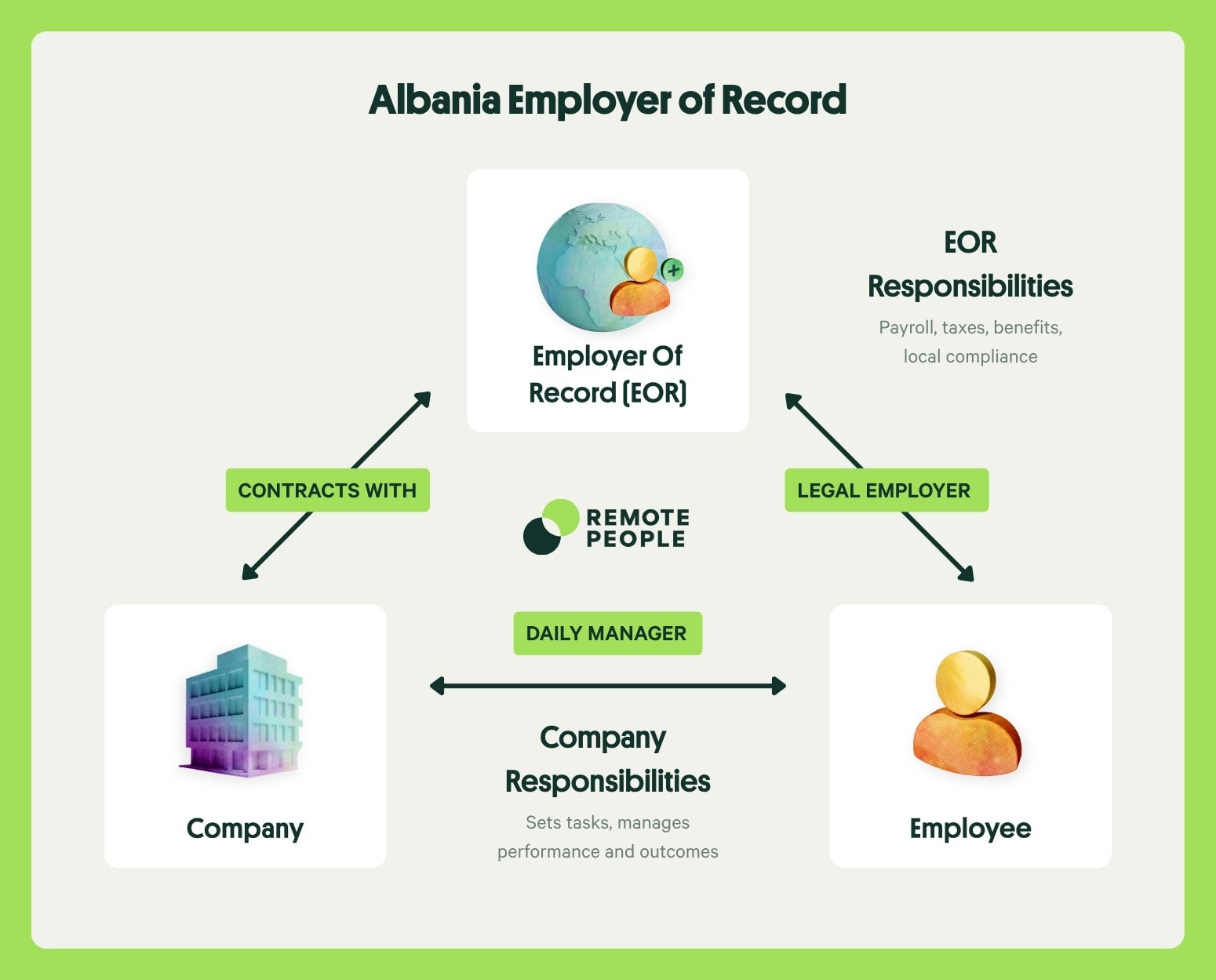
If you’d like to learn more about how Employer of Record (EOR) services work, read our What Is an Employer of Record (EOR)? guide for a complete overview of the model, its benefits, and when to use it.
If you’re comparing providers, our Best Employer of Record (EOR) Providers guide reviews the leading platforms to help you choose the right solution for your business.
Who Uses an EOR in Albania?
EORs in Albania work for startups rushing to market without legal overhead, established corporations testing new regions, consulting firms accessing specialized talent, and software development shops. All benefit from Albania’s skilled workforce and favorable cost structure.
Orgs with fewer than five Albanian employees typically find EOR cheaper than a local subsidiary. Larger orgs sometimes use EORs for specific units or temp projects. And multinationals often consolidate with one EOR provider for simpler global payroll.
Typical Onboarding Timeline
The process usually takes 7-14 calendar days from initial contact to first payroll. Here’s the sequence:
- First: Initial consultation and needs assessment (1-2 business days). Your organization meets with the EOR to discuss hiring plans, compensation ranges, job descriptions, and timeline expectations. The EOR confirms service scope, fee structure, and compliance requirements specific to your situation.
- Second: Candidate details provided (1 business day). Once you have selected your hire, share the job title, compensation, and start date with the EOR so contract preparation can begin. Recruitment itself is a separate service and is not part of standard EOR onboarding.
- Third: Employment contract preparation and review (2-3 business days). The EOR drafts an employment contract compliant with the Albanian Labour Code, including role description, compensation, benefits, leave entitlements, and termination terms. You and the candidate review the contract; any revisions are completed quickly.
- Fourth: Employment agreement execution (1 business day). The candidate and EOR sign the employment contract; the employee relationship is now formally established. The EOR registers the employee with Albanian social insurance and tax authorities.
- Fifth: First payroll setup and employee onboarding (1-2 business days). The EOR configures payroll processing, collects required tax and benefit documentation from the employee, and processes the first salary payment on the agreed date. You provide company orientation, access credentials, and project details.
Work permits for non-EEA hires and complex compensation can stretch things out, but most straightforward hires move quickly.
Hire in Albania
A cost-effective workforce, favorable tax structure, and growing English-speaking talent pool make Albania one of Southeast Europe’s best-kept hiring secrets.
We handle employment contracts, payroll, tax withholding, and full Albania compliance.
No local entity needed. Your team can start in days.
Employment Laws and Regulations in Albania
Employment Contracts
All employment relationships in Albania must be documented by a written employment contract. The primary governing statute is the Labour Code (Law No. 7961/1995), as amended, which sets minimum contract requirements. The contract must specify the employee’s name, position, workplace location, job responsibilities, probationary period (if applicable), compensation (gross and any performance-based components), working hours, leave entitlements, and termination terms. Contracts may be concluded for a definite term (fixed-term employment) or indefinite term (permanent employment). Fixed-term contracts may only be used for specific and temporary tasks, and their total duration including any renewal cannot exceed 3 years under the Labour Code. If the employee continues working after the fixed term expires without a new contract, the arrangement automatically converts to an indefinite-term contract. Indefinite contracts continue until either party terminates with proper notice.
Any contract changes (pay, hours, duties) must be written. The EOR prepares amendments for both parties to sign. Verbal changes don’t count and create risk.
Working Hours and Overtime
The standard full-time work week in Albania is 40 hours, distributed as 8 hours per day across 5 working days. Most employers operate Monday through Friday; the weekend consists of Saturday and Sunday. Time worked beyond 40 hours per week constitutes overtime and must be compensated at premium rates. Total overtime is capped at 200 hours per calendar year under Article 91 of the Labour Code. Employees are also entitled to a minimum daily rest of 11 consecutive hours and a weekly rest of 36 consecutive hours under Articles 83 and 86 of the Labour Code.
Albania overtime pay rates · Per Labour Code | ||
Overtime Type | Pay Rate | Example Rate |
|---|---|---|
Weekday overtime | 125% | Base hourly rate × 1.25 |
Holiday or rest day overtime | 150% | Base hourly rate × 1.50 |
Employers must track overtime hours accurately and ensure premium payments are reflected in payroll.
Contracts can include flexible or task-based work if both sides agree. Remote work is standard in Albania; just clarify the arrangement (fully remote, hybrid, in-office) and any sync requirements. Work-from-abroad is fine if the role doesn’t need office time.
Minimum Wage
Albania’s monthly minimum wage is ALL 50,000 (approximately $605 USD), effective 1 January 2026. This rate applies to all full-time employees regardless of sector or industry. Part-time employees must be compensated at a pro-rata minimum based on hours worked. The minimum wage is a floor; employers may pay more. Every employment contract must specify compensation at or above this threshold.
The minimum wage increases annually on 1 January based on inflation and economic conditions as determined by government decree. An EOR automatically adjusts compensation schedules to reflect minimum wage increases, ensuring compliance and avoiding wage underpayment penalties.
Probation Period
Employment contracts may include a probation period of up to 3 months. During probation, either the employer or employee may terminate the relationship with 5 days’ notice and without cause. This shorter notice period allows both parties to assess fit before committing to longer-term employment.
They’re optional and work well for technical roles. Just state the period upfront in the contract. Probationary staff get the same minimum wage, overtime, benefits, and legal protections as permanent employees.
Leave Entitlements
Annual Leave
All employees in Albania are entitled to 22 working days of annual paid leave per year under Law No. 91/2024, effective 24 August 2024. This entitlement applies to all employees, regardless of employment type or tenure. Working days are calculated as weekdays excluding public holidays. For a standard 5-day work week, 22 working days equals approximately 4.4 calendar weeks or roughly 30-31 calendar days when holidays are included.
Leave must be scheduled with the employer’s approval. You’re required to let employees take their full allotment each year or carry days forward (unless your policy restricts it). If they leave the company, they get paid for unused leave.
Sick Leave
Sick leave is administered in two phases under the Labour Code. For the first 14 days of absence due to illness per year, the employer pays 80% of the employee’s regular salary. Medical certification is required, typically a doctor’s note or health certificate. Beyond 14 days, the social insurance system assumes responsibility and pays either 70% of salary (standard benefit) or 80% of salary (if the employee has 10 or more years of contributions). The employee must provide medical documentation to claim social insurance benefits.
Sick leave is separate from annual leave and does not reduce annual leave entitlements. Employees should notify their employer as soon as possible when unable to work due to illness, and provide a medical certificate within three days (or as specified by the employer’s policy).
Maternity Leave
Maternity leave totals 365 days, comprised of two phases. During the first 150 days, the employee receives 80% of her regular salary, paid by the Social Insurance Institute (the employer does not directly pay this benefit; the social insurance system covers it). For the remaining 215 days, the employee receives 50% of salary, also paid by social insurance.
The leave must be continuous around the birth and the employee’s job is protected. She returns to the same position or equivalent role afterward.
Paternity Leave
Albania does not have a statutory paternity leave entitlement under the Labour Code. Some employers offer 3 days of voluntary paid leave around the birth as a contractual benefit, but this is not required by law. A 2020 proposed amendment to introduce a statutory 3-day paternity right was not enacted. If the EOR’s employment contract grants paternity leave as a contractual benefit, it should be stated explicitly in the contract.
Other Statutory Leave
Employees are entitled to paid time off for specific life events: 5 days for the employee’s own marriage and 5 days for the death of a spouse, parent, or direct descendant, under Article 96(1) of the Labour Code. These are granted separately from annual leave and sick leave and are intended to address significant personal events. Documentation (marriage certificate or death certificate) is typically required as proof.
Albania observes 13 public holidays per year. Employees don’t work them and get paid the regular rate if the holiday falls on a work day. Work on a holiday? That’s 150% pay.
Albania statutory leave entitlements · Per Labour Code (Law No. 7961/1995) | ||
Leave Type | Duration | Eligibility & Notes |
|---|---|---|
Annual Leave | 22 working days/year | 100% paid salary |
Sick Leave (Employer) | 14 days/year | 80% paid by employer |
Sick Leave (Social Insurance) | Beyond 14 days | 70% or 80% via social insurance |
Maternity Leave (Phase 1) | First 150 days (35 pre-birth + 115 post-birth) | 80% paid by social insurance |
Maternity Leave (Phase 2) | Remaining 215 days | 50% paid by social insurance |
Paternity Leave | None (not statutory) | Contractual benefit only |
Marriage Leave | 5 days | 100% paid by employer |
Bereavement Leave | 5 days | 100% paid by employer (spouse, parent, or direct descendant) |
Statutory Employee Benefits
All employers in Albania must enroll employees in the mandatory social insurance and health insurance systems, which function as statutory benefits independent of internal company benefits programs. Enrollment occurs automatically upon contract signature; the EOR handles registration with the social insurance institute and tax authority.
Social insurance covers old-age pension, disability, and survivor benefits. Both employer and employee contribute to this system. Health insurance provides access to Albania’s public healthcare system and covers medical examinations, hospitalization, prescription medications, and other medical services. The insured employee and dependents (spouse, children) are entitled to healthcare under the public system. Contributions are withheld from the employee’s salary and remitted to the social insurance and health insurance funds by the employer.
Beyond statutory benefits, some employers offer supplementary benefits such as private health insurance, life insurance, professional development allowances, or transportation subsidies. These voluntary benefits are negotiated individually and documented in the employment contract or a separate benefits agreement. They are not required by law but can be valuable recruitment and retention tools, especially for competitive roles.
Recent Regulatory Updates (2026)
The most significant recent change is the adjustment of the minimum wage effective 1 January 2026 to ALL 50,000 per month. This represents the annual minimum wage adjustment. Additionally, Law No. 91/2024 updated annual leave entitlements to 22 working days, effective 24 August 2024, improving employee leave protections.
The Albanian government has signalled ongoing labour law modernization, including potential updates to remote work regulations, digital employment platforms, and non-standard work arrangements. EORs monitor these developments and update practices accordingly. At present, no major legislative changes are imminent, but organizations should remain aware that additional updates may occur throughout 2026.
Work Permits and Visas in Albania
Work Permit Requirements
Who Needs a Work Permit
Non-EEA citizens (US, Canada, Australia, India, etc.) need a work permit. EU/EEA citizens can work freely; they just register locally. Albanian citizens need nothing.
Albanian citizens can work anywhere. EEA citizens just register at the local police directorate.
Eligibility and Required Documents
Non-EEA nationals apply through the Ministry of Interior or state police (the EOR usually handles this). You’ll need a permit application, passport, signed contract, proof of employer registration, credentials, and a medical certificate.
Some countries have bilateral agreements with Albania that speed things up or exempt professions. The EOR will advise on your specific case.
An important consideration: the work permit is issued to the individual employee, not the employer. If an employee changes employers, a new work permit application is typically required. This is a practical reason why EORs are valuable; the EOR holds the formal employer status, so employee mobility within the organization (role changes, internal transfers) does not require permit renewal.
Processing Time and Validity
Processing usually takes 15-30 days, though it can be faster if the credentials are solid or the role is in a priority sector like tech or finance.
Permits last one year and renew easily. The EOR watches the deadline and applies early so there’s no gap. Working past expiration is illegal, so timing matters.
Renewal Process
Renewal starts 30-60 days before expiration. The EOR preps updated documents and submits everything. It usually takes 10-20 days. Major changes to role or pay might slow things down.
Common Visa Types for Foreign Workers
Albania’s 2022 Unique Permit (also called the Single Permit) consolidates work authorization and residence into one application, per Fragomen. Foreign nationals employed by Albanian entities, intracompany transferees, digital nomads working remotely for foreign employers, and self-employed investors all apply through this single track, with processing targeted at 4 to 12 weeks. Nationals of visa-required countries must also obtain a Type D long-stay entry visa before collecting the permit in Albania.
Albania work visa types for foreign workers · 2026 | ||||
Visa Type | Duration | Best For | Leads to Long-Term Residency? | Processing |
|---|---|---|---|---|
Unique Permit – Employee | 1 year, renewable | Locally hired foreign staff | Yes, after 5 years | 4–12 weeks |
Unique Permit – Intracompany Transfer | 1 year, renewable | Multinational transferees and highly qualified staff | Yes | 4–12 weeks |
Unique Permit – Digital Nomad (DME) | 1 year, then 2 + 5 year renewals | Remote workers for foreign employers | Yes, after 5 years | 4–12 weeks |
Unique Permit – Self-Employed / Investor | 1 year, renewable | Freelancers, contractors, investors | Yes | 4–12 weeks |
Type D Long-Stay Entry Visa | Single-entry, 90 days to collect permit | Pre-entry travel document for visa-required nationals | N/A (entry visa only) | 5–15 working days |
How an EOR Handles Work Permits
An EOR coordinates the entire work permit process on behalf of the employee and the organization. Upon hiring a non-EEA national, the EOR assesses work permit requirements, gathers necessary documents from the employee (passport, medical records, credentials), completes all application forms, and submits the application to the Albanian authorities. The EOR tracks the application status, follows up if additional information is requested, and notifies you and the employee when the permit is granted.
The EOR also advises on visa options and, if necessary, provides documentation (employment contract, proof of sponsorship) to support visa applications at the Albanian embassy or consulate in the employee’s home country. Some organizations arrange visa sponsorship directly, while others ask the EOR to coordinate. The EOR can facilitate either approach.
For more detailed information on work permits and visa requirements, see the full guide to work permits and visas in Albania.
Payroll, Taxes, and Social Security in Albania
Employer Contributions
You must contribute to social insurance and health insurance for every employee. These are percentages of gross salary paid directly to the funds; they don’t reduce employee take-home pay.
Albania employer social security contributions · 2026 rates | ||
Contribution | Rate | Notes |
|---|---|---|
Social Insurance | 15% | Old-age, disability, survivor benefits; subject to monthly ceiling of ALL 186,416 |
Health Insurance | 1.7% | Public healthcare access; subject to monthly ceiling of ALL 186,416 |
Total Employer Contribution | 16.7% | Combined mandatory contributions |
The employer contribution rate for social insurance is 15% and for health insurance is 1.7%, totalling 16.7%. These contributions are subject to a monthly ceiling; contributions are calculated on wages up to ALL 186,416 per month (approximately $2,254 USD). Wages above this ceiling are not subject to employer contributions, creating a cost savings for higher-compensation roles. For example, an employee earning ALL 200,000 per month (above the ceiling) triggers contributions only on ALL 186,416, not the full salary.
Employee Contributions
Employees also contribute (deducted from gross salary) under the same monthly ceiling as employers.
Albania employee payroll deductions · 2026 monthly withholdings | ||
Deduction | Rate | Notes |
|---|---|---|
Social Insurance | 9.5% | Withheld from employee salary; subject to monthly ceiling of ALL 186,416 |
Health Insurance | 1.7% | Withheld from employee salary; subject to monthly ceiling of ALL 186,416 |
Total Employee Contribution | 11.2% | Combined mandatory deductions |
The employee contribution rate for social insurance is 9.5% and for health insurance is 1.7%, totalling 11.2%. These deductions reduce the employee’s net take-home pay. For example, an employee with a gross monthly salary of ALL 100,000 (approximately $1,209 USD) has deductions of ALL 11,200, resulting in net pay of ALL 88,800 (approximately $1,073 USD).
Income Tax
Albania imposes a progressive personal income tax (PIT) on employment income. Under Law No. 29/2023 (effective 1 January 2024), monthly salaries are taxed using a notched 4-tier structure. Employees earning up to ALL 50,000 per month pay nothing, while higher earners pay 13% or 23% only on the portion above defined deductions.
Albania monthly personal income tax brackets · 2026 (effective 1 January 2025) | ||
Monthly Taxable Income (ALL) | Rate | Tax Calculation |
|---|---|---|
Up to ALL 50,000 | 0% | No income tax (fully exempt) |
ALL 50,001 – 60,000 | 13% | 13% × (monthly income − ALL 35,000) |
ALL 60,001 – 200,000 | 13% | 13% × (monthly income − ALL 30,000) |
Above ALL 200,000 | 23% | ALL 22,100 + 23% × (monthly income − ALL 200,000) |
Because the brackets are applied monthly, an employee earning ALL 41,350 (about $500 — the salary level used throughout this guide) owes zero income tax, since gross pay falls below the ALL 50,000 exemption. By contrast, an employee earning ALL 100,000 per month (roughly $1,209) would pay 13% × (100,000 − 30,000) = ALL 9,100, or about $110 per month. The EOR withholds the calculated amount from each paycheck and reconciles any difference at year end based on cumulative earnings.
Payroll Cycle
Monthly payroll is standard in Albania, usually on the 25th or 30th. Some do bi-weekly. Most use bank transfer; cash or cheque work if both agree.
The EOR handles payroll on your schedule: calculates gross pay, withholds taxes and contributions, sends employer portions to the right funds, generates payslips, and transfers net pay. Payslips show all earnings, deductions, and take-home; employees keep copies.
Keep payroll records for five years; they’re open to inspection. The EOR maintains them and gives you regular reports on costs, deductions, and government payments.
13th Month Salary and Bonus Pay
A 13th month bonus isn’t required in Albania. Some employers offer it as a holiday gift or performance reward. If you do, document it in the contract and pay it on schedule.
Bonuses are fine and encouraged. They’re taxed like regular salary. A $500 bonus triggers the same tax and contribution withholding as regular pay.
Severance is usually not taxed if it’s per law or policy. Unused leave paid out? That’s taxed like regular income.
Cost of Hiring Through an EOR in Albania
EOR Service Fees
EOR fees range from $300-600/employee/month depending on complexity and support level. Some charge flat fees, others a payroll percentage (5-15%), or a hybrid model. Ask what’s included: payroll, taxes, benefits, HR, recruitment. Check for hidden fees.
Total Employment Cost Breakdown
Total cost includes gross salary, employer contributions (16.7%), and the EOR fee. Budget all three when planning headcount.
Albania employer cost example · $1,200/month gross · 2026 | ||
Employer Cost | Amount (USD) | % of Gross Salary |
|---|---|---|
Employee Gross Salary | $1,200 | 100% |
Employer Social Insurance (15%) | $180 | 15% |
Employer Health Insurance (1.7%) | $20 | 1.7% |
EOR Monthly Service Fee | $400 | 33% |
Total Monthly Employer Cost | $1,800 | 150% |
Figures converted at 1 USD ≈ 82.7 ALL (April 2026). Monthly USD totals rounded to the nearest dollar.
At $1,200 gross, your total cost is $1,800 (salary + 16.7% insurance + $400 EOR fee). Percentages shift with salary. A $2,500 earner costs closer to 46% above gross because contributions hit the ceiling. Higher earners = lower percentage.
A lower earner at $600/month costs $501, or 83.5% above gross, because the EOR fee stays fixed. This shows why fees hit harder on lower wages. Hiring multiple employees can help you negotiate volume discounts.
Costs are standard across most providers, though fees vary. Some offer tiering for 10+ employees or performance pricing. Always get a detailed breakdown upfront and ask about hidden costs: visa work, recruiting, penalties.
Rapid scaling can lower per-employee costs. Plus, you save on legal and accounting fees you’d spend setting up a subsidiary. You also avoid penalties for employment law violations.
Ready to hire your first employee in Albania? Contact RemotePeople for a free consultation on EOR services, cost estimates, and hiring timelines. Our team will guide you through the entire process, from role definition to first payroll, ensuring your Albania team is compliant, cost-effective, and productive from day one.
Benefits of Using an EOR in Albania
An EOR skips the bureaucracy of setting up a local entity. No weeks of registration, no local director hire, no office lease. You hire your first employee in days. That matters when you need to move fast.
Your EOR handles all compliance: payroll withholding, the 16.7% employer and 11.2% employee contributions, government filings. This transfers legal risk to them. They know the Labour Code inside and out and update as laws change.
A local entity costs $2,000-5,000 upfront plus $3,000-8,000 yearly for maintenance. An EOR costs $300-600/employee/month, no hidden fees. You skip the local finance hire, office rent, and tax hassles. For teams under 15, the EOR is cheaper and simpler. Employees get statutory leave, security, and local payroll, which boosts retention without adding internal overhead.
Termination and Offboarding in Albania
Notice Periods
Notice periods vary by tenure and contract type. During probation (up to 3 months), either side gives 5 days’ notice. This lets both parties test the fit.
Albania notice periods by tenure · Per Labour Code | ||
Employment Duration | Notice Period | Applies To |
|---|---|---|
Probation (up to 3 months) | 5 days | Either party |
Up to 6 months | 2 weeks | Resignation or no-cause termination |
6 months – 2 years | 1 month | Resignation or no-cause termination |
2 – 5 years | 2 months | Resignation or no-cause termination |
5+ years | 3 months | Resignation or no-cause termination |
These notice periods apply equally to resignations and employer-initiated no-cause terminations. Just-cause terminations (documented misconduct, serious breach) can bypass notice requirements.
Severance Pay
Albania mandates severance for employees with 3 or more years of continuous service, calculated at 0.5 months of salary per full year, based on the average gross salary of the last 3 months. The formula is set out in Articles 145–146 of the Albanian Labour Code (WIPO Lex). The worked examples below use the $500/month average salary assumed throughout this guide.
Albania severance pay schedule by years of service · Per Labour Code (Law 7961/1995, as amended) | |||
Years of Service | Severance Amount | Base Salary | Notes |
|---|---|---|---|
Under 3 years | None | N/A | Below the 3-year statutory eligibility threshold |
3 years | 1.5 months of salary | Avg gross of last 3 months | Minimum eligibility met (0.5 months × 3 years) |
5 years | 2.5 months of salary | Avg gross of last 3 months | Matches worked example used in this guide |
10 years | 5 months of salary | Avg gross of last 3 months | Long-tenure payout, no statutory cap in Albania |
Calculation Method
Severance applies after 3+ continuous years: 15 days’ salary per year of service, based on the last 3 months’ average pay. A 5-year employee earning $500/month averages gets $1,250.
Caps and Exceptions
No severance for: just-cause terminations, resignations, fixed-term contract expiry, or probationary periods.
Wrongful termination (retaliation, discrimination, rights violations) can lead to damages of up to 12 months’ wages instead of severance. Document everything and follow procedures. Your EOR ensures legal compliance.
Grounds for Termination
You can terminate for cause (performance, rule violations) or no cause (restructuring), with proper notice. Cause terminations need documentation. No-cause terminations follow the notice periods and may trigger severance.
Termination for discrimination (age, gender, race, religion, disability, pregnancy, union activity) is illegal. Retaliation for reporting safety violations is also unlawful. Work with your EOR to document everything and stay protected.
For indefinite-term contracts, Albanian law requires a specific termination procedure. The employer must first send a written meeting invitation at least 72 hours in advance; hold the meeting to discuss the reasons for termination; and then issue the written termination notice no sooner than 48 hours after the meeting. Skipping any of these steps can expose the employer to a wrongful dismissal claim of up to 12 months’ salary under the Labour Code.
EOR vs. Other Hiring Models in Albania
EOR vs. Setting Up a Local Entity
Choosing between an Employer of Record and setting up a local legal entity in Albania comes down to timeline, cost, and how long you plan to employ people there. The table below compares both approaches across setup time, upfront cost, ongoing administrative burden, compliance risk, and how quickly you can wind operations down if needed.
Albania EOR vs local entity comparison · Setup time, cost, risk and best-fit | ||
Comparison | Employer of Record | Your Own Local Entity |
|---|---|---|
Setup time | 1–2 weeks | 2–4 months |
Upfront cost | $0 | $2,000–$5,000 USD |
Ongoing cost | $300–$600 USD per employee per month | $3,000–$8,000 USD per year maintenance |
Local partner required | No (EOR is the local entity) | Yes (local director or manager needed) |
Social insurance registration | Handled by EOR | You manage it (or outsource) |
Payroll & tax filing | Handled by EOR | You manage it (or outsource) |
Best for team size | 1–15 employees | 15+ employees |
Scale down or exit | Easy, no entity to dissolve | Costly, formal legal dissolution required |
Government contracts | Not eligible | Eligible (requires local entity) |
An EOR gets your first hire live in 1-2 weeks for zero setup cost; a local entity takes 2-4 months and $2,000-5,000. The trade: monthly fees ($300-600/employee) versus annual maintenance ($3,000-8,000 for your own entity). The math favors EOR.
The EOR model works for testing markets, scaling gradually, or dodging the admin of entity ownership. You get all the operational benefits (payroll, tax, benefits) without the legal burden. Perfect if headcount bounces or you plan a short-term entry.
Switch to a local entity when you hit 15+ employees or need government contracts. Albania restricts public work to registered locals. You get more control over hiring and culture, but you inherit complexity, legal liability, and exit headaches like dissolution and remaining leases.
The choice comes down to team size, how long you’ll stay, and what contracts you need. For early entry and small distributed teams, EOR wins on speed, cost, and flexibility. At 15+ employees, a local entity starts making financial sense.
EOR vs. Hiring Independent Contractors
Misclassifying a full-time worker as an independent contractor in Albania can trigger back taxes, unpaid social contributions, and reclassification penalties from local labour authorities. The table below contrasts EOR employment with contractor engagement across tax treatment, benefits eligibility, intellectual-property ownership, and misclassification exposure so you can pick the right model for each role.
Albania EOR vs independent contractors · Compliance, cost, and risk | ||
Comparison | Employer of Record | Independent Contractors |
|---|---|---|
Legal relationship | Employee of the EOR | Self-employed, no employment relationship |
Compliance risk | Low; EOR ensures local labor law compliance | High; misclassification risk if relationship resembles employment |
Payroll & tax | EOR handles withholding, contributions, filings | Contractor invoices you; they handle their own taxes |
Benefits & leave | Statutory benefits, paid leave, social security | No entitlement to employee benefits |
IP protection | Stronger; employment contract assigns IP by default | Weaker; requires explicit IP assignment clause |
Termination | Subject to local notice periods and severance | Contract can be ended per agreement terms |
Best for | Long-term, core team roles | Short-term projects, specialized tasks |
Cost structure | Salary + employer contributions + EOR fee | Contractor fee (typically higher gross, lower total cost) |
Employees get statutory protections; contractors don’t. Contractor rates look higher upfront, but when you add EOR fees, contributions, and benefits, they often cost about the same.
The legal difference matters. Employees get statutory protections: minimum wage, paid leave, social security, notice, severance. Contractors get none of that; they’re self-employed under a commercial contract.
Use contractors for short projects: marketing audits, dev sprints, compliance reviews, translations. They cost more per hour (they cover their own taxes and benefits), but no payroll obligations, notice periods, or severance when done.
Misclassification risk arises when work that resembles full-time employment (regular schedule, ongoing management, integration into your team, reliance on your tools and systems) is incorrectly labeled as contractor work. Albanian labor authorities may reclassify such arrangements as employment and assess back payroll taxes, social contributions, and penalties. The safest approach is to use contractors for genuinely short-term, specialized, project-based work and to use the EOR model for recurring, managed roles. RemotePeople offers dedicated contractor solutions for organizations that need both models, with clear contractual and operational frameworks to minimize misclassification exposure.
EOR vs. PEO
EORs and PEOs both simplify international hiring, but only an EOR acts as the legal employer of record in Albania — a critical difference when you don’t have a local entity. The table below maps the practical distinctions across legal employer status, entity requirements, liability allocation, and scope of coverage.
Albania EOR vs PEO comparison · Legal employer, liability, and setup | ||
Comparison | Employer of Record | Professional Employer Organization (PEO) |
|---|---|---|
Legal employer | EOR is the legal employer | You remain the legal employer (co-employment) |
Local entity required | No; the EOR is the local entity | Yes; you must have your own entity in Albania |
Best for | Companies without a local entity | Companies that already have a local entity |
Compliance liability | EOR assumes compliance responsibility | Shared liability between you and the PEO |
Setup time | 1–2 weeks | Depends on your entity setup (weeks to months) |
Control over HR policies | EOR manages within local law framework | More direct control; PEO advises |
Typical use case | Market entry, small remote teams, testing new markets | Established local operations needing HR outsourcing |
Here’s the key difference: with an EOR, the provider is the legal employer from day one. With a PEO, you stay the legal employer and they help manage HR. EOR is for market entry; PEO works once you have an entity but want HR outsourcing. EOR takes 1-2 weeks and full liability; PEO requires you already have a local entity and shares liability.
Both provide outsourced HR, but the structure differs. EOR: the provider is your legal employer. PEO: you stay the employer and they assist. The difference matters for liability, control, and setup.
PEOs suit companies that already have a local entity and want to offload HR while keeping control. You decide hiring and pay; they handle compliance. But you share liability if things go wrong. PEOs are rare in small markets like Albania; most providers focus on big economies.
EOR is the practical choice for market entry and early scaling. You skip the setup delay and cost, and the EOR takes full compliance liability. When you’re ready for more control or government contracts, migrate to your own entity with PEO support. RemotePeople’s EOR solution is built for this path.
Public Holidays in Albania
Albania observes a set of official public holidays on which most private-sector employers must give staff a paid day off (timeanddate.com). The table below lists the statutory holidays employers need to build into payroll and leave calendars, along with the date rule for each.
Albania public holidays · 2026 calendar year | ||
Date | Holiday | Type |
|---|---|---|
January 1–2 | New Year’s Day | National |
March 14 | Summer Day (Dita e Primaveres) | National |
March 20 | Eid al-Fitr (Small Bayram) | Religious (movable) |
March 22 | Nowruz Day | National |
April 5 | Catholic Easter | Religious |
April 12 | Orthodox Easter | Religious |
May 1 | International Workers’ Day | National |
May 27 | Eid al-Adha (Great Bayram) | Religious (movable) |
September 5 | Mother Teresa Day | National |
November 28 | Independence Day | National |
November 29 | Liberation Day | National |
December 8 | National Youth Day | National |
December 25 | Christmas Day | Religious |
Source: timeanddate.com and Bank of Albania | ||
Albania has 13 public holidays in 2026, mixing national celebrations with religious observances. Employees get paid leave or premium pay (150%) if they work. Weekend holidays often get a compensatory weekday. Your EOR tracks it all.
How to Get Started with an EOR in Albania
- First, define your role. Specify the position, start date, skills, and salary range. This helps your EOR assess feasibility and timeline.
- Second, pick an EOR with real Albania experience. Check they are registered with the Tax Authority, know employment law, and have transparent pricing. Ask for references.
- Third, complete onboarding. You provide company info, bank details, and hire details. The EOR registers with tax authorities and social insurance.
- Fourth, finalize the contract. Your EOR drafts it per the Labour Code, covering salary, role, benefits, probation, and notice periods. Both sides sign before start date.
- Fifth, start payroll. The EOR sets up records, calculates withholdings and 16.7% contributions, processes first payment, and sends you reports. You manage the employee; they handle compliance.
You’re up and running in 1-2 weeks from contract to first pay. The EOR handles every government filing and regulatory step. Ready to get started? Contact RemotePeople. We’ll walk through your timeline, team size, and strategy.
Where companies hiring in Albania expand next
Teams hiring in Albania commonly expand across Central and Eastern Europe, where competitive labor costs and EU market access anchor regional growth. After building a team in Albania, employers often look to operations in Poland for aligned compensation ranges and delivery speed, then the Czech Republic for matching cost-to-quality tier. Hiring in Romania follows with similar cost profile and comparable hiring speed, and an EOR partner in Hungary typically closes the regional footprint via parallel labor-cost tier and talent supply.
Frequently Asked Questions
$300-600 per employee per month. That covers payroll, withholding, social insurance (16.7% employer, 11.2% employee), benefits, and Labour Code compliance. No hidden fees.
Contractors work for short projects and specialized roles with no employment overhead. But they skip benefits, leave, and social security. For long-term core roles, EOR employees are more stable and compliant. RemotePeople offers dedicated contractor solutions with clear frameworks to prevent misclassification.
The client company (you) owns it, not the EOR. Under Albanian law, work created during employment belongs to the client company by default. The employment contract assigns IP to the client company (you), not the EOR. Your EOR includes IP provisions in all contracts to prevent disputes.
1-2 weeks from request to first payroll, depending on how fast you move with candidate info and the contract. Tax and social insurance registration happen within days. Setting up your own entity? That takes 2-4 months.
Yes, fully. They get all statutory protections: 22 working days paid leave, social security, sick leave, maternity leave, protection against wrongful termination. Your EOR ensures compliance and handles all registrations.
Notice periods vary: 5 days during probation, 2 weeks for the first 6 months, 1 month for 6 months-2 years, 2 months for 2-5 years, 3 months for 5+ years. At 3+ years, they get severance of 15 days' salary per year of service. Just cause (documented misconduct) skips severance. Your EOR calculates everything and keeps you compliant.
Depends on nationality. Albanians and EU/EEA citizens don't need one. Others do. Your EOR advises on requirements and handles the application. See our work visa guide for details.
Yes. Hire fast, scale down quickly, no legal entity to dissolve or leases to break. Perfect for market testing, seasonal work, and rapid growth. Your EOR onboards hires in parallel as you need them.
Employer of Record in
Employer of Record in
Employer of Record in
Employer of Record in
Employer of Record in
Employer of Record in
Employer of Record in
Employer of Record in