
 Recruit
Employer of Record in Ukraine
-
 Drew Donnelly
- Published
- September 22, 2026
RemotePeople’s employer of record in Ukraine lets you hire employees in Ukraine with Unified Social Contribution compliance. We handle USC contributions at 22 percent from employer, pension and unemployment coverage, and paid annual leave administration.
Hire in Ukraine — book a free 30-minute demo
Tell us what you need. You'll get a tailored, transparent proposal within 24 hours, plus a free call to walk through it.
Tell us about your company
So we can match you with a specialist who knows your market — and unlock volume pricing tiers.
* All fields are required.
Where and when are you hiring?
Tell us the geography and timing and we'll quote each country line by line, with onboarding timelines.
* All fields are required.
Help us beat your current setup
We'll benchmark your current deal and send a line-by-line proposal in 24 hours — showing exactly where we cut cost, time, or risk. After you submit, you can book a call to walk through it together.
* All fields are required.
Thanks! Your proposal is on its way.
Expect a tailored, line-by-line proposal in your inbox within 24 hours. In the meantime…
Want to walk through it together?
Book a free 30-minute call with one of our specialists. We'll explain every line, answer your questions, and tailor the proposal further if you need.
No obligation. Pick a time that works for you.








- Hire in Ukraine — book a free 30-minute demo
- Tell us about your company
- Where and when are you hiring?
- Help us beat your current setup
- Thanks! Your proposal is on its way.
- How an Employer of Record Works in Ukraine
- Employment Laws and Regulations in Ukraine
- Work Permits and Visas in Ukraine
- Payroll, Taxes, and Social Security in Ukraine
- Cost of Hiring Through an EOR in Ukraine
- Benefits of Using an EOR in Ukraine
- Termination and Offboarding in Ukraine
- EOR vs. Other Hiring Models in Ukraine
- Public Holidays in Ukraine
- How to Get Started with an EOR in Ukraine
- Where companies hiring in Ukraine expand next
- Frequently Asked Questions
- Related EOR Destinations

Start hiring in Ukraine
Let RemotePeople handle payroll, compliance, and HR admin worldwide so you can focus on building your team.

Ukraine offers one of Europe’s most resilient and technically skilled workforces, with more than 300,000 IT professionals, strong English proficiency, and competitive wage levels even after several years of wartime disruption. For companies looking to hire employees in Ukraine, the regulatory environment combines a Soviet-era labour code that has been heavily modernized since 2014 with emergency provisions enacted under martial law, including expanded working-hour ceilings for critical infrastructure and suspended public-holiday transfers. An employer of record in Ukraine allows companies to onboard talent compliantly without registering a local representative office or limited liability company (TOV), handling payroll, tax withholding, social insurance registration, and employment contracts under Ukrainian law.
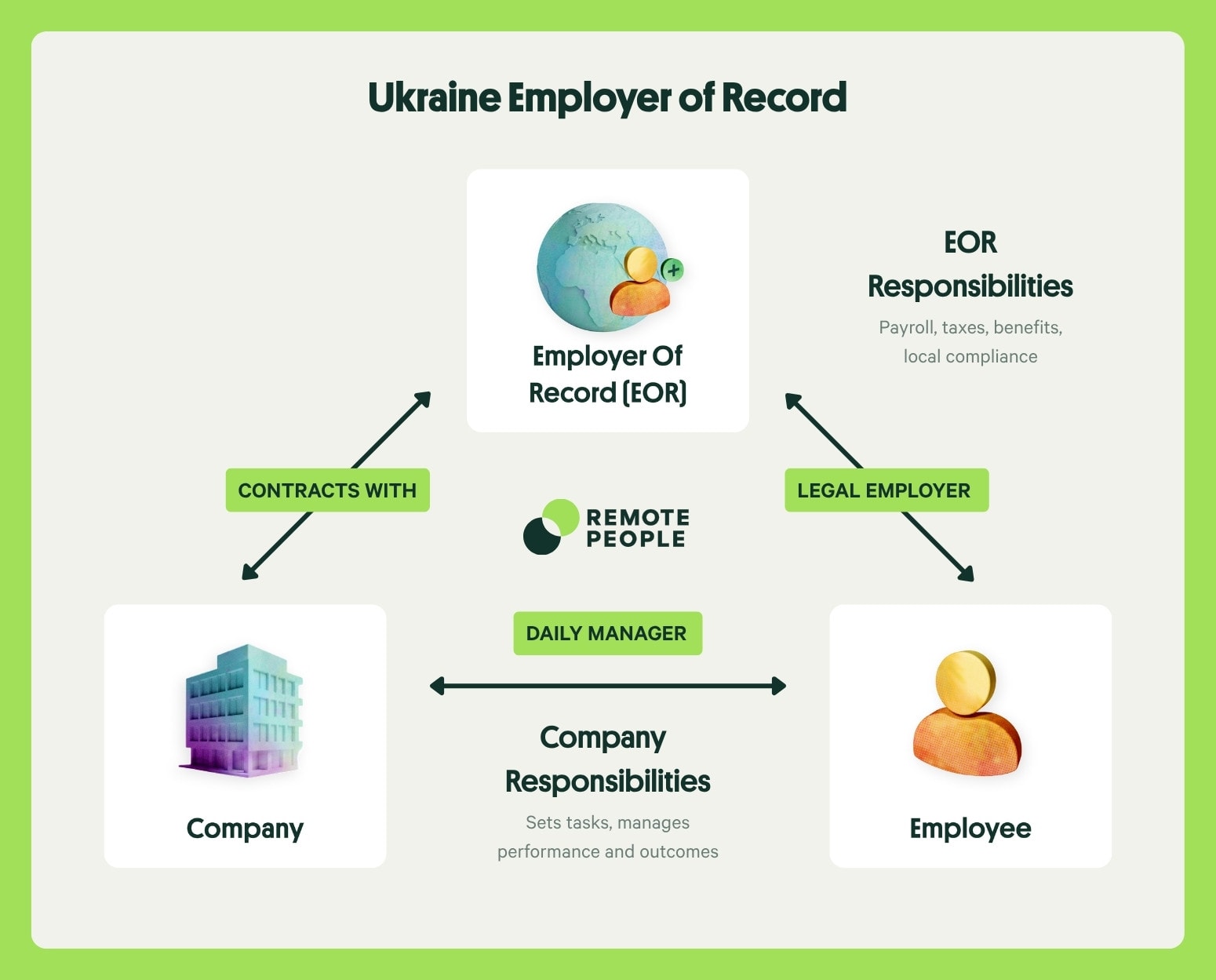
RemotePeople operates as the legal employer in Ukraine, managing every obligation from State Tax Service registration to ESV (Yedynyi sotsialnyi vnesok) contributions and PDFO (personal income tax) withholding under the Tax Code of Ukraine. Companies retain full day-to-day control over their employees while RemotePeople ensures compliance with the Kodeks Zakoniv pro Pratsiu (Code of Labour Laws No. 322-VIII), the Vacation Law (Law No. 504/96-VR), the Law on Employment of the Population (No. 5067-VI), and the temporary martial-law amendments enacted under Law No. 2136-IX of 15 March 2022.
How an Employer of Record Works in Ukraine

If you’d like to learn more about how Employer of Record (EOR) services work, read our What Is an Employer of Record (EOR)? guide for a complete overview of the model, its benefits, and when to use it.
If you’re comparing providers, our Best Employer of Record (EOR) Providers guide reviews the leading platforms to help you choose the right solution for your business.
Who Uses an EOR in Ukraine?
Companies at different growth stages use an employer of record in Ukraine to access Ukrainian talent without the cost and complexity of setting up a local entity, particularly given the operational risks associated with the ongoing war and martial law.
- Tech companies hiring IT talent: Ukraine remains one of the deepest IT talent pools in Europe, with strong concentrations in Kyiv, Lviv, Kharkiv, and Dnipro. EOR engagement lets foreign companies hire developers, QA engineers, and data scientists without navigating Diia City registration or establishing a Ukrainian entity (Diia City – Ministry of Digital Transformation).
- Companies supporting displaced employees: Many businesses use an EOR to retain Ukrainian employees who have relocated within Ukraine or returned after temporary residence abroad, while maintaining a single, locally compliant payroll relationship.
- Fast onboarding requirements: Companies with urgent hiring needs use an EOR to onboard employees within one to two weeks, compared to the four to eight weeks typically required to register a Ukrainian TOV, open a corporate bank account, and obtain an EDRPOU code.
- Foreign national hiring: Employers sponsoring non-Ukrainian workers benefit from an EOR’s relationships with the State Employment Service and experience navigating the work permit categories under the Law on Employment.
Any business that wants to hire compliantly in Ukraine without the fixed costs of a local entity can benefit from the EOR model, regardless of whether the engagement is short-term project-based or a long-term strategic hire.
Typical Onboarding Timeline
Onboarding through an EOR in Ukraine follows a set sequence, where each step depends on the one before it. Timelines vary depending on the employee’s nationality and how complex their tax and immigration situation is.
- First, EOR agreement and employee details: The client company signs the EOR service agreement and provides employee information, compensation details, and start date. This typically takes one to two business days.
- Second, employment contract drafting and review: The EOR prepares a compliant Ukrainian employment contract meeting Article 21 Labour Code requirements. The employee reviews and signs, either with a wet-ink signature or using a qualified electronic signature under Diia.Signature. This takes two to three business days.
- Third, tax and social insurance registration: The EOR issues the hiring order (nakaz) on or before the start date, files the unified notice with the State Tax Service of Ukraine before the employee begins work, and ensures the employee holds an Individual Tax Number (RNOKPP). Processing takes one to three business days.
- Fourth, payroll setup and benefits enrollment: The EOR configures the employee in the payroll system, sets up bi-monthly salary payments, and enrols the employee in any supplementary benefits offered by the client. This takes two to three business days.
- Fifth, employee onboarding and first day: The employee begins work. The EOR confirms all registrations are complete and the employee has been added to the State Tax Service systems. This takes one business day.

Most EOR providers can onboard a Ukrainian national in Ukraine within one to two weeks. For non-Ukrainian nationals requiring a work permit, the timeline extends by four to eight weeks depending on the permit category, the State Employment Service’s processing capacity in the relevant region, and whether the employee qualifies for the simplified IT specialist procedure.
Employment Laws and Regulations in Ukraine
Employment Contracts
Ukrainian employment law is governed primarily by the Kodeks Zakoniv pro Pratsiu (Code of Labour Laws of Ukraine, Law No. 322-VIII of 10 December 1971, as amended), supplemented by the Vacation Law (Law No. 504/96-VR), the Law on Employment of the Population (Law No. 5067-VI), the Law on Compulsory State Social Insurance (Law No. 1105-XIV), and the temporary martial-law statute (Law No. 2136-IX of 15 March 2022). The Ministry of Economy of Ukraine oversees labour policy, while the State Labour Service (Derzhpratsi) enforces compliance (State Labour Service of Ukraine).
Employment contracts in Ukraine may be concluded orally for indefinite-term employment, but written form is required under Article 24 for fixed-term contracts, remote and home-based work, contracts with minors, contracts requiring particular onboarding terms, and at the employee’s request. Required terms include the parties, job title, workplace, working time, remuneration, and start date. Contracts must be drafted in Ukrainian, with bilingual versions where the employee does not read Ukrainian (PwC Ukraine Worldwide Tax Summary).
Ukrainian law recognizes three main contract types: indefinite-term (the default), fixed-term (limited to specific cases such as project work, seasonal employment, or replacement of an absent employee under Article 23), and the “gig contract” introduced in 2022 for Diia City residents under the Law on Stimulating the Digital Economy. Civil-law contracts (tsyvilno-pravovi dohovory) for independent contractors exist outside the Labour Code but carry a high reclassification risk where the relationship resembles employment.
Working Hours and Overtime
Working time in Ukraine is regulated by Articles 50–65 of the Kodeks Zakoniv pro Pratsiu. Standard working time may not exceed 40 hours per week and 8 hours per day on a five-day working week. Daily rest must be at least double the duration of the previous working day, and weekly rest must be at least 42 consecutive hours. Employees are entitled to a paid lunch break of at least 30 minutes after no more than four hours of work (WIPO Lex – KZpP Articles 50–65).
Overtime is permitted under Article 62 only in narrow circumstances such as urgent public works, accident response, or essential services, and must not exceed 4 hours over two consecutive days or 120 hours per year. During martial law, Article 6 of Law No. 2136-IX raises the weekly cap to 60 hours for employees of critical infrastructure operators and suspends the annual overtime ceiling, while the standard 40-hour week and overtime premiums remain the default for all other employers (Baker McKenzie – Employment in Wartime Ukraine).
Overtime and Premium Pay Rates
Article 106 of the Kodeks Zakoniv pro Pratsiu (KZpP) sets statutory premium rates for hours worked beyond the 40-hour weekly cap, on rest days, public holidays, and at night. The table below summarises the multipliers, daily/annual caps, and base used for calculation. Employers must record overtime separately on the payslip and obtain trade union consent before assigning it.
Ukraine overtime and premium pay rates · Per Articles 106–108 KZpP | |||
Hour Type | Rate Multiplier | Annual/Daily Cap | Notes |
|---|---|---|---|
Standard overtime (weekday) | 200% | 4 hrs over 2 days; 120 hrs/year (suspended under martial law) | Art. 106; double the regular hourly rate |
Work on a rest day or public holiday | 200% | Replacement rest day may be granted instead | Art. 107; double pay or single pay plus a day off |
Night work (between 22:00 and 06:00) | 120% (+20% supplement) | Pregnant women and minors prohibited from night work | Art. 108; supplement on regular hourly rate |
Critical infrastructure overtime (martial law only) | 200% | Up to 60 hrs/week total | Law No. 2136-IX Art. 6; ends with martial law |
Time off in lieu of overtime | Not permitted | Cash premium is mandatory | Art. 106 prohibits substituting overtime pay with time off |
Managerial employees, employees on irregular working time, and employees engaged in summarized accounting of working time may be exempt from the standard overtime cap subject to the recordkeeping requirements of Article 61. Overtime cannot be substituted with compensatory time off; the Labour Code mandates monetary premium pay. Under martial law, the Cabinet of Ministers may also suspend Article 53 (shorter working time on the eve of public holidays) and Article 73 (paid public holidays) where critical operational continuity requires it (PwC Ukraine Worldwide Tax Summary).
Minimum Wage
Ukraine’s statutory minimum wage increased to UAH 8,647 gross per month (UAH 52 per hour) on 1 January 2026, up from UAH 8,000 throughout 2025. The rate was set by Article 8 of the Law on the State Budget of Ukraine for 2026 (Law No. 4225-IX of 3 December 2025) (Verkhovna Rada – State Budget Law 2026).
The minimum wage applies to all full-time employees regardless of seniority and forms the calculation base for many statutory amounts, including the ESV ceiling (15 times the minimum wage, equal to UAH 129,705 per month in 2026) and the minimum ESV contribution (22% of the minimum wage, or UAH 1,902.34 per month). Part-time workers are entitled to a proportional minimum based on hours worked. The 2026 minimum wage represents the third annual increase in real terms despite ongoing wartime constraints on the state budget.
Probation Period
The probationary period is defined in Articles 26–28 of the Kodeks Zakoniv pro Pratsiu and may not exceed three months for general roles, or six months for senior and specialist positions, in either case requiring the consent of the elected trade union body where one exists. For workers (as opposed to employees in management or specialist roles) the maximum is one month. The probationary period must be expressly stated in the hiring order; if it is not, the employee is deemed hired without probation (WIPO Lex – KZpP Articles 26–28).
During probation, the employer may dismiss the employee under Article 28 if their work performance demonstrates unsuitability for the role, by giving three days’ written notice. After the probation period expires, the employee is automatically considered to have passed probation and the standard dismissal procedures apply. Probationary employees retain their full entitlement to wages, statutory leave (accrued pro rata), social insurance, and ESV registration.
Leave Entitlements
Ukrainian employees are protected by a layered system of leave statutes. The Vacation Law (Law No. 504/96-VR of 15 November 1996) governs annual leave; the Labour Code covers sick leave, maternity, paternity, and parental leave; and the Law on Compulsory State Social Insurance regulates benefit payments financed through the Pension Fund of Ukraine.
Annual Leave
Under Article 6 of the Vacation Law, employees are entitled to 24 calendar days of paid annual leave per working year. Employees aged under 18 are entitled to 31 calendar days. Certain categories – including teachers, scientific researchers, civil servants, and persons with disabilities – qualify for extended leave of up to 56 calendar days. The 24-day minimum is calculated in calendar days inclusive of weekends but excluding the 11 statutory public holidays falling within the leave period (Verkhovna Rada – Vacation Law (No. 504/96-VR)).
Annual leave accrues from the first day of employment but the right to take it generally arises after six months of continuous service, except for specific categories (women before/after maternity leave, employees under 18, and several others) who may take leave at any time after hiring. Unused leave carries over indefinitely and must be paid out in cash on termination. Under martial law, employers may grant unpaid leave for the duration of the wartime period and unilaterally schedule annual leave for employees recalled from extended absences.
Sick Leave
Sick leave in Ukraine is paid for the first five calendar days of incapacity by the employer at 50–100% of average earnings depending on the cause, and from the sixth day onward by the Pension Fund of Ukraine through the State Sickness Benefit. The replacement rate depends on the employee’s insurance length: 50% for less than three years, 60% for three to five years, 70% for five to eight years, and 100% for eight or more years of insurance contributions. Sick leave is paid for up to four months of continuous incapacity in any twelve-month period (Pension Fund of Ukraine).
Sick leave at 100% applies in cases of work-related accidents, occupational diseases, treatment of children under 14, and care for sick close family members under specified conditions, irrespective of insurance length. Electronic medical certificates (e-likarniani) are issued through the eHealth platform and transmitted automatically to the employer and the Pension Fund.
Maternity Leave
Article 179 of the Labour Code provides 126 calendar days of maternity leave (70 days before delivery and 56 days after), extended to 140 calendar days in cases of complications or multiple births. Maternity benefit is paid by the Pension Fund of Ukraine at 100% of the employee’s average daily earnings over the previous 12 months, regardless of insurance length, with no statutory maximum. Women working in the Chornobyl-affected zones are entitled to 180 calendar days of maternity leave (PwC Ukraine – Individual Other Taxes).
Employers may not terminate the employment of a pregnant employee, an employee on maternity leave, or a single mother of a child under 14 (or a child with a disability under 18), except in cases of full liquidation of the enterprise, with mandatory placement assistance and continued payments. The protection extends from the confirmation of pregnancy through the end of maternity and parental leave.
Paternity Leave
Since the 2021 amendments to the Labour Code, fathers are entitled to 14 calendar days of one-time paid paternity leave under Article 17¹ of the Vacation Law, to be taken within the first three months after the child’s birth. The leave is paid by the employer at 100% of average earnings; the employer is not reimbursed by the Pension Fund. Paternity leave is in addition to, and may not be transferred from, the mother’s maternity entitlement (Verkhovna Rada – Vacation Law Art. 17¹).
Other Statutory Leave
Ukrainian law provides several additional paid or unpaid leave entitlements:
- Childcare leave (vidpustka po dohliadu za dytynoyu): Under Article 18 of the Vacation Law and Article 179 of the Labour Code, either parent may take unpaid childcare leave until the child reaches three years of age (six in cases of medical need), with their position protected and the period counting toward seniority for pension purposes.
- Educational leave: Up to 30 calendar days of additional paid leave per year for employees combining work with study at accredited educational institutions, under Articles 13–15 of the Vacation Law.
- Marriage leave: Up to 10 calendar days of unpaid leave on the employee’s request under Article 25 of the Vacation Law.
- Bereavement leave: Up to seven calendar days of unpaid leave on the death of a close family member under Article 25 of the Vacation Law.
- Mobilization and military service leave: Mobilized employees retain their position, average earnings, and benefits for the duration of military service under Article 119 of the Labour Code, as amended in 2022 to reflect martial-law conditions.
Ukrainian leave law combines the Vacation Law (No. 504/96-VR) with KZpP provisions and the Law on Compulsory State Social Insurance to define statutory entitlements. The table below consolidates annual leave, sick leave, maternity, paternity, and childcare leave with the days, pay rate, and statutory basis for each. All leave is in calendar days unless noted, and unused annual leave is paid out on termination under Article 24 of the Vacation Law.
Ukraine statutory leave entitlements · Per KZpP and Vacation Law | ||
Leave Type | Duration | Eligibility & Notes |
|---|---|---|
Annual leave | 24 calendar days | Paid at 100%; right to take arises after 6 months of service |
Annual leave (under 18) | 31 calendar days | Vacation Law Art. 6; may be taken any time |
Sick leave (employer-paid) | First 5 calendar days at 50–100% | Then Pension Fund pays based on insurance length, up to 4 months |
Maternity leave | 126 calendar days (140 for complications/multiples) | 100% average earnings via Pension Fund; no insurance length condition |
Paternity leave | 14 calendar days | 100% by employer; within 3 months of birth (since 2021) |
Childcare leave (unpaid) | Up to child age 3 (6 with medical need) | Position protected; counts toward pension seniority |
Educational leave (paid) | Up to 30 calendar days/year | For accredited study programmes; Vacation Law Arts. 13–15 |
Marriage leave (unpaid) | Up to 10 calendar days | On employee request; Vacation Law Art. 25 |
Bereavement leave (unpaid) | Up to 7 calendar days | Close family member; Vacation Law Art. 25 |
Mobilization / military service | Duration of service | Position and average pay preserved; KZpP Art. 119 |
Statutory Employee Benefits
Beyond leave entitlements and ESV contributions, employers in Ukraine must provide several mandatory benefits that form part of the overall compensation package.
- State pension insurance: Funded through the 22% employer ESV contribution and administered by the Pension Fund of Ukraine. Provides retirement, disability, and survivor pensions to insured employees.
- Temporary disability insurance: Covers sickness, maternity, and family-care benefits. Funded through ESV and administered by the Pension Fund (which absorbed the former Social Insurance Fund in 2023).
- Accident at work and occupational disease insurance: Funded through ESV and providing compensation for work-related injuries and occupational illnesses.
- Unemployment insurance: Funded through ESV; provides unemployment benefits to redundant employees who register with the State Employment Service.
- Occupational health and safety: Under the Law on Labour Protection (Law No. 2694-XII), employers must provide initial and periodic training, ensure safe working conditions, supply personal protective equipment, and conduct risk assessments under the supervision of Derzhpratsi.
- Severance for redundancy: Under Article 44 of the Labour Code, employers pay statutory severance of at least one average monthly salary on dismissal for redundancy or refusal to relocate, with higher multipliers for specific grounds.
- Average earnings preservation during military service: Mobilized employees retain their average earnings under Article 119 KZpP for the duration of their military service, with employer reimbursement available from the State Budget under conditions defined by Cabinet of Ministers Resolution No. 401 of 2022.
Recent Regulatory Updates (2026)
Ukraine has enacted several significant employment law changes effective in 2025 and 2026 that affect employers and EOR providers operating in the country.
The statutory minimum wage increased to UAH 8,647 gross per month (UAH 52 per hour) on 1 January 2026 under Article 8 of the State Budget Law. The ESV minimum payment rose accordingly to UAH 1,902.34 per month, and the ESV ceiling for both employer and employee calculations rose to UAH 129,705 per month (15 times the minimum wage). The planned increase of the cap to 20 times the minimum wage (UAH 172,940) under Article 32 of the Budget Law has been postponed for 2026 (PwC Ukraine – Other Taxes 2026).
The military levy on personal income increased from 1.5% to 5% in late 2024 under Law No. 4015-IX, applying to wages and most other personal income. The combined personal tax burden on wages is now 23% (18% PDFO plus 5% military levy). The 5% rate is scheduled to revert to 1.5% from 1 January of the year following the termination of martial law (Verkhovna Rada – Law No. 4015-IX on Tax Code Amendments).
Diia City – the special legal regime for IT companies operating since 2022 – continues to offer alternative tax treatment for resident employers and gig contractors, including a 5% PDFO on gig contractor income up to a cap, a 9% corporate income tax on distributed profits, and ESV calculated on the minimum wage rather than full salary. Diia City had over 1,800 resident companies as of early 2026 and is increasingly used by global tech employers (Diia City – Ministry of Digital Transformation). Martial law remains in force into 2026 and continues to affect mobilization rules, public holiday entitlements, and overtime ceilings; the standard provisions revert automatically when martial law ends.
Hire in Ukraine
One of the largest tech and engineering talent pools in Europe, highly competitive labor costs, and English-fluent professionals make Ukraine an exceptional hiring destination for global teams.
We handle employment contracts, payroll, tax withholding, and full Ukraine compliance with the Labour Code, USC contributions, and PIT remittance.
No local entity needed. Your team can start in days.
Work Permits and Visas in Ukraine
Work Permit Requirements
Who Needs a Work Permit
Ukrainian citizens and stateless persons permanently residing in Ukraine do not require a work permit. All other foreign nationals must obtain a work permit issued by the State Employment Service of Ukraine before commencing employment, with limited exemptions for those holding permanent residence permits, recognized refugee status, or temporary protection. Foreign IT specialists employed by Diia City residents may use a streamlined notification procedure rather than the standard work permit route (State Employment Service of Ukraine).
Eligibility and Required Documents
The specific requirements depend on the permit category, but common documentation includes a valid passport with at least six months’ validity beyond the permit duration, a signed employment contract or job offer, proof of qualifications (legalized or apostilled), a completed application form, proof of the employer’s legal status (extract from the EDR Unified State Register), evidence of payment of the state fee, and a clear criminal record. The minimum salary requirement under the Law on Employment is generally 10 times the minimum wage for highly qualified specialists and 5 times the minimum wage for standard categories (Verkhovna Rada – Law on Employment of the Population).
Processing Time and Validity
Work permits are issued by regional offices of the State Employment Service with a statutory processing time of seven business days (15 business days for ICT and seconded employees). Standard work permits are typically valid for up to two years (three years for ICT permits and Diia City IT specialists), and may be renewed. Once the work permit is granted, the employee applies separately for a Type D long-term entry visa at a Ukrainian consulate, then applies for a temporary residence permit (TRP) at the State Migration Service within 15 business days of arrival.
Renewal Process
Work permit and residence permit renewals should be initiated at least 60 days before expiry. Required documentation includes the current permit and TRP card, updated employment contract, recent payslips, proof of paid taxes and ESV contributions, and a valid passport. Renewals are issued for periods of up to two or three years depending on the permit category, and the same minimum salary requirements apply.
Common Visa Types for Foreign Workers
Ukraine has modernized its immigration framework through successive amendments to the Law on the Legal Status of Foreigners and Stateless Persons (Law No. 3773-VI) and the Law on Employment (Law No. 5067-VI). The State Employment Service issues work permits, while Ukrainian consulates abroad issue Type D long-term visas for employment. An EOR with established employer registration can sponsor most work permit categories.
Ukraine work visa types for foreign workers · 2026 | ||||
Visa / Permit Type | Duration | Best For | Leads to PR? | Processing |
|---|---|---|---|---|
Standard Work Permit | Up to 2 years | Foreign nationals employed by a Ukrainian-based employer | Yes (after 2 yrs continuous TRP) | 7 business days |
Highly Qualified Specialist Permit | Up to 3 years | Specialists earning ≥ 10× minimum wage; in-demand professions | Yes | 7 business days |
ICT (Intra-Corporate Transferee) | Up to 3 years | Managers, specialists, trainees seconded from a foreign affiliate | No | 15 business days |
Diia City IT Specialist (notification) | Up to 3 years | IT professionals at Diia City resident companies | Yes | 3–5 business days |
Type D Long-Term Visa | 90 days entry, 1 yr TRP | Entry visa following work permit grant | N/A (entry document) | 10–30 days at consulate |
Temporary Residence Permit (TRP) | Tied to permit (1–3 yrs) | Long-term legal stay for foreign workers in Ukraine | Yes (after 2 yrs continuous) | 15 business days |
Visa types not covered above that do not permit employment in Ukraine include:
- Type C short-term visa: Permits stays of up to 90 days within a 180-day period for business meetings, conferences, and tourism but does not authorize employment.
- Type B transit visa: Allows transit through Ukraine for up to five days; not a route for employment.
- Temporary protection (for displaced persons): Although not a work visa, holders of temporary protection status (granted to certain displaced persons under Cabinet of Ministers regulations) may be authorized to work without a separate permit during the protection period.
How an EOR Handles Work Permits
An employer of record in Ukraine can sponsor work permit applications because it acts as the legal employer registered with the State Tax Service, the Pension Fund, and the EDR. The EOR files the work permit application with the regional State Employment Service office, pays the statutory state fee (currently four times the minimum subsistence amount, around UAH 12,000 for a one-year permit), and coordinates documentation such as the employment contract, salary evidence, and proof of the employer’s legal status.
The employee is responsible for submitting the Type D visa application at the nearest Ukrainian consulate, attending the biometrics appointment, providing personal documentation (passport, qualifications, criminal record certificate), and once in Ukraine applying for the temporary residence permit at the State Migration Service within 15 business days. Work permit processing adds four to eight weeks to the standard onboarding timeline described in the EOR onboarding section above; the Diia City IT route can compress this to two to three weeks.
One important limitation: the employer listed on the work permit is bound to the employment conditions (salary, position, working hours) stated in the application. Any material change requires a new application or amendment. EOR providers structure engagement letters to match the permit terms exactly and flag any changes in scope before they are implemented.
Payroll, Taxes, and Social Security in Ukraine
Employer Contributions
The employer’s only payroll-tax obligation in Ukraine is the Unified Social Contribution (Yedynyi sotsialnyi vnesok, ESV), governed by Law No. 2464-VI. The contribution funds pension, sickness, maternity, work injury, and unemployment insurance through a single rate. The table below shows the rate, the 2026 monthly cap, and the receiving authority.
Ukraine employer ESV contributions · 2026 rates on gross salary | ||
Contribution | Rate | Notes |
|---|---|---|
Unified Social Contribution (ESV) – standard | 22% | Capped at UAH 129,705/month (15× min. wage); covers pension, sickness, accident, unemployment |
ESV – employees with disability (Group I or II) | 8.41% | Reduced rate for disabled employees of standard employers |
ESV – Diia City residents (gig contracts) | 22% on min. wage | UAH 1,902.34/month per gig specialist; gig income exempt from full-rate ESV |
Minimum monthly ESV | UAH 1,902.34 | 22% of UAH 8,647 minimum wage; due regardless of actual hours worked |
Total employer contributions | 22.00% | Single ESV payment to State Tax Service; no separate health insurance tax |
Employee Contributions
Employee deductions in Ukraine consist of Personal Income Tax (PDFO) and the temporary military levy under Sub-section 1 of Section XX of the Tax Code. ESV is fully employer-paid and does not appear on the employee deduction line. The table below summarises the two statutory withholdings the EOR remits monthly to the State Tax Service.
Ukraine employee payroll deductions · 2026 monthly withholdings | ||
Deduction | Rate | Notes |
|---|---|---|
Personal Income Tax (PDFO) | 18% | Flat rate on gross wages and most personal income |
Military Levy | 5% | Temporary; rises from 1.5% under Law No. 4015-IX; reverts to 1.5% one year after martial law ends |
Employee ESV share | 0% | Employees do not pay ESV; entire contribution is on the employer |
Diia City gig contractor PDFO | 5% | Reduced rate up to UAH 12 million annual cap; over the cap = standard 18% |
Total employee withholdings (standard) | 23.00% | 18% PDFO + 5% military levy; no employee social contribution |
Income Tax
Ukraine applies a flat Personal Income Tax (PDFO) under Article 167.1 of the Tax Code, with elevated rates for specific passive-income categories. The table below shows the 2026 PDFO rate and the additional military levy that together form the employee’s total income tax burden. There are no progressive brackets for ordinary employment income.
Ukraine personal income tax (PDFO) structure · 2026 | |
Income Type | Tax Rate |
|---|---|
Wages and most personal income (general regime) | 18% flat PDFO + 5% military levy = 23% effective |
Diia City gig contractor income (up to UAH 12 million/year) | 5% PDFO + 1.5% military levy |
Diia City gig contractor income (over UAH 12 million/year) | 18% PDFO + 5% military levy on the excess |
Investment income, dividends from non-Diia entities | 5% or 9% PDFO + 5% military levy depending on payer status |
Tax-free social allowance (Sotsialna pilha) | UAH 1,514 monthly tax credit if salary ≤ UAH 4,240 (limited categories) |
Ukraine applies a flat 18% personal income tax (PDFO) under Articles 167.1 and 168 of the Tax Code of Ukraine, supplemented by a 5% military levy under subsection 10 of section XX of the Tax Code (raised from 1.5% in late 2024). Both apply to gross wages and are withheld at source by the employer on the day salary is paid. There is no progressive scale for employment income; the 18% + 5% combined rate applies regardless of salary level (PwC Ukraine Tax Summary).
The Tax Social Allowance (sotsialna pilha) reduces taxable income by UAH 1,514 per month for low-income employees whose salary does not exceed UAH 4,240, applied at the employee’s request and rare in practice given that the threshold is well below the minimum wage. Employees may claim itemized tax deductions for educational expenses, mortgage interest on social housing, charitable contributions, and medical insurance premiums when filing the annual tax return (Form Schedule 1).
Payroll Cycle
Payroll in Ukraine is processed on a bi-monthly basis. Under Article 115 of the Labour Code, wages must be paid at least twice per month at intervals of no more than 16 calendar days, and no later than seven days after the end of the period for which the payment is made. Most employers run an advance (avans) on the 15th or 16th of the month and the final settlement (zarplata) by the end of the month or the first business days of the next.
PDFO and the military levy must be remitted to the State Tax Service on the day salary is paid (or the next business day if the salary is paid in cash). ESV contributions are due no later than the 20th day of the month following the month worked. The unified ESV/PDFO/Military Levy report (Yedyna zvitnist) is filed monthly through the e-Cabinet of the State Tax Service. Bank transfers are the standard payment method; payroll cards issued by Ukrainian banks are universal among private-sector employees.
13th Month Salary and Bonus Pay
Ukraine does not have a universal statutory 13th month salary for private-sector employees. A 13th-month bonus is mandatory only in specific public-sector positions defined by sectoral collective agreements. In the private sector, bonuses such as annual performance bonuses, holiday bonuses, or end-of-year premia are entirely voluntary and governed by the employment contract, collective agreement, or internal bonus regulation (polozhennia pro premiyuvannia).
Where a bonus is paid, it is fully subject to PDFO, the military levy, and ESV contributions. If a discretionary bonus is paid consistently according to clearly defined rules, Ukrainian labour courts may treat it as a contractual entitlement. Employers should include language stating that bonuses are paid at the employer’s discretion (na rozsud robotodavtsia) and subject to performance and budget approval.
Cost of Hiring Through an EOR in Ukraine
EOR Service Fees
EOR service fees in Ukraine typically range from $299 to $599 per employee per month. This fee covers the full scope of employer responsibilities: employment contract management, monthly payroll processing, PDFO and military levy withholding and filing, ESV registration and contributions, employee benefits administration, leave tracking, and ongoing compliance with the Labour Code and Tax Code. Some providers offer volume discounts for companies hiring multiple employees in Ukraine.
Total Employment Cost Breakdown
The example below assumes a mid-level Ukrainian employee earning a gross monthly salary of $3,000 USD, paid through RemotePeople’s EOR service. The breakdown shows the 22% ESV employer contribution, the EOR service fee, and the resulting total employer cost as a percentage above gross pay. PDFO and the military levy are withheld from the employee’s gross and do not increase the employer’s cost.

Ukraine employer cost example · USD 5,000 gross · 2026 | ||
Employer Cost | Amount (USD) | % of Gross |
|---|---|---|
Gross monthly salary | $5,000.00 | 100.0% |
Unified Social Contribution (ESV) (22%) | $686.00 | 13.7% |
EOR service fee (est.) | $499.00 | 10.0% |
Total monthly employer cost | $6,185.00 | 123.7% |
The total cost of employing a worker through an EOR in Ukraine at a gross monthly salary of USD 5,000 is approximately USD 6,185, or about 24% above gross salary. The 22% ESV contribution is the only employer payroll tax in Ukraine (there is no separate health insurance, accident insurance, or unemployment insurance contribution at the employer level – all are funded through ESV). Note that the ESV contribution is capped at 22% of UAH 129,705 (about USD 3,200) per month in 2026, so for salaries above this ceiling the effective employer contribution rate falls. The 23% PDFO + military levy is withheld from the employee’s gross salary and does not increase the employer’s total cost.
Ready to hire in Ukraine? Get started with RemotePeople: we handle employment contracts, payroll, PDFO and military levy withholding, ESV registration, and full Ukraine compliance. No local entity needed.
Benefits of Using an EOR in Ukraine
Ukrainian employment regulation is detailed and actively enforced by the State Labour Service. Strong employee protections, procedural requirements for dismissals, martial-law specific provisions, and frequent legislative updates mean that compliance mistakes are both easy to make and expensive to fix. An employer of record addresses these challenges directly.
- Speed to market: An EOR can onboard employees in Ukraine within one to two weeks, compared to the four to eight weeks required to register a TOV (limited liability company), obtain an EDRPOU code, open a corporate bank account, and register with the State Tax Service as an employer. This allows companies to secure talent and begin operations immediately.
- Full compliance assurance: Ukrainian labour law includes the Kodeks Zakoniv pro Pratsiu, the Vacation Law, the Law on Compulsory State Social Insurance, the Law on Labour Protection, the Tax Code, and the temporary martial-law statute. An EOR maintains legal expertise across all of these, reducing the risk of Derzhpratsi inspections and labour court claims.
- Cost efficiency versus a local entity: Setting up a TOV requires no minimum capital but incurs notary, registration, banking, and ongoing accounting and audit costs of roughly USD 5,000 to USD 12,000 per year. For companies hiring fewer than fifteen employees, the EOR model eliminates these fixed costs while providing the same level of legal compliance.
- Local payroll and tax expertise: Ukraine’s payroll and tax system involves bi-monthly wage payments, PDFO and military levy at source, ESV contributions to the State Tax Service, and monthly unified reporting. An EOR handles all of this accurately each pay cycle.
- Flexibility to scale: Companies can increase or decrease their Ukrainian headcount through an EOR without the structural commitments of maintaining a local entity. If a market test succeeds, the company can transition employees to its own TOV; if it does not, the EOR handles compliant offboarding.
- Risk mitigation: The EOR assumes the legal employer role, meaning compliance liability for ESV contributions, PDFO withholding, and employment contract adherence sits with the EOR. This protects the client company from direct exposure to Ukrainian labour court claims and Derzhpratsi penalties (which can reach 10× the minimum wage per violation).
- Employee experience: Employees hired through an EOR receive fully compliant Ukrainian employment contracts, statutory benefits (ESV insurance, paid leave, sick pay), and a Ukrainian-language payslip. This provides the same employment experience as working for a Ukrainian company directly.
For companies that want to build a team in Ukraine without the complexity and fixed costs of a local entity, an EOR provides the fastest and most compliant path. Contact RemotePeople to discuss your Ukraine hiring needs.
Termination and Offboarding in Ukraine
Notice Periods
Statutory notice periods in Ukraine are defined in Articles 38, 40, and 49-2 of the Kodeks Zakoniv pro Pratsiu. Most employer-initiated dismissals require two months’ written notice (under Article 49-2 for redundancy or staff reductions), while the standard notice for resignation by the employee is two weeks. The notice period runs from the day after delivery of the written notice. Mutual termination (zhoda storin) under Article 36(1) does not require any specific notice period and may take effect immediately (WIPO Lex – KZpP Articles 38, 40, 49-2).
Ukraine statutory notice periods · Per Articles 38, 40, 49-2 KZpP | |||
Termination Type | Notice Period | Who Can Give Notice | Notes |
|---|---|---|---|
Employee resignation (indefinite contract) | 2 weeks | Employee | Art. 38; written notice required |
Employee resignation for valid cause | No notice (immediate) | Employee | Art. 38 §3; e.g. employer breach, health, study, relocation of spouse |
Employer redundancy or staff reduction | 2 months | Employer | Art. 49-2; trade union notice 3 months in advance for collective |
Probation period dismissal | 3 calendar days | Employer | Art. 28; for unsuitability shown during probation |
Mutual agreement (zhoda storin) | No statutory notice | Both parties | Art. 36(1); effective on agreed date |
Summary dismissal (gross misconduct) | Immediate | Employer | Art. 40 §3, §4, §7, §8; theft, intoxication, breach of trust |
Fixed-term contract expiry | No notice required | Either | Art. 36(2); ends on contractual date |
Summary dismissal without notice (zvilnennya bez poperedzhennya) is permitted under Article 40 §3, §4, §7, and §8 only for serious cause such as repeated unjustified absence, theft confirmed by court order, intoxication at work, or single gross breach of duties by senior managers. In cases of mutual agreement (zhoda storin), the parties may agree to any notice period or immediate separation. Fixed-term contracts that expire on their agreed end date do not require notice. During martial law, certain dismissal grounds and timing rules are modified by Law No. 2136-IX, including suspension of trade union pre-approval requirements and shortened consultation periods (Baker McKenzie – Employment in Wartime Ukraine).
Severance Pay
Statutory severance (vykhidna dopomoga) in Ukraine is governed by Articles 44 and 44¹ of the Kodeks Zakoniv pro Pratsiu. The amount depends on the ground for dismissal and is calculated on the employee’s average monthly salary over the two calendar months preceding termination, in line with Cabinet of Ministers Resolution No. 100 of 8 February 1995 on the calculation of average earnings (WIPO Lex – KZpP Article 44).
Ukraine severance pay schedule by ground for dismissal · Per Article 44 KZpP | |||
Ground for Dismissal | Severance Amount | Base Salary | Notes |
|---|---|---|---|
Redundancy / staff reduction (Art. 40 §1) | 1 average monthly salary (minimum) | Average gross of last 2 months | Plus average earnings during job-search period (up to 2 months) |
Refusal to relocate or accept new conditions (Art. 36 §6) | 1 average monthly salary (minimum) | Average gross of last 2 months | Includes refusal of changes to essential conditions |
Health-based dismissal (Art. 40 §2) | 1 average monthly salary (minimum) | Average gross of last 2 months | Where medically certified inability to perform duties |
Employer breach causing employee resignation (Art. 38 §3) | 3 average monthly salaries | Average gross of last 2 months | Where employer failed to comply with contract or labour law |
Dismissal of officer due to ownership change (Art. 41 §6) | 6 average monthly salaries | Average gross of last 2 months | Maximum statutory multiplier; for senior officers |
Conscription / mobilization (Art. 36 §3) | 2 average monthly salaries | Average gross of last 2 months | For employees called for compulsory military service |
Calculation Method
The severance base is the average monthly salary of the two calendar months preceding the month of termination, calculated under Cabinet of Ministers Resolution No. 100. Variable components (bonuses, premiums) are included where they were regularly paid. The severance multiplier ranges from one to six average monthly salaries depending on the ground for dismissal and is set by statute, not negotiable downward by the parties.
In addition to severance, redundant employees are entitled to preserved average earnings during the job-search period (up to two months from the dismissal date, or three months on State Employment Service confirmation). Higher amounts are often agreed in mutual-termination settlements (uhoda pro rozirvannia trudovogo dohovoru) to incentivise voluntary departure and reduce litigation risk. Amounts of three to six months’ salary are common in settlements of senior roles or contested dismissals.
Caps and Exceptions
Ukraine does not apply a statutory monetary cap on severance – the amount is determined entirely by the multiplier and the employee’s average earnings. Severance is not payable in cases of dismissal for cause under Article 40 §3, §4, §7, or §8 (gross misconduct), during the probationary period, or when the employee resigns voluntarily without employer-caused reasons. Fixed-term contracts that expire on their agreed end date do not trigger severance obligations. Severance payments are subject to PDFO (18%) and the military levy (5%), but are exempt from ESV contributions under the Law on ESV.
Grounds for Termination
Indefinite-term employment contracts in Ukraine may be terminated by the employer only on grounds explicitly listed in the Labour Code, principally Articles 40 and 41. The most common grounds include redundancy or staff reduction (Article 40 §1), inability to perform duties due to insufficient qualification or health (Article 40 §2), repeated absenteeism (Article 40 §3), and breach of trust or commission of theft (Article 40 §4 and §8). Each ground requires specific procedural steps: redundancy requires two months’ notice and consultation with the trade union; health-based dismissal requires a medical certificate; misconduct dismissals require disciplinary investigation.
Before terminating, the employer must consult with the elected trade union body where the employee is a member (Article 43 KZpP), unless the dismissal falls within a list of grounds exempt from consultation. Termination is prohibited during protected periods: pregnancy, maternity/parental leave, sick leave, annual leave, and (under Article 184 KZpP) for single mothers of children under 14 except in cases of full liquidation of the enterprise. During martial law, certain procedural protections are temporarily relaxed under Law No. 2136-IX, including some trade union consultation requirements. Non-compliance with the procedural requirements entitles the employee to claim reinstatement plus payment of average earnings for the period of forced absence before the labour court.
EOR vs. Other Hiring Models in Ukraine
EOR vs. Setting Up a Local Entity
Setting up a Ukrainian limited liability company (Tovarystvo z Obmezhenoyu Vidpovidalnistyu, TOV) is the traditional path for hiring employees, but it requires registration with the State Tax Service, ESV registration with the Pension Fund, opening a Ukrainian bank account, and ongoing accounting compliance under Ukrainian standards (NP(S)BO). The table below compares the two paths across timeline, capital, and ongoing obligations.
Ukraine EOR vs local entity (TOV) comparison · Setup time, cost, risk and best-fit | ||
Comparison | Employer of Record | Own Entity (TOV) |
|---|---|---|
Setup time | 1–2 weeks | 4–8 weeks |
Upfront cost | $0 | $2,000–$5,000 (notary, registration, bank account) |
Ongoing cost | $299–$599/employee/month | $5,000–$12,000/year maintenance |
Local partner required | No (EOR is the local entity) | No (but requires resident director or PoA holder) |
ESV and tax registration | Handled by EOR | You manage it |
Payroll & tax filing | Handled by EOR | You manage it (or outsource) |
Best for team size | 1–15 employees | 15+ employees |
Scale down / exit | Easy, no entity to unwind | Costly, legal liquidation required (6–12 months) |
Diia City eligibility | Not eligible (must be Ukrainian-resident company) | Eligible if registered as Diia City resident |
For companies hiring one to fifteen employees in Ukraine, the EOR model eliminates the upfront investment and ongoing overhead of a TOV. Although Ukraine has no statutory minimum share capital requirement for a TOV, the costs of notary fees for the founding documents, state registration with the Unified State Register, opening a corporate bank account, and ongoing accounting and audit obligations create fixed costs that are disproportionate for a small team.
An EOR is best suited for market entry, distributed teams, and situations where the company needs operational flexibility – particularly during ongoing wartime conditions when a foreign company may not want a registered presence in Ukraine. A TOV becomes more cost-effective as headcount grows beyond fifteen employees, when the company seeks to register as a Diia City resident for IT-sector tax incentives, or when the business requires a permanent legal presence for banking, real estate, or intellectual property holding purposes.
The transition from EOR to own entity is straightforward: the EOR transfers employees to the new TOV through mutual agreement (porozumennia storin) or termination/rehire, and the new entity assumes all employment obligations. RemotePeople supports this transition process for clients that outgrow the EOR model.
EOR vs. Hiring Independent Contractors
Hiring Ukrainian talent as private entrepreneurs (Fizychna Osoba Pidpriyemets, FOP) on the simplified tax regime is common in Ukraine’s IT sector, but the State Labour Service and State Tax Service jointly investigate disguised employment under Cabinet of Ministers Resolution No. 197 of 2022. The table below compares the EOR model with FOP/civil-law contracts across compliance, cost, and risk.
Ukraine EOR vs independent contractors · Compliance, cost, and risk | ||
Comparison | EOR (Full-Time Employee) | Independent Contractor (FOP / Civil-Law Contract) |
|---|---|---|
Legal relationship | Employee of the EOR | Self-employed (FOP / private entrepreneur); no employment relationship |
Compliance risk | Low; EOR ensures Labour Code and Tax Code compliance | High; State Tax Service and Derzhpratsi reclassification risk if relationship resembles employment |
Payroll & tax | EOR handles withholding, ESV, PDFO, military levy filings | Contractor invoices you; they handle their own ESV and Single Tax |
Benefits & leave | Statutory leave, sick pay, ESV insurance | No Labour Code benefits; FOP self-funds their own social cover |
IP protection | Stronger; Art. 429 Civil Code assigns employment-created IP to employer | Weaker; requires explicit IP assignment clause in services contract |
Termination | Subject to Labour Code notice and severance | Contract can be ended per agreed terms (typically 30 days) |
Best for | Long-term, core team roles | Short-term projects, specialized tasks, B2B services |
Cost structure | Salary + 22% ESV + EOR fee | Contractor fee (FOP Group 3: 5% Single Tax + UAH 1,902.34 ESV) |
Ukraine enforces strict rules against disguised employment (prykhovane trudove pravovidnoshennia). The State Labour Service and State Tax Service jointly investigate FOP arrangements, and Article 21 of the Labour Code, together with the Cabinet of Ministers Resolution No. 197 of 2022 on combating undeclared labour, defines the criteria for employment relationships regardless of the contract label used. A contractor who works exclusively for one client, follows the client’s instructions on how and when to work, uses the client’s equipment, and is integrated into the client’s organizational structure is likely to be reclassified as an employee.
The consequences of misclassification are severe: the client company must pay retroactive ESV contributions for up to three years, plus PDFO and military levy adjustments, and may face Derzhpratsi fines of up to 10 times the minimum wage per violation (UAH 86,470 in 2026). The worker gains full employee status with all associated protections, including dismissal protection, paid leave, and severance entitlement.
Hiring contractors is appropriate in some cases, such as genuine project-based work with defined deliverables where the worker controls their own schedule and methods. The FOP Group 3 single-tax regime (5% on turnover up to roughly UAH 8.3 million per year plus a fixed ESV contribution) makes Ukraine attractive for genuine B2B engagements. For ongoing, integrated roles, the EOR model provides compliance certainty. RemotePeople also offers contractor management solutions for companies that need both employment types in Ukraine.
EOR vs. PEO (Professional Employer Organization)
A Professional Employer Organization (PEO) is a US co-employment model that does not exist as a legal structure in Ukraine. The closest functional equivalent is staff leasing (autstafing), which is regulated under Article 39 of the Law on Employment but with significant restrictions. The table below compares the international EOR model with staff leasing arrangements available in Ukraine.
Ukraine EOR vs PEO comparison · Legal employer, liability, and setup | ||
Comparison | Employer of Record (EOR) | PEO |
|---|---|---|
Legal employer | EOR is the legal employer | You remain the legal employer (co-employment) |
Local entity required | No, the EOR is the local entity | Yes, you must have your own TOV or representative office |
Best for | Companies without a local entity | Companies that already have a Ukrainian entity |
Compliance liability | EOR assumes compliance responsibility | Shared liability between you and the PEO |
Setup time | 1–2 weeks | Depends on your entity setup (weeks to months) |
Control over HR policies | EOR manages within Labour Code framework | More direct control; PEO advises |
Typical use case | Market entry, small remote teams, testing new markets | Established Ukrainian operations needing HR outsourcing |
Ukraine does not recognize PEO co-employment as a distinct legal model. Under Ukrainian law, any arrangement where a third party places workers with a client company typically falls under outsourcing or staff secondment (autstaffing), regulated by Article 39¹ of the Law on Employment and conditions set by the Cabinet of Ministers. Outsourcing has not historically been a widely-used employment route in Ukraine and is restricted in scope.
A traditional PEO co-employment model, as used in the United States, does not exist in Ukrainian law. For companies without a Ukrainian entity, the EOR is the only viable third-party employment model. For companies that already have a TOV and want to outsource HR administration, a payroll service provider or HR outsourcing firm (yedyna sluzhba personalu) is the appropriate alternative, as true co-employment is not recognized under Ukrainian law.
Public Holidays in Ukraine
Article 73 of the Kodeks Zakoniv pro Pratsiu sets eleven non-working public holidays per year, with one additional Orthodox commemoration day. When a public holiday falls on a Saturday or Sunday, Article 67 of the KZpP requires the following Monday to be granted as a paid day off. The table below lists all 2026 dates as recognised by the Cabinet of Ministers.
Ukraine public holidays · 2026 calendar year (under martial law transfers suspended) | ||
Date | Holiday | Type |
|---|---|---|
January 1 (Thursday) | Novyi Rik (New Year’s Day) | Nationwide |
March 8 (Sunday) | Mizhnarodnyi zhinochyi den (International Women’s Day) | Nationwide |
April 12 (Sunday) | Velykden (Easter Sunday) | Nationwide; Orthodox calendar (since 2025 reform) |
May 1 (Friday) | Den Pratsi (Labour Day) | Nationwide |
May 8 (Friday) | Den pamyati ta peremohy nad natsyzmom (Day of Remembrance and Victory over Nazism) | Nationwide; replaced 9 May Soviet-era Victory Day in 2023 |
May 31 (Sunday) | Triitsia (Holy Trinity / Pentecost) | Nationwide; movable Orthodox holiday |
June 28 (Sunday) | Den Konstytutsii (Constitution Day) | Nationwide |
July 15 (Wednesday) | Den Ukrainskoi Derzhavnosti (Day of Ukrainian Statehood) | Nationwide; statutory holiday since 2022 |
August 24 (Monday) | Den Nezalezhnosti (Independence Day) | Nationwide |
October 1 (Thursday) | Den zakhysnykiv i zakhysnyts Ukrainy (Day of Defenders of Ukraine) | Nationwide; moved from 14 Oct in 2023 reform |
December 25 (Friday) | Rizdvo Khrystove (Christmas Day) | Nationwide; moved from 7 Jan to 25 Dec in 2023 reform |
Ukraine has 11 statutory public holidays in 2026 under Article 73 of the Kodeks Zakoniv pro Pratsiu, following the 2023 calendar reform that moved Christmas from 7 January (Julian) to 25 December (Gregorian) and replaced 9 May Victory Day with 8 May Day of Remembrance and Victory over Nazism. Under Article 73, a public holiday falling on a Saturday or Sunday is normally transferred to the following Monday, but Article 6 of Law No. 2136-IX suspends this transfer rule during martial law and allows employers in critical sectors to designate public holidays as ordinary working days (Verkhovna Rada – Martial Law Labour Statute (Law No. 2136-IX)).
Employees required to work on a public holiday are entitled under Article 107 to either double pay (200%) for the hours worked or single pay plus a replacement rest day. The transfer rule and the standard 200% premium will resume automatically once martial law ends. Employers should consult their internal labour regulations and any applicable collective agreement for sector-specific holiday arrangements.
How to Get Started with an EOR in Ukraine
- First, define your hiring needs: Identify the roles you need to fill in Ukraine, the required qualifications, expected compensation range (benchmarked against the UAH 8,647 minimum wage and typical IT salaries of USD 2,000–6,000 per month for mid-to-senior engineers), and whether candidates are Ukrainian nationals or will require work permit sponsorship. This information determines the onboarding timeline and any additional immigration steps.
- Second, select your EOR provider: Evaluate providers based on their Ukrainian employer registration with the State Tax Service and Pension Fund, experience with the Kodeks Zakoniv pro Pratsiu and martial-law-specific provisions, payroll processing capabilities, and ability to support work permit sponsorship. Confirm that the provider handles ESV, PDFO, and the military levy correctly, and can manage compliance in Ukrainian and English.
- Third, finalize employment terms: Work with the EOR to draft a compliant employment contract that meets Article 21 KZpP requirements, reflects the agreed compensation package, and includes any supplementary benefits such as voluntary medical insurance (Dobrovilne medychne strakhuvannia), wellness allowances, equipment stipends, or additional annual leave beyond the statutory minimum.
- Fourth, onboard your employee: The EOR issues the hiring order (nakaz pro pryyom na robotu), files the unified notice with the State Tax Service before the start date, prepares and signs the employment contract, and ensures the employee holds a valid Individual Tax Number (RNOKPP). For non-Ukrainian employees, the EOR coordinates the work permit application process in parallel.
- Fifth, manage and scale your team: Once onboarded, the EOR processes bi-monthly payroll, manages leave requests through a self-service portal, handles PDFO, military levy, and ESV filings, and ensures ongoing compliance. You retain full operational control over your team’s work while the EOR manages the employer obligations. As your team grows, you can add employees through the EOR or transition to your own TOV when the headcount justifies it.
Ready to hire your first employee in Ukraine? Contact RemotePeople to get started. We handle the entire employment process from contract to payroll to compliance, so you can focus on building your team.
Where companies hiring in Ukraine expand next
Companies operating in Ukraine often extend across the Baltics and broader Eastern Europe, where tech talent and cost efficiency align. Most teams start with an EOR partner in Finland — aligned Nordic benefits and compensation standards. Estonia typically follows, with Baltic-region cost parity and deep tech talent. A team in Lithuania is a natural addition for shared Baltic tech talent pools, and operations in Poland completes the regional picture with parallel labor-cost tier and talent supply.
Frequently Asked Questions
EOR services in Ukraine typically cost between $299 and $599 per employee per month. This flat fee covers employment contract management, bi-monthly payroll processing, PDFO and military levy withholding, ESV registration and contributions, benefits administration, and ongoing compliance with the Kodeks Zakoniv pro Pratsiu and Tax Code. On top of the EOR fee, total employer costs include the 22% ESV contribution (capped at UAH 129,705 per month in 2026), bringing the total cost to roughly 24% above the employee's gross salary. The 23% PDFO + military levy is withheld from the employee's gross pay and does not increase the employer's cost.
An EOR can typically onboard a Ukrainian national in Ukraine within one to two weeks, covering contract preparation, State Tax Service unified notice filing, and payroll setup. For non-Ukrainian nationals who require a work permit (standard, highly qualified specialist, or ICT), the timeline extends by four to eight weeks depending on the permit category, the State Employment Service's processing capacity, and consular visa appointments. IT specialists hired by Diia City resident companies benefit from a streamlined notification procedure, typically taking 7–14 days.
An EOR in Ukraine must comply with the Kodeks Zakoniv pro Pratsiu (Code of Labour Laws No. 322-VIII) for contract terms, working time, and dismissal protection; the Vacation Law (No. 504/96-VR) for paid leave; the Law on Compulsory State Social Insurance (No. 1105-XIV) for sick and maternity benefits; the Law on the Unified Social Contribution (No. 2464-VI) for ESV; the Tax Code of Ukraine for PDFO and military levy withholding; the Law on Employment (No. 5067-VI) for work permits; the Law on Labour Protection (No. 2694-XII) for occupational safety; and the temporary martial-law statute (Law No. 2136-IX) for wartime-specific provisions. Enforcement is led by the State Labour Service (Derzhpratsi) and the State Tax Service.
Under Article 429 of the Civil Code of Ukraine, economic rights to works created by an employee in connection with their employment duties are jointly owned by the employee and the employer, unless the employment contract or a separate agreement provides otherwise. Most employers include explicit IP assignment clauses in employment contracts to vest 100% of economic rights in the employer. Since the EOR is the legal employer, the EOR–client agreement and the employment contract must explicitly assign or license the resulting rights to the client company. RemotePeople's standard employment contracts and client master services agreements include IP assignment clauses that transfer all economic rights to the client.
Hiring contractors in Ukraine carries significant misclassification risk. The State Labour Service and State Tax Service jointly investigate FOP (private entrepreneur) and civil-law contract arrangements under Article 21 of the Labour Code and Cabinet of Ministers Resolution No. 197 of 2022. Misclassification leads to retroactive ESV contributions for up to three years plus PDFO and military levy adjustments, and Derzhpratsi fines of up to 10 times the minimum wage per violation (UAH 86,470 in 2026). RemotePeople offers contractor management solutions for genuine FOP relationships, and the EOR model for ongoing, integrated roles.
Ukrainian law mandates employee benefits including ESV social insurance (covering pension, temporary disability, maternity, accident at work, and unemployment), a minimum of 24 calendar days paid annual leave (31 for under-18), employer-paid sick pay for the first 5 days followed by Pension Fund sickness benefits, 126 calendar days of maternity leave (140 for complications), 14 calendar days of paid paternity leave, unpaid childcare leave until child age 3, occupational health and safety measures under the Law on Labour Protection, and average earnings preservation for mobilized employees under Article 119 KZpP.
Yes, an EOR registered as an employer in Ukraine can act as the legal employer and sponsor work permit applications. This includes the Standard Work Permit for most foreign nationals, the Highly Qualified Specialist Permit for workers earning at least 10 times the minimum wage, the ICT (Intra-Corporate Transferee) Permit for seconded employees, and the streamlined Diia City IT specialist notification for IT professionals at Diia City resident companies. The EOR files the application with the State Employment Service, pays the state fee (around UAH 12,000 for a one-year permit), and coordinates with the employee on documentation and consular Type D visa appointments.
Termination of indefinite-term contracts in Ukraine is permitted only on grounds explicitly listed in Articles 40 and 41 of the Kodeks Zakoniv pro Pratsiu. Statutory notice periods are two months for redundancy or staff reduction (Article 49-2), three calendar days for probation period dismissal (Article 28), two weeks for employee resignation (Article 38), and immediate for summary dismissal on serious grounds (Article 40 §3, §4, §7, §8). Severance under Article 44 ranges from one to six average monthly salaries depending on the dismissal ground, with redundancy attracting one month minimum plus preserved earnings during a job-search period of up to two months. During martial law, certain procedural rules , including some trade union consultation requirements , are temporarily relaxed under Law No. 2136-IX.
Employer of Record in
Employer of Record in
Employer of Record in
Employer of Record in
Employer of Record in
Employer of Record in
Employer of Record in
Employer of Record in