
 Recruit
Employer of Record in Suriname
-
 Drew Donnelly
- Published
- September 22, 2026
RemotePeople’s employer of record in Suriname lets you hire employees in Suriname with SZV registration. We handle social security contributions at 6 percent employer share, Basic Health Insurance contributions at 4.65 percent, and statutory benefit administration.
Hire in Suriname — book a free 30-minute demo
Tell us what you need. You'll get a tailored, transparent proposal within 24 hours, plus a free call to walk through it.
Tell us about your company
So we can match you with a specialist who knows your market — and unlock volume pricing tiers.
* All fields are required.
Where and when are you hiring?
Tell us the geography and timing and we'll quote each country line by line, with onboarding timelines.
* All fields are required.
Help us beat your current setup
We'll benchmark your current deal and send a line-by-line proposal in 24 hours — showing exactly where we cut cost, time, or risk. After you submit, you can book a call to walk through it together.
* All fields are required.
Thanks! Your proposal is on its way.
Expect a tailored, line-by-line proposal in your inbox within 24 hours. In the meantime…
Want to walk through it together?
Book a free 30-minute call with one of our specialists. We'll explain every line, answer your questions, and tailor the proposal further if you need.
No obligation. Pick a time that works for you.








- Hire in Suriname — book a free 30-minute demo
- Tell us about your company
- Where and when are you hiring?
- Help us beat your current setup
- Thanks! Your proposal is on its way.
- How an Employer of Record Works in Suriname
- Employment Laws and Regulations in Suriname
- Work Permits and Visas in Suriname
- Payroll, Taxes, and Social Security in Suriname
- Cost of Hiring Through an EOR in Suriname
- Benefits of Using an EOR in Suriname
- Termination and Offboarding in Suriname
- EOR vs. Other Hiring Models in Suriname
- Public Holidays in Suriname
- How to Get Started with an EOR in Suriname
- Frequently Asked Questions
- Related EOR Destinations

Start hiring in Suriname
Let RemotePeople handle payroll, compliance, and HR admin worldwide so you can focus on building your team.

Suriname offers North American and European employers an attractive combination of Dutch-language fluency, stable legal infrastructure rooted in Dutch civil law, and a young, multicultural workforce. For companies looking to expand into South America, the country’s appeal is straightforward: labour costs well below North American levels, transparent payroll administration through the Sociale Verzekeringsbank (SZV), and no need to register a local company entity to begin hiring. The complexity lies in navigating the Dutch-origin employment framework – the Arbeidswet (Labour Act of 1963) – mandatory social security registration, and the dual-permit regime for foreign nationals.
An employer of record in Suriname becomes the legal employer on your behalf, registering employees with SZV, handling the 6% employer social security contribution and wage tax withholding, managing statutory leave entitlements, and sponsoring work permits for foreign hires. This approach lets you onboard a team in Paramaribo or elsewhere in the country within one to three weeks, without incorporating a local entity, opening a Surinamese bank account, or navigating the Ministry of Labour’s bureaucracy yourself.
How an Employer of Record Works in Suriname
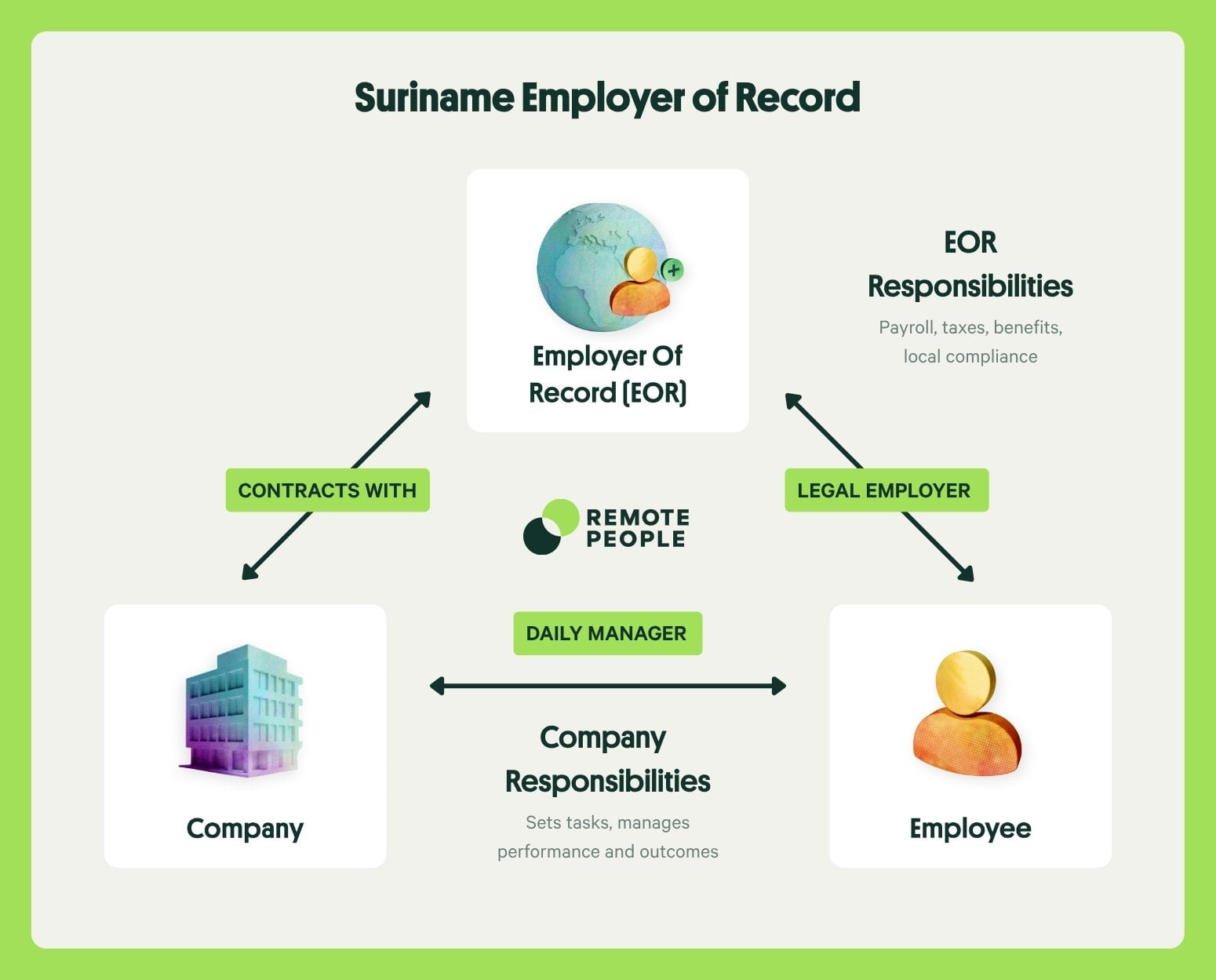
If you’d like to learn more about how Employer of Record (EOR) services work, read our What Is an Employer of Record (EOR)? guide for a complete overview of the model, its benefits, and when to use it.
If you’re comparing providers, our Best Employer of Record (EOR) Providers guide reviews the leading platforms to help you choose the right solution for your business.
Who Uses an EOR in Suriname?
An EOR is ideal for businesses that want to hire in Suriname without standing up a full subsidiary. Common use cases include:
- Testing the Surinamese market: A company can onboard one to five people in Paramaribo on a pilot basis without the cost and liability of registering a local entity.
- Small remote or hybrid teams: Organisations hiring Surinamese nationals for customer support, software development, data entry, or bilingual roles where the overhead of a local company outweighs the benefit.
- Fast onboarding of local talent: Companies that need a Surinamese accountant, developer, or analyst on payroll quickly with full SZV and tax compliance from day one.
- Relocating foreign specialists: Employers bringing in an experienced manager or technician from abroad and needing to sponsor a work permit without first establishing a Surinamese corporation.
- Flexible scaling: Teams that may grow or shrink without long-term commitment to entity overhead or liquidation costs.
An EOR absorbs the registration, filing, and compliance burden that would otherwise demand in-country HR and tax expertise.
Typical Onboarding Timeline
Most EOR providers can onboard a Suriname-resident employee within one to three weeks. The timeline for foreign nationals extends to four to eight weeks due to work-permit processing.
- EOR agreement and employee details: One to two business days to confirm the role, salary, start date, and collect the new hire’s identification and bank details.
- Employment contract drafting: Two to three days to prepare a Suriname-compliant contract in Dutch or English and obtain signatures.
- SZV and Belastingdienst registration: Three to five days for the EOR to register the employee with social security and tax authorities and receive confirmation.
- Payroll and benefits setup: Two to three days to activate payroll, set up SRD direct deposit, and enrol the employee in SZV and any supplemental benefits.
- First day of work: One day for orientation, equipment, and client onboarding.
Foreign nationals requiring a work permit will add six to ten additional weeks for Ministry of Labour approval and residence documentation.
Hire in Suriname
Suriname offers a Dutch-speaking workforce, a stable labour code, and just 6% employer social security contributions – making it one of the lowest-cost EOR markets in South America.
We handle employment contracts, payroll, tax withholding, and full Suriname compliance.
No local entity needed. Your team can start in days.
Employment Laws and Regulations in Suriname
Employment Contracts
Employment in Suriname is governed by the Arbeidswet (Labour Act of 1963), supplemented by the Burgerlijk Wetboek (Civil Code), Book 7A, which contains detailed provisions on employment relationships. The Labour Act requires employment contracts to be in writing for positions lasting more than two months. Contracts must state the parties’ names, the position, the salary, the workplace, the start date, and the duration (indefinite or fixed-term). Both indefinite and fixed-term contracts are permitted, though fixed-term contracts that are renewed repeatedly may be recharacterized as indefinite under Suriname’s labour jurisprudence. All EOR contracts are written and in Dutch or English. The Ministry of Labour, Wage Employment and Youth Affairs oversees compliance with statutory terms.
Working Hours and Overtime
Under the Labour Act, the standard maximum working week is 48 hours, with a daily limit of 8.5 hours. Employees are entitled to at least one full rest day per week (typically Sunday) plus a 30-minute meal break. Overtime beyond the 8.5-hour daily or 48-hour weekly limit is compensated at premium rates: 50% above the ordinary hourly rate for weekday overtime, and 100% above the ordinary rate for work on Sundays or public holidays. The table below details Suriname’s overtime and premium pay schedule as specified in the Labour Act of 1963.
Suriname overtime and premium pay rates · Per Labour Act 1963 | |||
Hour Type | Rate Multiplier | Daily / Weekly Cap | Notes |
|---|---|---|---|
Weekday overtime (beyond 8.5 hrs/day) | 1.5x base hourly rate | Max 4 hrs/day; 12 hrs total (8.5 + 4) | Weekday work beyond the standard 8.5-hour limit is paid at a 50% premium. Must be recorded in the labour register. |
Sunday or weekly rest-day work | 2.0x base hourly rate | No statutory weekly cap if compensatory rest is given | Treated as a public holiday equivalent. Compensatory rest day must be provided within the same week if possible. |
Public holiday work | 2.0x base hourly rate | Per holiday worked | Work on any national public holiday is paid at double the ordinary daily rate. |
Night work (between 8 p.m. and 6 a.m.) | 1.5x base hourly rate (minimum) | No statutory cap; subject to rest-day limits | Night work is paid at a 50% premium under labour practice; overtime during night hours compounds. |
Overtime pay is included in the SZV contribution base and is subject to loonbelasting (income tax) like ordinary wages. Employers must maintain time records showing all hours worked, including overtime, for inspection by the Ministry of Labour’s Arbeidsinspectie (labour inspectorate).
Minimum Wage
Suriname sets a national minimum wage by government decree. As of April 1, 2025, the minimum wage is SRD 9,095 per month for a standard 48-hour workweek, or approximately SRD 52.47 per hour. The minimum wage is adjusted periodically to account for inflation and is set by the Ministry of Labour in consultation with employers and workers. Sectoral minimums may apply to specific industries; employers must pay the higher of the national minimum or the applicable sectoral rate. For more information, consult the Ministry of Labour.
Probation Period
Under the Labour Act, the maximum probation period for a new employee is two months for standard permanent employment. During probation, either party may terminate the relationship without cause and without notice or severance, provided the probation clause is stated in the written contract. However, all statutory entitlements (SZV contributions, loonbelasting withholding, and accrual of annual leave) begin from the first day of employment, even during probation. Probation cannot be extended or restarted without explicit written consent. An EOR contract will typically reference the probation period and its conditions to align with the client’s internal policy while staying within the statutory two-month limit.
Leave Entitlements
Suriname’s statutory leave regime is set in the Labour Act 1963 and the Holiday Act (Vacantiewet) 1975. The framework grants annual leave on a tenure-based scale, provides employer-paid sick leave for the first few days (then SZV subsidy), and does not mandate paid maternity or paternity leave at the national level, though some employers offer these as discretionary benefits.
Annual Leave
Under the Holiday Act 1975, every employee who completes a full calendar year of service is entitled to a minimum of 12 working days of paid annual leave per year. After every additional year of continued service, the employee earns an additional 2 working days, up to a maximum of 18 working days per year (achieved after 3 years of continuous service). Accrual begins from the first day of employment, but the employee must complete 12 months of service before the first annual leave period may be taken. Leave must be scheduled by mutual agreement and is paid at the employee’s ordinary wage. Accrued but unused leave must be paid out if the employee leaves.
Sick Leave
Sick leave is a shared responsibility between the employer and SZV. The employer pays 100% of the employee’s ordinary wage for the first three days of a certified illness per calendar year. From the fourth day onwards, SZV provides a sick-leave subsidy (ziektebijslag) of 80% of the ordinary wage for up to 52 weeks, provided the employee has contributed to SZV for at least six months before the illness. A medical certificate from an SZV-approved physician is required. The job is protected throughout the sick-leave period.
Maternity Leave
Suriname does not mandate statutory paid maternity leave under national law. However, the social security system (SZV) provides maternity benefits for enrolled employees: a maternity allowance paid by SZV for a period around childbirth for employees who meet contribution requirements. Many private employers offer supplemental paid maternity leave as a discretionary benefit. EOR contracts may include such benefits on the client’s behalf. Pregnant employees receive job protection from the date of notification to the employer until one year after birth, and cannot be dismissed without prior government authorisation.
Paternity Leave
Suriname does not mandate statutory paternity leave under the Labour Act. However, some employers and EORs provide paternity leave as a discretionary benefit. Any such provision is typically negotiated between the employer and the employee.
Other Statutory Leave
Beyond the core entitlements, Surinamese workers receive additional protected absences under labour practice and collective agreements:
- Marriage leave: Time off for the employee’s own wedding, typically paid at the employer’s discretion or under collective bargaining.
- Bereavement leave: Paid time off on the death of a spouse, child, or parent, typically 2–3 working days under employer policy.
- Voting leave: Time off to vote in national elections with no salary deduction.
- Study leave: Time off for exams and professional development, if the employee is enrolled in a recognised institution, typically under collective agreement.
- Public holidays: Approximately 12–15 paid national holidays per year (see Public Holidays section below).
The table below summarises Suriname’s statutory leave framework. The key point for buyers is that annual leave accrues from day one and reaches a maximum of 18 working days per year, sick leave is largely funded by SZV after the first three days, and paid maternity and paternity leave are not statutory but may be offered as discretionary benefits.
Suriname statutory leave entitlements · Per Labour Act 1963 and Holiday Act 1975 | ||
Leave Type | Duration | Eligibility & Notes |
|---|---|---|
Annual leave (0–3 yrs) | 12 working days/year | Minimum after 1 completed year. Accrues from day one; first period taken after 12 months. Paid at ordinary wage. Additional 2 days earned after year 1, up to 18-day max. |
Annual leave (3+ yrs) | 18 working days/year | Maximum under the Holiday Act. Unused days paid out at termination. |
Sick leave (first 3 days/year) | Paid by employer | 100% of ordinary wage for first 3 days of certified illness per calendar year. Unpaid if no medical certificate. |
Sick leave (beyond 3 days) | Up to 52 weeks (SZV subsidy) | SZV pays 80% of ordinary wage from day 4 onwards after 6 months of contributions. Medical certificate required. Job protected. |
Maternity leave | Not statutory | No national paid-leave mandate. SZV provides maternity allowance to enrolled employees meeting contribution thresholds. Employer protection applies: no dismissal from notification to 1 year post-birth without authorisation. |
Paternity leave | Not statutory | No national mandate. May be offered as discretionary benefit under EOR contract. |
Public holidays | 12–15 paid days/year | National holidays listed in public-holiday table below. Work on a public holiday is paid at 2x ordinary rate. |
Statutory Employee Benefits
Beyond leave, the mandatory benefits landscape in Suriname is centred on the Sociale Verzekeringsbank (SZV), which administers the contributory social security system covering old-age pensions (Algemene Oudedagsvoorziening – AOV), child allowances (Algemene Kinderbijslag – AKB), and basic health insurance (Basiszorgverzekering – BZV). The EOR is responsible for registering every employee and remitting contributions on schedule:
- SZV social security (employer): 6% of gross wages, split as 4.65% for the basic health-insurance fund (BZV) and other SZV benefits, with the balance funding pensions and survivor benefits. No wage cap applies.
- SZV social security (employee): 4% of gross wages, deducted from the employee’s pay, funding the same pool of benefits.
- Paid public holidays: Employers observe the national public holidays (see table below), with paid time off standard for full-time employees and 2x premium pay for work on a public holiday.
- No 13th-month salary mandate: Unlike many Latin American countries, Suriname does not mandate a 13th-month bonus or aguinaldo payment. Any discretionary or contractual bonus is between the employer and employee.
Suriname has no separate unemployment insurance contribution, no occupational-hazard surcharge, and no mandatory private pension on top of SZV. All exact contribution rates are detailed in the payroll section below.
Recent Regulatory Updates (2026)
Suriname’s employment and tax framework has remained stable in the 2024–2026 period. The SZV contribution rates (6% employer, 4% employee) have not changed. Wage-tax brackets under the loonbelasting are reviewed annually; the 2026 rates maintain the progressive structure with a tax-free allowance of SRD 9,000 per month. The Ministry of Labour continues to enforce the two-month maximum probation period and ate statutory notice and severance requirements under the Labour Act and the Dismissal Act (Ontslagwet). No major changes to the public holiday schedule or leave entitlements have been enacted for 2026.
Work Permits and Visas in Suriname
Work Permit Requirements
Who Needs a Work Permit
Surinamese nationals and permanent residents need no permit to work in Suriname. All other foreign nationals – including citizens of the United States, Canada, the European Union, and other countries – require both a temporary stay visa (Toelating van Tijdelijk Verblijf) and a separate work permit (Werkvergunning) from the Ministry of Labour, Wage Employment and Youth Affairs before starting employment. CARICOM nationals may benefit from streamlined procedures under regional agreements.
Eligibility and Required Documents
To sponsor a foreign national for a work permit in Suriname, the employer (the EOR, in this case) must typically submit the following to the Ministry of Labour:
- A completed work-permit application form
- Proof of the EOR’s registration with the tax authority (Belastingdienst) and SZV
- A signed employment contract between the EOR and the foreign national, in Dutch or English
- The foreign national’s valid passport (valid for at least six months beyond the intended period of stay)
- Proof of the foreign national’s qualifications and professional experience (CV, degrees, certifications)
- A labour-market justification explaining why the role cannot be filled by a Surinamese national
- A police clearance certificate from the country of origin
- A medical examination report confirming fitness to work
- Evidence that the foreign national is not a security risk
- Payment of the work-permit application fee (typically SRD 75 or equivalent, depending on permit type)
Documents issued outside Suriname must be apostilled or legalised by a Surinamese embassy or consulate. Dutch translation may be required if documents are in other languages.
Processing Time and Validity
Work-permit processing typically takes 30–60 days once a complete file is lodged with the Ministry of Labour. The permit is usually issued for a period of one to two years and may be renewed before expiry. The foreign national must also obtain a temporary-stay visa from the Ministry of Justice and Police (Ministerie van Justitie en Politie) before the work permit can be activated. The residence permit and work permit are distinct but linked; both must be in place before employment can begin.
Renewal Process
Work-permit renewals are filed at least 30 days before expiry. Required documentation includes an updated employment contract, current passport, fresh medical clearance, and a statement from the employer confirming ongoing employment. The employee may continue working while the renewal is in process, provided the application is submitted before expiry. The EOR coordinates the entire renewal on behalf of the employee and the client.
Common Visa Types for Foreign Workers
Suriname’s Ministry of Justice and Ministry of Labour issue a limited set of residence and work permits for foreign nationals. The table below summarises the most common permits sponsored by an EOR for foreign hires.
Suriname work visa types for foreign workers · 2026 | ||||
Visa Type | Duration | Best For | Work Permit Req’d? | Processing |
|---|---|---|---|---|
Temporary Stay + Work Permit | 1–2 years, renewable | Standard foreign hires with a Surinamese employer contract | Yes (required) | 30–60 days |
Short-Term Work Permit | Up to 6 months | Short-term project workers, consultants, short assignments | Yes (required) | 20–30 days |
CARICOM Short-Stay | Up to 90 days | Citizens of CARICOM member states on short business visits | No | On arrival (visa-free entry) |
Tourist Visa | Up to 90 days | Visitors and tourists; does not authorise work | No | On arrival or pre-approved online |
Student Residence | Duration of studies | Students enrolled in Surinamese institutions | Work permit needed for part-time employment | 20–30 days |
Source: Ministry of Justice and Police and Ministry of Labour | ||||
How an EOR Handles Work Permits
The EOR is the official sponsor of the work-permit application on behalf of the foreign hire. The EOR prepares the employment contract in Dutch or English, compiles the labour-market justification, and files the complete application package with the Ministry of Labour. The employee is responsible for obtaining police clearances and medical examinations, collecting apostilled documents, and presenting in person for final approval. The EOR coordinates timelines to ensure the foreign worker’s start date aligns with permit approval. Because work-permit processing adds 30–60 days to onboarding, the EOR typically begins the application in parallel with contract execution.
Payroll, Taxes, and Social Security in Suriname
Employer Contributions
Employer payroll burden in Suriname is concentrated in the SZV social security system. There is no separate unemployment insurance contribution, no occupational-hazard levy, and no municipal wage surtax. The table below shows the statutory employer contributions that apply to all covered employees. All rates are applied to gross wages with no cap.
Suriname employer payroll contributions · 2026 rates | ||
Contribution | Rate | Notes |
|---|---|---|
SZV (social security and health) | 6% | Includes 4.65% basic health insurance (BZV) plus funding for old-age pension (AOV), child allowance (AKB), and other SZV benefits. No wage cap. Registered with SZV as patronal employer. |
No other statutory employer payroll levies | – | Suriname does not impose employer contributions for unemployment insurance, occupational hazards, or training funds on payroll. VAT on labour costs does not apply in Suriname. |
Employee Contributions
Employee payroll deductions in Suriname consist of SZV contributions (mandatory) and income-tax withholding (where applicable). The table below details the statutory deductions.
Suriname employee payroll deductions · 2026 rates | ||
Deduction | Rate | Notes |
|---|---|---|
SZV contribution (social security) | 4% of gross wages | Mandatory deduction from employee pay, remitted to SZV by the employer. Funds the same pool as the 6% employer contribution: pensions (AOV), child allowance (AKB), and health insurance (BZV). |
Wage tax (loonbelasting) | Progressive: varies by bracket | Withheld on behalf of employees by the employer monthly. Tax-free monthly allowance of SRD 9,000. See tax-brackets table below for rates. |
Income Tax
Suriname applies a progressive wage tax (loonbelasting) to employment income. The 2026 tax system features a tax-free monthly allowance of SRD 9,000, above which income is taxed at progressive rates. The exact bracket structure is set annually by the Belastingdienst (Tax Authority) and applied monthly to gross wages. The table below provides the standard 2026 progression based on the four statutory brackets: 8%, 18%, 28%, and 38%.
Suriname wage tax brackets (loonbelasting) · 2026 progressive rates | ||
Monthly Income (SRD) | Tax Rate | Notes |
|---|---|---|
0–9,000 | 0% (tax-free allowance) | Standard tax-free monthly threshold. All employees earning SRD 9,000 or less pay no loonbelasting. |
9,001–31,858 | 8% | First tax bracket applies to income exceeding SRD 9,000. Tax is calculated on the amount above the threshold. |
31,859–49,738 | 18% | Second bracket applies to income in this range after the 8% bracket is exhausted. |
49,739–74,798 | 28% | Third bracket applies to income in this range after the first two brackets are exhausted. |
74,799+ | 38% | Highest marginal tax rate applies to all income above SRD 74,799 per month. |
The Belastingdienst publishes wage-tax tables monthly on the official tax website and provides a calculator tool (calculator.tax.sr) for employers to compute withholdings accurately. The EOR uses these tables to calculate and remit monthly tax withholding on behalf of employees.
Payroll Cycle
Suriname operates on a monthly payroll cycle. Salaries are typically paid by bank transfer on or before the last working day of the month. The EOR calculates gross pay, deducts the 4% SZV contribution and applicable loonbelasting, and delivers a pay stub (loonstrook) to the employee itemising the gross amount, all deductions, and net pay. Overtime is included in the same monthly calculation. The EOR remits SZV contributions to the Sociale Verzekeringsbank by the 15th of the following month and withheld tax to the Belastingdienst on the same schedule.
13th Month Salary and Bonus Pay
Suriname does not mandate a 13th-month salary or aguinaldo payment by law. Any discretionary year-end bonus or 13th-month payment is a contractual arrangement between the employer and the employee and is subject to the same SZV contributions and loonbelasting as ordinary wages. The EOR will process such payments if the client chooses to offer them.
Cost of Hiring Through an EOR in Suriname
EOR Service Fees
EOR service fees in Suriname typically range from USD 300 to USD 600 per employee per month, depending on the complexity of the role, whether a work permit is required, local tax compliance support, and the scope of HR administration included. An EOR serving a single employee in Paramaribo may charge toward the higher end of the range if work-permit sponsorship and frequent compliance reporting are required. Teams of three or more employees may qualify for volume discounts. Fees cover payroll processing, SZV and tax-authority registration and filing, monthly statements, benefits administration, and basic termination support. Work permits and legal review of contracts are sometimes billed separately.
Total Employment Cost Breakdown
The table below illustrates the total monthly cost to hire a single employee in Suriname at a mid-market salary level, including EOR service fees and all statutory contributions. This example assumes a gross monthly salary of approximately USD 1,500, with estimated SRD conversion at current rates. All amounts shown are in USD for ease of comparison for U.S.-based buyers.
Suriname total employment cost example · Per employee per month (USD) | ||
Cost Component | Amount (USD) | Notes |
|---|---|---|
Gross Monthly Salary | $1,500 | Example mid-market salary for a professional or bilingual support role in Paramaribo. |
Employer SZV Contribution (6%) | $90 | Mandatory social security contribution remitted to SZV. No wage cap. |
Employer Wage Tax Withholding (est.) | $0–$50 | Wage tax depends on employee’s total income and tax brackets. Low-to-mid earners may owe little to no tax after the SRD 9,000 monthly allowance. |
EOR Service Fee | $400–$600 | Flat monthly fee covering payroll, compliance, SZV administration, and basic HR support. Higher end if work-permit sponsorship required. |
Total Employer Cost per Month | $1,990–$2,240 | Sum of salary, contributions, and EOR fee. Salary is always paid to the employee; employer contributions and EOR fees are costs borne by the client. |
Effective Hiring Cost (as % of Salary) | 33–49% | EOR service + contributions as a percentage of the gross salary. Varies by salary level and work-permit complexity. |
Ready to hire in Suriname? Get started with RemotePeople – we handle employment contracts, payroll, tax withholding, and full Suriname compliance. No local entity needed. Contact us for a custom quote.
Benefits of Using an EOR in Suriname
An EOR in Suriname offers significant advantages over establishing a local entity or hiring contractors. Here are the key benefits:
- Speed to market: Onboard your first employee in 1–3 weeks (2–4 weeks with work permits) instead of months of corporate registration, bank setup, and government approvals.
- Compliance assurance: The EOR handles all mandatory SZV registration, loonbelasting withholding, and labour law compliance – eliminating the risk of penalties or employee claims.
- Cost efficiency vs. local entity: An EOR costs 30–50% of the salary as an all-in fee. A local company requires upfront registration costs (USD 2,000–$5,000), ongoing accounting and audit, corporate tax returns, and liquidation costs if you exit. For small teams, the EOR model is significantly cheaper over a 2–5 year horizon.
- Local expertise: The EOR knows Suriname’s labour code, cultural norms, and government processes – reducing your operational risk and speeding problem resolution.
- Flexibility to scale up or down: Add or remove employees without corporate restructuring. If your market test fails, you can exit cleanly without unwinding a subsidiary.
- Risk mitigation: The EOR is the legal employer and absorbs liability for employment disputes, wrongful termination claims, and non-compliance with labour law. Your company’s exposure is contractual only.
- Employee experience: Employees receive on-time payroll, SZV benefits, and professional HR support – improving retention and morale versus informal arrangements.
An EOR is the fastest, lowest-risk path to building a presence in Suriname without corporate overhead.
Termination and Offboarding in Suriname
Notice Periods
Under Suriname’s Labour Act and the Dismissal Act (Ontslagwet), notice periods scale with tenure. The employer must provide written notice to the employee, citing the grounds for termination if applicable. The table below outlines the statutory notice periods that apply to regular dismissals (i.e., terminations with permissible cause, as distinct from dismissals for gross misconduct, which may allow shorter notice or none at all).
Suriname statutory notice periods · Per Labour Act 1963 and Dismissal Act (Ontslagwet) | |||
Length of Service | Notice Period (Employer) | Notice Period (Employee) | Notes |
|---|---|---|---|
During probation (0–2 months) | No notice required | No notice required | Either party may terminate at will without cause or notice during the statutory probation period. No severance owed. |
Less than 5 years | 1 month | 1 month | Notice must be provided in writing, stating the effective termination date. Notice period runs from the end of the calendar month in which notice is given (or contractually defined otherwise). |
5 years or more | 2 months | 1 month | Extended notice period for employer reflects greater tenure and expectation of job security. Calculated from the date notice is given, expiring at the end of the second calendar month following notice. |
Gross misconduct or cause | As permitted by law or contract | – | In cases of serious breach (e.g., theft, violence, gross negligence), the employer may terminate immediately without notice if the Dismissal Board approves. Requires urgent application and strong evidence. |
Any early termination without proper notice exposes the employer to compensation claims. The EOR manages notice compliance to protect both the client and the employee.
Severance Pay
Suriname does not mandate a statutory severance schedule for regular dismissals under the Labour Act or Civil Code. Instead, the Dismissal Act (Ontslagwet) and the Dismissal Board (Ontslagcommissie) system govern when dismissal is legally permissible. If an employer terminates an employee without a valid dismissal permit or for an impermissible reason, a labour court may order compensation to the employee. The compensation typically reflects the employee’s salary and length of service but is determined on a case-by-case basis rather than by a fixed statutory formula. In practice, courts award compensation ranging from two weeks to several months of salary depending on the circumstances and the employee’s tenure.
Calculation Method
Where a dismissal is found to be unlawful or procedurally defective, compensation is usually calculated as a percentage of the employee’s average monthly salary, multiplied by the number of months of service or a period reflecting the notice period that should have been given. For example, a 2-year employee dismissed without proper notice might receive two to three months of salary as compensation; a 10-year employee might receive four to six months. The Dismissal Board and labour courts review the facts to determine fairness. The table below provides illustrative severance amounts based on estimated court practice for wrongful dismissal claims, though Suriname has no statutory formula.
Suriname estimated severance compensation (wrongful dismissal) · Illustrative amounts based on court practice | |||
Years of Service | Est. Severance Amount | Base Salary Definition | Notes |
|---|---|---|---|
1 year | 1–1.5 months gross salary | Last ordinary monthly salary | For a wrongfully dismissed 1-year employee, courts typically award 1–1.5 months of average salary as compensation. |
3 years | 2–3 months gross salary | Average of last 3–6 months of salary | Compensation reflects increased tenure and stability expectations. Courts may award higher multiples if procedural defects are serious. |
5 years | 3–4 months gross salary | Average of last 3–6 months of salary | Extended tenure increases court awards. Dismissal without proper Dismissal Board approval typically triggers compensation at the higher end. |
10 years | 4–6 months gross salary | Average of last 6–12 months of salary | Long-tenured employees receive higher awards. Dismissal due to operational necessity (without Dismissal Board approval) may result in 6+ months compensation. |
Caps and Exceptions
There is no statutory cap on compensation for wrongful dismissal, though large awards are rare outside of senior or long-serving roles. Employees dismissed during probation are not entitled to severance. Employees who resign voluntarily receive severance only if the contract or a collective bargaining agreement provides for it. The EOR and the client should consult labour counsel before dismissing an employee to ensure compliance with the Dismissal Act and avoid claims.
Grounds for Termination
Under the Dismissal Act, employers may only dismiss employees for permissible grounds, and must obtain a dismissal permit from the Ministry of Labour (typically via the Dismissal Board – Ontslagcommissie) before termination becomes effective, with limited exceptions for gross misconduct. Permissible grounds include:
- Operational necessity (bedrijfseconomische reden): Redundancy, restructuring, or closure of the role due to legitimate business reasons. Requires a dismissal permit and notice period compliance.
- Incapacity: The employee cannot perform the role due to lack of skills, illness, or injury (after reasonable accommodation). Requires proof and medical evidence.
- Misconduct: Serious breach of contract (theft, violence, insubordination, repeated unexcused absence). May allow shorter notice if the breach is grave and the employer can demonstrate prompt action.
- Criminal conviction: Dismissal may be justified if the employee is convicted of a crime incompatible with the role.
Dismissals must not be discriminatory (e.g., on the grounds of race, gender, religion, political opinion, or union membership) and are subject to challenge before the labour courts.
EOR vs. Other Hiring Models in Suriname
EOR vs. Setting Up a Local Entity
An EOR model eliminates the need to register a Surinamese company, open a bank account, and manage corporate tax filings. The table below compares the time, cost, and complexity of hiring through an EOR versus establishing your own local subsidiary.
Suriname EOR vs. local entity comparison · Setup time, cost, risk and best-fit | ||
Factor | Employer of Record (EOR) | Own Entity (LLC / BV) |
|---|---|---|
Setup time | 1–2 weeks | 6–12 weeks (corporate registration, bank account, SZV/tax enrolment) |
Upfront cost | $0 (EOR agreement only) | $3,000–$8,000 (legal fees, registration, accounting setup) |
Ongoing annual cost | $300–$600/employee/month | $1,500–$3,000+ (accounting, tax returns, audit, compliance) |
Payroll & HR admin | Managed by EOR | You hire/manage or engage local staff |
Local partner required | No (EOR is the legal employer) | Optional, but recommended for compliance guidance |
SZV & tax registration | Handled by EOR | Your responsibility |
Best for team size | 1–10 employees (cost-effective) | 10+ employees (overhead justified) |
Scale down / exit | Immediate (terminate EOR agreement) | Complex & expensive (liquidation, tax clearance, penalties) |
Government contracts | Limited (EOR is the entity; contracts must be in EOR name) | Direct (your entity signs contracts) |
Source: Ministry of Labour Suriname and RemotePeople | ||
For teams of 1–10 employees, an EOR saves 60–70% on total cost of hire over a 3–5 year horizon compared to establishing a subsidiary. The EOR model shines when you need flexibility or are testing a market.
EOR vs. Hiring Independent Contractors
Hiring contractors (freelancers, consultants) in Suriname offers flexibility but comes with compliance risk and no access to employee benefits. The table below details the key differences.
Suriname EOR vs. independent contractors · Compliance, cost, and risk | ||
Factor | EOR (Full-Time Employee) | Independent Contractor |
|---|---|---|
Legal relationship | Employer–employee (statutory protections apply) | Client–vendor (contract-based, limited protections) |
Compliance risk | Low (EOR handles all labour law compliance) | High (misclassification risk if contractor is de facto employee) |
Payroll & tax | Employer withholds SZV and loonbelasting | Contractor responsible for own taxes (you pay gross invoice amount) |
Benefits & leave | Statutory leave, SZV health, sick leave, maternity protection | None (contractor’s responsibility) |
IP ownership | Employer owns work product (unless contract specifies otherwise) | Contractor owns IP unless contract assigns to client |
Termination | Subject to notice periods and dismissal rules | Easier to terminate per contract; no severance obligation |
Best for | Stable roles, core team members, long-term assignments | Project work, specialized consultants, part-time or variable hours |
Cost (per month) | Salary + 6% SZV + EOR fee ($400–$600) | Flat project fee or hourly rate (contractor sets price) |
Source: Labour Act 1963 and Guide to Doing Business – Suriname | ||
Misclassification risk is real in Suriname. If a contractor works under your direction, on your premises, and full-time, labour courts may recharacterise the relationship as employment – triggering back taxes, penalties, and severance liability. An EOR eliminates this risk entirely.
EOR vs. PEO (Professional Employer Organization)
Suriname does not have a formal PEO (Professional Employer Organization) framework as exist in some developed countries. A PEO typically assumes co-employment of your existing staff, sharing payroll and HR costs. In Suriname’s context, an EOR is the standard alternative. The table below clarifies the distinction should you encounter PEO language in global vendor discussions.
Suriname EOR vs. PEO comparison · Legal employer, liability, and setup | ||
Factor | Employer of Record (EOR) | Professional Employer Organization (PEO) |
|---|---|---|
Legal employer | EOR (all employees hired by EOR) | PEO co-employer (shares liability with you) |
Local entity required | No (EOR is the registered entity) | Yes (you must have your own entity; PEO is supplemental) |
Availability in Suriname | Yes (multiple EOR providers) | No (Suriname has no PEO framework or licensed PEO companies) |
Best for | Market entry, testing, flexible scaling without subsidiary overhead | Companies with existing local entity seeking to transfer HR/payroll admin |
Compliance liability | EOR assumes employer liability; you retain operational control | Shared liability between PEO and client (if PEO were available) |
Setup time | 1–2 weeks | N/A in Suriname (service not available) |
Cost | $300–$600/employee/month | N/A in Suriname |
Source: Ministry of Labour Suriname and RemotePeople | ||
For Suriname, EOR is the standard and most cost-effective model. PEOs are not licensed or available in the country, so the EOR approach is your best option for entering the market without corporate overhead.
Public Holidays in Suriname
Suriname observes 15 national public holidays in 2026. Employees are entitled to paid time off on all gazetted public holidays. If an employee is required to work on a public holiday, they are entitled to either a day off in lieu or payment at 2 times the regular rate. The table below lists all public holidays for 2026.
Suriname public holidays · 2026 calendar year | ||
Date | Holiday | Type |
|---|---|---|
January 1 | New Year’s Day | National |
February 17 | Chinese New Year | Cultural |
March 10 | Holi Phagwa | Hindu Festival |
April 10 | Good Friday | Christian |
April 12 | Easter Sunday | Christian |
April 13 | Easter Monday | Christian |
May 1 | Labour Day | National |
July 1 | Freedom Day | National (Abolition of Slavery) |
August 9 | Indigenous People’s Day | National |
September 21 | Eid al-Fitr | Islamic (date varies; subject to moon sighting) |
October 31 | Eid al-Adha | Islamic (date varies; subject to moon sighting) |
October 30 | Diwali | Hindu Festival |
November 25 | Independence Day | National |
December 25 | Christmas Day | Christian |
December 26 | Boxing Day | National |
Note: Islamic holidays (Eid al-Fitr and Eid al-Adha) are observed on dates set by the Islamic lunar calendar and may vary by one to two days depending on lunar sighting. Employers should confirm exact dates with the Ministry of Labour each year. The EOR will update payroll systems accordingly.
How to Get Started with an EOR in Suriname
Hiring your first employee in Suriname through an EOR involves these key steps:
1. Define your role and budget: Decide which position(s) you want to fill, the salary range, and whether the hire is local or requires a work permit. Share these details with the EOR for a cost estimate.
2. Sign the EOR service agreement: Execute the master service agreement with the EOR, outlining fees, services, compliance obligations, and termination terms. This typically takes 2–3 days.
3. Collect employee details and secure agreement: Gather the prospective employee’s name, contact information, passport (if foreign national), education/certifications, and employment history. Confirm their interest and start date.
4. Draft and execute the employment contract: The EOR prepares a compliant Dutch or English employment contract referencing the Labour Act and your agreed terms (salary, start date, probation, leave, termination). Both you and the employee sign within 2–3 days.
5. File work permit application (if applicable): For foreign nationals, the EOR submits the work permit application to the Ministry of Labour, including labour-market justification and required documents. Processing takes 30–60 days. Domestic hires skip this step.
6. Register with SZV and Belastingdienst: The EOR registers the employee with the social security authority and tax authority, sets up the payroll account, and ensures all withholding tables are active. This takes 3–5 days.
7. Activate payroll and benefits: The EOR configures the monthly payroll cycle, sets up the employee’s bank account for salary transfer, and enrols the employee in SZV benefits and any supplemental health insurance. Complete by the start date.
8. Employee start and onboarding: The employee begins work on the agreed date. The EOR delivers the first pay stub, benefit documentation, for ongoing support.
Ready to hire in Suriname? Contact RemotePeople and speak with an EOR specialist about your hiring plan. Get started today.
Frequently Asked Questions
For a local hire (Surinamese national), expect 1–3 weeks from contract signature to first day of work. For a foreign national requiring a work permit, add 30–60 days for Ministry of Labour approval. Work-permit applications should be filed in parallel with contract execution to minimize delay.
Termination is subject to Suriname's notice periods and Dismissal Act requirements. Employees with less than 5 years of service require 1 month notice; those with 5+ years require 2 months. Termination must be for a permissible ground (operational necessity, incapacity, misconduct). The EOR handles all procedural compliance and helps avoid wrongful dismissal claims.
No. Suriname does not mandate statutory paid maternity leave. However, pregnant employees have job protection from notification until one year after birth (no dismissal without government authorisation). Many employers offer discretionary maternity benefits (4–8 weeks paid) to attract talent. The EOR can facilitate this if you choose to offer it.
No. Unlike many Latin American countries, Suriname does not require a 13th-month bonus or aguinaldo. Any year-end or discretionary bonus is contractual. If you offer one, it's subject to the same SZV contributions and loonbelasting as ordinary wages.
All Surinamese salaries are paid in Surinamese dollars (SRD). Your client salary might be in USD, but the EOR converts at current exchange rates and pays employees in SRD. Contractors and consultants may invoice in USD; clarify terms upfront.
No. All foreign nationals must have both a temporary stay visa (Toelating van Tijdelijk Verblijf) and a separate work permit (Werkvergunning) issued by the Ministry of Labour before employment begins. CARICOM nationals may have simplified or visa-free entry, but a work permit is still required.
SZV (Sociale Verzekeringsbank) is Suriname's social security authority, administering pensions (AOV), health insurance (BZV), and child allowances (AKB). Your EOR remits the 6% employer contribution monthly on your behalf; the employee's 4% is deducted from salary. You do not deal with SZV directly – the EOR handles all filings and payments.
You can hire contractors for short-term or project-based work, but misclassification risk is real. If a 'contractor' works full-time, under your direction, and from your premises, Surinamese labour courts may recharacterise the relationship as employment – triggering back taxes, penalties, and severance liability. An EOR eliminates this risk and is cheaper than defending a misclassification claim.




