
 Recruit
Employer of Record in the United States
-
 Drew Donnelly
- Published
- September 12, 2026
RemotePeople’s employer of record in United States lets you hire employees in United States with FICA compliance. We handle FICA Social Security contributions at 6.2 percent employer share, Medicare contributions at 1.45 percent, and federal income tax withholding.
Hire in USA — book a free 30-minute demo
Tell us what you need. You'll get a tailored, transparent proposal within 24 hours, plus a free call to walk through it.
Tell us about your company
So we can match you with a specialist who knows your market — and unlock volume pricing tiers.
* All fields are required.
Where and when are you hiring?
Tell us the geography and timing and we'll quote each country line by line, with onboarding timelines.
* All fields are required.
Help us beat your current setup
We'll benchmark your current deal and send a line-by-line proposal in 24 hours — showing exactly where we cut cost, time, or risk. After you submit, you can book a call to walk through it together.
* All fields are required.
Thanks! Your proposal is on its way.
Expect a tailored, line-by-line proposal in your inbox within 24 hours. In the meantime…
Want to walk through it together?
Book a free 30-minute call with one of our specialists. We'll explain every line, answer your questions, and tailor the proposal further if you need.
No obligation. Pick a time that works for you.








- Hire in USA — book a free 30-minute demo
- Tell us about your company
- Where and when are you hiring?
- Help us beat your current setup
- Thanks! Your proposal is on its way.
- How Does a U.S. Employer of Record Work?
- United States Employer Of Record EOR vs Legal Entity in the United States
- How Much Do Employer of Record Services Cost in the United States?
- How Does a USA Employer of Record Help with Payroll and Taxes?
- How Does a USA Employer of Record Help with Benefits Administration?
- What Labor Laws Apply to Hiring in the United States?
- Payroll and Employment Taxes in the United States
- Work Permits and Visas in the United States
- Worker Classification and Misclassification Risk in the United States
- Worker Classification and Misclassification Risk in the United States
- Time Off and Leave in the United States
- Terminations and Severance in the United States
- How Does a USA Employer of Record Work?
- What are the Benefits of a United States Employer of Record Service?
- What are the Downsides of a USA Employer of Record?
- How to Choose a United States EOR
- Engage a United States Employer of Record, with RemotePeople
- Where companies hiring in the United States expand next
- Frequently Asked Questions
- Related EOR Destinations

Start hiring in USA
Let RemotePeople handle payroll, compliance, and HR admin worldwide so you can focus on building your team.

The United States is the world’s largest economy and one of the most sought-after hiring destinations for international companies. With a labour force of over 165 million, deep talent pools across technology, finance, healthcare, engineering, and professional services, and a business culture built around performance and innovation, the US offers unmatched opportunity for companies looking to scale.
Hiring here, however, is genuinely complex. The US does not operate as a single employment market. Each of the 50 states has its own tax system, labour laws, workers’ compensation requirements, and in many cases its own minimum wage, paid leave mandates, and anti-discrimination rules. A company hiring its first US employee in California faces an entirely different compliance landscape than one hiring in Texas or New York.
For international companies without a US entity, an Employer of Record provides the fastest and most practical route to compliant hiring. Rather than incorporating in the US, registering in each relevant state, and building out a local HR function, an EOR handles all of it from day one. This guide covers everything you need to know about US employment law, payroll taxes, benefits, visa requirements, and how an EOR can support your expansion.
How Does a U.S. Employer of Record Work?
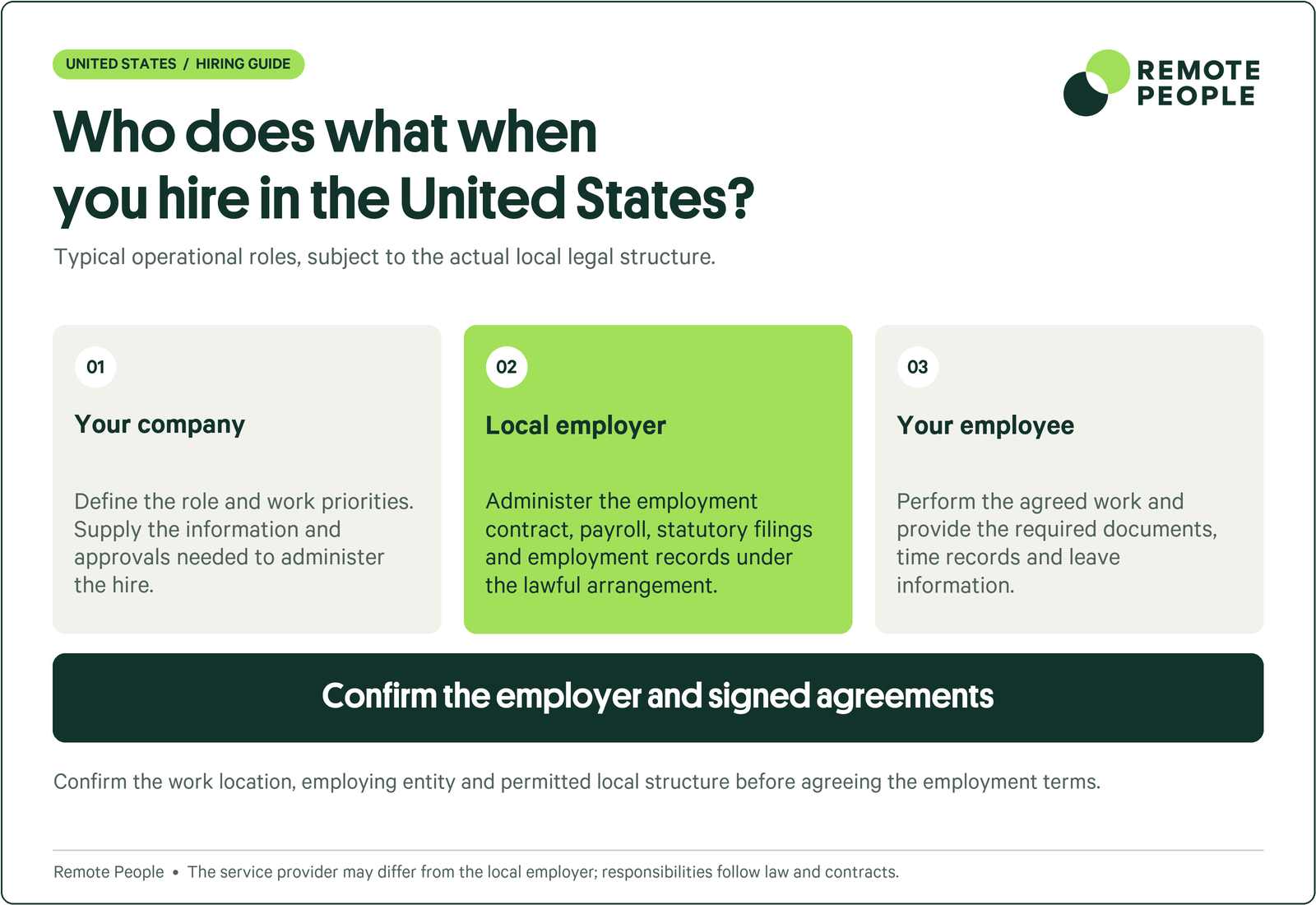
A U.S. Employer of Record (EOR) steps in to legally employ your U.S.-based team members, so you don’t have to set up a company in every state. You still manage the day-to-day assigning tasks, setting schedules, overseeing performance, but the EOR takes care of all the behind-the-scenes work that makes the hire official and compliant.
Once you choose a candidate, the EOR handles onboarding, offer letters, background checks, and ensures everything aligns with federal and state employment laws. From there, they run payroll, withhold the correct taxes, administer employee benefits, and manage things like workers’ comp, unemployment insurance, and HR compliance.
If you’re hiring across multiple states – or don’t yet have a U.S. entity – this model helps you skip the paperwork, cut the risk, and hit the ground running. A U.S. EOR gives you a fast, flexible way to grow your team while staying fully compliant and focused on your business.

If you’d like to learn more about how Employer of Record (EOR) services work, read our What Is an Employer of Record (EOR)? guide for a complete overview of the model, its benefits, and when to use it.
If you’re comparing providers, our Best Employer of Record (EOR) Providers guide reviews the leading platforms to help you choose the right solution for your business.
United States Employer Of Record EOR vs Legal Entity in the United States
If your business wants to recruit a labor force in the U.S., you’ll need to establish a legal right to do so. The most common route to this is through establishing a local entity such as a subsidiary corporation. In doing this, you will be granted the freedom to conduct business so long as you remain compliant with all federal and state regulations. Establishing a subsidiary in the U.S. requires filing Articles of Organization with the relevant office, obtaining an Employer Identification Number (EIN) for tax purposes, and completing several other administrative steps. The process can be finalized in as little as four weeks but often takes much longer due to complications and delays.
In the United States, the majority of corporations are registered in Delaware, due to its business-friendly tax and compliance regime.
Another option is to work with a U.S. EOR service. As part of a package of services, Employer of Record companies can act as proxy entities and allow you to begin recruiting immediately. It can also handle the hiring process, contracting, and employee management while taking responsibility for ensuring legal compliance is maintained throughout. While there are costs and other factors to consider when choosing to work with an EOR, it can offer significant benefits for anyone beginning to operate in the U.S.
How Much Do Employer of Record Services Cost in the United States?
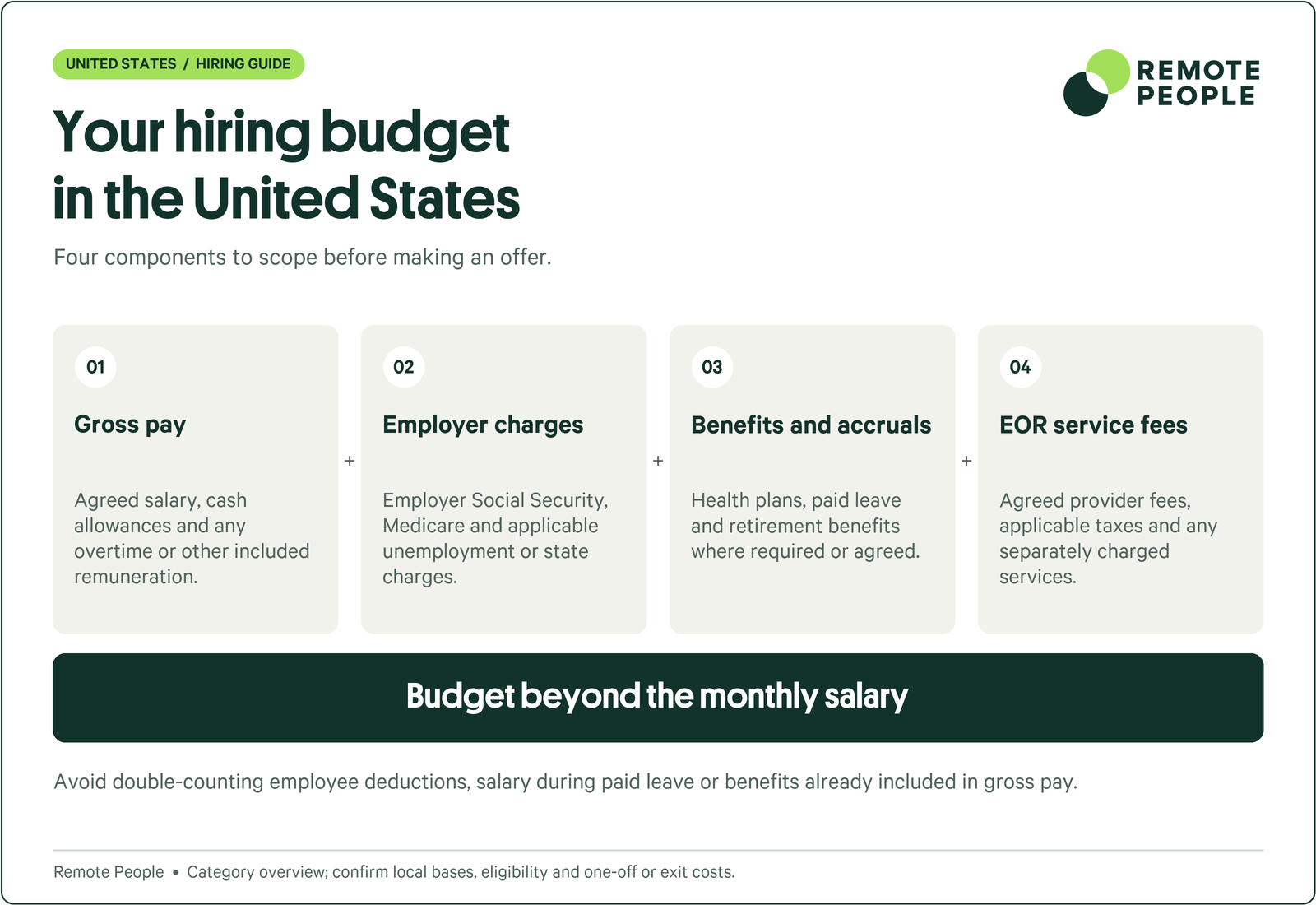
US EOR pricing reflects the complexity of multi-state compliance, benefits administration, and payroll management across 50 jurisdictions. Costs vary based on the number of employees, the states they are located in, and the scope of services required including health insurance, retirement plan access, and visa support.
Most full-service US EOR packages range from $500 to $1,500 per employee per month, with pricing at the higher end for employees in states with more complex compliance requirements or where benefits administration is included. Some providers charge a flat monthly fee per employee while others price as a percentage of gross salary, typically between 5% and 15%.
RemotePeople’s US EOR service starts from $199 per employee per month, covering employment contracts, multi-state payroll, FICA and FUTA compliance, and statutory benefits. Health insurance and retirement plan administration are available depending on your package.
When comparing providers, ask specifically whether multi-state registration, workers’ compensation, and ACA compliance are included in the base fee or charged separately, as these are common sources of unexpected cost in US EOR arrangements.
How Does a USA Employer of Record Help with Payroll and Taxes?
US payroll is more complex than most markets because obligations exist at the federal, state, and local level simultaneously. A US EOR manages the entire process on your behalf.
This includes calculating gross and net wages, withholding and remitting federal income tax, Social Security, and Medicare under FICA, and handling unemployment taxes under both FUTA and each applicable state’s SUTA. The EOR ensures compliance with FLSA wage and hour requirements, registers your employees in each state where they work, and files all required reports with the IRS, Department of Labor, and state tax agencies.
For international companies without a US presence, this level of multi-agency, multi-state compliance is difficult to manage independently. An EOR removes that burden entirely, giving you a compliant, fully managed payroll operation from day one without having to build the infrastructure yourself.
How Does a USA Employer of Record Help with Benefits Administration?
Benefits are a critical part of compensation in the US. For many candidates, the quality of a benefits package carries as much weight as base salary when evaluating a role.
A US EOR gives your employees access to group health insurance, retirement plans such as 401(k), workers’ compensation, and any state-mandated benefits including paid family leave and disability insurance. It administers all deductions and contributions through payroll and ensures compliance with ACA requirements, IRS retirement plan rules, and state-specific obligations.
For international companies, accessing competitive US benefits without a local entity is one of the most practical advantages of using an EOR. Rather than negotiating and managing individual benefit programs across multiple states, everything is consolidated through a single provider.
What Labor Laws Apply to Hiring in the United States?
U.S. employment is regulated by a collection of laws, including the 1938 Fair Labor Standards Act (FLSA), which sets standards for minimum wages, overtime, record keeping, and many other areas. Some of the most notable areas of U.S. labor law include:
Employment Contracts
While employment contracts in the U.S. are less concerned with defining the length of employment or terms of termination than in most countries, they are vital to determining the specifics of a working relationship. This includes everything from responsibilities to compensation and dispute resolution. It is also common to see clauses relating to intellectual property ownership, non–disclosure, and confidentiality.
Until their ban in April 2024, non-compete clauses were also regular features in U.S. contracts. This significant shift in employment law highlights the benefits of working with an EOR that is diligent about staying up to date with the evolving regulatory landscape.
Working Hours
The FLSA states that a standard working week in the U.S. is 40 hours and anything over this is overtime which must be compensated at a rate of at least 150% of standard pay. However, there are several exemptions to this, particularly for high earners, something that changed significantly when revised overtime rules were released in April 2024.
Unlike the majority of the developed world. Private employers in the U.S. are not required to offer any paid annual leave to employees, even for public holidays. Some provisions are made for sick leave and family medical leave but, in general, any paid leave is considered a benefit and must be negotiated and detailed in the contract.
Paid Holidays
The US observes 11 federal public holidays: New Year’s Day, Martin Luther King Jr. Day, Presidents’ Day, Memorial Day, Juneteenth, Independence Day, Labor Day, Columbus Day, Veterans Day, Thanksgiving, and Christmas Day.
Federal holidays apply automatically to federal government employees. Private sector employers are not legally required to provide paid time off on these days. Many states observe additional state-specific holidays, but again without a private employer obligation attached.
In practice, most competitive employers offer between 6 and 10 paid holidays per year as part of their standard benefits package. The specific days offered, and whether employees receive pay or time in lieu for working on a holiday, are determined by company policy or employment contract rather than statute.
Overtime
The Fair Labor Standards Act (FLSA) requires employers to pay non-exempt employees 1.5 times their regular rate for all hours worked beyond 40 in a workweek. Exemptions apply to Executive, Administrative, and Professional (EAP) roles earning at least $684 per week ($35,568 per year). The Department of Labor’s 2024 attempt to raise this threshold was struck down by federal courts, leaving the 2019 figure in place federally.
Several states set higher exemption thresholds. Washington State requires $1,541.70 per week, California $1,352 per week, and New York $1,275 per week for New York City employees. Employers must apply whichever threshold is higher.
From 2026, the OBBBA introduced a tax deduction for qualified overtime compensation, which may affect how some employees and employers approach overtime structuring.
At-Will Employment
The US follows the at-will employment doctrine in 49 states, meaning either party can end the employment relationship at any time, for any legal reason, with no requirement for notice or severance. Montana is the only exception.
Limits apply where termination involves discrimination, retaliation for protected activity, public policy violations, or breach of an implied contract. Employment contracts and offer letters can also modify at-will status if they include language implying job security.
There is no federal requirement for notice periods, severance pay, or redundancy payments. Any such entitlements are a matter of contract or company policy.
Union Membership
Freedom to form or join unions has been protected in the U.S. since 1935 by the National Labor Relations Act (NLRA). Employers are prohibited from interfering with these freedoms or from punishing employees for their union membership, or their participation in union activities.
Probation Period
The US follows the at-will employment doctrine in 49 states, which means formal probation periods carry less legal significance than in most other countries. Either party can end the employment relationship at any time, for any lawful reason, with no requirement for cause, notice, or severance.
Many employers nonetheless use an introductory period of 30 to 90 days to assess new hires, set performance expectations, and determine benefits eligibility. This is a practical tool rather than a legal framework. Completing the introductory period does not change the employee’s underlying at-will status in most cases.
Montana is the only state that requires just cause for termination after a probationary period. In all other states, the at-will doctrine applies regardless of whether a formal introductory period exists.
Payroll and Employment Taxes in the United States
Multi-State Payroll Compliance
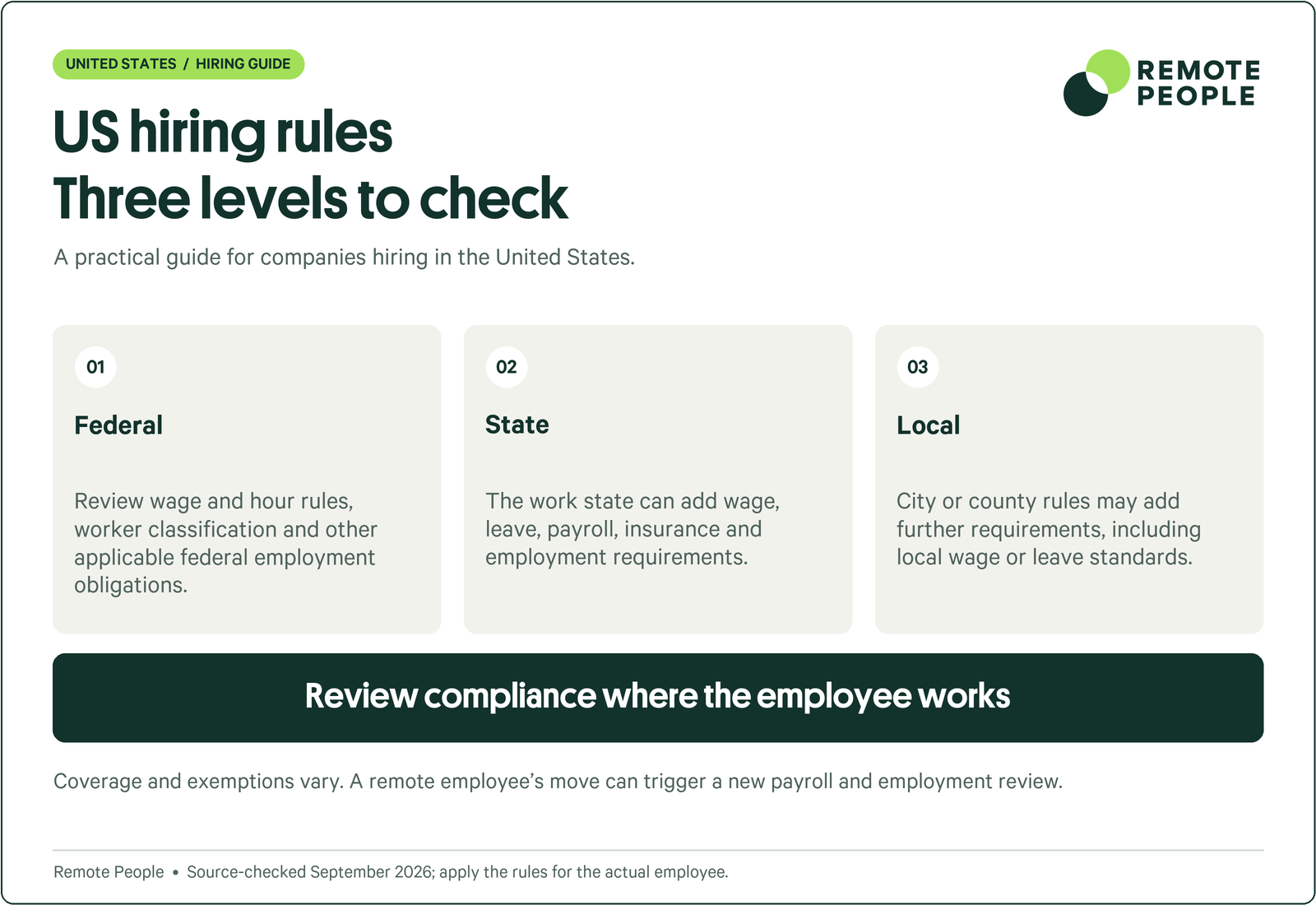
The US is unlike any other EOR market because compliance operates at the state level, not just federally. Each of the 50 states has its own income tax rates, unemployment insurance system, workers’ compensation requirements, paid leave laws, and labor regulations. Nine states have no income tax at all, while others exceed 13%.
A single remote hire in a new state can create tax nexus for the employer, triggering registration and filing obligations from day one. For companies building distributed or remote teams across multiple states, this compounds quickly.
An EOR handles multi-state registration, withholding, and compliance automatically, so you can hire in any state without managing separate employer accounts in each jurisdiction.
Minimum Wage
The federal minimum wage remains $7.25 per hour, unchanged since July 2009. This marks the longest period without an increase in the history of the Fair Labor Standards Act (FLSA). For a federal change to take effect, Congress must pass and the President must sign new legislation. Until that happens, $7.25 remains the national floor.
In practice, most employers pay considerably more. Over 30 states and the District of Columbia have enacted higher minimum wages, and many cities and counties have gone further still. Twenty states continue to apply the $7.25 federal rate.
State / Jurisdiction |
2026 Minimum Wage |
|---|---|
Washington, D.C. |
$17.95/hr |
Washington State |
$17.13/hr |
New York City / Long Island / Westchester |
$17.00/hr |
Connecticut |
$16.94/hr |
California |
$16.90/hr |
Hawaii / Rhode Island / New York (rest of state) |
$16.00/hr |
Federal (20 states) |
$7.25/hr |
Local ordinances can push rates even higher. Seattle, for example, requires $21.30 per hour for all employers in 2026. Employers with workers in multiple states must apply the highest applicable rate at each location.
Tipped employees are subject to a separate federal minimum cash wage of $2.13 per hour, with the employer required to make up the difference if tips do not bring the employee to at least $7.25 per hour. Many states do not allow a tip credit and require employers to pay the full state minimum wage before tips.
Social Security and Medicare Taxes
Employers and employees each contribute to the Federal Insurance Contributions Act (FICA), which funds Social Security and Medicare. Both parties pay matching rates, with the employer withholding the employee portion and remitting both shares to the IRS.
- Social Security: For 2026, the Social Security wage base is $184,500, up from $176,100 in 2025. Both employer and employee pay 6.2% on wages up to this cap, giving a combined rate of 12.4%. The maximum Social Security tax per employee is $11,439 per year for each side. Wages above $184,500 are not subject to Social Security tax.
- Medicare: Medicare is charged at 1.45% for both employer and employee on all wages with no cap. The combined rate is 2.9%.
- Additional Medicare Tax: An Additional Medicare Tax of 0.9% applies to employee wages exceeding $200,000 in a calendar year. This is an employee-only obligation. Employers must withhold it once the threshold is crossed but are not required to match it.
Tax |
Employee Rate |
Employer Rate |
Wage Cap |
|---|---|---|---|
Social Security |
6.2% |
6.2% |
$184,500 (2026) |
Medicare |
1.45% |
1.45% |
No cap |
Additional Medicare Tax |
0.9% |
None |
Applies above $200,000 |
Taxes
The United States levies a progressive federal income tax on individuals, administered by the Internal Revenue Service (IRS). Employers are required to withhold federal income tax from employee wages each pay period through the PAYE-equivalent system and remit it to the IRS.
The One Big Beautiful Bill Act (OBBBA), signed into law on 4 July 2025, made the seven tax rates introduced by the 2017 Tax Cuts and Jobs Act (TCJA) permanent. Without this legislation, those rates were due to expire at the end of 2025. The seven rates now apply on a permanent basis, adjusted annually for inflation.
Rate |
Single Filers |
Married Filing Jointly |
|---|---|---|
10% |
Up to $12,400 |
Up to $24,800 |
12% |
$12,401 – $50,400 |
$24,801 – $100,800 |
22% |
$50,401 – $105,700 |
$100,801 – $211,400 |
24% |
$105,701 – $201,775 |
$211,401 – $403,550 |
32% |
$201,776 – $256,225 |
$403,551 – $512,450 |
35% |
$256,226 – $640,600 |
$512,451 – $768,700 |
37% |
Above $640,600 |
Above $768,700 |
The standard deduction is $16,100 for single filers, $32,200 for married couples filing jointly, and $24,150 for heads of household. Personal exemptions remain eliminated.
Key OBBBA Changes Affecting Employees and Employers
The OBBBA introduced several new deductions and credits relevant to employment and payroll planning:
- The Child Tax Credit increased from $2,000 to $2,200 per qualifying child, now indexed for inflation from 2026 onwards.
- The SALT deduction cap increased from $10,000 to $40,400 in 2026 (up from $40,000 in 2025), rising 1% annually through 2029 before reverting to $10,000 in 2030. A phaseout applies for MAGI above $500,500.
- A senior bonus deduction of $6,000 is available to taxpayers aged 65 and over from 2025 through 2028, subject to a phaseout above $75,000 MAGI for single filers and $150,000 for joint filers.
- An overtime compensation deduction of up to $12,500 (single) or $25,000 (married filing jointly) applies to qualifying overtime pay. Phaseout begins above $150,000 MAGI (single) / $300,000 (MFJ).
- A car loan interest deduction of up to $10,000 per year applies to interest paid on loans for new vehicles. Phaseout begins above $100,000 MAGI (single) / $200,000 (MFJ).
Unemployment Taxes (FUTA and SUTA)
Employers in the US are responsible for both federal and state unemployment taxes. These are employer-only obligations and are not withheld from employee wages.
Federal Unemployment Tax (FUTA)
FUTA is charged at 6.0% on the first $7,000 of wages per employee per year. Most employers qualify for a 5.4% credit for timely payment of state unemployment taxes, reducing the effective net FUTA rate to 0.6%, or a maximum of $42 per employee per year.
This credit can be reduced in states that have outstanding federal unemployment loans. California has been flagged as potentially affected by a FUTA credit reduction in 2026, which would increase the effective rate for employers in that state. Employers should monitor IRS announcements in the second half of the year for confirmed credit reduction states.
State Unemployment Tax (SUTA)
State unemployment tax rates and wage bases vary significantly by state. New employers are typically assigned a standard rate until they build enough claims history for experience rating to apply.
Variable | Range |
|---|---|
SUTA rate | 0% to 20%+ depending on state and claims history |
State wage base | $7,000 (California, Arkansas) to $56,700+ (Washington State) |
Employers operating across multiple states must register separately for unemployment tax in each state and apply the applicable wage base and rate for employees in each location.
Health Insurance
The Affordable Care Act (ACA) requires employers with 50 or more full-time equivalent employees (known as Applicable Large Employers or ALEs) to offer affordable, minimum-value health coverage to full-time employees or face a shared responsibility penalty. For 2026, coverage is considered affordable if the employee’s share of the premium does not exceed 9.02% of household income.
Employers with fewer than 50 employees are not required to offer coverage, but health insurance is a baseline expectation in most hiring markets and a near-universal feature of competitive compensation packages.
Employer health insurance costs vary significantly by plan type, location, and workforce demographics. Average annual employer contributions run approximately $7,000 for single coverage and $24,000 for family coverage per employee. These costs are in addition to payroll taxes and represent one of the largest components of total employment cost in the US.
Pensions and Retirement
Most U.S. employees receive some retirement income through Social Security, but this rarely provides sufficient retirement income on its own. Employer-sponsored retirement plans are therefore a standard part of competitive compensation packages. The most common is the 401(k), though 403(b) plans are widely used in non-profit and educational sectors.
Under SECURE Act 2.0 (signed December 2022), new 401(k) and 403(b) plans established after December 29, 2022 are required to include automatic enrolment for eligible employees, with a default contribution rate of at least 3%. Existing plans established before that date are not required to add auto-enrolment, though many employers do so voluntarily. There is no federal mandate requiring employers to offer a retirement plan at all, but doing so is a baseline expectation in most hiring markets.
Work Permits and Visas in the United States
Foreign nationals require work authorisation to be employed in the United States. The type of visa required depends on the candidate’s nationality, qualifications, role, and whether they are being transferred from an existing employer or hired externally.
- H-1B is the primary route for professional and specialty occupation roles, including technology, engineering, finance, and healthcare. It requires employer sponsorship and is subject to an annual cap of 85,000 visas (65,000 regular cap plus 20,000 for US advanced degree holders). Demand significantly exceeds supply, and selection is by lottery each spring for the following fiscal year. The initial period is 3 years, extendable to 6. Note that from September 2025, a Presidential Proclamation introduced an additional $100,000 payment requirement for certain H-1B petitions.
- L-1 is available for intracompany transfers, allowing employees of multinational companies to move to a US office. L-1A covers managers and executives; L-1B covers employees with specialised knowledge. There is no annual cap, making it a more reliable route than H-1B for qualifying transfers.
- O-1 is for individuals with extraordinary ability in their field. It has no annual cap and can be employer or agent-sponsored, making it a viable alternative for highly accomplished candidates who cannot access the H-1B.
- TN is available exclusively to Canadian and Mexican citizens under the USMCA agreement. It covers specific listed professions and has no annual cap. Initial validity is up to 3 years with unlimited renewals.
- E-3 is available to Australian citizens only, subject to a 5,000 annual cap, for specialty occupation roles.
An EOR can employ workers who already hold valid US work authorisation. However, H-1B sponsorship is more complex in an EOR context. Because the H-1B requires the petitioning employer to be the day-to-day controlling employer, companies often need to sponsor H-1B visas directly rather than through an EOR. Legal advice is strongly recommended for any H-1B sponsorship arrangement involving an EOR.
Worker Classification and Misclassification Risk in the United States
The IRS and Department of Labor actively enforce worker classification rules, and the consequences of getting it wrong are significant. Employees must be engaged on a W-2 basis and are entitled to tax withholding, benefits, and full labor law protections. Independent contractors are paid on a 1099 basis and receive none of these protections.
Misclassifying an employee as a contractor can result in back taxes, interest, and penalties of up to 100% of unpaid payroll taxes, plus exposure to employee lawsuits for unpaid benefits and overtime. The IRS applies a multi-factor test looking at behavioral control (does the company control how work is done), financial control (does the company control the business aspects of the worker’s job), and relationship type (are there written contracts, benefits, or permanency suggesting employment).
Many companies default to contractor arrangements to reduce cost and administration, but ongoing or integrated roles carry significant reclassification risk. An EOR provides a fully compliant W-2 employment structure, eliminating misclassification exposure while giving you the flexibility of hiring without a local entity.
Worker Classification and Misclassification Risk in the United States
Workers’ compensation insurance is mandatory in every state except Texas, where participation remains optional for private employers. Coverage is employer-paid and provides medical care and wage replacement for employees who suffer work-related injuries or illnesses.
Premiums vary by state, industry, and the employer’s claims history, typically ranging from 0.5% to 3% of payroll. High-risk industries such as construction and manufacturing sit at the higher end, while office-based roles generally attract lower rates. Each state administers its own workers’ compensation system with its own rate structures, benefit levels, and compliance requirements.
Employers operating across multiple states must ensure coverage is in place in each state where employees are located, as a policy issued in one state does not automatically satisfy the requirements of another.
Time Off and Leave in the United States
Mandatory Annual Leave
The US has no federal mandate for paid vacation, paid sick leave, or paid parental leave. The primary federal protection is the Family and Medical Leave Act (FMLA), which provides up to 12 weeks of unpaid, job-protected leave for qualifying reasons. FMLA applies only to employers with 50 or more employees, and employees must have at least 12 months of tenure to be eligible.
At the state level, more than 13 states and Washington D.C. have enacted paid family and medical leave programs, with three additional states launching in 2026. Paid sick leave is mandated in 15 or more states. Employers hiring across multiple states must track each jurisdiction’s requirements separately.
Most competitive employers offer 10 to 20 days of PTO plus public holidays regardless of state law, as paid leave is a standard expectation in the US job market.
Parental Leave
The U.S. has no mandatory maternity or paternity leave entitlement. However, it does afford some benefits and protections to parents. For example, the Family and Medical Leave Act (FMLA) allows parents to take up to 12 weeks of unpaid leave in each 12-month period for birth and/or childcare without putting their jobs at risk. This is backed up by the Pregnant Workers Fairness Act, which requires employers to provide reasonable accommodations to employees affected by pregnancy, childbirth, or related medical conditions.
Terminations and Severance in the United States
The US at-will employment doctrine means most terminations do not require advance notice, cause, or severance. However, several important protections and obligations apply.
Wrongful termination claims can arise where dismissal involves discrimination based on a protected characteristic (race, gender, age, disability, religion, national origin), retaliation for protected activity such as whistleblowing or filing a workers’ compensation claim, or violation of an implied contract created by an offer letter or employee handbook.
The WARN Act (Worker Adjustment and Retraining Notification Act) requires employers with 100 or more full-time employees to provide 60 days written notice before a mass layoff or plant closure affecting 50 or more employees at a single location. Failure to comply results in liability for up to 60 days of back pay and benefits per affected employee. Several states have their own mini-WARN laws with lower thresholds, including California (75 employees), New York (50 employees), and New Jersey (50 employees).
Severance pay is not required by federal law. Where it is offered, it is typically documented in an employment contract, severance agreement, or company policy. Employers commonly use severance agreements to obtain a release of claims from the departing employee, particularly in layoff situations.
An EOR manages termination processes on your behalf, ensuring documentation is correct, final pay obligations are met, and any applicable WARN Act notice requirements are fulfilled in each state where your employees are located.
How Does a USA Employer of Record Work?
The main function of an EOR is to streamline the process of hiring and managing employees in the U.S. by acting as the official employer for tax purposes. This arrangement is especially beneficial for international companies who want to enter the U.S. market without the difficulties and costs of setting up a local office or subsidiary. Using an EOR, companies can quickly onboard employees, manage human resource functions, and efficiently comply with U.S. employment regulations. Some EORs even provide recruitment agency services.
In a market as regulated and competitive as the United States, taking advantage of an EOR service can help create an easier entry, with minimal risk and reduced administrative burden. This allows businesses to focus on strategic activities like expanding their market and optimizing their operations rather than getting bogged down by legal and procedural complications.
- Analyze Organizational Needs: The first step is to select a reputable EOR service provider. Once chosen, both parties will sign an agreement that outlines the EOR’s roles, responsibilities, and expectations, including handling legal compliance, payroll, and employee benefits.
- Employee Onboarding: The EOR takes over the onboarding process for new hires. This involves collecting necessary employee documents, setting up payroll, and ensuring employment contracts meet local legal standards.
- Compliance and Administration: The EOR manages all employment compliance, including adherence to federal and state labor laws. This includes income tax withholding, social security contributions, and any other statutory requirements.
Hire in the United States
Fifty states, fifty sets of rules: FICA, FUTA, state unemployment insurance, at-will variations, and state-specific wage-and-hour regulations.
We handle employment contracts, payroll, social contributions, and full US compliance.
No local entity needed. Your team can start in days.
What are the Benefits of a United States Employer of Record Service?
Using an Employer of Record in the USA provides many different advantages for companies that are looking to hire and manage employees without the hassle of having to establish a local entity. Here are the main benefits of using a USA EOR:
- Quick Market Entry: An EOR allows companies to hire employees quickly without the need for a physical presence or a local entity in the USA. This speeds up the process of entering the U.S. market, making it perfect for companies that want to start operations immediately.
- Compliance with Employment Laws: The EOR is responsible for ensuring all employment practices comply with both federal and state laws. This includes managing complicated issues such as employment taxes, workers’ compensation, and unemployment insurance.
- Cost Efficiency: Managing payroll, benefits, and compliance in-house can be very expensive, especially when a business is trying to navigate the tax system and employment legislation in a foreign country. An EOR can reduce these overhead costs significantly.
- Flexibility: Companies can quickly scale their operations up or down without the long-term commitments or complexities that are involved in hiring or laying off staff directly. This flexibility is crucial for adapting to changing business conditions
What are the Downsides of a USA Employer of Record?
Engaging a US Employer of Record comes with both pros and cons. Here are the main drawbacks of using an EOR in the USA:
- Limited Control Over Employees: When using an EOR, companies may face challenges in maintaining direct control over their workforce. The EOR handles all legal and HR aspects, which can sometimes distance the parent company from its employees.
- Dependence on the EOR’s Competence: The effectiveness of an EOR heavily relies on its ability to competently manage HR tasks. Any shortcomings in the EOR’s service delivery can impact employee satisfaction and operational efficiency.
- Cost Considerations: While using an EOR can save on the costs of setting up a legal entity, it is not necessarily cheaper than other employment options. The fees for EOR services may be quite hefty and must be weighed against the potential benefits.
How to Choose a United States EOR
Choosing the right Employer of Record in the USA requires careful consideration to ensure it completely aligns with your business needs. First, evaluate the EOR’s expertise and experience in the industry and region in which you plan to operate. An EOR with a strong track record in your sector can offer invaluable insights and a more tailored service. Next, consider the range of services that are being offered. Ensure the EOR can handle all your specific HR tasks, from payroll to compliance with local labor laws.
It is also important to assess customer service quality; responsive and proactive customer support is crucial for quickly and effectively addressing issues. Finally, review their pricing structure to ensure complete transparency and that it will fit into your budget. Avoid providers with hidden fees that could inflate your costs unexpectedly. By carefully taking the time to vet potential EORs based on these criteria, you can find a partner that meets your operational requirements and supports your overall strategic business objectives.
Engage a United States Employer of Record, with RemotePeople
Taking advantage of an Employer of Record in the United States is a great way to enhance your business’s operational efficiency significantly. An EOR simplifies the often complex compliance, payroll, and HR management processes, allowing you to focus on growth and core business activities. This partnership provides the ability to adapt to changing market demands swiftly and without the burdens of legal and administrative hassles.
If you’re unsure how to navigate Employer of Record options in the United States, RemotePeople is here to help. We provide expert EOR services tailored to your business needs—ensuring compliance, smooth onboarding, and scalable support across the U.S.
Where companies hiring in the United States expand next
Teams hiring in the United States frequently expand across North America and into aligned English-speaking markets. After building a team in the United States, employers often look to an EOR partner in Canada for USMCA labor provisions and trade framework, then the United Kingdom for the transatlantic English-first business corridor. A team in Ireland follows with shared transatlantic business norms, and operations in India typically closes the regional footprint via a scaled engineering workforce.
Frequently Asked Questions
A Professional Employer Organisation (PEO) operates under a co-employment model, meaning the client company must have its own US legal entity. The PEO shares employment responsibilities with the client. An EOR, by contrast, becomes the sole legal employer, allowing companies without a US entity to hire compliantly. For international companies entering the US market, an EOR is typically the appropriate solution until a decision is made to establish a permanent US presence.
Yes, you can outsource a USA employer of record service. Outsourcing to an EOR allows a company to legally employ staff in the USA without establishing their entity, and managing all related legal, HR, and compliance responsibilities externally.
This is one of the most common questions and the answer is nuanced. An EOR can employ workers who already hold valid US work authorisation. However, H-1B sponsorship through an EOR is legally complex because the H-1B requires the petitioning employer to exercise day-to-day control over the employee's work. In most cases, the actual client company needs to sponsor the H-1B directly rather than through the EOR. If you need to hire foreign nationals requiring H-1B sponsorship, legal immigration counsel is strongly recommended.
In most states, yes. At-will employment means either party can end the employment relationship at any time without cause or advance notice, unless a contract specifies otherwise. That said, terminations must not involve discrimination, retaliation, or breach of contract. Your EOR will guide you through the correct process, ensure final pay obligations are met on time, and document the termination properly to minimise legal exposure.
California consistently ranks as the most complex state for employers, with its own minimum wage, strict overtime rules, mandatory paid sick leave, pay transparency requirements, strong employee protections, and WARN Act with a lower threshold than federal law. New York, Washington, and Massachusetts are also notably more regulated than states like Texas or Florida. An EOR with multi-state experience manages these differences automatically.
Benefits and compliance obligations are tied to the state where the employee physically works, not where the company is headquartered. If an employee relocates from one state to another, the EOR must update state tax registrations, workers' compensation coverage, and ensure any new state-specific mandates such as paid family leave are correctly applied. This is one of the most common compliance gaps for companies managing US payroll without specialist support.
No. At-will employment applies to both parties. Employees can resign at any time without notice, and employers are not legally required to enforce or honour a notice period. The standard practice of giving two weeks notice is a professional courtesy, not a legal requirement. Employment contracts can specify a notice period, but enforcing it against an employee is uncommon and difficult in practice.
The most common payroll frequency in the US is bi-weekly, meaning employees are paid every two weeks for a total of 26 pay periods per year. Some states mandate minimum pay frequencies. For example, California requires most employees to be paid at least twice per month. New York has specific requirements depending on the industry. An EOR ensures the correct pay frequency is applied for each employee based on their state of employment.
Employer of Record in
Employer of Record in
Employer of Record in
Employer of Record in
Employer of Record in
Employer of Record in
Employer of Record in
Employer of Record in




