
 Recruit
Employer of Record in South Korea
-
 Drew Donnelly
- Published
- September 22, 2026
RemotePeople’s employer of record in South Korea lets you hire employees in South Korea with full National Pension compliance. We handle National Pension contributions at 4.5 percent, National Health Insurance contributions, Unemployment Insurance at 1.8 percent, and Workers’ Compensation Insurance.
Hire in South Korea — book a free 30-minute demo
Tell us what you need. You'll get a tailored, transparent proposal within 24 hours, plus a free call to walk through it.
Tell us about your company
So we can match you with a specialist who knows your market — and unlock volume pricing tiers.
* All fields are required.
Where and when are you hiring?
Tell us the geography and timing and we'll quote each country line by line, with onboarding timelines.
* All fields are required.
Help us beat your current setup
We'll benchmark your current deal and send a line-by-line proposal in 24 hours — showing exactly where we cut cost, time, or risk. After you submit, you can book a call to walk through it together.
* All fields are required.
Thanks! Your proposal is on its way.
Expect a tailored, line-by-line proposal in your inbox within 24 hours. In the meantime…
Want to walk through it together?
Book a free 30-minute call with one of our specialists. We'll explain every line, answer your questions, and tailor the proposal further if you need.
No obligation. Pick a time that works for you.








- Hire in South Korea — book a free 30-minute demo
- Tell us about your company
- Where and when are you hiring?
- Help us beat your current setup
- Thanks! Your proposal is on its way.
- How an Employer of Record Works in South Korea
- Hire in South Korea
- Employment Laws and Regulations in South Korea
- Work Permits and Visas in South Korea
- Payroll, Taxes, and Social Security in South Korea
- Cost of Hiring Through an EOR in South Korea
- Benefits of Using an EOR in South Korea
- Termination and Offboarding in South Korea
- EOR vs. Other Hiring Models in South Korea
- Public Holidays in South Korea
- How to Get Started with an EOR in South Korea
- Frequently Asked Questions
- Related EOR Destinations

Start hiring in South Korea
Let RemotePeople handle payroll, compliance, and HR admin worldwide so you can focus on building your team.

South Korea is the world’s twelfth-largest economy and sits inside the OECD’s top quartile for workforce education, which is why so many US, European, and APAC firms want a presence there. But hiring in Korea is not plug-and-play. The Labor Standards Act, the Four Major Insurances, progressive income tax up to 45%, and visa sponsorship for foreign hires each come with their own filings, deadlines, and penalties for getting it wrong. An employer of record in South Korea takes on all of that: the employment contract, the monthly payroll, the tax withholding, the social insurance enrolment, and every regulatory filing Korean labour law places on employers. You manage the work; the EOR is the legal employer on paper, and you skip the Korean subsidiary. Fees typically sit in the $300 to $600 per employee per month range, and most hires can start within one to two weeks of signing.
How an Employer of Record Works in South Korea
An employer of record in South Korea is the legal employer for your hires and manages every statutory obligation under Korean labour law, including the Labor Standards Act, the Employee Retirement Benefit Security Act, and the Four Major Insurances framework. This structure lets foreign companies onboard employees in South Korea within one to two weeks, compared to 3–6 months for registering a Korean corporation (법인, beopin) with the Ministry of Justice and the National Tax Service. The EOR registers each hire with the National Pension Service, the National Health Insurance Service, the Employment Insurance fund, and the Industrial Accident Compensation Insurance fund, files monthly payroll taxes, and ensures full compliance with the Ministry of Employment and Labor (MOEL).
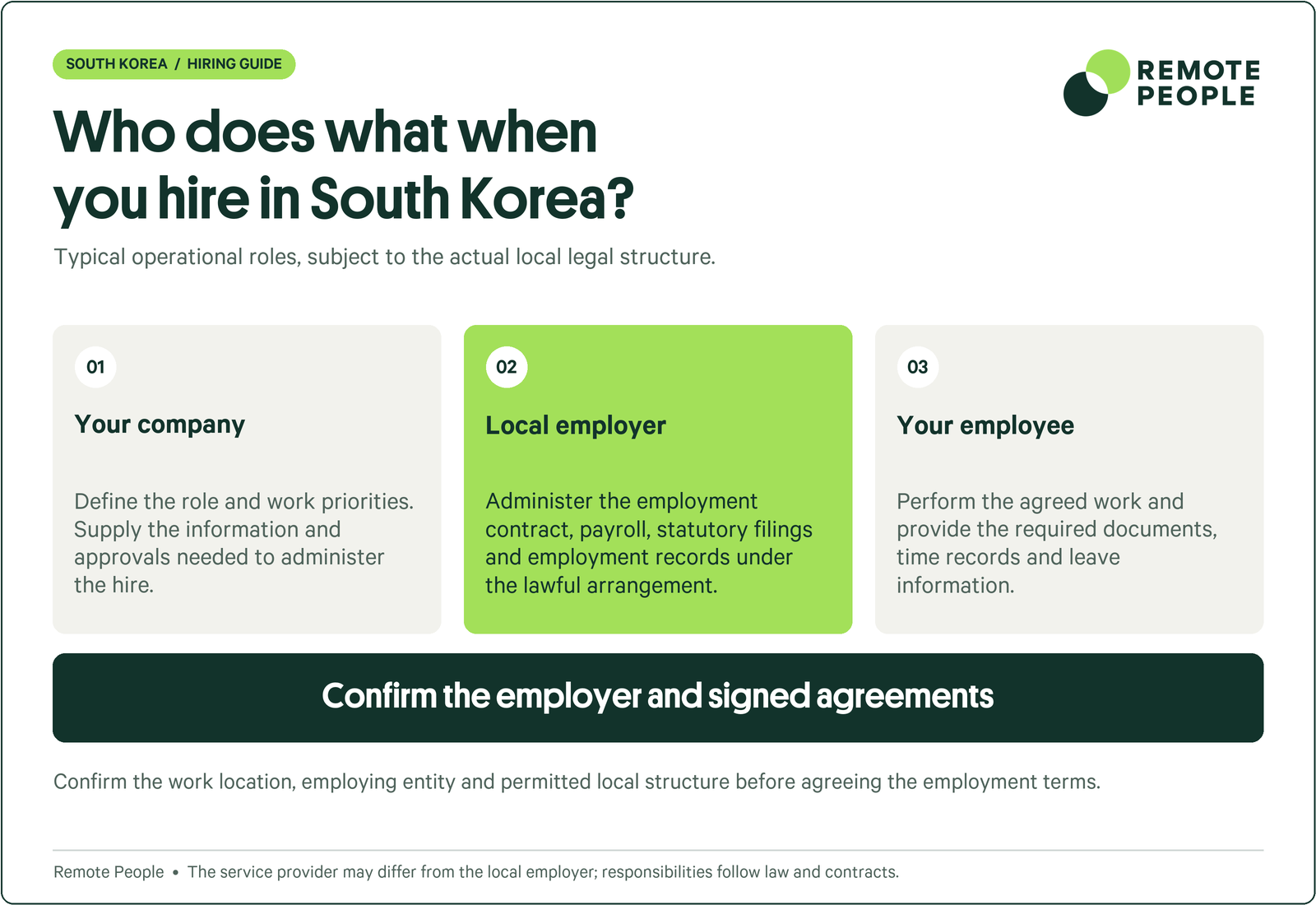
If you’d like to learn more about how Employer of Record (EOR) services work, read our What Is an Employer of Record (EOR)? guide for a complete overview of the model, its benefits, and when to use it.
If you’re comparing providers, our Best Employer of Record (EOR) Providers guide reviews the leading platforms to help you choose the right solution for your business.
Who Uses an EOR in South Korea?
Companies across a range of sizes and growth stages use employer of record services to hire in South Korea without the cost and complexity of incorporating a Korean entity.
- Market entry testing: A company looking to build a team in South Korea can hire its first 1–3 employees through an EOR and validate commercial demand before committing to entity incorporation, which typically takes 2–3 months and $25,000–$50,000 in setup costs.
- Small remote teams: Any business hiring fewer than fifteen employees in South Korea finds the EOR model more cost-effective than running a Korean subsidiary with its own tax agent, labour attorney, and office lease.
- Rapid onboarding: For organisations that need a new hire to start in under two weeks, the EOR bypasses the 2–3 month entity-registration process at the Supreme Court Registry Office and the National Tax Service.
- Foreign national sponsorship: Businesses hiring non-Korean employees use an EOR that holds a registered Korean office and can sponsor E-7 Specially Designated Activities visas through the Ministry of Justice and HiKorea.
The EOR model also suits established multinationals that want to move employees between countries quickly or hire a senior contributor ahead of committing to a full Korean branch.

Typical Onboarding Timeline
- Step one: Submit employee information, job scope, and compensation to the EOR. This takes 1–2 business days.
- Step two: The EOR drafts a bilingual employment contract that complies with Labor Standards Act Article 17 and sends it for the employee’s signature. Contract preparation takes 2–3 business days.
- Step three: The EOR registers the employee with the National Pension Service, the National Health Insurance Service, the Employment Insurance fund, and the Industrial Accident Compensation Insurance fund. Registration takes 3–7 business days.
- Step four: Payroll is set up and the first salary is processed on the company’s chosen pay date. Korean payroll runs monthly, with salaries commonly paid on the 10th or 25th of each month.
- Step five: The employee starts work on day one. Ongoing compliance reporting, tax filings, and monthly payroll reports continue for the life of the engagement.
Most EOR providers can onboard an employee in South Korea within one to two weeks. If the hire requires an E-7 work visa, the timeline extends by four to eight weeks for Certificate of Eligibility processing at the local immigration office.
Employers with teams in South Korea often extend across Northeast Asia, where advanced manufacturing and deep tech ecosystems cluster together. After building a team in South Korea, employers often look to an EOR partner in Japan for Asia-Pacific connectivity and English-proficient hires, then Taiwan for the Asia-Pacific gateway with multilingual workforce. A team in Hong Kong follows with access to pan-Asian talent and supply-chain clusters, and operations in China typically closes the regional footprint via deep Asian tech and services talent.
Hire in South Korea
A global tech and manufacturing powerhouse with NPS, NHI, EI, and industrial accident insurance, plus Korean Labor Standards Act compliance.
We handle employment contracts, payroll, social contributions, and full South Korean compliance.
No local entity needed. Your team can start in days.
Employment Laws and Regulations in South Korea
South Korea’s employment framework is governed primarily by the Labor Standards Act (근로기준법, enforced by the Ministry of Employment and Labor), with additional statutes covering retirement benefits (Employee Retirement Benefit Security Act), non-discrimination (Equal Employment Opportunity and Work-Family Balance Assistance Act), and minimum wage (Minimum Wage Act). Korean labour law provides strong employee protections, especially around dismissal, working hours, and the 52-hour weekly cap. Companies hiring through an employer of record in South Korea outsource these detailed compliance obligations to a local team that is registered with the Ministry of Employment and Labor and holds the permits needed to run payroll and sponsor visas.
Employment Contracts
Labor Standards Act Article 17 requires employers to specify working conditions in writing at the time of hiring, covering wages, working hours, paid holidays, and annual paid leave. The contract must be delivered to the employee and should be in Korean, though bilingual Korean/English contracts are standard practice for foreign-invested companies. Both fixed-term and indefinite-term contracts are permitted under the Act on the Protection, etc. of Fixed-term and Part-time Workers; a fixed-term employee who has worked continuously for more than two years must generally be converted to an indefinite-term employee unless a statutory exception applies (Paul Hastings: South Korea Employment Law).
Working Hours and Overtime
The standard Korean workweek is 40 hours across five days, with a daily limit of 8 hours under Labor Standards Act Article 50. Employers must give at least a 30-minute break for shifts over four hours and a one-hour break for shifts over eight hours. Overtime must be mutually agreed in writing and is capped at 12 hours per week, giving a hard ceiling of 52 total working hours per week for all businesses with five or more employees. Overtime, night work, and holiday work premiums are set out in Article 56 of the Labor Standards Act.
South Korea overtime and premium pay rates · Per Labor Standards Act Article 56 | |||
Hour Type | Rate Multiplier | Weekly/Daily Cap | Notes |
|---|---|---|---|
Weekday overtime (beyond 8 hrs/day or 40 hrs/week) | 150% (50% premium) | 12 hrs/week | Counts toward the 52-hour weekly cap |
Night work (10:00 PM – 6:00 AM) | 150% (50% premium) | No separate cap | Stacks with overtime premium when applicable |
Overtime worked at night | 200% (100% premium) | Subject to 12 hr weekly OT cap | Combined 50% overtime + 50% night premium |
Holiday work (first 8 hours) | 150% (50% premium) | N/A | Applies to both public holidays and the statutory weekly rest day |
Holiday work (beyond 8 hours) | 200% (100% premium) | N/A | Applies after the first 8 hours on a holiday |
Holiday work at night | 250% (150% premium) | N/A | Holiday premium plus night-work premium |
Managerial and supervisory staff covered by Article 63 are exempt from working-hour limits and overtime premiums, but they remain entitled to night-work premiums. Korean employers cannot buy their way out of the 52-hour cap, even with employee consent; breaches can result in criminal penalties under Article 110 of the Labor Standards Act.
Minimum Wage
The statutory minimum wage for 2026 is KRW 10,320 per hour, up 2.9% from KRW 10,030 in 2025. Based on the standard 209 working hours per month (40 hours a week plus 8 weekly paid rest hours), the monthly minimum wage equates to KRW 2,156,880. The rate was set by the Minimum Wage Council on 10 July 2025 and formally notified by the Ministry of Employment and Labor, effective 1 January 2026 (Korea.net: 2026 Minimum Wage). The minimum wage applies uniformly across all industries and regions and covers both Korean and foreign workers, including those on E-7 and E-9 visas.
Probation Period
The Labor Standards Act does not cap the probation period, but Korean labour market practice sets the standard probation at 3 months, with up to 6 months accepted for senior or complex roles. The probation clause must be written into the employment contract or the company’s rules of employment (취업규칙) to be enforceable. During probation, an employee with less than 3 months of continuous service may be dismissed without the 30-day notice under Article 26 of the Labor Standards Act, but broader unfair-dismissal protections still apply once the probation exceeds 3 months, and Korean courts have consistently ruled that probationary dismissal still requires “justifiable cause.”
Leave Entitlements
South Korea’s statutory leave framework is set by the Labor Standards Act and the Equal Employment Opportunity and Work-Family Balance Assistance Act, and funded partly by Employment Insurance for parental leave. Annual leave accrues from the first month of service, statutory maternity leave runs for 90 days, and paternity leave was doubled to 20 days in early 2025.
Annual Leave
Under Labor Standards Act Article 60, an employee who completes one full year with at least 80% attendance is entitled to 15 days of paid annual leave. Employees in their first year accrue 1 day of leave per completed calendar month (up to 11 days). From the fourth year of service, employees earn 1 additional day of paid leave for every 2 further years of tenure, capped at 25 days per year. Unused leave can be paid out at year-end as a leave allowance (연차수당) when the employer has complied with the mandatory leave-usage notice procedure.
Sick Leave
There is no statutory paid sick leave in South Korea for non-work-related illness, and employers are not required to grant paid time off for personal illness. Employees usually apply their annual paid leave to cover sickness absences. For work-related injuries or illness, Industrial Accident Compensation Insurance pays medical expenses and wage replacement, and the employer must grant the time needed for recovery under Article 23 of the Labor Standards Act, which prohibits dismissal during a work-injury recovery period plus 30 days thereafter.
Maternity Leave
Female employees are entitled to 90 days of paid maternity leave (120 days for multiple births) under Labor Standards Act Article 74, with at least 45 days (60 for multiple births) taken after the birth. The first 60 days are paid by the employer at 100% of ordinary wages (small and medium-sized enterprises can claim reimbursement from the government up to a cap); the remaining 30 days are paid by Employment Insurance. From 23 February 2025, maternity leave is extended to 100 days if the newborn requires neonatal intensive care (Lockton: South Korea Family Leave).
Paternity Leave
Under the 2025 amendment to the Equal Employment Opportunity and Work-Family Balance Assistance Act, paternity leave was doubled from 10 to 20 days with effect from 23 February 2025. Fathers may split the leave into up to four separate periods and must use it within 120 days of the child’s birth. The leave is fully paid, with Employment Insurance covering the wage support for eligible small and medium-sized enterprises for the full 20 days.
Other Statutory Leave
- Parental (childcare) leave: Up to 1 year of unpaid leave per parent for each child under 8 years old or in the second grade of elementary school (extended to 12 years old under the 2025 amendment), funded by Employment Insurance.
- Family care leave: Up to 90 days per year to care for a sick family member, unpaid at the employer level but partly subsidised by Employment Insurance.
- Menstrual leave: 1 day per month of unpaid menstrual leave under Article 73 of the Labor Standards Act, on request.
- Voting, reserve forces training, and civic-duty leave: Paid time off for voting, reserve military training, and mandatory civic duties as required under Korean law.
Korean leave entitlements are governed principally by the Labor Standards Act and are funded through a mix of employer payroll and Employment Insurance. The summary table below consolidates the statutory minimums so employers can see, at a glance, how much paid time off a South Korean hire is entitled to. The most important takeaway is that annual leave accrues from the very first month of work, unlike many countries that require a qualifying period.
South Korea statutory leave entitlements · Per Labor Standards Act | ||
Leave Type | Duration | Eligibility & Notes |
|---|---|---|
Annual leave (first year) | 1 day per month worked (max 11 days) | Accrues monthly for employees with less than 1 year of service (LSA Article 60) |
Annual leave (1+ years) | 15 days | Granted once attendance reaches 80% of the first full year; paid by employer |
Annual leave (long service) | +1 day per 2 years (up to 25 days) | Additional leave starts in the fourth year of continuous service |
Maternity leave | 90 days (120 days for multiple births) | First 60 days paid by employer; final 30 days by Employment Insurance (LSA Article 74) |
Paternity leave | 20 days | Effective 23 Feb 2025, paid by employer with Employment Insurance subsidy; split into up to 4 periods |
Childcare (parental) leave | Up to 12 months (18 months in special cases) | Unpaid at employer level; Employment Insurance pays a monthly childcare benefit |
Family care leave | Up to 90 days per year | Unpaid; partial subsidy via Employment Insurance for SMEs |
Menstrual leave | 1 day per month | Unpaid, on request (LSA Article 73) |
Sick leave (non-work-related) | Not statutory | No paid sick leave minimum; employees typically use annual leave |
Statutory Employee Benefits
Beyond paid leave, Korean employers must provide a specific set of statutory benefits. Most are funded through the Four Major Insurances (4대보험), administered by separate government agencies, plus a mandatory retirement benefit governed by the Employee Retirement Benefit Security Act.
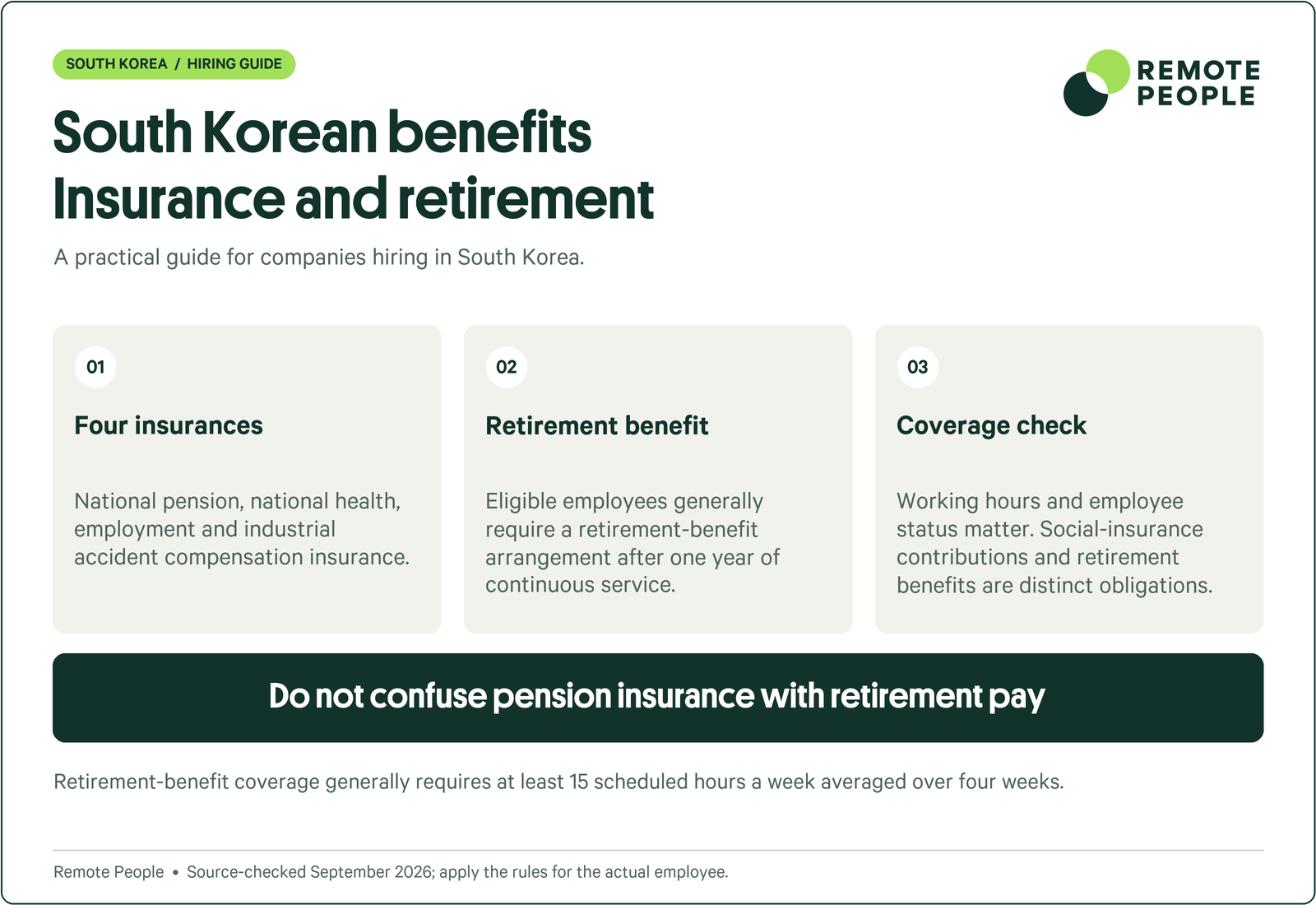
- National Health Insurance (NHIS): Mandatory coverage for all employees and dependants, including long-term care insurance. Employer and employee each contribute approximately 4.0674% of the monthly wage in 2026 (National Health Insurance Service).
- National Pension (NPS): Retirement pension contributions of 9% of eligible monthly income, split equally between employer and employee, with a scheduled increase to 13% by 2033 (National Pension Service).
- Employment Insurance (고용보험): Covers unemployment benefits, job training, and parental leave payments. Employee pays 0.9%; employer pays 1.15–1.75% depending on company size.
- Industrial Accident Compensation Insurance: Fully employer-funded at 0.7–1.9% of payroll depending on industry risk classification; employees pay nothing.
- Retirement pension (퇴직연금) or severance reserve: Employers must maintain either a Defined Benefit or Defined Contribution retirement pension plan, or a statutory severance reserve, under the Employee Retirement Benefit Security Act, accruing at least 30 days’ average wage per year of service.
- Meal and transportation allowances: Not mandatory, but widely paid as non-cash benefits; up to KRW 200,000 per month of meal allowance is exempt from income tax (PwC Korea: Individual Deductions).
Recent Regulatory Updates (2026)
Several employment-law changes took effect in 2025 and 2026 that affect employer of record payroll and HR workflows. Paternity leave was extended from 10 to 20 days under the 2025 amendment to the Equal Employment Opportunity and Work-Family Balance Assistance Act (effective 23 February 2025), the qualifying child age for reduced working hours during childcare was raised from 8 to 12, and maternity leave was extended to 100 days where the newborn requires neonatal intensive care.
The 2026 minimum wage was officially notified by the Ministry of Employment and Labor on 5 August 2025 at KRW 10,320 per hour (2.9% higher than 2025) with effect from 1 January 2026. The National Pension contribution rate is scheduled to rise by 0.5 percentage points per year until 2033, starting with the 9.5% total rate for 2026, in line with the pension reform passed by the National Assembly in March 2025 (Lockton: NPS Rate Increase).
Separately, the flat 19% foreign-worker income tax election was extended once again and remains available to foreign employees who begin Korean employment on or before 31 December 2026, for up to 20 years from the first day of Korean work.
Work Permits and Visas in South Korea
Work Permit Requirements
Who Needs a Work Permit
Any non-Korean national who wants to work in South Korea must hold a visa that explicitly permits employment. Tourist (B-2), short-term business (C-3-4), and student (D-2) visas do not authorise paid work. Permanent residents (F-5), marriage migrants (F-6), and overseas Korean (F-4) visa holders can work without sponsorship. All other foreign employees need an employer-sponsored visa, most commonly the E-7 Specially Designated Activities visa for professionals or the D-8 corporate investment visa for executives of foreign-invested companies.
Eligibility and Required Documents
For the most common employer-sponsored category, the E-7-1 professional visa, the applicant must hold a recognised bachelor’s degree plus at least one year of relevant work experience, or a three-year associate degree plus three years of relevant experience, or at least five years of verifiable experience in the designated occupation. The standard application package includes a passport, the sponsoring employer’s business registration certificate, the employment contract, proof of the applicant’s degree and career history (with apostille or consular authentication), and the Certificate of Eligibility application (사증발급인정서 신청서) filed at the local immigration office.
Processing Time and Validity
Certificate of Eligibility processing normally takes 2–4 weeks at the Korea Immigration Service. Once issued, the applicant converts the certificate into a visa at the Korean embassy or consulate in their home country in 1–2 weeks. The initial E-7 visa is issued for up to 2 years and can be renewed, with the first 90 days of residence triggering the alien registration card (외국인등록증) requirement at the local immigration office (HiKorea: Korea Immigration Service).
Renewal Process
E-7 renewal applications must be filed at least 2 months before the visa expires, with the renewed employment contract, updated payroll records, and tax and social insurance payment proofs. The Korea Immigration Service verifies that the sponsoring employer is still active, meets the minimum-wage threshold for the E-7 category (KRW 31.12 million per year for E-7-1 in 2026), and has no outstanding labour complaints. Employees can continue working during renewal review provided the application was filed before expiry.
Common Visa Types for Foreign Workers
South Korea’s work visa framework is governed by the Immigration Act and administered by the Ministry of Justice through the Korea Immigration Service. An employer of record that holds a registered Korean office can sponsor most of the employment-based categories below; some long-term residency visas (F-2, F-5) must be applied for by the individual once eligibility conditions are met.
South Korea work visa types for foreign workers · 2026 | ||||
Visa Type | Duration | Best For | Leads to APT? | Processing |
|---|---|---|---|---|
E-7-1 Specially Designated Activities (Professional) | Up to 2 years, renewable | Degreed professionals in 87 designated occupations earning at least KRW 31.12M/year | Yes (via F-2 then F-5) | 3–6 weeks |
E-7-2 / E-7-3 Semi-Professional & Skilled | Up to 2 years, renewable | Semi-professional and skilled-trade roles earning at least KRW 25.89M/year | Yes (via E-7-4 then F-2) | 4–8 weeks |
D-8 Corporate Investment | Up to 5 years, renewable | Executives or investors of a foreign-invested company with minimum KRW 100M investment | Yes (via F-2 then F-5) | 4–6 weeks |
D-7 Intra-Company Transfer | Up to 2 years, renewable | Employees transferred from an overseas parent, branch, or affiliate with at least 1 year’s prior service | Yes (via F-2 then F-5) | 3–6 weeks |
E-9 Non-Professional Employment | Up to 4 years 10 months | Low-skilled workers in manufacturing, construction, agriculture, and fisheries under the Employment Permit System | Limited (via E-7-4) | 8–12 weeks |
F-2-7 Long-Term Residence (Points-Based) | 3 years, renewable | Professionals in Korea who score 80+ points on the points-based system | Yes (to F-5 after 3 years) | Individual application |
F-1-D Digital Nomad (Workcation) | Up to 2 years | Remote workers employed by a non-Korean company earning at least twice Korea’s GNI per capita | No (non-employment) | 2–4 weeks |
- B-2 Tourist visa: Short-stay tourism only; no paid work permitted.
- C-3-4 Short-Term Business: Meetings, market research, contract negotiation; no paid employment.
- D-2 Student visa: Full-time degree study; limited part-time work only with prior immigration office approval.
- D-10 Job-seeker visa: Up to 6 months to job-hunt in Korea; not a work permit itself.
How an EOR Handles Work Permits
An employer of record in South Korea can act as the sponsoring entity for most employment-based visas, including E-7 Specially Designated Activities and D-7 Intra-Company Transfer. The EOR prepares the Certificate of Eligibility application, files it at the local immigration office, and supplies the sponsoring company’s business registration, tax payment certificate, and financial statements that immigration officials review. Once the Certificate is issued, the employee applies for the visa at the Korean embassy in their home country. Work-visa hires extend the onboarding timeline described in the Typical Onboarding Timeline section by four to eight weeks, depending on nationality and the current processing queue at the Korea Immigration Service. For highly regulated categories such as E-9 Employment Permit System workers, a local Korean entity is generally required and an EOR cannot act as sponsor.
Payroll, Taxes, and Social Security in South Korea
Employer Contributions
Korean employers contribute to the Four Major Insurances and must also maintain a retirement pension plan for employees with at least one year of service. The 2026 rates for the National Pension Service and National Health Insurance Service apply from 1 January 2026 and are cited from the respective agency notices.
South Korea employer social security contributions · 2026 rates | ||
Contribution | Rate | Notes |
|---|---|---|
National Pension (NPS) | 4.75% | Monthly income capped at KRW 6,370,000; rate rises 0.5 pt/year to 2033 |
National Health Insurance (NHIS) | 3.545% | Applied to monthly remuneration; no income ceiling for 2026 |
Long-Term Care Insurance | 0.4591% | Calculated as 12.95% of the NHIS contribution (effective 0.4591% of wage) |
Employment Insurance (EI) | 1.15% | Base 0.9% plus 0.25% employment-stability levy (small businesses) |
Industrial Accident Compensation Insurance | 0.7% – 1.9% | Rate set annually by industry risk classification; 100% employer-funded |
Retirement pension reserve | ~8.33% | Equivalent to 1 month’s salary per year of service; accrued as a reserve or paid into a DB/DC plan |
Total employer cost (typical) | ~10.7% + 8.33% | ~10.7% on statutory insurances (Four Majors + LTCI); the 8.33% retirement pension reserve brings the fully-loaded burden to ~19% |
Employee Contributions
Korean employees contribute to three of the Four Major Insurances through monthly payroll deduction. They do not contribute to Industrial Accident Compensation Insurance, which is fully employer-funded. The long-term care insurance component is itemised separately on the payslip but calculated as a fixed percentage of the NHIS contribution.
South Korea employee payroll deductions · 2026 monthly withholdings | ||
Deduction | Rate | Notes |
|---|---|---|
National Pension (NPS) | 4.75% | Matches employer; capped at KRW 6,370,000 of monthly income |
National Health Insurance (NHIS) | 3.545% | Equal split with employer on monthly remuneration |
Long-Term Care Insurance | 0.4591% | Added to NHIS deduction; calculated as 12.95% of NHIS |
Employment Insurance (EI) | 0.9% | Covers unemployment benefit and vocational training |
Industrial Accident Compensation Insurance | 0.0% | No employee contribution; fully employer-funded |
Total employee deductions | ~9.65% | Plus national and local income tax withheld per bracket (see next table) |
Source: National Pension Service and Employment Insurance (고용보험) | ||
Income Tax
South Korea applies progressive national income tax rates from 6% to 45% on residents, plus a 10% local income tax that is calculated on the national tax due (not on taxable income), administered by the National Tax Service. The thresholds below are annual taxable income figures. Foreign employees may elect, in writing, a flat 19% income tax rate for up to 20 years from first Korean employment, provided employment began on or before 31 December 2026 (PwC: Korea Individual Taxes).
South Korea income tax brackets · 2026 | |
Annual Taxable Income | National Tax Rate |
|---|---|
Up to KRW 14,000,000 | 6% |
KRW 14,000,001 – 50,000,000 | 15% |
KRW 50,000,001 – 88,000,000 | 24% |
KRW 88,000,001 – 150,000,000 | 35% |
KRW 150,000,001 – 300,000,000 | 38% |
KRW 300,000,001 – 500,000,000 | 40% |
KRW 500,000,001 – 1,000,000,000 | 42% |
Over KRW 1,000,000,000 | 45% |
Add a flat 10% local income tax on top of the national tax liability, so the effective top marginal rate for a resident is 49.5%. Withholding is calculated monthly using the Simplified Tax Withholding Table published by the National Tax Service, and reconciled through the year-end tax settlement each January.
Payroll Cycle
Korean payroll is almost always monthly and paid by bank transfer into the employee’s Korean bank account. Pay days are typically set for the 10th or 25th of the month, and employers must deliver a Korean-language payslip showing gross pay, the four major insurance deductions, national and local income tax withheld, and net pay. Withheld income tax is paid to the National Tax Service by the 10th of the following month, and Four Major Insurance contributions are paid to the respective agencies by the same deadline. Year-end tax settlement for employees is filed by the end of February, and the individual income tax return (종합소득세) is due by 31 May for anyone with additional income beyond employment.
13th Month Salary and Bonus Pay
A 13th month salary is not mandatory in South Korea under the Labor Standards Act. Most Korean employers, however, pay seasonal bonuses around the Lunar New Year (Seollal) and Chuseok holidays, and it is common in multinational companies to structure compensation as 12 months of base salary plus 1–3 months of performance bonus. When paid, these bonuses are taxable as ordinary employment income and subject to the same Four Major Insurance contributions as base salary. Some Korean employers also pay an annual leave allowance (연차수당) for unused paid leave at year-end; this is an entitlement under Labor Standards Act Article 60 when the employer has complied with the mandatory leave-usage notice procedure.
Cost of Hiring Through an EOR in South Korea
EOR Service Fees
EOR service fees in South Korea typically range from $300 to $600 per employee per month, with most providers billing a flat monthly rate rather than a percentage of salary. The fee covers employment contracts, payroll processing, tax and social insurance filings, statutory benefits administration, and HR support. Visa sponsorship, background checks, additional benefits administration, and severance accrual funding may carry additional set-up charges, but day-to-day compliance is included in the standard monthly fee.
Total Employment Cost Breakdown
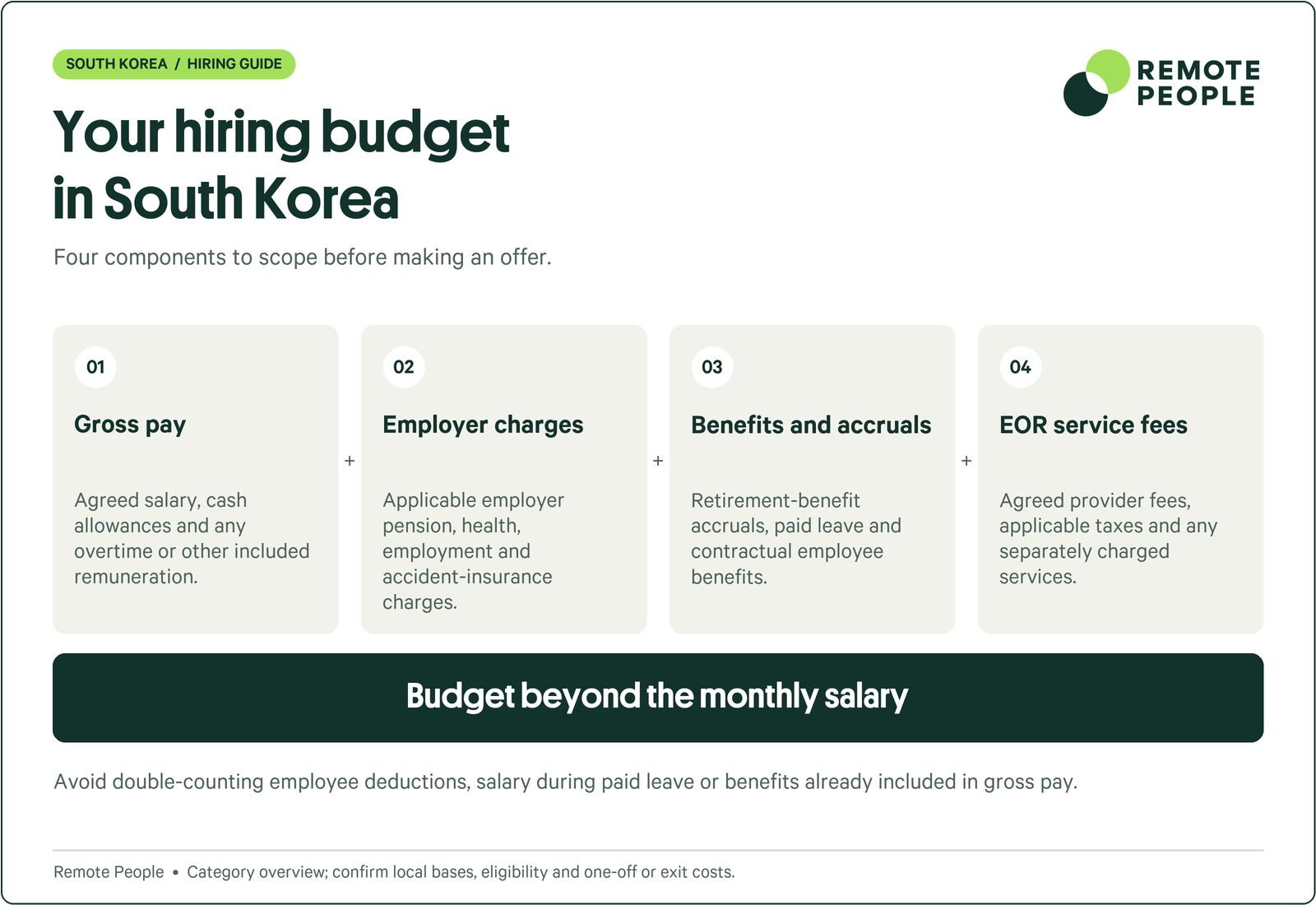
The table below illustrates the full employer cost of hiring a South Korean employee on an annual gross salary of USD 60,000 (roughly KRW 82 million at the assumed rate), including the Four Major Insurances, the retirement pension reserve accrued under the Employee Retirement Benefit Security Act, and the EOR service fee. Figures are converted at 1 USD ≈ 1,370 KRW, April 2026.
|
South Korea employer cost example · USD 60,000 gross · 2026 |
||
|
Employer Cost |
Amount (USD) |
% of Gross |
|---|---|---|
|
Gross annual salary |
$60,000 |
100.00% |
|
National Pension (employer share) |
$2,850 |
4.75% |
|
National Health Insurance (employer share) |
$2,127 |
3.545% |
|
Long-Term Care Insurance (employer share) |
$275 |
0.459% |
|
Employment Insurance (employer share) |
$690 |
1.15% |
|
Industrial Accident Insurance (mid-range 1.0%) |
$600 |
1.00% |
|
Retirement pension reserve (1 month per year) |
$5,000 |
8.33% |
|
EOR service fee (est. $500/month) |
$6,000 |
10.00% |
|
Total annual employer cost |
$77,542 |
129.24% |
Benefits of Using an EOR in South Korea
Korean labour law is highly protective, Four Major Insurance filings are monthly, and the retirement pension system adds an extra layer of compliance that catches out foreign buyers. An employer of record turns that complexity into a predictable monthly invoice. The benefits below are the reasons most companies choose an EOR over opening a Korean subsidiary for their first few hires.- Speed to market: You can onboard a South Korean employee in 1–2 weeks through an EOR, compared with the 2–3 months typically needed to incorporate a Korean corporation, register with the National Tax Service, and open the social insurance accounts.
- Compliance assurance: The EOR handles the Labor Standards Act, the Employee Retirement Benefit Security Act, and the Four Major Insurances filings, shielding you from the fines and criminal sanctions attached to Korea’s labour and tax statutes.
- Cost efficiency for small teams: A monthly EOR fee of $300–$600 is cheaper than running a Korean entity with its own tax agent, labour attorney, office lease, and HR headcount for fewer than 15 hires.
- Local expertise: EOR providers in South Korea have Korean-language HR teams who know how to draft a valid 근로계약서, file the monthly 원천징수 (tax withholding) return, and navigate the 연말정산 year-end tax settlement.
- Scale flexibility: You can add or release employees through an EOR without the cost of winding down a Korean corporation; Korean entity dissolution requires Supreme Court Registry filings, tax clearance, and a public notice period of at least two months.
- Risk mitigation: The EOR absorbs the employer-side misclassification risk under Korea’s strict worker-classification tests, plus the severance and retirement-pension accrual risk under the Employee Retirement Benefit Security Act.
- Employee experience: Workers receive a Korean employment contract, enrolment in all Four Major Insurances, and the statutory retirement pension, which means the same benefits framework as employees of a local Korean company.
Termination and Offboarding in South Korea
Notice Periods
Under Labor Standards Act Article 26, an employer must give at least 30 calendar days’ advance notice before dismissal, or pay 30 days’ ordinary wages in lieu of notice. The notice period does not apply to employees who have worked continuously for less than 3 months, or where the dismissal is for just cause attributable to the employee and mutually confirmed in writing. Korean courts apply a strict “justifiable cause” test to all dismissals beyond the initial 3 months of service, so notice alone does not make a dismissal lawful.|
South Korea statutory notice periods by position level · Per Labor Standards Act Article 26 |
|||
|
Tenure / Category |
Notice Period |
During Probation |
Notes |
|---|---|---|---|
|
Less than 3 months of continuous service |
None required |
None required |
LSA Article 26 exemption; contractual notice may still apply |
|
3 months or more (all indefinite-term staff) |
30 calendar days |
30 days if probation exceeds 3 months |
May be replaced by 30 days’ pay in lieu |
|
Managerial / supervisory (Article 63) |
30 calendar days |
30 days if applicable |
Same floor as general employees; contract may extend it |
|
Fixed-term employees |
30 calendar days if terminated early |
30 days if applicable |
Early termination requires “unavoidable reasons” under Article 661 of the Civil Act |
|
Collective dismissal (10+ employees or 10% of workforce) |
50 days prior notice to employee representatives + 30 days to workers |
Not applicable |
LSA Article 24 requires labour consultation and MOEL notification |
|
Just cause (employee misconduct) |
No notice required |
No notice required |
Must meet Article 23 “justifiable cause” standard and be documented |
Severance Pay
Severance pay (퇴직금, toejikgeum) is mandatory for employees who have completed at least one year of continuous service and who work 15 hours or more per week (averaged over 4 weeks), under the Employee Retirement Benefit Security Act. The statutory minimum is 30 days of average wage per year of continuous service, pro-rated for partial final years, and must be paid within 14 days of the employee’s last working day unless a written deferral agreement is signed.|
South Korea severance pay schedule by years of service · Per Employee Retirement Benefit Security Act |
|||
|
Years of Service |
Severance Amount |
Base Salary |
Notes |
|---|---|---|---|
|
Less than 1 year |
Not entitled |
Not applicable |
No statutory severance below 1 year or under 15 hrs/week |
|
1 year |
30 days’ average wage |
Average wage over last 3 months (incl. overtime and bonus) |
Pro-rated beyond 1 year for partial final year |
|
3 years |
90 days’ average wage |
Same calculation basis |
Equivalent to 3 months’ pay |
|
5 years |
150 days’ average wage |
Same calculation basis |
Equivalent to 5 months’ pay |
|
10 years |
300 days’ average wage |
Same calculation basis |
Equivalent to 10 months’ pay |
Calculation Method
Severance is calculated as “average wage × 30 days × continuous years of service.” The average wage is the total wages earned in the 3 calendar months preceding the last working day, divided by the number of days in that period, and it includes overtime pay, bonuses earned during those months, and annual leave allowance. The examples in the table above apply this formula to standard tenure tiers; partial final years are pro-rated to the day.Caps and Exceptions
There is no statutory cap on severance; the entitlement grows linearly with tenure. However, employees with less than one year of service or who work fewer than 15 hours per week (on a 4-week average) are excluded. Severance can be funded through a Defined Benefit or Defined Contribution retirement pension plan, which many Korean employers now use in place of the traditional in-house reserve. Dismissal for just cause does not remove the severance obligation; severance is paid regardless of the reason for termination.Grounds for Termination
Korean dismissal law is built around the “justifiable cause” standard in Article 23 of the Labor Standards Act. Acceptable grounds include gross misconduct, repeated poor performance despite documented warnings and improvement plans, criminal conduct that affects the employment relationship, and economic redundancy that meets the four criteria in Article 24 (urgent managerial need, effort to avoid dismissal, fair selection standards, and consultation with worker representatives). Protected categories include employees on maternity, paternity, or childcare leave, workers during the post-injury recovery period, union representatives during their term, and employees who have reported labour-law violations to the Ministry of Employment and Labor. Unfair-dismissal claims can be filed with the Labor Relations Commission within 3 months of the termination date.EOR vs. Other Hiring Models in South Korea
EOR vs. Setting Up a Local Entity
|
South Korea EOR vs local entity comparison · Setup time, cost, risk and best-fit |
||
|
Comparison |
Employer of Record |
Own Entity (Korean Corporation) |
|---|---|---|
|
Setup time |
1–2 weeks |
2–3 months |
|
Upfront cost |
$0 |
$25,000–$50,000 |
|
Ongoing cost |
$300–$600/employee/month |
$30,000–$60,000/year maintenance |
|
Local partner required |
No (EOR is the local entity) |
No, but a local director and registered address are required |
|
Social insurance registration |
Handled by EOR |
You manage it with NPS, NHIS, EI and IACI |
|
Payroll & tax filing |
Handled by EOR |
You manage it (or outsource to a Korean tax agent) |
|
Best for team size |
1–15 employees |
15+ employees |
|
Scale down / exit |
Easy, no entity to unwind |
Costly; Supreme Court Registry dissolution and tax clearance required |
|
Government contracts |
Not eligible |
Eligible (requires Korean corporation) |
EOR vs. Hiring Independent Contractors
|
South Korea EOR vs independent contractors · Compliance, cost, and risk |
||
|
Comparison |
EOR (Full-Time Employee) |
Independent Contractor |
|---|---|---|
|
Legal relationship |
Employee of the EOR |
Self-employed, no employment relationship |
|
Compliance risk |
Low. EOR ensures Labor Standards Act compliance. |
Higher. Misclassification risk if the relationship resembles employment. |
|
Payroll & tax |
EOR handles withholding, Four Major Insurances, and filings |
Contractor invoices you; they file their own taxes |
|
Benefits & leave |
Statutory benefits, paid leave, severance |
No entitlement to employee benefits or severance |
|
IP protection |
Stronger; employment contract assigns IP by default |
Weaker; requires explicit IP assignment clause |
|
Termination |
Subject to LSA notice and severance |
Contract can be ended per agreement terms |
|
Best for |
Long-term core roles |
Short-term projects and specialised tasks |
|
Cost structure |
Salary + employer contributions + EOR fee |
Contractor fee (typically higher gross, lower total cost) |
EOR vs. PEO (Professional Employer Organization)
|
South Korea EOR vs PEO comparison · Legal employer, liability, and setup |
||
|
Comparison |
Employer of Record (EOR) |
PEO |
|---|---|---|
|
Legal employer |
EOR is the legal employer |
You remain the legal employer (co-employment) |
|
Local entity required |
No; the EOR is the local entity |
Yes; you must have your own Korean entity |
|
Best for |
Companies without a local entity |
Companies that already have a Korean corporation |
|
Compliance liability |
EOR assumes most compliance responsibility |
Shared liability between you and the PEO |
|
Setup time |
1–2 weeks |
Depends on your Korean entity setup (weeks to months) |
|
Control over HR policies |
EOR manages within the Korean law framework |
More direct control; PEO advises |
|
Typical use case |
Market entry, small remote teams, testing new markets |
Established Korean operations needing HR outsourcing |
Public Holidays in South Korea
South Korea has 11 statutory public holidays in 2026, with substitute Mondays granted when certain holidays fall on a Saturday or Sunday under the Regulation on Closure Days for Public Offices. All holidays are paid days off for private-sector employees under Labor Standards Act Article 55.|
South Korea public holidays · 2026 calendar year |
||
|
Date |
Holiday |
Type |
|---|---|---|
|
Thu, 1 Jan 2026 |
New Year’s Day |
National |
|
Mon–Wed, 16–18 Feb 2026 |
Seollal (Lunar New Year) |
National (3 days) |
|
Sun, 1 Mar 2026 (observed Mon 2 Mar) |
Independence Movement Day |
National + substitute |
|
Fri, 1 May 2026 |
Labour Day |
Statutory (private sector) |
|
Tue, 5 May 2026 |
Children’s Day |
National |
|
Sun, 24 May 2026 (observed Mon 25 May) |
Buddha’s Birthday |
National + substitute |
|
Wed, 3 Jun 2026 |
Local Election Day |
Temporary (quadrennial) |
|
Sat, 6 Jun 2026 |
Memorial Day |
National (no substitute) |
|
Sat, 15 Aug 2026 (observed Mon 17 Aug) |
Liberation Day |
National + substitute |
|
Thu–Sat, 24–26 Sep 2026 |
Chuseok (Korean Thanksgiving) |
National (3 days) |
|
Sat, 3 Oct 2026 (observed Mon 5 Oct) |
National Foundation Day |
National + substitute |
|
Fri, 9 Oct 2026 |
Hangeul Day |
National |
|
Fri, 25 Dec 2026 |
Christmas Day |
National |
How to Get Started with an EOR in South Korea
- First, define the role and compensation: Draft a job description, target annual salary in KRW, and start date. RemotePeople uses this to size the Four Major Insurance contributions and the retirement-pension reserve for your cost estimate.
- Second, request a quote: Send the role details and any planned benefits to your RemotePeople account manager. We return a gross-to-total cost breakdown within 24 hours, including the EOR fee, payroll taxes, and statutory benefits.
- Third, sign the EOR agreement: Once you approve the quote, we sign a service agreement with your company and begin drafting the Korean employment contract for your hire.
- Fourth, onboard the employee: RemotePeople delivers a bilingual Korean/English employment contract, obtains the employee’s signature, registers them with NPS, NHIS, EI and IACI, and confirms the start date.
- Fifth, run payroll and stay compliant: RemotePeople processes monthly Korean payroll, files taxes and Four Major Insurance contributions, and issues the employee’s year-end tax settlement, while you focus on managing the work.
Frequently Asked Questions
EOR services in South Korea typically cost between $300 and $600 per employee per month, billed as a flat fee rather than a percentage of salary. The fee covers Korean employment contracts, monthly payroll, Four Major Insurance filings, and year-end tax settlement. On top of the EOR fee, employers pay roughly 10.7% of gross salary in statutory employer contributions plus an 8.33% retirement pension reserve, taking the fully-loaded employer burden to about 19% of gross salary (National Pension Service).
Most EOR providers can onboard a South Korean employee in 1–2 weeks from signing the service agreement. The Korean employment contract, Four Major Insurance enrolment, and payroll set-up together take 5–7 business days. If the hire needs an E-7 work visa, the timeline extends by 4–8 weeks for Certificate of Eligibility processing at the Korea Immigration Service (HiKorea).
Yes. Under the Employee Retirement Benefit Security Act, employees with at least one year of continuous service and 15+ hours per week are entitled to at least 30 days' average wage per year of service. For a three-year employee, that means 90 days of average wage, paid within 14 days of the final working day. Severance is owed regardless of the reason for termination (Ministry of Employment and Labor).
The 2026 minimum wage is KRW 10,320 per hour, which works out to KRW 2,156,880 per month on the statutory 209-hour basis. The rate applies uniformly across all industries and regions and covers both Korean and foreign workers. It was notified by the Ministry of Employment and Labor on 5 August 2025 and took effect on 1 January 2026 (Korea.net: 2026 Minimum Wage).
Yes, a Korea-registered EOR can sponsor most employment-based visas including the E-7 Specially Designated Activities visa and the D-7 Intra-Company Transfer visa. The EOR files the Certificate of Eligibility application at the local immigration office, and the employee then converts it into a visa at the Korean embassy in their home country. E-9 Employment Permit System workers, however, require a direct Korean employer and cannot be sponsored through an EOR (Fragomen: Republic of Korea).
No. South Korea's Labor Standards Act does not require a 13th month salary. Many Korean employers pay Lunar New Year (Seollal) and Chuseok bonuses, plus a year-end or performance bonus, as part of their total compensation package, but these are entirely discretionary and must be taxed as ordinary employment income when paid. Annual leave allowance for unused paid leave is a separate statutory entitlement under LSA Article 60.
A Korean employee has full Labor Standards Act protections, Four Major Insurance coverage, paid leave, and severance; a contractor is self-employed, invoices for services, pays their own taxes, and has no statutory severance. South Korean courts apply a "reality over form" test: if a contractor is integrated into your operations, uses your tools, and works set hours, they will likely be reclassified as an employee with retroactive liabilities. For core, long-term roles, an EOR is safer; RemotePeople's contractor management solution handles genuinely independent engagements compliantly.
Under Korean law, work-product IP created in the course of employment is generally assigned to the client company (you), not the EOR, when the employment contract explicitly states this. A well-drafted Korean employment contract includes express IP assignment and confidentiality clauses, so all deliverables and inventions produced during employment belong to you as the client. RemotePeople's standard Korean contracts include comprehensive IP assignment language to protect your business interests.