Recruit
Average Salary in Georgia
-
 Drew Donnelly
- Published
- September 21, 2026
Curious about salaries in Georgia? This guide breaks down the average wages, compares professions, highlights minimum wage figures, and explores how Georgia’s earnings measure up internationally.
- 5 ★ on G2








Let RemotePeople handle payroll, compliance, and HR admin worldwide so you can focus on building your team.
Georgia is a convenient outsourcing destination due to its low labor costs, diverse talent pool, and business-friendly environment. Employers seeking to outsource from the country may wonder, what is the average salary in Georgia? This information will help them develop a fair proposal.
The average monthly salary in Georgia is 2,271 Georgian lari (GEL), which translates to about USD 845. However, salaries vary depending on experience, education, position, industry, and location. Other factors to consider are median salary and salary range.
This article will break it down for you, providing the information you need to make a fair offer.
What is the Average Salary in Georgia?
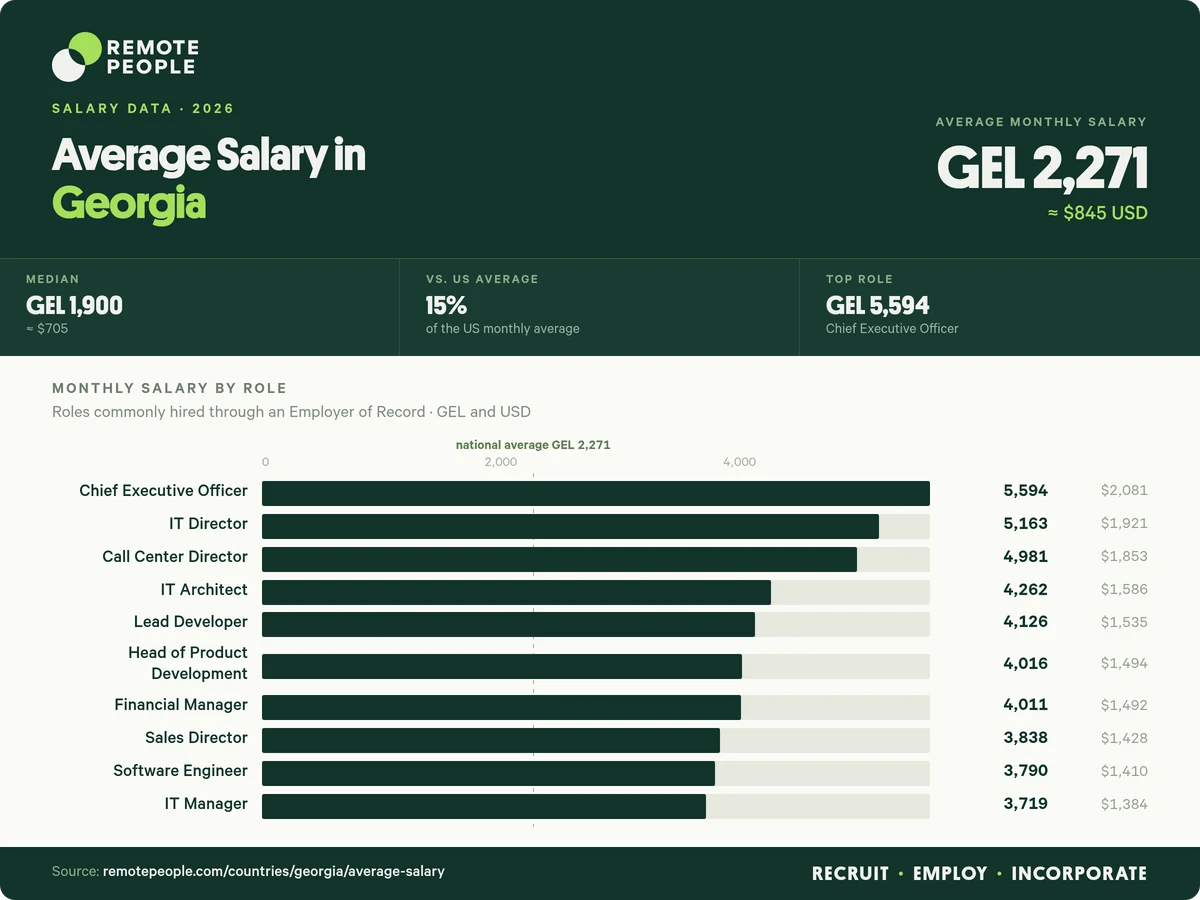
The average salary in Georgia is 2,271 GEL, or approximately $845 monthly. Wages are low due to an undeveloped economy, an informal sector, and an unregulated market. The country also lacks job opportunities.
Median Income
Georgia’s median monthly income is 1,900 GEL, or approximately $705. Fifty percent of workers earn higher wages, while the other half make less.
Salary Range
Georgia’s salary range spans from the lowest to the highest. Low-income earners make around 1,000 GEL monthly (approximately $370), while higher-paid workers earn closer to 3,200 GEL (about $1,190).
Salary Comparison by Profession
The average and mean salary and salary range only paint a fraction of the picture. You must also consider how salaries vary by industry, position, location, education, and experience. The following section will provide insight into how these factors impact salary.
Profession | Monthly Salary (GEL) |
|---|---|
Chief Executive Officer | 5,594 |
IT Director | 5,163 |
Call Center Director | 4,981 |
IT Architect | 4,262 |
Lead Developer | 4,126 |
Head of Product Development | 4,016 |
Financial Manager | 4,011 |
Sales Director | 3,838 |
Software Engineer | 3,790 |
IT Manager | 3,719 |
Banking Cashier | 1,020 |
Fabric Cutter | 1,019 |
Clothing Technologist | 1,014 |
General Laborer | 1,008 |
Packer | 993 |
Seamstress | 948 |
Porter | 916 |
Medical Records Clerk | 914 |
Tailor | 906 |
Average Wage in Georgia by Education
Education is typically directly related to earnings. Well-educated workers tend to qualify for higher-paying jobs. However, in Georgia’s work economy, it is challenging to get high-paying employment regardless of your education level. The country tends to see growth in low-paying industries that don’t require educated workers, like agriculture and service, making it difficult to get ahead.
Salary Comparison by Experience
Experience may be a more significant factor in earnings, as workers may be eligible for raises over time. However, Georgia has a decentralized bargaining system. Therefore, unions and employees don’t have much power when requesting fair wages and wage increases.
Salary Comparison by Location
Although wages are low throughout Georgia, workers tend to see the highest and most significant wage increases in major cities like Tbilisi and Mtskheta-Mtianeti due to a higher cost of living and proximity to large companies that offer more job opportunities.
How Much is Minimum Wage in Georgia?
Georgia’s private sector minimum wage, last updated in 1999, is 20 GEL (approximately $7.40 Georgia minimum wage in USD) monthly. It is one of the lowest minimum wages in the world and far lower than the country’s cost of living. It is just enough to buy a few liters of milk.
Human rights organizations have criticized the government for its low wages. Hopefully, they will update to modern standards.
Average Salary in Georgia vs. the Rest of the World
Comparing Georgia’s salaries to other countries worldwide can give you more perspective. These wage comparison charts will show how Georgia compares to developed, developing, and undeveloped nations.
Georgia vs. Developed Countries
Country | Average Salary | Comparison to Average Georgia Salary |
|---|---|---|
United Kingdom | £3,000 (approx. $4,100) | − 385% |
United States | $5,220 | − 518% |
Norway | 50,000 NOK (approx. $4,700) | − 456% |
Germany | €4,300 (approx. $4,470) | − 429% |
Austria | €3,700 (approx. $4,050) | − 379% |
Georgia vs. Developing Countries
Country | Average Salary | Comparison to Average Georgia Salary |
|---|---|---|
Romania | 4,000 RON (approx. $835) | 1% |
Russia | 73,700 RUB (approx. $700) | 17% |
Albania | 83,330 ALL (approx. $860) | − 2% |
Kazakhstan | 342,000 KZT (approx. $645) | 24% |
Ukraine | 18,000 UAH (approx. $500) | 41% |
Georgia vs. Undeveloped Countries
Country | Average Salary | Comparison to Average Georgia Salary |
|---|---|---|
Thailand | 15,000 Baht (approx. $420) | 50% |
Philippines | 15,000 PHP (approx. $265) | 69% |
Vietnam | 7.5 million Dong (approx. $300) | 65% |
Egypt | 3,900 EGP (approx. $125) | 85% |
Pakistan | 60,000 PKR (approx. $210) | 75% |
Georgia is a developing country with a high Human Development Index. Although its economy has been growing, its workforce still suffers from limited job opportunities, an informal workforce, and gender gaps. However, with EU support, Georgia has the potential to thrive.
The country is a good outsourcing destination due to its strategic location, low labor costs, and skilled talent pool. It offers a strong IT sector and multilingual workers. The government has launched initiatives to make Georgia a business-friendly environment for international partnerships.
What are the Most Common Outsourced Industries in Georgia?
Employers seeking remote talent in Georgia may consider hiring for the following industries:
IT Services
Georgia is experiencing rapid growth in the IT sector, positioning itself as a rising tech hub in the EU market. The Russia-Ukraine War has caused various workers and companies to relocate to the region, leading to an influx of talent. The government offers tax incentives for IT companies, making it an attractive outsourcing destination.
IT specialists in Georgia earn around 4,262 GEL (approx. $1,580) per month. Meanwhile, specialists in America earn about $7,009 per month, which gives employers plenty of bargaining power.
Agriculture
Georgia’s fertile soil and favorable climate make it a prime agricultural outsourcing destination. The country is a leading exporter of fruits and nuts and has a robust food processing and packaging subsector.
Industrial Manufacturing
Georgia is a prime source for industrial manufacturing, focusing on autos, aircraft, electronics, hydroelectric machinery, leather products, and pharmaceuticals. Since the collapse of the Soviet Union, it has been expanding its manufacturing sector and aiming to reach high development indicators. These exports have helped strengthen the country’s economy.
Conclusion
Factors like the collapse of the Soviet Union and the Russia-Ukraine War have boosted development in Georgia, making it a promising destination for skilled workers. Low salaries in the country mean workers are eager for outsourcing opportunities. Employers can use this to their advantage by hiring remote employees at low wages and providing opportunities for Georgians to earn a living in their country.