
 Recruit
Employer of Record (EOR) in Georgia
-
 Drew Donnelly
- Published
- September 21, 2026
RemotePeople’s employer of record in Georgia lets you hire employees in Georgia with streamlined payroll management. We handle 26% employer social security contributions, mandatory private pension accounts, and healthcare contributions.
Hire in Georgia — book a free 30-minute demo
Tell us what you need. You'll get a tailored, transparent proposal within 24 hours, plus a free call to walk through it.
Tell us about your company
So we can match you with a specialist who knows your market — and unlock volume pricing tiers.
* All fields are required.
Where and when are you hiring?
Tell us the geography and timing and we'll quote each country line by line, with onboarding timelines.
* All fields are required.
Help us beat your current setup
We'll benchmark your current deal and send a line-by-line proposal in 24 hours — showing exactly where we cut cost, time, or risk. After you submit, you can book a call to walk through it together.
* All fields are required.
Thanks! Your proposal is on its way.
Expect a tailored, line-by-line proposal in your inbox within 24 hours. In the meantime…
Want to walk through it together?
Book a free 30-minute call with one of our specialists. We'll explain every line, answer your questions, and tailor the proposal further if you need.
No obligation. Pick a time that works for you.








- Hire in Georgia — book a free 30-minute demo
- Tell us about your company
- Where and when are you hiring?
- Help us beat your current setup
- Thanks! Your proposal is on its way.
- How an Employer of Record Works in Georgia
- Hire in Georgia
- Employment Laws and Regulations in Georgia
- Work Permits and Visas in Georgia
- Payroll, Taxes, and Social Security in Georgia
- Cost of Hiring Through an EOR in Georgia
- Benefits of Using an EOR in Georgia
- Termination and Offboarding in Georgia
- EOR vs. Other Hiring Models in Georgia
- Public Holidays in Georgia
- How to Get Started with an EOR in Georgia
- Where companies hiring in Georgia expand next
- Frequently Asked Questions
- Related EOR Destinations

Start hiring in Georgia
Let RemotePeople handle payroll, compliance, and HR admin worldwide so you can focus on building your team.

Georgia offers a business-friendly tax regime with a flat 20% personal income tax, no social security contributions beyond a modest 2% pension scheme, and a fast-growing economy. For companies looking to hire employees in Georgia without establishing a local entity, an employer of record in Georgia provides the legal framework to onboard workers in days. An EOR removes the complexity of navigating Georgian labour law, pension registration, work permit requirements, and compliance obligations while maintaining full control over hiring decisions and management.
An EOR offers rapid deployment, cost efficiency, and protection from employment disputes through proper legal structuring. Compliance with Georgia’s evolving regulatory environment – particularly the new Special Labour Activity Permit system introduced in March 2026 – remains important. An EOR partner handles all statutory obligations, payroll processing, tax withholding, leave tracking, and regulatory reporting, letting your organisation focus on business growth rather than administrative work.
How an Employer of Record Works in Georgia
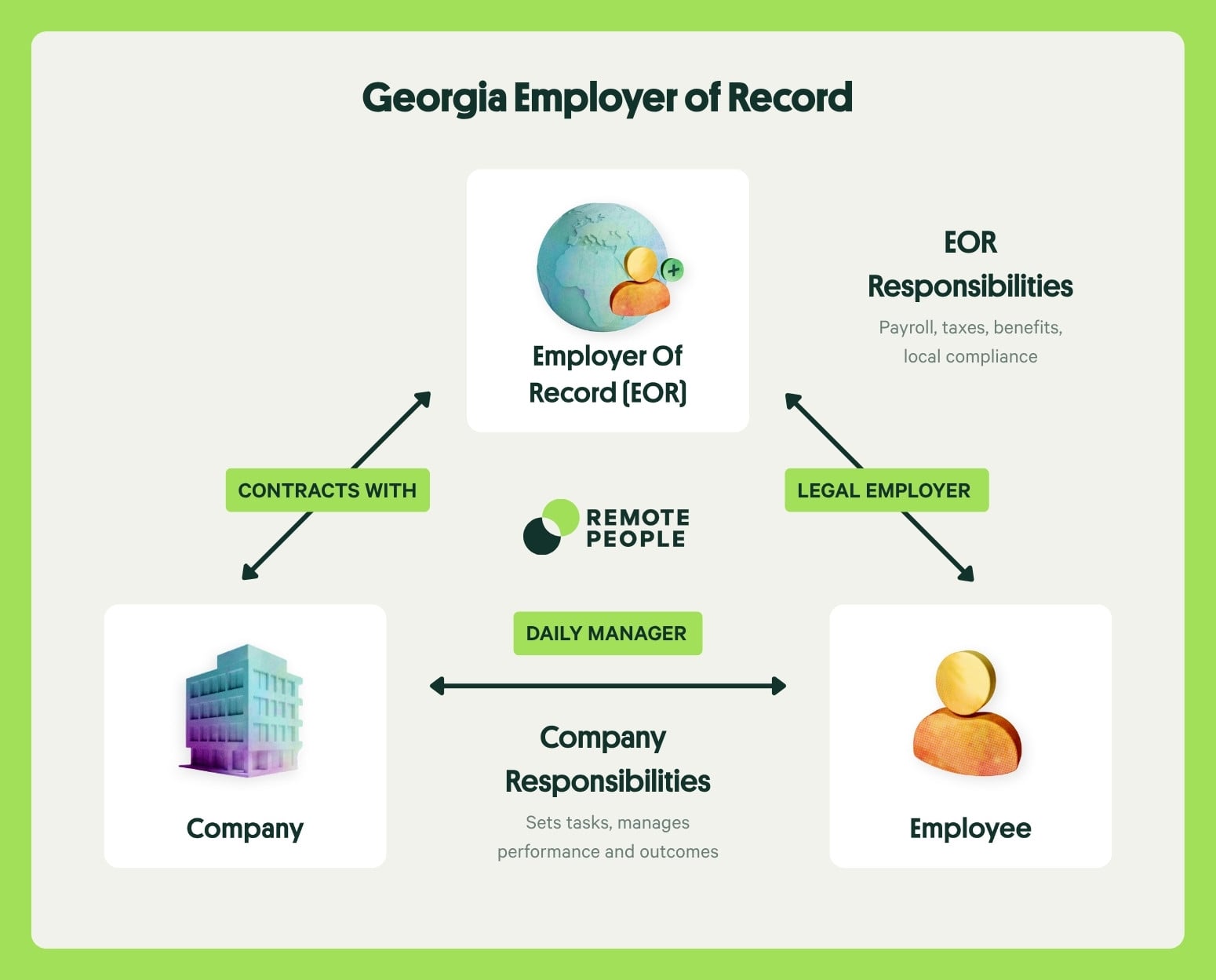
If you’d like to learn more about how Employer of Record (EOR) services work, read our What Is an Employer of Record (EOR)? guide for a complete overview of the model, its benefits, and when to use it.
If you’re comparing providers, our Best Employer of Record (EOR) Providers guide reviews the leading platforms to help you choose the right solution for your business.
Who Uses an EOR in Georgia?
EOR services in Georgia are used by organisations at various growth stages and operational models. Common use cases include the following scenarios:
Organisations entering Georgia’s market for the first time often use an EOR to hire a small team without committing to permanent entity registration. Companies hiring fewer than five employees may find that the cost and administrative burden of establishing a Georgian LLC outweigh the benefits. Remote-first companies with distributed teams across multiple countries use an EOR to centralise employment administration and avoid managing separate entities in each jurisdiction.
Typical Onboarding Timeline
The process of engaging an EOR and bringing an employee onto payroll in Georgia typically follows this sequence:
- First: Sign the EOR agreement and provide employee details (name, passport, role, salary). Duration: 1–2 days.
- Second: EOR drafts the employment contract and submits for review and approval. Duration: 2–3 days.
- Third: EOR registers the employee in the accumulated pension scheme with the Pension Agency of Georgia. Duration: 3–5 days.
- Fourth: Payroll system setup, bank account verification, and benefits election completion. Duration: 2–3 days.
- Fifth: Employee completes onboarding documentation and starts work on the agreed date. Duration: 1 day.
Total standard timeline: 1–2 weeks. If the employee is a foreign national requiring the Special Labour Activity Permit, add 4–8 weeks for permit processing by the Ministry of Internal Affairs of Georgia.
Hire in Georgia
Partner with an employer of record in Georgia to onboard talent in days, stay compliant with Georgian labour law, and skip the cost of setting up a local entity.
Employment Laws and Regulations in Georgia
Georgia’s employment framework is codified in the Organic Law of Georgia on Labour (Labour Code), last comprehensively consolidated in 2023. Understanding statutory rights, obligations, and recent reforms is essential for compliant hiring. This section covers core labour law provisions, recent regulatory updates including the March 2026 Special Labour Activity Permit system, and practical compliance guidance.
Employment Contracts
Georgian labour law requires a written employment contract for all employment relationships. The contract must be in Georgian, though bilingual contracts (Georgian and English) are common practice and acceptable to the tax and labour authorities. The contract must specify mandatory elements including: identity of the employer and employee, employment start date, job title and description, workplace location(s), working hours, remuneration amount and payment schedule, and leave entitlements.
Fixed-term contracts are permitted under the Labour Code but are limited to a maximum duration of 30 months (Article 18). After 30 months, employment automatically converts to an indefinite contract unless both parties formally renew under a new fixed-term agreement. Employment contracts take effect from the date of signing and should be signed before the employee’s first day of work.
Any modifications to the contract require written agreement from both parties and should be documented as an amendment. Unilateral contract changes are not valid. The Labour Code does not prescribe a specific form template, but EOR providers typically use templates vetted by Georgian labour counsel to ensure compliance.
Working Hours and Overtime
The standard working week in Georgia is 40 hours, typically distributed as 8 hours per day over 5 days. Article 24 of the Labour Code permits overtime work, but the combined total (regular plus overtime) cannot exceed 48 hours per week. For shifts exceeding 6 hours, employees are entitled to a 60-minute rest period. Employees under 18 years old are limited to 36 hours per week and cannot work overtime without special exemptions.
Overtime requires the employee’s written consent. When parties agree to overtime, the compensation rate must be set in the employment contract or collective agreement. If the parties cannot agree on the rate, Article 27 of the Labour Code permits either party to seek court determination. In practice, overtime rates typically range from 1.25x to 2.0x the regular hourly wage depending on the industry and timing (night work, weekend work, public holidays).
Night work (between 10 PM and 6 AM) entitles the employee to an increased rate and is limited to 40 hours per week. Work on weekly rest days and public holidays requires employee consent and a substitute rest day or additional compensation as per Article 24. Georgia recognizes 18 public holidays per year; work on these days must be compensated or offset with paid leave.
Overtime and Premium Pay Rates
The Labour Code of Georgia (Articles 24 and 27) establishes overtime pay requirements and caps. Standard working hours are 40 per week, with overtime requiring mutual consent and premium compensation.
Georgia overtime and premium pay rates · Per Labour Code of Georgia |
|||
Hour Type |
Rate Multiplier |
Weekly/Daily Cap |
Notes |
|---|---|---|---|
Standard weekday hours |
1.0x (regular rate) |
40 hours/week |
Article 24, Labour Code |
Overtime (weekday) |
Increased rate (by agreement) |
48 hours/week total |
Article 27, Labour Code; consent required |
Night work (10 PM – 6 AM) |
Increased rate (by agreement) |
40 hours/week |
Article 24; reduced hours for under-18s |
Weekly rest day work |
Increased rate (by agreement) |
Must grant substitute rest |
Article 24; employee consent required |
Public holiday work |
Increased rate (by agreement) |
Must grant substitute rest or pay |
Article 30; 18 public holidays per year |
Sources: Labour Code of Georgia and PwC Georgia Tax Summary |
|||
Exemptions to overtime caps apply to certain sectors (e.g., healthcare, emergency services, agriculture) with special authorization. Managerial and supervisory staff may have different overtime rules if documented in the employment contract.
Minimum Wage
Georgia’s statutory minimum wage is GEL 20 per month for the private sector and GEL 115 per month for public sector employees (Labour Code of Georgia). This rate has remained unchanged since 1999 and is effectively unenforced by the labour inspectorate. Market wages for skilled positions in Georgia substantially exceed the statutory minimum, and most employers pay competitive salaries reflecting local market conditions.
The minimum wage does not serve as a practical baseline for hiring decisions. Instead, organisations should conduct local market research or consult an EOR partner to determine competitive compensation ranges by role and experience level.
Probation Period
Employers may establish a probation period of up to 6 months (Article 19 of the Labour Code). The probation period must be specified in the employment contract before the employee’s first day. During probation, either party may terminate employment with 3 days’ written notice (or up to 7 days if specified in the contract). No severance payment is required if termination occurs during the probation period.
After the probation period expires, employment automatically converts to an indefinite contract unless the parties have agreed otherwise in writing. Only one probation period is permitted per employer–employee relationship; if a probation agreement expires, it cannot be renewed with the same employer.
Leave Entitlements
Georgia’s statutory leave framework balances employer flexibility with employee protections. The Labour Code provides for annual paid leave, sick leave, maternity leave, and various other leave types. Understanding each category’s eligibility, duration, and compensation rules is essential for compliance and employee satisfaction.
Georgia statutory leave entitlements · Per Labour Code of Georgia |
||
Leave Type |
Duration |
Eligibility & Notes |
|---|---|---|
Annual Leave (Paid) |
24 working days/year |
Accrues after 11 months service. Hazardous work: +10 calendar days. Carry-over 1 year with consent (Article 21, Labour Code). |
Unpaid Leave |
15 working days/year |
Statutory right. Taken by mutual agreement. No compensation required. |
Sick Leave |
40 calendar days/year (employer-paid) |
Medical certificate required for 3+ consecutive days. Beyond 40 days, state insurance covers (Article 36, Labour Code). |
Maternity Leave |
126 calendar days |
143 days for complications or multiple births. Paid up to GEL 1,000 from state budget. Job protected (Article 37, Labour Code). |
Childcare Leave |
604 calendar days |
First 57 days paid up to GEL 1,000. Remainder unpaid. Follows maternity leave. |
Paternity/Shared Leave |
Portion of unused maternity |
By mutual agreement. Adoption leave: 550 days (57 days paid up to GEL 1,000). |
Hazardous Work Leave |
Additional 10 calendar days/year |
For work in hazardous conditions per Ministry of Labour classification. |
Sources: Labour Code of Georgia and WIPO Lex Georgia Labour Code |
||
Annual Leave
Employees are entitled to a minimum of 24 working days of paid annual leave per year. Employees may also take up to 15 working days of unpaid leave annually. The right to annual leave accrues after 11 months of continuous service. Employees in hazardous working conditions (as defined by the Ministry of Labour) receive an additional 10 calendar days of paid leave per year.
Accrued annual leave may be carried forward into the following year with employee consent, though carry-over cannot occur across two consecutive years. If leave is not used, the employer may pay out the value at the regular daily rate, or the employee may carry it forward with written agreement. Leave must be scheduled in advance and communicated to the employee with reasonable notice.
Sick Leave
Employees receive paid sick leave up to 40 calendar days per year, covered by the employer (Article 36 of the Labour Code). Beyond 40 calendar days in a single year, the state social insurance system covers additional sick leave. A medical certificate from a licensed healthcare provider is required for absences exceeding 3 consecutive calendar days. The employer must maintain confidentiality of medical information and cannot dismiss an employee solely because of a medical condition without statutory justification.
Maternity Leave
Female employees receive 126 calendar days of maternity leave. If there are complications during pregnancy or childbirth, or in the case of multiple births, the entitlement increases to 143 calendar days (Article 37 of the Labour Code). The employee may split the leave between pre-natal and post-natal periods as she chooses. Maternity leave is paid from the state budget at a flat rate up to GEL 1,000 total, regardless of the employee’s salary.
After the initial maternity leave period, employees may take additional childcare leave of up to 604 calendar days (paid at up to GEL 1,000 for the first 57 days). This leave is at the employee’s choice and is typically unpaid after the first 57 days. Job protection is fully guaranteed; the employer cannot dismiss an employee during maternity or childcare leave without statutory grounds unrelated to the pregnancy or leave status.
Paternity Leave
Georgia does not provide a specific statutory paternity leave entitlement. However, fathers may use any unused portion of maternity leave by mutual agreement with the employer. Alternatively, if the mother has passed away or is otherwise unavailable, the father may use the full maternity leave entitlement. For employees who adopt a child, adoption leave is 550 calendar days, with the first 57 days paid at up to GEL 1,000.
Other Statutory Leave
Employees may be entitled to marriage leave, bereavement leave for immediate family members, and study leave (for education purposes) as per individual or collective agreements. Georgia’s Labour Code does not mandate a statutory entitlement for voting leave, but many employers grant it as a matter of practice. Additionally, all employees have a right to 15 days of unpaid leave per year for personal reasons, to be taken by mutual agreement with the employer.
Statutory Employee Benefits
Georgia’s mandatory employee benefits are simpler than EU employment standards. These benefits are either mandatory or commonly provided:
Georgia does not mandate employer-provided health insurance; the state funds universal healthcare through the State Fund of Georgia. Many employers offer supplementary private health insurance as a competitive benefit to attract talent.
The accumulated pension system is the sole mandatory contribution, with the employer paying 2% and the employee contributing a matching 2%. The government adds 1% (or 2% for employees earning under GEL 24,000 annually). Life insurance, disability insurance, meal and transport allowances, and housing or education fund contributions are all voluntary and not required by law.
Recent Regulatory Updates (2026)
Georgia’s employment and immigration frameworks have undergone significant updates in 2025–2026. These changes affect work permits, residence eligibility, and tax administration. The key updates for organisations hiring foreign nationals or expanding operations are:
Effective 1 March 2026, Government Decree No. 70 introduced a mandatory Special Labour Activity Permit for all foreign nationals working in Georgia, replacing the previous work permit framework. Employers or their EOR must submit applications to the Public Service Development Agency before the employee begins work.
The Labour Code was amended in late 2025 to strengthen anti-discrimination protections, adding explicit safeguards for age, disability, and gender identity. Separately, the 2018 Accumulated Pension Fund reached full enforcement in January 2026, with penalties now applied for late or missed contributions. Georgia’s Revenue Service also updated its electronic payroll filing portal in early 2026, requiring all employers to use the new digital submission format for monthly tax declarations.
Work Permits and Visas in Georgia
Georgia’s work permit framework underwent significant reform in early 2026 with new Labour Migration Law amendments, establishing a streamlined two-stage process for foreign workers. All foreign nationals wishing to work, freelance, or conduct business in Georgia must obtain a Special Labour Activity Permit under Government Decree No. 70, signed February 20, 2026, with exemptions for refugees, asylum seekers, diplomatic staff, foreign journalists, and holders of investment residence permits. The system balances Georgia’s goal to attract international talent with protections for local workers.
Work Permit Requirements
Who Needs a Work Permit
As of March 1, 2026, all foreign nationals who wish to work, freelance, or conduct business in Georgia must obtain a Special Labour Activity Permit under the Labour Migration Law amendments (Government Decree No. 70, signed February 20, 2026). Exemptions include refugees, asylum seekers, diplomatic staff, foreign journalists, and holders of investment residence permits. The permit requirement applies regardless of employment duration or contract type.
Eligibility and Required Documents
The work permit process follows a two-stage framework: obtain the Special Labour Activity Permit first, then either a Labour Residence Permit or D1 visa. Required documents include a valid passport, employment contract or business registration documentation, proof of professional qualifications, and a medical certificate confirming fitness to work. Employers must post the job vacancy on the government portal for 10 business days before submitting the permit application to comply with local hiring preferences.
Processing Time and Validity
The Special Labour Activity Permit costs $75–$150 (Government of Georgia) and requires approximately 30 days for processing. The Labour Residence Permit typically takes 1–2 months to issue. A transition period for existing workers extends until January 1, 2027, allowing those currently employed to complete the new registration without interruption.
Renewal Process
All permits are renewable without reapplication of the initial Special Labour Activity Permit. An employee may continue working during renewal provided the application is filed before the current permit expires, preventing employment gaps during administrative processing.
Common Visa Types for Foreign Workers
Georgia’s visa framework supports multiple employment scenarios through specialized residence permits for different professional profiles. Citizens of 95+ countries enjoy visa-free entry for up to 1 year and can transition directly to work permits without needing a tourist visa first. Georgia’s strategic location and business-friendly policies make it popular with remote workers, IT professionals, and multinational staff relocations.
Visa Types for Foreign Workers
Under the March 2026 immigration framework, foreign nationals working in Georgia must hold the appropriate visa or permit. The type required depends on the employment relationship, duration, and the applicant’s professional profile.
Georgia work visa types for foreign workers · 2026 |
||||
Visa Type |
Duration |
Best For |
Leads to APR? |
Processing |
|---|---|---|---|---|
Special Labour Activity Permit + D1 Visa |
1 year (renewable) |
Employed by Georgian companies |
Yes |
30–60 days |
Intra-Company Transfer |
Up to 3 years |
Multinational employees |
Yes |
30–60 days |
IT Worker Residence Permit |
3 years (renewable up to 12 years) |
IT professionals with 2+ years experience, $25,000+/yr income |
Yes |
30–45 days |
Digital Nomad (Remotely from Georgia) |
1 year |
Remote workers with $2,000+/month foreign income |
No |
Visa-free entry, permit optional |
Investor Residence Permit |
1 year (renewable) |
Investment of $300,000+ or real estate $150,000+ |
Yes |
30 days |
Several visa categories fall outside employment eligibility:
- Tourist visa – permits sightseeing and leisure only; no employment or business activity allowed
- Student visa – reserved for full-time academic study; part-time work permitted only under specific institutional approval
- Transit visa – valid for passage through Georgian territory only; no work authorization
How an EOR Handles Work Permits
An EOR takes full responsibility for navigating Georgia’s new permit system on behalf of the employee. The EOR posts the job vacancy on the government portal, applies for the Special Labour Activity Permit, and sponsors the D1 visa or Labour Residence Permit application. Georgia’s system requires a local legal entity to sponsor work permits. The EOR provides this infrastructure without requiring the hiring company to establish its own Georgian entity.
This arrangement extends onboarding timelines by 4–8 weeks for permit processing, but it avoids the complexity and cost of entity registration. The EOR stays current with regulatory changes to ensure compliance with the Labour Code, pension contributions, and work permit renewal deadlines.
Payroll, Taxes, and Social Security in Georgia
Georgia’s tax and payroll framework is straightforward, with a flat personal income tax rate, minimal employer contributions, and no complex social security tiers. The country built this system to attract foreign investment and international talent, resulting in one of Europe’s lowest total employment cost burdens. For employers, this simplicity means predictable payroll administration and much lower compliance overhead compared to most Western European destinations. See our Georgia payroll and tax guide for detailed calculations and compliance requirements.
Employer Contributions
Employer Social Security Contributions
Georgia maintains one of the lightest employer tax burdens globally, with the Accumulated Pension Fund as the sole mandatory contribution. This 2% obligation was introduced under the 2018 Pension Reform Act.
Georgia employer social security contributions · 2026 rates |
||
Contribution |
Rate |
Notes |
|---|---|---|
Accumulated Pension |
2% of gross salary |
Mandatory for all employees under retirement age |
Total |
2% |
One of the lowest employer contribution rates globally |
Sources: PwC Georgia Tax Summary and Pension Agency of Georgia |
||
Georgia imposes only a 2% employer pension contribution on gross salary, making it one of the world’s most affordable employment jurisdictions. There is no employer social security tax, no health insurance levy, no unemployment insurance contribution, and no payroll tax beyond the accumulated pension mandate. This single-rate system keeps payroll simple. Employers track only one deduction against wages.
The absence of multiple social security tiers reflects Georgia’s policy to keep labour costs low and compete globally for talent and investment. Compared to EU countries where employer social contributions often exceed 30% of gross salary, Georgia’s 2% rate is a significant cost advantage for hiring.
Employee Contributions
Employee Payroll Deductions
Employees in Georgia face a flat 20% personal income tax plus a 2% pension contribution. The Revenue Service of Georgia administers collection through employer withholding at the source.
Georgia employee payroll deductions · 2026 monthly withholdings |
||
Deduction |
Rate |
Notes |
|---|---|---|
Personal Income Tax |
20% of gross salary |
Flat rate on all employment income |
Accumulated Pension |
2% of gross salary |
Mandatory; government matches up to 2% for salaries under GEL 24,000/yr |
Total |
22% |
Combined PIT + pension deduction |
Sources: PwC Georgia Tax Summary and Georgia Revenue Service |
||
Employees in Georgia face a combined deduction of 22% from gross salary: 20% personal income tax plus 2% accumulated pension contribution. Both amounts are withheld by the employer at the time of payment, removing the need for employee filing at year-end. For lower-income workers, the government contributes a matching 2% to the pension account if annual salary falls below GEL 24,000.
Income Tax
Income Tax Brackets
Georgia applies a flat 20% personal income tax rate on all employment income, with no progressive brackets. Small and micro businesses benefit from reduced turnover-based rates under separate provisions of the Tax Code.
Georgia income tax brackets · 2026 |
|
Bracket |
Tax Calculation |
|---|---|
All employment income |
20% flat rate |
Micro business (turnover < GEL 30,000, no employees) |
0% on business income |
Small business (turnover < GEL 500,000) |
1% of turnover |
Small business (turnover GEL 500,000+) |
3% of turnover |
Sources: PwC Georgia Tax Summary and Georgia Revenue Service |
|
Georgia applies a single flat rate of 20% personal income tax to all employment income, with no progressive brackets. Self-employed individuals and business owners benefit from simplified regimes: micro businesses with turnover below GEL 30,000 and no employees pay zero tax on business income, while small businesses pay only 1–3% of turnover depending on revenue threshold. Georgia’s tax system is among the simplest in the region and avoids much of the administrative burden of progressive taxation.
Payroll Cycle
Payroll in Georgia is processed monthly, with payments made by bank transfer in Georgian Lari (GEL). Employers must provide itemized pay slips to each employee showing gross salary, tax withholding, pension contributions, and net pay. Employers are required to withhold 20% personal income tax and 2% pension contribution at the time of salary payment and remit these amounts to the Georgia Revenue Service (rs.ge) by the 15th of the following month. An annual tax return covering all employees must be filed by April 1 of the following calendar year.
13th Month Salary and Bonus Pay
Georgia does not mandate a 13th or 14th month salary payment, and no legal requirement exists for employers to offer discretionary bonuses. Some employers in banking, technology, and professional services sectors do offer annual bonuses or year-end payments as a retention and incentive tool. If a bonus or 13th month payment is specified in the employment contract, it becomes legally binding and must be paid as agreed.
Any bonus or additional salary payment is taxed identically to regular income: 20% personal income tax and 2% pension contribution are withheld at source. There are no special bonus tax rates or exemptions in Georgia’s system.
Cost of Hiring Through an EOR in Georgia
Using an EOR to hire in Georgia offers a transparent, all-in cost structure that bundles employment administration, payroll, compliance, and regulatory support into a single monthly fee. Georgia’s minimal employer contribution rate and streamlined tax system make it one of Europe’s most cost-effective EOR destinations. Companies can hire talent at significantly lower total cost than comparable roles in Western Europe or other Caucasus countries.
EOR Service Fees
EOR service fees in Georgia typically range from $300–$600 per employee per month, depending on the provider and service tier. This fee covers employment contract management, payroll processing and delivery, personal income tax withholding and monthly reporting to the Georgia Revenue Service, pension contribution registration and tracking, leave and statutory compliance monitoring, and ongoing regulatory updates. Georgia’s simple tax and contribution structure makes administration much less expensive than managing payroll in multi-tiered social security systems.
Total Employment Cost Breakdown
Total Employment Cost Example
The following example shows the total monthly cost of employing one worker through an EOR in Georgia, based on a $5,000 gross salary. Georgia’s minimal employer contributions make it one of the most cost-effective EOR destinations globally.
Georgia employer cost example · GEL 5,000 gross · 2026 |
||
Employer Cost |
Amount (USD) |
% of Gross |
|---|---|---|
Gross Monthly Salary |
$5,000 |
100.0% |
Employer Pension Contribution (2%) |
$100 |
2.0% |
EOR Service Fee (est.) |
$450 (est.) |
9.0% |
Total Monthly Cost |
$5,550 |
111.0% |
Sources: PwC Georgia Tax Summary and RemotePeople pricing |
||
This example shows a monthly gross salary of GEL 5,000: the employer contributes only GEL 100 in pension (2%), and the EOR service fee of approximately $450 ($300/month at standard exchange rates) brings the total monthly employment cost to $5,550. The employee receives a net payment of GEL 3,900 after the 20% personal income tax and 2% pension deduction from their gross salary. This demonstrates why Georgia is substantially cheaper for hiring than Western European alternatives.
Ready to hire in Georgia without the complexity of local entity setup? RemotePeople handles employment contracts, payroll processing, tax withholding, pension registration, and full Georgian compliance. Get started today.
Benefits of Using an EOR in Georgia
Georgia is a strong destination for international hiring through an EOR model, combining low employment costs, regulatory simplicity, and strategic location. The country’s business-friendly environment and straightforward tax framework remove much of the administrative burden of direct entity establishment. An EOR unlocks these advantages without requiring a company to register, maintain, and manage a separate Georgian legal entity.
An EOR enables rapid market entry, allowing companies to hire in Georgia within 1 to 2 weeks without registering a local entity. The EOR assumes full legal compliance responsibility, managing employment contracts, payroll processing, and tax filings under Georgian law.
Cost efficiency improves because the EOR eliminates entity registration fees, local accounting overhead, and the need for in-house legal counsel. Companies also gain workforce flexibility, scaling their Georgia team up or down without the fixed costs of maintaining a subsidiary. The EOR’s established local infrastructure provides direct access to Georgia’s talent pool across all sectors and regions.
An EOR relationship gives you access to Georgia’s business advantages, low employment costs, and streamlined regulatory framework while maintaining complete operational independence. You retain full control over hiring, compensation, and role definitions. The EOR simply manages the administrative and compliance layer. Whether you are testing a Georgian team or scaling a permanent presence, an EOR removes friction from market entry and lets you focus on building your business rather than navigating employment law and tax deadlines.
Termination and Offboarding in Georgia
Termination in Georgia is governed by Article 38 of the Labour Code and requires strict adherence to notice periods and severance obligations. The country distinguishes between standard termination (30 calendar days’ notice and 1 month’s severance), expedited termination (3 days’ notice plus 2 months’ severance), and termination for cause where notice and severance are waived. Understanding these requirements matters for employers managing workforce reductions or performance-related exits.
Georgia’s termination framework favors employers compared to Western Europe, but it requires specific procedures. Failure to observe notice periods, calculate severance correctly, or follow proper grounds for dismissal can lead to wrongful termination claims, reinstatement orders, or back-pay liability. Pregnant employees and those on maternity leave receive additional protections and cannot be terminated except in cases of company liquidation.
A well-structured offboarding process including final pay calculations, pension account settlement, and documentation of the termination reason protects both employer and employee. Most EOR providers in Georgia manage the entire termination process to ensure full compliance with the Labour Code.
Notice Periods
Standard notice from an employer is 30 calendar days written notice under Article 38 of the Labour Code. Employers may also elect expedited termination with only 3 calendar days’ notice provided they pay at least 2 months’ severance. During the probation period, either party may terminate with 3 calendar days’ notice with no severance obligation. An employee must provide 30 calendar days’ written notice to resign, unless the employment contract specifies a shorter period.
Exceptions include just-cause dismissal (theft, violence, gross breach of trust, or intoxication at work) where no notice period applies and the employee may be terminated immediately. Mutual agreement can also waive notice requirements if both parties consent in writing.
Notice Periods by Position Level
The Labour Code of Georgia requires written notice before terminating an employment contract. Notice periods vary by the employee’s position level and length of service, as specified in Articles 37 and 38.
Georgia statutory notice periods by position level · Per Labour Code of Georgia |
|||
Position Level |
Notice Period |
During Probation |
Notes |
|---|---|---|---|
Standard employee (employer-initiated) |
30 calendar days |
3 calendar days |
Article 38, Labour Code |
Standard employee (employee-initiated) |
30 calendar days |
3 calendar days |
May be shorter by agreement |
Expedited termination (employer) |
3 calendar days |
N/A |
Requires 2 months’ severance |
Fixed-term contract expiry |
No notice required |
3 calendar days |
Contract ends on stated date |
Collective redundancy |
45 calendar days |
N/A |
Applies to 100+ employees |
Sources: Labour Code of Georgia and Andersen Georgia |
|||
Severance Pay
Severance is mandatory when an employer terminates an employee without cause. The minimum severance is 1 month’s salary based on the employee’s last gross monthly compensation. If the employer chooses expedited termination with only 3 days’ notice instead of the standard 30, severance increases to at least 2 months’ salary. No severance is due if termination occurs during the probation period, if the employee is dismissed for just cause, or if a fixed-term contract expires on its stated date.
Georgia’s Labour Code sets a floor of 1 month’s salary but does not mandate a per-year-of-service multiplier as many EU countries do. Severance calculations are based on the employee’s last gross monthly salary, including regular bonuses if contractually guaranteed, but excluding discretionary bonuses or irregular compensation.
Severance Pay Schedule
Severance pay in Georgia is mandated under Article 38 of the Labour Code for employer-initiated terminations without cause. The amount depends on the employee’s tenure and the circumstances of dismissal.
Georgia severance pay schedule by years of service · Per Labour Code of Georgia |
|||
Years of Service |
Severance Amount |
Base Salary |
Notes |
|---|---|---|---|
During probation |
None |
N/A |
Either party may terminate with 3 days’ notice |
Under 1 year |
1 month’s salary |
Last gross monthly salary |
Standard 30-day notice termination |
1–5 years |
1 month’s salary |
Last gross monthly salary |
Same minimum; contract may provide more |
5–10 years |
1 month’s salary (minimum) |
Last gross monthly salary |
Higher amounts common by agreement |
10+ years |
1 month’s salary (minimum) |
Last gross monthly salary |
Collective agreements may increase |
Note: Georgia’s Labour Code sets a floor of 1 month’s salary but does not mandate a per-year-of-service formula like many EU countries. Severance beyond the minimum is typically negotiated. Sources: Labour Code of Georgia and CXC Global Georgia Guide |
|||
Calculation Method
Georgia uses a flat minimum of 1 month’s salary rather than a per-year formula. The base is the employee’s last gross monthly salary, including regular bonuses if contractually guaranteed. The Labour Code does not count irregular bonuses or discretionary payments unless the contract explicitly includes them in the severance calculation.
Caps and Exceptions
There is no statutory cap on severance; parties can agree to higher amounts. Exceptions: no severance applies for just-cause termination (gross misconduct, theft, repeated violations after written warning). Probation-period terminations carry no severance entitlement. Fixed-term contracts ending on their stated date do not trigger severance.
Grounds for Termination
Just-cause grounds under Article 37 of the Labour Code include violation of employment duties, breach of trust, intoxication at work, and extended absence of more than 2 consecutive months due to incapacity. Termination without cause requires economic justification (redundancy, restructuring, business closure). The employer must observe the 30-day notice period and pay 1 month’s severance. Pregnant employees and those on maternity or childcare leave cannot be terminated except in the event of company liquidation, providing near-absolute protection for these groups.
Proper documentation of the termination reason is essential. For just-cause dismissals, the employer should keep written records of the misconduct or violation. For redundancies or restructuring, the employer should document the business rationale and ensure the decision was made in good faith and not targeted at a protected category.
EOR vs. Other Hiring Models in Georgia
Employers entering Georgia have several options: establishing a local entity, hiring independent contractors, or using an EOR. Each model carries different compliance obligations, costs, and timelines. The choice depends on team size, market-entry strategy, expected duration in Georgia, and whether the company plans to grow or test the market. An EOR works best for small teams or short-term market exploration. A local entity suits established operations or government contracting.
Georgia’s key advantage is the speed and low cost of entity formation combined with a straightforward tax system. However, the new work permit regime effective March 2026 adds administrative complexity that favors the EOR model for smaller teams. A careful cost-benefit analysis of each model, accounting for setup time, ongoing compliance burden, and team size, will guide the decision.
EOR vs. Setting Up a Local Entity
An EOR is the local employer and removes the need for the client company to register a Georgian entity. The EOR assumes all legal employment obligations, including compliance with the Labour Code, tax withholding, pension registration, and the new work permit requirements. By contrast, a local entity makes the client company the legal employer and requires the client to manage or outsource compliance directly. Georgia’s entity setup is fast–registration takes 1 day through the National Agency of Public Registry–but the ongoing administrative burden (monthly tax filings, annual reporting, work permit administration) still favors an EOR for small teams.
Cost analysis: EOR services run $300–$600 per employee per month. A local entity incurs $500–$3,000 in initial setup costs plus $3,000–$8,000 annually for accounting, tax, and HR management. For a single employee, an EOR is cheaper. At 15+ employees, a local entity becomes more economical. Georgia allows 100% foreign ownership of local entities, so no local partner is required, but the client must still manage compliance or hire professional services.
An EOR works best for 1–15 employees, rapid market entry, or testing demand before committing capital to a permanent entity. A local entity suits 15+ employees, long-term operations, or eligibility for government contracts (which often require a local legal entity registered for 12+ months).
EOR vs. Local Entity Comparison
Companies expanding into Georgia must choose between partnering with an EOR or establishing their own legal entity. Each model offers different levels of control, compliance responsibility, and cost structure.
Georgia EOR vs local entity comparison · Setup time, cost, risk and best-fit |
||
Comparison |
Employer of Record |
Own Entity |
|---|---|---|
Setup time |
1–2 weeks |
1–4 weeks (fast in Georgia, but ongoing compliance adds months) |
Upfront cost |
$0 |
$500–$3,000 (registration + legal + accounting setup) |
Ongoing cost |
$300–$600/employee/month |
$3,000–$8,000/year maintenance |
Local partner required |
No (EOR is the local entity) |
No (100% foreign ownership allowed) |
Social insurance registration |
Handled by EOR |
You manage it |
Payroll & tax filing |
Handled by EOR |
You manage it (or outsource) |
Best for team size |
1–15 employees |
15+ employees |
Scale down / exit |
Easy, no entity to unwind |
Moderate, company dissolution required |
Government contracts |
Not eligible |
Eligible (requires local entity) |
Sources: RemotePeople and Georgia National Agency of Public Registry |
||
EOR vs. Hiring Independent Contractors
Contractors are appropriate for short-term projects, specialized consulting, or work where the contractor controls their schedule and tools. An EOR employee is part of your team, subject to employment law protections and obligations. The distinction is important: misclassifying an employee as a contractor triggers back taxes, penalties, and mandatory benefit claims under Georgian law.
Georgia’s Labour Code provides clear tests for employment vs. contractor status. If the relationship shows hallmarks of employment–fixed hours, exclusive service, employer-provided tools or workspace, ongoing relationship, or direction by the employer–Georgian courts will reclassify it as employment. This reclassification exposes the employer to arrears, fines, and reinstatement claims. Georgia’s new work permit rules (effective March 2026) also require foreign contractors to obtain a Special Labour Activity Permit, adding a compliance layer to contractor engagements. See our Georgia contractor hiring guide for detailed compliance requirements.
For contractor engagements, RemotePeople’s contractor management solution helps ensure proper classification, clear contractual terms, and work permit compliance. Contractors handle their own tax obligations, but the hiring company must ensure invoicing, IP assignment clauses, and termination terms are documented in the contractor agreement.
EOR vs. Independent Contractors Comparison
The decision between hiring through an EOR and engaging independent contractors depends on the nature of the work, the required level of control, and the risk tolerance for misclassification. Each model suits different operational needs.
Georgia EOR vs independent contractors · Compliance, cost, and risk |
||
Comparison |
EOR (Full-Time Employee) |
Independent Contractor |
|---|---|---|
Legal relationship |
Employee of the EOR |
Self-employed, no employment relationship |
Compliance risk |
Low, EOR ensures local labor law compliance |
High, misclassification risk if relationship resembles employment |
Payroll & tax |
EOR handles withholding, contributions, filings |
Contractor invoices you; they handle their own taxes |
Benefits & leave |
Statutory benefits, paid leave, social security |
No entitlement to employee benefits |
IP protection |
Stronger, employment contract assigns IP by default |
Weaker, requires explicit IP assignment clause |
Termination |
Subject to local notice periods and severance |
Contract can be ended per agreement terms |
Best for |
Long-term, core team roles |
Short-term projects, specialized tasks |
Cost structure |
Salary + employer contributions + EOR fee |
Contractor fee (typically higher gross, lower total cost) |
Sources: RemotePeople and Labour Code of Georgia |
||
EOR vs. PEO
A PEO (Professional Employer Organization) differs from an EOR in a key way: you retain legal employer status in a co-employment arrangement, while the PEO handles HR administration and compliance. An EOR, by contrast, becomes the sole legal employer on your behalf. In most cases, a PEO requires you to already have a legal entity in Georgia; the PEO then manages payroll, tax, and benefits for that entity. An EOR removes the need for a local entity altogether.
Georgia has no formal PEO regulatory framework or licensing requirement. PEO arrangements exist informally, typically as HR outsourcing agreements for companies with established Georgian entities. The EOR model is standard for companies without a Georgian presence. If you already have a Georgian entity and simply need HR administration support, a PEO-style arrangement may work. If you are entering Georgia for the first time without an entity, an EOR is the clear choice.
EOR vs. PEO Comparison
A Professional Employer Organization shares employer responsibilities with the client, while an EOR assumes full legal employer status. The distinction matters for compliance liability and is especially relevant in Georgia where labour inspections have increased since 2024.
Georgia EOR vs PEO comparison · Legal employer, liability, and setup |
||
Comparison |
Employer of Record (EOR) |
PEO |
|---|---|---|
Legal employer |
EOR is the legal employer |
You remain the legal employer (co-employment) |
Local entity required |
No, the EOR is the local entity |
Yes, you must have your own entity in Georgia |
Best for |
Companies without a local entity |
Companies that already have a local entity |
Compliance liability |
EOR assumes compliance responsibility |
Shared liability between you and the PEO |
Setup time |
1–2 weeks |
Depends on your entity setup (weeks to months) |
Control over HR policies |
EOR manages within local law framework |
More direct control, PEO advises |
Typical use case |
Market entry, small remote teams, testing new markets |
Established local operations needing HR outsourcing |
Sources: RemotePeople and CXC Global Georgia Guide |
||
Public Holidays in Georgia
Georgia observes 18 public holidays in 2026, among Europe’s highest. These include national holidays (New Year’s Day, Independence Day, Victory Day) and religious holidays tied to the Georgian Orthodox calendar (Orthodox Christmas, Easter, Epiphany). Holidays are never transferred to another date if they fall on a weekend. Employers must pay employees for time off on the actual holiday date. If an employee is required to work on a public holiday, the employer must provide increased compensation, typically at a premium rate set by agreement or company policy.
Remote workers employed via an EOR in Georgia receive all 18 public holidays regardless of their location, provided they are contracted under Georgian law. The EOR ensures payroll reflects all holiday entitlements and that no work is expected on these dates without prior agreement and compensation adjustment.
Georgia Public Holidays
Georgia observes 18 public holidays per year, established by the Georgian Parliament. Employees are entitled to paid time off on these dates, and work performed on public holidays must be compensated at overtime rates under the Labour Code.
Georgia public holidays · 2026 calendar year |
||
Date |
Holiday |
Type |
|---|---|---|
Jan 1 |
New Year’s Day |
National |
Jan 2 |
New Year’s Day (Day 2) |
National |
Jan 7 |
Orthodox Christmas Day |
Religious |
Jan 19 |
Orthodox Epiphany |
Religious |
Mar 3 |
Mothers’ Day |
National |
Mar 8 |
International Women’s Day |
National |
Apr 9 |
Independence Restoration Day |
National |
Apr 10 |
Orthodox Good Friday |
Religious |
Apr 11 |
Orthodox Holy Saturday |
Religious |
Apr 12 |
Orthodox Easter Sunday |
Religious |
Apr 13 |
Orthodox Easter Monday |
Religious |
May 9 |
Victory Day |
National |
May 12 |
St Andrew’s Day |
Religious |
May 17 |
Day of Family Purity and Respect for Parents |
National |
May 26 |
Independence Day |
National |
Aug 28 |
Assumption of Mary |
Religious |
Oct 14 |
Svetitskhovloba (Feast of the Living Pillar) |
Religious |
Nov 23 |
St George’s Day |
Religious |
How to Get Started with an EOR in Georgia
Hiring your first employee in Georgia is straightforward with an EOR. Follow these five steps to move from planning to active employment:
- Define the role: Define the role, compensation package, benefits (such as private health insurance), and contract terms. Decide whether the employee will be based in Georgia or work remotely from another country while employed under Georgian law.
- Choose an EOR provider: Choose an EOR provider with in-country expertise, an active Georgian entity, and a track record of compliance with the March 2026 work permit changes. Confirm they handle pension registration, tax withholding, and contract drafting in line with the Labour Code. Review our Georgia probation period guide to understand trial employment terms.
- Draft the contract: The EOR drafts a compliant employment contract under Georgian law, including pension enrollment with the Pension Agency, leave entitlements (24 working days minimum), and termination provisions. The contract is signed by both the employee and the EOR as legal employer.
- Handle permits: If the employee is a foreign national, the EOR initiates the Special Labour Activity Permit and residence permit process. The EOR posts the job on the government portal, submits the permit application, and tracks approval. The entire process takes 4–8 weeks.
- Start payroll: Payroll begins on the agreed start date. The EOR processes monthly salary payments, withholds 20% personal income tax and 2% pension contribution, remits employer pension contributions (2%), files tax returns, and provides payroll reports and compliance documentation.
Ready to hire in Georgia? RemotePeople handles every aspect of employment compliance, from contracts and payroll to work permits and termination. Get in touch today to start building your Georgia team.
Where companies hiring in Georgia expand next
Teams building a presence in Georgia often extend across the Caucasus and Central Asia, where Russian-language coordination and cross-border trade corridors remain strong. After building a team in Georgia, employers often look to an EOR partner in Azerbaijan for shared Central Asian hiring dynamics, then Kazakhstan for overlapping Central Asian talent profiles. A team in Uzbekistan follows with Central Asian cost parity and tech talent, and operations in Armenia typically closes the regional footprint via aligned Central Asian labor frameworks.
Frequently Asked Questions
EOR pricing in Georgia typically ranges from $300 to $600 per employee per month. Costs depend on the number of employees, contract complexity, and additional services such as benefits administration or payroll processing. Some providers also offer percentage-of-salary models. Georgia's relatively straightforward regulatory environment helps keep costs at the lower end compared to more heavily regulated markets (RemotePeople Pricing).
Most EOR providers can onboard a new employee in Georgia within 1 to 2 weeks, assuming all documentation is in order. This includes drafting and signing the employment contract, registering the employee with the Revenue Service (Revenue Service of Georgia), and setting up payroll. If a work permit is required for a foreign national, the timeline extends by 4 to 8 weeks under the March 2026 immigration rules (Public Service Development Agency).
You can engage independent contractors for short-term, specialized, or project-based work. However, if the working relationship resembles employment—fixed hours, ongoing direction, integration into your team—Georgian authorities may reclassify the contractor as an employee under the Labour Code of Georgia (WIPO Lex). Misclassification carries back-tax liability, penalties, and potential legal action. For ongoing, full-time roles, an EOR is the safer choice. If you do need to engage contractors, RemotePeople's contractor management solution ensures compliant contracts and payments.
Employers must contribute 2% of gross salary to the employee's individual pension account. Employees also contribute 2%, and the state adds 1% (or 2% for those earning under GEL 24,000 annually). Personal income tax is a flat 20%, withheld by the employer. There is no separate social security tax, health insurance levy, or unemployment fund contribution beyond the pension scheme, making Georgia's payroll tax structure one of the simplest in the region (PwC Georgia Tax Summary).
Intellectual property rights belong to whoever is designated in the employment or service agreement. In a standard EOR arrangement, the client company retains full IP ownership through an IP assignment clause in the employment contract. The EOR facilitates this by ensuring the contract language complies with Georgian law, specifically the Law on Copyright and Related Rights, so that all work product created during employment is assigned to the client company (you), not the EOR (WIPO Lex — Georgia).
No. An Employer of Record eliminates the need for a local entity entirely. The EOR acts as the legal employer, handling employment contracts, payroll, tax withholding, pension contributions, and regulatory compliance on your behalf. This allows you to hire Georgian workers or relocate international talent to Georgia without incorporating a subsidiary, registering a branch office, or navigating local bureaucracy (RemotePeople EOR Solutions).
Mandatory benefits include the 2% employer pension contribution, 24 working days of paid annual leave, employer-paid sick leave for up to 40 calendar days per year, and 18 public holidays. Maternity leave is 126 calendar days (143 for complications or multiple births), funded by the state at up to GEL 1,000 total. Beyond these statutory minimums (Labour Code of Georgia, WIPO Lex), many employers offer supplementary private health insurance, meal allowances, and professional development budgets to remain competitive in Georgia's talent market.
Yes. Under the immigration rules effective March 2026, Georgia requires work permits for most non-Georgian nationals. An EOR can sponsor and manage the entire work permit process, including gathering documentation, filing the application with the Public Service Development Agency, and ensuring compliance with permit conditions. Processing typically takes 4 to 8 weeks, and the EOR handles renewals and any regulatory changes during the permit period (Legislative Herald of Georgia).
Employer of Record in
Employer of Record in
Employer of Record in
Employer of Record in
Employer of Record in
Employer of Record in
Employer of Record in
Employer of Record in




