
 Recruit
Employer of Record (EOR) in Guatemala
-
 Drew Donnelly
- Published
- September 21, 2026
RemotePeople’s employer of record in Guatemala lets you hire employees in Guatemala with IGSS compliance. We handle IGSS social security contributions, IRTRA recreation fund fees, and INTECAP vocational training contributions.
Hire in Guatemala — book a free 30-minute demo
Tell us what you need. You'll get a tailored, transparent proposal within 24 hours, plus a free call to walk through it.
Tell us about your company
So we can match you with a specialist who knows your market — and unlock volume pricing tiers.
* All fields are required.
Where and when are you hiring?
Tell us the geography and timing and we'll quote each country line by line, with onboarding timelines.
* All fields are required.
Help us beat your current setup
We'll benchmark your current deal and send a line-by-line proposal in 24 hours — showing exactly where we cut cost, time, or risk. After you submit, you can book a call to walk through it together.
* All fields are required.
Thanks! Your proposal is on its way.
Expect a tailored, line-by-line proposal in your inbox within 24 hours. In the meantime…
Want to walk through it together?
Book a free 30-minute call with one of our specialists. We'll explain every line, answer your questions, and tailor the proposal further if you need.
No obligation. Pick a time that works for you.








- Hire in Guatemala — book a free 30-minute demo
- Tell us about your company
- Where and when are you hiring?
- Help us beat your current setup
- Thanks! Your proposal is on its way.
- How an Employer of Record Works in Guatemala
- Employment Laws and Regulations in Guatemala
- Work Permits and Visas in Guatemala
- Payroll, Taxes, and Social Security in Guatemala
- Cost of Hiring Through an EOR in Guatemala
- Benefits of Using an EOR in Guatemala
- Termination and Offboarding in Guatemala
- EOR vs. Other Hiring Models in Guatemala
- Public Holidays in Guatemala
- How to Get Started with an EOR in Guatemala
- Where companies hiring in Guatemala expand next
- Frequently Asked Questions
- Related EOR Destinations

Start hiring in Guatemala
Let RemotePeople handle payroll, compliance, and HR admin worldwide so you can focus on building your team.

Guatemala offers a growing talent pool, competitive labor costs, and a strategic Central American location for companies seeking to expand their workforce. An employer of record in Guatemala eliminates the complexity of setting up a local entity by acting as the legal employer while your company directs day-to-day work. For companies looking to hire employees in Guatemala, navigating the Código de Trabajo (Labour Code, Decree 1441), registering with the Instituto Guatemalteco de Seguridad Social (IGSS), and meeting Ministry of Labour requirements would typically require months of legal and administrative work.
RemotePeople handles employment contracts, payroll, tax withholding, IGSS registration, and benefits administration, allowing companies to start building a Guatemala team within days. This approach eliminates statutory compliance risks while maintaining full control over hiring and management decisions.
How an Employer of Record Works in Guatemala
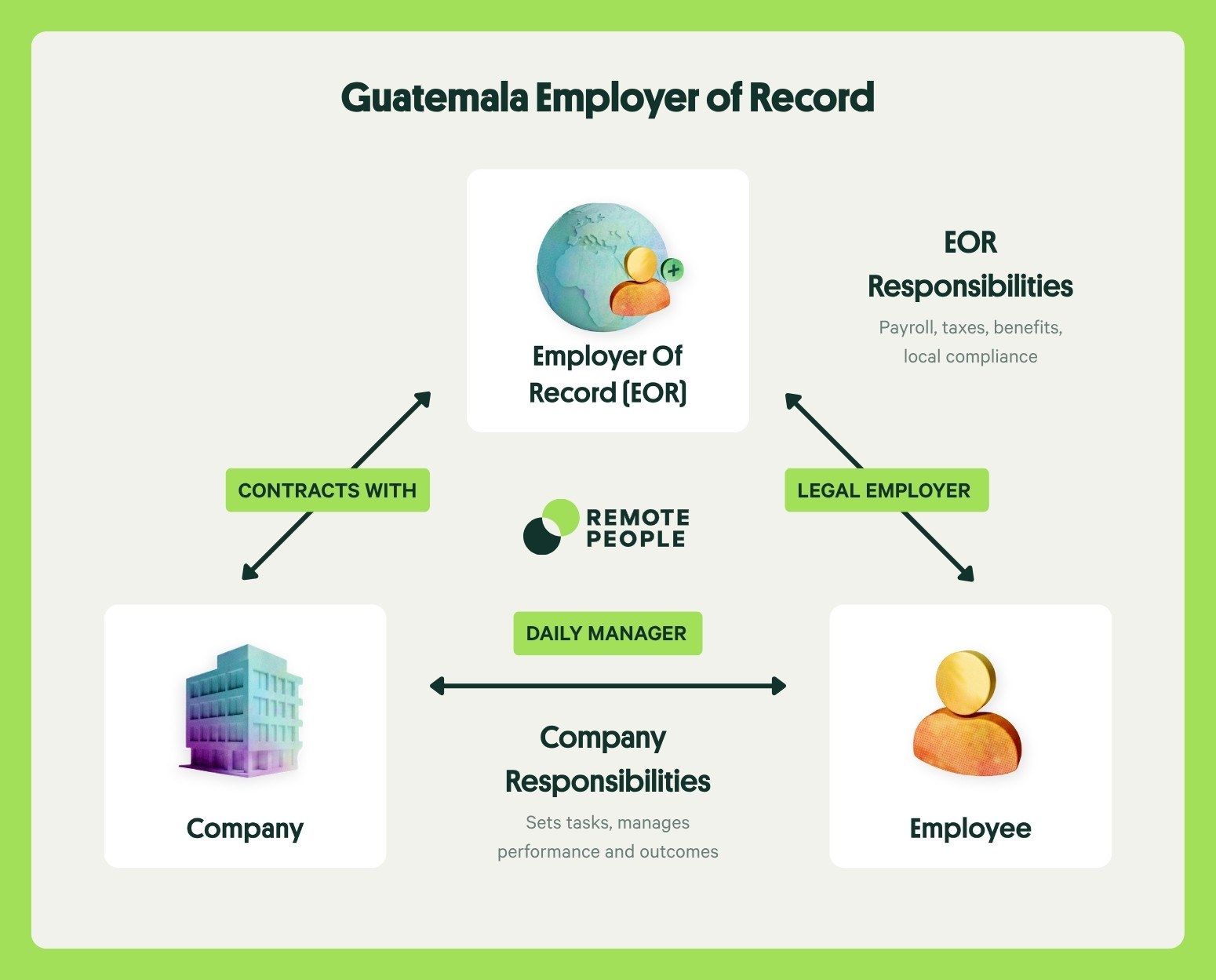
If you’d like to learn more about how Employer of Record (EOR) services work, read our What Is an Employer of Record (EOR)? guide for a complete overview of the model, its benefits, and when to use it.
If you’re comparing providers, our Best Employer of Record (EOR) Providers guide reviews the leading platforms to help you choose the right solution for your business.
Who Uses an EOR in Guatemala?
Employers of record serve a wide range of organizations with different reasons for engaging staff in Guatemala. Common scenarios include:
- Early-stage startups expanding into Central America without the capital or resources to establish a local entity, reducing time-to-hire from months to weeks.
- Established companies testing new markets or customer segments in Guatemala before committing to permanent infrastructure investment.
- Organizations hiring remote workers in Guatemala across departments such as customer support, operations, accounting, and software development, where local payroll compliance is essential.
- Companies transitioning existing contractors or consultants to permanent employee status while maintaining operational continuity and statutory compliance.
Whether you are scaling a small team or deploying larger headcount into Guatemala, an EOR provides the legal foundation and administrative backbone so hiring decisions depend on talent fit rather than compliance complexity.
Typical Onboarding Timeline
Engaging an EOR in Guatemala accelerates hiring significantly compared to traditional entity establishment. Here is the standard timeline:
- First: Initial intake and background verification (candidate information, employment start date, position, salary). Completed within 1–2 business days.
- Second: Contract drafting and legal review in Spanish, tailored to the role and compensation structure. Typically finalized within 2–3 business days.
- Third: Candidate signature and contract submission to the Dirección General de Trabajo for mandatory registration. Registration must occur within 15 days of employment start and is tracked through official channels.
- Fourth: IGSS enrollment and social security registration, including issuance of the employee’s IGSS affiliation number. Completed concurrently with contract registration.
- Fifth: Bank account setup and payroll system configuration, with the first payment processed within the first month of employment.
- Sixth: Benefits enrollment and ongoing compliance tracking, with monthly reporting and payment reconciliation.
The entire onboarding process typically takes 5–10 business days for standard hires. Work permit applications for certain nationalities may extend the timeline by 2–4 weeks, depending on Immigration authority processing and whether the candidate requires visa sponsorship.
Hire in Guatemala
Competitive labor costs, a skilled bilingual workforce, strategic Central American location, and growing tech talent make Guatemala an ideal destination for international hiring.
We handle employment contracts, payroll, tax withholding, and full Guatemala compliance.
No local entity needed. Your team can start in days.
Employment Laws and Regulations in Guatemala
Employment Contracts
All employment relationships in Guatemala are governed by the Código de Trabajo (Decree 1441) (WIPO Lex), which mandates written employment contracts for all positions. Contracts must be executed in triplicate: one copy for the employer, one for the employee, and one for submission to the Dirección General de Trabajo within 15 days of employment commencement. Failure to register contracts within this window exposes employers to administrative penalties and potential labor dispute complications.
Contracts may be fixed-term (for a specific duration or project completion) or indefinite (ongoing). The Código de Trabajo provides stronger protections for indefinite contracts; fixed-term positions are permitted but must include clear termination conditions. All contracts must be written in Spanish, and any clauses conflicting with statutory protections (such as minimum wage, leave entitlements, or working hours) are void. Spanish language requirements apply even for foreign nationals or remote workers.
Working Hours and Overtime
Guatemala’s Código de Trabajo establishes different maximum working hour limits based on shift type. A standard day shift is 8 hours per day, totaling 44 hours per week. Night shift work is capped at 6 hours per day (36 hours weekly), while mixed shifts combine provisions and cap at 7 hours daily (42 hours weekly). Regardless of shift type, total daily working time including overtime may not exceed 12 hours. Overtime is compensated at 150% of the employee’s regular hourly rate for each additional hour worked beyond the standard maximum (Código de Trabajo, Decree 1441).
Guatemala overtime and premium pay rates · Per Código de Trabajo |
|||
Hour Type |
Rate Multiplier |
Weekly/Daily Cap |
Notes |
|---|---|---|---|
Daytime Overtime |
150% |
Max 4 hrs/day; 12 hrs/day total with regular shift |
Beyond 8 hrs/day standard daytime shift |
Night Shift Hours |
150% |
Max 6 hrs/day; 12 hrs/day total including any daytime work |
Work between 19:00 and 06:00 qualifies as night shift |
Weekly Rest Day Work |
150% |
Minimum 1 day rest per week; no standard cap if exceeding |
Work on mandatory rest day (typically Sunday) is penalized |
Public Holiday Work |
150% |
All hours on holiday date |
National holidays include New Year, Independence Day (Sept 15), Christmas, and others per government decree |
Mixed Shift Overtime |
150% |
Max 5 hrs/day; 12 hrs/day total with mixed shift base |
Combination of day and night hours counts as mixed; applies stricter cap |
Employers must ensure that overtime practices comply with these caps and that compensation is calculated accurately. Some roles in export manufacturing or maquila operations may have specific exemptions defined through collective labor agreements, but individual exemptions from overtime caps are not permitted under the Código de Trabajo. Proper overtime tracking and documentation protects both employer and employee from wage disputes.
Minimum Wage
Guatemala’s minimum wage is adjusted annually by government decree and applies across all sectors except where sector-specific minimums are negotiated. Effective January 1, 2026, under Acuerdo Gubernativo 256-2025, the following rates apply in Cooking Education Zone 1 (CE1, Guatemala Department) and Cooking Education Zone 2 (CE2, remainder of the country):
CE1 (Guatemala Department): Non-agricultural workers earn a minimum of GTQ 4,002.28 per month (BLP Legal) (GTQ 131.58 per day). Agricultural workers earn GTQ 3,791.20 per month (GTQ 124.64 per day). Export and maquila sector workers earn GTQ 3,409.73 per month (GTQ 112.10 per day).
CE2 (Rest of country): Non-agricultural workers earn a minimum of GTQ 3,817.93 per month (GTQ 125.49 per day). Agricultural workers earn GTQ 3,625.89 per month (GTQ 119.21 per day).
These 2026 rates represent increases of 4% for non-agricultural roles, 5.5% for agricultural roles, and 7.5% for export and maquila sectors compared to 2025 minimums. Employers must ensure all employees meet or exceed these minimums; contractual agreements below the statutory minimum are void. Salary must be paid in Guatemalan Quetzals (GTQ) unless the employee agrees otherwise in writing.
Probation Period
The Código de Trabajo permits a probation period of two months (Código de Trabajo) for indefinite-term contracts. During this probation, either the employer or employee may terminate the employment relationship without providing notice or paying severance. This trial period allows both parties to assess fit before statutory protections fully activate. After the two-month probation expires, all statutory protections: including notice periods, severance requirements, and leave entitlements: apply in full. Employers should use the probation period to confirm role suitability, work quality, and cultural alignment, as transitioning to permanent status after probation is more restrictive for termination.
Leave Entitlements
Guatemala’s Código de Trabajo sets out the statutory leave entitlements employers must honor. Leave may be paid or unpaid depending on the type and employee tenure, and all leave periods count as worked time for benefit calculation purposes. Below are the main categories of leave with eligibility and compensation rules.
Annual Leave
Employees are entitled to 15 working days of annual leave per year (Código de Trabajo) after completing one year of continuous service. This leave is fully paid at the employee’s regular daily wage. The Código de Trabajo does not provide for carryover of unused leave into the following year; however, employers may permit carryover through written agreement. Leave must be scheduled with reasonable notice and coordinated to avoid excessive workplace disruption.
Sick Leave
Sick leave provisions depend on whether the employer is registered with IGSS. For IGSS-registered employers, the employer pays the employee’s full salary for the first two days of absence due to illness. From day three onward, IGSS covers approximately 66% of the employee’s salary (PwC Guatemala), with the employee receiving the difference or employer supplementing as negotiated. For non-registered employers, the employee receives partial salary based on length of continuous service: half salary for one month of absence if service is 2–6 months; half salary for two months if service is 6–9 months; and half salary for three months if service exceeds nine months. A medical certificate is typically required as evidence of illness.
Maternity Leave
Female employees are entitled to 84 calendar days of maternity leave (Código de Trabajo), consisting of 30 days before the expected birth and 54 days after delivery. The full salary is paid throughout the maternity leave period. For IGSS-registered employers, IGSS covers the cost of maternity benefits through the EMA (Enfermedad y Maternidad) program. Job protection applies during maternity leave and for 30 days after return to work. Nursing mothers also get two 30-minute breaks daily for one year following return to work for breastfeeding or milk expression.
Paternity Leave
The Código de Trabajo does not mandate paternity leave; however, employers commonly provide two days of paid leave upon the birth of a child through company policy or collective bargaining agreements. This entitlement may vary by employer and should be documented in the employment contract or employee handbook.
Other Statutory Leave
Additional leave entitlements include five days of paid leave for marriage, three days of paid leave for death of a spouse, parent, or child, and unpaid time off for civic duties such as voting or jury service as required by law. Employees should provide documentation (marriage certificate, death certificate, civic summons) within reasonable timeframes.
Guatemala statutory leave entitlements · Per Código de Trabajo (Decree 1441) |
||
Leave Type |
Duration |
Eligibility & Notes |
|---|---|---|
Annual Leave |
15 working days/year |
Begins after 1 year of continuous service. Fully paid. No statutory carryover; may be carried over by written agreement. Must be scheduled with notice. |
Sick Leave (IGSS-Registered) |
Unlimited; paid variably |
Employer pays 100% for days 1–2; IGSS pays ~66% from day 3 onward. Medical certificate required. Registered with IGSS mandatory for this benefit structure. |
Sick Leave (Non-IGSS-Registered) |
Varies by tenure |
2–6 months service: half salary for 1 month; 6–9 months: half salary for 2 months; 9+ months: half salary for 3 months. Medical certificate required. |
Maternity Leave |
84 calendar days |
30 days pre-birth and 54 days post-birth. 100% salary paid. IGSS covers cost for registered employers. Job protection during and 30 days post-return. Nursing breaks: two 30-minute breaks daily for 1 year post-return. |
Paternity Leave |
2 days (common practice) |
Not mandated by Código de Trabajo but widely provided through policy or collective agreements. Paid leave is typical employer practice. |
Marriage Leave |
5 days |
Paid leave for employee’s own marriage. Marriage certificate required. One-time entitlement per employee. |
Bereavement Leave |
3 days |
Paid leave for death of spouse, parent, or child. Death certificate required. Additional leave may be negotiated through company policy. |
Civic Duty / Voting Leave |
As required |
Unpaid time off for voting, jury duty, or other mandated civic participation. Proof of requirement (summons, ballot receipt) should be provided. |
Statutory Employee Benefits
Beyond leave entitlements, Guatemalan employers must provide several mandatory benefits funded through payroll deductions and employer contributions. These include:
- IGSS Healthcare Coverage: Employer contribution of 10.67% of gross salary plus employee deduction of 4.83% (PwC Guatemala), providing access to healthcare, disability coverage, and occupational injury protection through the Instituto Guatemalteco de Seguridad Social.
- Pension through IVS Program: Private pension fund contributions managed through Instituciones de Previsión Social (IPS), where employees and employers contribute to retirement savings with investment options selected by the employee.
- EMA Program (Maternity & Sickness): Employer and employee contributions to the Enfermedad y Maternidad program, providing income protection during maternity leave and extended illness not covered by standard IGSS.
- Aguinaldo (13th Month Bonus): Mandatory annual bonus paid in December equal to one month of salary (or prorated for partial-year service), required by Código de Trabajo Article 119.
- Bono 14 (14th Month Bonus): Second mandatory annual bonus paid in July, typically equal to one month of salary or prorated, often funded through a government employment stabilization program or employer contribution depending on sector.
Employers must withhold employee contributions and remit employer contributions on schedule; failure to remit IGSS or IPS contributions results in significant penalties and potential criminal liability. Many employers bundle these benefits into the gross compensation package communicated to employees, while others separate base salary from benefit contributions for clarity.
Recent Regulatory Updates (2026)
Guatemala’s employment and immigration framework continues to evolve. Key updates relevant to hiring in 2026 include:
- 2026 Minimum Wage Increase: Acuerdo Gubernativo 256-2025 (BLP Legal) increased minimum wages effective January 1, 2026, with sector-specific adjustments (4–7.5% increases). Employers must ensure all payroll reflects new minimums immediately.
- Digital Nomad Residence Permit (October 2025): Guatemala introduced (EY Tax News) a new temporary residence permit category for remote workers and digital nomads with a minimum income requirement of USD 2,000 per year, streamlining visa pathways for foreign remote employees and reducing work permit friction for eligible candidates.
- Planned Part-Time Employment Legal Pathways: Legislative proposals under discussion would create formal part-time employment classifications with distinct benefit and contribution structures, though not yet enacted as of April 2026.
- Tighter Labor Inspection Enforcement: Guatemala’s Ministry of Labour has increased workplace inspections and compliance audits, particularly in manufacturing and export sectors, with elevated penalties for violations of working hours, minimum wage, and benefits administration rules.
Work Permits and Visas in Guatemala
Work Permit Requirements
Who Needs a Work Permit
All foreign nationals need a work permit to work legally in Guatemala. Exemptions are rare and limited to diplomatic or specific bilateral agreements. Working without a permit can result in fines, deportation, and termination of employment.
Eligibility and Required Documents
Foreign workers must submit a job offer from a Guatemala-registered employer, valid passport, signed employment contract, and professional qualifications relevant to the role. A criminal background check and medical exam are also required. Guatemala imposes workforce quotas: foreign workers are limited to 10% of total workforce and 15% of total payroll, with limited exceptions for executives.
Processing Time and Validity
Applications are submitted through the Electronic Work Permit Platform for Foreigners (PEX) to the Department of Work Permits. The processing fee is GTQ 500 (approximately USD 65) (U.S. Embassy Guatemala). Standard processing takes 10–15 business days. Initial work permits are valid for 1–2 years and can be renewed up to a maximum of 5 years total.
Renewal Process
Employees must submit renewal applications through PEX before their current permit expires, including the same documentation plus proof of ongoing employment. Importantly, employees can continue working during the renewal processing period, avoiding employment gaps.
Common Visa Types for Foreign Workers
Guatemala’s visa framework offers several pathways for foreign workers depending on employment type and duration. The most common visa categories make hiring easier for both multinational corporations and independent remote workers. Each visa type carries different documentation requirements and processing timelines.
Guatemala work visa types for foreign workers · 2026 |
||||
Visa Type |
Duration |
Best For |
Leads to Residency? |
Processing |
|---|---|---|---|---|
Temporary Resident Visa (Work) |
1–2 years |
Employed by local company |
Yes |
10–15 days |
Intra-Company Transfer |
1–2 years |
Multinational employees |
Yes |
15–20 days |
Digital Nomad Residence Permit |
1–5 years |
Remote workers for foreign employers (USD 2,000 min. monthly income) |
Yes |
15–30 days |
Investor/Entrepreneur Visa |
1–5 years |
Business owners |
Yes |
20–30 days |
Source: Fragomen Guatemala and U.S. Embassy Guatemala |
||||
Additional visa categories exist but do not permit employment:
- Tourist visa (90 days): no work authorization permitted
- Student visa: no employment allowed
- Transit visa: no work authorization
How an EOR Handles Work Permits
An Employer of Record is the legal employer for work permit sponsorship purposes. The EOR files all work permit applications through PEX on behalf of the employee, who provides personal documents such as passport copies, background checks, and medical exams. Work permit processing typically adds 2-4 weeks to the overall onboarding timeline, and the EOR manages both initial approvals and annual renewals.
Payroll, Taxes, and Social Security in Guatemala
Guatemala employer social security contributions · 2026 rates |
||
Contribution |
Rate |
Notes |
|---|---|---|
IGSS (Sickness, Maternity, Accidents: EMA) |
4.00% |
Covers healthcare, maternity, workplace accidents |
IGSS (Disability, Old Age, Survivors: IVS) |
3.67% |
Pension, disability, death benefits |
IGSS Accident Surcharge |
3.00% |
Additional accident coverage |
INTECAP (Training Institute) |
1.00% |
Technical training and workforce development |
IRTRA (Worker Recreation) |
1.00% |
Recreational programs for workers |
Total |
12.67% |
IGSS (10.67%) and INTECAP (1.00%) and IRTRA (1.00%) |
Source: PwC Guatemala Other Taxes and PwC Guatemala Tax Summaries |
||
Guatemala employee payroll deductions · 2026 monthly withholdings |
||
Deduction |
Rate |
Notes |
|---|---|---|
IGSS (EMA) |
2.00% |
Healthcare, maternity, accidents |
IGSS (IVS) |
1.83% |
Pension, disability, survivors |
IGSS Accident |
1.00% |
Accident coverage |
Total IGSS |
4.83% |
Combined employee IGSS withholding |
ISR (Income Tax) |
5% or 7% |
Based on taxable income bracket |
Source: PwC Guatemala Individual Income Taxes and PwC Other Taxes |
||
Guatemala income tax brackets · 2026 |
|
Bracket |
Tax Calculation |
|---|---|
Up to GTQ 300,000 annual taxable income |
5% of taxable income |
Over GTQ 300,000 annual taxable income |
GTQ 15,000 and 7% on excess over GTQ 300,000 |
Source: PwC Guatemala Individual Tax and Dentons Guatemala Tax Guide |
|
All employees receive an annual deduction of GTQ 48,000 (PwC Guatemala) before calculating taxable income. Additional deductions include VAT paid (up to GTQ 12,000), donations (up to 5% of income), and life insurance premiums. Employers withhold ISR monthly and must reconcile all withholdings annually by January 31.
Payroll Cycle
Monthly payroll is the standard in Guatemala (PwC Tax Summaries). Employees must be paid by bank transfer to their individual accounts. All payroll must be processed and reported in GTQ (Guatemalan Quetzal). Each payslip must itemize gross salary, all deductions, and net payment due. Tax filing deadlines are strict: monthly ISR withholding declarations must be filed by the 15th of the following month, IGSS contributions are also due by the 15th, and annual ISR reconciliation must be submitted by January 31.
13th Month Salary and Bonus Pay
Guatemala mandates both a 13th month bonus (Aguinaldo) (BizLatinHub) and a 14th month bonus (Bono 14) for all employees. The Aguinaldo equals one month’s salary calculated as an average of gross salaries from December 1 through November 30 of the prior year, paid in two installments: 50% in the first half of December and 50% in the second half of January. The Bono 14 equals one month’s salary calculated as an average from July 1 through June 30 of the prior year, paid in full by July 15 and cannot be split. Both bonuses are pro-rated for employees hired partway through the year and are exempt from income tax withholding.
Cost of Hiring Through an EOR in Guatemala
EOR Service Fees
EOR service fees in Guatemala typically range from USD 300 to USD 600 per employee per month. This fee usually covers payroll processing, monthly tax filings, IGSS registration and contribution remittance, employment contract management, benefits administration, and ongoing compliance monitoring to ensure adherence to local labor law.
Total Employment Cost Breakdown
The following example illustrates the full monthly cost of hiring one employee in Guatemala with a gross salary of GTQ 10,000, including all employer contributions, statutory bonuses, and EOR fees:
Guatemala employer cost example · GTQ 10,000 gross · 2026 |
||
Employer Cost |
Amount (GTQ) |
% of Gross |
|---|---|---|
Gross Monthly Salary |
GTQ 10,000 |
100.00% |
IGSS Employer (EMA and IVS and Accident) |
GTQ 1,067 |
10.67% |
INTECAP |
GTQ 100 |
1.00% |
IRTRA |
GTQ 100 |
1.00% |
Aguinaldo Provision (1/12) |
GTQ 833 |
8.33% |
Bono 14 Provision (1/12) |
GTQ 833 |
8.33% |
EOR Service Fee (est. ~USD 500) |
GTQ 3,875 |
38.75% |
Total Monthly Cost |
GTQ 16,808 |
168.08% |
Source: PwC Guatemala Tax Summary and RemotePeople EOR Services |
||
Ready to hire in Guatemala? Get started with RemotePeople: we handle employment contracts, payroll, tax withholding, and full Guatemala compliance, with no local entity required.
Benefits of Using an EOR in Guatemala
An Employer of Record (EOR) offers significant advantages for companies entering the Guatemalan market or expanding their remote workforce. By partnering with an EOR, you avoid the complexity of establishing a local entity while maintaining full compliance with Guatemalan labor laws. The model provides immediate hiring capability, reduced administrative overhead, and predictable costs.
- Speed to Market: Launch operations in Guatemala within 1–2 weeks without months of entity registration. Your team can begin working immediately while the EOR handles all employment setup behind the scenes.
- Compliance Assurance: The EOR ensures adherence to the Código de Trabajo, payroll tax filing, social insurance contributions (IGSS), and all statutory benefits. You reduce legal and regulatory risk significantly.
- Cost Efficiency: No upfront capital for registering a local entity, no maintenance of separate payroll infrastructure, and predictable monthly fees. You pay only for the employees you hire, plus a flat EOR management fee.
- Local Expertise: The EOR has established relationships with Guatemalan authorities, understands local labor practices, and can navigate complex employment disputes. Local knowledge reduces costly mistakes.
- Flexibility to Scale: Add or remove employees as your business needs change without complex entity restructuring. The EOR absorbs administrative complexity, allowing you to focus on core operations.
- Risk Mitigation: The EOR assumes employment-related liabilities, including wrongful termination claims, wage disputes, and tax audits. Your company is shielded from direct labor law violations.
Ready to hire in Guatemala without the legal complexity? Contact our team today to explore how an EOR can accelerate your market entry and simplify your workforce management.
Termination and Offboarding in Guatemala
Notice Periods
The Código de Trabajo strictly regulates notice periods for termination (Código de Trabajo) without cause in Guatemala. Notice must be provided in writing and can be paid in lieu (paid notice), allowing the employee to leave immediately while receiving the equivalent salary. The notice period varies based on length of service and employment classification.
Guatemala statutory notice periods by position level · Per Código de Trabajo |
|||
Length of Service |
Notice Period |
During Probation |
Notes |
|---|---|---|---|
Less than 6 months |
1 week |
None required |
Calendar days |
6 months: 1 year |
10 days |
None required |
Calendar days |
1 – 5 years |
2 weeks |
None required |
Calendar days |
5+ years |
1 month |
None required |
Calendar days |
Managerial staff |
1 month minimum |
None required |
May be longer per contract |
Just-cause termination (despido justificado) requires no notice period and the employee must be dismissed immediately. Mutual agreement between employer and employee allows either party to waive notice requirements. Fixed-term contracts (contrato a plazo fijo) may allow termination without notice if specifically permitted in the contract text, though severance is still owed if termination occurs before the contract end date.
Severance Pay
Severance pay (indemnización) is mandatory in Guatemala for unjust dismissal after the probation period. Article 82 of the Código de Trabajo (Código de Trabajo) mandates one month of salary per year of service, calculated using the average gross salary from the last six months of employment. A 30% surcharge called “economic advantages” (ventajas económicas) is also applied to the base severance amount, significantly increasing the total obligation.
Guatemala severance pay schedule by years of service · Per Código de Trabajo |
|||
Years of Service |
Severance Amount |
Base Salary |
Notes |
|---|---|---|---|
1 year |
1 month salary and 30% |
Average of last 6 months |
Plus pro-rata Aguinaldo and Bono 14 |
3 years |
3 months salary and 30% |
Average of last 6 months |
Plus pro-rata Aguinaldo and Bono 14 |
5 years |
5 months salary and 30% |
Average of last 6 months |
Plus pro-rata Aguinaldo and Bono 14 |
10 years |
10 months salary and 30% |
Average of last 6 months |
Plus pro-rata Aguinaldo and Bono 14 |
Calculation Method
Severance is calculated as one month of salary per year of service, with partial years pro-rated. The base salary is defined as the average gross monthly salary paid during the last six months of employment, including all regular bonuses and allowances. The 30% ventajas económicas surcharge is applied to the base indemnización amount and is non-negotiable under Guatemalan law. Refer to Table 13 above for worked examples at different service lengths.
Caps and Exceptions
Guatemala has no statutory cap on severance pay, meaning the obligation increases proportionally with service length. Just-cause termination (despido justificado) eliminates the severance obligation entirely, but pro-rata Aguinaldo, Bono 14, and accrued vacation days remain due. Employees terminated during the two-month probation period receive no severance, though they must receive their final paycheck promptly. For fixed-term contracts, severance applies only if terminated before the contract end date without cause; contract expiration by its own terms carries no severance. Claims for unpaid severance must be filed within three months of employment termination.
Grounds for Termination
Just-cause termination (despido justificado) is permitted under Article 77 of the Código de Trabajo for reasons including repeated unauthorized absence, dishonesty or theft, insubordination or repeated disobedience of lawful orders, intentional damage to employer property or customer property, working while intoxicated or under the influence, and unauthorized disclosure of trade secrets or confidential business information. Termination for cause must be documented in writing and communicated to the employee immediately.
Termination without cause (despido injustificado) is permitted at any time, but the employer must pay full severance, notice pay, and all pro-rata statutory benefits. Protected categories of employees: including pregnant women, union members, and workers on authorized medical leave: cannot be terminated except for serious just cause, and even then require prior written authorization from labor authorities.
EOR vs. Other Hiring Models in Guatemala
Guatemala EOR vs local entity comparison · Setup time, cost, risk and best-fit |
||
Comparison |
Employer of Record |
Own Entity |
|---|---|---|
Setup time |
1–2 weeks |
3–6 months |
Upfront cost |
$0 |
$8,000–$15,000 |
Ongoing cost |
$300–$600/employee/month |
$15,000–$25,000/year maintenance |
Local partner required |
No (EOR is the local entity) |
No (but legal counsel recommended) |
Social insurance registration |
Handled by EOR |
You manage it |
Payroll & tax filing |
Handled by EOR |
You manage it (or outsource) |
Best for team size |
1–15 employees |
15+ employees |
Scale down / exit |
Easy, no entity to unwind |
Costly, legal dissolution required |
Government contracts |
Not eligible |
Eligible (requires local entity) |
An EOR model is ideal for companies testing the Guatemalan market, entering rapidly with small remote teams, or avoiding the administrative and financial burden of entity registration. The EOR becomes your local employer, handling all compliance, payroll, and tax obligations from day one. This approach is especially valuable for startups and companies without existing Guatemalan operations.
Setting up your own local entity in Guatemala is appropriate for companies planning long-term, large-scale operations (15+ employees), pursuing government contracts, or seeking maximum control over local operations. However, entity setup involves significant upfront capital, months of legal registration and tax authority filings, and ongoing compliance complexity. You must hire local finance staff or outsource payroll, creating ongoing management overhead.
The EOR model offers faster time to market, zero upfront cost, and easy exit if your market strategy changes. A local entity provides greater control and eligibility for government contracts, but requires sustained investment and long-term commitment to justify the legal and financial complexity.
Guatemala EOR vs independent contractors · Compliance, cost, and risk |
||
Comparison |
EOR (Full-Time Employee) |
Independent Contractor |
|---|---|---|
Legal relationship |
Employee of the EOR |
Self-employed, no employment relationship |
Compliance risk |
Low, EOR ensures local labor law compliance |
High, misclassification risk if relationship resembles employment |
Payroll & tax |
EOR handles withholding, contributions, filings |
Contractor invoices you; they handle their own taxes |
Benefits & leave |
Statutory benefits, paid leave, social security |
No entitlement to employee benefits |
IP protection |
Stronger, employment contract assigns IP by default |
Weaker, requires explicit IP assignment clause |
Termination |
Subject to local notice periods and severance |
Contract can be ended per agreement terms |
Best for |
Long-term, core team roles |
Short-term projects, specialized tasks |
Cost structure |
Salary and employer contributions and EOR fee |
Contractor fee (typically higher gross, lower total cost) |
The EOR model provides employment, statutory benefits, and full compliance protection for core team members. Contractors are ideal for short-term projects, specialized expertise, or temporary workload spikes where employment commitment is not necessary. However, Guatemala’s labor courts and authorities have become increasingly strict about contractor misclassification: if a contractor works full-time, receives direction from your company, and performs duties that resemble permanent employment, labor authorities may reclassify them as employees retroactively, triggering back-pay and severance obligations.
For long-term roles and core business functions, the EOR model eliminates misclassification risk and ensures full compliance. If you do use contractors, keep engagement short-term, avoid providing tools or workspace, and ensure the contractor maintains independent control over their work. For guidance on structuring contractor relationships properly, see our guide to hire contractors in Guatemala.
Guatemala EOR vs PEO comparison · Legal employer, liability, and setup |
||
Comparison |
Employer of Record (EOR) |
PEO |
|---|---|---|
Legal employer |
EOR is the legal employer |
You remain the legal employer (co-employment) |
Local entity required |
No, the EOR is the local entity |
Yes, you must have your own entity in Guatemala |
Best for |
Companies without a local entity |
Companies that already have a local entity |
Compliance liability |
EOR assumes compliance responsibility |
Shared liability between you and the PEO |
Setup time |
1–2 weeks |
Depends on your entity setup (weeks to months) |
Control over HR policies |
EOR manages within local law framework |
More direct control, PEO advises |
Typical use case |
Market entry, small remote teams, testing new markets |
Established local operations needing HR outsourcing |
Sources:
RemotePeople EOR;
RemotePeople Guatemala PEO
|
||
An EOR and a PEO (Professional Employer Organization) differ fundamentally in legal structure and use case. With an EOR, the EOR is the legal employer of record: you are the client, not the employer. With a PEO, you remain the legal employer while the PEO co-employs workers and manages HR administration; this creates shared liability and requires you to maintain a local Guatemalan entity.
Guatemala does not have a formal PEO regulatory framework like some countries; most PEO models operate as HR outsourcing services that assume administrative burdens while you retain employer status and liability. For companies without an existing Guatemalan entity, an EOR is the more practical model because it eliminates the legal obligation to maintain a local company while providing full employment protections.
Choose EOR if you are entering Guatemala for the first time or testing a new market without a local entity. Choose PEO if you already operate a Guatemalan company and want to outsource HR administration while maintaining direct employer control and liability.
Public Holidays in Guatemala
Guatemala public holidays · 2026 calendar year |
||
Date |
Holiday |
Type |
|---|---|---|
January 1 |
New Year’s Day |
National |
April 2 |
Holy Thursday |
National (movable) |
April 3 |
Good Friday |
National (movable) |
April 4 |
Holy Saturday |
National (movable) |
May 1 |
Labour Day |
National |
June 30 |
Army Day |
National |
August 15 |
Assumption of the Virgin Mary |
Guatemala City only |
September 15 |
Independence Day |
National |
October 20 |
Revolution Day |
National |
November 1 |
All Saints’ Day |
National |
December 24 |
Christmas Eve (from 12:00) |
National (half day) |
December 25 |
Christmas Day |
National |
December 31 |
New Year’s Eve (from 12:00) |
National (half day) |
Note: Local patron saint days vary by municipality and are observed as holidays in their respective regions.
Sources:
timeanddate.com Guatemala 2026;
Ministerio de Trabajo: Feriados Laborales 2026
|
||
Public holidays in Guatemala fall on fixed dates or movable religious observances (Easter-related dates). Employees are entitled to paid time off on all national holidays; work performed on a holiday is either paid at double rate or compensated with an equivalent day off, depending on employment contract terms. When planning payroll, payroll and tax administration must account for these dates to ensure correct compensation calculation and statutory compliance.
How to Get Started with an EOR in Guatemala
- First, define your hiring needs: Identify the roles, salary expectations (referencing the average salary in Guatemala and local minimum wage), and timeline for your Guatemalan team. Clarify whether you need full-time employees, contractors, or a mix.
- Second, choose an EOR provider: Evaluate EOR firms on their local Guatemalan presence, compliance track record, and pricing structure. Ensure they offer integration with your payroll and HR systems.
- Third, verify compliance requirements: Confirm which employee benefits are mandatory (IGSS, Aguinaldo, Bono 14) and review the probation period rules for your first hires. Understand payroll and tax obligations for the year.
- Fourth, initiate the hiring process: Submit candidate information and employment details to your EOR. The EOR will prepare employment contracts in Spanish, register employees with IGSS, and set up payroll processing.
- Fifth, onboard and manage: Once employees are on the EOR’s payroll, manage day-to-day operations directly while the EOR handles compliance, tax filings, and benefit administration. Stay informed of any labor law changes that affect your team.
Ready to expand your team in Guatemala? Contact our team today to learn how our employer of record solution can simplify hiring and ensure full compliance with Guatemalan labor law. Visit remotepeople.com/contact to discuss your hiring timeline and requirements with our Guatemala specialists.
Where companies hiring in Guatemala expand next
Teams hiring in Guatemala frequently expand across Central America and nearby markets, leveraging nearshoring to the US and shared Spanish-language talent. Many companies add hiring in El Salvador first, drawing on SICA-wide workforce mobility. An EOR partner in Costa Rica follows as shared Central American labor norms, while Panama offers SICA-region proximity and shared Central American labor practices. A team in Honduras is often the fourth step, valued for aligned SICA employment frameworks.
Frequently Asked Questions
EOR costs in Guatemala typically range from $300 to $600 per employee per month as a flat service fee, plus the employee's salary and statutory contribution costs (IGSS, Aguinaldo, Bono 14) (RemotePeople Guatemala EOR). There are no upfront setup fees. The exact fee depends on the EOR provider and the level of support required (payroll, HR, compliance, etc.).
An EOR can hire and onboard employees in Guatemala within 1–2 weeks (RemotePeople). This includes contract preparation in Spanish, IGSS registration, payroll setup, and work authorization for foreign nationals if needed. This speed-to-market is significantly faster than establishing a local legal entity, which typically takes 3–6 months.
Yes. An EOR in Guatemala handles all payroll tax compliance, including income tax (ISR) withholding and filing, social insurance (IGSS) registration and monthly contributions, and annual tax returns. The EOR ensures on-time filing with Guatemalan tax authorities (SAT – Superintendencia de Administración Tributaria) and maintains compliance with the Código de Trabajo (WIPO Lex Guatemala).
Intellectual property (IP) created by an employee during their employment belongs to your company (the client), not the EOR. The employment contract between the employee and the EOR includes standard IP assignment clauses that ensure all work product, inventions, and creations are owned by your organization. This is one of the key advantages of the EOR model over independent contractor arrangements (RemotePeople Guatemala EOR).
Yes. Many EOR providers, including RemotePeople, can help you hire independent contractors in Guatemala alongside full-time employees. Contractors are ideal for short-term projects, specialized expertise, or temporary workload increases. Learn more about structuring contractor arrangements properly in our guide to hire contractors.
The EOR handles the entire termination process in compliance with Guatemalan labor law. This includes providing required notice periods (ranging from 1 week to 1 month depending on length of service) (Código de Trabajo), calculating severance pay and the 30% ventajas económicas surcharge, processing pro-rata bonuses (Aguinaldo, Bono 14), and filing final tax documentation. The EOR assumes the administrative and legal liability for proper termination compliance.
Yes. All employees hired through an EOR in Guatemala receive statutory benefits mandated by the Código de Trabajo (WIPO Lex), including social insurance (IGSS), Aguinaldo (13th month bonus), Bono 14 (14th month bonus), paid vacation (15 days per year), and sick leave. These benefits are non-negotiable and are factored into the total cost of employment.
Yes. The EOR can hire foreign nationals and manage their work authorization. This includes sponsoring work visas (Visa Temporal para Trabajadores Expertos or similar visa categories) and obtaining the necessary permits from Guatemalan immigration authorities (Dirección General de Migración). The EOR handles all documentation and ensures compliance with immigration regulations, allowing foreign employees to work legally in Guatemala (Guatemala Labour Code).
Employer of Record in
Employer of Record in
Employer of Record in
Employer of Record in
Employer of Record in
Employer of Record in
Employer of Record in
Employer of Record in