
 Recruit
Employer of Record (EOR) in El Salvador
-
 Drew Donnelly
- Published
- September 21, 2026
RemotePeople’s employer of record in El Salvador lets you hire employees in El Salvador with seamless payroll integration. We handle ISSS health insurance contributions, AFP pension scheme contributions, and INSAFORP vocational training fees.
Hire in El Salvador — book a free 30-minute demo
Tell us what you need. You'll get a tailored, transparent proposal within 24 hours, plus a free call to walk through it.
Tell us about your company
So we can match you with a specialist who knows your market — and unlock volume pricing tiers.
* All fields are required.
Where and when are you hiring?
Tell us the geography and timing and we'll quote each country line by line, with onboarding timelines.
* All fields are required.
Help us beat your current setup
We'll benchmark your current deal and send a line-by-line proposal in 24 hours — showing exactly where we cut cost, time, or risk. After you submit, you can book a call to walk through it together.
* All fields are required.
Thanks! Your proposal is on its way.
Expect a tailored, line-by-line proposal in your inbox within 24 hours. In the meantime…
Want to walk through it together?
Book a free 30-minute call with one of our specialists. We'll explain every line, answer your questions, and tailor the proposal further if you need.
No obligation. Pick a time that works for you.








- Hire in El Salvador — book a free 30-minute demo
- Tell us about your company
- Where and when are you hiring?
- Help us beat your current setup
- Thanks! Your proposal is on its way.
- How an Employer of Record Works in El Salvador
- Employment Laws and Regulations in El Salvador
- Work Permits and Visas in El Salvador
- Cost of Hiring Through an EOR in El Salvador
- Benefits of Using an EOR in El Salvador
- Termination and Offboarding in El Salvador
- EOR vs. Other Hiring Models in El Salvador
- Public Holidays in El Salvador
- How to Get Started with an EOR in El Salvador
- Where companies hiring in El Salvador expand next
- Frequently Asked Questions
- Related EOR Destinations

Start hiring in El Salvador
Let RemotePeople handle payroll, compliance, and HR admin worldwide so you can focus on building your team.

El Salvador has become one of the most compelling nearshore hiring markets in Central America, combining a fully dollarised economy, a Central Standard Time workday aligned with North American teams, and a growing bilingual talent pool of software engineers, customer support agents, finance analysts, and digital operations specialists concentrated in San Salvador, Santa Tecla, and Antiguo Cuscatlán. Since the country adopted the US dollar as legal tender under the Ley de Integración Monetaria of 2001, foreign employers avoid the currency conversion risk that complicates payroll in most of Latin America. Compliance for any business looking to hire employees in El Salvador means registering workers with the Instituto Salvadoreño del Seguro Social (ISSS) for health and social insurance, enrolling them in an Administradora de Fondos de Pensiones (AFP) for retirement savings, paying the INSAFORP training levy, and applying the Código de Trabajo at every stage of the employment relationship.
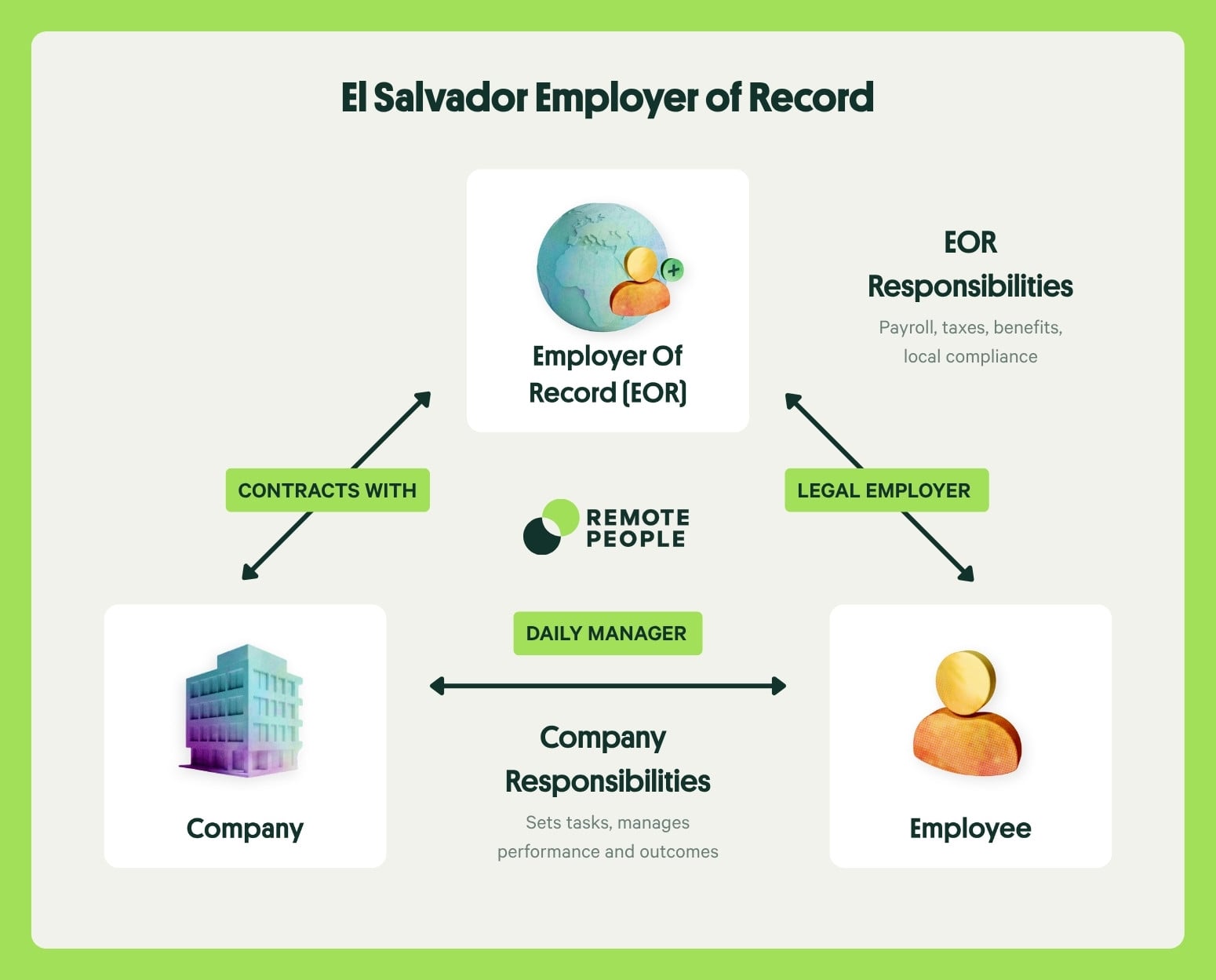
An employer of record in El Salvador removes the need to incorporate a local company while keeping every hire fully compliant with Salvadoran labour law. The EOR acts as the legal employer on paper, managing Spanish-language employment contracts, ISSS and AFP enrolment, income tax (ISR) withholding, aguinaldo payments, vacation premiums, and work visa sponsorship. You retain full operational control over the employee’s day-to-day work, performance, and deliverables.
How an Employer of Record Works in El Salvador
If you’d like to learn more about how Employer of Record (EOR) services work, read our What Is an Employer of Record (EOR)? guide for a complete overview of the model, its benefits, and when to use it.
If you’re comparing providers, our Best Employer of Record (EOR) Providers guide reviews the leading platforms to help you choose the right solution for your business.
Who Uses an EOR in El Salvador?
Companies typically use an employer of record in El Salvador to test the Central American market before committing to a full entity, to hire a small team of one to fifteen people without the overhead of incorporation, or to onboard a single high-value hire in one to two weeks rather than the two to three months a local entity setup would take. The model is particularly useful for firms hiring bilingual software developers in San Salvador, customer support representatives serving North American clients, or finance and operations talent in Antiguo Cuscatlán, where nearshore cost advantages are significant for North American employers on the same time zone and in the same currency.
An EOR is the right fit for foreign companies that need local compliance without a permanent establishment, for employers converting existing Salvadoran contractors into full employees to reduce misclassification exposure, and for organisations that need to offer statutory benefits quickly to attract senior talent in a competitive bilingual market.
Typical Onboarding Timeline
Onboarding a Salvadoran national through an EOR typically takes one to two weeks, broken into five clear stages.
- First, sign the EOR service agreement and share the employee’s details including full name, Documento Único de Identidad (DUI), salary, and start date (1–2 days).
- Second, the EOR drafts a compliant Spanish-language employment contract and sends it for signature (2–3 days).
- Third, ISSS, AFP, and INSAFORP registration happen in parallel, together with Ministerio de Hacienda tax enrolment if needed (2–4 business days).
- Fourth, payroll configuration, benefits enrolment, and bank account verification are finalised (1–2 days).
- Fifth, the employee officially starts work and receives their first paycheck on the next monthly or biweekly payroll cycle.
If the hire is a foreign national requiring a work permit, add 4 to 8 weeks for processing through the Ministerio de Trabajo y Previsión Social and the Dirección General de Migración y Extranjería. An expedited pathway may be available for senior technical roles and intra-company transferees.
Hire in El Salvador
A fully dollarised economy, a Central Standard Time workday, and a growing pool of bilingual software, support, and finance talent in San Salvador make El Salvador one of the strongest nearshore hiring markets in Central America.
We handle employment contracts, ISSS and AFP enrolment, payroll, ISR withholding, and full Código de Trabajo compliance.
No local entity needed. Your team can start in days.
Employment Laws and Regulations in El Salvador
Employment Contracts
The Código de Trabajo of 1972, together with its subsequent reforms, governs every employment relationship in El Salvador and is administered by the Ministerio de Trabajo y Previsión Social. Written contracts are mandatory under Article 18 of the Código de Trabajo for any employment relationship and must be executed in Spanish in at least three original copies: one for the employer, one for the employee, and one filed with the Dirección General de Trabajo. Indefinite-term contracts (contrato por tiempo indefinido) are the default for ongoing roles, while fixed-term contracts (contrato por tiempo determinado) may only be used for work of a temporary or specific nature.
Employment contracts must specify job title, workplace, salary, working hours, leave entitlement, probation clause if any, and notice terms. Any contract clause that waives a right granted by the Código de Trabajo is void under Article 30, and the principle of in dubio pro operario means ambiguities are interpreted in favour of the worker.
Working Hours and Overtime
The maximum legal workweek in El Salvador is 44 hours under Article 161 of the Código de Trabajo, distributed over no more than six days with a maximum of 8 hours per day for daytime work. Night work between 7:00 p.m. and 6:00 a.m. is capped at 7 hours per day and 39 hours per week, and mixed shifts at 7.5 hours per day. The weekly rest day, typically Sunday, is paid by the employer under Article 171.
Overtime is paid at 200% of the ordinary rate for any hour worked beyond the daily or weekly limit, under Article 169. Work performed on the weekly rest day or on a public holiday is paid at 200% of the regular rate in addition to the rest day pay already owed, effectively a triple-pay arrangement. Overtime must be agreed in writing and cannot become a permanent feature of the job without the authorisation of the Dirección General de Trabajo.
El Salvador overtime and premium pay rates 2026 (Código de Trabajo Articles 161, 168, 169, 171, 192) | |||
Hour Type | Rate Multiplier | Daily / Weekly Cap | Notes |
|---|---|---|---|
Ordinary day shift | 100% (1.0×) | 8 hrs/day • 44 hrs/week | Standard workweek under Article 161 of the Código de Trabajo. |
Night shift (7:00 p.m.–6:00 a.m.) | 125% (1.25×) | 7 hrs/day • 39 hrs/week | Night surcharge of 25% over the daytime rate, capped hours per Article 161. |
Overtime (beyond 44 hrs/week) | 200% (2.0×) | Must be in writing | Article 169 requires double pay and prior written authorisation for regular overtime. |
Weekly rest day (typically Sunday) | 300% (triple pay) | — | Article 171/174: 200% premium plus the paid rest day already owed. |
Public holiday | 300% (triple pay) | — | Article 192: 200% premium plus the paid holiday already owed. |
Minimum Wage
El Salvador sets minimum wages by economic sector under resolutions of the Consejo Nacional del Salario Mínimo. The rates that took effect on 1 June 2025 under Decreto Ejecutivo No. 12-2025 remain in force in 2026, and no new increase has been announced. The minimum monthly wage for workers in commerce, services, and industry is $408.80, equivalent to a daily rate of $13.44. Textile and apparel maquila workers earn a minimum of $402.26 per month, and the agricultural sector minimum is $272.72 per month.
Because El Salvador is fully dollarised, employers and employees transact entirely in US dollars, which eliminates the exchange rate volatility that affects hiring in most Latin American markets. For more detail on the 2026 minimum wage, including the sector variations and historical context, see the El Salvador minimum wage guide.
Probation Period
Probation periods in El Salvador may last up to 30 calendar days under Article 28 of the Código de Trabajo. Probation must be expressly included in the written employment contract to be enforceable; if the contract does not mention probation, the employee is considered permanent from day one. During the 30-day probation window, either party may terminate the employment relationship without notice and without indemnización. Once probation ends, the full protection of Article 58 severance and notice obligations applies, and termination without just cause triggers the statutory severance formula described below. See the El Salvador probation period guide for operational detail.
Leave Entitlements
Salvadoran law provides a comprehensive set of statutory leave entitlements under the Código de Trabajo and the Ley del Seguro Social, covering paid annual leave with a mandatory premium, sick leave jointly funded by the employer and the ISSS, maternity leave funded by the ISSS, and specific family event leave. The ISSS funds most medical and parental leave after the initial employer-covered period.
Annual Leave
Paid annual leave in El Salvador is 15 consecutive days per year of service under Article 177 of the Código de Trabajo, available once the employee has completed one full year with the same employer and worked a minimum of 200 days during that year as required by Article 180. Vacation pay equals the ordinary salary for the 15 days plus a 30% premium, meaning the employee is paid 19.5 days of salary for the vacation period. El Salvador is the only country in the Northern Triangle of Central America that mandates this additional 30% vacation bonus, and payment must be made before the employee begins the leave.
Sick Leave
Sick leave in El Salvador is funded jointly by the employer and the ISSS. The employer pays the first three days of incapacity at 75% of salary under Article 307 of the Código de Trabajo, and the ISSS pays from day four onward at 75% of the contribution base for common illness (enfermedad común) for up to 52 weeks. A medical certificate issued by an ISSS-authorised physician is required for the ISSS subsidy to begin. Work-related illness and injury are covered entirely by the ISSS from day one under the riesgos profesionales framework.
Maternity Leave
Maternity leave in El Salvador is 16 weeks of fully paid leave under Article 309 of the Código de Trabajo, as reformed by Decreto Legislativo No. 900 of 2017. At least six weeks must be taken after delivery, and the mother may choose when to begin the prenatal portion. The leave is funded at 100% of salary by the ISSS, not the employer, provided the mother has contributed for at least 12 weeks within the 12 months prior to delivery. Dismissal during pregnancy and for the full duration of maternity leave is prohibited under Article 113 and can only occur for cause and with prior authorisation from a labour court.
Paternity Leave
Paternity leave in El Salvador is three working days of fully paid leave under Article 29 of the Código de Trabajo, applicable to biological and adoptive fathers. The leave must be taken within the 15 days following the birth and is paid by the employer at 100% of salary. Multiple births do not extend the entitlement, but collective agreements at larger employers often supplement the statutory minimum.
Other Statutory Leave
Salvadoran law provides additional paid leave for specific life events under Article 29 of the Código de Trabajo.
- Bereavement leave of three working days for the death of a spouse, parent, child, or sibling.
- Marriage leave of three working days for the employee’s own wedding.
- Civic duty leave for employees summoned as witnesses, jurors, or electoral officials, for the time required by law.
- Medical appointment leave for attending ISSS consultations with proof of attendance.
- Breastfeeding leave of one hour per day for nursing mothers until the child turns one year old, under Article 312.
El Salvador statutory leave entitlements · Per Código de Trabajo | ||
Leave Type | Duration | Eligibility & Notes |
|---|---|---|
Annual leave | 15 consecutive days | Paid at 130% of salary (15 days + 30% premium). Available after 1 year and 200 days worked |
Sick leave | Up to 52 weeks | Employer pays first 3 days at 75%; ISSS pays from day 4 at 75% of contribution base |
Maternity leave | 16 weeks | Fully paid by ISSS at 100% of salary; 6 weeks mandatory postnatal; dismissal prohibited |
Paternity leave | 3 working days | Fully paid by employer; must be taken within 15 days of birth |
Bereavement leave | 3 working days | Death of spouse, parent, child, or sibling. Employer-funded |
Marriage leave | 3 working days | For the employee’s own wedding. Employer-funded |
Breastfeeding leave | 1 hour per day | For nursing mothers until child turns 1 year old, under Article 312 |
Statutory Employee Benefits
Salvadoran employers must fund several mandatory benefits beyond base salary and social security contributions. The most significant is the aguinaldo, a year-end bonus equivalent to 15 days of salary for employees with 1 to 3 years of service, 19 days for those with 3 to 10 years, and 21 days for those with more than 10 years, payable between 12 and 20 December each year under Article 196 of the Código de Trabajo. A 2025 reform extended the payment window to begin on 20 October, allowing employers to pay earlier if they choose. Employees with less than one year of service receive a proportional aguinaldo.
Employers must also register employees with the ISSS for health and maternity insurance, an AFP of the employee’s choice (Confia or Crecer) for retirement savings, and INSAFORP for workforce training. The ISSS provides medical coverage at its own hospitals and clinics, while the AFP manages individual retirement accounts under the private pension system established by Decreto Legislativo No. 927 of 1996. For a full breakdown, see the El Salvador employee benefits guide.
Recent Regulatory Updates (2025-2026)
Several labour updates have taken effect in the past 18 months. First, the sectoral minimum wages rose on 1 June 2025 under Decreto Ejecutivo No. 12-2025, lifting the commerce and industry rate to $408.80 per month and the agricultural rate to $272.72, and these figures remain in force in 2026 with no new adjustment announced. Second, the reform to Article 200 of the Código de Trabajo extended the aguinaldo payment window from 12-20 December to 20 October-20 December, giving employers more flexibility to distribute the year-end bonus. Third, the Ministerio de Hacienda confirmed in late 2025 that the annual ISR brackets and the $75-per-month ISSS employer cap remain unchanged for the 2026 fiscal year.
No broad labour reform is expected in 2026, and the regulatory environment remains stable. Employers should monitor the Ministerio de Trabajo website for any sector-specific announcements or ISSS contribution adjustments.
Work Permits and Visas in El Salvador
Work Permit Requirements
Who Needs a Work Permit
Foreign nationals employed in El Salvador require a residence permit with work authorisation, issued by the Dirección General de Migración y Extranjería under the Ley de Migración y Extranjería. Citizens of the Central American Integration System (SICA) member states including Guatemala, Honduras, and Nicaragua benefit from simplified residence arrangements, and nationals of countries with bilateral agreements may be eligible for expedited processing. Short business visits of up to 90 days do not require a work permit but do not permit paid employment with a local employer.
Eligibility and Required Documents
To qualify for temporary residence with work authorisation, the foreign employee must have a signed employment contract with a Salvadoran employer and a letter of sponsorship from that employer. Required documents include a valid passport with at least one year of validity, the signed employment contract, proof of professional qualifications, a criminal background check from the country of origin apostilled and translated into Spanish, a medical certificate, and proof of financial solvency. Under Article 7 of the Ley de Migración y Extranjería, foreign nationals may not exceed 10% of a Salvadoran company’s total workforce for ordinary roles, though specialised technical positions and managerial staff may be exempt from this cap.
Processing Time and Validity
Work permit processing at the Dirección General de Migración y Extranjería typically takes four to eight weeks, combining the Ministerio de Trabajo labour authorisation and the migration residence card. The temporary residence card is valid for up to one year and is renewable for up to five consecutive years, after which the employee may apply for definitive residence. The permit is tied to the sponsoring employment contract, and if the contract ends, the permit must be cancelled or the employee must secure new sponsorship within 30 days.
Renewal Process
Renewal must be initiated at least 30 days before the current permit expires. The renewal process requires proof of ongoing employment, continued ISSS enrolment, and a valid residence card issued by Migración. Renewal typically takes two to four weeks, and employees may continue working under the expiring permit during the processing window. For a full walkthrough of the application process, see the El Salvador work visa guide.
Common Visa Types for Foreign Workers
Foreign nationals typically need a work permit or employment-authorised visa to take up a job in El Salvador (Dirección General de Migración y Extranjería). The table below summarises the most common visa categories employers use when relocating international hires, along with typical eligibility requirements and permit durations.
El Salvador work visa types 2026 (Ley de Migración y Extranjería, Decreto 286/2019) | ||||
Visa Type | Duration | Best For | Leads to Permanent Residency? | Processing Time |
|---|---|---|---|---|
Temporary Residence (Residencia Temporal) | Up to 2 years, renewable | Skilled foreign employees on local payroll under a standard work contract | Yes — after two continuous years | 30–60 days |
Intra-Company Transfer (Traslado Intraempresarial) | Up to 1 year, extendable | Executives, managers, and specialists moved from a foreign parent or affiliate | Yes — via conversion to Temporary Residence | 30–45 days |
CA-4 Regional Mobility | Up to 90 days | Guatemala, Honduras, and Nicaragua nationals on short assignments | No — short-stay only | Immediate at border |
Investor Residence (Inversionista) | 2 years, renewable | Foreign investors and founders committing capital above the statutory threshold | Yes — accelerated path | 45–90 days |
Digital Nomad (Ley de Trabajo Remoto) | Up to 2 years | Remote workers earning income from clients or employers located outside El Salvador | No — not counted toward residency | 30–60 days |
Source: Dirección General de Migración y Extranjería; Ley de Migración y Extranjería (Decreto 286/2019) | ||||
The employer’s total statutory social security burden in El Salvador is 17.25% of gross salary for the typical white-collar hire, broken down as 7.5% ISSS (capped at $75 per month), 8.75% AFP, and 1.0% INSAFORP. The ISSS cap means that for employees earning more than $1,000 per month, the effective ISSS rate falls below 7.5% of total gross. These figures exclude aguinaldo and vacation premium accruals, which add approximately 5.4% on top of the social security base.
Employee Contributions
Alongside income tax, employees in El Salvador pay statutory payroll deductions that fund social security, health cover, and other state schemes (PwC Worldwide Tax Summaries: El Salvador). The table below summarises the employee-side contribution rates payroll must withhold from gross pay each month.
El Salvador employee payroll deductions · 2026 monthly withholdings | ||
Deduction | Rate | Notes |
|---|---|---|
ISSS (health & maternity) | 3.00% | Employee share under Ley del Seguro Social. Capped at $30 per month on the $1,000 contribution ceiling |
AFP (pension) | 7.25% | Employee share to the chosen Administradora de Fondos de Pensiones (Confia or Crecer) |
Income tax (ISR) withholding | 0.00% – 30.00% | Progressive withholding per Ley de Impuesto Sobre la Renta. First $4,064 annually is exempt |
Total (before ISR) | 10.25% | Plus progressive income tax for earners above the $4,064 annual exemption |
Employees earning up to $1,000 per month contribute a flat 10.25% in combined ISSS and AFP deductions. Higher earners see the effective ISSS contribution fall below 3% because of the $30 monthly cap, while the 7.25% AFP contribution applies to salary up to $7,045.06 per month. Income tax withholding begins once annual taxable income exceeds $4,064.
Income Tax
Personal income tax in El Salvador is levied on a progressive basis, with the rate rising as taxable income crosses statutory thresholds (PwC Worldwide Tax Summaries: El Salvador). The table below sets out the current income-tax brackets that apply to resident employees so you can model net-of-tax compensation before making an offer.
El Salvador income tax brackets · 2026 | |
Annual Taxable Income (USD) | Tax Calculation |
|---|---|
Up to $4,064.00 | 0% (tax-free threshold) |
$4,064.01 to $9,142.86 | 10% on the amount above $4,064 |
$9,142.87 to $22,857.14 | 20% on excess over $9,142.86 plus $507.89 fixed amount |
Above $22,857.14 | 30% on excess over $22,857.14 plus $3,250.75 fixed amount |
El Salvador applies a four-bracket progressive income tax with a top marginal rate of 30% under the Ley de Impuesto Sobre la Renta. The tax-free threshold of $4,064 per year means employees earning under approximately $339 per month owe no income tax. The bracket thresholds are fixed in US dollars rather than indexed to inflation, and no change has been announced for the 2026 tax year. Employees may claim limited deductions for medical expenses, education costs, and mandatory social security contributions, all of which the EOR applies automatically during monthly withholding.
Payroll Cycle
Payroll in El Salvador is paid monthly or biweekly, with biweekly being common in services and commerce and monthly more typical for administrative and professional roles. Payments must be made in US dollars by bank transfer to an account in the employee’s name, with cash payments permitted only in exceptional circumstances and against signed receipts. Employers must issue a monthly payslip (boleta de pago) detailing gross salary, deductions, and net pay. ISSS, AFP, and INSAFORP contributions are remitted through the online planilla system by the deadline assigned to the employer, typically within the first ten working days of the following month. Income tax withholdings are reported and paid monthly to the Ministerio de Hacienda.
Aguinaldo and Bonus Pay
The aguinaldo is El Salvador’s mandatory year-end bonus under Article 196 of the Código de Trabajo and functions as a 13th month payment. Every employer must pay 15 days of salary for workers with 1 to 3 years of service, 19 days for 3 to 10 years, and 21 days for more than 10 years of service. The aguinaldo is calculated on the basic salary plus any habitual bonuses and commissions. Employees who leave mid-year receive a pro-rata aguinaldo based on days worked. The payment window runs from 20 October to 20 December each year under the 2025 reform to Article 200, giving employers flexibility to distribute the bonus earlier in the last quarter.
Cost of Hiring Through an EOR in El Salvador
EOR Service Fees
EOR services in El Salvador typically cost between $300 and $600 per employee per month. The fee covers contract drafting in Spanish, ISSS and AFP registration, monthly payroll processing, income tax withholding, aguinaldo and vacation premium administration, termination support, and compliance updates as Salvadoran labour law evolves.
Total Employment Cost Breakdown
The all-in cost of employing someone in El Salvador goes well beyond gross salary. The table below walks through a realistic cost build-up for a typical hire, layering mandatory employer social contributions, statutory benefits, and payroll taxes on top of base pay so finance teams can budget accurately before an offer goes out.
El Salvador employer cost example · $1,500/month gross · 2026 | ||
Employer Cost | Amount (USD) | % of Gross |
|---|---|---|
Gross salary | $1,500.00 | 100.00% |
ISSS 7.5% (capped at $75 on $1,000 base) | $75.00 | 5.00% |
AFP 8.75% | $131.25 | 8.75% |
INSAFORP 1.00% | $15.00 | 1.00% |
Aguinaldo accrual 4.17% (15 days/year) | $62.50 | 4.17% |
Vacation premium accrual 1.25% (30% of 15 days) | $18.75 | 1.25% |
EOR service fee | $400.00 | 26.67% |
Total monthly cost | $2,202.50 | 146.83% |
The total monthly cost of a $1,500 gross hire in El Salvador through an EOR is approximately $2,203, or about 47% above the gross salary. The statutory employer contributions add 14.75% (ISSS at the $75 cap plus 8.75% AFP plus 1.0% INSAFORP), the aguinaldo and vacation premium accruals add another 5.42%, and the EOR service fee contributes the remaining 26.67%. Because El Salvador is fully dollarised, every figure in the table is denominated in US dollars and there is no exchange rate footnote to apply. Companies hiring employees below the $1,000 ISSS contribution cap will see the effective ISSS rate rise to the full 7.5%, and companies hiring senior employees above that cap enjoy a slight effective reduction because the cap flattens at $75 per month.
Ready to hire in El Salvador? Get started with RemotePeople. We handle employment contracts, payroll, tax withholding, and full El Salvador compliance. No local entity needed.
Benefits of Using an EOR in El Salvador
Hiring through an employer of record in El Salvador delivers speed, compliance certainty, and cost efficiency in one package. Instead of the two-to-three-month local entity setup, an EOR onboards a Salvadoran employee in one to two weeks, giving you a productive team member on payroll before the incorporation paperwork for an S.A. de C.V. would even be complete. The EOR also assumes full responsibility for Código de Trabajo, ISSS, AFP, and Ministerio de Hacienda obligations, transferring compliance risk away from your business. For companies with only one or two hires in El Salvador, this eliminates the recurring cost of local accountants, labour lawyers, and payroll software that a self-managed entity would require.
The EOR model also provides flexibility to scale up or down without penalty. A local S.A. de C.V. costs roughly $2,500 to $5,000 to incorporate and another $3,000 to $6,000 per year to maintain, even for a single hire, and closing it if your El Salvador plans change requires a formal dissolution process that can take six to twelve months. An EOR contract can be terminated on short notice with no wind-down cost, and the employee can be offboarded compliantly under Article 58 indemnización rules. Add to this the EOR’s access to strong local benefits packages, which are often hard for foreign employers to negotiate directly with ISSS-affiliated providers and AFPs, and the result is a materially lower total cost of entry than any entity-based alternative.
Finally, an EOR gives you local expertise without hiring it. Salvadoran labour law is highly protective of workers, and subtle compliance missteps around maternity protection, just-cause termination, or the 10% cap on foreign workers can create significant liability. A competent EOR has dealt with these nuances hundreds of times and provides operational protection that a foreign HR team cannot replicate from abroad. For companies hiring bilingual talent across Central America, the shared US dollar currency and the Central Standard Time overlap with North American business hours make El Salvador one of the most operationally efficient nearshore hiring destinations in the region.
Termination and Offboarding in El Salvador
Notice Periods
El Salvador does not impose a statutory minimum notice period for terminating an indefinite-term employment contract. Instead, the Código de Trabajo distinguishes between dismissal with just cause and dismissal without just cause. An employer who terminates without just cause must pay the statutory indemnización described below, regardless of notice given. During the 30-day probation period, either party may terminate the contract without notice or indemnización. For fixed-term contracts, the employer must honour the full contract term unless the employee breaches their obligations, and early termination without cause triggers the payment of salaries remaining to the end of the term.
Severance Pay
El Salvador’s labour code entitles eligible employees to severance pay when an indefinite contract ends without cause, typically rising with years of service (Código de Trabajo de El Salvador, Article 58). The table below lays out the statutory severance schedule so finance teams can budget end-of-service liabilities before a termination date is set.
El Salvador severance entitlements 2026 (Código de Trabajo Article 58 — indemnización por despido sin causa justificada) | |||
Years of Service | Severance Entitlement | Capped Base Salary | Notes |
|---|---|---|---|
Less than 6 months | 15 days of basic salary (statutory minimum) | Max $1,612.80/month ≈ $53.76/day | Minimum floor applies even when service is under six months. |
6 months – under 1 year | 15 days (minimum) + proportional share | Max $1,612.80/month ≈ $53.76/day | Proportional calculation based on months worked. |
1 year | 30 days of basic salary | Max $1,612.80/month ≈ $53.76/day | One full month of the capped base salary per year of service. |
3 years | 90 days of basic salary | Max $1,612.80/month ≈ $53.76/day | Three months of capped base salary. |
5 years | 150 days of basic salary | Max $1,612.80/month ≈ $53.76/day | Five months of capped base salary. |
10 years | 300 days of basic salary | Max $1,612.80/month ≈ $53.76/day | Ten months of capped base salary; long-tenure employees often receive the statutory cap. |
Source: Código de Trabajo de El Salvador, Article 58; daily cap = 4× daily legal minimum wage (commerce, services and industry sector 2026) | |||
Calculation Method
Indemnización por despido sin causa justificada is regulated by Article 58 of the Código de Trabajo. Employees dismissed without just cause are entitled to 30 days of basic salary for each year of service plus a proportional amount for any fraction of a year worked. The minimum indemnización is 15 days of basic salary, even if the employee has worked less than six months. The calculation base is the ordinary salary, excluding overtime and non-habitual bonuses.
Caps and Exceptions
Article 58 of the Código de Trabajo caps the daily salary used to calculate indemnización at four times the daily legal minimum wage. For the commerce, services, and industry sector in 2026, this produces a maximum monthly severance base of approximately $1,612.80. The cap is most relevant for higher-earning employees, whose actual salary may exceed the statutory ceiling; in practice, severance calculations are often made on the capped base rather than on the real salary. Employees on maternity protection, union protection, or proven workplace retaliation cannot be dismissed without prior authorisation from a labour court, and unauthorised terminations trigger reinstatement plus back pay. Accrued aguinaldo and vacation premium up to the termination date must also be paid at offboarding.
Grounds for Termination
Article 50 of the Código de Trabajo lists the grounds for just-cause termination by the employer, including repeated breach of contractual obligations, dishonesty, willful damage to company property, revealing trade secrets, unjustified absence for two consecutive days or three days in a month, and conduct that endangers colleagues or the workplace. Termination for just cause avoids the indemnización but requires the employer to prove the grounds before a labour inspector and, if contested, before a labour court. Termination without cause is legally permitted but triggers the full indemnización under Article 58. Collective dismissals require prior consultation with the Ministerio de Trabajo and may be subject to additional procedural requirements under Article 57.
EOR vs. Other Hiring Models in El Salvador
EOR vs. Setting Up a Local Entity
Choosing between an Employer of Record and setting up your own legal entity in El Salvador comes down to timeline, upfront cost, ongoing administrative burden, and how quickly you can scale up or wind down. The table below lays out both paths side by side across setup time, cost, compliance risk, and flexibility so you can match the right model to the size and duration of your El Salvador hiring plan.
El Salvador EOR vs local entity comparison · Setup time, cost, risk and best-fit | ||
Comparison | Employer of Record | Own Entity (S.A. de C.V.) |
|---|---|---|
Setup time | 1–2 weeks | 2–3 months |
Upfront cost | $0 | $2,500–$5,000 |
Ongoing cost | $300–$600/employee/month | $3,000–$6,000/year maintenance |
Minimum capital | None (EOR is the local entity) | $2,000 minimum for an S.A. de C.V. |
Social insurance registration | Handled by EOR | You manage it |
Payroll & tax filing | Handled by EOR | You manage it (or outsource) |
Best for team size | 1–15 employees | 15+ employees |
Scale down / exit | Easy, no entity to unwind | Costly, formal dissolution required |
Government contracts | Not eligible | Eligible (requires local entity) |
The most meaningful difference between an EOR and a Salvadoran S.A. de C.V. is time to first paycheck. An EOR can have your employee on compliant payroll within two weeks, while incorporating an S.A. de C.V., obtaining a Número de Identificación Tributaria (NIT) from the Ministerio de Hacienda, opening a local bank account, and registering with the ISSS and AFPs typically consumes two to three months. The second difference is the cost curve: below roughly 15 employees, an EOR’s per-employee fees are lower than the fixed overhead of running your own S.A. de C.V. because the entity maintenance costs (accountant, labour lawyer, payroll software, annual Ministerio de Hacienda filings) do not scale down.
The S.A. de C.V. model becomes advantageous once you cross roughly 15 to 20 employees, the payroll volume justifies a dedicated Salvadoran finance function, or you need to pursue public-sector contracts that require a Salvadoran taxpayer identity. Many companies use an EOR for the first six to twelve months to validate the market, then convert to an S.A. de C.V. once growth is established. RemotePeople supports this transition with employee continuity, transferring aguinaldo accruals and seniority calculations to the new entity.
EOR vs. Hiring Independent Contractors
Classifying a El Salvador-based worker as an independent contractor rather than an employee can expose you to back-taxes, unpaid social contributions, and reclassification penalties if the working relationship looks like employment in practice. The table below contrasts EOR employment with contractor engagement across legal relationship, tax and benefits treatment, IP ownership, and misclassification risk so you can pick the right model role by role.
El Salvador EOR vs independent contractors · Compliance, cost, and risk | ||
Comparison | EOR (Full-Time Employee) | Independent Contractor |
|---|---|---|
Legal relationship | Employee of the EOR | Self-employed, no employment relationship |
Compliance risk | Low. EOR ensures Código de Trabajo compliance | Higher if the relationship resembles employment (misclassification risk) |
Payroll & tax | EOR handles withholding, ISSS, AFP filings | Contractor invoices you; they handle their own taxes and social security |
Benefits & leave | Aguinaldo, vacation premium, ISSS, AFP | No entitlement to employee benefits |
IP protection | Stronger; employment contract assigns IP by default | Weaker; requires explicit IP assignment clause |
Termination | Subject to Article 58 notice and indemnización | Contract can be ended per agreement terms |
Best for | Long-term, core team roles | Short-term projects, specialised tasks |
Cost structure | Salary + contributions + aguinaldo + EOR fee | Contractor fee (typically higher gross, lower total cost) |
Hiring independent contractors through a contrato de prestación de servicios is only appropriate in some cases, such as short-term project work, specialised consulting engagements, or roles with genuine autonomy over schedule and deliverables. El Salvador’s labour courts apply the principle of primacía de la realidad, meaning the actual working relationship trumps the label on the contract. If a contractor works fixed hours, uses company equipment, reports to a manager, and receives regular monthly payments, the courts may reclassify the relationship as employment, exposing the employer to retroactive aguinaldo, unpaid ISSS and AFP contributions, Ministerio de Hacienda penalties, and Article 58 indemnización.
For ongoing roles that resemble employment, an EOR is the compliant alternative. It provides the same flexibility as a contractor engagement from your operational perspective while ensuring full legal classification as an employee. For genuine project-based contractor work, RemotePeople also offers a dedicated contractor management solution that handles compliant payments, classification assessments, and IP protection for Salvadoran contractors.
EOR vs. PEO (Professional Employer Organization)
EORs and PEOs both simplify international hiring, but only an EOR becomes the legal employer of record in El Salvador — a critical distinction when you don’t have a local entity of your own. The table below maps the practical differences across legal employer status, entity requirement, liability allocation, and scope of coverage.
El Salvador EOR vs PEO comparison · Legal employer, liability, and setup | ||
Comparison | Employer of Record (EOR) | PEO |
|---|---|---|
Legal employer | EOR is the legal employer | You remain the legal employer (co-employment) |
Local entity required | No; the EOR is the local entity | Yes; you must have your own S.A. de C.V. in El Salvador |
Best for | Companies without a local entity | Companies that already have a local entity |
Compliance liability | EOR assumes compliance responsibility | Shared liability between you and the PEO |
Setup time | 1–2 weeks | Depends on your entity setup (weeks to months) |
Control over HR policies | EOR manages within Código de Trabajo framework | More direct control, PEO advises |
Typical use case | Market entry, small remote teams, testing El Salvador | Established Salvadoran operations needing HR outsourcing |
El Salvador does not have a formal PEO framework in the way the United States does. Companies looking at PEO services for El Salvador almost always end up with either an EOR arrangement (where the EOR is the full legal employer) or a payroll outsourcing contract that requires an existing S.A. de C.V.
The practical choice for most foreign companies is therefore between an EOR (if you have no Salvadoran entity) and payroll outsourcing (if you already do). EOR is the clear winner for market entry and small teams; payroll outsourcing makes sense once your S.A. de C.V. is fully operational and you want to reduce administrative overhead without transferring legal employer status. RemotePeople also offers a local El Salvador PEO service for companies already operating in the country.
Public Holidays in El Salvador
El Salvador observes a defined set of official public holidays on which most private-sector employers must give staff a paid day off (timeanddate.com El Salvador 2026). The table below lists the statutory holidays employers need to build into payroll calendars and leave planning for the year, along with the date rule for each.
El Salvador public holidays · 2026 calendar year | ||
Date | Holiday | Type |
|---|---|---|
1 January (Thursday) | Año Nuevo (New Year’s Day) | Civic |
2 April (Thursday) | Jueves Santo (Maundy Thursday) | Religious |
3 April (Friday) | Viernes Santo (Good Friday) | Religious |
4 April (Saturday) | Sábado Santo (Holy Saturday) | Religious |
1 May (Friday) | Día del Trabajo (Labour Day) | Civic |
10 May (Sunday) | Día de la Madre (Mother’s Day) | Civic |
17 June (Wednesday) | Día del Padre (Father’s Day) | Civic |
3 August (Monday) | Fiestas Agostinas (Eve of El Salvador del Mundo) | Religious (San Salvador) |
5 August (Wednesday) | Día del Salvador del Mundo | Religious (San Salvador) |
6 August (Thursday) | Transfiguración del Señor | Religious (national) |
15 September (Tuesday) | Día de la Independencia | Civic |
2 November (Monday) | Día de los Difuntos (All Souls’ Day) | Religious |
25 December (Friday) | Navidad (Christmas Day) | Religious |
El Salvador observes 11 national public holidays in 2026 under Article 190 of the Código de Trabajo, with San Salvador municipality recognising two additional local days during the Fiestas Agostinas in early August. Employees who work on a public holiday are entitled to 200% of their regular rate in addition to the holiday pay already owed. Payroll scheduling should account for these dates, particularly the cluster around Holy Week in April and the San Salvador patronal festivities in August, which effectively close businesses across the capital region for three to five consecutive days.
How to Get Started with an EOR in El Salvador
Engaging an employer of record in El Salvador is a straightforward five-step process.
- First, define the role you want to fill, including salary range in USD, start date, and any specific requirements such as bilingual English proficiency or technical certifications.
- Second, request a quote from RemotePeople including the monthly EOR fee and the all-in employer cost for your proposed salary. We will confirm the applicability of the ISSS cap and any sector-specific minimum wage.
- Third, sign the EOR service agreement and share employee details including full name, DUI, bank account, and emergency contact.
- Fourth, RemotePeople drafts the Spanish-language employment contract and handles ISSS, AFP, INSAFORP, and Ministerio de Hacienda registration.
- Fifth, your employee starts work within one to two weeks of the signed agreement and receives their first paycheck on the following payroll cycle.
For a compliant, fast, and cost-effective path to hiring in El Salvador, contact our team to start the process today. You can also learn more about the broader regulatory environment in our doing business in El Salvador guide, or review current pay benchmarks in the El Salvador average salary report.
Where companies hiring in El Salvador expand next
Teams hiring in El Salvador frequently expand across Central America and nearby markets, leveraging nearshoring to the US and shared Spanish-language talent. Teams frequently add operations in Honduras for aligned SICA employment frameworks; Costa Rica often follows for SICA-wide workforce mobility; hiring in Panama is a common next step, offering shared Central American labor norms; and an EOR partner in Guatemala rounds out the regional footprint with SICA-region proximity and shared Central American labor practices.
Frequently Asked Questions
EOR services in El Salvador typically cost between $300 and $600 per employee per month. Beyond the EOR fee, you pay employer contributions of approximately 17.25% of gross salary (7.5% ISSS capped at $75, 8.75% AFP, and 1.0% INSAFORP), plus aguinaldo and vacation premium accruals of approximately 5.4%. All-in, expect a $1,500 gross salary to cost roughly $2,203 per month through an EOR in El Salvador.
Onboarding a Salvadoran national through an EOR typically takes one to two weeks from signed service agreement to first working day. For foreign nationals requiring a work permit, add four to eight weeks for processing through the Ministerio de Trabajo y Previsión Social and the Dirección General de Migración y Extranjería.
Yes. An EOR can sponsor temporary residence with work authorisation for foreign nationals without requiring you to set up a local entity. RemotePeople handles the Ministerio de Trabajo application, document apostille, and residence card registration on your behalf.
The employment contract assigns IP to the client company (you), not the EOR. RemotePeople makes sure the contract includes proper IP assignment language under Salvadoran law, so all code, content, and inventions created by the employee flow directly to your business. The EOR acts only as the legal employer of record for payroll and compliance purposes.
Yes, for genuine project-based work with autonomy, contractors are a legitimate option. However, El Salvador applies the primacía de la realidad principle, which means labour courts reclassify contractors as employees if the relationship resembles employment (fixed hours, company equipment, exclusive dedication, monthly pay). For ongoing roles, RemotePeople's contractor management solution provides a compliant alternative that handles classification, payments, and IP protection without the misclassification risk of direct engagement.
Functionally yes, but the amount depends on tenure. The aguinaldo is 15 days of salary for employees with 1 to 3 years of service, 19 days for 3 to 10 years, and 21 days for more than 10 years, paid between 20 October and 20 December each year under Articles 196 and 200 of the Código de Trabajo. Employees with less than one year of service receive a pro-rata amount.
You must pay the indemnización under Article 58 of the Código de Trabajo, equal to 30 days of basic salary for each year of service with a minimum of 15 days. The daily salary used in the calculation is capped at four times the legal daily minimum wage, which produces a maximum monthly severance base of approximately $1,612.80 in the commerce and industry sector for 2026. Accrued aguinaldo and vacation premium must also be paid at offboarding.
The minimum monthly wage for commerce, services, and industry in 2026 is $408.80, unchanged from the rate set in June 2025 under Decreto Ejecutivo No. 12-2025. Textile maquila workers earn a minimum of $402.26 per month, and agricultural workers earn $272.72 per month. Because El Salvador is fully dollarised, these figures are the actual amounts paid, with no currency conversion. See the El Salvador minimum wage guide for the full sectoral breakdown.
Employer of Record in
Employer of Record in
Employer of Record in
Employer of Record in
Employer of Record in
Employer of Record in
Employer of Record in
Employer of Record in