
 Recruit
Employer of Record (EOR) in Luxembourg
-
 Drew Donnelly
- Published
- September 22, 2026
RemotePeople’s employer of record in Luxembourg lets you hire employees in Luxembourg with full compliance. We handle monthly CCSS registrations, employer social contributions of 11.9-13.7%, mandatory accident insurance through the MDE mutual insurance scheme, and timely contribution payments by the 20th of each month.
Hire in Luxembourg — book a free 30-minute demo
Tell us what you need. You'll get a tailored, transparent proposal within 24 hours, plus a free call to walk through it.
Tell us about your company
So we can match you with a specialist who knows your market — and unlock volume pricing tiers.
* All fields are required.
Where and when are you hiring?
Tell us the geography and timing and we'll quote each country line by line, with onboarding timelines.
* All fields are required.
Help us beat your current setup
We'll benchmark your current deal and send a line-by-line proposal in 24 hours — showing exactly where we cut cost, time, or risk. After you submit, you can book a call to walk through it together.
* All fields are required.
Thanks! Your proposal is on its way.
Expect a tailored, line-by-line proposal in your inbox within 24 hours. In the meantime…
Want to walk through it together?
Book a free 30-minute call with one of our specialists. We'll explain every line, answer your questions, and tailor the proposal further if you need.
No obligation. Pick a time that works for you.








- Hire in Luxembourg — book a free 30-minute demo
- Tell us about your company
- Where and when are you hiring?
- Help us beat your current setup
- Thanks! Your proposal is on its way.
- How an Employer of Record Works in Luxembourg
- Employment Laws and Regulations in Luxembourg
- Work Permits and Visas in Luxembourg
- Payroll, Taxes, and Social Security in Luxembourg
- Cost of Hiring Through an EOR in Luxembourg
- Benefits of Using an EOR in Luxembourg
- Termination and Offboarding in Luxembourg
- EOR vs. Other Hiring Models in Luxembourg
- Public Holidays in Luxembourg
- How to Get Started with an EOR in Luxembourg
- Where companies hiring in Luxembourg expand next
- Frequently Asked Questions
- Related EOR Destinations

Start hiring in Luxembourg
Let RemotePeople handle payroll, compliance, and HR admin worldwide so you can focus on building your team.

An employer of record in Luxembourg lets you hire employees in the Grand Duchy without setting up a local entity, typically for $300–$600 per employee per month. RemotePeople’s Luxembourg EOR handles the employment contract, monthly payroll, CCSS registration, income tax withholding, and full compliance with the Code du Travail so your team can start within one to two weeks. Luxembourg offers access to one of Europe’s wealthiest and most multilingual talent markets, with fluent speakers of French, German, English, and Luxembourgish concentrated in finance, technology, EU institutions, and life sciences. Setting up your own S.à r.l. takes three to six months and requires a minimum of €12,000–€12,500 in share capital; an EOR skips all of that.
This guide explains how an EOR works in Luxembourg, what Luxembourgish labour law requires, the real cost of hiring, and how EOR compares to setting up a local entity or hiring contractors. All figures reflect rates in force as of January 1, 2026.
How an Employer of Record Works in Luxembourg
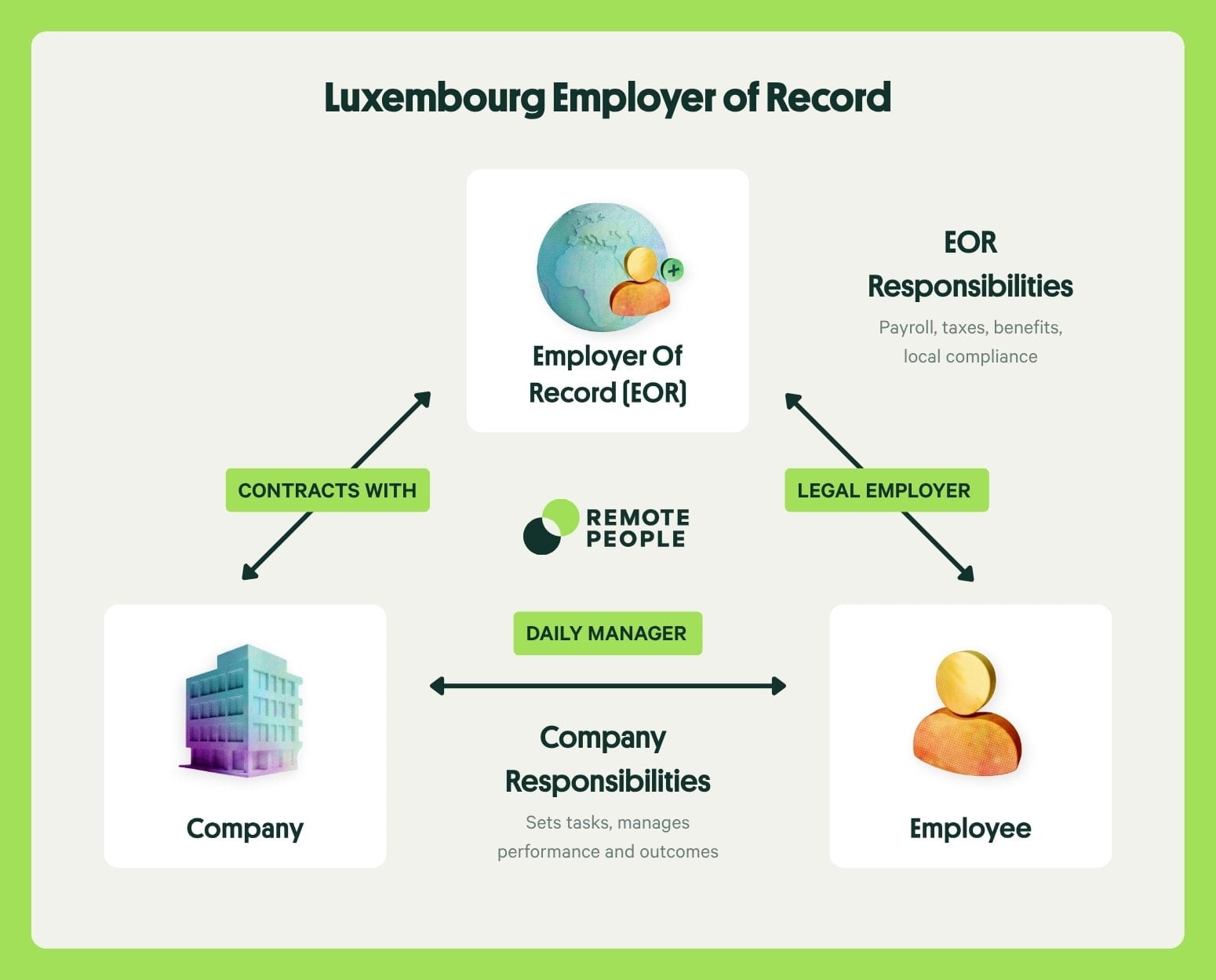
If you’d like to learn more about how Employer of Record (EOR) services work, read our What Is an Employer of Record (EOR)? guide for a complete overview of the model, its benefits, and when to use it.
If you’re comparing providers, our Best Employer of Record (EOR) Providers guide reviews the leading platforms to help you choose the right solution for your business.
Who Uses an EOR in Luxembourg?
Luxembourg’s small size (660,000 residents), high cost of entity setup, and cross-border workforce (nearly half of private-sector employees commute daily from France, Belgium, or Germany) make EOR an efficient entry model for foreign employers. Typical use cases include:
- Testing the Luxembourg market before committing to an entity: Companies evaluating demand, local client relationships, or regulatory fit for operations in Luxembourg can hire one or two employees through an EOR before investing in a full S.à r.l. registration that takes three to six months.
- Hiring a small team without entity overhead: Organizations that need fewer than fifteen employees in Luxembourg often find that EOR fees of $300–$600 per employee per month are significantly cheaper than the €12,500 share capital, €3,000–€5,000 annual accounting fees, and 24.94% corporate tax exposure of a local entity.
- Onboarding quickly: An EOR can issue a signed contract and register the employee with the CCSS within one to two weeks, compared to three to six months for entity setup followed by CCSS registration.
- Hiring third-country nationals needing work permits: An EOR can sponsor the EU Blue Card or standard work permit application with the Immigration Directorate, managing the four- to eight-week processing window and the €80 residence permit fee on the employer’s behalf.
Businesses expanding into Luxembourg usually work with an EOR while they decide whether the long-term headcount justifies the fixed cost of a local entity. Once a team exceeds fifteen to twenty employees, an entity typically becomes more cost-efficient than ongoing EOR fees.
Typical Onboarding Timeline
A compliant hire through an EOR in Luxembourg typically takes seven to ten business days from signed service agreement to first day of work.
- EOR agreement and employee details: 1–2 days to share the candidate’s passport, qualifications, salary, start date, and benefits.
- Employment contract drafting and review: 2–3 days for the EOR to prepare the French/German/English CDI under Article L.121-4 of the Code du Travail, share it with the candidate, and capture signatures.
- CCSS and tax registration: 3–5 days to file the DEC (Déclaration d’Entrée) with the Centre Commun de la Sécurité Sociale, obtain the employee’s matricule number, and request the RTS tax card from the Administration des Contributions Directes.
- Payroll setup and benefits enrolment: 2–3 days to load the employee into payroll, enrol them with the CNS health fund and CNAP pension fund, and finalise any supplementary benefits.
- Employee onboarding and first day: 1 day for IT access, policies, and orientation.
Most EOR providers can onboard an employee in Luxembourg within one to two weeks. Third-country nationals requiring an EU Blue Card or a standard work permit add four to eight weeks to the timeline, since the temporary authorisation to stay must be issued by the Immigration Directorate before the employee can enter Luxembourg.
Hire in Luxembourg
The EU’s financial heart with CNS health insurance, multilingual workforce rules, and some of Europe’s strongest employee protections.
We handle employment contracts, payroll, social contributions, and full Luxembourg compliance.
No local entity needed. Your team can start in days.
Employment Laws and Regulations in Luxembourg
Employment Contracts
Luxembourg’s employment relationship is governed by the Code du Travail (consolidated labour code), enforced by the Inspection du travail et des mines (ITM) and interpreted by the Tribunal du travail. Article L.121-4 of the Code du Travail requires every employment contract to be in writing, signed and dated by both parties, with two original copies, and executed no later than the employee’s first day of work (ITM Luxembourg). Failure to provide a written contract converts the relationship into an indefinite-term contract by default and can expose the employer to a fine.
Contracts may be indefinite (CDI) or fixed-term (CDD), with CDDs limited to 24 months including renewals and restricted to specific grounds such as replacing an absent employee or seasonal work. Luxembourg permits contracts in French, German, or English; language is a matter of agreement between the parties as long as the employee understands it. The contract must state the trial period, working hours, place of work, collective agreement (if any), notice period rules, paid leave entitlement, and the remuneration.
Working Hours and Overtime
The statutory workweek in Luxembourg is 40 hours, with a daily limit of 8 hours, set out in Article L.211-5 of the Code du Travail (Chambre des salariés). Overtime may only be worked under specific conditions (written authorisation from the ITM, an exceptional workload, urgent work, or a collective agreement provision) and cannot push total working time beyond 10 hours in a day or 48 hours in a week. Managerial staff (cadres supérieurs) with genuine authority, high compensation, and autonomy are excluded from working time limits.
Luxembourg law prefers overtime to be compensated by paid time off rather than cash, at a rate of 1.5 hours of rest per hour of overtime, or credited to an employee’s time-savings account (compte épargne-temps). When time off is not possible, the employer must pay the employee’s normal hourly wage plus a 40% supplement. The table below summarises the premium pay framework.
Luxembourg overtime and premium pay rates · Per the Code du Travail |
|||
Hour Type |
Rate Multiplier |
Weekly/Daily Cap |
Notes |
|---|---|---|---|
Weekday overtime (preferred: paid time off) |
1.5x in rest hours |
10 hrs/day, 48 hrs/week |
Default compensation under Article L.211-27 is 1.5 hours of paid rest per overtime hour. |
Weekday overtime (cash) |
140% |
10 hrs/day, 48 hrs/week |
Hourly wage plus 40% supplement when time off is not practicable. Overtime supplement is exempt from income tax and social contributions. |
Sunday work |
170% (of which 70% supplement) |
Permitted only under dispensation |
Workers get a full day of compensatory rest in the following 2 weeks. The 70% Sunday supplement is tax-exempt. |
Public holiday work |
200% (of which 100% supplement) |
Rarely authorised |
Article L.232-5 sets a 100% premium on top of normal pay, plus entitlement to a compensatory day off. |
Night work (22:00–06:00) |
Per collective agreement |
Not statutory |
No statutory night premium; sectoral collective agreements (banking, industry) commonly provide 15–25% supplements. |
Overtime supplements in Luxembourg are exempt from income tax and social security contributions, which makes overtime more attractive to employees than a headline salary increase. Total overtime may not exceed 8 hours per week in most cases, and any hours above the statutory cap require an ITM dispensation.
Minimum Wage
Luxembourg has the highest statutory minimum wage in the European Union. The social minimum wage (salaire social minimum, or SSM) is set by law and automatically adjusted through the échelle mobile des salaires every time the consumer price index rises 2.5%. As of January 1, 2026, after the most recent indexation, the gross monthly SSM for an unskilled adult worker aged 18 or older is €2,703.74, and for a skilled worker (SSM qualifié) it is €3,244.49, which is 20% higher (Guichet.lu).
- Unskilled adult (18+): €2,703.74 gross per month (€15.63 per hour).
- Skilled adult: €3,244.49 gross per month (120% of unskilled rate).
- Workers aged 17: 80% of the unskilled SSM (€2,162.99).
- Workers aged 15–16: 75% of the unskilled SSM (€2,027.81).
A “skilled worker” is defined by the possession of a recognised technical or professional qualification (CATP, DAP, BTS, or equivalent) or by ten years of experience in the profession. Sector-specific collective bargaining agreements in finance, insurance, hospitality, and construction routinely set higher floors than the statutory SSM.
Probation Period
The probationary period (période d’essai) in Luxembourg is governed by Article L.121-5 of the Code du Travail. The standard maximum is six months. It is reduced to three months for employees whose qualification is below the CATP (certificat d’aptitude technique et professionnelle), and can be extended up to twelve months for employees whose gross monthly salary equals or exceeds €4,474.31 (the threshold for 2026). During probation, either party may terminate the contract with shorter notice (four days per month of probation agreed) and without having to state a cause, though dismissal for discriminatory reasons is still prohibited. The probation period must be explicitly agreed in the written contract; absent a clause, there is no trial period.
Leave Entitlements
Luxembourg’s statutory leave framework is set out in Book II, Title III of the Code du Travail. It grants one of the most generous annual leave entitlements in Europe, pays 100% of salary during most short-term leaves, and shifts the cost of longer absences to social security funds so that small employers are not penalised for hiring.
Annual Leave
Every full-time employee is entitled to a minimum of 26 working days of paid annual leave per calendar year under Article L.233-4 of the Code du Travail (Chambre des salariés). Entitlement accrues at a rate of 2.17 days per month from the first day of employment, and employees may take full leave only after three continuous months of service. Unused leave carries over to March 31 of the following year; it is lost thereafter unless the employer prevented the employee from taking it. Leave accrues during probation. Employees with disabilities and war-disabled workers receive six additional days.
Sick Leave
Employees must notify their employer of their incapacity on the first day of absence and submit a medical certificate by the third day. The employer pays 100% of the salary until the end of the calendar month in which the 77th day of cumulative sick leave falls, counted over a rolling 18-month reference period (CNS – Sickness benefit). From day 78 onward, the Caisse Nationale de Santé (CNS) pays the employee directly. Employers are automatically affiliated with the Mutualité des Employeurs, which reimburses 80% of wages paid during the employer-funded period.
Maternity Leave
Maternity leave in Luxembourg is 20 weeks, divided into 8 weeks of prenatal leave before the expected date of delivery and 12 weeks of postnatal leave afterwards. The employee receives a maternity allowance from the CNS equal to her average gross salary over the three months preceding leave, capped at five times the social minimum wage. The job is fully protected during leave and for twelve weeks after the return. Multiple births do not extend the leave but adoption leave of up to 12 weeks is available for children under age 12.
Paternity Leave
Fathers (or the co-parent in a same-sex couple) are entitled to 10 days of fully paid paternity leave under Article L.233-16 of the Code du Travail. The first two days are paid by the employer and the remaining eight days by the State. Leave must be taken within two months of the birth. In the case of multiple births, the father is entitled to 10 days for each child.
Other Statutory Leave
The Code du Travail provides several other paid special leaves that apply to every employee regardless of tenure:
- Marriage leave: 3 days for the employee’s own marriage or civil partnership.
- Bereavement leave: 3 days for the death of a spouse, partner, or first-degree relative; 1 day for a second-degree relative.
- Parental leave: 4 or 6 months of full-time leave (or part-time equivalents) per child under age 6, with a flat-rate allowance paid by the Zukunftskeess (CAE).
- Adoption leave: 12 weeks for adopting a child under 12, paid by the CNS.
- Moving house leave: 2 days per six-year period per employer.
- Family care leave (congé pour raisons familiales): Up to 12 days per year depending on the child’s age to care for a sick child.
- Study leave: Up to 80 days over an entire career for approved courses, shared between the employer and the State.
The leave framework is codified in Articles L.233-1 and following of the Code du Travail, and enforced by the ITM. The summary table below captures the core statutory entitlements and notes the single most important point for employers: annual leave accrues from day one, so even an employee on probation builds up paid vacation.
Luxembourg statutory leave entitlements · Per the Code du Travail |
||
Leave Type |
Duration |
Eligibility & Notes |
|---|---|---|
Annual leave |
26 working days |
Accrues 2.17 days per month from day one. Full use after 3 months’ service. 6 additional days for employees with disabilities. |
Sick leave |
Up to 78 weeks over 104 weeks |
Employer pays 100% until month-end in which the 77th cumulative day falls; CNS pays thereafter. Employer reimbursed 80% by the Mutualité des Employeurs. |
Maternity leave |
20 weeks (8 + 12) |
Paid at 100% of average salary by the CNS (capped at 5x SSM). Full job protection during and 12 weeks after return. |
Paternity leave |
10 working days |
Days 1–2 paid by employer, days 3–10 paid by the State. Must be used within 2 months of the birth. |
Parental leave |
4 or 6 months per child |
For children under 6. Flat-rate allowance paid by the CAE. Either parent can take it; can be split part-time. |
Adoption leave |
12 weeks |
For the adoption of a child under 12. Paid at the same rate as maternity leave by the CNS. |
Marriage leave |
3 days |
Employee’s own marriage or PACS. Paid in full by employer. |
Bereavement leave |
1 or 3 days |
3 days for spouse, partner, or first-degree relative; 1 day for second-degree relative. Employer-paid. |
Family care leave |
5–12 days per year |
To care for a sick child; duration depends on child’s age. Paid by the CNS. |
Statutory Employee Benefits
Beyond leave and social security, Luxembourg employers must provide or fund several mandatory benefits and meet sector-specific collective agreement obligations. Contribution rates and ceilings are detailed in the payroll tables in section 4.
- Health insurance (CNS): Universal public coverage is mandatory through the Caisse Nationale de Santé, funded by joint employer and employee contributions. In-kind benefits (doctor, hospital, dental) are covered at 80–100% depending on service; private top-up insurance is common but not required.
- Pension (CNAP): The first-pillar pension is administered by the Caisse Nationale d’Assurance Pension. From 2026 the total contribution rate is 25.5% of gross pay, split 8.5% employer / 8.5% employee / 8.5% State. Supplementary occupational pension schemes under Article 110bis are optional but popular in finance.
- Accident insurance (AAA): Employer-only contribution of 0.65% covers workplace and commuting accidents, administered by the Association d’assurance accident.
- Dependency insurance: Employee-only contribution of 1.4% funds long-term care under the Caisse Nationale de l’Assurance Dépendance.
- Mutualité des Employeurs: Employers are auto-affiliated to this mutual fund, which reimburses wages during the employer-paid 77-day sick leave period. The contribution rate is risk-banded from roughly 0.60% to 2.96% depending on the employer’s absence class.
- Meal vouchers (chèques-repas): Not mandatory, but common in Luxembourg. When provided at up to €15 per working day, the employer-funded portion is tax-exempt for the employee.
Collective bargaining agreements may layer additional obligations on top of the statutory floor, particularly in banking (ABBL CBA), insurance (ACA CBA), construction, and public transport.
Recent Regulatory Updates (2026)
The most significant 2026 change is the increase of the first-pillar pension contribution rate. A December 2025 law raised total pension contributions from 24% to 25.5%, with each of the three payers (employer, employee, State) moving from 8% to 8.5%. This increase will be phased in through 2032 as part of the government’s pension sustainability reform (Ministry of Health and Social Security).
The accident insurance rate was reduced from 0.70% to 0.65% effective January 1, 2026. Income tax brackets were not indexed in the 2026 budget law, so the brackets set in the 2025 tax reform remain in force. A draft Bill n°8676, published on 6 January 2026, proposes to replace the three-class tax system (1, 1a, 2) with a single tariff (Tarif U) from tax year 2028; the current class-based system continues to apply for 2026 and 2027. The EU Blue Card salary threshold for new applications in 2026 is €63,408 gross per year.
Work Permits and Visas in Luxembourg
Work Permit Requirements
Who Needs a Work Permit
EU, EEA, and Swiss nationals do not need a work permit to take up employment in Luxembourg. They must, however, make a declaration of arrival at their commune within eight days and apply for a registration certificate within three months if they intend to stay more than 90 days. Citizens of all other countries (third-country nationals) must hold a residence permit with authorisation to work before starting employment. Certain professions (lawyers, doctors, accountants) also require recognition of qualifications from the relevant professional order.
Eligibility and Required Documents
The core documents needed for a Luxembourg work permit application are: a valid passport with at least six months’ validity, a signed Luxembourg employment contract, the employer’s extract from the Luxembourg Business Register, a copy of the job vacancy notice filed with ADEM (the public employment service), recognised diplomas or proof of professional experience, a recent criminal record certificate, and a medical certificate after arrival. Dependents must provide additional civil-status documents. The job must first be posted with ADEM for at least three weeks so that EU applicants have priority access (the labour market test), unless the role is on the list of shortage occupations or qualifies for the EU Blue Card.
Processing Time and Validity
Standard work permit processing by the Immigration Directorate takes two to four months from the date a complete file is received. The EU Blue Card has a faster track of up to three months, and priority cases can be processed in four to eight weeks. The initial residence permit is typically valid for one to three years depending on the category; the EU Blue Card is issued for up to four years. Fees are €80 for the residence permit and €50 for the type D visa where required.
Renewal Process
Renewals must be filed at least two months before the permit expires. The employee can continue working during the renewal process as long as the application is filed on time. After five years of legal residence, third-country nationals become eligible for a long-term resident (EU) status, which removes the need to sponsor subsequent employment.
Common Visa Types for Foreign Workers
Work permits for Luxembourg are issued by the General Department of Immigration within the Ministry of Foreign and European Affairs. An EOR registered in Luxembourg can sponsor most of the categories listed below. The table shows the primary routes available in 2026 and whether each leads toward long-term residence.
Luxembourg work visa types for foreign workers · 2026 |
||||
Visa Type |
Duration |
Best For |
Leads to APT? |
Processing |
|---|---|---|---|---|
EU Blue Card |
Up to 4 years, renewable |
Highly qualified third-country nationals earning ≥ €63,408/yr (2026) |
Yes |
Up to 3 months; priority cases 4–8 weeks |
Salaried worker permit |
1–3 years, renewable |
Third-country nationals hired for any role not on the shortage list |
Yes (after 5 yrs) |
2–4 months (includes ADEM labour market test) |
Intra-company transfer (ICT) |
Up to 3 years (managers/specialists), 1 year (trainees) |
Employees of a foreign parent company transferred to a Luxembourg branch |
No (capped period) |
1–3 months |
Independent worker permit |
Up to 3 years |
Self-employed founders and freelancers with viable business plans |
Yes |
2–4 months |
Investor visa |
3 years, renewable |
Third-country nationals investing ≥ €500,000 in a local company or ≥ €3 million in an approved investment vehicle |
Yes |
3–6 months |
Researcher permit |
Up to 5 years |
Researchers hosted by an approved research organisation |
Yes |
1–3 months |
Luxembourg does not issue a digital nomad visa. The following statuses are available but do not permit employment: the Schengen short-stay visa (up to 90 days in 180, tourism or business meetings only); the student residence permit (part-time work of up to 15 hours per week once enrolled); and the au pair permit (limited to childcare-host family arrangements).
How an EOR Handles Work Permits
A Luxembourg-registered EOR can act as the sponsoring employer for the EU Blue Card, the salaried worker permit, the ICT permit, and the researcher permit. The EOR files the pre-hire temporary authorisation to stay with the Immigration Directorate, posts the job with ADEM when a labour market test is required, and prepares the employment contract that accompanies the application. Because the EOR is already registered with the CCSS and holds a Luxembourg trade licence, it bypasses the need to open a local entity and register it separately.
The employee provides the personal documents (passport, diplomas, criminal record, medical certificate) and attends the biometric appointment. Sponsoring a third-country national extends the standard one- to two-week EOR onboarding by roughly four to eight weeks for a Blue Card or by two to four months for a standard permit. In practice most EOR hires in Luxembourg are EU nationals or cross-border commuters from France, Belgium, or Germany, which avoids the permit process entirely.
Payroll, Taxes, and Social Security in Luxembourg
Employer Contributions
Luxembourg employers withhold income tax at source monthly and pay joint social security contributions to the CCSS by the 10th of the following month. The employer-side contributions in 2026 cover pension, health care, accident insurance, the mutualité des employeurs, and a small work-life balance tax. The table below shows each line item, the rate, and how it is capped.
Luxembourg employer social security contributions · 2026 rates |
||
Contribution |
Rate |
Notes |
|---|---|---|
Pension (CNAP) |
8.50% |
Increased from 8.00% in 2026. Capped at 5x the SSM (€13,518.70/month). |
Health insurance – in-kind (CNS) |
2.80% |
Covers medical care, hospital, and maternity in-kind benefits. Capped at 5x SSM. |
Health insurance – cash benefits (CNS) |
0.25% |
Funds short-term sick pay and maternity cash benefits. Capped at 5x SSM. |
Accident insurance (AAA) |
0.65% |
Reduced from 0.70% in 2026. Covers workplace and commuting accidents. Capped at 5x SSM. |
Employers’ Mutual Insurance |
0.60%–2.96% |
Risk-banded based on absence rate (4 classes). Reimburses 80% of sick-pay up to day 77. |
Health-at-work contribution |
0.14% |
Funds occupational health services (STM). |
Employer total (typical) |
≈ 13.04% |
Assuming a mid-band mutualité rate of ~0.70%. Applied to gross salary up to €13,518.70/month. |
Employee Contributions
Employee contributions are withheld at source by the employer and remitted to the CCSS together with the employer’s share. The employee’s total rate in 2026 is approximately 12.20%, plus income tax on top. Dependency insurance is unique in that it is paid only by the employee, on a base reduced by 25% of the SSM.
Luxembourg employee payroll deductions · 2026 monthly withholdings |
||
Deduction |
Rate |
Notes |
|---|---|---|
Pension (CNAP) |
8.50% |
Matched by employer. Capped at €13,518.70/month gross. |
Health insurance – in-kind (CNS) |
2.80% |
Capped at 5x SSM. |
Health insurance – cash benefits (CNS) |
0.25% |
Capped at 5x SSM. |
Dependency insurance (CNAD) |
1.40% |
Employee-only. Base = gross salary minus 25% of SSM abatement. Uncapped. |
Employee total |
12.95% |
Social contributions only. Income tax (0–42%) plus employment fund surcharge (7–9% of tax) are additional. |
Income Tax
Luxembourg applies a 23-bracket progressive personal income tax, with rates in 2026 ranging from 0% to 42% for residents in Tax Class 1 (single taxpayer). Tax Class 1a applies to single parents and widowed taxpayers, while Tax Class 2 applies to jointly assessed married couples. On top of the income tax, every taxpayer pays a 7% employment fund contribution (9% on adjusted taxable income above €150,000 in Class 1 or 1a; above €300,000 in Class 2). The table below shows the simplified top-of-bracket structure; the ACD publishes the full annual tax scale.
Luxembourg income tax brackets · 2026 (Tax Class 1) |
|
Bracket |
Tax Calculation |
|---|---|
Up to €13,230 |
0% |
€13,230 – €15,435 |
8% |
€15,435 – €17,640 |
9% |
€17,640 – €19,845 |
10% |
€19,845 – €22,050 |
11% |
€22,050 – €24,255 |
12% |
€24,255 – €26,460 |
14% |
€26,460 – €28,665 |
16% |
€28,665 – €30,870 |
18% |
€30,870 – €33,075 |
20% |
€33,075 – €35,280 |
22% |
€35,280 – €37,485 |
24% |
€37,485 – €39,690 |
26% |
€39,690 – €41,895 |
28% |
€41,895 – €44,100 |
30% |
€44,100 – €46,305 |
32% |
€46,305 – €48,510 |
34% |
€48,510 – €50,715 |
36% |
€50,715 – €110,403 |
38% |
€110,403 – €165,600 |
39% |
€165,600 – €234,870 |
40% |
Above €234,870 |
42% |
Payroll Cycle
Payroll in Luxembourg is monthly and paid in euros by bank transfer on or before the last working day of the month. Cash payment is not prohibited but is rare and requires the employee’s written agreement. Employers must issue a detailed payslip (fiche de salaire) showing gross, contributions, tax, and net, and must retain payroll records for ten years. Social security contributions are due to the CCSS by the 10th of the following month. Monthly withheld income tax (retenue d’impôt) is remitted to the ACD by the 10th of the following month. The annual payroll reconciliation (décompte annuel) is due by the end of February of the year following the tax year.
13th Month Salary and Bonus Pay
A 13th month salary is not mandatory under the Code du Travail. It is, however, common practice in banking, insurance, and white-collar roles, often contractually agreed and paid in December, with pro-rata entitlement for part-year joiners and leavers. Some sector-level collective agreements (for example the banking ABBL CBA and the insurance ACA CBA) require a 13th month payment. When paid, it is fully taxable and subject to social security contributions like any other salary. A 14th month is occasionally seen in finance roles but is always contractual rather than statutory.
Cost of Hiring Through an EOR in Luxembourg
EOR Service Fees
EOR services in Luxembourg typically cost $300–$600 per employee per month as a flat fee, charged on top of the employee’s gross salary and employer social charges. The fee includes the employment contract, monthly payroll, CCSS registration and reporting, income tax withholding, leave tracking, statutory benefits enrolment, and HR support. Some providers charge a small one-time onboarding fee (often $100–$300) to cover the initial setup. Work permit sponsorship, if required, is usually billed separately at $500–$1,500 per application plus government fees.
Total Employment Cost Breakdown
The table below shows a typical employer cost for a Luxembourg employee on a $100,000 annual gross salary, paid monthly. All figures are in USD using an indicative rate of €1 = $1.07 for 2026. Employer social contributions apply at the standard mid-band rate including a ~0.70% Mutualité des Employeurs contribution. Actual costs vary with salary level, the specific mutualité class, and the presence of a supplementary pension plan.
Luxembourg employer cost example · USD 100,000 gross · 2026 |
||
Employer Cost |
Amount (USD) |
% of Gross |
|---|---|---|
Gross annual salary |
$100,000 |
100.00% |
Pension (CNAP) – 8.50% |
$8,500 |
8.50% |
Health insurance in-kind (CNS) – 2.80% |
$2,800 |
2.80% |
Health insurance cash (CNS) – 0.25% |
$250 |
0.25% |
Accident insurance (AAA) – 0.65% |
$650 |
0.65% |
Employers’ Mutual – 0.70% |
$700 |
0.70% |
Health-at-work – 0.14% |
$140 |
0.14% |
EOR fee ($450/month × 12, est.) |
$5,400 |
5.40% |
Total employer cost |
$118,440 |
118.44% |
Figures converted at €1 ≈ $1.07, April 2026. Social contributions apply up to the ceiling of five times the SSM (€13,518.70/month, ~$173,640/year); above the cap, the effective employer rate drops.
Ready to hire in Luxembourg? Get started with RemotePeople. We handle employment contracts, payroll, tax withholding, and full Luxembourg compliance, with no local entity needed.
Benefits of Using an EOR in Luxembourg
Luxembourg’s combination of high salaries, complex social security rules, and small talent pool makes EOR an attractive alternative to setting up an S.à r.l. Companies that hire through an EOR gain speed and compliance confidence without the fixed costs of a local entity.
- Speed to market: An EOR can have an employee productive in Luxembourg within one to two weeks, while an S.à r.l. incorporation, bank account opening, and CCSS employer registration typically take three to six months.
- Compliance assurance: The EOR stays current with CCSS rate changes (the 2026 pension increase, the accident rate cut), sector collective agreements, and Code du Travail amendments, shielding the client from fines by the ITM and the CCSS.
- Cost efficiency versus a local entity: At 1–15 employees the $300–$600 monthly EOR fee per head is typically lower than the €5,000–€15,000 per year in legal, accounting, and domiciliation fees for an S.à r.l., plus the opportunity cost of the €12,500 share capital.
- Local expertise: Luxembourg payroll is complex (tax class selection, RTS card, cross-border worker rules for French/Belgian/German commuters, multilingual contracts). An EOR provides in-country HR specialists who speak French, German, and English and handle these nuances.
- Flexibility to scale up or down: Headcount can grow or shrink without entity-level implications. Closing an S.à r.l. requires a liquidation process that can take 9–18 months and has tax consequences; offboarding an EOR employee follows standard notice and severance rules only.
- Risk mitigation: The EOR is the legal employer, so the client avoids permanent establishment exposure in Luxembourg for corporate tax purposes, provided they do not conduct core business activities locally that would create PE on their own.
- Employee experience: The employee receives a Luxembourg-law contract, full access to the CNS health system, CNAP pension vesting, and 26 days of paid leave from day one, which matches or exceeds the package offered by most local employers.
For any business weighing the cost of an entity against speed and simplicity, an EOR is a low-risk first move. RemotePeople can have your Luxembourg hire onboarded within ten business days.
Termination and Offboarding in Luxembourg
Notice Periods
Luxembourg requires advance written notice for almost all dismissals, and the notice period is calculated strictly on the employee’s length of service. Notice runs from the 15th of the month if notification is given before the 15th, or from the 1st of the following month if given later. Employees may be released from work during notice (paid in full) or required to work it. Article L.124-1 of the Code du Travail sets the statutory floor, and it cannot be reduced by contract, only lengthened. Employer and employee notice periods are the same length, except during probation where notice is four days per month of probation agreed.
Luxembourg statutory notice periods by position level · Per the Code du Travail |
|||
Position Level / Tenure |
Notice Period |
During Probation |
Notes |
|---|---|---|---|
Less than 5 years of service |
2 months |
4 days per month of probation agreed |
Applies to both employer- and employee-initiated dismissal. |
5 to 10 years of service |
4 months |
n/a (probation ended) |
Same rule for resignation and dismissal. |
10 or more years of service |
6 months |
n/a (probation ended) |
Longest statutory notice in Luxembourg. |
Collective dismissal (redundancy) |
As above + social plan |
Not applicable |
Employers with more than 15 employees dismissing 7+ people in 30 days must negotiate a social plan with staff representatives. |
Serious misconduct (faute grave) |
None – summary dismissal |
None |
Must notify within 1 month of the facts; employee can contest before the Tribunal du travail. |
Dismissal for serious misconduct (faute grave) permits summary termination with no notice and no severance, but the employer must notify within one month of discovering the fault and must be prepared to defend the qualification in the Tribunal du travail. Mutual agreement (résiliation conventionnelle) and fixed-term contract expiry follow their own rules and do not trigger notice obligations.
Severance Pay
Severance pay (indemnité de départ) is owed only when an employer dismisses an indefinite-contract employee with five or more years of service, and only for dismissals with notice (not for serious misconduct or mutual separation). The entitlement is set by Article L.124-7 of the Code du Travail and increases in steps with tenure. Severance is calculated on the employee’s actual gross monthly pay over the 12 months preceding the termination, including bonuses and the value of benefits in kind.
Luxembourg severance pay schedule by years of service · Per the Code du Travail |
|||
Years of Service |
Severance Amount |
Base Salary |
Notes |
|---|---|---|---|
Under 5 years |
None |
n/a |
Below the statutory threshold. |
5 to 10 years |
1 month gross |
Average of 12 months preceding dismissal |
Companies with < 20 employees may extend notice by the same period instead of paying severance. |
10 to 15 years |
2 months gross |
Average of 12 months preceding dismissal |
Same small-company substitution option. |
15 to 20 years |
3 months gross |
Average of 12 months preceding dismissal |
Same small-company substitution option. |
20 to 25 years |
6 months gross |
Average of 12 months preceding dismissal |
Substitution by notice extension no longer available. |
25 to 30 years |
9 months gross |
Average of 12 months preceding dismissal |
Mandatory cash payment. |
30 or more years |
12 months gross |
Average of 12 months preceding dismissal |
Statutory maximum. |
Calculation Method
The base for severance is the actual gross monthly remuneration paid over the 12 months preceding the dismissal, including regular bonuses, commissions, 13th month where contractually owed, and the cash value of benefits in kind such as a company car. One-off discretionary payments are excluded. Severance is paid in cash on the date the contract ends and is exempt from social security contributions. It is also partially exempt from income tax, up to twelve times the SSM at the time of payment.
Caps and Exceptions
The statutory maximum is twelve months of salary, reached at 30 years of service. Employees dismissed for serious misconduct receive no severance, though this qualification can be challenged before the Tribunal du travail; unfair dismissal findings frequently lead to additional damages beyond statutory severance. Companies with fewer than 20 employees may replace severance with an equivalent extension of the notice period for tenure under 20 years, but this option disappears at 20 years of service. Collective bargaining agreements may provide higher severance than the statutory minimum, and any such CBA takes precedence.
Grounds for Termination
Luxembourg does not recognise employment at will. A dismissal for personal reasons must be based on real and serious grounds (motifs réels et sérieux) related to the employee’s conduct, skill, or the company’s economic situation. Employers with 150 or more staff must hold a pre-dismissal interview (entretien préalable) at least two business days before notifying the dismissal. All dismissal letters must be sent by registered post. The employee can request a written statement of the grounds within one month, and can challenge the dismissal before the Tribunal du travail within three months. Protected categories include pregnant employees, employees on parental leave, staff representatives, and and employees on long-term sick leave, and dismissal of these workers is subject to stricter rules or outright prohibition during the protected period.
EOR vs. Other Hiring Models in Luxembourg
EOR vs. Setting Up a Local Entity
Setting up an S.à r.l. (société à responsabilité limitée) is the most common local entity route. It requires a €12,500 minimum share capital (€12,000 paid up at incorporation), notarial deed, registration with the Luxembourg Business Register, and CCSS employer registration. Legal and administrative costs typically run €5,000–€10,000 at setup and €5,000–€15,000 per year to maintain, before any payroll fees. An EOR avoids all of this for teams of up to roughly fifteen employees.
Luxembourg EOR vs local entity comparison · Setup time, cost, risk and best-fit |
||
Comparison |
Employer of Record |
Own Entity (S.à r.l.) |
|---|---|---|
Setup time |
1–2 weeks |
3–6 months |
Upfront cost |
$0 |
€12,500 share capital + €5,000–€10,000 notary and setup fees |
Ongoing cost |
$300–$600/employee/month |
€5,000–€15,000/year accounting, domiciliation, and audit |
Local partner required |
No (EOR is the local entity) |
No (but a local managing director is typical) |
Social insurance registration |
Handled by EOR |
You manage it with the CCSS |
Payroll & tax filing |
Handled by EOR |
You manage it (or outsource) |
Best for team size |
1–15 employees |
15+ employees |
Scale down / exit |
Easy – no entity to unwind |
Costly – liquidation takes 9–18 months |
Government contracts |
Not eligible |
Eligible (requires local entity) |
For a company hiring one to five employees in Luxembourg, EOR is clearly cheaper in year one. Break-even typically arrives around fifteen to twenty employees, when annual EOR fees begin to exceed annual entity maintenance costs. Companies that plan to bid on Luxembourg government contracts, issue invoices from a Luxembourg address, or apply for sector licences (for example a financial services agrément from the CSSF) must set up their own entity because an EOR cannot pursue those activities on their behalf.
EOR vs. Hiring Independent Contractors
Contractors in Luxembourg work under a service agreement (contrat de prestation de services), register themselves as indépendants with the CCSS, and pay their own social security and income tax. Engaging contractors is faster and lighter than employment, but the line between independent and subordinate work is narrow, and misclassification is a material risk.
Luxembourg EOR vs independent contractors · Compliance, cost, and risk |
||
Comparison |
EOR (Full-Time Employee) |
Independent Contractor |
|---|---|---|
Legal relationship |
Employee of the EOR |
Self-employed, no employment relationship |
Compliance risk |
Low – EOR ensures Code du Travail compliance |
High – misclassification risk if relationship resembles employment |
Payroll & tax |
EOR handles withholding, contributions, filings |
Contractor invoices you; they handle their own CCSS and ACD filings |
Benefits & leave |
26 days annual leave, CNS health, CNAP pension, paid sick |
No entitlement to employee benefits |
IP protection |
Stronger – employment contract assigns IP by default |
Weaker – requires explicit IP assignment clause |
Termination |
Subject to 2–6 month notice and potential severance |
Contract can be ended per agreement terms |
Best for |
Long-term, core team roles |
Short-term projects, specialised tasks |
Cost structure |
Salary + employer contributions + EOR fee |
Contractor fee (typically higher gross, lower total cost) |
Luxembourg’s Tribunal du travail applies a substance-over-form test to determine whether a contractor is in fact an employee, examining subordination, integration into the client’s organisation, exclusivity, fixed hours, and use of the client’s tools. A finding of misclassification triggers back payment of up to three years of social contributions, income tax, paid leave, and potentially severance, plus fines from the CCSS and the ITM. Using a contractor for a role that looks and operates like employment is only appropriate in clearly defined project engagements with a genuine multi-client practice. RemotePeople can also handle compliant contractor engagements through our contractor solution, so the choice between EOR and contractor can be made on the economics rather than the operations.
EOR vs. PEO (Professional Employer Organization)
Luxembourg does not have a distinct regulatory framework for PEO, and the term is rarely used in the local market. An EOR is the only model that allows a foreign company to hire without a Luxembourg entity. What is sometimes called a PEO in Luxembourg is in fact an HR outsourcing provider that works for companies that already have their own entity.
Luxembourg EOR vs PEO comparison · Legal employer, liability, and setup |
||
Comparison |
Employer of Record (EOR) |
PEO (HR outsourcing) |
|---|---|---|
Legal employer |
EOR is the legal employer |
You remain the legal employer |
Local entity required |
No – the EOR is the local entity |
Yes – you must have your own S.à r.l. or S.A. |
Best for |
Companies without a Luxembourg entity |
Companies that already have a local entity and want to outsource HR operations |
Compliance liability |
EOR assumes Code du Travail and CCSS liability |
Client retains full liability; provider advises |
Setup time |
1–2 weeks |
Depends on your entity setup (3–6 months if starting from scratch) |
Control over HR policies |
EOR manages within the Code du Travail framework |
More direct control; PEO advises |
Typical use case |
Market entry, small remote teams, testing new markets |
Established Luxembourg operations needing payroll or HR outsourcing |
Source: ITM – Luxembourg Labour Code and CCSS – Declare wages |
||
Because there is no co-employment model in Luxembourg, companies that do not want to set up a local entity rely on EOR. Providers advertising “PEO services in Luxembourg” usually mean one of two things: payroll outsourcing for your existing entity, or a white-labelled EOR arrangement. For market entry without a registered company, EOR is the correct choice.
Public Holidays in Luxembourg
Luxembourg observes 11 national public holidays. Employees who are required to work on a public holiday receive their regular pay plus a 100% supplement and a compensatory day off. If a public holiday falls on a Sunday or another non-working day, the employee is entitled to a replacement day off within three months. The table below lists the statutory holidays for 2026.
Luxembourg public holidays · 2026 calendar year |
||
Date |
Holiday |
Type |
|---|---|---|
Thu, Jan 1 |
New Year’s Day |
National |
Mon, Apr 6 |
Easter Monday |
Christian / movable |
Fri, May 1 |
Labour Day |
National |
Sat, May 9 |
Europe Day |
National (replacement day owed) |
Thu, May 14 |
Ascension Day |
Christian / movable |
Mon, May 25 |
Whit Monday |
Christian / movable |
Tue, Jun 23 |
National Day (Grand Duke’s Official Birthday) |
National |
Sat, Aug 15 |
Assumption of Mary |
Christian (replacement day owed) |
Sun, Nov 1 |
All Saints’ Day |
Christian (replacement day owed) |
Fri, Dec 25 |
Christmas Day |
Christian |
Sat, Dec 26 |
Saint Stephen’s Day |
Christian (replacement day owed) |
Four of the 2026 public holidays (Europe Day, Assumption, All Saints, Saint Stephen’s) fall on a Saturday or Sunday, so Luxembourg employees are entitled to a replacement day off within three months. Payroll systems must track these in-lieu days correctly or the employer risks ITM fines.
How to Get Started with an EOR in Luxembourg
A typical EOR engagement in Luxembourg follows a clear five-step path from first contact to employee day one.
- First, scope the hire: Share the role, target salary, benefits package, start date, and whether the candidate is an EU, EEA, Swiss, or third-country national. RemotePeople will confirm that the EOR can sponsor the work permit (where required) and quote the total monthly cost.
- Second, sign the EOR service agreement: This is a simple master services agreement between your company and the EOR covering fees, deliverables, data protection (GDPR compliance is mandatory), and termination terms.
- Third, draft and sign the employment contract: The EOR drafts a Luxembourg-law CDI in the agreed language, incorporating the trial period, salary, hours, place of work, and any sector collective agreement references. The candidate signs, then the EOR counter-signs as the legal employer.
- Fourth, register with the CCSS and the ACD: The EOR files the DEC with the Centre Commun de la Sécurité Sociale within eight days, requests the RTS tax card from the Administration des Contributions Directes, and enrols the employee with the CNS, CNAP, and Mutualité des Employeurs.
- Fifth, start day one: Payroll runs on schedule each month, the EOR tracks leave and sick days, and you manage the employee’s day-to-day work. RemotePeople provides English-speaking account managers and local HR support for the entire engagement.
Ready to hire in Luxembourg? Contact RemotePeople to onboard your first Luxembourg employee in under two weeks, with no entity needed.
Where companies hiring in Luxembourg expand next
Teams hiring in Luxembourg typically expand across Western Europe, where EU labor directives and adjacent markets enable rapid regional scale. Common expansion paths include Austria (EU-wide worker mobility and portable social security) and a team in France (shared EU compliance frameworks). Teams scaling further usually add operations in the Netherlands for EU-level labor law alignment, with Belgium extending coverage through adjacent EU market with harmonized labor directives.
Frequently Asked Questions
EOR services in Luxembourg typically cost between $300 and $600 per employee per month as a flat fee, charged on top of gross salary and employer social contributions. Employer social charges in Luxembourg are approximately 13% of gross pay, capped at five times the social minimum wage (CCSS). Work permit sponsorship for third-country nationals is usually billed separately.
An EOR can onboard an EU, EEA, or Swiss national in Luxembourg within one to two weeks. Third-country nationals requiring an EU Blue Card add four to eight weeks for permit processing, and a standard salaried worker permit can take two to four months. By comparison, setting up your own S.à r.l. takes three to six months before you can make your first hire.
The social minimum wage (SSM) for an unskilled adult worker is €2,703.74 gross per month as of January 1, 2026, and €3,244.49 for a skilled worker with a recognised qualification. The hourly rate is €15.63 for unskilled workers. Luxembourg has the highest statutory minimum wage in the EU, and it is automatically indexed to inflation (Guichet.lu).
Luxembourg applies a 23-bracket progressive income tax. In Tax Class 1 (single taxpayer), the first €13,230 of annual income is tax-free, and the top rate of 42% applies above €234,870. A 7% employment fund surcharge is added on top of the tax due, rising to 9% for taxable income above €150,000 in Classes 1 and 1a (PwC Worldwide Tax Summaries).
No. The Code du Travail does not require a 13th month salary. It is, however, common practice in banking, insurance, and many white-collar roles, often required by sector collective bargaining agreements such as the banking ABBL CBA. When paid it is fully taxable and subject to social security like any other salary (Chambre des salariés).
Statutory notice periods are two months for less than five years of service, four months for five to ten years, and six months for ten or more years. During probation, notice is four days per month of probation agreed. Notice runs from the 15th of the month or the 1st of the following month depending on the date of notification (Guichet.lu).
Yes. Luxembourg issues the EU Blue Card for highly qualified third-country nationals. The 2026 salary threshold is €63,408 gross per year, and the card is valid for up to four years. Processing takes up to three months, with priority cases handled in four to eight weeks. The initial residence permit fee is €80 (European Commission – EU Blue Card Luxembourg).
IP created by an employee in the course of their employment is assigned to the client company (you), not the EOR, provided the service agreement and employment contract include the standard IP assignment clauses. RemotePeople's contracts ensure IP flows directly from the employee to your company under Luxembourg law, with no residual rights retained by the EOR.
Yes. RemotePeople offers both employer of record services and a compliant contractor management solution for Luxembourg. Because misclassification risk is high (the Tribunal du travail applies a strict subordination test), we recommend employee engagement through the EOR for any role with regular hours, exclusivity, or integration into your team.
No. With an employer of record you can hire employees in Luxembourg without setting up a local S.à r.l. or S.A. The EOR is already registered with the Centre Commun de la Sécurité Sociale (CCSS) and holds a Luxembourg trade licence, so it signs the employment contract as the legal employer on your behalf. Setting up your own entity takes three to six months and requires a minimum of €12,000–€12,500 in share capital, while an EOR hire can be operational in one to two weeks (Guichet.lu – S.à r.l. setup).
Employer social security contributions in Luxembourg are approximately 13% of gross salary in 2026. This breaks down to 8.50% pension (CNAP, up from 8.00% in 2025), 2.80% health insurance in-kind (CNS), 0.25% health cash benefits, 0.65% accident insurance (AAA, down from 0.70%), 0.14% health-at-work, plus a risk-banded Mutualité des Employeurs contribution typically around 0.70%. Contributions are capped at five times the social minimum wage (€13,518.70 per month) and remitted to the CCSS by the 10th of the following month (CCSS – Social parameters).
Employer of Record in
Employer of Record in
Employer of Record in
Employer of Record in
Employer of Record in
Employer of Record in
Employer of Record in
Employer of Record in