
 Recruit
Employer of Record in Slovakia
-
 Drew Donnelly
- Published
- September 22, 2026
RemotePeople’s employer of record in Slovakia lets you hire full-time employees in 1–2 weeks for a service fee of $300–$600 per employee per month, with no local entity required. We handle the full 36.2% employer social and health contribution, 14.4% employee deductions, and 2026 Slovak Labour Code compliance.
Hire in Slovakia — book a free 30-minute demo
Tell us what you need. You'll get a tailored, transparent proposal within 24 hours, plus a free call to walk through it.
Tell us about your company
So we can match you with a specialist who knows your market — and unlock volume pricing tiers.
* All fields are required.
Where and when are you hiring?
Tell us the geography and timing and we'll quote each country line by line, with onboarding timelines.
* All fields are required.
Help us beat your current setup
We'll benchmark your current deal and send a line-by-line proposal in 24 hours — showing exactly where we cut cost, time, or risk. After you submit, you can book a call to walk through it together.
* All fields are required.
Thanks! Your proposal is on its way.
Expect a tailored, line-by-line proposal in your inbox within 24 hours. In the meantime…
Want to walk through it together?
Book a free 30-minute call with one of our specialists. We'll explain every line, answer your questions, and tailor the proposal further if you need.
No obligation. Pick a time that works for you.








- Hire in Slovakia — book a free 30-minute demo
- Tell us about your company
- Where and when are you hiring?
- Help us beat your current setup
- Thanks! Your proposal is on its way.
- How an Employer of Record Works in Slovakia
- Employment Laws and Regulations in Slovakia
- Work Permits and Visas in Slovakia
- Payroll, Taxes, and Social Security in Slovakia
- Cost of Hiring Through an EOR in Slovakia
- Benefits of Using an EOR in Slovakia
- Termination and Offboarding in Slovakia
- EOR vs. Other Hiring Models in Slovakia
- Public Holidays in Slovakia
- How to Get Started with an EOR in Slovakia
- Where companies hiring in Slovakia expand next
- Frequently Asked Questions
- Related EOR Destinations

Start hiring in Slovakia
Let RemotePeople handle payroll, compliance, and HR admin worldwide so you can focus on building your team.
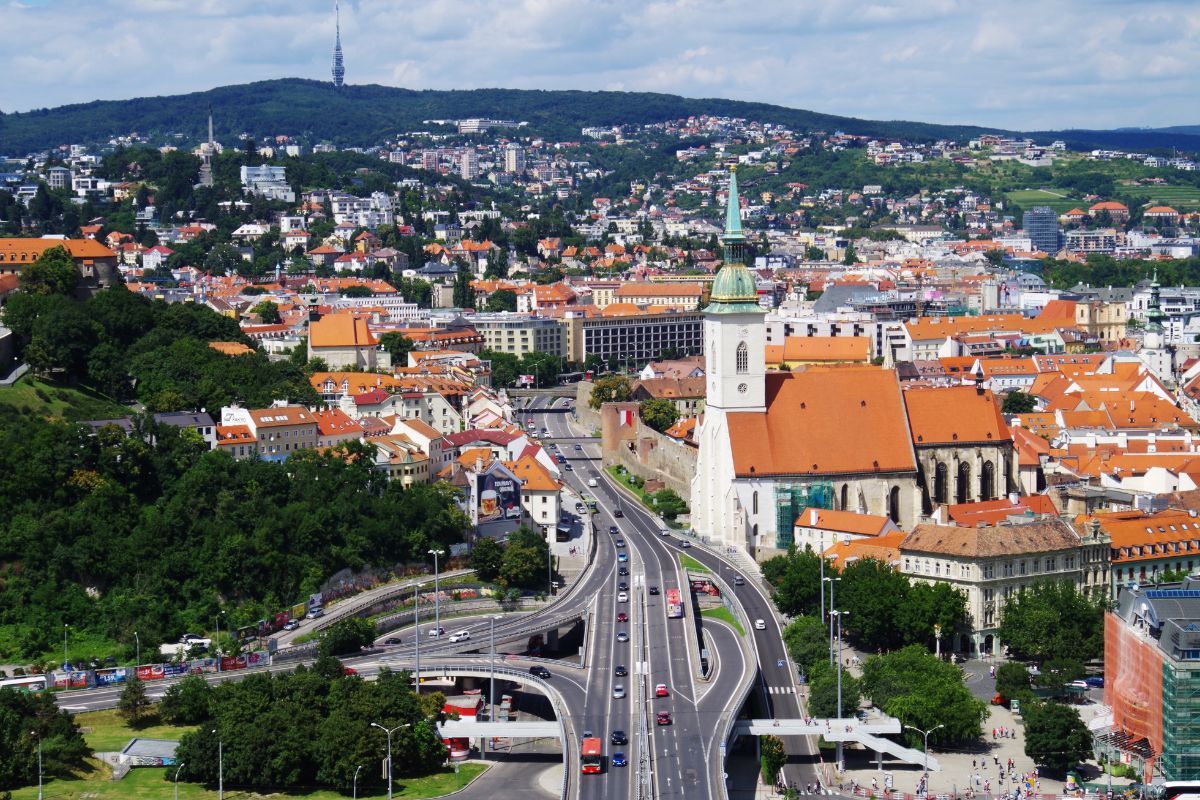
Slovakia sits at the crossroads of Central Europe and pairs a euro-denominated payroll system with one of the region’s deepest talent pools in automotive engineering, shared services, IT, and advanced manufacturing. For 2026 the country moved to a new progressive income tax scale of 19%, 25%, 30% and 35%, raised the employee health insurance contribution from 4% to 5%, extended employer-paid sick leave from 10 to 14 days, and lifted the statutory minimum wage to €915 per month. Those changes sit on top of a detailed Labour Code, monthly social insurance filings with Sociálna poisťovňa, and residency-permit rules for non-EU hires that add weeks to onboarding.
An employer of record in Slovakia absorbs those frictions. RemotePeople acts as the legal employer on paper, runs local payroll in euro, withholds tax at source, and keeps the contract aligned with the Slovak Labour Code while the client directs the day-to-day work. The result is a live hire in one to two weeks instead of the three to six months a greenfield s.r.o. typically needs to incorporate.
How an Employer of Record Works in Slovakia
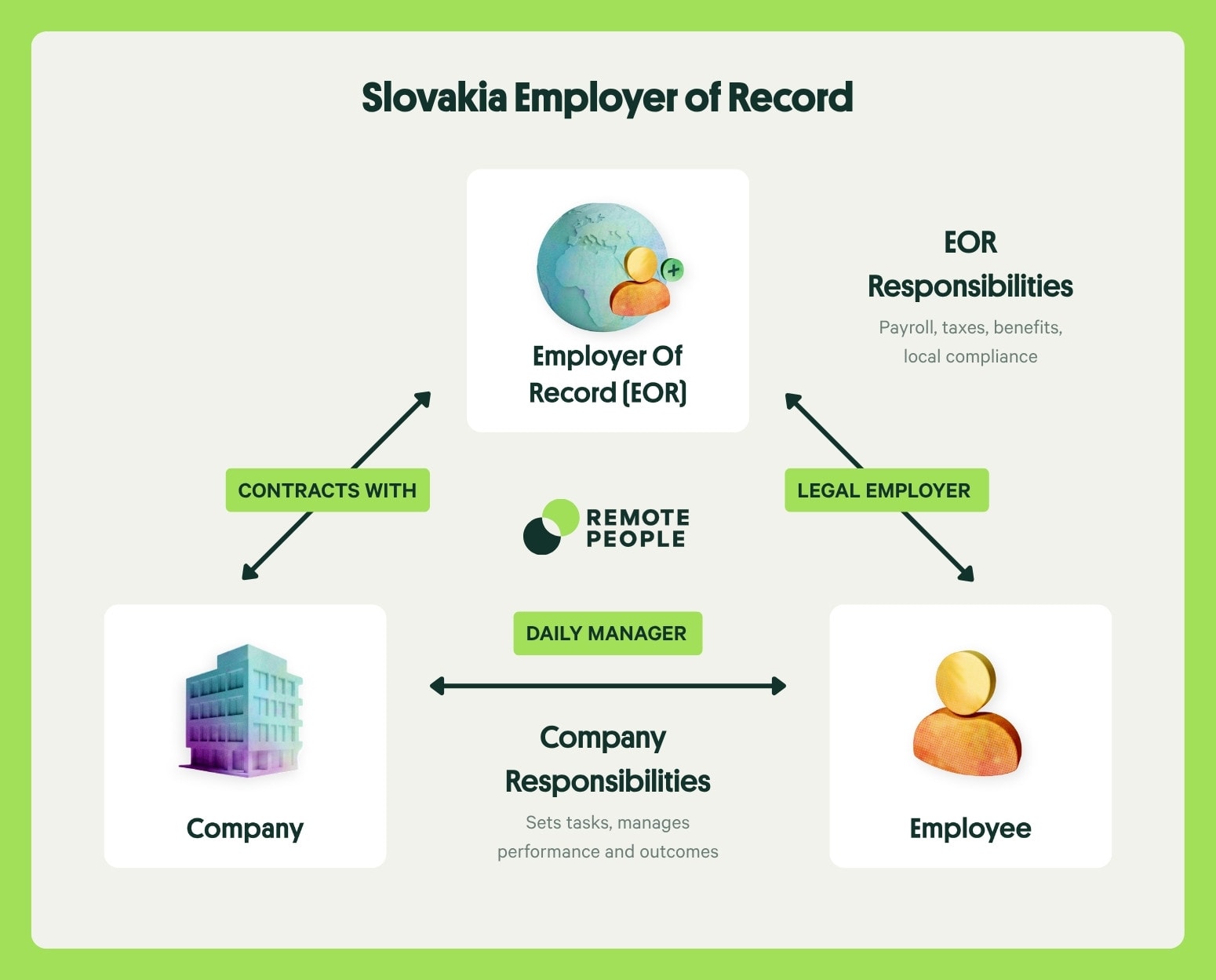
If you’d like to learn more about how Employer of Record (EOR) services work, read our What Is an Employer of Record (EOR)? guide for a complete overview of the model, its benefits, and when to use it.
If you’re comparing providers, our Best Employer of Record (EOR) Providers guide reviews the leading platforms to help you choose the right solution for your business.
Who Uses an EOR in Slovakia?
An EOR fits companies that need a compliant Slovak hire without the overhead of incorporating a subsidiary. Common situations include testing the Slovak talent market before committing to an entity, bringing on one to fifteen employees where incorporation is not cost-effective, hiring remote workers already living in Bratislava, Košice, or Žilina, converting a long-running contractor to a compliant employee, and sponsoring third-country nationals who need work permit backing. The model is also popular with firms that want to onboard in days rather than the three to six months a full s.r.o. setup typically takes.
Typical Onboarding Timeline
Most employer of record providers can onboard a new hire in Slovakia within one to two weeks. The steps below cover a standard onboarding for an EU national; combined residence and work permit sponsorship for non-EU hires adds three to four months to the timeline.
- First, the client signs the EOR service agreement and shares the employee’s details, start date, and salary (1–2 days).
- Second, the EOR drafts a Slovak-language employment contract that meets Labour Code §42 requirements and sends it for signature (2–3 days).
- Third, the EOR registers the new hire with Sociálna poisťovňa no later than the day before the start date and enrols the employee in a public health insurance fund (1–3 days).
- Fourth, payroll is configured, the local bank account is linked, and any statutory benefits are activated (2–3 days).
- Fifth, the employee starts on the agreed date and first payroll runs at month-end.
Hire in Slovakia
Euro-denominated payroll, a strong engineering and shared-services talent pool, EU member-state market access, and one of the most cost-competitive labour bases in the eurozone make Slovakia a high-value hire for companies expanding into Central Europe.
We handle employment contracts, payroll, tax withholding, and full Slovak Labour Code compliance.
No local entity needed. Your team can start in days.
Employment Laws and Regulations in Slovakia
Employment Contracts
Slovak employment is governed by Labour Code Act No. 311/2001 Coll. (Zákonník práce), with the Ministry of Labour, Social Affairs and Family as the principal regulator and the National Labour Inspectorate as the enforcement arm. Every employment contract must be in writing and must specify the job title and description, place of work, start date, and wage terms under §43.
Indefinite contracts are the default. Fixed-term contracts can be used for up to two years and may be renewed twice within that window, after which the relationship converts to indefinite under §48. Slovak-language contracts are the norm, though bilingual Slovak-English versions are common and enforceable provided the Slovak version controls in case of dispute.
Working Hours and Overtime
The standard workweek in Slovakia is 40 hours, normally arranged as eight hours per day across five days under Labour Code §85. Two-shift operations run 38.75 hours per week and three-shift or continuous operations run 37.5 hours per week. Overtime is capped at 150 hours per calendar year, with a further 250 hours possible with the employee’s written agreement to a total ceiling of 400 hours per year under §97.
Overtime is paid at the regular rate plus a minimum 25% premium (35% for hazardous work), with weekend, night, and public holiday work carrying separate premiums tied to the statutory minimum hourly wage. Work on public holidays must be compensated with a 100% premium on top of average earnings or equivalent paid time off.
Slovakia overtime and premium pay rates · Per Labour Code Act No. 311/2001 Coll. | |||
Hour Type | Rate Multiplier | Weekly or Annual Cap | Notes |
|---|---|---|---|
Standard overtime | +25% of average earnings | 150 hrs/year ordered; 400 hrs/year with consent | Per §121 |
Hazardous-work overtime | +35% of average earnings | Same annual caps apply | Per §121 |
Night work (22:00 to 06:00) | +40% of the minimum hourly wage | 8-hour shift max; health checks required | Per §123 |
Saturday work | +50% of the minimum hourly wage | Two consecutive rest days/week | Per §122a |
Sunday work | +100% of the minimum hourly wage | Extra rest protections apply | Per §122b |
Public holiday work | +100% of average earnings | Compensatory time off allowed by agreement | Per §122 |
Minimum Wage
The Slovak statutory minimum wage rose to €915 per month on January 1, 2026, a €99 increase from the 2025 level of €816. The hourly minimum is €5.259 for a 40-hour workweek.
The 2026 rate was set through the negotiated mechanism in Act No. 663/2007 on the minimum wage, with Grant Thornton reporting a 12.13% year-on-year increase (Grant Thornton: Minimum wage as of January 1, 2026). The minimum wage applies to all sectors and all employees regardless of nationality, and also sets the floor for six job complexity classes that raise the minimum proportionately for more demanding roles. Detailed rules are on our Slovakia minimum wage page.
Probation Period
Slovakia allows a probationary clause of up to three months for regular employees and up to six months for managerial employees under Labour Code §45. The probation must be agreed in writing in the employment contract itself, cannot be extended beyond the statutory cap, and is suspended for any full days of absence due to illness or other recognised obstacles to work.
During probation either side may terminate without notice and without cause on three days’ written notice, making it a widely used provision in Slovak hiring. Detailed rules are on our Slovakia probation period page.
Leave Entitlements
Slovakia’s statutory leave framework sits in Part V of the Labour Code and is broadly aligned with EU directives. It combines four weeks of paid annual leave, a layered sick pay system split between employers and Sociálna poisťovňa, and 34 weeks of maternity leave that can extend to 43 weeks for multiple births.
Annual Leave
Slovak employees are entitled to a minimum of four weeks (20 working days) of paid annual leave per calendar year under Labour Code §103. Employees who turn 33 during the calendar year, or who permanently care for a child, are entitled to five weeks (25 working days). Teachers, academic staff, and similar categories receive eight weeks (40 working days).
Leave is calculated on a proportional basis for part-year or part-time contracts. Unused leave generally carries over and should be taken by the end of the following year; if not, the employer must allow it to be taken before it lapses. Leave accrues during periods of recognised absence such as maternity leave, temporary incapacity for work up to 100 days per year, and parental leave up to the child’s third birthday.
Sick Leave
Sick leave in Slovakia is covered jointly by the employer and Sociálna poisťovňa. For the first 14 calendar days of incapacity, the employer pays wage compensation at 25% of the daily assessment base for days one to three and 55% from day four to day fourteen, under the 2026 consolidation package that extended employer-paid sick leave from the previous ten-day window.
From day 15 onward, Sociálna poisťovňa pays sickness benefit (nemocenské) at 55% of the daily assessment base, funded from the 1.4% employee and 1.4% employer sickness insurance contributions. Maximum paid duration is 52 weeks per spell, after which the case is referred to the invalidity assessment system.
A medical certificate must be issued electronically by a registered doctor and is transmitted automatically to both the employer and Sociálna poisťovňa through the ePN electronic sick note system. Work accidents and occupational diseases are covered by a separate statutory accident insurance scheme funded by the 0.8% employer contribution.
Maternity Leave
Slovak maternity leave (materská dovolenka) is 34 weeks for a single birth, 37 weeks for single mothers, and 43 weeks for twins or multiple births, funded by Sociálna poisťovňa at 75% of the daily assessment base rather than by the employer. Eligibility requires at least 270 days of sickness insurance participation in the two years before the start of leave.
The leave normally starts six to eight weeks before the due date and runs continuously after the birth. Employers cannot dismiss a pregnant employee or a mother on maternity leave except in very limited circumstances, and the employee has the right to return to the same position at the end of the leave under §157.
Paternity Leave
Fathers are entitled to two weeks of paid paternity leave under the system introduced in November 2022 to transpose the EU Work-Life Balance Directive. The leave is paid by Sociálna poisťovňa at 75% of the daily assessment base and must be taken within six weeks of the child’s birth. Eligibility mirrors the maternity leave rule of 270 days of sickness insurance participation in the previous two years.
Other Statutory Leave
Slovak law provides several additional paid leave categories that an EOR will track alongside annual and sick leave.
- Parental leave: up to the child’s third birthday, with the option to claim parental allowance from the state until the child is three or six for a child with long-term health issues.
- Marriage leave: 1 day for the employee’s own wedding.
- Bereavement leave: 2 days plus the day of the funeral for the death of a spouse, partner, or child; 1 day plus the day of the funeral for a parent, sibling, parent-in-law, or grandparent.
- Blood donation leave: paid time off for the donation plus any necessary rest.
- Medical examination leave: paid time off for examinations that cannot be performed outside working hours, capped at seven days per year.
- Moving leave: 1 day for a move in the employer’s interest, half a day for a personal move the employer agrees to.
Slovakia statutory leave entitlements · Per Labour Code Act No. 311/2001 Coll. | ||
Leave Type | Duration | Eligibility & Notes |
|---|---|---|
Annual leave | 20 working days (25 if age 33+) | §103. Teachers and academics receive 40 days. Pro-rated for part-year contracts. |
Sick leave | Up to 52 weeks | Days 1–14 paid by employer at 25%/55%; day 15+ by Sociálna poisťovňa at 55%. |
Maternity leave | 34 weeks (43 for multiples) | Paid by Sociálna poisťovňa at 75% of daily assessment base. 270-day insurance rule. |
Paternity leave | 2 weeks | Paid by Sociálna poisťovňa at 75%. Must be taken within 6 weeks of birth. |
Parental leave | Until age 3 (6 for long-term illness) | Follows maternity. Parental allowance from the state. Job protection throughout. |
Marriage leave | 1 day | Paid by employer. Granted for the employee’s own wedding. |
Bereavement leave | 1–2 days + funeral | Paid by employer. Scope depends on relationship to the deceased. |
Medical examination leave | Up to 7 days/year | Paid by employer when examinations cannot occur outside working hours. |
Statutory Employee Benefits
Slovakia’s mandatory benefits sit on top of the contribution-funded social insurance and public health insurance systems rather than being paid directly by employers. The public health insurance system provides universal coverage through three competing health insurance companies (Všeobecná zdravotná poisťovňa, Dôvera, and Union), delivering primary care, specialist treatment, hospital care, and prescription drugs at regulated prices. The state pension system run by Sociálna poisťovňa pays a defined-benefit old age pension funded by the 14% employer and 4% employee contributions, with statutory retirement age currently 64 years and indexed to life expectancy.
Beyond contribution-funded benefits, employers must provide meal allowances worth at least 55% of the statutory meal ticket value (currently €4.00 for a five-hour shift) under Labour Code §152, fund the statutory accident insurance, and provide safe workplace conditions in line with the Health and Safety Act 124/2006. Slovak law does not require private medical insurance, pension top-ups, or transport allowances, but supplementary pension contributions (III. pillar), multisport cards, and private health packages are all common voluntary benefits in competitive talent markets. Rate details for every contribution line are in the payroll tables in the next section and on our Slovakia employee benefits page.
Recent Regulatory Updates (2026)
The most consequential change of the past year is the third consolidation package passed in October 2025 and effective from January 1, 2026. The package introduced new 30% and 35% income tax brackets on top of the existing 19% and 25% rates, raised the employee health insurance contribution from 4% to 5%, extended employer-paid sick leave from 10 to 14 days, and reduced the general tax allowance threshold (Accace: Consolidation package in Slovakia from 2026).
Alongside the tax and contribution changes, the statutory minimum wage rose to €915 per month from January 1, 2026, under the negotiated formula in Act 663/2007. The maximum monthly assessment base for social insurance rose from €15,730 to €16,764, and the package also reintroduced retail trading restrictions on several public holidays. May 8 (Victory over Fascism) and September 15 (Our Lady of Sorrows) were reclassified as working days for 2026 as a temporary austerity measure, while November 17 was permanently removed from the non-working holiday calendar (Grant Thornton: Consolidation of Public Finances for 2026).
Work Permits and Visas in Slovakia
Work Permit Requirements
Who Needs a Work Permit
EU, EEA, and Swiss citizens enjoy full free movement and can work in Slovakia without any permit; they only need to register their residence with the Foreign Police within 30 days of arrival for stays exceeding three months. All other nationals, including UK citizens post-Brexit, need either a Single Permit (combined residence and work permit), an EU Blue Card, or a Seasonal Employment Permit before starting employment. Certain categories are exempt, including family members of EU citizens with a residence permit, accredited journalists, and holders of permanent residence or long-term EU resident status.
Eligibility and Required Documents
For non-EU hires, the employer applies for a Single Permit that combines residence and work authorisation through the Bureau of Border and Foreign Police. The standard documentation set includes a signed employment contract or binding job offer, confirmation that the vacancy was listed with the Central Office of Labour, Social Affairs and Family for at least 20 working days, the employee’s passport, apostilled and translated diploma or professional qualification, a clean criminal record certificate from the country of origin, and proof of accommodation. All foreign-language documents must be translated into Slovak by a court-certified translator.
Processing Time and Validity
A Single Permit application typically takes 90 to 120 days from submission at a Slovak embassy or consulate to issuance. The EU Blue Card route, reserved for highly skilled professionals with a university degree earning at least 1.5 times the Slovak average gross monthly salary, is usually processed in 60 to 90 days and skips the 20-day labour market test.
Initial permits are valid for up to five years for the Single Permit and up to four years for the Blue Card, aligned with the duration of the employment contract. Delays most often come from missing apostilles, incomplete qualification documents, or consular appointment backlogs in high-volume source countries such as Ukraine, Serbia, and the Philippines.
Renewal Process
Renewal applications must be filed at least 90 days before the current permit expires. The employee can continue working while the application is pending, provided the employer has filed before the expiry date.
Documentation mirrors the initial application, with an updated contract, confirmation of ongoing employment, and refreshed proof of accommodation and criminal record. After five years of continuous lawful residence, the employee becomes eligible for long-term EU resident status, which provides broader labour market access across the EU.
Common Visa Types for Foreign Workers
Slovakia offers several pathways for foreign workers depending on skill level, assignment length, and nationality.
Slovakia work visa types for foreign workers · 2026 | ||||
Visa Type | Duration | Best For | Leads to PR? | Processing |
|---|---|---|---|---|
Single Permit | Up to 5 years, renewable | Non-EU workers in labour-office listed roles | Yes, long-term EU resident after 5 years | 90 to 120 days |
EU Blue Card | Up to 4 years, renewable | High-skill roles at ≥1.5× average gross salary | Yes, long-term EU resident after 5 years | 60 to 90 days |
Intra-Company Transfer Permit | Up to 3 years (managers), 1 year (trainees) | Staff transferred from a non-EU parent company | No, ICT time excluded from residence count | 60 to 90 days |
Seasonal Employment Permit | Up to 180 days in any 12-month period | Agriculture, forestry, and tourism roles | No | 30 to 60 days |
National Visa (Type D) | Up to 1 year | Bridging to Single Permit or long assignments | Converts into Single Permit or Blue Card | 30 to 60 days |
How an EOR Handles Work Permits
Because Slovak work permit sponsorship must be filed by a registered local employer, the EOR is well placed to handle Single Permit, Blue Card, and ICT applications on behalf of client companies. The provider posts the role on the central labour office register for the mandatory 20-working-day labour market test, compiles the application package, liaises with the Ministry of the Interior and the embassy handling the visa appointment, and tracks renewal deadlines.
Work permit sponsorship typically extends the one to two week EOR onboarding window by three to four months, so clients should plan accordingly when hiring third-country nationals. RemotePeople supports full sponsorship for Single Permit and EU Blue Card routes in Slovakia. Full details on Slovak visa pathways are on our Slovakia work visa and permit page.
Payroll, Taxes, and Social Security in Slovakia
Employer Contributions
Slovak employers contribute 36.2% of gross salary to the combined social insurance and public health insurance systems. The largest lines are old age pension insurance at 14%, public health insurance at 11%, the solidarity reserve fund at 4.75%, and invalidity insurance at 3%, with smaller charges for sickness, unemployment, guarantee, and accident insurance.
Social insurance contributions (everything except health insurance and accident insurance) are capped once an employee’s monthly gross salary reaches €16,764 for 2026, up from €15,730 in 2025. Health insurance has no ceiling, and accident insurance is also calculated on an unlimited assessment base at a flat 0.8%.
Slovakia employer social insurance and health contributions · 2026 rates | ||
Contribution | Rate | Notes |
|---|---|---|
Old age pension insurance | 14.00% | Funds the state defined-benefit pension administered by Sociálna poisťovňa. |
Invalidity insurance | 3.00% | Funds invalidity pensions and related benefits. |
Sickness insurance | 1.40% | Funds Sociálna poisťovňa sickness, maternity, and paternity benefits from day 15. |
Unemployment insurance | 1.00% | Funds unemployment benefits paid by the labour office (0.5% where employer also funds the support contribution). |
Guarantee insurance | 0.25% | Covers unpaid wages in the event of employer insolvency. |
Accident insurance | 0.80% | Covers work accidents and occupational disease; unlimited assessment base. |
Solidarity reserve fund | 4.75% | Secondary funding source for the state pension system. |
Public health insurance | 11.00% | Funds universal public healthcare; no assessment cap. |
Total employer contributions | 36.20% | Social insurance capped at €16,764 monthly. Health and accident insurance uncapped. |
Employee Contributions
Slovak employees contribute a combined 14.4% of gross salary, split between old age pension at 4%, invalidity insurance at 3%, sickness insurance at 1.4%, unemployment insurance at 1%, and public health insurance at 5% (up from 4% in 2025 under the consolidation package). The same €16,764 monthly cap applies to the social insurance portion. Together with the 19%+ progressive income tax, a typical Slovak worker sees a combined payroll deduction of roughly 33% before personal tax credits.
Slovakia employee payroll deductions · 2026 monthly withholdings | ||
Deduction | Rate | Notes |
|---|---|---|
Old age pension insurance | 4.00% | Employee share of the state defined-benefit pension. Capped at €16,764 monthly. |
Invalidity insurance | 3.00% | Funds invalidity benefits administered by Sociálna poisťovňa. |
Sickness insurance | 1.40% | Funds Sociálna poisťovňa sickness benefit from day 15. |
Unemployment insurance | 1.00% | Funds unemployment benefits for qualifying job seekers. |
Public health insurance | 5.00% | Raised from 4% in 2026. No assessment ceiling. |
Total employee deductions | 14.40% | Plus 19% basic income tax and 25%/30%/35% bands above the thresholds. |
Income Tax
Slovakia applies a four-rate progressive personal income tax on employment income from January 1, 2026, following the third consolidation package. Tax is charged at 19% on the portion of annual income up to €43,983.32, 25% on the portion from €43,983.32 to €60,349.21, 30% on the portion from €60,349.21 to €75,010.32, and 35% on the portion above €75,010.32 (PwC Worldwide Tax Summaries: Slovak Republic).
Only the portion of income within each bracket is taxed at the corresponding rate, so a gross annual income of €55,000 is taxed at 19% up to €43,983.32 and at 25% on the remainder. Every employee who claims the general tax allowance receives a base deduction that is phased out above higher income levels; for 2026 the maximum non-taxable portion is €5,920.32 per year. Additional credits are available for a non-working spouse and for dependent children, with the child tax bonus ranging from €33.60 to €100 per month depending on age.
Slovakia income tax brackets · 2026 annual amounts in EUR | |
Annual Taxable Income (EUR) | Tax Rate |
|---|---|
Up to €43,983.32 | 19% on the portion within this band |
€43,983.33 to €60,349.21 | 25% on the portion within this band |
€60,349.22 to €75,010.32 | 30% on the portion within this band |
Above €75,010.32 | 35% on the portion above this threshold |
General tax allowance (non-taxable base) | Up to €5,920.32/year (phased out at higher incomes) |
Payroll Cycle
Slovak payroll is paid monthly, typically by the last working day of the following month under Labour Code §129. Salaries must be paid in euro by bank transfer to a Slovak-based account in the vast majority of cases. Cash payments are legal but uncommon and require receipt documentation.
Employers must issue an itemised payslip each month showing gross salary, each social insurance and health line, the income tax withholding, any tax credits applied, and net pay. Monthly tax and social insurance returns are due by the 8th of the following month, health insurance returns by the same date, and the annual reconciliation (ročné zúčtovanie) by the end of March each year. Sociálna poisťovňa and health fund registrations must be filed no later than the day before the employee’s start date. Full Slovak payroll mechanics are on our Slovakia payroll and tax page.
13th Month Salary and Bonus Pay
A 13th month salary is not mandatory in Slovakia. Employers have no statutory obligation to pay an annual bonus, vacation bonus, or profit share.
Where 13th month pay is offered, it is a contractual benefit that sits alongside standard salary, is fully subject to income tax at the employee’s applicable bracket rate and to the 14.4% employee social insurance and health deductions, and is usually paid with December or July payroll. Discretionary performance bonuses, annual objectives-based bonuses, and meal-voucher top-ups above the statutory minimum are all common private-sector practices but remain entirely voluntary.
Cost of Hiring Through an EOR in Slovakia
EOR Service Fees
Employer of record fees in Slovakia typically range from $300 to $600 per employee per month, billed as a flat USD amount regardless of salary. The fee covers contract drafting and management, monthly payroll processing in euro, tax withholding and remittance, social insurance and health insurance administration, statutory leave tracking, and ongoing labour-code compliance.
Total Employment Cost Breakdown
The real cost of hiring in Slovakia is the gross salary plus the 36.2% employer social insurance and health contributions plus the EOR service fee. On a $2,000/month gross salary, the total monthly employer cost is approximately $3,124, or roughly 56% above the gross figure. All USD amounts are approximate conversions at $1 = €0.92 (April 2026 rate).
Slovakia employer cost example · $2,000/month gross · 2026 | ||
Employer Cost | Amount (USD) | % of Gross |
|---|---|---|
Gross monthly salary | $2,000.00 | 100.00% |
Old age pension insurance | $280.00 | 14.00% |
Invalidity insurance | $60.00 | 3.00% |
Sickness insurance | $28.00 | 1.40% |
Unemployment insurance | $20.00 | 1.00% |
Guarantee insurance | $5.00 | 0.25% |
Accident insurance | $16.00 | 0.80% |
Solidarity reserve fund | $95.00 | 4.75% |
Public health insurance | $220.00 | 11.00% |
EOR service fee | $400.00 | 20.00% |
Total monthly employer cost | $3,124.00 | 156.20% |
Ready to hire in Slovakia? Get started with RemotePeople and we will handle employment contracts, payroll, tax withholding, and full Slovak compliance. No local entity needed.
Benefits of Using an EOR in Slovakia
Using an employer of record in Slovakia cuts the time between signing a candidate and having them on the books from months to days. A greenfield Slovak s.r.o. typically takes three to six months to incorporate, register with the commercial register, obtain a VAT number, and set up local banking and payroll, while an EOR can onboard the same hire in one to two weeks because the legal infrastructure is already in place.
The compliance dividend is just as important. The Slovak Labour Code runs to more than 250 sections, monthly tax and social insurance returns are due by the 8th of the following month, the 2026 consolidation package rewrote the income tax brackets and raised employee health insurance, and the Sociálna poisťovňa assessment base moved again on January 1.
An EOR that specialises in Slovakia keeps on top of each change, indemnifies the client against employer-side liability, and typically carries employers’ liability insurance as a backstop. For companies hiring one to fifteen people, that is almost always cheaper than paying an in-country CFO, labour lawyer, and local accountant.
The model also scales in both directions. Need a second hire in Košice next month? Add them to the same EOR contract.
Need to close the Slovak operation after a strategic pivot? Give statutory notice and exit; there is no entity to wind down, no tax clearance queue, and no commercial register filings. That flexibility is why EORs are the default route for cross-border hiring in Slovakia’s one-to-fifteen-employee band.
Termination and Offboarding in Slovakia
Notice Periods
Statutory notice for indefinite contracts in Slovakia scales with length of service under Labour Code §62, and cannot be shortened below that minimum. Employees with less than one year of service serve a one-month notice period, those with one to five years serve two months, and those with five or more years of service serve three months when terminated on redundancy or serious organisational grounds.
Notice must be given in writing and delivered in person or by a verifiable route. The notice period runs from the first day of the calendar month following delivery. Employees have a stronger position during the notice period, with continuing pay, benefits, and protection from immediate dismissal except in cases of gross misconduct.
Slovakia statutory notice periods by length of service · Per Labour Code Act No. 311/2001 Coll. | |||
Length of Service | Notice Period | During Probation | Notes |
|---|---|---|---|
Less than 1 year | 1 month | 3 days (probation up to 3 months) | Per §62(2) |
1 to less than 5 years | 2 months | 3 days (probation up to 3 months) | Per §62(3) |
5 years or more (redundancy) | 3 months | 3 days | Per §62(3), §63(1)(a-b) |
Managerial employees on probation | Per contract | 3 days (probation up to 6 months) | Per §45(2) |
Collective redundancy (20 or more) | Notice plus 30-day labour office notification | 0 days | Per §73 |
Severance Pay
Slovakia severance pay schedule by years of service · Per Labour Code Act No. 311/2001 Coll. | |||
Years of Service | Severance Amount | Base Salary | Notes |
|---|---|---|---|
Less than 2 years | Notice period only (no severance) | Per §76 | Redundancy only (§63(1)(a-b)) |
2 to less than 5 years | 2× average monthly earnings | Per §76 | Redundancy only |
5 to less than 10 years | 3× average monthly earnings | Per §76 | Redundancy only |
10 to less than 20 years | 4× average monthly earnings | Per §76 | Redundancy only |
20 years or more | 5× average monthly earnings | Per §76 | Redundancy only |
Occupational accident or disease | 10× average monthly earnings | Per §76(3) | Covered by accident insurance |
Calculation Method
Severance pay in Slovakia is set out in Labour Code §76 and applies to dismissals on economic or organisational grounds such as redundancy, employer closure, or restructuring under §63(1)(a-b). The statutory scale runs from two months of average salary for two to less than five years of service to five months of average salary for twenty or more years of service. Employees who accept severance and leave immediately instead of working out the notice period receive the same multiplier regardless of tenure.
Severance is calculated on the employee’s average gross monthly earnings over the previous quarter, including regular bonuses and allowances that formed part of the contractual pay. Unused annual leave is always paid out separately on exit and is not included in the severance calculation.
Caps and Exceptions
There is no statutory maximum cap on redundancy severance, but the five-month ceiling is low enough that most dismissals stay within predictable cost brackets. Employees terminated for cause on disciplinary grounds under §63(1)(d-f), for gross breach of duty, or for conviction of a crime related to their job are not entitled to severance.
Fixed-term contracts that expire naturally carry no severance obligation. Protected categories such as pregnant employees, mothers on maternity leave, employees on parental leave, and employees caring for a child under three can only be dismissed in very limited circumstances and with written justification. A separate lump-sum severance of ten times average monthly earnings applies where the termination results from a recognised work injury or occupational disease, reimbursed to the employer from the accident insurance scheme administered by Sociálna poisťovňa.
Grounds for Termination
Slovak law recognises termination by mutual agreement under §60, termination with notice on statutory grounds under §63, immediate termination for gross misconduct under §68, and termination during the probation period without cause under §72. Economic and organisational dismissals must be supported by documentation showing the role is genuinely being eliminated or reorganised and cannot simply be replaced by a different person in the same function.
Mutual-agreement terminations under §60 are common in practice because they let both sides avoid procedure and usually come with an uplifted severance package above the statutory minimum. Immediate termination for gross misconduct requires the employer to act within two months of learning of the misconduct and within one year of the act itself.
EOR vs. Other Hiring Models in Slovakia
EOR vs. Setting Up a Local Entity
Slovakia EOR vs local entity comparison · Setup time, cost, risk and best-fit | ||
Comparison | Employer of Record | Own Entity (s.r.o.) |
|---|---|---|
Setup time | 1–2 weeks | 3–6 months |
Upfront cost | $0 | $5,000–$15,000 |
Ongoing cost | $300–$600/employee/month | $12,000–$28,000/year maintenance |
Local partner required | No (EOR is the local entity) | No, but local director recommended |
Social insurance registration | Handled by EOR | You manage it |
Payroll & tax filing | Handled by EOR | You manage it (or outsource) |
Best for team size | 1–15 employees | 15+ employees |
Scale down / exit | Easy. No entity to unwind | Costly. Legal dissolution required |
Government contracts | Not eligible | Eligible (requires local entity) |
For most companies hiring their first handful of people in Slovakia, the EOR is the better economic choice. A single-member Slovak s.r.o. can cost $5,000 to $15,000 to set up properly once legal fees, notary costs, commercial register filing, and the minimum €5,000 share capital are considered, with another $12,000 to $28,000 per year to maintain the accounting, payroll, and compliance function that any entity in the EU requires.
The break-even point against an EOR typically sits around 15 employees. Below that, the monthly EOR fee is lower than the fixed cost of running an in-country finance and HR function; above it, the per-head savings of owning the entity start to compound. Companies that plan to bid on Slovak public tenders, take strategic investment incentives from SARIO, or need a local entity for regulatory reasons (banking, insurance, energy) will need their own s.r.o. regardless of team size.
The exit story is just as important as the setup story. Closing a Slovak s.r.o. is a multi-month affair involving tax clearance, a liquidator, and commercial register filings. Closing out an EOR relationship takes a single notice period.
EOR vs. Hiring Independent Contractors
Slovakia EOR vs independent contractors · Compliance, cost, and risk | ||
Comparison | EOR (Full-Time Employee) | Independent Contractor |
|---|---|---|
Legal relationship | Employee of the EOR | Self-employed, no employment relationship |
Compliance risk | Low. EOR ensures Labour Code compliance | Higher. Misclassification risk under §1(2) of the Labour Code |
Payroll & tax | EOR handles withholding, contributions, filings | Contractor invoices you; they handle their own taxes |
Benefits & leave | Statutory benefits, paid leave, social insurance | No entitlement to employee benefits |
IP protection | Stronger. Employment contract assigns IP by default | Weaker. Requires explicit IP assignment clause |
Termination | Subject to local notice periods and severance | Contract can be ended per agreement terms |
Best for | Long-term, core team roles | Short-term projects, specialised tasks |
Cost structure | Salary + employer contributions + EOR fee | Contractor fee (typically higher gross, lower total cost) |
Hiring independent contractors is only appropriate in some cases, such as short-term projects, specialised consulting engagements, and roles with genuine autonomy over hours and method. Slovakia applies the substance test under Labour Code §1(2), which looks at whether the relationship shows personal performance, subordination to the principal’s instructions, fixed working hours, and economic dependence. Where those criteria are met, the arrangement is treated as employment regardless of how the contract is labelled, a phenomenon known locally as the fake-SZČO problem.
If a contractor relationship is reclassified as employment, the consequences flow backwards. The client becomes liable for unpaid employer social insurance and health contributions of 36.2%, unpaid employee contributions of 14.4% and the applicable income tax, interest on the underpaid sums, and administrative penalties from the labour inspectorate and Financial Administration. The contractor also gains a retroactive claim to statutory leave and severance. RemotePeople’s Slovakia contractor management solution handles compliant contractor payments, written agreements, and classification reviews so clients can use the contractor route where it fits without carrying the compliance exposure.
EOR vs. PEO (Professional Employer Organization)
Slovakia EOR vs PEO comparison · Legal employer, liability, and setup | ||
Comparison | Employer of Record (EOR) | PEO |
|---|---|---|
Legal employer | EOR is the legal employer | You remain the legal employer (co-employment) |
Local entity required | No. The EOR is the local entity | Yes. You must have your own entity in Slovakia |
Best for | Companies without a local entity | Companies that already have a local entity |
Compliance liability | EOR assumes compliance responsibility | Shared liability between you and the PEO |
Setup time | 1–2 weeks | Depends on your entity setup (weeks to months) |
Control over HR policies | EOR manages within local law framework | More direct control, PEO advises |
Typical use case | Market entry, small remote teams, testing new markets | Established local operations needing HR outsourcing |
The single clearest difference between the two models is entity ownership. An EOR already holds the Slovak company that signs employment contracts, pays payroll, and files with Sociálna poisťovňa, so the client needs nothing on the ground. A PEO works in co-employment with an entity the client already owns, sharing HR administration and payroll tasks while leaving the employment relationship itself with the client.
Slovakia does not have a dedicated PEO licensing framework in the way the United States does. What gets marketed as PEO in Slovakia is usually payroll outsourcing, HR-as-a-service, or consulting support layered on top of a client-owned s.r.o. Because of that, the practical choice for a foreign company without a Slovak entity is almost always between incorporating or using an EOR.
Public Holidays in Slovakia
Slovakia public holidays · 2026 calendar year | ||
Date | Holiday | Type |
|---|---|---|
January 1 | Day of the Establishment of the Slovak Republic / New Year’s Day | State holiday |
January 6 | Epiphany (Three Kings’ Day) | Public holiday |
April 3 | Good Friday | Movable (Easter) |
April 6 | Easter Monday | Movable (Easter) |
May 1 | International Workers’ Day | Public holiday |
July 5 | Saints Cyril and Methodius Day | State holiday |
August 29 | Slovak National Uprising Anniversary | State holiday |
November 1 | All Saints’ Day | Public holiday |
December 24 | Christmas Eve | Public holiday |
December 25 | Christmas Day | Public holiday |
December 26 | St. Stephen’s Day | Public holiday |
Slovakia observes 11 non-working public holidays in 2026, a reduction from the longer-running 15-holiday calendar. The 2026 consolidation package temporarily converted May 8 (Victory over Fascism Day) and September 15 (Our Lady of Sorrows) into regular working days and permanently removed November 17 (Struggle for Freedom and Democracy Day) from the non-working list. September 1 (Constitution Day) remains a ceremonial state holiday but has not been a non-working day since 2024.
Slovak law does not shift holidays that fall on a weekend to the next Monday, so the employee calendar varies slightly year to year depending on the day of the week. Work performed on a public holiday must be compensated either with paid time off in lieu or with a 100% wage premium on top of average earnings if the employee agrees in writing. Payroll calendars should build these days into monthly timesheets and leave tracking.
How to Get Started with an EOR in Slovakia
Starting the EOR process with RemotePeople takes a single conversation and a few signed documents. The five steps below cover a standard onboarding for an EU-national employee based in Slovakia.
- First, share the role details with RemotePeople, including the job title, salary range, start date, and whether the candidate needs work permit sponsorship.
- Second, RemotePeople prepares a cost estimate in USD covering gross salary, employer contributions, the EOR fee, and any visa costs if applicable.
- Third, sign the EOR service agreement and send the employee’s details, identification, bank account, and any required qualification documents.
- Fourth, RemotePeople drafts the Slovak employment contract, registers the contract with Sociálna poisťovňa the day before the start date, and enrols the employee with a public health insurance fund.
- Fifth, the employee starts work on the agreed date, and RemotePeople runs monthly payroll, tax withholding, and ongoing compliance for the life of the engagement.
Contact our team for a fixed quote on hiring in Slovakia and a realistic onboarding timeline based on your role, team size, and nationality mix.
Where companies hiring in Slovakia expand next
Teams hiring in Slovakia commonly expand across Central and Eastern Europe, where competitive labor costs and EU market access anchor regional growth. Teams frequently add a team in the Czech Republic for similar cost profile and comparable hiring speed; operations in Romania often follows for parallel labor-cost tier and talent supply; Hungary is a common next step, offering aligned compensation ranges and delivery speed; and hiring in Poland rounds out the regional footprint with matching cost-to-quality tier.
Frequently Asked Questions
Beyond the employer contributions of 36.2% of gross salary, you will pay an EOR service fee of $300–$600 per employee per month. The exact amount depends on your provider and the complexity of the role. On a $2,000/month gross salary, a typical all-in monthly cost is approximately $3,124, or about 56% above gross.
Standard onboarding for an EU national takes one to two weeks from signed agreement to first payroll, including contract drafting, Sociálna poisťovňa registration, and health insurance enrolment. Non-EU hires who need a Single Permit or EU Blue Card add three to four months to that timeline.
The employment contract assigns IP to the client company (you), not the EOR. The EOR makes sure the contract has proper IP assignment language so all intellectual property, code, designs, and written work product flow directly to your business from the day the employee starts.
An EOR is built around the employment model, but RemotePeople also offers a Slovakia contractor management solution that handles compliant contractor payments, written agreements, and substance-test classification reviews. That route is a better fit for short-term project work than the EOR, while still protecting you from misclassification exposure.
The Slovak statutory minimum wage is €915 per month effective January 1, 2026, with an hourly minimum of €5.259. The 2026 rate is a 12.13% increase over the 2025 level of €816. You can read more on our Slovakia minimum wage page.
No. A 13th month salary is not mandatory in Slovakia. Employers may pay a discretionary bonus or annual incentive, but there is no statutory requirement. When paid, bonuses are taxed at the employee's applicable income tax bracket and are subject to the 14.4% employee and 36.2% employer social insurance and health contributions.
The third consolidation package effective January 1, 2026, introduced new 30% and 35% income tax brackets on top of the existing 19% and 25% rates, raised the employee health insurance contribution from 4% to 5%, and extended employer-paid sick leave from 10 days to 14 days. The maximum monthly social insurance assessment base also rose from €15,730 to €16,764.
Statutory notice under Labour Code §62 scales with length of service: one month for less than one year, two months for one to five years, and three months for five or more years. Severance for economic dismissals under §76 ranges from two to five months of average gross pay depending on the employee's tenure.
Employer of Record in
Employer of Record in
Employer of Record in
Employer of Record in
Employer of Record in
Employer of Record in
Employer of Record in
Employer of Record in