
 Recruit
Employer of Record in Slovenia
-
 Drew Donnelly
- Published
- September 22, 2026
RemotePeople’s employer of record in Slovenia lets you hire employees in Slovenia with full ZPIZ and ZZZS compliance. We handle pension and disability contributions at 8.85 percent, health insurance contributions at 6.56 percent, and unemployment insurance payments.
Hire in Slovenia — book a free 30-minute demo
Tell us what you need. You'll get a tailored, transparent proposal within 24 hours, plus a free call to walk through it.
Tell us about your company
So we can match you with a specialist who knows your market — and unlock volume pricing tiers.
* All fields are required.
Where and when are you hiring?
Tell us the geography and timing and we'll quote each country line by line, with onboarding timelines.
* All fields are required.
Help us beat your current setup
We'll benchmark your current deal and send a line-by-line proposal in 24 hours — showing exactly where we cut cost, time, or risk. After you submit, you can book a call to walk through it together.
* All fields are required.
Thanks! Your proposal is on its way.
Expect a tailored, line-by-line proposal in your inbox within 24 hours. In the meantime…
Want to walk through it together?
Book a free 30-minute call with one of our specialists. We'll explain every line, answer your questions, and tailor the proposal further if you need.
No obligation. Pick a time that works for you.








- Hire in Slovenia — book a free 30-minute demo
- Tell us about your company
- Where and when are you hiring?
- Help us beat your current setup
- Thanks! Your proposal is on its way.
- How an Employer of Record Works in Slovenia
- Employment Laws and Regulations in Slovenia
- Work Permits and Visas in Slovenia
- Payroll, Taxes, and Social Security in Slovenia
- Cost of Hiring Through an Employer of Record in Slovenia
- Benefits of Using an EOR in Slovenia
- Termination and Offboarding in Slovenia
- EOR vs. Other Hiring Models in Slovenia
- Public Holidays in Slovenia
- How to Get Started with an EOR in Slovenia
- Frequently Asked Questions
- Related EOR Destinations

Start hiring in Slovenia
Let RemotePeople handle payroll, compliance, and HR admin worldwide so you can focus on building your team.
A Slovenian employee costs you three statutory pay events a year that do not exist in most countries: twelve monthly salaries, a holiday allowance (regres) of at least EUR 1,481.88 by 1 July, and, since November 2025, a winter allowance of at least EUR 740.94 by 18 December. Miss the regres deadline and the Labour Inspectorate can fine the employer up to EUR 20,000. That is the kind of detail that separates a compliant hire in Slovenia from an expensive one.
Slovenia deserves the effort. The country combines a highly educated, English-proficient workforce of just over one million employed people with the euro, EU and Schengen membership and a position between Central Europe, Italy and the Balkans. Pharmaceuticals (Krka, Lek/Novartis), automotive, electrical engineering, logistics through the Port of Koper and a growing Ljubljana ICT scene create deep pools of engineers, developers and finance professionals at an average gross salary of EUR 2,751 per month. For companies looking to hire employees in Slovenia, the friction is administrative: the Employment Relationships Act (ZDR-1), a 50% top income-tax rate, monthly ZPIZ and ZZZS contributions with a new long-term care levy, mandatory meal and commuting reimbursements, sector collective agreements and a single work-and-residence permit for non-EU hires.
An employer of record in Slovenia removes that friction. RemotePeople acts as the legal employer through a Slovenian entity. We draft the ZDR-1-compliant contract in Slovene and English, run euro payroll, file the REK-O return with the Financial Administration (FURS) on every payday, pay regres and the winter allowance on time and sponsor single permits and EU Blue Cards, while you manage the work. A first hire is live in one to two weeks rather than the four to eight weeks a greenfield d.o.o. needs to become payroll-ready.
How an Employer of Record Works in Slovenia
An employer of record (EOR) in Slovenia is a Slovenian-registered company that employs your staff on your behalf. The EOR signs the employment contract, registers the employee for social insurance through the SPOT business portal (the M-1 form must be filed within eight days of the start date), withholds income tax, pays all contributions to ZPIZ (pension), ZZZS (health) and the state funds and is the employer that FURS, the Labour Inspectorate and the labour courts recognise. Your company directs the day-to-day work, sets objectives and approves leave.
Slovenia has no EOR-specific statute. The closest framework is the provision of workers to a user under the Labour Market Regulation Act (ZUTD), which requires the provider to be registered with the Ministry of Labour and, since 2025, to hold a EUR 100,000 bank guarantee and to operate from a Slovenian entity rather than cross-border. RemotePeople employs Slovenian staff through a locally registered entity so that the arrangement stands up to inspection.
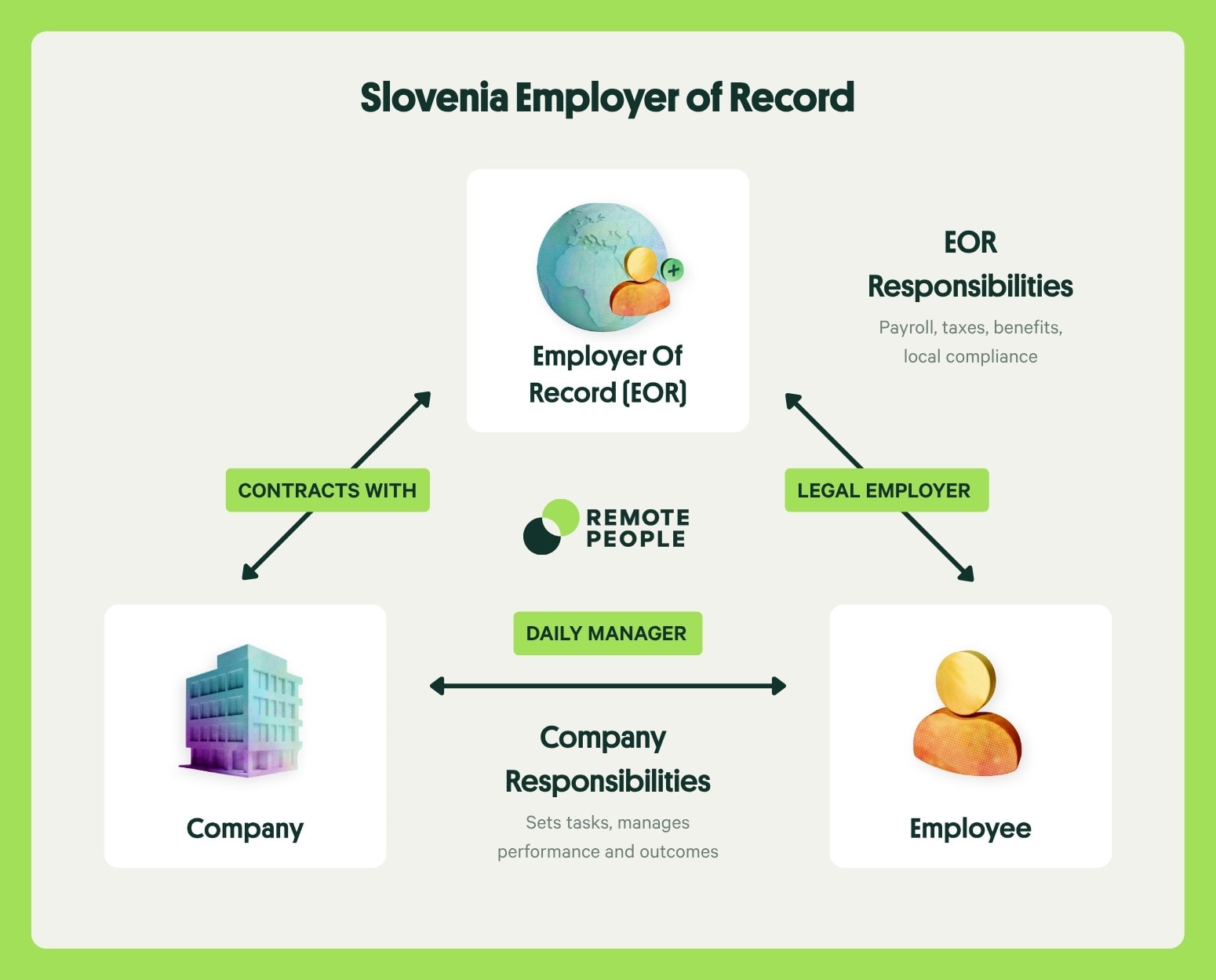
If you’d like to learn more about how Employer of Record (EOR) services work, read our What Is an Employer of Record (EOR)? guide for a complete overview of the model, its benefits, and when to use it.
If you’re comparing providers, our Best Employer of Record (EOR) Providers guide reviews the leading platforms to help you choose the right solution for your business.
Who Uses an EOR in Slovenia?
An EOR fits companies that need a compliant Slovenian hire without the overhead of incorporating a subsidiary. The structure suits organisations at several stages of European expansion.
- Market testing: A company looking to build a team in Slovenia can hire the first one or two people through an EOR, validate the market for six to twelve months and incorporate a local d.o.o. only once the commercial case is proven.
- Small-team hiring: For a headcount plan of one to fifteen people, EOR pricing is cheaper than running a Slovenian finance, HR and legal function in Ljubljana.
- Nearshore engineering and pharma talent: German, Austrian and Italian companies use Slovenia for engineering, software and regulatory-affairs roles at 40–60% of Munich or Vienna salary levels, with same-time-zone collaboration and EU data-protection rules.
- Non-EU workforce: For third-country nationals who need a single residence-and-work permit or an EU Blue Card, the EOR acts as the sponsoring employer, obtains the Employment Service consent and absorbs the immigration risk.
- Contractor conversions: When a long-running freelance relationship through a sole trader (s.p.) starts to look like employment under the ZDR-1 reality-of-relationship test, an EOR is the fastest legal path to convert the contractor into a compliant employee.
Take a Munich-based industrial software company that had worked with a Maribor developer as a sole trader for two years. When the developer moved to fixed hours, the company’s Jira instance and a company laptop, the arrangement met every element of an employment relationship under Article 4 of ZDR-1, and Slovenia’s 2025 reform of the flat-rate sole-trader regime made the exposure harder to ignore. Through an EOR, the developer signed an indefinite Slovenian employment contract, kept working for the same team and the company avoided a disguised-employment finding that carries fines of EUR 3,000 to 20,000 plus back-contributions.
Typical Onboarding Timeline
Most employer of record providers can onboard a new hire in Slovenia within one to two weeks for an EU national. A single permit for a non-EU hire adds one to three months.
- First, EOR agreement and employee details: You sign the EOR service agreement and share the employee’s details, start date and gross salary in euros. This takes one to two business days.
- Second, employment contract drafting: The EOR drafts a bilingual Slovene-English contract that meets the Article 31 content requirements, references the applicable collective agreement and records the meal and commuting allowance basis. The employee reviews and signs before the start date. This takes two to three business days.
- Third, social insurance registration: The EOR files the M-1 registration with ZZZS and ZPIZ through the SPOT portal within eight days of the start date and, for remote workers, notifies the Labour Inspectorate of the home workplace. This takes one to three business days.
- Fourth, payroll setup: The EOR configures payroll in euros, applies the 2026 tax scale and general allowance, sets up working-time records as required by the ZEPDSV and links the employee’s bank account. This takes one to two business days.
- Fifth, first day and first payroll: The employee starts on the agreed date. Salary is paid by the 18th of the following month at the latest, and the REK-O return and all contributions are filed and paid with FURS on the payday.
Teams hiring in Slovenia commonly expand across Central and Eastern Europe. Common next steps include operations in Hungary and Poland for aligned cost-to-quality tiers, hiring in the Czech Republic for comparable hiring speed, Croatia for the Adriatic corridor and an EOR partner in Romania for scale.
Hire in Slovenia
Slovenia offers euro-denominated payroll, an EU-compliant employment framework, and a highly educated Central European workforce at the crossroads of Western Europe and the Balkans.
We handle employment contracts, payroll, tax withholding, and ZPIZ and ZZZS registration, plus full Slovenian compliance.
No local d.o.o. needed. Your team can start in one to two weeks.
Employment Laws and Regulations in Slovenia
Employment Contracts
Employment in Slovenia is governed by the Employment Relationships Act (Zakon o delovnih razmerjih, ZDR-1), in force since 2013 and last substantively amended by ZDR-1D in November 2023, which transposed the EU directives on transparent working conditions and work-life balance. The Labour Inspectorate enforces the Act; individual disputes go to the specialised labour and social courts.
A contract must be in writing and delivered to the employee before work starts. Article 31 lists the mandatory contents: the parties, start date, job title and a short description of the work, place of work, whether the contract is fixed-term and why, full- or part-time status, and daily or weekly working hours and their distribution. It must also state the basic salary in euros with other pay components, the pay period and payday, annual leave, notice periods and the applicable collective agreement. Since 2023 it must add any training the employer provides and the allowances and reimbursements payable. The Public Use of the Slovene Language Act requires internal acts and employee communications in Slovene, so contracts are bilingual in practice with the Slovene version prevailing.
Indefinite contracts are the norm. Fixed-term contracts are permitted only for reasons listed in Article 54 (a temporary increase in work, replacement of an absent employee, seasonal or project work, managers, foreign nationals tied to a permit) and successive fixed-term contracts for the same work may not exceed two years in total, failing which the contract is deemed indefinite. Collective bargaining covers roughly 79% of Slovenian employees; sector agreements are extended to all employers in an activity by ministerial decision, so the employer’s registered activity code determines which agreement applies and, with it, allowances such as seniority pay and premiums. There is no sector agreement for computer programming and IT services, so pure software employers apply ZDR-1 directly. Companies with more than 20 employees may face a works council election.
Two 2023 additions matter to remote-first employers. Employees have a statutory right to disconnect outside working hours, and employers had to adopt measures by November 2024. And since 20 November 2023 every employer must keep daily working-time records (start, end, overtime) under the ZEPDSV, with electronic recording imposed on repeat offenders; a 2025 amendment removed the duty to record lunch breaks and exempted managers.
Working Hours and Overtime
Full-time work is 40 hours per week (a collective agreement may set full-time as low as 36). Overtime may be ordered in writing only in the circumstances listed in Article 144 and is capped at 8 hours per week, 20 hours per month and 170 hours per year, or 230 hours with the employee’s written consent to each excess. Employees are entitled to a paid 30-minute break in any day of at least six hours, 12 consecutive hours of daily rest and 24 consecutive hours of weekly rest. Night work is work between 23:00 and 06:00.
Overtime and Premium Pay Rates
ZDR-1 Article 128 obliges employers to pay allowances for overtime, night, Sunday and public-holiday work but sets no statutory percentages; the rates come from the applicable collective agreement or, where none applies, from the employment contract or internal act.
Slovenia overtime and premium pay rates · Per ZDR-1 and sector collective agreements | |||
Hour Type | Rate Multiplier | Weekly/Monthly Cap | Notes |
|---|---|---|---|
Standard overtime | 130% (typical) | 8 hrs/week, 20 hrs/month, 170 hrs/year (230 with consent) | Statutory minimum is described as “an allowance”; 30% is standard across sector agreements. |
Night work (23:00 to 06:00) | 130 to 175% | 8 hrs average per night over 4 months for regular night workers | Trade agreement pays 75%; hospitality and agriculture 50%. |
Sunday work | 150 to 200% | Weekly rest of 24 hrs must still be granted | Trade agreement pays 100% (minimum EUR 6.05/hour). |
Public holiday work | 150 to 350% | Only work-free holidays attract the premium | Trade agreement pays 250%; hospitality 150%. |
Seniority allowance | +0.5% of basic salary per year of service (customary) | — | Amount set by collective agreement. |
An employee working overtime on a Sunday receives both premiums. Because rates depend on the collective agreement, RemotePeople confirms the applicable agreement at contract stage and builds the premiums into payroll rules.
Minimum Wage
Slovenia’s statutory minimum wage rose to EUR 1,481.88 gross per month on 1 January 2026, a 15.97% increase from EUR 1,277.72 in 2025 and the largest single adjustment since the Minimum Wage Act was rewritten in 2018. The Act requires the minimum wage to sit between 120% and 140% of calculated minimum living costs and to be adjusted at least for inflation each January after consultation with the social partners. Net, the 2026 minimum is about EUR 1,000 for a single earner.
Overtime, night, Sunday and holiday allowances, the seniority allowance, performance bonuses and expense reimbursements (meal, commuting) are excluded from the minimum-wage calculation and must be paid on top. Separately, the minimum contribution base for social insurance is EUR 1,521.62 per month from March 2026, so contributions on a minimum-wage salary are calculated on that higher base.
Probation Period
Probation may last up to six months under Article 125 of ZDR-1 and may be extended only for justified absence such as illness. During probation either party may terminate with seven days’ notice; an employer termination requires a written finding that probation was unsuccessful, and statutory severance applies. A new fixed-term contract for the same work may not include a fresh probation period. Employers should note a March 2026 Supreme Court ruling (VIII Ips 28/2025) that dismissal for business reasons during probation is unlawful because the Article 125 grounds are exhaustive. Our probation period in Slovenia guide covers the procedure in detail.
Leave Entitlements
Slovenian leave rules combine ZDR-1 minimums with state-funded parental benefits under the Parental Protection and Family Benefits Act (ZSDP-1) and sickness benefits from ZZZS.
Annual Leave
Employees are entitled to at least four weeks of paid annual leave per calendar year, which is 20 working days on a five-day week (Article 159). The statute adds three days for employees aged 55 or over, disabled employees and those caring for a child with special needs, one extra day for each child under 15 and seven days for employees under 18. Part-year employees accrue one-twelfth per month. At least two weeks must be taken in the leave year; the balance may be carried to 30 June of the following year, or to 31 March a year later where illness or parental leave prevented its use.
Annual leave comes with a statutory holiday allowance, regres, of at least the minimum wage (EUR 1,481.88 in 2026), payable by 1 July or, for illiquid employers whose collective agreement allows it, by 1 November. Regres is exempt from income tax and contributions up to 100% of the latest published average monthly gross salary (EUR 2,751.37 in June 2026), and cash payment is treated as a violation.
Sick Leave
The employer pays salary compensation for the first 30 working days of each sickness absence, up to 120 working days per calendar year, at 80% of the employee’s salary base for illness or non-work injury and 100% for a work injury or occupational disease (Article 137). From the 31st working day the compulsory health insurance fund ZZZS pays: 80% for illness (90% after 90 days), 70% for non-work injury and 100% for work injury, with the employer advancing payment and claiming a refund electronically. New rules from 1 January 2026 require employees to notify the employer within three working days, see a doctor by day four and observe a movement regime, with electronic sick certificates (eBOL) and mandatory electronic refund claims from April 2026.
Maternity Leave
Maternity leave is 105 days, normally starting 28 days before the due date, with benefit at 100% of the salary base paid by the state through the Centres for Social Work rather than by the employer and with no upper cap.
Paternity Leave
Fathers receive 15 days of paternity leave at 100% of the salary base, capped at 2.5 times the average monthly wage, funded by the state. This is in addition to the father’s own non-transferable share of parental leave described below. Several competitor guides still quote the pre-2023 figure of 30 days; the current entitlement is 15 days of paternity leave plus 60 non-transferable days of parental leave.
Other Statutory Leave
Parental leave is 160 days per parent, of which 60 days cannot be transferred and 100 may be transferred to the other parent, at 100% of the salary base capped at 2.5 times the average wage, with extensions for multiple births and premature babies. Employees may take up to seven working days of paid personal leave per year for their own marriage, the death of a spouse, partner, child or parent, or a serious accident (Article 165), and collective agreements add moving and other events. Since November 2023 employees may also take five working days of unpaid care leave per year to look after a family member with significant care needs, and victims of domestic violence receive five paid days. Blood donation is a paid day off refunded by ZZZS. Public holidays that fall on a working day are paid at 100% of salary.
Leave Entitlements Summary
Slovenia statutory leave entitlements · Per ZDR-1, ZSDP-1 and ZZVZZ | ||
Leave Type | Duration | Eligibility & Notes |
|---|---|---|
Annual leave | 20 working days (4 weeks) | Plus 3 days for age 55+ or disability; plus 1 day per child under 15; regres of at least EUR 1,481.88 by 1 July. |
Sick leave (employer-paid) | First 30 working days per absence, up to 120 days a year | 80% of salary base (100% for work injury); ZZZS pays from day 31. |
Maternity leave | 105 days | 100% of salary base, uncapped, paid by the state. |
Paternity leave | 15 days | 100% of salary base, capped at 2.5x average wage; state-funded. |
Parental leave | 160 days per parent (60 non-transferable) | 100% of salary base, capped at 2.5x average wage; state-funded. |
Personal leave (marriage, bereavement, accident) | Up to 7 working days per year | Paid; at least 1 day per event. |
Care leave | 5 working days per year | Unpaid; for care of a family member or household member with significant health-related care needs. |
Blood donation | 1 day per donation | Paid; refunded by ZZZS. |
Source: ZDR-1 (PISRS) and gov.si, family rights and benefits | ||
Statutory Employee Benefits
Slovenian employees are covered by compulsory pension and disability insurance (ZPIZ), health insurance (ZZZS), unemployment insurance, parental protection insurance and, since 1 July 2025, long-term care insurance funded by a 1% contribution from each of employer and employee. Employees also pay a flat compulsory health contribution of EUR 39.36 per month, which replaced supplementary health insurance in 2024. Supplementary (second-pillar) pension is voluntary in the private sector. However, the ZPIZ-2O reform in force from 1 January 2026 obliges employers with more than ten employees and no collective scheme to open negotiations with employee representatives on introducing one by 1 January 2028. The duty is to negotiate, not to fund.
Regres, Winter Allowance and Mandatory Reimbursements
Beyond social insurance, four cash obligations distinguish Slovenia from its neighbours and are the most common budgeting surprise for foreign employers.
- Regres (holiday allowance): at least the minimum wage, EUR 1,481.88 in 2026, paid by 1 July, pro-rated for part-year and part-time employees.
- Winter allowance (zimski regres): a new statutory right under the Act on the Right to Winter Allowance, in force since 20 November 2025, of at least 50% of the minimum wage (EUR 740.94 in 2026), payable by 18 December; exempt from tax and pension contributions up to that amount (Wolf Theiss).
- Meal allowance: a reimbursement for every day worked (Article 130), tax-free up to EUR 7.96 per day for at least four hours’ presence plus EUR 0.99 per hour beyond eight hours.
- Commuting allowance: reimbursement of travel to and from work, tax-free up to EUR 0.21 per kilometre or a EUR 140 monthly floor where the distance calculation yields less; not payable for days worked from home.
Employers must also fund preliminary and periodic medical examinations and safety training under the Occupational Health and Safety Act, and, for remote employees, provide equipment or pay compensation for the use of the employee’s own equipment.
Recent Regulatory Updates (2026)
Slovenia has changed employer obligations at an unusual pace since mid-2025.
The long-term care contribution of 1% each for employer and employee took effect on 1 July 2025 under the Long-Term Care Act, lifting total employer contributions to 17.10% and employee contributions to 23.10%. The mandatory winter allowance followed in November 2025, with the first payment due by 18 December 2025. On 1 January 2026 the minimum wage rose 15.97% to EUR 1,481.88 and the income-tax thresholds and general allowance were revalued. The same day, the business-performance bonus rules were tightened to a maximum of two tax-free payments per year sharing a combined cap with the winter allowance, the ZPIZ-2O pension reform introduced the supplementary-pension negotiation duty and new sick-leave discipline rules took effect.
Immigration was overhauled by the ZTuj-2I amendments to the Foreigners Act. Single permits are now issued for two years initially and renewed for three. The EU Blue Card salary threshold fell from 1.5 to 1.0 times the average gross salary from 21 July 2025, and a digital-nomad residence permit became available on 21 November 2025. The Labour Market Regulation Act (ZUTD-I) raised the bank guarantee for agency-work providers to EUR 100,000 and required EU providers to operate through a Slovenian branch. The EU Pay Transparency Directive had not been transposed by its 7 June 2026 deadline; a draft requiring salary ranges in job adverts and gender pay-gap reporting for employers with 100 or more staff was pending before the new government in September 2026.
Work Permits and Visas in Slovenia
Work Permit Requirements
Who Needs a Work Permit
Citizens of EU and EEA member states and Switzerland do not need a permit to work in Slovenia; they register their residence with the administrative unit within three months, and since November 2025 that registration certificate is of unlimited validity. All other foreign nationals need a single residence-and-work permit (enotno dovoljenje) issued by the administrative unit with the consent of the Employment Service of Slovenia (ZRSZ), or one of the specialised permits below (gov.si, employment and work of foreign nationals).
Eligibility and Required Documents
The Employment Service gives consent only if no suitable registered unemployed person is available (the labour-market test). The employer must be registered and actively trading, have settled its tax liabilities and have no illegal-employment convictions. Since May 2025 it must also not have dismissed workers for business reasons from the same position in the previous six months, unless it pays at least the average gross wage. Shortage occupations, permit extensions with the same employer, Blue Card applicants and several other categories are exempt from the test. The applicant supplies a valid passport, the signed employment contract, proof of accommodation and means of subsistence, health insurance, a criminal-record certificate no older than 90 days (apostilled), qualifications and fingerprints; applications may be filed abroad at a Slovenian mission or, since November 2025, in Slovenia.
Processing Time and Validity
The administrative unit must decide within 30 days of a complete application (60 days where further fact-finding is needed), but one to three months is typical, and longer at busy units in Ljubljana. Since May 2025 a first single permit is issued for up to two years and renewals for up to three years. Workers in shortage occupations may start work on the certificate of application once Employment Service consent is issued, provided the employer funds an 80-hour Slovene course within six months. Fees are EUR 102 for applications abroad or EUR 70 in Slovenia, plus EUR 15.47 for the residence card.
Renewal Process
Renewal is filed at the administrative unit before the current permit expires, with updated employment-contract, insurance and accommodation evidence; a change of employer or job requires a separate written approval. Employers must register a permit holder for social insurance within 15 days of the start date, and a worker whose permit is revoked because of employer breaches now receives statutory compensation of three times the gross minimum wage.
Common Visa Types for Foreign Workers
Slovenia work permit and visa types for foreign workers · 2026 | ||||
Permit Type | Duration | Best For | Leads to Permanent Residence? | Processing |
|---|---|---|---|---|
Single residence-and-work permit | Up to 2 years initially; renewals up to 3 years | Most third-country employees; labour-market test applies unless exempt | Yes (after 5 years’ continuous residence; A2 Slovene) | 30 to 60 days statutory; 1 to 3 months typical |
EU Blue Card | 2 years (contract plus 3 months if shorter); renewal up to 3 years | Graduates or ICT specialists with 3 years’ experience earning at least the average gross salary (approximately EUR 30,400/year in 2026); contract of 6+ months | Yes; immediate family reunification | 30 to 60 days |
Intra-corporate transfer (ICT) permit | 1 year initially; up to 3 years for managers and specialists | Group employees with 9+ months’ service transferring to a Slovenian entity | No | 30 to 90 days |
Seasonal work permit | Up to 90 days (agriculture, hospitality); longer via single permit | Seasonal roles | No | Accelerated |
Digital nomad residence permit | 12 months, non-renewable (re-apply after 6 months abroad) | Remote workers employed by foreign companies with income of at least 2x the Slovenian average net salary (approximately EUR 3,200/month) | No; no work for Slovenian employers | Since 21 November 2025 |
Bilateral agreement permits (Bosnia and Herzegovina, Serbia) | 3 years, renewable | Workers recruited via home-country employment services | Yes | Via ZRSZ |
Visitors on a Schengen visa may attend meetings but may not work. Family reunification for Blue Card holders is immediate, and renewals of family permits require an A1 Slovene language exam. Our Slovenia work visa and permit guide walks through each route.
How an EOR Handles Work Permits
An employer of record in Slovenia sponsors the single permit or Blue Card as the legal employer. RemotePeople issues the employment contract that meets the salary and duration thresholds, files the application with the administrative unit, supplies the employer-side evidence for the Employment Service consent (registration, tax clearance, no recent business-reason dismissals for the role) and registers the employee for social insurance within 15 days of the start date. The employee supplies personal documents, attends the mission or administrative unit for biometrics and completes the Slovene language course where the shortage-occupation fast track is used. Permit processing adds one to three months to the standard onboarding timeline; Blue Card applications for degree holders earning above the average wage tend to move fastest.
Payroll, Taxes, and Social Security in Slovenia
Employer Contributions
Employer contributions in Slovenia are calculated on gross salary with no upper ceiling and a minimum base of EUR 1,521.62 per month from March 2026.
Slovenia employer social security contributions · 2026 rates | ||
Contribution | Rate | Notes |
|---|---|---|
Pension and disability insurance (ZPIZ) | 8.85% | No ceiling; minimum base EUR 1,521.62. |
Health insurance (ZZZS) | 6.56% | Covers sickness benefit from day 31. |
Injury at work and occupational disease | 0.53% | Employer-only. |
Parental protection | 0.10% | Funds maternity, paternity and parental benefits. |
Unemployment insurance | 0.06% | — |
Long-term care insurance | 1.00% | New from 1 July 2025. |
Total employer contributions | 17.10% | Plus regres, winter allowance, meal and commuting reimbursements (see below). |
Source: PwC Slovenia, Other taxes and KPMG Flash Alert 2025-133 | ||
Employee Contributions
Slovenia employee payroll deductions · 2026 monthly withholdings | ||
Deduction | Rate | Notes |
|---|---|---|
Pension and disability insurance (ZPIZ) | 15.50% | No ceiling. |
Health insurance (ZZZS) | 6.36% | — |
Unemployment insurance | 0.14% | — |
Parental protection | 0.10% | — |
Long-term care insurance | 1.00% | New from 1 July 2025. |
Compulsory flat health contribution | EUR 39.36/month | Replaced supplementary health insurance in 2024; fixed amount for March 2026 to February 2027. |
Total employee contributions | 23.10% + EUR 39.36 | Income tax withheld separately at 16 to 50%. |
Source: PwC Slovenia, Other taxes | ||
Income Tax
Slovenia taxes employment income under the Personal Income Tax Act (ZDoh-2) on a progressive annual scale. The employer withholds an advance each month and FURS issues an informative annual assessment by 31 May of the following year. Thresholds and allowances are revalued each January.
Slovenia income tax brackets · 2026 | |
Annual Taxable Income (EUR) | Tax Rate |
|---|---|
0 to 9,721.43 | 16% |
9,721.44 to 28,592.44 | 26% |
28,592.45 to 57,184.88 | 33% |
57,184.89 to 82,346.23 | 39% |
Above 82,346.23 | 50% |
Every resident receives a general allowance of EUR 5,551.93 in 2026, with an additional allowance for annual income below EUR 17,766.18, and dependent-child allowances start at EUR 2,995.80 for the first child. Employees under 29 receive an extra EUR 1,443.50 allowance. Regres is tax-free up to the average monthly gross salary, the winter allowance up to 50% of the minimum wage and the business-performance bonus up to the average monthly salary, subject to a combined cap with the winter allowance.
Payroll Cycle
Payroll in Slovenia is monthly. ZDR-1 Article 134 requires salary to be paid by bank transfer no later than 18 days after the end of the pay period, so by the 18th of the following month. A written payslip showing salary, allowances, contributions and tax is due on payday, and an annual statement by 31 January. On the payday the employer files the REK-O return electronically with FURS through eDavki and pays the withheld income tax and all employer and employee contributions, including long-term care, the same day. The meal and commuting reimbursements are paid with salary and reported on the same return.
13th Month Salary and Bonus Pay
Slovenia has no statutory 13th-month salary. The mandatory year-end payment since 2025 is the winter allowance of at least 50% of the minimum wage, due by 18 December. Many employers additionally pay a business-performance bonus (poslovna uspešnost). It is exempt from income tax up to 100% of the average monthly salary, provided the criteria are set out in a collective agreement or general act and all eligible employees are paid. From 2026 it may be paid tax-free at most twice a year and shares its exemption ceiling with the winter allowance. Social contributions remain due on the bonus, and individual work-performance bonuses are fully taxable.
Cost of Hiring Through an Employer of Record in Slovenia
EOR Service Fees
Published EOR fees in Slovenia range from USD 199 to about USD 700 per employee per month. RemotePeople charges a flat USD 199 per employee per month with no salary markup, covering the bilingual contract, monthly euro payroll, REK-O filings, ZPIZ and ZZZS registration, regres and winter-allowance administration, working-time records, leave tracking and offboarding. Government permit fees and any supplementary benefits are passed through at cost. See our employer of record cost guide for a provider comparison.
Total Employment Cost Breakdown
The table below shows the full monthly cost of employing one worker in Slovenia through an EOR, using a hypothetical gross salary equivalent to USD 5,000 (about EUR 4,300 at USD 1.16 per euro) and 21 working days in the month. Regres and the winter allowance are shown as one-twelfth monthly accruals.
Slovenia employer cost example · $5,000 gross · 2026 | ||
Employer Cost | Amount (USD) | % of Gross |
|---|---|---|
Gross monthly salary | $5,000 | 100.0% |
Pension and disability insurance (8.85%) | $443 | 8.9% |
Health insurance (6.56%) | $328 | 6.6% |
Injury, parental and unemployment insurance (0.69%) | $35 | 0.7% |
Long-term care contribution (1.00%) | $50 | 1.0% |
Meal allowance (EUR 7.96 x 21 days) | $194 | 3.9% |
Regres accrual (EUR 1,481.88 / 12) | $143 | 2.9% |
Winter allowance accrual (EUR 740.94 / 12) | $72 | 1.4% |
EOR service fee (RemotePeople, flat) | $199 | 4.0% |
Total monthly employer cost | $6,464 | 129.3% |
Source: PwC Slovenia, Other taxes, gov.si, annual leave and holiday allowance and Wolf Theiss, winter allowance; EOR fee per RemotePeople published pricing | ||
Employing a worker on USD 5,000 gross therefore costs about USD 6,464 per month, roughly 29% above salary. Social contributions account for 17.1 points of the premium, the statutory allowances and reimbursements for 8.2 points and the EOR fee for 4.0. Commuting reimbursement is additional for office-based staff and depends on distance. Because contributions have no ceiling, the percentage does not fall for higher earners as it does in Germany or Austria.
Ready to hire in Slovenia? Get started with RemotePeople: we handle employment contracts, euro payroll, tax withholding, regres and full Slovenian compliance. No local entity needed.
Benefits of Using an EOR in Slovenia
Slovenian employment regulation is detailed and actively enforced. The Labour Inspectorate found 1,628 regres violations in 2024 alone. Working-time records are mandatory, remote workplaces must be notified before the employee starts and dismissals follow prescribed warnings, hearings and deadlines. Compliance mistakes are inexpensive to avoid and expensive to fix, and an employer of record in Slovenia avoids them by design.
Using an EOR in Slovenia removes the need to incorporate a d.o.o. with EUR 7,500 share capital, register with AJPES and FURS, open a Slovenian bank account under foreign-owner KYC and register as a provider of workers. A first employee can be on payroll within one to two weeks rather than the four to eight weeks a new entity needs to become payroll-ready. The EOR also absorbs the fixed costs of an entity, which matters for teams of one to fifteen people or for companies that want the option to scale down without liquidating a company.
The EOR’s local expertise carries the annual compliance calendar: the January minimum-wage and tax-scale revaluation, the 1 July regres deadline, the 18 December winter-allowance deadline, sick-leave refund claims to ZZZS, the 31 January annual pay statement and, from 2026, the supplementary-pension negotiation duty for larger employers. When the long-term care contribution started in July 2025 and the winter allowance was enacted in November 2025, RemotePeople updated payroll without clients having to track the Uradni list.
For companies that want to build a team in Slovenia without the complexity and fixed costs of a local entity, an EOR provides the fastest compliant path. Contact RemotePeople to discuss your Slovenia hiring needs.
Termination and Offboarding in Slovenia
Notice Periods
Statutory notice periods under Article 94 of ZDR-1 depend on who terminates, why and on length of service. Notice runs from delivery of the written notice, and a notice period that overlaps with sick leave ends on the last day of the absence.
Slovenia statutory notice periods by length of service · Per ZDR-1 Article 94 | |||
Situation | Notice Period | During Probation | Notes |
|---|---|---|---|
Employer termination, business or incapacity reasons — under 1 year of service | 15 days | 7 days | Written notice with reasons. |
Employer termination, business or incapacity reasons — 1 to 2 years | 30 days | 7 days | — |
Employer termination, business or incapacity reasons — over 2 years | 30 days plus 2 days per year above 2 years, maximum 60 days | 7 days | For example, 10 years equals 46 days; 17 or more years equals 60 days. |
Employer termination — 25 or more years of service | 80 days | — | Collective agreement may shorten to 60 days, but no lower. |
Employer termination, culpability reasons | 15 days | 7 days | Prior written warning required. |
Employee resignation — under 1 year | 15 days | 7 days | — |
Employee resignation — over 1 year | 30 days | 7 days | Contract may extend to a maximum of 60 days. |
Extraordinary termination (either party) | None | None | Within 30 days of learning the reason and 6 months of its occurrence. |
Pay in lieu of notice is permitted by agreement. Older employees (58 or within five years of retirement eligibility), pregnant and breastfeeding employees, parents on leave and for one month afterwards, disabled employees and works-council and union representatives enjoy special protection, and business-reason dismissals of older workers require their written consent.
Severance Pay
Severance is a statutory entitlement in Slovenia on any employer termination for business or incapacity reasons, on an unsuccessful probation and on expiry of a fixed-term contract.
Slovenia severance pay schedule by years of service · Per ZDR-1 Article 108 | |||
Years of Service | Severance Amount | Base Salary | Notes |
|---|---|---|---|
1 to 10 years | 1/5 of average monthly salary per year of service | Average gross salary of the last 3 months | For example, 5 years equals 1.0 month’s salary. |
10 to 20 years | 1/4 of average monthly salary per year of service | Average gross salary of the last 3 months | For example, 15 years equals 3.75 months’ salary. |
Over 20 years | 1/3 of average monthly salary per year of service | Average gross salary of the last 3 months | For example, 25 years equals 8.33 months’ salary. |
Statutory cap | 10 times the average monthly salary | — | Collective agreement may provide more. |
Fixed-term contract expiry | 1/5 of average monthly salary for contracts up to 1 year, pro-rated upward for longer terms | Average gross salary | Not due for replacement, seasonal or project work per collective agreement, or if an indefinite contract follows immediately. |
Calculation Method
Severance is calculated on the employee’s average monthly gross salary over the last three months before termination, multiplied by the fraction for each completed year of service with the employer (and its legal predecessors). The applicable fraction is determined by total service, so an employee with 12 years receives 12 times one-quarter, not ten times one-fifth plus two times one-quarter. Severance is paid with the final salary.
Caps and Exceptions
The statutory cap is ten months’ average salary unless a collective agreement provides more. Severance is not owed on a culpability dismissal, an extraordinary termination or an employee resignation, and a mutual termination agreement carries no severance unless the parties agree one. A judicial termination in an unfair-dismissal case can attract compensation of up to 18 months’ salary in addition to severance.
Grounds for Termination
Ordinary termination by the employer is lawful only for one of the reasons in Article 89: business reasons (the work is no longer needed), incapacity (the employee cannot perform the work), culpability (breach of obligations), disability-related inability or unsuccessful probation. The reason must be serious and must make continuation impossible. A culpability dismissal requires a prior written warning issued within 60 days of learning of the breach and no later than six months after it, and a repeat breach within six months (18 months where a collective agreement so provides). The employee may request a hearing within three working days and must receive the written decision within eight days of the hearing. Extraordinary termination without notice is reserved for the serious breaches listed in Article 110 and must be issued within 30 days of learning of the reason.
Collective redundancies (ten employees at employers with 20–99 staff, 10% at 100–299, 30 at 300 or more within 30 days, or 20 or more within 90 days) require a redundancy programme, consultation with the union and notification to the Employment Service, with dismissals only after 30 days. Employees may challenge a dismissal at the labour court within 30 days; remedies are reinstatement or judicial termination with compensation of up to 18 months’ salary.
EOR vs. Other Hiring Models in Slovenia
EOR vs. Setting Up a Local Entity
Companies hiring in Slovenia choose between establishing a d.o.o. (limited liability company) and using an EOR. The table compares the two on time, cost and obligations.
Slovenia EOR vs local entity comparison · Setup time, cost, risk and best-fit | ||
Comparison | Employer of Record | Own Entity (d.o.o.) |
|---|---|---|
Setup time | 1 to 2 weeks | 1 to 5 business days for court registration; 4 to 8 weeks to be payroll-ready (bank KYC, FURS, VAT, insurance registrations) |
Upfront cost | $0 | EUR 7,500 minimum share capital (deposited before registration) plus notary and advisory fees for non-standard structures |
Ongoing cost | $199/employee/month flat | Corporate income tax, annual financial statements to AJPES, accounting, payroll and legal support; supplementary-pension negotiation duty above 10 staff |
Local presence required | No (the EOR is the local entity) | Registered office; director; Slovenian bank account |
Social insurance registration | Handled by the EOR | You file M-1 registrations via SPOT within 8 days |
Payroll and tax filing | Handled by the EOR | You file REK-O with FURS on each payday |
Work-permit sponsorship | EOR sponsors single permits and Blue Cards | Your entity sponsors, subject to the labour-market test |
Best for team size | 1 to 15 employees | 15+ employees or a permanent operating presence |
Scale down / exit | Easy; no entity to liquidate | Voluntary liquidation procedure |
Government contracts | Not eligible | Eligible |
For teams of one to fifteen, the EOR avoids the share capital, the bank-account onboarding that stretches to several weeks for foreign owners and the ongoing accounting and reporting of a d.o.o. An entity becomes worthwhile when headcount grows, when the business needs to bid for public contracts or when it must hold property, licences or IP in Slovenia. RemotePeople supports the transfer of employees from the EOR to a new entity when clients reach that point; our Slovenia company registration guide covers the d.o.o. route.
EOR vs. Hiring Independent Contractors
Slovenia EOR vs independent contractors · Compliance, cost and risk | ||
Comparison | EOR (Full-Time Employee) | Independent Contractor (s.p. or company) |
|---|---|---|
Legal relationship | Employee of the EOR under ZDR-1 | Self-employed; civil-law contract |
Compliance risk | Low; EOR ensures ZDR-1 and payroll compliance | High; Article 13 prohibits civil-law contracts where the elements of employment exist; Article 18 presumes employment |
Payroll and tax | EOR withholds tax and pays 17.10% employer contributions | Contractor invoices and pays own tax and contributions |
Benefits and leave | 20+ days’ leave, regres, winter allowance, sick pay, parental benefits | None |
IP protection | Software created in employment belongs to the employer; other works for 10 years | Requires an explicit assignment clause |
Termination | ZDR-1 notice, severance and procedure | Per contract terms |
Best for | Ongoing, integrated roles | Genuine project work with own tools, clients and schedule |
Cost structure | Salary plus 17.10% plus allowances plus EOR fee | Fee only, but fines of EUR 3,000 to 20,000 plus back-contributions if reclassified |
Slovenia applies a substance test. Article 4 of ZDR-1 defines an employment relationship as voluntary integration into the employer’s organised work process, personal and continuous work for pay under the employer’s instructions and supervision. Where those elements exist, Article 13 prohibits using a civil-law contract and Article 18 presumes employment; the Labour Inspectorate can order the employer to issue an employment contract and impose fines of EUR 3,000 to 20,000, with back-contributions. The 2025 reform of the flat-rate tax regime for sole traders was aimed squarely at dependent s.p. arrangements. Genuine contractors with their own clients, tools and schedules remain lawful, and RemotePeople offers contractor management for those engagements alongside the EOR model for integrated roles.
EOR vs. PEO (Professional Employer Organization)
Slovenia EOR vs PEO comparison · Legal employer, liability and setup | ||
Comparison | Employer of Record (EOR) | PEO |
|---|---|---|
Legal employer | EOR (registered provider of workers) | You remain the legal employer |
Local entity required | No | Yes; a Slovenian d.o.o. or branch registered with FURS and ZZZS |
Compliance liability | EOR carries employer obligations | Stays with your entity; PEO advises and processes |
Setup time | 1 to 2 weeks | Depends on your entity |
Agency-work rules | EOR holds the ZUTD registration and required guarantee | Not applicable; no supply of workers |
Typical use case | Market entry, small or remote teams, non-EU hires | Established Slovenian operations outsourcing payroll and HR |
Co-employment does not exist in Slovenian law. The only lawful split between the legal employer and the company directing the work is registered agency work, under which the provider is the sole employer. Agency workers must receive equal pay and conditions to comparable staff, and at users with more than ten employees they may not exceed 25% of the user’s own workforce unless a collective agreement allows more. For a company without a Slovenian entity the EOR is therefore the compliant route; for a company that already has a d.o.o., a PEO or payroll outsourcing service in Slovenia handles HR and payroll administration while the entity remains the employer.
Public Holidays in Slovenia
Slovenia observes 15 work-free days under the Public Holidays and Work-Free Days Act. Holidays that fall on a Saturday or Sunday are not moved and no substitute day is granted, so the number of paid weekday holidays varies from year to year. In 2026 only seven of the fifteen fall on a working day.|
Slovenia public holidays and work-free days · 2026 calendar year |
||
|
Date |
Holiday |
Type |
|---|---|---|
|
1 January (Thu) |
New Year’s Day |
Work-free |
|
2 January (Fri) |
New Year’s holiday |
Work-free |
|
8 February (Sun) |
Prešeren Day, Slovenian Cultural Holiday |
Work-free; falls on a weekend |
|
5 April (Sun) |
Easter Sunday |
Work-free; always a Sunday |
|
6 April (Mon) |
Easter Monday |
Work-free |
|
27 April (Mon) |
Day of Uprising Against Occupation |
Work-free |
|
1 May (Fri) |
Labour Day |
Work-free |
|
2 May (Sat) |
Labour Day (second day) |
Work-free; falls on a weekend |
|
24 May (Sun) |
Whit Sunday |
Work-free; always a Sunday |
|
25 June (Thu) |
Statehood Day |
Work-free |
|
15 August (Sat) |
Assumption Day |
Work-free; falls on a weekend |
|
31 October (Sat) |
Reformation Day |
Work-free; falls on a weekend |
|
1 November (Sun) |
Day of Remembrance of the Dead |
Work-free; falls on a weekend |
|
25 December (Fri) |
Christmas Day |
Work-free |
|
26 December (Sat) |
Independence and Unity Day |
Work-free; falls on a weekend |
How to Get Started with an EOR in Slovenia
- First, define your hiring needs: Identify the roles, the expected gross salary in euros, whether the employee will work remotely or from an office (which determines commuting reimbursement and the remote-work notification) and whether candidates are EU nationals or will need a single permit or Blue Card.
- Second, select your EOR provider: Confirm the provider employs through its own Slovenian entity registered as a provider of workers, that it can sponsor single permits and Blue Cards and that pricing is published. Ask how it handled the July 2025 long-term care contribution and the first winter-allowance payment in December 2025.
- Third, finalise employment terms: Work with the EOR to draft the bilingual Article 31 contract, identify the applicable collective agreement, set a probation period within the six-month ceiling and add any supplementary benefits such as a second-pillar pension contribution, private health cover or additional leave.
- Fourth, onboard your employee: The EOR files the M-1 registration through SPOT, notifies the Labour Inspectorate of any home workplace, sets up working-time records and configures euro payroll with the 2026 tax scale. The employee receives the contract, allowance schedule and holiday calendar.
- Fifth, manage and scale your team: The EOR runs monthly payroll, files REK-O on payday, pays regres by 1 July and the winter allowance by 18 December, processes sick-leave refunds with ZZZS and handles offboarding under Articles 89–118. As your team grows, add employees through the EOR or transition to your own d.o.o. when the headcount justifies it.
Ready to hire your first employee in Slovenia? Contact RemotePeople to get started. We handle the entire employment process from contract to payroll to compliance, so you can focus on building your team.
Frequently Asked Questions
An employer of record in Slovenia costs from about USD 199 to USD 700 per employee per month. RemotePeople charges a flat USD 199 with no salary markup. On top of the fee, employer contributions add 17.10% of gross salary, and statutory allowances (regres of at least EUR 1,481.88 a year, a winter allowance of at least EUR 740.94, meal reimbursement of up to EUR 7.96 per working day and commuting costs) add roughly a further 8% for a mid-level salary. An employee on USD 5,000 gross costs about USD 6,464 per month in total.
Yes. Slovenia has no EOR-specific statute, and the arrangement falls under the provision of workers to a user regulated by the Labour Market Regulation Act. Compliant providers employ staff through a Slovenian entity registered with the Ministry of Labour, hold the required EUR 100,000 bank guarantee and give agency workers equal pay and conditions. RemotePeople employs Slovenian staff through a locally registered entity.
No. An employer of record in Slovenia is the legal employer, holds the FURS, ZPIZ and ZZZS registrations and files the monthly REK-O return, so your company can employ staff in Slovenia without incorporating a d.o.o. or registering as a foreign employer with the Slovenian authorities.
One to two weeks for an EU, EEA or Swiss national, covering the bilingual contract, M-1 social-insurance registration within eight days of the start date and payroll setup. A non-EU hire needs a single residence-and-work permit or EU Blue Card, which adds one to three months; shortage-occupation hires can start on the certificate of application once the Employment Service consents.
Employer contributions total 17.10% of gross salary with no ceiling: pension 8.85%, health 6.56%, injury 0.53%, parental 0.10%, unemployment 0.06% and long-term care 1.00%. Employers must also pay regres of at least the minimum wage by 1 July, a winter allowance of at least half the minimum wage by 18 December, a meal reimbursement for each working day and commuting costs for office-based staff, and fund medical examinations and safety training.
EUR 1,481.88 gross per month from 1 January 2026, up 15.97% from EUR 1,277.72 in 2025. Allowances for overtime, night, Sunday and holiday work, the seniority allowance, performance bonuses and expense reimbursements are excluded and must be paid on top. Regres for 2026 must be at least the same EUR 1,481.88.
Yes. The EOR sponsors the single residence-and-work permit, issued for up to two years initially and renewed for up to three, or an EU Blue Card for graduates and experienced ICT specialists earning at least the average gross salary (about EUR 30,400 a year in 2026) on a contract of six months or more. The Employment Service applies a labour-market test unless the role is a shortage occupation, and processing typically takes one to three months.
An EOR is the legal employer and needs no entity on your side; it carries payroll, tax, social-insurance and employment-law liability. A PEO works only for companies that already have a Slovenian d.o.o. or branch, which remains the legal employer while the PEO processes payroll and HR. Because co-employment does not exist in Slovenian law, a company without a local entity can only hire compliantly through an EOR or by incorporating.
Employer of Record in
Employer of Record in
Employer of Record in
Employer of Record in
Employer of Record in
Employer of Record in
Employer of Record in
Employer of Record in