
 Recruit
Employer of Record (EOR) in Italy
-
 Drew Donnelly
- Published
- September 22, 2026
An Employer of Record (EOR) in Italy is a third-party employer that hires staff on your behalf under an Italian CCNL contract, handling INPS social security, INAIL insurance, TFR severance accruals, and IRPEF payroll tax compliance. An Italy EOR lets you onboard Italian employees in 1–2 weeks without registering a Partita IVA or local branch.
Hire in Italy — book a free 30-minute demo
Tell us what you need. You'll get a tailored, transparent proposal within 24 hours, plus a free call to walk through it.
Tell us about your company
So we can match you with a specialist who knows your market — and unlock volume pricing tiers.
* All fields are required.
Where and when are you hiring?
Tell us the geography and timing and we'll quote each country line by line, with onboarding timelines.
* All fields are required.
Help us beat your current setup
We'll benchmark your current deal and send a line-by-line proposal in 24 hours — showing exactly where we cut cost, time, or risk. After you submit, you can book a call to walk through it together.
* All fields are required.
Thanks! Your proposal is on its way.
Expect a tailored, line-by-line proposal in your inbox within 24 hours. In the meantime…
Want to walk through it together?
Book a free 30-minute call with one of our specialists. We'll explain every line, answer your questions, and tailor the proposal further if you need.
No obligation. Pick a time that works for you.








- Hire in Italy — book a free 30-minute demo
- Tell us about your company
- Where and when are you hiring?
- Help us beat your current setup
- Thanks! Your proposal is on its way.
- How an Employer of Record Works in Italy
- Employment Laws and Regulations in Italy
- Work Permits and Visas in Italy
- Payroll, Taxes, and Social Security in Italy
- Cost of Hiring Through an EOR in Italy
- Benefits of Using an EOR in Italy
- Termination and Offboarding in Italy
- EOR vs. Other Hiring Models in Italy
- Public Holidays in Italy
- How to Get Started with an EOR in Italy
- Where companies hiring in Italy expand next
- Frequently Asked Questions
- Related EOR Destinations

Start hiring in Italy
Let RemotePeople handle payroll, compliance, and HR admin worldwide so you can focus on building your team.

An employer of record in Italy lets you hire employees without setting up a local entity. The EOR becomes the legal employer on your behalf, handling employment contracts, payroll, tax withholding, INPS registration, and full compliance with Italian labor law. EOR services in Italy typically cost $300 to $600 per employee per month as a flat fee, on top of the employee’s salary and mandatory employer contributions of approximately 30%.
Italy has one of Europe’s largest talent pools, a strong industrial base, and a growing services sector. Whether you are building a remote team, testing the Italian market, or hiring a single specialist, an EOR in Italy lets you onboard employees in as little as one to two weeks, compared to several months and tens of thousands of euros for entity incorporation.
This guide covers what you need to know to hire in Italy through an EOR in 2026: employment law, payroll and taxes, work permits, costs, and how EOR compares to other hiring models.
How an Employer of Record Works in Italy
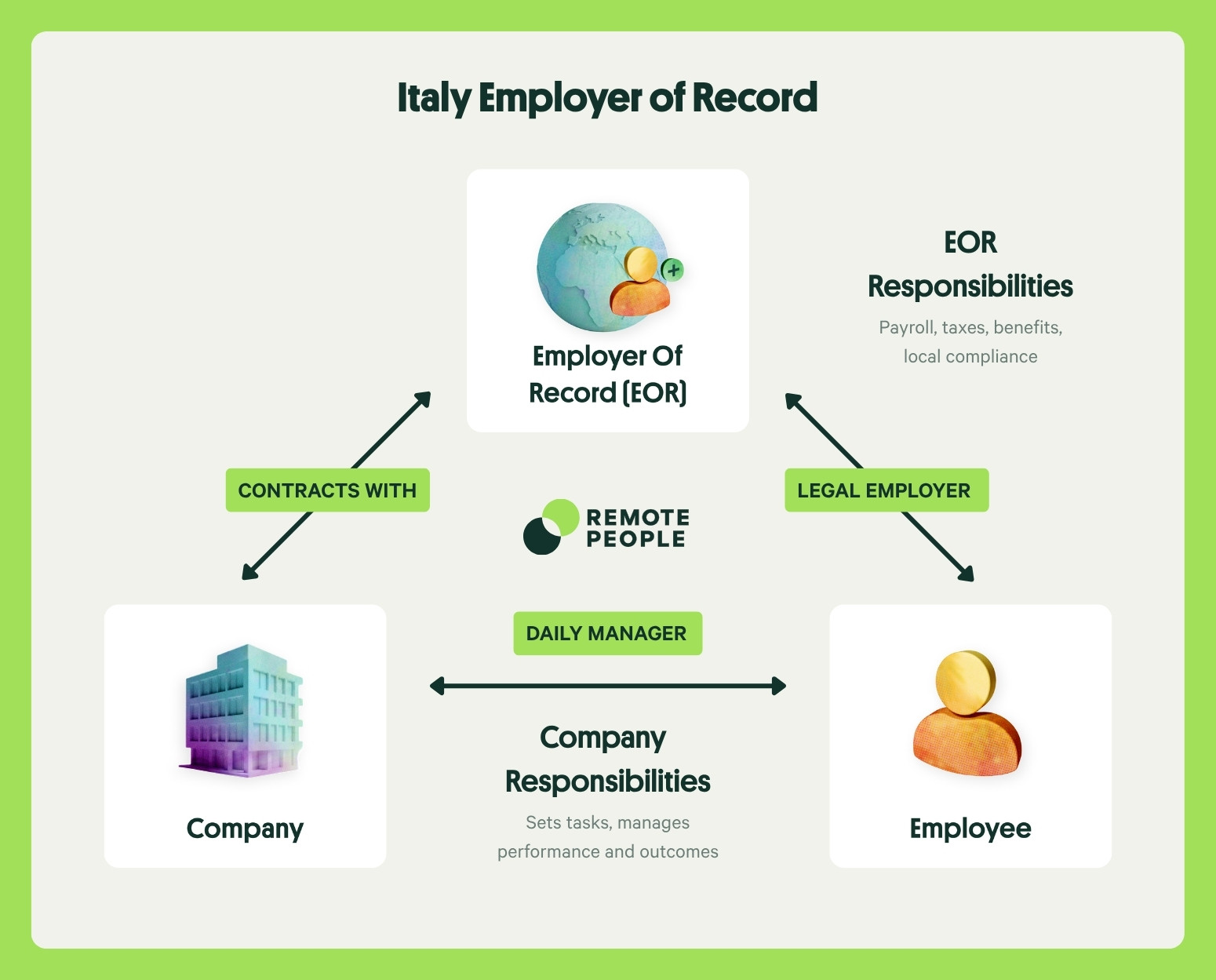
If you’d like to learn more about how Employer of Record (EOR) services work, read our What Is an Employer of Record (EOR)? guide for a complete overview of the model, its benefits, and when to use it.
If you’re comparing providers, our Best Employer of Record (EOR) Providers guide reviews the leading platforms to help you choose the right solution for your business.
Who Uses an EOR in Italy?
Companies of all sizes use EOR services in Italy, and for different reasons. What they have in common is a need to employ people locally without the cost and complexity of setting up an Italian entity.
Companies exploring the Italian market often hire one or two employees through an EOR to validate demand and build relationships before investing in a full subsidiary. This avoids the upfront cost and multi-month timeline of entity formation.
Organizations that need a handful of employees in Italy for sales, customer support, or product development can use an EOR to employ them compliantly without the overhead of maintaining a local entity. When speed matters, an EOR can have the employment contract signed and the employee onboarded in one to two weeks, compared to two to four months for entity incorporation.
Non-EU nationals require a work permit (nulla osta) to work in Italy. An EOR with a local entity can sponsor these permits and manage the quota-based application process under the Decreto Flussi.
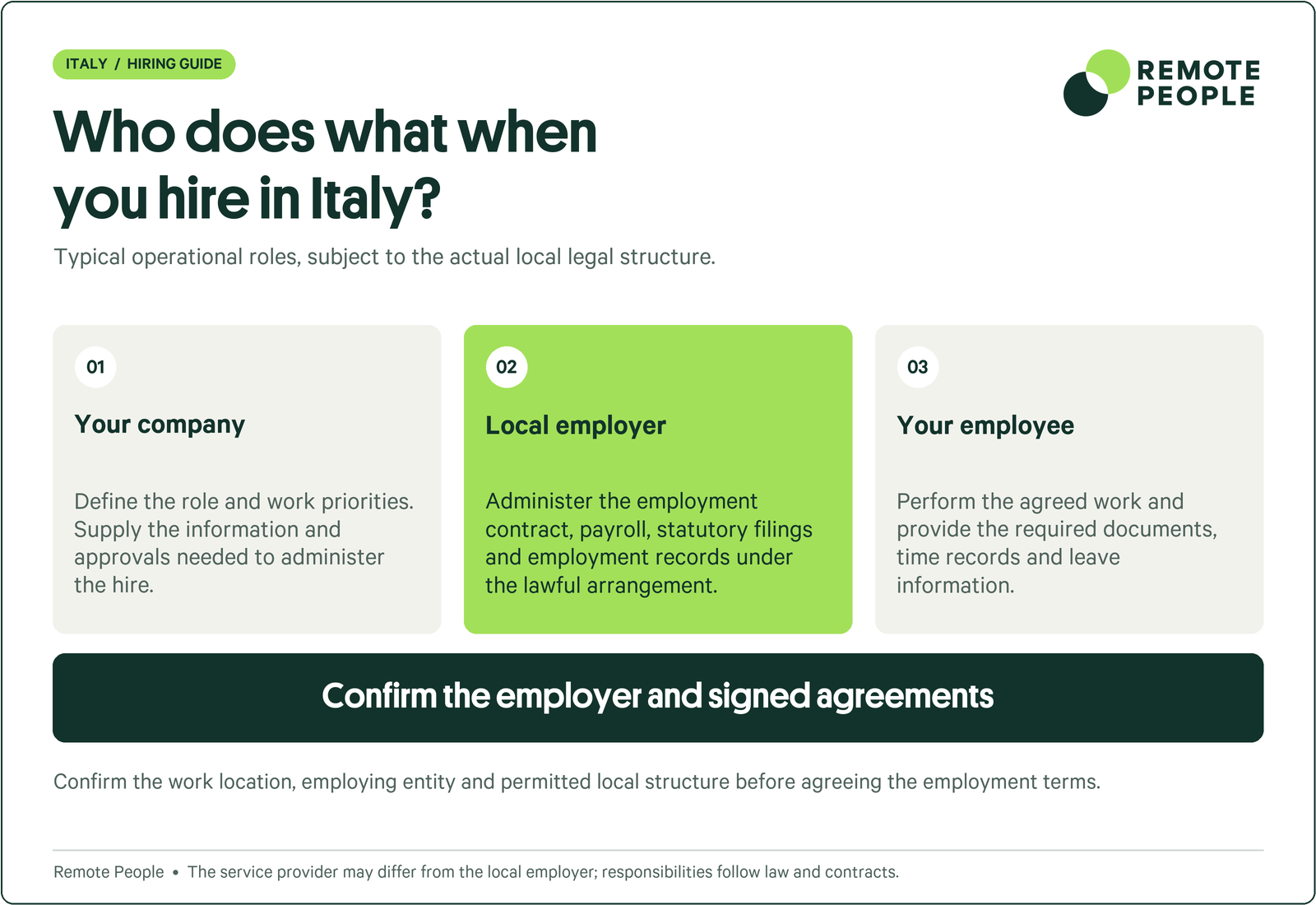
In each case, the EOR takes on the legal risk and administrative work, so the client company can focus on managing its team and growing its business in Italy.
Typical Onboarding Timeline
The EOR onboarding process in Italy follows a structured sequence. Here is what the timeline looks like for a standard hire who does not require a work permit:
- First: Sign the EOR service agreement and provide the new hire’s personal details, job description, compensation package, and start date. This takes one to two days.
- Second: The EOR drafts a compliant employment contract under Italian law and the applicable CCNL, reviews it with you, and sends it to the employee for signature. This typically takes two to three days.
- Third: The EOR registers the employee with INPS for social security, INAIL for workplace insurance, and the Agenzia delle Entrate for tax purposes. Registration takes three to five business days.
- Fourth: Payroll setup, benefits enrollment, and internal system configuration take two to three days.
- Fifth: The employee starts work on the agreed date. The EOR provides onboarding documentation and confirms all registrations are complete.
Most EOR providers can onboard an employee in Italy within one to two weeks. If the employee is a non-EU national requiring a work permit, the timeline extends by four to twelve weeks depending on the visa category and Decreto Flussi processing times.
Hire in Italy
Get compliant employment contracts, payroll, and benefits administration handled for you. Start onboarding your Italy-based team in as little as one to two weeks.
Employment Laws and Regulations in Italy
Employment Contracts
Employment in Italy is governed by the Italian Civil Code (Book V), Legislative Decree 81/2015 (the “Jobs Act”), and the Workers’ Statute (Law 300/1970). The Ministry of Labour and Social Policies (Ministero del Lavoro e delle Politiche Sociali) is the primary regulatory authority. In practice, much of Italian employment law is shaped by national collective bargaining agreements (CCNL), which set sector-specific rules on pay, working hours, leave, notice periods, and other terms (WIPO Lex).
All employment contracts in Italy must be in writing and must specify the job title, duties, workplace, compensation, working hours, applicable CCNL, contract type, and probation period. The two main contract types are indefinite-term (contratto a tempo indeterminato), which is the default and preferred form, and fixed-term (contratto a tempo determinato), which can last up to 12 months without justification or up to 24 months with a valid reason. Fixed-term contracts can be renewed up to four times within the 24-month limit (Chambers & Partners).
Working Hours and Overtime
The standard working week in Italy is 40 hours, as set by Legislative Decree 66/2003. Most employees work eight hours per day, Monday through Friday, though CCNLs may set different daily schedules.
The maximum working week, including overtime, must not exceed 48 hours averaged over a four-month period. Employees are entitled to a minimum daily rest of 11 consecutive hours and a weekly rest of at least 24 consecutive hours, typically on Sunday (PwC).
Overtime is regulated by both statute and the applicable CCNL. The annual cap on overtime is 250 hours per employee, unless a CCNL sets a different limit. Overtime rates vary by CCNL but typically follow the structure shown in the table below.
Italy overtime and premium pay rates · Per Legislative Decree 66/2003 & CCNL | |||
Hour Type | Rate Multiplier | Weekly/Daily Cap | Notes |
|---|---|---|---|
Weekday overtime (first tier) | +15% to +25% | 250 hours/year (statutory) | Exact rate set by applicable CCNL |
Weekday overtime (second tier) | +20% to +30% | Included in annual cap | Applies after first threshold (CCNL-dependent) |
Night work (23:00 – 06:00) | +15% to +30% | Max 8 hours/24-hour period | Night workers limited to 8 hrs average over reference period |
Sunday work | +30% to +40% | Per CCNL | Applies when Sunday is not the regular rest day |
Public holiday work | +50% to +60% | Per CCNL | Some CCNLs grant compensatory rest instead |
Night overtime | +30% to +50% | Subject to both night and overtime caps | Cumulative premium combining night and overtime rates |
Source: WIPO Lex and L&E Global Italy Employment Law | |||
Managerial employees (dirigenti) are generally exempt from overtime limits under most CCNLs. Overtime hours beyond the 250-hour annual cap are prohibited unless the CCNL explicitly allows a higher limit. Overtime does not affect the calculation of TFR severance or 13th month salary, as these are based on the standard contractual salary.
Minimum Wage
Italy does not have a statutory national minimum wage. Instead, minimum pay is determined by the applicable CCNL for each sector.
Italy has over 900 registered CCNLs, though around 30 major agreements cover the vast majority of workers. The hourly equivalent under most CCNLs ranges from approximately €7 to €9 per hour, depending on the sector and employee level (Eurofound).
In 2025, Italy enacted Law No. 144/2025, which delegates the government to safeguard minimum wage in Italy through strengthened collective bargaining frameworks rather than introducing a statutory minimum. This law aims to ensure that all workers receive fair compensation in line with Article 36 of the Italian Constitution, which guarantees a wage proportionate to the quantity and quality of work performed.
Probation Period
Probation periods (periodo di prova) in Italy must be agreed in writing before or at the start of employment. The maximum duration depends on the employee’s role and the applicable CCNL. For most non-managerial employees, the probation period ranges from one to three months.
For managers (dirigenti), the probation period can extend up to six months. For more details, see our guide on the probation period in Italy.
During probation, either party can terminate the employment relationship without notice and without severance. However, the employer cannot dismiss the employee before the minimum probation period has elapsed if one is specified in the CCNL. Once the probation period ends, the employment automatically converts to a confirmed contract with full statutory protections.
Leave Entitlements
Italian law gives employees a wide range of statutory leave entitlements. The Italian Civil Code, Legislative Decree 66/2003, and the applicable CCNL together set the minimums that every employer must provide. Here is what each leave type looks like.
Annual Leave
All employees in Italy are entitled to a minimum of four weeks (20 working days) of paid annual leave per year. Many CCNLs provide additional days based on seniority, with entitlements reaching 26 to 32 days for long-serving employees. At least two consecutive weeks must be taken within the calendar year of accrual.
The remaining two weeks can be carried over and used within 18 months. Leave accrues from the first day of employment, including during the probation period.
Sick Leave
Sick leave in Italy is a shared responsibility between the employer and INPS. For the first three days (the “carenza” period), the employer pays 100% of salary. From day four onward, INPS pays sickness benefits: 50% of average daily pay for days 4 through 20, and 66.67% for days 21 through 180.
Many CCNLs require the employer to top up the INPS benefit so the employee receives close to full pay. Employees must submit a medical certificate (certificato medico) to INPS electronically, and the employer can request a home visit to verify the illness.
Maternity Leave
Maternity leave (congedo di maternità) in Italy is five months, mandatory and fully protected. The standard split is two months before the expected due date and three months after birth, though employees can opt to work until one month before the due date and take four months after. INPS pays 80% of average daily pay during the full five months.
Most CCNLs require the employer to top up the remaining 20% so the employee receives full salary. Dismissal during pregnancy and until the child turns one year old is prohibited.
Paternity Leave
Fathers in Italy are entitled to 10 days of mandatory paid paternity leave (congedo di paternità obbligatorio), which can be taken within five months of the child’s birth. In the case of multiple births, paternity leave increases to 20 days. During this period, the father receives 100% of salary, funded by INPS.
Other Statutory Leave
Italian law and CCNLs provide several additional leave entitlements beyond annual, sick, and parental leave:
Each parent can take up to six months of parental leave (congedo parentale), with a combined maximum of 10 months (11 if the father takes at least three months). Starting in 2026, the first three months are paid at 80% of salary by INPS, with the remainder at 30%. Parental leave can be taken until the child turns 12.
Employees are entitled to 15 calendar days of paid marriage leave, as provided by most CCNLs. Three days of paid bereavement leave per year apply for the death or serious illness of a spouse, registered partner, or close family member under Law 53/2000.
Employees with at least five years of service are entitled to up to 150 hours of study leave over three years for continuing education, and the Workers’ Statute (Law 300/1970) grants the right to attend exams. Blood donors receive a paid day off on the day of donation under Law 219/2005.
Under the Italian Civil Code and Legislative Decree 66/2003, the table below summarises every statutory leave entitlement. The most important point for employers is that annual leave accrues from day one, including during the probation period, and unused leave must be paid out upon termination.
Italy statutory leave entitlements · Per Italian Civil Code & Legislative Decree 66/2003 | ||
Leave Type | Duration | Eligibility & Notes |
|---|---|---|
Annual leave | 4 weeks (20 days) minimum; up to 32 days per CCNL | All employees; accrues from day one; 2 weeks must be consecutive |
Sick leave | Up to 180 days per illness episode | Days 1–3 paid by employer (100%); days 4–20 INPS pays 50%; days 21–180 INPS pays 66.67%; CCNL top-ups common |
Maternity leave | 5 months (mandatory) | INPS pays 80%; most CCNLs top up to 100%; job protected until child turns 1 |
Paternity leave | 10 days (20 for multiple births) | 100% pay via INPS; must be taken within 5 months of birth |
Parental leave | Up to 6 months per parent (10–11 months combined) | First 3 months at 80% (2026); remainder at 30%; available until child turns 12 |
Marriage leave | 15 calendar days | Paid at full salary; per CCNL |
Bereavement leave | 3 days per year | For death or serious illness of spouse or close family; per Law 53/2000 |
Study leave | 150 hours over 3 years | Requires 5 years of service; per Workers’ Statute (Law 300/1970) |
Source: WIPO Lex and PwC Italy Tax Summary | ||
Statutory Employee Benefits
Beyond leave, Italian law requires employers to provide a range of additional benefits. Whether you employ directly or through an EOR, all of the following are mandatory:
Italy has a universal public healthcare system, the Servizio Sanitario Nazionale (SSN), funded through social security contributions and general taxation. All legally employed individuals and their dependents are covered. Many employers also offer supplementary private health insurance, though this is not legally required unless specified in the CCNL.
Both employers and employees contribute to the public pension system through INPS. The combined pension contribution rate is 33% of gross salary (approximately 23.81% employer, 9.19% employee). See the employee benefits in Italy page for additional detail.
TFR (trattamento di fine rapporto) accrues at approximately 7.41% of annual gross salary each year and is paid out upon termination of employment for any reason. Employees can choose to leave TFR with the employer, transfer it to a supplementary pension fund, or (in companies with 50+ employees) have it managed by the INPS Treasury Fund.
Employees who fall ill receive sick pay funded partly by the employer (first three days) and partly by INPS (from day 4 onward, at 50% for days 4–20 and 66.67% for days 21–180). Unemployment insurance (NASpI) provides income replacement at up to 75% of average salary for workers who lose their jobs involuntarily, with benefits lasting up to 24 months depending on contribution history.
Workplace accident insurance through INAIL covers medical treatment, temporary disability payments, and permanent disability compensation for work-related injuries and occupational diseases. Premiums are paid entirely by the employer.
Recent Regulatory Updates (2026)
Several changes to Italian employment law took effect in late 2025 and 2026. The biggest is the reduction of the second IRPEF income tax bracket from 35% to 33% for income between €28,000 and €50,000, effective from 2026. This was made permanent by the 2026 Budget Law and reduces the tax burden on mid-range earners (KPMG).
Law No. 144/2025 delegates the government to strengthen collective bargaining and ensure fair wages, moving away from proposals for a statutory minimum wage.
The law requires legislative decrees to be issued within six months to tackle underpayment and promote timely CCNL renewals. Separately, Law No. 132/2025 introduces a regulatory framework for the use of artificial intelligence in employment decisions, scheduled to take effect in 2026.
On parental leave, the 2026 Budget Law expands entitlements. The first three months of parental leave will now be paid at 80% of salary (up from 30% to 60% previously), and overall parental leave has been extended from 10 to 11 months as a baseline.
Productivity bonuses of up to €5,000 will be taxed at a preferential 1% rate instead of the standard IRPEF rates. Italy is also implementing the EU Pay Transparency Directive in 2026, which will require employers to provide greater salary disclosure and reporting.
Work Permits and Visas in Italy
Work Permit Requirements
Who Needs a Work Permit
EU, EEA, and Swiss nationals have the right to work in Italy without a work permit or visa. They can register with the local Anagrafe (registry office) after three months.
Non-EU nationals require a work permit (nulla osta al lavoro) and a work visa (visto per lavoro) to be employed in Italy. Some bilateral agreements and special categories (e.g., holders of long-term EU residence permits issued by another member state) may have simplified procedures.
Eligibility and Required Documents
To obtain a work permit in Italy, the employer must apply for the nulla osta through the Sportello Unico per l’Immigrazione (Single Immigration Desk). Required documents typically include a valid passport, the employment contract or offer letter, proof of adequate accommodation in Italy, educational qualifications or professional certifications, and evidence that the employer has met any applicable quota requirements under the Decreto Flussi. For more details on the process, see our work visas in Italy.
Processing Time and Validity
Processing times vary by visa category. The nulla osta must be issued within 30 days of the application being submitted, under the reformed Decreto Flussi rules.
After receiving the nulla osta, the employee applies for the work visa at the Italian consulate in their home country, which typically takes an additional two to four weeks. The initial work permit (permesso di soggiorno) is usually valid for one to two years, matching the duration of the employment contract.
Renewal Process
Work permit renewals must be submitted at least 60 days before the permit expires. The employee can continue working while the renewal is being processed, provided the application was submitted on time.
Renewal requires a valid employment contract, proof of continued employment, and updated documentation. After five years of continuous legal residence and employment, employees can apply for a long-term EU residence permit (permesso di soggiorno UE per soggiornanti di lungo periodo), which grants indefinite work rights.
Common Visa Types for Foreign Workers
Italy’s work visa system is managed by the Ministry of the Interior, with annual quotas set through the Decreto Flussi. The 2026–2028 Decreto Flussi authorizes approximately 500,000 work visas over three years.
The EOR can sponsor most categories except self-employment visas. Below is an overview of the main visa types available to foreign workers.
Italy work visa types for foreign workers · 2026 | ||||
Visa Type | Duration | Best For | Leads to Long-Term Residency? | Processing Time |
|---|---|---|---|---|
Subordinate work (Lavoro Subordinato) | 1–2 years | Standard employment | Yes (after 5 years) | 4–8 weeks |
EU Blue Card | 2 years (renewable) | Highly skilled workers (€46,000+ gross/year) | Yes (after 5 years) | 4–8 weeks |
Seasonal work | Up to 9 months | Agriculture, tourism | No | 4–6 weeks |
Intra-company transfer (ICT) | Up to 3 years (managers); 1 year (trainees) | Managers and specialists in multinational companies | No (unless converted) | 4–8 weeks |
Self-employment (Lavoro Autonomo) | 1–2 years | Freelancers and entrepreneurs | Yes (after 5 years) | 6–12 weeks |
Digital nomad visa | 1 year (renewable) | Remote workers employed by non-Italian companies | Yes (after 5 years) | 4–8 weeks |
Visa types not listed above, including tourist visas, student visas, and transit visas, do not permit employment in Italy.
How an EOR Handles Work Permits
An EOR in Italy can sponsor work permits for non-EU employees because the EOR operates through its own Italian legal entity. The EOR files the nulla osta application with the Sportello Unico, manages the documentation, and tracks the process through to permit issuance. The employee’s responsibilities include providing personal documents, attending the consulate appointment, and completing biometric registration upon arrival in Italy.
Using an EOR for work permit sponsorship adds approximately four to twelve weeks to the onboarding timeline described in the section above. The exact duration depends on the visa category, the employee’s nationality, and whether the application falls within the Decreto Flussi quota cycle.
EU Blue Card applications are exempt from quota limits and generally process faster. The EOR also handles permit renewals and any changes in employment terms that require permit amendments.
Payroll, Taxes, and Social Security in Italy
Employer Contributions
Employers in Italy make substantial social security contributions to INPS and INAIL on behalf of each employee. The total employer contribution rate typically ranges from 29% to 32% of gross salary, depending on the company’s sector, size, and risk classification. The table below shows the standard breakdown for a commercial-sector employer with 50 or more employees (INPS).
Italy employer social security contributions · 2026 rates | ||
Contribution | Rate | Notes |
|---|---|---|
IVS pension (INPS) | 23.81% | Main pension fund; no earnings cap for pre-1996 contributors |
NASpI unemployment (INPS) | 1.61% | Funds the Nuova Assicurazione Sociale per l’Impiego |
Sickness fund (INPS) | 2.22% | Employer-only contribution; funds INPS sick pay from day 4 |
Maternity fund (INPS) | 0.46% | Funds maternity and paternity leave payments |
CUAF family allowance (INPS) | 0.68% | Cassa Unica Assegni Familiari; now largely replaced by universal allowance |
FIS solidarity fund (INPS) | 0.50% | Wage guarantee for companies with 5+ employees not covered by CIG |
INAIL workplace insurance | 0.30% – 9.00% | Rate depends on risk classification; ~0.40% for office roles |
Total employer cost (typical office) | ~29.7% – 30.5% | Varies by sector, company size, and INAIL risk class |
Source: INPS Contribution Rates and PwC Italy Tax Summary | ||
Employee Contributions
Employees in Italy also contribute to social security through payroll deductions withheld by the employer (or EOR). The employee’s share is lower than the employer’s, and IRPEF income tax is withheld monthly based on the employee’s expected annual income. The table below shows the standard employee deductions (PwC).
Italy employee payroll deductions · 2026 monthly withholdings | ||
Deduction | Rate | Notes |
|---|---|---|
INPS pension contribution | 9.19% | On gross salary up to €55,448/year; 9.49% for some categories |
Additional INPS contribution | 1.00% | Applies only on gross salary exceeding €55,448/year |
IRPEF income tax | 23% – 43% | Withheld monthly per bracket; see income tax table below |
Regional surcharge (addizionale regionale) | 0.70% – 3.33% | Varies by region; applied to taxable income |
Municipal surcharge (addizionale comunale) | 0% – 0.90% | Varies by municipality; applied to taxable income |
Total employee deductions (illustrative) | ~30% – 45%+ | Depends on income level, region, and municipality |
Source: PwC Italy Tax Summary and Agenzia delle Entrate | ||
Income Tax
Italy uses a progressive income tax system called IRPEF (Imposta sul Reddito delle Persone Fisiche). The 2026 Budget Law reduced the number of brackets from four to three and lowered the second bracket rate from 35% to 33%.
The current IRPEF brackets are shown below. In addition to national IRPEF, employees pay regional and municipal surcharges that vary by location (Agenzia delle Entrate).
Italy income tax brackets · 2026 | |
Taxable Income Bracket | Tax Calculation |
|---|---|
Up to €28,000 | 23% of taxable income |
€28,001 – €50,000 | €6,440 + 33% on income above €28,000 |
Above €50,000 | €13,700 + 43% on income above €50,000 |
Source: Agenzia delle Entrate and PwC Italy Income Tax | |
Payroll Cycle
Payroll in Italy runs on a monthly cycle, with employees paid once per month, typically by the end of the month or the first few days of the following month. Payment must be made by bank transfer; cash payment of salaries is prohibited by law for amounts above a very low threshold. Employers must issue a detailed pay slip (busta paga) with every payment, showing gross salary, all deductions, employer contributions, and net pay.
Key payroll deadlines include: monthly IRPEF and social security contribution payments to INPS by the 16th of the following month (via F24 form), annual tax reconciliation (Certificazione Unica) by March, and the annual declaration (Modello 770) by October. INAIL premiums are calculated annually based on the prior year’s payroll and paid in February, with a balance adjustment in November.
13th Month Salary and Bonus Pay
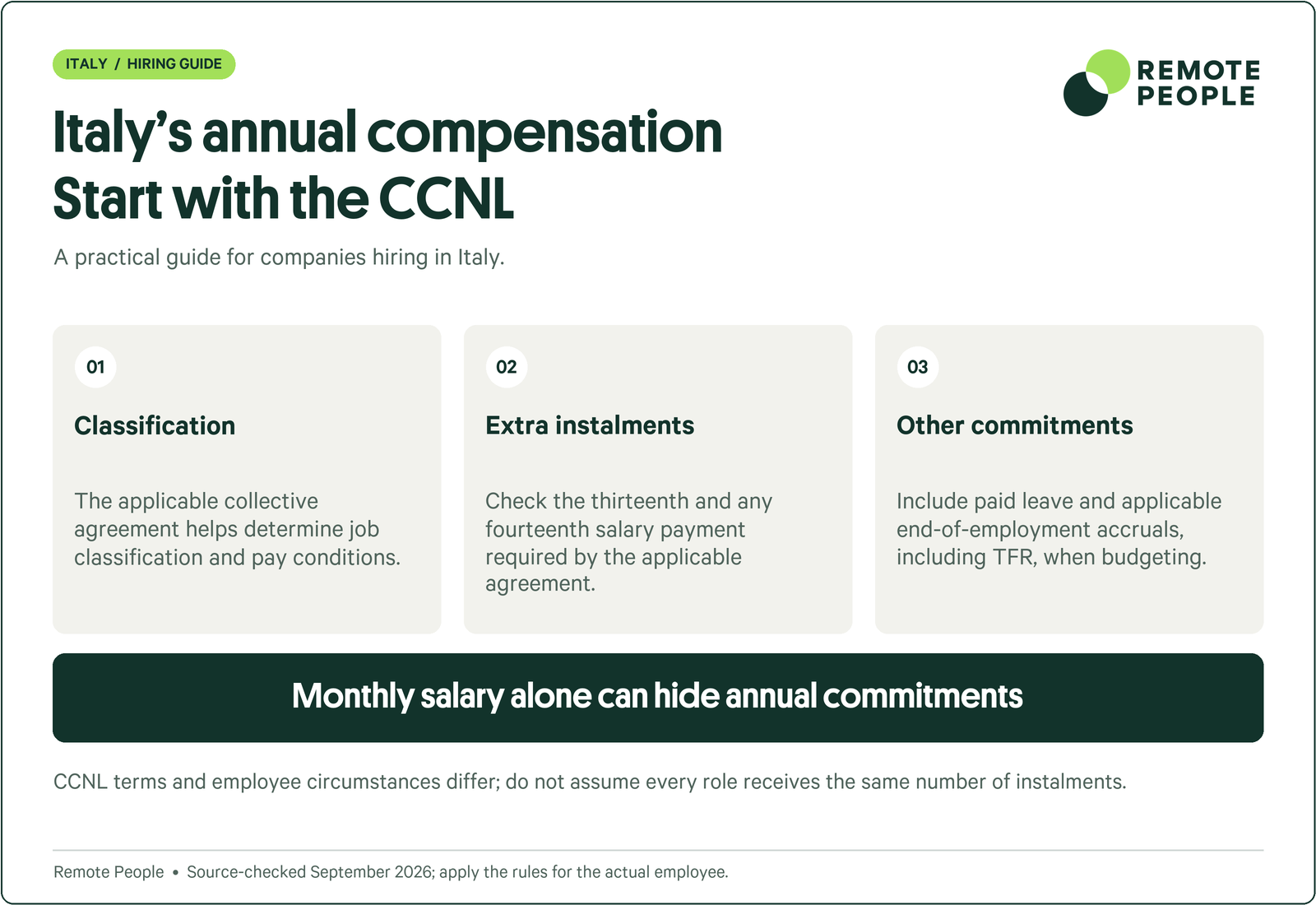
The 13th month salary (tredicesima) is mandatory in Italy for all employees. It equals one month’s gross salary and is paid in December, typically before Christmas. The tredicesima accrues at 1/12 of the monthly salary for each month worked.
Employees who join or leave mid-year receive a pro-rated amount. The tredicesima is subject to standard income tax and social security deductions.
Some CCNLs also require a 14th month salary (quattordicesima), usually paid in June or July. The quattordicesima is not required by law and depends entirely on the applicable CCNL.
The commerce sector CCNL (CCNL Commercio), for example, mandates a 14th month payment. Employers should factor the tredicesima (and quattordicesima if applicable) into their annual cost calculations, as these increase the total annual compensation by 8.3% to 16.7% above the stated monthly salary.
Cost of Hiring Through an EOR in Italy
EOR Service Fees
EOR service fees in Italy typically range from $300 to $600 per employee per month. This flat fee covers employment contract management, monthly payroll processing, tax withholding and filing, social security contributions, benefits administration, leave management, and ongoing compliance support. The exact fee depends on the complexity of the engagement, the number of employees, and the level of additional services (such as work permit sponsorship or supplementary benefits administration).
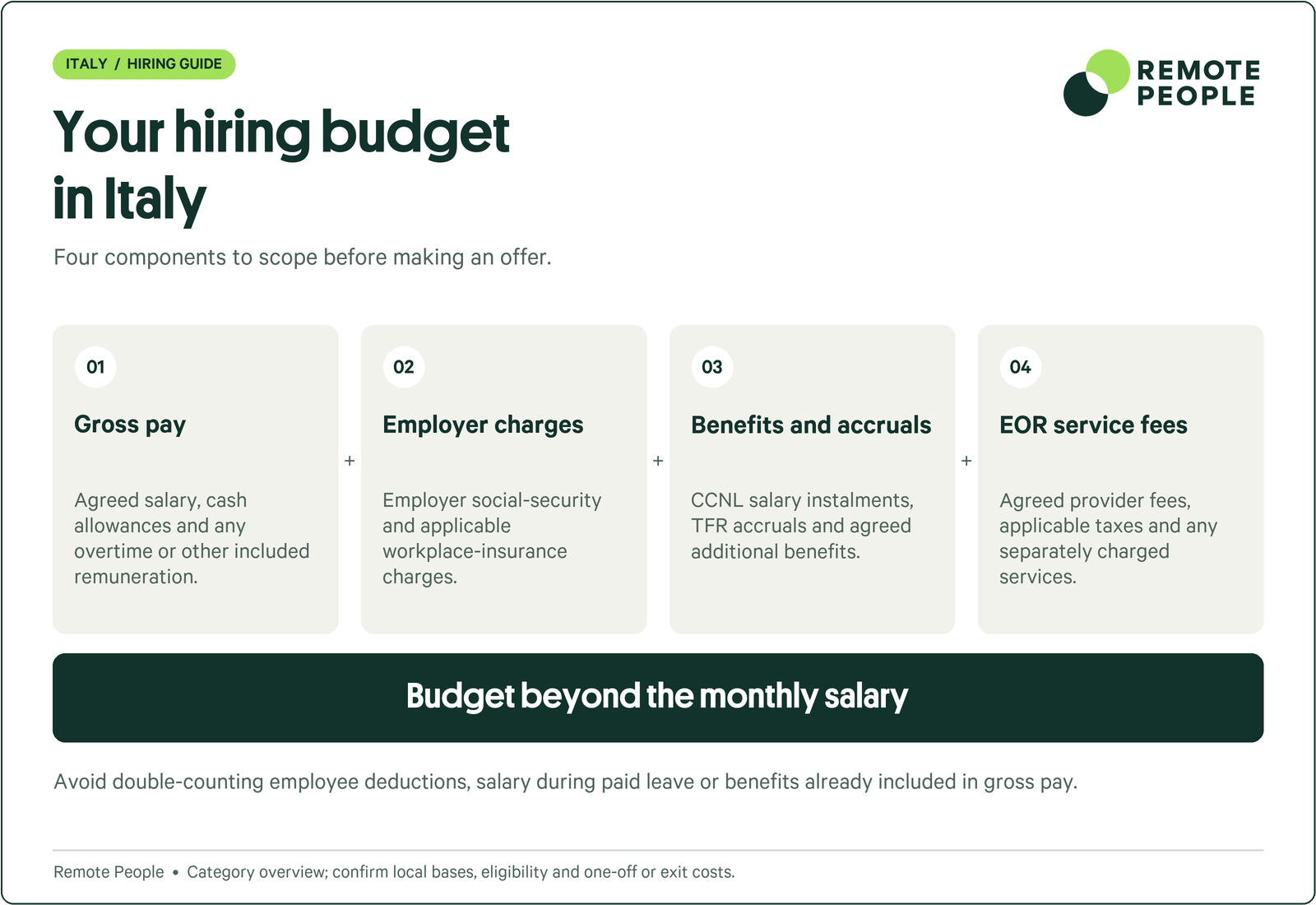
Total Employment Cost Breakdown
The table below shows the full monthly cost of employing someone through an EOR in Italy, using a $5,000 gross monthly salary as an example. This includes the employer’s social security contributions, TFR accrual, the 13th month salary provision, and the EOR service fee.
All figures are in USD. The exchange rate used is 1 USD ≈ 0.92 EUR (April 2026).
Italy employer cost example · USD 5,000 gross · 2026 | ||
Cost Category | Amount (USD) | % of Gross |
|---|---|---|
Gross monthly salary | $5,000 | 100% |
INPS employer contributions | $1,486 | 29.72% |
INAIL workplace insurance | $20 | 0.40% |
TFR accrual provision | $371 | 7.41% |
13th month salary provision | $417 | 8.33% |
EOR service fee | $499 | 9.98% |
Total monthly employer cost | $7,793 | 155.86% |
Source: INPS Contribution Rates and PwC Italy Tax Summary | ||
Ready to hire in Italy? Get started with RemotePeople, and we handle employment contracts, payroll, tax withholding, and full Italian compliance.
No local entity needed. Contact our team for a free consultation on hiring costs and timelines for your situation.
Benefits of Using an EOR in Italy
Using an employer of record in Italy gives you access to one of Europe’s most complex employment frameworks without taking on the compliance burden yourself. There are over 900 CCNLs, mandatory TFR accrual, a multi-layered tax system, and strong employee protections.
An EOR takes all of that off your plate. Here is what that looks like in practice.
An EOR can have your first employee in Italy onboarded and working within one to two weeks. Entity incorporation typically takes two to four months, plus additional time for bank account setup, INPS and INAIL registration, and payroll system configuration. If you need to hire quickly, an EOR eliminates this waiting period entirely.
Italian employment law is shaped by national statutes, EU directives, and the applicable CCNL for each employee’s sector. Getting any of these wrong—wrong CCNL classification, incorrect TFR calculation, missed INPS filing—can result in fines, back-payments, and legal disputes. The EOR’s local legal team keeps every aspect of the employment relationship compliant.
Running your own entity in Italy means paying for a registered office, accounting, corporate tax filings, and local legal counsel on top of employment costs. For teams of fewer than 10 to 15 employees, the EOR model is almost always more cost-effective. You pay a flat monthly fee per employee instead of absorbing the fixed overhead of an entity.
Because the EOR is the legal employer, it absorbs the direct legal risk of employment claims, wrongful termination disputes, and regulatory penalties. Your company retains operational control of the employee’s work while the EOR carries the employment liability on its books.
Italy’s notice period and TFR obligations make it expensive to exit quickly if a hire does not work out. With an EOR, you can scale your Italy team up or down without the sunk cost of maintaining a legal entity through quiet periods.
An EOR can manage employees across multiple Italian regions or across multiple EU countries from a single service agreement. You do not need separate entities, payroll providers, or legal advisors for each location.
For non-EU nationals, the EOR can sponsor work permits through its own Italian entity, manage Decreto Flussi applications, and handle EU Blue Card filings. You do not need your own entity or immigration infrastructure to bring in international talent.
Ready to see how an EOR simplifies hiring in Italy? Check our EOR pricing or contact us for a free consultation.
Termination and Offboarding in Italy
Notice Periods
Notice periods in Italy are governed by the applicable CCNL and vary based on the employee’s level, tenure, and the collective agreement in force. Both the employer and employee must provide written notice before terminating the employment relationship.
Italian law allows either party to pay salary in lieu of notice (indennità sostitutiva del preavviso). The notice period applies to indefinite-term contracts; fixed-term contracts end automatically at the agreed date unless renewed (L&E Global).
Italy statutory notice periods by position level · Per CCNL Commercio (Commerce sector) | |||
Position Level | Notice Period | During Probation | Notes |
|---|---|---|---|
Quadri and Level 1 (senior supervisors) | 45 – 120 calendar days | None required | Varies by tenure: shorter for <5 years, longer for 10+ years |
Levels 2 – 3 (professionals) | 30 – 90 calendar days | None required | Increases with years of service |
Levels 4 – 5 (skilled workers) | 20 – 60 calendar days | None required | Increases with years of service |
Levels 6 – 7 (entry-level workers) | 15 – 45 calendar days | None required | Increases with years of service |
Dirigenti (managers/executives) | 6 – 12 months | None required | Governed by the CCNL Dirigenti; significantly longer notice |
Source: WIPO Lex and L&E Global Italy Termination | |||
Dismissal for just cause (giusta causa), such as serious misconduct or criminal behavior, does not require notice. Mutual termination agreements (risoluzione consensuale) can specify their own terms. Employees who resign before the notice period expires must compensate the employer for the unserved portion unless the employer waives this right.
Severance Pay
Severance in Italy is unique compared to most other countries. The TFR (trattamento di fine rapporto) is a mandatory deferred compensation that accrues throughout the entire employment relationship.
It is owed to every employee upon termination, regardless of the reason, including resignation. The governing provision is Article 2120 of the Italian Civil Code (WIPO Lex).
Italy severance pay schedule by years of service · Per Italian Civil Code Art. 2120 | |||
Years of Service | Severance Amount (TFR) | Base Salary | Notes |
|---|---|---|---|
1 year | €3,407 | €46,000 annual gross | €46,000 ÷ 13.5 = €3,407 |
3 years | €10,222 | €46,000 annual gross | €3,407 × 3 = €10,222 (before revaluation) |
5 years | €17,037 | €46,000 annual gross | €3,407 × 5 = €17,037 (before revaluation) |
10 years | €34,074 | €46,000 annual gross | €3,407 × 10 = €34,074 (before revaluation) |
Source: WIPO Lex and Chambers & Partners | |||
Calculation Method
The TFR formula is: annual gross salary divided by 13.5 for each year of service. “Annual gross salary” includes the base salary, 13th month, 14th month (if applicable), and other regular compensation elements. Overtime is excluded.
The accumulated TFR is revalued each year by a fixed coefficient of 1.5% plus 75% of the ISTAT consumer price index. This revaluation means the actual payout at termination will be slightly higher than the simple multiplication shown in the table above.
Caps and Exceptions
There is no statutory cap on TFR, as it is not traditional severance but deferred compensation. TFR is owed in all termination scenarios: employer-initiated dismissal, employee resignation, retirement, mutual agreement, or end of a fixed-term contract. The only way an employee does not receive TFR is if the employment never started.
Employees may choose to redirect their TFR to a supplementary pension fund (fondo pensione complementare) instead of leaving it with the employer. In companies with 50 or more employees, unallocated TFR is automatically transferred to the INPS Treasury Fund. In addition to TFR, employees dismissed without just cause may be entitled to additional compensation under the Jobs Act (Legislative Decree 23/2015), ranging from 6 to 36 months’ salary depending on the circumstances and the applicable court ruling.
Grounds for Termination
Italian law recognizes three grounds for employer-initiated termination. Just cause (giusta causa) covers serious misconduct so severe that the employment relationship cannot continue even temporarily, such as theft, violence, or gross insubordination. No notice is required for just cause dismissal.
Justified subjective reason (giustificato motivo soggettivo) covers less severe employee misconduct or failure to perform, and requires the employer to serve the contractual notice period. Justified objective reason (giustificato motivo oggettivo) covers economic, organizational, or production-related reasons that are not related to the employee’s conduct.
Unfair dismissal protections in Italy are strong. Under the Jobs Act, employees hired after March 7, 2015, on indefinite contracts are entitled to compensation of two months’ salary per year of service (minimum 6, maximum 36 months) if a court finds the dismissal unjustified.
For employees hired before that date or in companies with fewer than 15 employees, different and sometimes more protective rules apply. Dismissals based on discrimination, pregnancy, or union activity are automatically void and require reinstatement.
EOR vs. Other Hiring Models in Italy
EOR vs. Setting Up a Local Entity
Setting up a company in Italy, typically as a Società a Responsabilità Limitata (S.r.l.), involves notarization of the articles of incorporation, registration with the Camera di Commercio, opening a local bank account, registering with INPS and INAIL, and establishing payroll systems. The process takes two to four months and costs €5,000 to €15,000 in setup fees, plus ongoing annual maintenance costs of €10,000 to €25,000. The table below compares an EOR with a local entity across nine dimensions.
Italy EOR vs local entity comparison · Setup time, cost, risk and best-fit | ||
Comparison | Employer of Record | Own Entity (S.r.l.) |
|---|---|---|
Setup time | 1–2 weeks | 2–4 months |
Upfront cost | $0 | $5,000–$15,000 |
Ongoing cost | $300–$600/employee/month | $10,000–$25,000/year maintenance |
Local partner required | No (EOR is the local entity) | No (single-shareholder S.r.l. allowed) |
Social insurance registration | Handled by EOR | You manage it |
Payroll & tax filing | Handled by EOR | You manage it (or outsource) |
Best for team size | 1–15 employees | 15+ employees |
Scale down / exit | Easy, no entity to unwind | Costly, legal dissolution required |
Government contracts | Not eligible | Eligible (requires local entity) |
Source: Chambers & Partners and L&E Global Italy | ||
For companies that need to test the Italian market or hire a small team, the EOR is the faster and more cost-effective option. Entity setup makes sense once your Italian headcount exceeds 15 employees and you plan to maintain a long-term, permanent presence in the country.
The key trade-off is control. With an entity, you have complete flexibility over employment policies, benefits packages, and strategic decisions. With an EOR, you operate within the EOR’s established employment framework, which is optimized for compliance but may offer less room for custom policies.
EOR vs. Hiring Independent Contractors
Hiring independent contractors in Italy can seem simpler and cheaper than using an EOR, but it carries significant legal risk. Italy has strict rules on worker classification, and the consequences of misclassification include back payment of all employer social security contributions, IRPEF withholding, TFR, leave entitlements, and penalties.
The table below compares the two models. For more on hiring contractors in Italy, see our dedicated guide.
Italy EOR vs independent contractors · Compliance, cost, and risk | ||
Comparison | EOR (Full-Time Employee) | Independent Contractor |
|---|---|---|
Legal relationship | Employee of the EOR | Self-employed, no employment relationship |
Compliance risk | Low, EOR ensures local labor law compliance | High, misclassification risk if relationship resembles employment |
Payroll & tax | EOR handles withholding, contributions, filings | Contractor invoices you; they handle their own taxes |
Benefits & leave | Statutory benefits, paid leave, social security | No entitlement to employee benefits |
IP protection | Stronger, employment contract assigns IP by default | Weaker, requires explicit IP assignment clause |
Termination | Subject to local notice periods and severance | Contract can be ended per agreement terms |
Best for | Long-term, core team roles | Short-term projects, specialized tasks |
Cost structure | Salary + employer contributions + EOR fee | Contractor fee (typically higher gross, lower total cost) |
Source: Chambers & Partners and L&E Global Italy | ||
Italy distinguishes between genuine self-employment and “collaborazione coordinata e continuativa” (coordinated and continuous collaboration), which is a form of quasi-employment. If a contractor works exclusively for one client, follows set hours, uses the client’s tools, and is integrated into the client’s organizational structure, Italian courts can reclassify the relationship as employment. The consequences include retroactive payment of all employer contributions, TFR, leave, and 13th month salary from the start of the engagement, plus penalties.
For any role where the worker will be integrated into your team on an ongoing basis, using an EOR provides significantly more legal protection than engaging the person as a contractor. Reserve contractor arrangements for genuinely independent, project-based engagements where the contractor controls how and when they work.
EOR vs. PEO (Professional Employer Organization)
In Italy, staff leasing (somministrazione di lavoro) is regulated by Legislative Decree 81/2015 and requires ministerial authorization. A PEO in Italy operates under this co-employment model, where the PEO becomes the formal employer while the client retains operational control. The critical difference between an EOR and a PEO is that a PEO requires your company to already have a local entity in Italy, while an EOR does not.
Italy EOR vs PEO comparison · Legal employer, liability, and setup | ||
Comparison | Employer of Record (EOR) | PEO |
|---|---|---|
Legal employer | EOR is the legal employer | You remain the legal employer (co-employment) |
Local entity required | No, the EOR is the local entity | Yes, you must have your own entity in Italy |
Best for | Companies without a local entity | Companies that already have a local entity |
Compliance liability | EOR assumes compliance responsibility | Shared liability between you and the PEO |
Setup time | 1–2 weeks | Depends on your entity setup (weeks to months) |
Control over HR policies | EOR manages within local law framework | More direct control, PEO advises |
Typical use case | Market entry, small remote teams, testing new markets | Established local operations needing HR outsourcing |
Source: Chambers & Partners and L&E Global Italy | ||
Under Italian law, staff leasing agencies (including entities operating as PEOs) must hold specific ministerial authorization from the Ministry of Labour. The number of staff-leased employees cannot exceed 20% of the client’s permanent workforce for indefinite contracts or 30% for fixed-term contracts. These limits do not apply to EOR arrangements where the EOR is the sole legal employer.
If you do not have a local entity in Italy and do not plan to establish one, the EOR is the correct model. If you already have an Italian subsidiary and want to outsource HR and payroll administration, a PEO may be appropriate. For most companies hiring their first employees in Italy, the EOR path is faster, simpler, and carries less compliance risk.
Public Holidays in Italy
Italy observes 12 national public holidays each year, plus a local patron saint’s day that varies by city (for example, June 24 in Florence for San Giovanni, December 7 in Milan for Sant’Ambrogio). Employees who work on a public holiday are entitled to premium pay per their CCNL, typically 50% to 60% above the standard rate. The table below lists all national public holidays for 2026 (timeanddate.com).
Italy public holidays · 2026 calendar year | ||
Date | Holiday | Type |
|---|---|---|
January 1 | Capodanno (New Year’s Day) | National |
January 6 | Epifania (Epiphany) | National |
April 5 | Pasqua (Easter Sunday) | National |
April 6 | Lunedì dell’Angelo (Easter Monday) | National |
April 25 | Festa della Liberazione (Liberation Day) | National |
May 1 | Festa dei Lavoratori (Labour Day) | National |
June 2 | Festa della Repubblica (Republic Day) | National |
August 15 | Ferragosto (Assumption of Mary) | National |
November 1 | Ognissanti (All Saints’ Day) | National |
December 8 | Immacolata Concezione (Immaculate Conception) | National |
December 25 | Natale (Christmas Day) | National |
December 26 | Santo Stefano (St. Stephen’s Day) | National |
Source: timeanddate.com Italy 2026 and Agenzia delle Entrate | ||
Public holidays falling on a weekend are generally not moved to the following Monday in Italy. However, when a holiday falls on a Tuesday or Thursday, many Italian companies observe an unofficial “ponte” (bridge day), giving employees the Monday or Friday off to create a long weekend. Employers should plan payroll and project timelines around the August holiday period, as many Italian businesses significantly reduce operations during the weeks surrounding Ferragosto (August 15).
How to Get Started with an EOR in Italy
If you are ready to hire employees in Italy, Hiring your first employee in Italy through an EOR takes five steps, from the initial setup to the employee’s first day.
- First: Define the role and compensation. Determine the job description, required qualifications, salary (benchmarked against Italian market rates and the applicable CCNL), and benefits package. Your EOR provider can advise on competitive compensation for the Italian market and help you understand the total employer cost, including social security, TFR, and the 13th month salary.
- Second: Select your EOR provider and sign the service agreement. Choose an EOR with a legal entity in Italy, experience with the relevant CCNL for your industry, and the ability to handle work permits if needed. The service agreement defines the EOR’s responsibilities, your obligations as the client, fee structure, and termination terms.
- Third: Onboard the employee. Provide the employee’s personal details and the agreed compensation package. The EOR drafts a compliant employment contract, registers the employee with INPS and INAIL, and configures payroll. The employee signs the contract and starts work, typically within one to two weeks of signing the service agreement.
- Fourth: Manage day-to-day work. You direct the employee’s daily tasks, set goals, and manage performance. The EOR handles all back-office employment administration: monthly payroll runs, tax filings, leave tracking, benefits management, and compliance updates. Most EORs provide an online platform where you can view payroll reports, manage leave requests, and access employment documents.
- Fifth: Scale, adjust, or transition. As your needs evolve, you can add more employees through the same EOR, adjust compensation, or eventually transition employees to your own Italian entity if you decide to incorporate. The EOR handles the offboarding process if you need to end an engagement, including TFR payout, notice periods, and final payroll.
Ready to hire in Italy? Contact RemotePeople for a free consultation on Italian hiring costs, timelines, and compliance requirements. We handle the employment, so you can focus on building your team.
Where companies hiring in Italy expand next
Employers with operations in Italy often extend across Southern Europe, leveraging EU portability and overlapping business culture. Teams frequently add operations in France for EU-wide worker mobility and portable social security; Spain often follows for shared EU compliance frameworks; hiring in Switzerland is a common next step, offering EU-level labor law alignment; and an EOR partner in Greece rounds out the regional footprint with adjacent EU market with harmonized labor directives.
Frequently Asked Questions
EOR services in Italy typically cost between $300 and $600 per employee per month as a flat service fee. On top of that, you pay the employee’s gross salary plus mandatory employer contributions (approximately 30% for INPS and INAIL (PwC)), TFR accrual (7.41%), and 13th month salary provision (8.33%). For a $5,000/month gross salary, the total monthly employer cost is approximately $7,800.
An EOR can onboard an employee in Italy within one to two weeks for EU nationals who do not require a work permit. For non-EU nationals needing a work visa, the process takes an additional four to twelve weeks depending on the visa category and Decreto Flussi processing times (Italian Ministry of Foreign Affairs).
Italy does not have a statutory national minimum wage. Pay floors are set by national collective bargaining agreements (CCNL) for each sector (WIPO Lex). The applicable CCNL determines the minimum salary for each job level. Typical hourly equivalents range from approximately €7 to €9 depending on the sector.
The 13th month salary (tredicesima) is mandatory in Italy (WIPO Lex). It equals one month’s gross salary and is paid in December. It accrues monthly at 1/12 of the monthly salary. Some sectors also require a 14th month salary (quattordicesima), typically paid in June or July, depending on the applicable CCNL.
TFR (trattamento di fine rapporto) is a mandatory deferred compensation that accrues at approximately 7.41% of annual gross salary each year (WIPO Lex). It is paid to the employee upon termination of employment for any reason, including resignation. TFR is not traditional severance; it is earned compensation that the employer sets aside throughout the employment relationship.
Yes. Because the EOR operates through its own Italian legal entity, it can apply for the nulla osta (work authorization) on behalf of non-EU employees and sponsor work permits through the Sportello Unico (Italian Ministry of Foreign Affairs) per l’Immigrazione. This includes standard subordinate work permits and EU Blue Card applications.
Employers in Italy contribute approximately 30% of gross salary to INPS (PwC) for pension (23.81%), unemployment (1.61%), sickness (2.22%), maternity (0.46%), and family allowance (0.68%), plus INAIL workplace insurance (0.30% to 9.00% depending on risk classification). Rates can vary by sector and company size.
The EOR manages the full termination process under Italian law (WIPO Lex). That means serving the notice period required by the applicable CCNL (which varies by employee level and tenure), calculating and paying the final TFR amount, processing final payroll including any unused leave payout, and filing termination documentation with INPS. Italy has strong unfair dismissal protections, so having the EOR handle the process reduces your legal exposure.
No. An employer of record in Italy eliminates the need to set up your own Italian subsidiary. The EOR uses its existing legal entity to employ workers on your behalf, handling contracts, payroll, tax filings, and INPS registration. This saves you the two to four months and tens of thousands of euros it takes to incorporate in Italy (RemotePeople EOR).
An EOR in Italy is designed for hiring employees, not contractors. However, RemotePeople also offers a contractor management solution that handles compliant contractor agreements, invoicing, and payments in Italy. This is important because Italy has strict rules on subordinate employment versus autonomous work, and misclassification can result in back-payments and fines under Legislative Decree 81/2015 (WIPO Lex).
Probation periods in Italy (periodo di prova) must be agreed in writing before or at the start of employment. The maximum duration is set by the applicable CCNL and typically ranges from one to six months depending on the employee's job level and seniority. During probation, either party can terminate without notice or severance (WIPO Lex). See the probation period in Italy page for full details.
A PEO (professional employer organization) in Italy creates a co-employment arrangement where you and the PEO share employer responsibilities, and you still need your own Italian legal entity. An EOR becomes the sole legal employer of your workers in Italy, so you do not need a local entity at all. For companies without an Italian subsidiary, an EOR is the only compliant option. See the PEO in Italy page for a full comparison.
Employer of Record in
Employer of Record in
Employer of Record in
Employer of Record in
Employer of Record in
Employer of Record in
Employer of Record in
Employer of Record in