
 Recruit
Employer of Record (EOR) in Malta
-
 Drew Donnelly
- Published
- September 22, 2026
An Employer of Record (EOR) in Malta is a Maltese-registered company that hires employees on your behalf, handling Inland Revenue Department FSS tax, social security contributions, Jobsplus registration, and Employment and Industrial Relations Act compliance. A Malta EOR lets you hire local talent in 1–2 weeks—no Maltese entity required.
Hire in Malta — book a free 30-minute demo
Tell us what you need. You'll get a tailored, transparent proposal within 24 hours, plus a free call to walk through it.
Tell us about your company
So we can match you with a specialist who knows your market — and unlock volume pricing tiers.
* All fields are required.
Where and when are you hiring?
Tell us the geography and timing and we'll quote each country line by line, with onboarding timelines.
* All fields are required.
Help us beat your current setup
We'll benchmark your current deal and send a line-by-line proposal in 24 hours — showing exactly where we cut cost, time, or risk. After you submit, you can book a call to walk through it together.
* All fields are required.
Thanks! Your proposal is on its way.
Expect a tailored, line-by-line proposal in your inbox within 24 hours. In the meantime…
Want to walk through it together?
Book a free 30-minute call with one of our specialists. We'll explain every line, answer your questions, and tailor the proposal further if you need.
No obligation. Pick a time that works for you.








- Hire in Malta — book a free 30-minute demo
- Tell us about your company
- Where and when are you hiring?
- Help us beat your current setup
- Thanks! Your proposal is on its way.
- How an Employer of Record Works in Malta
- Employment Laws and Regulations in Malta
- Work Permits and Visas in Malta
- Payroll, Taxes, and Social Security in Malta
- Cost of Hiring Through an EOR in Malta
- Benefits of Using an EOR in Malta
- Termination and Offboarding in Malta
- EOR vs. Other Hiring Models in Malta
- Public Holidays in Malta
- How to Get Started with an EOR in Malta
- Frequently Asked Questions
- Related EOR Destinations

Start hiring in Malta
Let RemotePeople handle payroll, compliance, and HR admin worldwide so you can focus on building your team.

An employer of record (EOR) in Malta allows companies to hire employees without establishing a local entity, with EOR services typically costing USD 300–USD 600 per employee per month.
The EOR becomes the legal employer and handles payroll, tax withholding, social security contributions, statutory benefits, work permits, and employment contracts on your behalf—ensuring full compliance with Maltese employment law under the Employment and Industrial Relations Act (Chapter 452). Malta’s EU membership, English-speaking workforce, and competitive tax rates make it a popular hiring destination, but navigating its Wage Regulation Orders, sector-specific rules, and contribution thresholds requires local expertise.
This guide covers everything you need to know about hiring through an EOR in Malta in 2026, including employment regulations, tax structures, termination rules, and work permit requirements.
How an Employer of Record Works in Malta
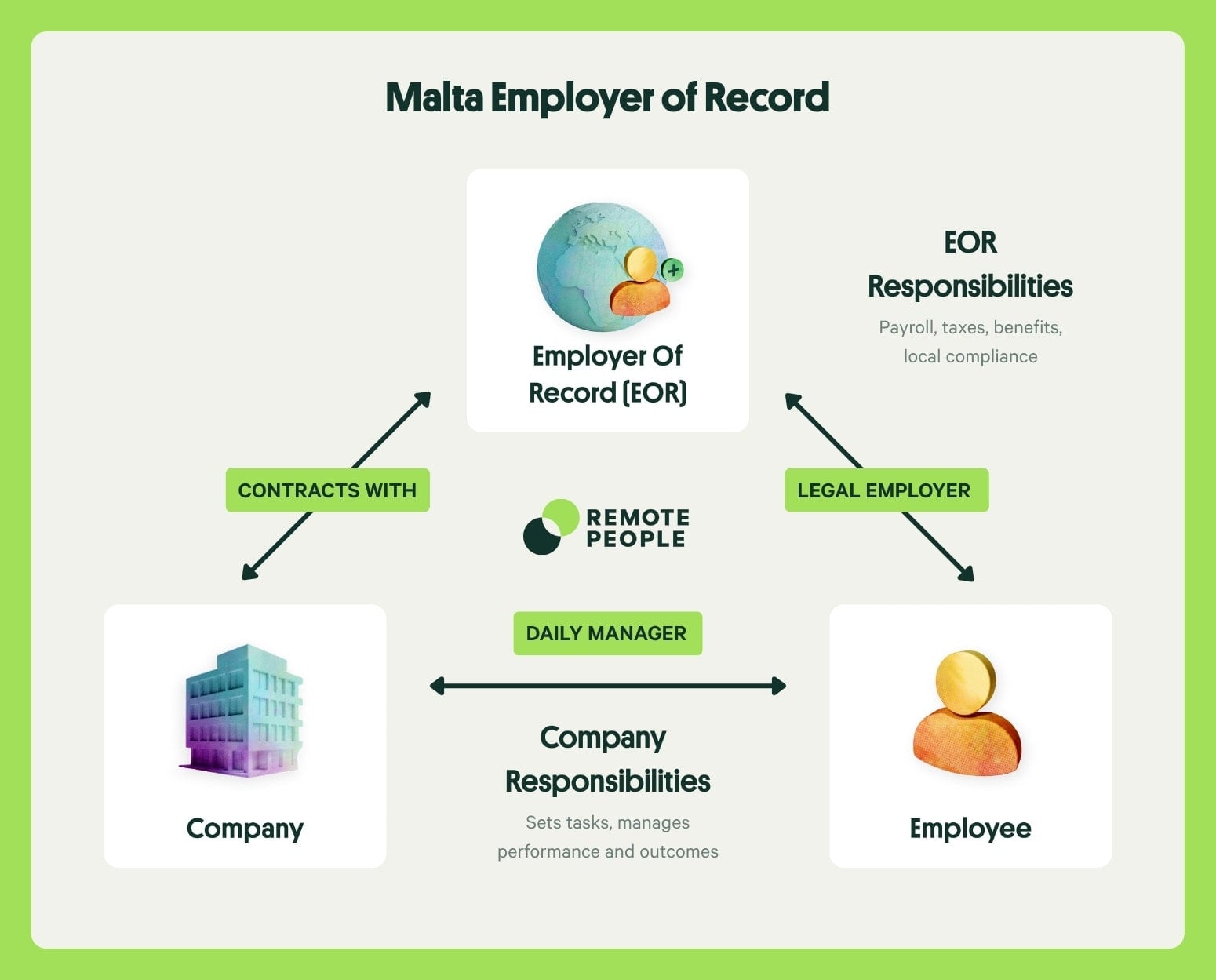
If you’d like to learn more about how Employer of Record (EOR) services work, read our What Is an Employer of Record (EOR)? guide for a complete overview of the model, its benefits, and when to use it.
If you’re comparing providers, our Best Employer of Record (EOR) Providers guide reviews the leading platforms to help you choose the right solution for your business.
Who Uses an EOR in Malta?
Companies that want to hire employees in Malta use EOR services for several common scenarios:
- Market testing: Early-stage companies entering the Maltese market without committing to the cost and complexity of establishing a local entity (which typically takes 3–4 months and EUR 3,000–EUR 8,000).
- Small distributed teams: Organizations hiring 1–15 remote or hybrid workers in Malta without the overhead of opening a payroll office or subsidiary.
- Rapid hiring: Companies needing to onboard Maltese talent within 1–2 weeks rather than waiting 8–12 weeks for entity registration and compliance setup.
- International talent: Employers seeking to hire foreign nationals in Malta who need work permit sponsorship, visa coordination, and local employment law expertise.
An EOR is also useful when you need to scale up or down without bearing the legal and financial costs of entity dissolution or restructuring.
Typical Onboarding Timeline
Once you engage an EOR provider in Malta, hiring typically unfolds as follows. Initial verification and document collection takes 1–2 business days, during which the EOR confirms the employee’s identity and gathers necessary information. Employment contract preparation and local labour law review takes 2–4 business days. Social security and tax registration happens in parallel and takes 3–5 business days. If the hire involves a non-EU/EEA citizen, work permit filing adds 6–12 weeks (or 3–6 weeks for priority cases). Payroll setup and first payment typically occurs within 1–2 weeks of contract signature. End-to-end, for EU citizens, you can have a fully onboarded Maltese employee within 1–2 weeks; for non-EU workers, expect 2–3 months including work permit processing.
Hire in Malta
An EU island hub for iGaming and fintech with SSC contributions, Employment and Industrial Relations Act, and Maltese compliance requirements.
We handle employment contracts, payroll, social contributions, and full Maltese compliance.
No local entity needed. Your team can start in days.
Employment Laws and Regulations in Malta
Employment Contracts
Maltese labour law requires a written employment contract for every employee. The governing statute is the Employment and Industrial Relations Act (EIRA), Chapter 452 of the Laws of Malta, enforced by the Department of Industrial and Employment Relations (DIER). An EOR in Malta prepares contracts that fully comply with all statutory requirements. The contract must specify job title, place of work, salary, start date, and employment term (permanent, fixed-term, or probationary). Under Article 35 of the Labour Law, the contract must include all essential terms and conditions. Contracts must be in Maltese or translated into Maltese; employers may provide a version in another language for reference only. Any changes to employment terms require a written amendment signed by both parties. An EOR ensures contracts remain compliant with evolving regulations and reflect current Maltese employment norms.
Working Hours and Overtime
The standard working week in Malta is 40 hours, typically spread across 8 hours per day, Monday through Friday. Employees are entitled to a minimum of 11 consecutive hours of rest between shifts and at least one uninterrupted 24-hour rest period per week (usually Sunday). Overtime is compensation for any hours worked beyond 40 per week. The vast majority of employees not covered by a Wage Regulation Order (WRO) are entitled to overtime compensation at 150% (1.5x) the normal hourly rate. However, most sectors in Malta–including retail, catering, hospitality, healthcare, and construction–have sector-specific Wage Regulation Orders that often mandate 200% (2x) or 250% (2.5x) premiums for work on Sundays, public holidays, and night shifts. The law limits total working time (including overtime) to an average of 48 hours per week over a 17-week reference period, unless an employee has signed an individual opt-out agreement.
Malta overtime and premium pay rates · Per Employment and Industrial Relations Act (Chapter 452) | |||
Hour Type | Rate Multiplier | Weekly/Daily Cap | Notes |
|---|---|---|---|
Overtime (beyond 40h/week, no WRO) | 150% (1.5x base rate) | Average 48h/week over 17-week period | Statutory minimum; sector WRO may mandate higher |
Sunday work (sector WRO) | 200%–250% (2.0x–2.5x base rate) | As per applicable WRO | Specific to retail, catering, hospitality, construction |
Public holiday work (sector WRO) | 200%–250% (2.0x–2.5x base rate) | As per applicable WRO | Plus holiday recognition; employer may require assignment |
Night work (generally 10 PM–6 AM, sector-dependent) | 150%–200% (1.5x–2.0x base rate) | Sector-dependent, no daily cap | Depends on sector WRO; specific premium varies |
Overtime rates vary by sector due to Malta’s Wage Regulation Order system. An EOR in Malta applies the correct overtime rate based on the employee’s industry and will flag if a sector-specific WRO applies to your hire.
Minimum Wage
As of 1 January 2026, the national minimum wage in Malta is EUR 229.44 per week (approximately EUR 997 per month for a 40-hour week), set by government regulation effective from 1 January 2026. This represents an increase of EUR 4.66 per week from the previous minimum of EUR 221.78. This rate applies to all employees aged 18 and over. Employers cannot pay less than this amount unless a Wage Regulation Order (WRO) for their specific sector mandates a higher minimum. Part-time employees are entitled to the same minimum wage on a pro-rata basis. Younger workers (17 and under) have lower statutory minimums: EUR 222.66 per week for age 17, and EUR 219.82 per week for under 17. An EOR ensures all payroll calculations meet or exceed the current minimum wage floor and adjusts automatically when rates change.
Probation Period
Under the Employment and Industrial Relations Act, employers in Malta may establish a probationary period of up to 3 months (or 1 month for workers under 18). During the first month of probation, the employer may terminate the employee without providing notice and without any obligation to pay severance or salary in lieu of notice. If the employee is terminated after the first month but before probation ends, a one-week notice period applies. Once probation is completed, full statutory notice periods apply. Probation is optional; many employers use it to assess fit, skills, and cultural alignment before committing to permanent employment. An EOR will clearly specify the probation period in the employment contract and ensure compliance with termination procedures if probation ends in dismissal.
Leave Entitlements
Maltese labour law guarantees employees a comprehensive suite of paid and unpaid leave, from annual vacation to parental leave. All statutory leave is regulated by the Employment and Industrial Relations Act (EIRA) Chapter 452. Below is a detailed breakdown of statutory leave types and their eligibility rules.
Annual Leave
Every employee working a 40-hour week is entitled to a minimum of 192 hours of paid annual leave per year (approximately 4.8 weeks or 24 calendar days). Employees aged under 18 receive one additional calendar month (approximately 22–23 working days) annually. Annual leave accrues from the first day of employment and must be paid at the employee’s average daily rate (based on the preceding 12 months’ salary or contractual rate). Employers must grant at least two consecutive weeks of leave in a single uninterrupted period each year. Up to 50% of annual leave entitlement can be carried forward to the following year if there is a written agreement with the employer; the remaining leave must be taken or paid out. Unused leave carried forward into the next year must be taken by 30 June of that year or forfeited. During probation, annual leave accrues normally and is not forfeited if probation ends in dismissal during the first month (though no payout is owed for leave not yet taken).
Sick Leave
Under Maltese law, employees are entitled to 12 days of fully paid sick leave and an additional 12 days of sick leave at 50% pay each calendar year. The first day of illness may be unpaid at employer discretion (subject to contract terms). Days 2 and onwards are paid at the rates specified above. A medical certificate is typically required from the employer from day 4 onwards, though employers may require one earlier if authorized by contract. Sick leave is covered by the Social Security scheme and is governed by the Law on Maternity and Sickness Insurance. Extended illness beyond 24 days per calendar year may be subject to state social insurance support.
Maternity Leave
Maternity leave in Malta spans 18 weeks total: two weeks before the expected date of childbirth and 16 weeks after birth. If pregnancy is medically complicated, the pre-natal portion extends to four weeks (total 20 weeks). The first 14 weeks are fully paid by the employer and refunded through the national Social Security fund. The remaining weeks (14–18) are paid at 50% of the employee’s salary by the employer. During maternity leave, the employee’s employment relationship is protected, and she retains all employment rights and benefits. These entitlements are governed by the Law on Maternity and Sickness Insurance.
Paternity Leave
Fathers are entitled to 10 calendar days of fully paid paternity leave within 6 months of the child’s birth. This leave must be taken in consecutive days and is paid at the employee’s full salary by the employer. Paternity leave is governed by the Law on Maternity and Sickness Insurance.
Parental Leave
Either parent may take parental leave until the child reaches 4 years of age (extended from the previous 1.5 years as of recent amendments). During parental leave, the employee receives 60% of their salary paid by the employer, or may opt for a lower state benefit of 43.75% paid by Social Security. Parental leave can be split between parents and does not count against seniority or service-related benefits. This entitlement is governed by the Law on Maternity and Sickness Insurance.
Other Statutory Leave
Employees are entitled to additional statutory leave types: Carer’s Leave (up to 5 days per year to care for dependent family members), Urgent Family Leave (1–3 days for family emergencies), Adoption Leave (equivalent to maternity leave for adoptive parents), Leave for Medically Assisted Procreation (MAR) (5 working days per calendar year), Birth Leave (1 day for father or partner when child is born), Bereavement Leave (typically 1–3 days, governed by collective agreement or employer policy), Injury Leave (paid leave for work-related injuries), Leave for Jury Service (paid by employer), and Quarantine Leave (paid by employer if required by government order). Study leave and voting leave are covered under collective agreements or employer policies in most sectors.
Malta statutory leave entitlements · Per Employment and Industrial Relations Act (Chapter 452) | ||
Leave Type | Duration | Eligibility & Notes |
|---|---|---|
Annual Leave | 192 hours minimum (40h week) | All employees. Under 18: +1 calendar month. Min 2 consecutive weeks mandatory. Max 50% carry-over to next year; must be used by 30 June. |
Sick Leave (Days 1–12) | 100% of salary | Fully paid. Day 1 at employer discretion (may be unpaid). Medical cert. typically required from day 4. |
Sick Leave (Days 13–24) | 50% of salary | Half-pay. Ongoing medical certification required. Part of 24-day annual entitlement. |
Maternity Leave | 18 weeks (14 pre-/post paid 100%, 4 weeks at 50%) | Complicated pregnancy: 20 weeks (16 pre-/post). Job protection. 14 weeks refunded by state. |
Paternity Leave | 10 calendar days | Within 6 months of birth. Consecutive days. 100% paid by employer. |
Parental Leave | Until child reaches 4 years of age | 60% by employer or 43.75% by state. Can be split between parents. |
Carer’s Leave | Up to 5 days per year | To care for dependent family members. Paid by employer or state depending on scheme. |
Adoption Leave | Equivalent to maternity leave | For adoptive parents. Similar payment structure as maternity leave. |
Other Leave (Bereavement, Marriage, Birth, MAR, Jury Service, Quarantine) | Varies (1–5 days typically) | Covered by collective agreement or employer policy; some paid by state, some by employer. |
Under the Employment and Industrial Relations Act (EIRA) Chapter 452, all statutory leave entitlements in Malta are mandatory and cannot be waived by contract. The table above summarizes every statutory leave entitlement available to employees. A key takeaway: annual leave accrues from day one of employment, including during the probation period, and employees retain the right to use or be paid for accrued leave upon termination.
Statutory Employee Benefits
Beyond wages and leave, Maltese employers are required to provide or arrange certain statutory benefits. Health insurance is the primary mandatory benefit–all employees must have continuous social security coverage through the state health insurance scheme, funded by employer and employee contributions (combined 4% of salary). Employers cannot opt out of state health insurance; the contribution is mandatory. The state scheme covers all residents and provides free or heavily subsidized medical care. Some employers voluntarily offer supplementary private health insurance, but this does not replace the mandatory state contribution. Pension contributions are mandatory under the first pillar state scheme: employees contribute 4% of salary (up to a salary cap of EUR 31,250 per year as of 2026), and employers contribute an equal amount. This funds the basic state old-age pension. Occupational safety and work accident insurance are covered through employer social security contributions (estimated 0.5–1% of payroll depending on industry risk). Statutory bonuses are unique to Malta: the government mandates quarterly cash bonuses: EUR 121.16 in March and September, and EUR 135.10 in June and December, paid by the employer. These are not optional; all employees earning below a certain threshold (approximately EUR 31,250 annually) are entitled to these bonuses. An EOR in Malta automatically calculates and processes statutory bonuses, pension contributions, and all social insurance payments.
Recent Regulatory Updates 2026
Several regulations affecting employers in Malta have been implemented or updated in 2026. The national minimum wage increased to EUR 229.44 per week effective 1 January 2026, reflecting inflation adjustments. Personal income tax brackets were restructured effective 1 January 2026, introducing new family-based rates for married couples and parents with dependent children, offering wider zero-rate and reduced-rate bands for families. Social security contribution thresholds and rates remain relatively stable in 2026, though the salary caps for contributions adjusted slightly. A significant change in 2026 is the introduction of the mandatory Pre-Departure Course for third-country nationals seeking work permits in Malta: effective 1 March 2026, all non-EU workers must complete this online course (cost EUR 250) before their work permit application can be processed. Additionally, health screening for work permit applicants shifted to a fully automated system effective 4 May 2026; paper-based health submissions are no longer accepted. The Malta Employer’s Guide (updated 2026 by DIER) reflects these changes and is available on the Department of Industrial and Employment Relations website. An EOR in Malta automatically tracks these regulatory updates and ensures payroll, taxes, and work permit handling remain fully compliant throughout 2026 and beyond.
Work Permits and Visas in Malta
Work Permit Requirements
Who Needs a Work Permit
EU and EEA citizens (including Swiss nationals) have the right to work in Malta without a permit, thanks to EU freedom of movement. Third-country nationals (TCNs)–individuals from outside the EU/EEA–must obtain a work permit before beginning employment in Malta. This requirement applies to citizens of all non-EU countries, regardless of educational background or job level. The work permit is typically sponsored by the employer and filed through the Identity Malta agency (Identità), which handles all immigration and residence applications.
Eligibility and Required Documents
To apply for a work permit in Malta, the employer and employee must provide: a valid passport or travel document (minimum 6 months validity), an employment contract signed by both parties specifying job title, salary, start date, and employment terms, proof of the employer’s registration and good standing in Malta, police clearance certificate from the employee’s country of origin (or countries of residence in the past 5 years), and medical certificate (health screening now automated as of May 2026). For certain sectors (healthcare, education, financial services), additional professional qualifications may be required. The employee must also complete the Mandatory Pre-Departure Course (effective March 2026) and provide proof of completion before the permit application will be processed.
Processing Time and Validity
Work permit processing in Malta takes 6–12 weeks for standard applications, with priority processing available for key sectors (typically 3–6 weeks). The initial work permit is valid for one year. Upon renewal, if the employee has completed their first year of residence and holds a two-year employment contract, they may be eligible for a two-year renewal permit, reducing administrative burden. Processing times can extend if the police clearance certificate is delayed, if the medical screening encounters issues, or if additional documentation is requested.
Renewal Process
Work permit renewal must be initiated at least 4 weeks before the current permit expires. The renewal process involves submission of the renewal application form, proof of continued employment (updated employment contract or letter from employer), and a new police clearance certificate if one is due. The employee may continue working during the renewal period if the application is filed on time. Unlike the initial permit, a renewal for employees in their second+ year may be expedited if no employment terms have changed.
Common Visa Types for Foreign Workers
Malta operates a single integrated immigration system centered on the Single Permit (work permit combined with residence rights). Other visa categories that facilitate entry and residence for foreign workers include the EU Blue Card (for highly skilled workers), intra-company transfer permits, self-employment residence permits, and the Nomad Residence Permit (for remote workers). Below is an overview of the main visa types used by employers hiring international talent.
Malta work visa types for foreign workers · 2026 | ||||
Visa Type | Duration | Best For | Leads to Long-Term Residency? | Processing Time |
|---|---|---|---|---|
Single Permit (Standard Work Permit) | 1 year initial; up to 2 years on renewal | Third-country nationals seeking full-time employment in any sector | Yes, after 1 year; may lead to permanent residency after 5+ years | 6–12 weeks; 3–6 weeks priority |
EU Blue Card | Up to 2 years, renewable | Highly qualified workers (degree + 3 years relevant experience); specialist professionals | Yes; leads to long-term residency after 2 years | 6–10 weeks |
Intra-Company Transfer Permit | 1–3 years | Managers, specialists, and intra-group transferees from parent company branches | Possible, depending on overall residency pattern | 8–12 weeks |
Self-Employment Residence Permit | 2 years, renewable | Entrepreneurs, freelancers, independent contractors, and business owners | Yes; can lead to permanent residency | 10–16 weeks |
Nomad Residence Permit | 1 year, renewable | Remote workers employed by non-Maltese companies; digital nomads | Possible with sustained residence | 4–8 weeks |
Visa types not suitable for employment include tourist visas (C visa), student visas, and transit visas–none of these permit paid employment in Malta. Visitors on tourist visas who engage in paid work risk visa cancellation, deportation, and employer penalties. An EOR in Malta ensures the correct visa category is selected for each hire and manages all applications and renewals.
How an EOR Handles Work Permits
When you hire a foreign national through an EOR in Malta, the EOR takes full responsibility for the work permit and visa process. This includes preparing the permit application with all required documents, collecting identity, employment, and background documents from the employee, submitting the application to Identity Malta with the employment contract, coordinating with the employee’s home country embassy if a prior visa is required, and tracking application status through Identity Malta’s system. The EOR also handles permit renewals, informs you of renewal deadlines, and manages any employment term changes that require permit amendments (such as salary increases above a threshold or job title changes). Government fees for the Single Permit (EUR 600 for first-time applications, EUR 150 for renewals with no changes, EUR 300 for job changes) are typically passed through to you or bundled into your EOR service fee. The mandatory Pre-Departure Course (EUR 250) is the employee’s responsibility but an EOR will ensure the employee registers, completes it, and provides proof. By outsourcing these tasks to an EOR, you avoid the delays, administrative burden, and compliance risks of navigating Malta’s immigration system yourself. The EOR also acts as the official employer contact with Identity Malta, streamlining all communications.
Payroll, Taxes, and Social Security in Malta
Employer Contributions
Malta’s employer social security contributions are mandatory and represent a significant portion of total employment cost. Effective 2026, the combined employer contribution rate is approximately 10% of gross salary for most sectors, though rates vary slightly by employee age, salary level, and work accident risk classification. Below is the standard breakdown of employer contributions.
Malta employer social security contributions · 2026 rates | ||
Contribution Component | Rate / Amount (2026) | Notes |
|---|---|---|
State pension (employer share) | 4% of salary (up to EUR 31,250/year cap) | First pillar mandatory pension; applied to all employees |
Health insurance | 2% of salary (up to EUR 31,250/year cap) | State healthcare coverage; mandatory for all employees |
Unemployment insurance | 0.8% of salary (no cap) | Employer and employee contributions split |
Work accident and occupational disease insurance | 0.5%–2.0% of salary (variable by sector risk classification) | Office-based roles typically 0.5%; construction/manufacturing higher |
Maternity/sickness/disability insurance | Fixed weekly amount (EUR 6.62–EUR 55.93/week depending on salary band) | Proportional for earnings above EUR 559.31/week |
Total employer contribution (standard) | ~10% of salary (+ fixed amounts) | Combines percentage and fixed components; varies by salary and sector |
Employee Contributions
Employees in Malta contribute to the same social insurance schemes as employers, though at a lower combined rate. These contributions are deducted from gross salary before income tax is calculated. The total employee contribution rate is approximately 10%, though the exact amount varies by salary band and age.
Malta employee payroll deductions · 2026 monthly withholdings | ||
Withholding Component | Rate / Amount (2026) | Notes |
|---|---|---|
State pension (employee share) | 4% of salary (up to EUR 31,250/year cap) | First pillar contribution; deducted before income tax |
Health insurance | 2% of salary (up to EUR 31,250/year cap) | Mandatory; deducted before income tax |
Unemployment insurance | 0.8% of salary (no cap) | Shared equally with employer |
Work accident and occupational disease | Fixed weekly amount (EUR 6.62–EUR 55.93/week depending on salary band) | Proportional scale based on earnings |
Total employee contribution (standard) | ~10% of salary (+ fixed amounts) | Applied before income tax; varies by salary and risk class |
Income Tax
Malta applies a progressive personal income tax system with rates ranging from 0% to 35%, calculated on taxable income after social security contributions are deducted. Effective 1 January 2026, new family-based tax rates were introduced, offering significant tax relief for married couples and parents with dependent children. Below are the standard tax brackets for single individuals without dependent children.
Malta income tax brackets · 2026 | |
Taxable Income (EUR) | Tax Rate |
|---|---|
EUR 0–EUR 12,000 | 0% (tax-free) |
EUR 12,001–EUR 16,000 | 15% |
EUR 16,001–EUR 60,000 | 25% |
EUR 60,001 and above | 35% |
Married couples and single parents with dependent children access wider zero-rate and reduced-rate bands, significantly reducing tax liability. For example, a married couple with two or more qualifying children receives a zero-rate threshold of up to EUR 22,500 annually. Taxable income is calculated on annual earnings after social security deductions. An EOR in Malta automatically calculates the correct tax bracket, applies family rates if applicable, and withholds the correct amount monthly.
Payroll Cycle
Payroll in Malta is typically processed monthly, with salaries paid by bank transfer to employee accounts by the last day of the month for the previous month’s work. Some employers offer biweekly or fortnightly payroll, though monthly is the standard. Employers must provide detailed payslips showing gross salary, each deduction (social security, income tax), net pay, and YTD totals. Income tax and social security withholdings must be submitted to the Commissioner for Revenue (CfR) and the Department of Social Security by the 10th of the following month. An EOR handles all payroll processing, tax filing deadlines, and regulatory reporting on your behalf.
Statutory Bonuses and 13th Month Salary
Malta does not have a mandatory 13th month salary, unlike some other European countries. However, Malta uniquely mandates quarterly government bonuses: EUR 121.16 in March and September, and EUR 135.10 in June and December (2026 rates). These bonuses are paid by the employer to all employees earning below a salary threshold (approximately EUR 31,250 per year) and are mandatory, not optional. The bonuses are separate from regular salary and are subject to social security contributions and income tax. An EOR automatically calculates and processes these bonuses in the correct months. Some private employers voluntarily offer additional year-end bonuses or 13th month payments as part of their compensation strategy, but these are not legally required and vary by company policy.
Cost of Hiring Through an EOR in Malta
EOR Service Fees
EOR providers in Malta typically charge between USD 300–USD 600 per employee per month (or equivalent in EUR). This fee covers payroll processing, tax withholding and filing, social security contributions and registration, employment contract preparation and maintenance, leave tracking and administration, statutory benefits management, and basic HR support. Some EOR providers charge a flat monthly fee, while others use a tiered structure based on employee count or job level. Government fees for work permits (EUR 600 first application, EUR 150 renewal, EUR 300 job changes) and the mandatory Pre-Departure Course (EUR 250 per employee) are usually passed through separately. Setup fees (if any) are typically one-time charges of USD 100–USD 500 per entity registration, though many EOR providers offer zero setup fees to remain competitive.
Total Employment Cost Breakdown
Malta employer cost example · USD 3,500 gross monthly salary · 2026 | ||
Cost Line Item | Monthly Amount (USD) | % of Gross |
|---|---|---|
Gross employee salary | USD 3,500 | 100% |
Employer pension contribution (4%) | USD 140 | 4.0% |
Employer health insurance (2%) | USD 70 | 2.0% |
Employer unemployment insurance (0.8%) | USD 28 | 0.8% |
Employer work accident insurance (0.5%–2.0%, avg 1%) | USD 35 | 1.0% |
Employer social insurance (fixed weekly, pro-rated) | USD 42 | 1.2% |
EOR service fee (mid-range estimate) | USD 450 | 12.9% |
Total monthly employer cost | USD 4,265 | 121.9% |
Exchange rate: 1 USD = 0.92 EUR (April 2026). Figures converted at this rate. EOR fee estimate based on mid-range provider pricing (USD 300–USD 600/month). Government fees (work permits, Pre-Departure Course) not included. Statutory bonuses (EUR 121.16/EUR 135.10 quarterly) add approximately EUR 40–EUR 50/month in additional cost. | ||
Ready to hire in Malta? Get started with RemotePeople – we handle employment contracts, payroll, tax withholding, and full Malta compliance. No local entity needed. Contact us to begin.
Benefits of Using an EOR in Malta
An employer of record in Malta simplifies the entire employment process and provides strategic advantages for companies entering the market or scaling international teams. Below are the key benefits:
- Speed to market: Onboard Maltese employees in 1–2 weeks (EU citizens) or 2–3 months (non-EU with work permits) rather than waiting 3–4 months to establish a local entity. This allows you to test the market, launch new projects, and respond to business opportunities rapidly without legal and administrative delays.
- Zero upfront capital: An EOR requires no setup fees, legal incorporation costs, or capital investment. You pay only per employee per month, making it ideal for small teams or uncertain hiring timelines. By contrast, establishing a Maltese subsidiary typically costs EUR 3,000–EUR 8,000 upfront, plus ongoing administrative expenses.
- Full regulatory compliance: An EOR ensures payroll, taxes, social security, work permits, and employment contracts comply with the Employment and Industrial Relations Act (Chapter 452) and all current Maltese law. The EOR absorbs the compliance risk, and employers avoid penalties for late tax filings, incorrect contributions, or labor law violations.
- Local legal expertise: An EOR has in-house knowledge of Maltese employment law, Wage Regulation Orders, sector-specific rules, and regulatory updates. They manage leave accrual, statutory bonuses, work permit renewals, and termination procedures correctly, so you don’t have to hire local HR consultants.
- Flexibility to scale and pivot: Hire one employee or ten with no structural overhead. If headcount changes, you adjust without unwinding a legal entity. An EOR also allows you to hire across multiple departments or roles without re-registering different business lines, simplifying organizational complexity.
- Risk mitigation: EORs assume the role of legal employer, taking on employment law liability and compliance responsibility. If a labor dispute arises, the EOR’s legal framework and documentation protect your company. This is especially valuable when navigating work permit disputes, termination claims, or tax audits.
- Enhanced employee experience: An EOR’s professionalism–timely payroll, clear payslips, prompt leave processing, and responsive HR support–boosts employee satisfaction and retention. Employees benefit from a single point of contact for employment matters, simplifying communication and reducing frustration with administrative delays.
Termination and Offboarding in Malta
Notice Periods
Notice periods in Malta are determined by length of continuous service and are governed by the Employment and Industrial Relations Act (EIRA) Chapter 452. Both employer and employee must provide written notice. The statutory floor protects employees from arbitrary termination and gives employers time to transition roles. Notice can be paid in lieu of service (the employer pays out the remaining notice period salary without requiring the employee to work), though contract terms may specify otherwise.
Malta statutory notice periods by position level · Per Employment and Industrial Relations Act (Chapter 452) | |||
Length of Service | Employer Notice Period | Employee Notice Period | Notes |
|---|---|---|---|
Less than 1 month (first month of probation) | No notice required | No notice required | No severance, no pay in lieu. Either party may terminate immediately. |
1–6 months | 1 week written notice | 1 week written notice | Notice must be given in writing. Can be paid in lieu (employer pays 1 week salary without requiring employee to work). |
6 months–2 years | 2 weeks written notice | 2 weeks written notice | Notice period begins when written notice is served. Paid in lieu option available. |
2–4 years | 4 weeks written notice | 4 weeks written notice | Proportionally longer notice reflects job stability and employee transition needs. |
4–7 years | 8 weeks written notice | 8 weeks written notice | Extended notice supports management transitions and knowledge transfer. |
7+ years (+ 1 week per additional year) | 8 weeks + 1 week per year above 7 years (max 12 weeks) | 8 weeks + 1 week per year above 7 years (max 12 weeks) | Long-tenure employees receive extended notice. Maximum notice is 12 weeks (approximately 3 months). |
Exceptions to the notice period requirement include just-cause termination (gross misconduct, serious breach of contract–immediate termination without notice), mutual agreement (employer and employee may agree to terminate without notice or with reduced notice), and fixed-term contracts (automatically terminate on expiry without notice, unless the employment is converted to indefinite). If an employer terminates without providing required notice and does not pay in lieu, the employee may claim back pay for the notice period at the industrial tribunal.
Severance Pay
Malta does not have a statutory severance pay system. Unlike many EU countries, Maltese law does not require employers to pay severance compensation upon termination of an indefinite contract. The only mandatory payment upon termination is salary for the notice period (or pay in lieu of notice). However, if an employer chooses to provide enhanced compensation to expedite a separation or settle a dispute, this is negotiated between the parties and documented in a severance or settlement agreement. Severance in Malta is therefore voluntary, not mandatory, and is used strategically by employers rather than as a legal requirement.
Severance Pay Schedule (Voluntary Basis)
While Malta has no statutory severance requirement, many international employers offering severance use a formula-based approach for consistency and fairness. Below are example calculations if an employer opts to offer voluntary severance:
Malta severance pay schedule by years of service · Voluntary employer practice (not statutory) | |||
Years of Service | Voluntary Severance Example | Base for Calculation | Notes |
|---|---|---|---|
Less than 1 year (post-probation) | EUR 0 (none) | N/A | No severance typically offered for very short tenure; pay-in-lieu of notice may apply. |
1–2 years | EUR 500–EUR 1,500 | One-time lump sum (negotiated) or 0.5x monthly salary | Voluntary compensation; varies by sector and employer policy. Often combined with pay-in-lieu of notice. |
2–5 years | EUR 1,500–EUR 5,000 | 1x to 2x monthly salary, or lump sum based on role | Mid-career separations often include severance if employer-initiated redundancy or downsizing. |
5+ years | EUR 5,000–EUR 15,000+ | 2x to 4x monthly salary, or negotiated lump sum | Long-tenure employees may receive enhanced severance in professional separations to recognize service and ease transition. |
Calculation Method
If an employer elects to pay voluntary severance, the calculation is not prescribed by law and is negotiated between the employer and employee. Common approaches include: a fixed lump sum based on tenure tier (e.g., EUR 1,000 per year of service), a multiple of monthly salary (e.g., 2 weeks per year, capped at 3 months total), or a percentage-based formula (e.g., 10% of final salary per year of service). The severance must be documented in writing and agreed in a settlement agreement, which often requires the employee to waive further claims in exchange. Severance is subject to social security contributions and income tax (treated as regular income), so the net payment to the employee is lower than the gross amount agreed.
Caps and Exceptions
There is no statutory cap on voluntary severance in Malta–employers may offer any amount they choose. However, if an employee challenges a termination at the Industrial Tribunal, the tribunal may award compensation for wrongful or unfair dismissal beyond the severance negotiated, so both parties benefit from a clear settlement agreement. Just-cause terminations (gross misconduct, serious breach of contract, criminal activity) typically do not include severance, even voluntarily. Fixed-term contract terminations at expiry do not require notice or severance, as the contract term naturally concludes. During probation, if terminated within the first month, no notice and no severance are required; if terminated after one month, only notice (typically 1 week) applies, though severance may be offered voluntarily.
Grounds for Termination
Termination in Malta may be with or without cause. Termination without cause (redundancy, business need, performance improvement not achieved) requires notice as specified in the Employment and Industrial Relations Act and complies with Chapter 452. The employer must document the reason, follow proper procedure (warning, opportunity to respond), and provide the statutory notice period or pay in lieu. Termination for just cause (gross misconduct, theft, violence, serious breach of contract, repeated insubordination after warnings) permits immediate termination without notice or severance. Protected categories (pregnancy, disability, union membership, political affiliation, sexual orientation, racial or religious discrimination) cannot be grounds for termination; any termination on these bases is automatically wrongful and may result in tribunal awards for compensation, reinstatement, or damages. An EOR ensures all terminations follow proper procedure, document grounds thoroughly, and comply with statutory requirements to minimize legal risk.
EOR vs. Other Hiring Models in Malta
EOR vs. Setting Up a Local Entity
Malta EOR vs local entity comparison · Setup time, cost, risk and best-fit | ||
Factor | Employer of Record (EOR) FASTER | Own Local Entity (Subsidiary) |
|---|---|---|
Setup time | 1–2 weeks | 8–12 weeks (incorporation, tax registration, bank account, compliance certifications) |
Upfront cost | $0 (zero setup fees) | EUR 3,000–EUR 8,000 (legal fees, government registration, accounting) |
Ongoing cost | USD 300–USD 600/employee/month | EUR 2,000–EUR 5,000/year (accounting, compliance, admin overhead, plus your own HR/payroll setup) |
Local partner required | No (EOR is the local entity) | No for standard operations (optional for specific services like immigration sponsorship or certain sectors) |
Social insurance registration | Handled by EOR | You manage it (or hire accountant) |
Payroll and tax filing | Handled by EOR | You manage it (or outsource to accountant; additional cost) |
Best for team size | 1–15 employees | 15+ employees (achieves economies of scale) |
Scale down or exit | Easy – no entity to unwind; simply stop using the EOR | Costly – requires legal dissolution, final tax filings, wind-down of business records (2–6 months, EUR 1,000–EUR 3,000) |
Government contracts | Not eligible (EOR is third-party employer, not your company) | Eligible (your entity can bid on government tenders and contracts) |
An EOR is ideal for companies testing the Maltese market, scaling small teams, or hiring remote workers without establishing a subsidiary. If your business grows to 15+ employees or requires the ability to bid on government contracts, a local entity becomes more cost-effective and operationally strategic. Many multinational companies use an EOR initially to enter the market, then transition to a subsidiary once market viability is proven and team size justifies the investment.
EOR vs. Hiring Independent Contractors
Malta EOR vs independent contractors · Compliance, cost, and risk | ||
Factor | EOR (Full-Time Employee) | Independent Contractor |
|---|---|---|
Legal relationship | Employee of the EOR (you control work, hours, methods, resources) | Self-employed; no employment relationship (contractor controls methods, invoices you, owns tools) |
Compliance risk | Low – EOR ensures full compliance with Maltese labor law, statutory benefits, and tax withholding | High – misclassification risk if relationship resembles employment (set hours, management control, exclusivity). Malta labor inspectors and courts scrutinize contractor arrangements carefully. |
Payroll and tax | EOR handles withholding, contributions, and filings; you pay fixed monthly fee | Contractor invoices you; contractor handles their own income tax and social security (self-employed contributions ~15% of net income) |
Benefits and leave | Statutory benefits, paid annual leave (192h minimum), sick leave, maternity/paternity leave, pension contributions | No entitlement to employee benefits; no paid leave (unless negotiated in contract and paid as billable hours) |
IP protection | Stronger – employment contract assigns all IP created during employment to the employer by default under Maltese law | Weaker – contractor retains IP ownership unless a separate IP assignment clause is signed and enforced |
Termination | Subject to statutory notice periods (1 week to 12 weeks depending on tenure); severance negotiable | Contract can be ended per agreement terms (often 30 days notice or immediate if specified) |
Best for | Long-term, core team roles, ongoing strategic work, roles requiring supervision and integration with company culture | Short-term projects, specialized tasks, defined deliverables, roles requiring independence and expertise (consultants, designers, developers on project basis) |
Cost structure | Salary (USD 2,500–USD 5,000+ depending on role) + employer contributions (~10%) + EOR fee (USD 300–USD 600) ≈ 20–22% overhead above salary | Contractor fee (typically 20–40% higher than employee salary for same role, to cover contractor’s self-employment taxes and overhead); no employer contributions |
Misclassification risk in Malta is substantial. If a contractor is treated as an employee in practice (fixed hours, management oversight, integration with company processes, benefits provision), Malta’s labour tribunal will reclassify them as an employee, triggering back-payment of social security contributions, penalties, and potential fines for the employer. For core team roles or roles lasting 6+ months, an EOR employee relationship is safer and more compliant than a contractor arrangement. Contractors suit short-term, well-defined projects where the relationship is genuinely independent.
EOR vs. PEO (Professional Employer Organization)
Malta EOR vs PEO comparison · Legal employer, liability, and setup | ||
Factor | Employer of Record (EOR) | PEO (Professional Employer Organization) |
|---|---|---|
Legal employer | EOR is the legal employer (on payroll, in employment contracts, with government) | You remain the legal employer (co-employment model); PEO is an administrative partner |
Local entity required | No – the EOR is the local entity | Yes – you must have your own legal entity in Malta to use a PEO |
Best for | Companies without a local entity; market entry, testing new regions, small remote teams | Companies that already have a local entity in Malta; need to outsource HR, payroll, and compliance |
Compliance liability | EOR assumes compliance responsibility; EOR bears risk of labor violations, tax errors, misclassifications | Shared liability between you and the PEO (typically defined in service agreement); you retain some compliance exposure |
Setup time | 1–2 weeks (no entity registration needed) | Depends on your entity setup (weeks to months if entity doesn’t exist; days if entity is already established) |
Control over HR policies | EOR manages within local law framework; you provide high-level guidance on company policy | More direct control; you set company HR policies and the PEO administers them, with PEO advisory input |
Typical use case | Market entry, small remote teams, testing new markets, rapid hiring without entity overhead | Established local operations needing HR outsourcing; company wants to retain employer status but offload administration |
Malta does not have a formal PEO regulatory category distinct from EOR; however, companies with Maltese subsidiaries can outsource HR and payroll administration to service providers. The key distinction is legal employer status: an EOR is the legal employer, while a PEO is a co-employer or administrator working under your legal entity. For companies entering Malta without an existing entity, an EOR is the appropriate model. For companies already operating in Malta with a subsidiary, a PEO-style arrangement (outsourced HR/payroll service) is an alternative to in-house management.
Public Holidays in Malta
Malta celebrates 14 public and national holidays each year, comprised of nine religious feasts and five national holidays. All employees are entitled to these days off with full pay. Under the National Holidays and Other Public Holidays Act of 1975, if a public holiday falls on a regular rest day (Saturday or Sunday), the employee does not receive an additional day off in lieu; the holiday recognition follows the calendar date. If an employee is required to work on a public holiday, they are entitled to premium pay (typically 200% of the normal rate per sector Wage Regulation Order) or time off in lieu, depending on the employment contract and sector practice. An EOR ensures all public holidays are tracked, payroll correctly reflects premium pay when employees work, and employees receive appropriate time off or compensation.
Malta public holidays · 2026 calendar year | ||
Date | Holiday Name | Type |
|---|---|---|
1 January | New Year’s Day | National |
10 February | Feast of St. Paul’s Shipwreck | Religious |
19 March | Feast of St. Joseph (Father’s Day) | Religious |
5 April | Easter Sunday (Moveable) | Religious |
6 April | Easter Monday (Moveable) | Religious |
1 May | Labour Day | National |
7 June | Feast of St. Peter and St. Paul (Sette Giugno / Independence Day) | National/Religious |
29 June | Feast of St. Peter and St. Paul (alternative observance) | Religious |
15 August | Feast of the Assumption of Mary | Religious |
21 September | Independence Day | National |
8 December | Feast of the Immaculate Conception | Religious |
13 December | Republic Day | National |
25 December | Christmas Day | Religious |
26 December | Boxing Day (St. Stephen’s Day) | Religious |
How to Get Started with an EOR in Malta
Starting your hiring journey in Malta through an EOR is straightforward and typically takes 1–2 weeks from initial contact to first employee onboarding. Here is the step-by-step process:
- Step 1: Define your hiring needs. Determine the job title, salary range (confirm it meets the EUR 229.44/week minimum), employment type (permanent, fixed-term), and any work permit requirements (EU citizen vs third-country national). If hiring a non-EU worker, gather their passport details and confirm their eligibility.
- Step 2: Contact your EOR provider. Provide company information, employee details, desired start date, and any special requirements (e.g., sector with specific Wage Regulation Order, management role, special leave needs). Ask the EOR to confirm pricing, service scope, and processing timeline specific to your situation.
- Step 3: Employment contract preparation. The EOR drafts an employment contract compliant with the Employment and Industrial Relations Act (Chapter 452), specifying job title, salary, start date, probation period (if any), leave entitlements, working hours, and termination terms. You review and approve; the employee receives a copy in their language of choice.
- Step 4: Work permit application (if applicable). If the employee is a third-country national, the EOR initiates the work permit application with Identity Malta. The employee completes the mandatory Pre-Departure Course (EUR 250) and undergoes the automated health screening (effective May 2026). Processing takes 6–12 weeks for standard cases, 3–6 weeks for priority sectors.
- Step 5: Social security and tax registration. The EOR registers the employee with the Department of Social Security and the Commissioner for Revenue (tax withholding), ensuring all contribution and tax accounts are active before the first payroll date.
- Step 6: Payroll setup and first payment. The EOR configures the employee’s payroll profile (salary, deductions, bank account), processes the first month’s payroll, and makes the payment by month-end. You receive a detailed payslip and payroll summary.
Ready to hire your first Malta employee? Contact RemotePeople today. Our team will guide you through the entire onboarding process and handle all employment, tax, and compliance requirements so you can focus on building your business.
Frequently Asked Questions
No. By using an employer of record (EOR), you can hire in Malta without registering a subsidiary or branch. The EOR becomes the legal employer, and you manage the employee's day-to-day work. This avoids the cost (EUR 3,000–EUR 8,000), complexity, and 8–12 week timeline of entity registration.
Most EOR providers charge USD 300–USD 600 per employee per month. This includes payroll processing, tax withholding, social security management, leave administration, and HR support. Government fees (work permits, Pre-Departure Course) are usually billed separately.
For EU citizens, 1–2 weeks (verification, contract, registration, payroll setup). For non-EU workers, 2–3 months due to work permit processing (6–12 weeks standard, 3–6 weeks priority). The EOR can begin all processes in parallel to minimize delays.
EUR 229.44 per week (approximately EUR 997 per month for a 40-hour week) for employees aged 18+. This increased from EUR 221.78 on 1 January 2026. Part-time employees are entitled to the same hourly rate pro-rata.
No statutory 13th month salary exists in Malta. However, the government mandates quarterly bonuses: EUR 121.16 in March and September, EUR 135.10 in June and December. These are paid by the employer and are subject to tax and contributions.
A full-time employee (40-hour week) is entitled to a minimum of 192 hours of paid annual leave per year (approximately 4.8 weeks). Employees under 18 receive one additional calendar month. Up to 50% can be carried forward to the next year; the rest must be used by 30 June or forfeited.
Notice periods range from 1 week (for less than 6 months tenure) to 12 weeks (for 7+ years of service). Notice can be paid in lieu (employer pays salary for the notice period without requiring the employee to work). Malta has no statutory severance pay requirement, though some employers offer voluntary severance as part of a settlement agreement.
Employer of Record in
Employer of Record in
Employer of Record in
Employer of Record in
Employer of Record in
Employer of Record in
Employer of Record in
Employer of Record in