
 Recruit
Employer of Record (EOR) in Estonia
-
 Drew Donnelly
- Published
- September 21, 2026
RemotePeople’s employer of record in Estonia lets you hire employees in Estonia with simplified Estonian tax compliance. We handle 33% social tax, unemployment insurance contributions, and mandatory funded pension transfers.
Hire in Estonia — book a free 30-minute demo
Tell us what you need. You'll get a tailored, transparent proposal within 24 hours, plus a free call to walk through it.
Tell us about your company
So we can match you with a specialist who knows your market — and unlock volume pricing tiers.
* All fields are required.
Where and when are you hiring?
Tell us the geography and timing and we'll quote each country line by line, with onboarding timelines.
* All fields are required.
Help us beat your current setup
We'll benchmark your current deal and send a line-by-line proposal in 24 hours — showing exactly where we cut cost, time, or risk. After you submit, you can book a call to walk through it together.
* All fields are required.
Thanks! Your proposal is on its way.
Expect a tailored, line-by-line proposal in your inbox within 24 hours. In the meantime…
Want to walk through it together?
Book a free 30-minute call with one of our specialists. We'll explain every line, answer your questions, and tailor the proposal further if you need.
No obligation. Pick a time that works for you.








- Hire in Estonia — book a free 30-minute demo
- Tell us about your company
- Where and when are you hiring?
- Help us beat your current setup
- Thanks! Your proposal is on its way.
- How an Employer of Record Works in Estonia
- Employment Laws and Regulations in Estonia
- Work Permits and Visas in Estonia
- Payroll, Taxes, and Social Security in Estonia
- Cost of Hiring Through an EOR in Estonia
- Benefits of Using an EOR in Estonia
- Termination and Offboarding in Estonia
- EOR vs. Other Hiring Models in Estonia
- Public Holidays in Estonia
- How to Get Started with an EOR in Estonia
- Where companies hiring in Estonia expand next
- Frequently Asked Questions
- Related EOR Destinations

Start hiring in Estonia
Let RemotePeople handle payroll, compliance, and HR admin worldwide so you can focus on building your team.

Estonia is the most digital-first labour market in the European Union, with e-government services that let an employer file payroll, taxes, and social contributions in minutes rather than days. The country runs a flat 24% personal income tax, a 33% employer social tax, and one of the simplest payroll regimes in Europe.
For companies looking to hire employees in Estonia, those advantages come paired with the Employment Contracts Act, mandatory monthly payroll filings to the Tax and Customs Board, and a national immigration quota that capped non-EU work permits at 1,292 slots in 2026.
An employer of record in Estonia removes that friction. RemotePeople acts as the legal employer on paper, runs Estonian payroll, withholds tax at source, and keeps the contract compliant with the Employment Contracts Act, while the client manages the day-to-day work. The result is a hire live in one to two weeks instead of the three to six months needed to incorporate an Estonian OÜ.
How an Employer of Record Works in Estonia
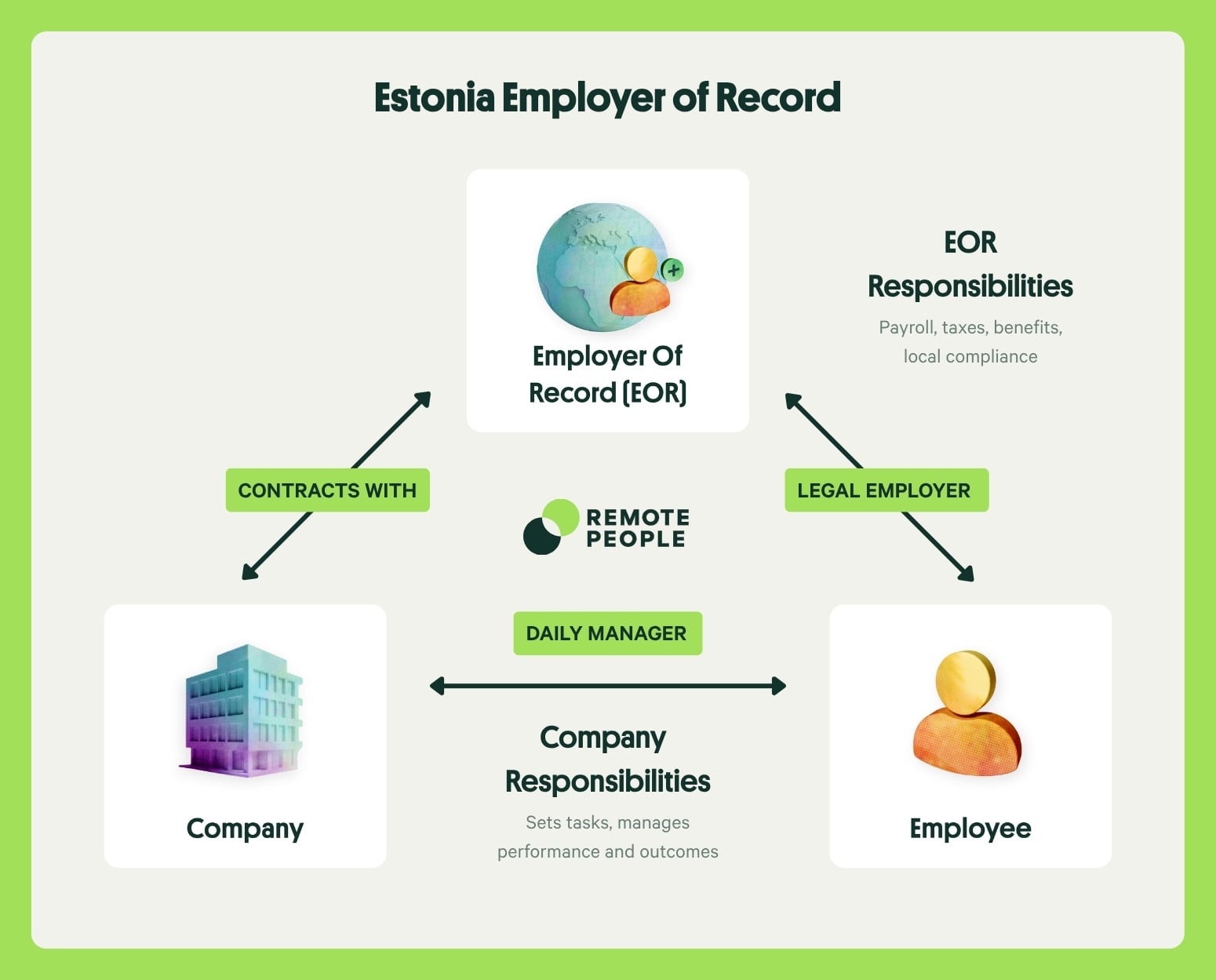
If you’d like to learn more about how Employer of Record (EOR) services work, read our What Is an Employer of Record (EOR)? guide for a complete overview of the model, its benefits, and when to use it.
If you’re comparing providers, our Best Employer of Record (EOR) Providers guide reviews the leading platforms to help you choose the right solution for your business.
Who Uses an EOR in Estonia?
An EOR fits companies that need a compliant Estonian hire without the overhead of incorporating a private limited company (osaühing). Common situations include testing the Estonian talent market before committing to an entity, bringing on one to fifteen employees where incorporation is not cost-effective, hiring remote workers already living in Tallinn or Tartu, converting a long-running contractor to a compliant employee, and sponsoring third-country nationals who need work permit backing under the immigration quota. The model is also popular with firms that want to onboard in days rather than the three to six months a full Estonian entity setup typically takes.
Typical Onboarding Timeline
Most employer of record providers can onboard a new hire in Estonia within one to two weeks. The steps below cover a standard onboarding for an EU national; work permit sponsorship for non-EU hires adds two to three months to the timeline.
- First, the client signs the EOR service agreement and shares the employee’s details, start date, and salary (1–2 days).
- Second, the EOR drafts an Estonian-language employment contract that meets Employment Contracts Act §5 requirements and sends it for signature (2–3 days).
- Third, the EOR registers the employment in the Tax and Customs Board Employment Register before the first working day and enrols the employee with the Health Insurance Fund and Unemployment Insurance Fund (1–3 days).
- Fourth, payroll is configured, the bank account is linked, and any statutory benefits are activated (2–3 days).
- Fifth, the employee starts on the agreed date and the first payroll runs at month-end.
Hire in Estonia
A flat 24% income tax, EU digital single market access, one of Europe’s simplest payroll regimes, and a talent pool of 1.3 million make Estonia a launchpad for tech-driven hiring.
We handle employment contracts, payroll, tax withholding, and full Estonia compliance under the Employment Contracts Act.
No local entity needed. Your team can start in days.
Employment Laws and Regulations in Estonia
Employment Contracts
Estonian employment is governed by the Employment Contracts Act (Töölepingu seadus), enacted in 2009 and overseen by the Ministry of Social Affairs and the Labour Inspectorate (Tööinspektsioon). Every contract must be in writing and registered in the Tax and Customs Board Employment Register no later than the first working day. Section 5 requires the contract to specify the job title and description, place of work, start date, duration, working hours, annual leave entitlement, notice period, and gross remuneration.
Indefinite contracts are the default. Fixed-term contracts are allowed only for a specific temporary reason such as project work, seasonal demand, or temporary replacement, and the maximum cumulative duration is five years. Contracts may be drafted in Estonian or bilingually, but the Estonian version controls in case of dispute and must be available to the Labour Inspectorate on request.
Working Hours and Overtime
The standard workweek in Estonia is 40 hours, normally arranged as eight hours per day across five days under Employment Contracts Act §43. Overtime is calculated as an average over a four-month reference period and must not push the average past 48 hours per week, with a written agreement allowing extension to a 52-hour weekly average for limited periods.
Overtime pay is at least 1.5 times the regular hourly rate, or compensated with paid time off in lieu by mutual agreement. Night work between 22:00 and 06:00 carries a 1.25x premium, and work on a public holiday is paid at 2.0x the regular hourly rate even if it falls within standard weekly hours. Working hours are reduced by three hours on the eve of New Year’s Day, Independence Day, Victory Day, and Christmas Eve.
Estonia overtime and premium pay rates · Per Employment Contracts Act | |||
Hour Type | Rate Multiplier | Weekly or Daily Cap | Notes |
|---|---|---|---|
Standard workweek | 1.0x (regular wage) | 40 hours per week | ECA §43. Normally eight-hour day across five days. |
Overtime (weekday) | 1.5x regular wage | Average 48 hours per week over a 4-month reference period | ECA §44(7), §46(1). May be compensated in paid time off in lieu by mutual agreement. |
Overtime by written agreement | 1.5x regular wage | Up to 52 hours per week average over a 4-month reference period | ECA §46(3). Employee may cancel the agreement with 2 weeks notice at any time. |
Night work (22:00–06:00) | 1.25x regular wage | Not applicable (premium on top of base hours) | ECA §45(1). Premium unless the wage already includes a night-work component. |
Public holiday work | 2.0x regular wage | Not applicable | ECA §45(2). Applies on top of the regular working day structure. |
Minimum Wage
The Estonian minimum wage rises to approximately $1,028 per month on April 1, 2026, an 8.6% increase from the $963 rate that applied from January through March. The hourly minimum is approximately $6.16. All USD figures in this article are approximate conversions at the April 2026 reference rate.
The new rate was set by the tripartite agreement between the Estonian Employers Confederation, the Estonian Trade Union Confederation, and the government, then formalised by government regulation. Estonia’s minimum wage is benchmarked against the average wage and is on a 2023 goodwill path toward 47.5% of average earnings in 2026 and 50% by 2027 (ERR News). The minimum wage applies to all sectors and all employees regardless of nationality.
Probation Period
Estonia allows a probationary period of up to four months under Employment Contracts Act §6, which cannot be extended. For fixed-term contracts shorter than eight months, the probation may not exceed half the contract duration.
Probation must be stated in the written contract; if it is not mentioned, the employment is permanent from day one with no trial period. During probation either side may terminate with 15 calendar days’ notice, on the grounds that the employee did not meet the level of work required.
Leave Entitlements
Estonia’s statutory leave framework is set out in Chapter 4 of the Employment Contracts Act and combines 28 calendar days of paid annual leave, 100 calendar days of fully paid maternity leave, 30 calendar days of paternity leave, and a 475-day shared parental benefit that can be split between both parents until the child turns three.
Annual Leave
Estonian employees are entitled to 28 calendar days of paid annual leave per calendar year under Employment Contracts Act §55. At least 14 of those days must be taken consecutively, and the right to use leave accrues from the start of employment, including during probation.
Unused leave carries over to the following calendar year but expires one year after the end of the calendar year for which it accrued. Minors under 18 receive 35 calendar days, and employees with reduced working capacity receive an additional 7 days.
Sick Leave
Sick leave in Estonia is funded jointly by the employer and the Health Insurance Fund. The first three calendar days of any sick spell are unpaid for the employee.
From day 4 to day 8 the employer pays 70% of the employee’s average wage over the previous six months. From day 9 onward the Health Insurance Fund takes over and pays 70% of average insured income, capped at approximately $138 per day from January 1, 2026.
A digital medical certificate issued through the e-health system is required for every absence and is filed automatically with the employer and the Health Insurance Fund. Sickness benefit can run for up to 182 calendar days per spell, and from April 1, 2026 employees may return to work on adapted duties from day 31 of a long-term absence rather than the previous day 61 threshold.
Maternity Leave
Estonian maternity leave is 100 calendar days, paid at 100% of the mother’s average insured earnings from the prior calendar year by the Social Insurance Board. Leave begins at least 30 and up to 70 calendar days before the expected birth date.
The 2026 monthly minimum benefit is approximately $891 and the maximum is approximately $4,118. Employers cannot dismiss a pregnant employee or a mother on maternity leave except in cases of company liquidation, and the employee has the right to return to the same position at the end of the leave.
Paternity Leave
Fathers are entitled to 30 calendar days of paid paternity leave that can be taken at any time until the child turns three. The benefit is paid by the Social Insurance Board at 100% of average insured earnings, subject to the same $891 minimum and $4,118 maximum monthly caps as maternity benefit. Paternity leave is in addition to the shared parental benefit and does not reduce that entitlement.
Estonia statutory leave entitlements · Per Employment Contracts Act 2009 | ||
Leave Type | Duration | Eligibility & Notes |
|---|---|---|
Annual leave | 28 calendar days | Section 55. Accrues from day one including probation. 14 days must be taken consecutively. Carryover up to 1 year. |
Sick leave | Up to 182 days | Days 1 to 3 unpaid; days 4 to 8 employer pays 70%; day 9+ Health Insurance Fund pays 70% (capped at $138/day). |
Maternity leave | 100 calendar days | 100% of average earnings paid by Social Insurance Board. Min $891, max $4,118/month in 2026. |
Paternity leave | 30 calendar days | Usable until child turns 3. Paid by Social Insurance Board at the same benefit rates as maternity leave. |
Shared parental leave | Up to 475 days | Split between parents until child turns 3. From 2026, no income reduction while working. |
Childcare leave | Up to 10 working days | Per parent per year for children under 14. Paid at minimum wage by Social Insurance Board. |
Adoption leave | 70 calendar days | Per adoptive parent. Same payment formula as maternity benefit. |
Study leave | Up to 30 days | Per year. 20 days paid at average wage for formal qualification programmes. |
Statutory Employee Benefits
Estonia’s mandatory benefits sit on top of the social tax system and are mostly funded through payroll contributions rather than direct employer payments. The Health Insurance Fund (Tervisekassa) provides universal public healthcare financed by the 13% health-insurance portion of the 33% employer social tax, giving employees access to family doctors, hospital care, prescription medicine, and dental coverage. The Estonian state pension system is built on three pillars: a pay-as-you-go state pension funded by the 20% pension portion of social tax, a mandatory funded pension (II pillar) where the employee contributes 2% of gross salary and the state adds 4% from social tax, and a voluntary III pillar with tax-deductible private contributions.
Beyond the contribution-funded benefits, employers must enrol every employee in the Unemployment Insurance Fund, fund the days 4–8 sick-pay window at 70%, and observe the GDPR data-protection rules overseen by the Data Protection Inspectorate. Estonia does not require employers to provide private medical insurance, meal vouchers, or transport allowances by statute, though all three are common voluntary benefits in competitive talent segments. Rate details for every contribution line are in the payroll tables in the next section and on our Estonia payroll and tax page.
Recent Regulatory Updates (2026)
The biggest payroll change of 2026 is the rise in the personal income tax rate from 22% to 24%, the second annual increase after the 2025 jump from 20%. From January 1, 2026 the universal basic exemption is also reset to a flat $9,120 per year for every taxpayer regardless of income, eliminating the income-based phase-out that produced Estonia’s so-called “tax hump” between roughly $15,650 and $27,390 of annual income (Tax and Customs Board).
Parliament also abolished the previously planned temporary defence tax in June 2025, so no defence surcharge applies in 2026. The Health Insurance Fund’s daily sickness-benefit cap rose to approximately $138 from January 1, 2026, and from April 1, 2026 employees on long-term sick leave may return to adapted duties from day 31 instead of day 61 (TEGOS legal). The shared parental benefit also became fully compatible with paid work from January 2026, removing the previous income reduction when a parent returns to part-time work.
Work Permits and Visas in Estonia
Work Permit Requirements
Who Needs a Work Permit
EU, EEA, and Swiss citizens enjoy full free movement and can work in Estonia without any permit; they only need to register their place of residence with the local municipality after three months of stay. All other nationals, including UK citizens post-Brexit, need a long-stay D-visa or a temporary residence permit for employment before starting work. Certain categories sit outside the standard immigration quota, including EU Blue Card holders, intra-corporate transferees, and applicants under the Startup Visa scheme.
Eligibility and Required Documents
For non-EU hires, the employer applies through the Police and Border Guard Board (Politsei- ja Piirivalveamet) with a signed employment contract, a detailed job description, the employee’s passport, an apostilled diploma or proof of professional qualification, a clean criminal record certificate from the country of origin, proof of accommodation in Estonia, and health insurance coverage. The employer must also confirm that the salary on offer meets the legal threshold of at least the Estonian average gross wage, and in most cases the role must first be cleared with the Unemployment Insurance Fund unless the post is exempt.
Processing Time and Validity
Standard residence-permit applications for employment take 30 to 60 days from filing. The EU Blue Card route, reserved for highly qualified professionals earning at least 1.5 times the Estonian average gross wage, follows the same processing window but is exempt from the immigration quota and the labour-market test.
Initial permits are valid for the duration of the employment contract up to a maximum of two years for the standard work permit and up to two years for the Blue Card, both renewable. Delays most often come from missing apostilles, incomplete qualification documents, or quota exhaustion later in the calendar year. Estonia capped non-EU employment-related residence permits at 1,292 slots in 2026 (Jobbatical).
Renewal Process
Renewal applications must be filed at least two months before the current permit expires. The employee can continue working while the application is pending, provided the employer has filed before the expiry date.
Documentation mirrors the initial application, with an updated contract, confirmation of ongoing employment, and refreshed insurance coverage. After five years of continuous lawful residence, the employee becomes eligible for long-term EU resident status in Estonia.
Common Visa Types for Foreign Workers
Estonia offers several pathways for foreign workers depending on skill level, salary, and assignment length.
Estonia work visa types for foreign workers · 2026 | ||||
Visa Type | Duration | Best For | Path to Long-Term Residency? | Processing Time |
|---|---|---|---|---|
Residence permit for employment | Up to 5 years (initial) | Full-time non-EU hires filling Estonian roles | Yes, long-term EU resident status after 5 years of continuous lawful stay | 30 to 60 days |
EU Blue Card | Up to 5 years (or contract term plus 3 months) | Highly qualified non-EU hires earning at least 1.5x the Estonian average gross wage | Yes, with EU-wide intra-block mobility rights | 30 to 60 days |
Intra-Corporate Transfer (ICT) permit | Up to 3 years (manager or specialist), up to 1 year (trainee) | Multinational internal transfers from a non-EU parent company | No, requires switching to another category | 30 to 60 days |
Startup Visa | 1 year (D-visa) or up to 5 years (residence permit) | Founders and early employees of Estonian-registered startups | Yes, through residence permit renewal | 30 days (typical) |
Digital Nomad Visa | Up to 1 year | Remote workers employed by a non-Estonian company with income at least approximately $4,891 per month | No, designed as a temporary stay visa | 15 to 30 days |
Short-term employment registration | Up to 12 months within any 15-month period | Seasonal work, brief assignments, and visiting specialists | No, separate from residence-permit track | 15 business days (typical) |
How an EOR Handles Work Permits
Because Estonian residence-permit sponsorship must be filed by a registered local employer, the EOR is well placed to handle temporary residence permits, EU Blue Card applications, and ICT files on behalf of client companies. The provider prepares the application package, files with the Police and Border Guard Board, liaises with the Unemployment Insurance Fund where labour-market clearance is needed, and tracks renewal deadlines. Detailed visa categories are covered on our Estonia work visa and permit page.
Work permit sponsorship typically extends the one to two week EOR onboarding window by two to three months, so clients should plan ahead when hiring third-country nationals. RemotePeople supports full sponsorship for the EU Blue Card and the standard temporary residence permit for employment in Estonia.
Payroll, Taxes, and Social Security in Estonia
Employer Contributions
Estonian employers contribute a flat 33.8% of gross salary in payroll taxes, made up of 33% social tax and 0.8% unemployment insurance. The social tax funds the state pension (20%) and the Health Insurance Fund (13%) and is paid only by the employer, with no equivalent employee deduction. Unlike most EU countries, Estonia has no separate work-accident, training, or family-fund line items.
Social tax has a minimum monthly base of approximately $963 in 2026 (the previous year’s minimum wage), so even part-time employees trigger a minimum employer obligation of approximately $318 per month. There is no upper cap on the social tax base, meaning the 33% applies to the full gross salary regardless of income level.
Estonia employer social security contributions · 2026 rates | ||
Contribution | Rate | Notes |
|---|---|---|
Social tax (state pension portion) | 20.00% | Funds the public pay-as-you-go state pension. Paid only by the employer. |
Social tax (health insurance portion) | 13.00% | Funds universal coverage through the Health Insurance Fund (Tervisekassa). |
Unemployment insurance (employer share) | 0.80% | Funds unemployment benefits and the redundancy top-up paid by Töötukassa. |
Total employer contributions | 33.80% | No upper cap. Minimum monthly social tax base is approximately $963 in 2026. |
Employee Contributions
Estonian employees contribute 1.6% of gross salary to unemployment insurance and 2% to the mandatory funded pension (II pillar) by default, deducted at source by the employer every month. Workers can voluntarily raise their funded-pension rate to 4% or 6%, and the state continues to add 4% from the social tax pool regardless of the chosen rate.
Estonia employee payroll deductions · 2026 monthly withholdings | ||
Deduction | Rate | Notes |
|---|---|---|
Unemployment insurance (employee share) | 1.60% | Funds the Unemployment Insurance Fund (Töötukassa). Withheld at source, no upper cap. |
Mandatory funded pension (II pillar) | 2.00% | Default rate. Employee may opt for 4% or 6%. State adds 4% from social tax. |
Personal income tax | 24.00% | Flat rate from January 1, 2026. Applied after $760/month basic exemption. |
Total employee deductions | 3.60% + 24% income tax | Income tax applies to gross less unemployment, funded pension, and basic exemption. |
Income Tax
Estonia applies a flat 24% personal income tax to all employment income from January 1, 2026, up from 22% in 2025 and 20% in 2024. The flat-rate system has no brackets and no surcharges, making payroll calculation simple even for high earners.
Every taxpayer benefits from a universal basic exemption of approximately $9,120 per year, or about $760 per month. From 2026 the exemption no longer phases out at higher incomes, so a worker earning $108,700 receives the same monthly allowance as one earning $21,740. Pensioners get a higher allowance of approximately $10,122 per year.
Estonia income tax brackets · 2026 | |
Annual Taxable Income (USD) | Tax Calculation |
|---|---|
Up to $9,120 (basic exemption) | 0% (universal allowance for all working-age taxpayers) |
Above $9,120 | 24% flat rate on income net of unemployment and funded pension contributions |
Up to $10,122 (pensioners) | 0% (enhanced annual allowance for state pension recipients) |
Payroll Cycle
Estonian payroll is paid monthly, typically on the last working day of the month or no later than the date stated in the employment contract, by bank transfer to a local bank account. Cash payments are legal but uncommon and require receipt documentation.
Employers must issue an itemised payslip each month showing gross salary, each tax and social-security line, and net pay. The TSD declaration covering income tax withheld, social tax, unemployment insurance, and funded pension contributions must be filed with the Tax and Customs Board by the 10th day of the following month, and the same date is the deadline for paying the taxes due. Employment changes are reported in real time through the Employment Register.
13th Month Salary and Bonus Pay
A 13th month salary is not mandatory in Estonia. Employers have no statutory obligation to pay an annual bonus, vacation bonus, or profit share.
Where 13th month pay is offered, it is a contractual benefit that sits alongside standard salary, is fully subject to the 24% income tax, the 33% social tax, and the 0.8% unemployment insurance contribution, and is usually paid with December payroll or alongside an annual performance review. Discretionary performance bonuses are common in Estonian tech and finance roles but remain entirely voluntary.
Cost of Hiring Through an EOR in Estonia
EOR Service Fees
Employer of record fees in Estonia typically range from $300 to $600 per employee per month, billed as a flat USD amount regardless of salary. The fee covers contract drafting and management, monthly payroll processing, tax withholding and remittance, social tax and unemployment insurance administration, statutory leave tracking, and ongoing Employment Contracts Act compliance. Full details on Estonian payroll mechanics are available on our Estonia payroll and tax page.
Total Employment Cost Breakdown
The real cost of hiring in Estonia is the gross salary plus the 33.8% employer payroll taxes plus the EOR service fee. On a $1,200 per month gross salary, the total monthly employer cost is approximately $2,005.60, or roughly 67.1% above the gross figure. USD amounts in this article are approximate conversions at the April 2026 reference rate.
Estonia employer cost example · $1,200/month gross · 2026 | ||
Employer Cost | Amount (USD) | % of Gross |
|---|---|---|
Gross salary | $1,200.00 | 100.0% |
Social tax (state pension portion) | $240.00 | 20.0% |
Social tax (health insurance portion) | $156.00 | 13.0% |
Unemployment insurance (employer share) | $9.60 | 0.8% |
EOR service fee | $400.00 | 33.3% |
Total monthly employer cost | $2,005.60 | 67.1% above gross |
Ready to hire in Estonia? Get started with RemotePeople and we will handle employment contracts, payroll, tax withholding, and full Estonian compliance. No local entity needed.
Benefits of Using an EOR in Estonia
Hiring through an employer of record gives a foreign company immediate access to Estonia’s digital-first labour market without the legal, tax, or HR overhead of establishing a local entity. Speed is the most visible advantage: a RemotePeople hire goes live in one to two weeks, against the three to six months a private limited company (osaühing) typically needs to incorporate, register with the Tax and Customs Board, and open a local bank account. The EOR also absorbs the steep learning curve on the Employment Contracts Act, the 33.8% payroll tax stack, and the real-time Employment Register filing rules that catch new entrants by surprise.
The model is also a built-in compliance shield. The EOR is the legal employer in the eyes of the Labour Inspectorate, which means it carries the risk of late payroll filings, contract errors, and termination disputes rather than the client. That risk transfer matters in a country where the Tax and Customs Board can audit payroll history at any time and where misclassifying a contractor as an employee triggers back social tax, interest, and penalties. Pricing is predictable too: a flat USD service fee replaces the lumpy upfront cost of incorporation, accountancy retainers, and legal advice, which makes hiring one to fifteen Estonian employees significantly cheaper on a total-cost basis.
Beyond cost and speed, the EOR delivers a better employee experience. New hires receive a properly drafted Estonian contract, get their health insurance card from Tervisekassa, see their II-pillar funded pension contributions deducted correctly, and receive payslips that match the data filed with the Tax and Customs Board. When the business needs to scale up or down, headcount can be adjusted in days without unwinding a legal entity, which makes Estonia a useful base for testing the Baltic and Nordic talent markets before committing to a permanent presence.
Termination and Offboarding in Estonia
Notice Periods
Notice periods in Estonia scale with length of service under Employment Contracts Act §97. Employers must give 15 calendar days for service of less than one year, 30 days for one to five years, 60 days for five to ten years, and 90 days for ten or more years.
During the four-month probation either side may terminate with 15 calendar days’ notice on the grounds that the employee did not meet the level of work required. Employees resigning of their own accord must give 30 calendar days’ notice regardless of tenure. Notice may be replaced with payment in lieu by mutual agreement.
Estonia statutory notice periods by position level · Per Employment Contracts Act | |||
Position Level | Notice Period | During Probation | Notes |
|---|---|---|---|
Employer termination, less than 1 year of service | 15 calendar days | 15 calendar days | ECA §97(2)(1) and §96. Applies during the initial year of employment. |
Employer termination, 1 to 5 years of service | 30 calendar days | 15 calendar days | ECA §97(2)(2). Tenure counted from the start of employment. |
Employer termination, 5 to 10 years of service | 60 calendar days | 15 calendar days | ECA §97(2)(3). Longer service qualifies for doubled notice. |
Employer termination, 10 or more years of service | 90 calendar days | 15 calendar days | ECA §97(2)(4). Capped at 90 days regardless of further tenure. |
Employee ordinary resignation (any tenure) | 30 calendar days | 15 calendar days | ECA §98(1), §96. Employee may resign without showing cause. |
Severance Pay
Estonian severance is narrowly defined under Employment Contracts Act §100. Mandatory severance is triggered only by employer-initiated redundancy or by an employee cancelling for a material breach by the employer. The Unemployment Insurance Fund (Töötukassa) adds a separate statutory benefit for employees with five or more years of service.
Estonia severance pay schedule by years of service · Per Employment Contracts Act | |||
Years of Service | Severance Amount | Base Salary | Notes |
|---|---|---|---|
Less than 1 year (redundancy) | 1 month average wages from employer | Average of the last 6 months gross pay | ECA §100(1). Paid only on lay-off or employer-initiated termination for economic reasons. |
1 to 5 years (redundancy) | 1 month average wages from employer | Average of the last 6 months gross pay | ECA §100(1). Same flat amount regardless of specific tenure within the band. |
5 years or more (redundancy) | 1 month from employer plus Unemployment Insurance benefit from Töötukassa | Employer portion: average of last 6 months gross. Töötukassa portion: statutory formula. | ECA §100(1-2). The Unemployment Insurance Fund adds a top-up for longer-tenured employees. |
Employee cancellation for employer breach (any tenure) | 3 months average wages from employer | Average of the last 6 months gross pay | ECA §100(4). Awarded when the employee terminates for a material breach by the employer. |
Calculation Method
Statutory severance in Estonia is paid only on redundancy or other employer-initiated termination for economic reasons, not on dismissal for cause or voluntary resignation. The employer pays one month of average wages, calculated from the employee’s last six months of earnings, on the final working day under Employment Contracts Act §100.
The base for the calculation includes regular salary and contractual bonuses but excludes one-off payments such as project completion awards or expense reimbursements. Untaken annual leave is paid out as a separate lump sum on top of the redundancy payment.
Caps and Exceptions
The Unemployment Insurance Fund (Töötukassa) tops up the employer-paid month with one additional month for employees with five to ten years of service and two additional months for those with ten or more years. There is no statutory cap on the resulting payment.
Severance is not payable on termination during probation, on dismissal for serious misconduct under §88, or on the natural expiry of a fixed-term contract. Pregnant employees and those on maternity, paternity, or shared parental leave can only be made redundant in the event of company liquidation.
Grounds for Termination
Estonian law distinguishes between ordinary termination and termination with cause. Ordinary termination by the employer is allowed only on economic grounds such as redundancy, restructuring, or business closure, and must be supported by documentation that the role is no longer needed. Termination with cause covers serious breaches of duty such as theft, gross negligence, repeated unjustified absence, or breach of confidentiality, and requires a prior warning except in the most severe cases.
Protected categories include pregnant employees, those on parental leave, employee representatives, and workers with reduced working capacity, who can only be dismissed under narrow exceptions. The Labour Dispute Committee (Töövaidluskomisjon) hears wrongful termination claims and can order reinstatement or compensation of up to three months’ average wage.
EOR vs. Other Hiring Models in Estonia
EOR vs. Setting Up a Local Entity
Choosing between an Employer of Record and setting up your own legal entity in Estonia comes down to timeline, upfront cost, ongoing administrative burden, and how quickly you can scale up or wind down. The table below lays out both paths side by side across setup time, cost, compliance risk, and flexibility so you can match the right model to the size and duration of your Estonia hiring plan.
Estonia EOR vs local entity comparison · Setup time, cost, risk and best-fit | ||
Comparison | Employer of Record | Own Entity (Estonian OÜ) |
|---|---|---|
Setup time | 1–2 weeks | 3–6 months |
Upfront cost | $0 | $3,000–$8,000 |
Ongoing cost | $300–$600/employee/month | $8,000–$15,000/year maintenance |
Local partner required | No (EOR is the local entity) | No, but local accountant essential |
Social tax registration | Handled by EOR | You manage it |
Payroll & tax filing | Handled by EOR | You manage it (or outsource) |
Best for team size | 1–15 employees | 15+ employees |
Scale down / exit | Easy (no entity to unwind) | Costly (legal dissolution required) |
Government contracts | Not eligible | Eligible (requires local entity) |
Setting up an Estonian private limited company is unusually fast for the European Union, since the e-Residency programme can issue digital company registration in under a week. The real time-cost lies in the months of follow-up to register with the Tax and Customs Board, open a local bank account, set up payroll software, and integrate with the Employment Register. By contrast a RemotePeople hire goes live in one to two weeks because the EOR is already plugged into all of those systems.
The cost gap is most pronounced for small teams. A foreign company hiring one to five Estonian employees through an EOR pays roughly $300 to $600 per employee per month plus the 33.8% payroll tax, with no upfront cost. The same company running its own osaühing typically spends $3,000 to $8,000 on incorporation, legal advice, and accountancy setup, then another $8,000 to $15,000 a year on bookkeeping, payroll software, and statutory filings before any salaries are paid. The break-even for a local entity tends to sit around fifteen employees.
Risk also shifts. Under the EOR model the provider is the legal employer, so the Labour Inspectorate, the Tax and Customs Board, and the Labour Dispute Committee deal directly with RemotePeople rather than the client. That matters in a fully digital tax environment where payroll filings are due by the 10th of each month and any late filing triggers automatic interest charges.
EOR vs. Hiring Independent Contractors
Classifying a Estonia-based worker as an independent contractor rather than an employee can expose you to back-taxes, unpaid social contributions, and reclassification penalties if the working relationship looks like employment in practice. The table below contrasts EOR employment with contractor engagement across legal relationship, tax and benefits treatment, IP ownership, and misclassification risk so you can pick the right model role by role.
Estonia EOR vs independent contractors · Compliance, cost, and risk | ||
Comparison | EOR (Full-Time Employee) | Independent Contractor |
|---|---|---|
Legal relationship | Employee of the EOR | Self-employed, no employment relationship |
Compliance risk | Low (EOR ensures Estonian labour law compliance) | Higher (misclassification risk if relationship resembles employment) |
Payroll & tax | EOR handles withholding, social tax, filings | Contractor invoices you; they handle their own taxes |
Benefits & leave | Statutory leave, sick pay, social tax coverage | No entitlement to employee benefits |
IP protection | Stronger (employment contract assigns IP by default) | Weaker (requires explicit IP assignment clause) |
Termination | Subject to ECA notice periods and severance | Contract can be ended per agreement terms |
Best for | Long-term, core team roles | Short-term projects, specialised tasks |
Cost structure | Salary + 33.8% payroll taxes + EOR fee | Contractor fee (typically higher gross, lower total cost) |
Hiring through an Estonian EOR is the right call when the role is long-term, full-time, and central to the business. Independent contracting is only appropriate in some cases such as short-term project work, specialised consulting, or roles with genuine autonomy over how the work is delivered. Estonia’s Tax and Customs Board uses substance-over-form rules to look past contract labels and check whether the worker is in fact integrated into the client’s organisation.
If a contractor is reclassified as an employee, the consequences are factual rather than dramatic: the client owes back social tax at 33%, back unemployment insurance, late-payment interest, and potentially the employee’s untaken annual leave. The EOR route eliminates that risk entirely because the worker is correctly classified from day one and RemotePeople is the named legal employer in the Tax and Customs Board’s Employment Register.
Cost-wise, contractors look cheaper on paper because the company avoids the 33.8% payroll tax, but that gap usually closes once contractors price in their own social tax obligation through the FIE (sole trader) regime. For long-term roles the EOR model gives both sides predictability, with the client knowing the total monthly cost and the worker receiving statutory leave, sick pay, and II-pillar pension contributions.
EOR vs. PEO (Professional Employer Organization)
EORs and PEOs both simplify international hiring, but only an EOR becomes the legal employer of record in Estonia — a critical distinction when you don’t have a local entity of your own. The table below maps the practical differences across legal employer status, entity requirement, liability allocation, and scope of coverage.
Estonia EOR vs PEO comparison · Legal employer, liability, and setup | ||
Comparison | Employer of Record (EOR) | PEO |
|---|---|---|
Legal employer | EOR is the legal employer | You remain the legal employer (co-employment) |
Local entity required | No (the EOR is the local entity) | Yes (you must have your own Estonian OÜ) |
Best for | Companies without a local entity | Companies that already have an Estonian entity |
Compliance liability | EOR assumes compliance responsibility | Shared liability between you and the PEO |
Setup time | 1–2 weeks | Depends on your entity setup (weeks to months) |
Control over HR policies | EOR manages within Estonian labour law framework | More direct control, PEO advises |
Typical use case | Market entry, small remote teams, testing new markets | Established local operations needing HR outsourcing |
The simplest way to think about the EOR–PEO split is entity ownership. An EOR replaces the need for a local entity entirely because the EOR itself is registered in Estonia and named on the contract, payroll, and Employment Register filings. A PEO model assumes the client already runs an Estonian OÜ and just outsources the HR, payroll, and benefits administration on a co-employment basis.
Estonia does not regulate PEO services as a separate category, so any provider that offers “PEO” in Estonia is in practice supplying outsourced HR and payroll to companies that already have a local entity. That is a useful service for established operations with twenty or more employees, but it does not solve the market-entry problem for a foreign company that has no Estonian presence.
For most companies expanding into Estonia for the first time, the EOR is the right choice. It bundles entity, contract, payroll, tax filing, and compliance into a single monthly fee and removes the need to evaluate local accountants, payroll software, and employment lawyers separately.
Public Holidays in Estonia
Estonia observes a defined set of official public holidays on which most private-sector employers must give staff a paid day off (Republic of Estonia: National and Public Holidays). The table below lists the statutory holidays employers need to build into payroll calendars and leave planning for the year, along with the date rule for each.
Estonia public holidays · 2026 calendar year | ||
Date | Holiday | Type |
|---|---|---|
January 1 (Thu) | New Year’s Day | Public holiday |
February 24 (Tue) | Independence Day | National holiday |
April 3 (Fri) | Good Friday | Public holiday |
April 5 (Sun) | Easter Sunday | Public holiday |
May 1 (Fri) | Spring Day (Labour Day) | Public holiday |
May 24 (Sun) | Whit Sunday (Pentecost) | Public holiday |
June 23 (Tue) | Victory Day | National holiday |
June 24 (Wed) | Midsummer Day (Jaanipäev) | Public holiday |
August 20 (Thu) | Restoration of Independence Day | National holiday |
December 24 (Thu) | Christmas Eve | Public holiday |
December 25 (Fri) | Christmas Day | Public holiday |
December 26 (Sat) | Boxing Day | Public holiday |
Estonia observes 12 public holidays in 2026, all paid days off for full-time employees. Working hours are reduced by three hours on the eve of New Year’s Day, Independence Day, Victory Day, and Christmas Eve, and any work performed on a public holiday is paid at 2.0 times the regular hourly rate. Holidays falling on a weekend are not moved to the next working day, which means Boxing Day in 2026 lands on a Saturday and Whit Sunday on a Sunday.
How to Get Started with an EOR in Estonia
- First, contact RemotePeople with the candidate’s details, the agreed gross salary, and the target start date.
- Second, sign the EOR service agreement and review the locally compliant Estonian-language employment contract drafted under the Employment Contracts Act.
- Third, the candidate signs the contract digitally and RemotePeople registers the employment in the Tax and Customs Board Employment Register before the first working day.
- Fourth, payroll, social tax, unemployment insurance, and II-pillar pension contributions are configured, and the employee is enrolled with the Health Insurance Fund.
- Fifth, the employee starts work and the first monthly payroll is filed by the 10th of the following month, with all statutory leave tracked from day one.
Ready to build your Estonia team? Get in touch with RemotePeople for a flat-fee EOR quote covering contracts, payroll, tax filings, and full Employment Contracts Act compliance.
Where companies hiring in Estonia expand next
Companies operating in Estonia often extend across the Baltics and broader Eastern Europe, where tech talent and cost efficiency align. After building a team in Estonia, employers often look to an EOR partner in Poland for similar cost profile and comparable hiring speed, then Finland for shared Nordic labor frameworks. A team in Ukraine follows with shared Baltic tech talent pools, and operations in Lithuania typically closes the regional footprint via Baltic cost advantages and engineering depth.
Frequently Asked Questions
Beyond the 33.8% employer payroll taxes (33% social tax plus 0.8% unemployment insurance), you will pay an EOR service fee of $300 to $600 per employee per month. The exact amount depends on your provider and the complexity of the role, but the fee is always charged as a flat USD amount and includes contract drafting, payroll processing, tax filings, and ongoing compliance support.
Most EOR providers can onboard a new Estonian hire within one to two weeks for an EU national, compared to the three to six months a private limited company (osaühing) needs to incorporate, register with the Tax and Customs Board, and set up payroll. Non-EU hires that need a temporary residence permit for employment add another two to three months because of the residence permit application and the 1,292-slot annual quota.
The employment contract assigns IP to the client company (you), not the EOR. RemotePeople makes sure the Estonian contract has proper IP assignment language so all intellectual property created in the course of employment flows directly to your business under both the Employment Contracts Act and the Copyright Act.
You can, but Estonia's Tax and Customs Board applies substance-over-form rules to check whether a contractor is in fact an employee, and reclassification triggers back social tax at 33% plus interest. For long-term roles the safer route is RemotePeople's contractor management solution, which handles compliant contractor payments in Estonia and reduces classification risk by getting the paperwork right from day one.
Estonia recognises both indefinite and fixed-term contracts under the Employment Contracts Act, with indefinite the default. RemotePeople uses a fully compliant Estonian-language contract that meets §5 of the Act, including job description, place of work, working hours, gross salary, annual leave entitlement, and notice period. Fixed-term contracts are limited to specific temporary reasons and may not exceed five years cumulatively.
Sick leave is split between the employer and the Health Insurance Fund. The first three calendar days of any sick spell are unpaid for the employee, days 4 to 8 are paid by the employer at 70% of average wage, and from day 9 onwards the Health Insurance Fund pays 70% of average insured income up to a daily cap of approximately $138 in 2026.
Every RemotePeople employee in Estonia gets full state health insurance through Tervisekassa, the state pension contribution funded by the 20% pension portion of social tax, mandatory funded pension (II pillar) contributions through Tax and Customs Board, unemployment insurance coverage through Töötukassa, 28 calendar days of paid annual leave, and statutory sick, maternity, paternity, and shared parental leave. The EOR can also administer voluntary benefits like private health insurance or meal allowances if the client funds them.
Termination must follow the Employment Contracts Act notice rules, which scale from 15 calendar days for service under one year up to 90 days for service of ten years or more. On redundancy the employer pays one month of average wage, and the Unemployment Insurance Fund tops this up by one or two extra months for long-tenured employees. RemotePeople manages the full offboarding process, including notice, severance calculation, untaken leave payout, and the Employment Register exit filing.
Employer of Record in
Employer of Record in
Employer of Record in
Employer of Record in
Employer of Record in
Employer of Record in
Employer of Record in
Employer of Record in